Scary Icons Create Tee Times

Whenever rain is in the forecast, even if it’s only a 20 percent chance of showers, play at my club goes way down. Seeing a thunderstorm icon in their web browser apparently causes many members to make non-golf plans for the day. On Sunday, twenty guys showed up for our regular game—a good turnout—but we had the course to ourselves until noon, I think because the Weather Channel icon that morning had lightning bolts in it. There was enough drizzle at one point to make me put on rain gloves, but there was never any lightning or even real rain, and the sun was shining by the time we finished. Our club’s website has a weather app. Maybe someone could modify it to show lightning bolts all the time.

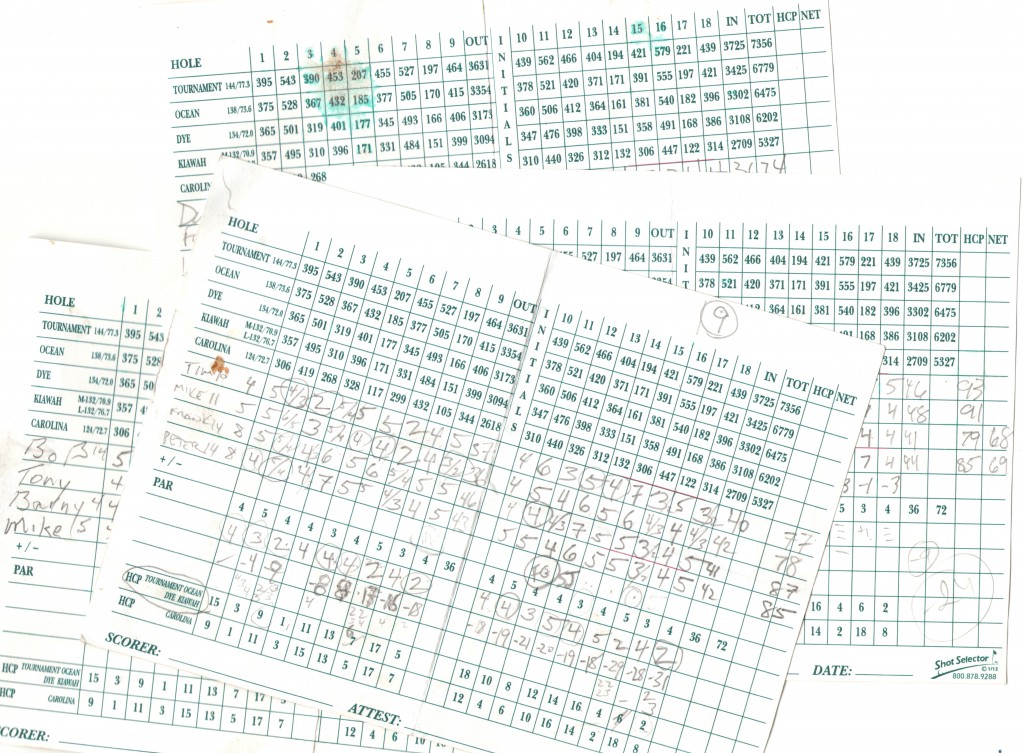
In honor of the Ryder Cup, we used scorecards from Medinah, which Hacker (real name) had downloaded from the club’s website. (We did the same thing during the PGA Championship with scorecards from the Ocean Course at Kiawah.) The only real effect was to shuffle the holes where the handicap strokes fell, but using the scorecard of a major venue is a respectful way to acknowledge the efforts of the big boys, and, besides, variety is interesting.

We also randomly divided into Ryder Cup teams—ten guys representing the United States and ten representing Europe—and played five four-ball matches, for one point each. I was on the U.S. team, which won, 4½ points to ½. We all assumed that the real U.S. team would win, too, by annihilating the Europeans in the singles matches, in the afternoon. Imagine our surprise. The Sunday Morning Group’s record in using golf to predict important events is now 2-1-0; matches of ours correctly called the outcome of the 2008 presidential election and the 2012 Super Bowl.

We’ll play our Presidential Special game again on Election Day. It was created by Tim, who is the inventor of several core concepts, including negative skins, “shooting your pants,” and the mathematical formula by which we predict the winning team score in our regular Sunday games (13 minus the lowest handicap in the field, times -1). Half the field will represent Obama and half Romney, and each hole will have an Electoral College value equal to the sum of its number and its handicap stroke index.(Our 16th hole has a stroke index of 17, so it’s worth 33 electoral votes—16 plus 17.) An entire golf course adds up to 342 electoral votes—172 needed to win.

Future trivia question: Who made the winning putt in the 2012 Ryder Cup Matches? Answer: It wasn’t Martin Kaymer, whose 1-up victory over Steve Stricker guaranteed only a 14-14 tie (and thus a European “retention” of the trophy). The winning putt was the short par putt that Tiger Woods conceded to Francesco Molinari on the eighteenth hole, because their halved match gave Europe a 14½ -13½ victory. If Tiger had made his putt, 2012 would have been the third tie in Ryder Cup history.

Alien or Shooting Star? Mystery Golf Photo

I took the photo above the other night and shared it with Graham Stevens, the reader who was kind enough to write about his recent experience at a carts-only course in North Carolina. He used his iPhone to show the picture to his daughter, who is seven, and asked her to guess what it was. Her responses, in order:

  1.  A skinny alien.
  2.  Saturn and a shooting star.
  3. A spooky person staring through the crack of a door with a glow stick on their ankle.

Stevens, in an email, told me: “She then used her fingers to zoom in on the bottom of the picture and said, ‘It looks like a green golf hole.’  I said, ‘Correct!  It is a golf hole.’ She said, ‘Tell your friend he needs a new camera.’ I said, ‘He was playing at night.’ She said, ‘Is he crazy?'”

My crazy friends and I did play golf at night last week, and I’ll be writing about our experience in a future issue of Golf Digest. If you’ve never played golf in the dark, or if you haven’t done it recently, you should watch for the story. As with every other aspect of the game, the technology has improved.

My glowing red ball.


Golf Innovation: Slow-Play Workaround

There’s a birdhouse near the ninth tee at my home course, and if you’re stuck behind slowpokes you can use it to pass the time. A hundred points for chipping a ball through the opening, five for hitting any part of the birdhouse, one for hitting the tree—or whatever. That’s Addison in the photos above and below, and, as you can see, he has the kind of short game you need to excel in this game. Tony had the idea of putting a dollar in the birdhouse each time you play, winner take all.

I learned another slow-course game from Reese, who is Addison’s father. It’s called Poison. Each person in your group, in turn, uses his driver to chip a ball from one tee marker to the other. (If you hit it, you get to go again.) Once you’ve hit it, you chip back to the other tee marker, and once you’ve hit that one your ball becomes poison and you can eliminate other players by hitting their ball with yours. There’s more strategy than you would think, especially once multiple balls have become poison. Suggestion: assign someone to keep an eye on the group ahead, so that your slow-play solution doesn’t become part of the problem.

How to Hold Your Own Golf Major

Hacker (real name), Ocean Course Scorecard, Les, August 12, 2012.

When my friends and I play on Sunday mornings, we use our Sunday Morning Group scorecard, which Jim created for us with a desktop publishing program that he uses in his job. Among other features, it lists our local rules, such as “You get an extra stroke if you wear shorts after November 1” and “No one gets a stroke on a par 3.” Some of the older guys complain about the par-3 rule, but what can we do? It’s printed right on the card.

This year, Hacker (real name) had the idea of celebrating golf’s four majors, on each major’s final day, by using not our own Sunday scorecard but the scorecard from whatever course the major was being played on. So during our regular game this weekend we used the scorecard of the Ocean Course at the Kiawah Island Golf Resort, where the PGA Championship was held. (You can download the Ocean Course card yourself, from either of the links in this paragraph.)

The main effect of using another course’s scorecard on your own course is that most of the handicap strokes fall in unfamiliar places. This impacts one of our local rules, because (for example) although our sixteenth hole is ordinarily a par 3 (meaning that no one gets a stroke on it), on the Ocean Course it’s a par 5 with a stroke index of 4 (meaning that anyone receiving 4 or more strokes that day gets a pop).

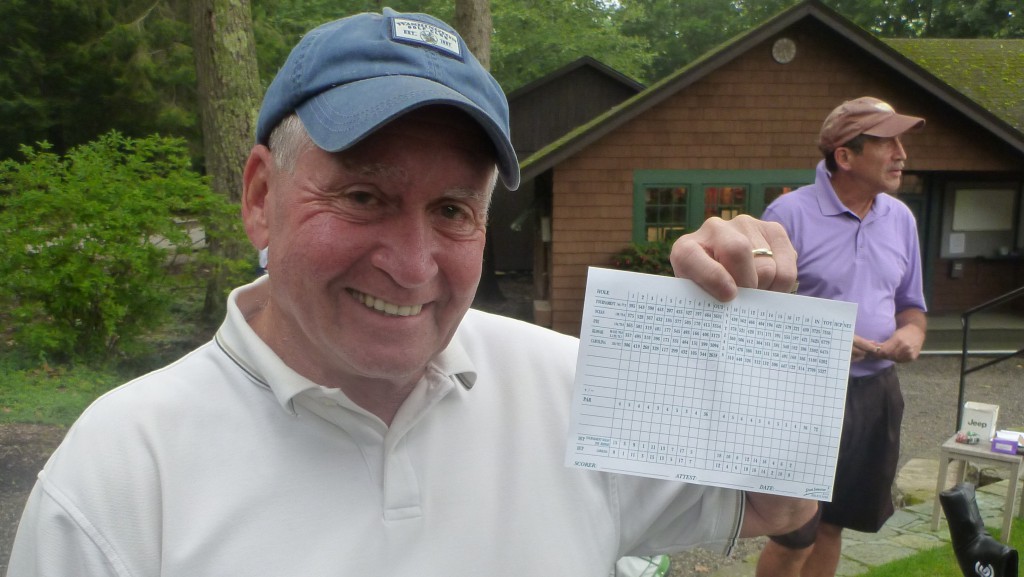
We compounded the impact by using a best-ball feature that I introduced a few years ago, called All Birdies. In All Birdies, all under-par scores on any hole count. On the sixteenth hole, for example, I had a 2 and my three teammates had net 2s. Since Kiawah’s sixteenth is a par 5, our four 2s counted as albatrosses and our team went -12 on that hole alone. That wasn’t enough to win, unfortunately, but we felt pretty tough for a while. (The winning team was Tim’s, at -31. Theirs is the top card on the pile in the photo below.)

Major results, Sunday Morning Group, August 12, 2012.

News From the 2012 Member-Guest

Amazing member-guest discovery: golf-cart Surround Sound.

My brother, John, and I played in my club’s member-guest tournament this past weekend. One of our five matches was against Fritz and Klinger, whose golf cart you see in the photograph above. That’s Klinger’s iPhone, in the one cup holder that isn’t holding a beer. It’s playing “Send Her My Love,” by Journey, and If you could hear the music you’d be blown away, because Fritz and Klinger have discovered that a golf cart cup holder acts like both an amplifier and a Surround Sound speaker system. Try it with your own iPhone or iPod if you don’t believe me.

Three golfers, nine drivers.

The golf bags in the photo above belong to (from left to right) me, Tim-o, and Tony.  You will notice that the three of us, in addition to apparently being infatuated with obsolete Nike products, carry three drivers each. The lofts are 10.5, 13, and 16 degrees. I’ll have more to say about this club selection in a week or two. (Full disclosure: after the 9-hole stroke-play opener, on Friday—which John and I won, at 7 under—I removed my 13-degree driver, which I’d bought on eBay the week before, to make room for a second 6-hybrid.

Rob and miscellaneous member-guest stuff.

Usually, the so-called gifts you get at a member-guest are pretty crummy, but this year the ones at my club were great: a golf hat, a golf towel with a zipper pocket and a semi-mysterious Velcro strip, and a belt with a buckle that’s also a beer opener. In the photo above, Rob is wearing his belt on the outside, for easier access (although he’s got it upside down). He’s also wearing his give-’em-a-brake safety-yellow golf shirt and carrying a beer, two putters, and a portable cooler.

Jaws, lighting the putting-contest qualifier.

On Friday night, after the stag dinner, so many guys wanted to keep trying to qualify for the putting contest that Jaws drove home and brought back his big workshop lights. That’s him in the photo above, setting up one of the units. My brother and I qualified but were eliminated the next evening, in a four-hole playoff for the last three spots in the final.

Putting-contest qualifier, under the lights.

On Saturday night, after Fritz and Klinger had won the putting contest and a dozen of us had played a five-hole one-club tournament in a race with the setting sun, we held an unofficial supplemental putting contest, using glowing balls and glowing cup inserts—items about which I’ll have more to say in a week or two. The winners were Tim and Chick. Here’s what the putting green looked like in the dark:

Glowing ball, glowing hole.

Also here:

Doc, Jr.

There were thunderstorms in the forecast all weekend, but the rain and lightning held off until halfway through the final shoot-out, on Sunday afternoon. Here’s what the rain looked like when it was coming down:

The gutter in that photo has been clogged for ten or fifteen years, but when it’s raining no one wants to go up on a ladder to unclog it and when it isn’t raining it doesn’t overflow. During most of the rest of the weekend, though, the weather looked like this:

Chick, Rob, putting-contest qualifier.

The overall winners of the member-guest were Ray and Mike. My brother and I beat them, one-up, in our final match of the weekend, but that wasn’t enough to knock them out of first place in our flight. Here’s Ray resting during the lightning delay. (Mike was on the phone apologizing to his wife for already being several hours later than he had said he was going to be.)

Ray, resting in the clubhouse during the lightning delay.

And here’s what the shoot-out field looked like on the first tee. We determined honors by using the Sunday Morning Group’s limited-edition collection of numbered poker chips. Art and Scribby (on the right, with the white hair and the no hair) were the first to be eliminated, when they bogeyed the first hole.

New Golf Game: Shoot Your Pants

Chick, pants, winnings, August 2010.

I wrote about golf pants the other day. And here I am, writing about them again.

My friend Bernie shoots his age fairly often—an impressive achievement for a guy in his eighties. But Chick, who is half his age, came fairly close to doing something even more impressive. He shot 38 on the front nine and, therefore, as Tim pointed out, had a rare opportunity to shoot his pants—waistband on the front, inseam on the back. Chick is tall, so this was remotely possible, even though he usually scores in the mid or upper eighties. Golf being what it is, he ended up playing the back nine in closer to his sports coat—the result, primarily, of shooting his hat size on a couple of par 4s.

If you count handicap strokes, playing a round in even pants is a reasonable goal for many golfers, because waist size tends to vary directly with U.S.G.A. index. The two members of my club who are the most likely to turn in low gross scores, Addison and Kevin, are in their early twenties and wear belts that look like wristbands. Playing 18 holes in net Dockers is as challenging for them as it is for my contemporary Billy, whose gut gives him what appears, on paper, to be an overwhelming advantage. As for myself, I’ve often been under pants, gross, on our front nine, but have never shot my inseam on the back, a consequence of being tragically long-waisted for a golfer of my height and handicap.

Billy, big pants, follow-through, May, 2012.

My father, who was a stockbroker, used to reckon par the way they do in the bond market, at 100. To him and his friends, “five under” meant 95; “three over” was 103. Even with that generous scoring system, though, he had trouble getting into red figures. I took up the game late, in my mid-thirties, and when my brother, who had been the captain of his high school and college golf teams, saw me hit a weak slice with a five-iron, shortly after I’d started playing, he said, “You’re already the second best golfer in the family.” My brother, incidentally, has shot his pants several times, despite being cursed with a 34-inch waist.

A Better Way to Play Skins

Gillen (right) and a close personal friend.

A big problem with almost any skins game is that it gives an unfair advantage to players with high handicaps. My friend Tim—who is the mathematician-in-residence of my regular Sunday Morning Group—invented an improved version seven or eight years ago, and my regular golf buddies and I have played it ever since. Tim’s version eliminates all the weaknesses of the regular game. It’s so good, in fact, that we call it Perfect Skins. Here’s how it works:

Each player, on the first tee, throws in some mutually agreed-upon sum—say, ten bucks. That money is divided into two skins pools, one for the front nine and one for the back, and every skin won is worth a proportional share of its pool. (If three skins are won on the front nine, for example, each is worth a third of the front-nine skin pool; if a single player finishes with two of those three skins, he wins two-thirds of the pool.) The object is the same as in any skins game: to win holes outright, with scores unequaled by other players. But there’s a twist: in Perfect Skins, a player who loses a hole outright, with a score that’s worse than everyone else’s, gives up a skin—or acquires a negative one, if he has none to give up. Let’s say the sixth hole is birdied by one player, parred by two players, and bogeyed by the fourth; in that case, the player with the birdie wins a skin while the player with the bogey loses one. We call negative skins “Gillens,” after the last name of the particular player whose long-running success at regular skins Tim was trying to thwart with his invention. Gillen hates Perfect Skins.

Any player with a negative skin balance may buy himself back to zero before teeing off on any hole during the nine-hole match, at the price of one dollar per negative skin, with the money going into the pool for that nine—but he may do so only once during the nine. That leads to the really interesting part of the game: Winning a skin when your balance is negative feels like a waste, because it merely moves you back toward zero rather than earning you a share of the pool. But buying back too early in a match raises the risk that one or two bad holes near the end of the nine could give you a deficit too large to eliminate before the end of the nine.

If you haven’t used your buyback yet, acquiring a negative skin is often less costly than permitting another player to win a positive one and thereby gain a share of the pool. That means that attempting a very risky shot may be to your advantage, if there’s a chance that doing so will prevent another player from winning the hole, or if doing so will ensure an outright loss by a player who now has a positive balance—unless you yourself hold a couple of skins, in which case your best strategy may be to play defensively. A player who ends the nine with a negative skin balance—say, because he lost the final two holes outright—owes the pot two dollars for each negative skin still in his possession at the end of the nine.

Perfect Skins eliminates all the shortcomings of regular skins: it greatly reduces the influence of luck, because erratic players are punished for their disasters in addition to being rewarded for their fluky good fortune; it eliminates the high-handicap advantage, because the players with the most strokes are also the ones who are the most likely to suffer the kinds of disasters that lead to negative skins; it keeps everyone in the game, because not losing a hole can be just as important as winning it, and players who suffer a string of bad holes can redeem themselves by buying back into the game; it adds a new level of pressure, especially on the final tee, because skins aren’t safe until the last putt has fallen.

I’ve played Perfect Skins in threesomes, foursomes, and fivesomes, and it works beautifully, though somewhat differently, in all those combinations. With three players, for example, the skin balance changes on every hole unless all three players tie—meaning that the standings can shift dramatically over just a few holes. With five players, in contrast, outright victories are harder to come by, so that a single skin successfully held to the end of the match could end up being worth the entire pool. In all combinations, the most important issue for any player with a negative balance is deciding when to buy back to zero. You have to think realistically about how well or poorly you’re likely to play the holes that lie ahead, and who still has strokes, where you yourself have strokes, and where you can afford to be aggressive.

More About Foursomes: Muirfield, Troon, Prestwick, and Kümmel

The golfer's liqueur.

In 2009, I played a round at Muirfield, in eastern Scotland, where the Open Championship will be held in 2013. Alastair Brown, the secretary, described it to me (over lunch) as “a lunching club with a golf course attached to it.” A member, he said, once described an ideal day at Muirfield as “two-and-a-half, two-and-a-half, two-and-a-half”: a two-and-a-half-hour 18-hole foursomes match in the morning, followed by a two-and-a-half-hour lunch, followed by a two-and-a-half-hour 18-hole foursomes match in the afternoon.

In the United States, foursomes is usually known as Scotch foursomes or alternate shot, and it’s often a prelude to divorce; at Muirfield, it’s the signature game. Hitting just half the shots gets the non-lunch portions of the day over faster, and ensures that someone always has a hand free to hold the kümmel, a clear, anise-and-fennel-flavored beverage, which is sometimes called the golfer’s liqueur. “The way the club’s members play golf is the antithesis of championship golf,” Brown told me—and he meant that as praise. Muirfield has its own foursomes handicapping system, named after C. J. Y. Dallmeyer, a club captain in the 1950s, who invented it: if you go three-up in a match, you give strokes to your opponents until you’re back to one-up. Dallmeyer also initiated a heavily lunch-oriented New Year’s Day tournament, called the Captain’s Frolic.

Foursomes is also a historically significant game at Royal Troon and Prestwick, two other courses on the Open Rota, on Scotland’s west coast. Every year, members of the two clubs play a cross-country foursomes match over both courses, which abut each other. Half the field starts on the first tee at Prestwick, and half starts on the first tee at Troon. Everyone plays to the eighteenth green on the other course, breaks for lunch, and then plays all the way back. The two members I played with at Troon told me that, usually, a team scores better if it starts at Prestwick, because a typical Prestwick lunch includes so much alcohol that golfers who make the turn there sometimes have trouble finding their way home.

Before lunch, Royal Troon, May, 2009. I'm standing on the tee of the famous Postage Stamp. That's the green by my right arm.

Muirfield has an undeserved reputation for hostility to outsiders. It’s true that visitors are limited to specific tee times on Tuesdays and Thursdays, but the club actually welcomes thousands of unaccompanied non-members every year, and you can make reservations online. You have to wear a jacket and tie in the dining room, but the atmosphere is seductively informal, and even visitors are encouraged to linger. No table has fewer than six chairs, an arrangement that forces groups of golfers to mix, and the food is served cafeteria-style. Diners who don’t live in fear of their cardiologists sometimes bypass lunch itself and move straight from the bar to the dessert table, where the specialties include rhubarb crumble, sticky toffee pudding, and ice cream from S. Luca of Musselburgh, a locally famous dairy.

Muirfield’s locker room has modern, car-wash-caliber showers, like the ones at Merion and Pine Valley, but the other amenities are distinctly old-school, among them a pair of wooden dressing tables, each furnished with a shaving mirror, a nail file on a chain, and a single hairbrush and comb (and no beaker of blue Barbicide). And the members’ locker room at Prestwick is even cooler. Ninety of the lockers there date back to 1877. They look like Queequeg’s coffin.

Choosing Teams in Scotland

Cruden Bay Golf Club, Scotland, 2008. That's the green of the fifth hole, a par 5, in the upper right-hand corner.

At five o’clock yesterday afternoon, I stopped by Cruden Bay Golf Club, in northeastern Scotland, on my way back to my hotel. I had played there the day before, and I thought maybe the pro would let me sneak out for five or six holes before dinner. He said OK–but the course was empty, so why stop? Snow began falling as I teed off on 5, but the sun was out again by the time I reached the green. I ended up playing all 18, in a little over two hours, and then ate dinner in the clubhouse, which has huge windows that overlook most of the course.

Spring snow, Cruden Bay, Scotland, April 2012.

This morning, there was snow on my rental car, which is a kind of MG I’d never seen before, and I had to scrape the windshield with one of my golf shoes. I played at 8:00 at Fraserburgh Golf Club, a wonderful links course up the coast from Cruden Bay. The Sunday-morning regulars at Fraserburgh choose teams the way my friends and I usually do at home, by pulling balls out of someone’s hat. The temperature was in the mid-30s, and the wind was blowing hard. The golfers below fortified themselves with quite a lot of Budweiser, which one of them referred to as coffee.

Choosing teams, Fraserburgh Golf Club, Scotland, April 2012.

In the afternoon, I played at Peterhead Golf Club, which is just a few miles south of Fraserburgh. You park in a public lot on the town side of the Ugie River and cross a footbridge to get to the golf club. They manage tee order slightly differently there:

Peterhead Golf Club, Scotland, April 2012.

I played with Peterhead’s pro, Harry Dougal, who has a crushing handshake and sometimes carries his golf bag like a briefcase. He lost his wife in a car accident eight years ago. He said that swallows nest in the club’s rain shelters–that green shed in the photo is one of them–and return (from South Africa) on the same day every year.

Harry Dougal, Peterhead Golf Club.

Snow fell hard a couple of holes before I took the photograph above, but it didn’t last very long. I brought four pairs of rain gloves on this trip, and I’ve worn them every round, for warmth. I’ve wiped my nose on them so often that they’re all sort of shiny and stiff. At Fraserburgh, I played with a semi-retired furniture-store owner and a semi-retired fisherman. The fisherman didn’t wear gloves of any kind, because a fisherman’s hands, by comparison with fishing, are never cold.

18 Good Things About Golf: No. 7

Strokes: member-guest, 2011.

7. Golf, like all sports, is perfectly meritocratic: If you shoot the best score, you win. At the same time, though, golf is highly socialistic. In fact, it’s the world’s only welfare state that works. The U.S.G.A.’s handicapping system takes strokes from each according his ability and gives them to each according to his need—communism with a human face. Unlike raw capitalism, golf has figured out how to foster individual achievement without smothering the hopes of those who can’t keep up. Like most golfers, I am proud to give strokes yet unashamed to receive them.

Because of handicaps, competitive matches can be played by players of greatly different levels of skill. If Rory McIlroy, for some reason, could find no one else to play with, he could play with me and, after spotting me one or two dozen strokes, still hope to have an interesting contest. Golf is the only sport I know of in which direct competition between pros and amateurs, or between men and women, or between adults and children, or between young women and old men, or between old women and touring professionals, is routinely feasible. The use of different tees makes it possible to adapt the course to the abilities of the players, and the handicapping system allows further adjustments. As a result, you can play golf on an equal footing not only with your wife but also with your kids or grandkids. Thus, golf simultaneously enhances sexual parity (important to liberals) and traditional family values (ditto to conservatives).

You’d think that a system designed to facilitate gambling among strangers would be fatally vulnerable to inconsistencies and abuses. In fact, though, the handicapping system, like the post office, works better than we have any right to expect. I often play nassaus with people I don’t know—people whose ideas about reportable scores may differ wildly from my own—and yet, far more often than the laws of probability would predict, our matches come down to the final press or the final hole or the final putt. How does that happen?

The explanation, I believe, is that human nature makes the handicap system almost magically self-correcting. A golfer with a pop has a mindset different from that of a golfer playing naked. Players with too many strokes inevitably find ways to waste them, and players with too few are often inspired to shoot better than they know how. (Ben Hogan—or was it Sam Snead?—once played a match with an amateur who complained that he wasn’t receiving enough strokes, and Snead—or was it Gene Sarazen?—replied, “Then you’re just going to have to play harder.”) Every club has its sandbaggers, chiselers, pretenders, and poseurs, but, over the course of a season or two, the bets tend to even out. One way or another, most of us manage to live up or down to our innermost expectations.