The Capital of Left-Handed Golf (No, Bubba, It’s Not Augusta, GA)

Clubhouse, Kingussie Golf Club, Scotland.

In 1992, when I was new to the game, I took my first golf trip to Scotland. You can probably guess at least part of the itinerary. I played at Turnberry, Gleneagles, St. Andrews, Carnoustie, and Dornoch, and I finished at Tain, an Old Tom Morris course at the inland end of Dornoch Firth. That last round went by so fast that it left me with most of a day to fill, so I asked my playing partners, who were Tain regulars, if they could recommend a course on the long road to the airport—any course at all. They suggested Kingussie, just off the A9, about a third of the way between Dornoch and Glasgow, in what is now Cairngorms National Park. So that’s where I went.

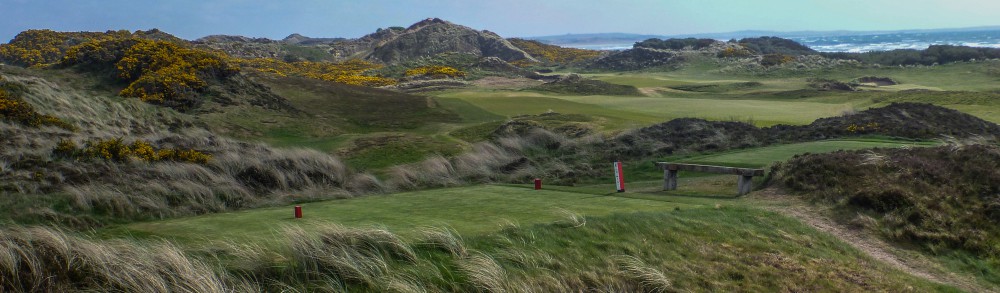
My expectations were neither high nor low; I just wanted one more chance to swing my clubs. But during the decade and a half since then I’ve probably thought about Kingussie as often as Carnoustie. You could never hold a British Open there—among other reasons, the course is almost 2,000 yards too short—and golf-tour operators almost never send American travelers to play it. Nevertheless, it stuck in my mind. The course (which was expanded and redesigned by Harry Vardon in 1908) is set in and around the elevated valley of the River Gynack, in the rocky hills above the village. The first hole is a long, semi-blind par-three, and the sixth is a short par-4 that plays past the ruin of an old shieling, or shepherd’s hut, and the fourteenth, called the Dyke, runs along an old stone wall. It was a memorable finish to a memorable trip.

The Shepherd's Hut, Sixth Hole, Kingussie.

I returned to Kingussie in 2007 and played with three Scots, two of whom were on holiday from the Orkneys, a cluster of small islands north of the Scottish mainland. When we had finished, we had a drink with a group of regulars sitting at two picnic tables outside the clubhouse. One of them told me, “Kingussie has more left-handed and cross-handed players than any other golf club in the world”—a consequence, he said, of the town’s intense devotion to shinty, a bruising Highlands stick game that is similar to the Irish sport hurling (from which it evolved) and to field hockey, and in which there is apparently a tactical advantage to playing from the wrong side of the ball. No, no, another member insisted: there are more left-handed golfers in Newtonmore, Kingussie’s principal shinty rival, three miles to the west. The conversation then veered into a discussion of Newtonmore’s golf course, which my new friends unanimously dismissed as too flat to bother with.

One of my new friends from the Orkneys.

That evening (after a second eighteen), I drove over to Newtonmore and watched a youth shiny practice, the only form of the game available locally that evening. I stood with a group of shinty moms in a parking lot filled with Scottish minivans, and saw that grade-school shinty players, unlike the adult shinty players in the stories I had heard at the picnic table at Kingussie, wear helmets and still have their teeth.

Shinty practice, Newtonmore, Scotland, 2007.

Why Golf Tournaments Last Four Days

Seventy-two-hole golf tournaments at the time of the first Masters, in 1934, were invariably scheduled for three days, with a thirty-six-hole final on Saturday—an accommodation to the nation’s blue laws. It was Bobby Jones who thought of expanding the schedule. “My idea in stringing out the medal play over four days,” he wrote in a letter to Clifford Roberts, the club’s chairman and co-founder, not long before the tournament, “was to give time for special events to be sandwiched in between.” These events included an optional alternate-shot match, an approach-and-putt contest (to be held on the practice putting green), an iron contest (to be held in the old practice area, which can still be seen between the ninth and eighteenth fairways), and a driving contest.

Roberts liked the four-round idea—one of many golf innovations introduced at the Masters—in part because it eliminated what he believed to be a disadvantage for players who were “unable to do their best scoring if forced to play thirty-six holes in one day.” He also liked the fact that the schedule would enable the club to sell four days’ worth of tournament-round tickets instead of just three. (Tournament-round tickets sold for $2.20, including tax; practice round tickets were $1.10; series tickets, good for all week, were $5.50.) Roberts had initially wanted the driving contest and other special events to be scheduled alongside the practice rounds—on Sunday, Monday, Tuesday, and Wednesday—partly because he hoped they would increase practice-round ticket sales, and partly because he thought a long schedule of activities might make the tournament seem more substantial to local hoteliers and merchants, whose support would be needed both that year and in the future.

Incidentally, Roberts loved the special events, and he helped to create many of them. One year, he arranged an exhibition for local children, who were given free practice-round tickets; he scheduled the exhibition late in the afternoon so that it wouldn’t conflict with school. Another year, he devised a competition in which the pros took turns trying to repeat Sarazen’s double-eagle shot from the fifteenth fairway. (None succeeded.) For the 1942 Masters, he wanted to hold a complex “ringer score contest” in which the seven tournament champions would compete against the rest of the field during the four practice rounds. The contest was never held, but not for lack of support from the chairman. (Among other things, he wrote, the competition would “give the newspaper boys something to write about” during the first half of the week.) According to one spectator from that era, “The contests were fun, because the pros were always so relaxed and having such a good time.”

Those early special events were the precursors of the Par 3 Contest—another Roberts innovation. The first was held in 1960 (and won by Sam Snead) after enthusiastic lobbying by Roberts. “I am really rather bullish on the idea of making use of the Par-3 course as a distinctive pre-tournament event,” he had written the year before. “If so, it can be quite a feather in the cap of the Masters Tournament.  I say this because no other club holding a tournament could duplicate what I am proposing we do at Augusta. So far as I know, no other club has a Par-3 layout and, even if they do, I am sure they don’t have anything to compare with ours.” The event has always drawn a huge and enthusiastic crowd. It is also popular with the players and their children—even though no winner of the Par 3 Contest has ever gone on to win the Masters. Yesterday’s event was shortened by rain and lightning. Padraig Harrington and Jonathan Byrd were leading, at 5 under, when it was called.

Masters Countdown: Ninth Hole

Augusta National's ninth green, 1935.

Clifford Roberts, Augusta National’s co-founder and first chairman, liked to say that he made only one contribution to the original design of the course. During the construction of the ninth hole, he persuaded the contractor to create a level landing area in the steeply tilting fairway at the distance he normally drove the ball (about 180 yards). “The engineer was not at all enthusiastic about accommodating me,” Roberts wrote in his book about the club, “but finally agreed to bring back a tractor and do the job.” Roberts later told friends that he had requested the change because he didn’t want any of his matches with Bobby Jones to be decided by his luck at hitting a fairway wood to an elevated green from a downhill, sidehill lie. The current ninth hole was then the eighteenth, and Jones customarily either gave Roberts nine strokes or allowed him to begin their matches with a nine-up edge. Even so, Roberts needed all the help he could get.

(Augusta National doesn’t use the U.S.G.A.’s handicapping method. It has its own simple system, devised by Roberts, which is based on the number of pars a player ordinarily shoots, with a small adjustment for birdies. Essentially, if you make six pars, your handicap is twelve. The Roberts system works well, is easy to compute, and allows daily modification.)

Roberts’s difficulties with the second shot on the ninth hole were shared by most of the club’s other members, who, like him and unlike Jones, weren’t long enough off the tee to come close to the ideal driving area, at the bottom of the hill. And neither Jones nor Alister MacKenzie, who designed the course, was at all disapproving of Roberts’s modification. In consultations among the three, Roberts’s role was to supply the viewpoint of the average golfer, and Jones and MacKenzie both solicited his opinion. Roberts’s landing area is still visible in the ninth fairway, and it still receives plentiful use from members and guests, as well as from occasional Masters competitors.

Hord Hardin, who was the president of the U.S.G.A. from 1968-69 and was Augusta National’s third chairman, between 1980 and 1991, told me a story in 1996, shortly before he died, that I’ve heard in several versions. Augusta National had a few women associate members in the early years. (Most, if not all, were members’ wives—possibly including Roberts’s first wife, Mary Agnes Bishop, whom he married in 1937 and from whom he was divorced not long afterward.) In the clubhouse one day, one of the women told Roberts that she had just made a hole-in-one on the eighth—a 500-plus-yard uphill par 5—and Roberts asked how that was possible. Hardin told me, “She was playing the ninth, and flat missed her tee shot. The ball hit a something off to the right, flopped up in the air, and went in the hole on the eighth green, no more than fifty yards away. When he heard that, Mr. Roberts is supposed to have said, ‘That’s it. No more women members.'” Roberts and Jones’s original plan for the club had included a second course, intended mostly for women, and a large women’s locker room, which was to have been situated in the huge new clubhouse they intended to build as soon as they could afford to tear down the dilapidated old plantation house. The Great Depression forced them to scale back their ambitions, and prevented them from demolishing what today is probably the most recognizable building in golf.

As the photograph above shows, the ninth green’s famous false front, which contributed to Greg Norman’s spectacular final-round collapse in 1996, was originally more pronounced. (Look at the far right-hand edge of the photo.) The ninth hole is also seventy yards longer than it was during the first tournament. The most recent extension was during the summer of 2001, when the Masters tee was moved back thirty yards and a high stone wall was built to seclude it from a service road just beyond it. At the same time, additional trees were planted on the left between the new tee and the members’ tee, to eliminate the possibility of tournament players’ using the first fairway as an alternate driving area, and new pine trees were planted along the right side of the ninth fairway, to tighten the landing zone. Even though the hole today is 460 yards long from the tournament tee, Masters competitors often have as little as a nine-iron or a wedge for their second shot.

Players, fans, and television commentators who claim that Augusta National had no rough until Hootie Johnson added the “second cut,” in 1999, should study the photograph below, which was taken at the 1949 Masters. The rough in the foreground is several times the height of any grass on the course today. And note the greenside bunker configuration. MacKenzie’s original large bunker was later reconfigured and divided into three, and then at some point after 1949 the bunker nearest the tee was removed.

Ninth hole, Augusta National, 1949 Masters.

That’s the end of my hole-by-hole Masters Countdown for this year. I’ll take it up again next spring, beginning with the tenth hole—although I’ll have one or two more things to say about the Masters before this year’s tournament is over.

Sunday Morning on Friday Afternoon

The Friday-afternoon version of my regular Sunday Morning Group met the other day. Seven players showed up: three retirees, one semi-retiree, two self-employees, and one college student home for the weekend. We picked teams by drawing balls from my hat, three vs. four. As always, the threesome started two under par (an adjustment we borrowed from Augusta National) and no one got two strokes on any hole. The wager was twelve dollars a man: five dollars for best-ball, five dollars for skins, and two dollars for the Money Hole (which, because there were seven of us, was the seventh). Because it was Friday, not Sunday, we allowed strokes on par-threes. 

The course had been open for more than a week and the weather was flawless, but our cars were the only ones in the parking lot so we played as a sevensome. Later,  we picked up an eighth player: a self-employee, but one who runs a real company and has young children and so sometimes runs late. Even as an eightsome, we played faster than most foursomes, perhaps partly because Ray, over the winter, had eliminated a few redundant elements from his pre-shot routine. He’s just about the last member of the group who still believes in practice swings, although he now limits himself to one, plus waggles.

My team went a stroke ahead on the seventeenth, with a net birdie by Jim. He is recently divorced and hadn’t played in two years, except for a single round during an otherwise golf-free trip to Ireland a couple of weeks ago. On the eighteenth, Ray, on the enemy team, made a natural eagle, retaking the lead—but Jim answered him with a second consecutive net birdie, and we finished in a tie. Rick, as always, suggested giving everyone their money back, but Hacker (real name) reminded him that, in our group, “money doesn’t flow backward,” and told him to forget it. We held a playoff on the practice green—putting to the second hole from the top of one of the teak side tables on the patio, closest to the pin—and my team won.

Hacker, on the seventeenth tee, proving that intact rotator cuffs are overrated.

Important Rule Change Regarding Legs

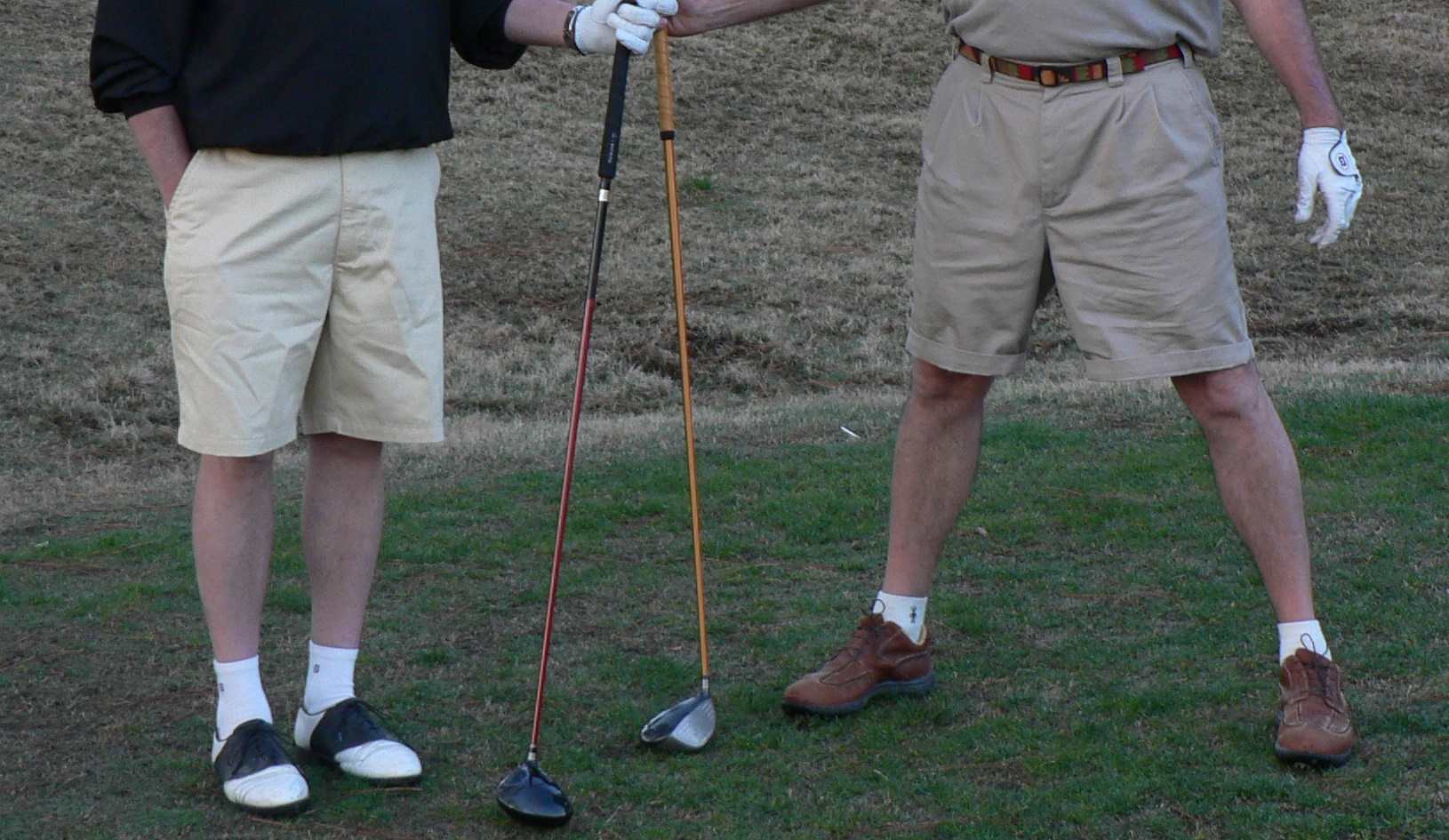
Hacker (real name) and Tony: what's the rule?

My regular Sunday Morning Group has its own rules, which are printed on the back of our scorecard. The most important ones: nobody gets a stroke on a par-3; nobody gets more than one stroke on any hole; you can’t win a skin if you aren’t present when we go over the scorecards; and “money doesn’t flow backward” (i.e., no refunds on wagers or anything else, even if somebody screwed up). We also give an extra stroke to anyone who wears shorts after November 1.

Our course stayed open so long last year—until New Year’s Day—that we added a new rule: anyone who wears shorts after December 1 gets two extra strokes. I was a beneficiary on our home course in December and on courses we visited in January, February, and early March, after our home course had closed. On one of those days, in the Bronx, I just about froze. But having two extra chances at skins is a powerful inducement—even though, when we’re on the road, we usually just throw the whole pot toward lunch.

Now that our home course is open again—six weeks earlier than normal—we face a dilemma. It’s still technically winter (since at this time last year most of the course was covered with snow), but yesterday the temperature was in the eighties. So do we give strokes for shorts, or not?

Luckily, Hacker (real name) thought of a solution: tomorrow, when our Sunday Morning Group plays its first official round at home since January 1, anyone who doesn’t wear shorts will lose a stroke. Deservedly.

Golf and the Second Greatest Game

A golf-obsessed friend took up bridge a few years ago. He thought his wife would be pleased, since bridge is a game that husbands and wives often freely choose to play as partners—unlike, oh, golf. But she was not pleased. No matter how sensitively he described the intellectual satisfaction he took from this quietly complex card game, which is played and adored by little old ladies all over the world, she responded coldly. “I know what bridge is,” she snarled one evening as he headed out the door to his regular Thursday game. “It’s just indoor golf.

Ah. Just so. I myself began playing seven or eight years ago, during a rainy vacation at the seashore, and I now understand why bridge used to be as important at some golf clubs as golf was, back before TV and the Internet made it so easy to be not quite bored enough to break open a deck of cards. President Eisenhower, whose love for golf was so deep that it helped inspire an entire generation to play, was equally crazy about bridge. Maybe crazier.

The relationship between bridge and golf is more than accidental. Both games are founded on the most basic male social unit: the foursome. Both displace a player’s entire mental capacity, leaving no room for thoughts about the office. Both are games for a lifetime—and they’re complementary, because four golfers can effortlessly switch to bridge during frost delays, thunderstorms, and darkness. Both games involve the wily outsmarting of opponents, and both reward years of conscientious study. My friend’s wife was right to be angry: bridge is best ball played on a table.

The connection between golf and bridge could be made even stronger if golfers would borrow a couple of appealing concepts from their indoor counterparts. The first is that of trump—which in bridge is a suit that annihilates all others. (If the trump for a particular hand is hearts, say, then any heart, even the lowly two, will beat any card in any other suit, including an ace.) The place to add trumps to golf is on the green, by declaring that all holed putts over twenty feet (say) are trump. If your partner lies four but sinks his twenty-five-footer, he trumps the other side, and the two of you win the hole, even if one of your opponents makes a tap-in three.

The other importable bridge concept is that of the dummy. In every bridge hand one of the four players (the partner of the player who initiated the winning bid) becomes the dummy, turning his cards over on the table and sitting out the playing of the hand. In golf, the dummy on each hole would be the player in the foursome who had just hit the worst tee shot. Like a bridge dummy, a golf dummy would excuse himself by saying, “Good luck, partner.” Then he would retrieve his ball from the bushes, and head off to the kitchen to fill a tray with snacks.

I’ve been thinking about golf and bridge because I gave up opening day at my home course this week in order to play bridge in an American Contract Bridge League tournament in Memphis with a friend from Mississippi. He’s a very good player and I’m not, but one of bridge’s attractive similarities to golf is that it accommodates participants at all skill levels, even as partners. The Memphis tournament is a national championship—a bridge major—although the games we played in were just for choppers. Still, there were stars in the other rooms, and in our hotel. I rode up in an elevator with Lynn Deas, a national champion who dresses colorfully, uses a motorized scooter, and always has a tiny dog sitting in her lap! I even helped her back her scooter over the raised threshold at the door of the elevator! Twice in the lobby I saw Eric Kokish, who is the inventor of a famous bidding convention, the Kokish Relay, and is also the Canadian-born non-playing coach of the Nick Nickell team, which may be the greatest bridge team of all time! I also saw Nick Nickell, talking with someone I sort of recognized but couldn’t think of the name of!

The stars of the Nickell team are Jeff Meckstroth and Eric Rodwell, middle-aged guys who play as partners and are usually referred to, jointly, as Meckwell. As it happens, Meckstroth—who looks like a truck driver—was a scratch golfer as a kid and thought about trying to play on tour, before he turned pro as a bridge player instead. (He has said that he always knew he didn’t want a real job.) He plays bridge in tournaments all over the world but still manages to get in something like 160 golf rounds a year. One reason that he and Rodwell have been so successful—in addition to the fact that they’re brilliant card players and bidding theorists—is that they are very aggressive: they shoot at pins. And that’s what I’m going to do as soon as I get home.

Back-Roads Scotland: Cullen

In 2007, I traveled to Scotland on an unusual Golf Digest assignment. I landed in Glasgow without tee times or an itinerary, and I rented a car and set out in a more or less random direction, with the goal of playing only courses I’d never heard of before. You can read my article about that trip here or here.

One of my favorite stops was a quirky course called Cullen, in Aberdeenshire, on the southern coast of the Moray Firth. The original nine holes were laid out by Old Tom Morris, and the course has blind shots, crossing fairways, otherworldly topography, and a cool tee shot that you hit from the top of a cliff. Partway through my round, I joined (as the fifth player) a group of older golfers from a club called Hopeman, about thirty miles to the west. They were on a golf outing, and this was their second round of the day, and they were playing a scramble, in competition with three other groups from their club. Most of them were carrying flasks, from which they were sipping a mixture of something and Drambuie—I couldn’t quite make out the recipe—and their golf bags were so full of empty beer bottles that they clanked when the wind, which was fierce, knocked them over.

They urged me to have a swig from one of their flasks. I declined, because I’d quit drinking about a year before, but they were so relentless that I eventually decided it would be better to risk falling off the wagon than to come to blows. As soon as I’d drunk a capful, though, they began to worry about their supply. “Are you driving?” one asked. His brow was furrowed with concern. When I said I was, he and the others concluded that offering me another swig or a beer would be unwise. Toward the end of the round, one of them asked, in a slurry brogue, “Wha hoe wah noo?” and only I could understand him: “What hole are we on now?” (It was the seventeenth.) Photo below. That’s the eighteenth green in the distance. I went back a year later with friends from home.

The boys from Hopeman: "Wha hoe wah noo?"

The specialty in the clubhouse—at left in the photo above, behind the big rock—is Cullen Skink, a fish soup that has its own Wikipedia entry.

The bent flag shows how hard the wind was blowing.

Looking back toward the clubhouse and the town.

The boys from Hopeman and some of their beverages.

Here’s where my friends and I stayed in Cullen when we went back the following year:

Snow Golf

It snowed here last night–as it’s entitled to. Nevertheless, unless we get a big melt my friends will  have to change our Sunday golf plans. One possibility would be to play in the snow, at home. I own a pair of L. L. Bean snowshoes that I’ve never used for anything but golf, and I have a cache of orange balls.

It’s actually been a while since I played snow golf. I used to do it all winter long, with four old guys at my club who called themselves the Fuckheads, after their favorite term of endearment. They’re all dead now: John, who carried his golf bag by the handle, like a suitcase; Dick, who seldom took a waking breath that wasn’t filtered through a Tiparillo; Ed, who caddied for Titanic Thompson on our course the weekend of the wedding of Horton Smith, who won the first and third Masters tournaments and married a local girl; and Doug, who lived well into his nineties and whose house was up the street from mine. When they were younger, before I came along, they used to end their winter rounds by lighting a fire in the unheated cabin that serves as our clubhouse and drinking scotch while frost formed on the insides of the windows. One bitterly cold January morning long ago, they told me, the liquor froze in a glass that one of them had left on a table a few paces from the fire.

Playing golf in the snow is good for a golf swing. Snow dissipates energy even more than sand or dirt does, so you have to keep still and swing smoothly. Each of us carried only a single club, a limitation that inspired inventiveness in shot-making. It was while playing winter golf that I learned what must be the first principle of the golf swing: that the key to achieving power is not effort but ease. Facing a hundred-yard shot and having only a seven-iron with which to hit it, I swung easily and gracefully and launched my ball on a high, gorgeous, left-bending arc that ended deep within the woods behind the green.

Stroke Bank: A Refinement

Last night, we tried to reserve a tee time for today at the Links at Union Vale, but the course was fully booked into the afternoon—a February Wednesday in New England as busy as a summer Saturday. So we went back to Tunxis Plantation, which was still first-come-first-served. We teed off a little after 9:00, and again played Stroke Bank/Second Ball Decides—see earlier post—and thought of a further improvement: Stroke Deposits.

Let’s say you make a 4 and your partner makes a 5 on a par-four, while your opponents both slice their drives out of bounds and end up with 7s. You and your partner have the low gross score on the hole, so you have to commit first. If you keep your 4 and 5, your opponents, if they wish to halve the hole, will need to use a lot of strokes. In fact, one of them will have to use three strokes (to turn his 7 into a 4, tying your par) and the other will have to use two strokes (to turn his 7 into a 5, tying your partner’s bogey). Alternatively, your opponents could choose to win the hole outright—if either of them is able and willing to spend four strokes (to turn his 7 into a 3, thereby beating your 4, which is your team’s better ball).

If you don’t think they’re likely to do those things, or if you don’t care whether they do—maybe because you’re ahead in the match, or because they’re running out of strokes with hard holes still to play—you or your partner can choose to bank some or all of your surplus. For example, you yourself could deposit as many as three strokes, turning your 4 into a 7. Now your opponents can halve the hole if one of them spends just two strokes, turning his 7 into a 5 (thereby tying the other ball as well). But you’d have increased your stroke-bank balance by three, a trade-off that might be advantageous for you on the holes ahead.

This game, in practice, is nowhere near as complicated as it probably sounds. But there’s lots of psychological intrigue, and the four of us had many long, whispered strategy discussions as we walked from green to tee. Hacker (real name) and I lost three ways to Rick and our superintendent, but the match, as somehow always happens, came down to the final putt. And when we walked off the eighteenth green the sun was shining, and the Weather Underground app on my phone said the temperature was 56 degrees. We stopped at a barbecue place for lunch on the way home, and we’re all going to play again on Sunday.

These guys were warming up on the range at Tunxis when we finished.

February Golf, Continued

Tunxis Plantation yesterday. We had some rain and snow a little later, but nothing golf-threatening.

Last week, Hacker (real name) and I had to travel an hour west to find an open golf course; yesterday, we had to travel an hour east, to Tunxis Plantation, in Farmington, Connecticut. We were joined by Mike A., whose company makes boxes, and by our home-course superintendent, who was taking a day off from cutting down trees.

We played Stroke Bank again (see yesterday’s post)—this time with two two-man teams. We combined it with our favorite version of two-man best ball, which is called Second Ball Decides. (If my partner makes a 3 and I make a 5 on a hole, and our opponents make a 3 and a 4, our opponents win the hole because, even though the better balls tied—3 and 3—their worse ball [4] was better than our worse ball [my 5]. The first ball was a tie, so we let the second ball decide.)

On one hole late in the match, my partner (our superintendent) used one of his strokes to force Hacker and Mike A. to spend three of theirs. Nevertheless, we lost both the back and the overall on the seventeenth—although we did win a consolation press on the final hole.