My Father, a.k.a. Johnny Persimmon Seed

Persimmon tree planted by my father, eleventh hole, Kansas City Country Club, September 28, 2013.

Persimmon tree planted long ago by my father. Eleventh hole, Kansas City Country Club, September 28, 2013.

Many years ago, my father planted two persimmon trees, a male and a female, in the rough on the eleventh hole at the Kansas City Country Club, where he was a member. Persimmon is the wood that the best wooden woods were made from, and he felt that every golf club ought to pay tribute. (Persimmon is as hard as ebony. It’s still used for pool cues and archery bows, among other useful implements.) Our behind-our-house neighbors had a huge persimmon tree, which dropped plum-size fruits into their yard and ours. My friends and I used to collect the squishiest ones and throw them at each other—another important application. My father never extended his persimmon-planting program beyond the eleventh hole at the Kansas City Country Club, but the idea was a good one and someone ought to take it up again—maybe me.

american persimmon

I was in Kansas City for my fortieth high-school reunion, and I played golf at K.C.C.C. with my classmates Dick, Hinkley, and Pajamas. They’re still in the witness protection program because of stuff we did when we were teenagers, so I can’t show you a photo, but you can read a little bit about them here. I also played a round at Indian Hills Country Club, which, like K.C.C.C. and Swope Memorial, was designed by A. W. Tillinghast. The guys I played with at Indian Hills are much younger than I am, so I can show their faces:

Adam, me, Scott, Ricardo, Indian Hills Country Club, September 26, 2013.

Adam, me, Scott, Ricardo, Indian Hills Country Club, September 26, 2013.

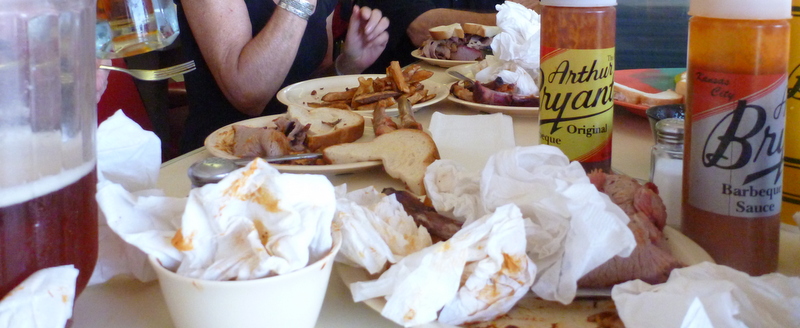
While I was in town, I also made mandatory stops at Winstead’s and Arthur Bryant’s. Bryant’s is the world’s best barbecue place. The health department shut it down for a few days recently, because of a misunderstanding concerning cockroaches, or something. The sandwiches are so big that they give you extra bread, which you can also use as supplemental napkins.
P1090531

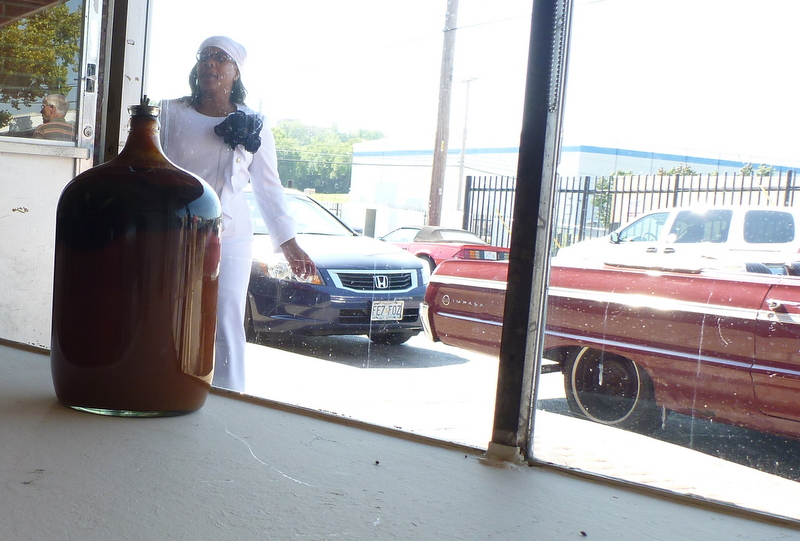
Bryant’s barbecue sauce, if you aren’t familiar with it, is unlike any you’ve ever tasted. New batches are aged in the restaurant’s front window, and the jug in the photo below may have been there when I was in high school. The dark liquid near the top is of unknown composition.
P1090533

I keep a case of Bryant’s sauce in my sauce cellar, in my basement, along with a case from Gates & Sons, which is Bryant’s main competitor. The two sauces are so different that you don’t have to choose one or the other. You can enjoy them both, or you can do what my wife and I often do, which is to mix them together. In any configuration, they are so much better than other so-called barbecue sauces that it’s almost ridiculous.
ABBBQ

Report From the 2013 Men’s Member-Guest, Part Two

From left to right: plastic beer cups, Kegerator, ice chest containing non-beer-type beverages.

From left to right: plastic beer cups, Kegerator, ice chest containing non-beer-type beverages.

For the men’s member-guest in 2012, we spent hundreds of dollars on ice, and the beer kegs, after a while, dispensed nothing but foam. This year, we followed the example of Michael U.’s fraternity and bought two Kegerators, for about six hundred dollars each. Each one is a medium-size refrigerator whose only job is to keep a keg of beer cold.

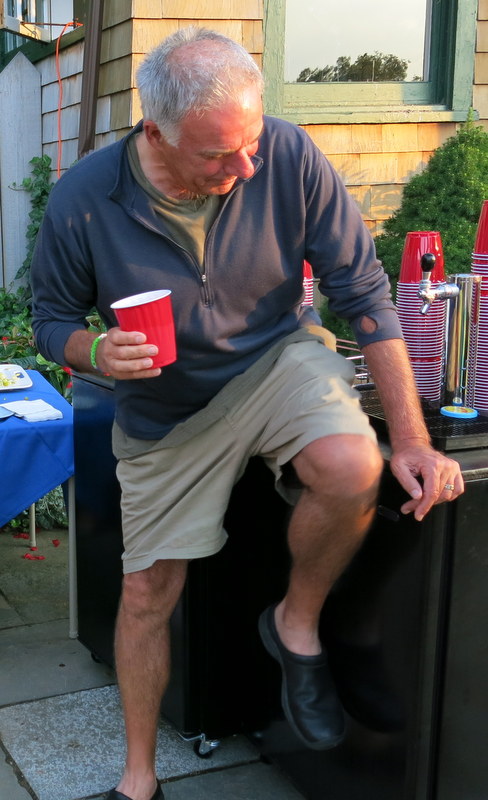
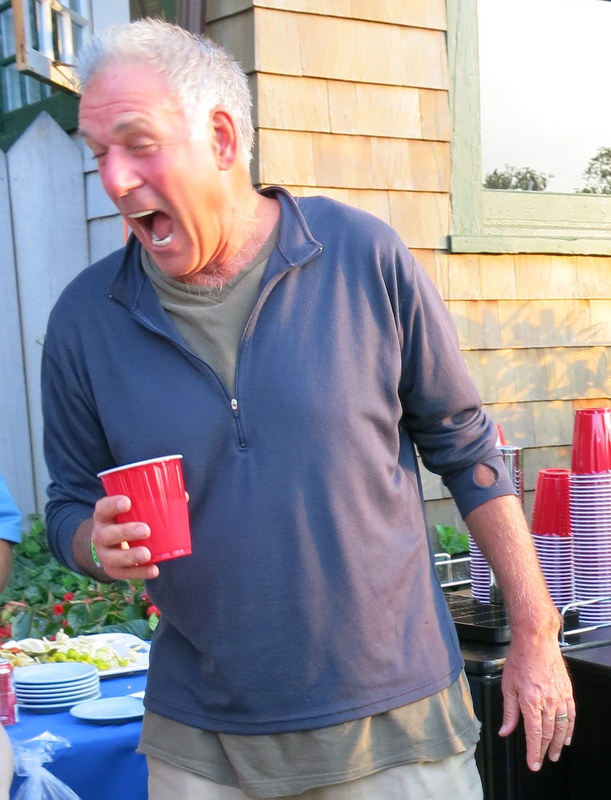
Tony, attempting to use one or our new six-hundred-dollar Kegerators as a chair.

Tony, attempting to use one or our new six-hundred-dollar Kegerators as a chair.

Tony, after being told not to use one off our new six-hundred-dollar Kegerators as a chair.

Tony, after being told not to use one of our new six-hundred-dollar Kegerators as a chair.

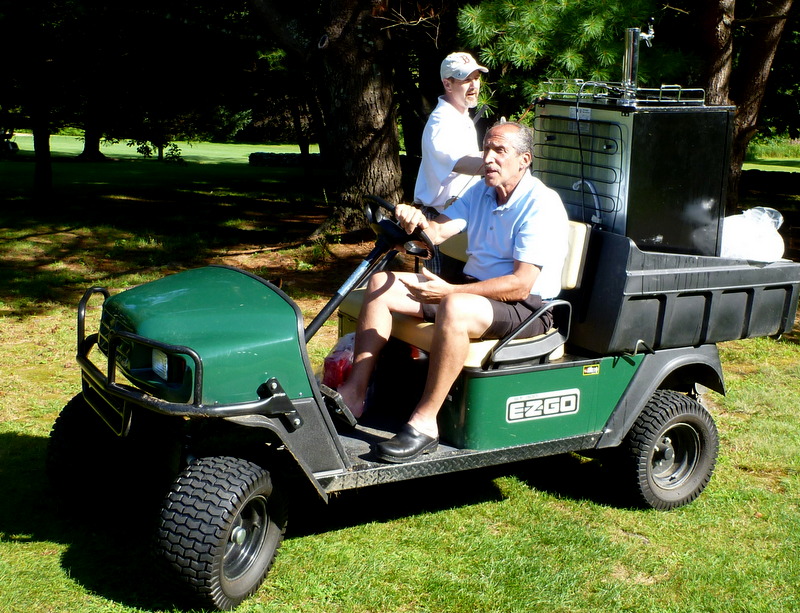
While the matches were going on, we kept one of the Kegerators near the clubhouse and the other plugged in to an outlet in the pump house, by the pond on the fourth hole. During the shootout, at the end, we put one of the Kegerators on the back of a maintenance cart and had the golf-shop assistants drive it around:

Nick, Connor, Katie, and a Kegerator.

Nick, Connor, Katie, and a Kegerator.

Later, for some reason, Les took over.

P1080233

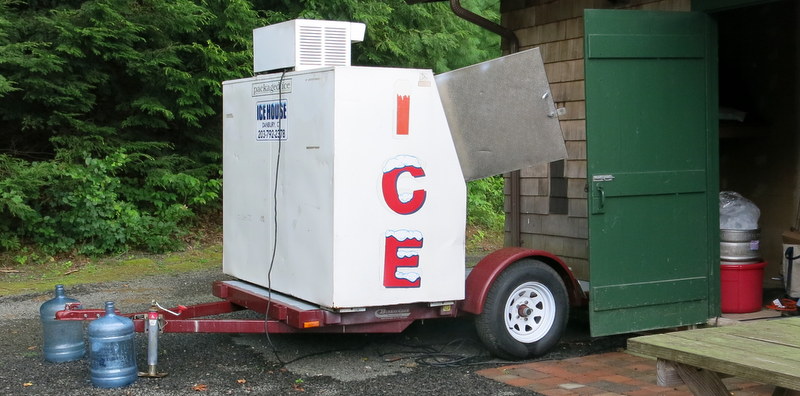
We still needed ice, for soft drinks and so forth, and to solve that problem we rented an entire ice freezer like the ones you see at liquor stores. It had its own trailer and was filled with ice bags, and we paid for just the bags we used. IMG_2484We no longer have the ice freezer, but the Kegerators are ours forever. We keep them in the men’s locker room, of course.

New Golf Playoff Format: Reverse Putt-Like-Pete

P1090240

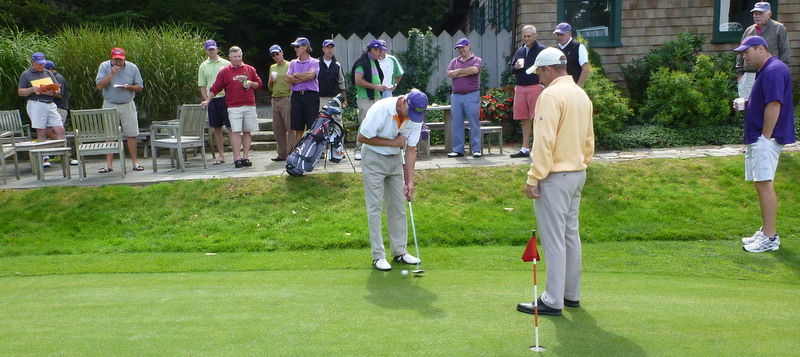
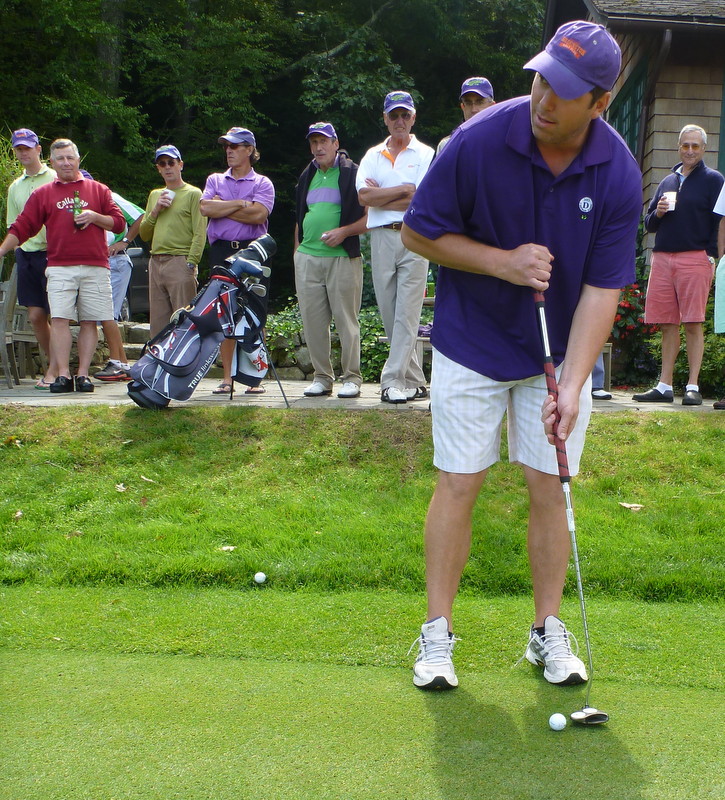
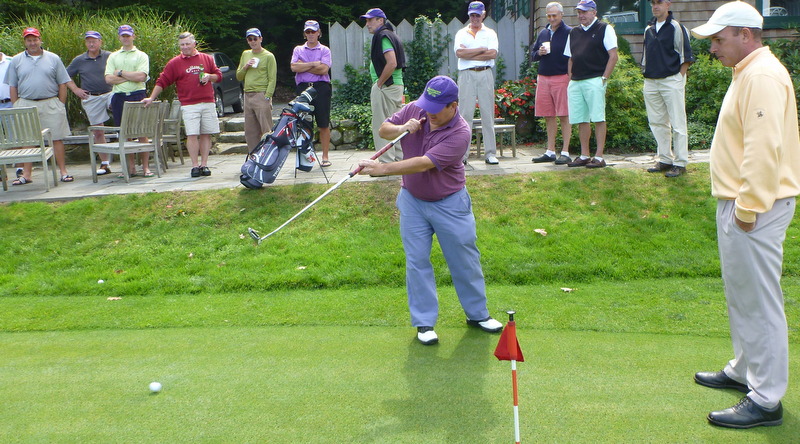
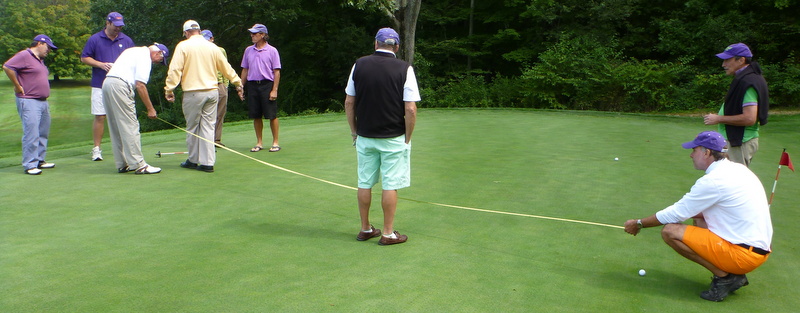
When the Sunday Morning Group’s regular game ends in a tie, we don’t divide the pot—a semi-corollary of Hacker (real name)’s rule that Money Never Flows Backward. We hold a playoff instead, and, over the years, we have invented many compelling formats. Last Sunday, we came up a new one, in honor of Peter P., who is in the hospital. Peter uses a long putter, so Corey, our pro, picked a similar one from the golf shop, and we made the eight playoff participants use it on a long putt on the practice green, closest to the hole wins. To make the competition more interesting, we made them use it wrong-way-around: righties had to putt lefty, and lefties had to putt righty. Furthermore, they had to strike the ball with the round thing on the back of the putter head, not the face. As always in our playoffs, the stymie rule was in effect. Here’s Chic, our new golf chairman, taking his turn:

P1090243

And here’s Rafael, who is from Mexico:

P1090247

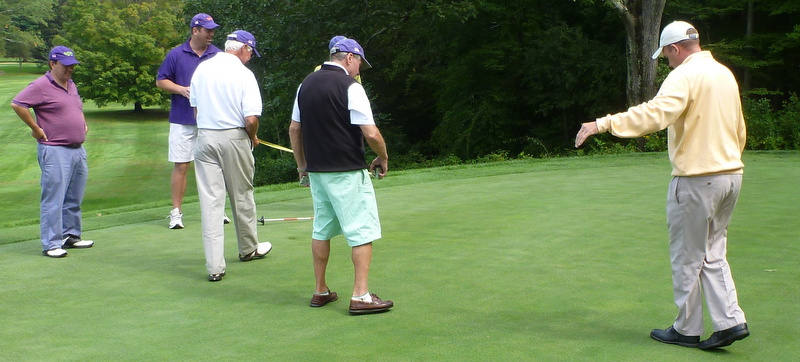
Putting backward off the round thing on the back of a long putter turned out to be harder than anyone had guessed, and only two balls—Rafael’s and Tim’s—ended up within twenty-five feet of the hole. We couldn’t tell whose ball was closer, so Corey paced them off. (By law, golf professionals wear shoes that are exactly twelve inches long.)

P1090255We still couldn’t tell, so Hacker got a measuring tape from the back of his car:

P1090259

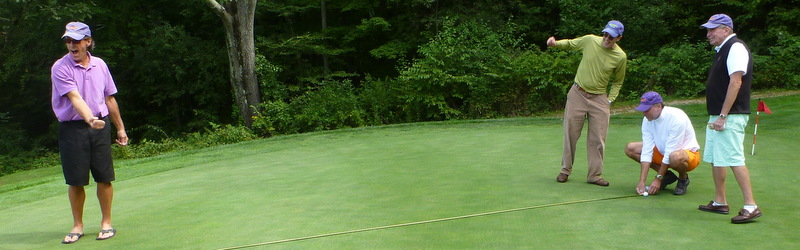
The winner, by half an inch, was Tim:

That's Tim,

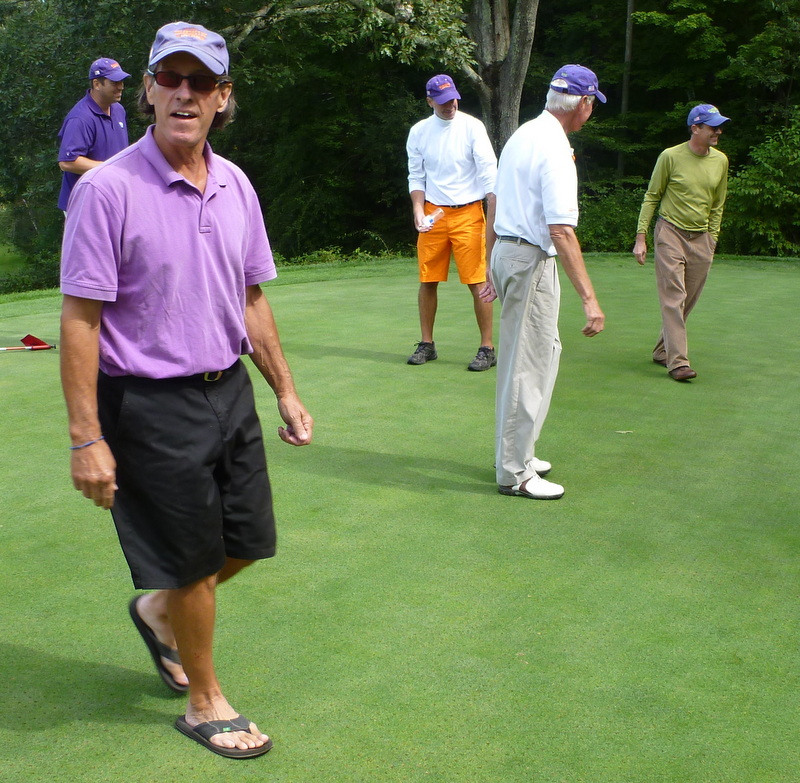
That’s Tim, in the green shirt, third from the right. Barney, left, was on his team. Fritz is holding the tape, and Hacker is supervising.

Then everybody went back to the patio for a couple more beers.

P1090265

Hat Day, Bumper Stickers, and Playing in Absentia

IMG_1131

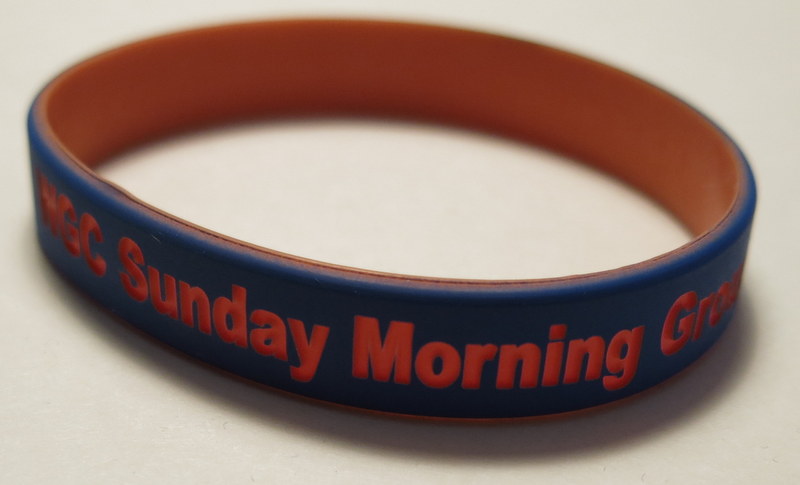
My Sunday Morning Group has a certain amount of branded merchandise, which is available for purchase by members only. Our wristbands (above) are free if you wear them, five dollars if you don’t. We also have European-style S.M.G. bumper-stickers, which cost two dollars but are currently not in stock. If you have one on your car (and also if you don’t), you can park in the Executive Parking Lot, between the clubhouse and the Dumpster.

IMG_2062Most of all, we have hats. The original ones, which we designed ten or fifteen years ago, are purple and orange, a color combination we selected because we thought it would get on the nerves of some women who had recently complained about our drunken boorishness, and so forth. (When we wore our new hats on a field trip to a golf course in another town, an assistant in the golf shop asked, “Do you guys all work for Federal Express?”) The most recent hats are purple and fluorescent green. You can see both versions in the photo below:

Nick wanted us to have a POW/MIA emblem on our hats, but he settled for an American flag.

Nick (not pictured) thought we ought to have a POW/MIA emblem on our hats, but he settled for an American flag.

Some guys wear their S.M.G. hats fairly often, but most guys wear them only on Hat Day, when wearing them is mandatory. Hat Day takes place whenever Hacker (real name) says, usually once or twice a season. If you come to Hat Day without a hat, you have to buy a new one (for $19.99), rent a loaner (for $3.99), or buy a reconditioned one (for $9.99). The reconditioned hats are loaners that have been reconditioned by sitting in Hacker’s barn since whenever the last Hat Day was. On the most recent Hat Day, Hacker sold three of them.

Hacker (with the last three purple-and-greens) and Greg, Hat Day, 2013.

Hacker (with the last of the new purple-and-greens) and Greg, Hat Day, 2013.

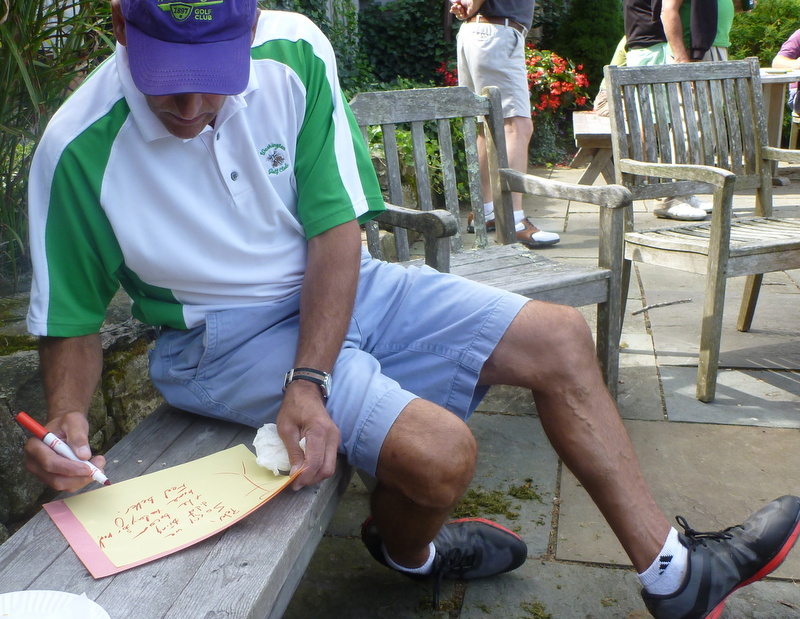
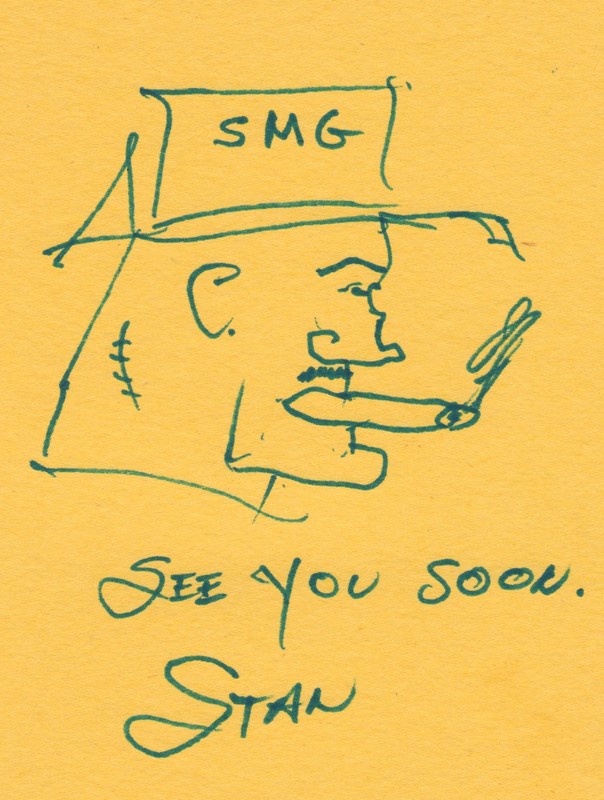
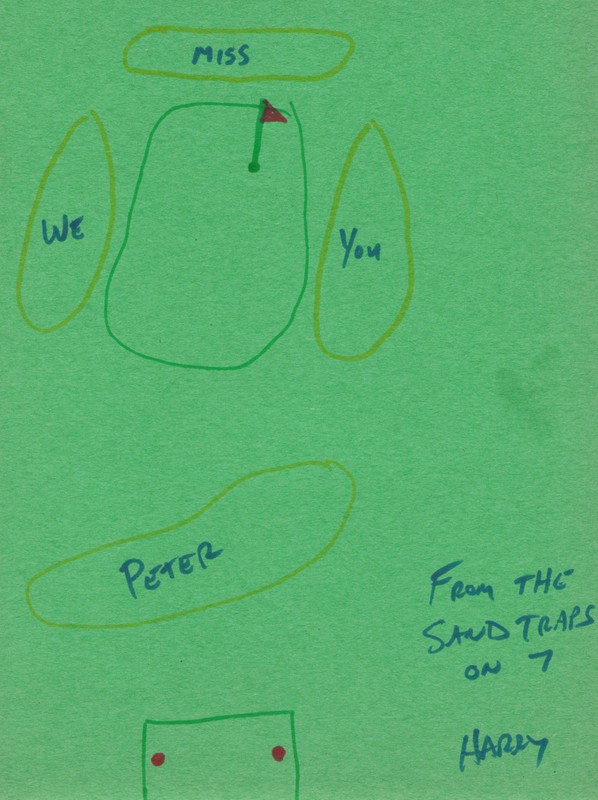
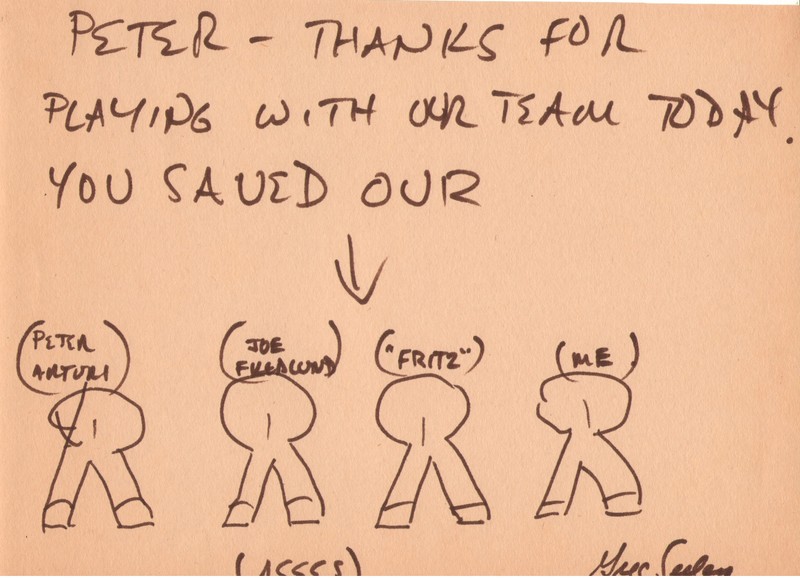
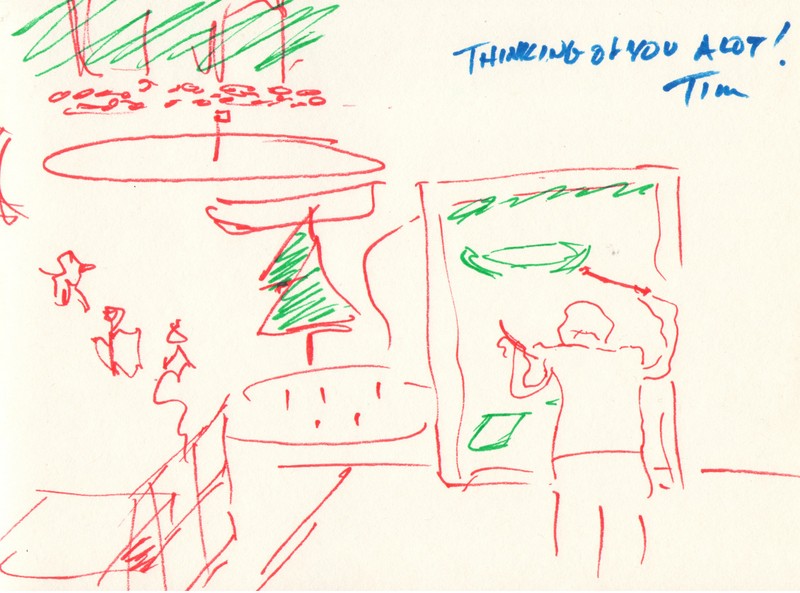
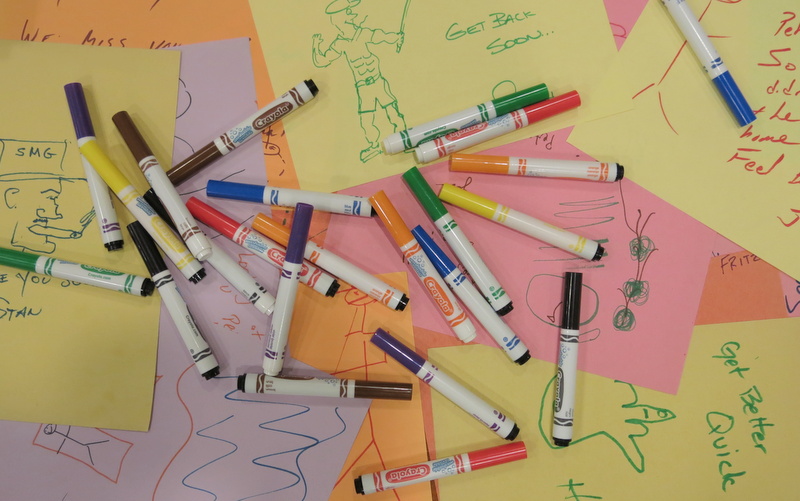
We had twenty-one guys that day, although only twenty were physically present. Peter P.—who had a horrific car accident shortly before Labor Day—was still in the hospital, but Hacker had figured out a way to let him play in absentia, by giving him a score of net par on every hole. We played two best balls, and Peter’s team needed his ball on seven holes, so he was more useful than quite a few of the guys who actually showed up. Peter also won a share of the Money Hole. During lunch, we used colored markers and construction paper to draw get-well pictures for him:

P1090220-002

P1090229

Here are some of the pictures:

Stan for Pete Harry for Pete-001 Greg for Pete

Tim for Pete

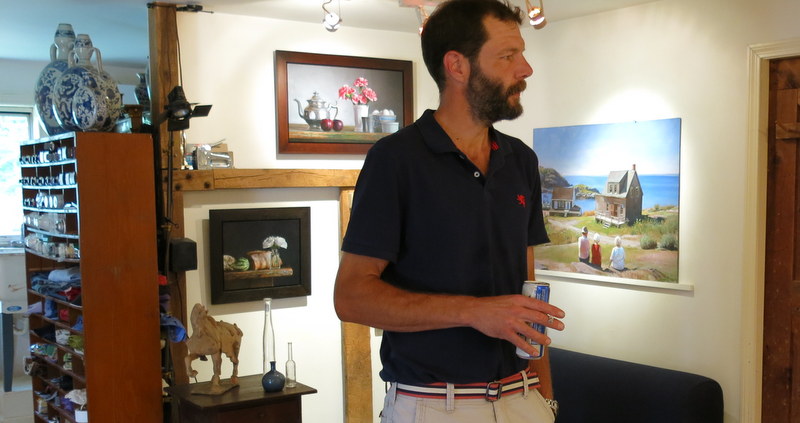
That last one, by Tim, shows Peter himself painting a picture of a golf hole. Peter doesn’t actually paint golf holes, but he is a painter. Just a couple of weeks before his accident, he held a reception in his studio, and a lot of us went—a rare opportunity to learn what someone we hang around with does when he’s not playing golf. Here’s Peter that evening, along with some of his paintings:

IMG_2691-002

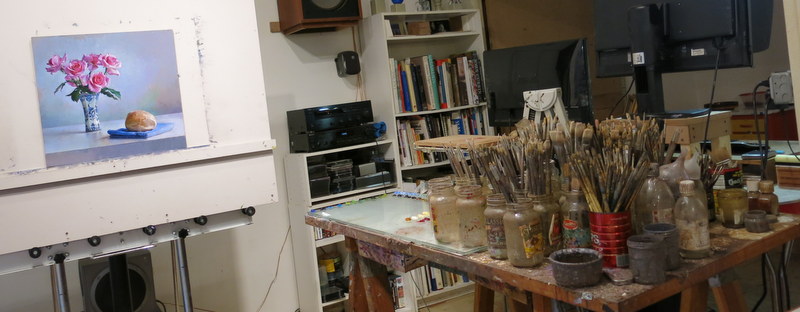
And here’s where he works:

IMG_2707And here’s another one of his pictures:

IMG_2699

We want him back soon, in person, and not only because he draws better than we do.

IMG_2739

Further Thoughts on Packing for Golf Trips

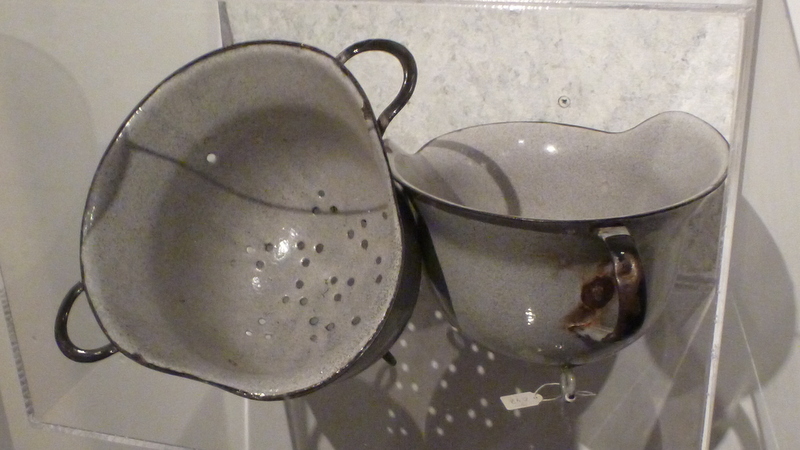
Strainer and chamber pot fashioned from German helmets after the end of the Second World War. Resistance Museum, Amsterdam, September 8, 2013.

Strainer and chamber pot fashioned from German helmets after the end of the Second World War. Resistance Museum, Amsterdam, September 8, 2013.

My wife and I just returned from Germany, the Netherlands, and Belgium, where we spent ten days celebrating our thirty-fifth wedding anniversary. Among the many interesting places we visited was a museum devoted to the Dutch resistance during the Second World War. (See photo above.) For reasons having to do with my desire to remain married for another thirty-five years, I didn’t play even one hole of golf. But I did do some golf-related luggage research, and I wife-tested a few ideas about minimalist packing.

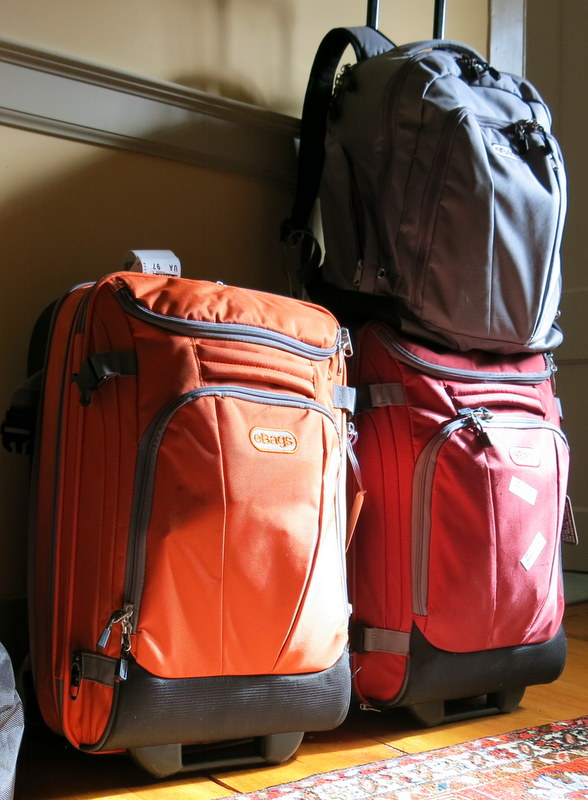
Our luggage. (My wife's backpack and purse are out of the frame.)

Our luggage. (My wife’s backpack and purse are out of the frame.)

We each took just a carry-on bag and a small backpack (plus my wife’s purse). All the luggage was from eBags, an online luggage company for which I am an unpaid shill. Here’s what we took: two eBags Mother Lode TLS Mini 21″ Wheeled Duffels; an eBags TLS Workstation Laptop Backpack; and a similar, older backpack, which eBags apparently no longer makes but is a lot like this one. My wife not only got along fine without a big suitcase but actually packed lighter than I did. We didn’t carry the carry-ons onto our plane—international flight, one checked bag free—but once we were in Europe our relatively light load made it easy to get on and off trains, climb stairs, take the tram instead of a taxi, etc., while still leaving room for souvenirs. The bags are perfectly designed, and the laptop backpack is like a mobile office—not that I did any work.

Souvenirs, outdoor flower market, Amsterdam.

Souvenirs, outdoor flower market, Amsterdam.

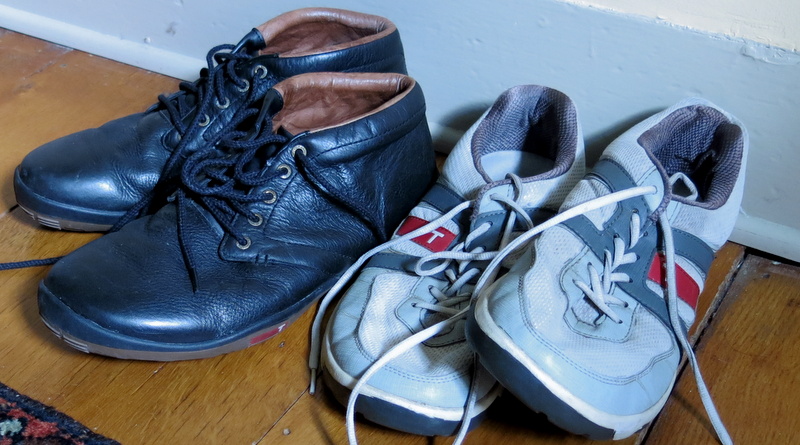
Although I left my golf clubs at home, I did take two pairs of golf shoes, both by True Linkswear, another company for which I am an unpaid shill. They were the only shoes I took on the trip, and (it turns out) I could have gotten by with just the black ones, a model called Chukka. (I took the others, called Sensei, because the Chukkas look a little spooky when worn with shorts—but then I ended up never wearing shorts.) Chukkas are waterproof; Senseis are not. Both are extremely comfortable, and, by comparison with some of the shoes that Europeans wear, Chukkas don’t look strange at all.

True Chukka (left) and Sensei (right).

True Chukka (left) and Sensei (right).

Before we left for Europe, I held tryouts for the position of Trip Pants. The pre-competition favorite was a pair of black Nike flat-front Dri-Fit Tech Golf Pants, which are 95 percent polyester and 5 percent spandex. But when I wore them for a test round on my home course I decided that they made too much noise when I walked, and that they felt too much as though they were made of bubble wrap. I had similar issues with a super-cheap pair of no-name pants I found on Amazon. The eventual winner was a pair of black Dockers Advantage 365 Khakis, which are 100 percent polyester microfiber. They don’t wrinkle, they don’t stain, they can be “laundered” in a hotel-room sink, and they look fine in the morning if you leave them in a heap on the floor overnight—yet they remain silent when you cross your legs.

Docker's 365 Advantage microfiber pants, in overnight storage.

Dockers 365 Advantage microfiber pants, in overnight storage. (Note belt with beer-opener buckle, by Bison Designs.)

I also took a pair of pre-wrinkled 100 percent cotton Dockers in a grayish color, which, unlike the Advantage 365s, don’t look like the bottom half of a limo driver’s uniform. But if I’d been on a golf trip with my pals, instead of a romantic getaway with my wife, I’d have taken a second pair of microfiber instead.

The Muny Life: The Wrath of Cobbs Creek

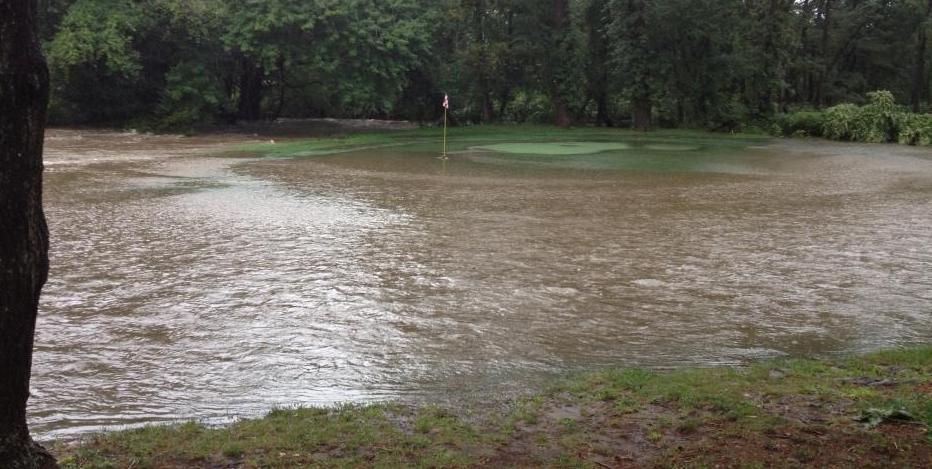
Cobbs Creek 7I wrote about Cobbs Creek Golf Club, in western Philadelphia, in the June issue of Golf Digest. The main course—which regulars call the Crick—was named after its most diabolical hazard, which also runs along the eastern edge of Merion Golf Club, a few miles away. The Crick’s creek has always been both an asset and a liability. Hugh Wilson, who also designed Merion, brilliantly incorporated it into his routing, and Charles Barkley once got so angry at it—on the third hole, a short par 4—that he threw his clubs into the water, then stormed back to the golf shop and bought another set. But when the creek floods, as it did on Labor Day, it can carry away entire greens. Most of the photos in this post were sent to me by Paul Cornely, the head of the regular men’s group, which is called the Cobbs Creek Publinks Golf Club. Cornely and I played back in March, when the water was better behaved.

Cobbs Creek 5-001

Cornely writes:

The rain started at 10:45, and in an hour the course and nearby area got four-plus inches. We had twenty-five guys, and the last group was on the eighteenth green when the rain started. It was coming down so hard that we had to stay in the clubhouse. These pictures were taken between about 11:45 and 12:15.

In normal weather, this is a golf hole with a creek running down the center of the fairway.

In normal weather, this is a golf hole with a creek running down the center of the fairway, as you can see in the photo below.

Here’s what the hole in the photo above looked like back in March:

IMG_0461-001

The next photo, below, was taken near the clubhouse during the rainstorm. The river you see at the bottom of the hill had been the first fairway until an hour or two before. As bad as things look in these pictures, though, they were worse in 2006, when an August flood swept away the third and fourth greens.

Cobbs Creek 1-001

In recent years, a group of Crick aficionados led by Chris Lange,a local businessman, has developed a plan to deal with the flooding problem, which also affects a neighboring facility owned by the city’s transit authority. The group also wants to repair many years’ worth of erosion damage and restore Wilson’s routing, which was modified in 1950, when most of the original thirteenth fairway was appropriated for a missile base. (Today, it’s a driving range.)

Here's the driving range next door. During the early years of the Cold War, it was a missile base.

Here’s the driving range next door, four months before the flood. During the early years of the Cold War, it was a missile base.

The 1950 reconfiguration, by George Fazio, was cleverly done, since it preserved all eighteen of the Crick’s original greens. But no one believes the current course is as good as the one that Wilson designed, and the architects Gil Hanse and Jim Wagner, whose office is nearby, have created a restoration plan. The Golf Association of Philadelphia has endorsed the project, most of which will be financed privately, and has agreed to move its headquarters to the course if the city approves it. Maybe the Labor Day Flood will move things along.

Cobbs Creek 3-001

Am I Related By Marriage to the Inventor of the Golf Rainsuit?

GD Hodgman 2 9-61

My wife’s last name is Hodgman. In 1838, a distant relative of hers—that is to say, a relative not related to her by money—founded the Hodgman Rubber Co., which still sort of exists. In fact, my wife has a Hodgman camo rain jacket (which she never wears). She also has an old box of Hodgman rubber bands, and she claims that the company was once famous for manufacturing horse condoms.

Hodgman Rubber Co., 1913.

Hodgman Rubber Co., 1913.

In 1913, Hodgman Rubber published a self-celebratory book, on the occasion of its seventy-fifth birthday. “The orderly business man at his desk is lulled by the harmonious music of the rubber band,” the book’s author wrote; “the eager traveler hastens swiftly on his unwearied way in the glad knowledge that not he but his motor car is rubber tired. Rubber is the main spring of sport in football and in tennis. The urgencies of business are sped by messages over telephones that are rubber wired.” And so forth. Also, eventually, rainsuits for golfers.

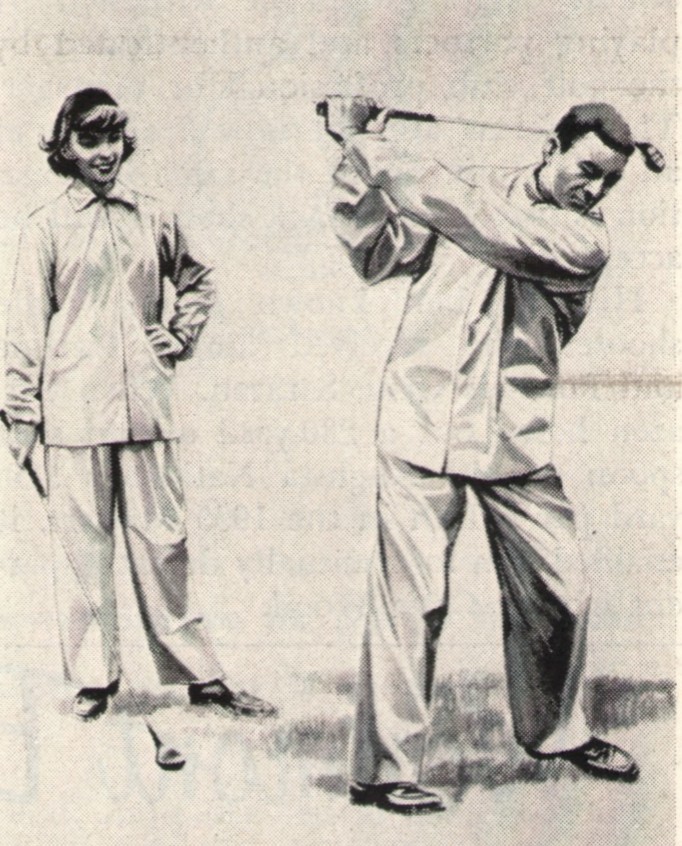
GD Hodgman 9-58

Hodgman rainsuits couldn’t cure a reverse pivot, apparently (see advertisement above). But they did leave plenty of room for unavoidable age-related increases in B.M.I.

GD rain clothing 4-61

Ann “Distant Relative of Possible Inventor of the Rainsuit” Hodgman and I are currently in Amsterdam, celebrating our thirty-fifth wedding anniversary. There was a little rain here this morning, and when we walked to breakfast I wore a golf rain jacket—which, I’m sorry to report, was not a Hodgman. But, at any rate, it’s not raining now.

Will This Umbrella Take Over the Golf World?

Ferenz

People who sell things for a living have a rotten reputation, but I like them. They look you in the eye, use your name a lot, hold your shoulder while they talk to you, and laugh really hard at your jokes.They take you out to expensive restaurants, and when the waiter asks them if they want something to drink they don’t say, “Just water, please.” They send you a Christmas card. They ask you where you went to college and what your kids do after school. They suggest through facial expressions and body language that they would like to marry you. In other words, salespeople treat you exactly the way you wish everyone would treat you—the way you deserve to be treated. Their only tiny flaw is that they don’t mean any of it: they’re just trying to make a sale. But isn’t that really a trivial defect, all things considered? Doesn’t the insincerity of salespeople seem like a negligible shortcoming in comparison with the incalculably opulent richness of their devotion?

Ferenz 2

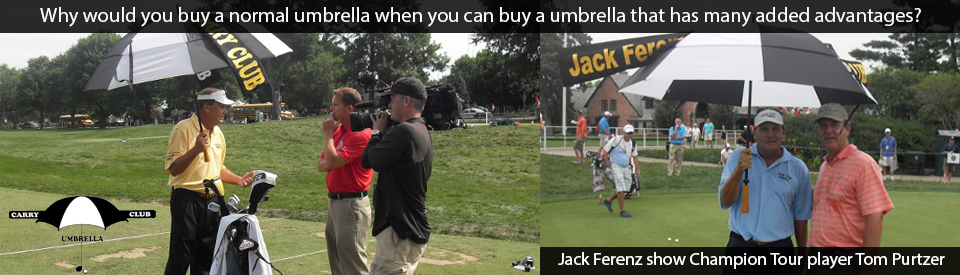
Well, I think it does. And I always have plenty of opportunities to agree with myself at the P.G.A. Golf Merchandise Show, which is held in Orlando every January and is full of salespeople. Among the dozens I met there a couple of years ago was Jack Ferenz, a former tour player. (His best year was 1990, when he entered twenty-one tournaments, made five cuts, and finished second at the Deposit Guaranty Golf Classic, two strokes behind Gene Sauers, the same week as the Masters.) He was selling an invention of his, which was then called the Dry Club Umbrella. He described it on a Facebook page (which has two “likes” but doesn’t seem to be active anymore): “We have designed a state of the art golf umbrella that will take over the golf world. Our unique design allows player to carry 2 clubs, handsfree, and remain 75% drier than with standard umbrella.”

Ferenz 3

Since then, Ferenz has renamed his invention the Carryclubumbrella, and perhaps also tweaked the design. Even after studying the patent drawings and the photographs and descriptions on Ferenz’s website, though, I’m not a hundred percent certain I understand how it works. Then again, I’m not an umbrella guy, so you should check it out for yourself.

ferenz 4

Scenes From Junior Golf Camp

photo

Addison won the club championship last week and is now on his way back to school, along with everyone else his age and younger. Before the summer officially came to an end, though, Corey, our pro, held a golf camp for future club champions. In the photo above, Aaron is lining up a sliding fifteen-footer—a putt he has to make if his team is to advance to a playoff. Here’s what happened, in case you missed it on Golf Central:

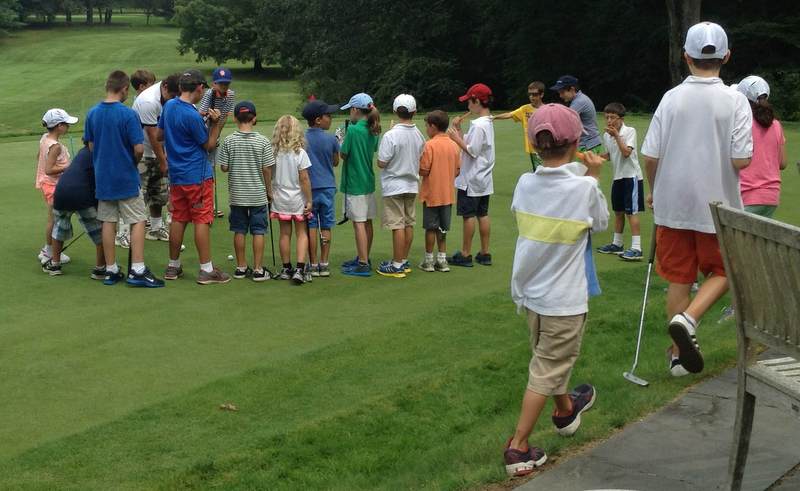
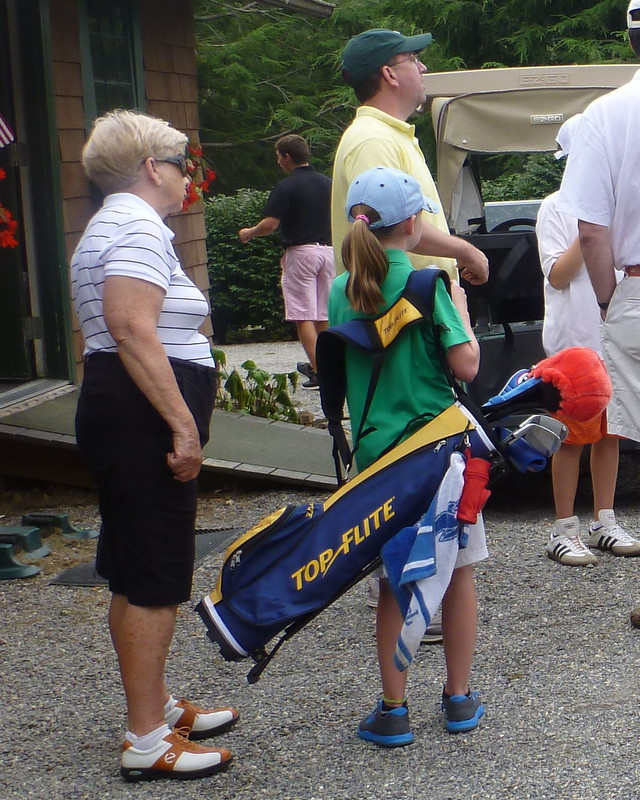
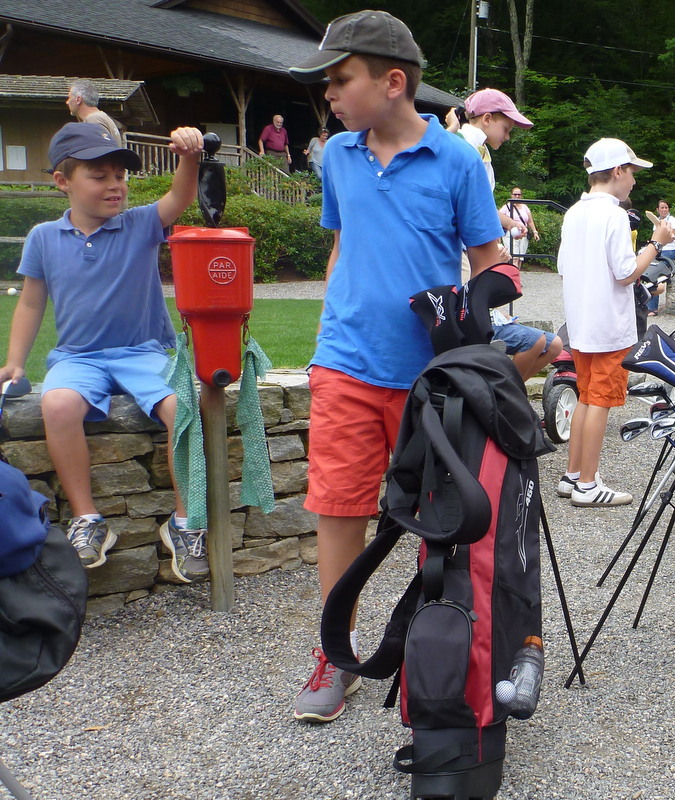
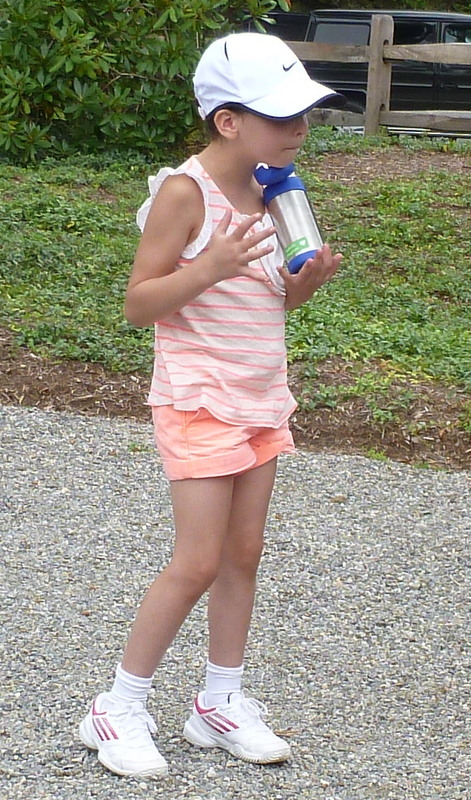
When I was a lad, I took a few group lessons from Tom Watson’s teacher, Stan Thirsk. They didn’t do any good. He told us to keep our left arm straight as we swung, and because my clubs weighed more than I did I couldn’t come close. He didn’t give us Fla-Vor-Ice Freeze Pops, either. If he had, maybe I wouldn’t have given up golf for twenty-three years, beginning at the age of thirteen. The kids at Corey’s camp, by contrast, had almost as much fun with golf as I do now. Below are photos of several of them, and of a few nervous-looking parents. (My friends and I arrived for the Friday edition of our regular Sunday-morning game just as they were knocking off for the day.)

P1080716

P1080688 P1080665

That's Corey, on the right. The father hasn't learned how to carry a golf bag yet.

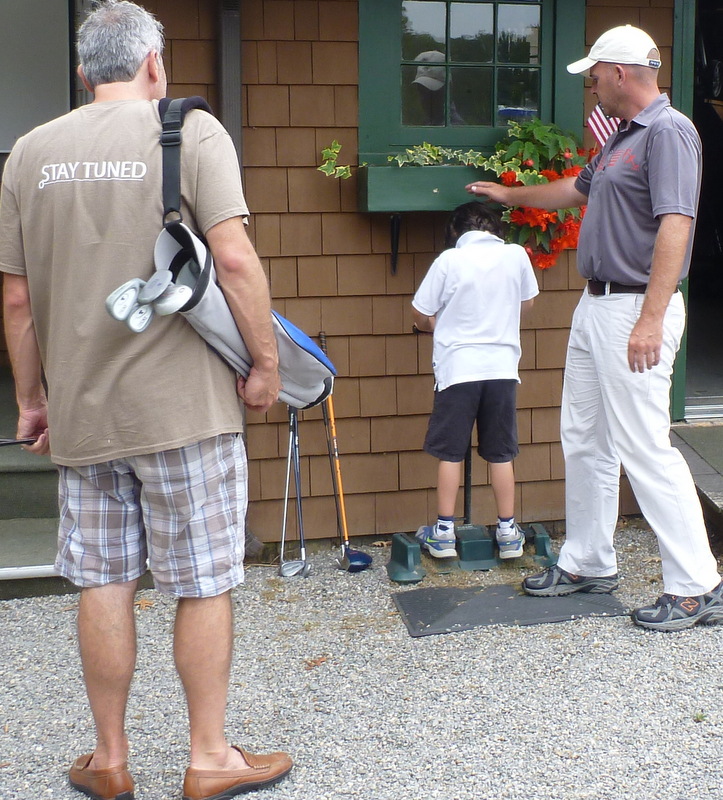
That’s Corey, on the right, giving a lesson in shoe cleaning. The dad, on the left, hasn’t learned how to carry a golf bag yet.

P1080674

P1080699

This guy hadn't had enough.  He squeeze in a couple of extra holes while his mother looked for him in the clubhouse.

This guy hadn’t had enough. He squeezed in a couple of extra holes while his mother waited for him outside the men’s locker room.

A Golfer’s Bucket List: No. 7

15

Make a hole-in-one, hit a 300-yard drive, reach a par-5 in two, drive a short par‑4, shoot your age, make a natural eagle, make a natural birdie—or achieve some other personal best that you aren’t likely to repeat. I once hit a good drive on a par-5 on a course whose name you would recognize in an instant. I asked my caddie how far I had left to the pond in front of the green, intending to lay up, and he gave me a fierce look that translated roughly as, “Are you so bored with life that you are willing to squander what may be the only opportunity you may ever have to duplicate the Shot Heard Round the World?” Chastened, I chose a fairway wood, made a good swing, and put my ball on the green. I didn’t make a double eagle, an eagle, or a birdie, and I almost didn’t make a par, but the caddie was right, of course. Nobody on his deathbed ever consoled himself with memories of hitting the fat part of the green in three.