My Latest Contribution to the Divot Museum

P1100167

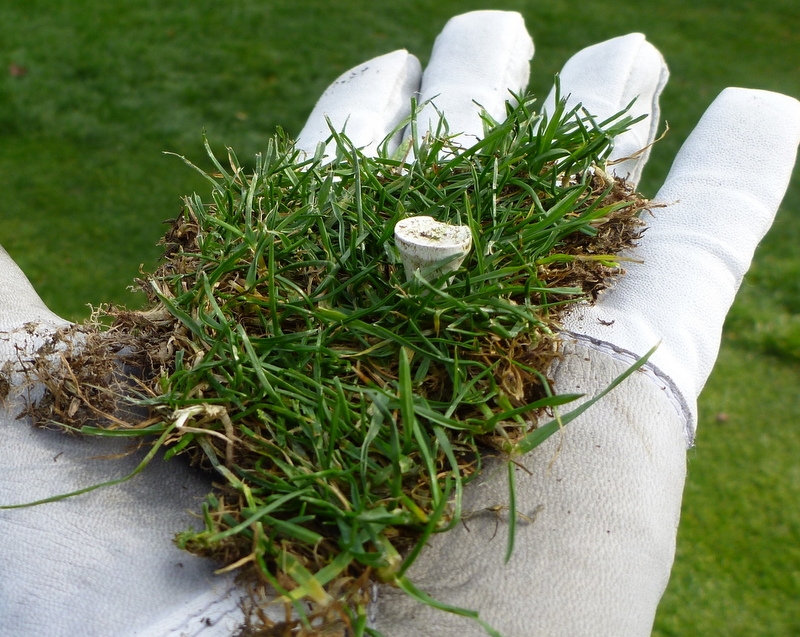
The seventh hole on my home course is a 125-yard par 3. I hit 9-iron the other day, and I took a divot that was just about perfect—uniform depth, playing-card size and shape—except that it began a couple of inches behind the ball and extended a couple of inches beyond it. In addition, my tee peg (a half-length stub I’d found nearby) remained upright near the center of it, untouched. Even so, my ball finished just twenty yards short of the green, meaning that I’d hit what was essentially a 90-yard explosion shot. And they say the long bunker shot is the toughest shot in golf.

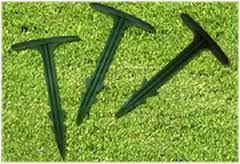
If I hadn’t sent my divot to the Divot Museum, I could have used the tee stub to refasten it to the golf course. Believe it or not, a company called McDivot makes biodegradable anchors that do exactly that. Here’s what they look like:

mcdivot

I saw a bowl of McDivots on the counter in the golf shop at Royal Portrush Golf Club a few years ago, and one of the assistants told me that using them prevents wind, rain, mowers, and crows from flipping replaced divots out of their holes. (The same company also makes an industrial-size version, called GreenStakes, which can be used to hold down entire fairways.) I took a McDivot home as a souvenir, and displayed it on my desk for several years. At some point, though, I must have thrown it out, because I just spent almost an hour unsuccessfully searching for it in my office. So the photo above, which is from the McDivot website, will have to do.

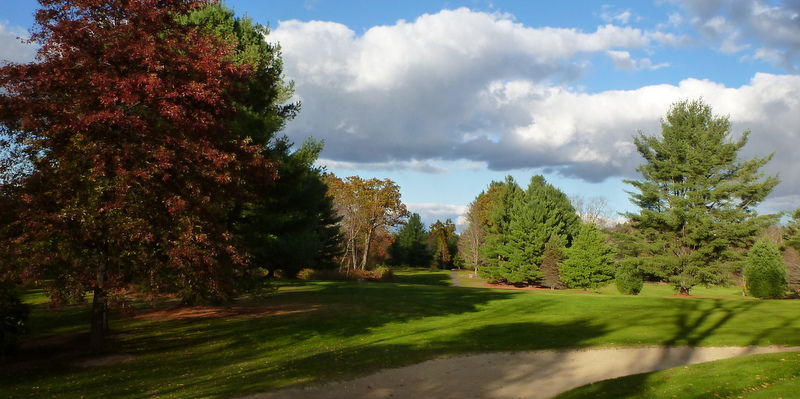
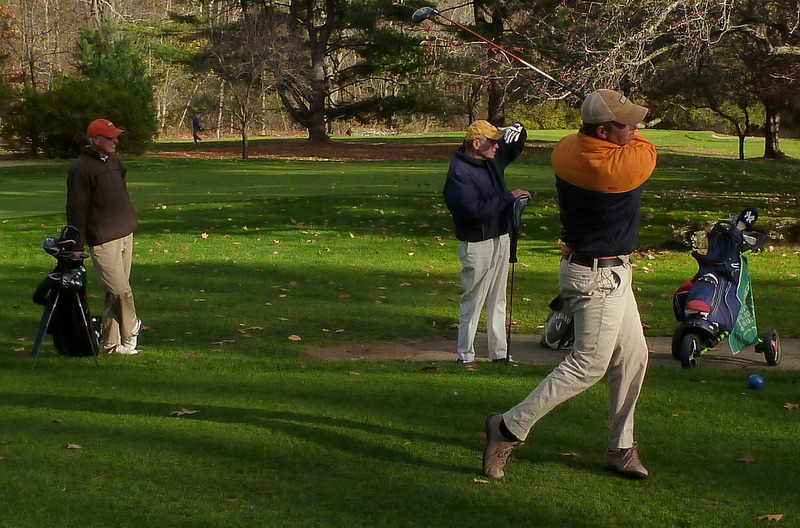
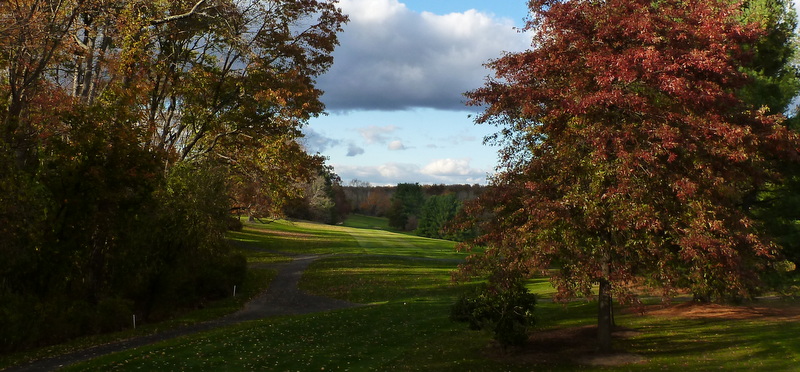
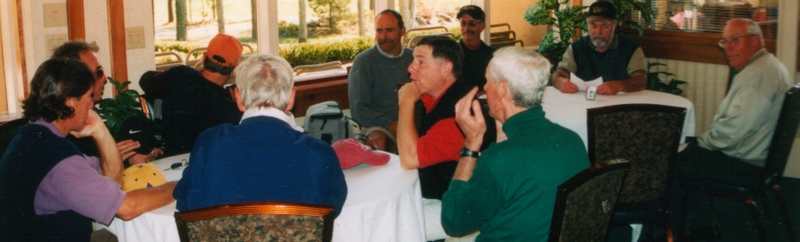
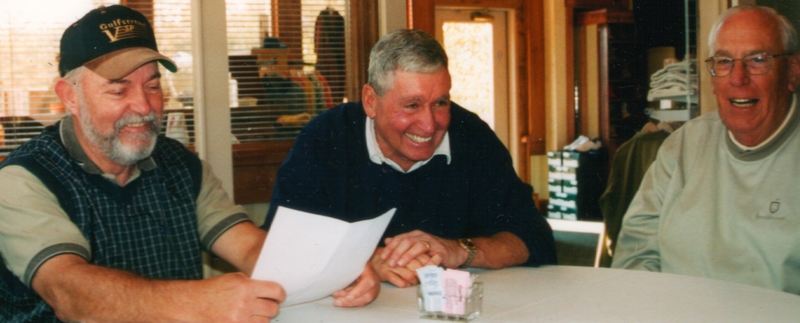
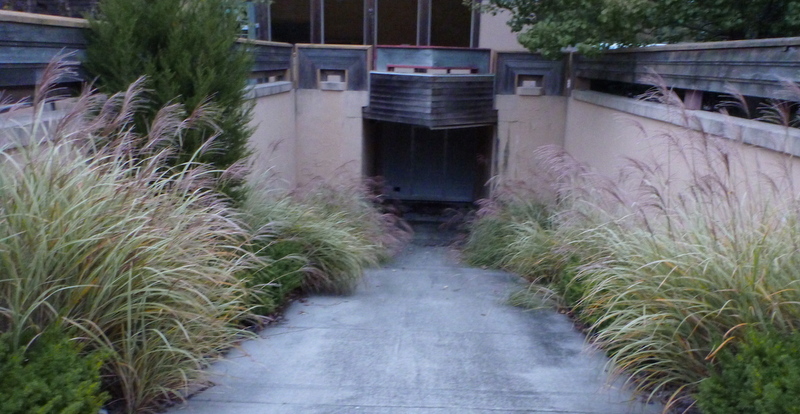
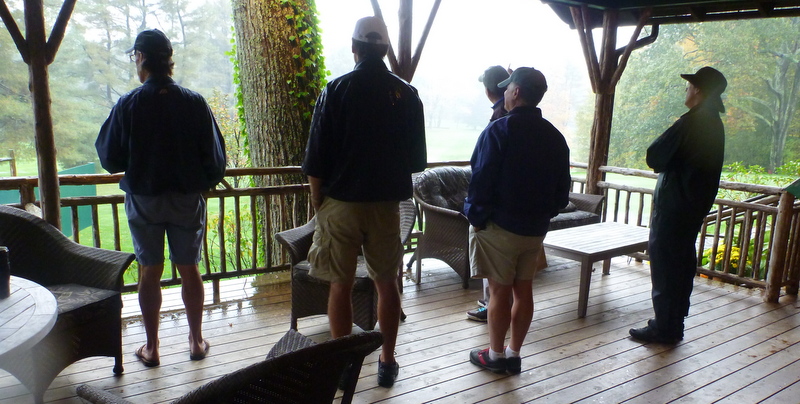
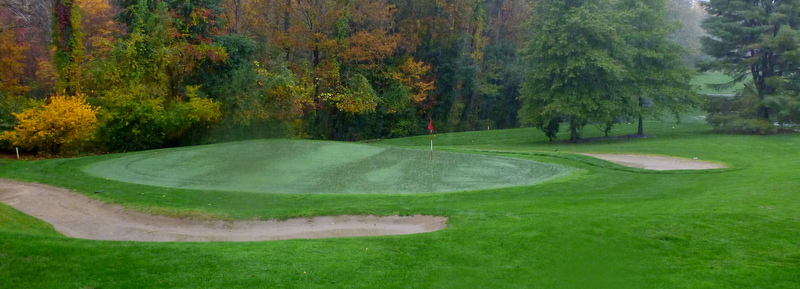
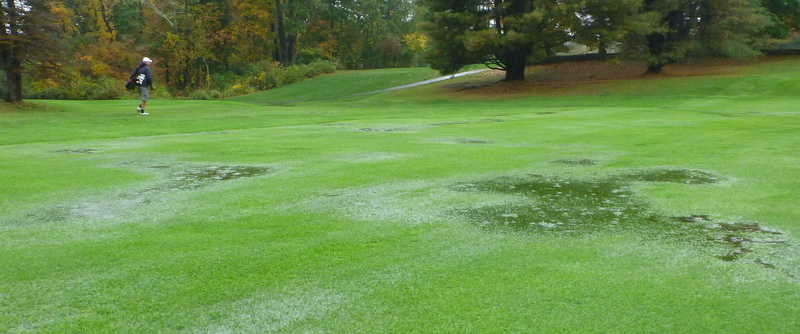
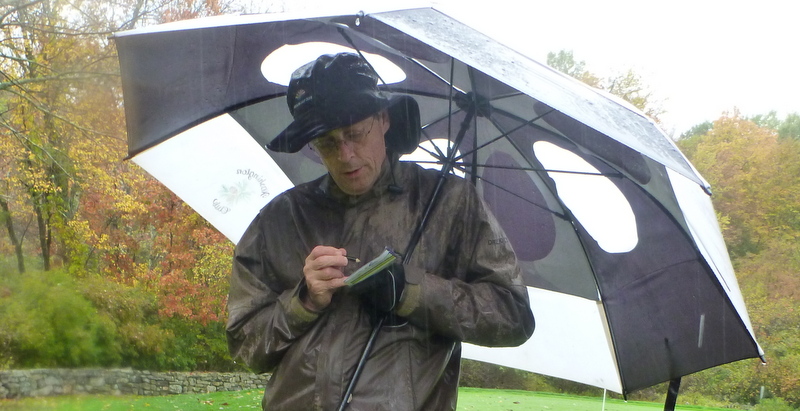
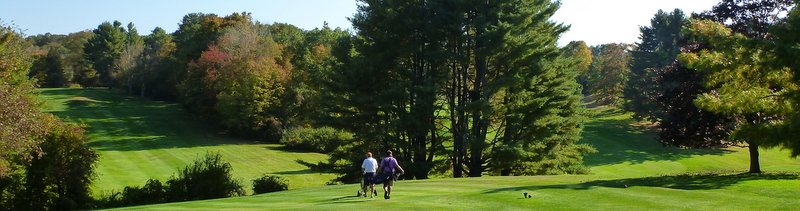
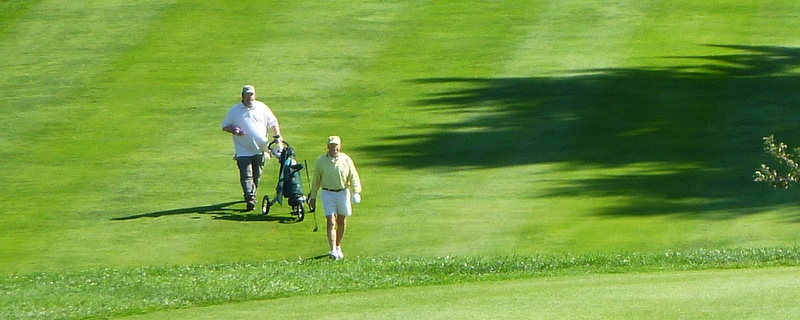
Anyway, divots aside, it was a nice day for golf, as you can see here:

P1100162

P1100155

P1100161

A Ghost Course in Southern New Jersey

The Great Trial, Blue Heron Pines East, October, 2003.

The Great Trial, Blue Heron Pines East, October, 2003.

On the morning of the second day of the Sunday Morning Group’s fourth annual autumn golf trip to Atlantic City, in 2003, Hacker (real name) gave everyone printed driving directions to Blue Heron Pines East, the course we were scheduled to play that day, but then drove himself and Harry, his navigator, to a course called Harbor Pines, which we weren’t playing until the next day and which was twenty-five minutes from Blue Heron. We had to shuffle the tee times while we waited for them to realize they’d screwed up. Then, after the round, we held a trial in the clubhouse—there were several lawyers on the trip—and sentenced the two of them to buy everybody’s lunch. Harry never fully understood why he was being forced to pay for so many bacon cheeseburgers, but everyone else, including Hacker, thought the whole thing was pretty funny.

That's Hacker in the middle and Harry on the right. Harry claimed later that he'd been represented by incompetent counsel.

The reading of the charges. That’s Hacker in the middle and Harry on the right. Harry claimed later that he’d been represented by incompetent counsel.

Blue Heron Pines East, which was designed by Steve Smyers, was one of our favorite golf courses, but in 2007 a real-estate developer bought it, and announced a plan to build an enormous condominium complex right on top of most of the holes. A year later, the global economic implosion helped to kill the condominium project, but the golf course remained closed and was allowed to revert to New Jersey. Earlier this month, during this year’s S.M.G. trip, Hacker and I drove over to have a look at the ruins, after playing a round at what used to be called Blue Heron Pines West. (It was designed by our close personal friend Stephen Kay and is still doing business, as Ron Jaworski’s Blue Heron Pines). Here’s what used to be the sign at the entrance of the East course:

P1100102And here’s the old driving range and part of the old parking lot:

P1100084

And here’s the ramp leading down into what used to be the cart barn:

P1100099

And here, through the opening in the trees, is what was once the fairway of the first hole, a really nice short, uphill par 4. The green was on the rise in front of that bank of trees in the distance:

P1100096

And here’s the patio outside the clubhouse. We held the trial on the other side of those double doors, in what was then the grillroom:

P1100087

And here’s another view of the clubhouse, and of what used to be the entrance of the golf shop:

P1100082

We learned during this year’s trip that the property has a new owner, who just received approval for a new condominium plan. That means, I guess, that people aren’t suddenly going to come to their senses and give us back our golf course. We like the surviving course a lot, but it would be nice to have both. And if the condominiums really do get built we won’t even be able to explore the remains.

P1100098

A few years ago, for The New Yorker, I wrote about another ghost course, on an island in the Outer Hebrides, in northwestern Scotland. You can read about that lost golf course here.

Flat Pete Goes on a Golf Trip

IMG_2844

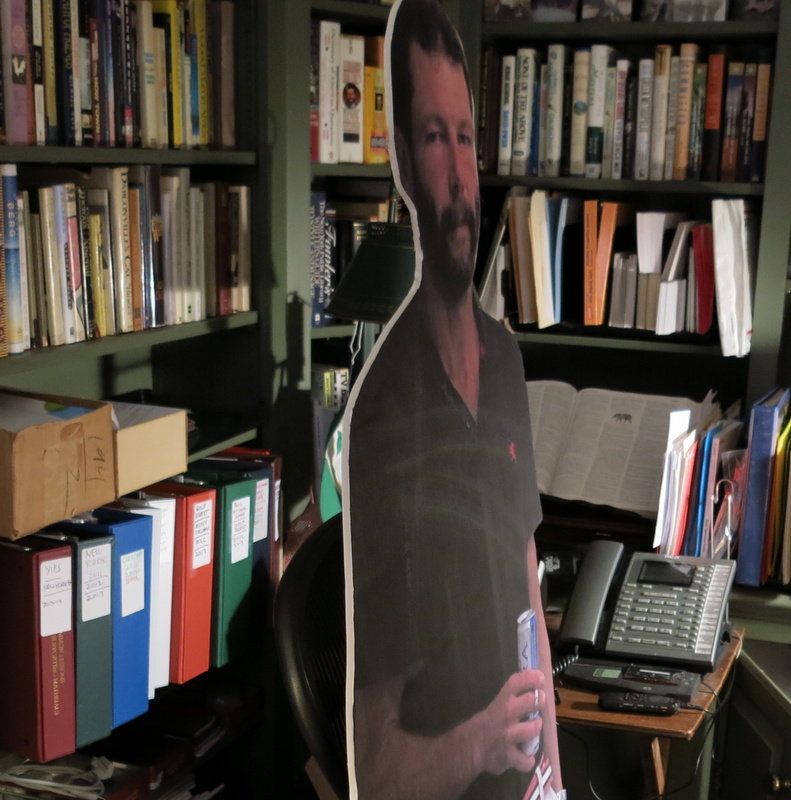
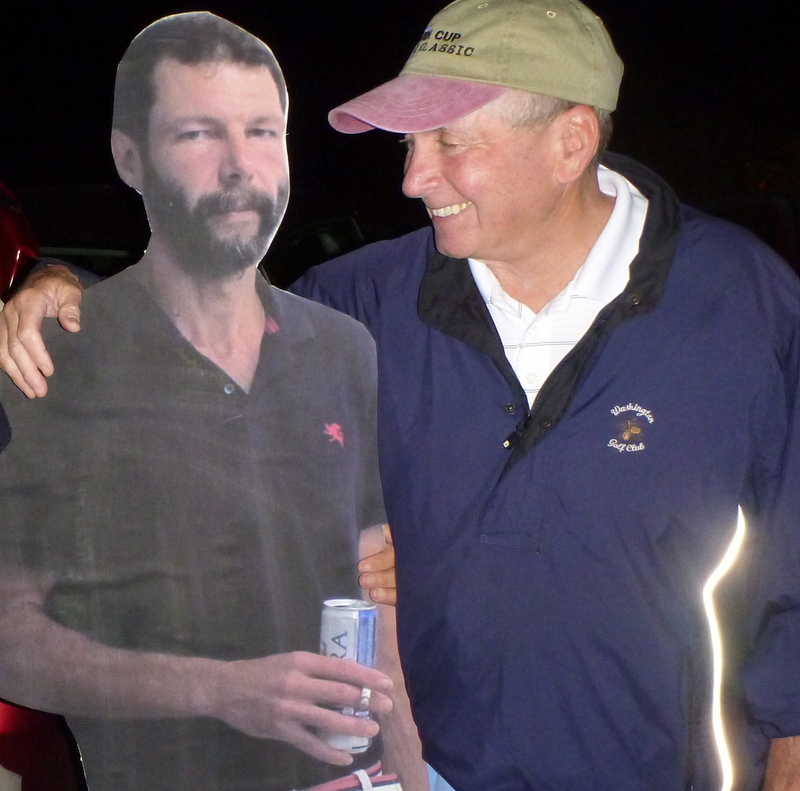
Peter P., a regular member of the Sunday Morning Group, was in a car accident back in August. He’s finally out of the hospital, but he isn’t walking again yet, much less playing golf, so we had to improvise in order to take him on our annual autumn trip to Atlantic City. We made a two-dimensional version of him, called Flat Pete, because we figured that in that form he would be easier to pack and lug around. The photo below shows him from the side. Notice how his eyes seem to follow you around the room:

IMG_2845Flat Pete was made possible by Reese, who not only printed him on the fancy color plotter in his office but also put himself at tremendous personal risk by inhaling clouds of spray adhesive during assembly. Flat Pete is so eerily realistic that my dog went crazy when I brought him up to my office after cutting him out in the basement. He rode down in my car, with Hacker (real name) and Gene. Here he is with Hacker, in Hacker’s driveway, when we were loading up to go:

P1090980-001

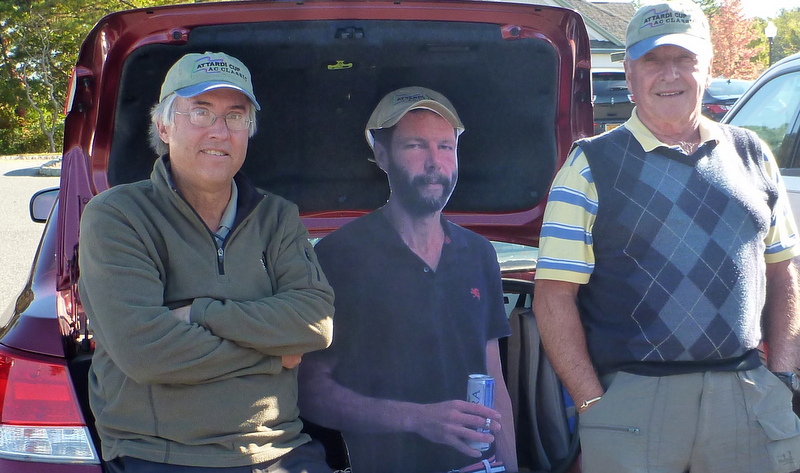
And here he is in the parking lot of the first golf course we played in A.C. That’s me on the left and Gene on the right. All three of us are wearing hats that Hacker had had custom-made for the trip, at a place called Fat City:

P1090987

Flat Pete made a better impression on bartenders than the rest of us usually do, even though he brought his own beer. He was also the only guy on the trip who didn’t snore.

IMG_2868

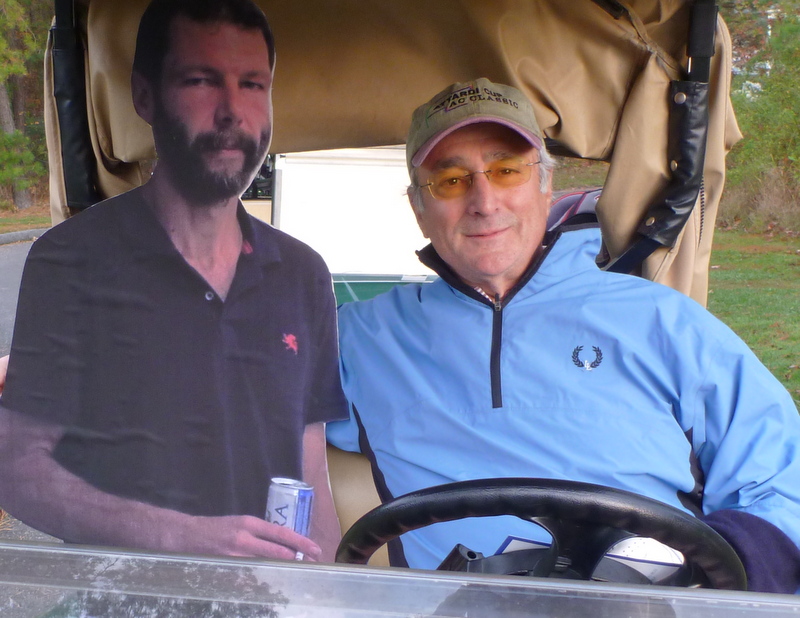
And he won fifteen bucks playing golf—which is better than Mike A. did. Here he is in a golf cart with Other Gene:

P1100030

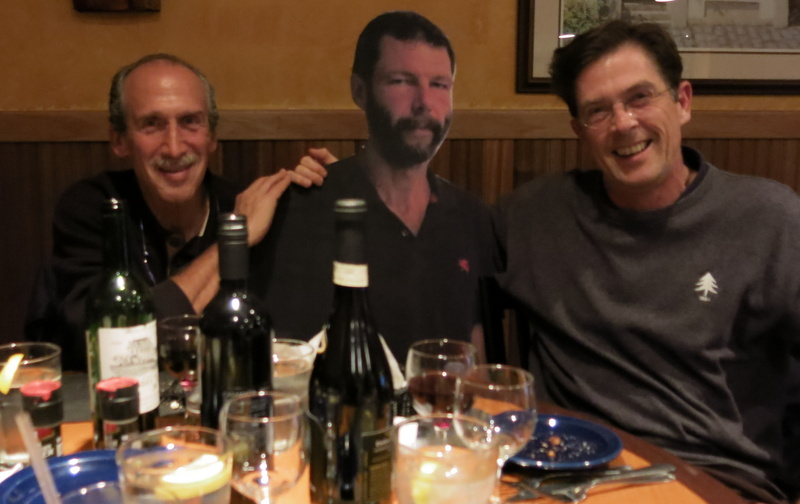
Anyway, it was nice to have him along, and we’re all hoping that next year, or the year after that, he’ll be able to make it in person:

Les, Peter P., Tim, Basilicos Ristorante, Sea Isle City, NJ, October, 2013.

Les, Peter P., Tim, Basilicos Ristorante, Sea Isle City, NJ, October, 2013.

Shep’s Cool Spinning-Golf-Ball Trick

During my Sunday Morning Group’s recent golf trip to Atlantic City, Shep—who used to play on a professional tour in South America and now is a stockbroker—demonstrated several cool golf-ball tricks, including the one shown in the video below. He got the ball spinning by bouncing it back and forth with his wedge, then held it, still spinning, on the clubface.

The trick, it turns out, is even harder than it looks, although Josh was able to make a ball spin (in the air) alternately clockwise and counterclockwise. Well, forget it. A little later, we saw two guys shooting a pistol at a target. They stopped while we teed off—which was nice, although it made no difference, since you could hear the gunshots all over the course.

Golf-Hating Masochist Builds House on Golf Course

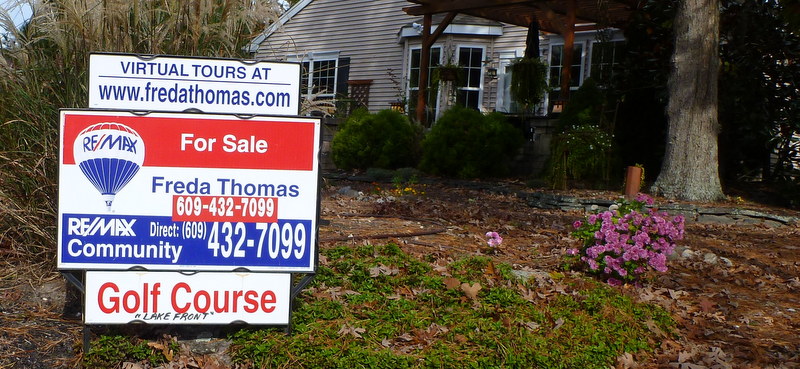
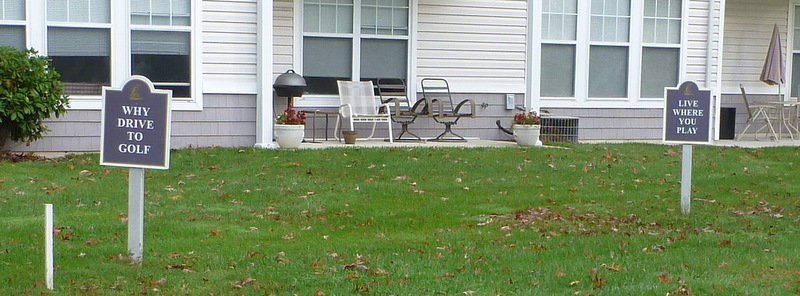
Most people who live on golf courses play golf, or like golf. This for-sale sign faces the course, not the street. The "lake front" it mentions is a swimming-pool-size water hazard. In other words, it's a dream house.

Most people who live on golf courses play golf, or, at the very least, like golf. This for-sale sign faces the course, not the street, because the real-estate agent knows that golfers are the people most likely to be interested in buying a house with a view of a fairway. The “lake front” mentioned down at the bottom of the sign refers to a water hazard the size of a swimming pool. In other words, this is a golfer’s dream house.

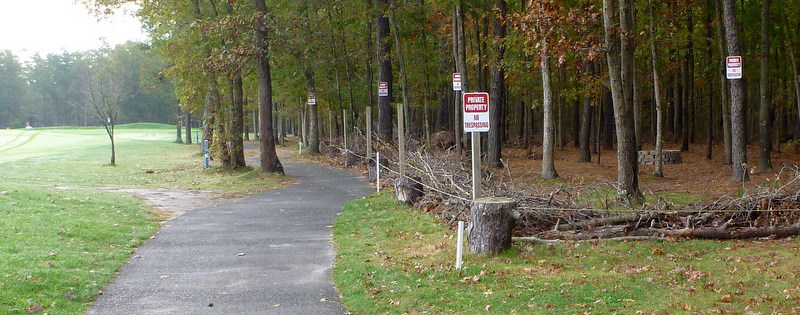
The Sunday Morning Group has just returned from its annual end-of-season golf trip to Atlantic City. We had a terrific time (and I’ll have more to say about the trip over the next couple of weeks). Two of the three courses we played had houses or condos along some of the fairways. People who live next to golf holes do so at least partly because they love golf—or so you would think. The guy whose property is shown in the photos below apparently does it to keep himself in a constant state of agitated fury.

P1100043

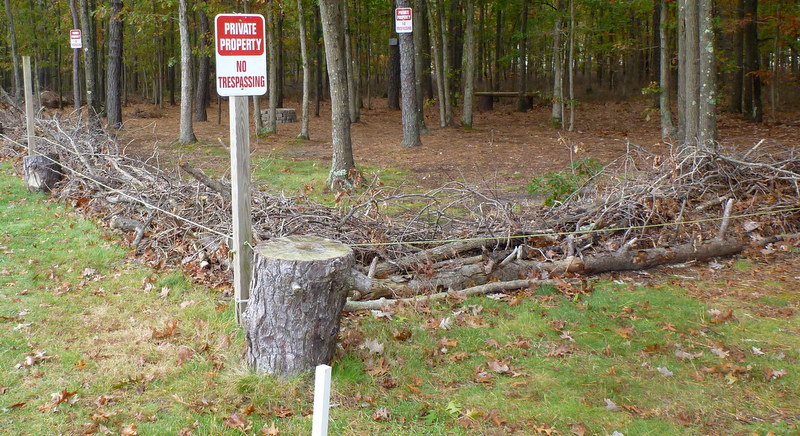
The brush fence shown in the photo above runs along the guy’s rear property line, and, lest anyone think those branches fell from the trees in neat piles and straight lines, he added no-trespassing signs, fence posts reinforced with rebar, nylon rope, out-of-bounds stakes, and a red line painted on part of the cart path where the asphalt apparently encroaches a few inches into his yard:

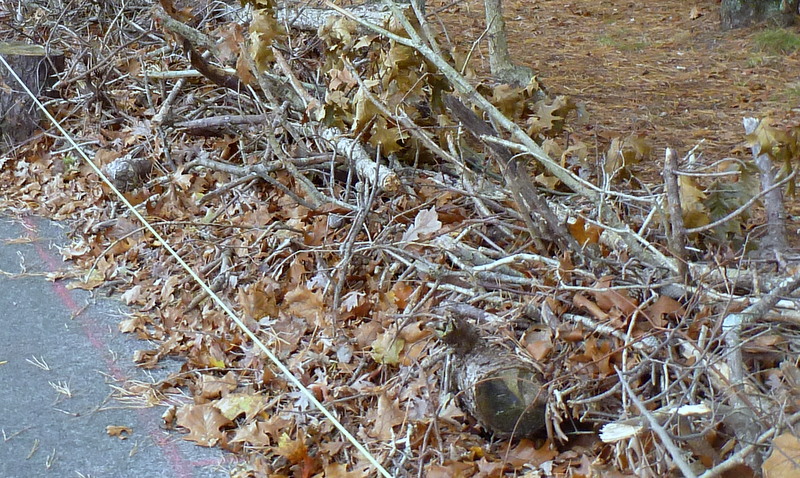
The red line painted on the edge of the cart path in the lower left-hand corner of the photo, just below the nylon rope, runs along the edge of the property. Did the owner hire a surveyor to  determine the exact location of the line?

The red line painted on the edge of the cart path in the lower left-hand corner of the photo, just under the nylon rope, runs along the edge of the property. Did the owner hire a surveyor to determine an exact location for the line?

The creation of this barrier was not the work of a single afternoon.

P1100045

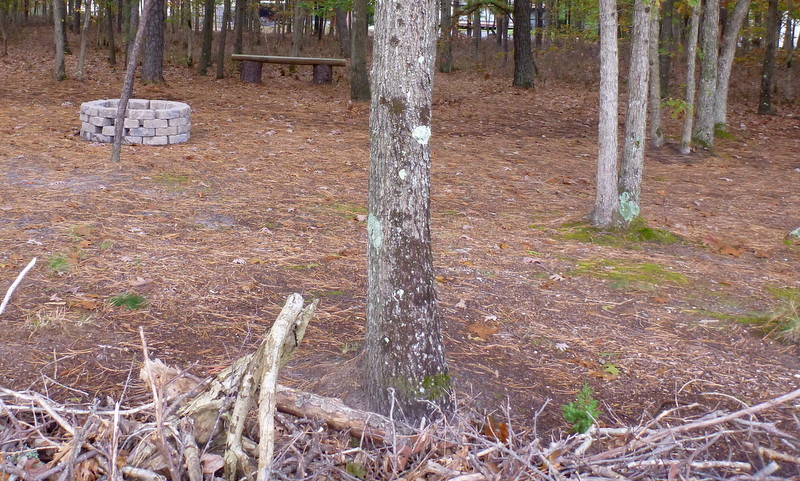
The owner also installed a bench and a fire pit near the brush fence, perhaps so that he can keep golfers under personal surveillance and incinerate balls that land inside the barrier.

P1100049

Last spring, I played a couple of rounds at Formby Golf Club, in England. A rich guy whose house backs up to the seventeenth tee had installed close-circuit video cameras on tall poles at the edge of his property, to keep an eye on the golfers. Wouldn’t it be easier to live somewhere else? Or maybe some people just enjoy feeling pissed-off all the time. The signs below are more in line with my own thinking.

P1100035

What’s In My Bag, Part Five: Awesome New Putter

Daddy LLTony bought a new putter and told me he couldn’t miss anything with it. I tried it and couldn’t miss anything with it, either. Then Tony went on a golf-free trip with his wife. I asked him if I could use his putter while he was gone (and keep it if anything happened to him on the trip). He said I could, and told me where to find the key to his garage—unnecessarily, it turned out:

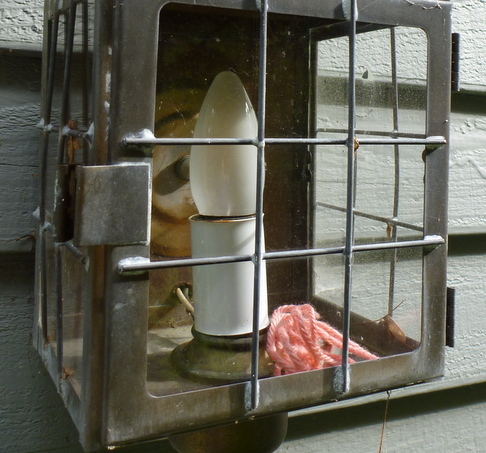
Tony's wife, Teresa, tied pink yarn to the key, to make it easier for burglars to find.

Tony’s wife, Teresa, tied pink yarn to the key, to make it easier for burglars to see. Like them, I spotted it immediately.

New putters always work for a day or two, but Tony’s putter worked for the entire time he was gone, and just before he got back I bought one for myself. Meanwhile, Chic—entirely independently—went to Golfers’ Warehouse, as an alternative to throwing himself off Bad Putters’ Leap, and, after trying every putter in the store, he came home with one, too. That made three of us, and I just learned that Dan now has one as well.

DLL

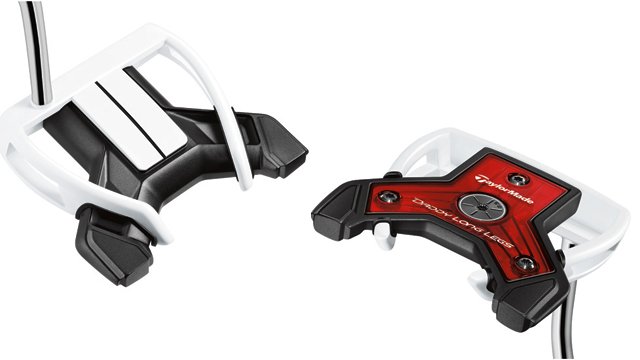
The putter is the Daddy Long Legs, by TaylorMade. The company has scientific-sounding explanations for why it works so well, but, for all I know, they make that stuff up. Whatever the real reasons are, it’s by far the best putter I’ve ever owned. It comes in two sizes—one with a thirty-five-inch shaft, and one with a thirty-eight-inch shaft—and I now own both.

Tony and his Daddy Long Legs, on the way to winning the senior division of a local amateur tournament back in July.

Tony and his Daddy Long Legs, on the way to winning the senior division of the Danbury Amateur, back in July.

There’s an old guy at our club who putts with an Acushnet Bullseye, which he recently re-gripped with electrical tape and what looks like tennis-racket tape. That’s ridiculous! It’s a piece of crap! It’s been obsolete for decades!

bullseye

Back in the early nineteen-nineties, I spent some time with the late Karsten Solheim, the founder of Ping and the inventor of perimeter-weighted putters and irons. Solheim took up golf in the nineteen-fifties, while he was working at General Electric. He putted poorly, but he decided, eventually, that his difficulties were primarily the fault of his equipment. Most putters of that era, including the Bullseye, had heads that were uniform in thickness, so that the weight was evenly distributed from one end to the other. “Hitting a golf ball with one of those putters is like hitting a tennis ball with a Ping-Pong paddle,” he told me. “The weight isn’t in the right places, and it twists in your hands.” In his garage, he took a small rectangular aluminum bar and attached a lead weight to either end. He then attached a shaft near the center of the aluminum bar. With this crude club, he went to the practice green, and found he didn’t have to hit a ball in exactly the right place in order to make it go straight.

Patent drawing for Karsten Solheim's original heel-and-toe-weighted putter,

Patent drawing for Karsten Solheim’s original heel-and-toe-weighted putter, 1962.

Solheim made various refinements, and hawked his putters at tour events. His big break came in 1967, when Julius Boros won the Phoenix Open with a model called the Anser.  (The name had been suggested by Karsten’s wife, Louise, with the idea that the putter would provide an “answer” to Arnold Palmer, who had been unmoved by one of her husband’s demonstrations. Solheim had to leave out the w to fit the name on the back of the putter head.) All modern putters embody his ideas about weighting, in one form or another. And the Daddy Long Legs takes those ideas to a new level.

Karsten and Louise Solheim.

Karsten and Louise Solheim and their wares, early nineteen-sixties.

Or so I assume. At any rate, I love my new putter and, no, you can’t borrow it. You can’t steal it, either, because unlike Tony I don’t keep it in my garage.

(Read Part OnePart Two, Part Three, and Part Four.)

What's In My Bag?

What’s In My Bag?

How Autumn Leaves are Deposited on New England Golf Courses

If you don’t live around here, you may not be familiar with the process shown in the video above. The leaves are imported from China, or someplace, and the wind does most of the work. The colors are nice. P1090888 I shot the video on Monday at our Enemy Club No. 2, where I played with Hacker (real name) and Paul. We have a big team match coming up there in early November, and Hacker and I were studying the greens. Paul joined us because he had nothing better to do. We played 10-Ball with a Snake add-on.

Hacker, seventh green, Enemy Club No. 2.

Hacker, seventh hole, Enemy Club No. 2.

The course is my second favorite nine-holer in our part of the state—after our home course, naturally. It was built on the former estate of some rich guy, and it has lots of old apple trees, which are left to look after themselves. P1090894 Whenever I play there in the fall, I cram apples into my golf bag. They taste a million times better than any of the apples in a grocery store. In fact, I hate apples, except for these.

I had a little trouble zipping this back up.

I had a little trouble zipping this back up.

There were very few other people on the course—a surprise, given how nice the day was. We saw a guy on the practice green who said he was trying to become a less crappy putter.

I think the thing on his left arm may be a practice gadget, too.

I think the thing on his left arm may be a practice gadget, too.

And we saw a kid who, apparently, had invented a game that’s even more complicated than the stuff that Hacker and Tim come up with. P1090930

The Day I T-Boned the Mercedes of the President of Pine Valley

Ernie Ransome, No. 18 tee, Pine Valley Golf Club.

Ernie Ransome, eighteenth hole, Pine Valley Golf Club.

Ernie Ransome, shown above, was the president of Pine Valley Golf Club from 1977 until 1988, and Pine Valley, as you surely know, is one of the two or three best golf courses in the world. Ransome died this year, and Jerry Tarde, the editor-in-chief of Golf Digest, wrote an essay in which he described Ransome, affectionately, as the club’s “all-powerful dictator.” He recalled that Ransome “presided over annual meetings that took no more than six minutes as, for example, the club treasurer would report, ‘I have not seen the financials, but I’m told income exceeds expenditures.’ At which point, Ransome would interrupt, ‘All in favor of the budget submitted by the treasurer, say, ‘Aye.’ All opposed, say, ‘I resign.'” Clifford Roberts, the legendarily gruff co-founder of Augusta National, would have approved. When Roberts, at a meeting of the club’s governors, asked Charles Yates, the board’s secretary, whether he had the minutes, Yates asked, “Do you mean last year’s, this year’s, or next year’s?”.

Clifford Roberts, the archetype of the golf-club benevolent dictator.

Clifford Roberts, the original golf-club benevolent dictator.

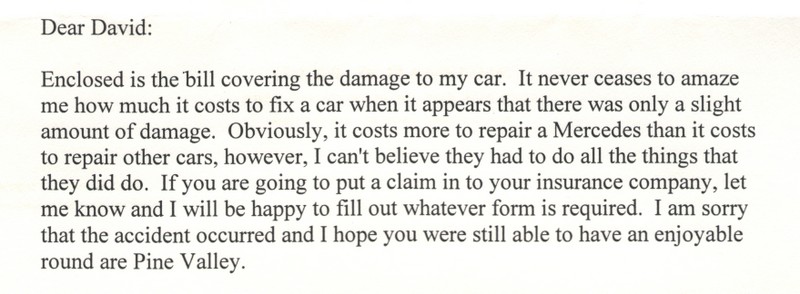
I’ve been lucky, over the years, to play quite a few rounds at Pine Valley. One day in 2001, while I was visiting as the guest of a man who, at the time, was also a member of my nine-hole home club, I set out in my car for the club’s driving range, to hit a few balls before our group teed off. At the little intersection nearest the clubhouse, I nosed out a few feet past the stop sign and, when I did, crashed into a Mercedes, which was coming down the hill from the right. Luckily, I recognized the driver as Ransome, and apologized profusely, even though I wasn’t certain the crash had been my fault. A maintenance cart with a trailer attached to it was parked across the intersection, and Ransome, in order to avoid it, had been driving on the wrong side of the road. He had also been driving quite fast. At any rate, he said that he was late for a doctor’s appointment, and asked me to let Lenny Ward, the club’s caddie master, know what had happened. I did, and when I met with Ransome that afternoon I told him to simply send me the repair bill. And that’s what he did.
Ransome Letter

The bodywork had been done at a dealership in Delaware owned by Buddy Marucci, a Pine Valley member and Tiger Woods’s opponent in the extraordinary final match of the 1995 U.S. Amateur.
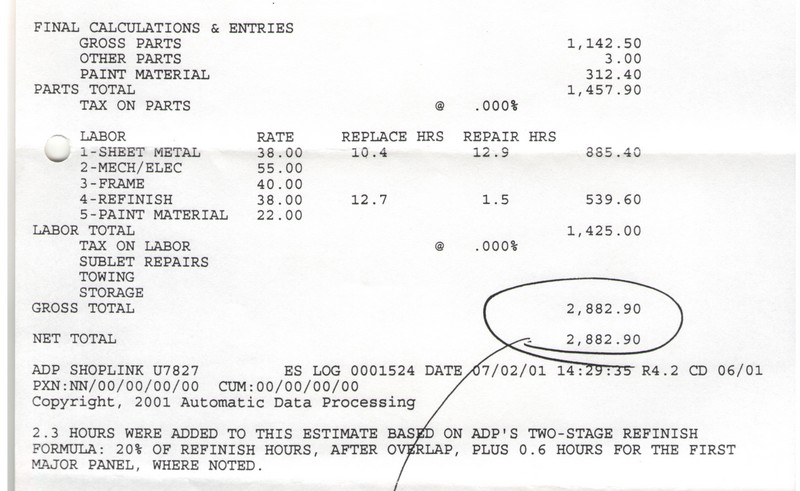
marucci bill

I happily paid the bill, and I didn’t make an insurance claim, because I didn’t want an adjuster to take a position that might upset Ransome and, as a consequence, make life unpleasant for the member who had been my host. I decided to think of the $2,889.20 as a retroactive surcharge for all the rounds I had played at Pine Valley over the years, and when I divided it by that number it didn’t seem onerous.

Owen letter

Here’s another Ransome story from Jerry Tarde’s tribute:

One day as Ransome was approaching his ball on 11, a golfer hit a particularly bad drive off 16 and, reacting viscerally, winged his club into the sandy waste in front of the tee. Ransome, with hands on hips, did what might be described as a slow burn in the fairway, which caught the eye of the angry golfer still standing on the tee. “We. . .don’t. . .throw. . .clubs. . .at Pine Valley,” Ransome finally boomed.

“I’m the member in this group,” yelled back the angry golfer. “Who the [expletive] are you?!”

To which, Ransome immediately replied: “Not anymore you aren’t.” Then, to the caddies: “Boys, take the bags in.”

You see, that’s what I wanted to avoid.
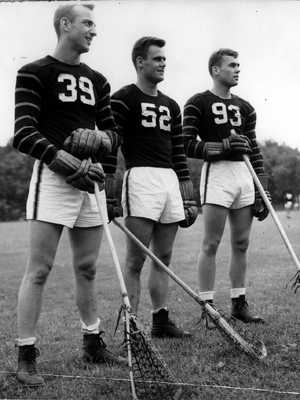
Ransome played lacrosse at Princeton. That's him in the center in 1946.

Ransome played lacrosse at Princeton. That’s him, in the center, in 1946.

Golf in the Rain—But Not the Presidents Cup

P1090651

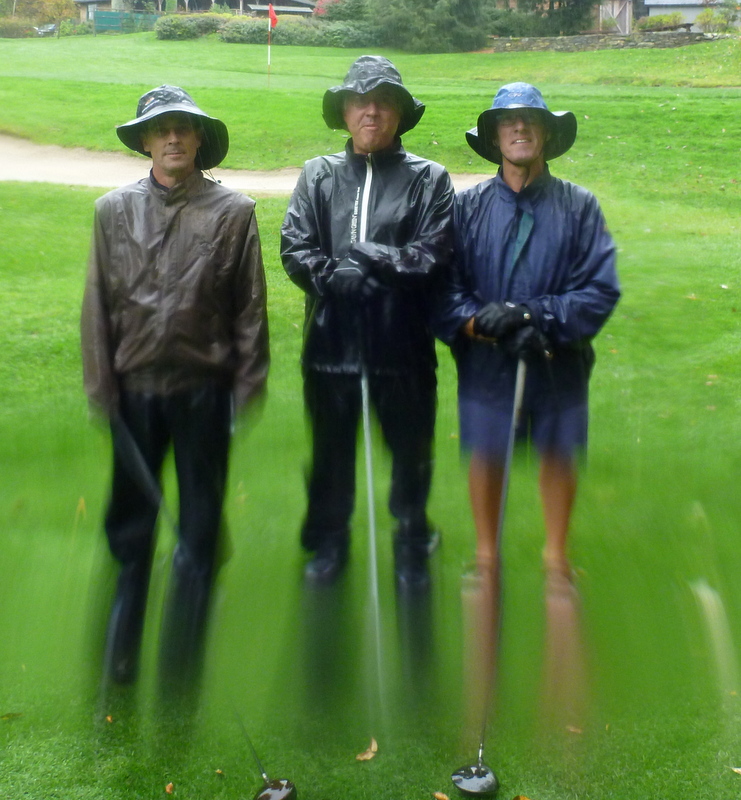
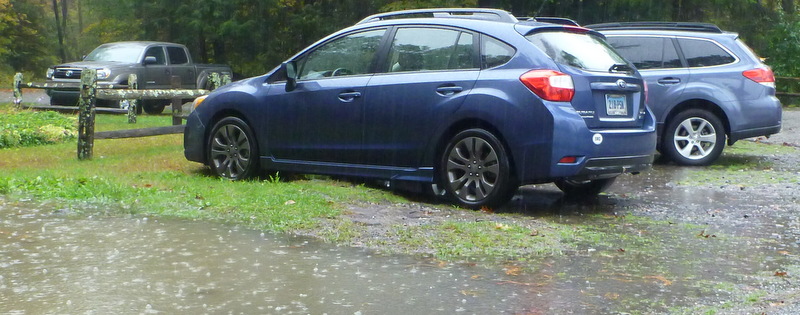
The rain that caused delays at the Presidents Cup reached my part of the world on Saturday night. It was still coming down on Sunday morning, when my friends and I assembled. We couldn’t tee off right away, because the greens were submerged.

P1090638

Barney went to get coffee, and we talked about going out to breakfast. After an hour, though, we said the hell with it and teed off. We had eight guys plus Peter P., who is still recovering from his car accident and so was playing in absentia.

P1090724

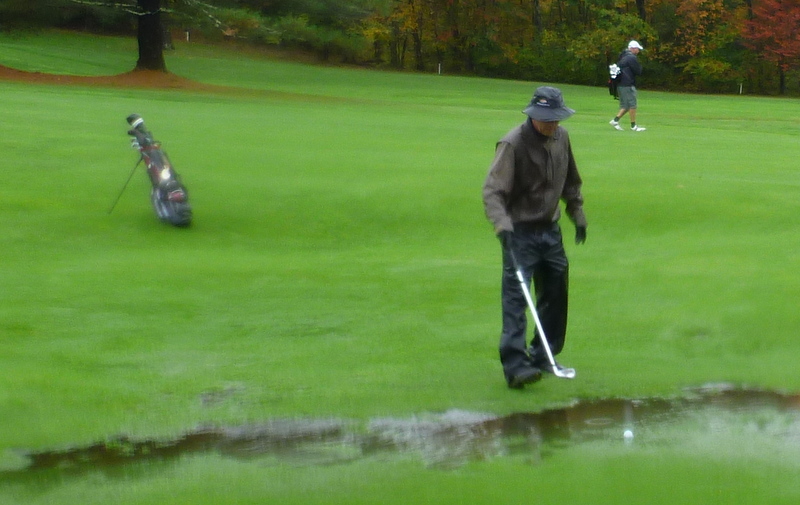
The course was wet, but it was playable, and when the rain let up a little bit most of the puddles disappeared.

P1090677

On a dry day, you can step across this creek:

P1090764

Keeping the scorecards dry was problematic:

P1090737So was keeping water off the lens of my camera:

P1090771

But playing was better than going home and doing chores, and in areas where the water was too deep you could take relief.

P1090788

The tee shot from on No. 13, which on Sundays we play from the tips, was even more intimidating than it usually is, but after thinking about it for a while Barney decided not to lay up.

P1090748

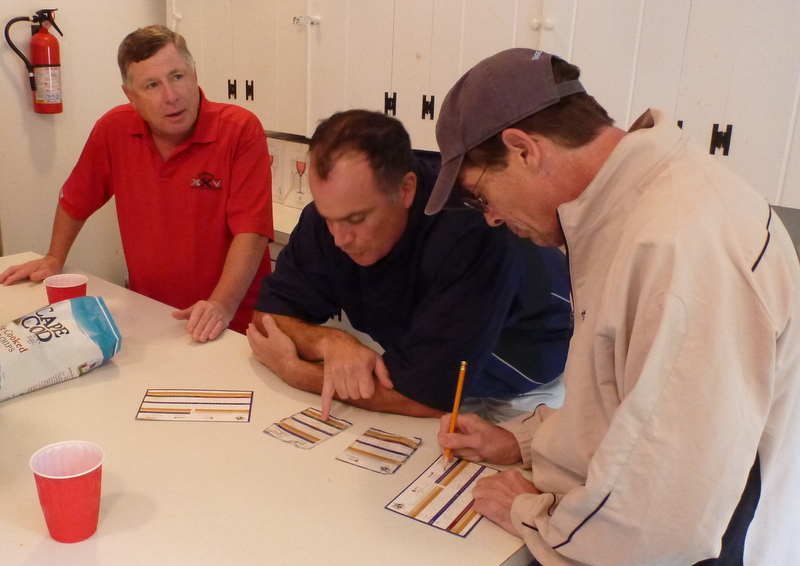
The round took just over three hours, and we all shot about what we usually shoot. Then we grilled cheeseburgers, as always. We ate them in the clubhouse kitchen rather than on the patio, though. That’s also where we did skins, after reconstructing the scorecards.

P1090811

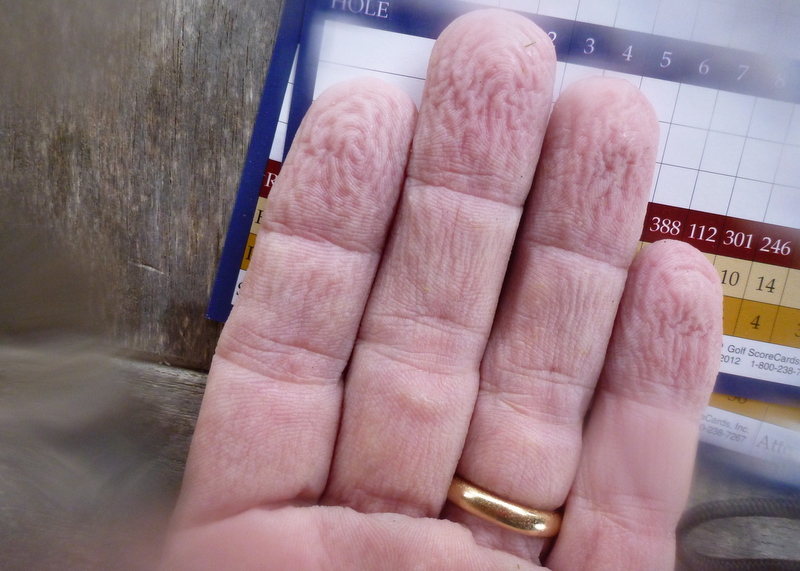
My team won, and I won two skins. My fingers looked the way my kids’ used to after their baths.

P1090803

Then it was time to go home.

P1090664

International Leaf Rule Now in Effect

P1090578All the big tournaments are over now. The club championship has been decided. The kids who worked in the golf shop all summer are back at school. Our Enemy Club has been defeated. The deer eating acorns between the fifth and sixth holes have grown so used to us that they scarcely look up when we play through. The International Leaf Rule is in effect. 
P1090604

I know people who live in places where golf can be played in shorts year-round. To them, the cycle of the seasons is a kind of poverty. But I think they are the ones who are deprived. For them, golf has no beginning and no end. They don’t get to savor a year’s two most consequential rounds: its first and its last. One season blends into the next, and they never reach a point from which they are forced to assess their golf game’s progress or decline.

P1090609Hacker (real name) and I had the course to ourselves for our first nine holes on Tuesday afternoon. Barney, who didn’t have to pick up his daughter until four-fifteen, joined us at the turn. We waved to an older member who used to play by himself but now is always accompanied by his son. He uses something called Martini Tees, and when he misplaced one the other day he had his son call the golf shop to report it missing. His son acts as his caddie and navigator, guiding him from hole to hole. Golf is almost over, but not yet.

P1090582