Huge Falling Tree Crushes Golf Carts

On the right-hand side of the photo above—which I took this past Saturday morning, at the beginning of an annual mixed event called the Fall Classic—you can see a huge, ancient, two-trunked oak tree just past the end of the golf shop. About three and a half hours later, toward the end of the tournament, the tree suddenly fell down. My foursome was on the far side of the course when it went, but even from that distance the sound was like an explosion. Here’s what I saw when when I got back to the first tee:

The course was full of golfers, but, amazingly, no one was standing near the tree when it fell, and no one was sitting in any of the golf carts parked beside it. Bob W. and Nick-who-works-in-the-golf-shop were playing a putting game on the practice green, and they watched it go down.

The roots picked up the water cooler near the first tee and flipped it over the split-rail fence, onto its roof:

That’s Margaret’s coffee mug. It was unharmed.

Within an hour, our favorite tree guy, who played with Gene B. in the member-guest this year, was on the job. He and his crew cleaned up everything but the two main trunks, which were too big for the chipper.

The next morning, my friends and I posed on the trunks before we teed off. We’re thinking about turning them into a bench. Or maybe we’ll just leave them where they are. That would definitely be easier. Maybe we’ll leave the squashed golf carts there, too, as a reminder that golf carts don’t last forever.


Alien or Shooting Star? Mystery Golf Photo

I took the photo above the other night and shared it with Graham Stevens, the reader who was kind enough to write about his recent experience at a carts-only course in North Carolina. He used his iPhone to show the picture to his daughter, who is seven, and asked her to guess what it was. Her responses, in order:

  1.  A skinny alien.
  2.  Saturn and a shooting star.
  3. A spooky person staring through the crack of a door with a glow stick on their ankle.

Stevens, in an email, told me: “She then used her fingers to zoom in on the bottom of the picture and said, ‘It looks like a green golf hole.’  I said, ‘Correct!  It is a golf hole.’ She said, ‘Tell your friend he needs a new camera.’ I said, ‘He was playing at night.’ She said, ‘Is he crazy?'”

My crazy friends and I did play golf at night last week, and I’ll be writing about our experience in a future issue of Golf Digest. If you’ve never played golf in the dark, or if you haven’t done it recently, you should watch for the story. As with every other aspect of the game, the technology has improved.

My glowing red ball.


Hunting in Hazards

Two examples, from Monday afternoon. That’s a great blue heron in the photo above. It’s looking for dinner at the junction of two streams on the fifteenth hole. And that’s Rick in the photo below, looking for his drive in the lateral to the left of the thirteenth fairway. He, Adam K., Hacker (real name), and I teed off at 4:00, and we had just about run out of daylight by the time we finished, at 7:00. I missed my first opportunity in several months to play golf in a sweater. Oh, well. More opportunities ahead.

The Guys I Usually Play Golf With Golf School

Meet our faculty.

Like most casual players, I receive the bulk of my golf instruction not from PGA professionals but from the guys in my regular weekend group. When I loop a screamer out of bounds, for example, they don’t hesitate to tell me what I did wrong—and I return the favor. We all have a solid grounding in swing mechanics, which we acquired from magazines, books, Johnny Miller, and the Golf Channel.

We know so much, in fact, that we could probably help you, too. And that’s exactly what we’re going to do at our new golf school, The Guys I Usually Play Golf With Golf School. The instructors are my buddies and me, and we will devote the same thoughtful attention to your swing that we have always devoted to our own.

The main thing you should know about our school is that we’re not going to change your grip. That’s because there are only two things that can go wrong with a golf swing, in our opinion: getting a little quick and moving your head. When you get a little quick, one of us will say “Little quick there,” or “Nice ‘n’ easy now,” or “Low and slow, ol’ buddy.” That usually does the trick. If it doesn’t, Nick will say, “Keep your head down, stupid”—which is not an insult, because he says the same thing to himself before every swing.

If you’re having trouble off the tee, we’re probably going to suggest that you try Brendan’s new driver. Brendan has hardly ever hit a bad shot with it, and when he hurt his thumb last fall and couldn’t play for a month, we snuck it out of his bag and passed it around. Hacker (real name) later bought a driver just like it, but Brendan’s actual new driver is the only one that truly works almost all the time. When your turn with it is over, we’ll send you into the golf shop to buy a new driver of your own. The brand you choose won’t matter, as long as it’s one of the expensive ones, which always work for a week or two.

We own every training aid ever manufactured, and you can take your pick, if you don’t mind wading through the junk in our garages. Help yourself to my old snow tires, too. Our short-game clinic is taught by Bruce and George. Watching those guys chipping and putting for an hour will turn you into Phil Mickelson, by comparison. (An hour’s the limit, though; overexposure could turn you into them.) They also teach a class in deep-water ball-retrieval.

All our lessons are playing lessons, by the way. Net best ball, first-tee do-over, no junk, no gimmes, no strokes on par-3s. We’ll explain the rest when you get here. The first round of beers, needless to say, is on you.

Don’t worry—we’re not going to mess with your grip. Or your wardrobe.

Members Caddying for Members

Brad (now our club president) making the official call on who is taller: Tim (light blue shirt) or Ben (with SoBe bottle), who is Tim’s son (and caddie). Summer, 2007.

Many years ago, my friend Art caddied for my friend Jim in the chump flight of our club championship. When Art showed up on the practice tee with a damp towel draped over his shoulder, Jim’s opponent threw a fit. “You can’t have a caddie,” he said. “It isn’t fair.” Art’s handicap was very low, and Jim’s and his opponent’s were very high. With Art reading Jim’s putts, the opponent complained, Jim would have an unreasonable advantage.

Our pro overruled his objection, naturally, and, using the rule book, proved to him that caddies are as much a part of golf as bunkers and casual water. Jim’s opponent remained upset, however. Conciliatorily, Art agreed to turn his back whenever he swung, so as not to make him nervous.

Since that time, members caddying for members during important tournaments has  become a tradition at my club—as I mentioned in my previous post. Friends caddie for friends, sons for fathers, fathers for sons, brothers for brothers, victims for victors. Caddying takes some of the sting out of the octuple-bogey that kept you from advancing to match play. It also turns an individual match into a team event, and, in a thought-provoking way, inverts the chemistry of rivalry.

I’ve caddied for several friends over the years, and several friends have caddied for me; mostly, I’ve caddied for my friend Ray, who is one of my club’s best players. One year, when he and I met in the first round of a big tournament, we agreed that the loser of our match would caddie for the winner the rest of the way. That was pretty much the same thing as my agreeing that I would caddie for him, since he was the defending champion and I had barely survived the qualifier. And, in fact, that’s the way it worked out.

Caddying is a challenge because it requires you to maintain a precise but shifting balance between involvement and invisibility. My worst failure as a caddie came during the final round of the club championship one year, when, intoxicated by the emotion of the match, I loudly disputed a rules interpretation made by our pro. My biggest contribution occurred during the same tournament a few years before, on a par-5 where Ray had hit his drive into a terrible position from which to go for the green. Ray is a stubborn, aggressive player, and he doesn’t like to lay up. He took a long look at his lie, though, and said, morosely, “I guess I should just knock it down there with a wedge”—the sensible play, and, as he knew, exactly what I myself would have done.

But I swallowed hard and said, “That doesn’t sound like you.” The gloomy look vanished from his face. He took his three-wood, and—from a sidehill, downhill lie—hammered his ball just short of the green. It was a dangerous shot, which I would never have attempted and could never have pulled off. But (as I had to keep reminding myself that day) I wasn’t the guy playing the match.
Report from the Club Championship

On Sunday, Addison and I played in the final match of our club championship. At 5:25 the evening before, I received this email from him:

Headed to the course if you’re interested in a quick nine right now. Will wait til 5:40 for a response. Or just be there by 5:40.

He sent the email from his phone, in his driveway, but I beat him to the course, and we teed off at 5:38, for a practice round. On the fourth hole, we saw a red-tailed hawk fussing with something on the ground—maybe a chipmunk. When we got close, the hawk moved to a tree and turned its back to us:

Except for the hawk and whatever it was eating, the course was empty, and we played half of a Two-Hour Eighteen™ in 55 minutes. Then we went to dinner at our favorite restaurant, Popey’s—which is pronounced “Poppy’s.” (Don’t bother searching for it on Google, unless you’re interested in Popeye.)  One topic of discussion: how easy it would be, with a little red, blue, black, and white paint, to make the name on the sign look the way it’s pronounced. Also, we got ice cream.

Our club championship final is 27 holes. The next morning, Addison and I teed off at 8:00, and played the first 18 holes in two hours and fifteen minutes. It was too early to start the final nine—the Sunday Morning Group was still playing, among other reasons—so, to kill time, we went to lunch at our second favorite restaurant, the Hidden Valley Eatery,  with Tony, who was caddying for me. (One of our club’s best traditions is members caddying for members. In last year’s final, Gary, our superintendent, caddied for Ray, who won.)

Hidden Valley wasn’t serving lunch yet—too early—so all three of us ordered breakfast pizzas, a house specialty. Bacon, cheese, tomatoes, something, something, and two fried eggs. Then, back to the course for the final nine, with the usual gallery:

(I won!)

Push Carts on Tee Boxes? On Greens?

Push carts on putting green, Victoria Golf Club, Melbourne, Australia, June, 2010.

During the women’s member-guest at my club, a couple of weeks ago, a few guys from my Sunday Morning Group played a travel round at our enemy club, on the other side of town. (We have a reciprocal arrangement for tournament days, etc.)  A member strode up at some point and told them to stop rolling their push carts onto the tee boxes—and later he strode up to again and told them not to put their golf bags on the tee boxes, either. (Hey, maybe they should remove their golf shoes, too.)

I took the photos above and below at Victoria Golf Club, near Melbourne, Australia, in 2010. (The Australian Masters was played at Victoria that year and the next.) Players there are asked to roll their push carts and pull carts not just over the tee boxes but across the greens, to keep the fringes from being beaten up by concentrated foot traffic. Other Sandbelt courses have the same policy—including Royal Melbourne and Kingston Heath, which are ranked No. 22 and No. 11, respectively, on Golf Digest’s list of the 100 Best Courses Outside the United States.  Ditto Bandon Dunes (although at Bandon golfers with carts are asked to cross the greens only, and not to park their carts on them).

These practices makes perfect sense, because a push cart weighs much less than a greens mower. Or a tee mower. Or any of the guys that you or I play golf with. So lighten up, enemy club.


Golf Innovation: Slow-Play Workaround

There’s a birdhouse near the ninth tee at my home course, and if you’re stuck behind slowpokes you can use it to pass the time. A hundred points for chipping a ball through the opening, five for hitting any part of the birdhouse, one for hitting the tree—or whatever. That’s Addison in the photos above and below, and, as you can see, he has the kind of short game you need to excel in this game. Tony had the idea of putting a dollar in the birdhouse each time you play, winner take all.

I learned another slow-course game from Reese, who is Addison’s father. It’s called Poison. Each person in your group, in turn, uses his driver to chip a ball from one tee marker to the other. (If you hit it, you get to go again.) Once you’ve hit it, you chip back to the other tee marker, and once you’ve hit that one your ball becomes poison and you can eliminate other players by hitting their ball with yours. There’s more strategy than you would think, especially once multiple balls have become poison. Suggestion: assign someone to keep an eye on the group ahead, so that your slow-play solution doesn’t become part of the problem.

Reader’s Trip Report: Sand Hills Golf Club

Sand Hills Golf Club, 16th hole.

Adam Sachs, a reader from Kansas City, recently returned from a trip to Sand Hills Golf Club, near Mullen, Nebraska. Excerpts from his report:

Sand Hills is a sublime private venue for purists willing to travel ten hours or more to The Middle of Nowhere, Nebraska. Here’s the pre-game formula:

(1) Either fly to Denver or Omaha and drive four hours on I-80, then another one to two hours through a landscape that looks like what you might think you’d see on the moon, including sand-dune craters; or fly private or commercial into North Platte and drive an hour and fifteen minutes up state highway 97 to mile maker 55.  (Note: if you reach Mullen, the closest town, you’ve gone about thirteen miles too far north.)

(2) Drive about two and a half miles down a winding road, free from power lines or really much of anything, veer straight/left past Crenshaw Drive.

(3) Introduce yourself to the nice lady at the reception desk, identify your host, get your cabin assignment, load up your travel bags on a golf cart and take a short drive around back to some sparse but comfortable cabins: two firm queen mattresses, a couple of small TVs, a completely adequate bathroom with a shower, and a telephone for calls up to the Clubhouse and long distance collect calls. (There is almost no cell phone coverage and only limited Wi-Fi, in the lobby of the decidedly humble clubhouse.)

Seventeenth green.

I convinced my wife I had to go because my new client invited me. Turned out he checked himself into the hospital the night before the trip with chest pains. He’s fine—a little blood-pressure issue—but he never made it to Sand Hills. I played with ten guys I had never met and hardly know a thing about (besides their home courses: Castle Pines, Robert Trent Jones Golf Club, etc.) and had a fantastic time.

You can read Adam’s blow-by-blow account of his favorite holes here.The photos are his, too—including this one:

Dan Daly, the chef at the halfway house, preparing the staple meal of my own Sunday Morning Group.

How to Hold Your Own Golf Major

Hacker (real name), Ocean Course Scorecard, Les, August 12, 2012.

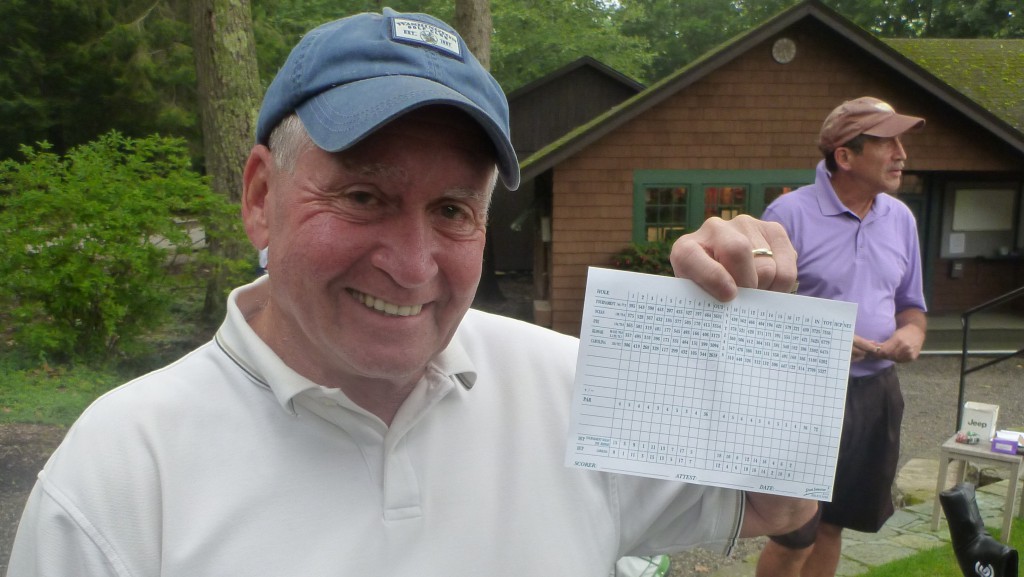
When my friends and I play on Sunday mornings, we use our Sunday Morning Group scorecard, which Jim created for us with a desktop publishing program that he uses in his job. Among other features, it lists our local rules, such as “You get an extra stroke if you wear shorts after November 1” and “No one gets a stroke on a par 3.” Some of the older guys complain about the par-3 rule, but what can we do? It’s printed right on the card.

This year, Hacker (real name) had the idea of celebrating golf’s four majors, on each major’s final day, by using not our own Sunday scorecard but the scorecard from whatever course the major was being played on. So during our regular game this weekend we used the scorecard of the Ocean Course at the Kiawah Island Golf Resort, where the PGA Championship was held. (You can download the Ocean Course card yourself, from either of the links in this paragraph.)

The main effect of using another course’s scorecard on your own course is that most of the handicap strokes fall in unfamiliar places. This impacts one of our local rules, because (for example) although our sixteenth hole is ordinarily a par 3 (meaning that no one gets a stroke on it), on the Ocean Course it’s a par 5 with a stroke index of 4 (meaning that anyone receiving 4 or more strokes that day gets a pop).

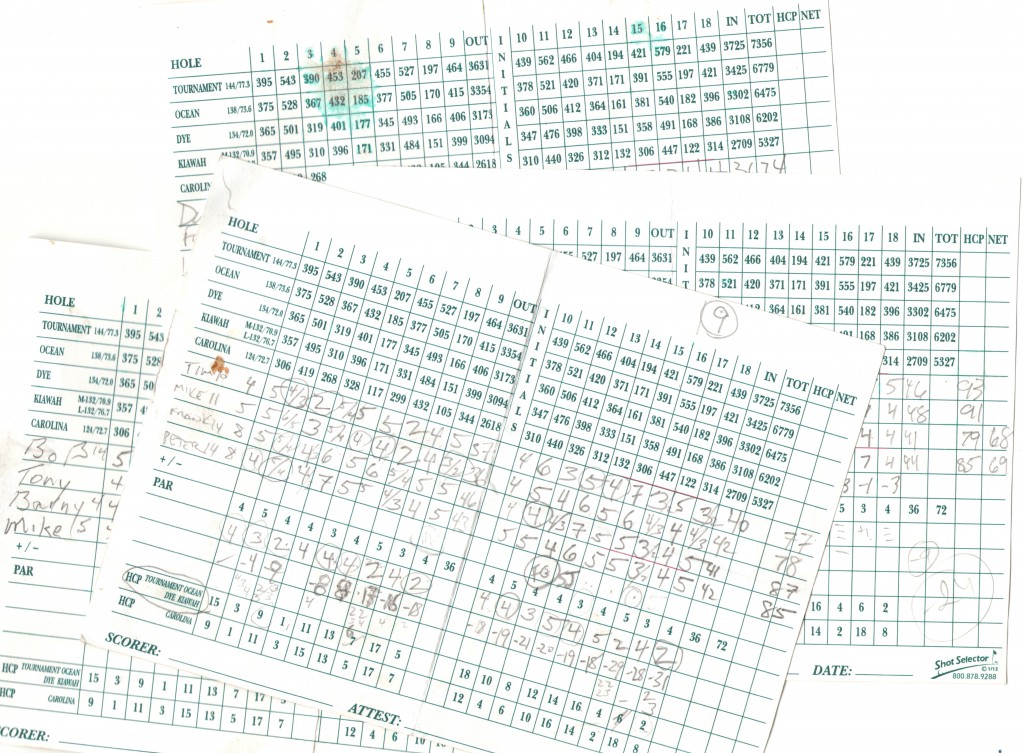
We compounded the impact by using a best-ball feature that I introduced a few years ago, called All Birdies. In All Birdies, all under-par scores on any hole count. On the sixteenth hole, for example, I had a 2 and my three teammates had net 2s. Since Kiawah’s sixteenth is a par 5, our four 2s counted as albatrosses and our team went -12 on that hole alone. That wasn’t enough to win, unfortunately, but we felt pretty tough for a while. (The winning team was Tim’s, at -31. Theirs is the top card on the pile in the photo below.)

Major results, Sunday Morning Group, August 12, 2012.