The Late-Season-Golf Problem, in Diagram Form

Several years ago, I played a few rounds in northern Scotland in December. The sun began setting almost as soon as it had risen, and even at noon it practically sat on the horizon. The late-season golf window here in Connecticut isn’t as narrow, but you have to pay attention. Five of us teed off at 1:00 this afternoon. We played in just over three hours, but by the end I was having trouble following drives. Mornings are tough, too:

Rick, November sun, Sunday morning, seventeenth hole.

Last week, I spent a couple of days in Kansas City without my golf clubs. My mother told me about a local country club, which a few years ago assessed its members for major improvements to the golf course. The assessment was substantial, and quite a few members left the club rather than pay it. Four of my mother’s friends went to the club one day for their regular bridge game, and when lunch was over they discovered that none of them could sign the check. All four, it turned out, had dropped their membership without telling the others.

Stanley on the second tee last Sunday, with his Crocodile Dundee hat (bought on eBay) and late-season club-carrier thing.

Golf Carts: Fairway or Rough?

The winning team, by a record margin: Chic, Gary, and Doug. Second hole, November 4, 2012.

Beginning November 1, the Sunday Morning Group gives an extra handicap stroke to anyone who wears shorts. Chic and Doug both did this morning—and Doug didn’t wear a hat, and after a few holes he took off his jacket—even though it was 35 degrees when we started. We had three threesomes, and we played two best balls, net, off the low handicap, which was four. Chic and Doug ended up on the same team, along with Gary, our superintendent, but the extra strokes were meaningless because they shot 12 under, which was 16 shots better than the second-place team (mine). That’s a record, as far as anyone can remember. Incidentally, the Sunday Morning Group’s record worst round is 9 over par, net, on one best ball; it was set on October 22, 2001, by Frank D., Rick, and me.

November 1 is also the day the golf shop closes for the year, and that means no golf carts from now till spring. (The carts are stored for the winter in a building behind the ninth green which somehow survived Hurricane Sandy—see the photo below.) The course always looks great once the carts have been put away, because there aren’t tire tracks running everywhere.

Thinking about that made me think about an unresolved controversy at many clubs, including mine: do golf carts do more damage on fairways or in the rough? Gnarly old rough seems “stronger” than manicured fairways, but cart tracks are usually harder to see in short grass than in long. I’ve played courses where players were told to keep their carts off the fairways, and I’ve played others where they were told to keep them out of the rough.

Several years ago, I asked Stacy Bonos, an agronomist in the Turfgrass Breeding Project at Rutgers University, who was right. She hesitated, but when I pressed her she said that, all in all, carts probably probably did less damage to fairways than to rough.

No more carts till spring.

Hurricane Sandy Golf Update

The huge old oak tree near the fourth green, which was nearly destroyed in the Halloween storm a year ago, dropped one more branch yesterday, during Hurricane Sandy, creating a shortcut to the fifth tee.

Playing golf during the hurricane turned out to be impractical, but five of us did play an inspection round Tuesday afternoon, after the storm had passed. There was surprisingly little damage to the course, other than the busted fence in the photo above and a white pine that had fallen across the fifth tee, visible in the photo below. We decided to play the pine trunk “as it lies,” and, because it was lying between the white tee markers, that meant getting the ball up fairly quickly.

Adam teeing off on the fifth hole.

Thirteen years ago, on the first night of the Sunday Morning Group’s first annual October golf trip to Atlantic City, we ate dinner at a terrific Italian place downtown. We looked for it again a couple of times during the next few years, but no one could remember its name or exactly where it had been, and we eventually gave up, although we didn’t stop talking about it. (“Remember that great Italian place we ate dinner at in 2000?” etc.) Last night, during the storm, while I was watching the Weather Channel and searching the Web for frightening pictures of hurricane damage, I noticed a photo on the MSNBC site of a flooded street in Atlantic City, and scared my wife by shouting “That’s it!”

And that truly is it: Angelo’s Fairmount Tavern, on Fairmount Avenue. Someone please tell me that the hurricane didn’t sweep it away.

Hurricane Sandy Golf

On Sunday, two three-man teams tied at -10, so we held a playoff: wrong-handed overhand throw over the fence between the first tee and the putting green, closest to the pin. This was supposed to present a “perfect storm” of difficulty, but Corey (our new pro) and Nick (who works in the golf shop and plays three sports at a local high school) can throw better lefty than most of the rest of us can throw righty, and since the two of them were on the same team it wasn’t close. That’s Corey, throwing, in the photo above. At the far right is Stanley, nervously practicing.

While the burgers were grilling, Hacker (real name) suggested that we play golf during the hurricane “to monitor the storm and protect the course.” We’re going to try that on whichever day the weather seems worst, assuming that trees haven’t fallen across our driveways. Someone said that we might as well play naked, because if we didn’t the hundred-mile-an-hour winds would “blow our clothes off.”

This hurricane has made everyone think about the storm we had exactly a year ago, when we lost power for a week and I had to fly to Chicago to take a shower. Here’s what things looked like then:

And here’s what the golf course looked like a week later, when I got back from Chicago:

No one thought we’d play again that year, but, thanks to Gary and his crew, we were open again as soon as the snow had melted, and we stayed open through New Year’s Day—a record by almost a month.

Beer-Related Golf Infrastructure

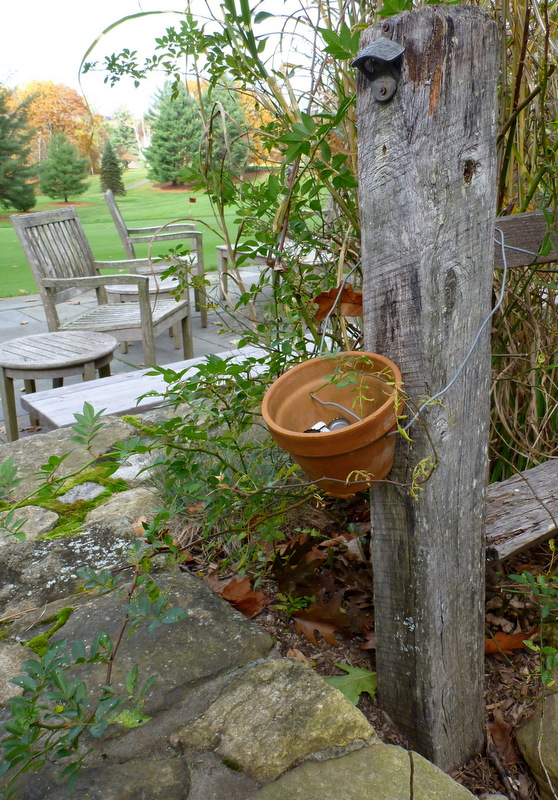
You can’t drink beer at the golf course if you can’t open the bottle. The Sunday Morning Group has two built-in bottle openers right on the beer-drinking patio, next to the clubhouse. One opener is attached to a fence post (see above—and note the flower pot, for catching caps); the other is attached to the Superintendent’s Chair (see below). The Superintendent’s Chair is where the superintendent always sits, unless he doesn’t feel like it or someone else is sitting there already.

Also, as backup, every member who played in this year’s member-guest has a belt with a beer-opener buckle (see below). Word to the wise: stand up before opening a beer with your belt. (If you’d like your own beer-opener belt—and what normal golfer wouldn’t?—you can order it here.)

Tap-Cap belt, by Bison Designs, proud sponsor of the Sunday Morning Group (or vice versa).

Playing Golf for Unbelievable Stakes

This is what Shep’s golf swing looks like, in case you’re wondering why Tony and I didn’t win the qualifier.

On Wednesday afternoon, Tony and I played Shep and Ben, straight up, for the championship of the world. They’re way better than we are, but we thought their relative unfamiliarity with our course would give us an advantage. It didn’t. They closed us out on the sixteenth hole, so we introduced an important Sunday Morning Group concept: the Qualifying Tournament. The sixteen holes we’d just finished, Tony explained, had been a qualifier for the day’s real action, a two-hole match for the championship of the universe. The top two pairs from the qualifier—them and us, coincidentally—advanced to the final, and because the two of them had (technically) finished ahead of the two of us we let them tee off first.

Not everyone likes the Qualifying Tournament concept, but rules are rules. And, as it happened, I birdied the seventeenth, putting Tony and me one-up in the main event. “We press you for the fourth dimension,” Shep said. I birdied the eighteenth, too—but so did they. That made Tony and me the undisputed champions of the universe, but it halved the press and, therefore, left the space-time continuum intact.

Can anyone identify the course in the photo above? We played there a couple of weeks ago, thanks to some shrewd favor-trading by Shep, and to get to it we took a boat (see below). Correct answerers, if any, will qualify for the next round.

A College Professor Revisits the Divot Question

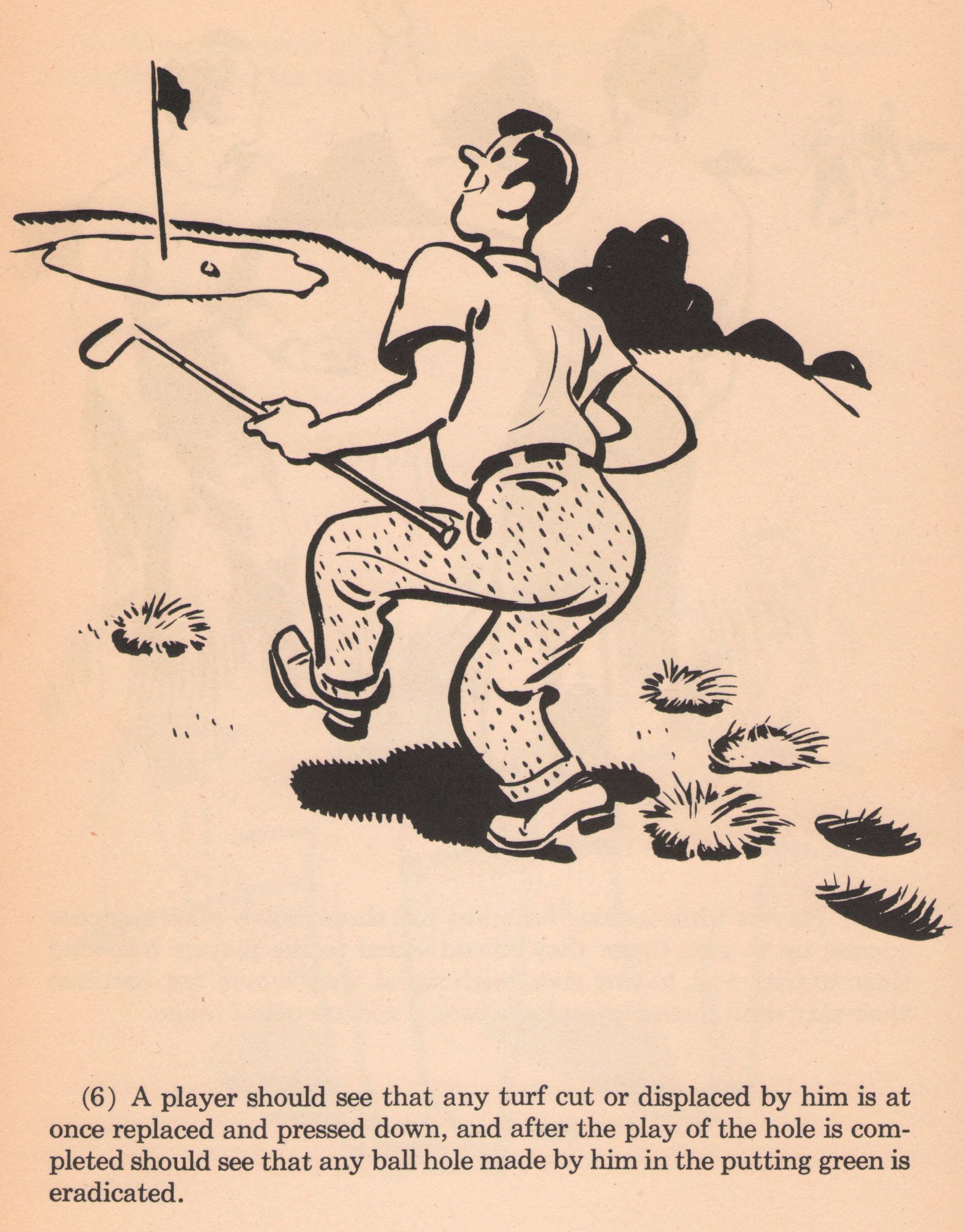
Divot-replacement advice from “The Rules of Golf Illustrated and Explained,” edited by Francis Ouimet, 1948.

A few days ago, I pointed out that golfers use the word “divot” to mean both a chunk of turf and the hole the chunk leaves behind.  I received a long, thoughtful comment from John H. Jones, who is a professor of English at Jacksonville State University, in Jacksonville, Alabama. (He’s also the author of a book about William Blake, which will be the inaugural selection of the Sunday Morning Group’s book club, if we ever start one.)  A couple of days later, he sent another comment, which I’ve reproduced below.

I asked Jones to tell me something about himself, and in an email he wrote, “I started playing golf when I was about fifteen, after it became unavoidably obvious that a career as a wide receiver in the NFL was out of the question.” He knocked off for graduate school, and didn’t play again for twenty-five years. “Then for some unknown reason, during the summer before last, I decided to pick up a golf club and give it another try.” Now he’s hooked. Anyway, here are his further thoughts about divots:

Looking back at the OED [Oxford English Dictionary] information about the usage of “divot,” I kept thinking that the first usage of the term meaning “a piece of turf cut out with a club” appearing in 1886 seemed awfully late, given the long history of golf. Of course, the game takes off and gets a great deal of publicity in the second half of the nineteenth century, but still, the written use of “divot” as a “slice of turf” goes back to the sixteenth century. Surely, I thought, the golf application must have come much sooner than 1886.

A little more research took me to Peter Davies’s “The Historical Dictionary of Golfing Terms: From 1500 to the Present” (2005), where I found no better historical information for the first usage of “divot” in golf. Davies’s first notice of “divot” is also by [Horace] Hutchinson, coming in the 1890 publication “Badminton Guide to Golf,” where he says, “No golfer is worthy of the name who does not put back his divot” (260), the same year and probably the same publication as the OED’s reference to Hutchinson in 1890. And it also conveys the same sentiment.

But I still had a difficult time believing that “divot” as a piece of turf cut by a golf club did not find its way into writing until that late nineteenth century. That may very well be the case, though, because a random look at other golf terms in the OED puts “mashie” and “dormy” in the same time period. “Putter” appears about a hundred years earlier. I suspect a more thorough examination would find most golf terms finding their way into writing around the same time.

One additional piece of information appears in Davies, however. He gives a second definition for “divot” as “the cavity left by the divot,” and the first usage he notes is very recent, appearing in 1969 in “The Greatest Game of All,” where Jack Nicklaus writes that a ball “ended up in a shallow fairway divot” (160).

I wonder if the fact that the “divot” as cavity definition comes nearly eighty years after “divot” as a slice of turf suggests that instead of heeding Hutchinson, golfers over time gradually became more careless about replacing the slices of turf they cut with their clubs, so a new definition was needed.

Here’s another thought: early golfers probably didn’t take a lot of divots, since they used flat swings, wooden clubs, and crummy balls, and when they did take divots the gouges were probably hard to distinguish from existing features of the cow pastures they played in. So maybe divot replacement is a modern development, and is mainly the product of late-nineteenth-century innovations in golf equipment, swing technique, and lawn-mowing. I also think it’s sort of interesting that Francis Ouimet doesn’t use the word “divot” on the page I reproduced at the top of this post.

Remembering Uncle Frank

Every October for the past thirteen years, my Sunday-morning golf buddies and I have driven two hundred miles south, to Atlantic City, for a three-day late-season golf extravaganza (about which I’ll have more to say in a few days). For the past eight years, our trip has been dedicated to the memory of a friend we called Uncle Frank, who died, at the age of seventy, a month before our trip in 2004. This year, we honored him by using (and losing) twenty dozen golf balls with his name printed on them. They should be turning up in the woods of southern New Jersey for years.

Uncle Frank inspired one of the nine local rules printed on the back of our Sunday Morning Group scorecard: “No competitor shall dress in a black-and-white sun suit purchased by his wife.” When we held our first golf-club sleepover, a decade ago, he arrived in a blond wig and a blue feather boa (see photo, below). He smoked cigars as though they were cigarettes, and then he switched back to cigarettes, which he would have smoked two at a time if he hadn’t needed a free hand for storytelling. He discovered that he was sick after waking up one morning unable to speak above a whisper—the ultimate ironic disability for a man who lived to talk. The doctors found lung cancer and said that it had spread to his vocal cords. He died before the golf season ended.

People fell for Uncle Frank. If you needed to play a fully booked golf course, he was the guy you sent into the golf shop to negotiate. He’d come out ten minutes later with four tee times and an invitation to spend Christmas with the family of the pro. A couple of weeks after his funeral, his wife threw a party in his memory, and so many people wanted to come that she had to find a bigger room

Telling stories about Uncle Frank is hard to do because the teller is always aware that Uncle Frank would have told them better—like the one about the Japanese steakhouse in Myrtle Beach where he cracked up the joint by doing an impression of the chefs’ stylized food-preparation routines using a couple of sex aids he had borrowed from a bachelorette party one table over. Nothing about that performance was inoffensive; somehow, though, it didn’t offend. The only possible explanation is that Uncle Frank’s own disarming vulnerability showed through everything he did, even when he was flipping shrimp into his pocket with a dildo. As loud as he usually was, he was narrowly attuned to the feelings of others. When my father died, he was the first of my friends to call.

If Uncle Frank felt sorry for himself as he was dying, he didn’t show it. The nurses in the hospital all had crushes on him; doctors making rounds dropped by to share a joke. After his cancer had spread to his brain, he was given a marathon radiation treatment, during which his head had to be immobilized in a halo brace, a birdcage-like contraption that was anchored to his shoulders and his skull. When the session ended, eighteen hours after it began, he asked the nurses to take him to the children’s oncology ward before removing the brace. A couple of days before, at home, he had made a basketball backboard out of Styrofoam, and now he asked the nurses to attach it to the back of his head. He let the children in the ward shoot free throws with a Nerf ball, three shots for a dollars. “Hey,” he told me later, “I made twenty-three bucks.”

Three days after the radiation treatment, my friend Jim took Uncle Frank to the golf club for what would turn out to be his final round. I saw them in their cart in the parking lot afterward. Uncle Frank’s face was puffy from the steroids he’d been taking, and he had a bottle of oxygen on the seat beside him, but he was happy. “If this was baseball,” he said, “I’d be batting .750.” Four days later, he was gone.

Uncle Frank, Sunday Morning Group sleepover, 2002.


How to Conduct a Golf Playoff

That’s Stanley preparing to hit a lob shot over the patio from the bed of Nick’s pickup truck during a playoff in 2007.

The Sunday Morning Group’s games sometimes end in ties. Matching cards would be boring, and playing extra holes would force everyone to walk too far from the beer coolers, so we almost always hold playoffs on or around the practice green.

We don’t have just one format. On various occasions over the years, we have required playoff contestants to: putt balls from the top of a beer can while standing on one leg on the seat of a chair on the patio; throw balls onto the roof of the clubhouse so that they roll down the porch roof, down the porch steps, across the patio, and down a short, steep grassy slope and onto the practice green; chip through the split-rail fence that separates the patio from the parking lot; pitch from the pinnacle of a four-foot-tall pile of dirt in the middle of the first tee, which was being rebuilt; throw balls wrong-handed (overhand only) onto the practice green from the edge of the first fairway; and hit lob shots from the plastic liner in the bed of Nick’s pickup truck, which he had backed up to the fence.

Hacker (real name) improving his lie in the bed of Nick’s pickup truck.

In all our playoffs, we use the stymie rule, which the rest of the golf world abandoned in 1953: your ball stays where it stops, even if it’s blocking someone else’s putt, pitch, or throw. When we have large groups, we sometimes save time by making everyone putt, pitch, or throw at the same time, toward a single hole. Once, in pouring rain, we held a playoff inside the clubhouse, with a long putt that had to run from the (linoleum) floor of the kitchen all the way across the (carpeted) floor of the living room. The target was a beer bottle.

Last weekend, the playoff was a throw to the practice green from the window above the urinal in the men’s bathroom. (The men’s bathroom was designed by Reese, who is an architect and a 12-handicap. The window is ideally situated: directly overlooking the grill on which we cook our cheeseburgers.) The throw from the urinal is tough, because the ball has to miss the recycling barrels and clear a fairly tall fence. Barney went first and almost holed out; nobody else came close. (In almost any playoff format, the person who goes first has a huge advantage, for unknown reasons.)

Rick holding the bathroom window for Chic during last Sunday’s playoff.

Doug holding the window for Les, who is (arguably cheating by) standing in the urinal.

Sometimes, a playoff seems like so much fun that we open it to the whole group—including caddies, if there happen to be any. Other members, getting ready to tee off on the first hole, invariably scowl when they see us standing in a long row with our backs to the practice green, holding a beer in one hand and weighing a ball in the other, getting ready to throw the ball over a shoulder at one of the holes and quietly dreading the moment when, finally, it will be time to go home.

Scary Icons Create Tee Times

Whenever rain is in the forecast, even if it’s only a 20 percent chance of showers, play at my club goes way down. Seeing a thunderstorm icon in their web browser apparently causes many members to make non-golf plans for the day. On Sunday, twenty guys showed up for our regular game—a good turnout—but we had the course to ourselves until noon, I think because the Weather Channel icon that morning had lightning bolts in it. There was enough drizzle at one point to make me put on rain gloves, but there was never any lightning or even real rain, and the sun was shining by the time we finished. Our club’s website has a weather app. Maybe someone could modify it to show lightning bolts all the time.

In honor of the Ryder Cup, we used scorecards from Medinah, which Hacker (real name) had downloaded from the club’s website. (We did the same thing during the PGA Championship with scorecards from the Ocean Course at Kiawah.) The only real effect was to shuffle the holes where the handicap strokes fell, but using the scorecard of a major venue is a respectful way to acknowledge the efforts of the big boys, and, besides, variety is interesting.

We also randomly divided into Ryder Cup teams—ten guys representing the United States and ten representing Europe—and played five four-ball matches, for one point each. I was on the U.S. team, which won, 4½ points to ½. We all assumed that the real U.S. team would win, too, by annihilating the Europeans in the singles matches, in the afternoon. Imagine our surprise. The Sunday Morning Group’s record in using golf to predict important events is now 2-1-0; matches of ours correctly called the outcome of the 2008 presidential election and the 2012 Super Bowl.

We’ll play our Presidential Special game again on Election Day. It was created by Tim, who is the inventor of several core concepts, including negative skins, “shooting your pants,” and the mathematical formula by which we predict the winning team score in our regular Sunday games (13 minus the lowest handicap in the field, times -1). Half the field will represent Obama and half Romney, and each hole will have an Electoral College value equal to the sum of its number and its handicap stroke index.(Our 16th hole has a stroke index of 17, so it’s worth 33 electoral votes—16 plus 17.) An entire golf course adds up to 342 electoral votes—172 needed to win.

Future trivia question: Who made the winning putt in the 2012 Ryder Cup Matches? Answer: It wasn’t Martin Kaymer, whose 1-up victory over Steve Stricker guaranteed only a 14-14 tie (and thus a European “retention” of the trophy). The winning putt was the short par putt that Tiger Woods conceded to Francesco Molinari on the eighteenth hole, because their halved match gave Europe a 14½ -13½ victory. If Tiger had made his putt, 2012 would have been the third tie in Ryder Cup history.