News From the 2012 Member-Guest

Amazing member-guest discovery: golf-cart Surround Sound.

My brother, John, and I played in my club’s member-guest tournament this past weekend. One of our five matches was against Fritz and Klinger, whose golf cart you see in the photograph above. That’s Klinger’s iPhone, in the one cup holder that isn’t holding a beer. It’s playing “Send Her My Love,” by Journey, and If you could hear the music you’d be blown away, because Fritz and Klinger have discovered that a golf cart cup holder acts like both an amplifier and a Surround Sound speaker system. Try it with your own iPhone or iPod if you don’t believe me.

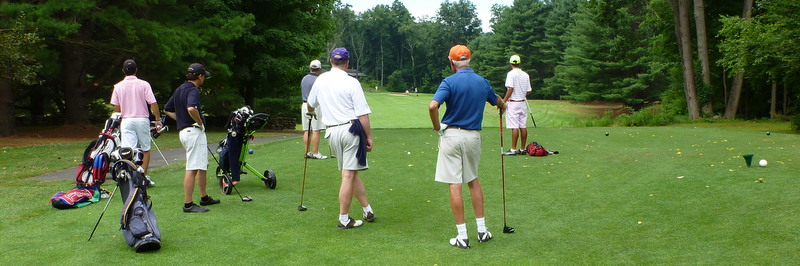
Three golfers, nine drivers.

The golf bags in the photo above belong to (from left to right) me, Tim-o, and Tony.  You will notice that the three of us, in addition to apparently being infatuated with obsolete Nike products, carry three drivers each. The lofts are 10.5, 13, and 16 degrees. I’ll have more to say about this club selection in a week or two. (Full disclosure: after the 9-hole stroke-play opener, on Friday—which John and I won, at 7 under—I removed my 13-degree driver, which I’d bought on eBay the week before, to make room for a second 6-hybrid.

Rob and miscellaneous member-guest stuff.

Usually, the so-called gifts you get at a member-guest are pretty crummy, but this year the ones at my club were great: a golf hat, a golf towel with a zipper pocket and a semi-mysterious Velcro strip, and a belt with a buckle that’s also a beer opener. In the photo above, Rob is wearing his belt on the outside, for easier access (although he’s got it upside down). He’s also wearing his give-’em-a-brake safety-yellow golf shirt and carrying a beer, two putters, and a portable cooler.

Jaws, lighting the putting-contest qualifier.

On Friday night, after the stag dinner, so many guys wanted to keep trying to qualify for the putting contest that Jaws drove home and brought back his big workshop lights. That’s him in the photo above, setting up one of the units. My brother and I qualified but were eliminated the next evening, in a four-hole playoff for the last three spots in the final.

Putting-contest qualifier, under the lights.

On Saturday night, after Fritz and Klinger had won the putting contest and a dozen of us had played a five-hole one-club tournament in a race with the setting sun, we held an unofficial supplemental putting contest, using glowing balls and glowing cup inserts—items about which I’ll have more to say in a week or two. The winners were Tim and Chick. Here’s what the putting green looked like in the dark:

Glowing ball, glowing hole.

Also here:

Doc, Jr.

There were thunderstorms in the forecast all weekend, but the rain and lightning held off until halfway through the final shoot-out, on Sunday afternoon. Here’s what the rain looked like when it was coming down:

The gutter in that photo has been clogged for ten or fifteen years, but when it’s raining no one wants to go up on a ladder to unclog it and when it isn’t raining it doesn’t overflow. During most of the rest of the weekend, though, the weather looked like this:

Chick, Rob, putting-contest qualifier.

The overall winners of the member-guest were Ray and Mike. My brother and I beat them, one-up, in our final match of the weekend, but that wasn’t enough to knock them out of first place in our flight. Here’s Ray resting during the lightning delay. (Mike was on the phone apologizing to his wife for already being several hours later than he had said he was going to be.)

Ray, resting in the clubhouse during the lightning delay.

And here’s what the shoot-out field looked like on the first tee. We determined honors by using the Sunday Morning Group’s limited-edition collection of numbered poker chips. Art and Scribby (on the right, with the white hair and the no hair) were the first to be eliminated, when they bogeyed the first hole.

Golf-certified Acoustic Engineer Needed

Pump house, fourth hole. The roof is made of corrugated metal.

The main source of irrigation water on my home course is a pond on the fourth hole. The pump is housed in a corrugated-metal building concealed in some bushes near the pond’s far right-hand corner, about 180 yards from the main men’s tees—a location, that, coincidentally, is the universal crummy-tee-shot sweet spot for the average male golfer. (A pro at a golf development in Arizona once told me that you should never buy a house or building lot on the right-hand side of any golf hole 180 yards from the regular men’s tees, unless you wouldn’t mind building a dome over your swimming pool and glazing your windows with Lexan.) Sliced drives that don’t land in the pond often hit the roof of the pump house, making a distinctive clang that you can hear over much of the course.

Fourth hole. The men’s tee is in the lower right-hand corner of the photo. The pump house is at the other end of the banana-shaped red line, 180 yards away.

By now, that sound is almost as much a part of our club’s culture as the window conveniently situated above the urinal in the men’s locker room. So here’s the problem: the pump house has been falling down for years—it’s currently being held up by the gray building jack you see in the center of the photo at the top of this post—and we just received approval from the town’s Inland Wetlands Commission to replace it. What I’m wondering is whether there’s a way to “tune” the new pump-house roof so that, when slicers hit it with their drives, it will sound exactly the same as the old pump-house roof. We can’t simply re-use the old roof—an early suggestion—because by this point large parts of it are made mostly of rust.

New Golf Game: Shoot Your Pants

Chick, pants, winnings, August 2010.

I wrote about golf pants the other day. And here I am, writing about them again.

My friend Bernie shoots his age fairly often—an impressive achievement for a guy in his eighties. But Chick, who is half his age, came fairly close to doing something even more impressive. He shot 38 on the front nine and, therefore, as Tim pointed out, had a rare opportunity to shoot his pants—waistband on the front, inseam on the back. Chick is tall, so this was remotely possible, even though he usually scores in the mid or upper eighties. Golf being what it is, he ended up playing the back nine in closer to his sports coat—the result, primarily, of shooting his hat size on a couple of par 4s.

If you count handicap strokes, playing a round in even pants is a reasonable goal for many golfers, because waist size tends to vary directly with U.S.G.A. index. The two members of my club who are the most likely to turn in low gross scores, Addison and Kevin, are in their early twenties and wear belts that look like wristbands. Playing 18 holes in net Dockers is as challenging for them as it is for my contemporary Billy, whose gut gives him what appears, on paper, to be an overwhelming advantage. As for myself, I’ve often been under pants, gross, on our front nine, but have never shot my inseam on the back, a consequence of being tragically long-waisted for a golfer of my height and handicap.

Billy, big pants, follow-through, May, 2012.

My father, who was a stockbroker, used to reckon par the way they do in the bond market, at 100. To him and his friends, “five under” meant 95; “three over” was 103. Even with that generous scoring system, though, he had trouble getting into red figures. I took up the game late, in my mid-thirties, and when my brother, who had been the captain of his high school and college golf teams, saw me hit a weak slice with a five-iron, shortly after I’d started playing, he said, “You’re already the second best golfer in the family.” My brother, incidentally, has shot his pants several times, despite being cursed with a 34-inch waist.

A Better Way to Play Skins

Gillen (right) and a close personal friend.

A big problem with almost any skins game is that it gives an unfair advantage to players with high handicaps. My friend Tim—who is the mathematician-in-residence of my regular Sunday Morning Group—invented an improved version seven or eight years ago, and my regular golf buddies and I have played it ever since. Tim’s version eliminates all the weaknesses of the regular game. It’s so good, in fact, that we call it Perfect Skins. Here’s how it works:

Each player, on the first tee, throws in some mutually agreed-upon sum—say, ten bucks. That money is divided into two skins pools, one for the front nine and one for the back, and every skin won is worth a proportional share of its pool. (If three skins are won on the front nine, for example, each is worth a third of the front-nine skin pool; if a single player finishes with two of those three skins, he wins two-thirds of the pool.) The object is the same as in any skins game: to win holes outright, with scores unequaled by other players. But there’s a twist: in Perfect Skins, a player who loses a hole outright, with a score that’s worse than everyone else’s, gives up a skin—or acquires a negative one, if he has none to give up. Let’s say the sixth hole is birdied by one player, parred by two players, and bogeyed by the fourth; in that case, the player with the birdie wins a skin while the player with the bogey loses one. We call negative skins “Gillens,” after the last name of the particular player whose long-running success at regular skins Tim was trying to thwart with his invention. Gillen hates Perfect Skins.

Any player with a negative skin balance may buy himself back to zero before teeing off on any hole during the nine-hole match, at the price of one dollar per negative skin, with the money going into the pool for that nine—but he may do so only once during the nine. That leads to the really interesting part of the game: Winning a skin when your balance is negative feels like a waste, because it merely moves you back toward zero rather than earning you a share of the pool. But buying back too early in a match raises the risk that one or two bad holes near the end of the nine could give you a deficit too large to eliminate before the end of the nine.

If you haven’t used your buyback yet, acquiring a negative skin is often less costly than permitting another player to win a positive one and thereby gain a share of the pool. That means that attempting a very risky shot may be to your advantage, if there’s a chance that doing so will prevent another player from winning the hole, or if doing so will ensure an outright loss by a player who now has a positive balance—unless you yourself hold a couple of skins, in which case your best strategy may be to play defensively. A player who ends the nine with a negative skin balance—say, because he lost the final two holes outright—owes the pot two dollars for each negative skin still in his possession at the end of the nine.

Perfect Skins eliminates all the shortcomings of regular skins: it greatly reduces the influence of luck, because erratic players are punished for their disasters in addition to being rewarded for their fluky good fortune; it eliminates the high-handicap advantage, because the players with the most strokes are also the ones who are the most likely to suffer the kinds of disasters that lead to negative skins; it keeps everyone in the game, because not losing a hole can be just as important as winning it, and players who suffer a string of bad holes can redeem themselves by buying back into the game; it adds a new level of pressure, especially on the final tee, because skins aren’t safe until the last putt has fallen.

I’ve played Perfect Skins in threesomes, foursomes, and fivesomes, and it works beautifully, though somewhat differently, in all those combinations. With three players, for example, the skin balance changes on every hole unless all three players tie—meaning that the standings can shift dramatically over just a few holes. With five players, in contrast, outright victories are harder to come by, so that a single skin successfully held to the end of the match could end up being worth the entire pool. In all combinations, the most important issue for any player with a negative balance is deciding when to buy back to zero. You have to think realistically about how well or poorly you’re likely to play the holes that lie ahead, and who still has strokes, where you yourself have strokes, and where you can afford to be aggressive.

More About Coping With Rain

Tony, Dave, Ray, Bandon Dunes, February, 2007

Everyone agrees that you can’t change the weather by worrying about it. Shouldn’t it follow, then, that you can change the weather by not worrying about it? I tested this concept on a Saturday six years ago. The sky was growing dark, so, in the hope of diverting the approaching thunderstorm, I purposely didn’t check the Weather Channel or become agitated before heading to the golf course.

Well, it didn’t work. As Hacker (real name), Ray, Tony, and I were getting ready to tee off, Fran, our pro, came out of the golf shop and said, “When I blow the horn, come straight in. There’s a huge cell heading for us.”

The thunder began as we were putting out on five, and moderately heavy rain was falling by the time we got back to the clubhouse. Ray went inside to estimate how quickly the angry green-and-orange amoeba was moving across the radar screen.

“About an hour,” he said when he came back. Hacker and I keep decks of cards in our glove compartments. The four of us sat at a table on the clubhouse porch and played setback, while water overflowed the gutters. I used to belong to a golf club where the old guys played setback all winter. The pro would knock on the card-room door in early April, to let them know it was spring.

We could still hear thunder after an hour, so we all went home. I stomped around the house for a while—“Hey, look! I’m not playing golf!”—then took a nap, which I had been planning to do anyway. When I woke up, I checked my computer: the last of the angry amoeba was almost east of us. I started e-mailing people.

E-mail is the most important golf-related discovery since the sand wedge, because, unlike the telephone, it lets you set up a golf game without anybody’s wife catching on until it’s too late. Tony and I met on the first tee at 4:00, and we had the place to ourselves for five or six holes. The sun came out. We watched swallows skimming the fairways, gorging on mosquitoes. We listened to the trees shaking themselves dry in the breeze: rain’s echo.

And then it was just like the hour after a rainstorm when you were a kid: in ones and twos and threes, our friends came back out to play. As Tony and I walked to the eighth tee, we passed Gillen and Tim, on the second green. Tim was saying, “We putted pretty well, but we didn’t sink anything over ten or twelve feet, and to do well in a scramble you have to sink long ones”—today’s version of the permanent conversation, resuming after a lightning delay. Gene and Nick and Frank were a hole behind them. Mike joined Tony and me on fourteen, by way of the range.

I ended up playing twenty-seven holes—nine more than I would have played if it hadn’t rained. Maybe not worrying works, after all.


Why Rain is a Golfer’s Best Friend

Golf weather. Second fairway and third green, September, 2011. The pond in the foreground is a stream you can usually step across.

There have been showers in the forecast every day this week, and as a consequence my home course has been empty. Hardly any rain has actually fallen, except at night, but an image of raindrops in an icon on a weather website is apparently all it takes to keep most members cowering at home. On a cloudless 100-degree day in August, my friends and I often have to wait on every shot, but if the evening news mentions even a ten percent chance of occasional sprinkles we’ll usually have the place to ourselves. Earlier this week, Tony, Addison, and I played 27 holes in three and a half hours, on foot, and during that whole time we encountered just one other group: a dad and his ten-year-old son, who waved us through. The temperature was perfect—it hovered near the point where you sort of begin to think about maybe putting on a sweater—but we never got truly wet, and although I wore my rain hat for a little while I never had to wipe off my glasses. And no need for sunscreen.

Tony, light rain, empty course, eighteenth fairway, June, 2012.

Later this summer, my wife and I will spend some time on Martha’s Vineyard. There’s a golf course there that I like a lot, called Farm Neck, but it’s so popular that tee times can be hard to come by, especially on short notice. What I usually do is wait for the sky to cloud over and then show up unannounced, confident that the forecast will have created openings in the tee sheet. And if it actually rains, who cares? If you have the right equipment, there are only two kinds of weather you can’t play golf in: lightning and dark. And dark isn’t necessarily an insurmountable problem, as you can tell from the photo below:

Closing hole, Sunday Morning Group, annual end-of-season golf trip to Atlantic City, October, 2007.

Sunday Morning on Friday Afternoon

The Friday-afternoon version of my regular Sunday Morning Group met the other day. Seven players showed up: three retirees, one semi-retiree, two self-employees, and one college student home for the weekend. We picked teams by drawing balls from my hat, three vs. four. As always, the threesome started two under par (an adjustment we borrowed from Augusta National) and no one got two strokes on any hole. The wager was twelve dollars a man: five dollars for best-ball, five dollars for skins, and two dollars for the Money Hole (which, because there were seven of us, was the seventh). Because it was Friday, not Sunday, we allowed strokes on par-threes. 

The course had been open for more than a week and the weather was flawless, but our cars were the only ones in the parking lot so we played as a sevensome. Later,  we picked up an eighth player: a self-employee, but one who runs a real company and has young children and so sometimes runs late. Even as an eightsome, we played faster than most foursomes, perhaps partly because Ray, over the winter, had eliminated a few redundant elements from his pre-shot routine. He’s just about the last member of the group who still believes in practice swings, although he now limits himself to one, plus waggles.

My team went a stroke ahead on the seventeenth, with a net birdie by Jim. He is recently divorced and hadn’t played in two years, except for a single round during an otherwise golf-free trip to Ireland a couple of weeks ago. On the eighteenth, Ray, on the enemy team, made a natural eagle, retaking the lead—but Jim answered him with a second consecutive net birdie, and we finished in a tie. Rick, as always, suggested giving everyone their money back, but Hacker (real name) reminded him that, in our group, “money doesn’t flow backward,” and told him to forget it. We held a playoff on the practice green—putting to the second hole from the top of one of the teak side tables on the patio, closest to the pin—and my team won.

Hacker, on the seventeenth tee, proving that intact rotator cuffs are overrated.

How to Take a Golf Trip With Friends


How to stock a golf-trip refrigerator. (Ferris's house, Pinehurst, 2006)

My regular golf buddies and I have taken many trips together, and, by trial and error, we’ve learned a lot about what works and what doesn’t. Here are some tips:

Do give one person the overall responsibility for managing the itinerary, keeping track of reservation deadlines, reminding laggards to make their deposits, and deciding which minor tasks can safely be delegated. Having a single, reliable leader makes it less likely that critical details (such as tee times) will be forgotten, and creates a clear blame path if things go wrong.

Don’t automatically assume that nobody will be up for more than eighteen holes a day or (equally important) that everybody will. During a buddies trip that eight friends and I took to Scotland in 2008, we designated one round as the official eighteen for each day, so that oldsters could flake out in the afternoon without losing their place in the standings. On the final day of an earlier, ten-day trip to Ireland, when even the golf obsessives had begun to fade, we revived everyone’s spirits by playing a scramble in the afternoon.

Do establish a centralized rule-making authority with the power to silence whiners, naysayers, and independent thinkers. Among my friends, this authority is called the Committee, and it typically consists of Hacker (real name) plus one or two people who, over the years, have satisfied Hacker that they are likely to agree with him. The Committee has many responsibilities, including picking the games, choosing the stakes, deciding whether or not Gene will be allowed to play from the senior tees, and settling minor but potentially divisive issues as they arise, such as do we get a first-tee do-over or not, and what about handicap strokes on par-threes? The Committee’s decision is always final—a relief to most people, who go on golf trips to escape their current responsibilities, not to acquire new ones.

The Committee.

Don’t allow trip-threatening behavior to go unpunished. On the second morning of our annual Atlantic City trip a few years ago, one foursome drove to the wrong golf course (with Hacker, of all people, at the wheel), even though all five cars had left our hotel at the same time and everybody had been given printed driving directions. The resulting confusion came close to ruining the whole trip, or so we said. When the round was over, we restored order by conducting a trial in the clubhouse—taking advantage of the fact that two of the participants that year were lawyers—and sentenced the offenders to pay for everybody’s lunch.

Do collect all wagers before anyone tees off. Losers always outnumber winners, and on a large golf trip that means that if the prize money isn’t in hand when the scores are tabulated the victors will have to collect from a sullen mob. We handle this on our golf trips by collecting a single buy-in on the first morning of the whole trip—currently, a hundred bucks a man—and paying all prizes for the trip out of that fund.

Don’t let the stakes get out of hand. The purpose of playing for money is to make three-foot putts seem important, not to let anyone get rich. We try to spread the prize money around by having lots of complicated side bets, all paid off from the same hundred bucks. The big winner, furthermore, is expected to buy lunch on the last day.

Do establish community-building trip traditions, such as our rule that recovering alcoholics drink free.

Don’t feel you have to do everything as a group. We often split up for dinner, primarily to eliminate tedious late-afternoon arguments about who is willing to pay how much to eat what. Doing this also occasionally generates interesting demographic data, as it did on the night when (as someone realized later) all the Democrats went to a sushi bar while all the Republicans went to Outback. (Figuring out that this had happened took some deductive work, because in our group, as in all successful golf groups, we almost never mention politics, even with people we agree with.)

Do be careful about the guest list. We usually open up our trips to friends from outside our club, and even to friends of friends. This has beneficially expanded our acquaintance with overweight middle-aged men from outside our immediate geographical area, but it has occasionally led to problems. One year, one guy invited an old high-school friend of his, whom he hadn’t seen in years. The old friend, who began drinking as soon as he got into Hacker’s car, bought a dozen condoms at a convenience store during the first refueling stop, then stashed the box under his seat and forgot all about it. A week after we got back, Hacker’s wife discovered the condoms and—here’s the problem—didn’t believe, even for a minute, that they belonged to any of us.

Don’t let a buddies trip end without establishing a Committee to pick the next destination.

How to load a rental car. (Cruden Bay, Scotland, 2008)

Golf in the Footsteps of the Three Stooges

On Sunday, twelve of us played  Van Cortlandt Park, in the Bronx, one of a dozen courses owned by the city of New York. It opened the summer of 1895, six years after my home club, and is the oldest public course in the United States. It also has what may be the world’s coolest locker room, which still contains the original wooden lockers (photos above and below). The Three Stooges considered Van Cortlandt their home course. Other visitors have included Babe Ruth, Willie Mays, Jackie Robinson, Joe Louis, and my friends and me. (On Sunday, even though it was 28 degrees when we left home, three of us wore shorts.)

Sunday Morning Group, Van Cortlandt locker room, March 11, 2012.

The original Van Cortlandt golf course was built for $642.80. It had just nine holes, of which the last was more than 700 yards long. For a few years in 1960s, the city operated three ski slopes on the four short, hilly, quirky closing holes, at the southern end of the park. (You get to those holes by crossing under the Major Deegan Expressway, on a concrete walkway with tall fences on either side.) But now the golf course is just a golf course, even during the so-called winter.

Emerging from under the Major Deegan Expressway, on the way to the fifteenth tee.

Van Cortlandt was originally known as the Meadows, and it was very popular, even though in 1895 hardly anybody in America owned golf clubs or knew anything about how to hit a golf ball. In 1899, Tom Bendelow—a 30-year-old Scotsman and former typesetter, who eventually designed 650 courses in North America—expanded Van Cortlandt to 18 holes. By 1920, according to the Parks Department, it was handling 5,000 players a week.

This is what golf in America looked like in 1895, the year Van Cortlandt opened.

Bendelow’s design survived until the 1940s, when Robert Moses began building highways on top of it. Today, the course is divided into four roughly equal-size lobes. They are separated by two highways (the Major Deegan and the Mosholu Parkway) and a fence-enclosed swamp called Tibbetts Brook, which resembles the Dead Marshes in The Lord of the Rings, except murkier.

This way across Tibbetts Brook.

On Sunday, the first of our three tee times was 7:56. That meant leaving home at a little before 6:00, which really meant leaving home at a little before 5:00, since daylight saving time had gone into effect overnight. And that, for me, meant getting up at what my brain still thought was 3:30. It was worth it, though—what else could I have done on a Sunday morning in March, except maybe work on my taxes?—and I was actually awake and waiting when my alarm went off, as I usually am the night before I play golf.

Because we were going to Van Cortlandt, we were able to lure Ferris out of hibernation. The night before, he sent us this email:

My childhood home was at 1 Tibbetts Road, in Yonkers, and our property line was Van Cortlandt Park. My friends and I used to cut holes in the chain-link fence near the fourth green and play the three holes on this side of the Major Deegan and Mosholu Parkway. We would steal the bamboo whips that the ‘parkies’ used to whip the dew off the greens, and occasionally we would also steal the flags, and we would sell golf balls. Since the approaches to some of the holes were blind, we could run out and grab balls that had just been hit and then sell them to the next groups that came by. We did all this while keeping an eye out for the parkies’ pickup trucks. When we saw them come rumbling over the hill, we would scoot back through the hole that we had cut in the fence, and then hide in the woods. The following day, the hole would be wired closed, so we always carried a heavy-duty wire-cutter in one of our golf bags. Of course, most of us had old bags, with hickory-shafted clubs. My house was about two hundred yards from the course. I’ve never paid to play at Van Cortlandt, and I’ve never played the holes on the other side of the highways.

Ferris's fence, with a modern hole, just beyond the fourth green.

For lunch, we went to the Bronx Ale House, just a few minutes away. To see what that was like, check out the photos on this (non-golfer’s) blog. Pay particular attention to the picture of the Alehouse Burger. Here was Sunday’s beer menu:

Bronx Ale House.

You can read an old New Yorker article of mine about playing winter golf in New York City here. The photo below is of the line of golfers at the first tee as we walked off the fourteenth green, on our way to the holes on the other side of the Major Deegan. There were more golfers waiting in front of the clubhouse.