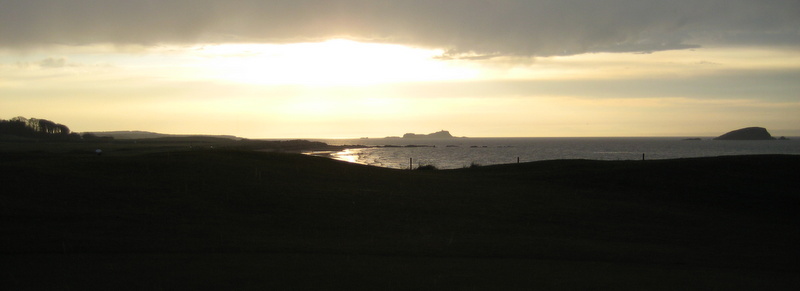
Reader’s Trip Report: Cruit Island, County Donegal, Ireland

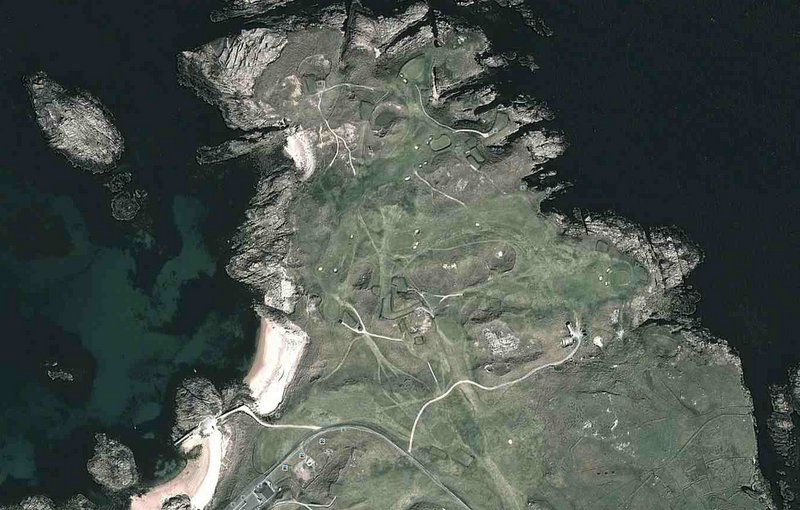
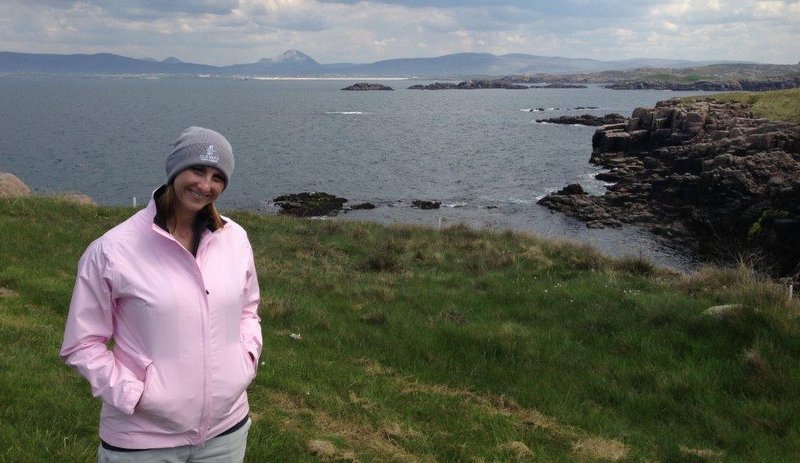
Cruit IslandI’ve taken two golf trips to northwestern Ireland, and I’ve played some of my favorite rounds there, including ones at Carne, Enniscrone, Narin & Portnoo, Portsalon, and Ballyliffin. (You can read about one of those trips here.) Since then, several people have told me I missed a gem: Cruit Island Golf Club, a nine-holer, which lies at the outermost tip of a sparsely populated island that’s connected to the mainland by a causeway. (The drive from Donegal to the golf club is roughly an hour and a half. My rule for estimating driving times on Ireland’s sidewalk-size back roads: think of the kilometers as miles, then multiply by two.)

IMG_2479

Vic Thompson—a reader in southern Illinois and a member of Lake of Egypt Country Club, which I have now moved to No. 1 on my list of the World’s Best-Named Golf Clubs—has played there twice, in 2012 and 2013. Recently, he wrote to urge me to play there, too.

IMG_2490

Excerpts from Thompson’s report:

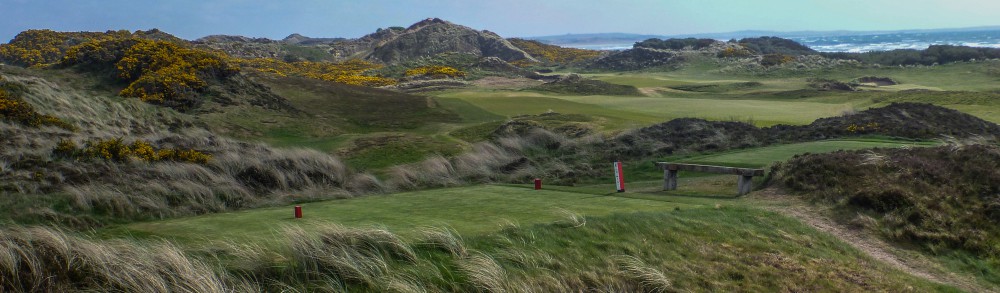
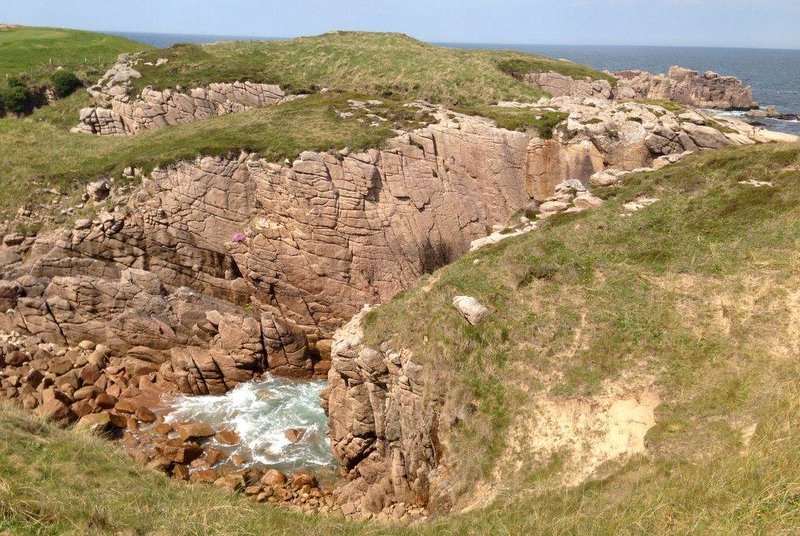
I first traveled to Ireland in 2001 and played the southwestern courses, Lahinch, Ballybunion, Tralee, Waterville, and Old Head. I returned in 2003 (Scotland & Ireland), 2011 (with my wife just to sight-see), 2012, and 2013. Of all the courses I have played in Ireland, Cruit Island—pronounced Critch Island—was the most fun. It has blind tee shots, tee boxes set on top of large high dunes, and great putting greens. The first tee is high atop a dune, giving the golfer a panoramic view of parts of the course as well as the cliffs and ocean. The sixth hole is a 140-yard par 3 that is all carry over a stunning wave-crashing gorge. The scenery is stunning. The azure waters and rocks surrounding the course are breathtaking.

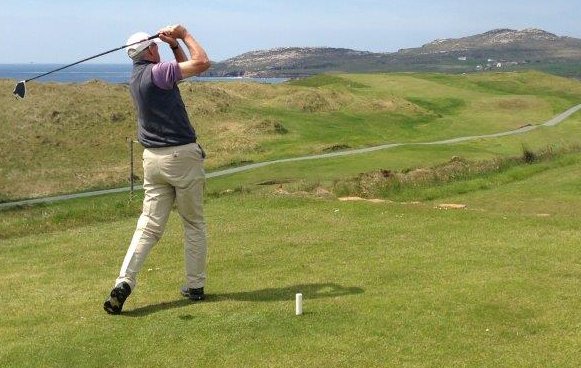
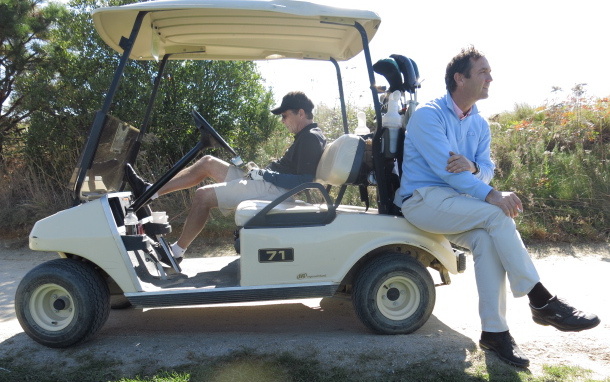
IMG_2488My first visit was in 2012, on a trip with my golf buddy Bob. We were staying at the Lake House Hotel in Portnoo, and one of our hosts recommended that we drive up and see it. We did, and the course manager—who happened to be a relative of another of our hosts at the hotel—invited us to play nine holes and provided us with an electric cart, all at no cost. He was so proud of the course, which opened in 1986, and the more he talked the more excited he became.

IMG_2476I went back with my daughter, Jenny, in 2013. Jimmy said, “We’ll settle up when you finish,” and after our round he said that fifteen euros should take care of it. I thanked  him, and commented that this was the most fun I had ever had on an Irish course. Cruit Island is out of the way, but I recommend putting it on your itinerary. Heck, the drive alone is worth it. 

IMG_2484I’m sold. Let’s go!

DSC00632

Golf-Travel Update: Hotel-Room Power Problem Solved, Sort Of

2013-07-16_12-48-09_607

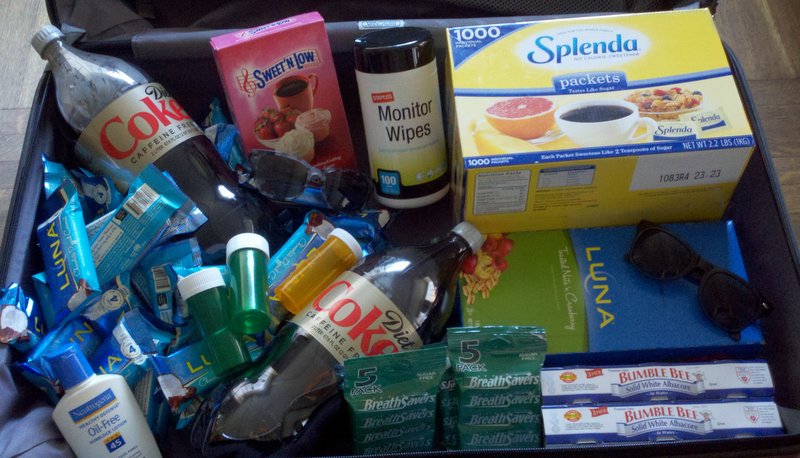
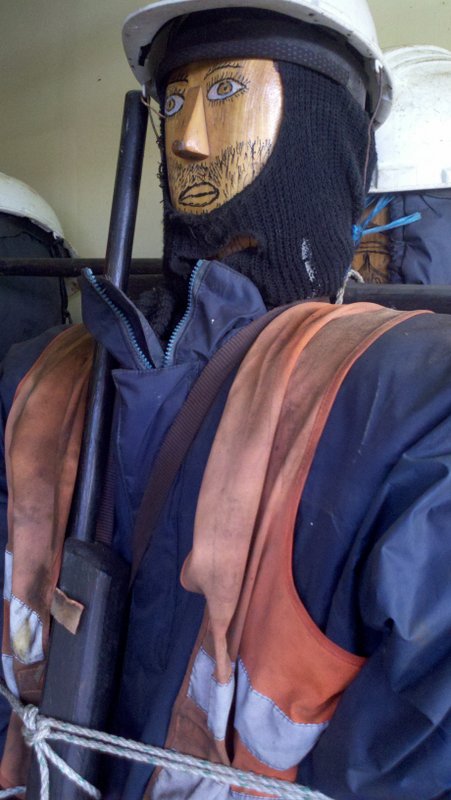
My friend Patty recently spent a couple of weeks crossing the ocean on a freighter. That’s her suitcase, in the photo above. She didn’t pack the way I would have packed, but she took everything she thought she would need, as I also try to do when I travel. And the crew of her ship did the same—for example, by packing a squadron of fake armed guards, for scaring away pirates:

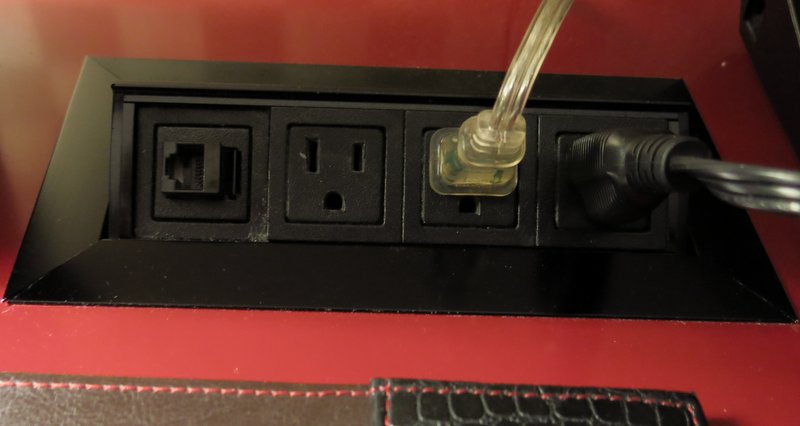
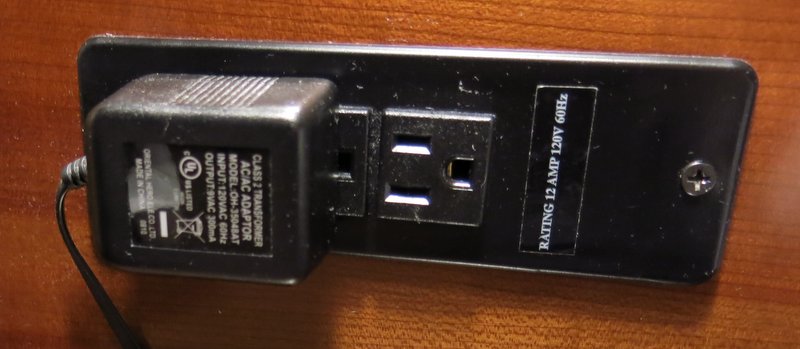
2013-07-23_19-39-53_809One of my own biggest travel issues, as I’ve mentioned before, is finding enough places to plug in all the stuff I need to plug in. Most hotel rooms have way too few electrical outlets, and often the only unused ones are hidden behind huge pieces of hard-to-move furniture, such as beds. Not long ago, I stayed in a hotel in Baltimore that was better equipped than most. For example, it had one of these:

IMG_3379

Still, one of the sockets was already being used by the hotel itself (for a lamp), and the spacing was was so tight that if I’d needed to plug in a “wall wart” power adapter I would have rendered the adjacent socket unusable, as had already happened on the three-socket wall receptacle in the photo below. (That space-hogging adapter isn’t mine. I don’t remember what it was powering—maybe the phone next to the bed.)

IMG_3387

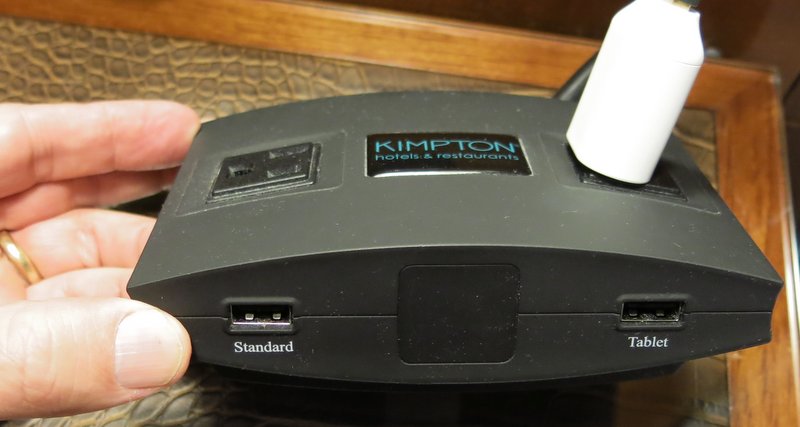
The room also had one of these, on the desk. It’s called a ChargePort, and it’s sold by a company called TeleAdapt, which does a lot of business with hotels:

IMG_3384

I was OK with it, although (since it had to be plugged in somewhere else) it increased the number of available AC outlets by just one. The labels on the USB ports seem unnecessarily inscrutable. (“Standard” actually means “1 amp”; “Tablet” means “2.1 amps.”) Plus, the thing sells for sixty bucks!

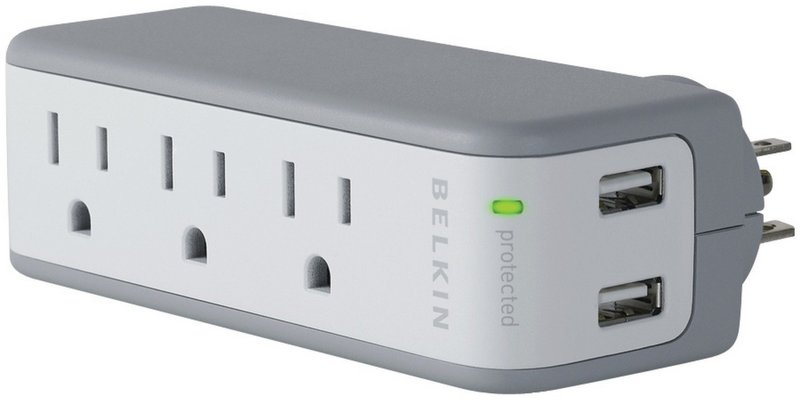
The next night, I stayed at a Marriott in Massachusetts. My room there had just one accessible socket within a cable’s length of anywhere I was willing to sit. Luckily, I had recently bought a Belkin 3-Outlet Mini Travel Swivel Charger Surge Protector with Dual USB Ports—and, furthermore, I had remembered to pack it:

BelkinIt’s not perfect, but it’s pretty small, and it allowed me to leverage that stupid single socket, which was in the base of the desk lamp:

IMG_3446I didn’t go as far as my friend Rex, who travels with a full-size power strip. He also packs a 150-watt incandescent light bulb (for reading) and an old-fashioned full-flow shower head. And, because you can’t replace a hotel shower head with just your hand, he also travels with a wrench and a roll of Teflon plumber’s tape.

Hacker (Real Name) Invents Great New Golf Game While Asleep

P1080982

Recently, I wrote that I’d had an extremely rare dream-within-a-dream, about the rules of golf. Reading about my dream made my friend Hacker (shown above) recall that he, too, had recently dreamt about golf, and that in his dream he had invented a new kind of scramble. (In a scramble, all the players on each team drive on each hole, then choose the best drive and play their second shots from there, then choose the best second shot and play their third shots from there, and so on, until the ball is holed out.) In Hacker’s dream version, each four-man team had to count two balls on each hole. As he explained the rules to me: “All four drive. Pick two balls. Assign two players to play each ball until holed out. Score both balls. No handicap.”

Tim (left) and Paul, Sunday scramble, Atlantic City, October 20, 2013.

Tim (left) and Paul, Sunday-afternoon scramble, Atlantic City, October 20, 2013.

In Hacker’s dream, the purpose of this game was “to screw Tim” (another of our friends, who invented our game Perfect Skins “to screw Gilllen”). But it’s a great idea, no matter whom it screws, and we’re going to try it next fall, during the Crystal Anniversary of our annual golf trip to Atlantic City, if not before. Hacker’s dream format is especially attractive because it prevents a team from depending too heavily on any one player.

I love scrambles, and I’ve put some thought into what my ideal scramble team would look like, in any format. The first thing I want is a guy who can drive the ball really long and really straight. On my dream team, that will be me—but not the me who usually hangs out at my club. The me I want is the me who hits all my provisional drives, after I’ve pumped my first drive out of bounds. The provisional me never fails to find the middle of the fairway, and he is scary, scary long.

Next, I want someone who pures his approach shots, so that we can be sure of getting at least one ball close on every hole. That player will be me, too, but not the same me who’s so awesome with a driver. The me I want for approach shots is the me who, during my regular rounds, hits all my lay-ups. The lay-up me hits nothing but smooth, high draws, and he’s a club and a half longer than the me who hits my tee shots on par 3s.

Pitching, chipping, and bunker play usually don’t count for much in a scramble, because with multiple tries at every approach shot you seldom get into serious trouble, and when you do get into trouble you have multiple chances to get out. Still, it’s important to have at least one guy on the team who’s really good at sticking it tight from fifty yards and in. On my dream team, that will be me—but not the provisional me, the lay-up me, or the regular me. For the short stuff, we’re going to need the me who handles my up-and-downs when I’m playing by myself. That me has the softest hands you ever saw. He can knock it dead from any lie—with backspin!—as long as nobody’s watching.

The truly crucial skill in a scramble is putting. The secret weapon on my dream team will be a guy who is probably the best putter I’ve ever played with: me. In a weekend tournament at my club several years ago, every participant had a floating mulligan, which could be used on any shot. I forgot about mine until I got to the sixteenth green, where I faced a tricky ten-footer. I told myself that that I didn’t have to make the putt, because I’d have a second chance if I missed—and the ball went in. And I never even got to use my do-over, because just knowing I had it enabled me to one-putt the next two greens, too, from about as far away. “Leave your putters in your bags, boys,” the mulligan me will say. With a guy like that on the team, how can we do anything but win?

Ben and Shep, final hole, Sunday-afternoon scramble, Atlantic City, October 20, 2013.

Ben and Shep, final-hole gallery, Sunday-afternoon scramble, Atlantic City, October 20, 2013.

Reader’s Trip Report: Mackinac Island, Michigan

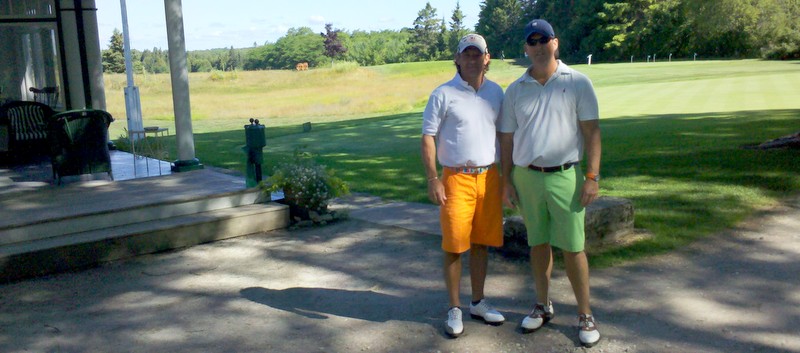
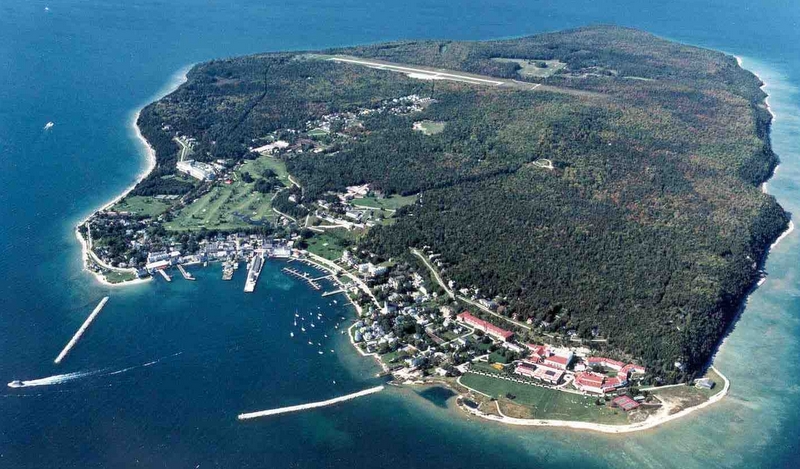
IMG_20130804_104132Jim Doherty, a reader in Chicago, wrote to me toward the end of the summer about a family vacation he had taken to Mackinac Island, Michigan—which is in Lake Huron all the way up next to Canada. (Mackinac, incidentally, is pronounced Mackinaw.) Jim is one of the guys in the photo above; the other is his brother-in-law, Mike. Because male golfers are essentially interchangeable, it doesn’t matter which is which. Here’s what the island looks like from the air.

Mackinac

Jim wrote:

Mackinac Island doesn’t allow any motorized vehicles. You ferry over with bikes, and there are horses and carriages that you can use to get around as well. The island had some military importance way back in 1812 and is now a beautiful spot to visit. There are a lot of fudge shops, for some reason. Anyway, even though our wives had chosen this non-golf-hotspot for our vacation, Mike and I brought our sticks on the theory that at some point our families would be equally sick of us (seven-hour drive) and be happy to see us exit to a golf course for a while.

Mackinac has two courses. One belongs to the Grand Hotel, where Jim, Mike, and their families were staying. It’s made up of two non-contiguous nines, called the Jewel and the Woods, and golfers are transported from one to the other by horse-drawn carriage. According to the hotel’s website, “The leisurely 15-minute ride includes parts of the island unseen by many visitors.” That sounds mildly interesting, but I think Jim and Mike were right to skip it. Jim wrote, “I try to avoid non-golf resorts that have a course. I find that they are usually full of very slow, non-regular golfers who are just trying to kill time, theirs and mine.” (The hotel and its golf course are visible in the photo above, in the lower part of the island.)

Instead, Jim and Mike played a nine-hole course called Wawashkamo Golf Club, which you can see, sort of, in the clearing in the woods near the runway at the top of the photo of the island. Here’s what the club’s front gate looks like:

Wawashkamo

Jim continued:

Remember, there are no motorized vehicles, so we rode our bikes, with our bags on our backs, up to the course. The inclines early in the ride were steep enough that we needed to walk the bikes, but it was worth it. Wawashkamo is a gem. No irrigation in the fairways or rough. Fescue-lined holes. Tiny hand-mowed greens in great shape, and tees that are literally about twenty square feet. I guarantee that the area rug under your dining-room table is bigger.

IMG_20130804_101313

Wawashkamo was laid out in 1898 by a Scotsman (from Carnoustie!) named Alex Smith. The club’s first pro was Frank Dufina, a Chippewa Indian, who played in the 1911 Western Open. He was fourteen years old when he went to work at Wawashkamo, and eighty-four when he retired, in 1968. Among the course’s unique features is its third green:

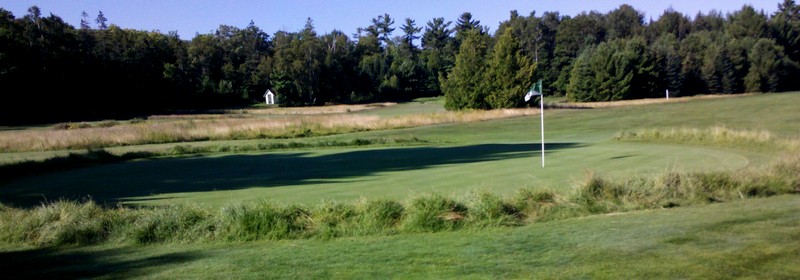
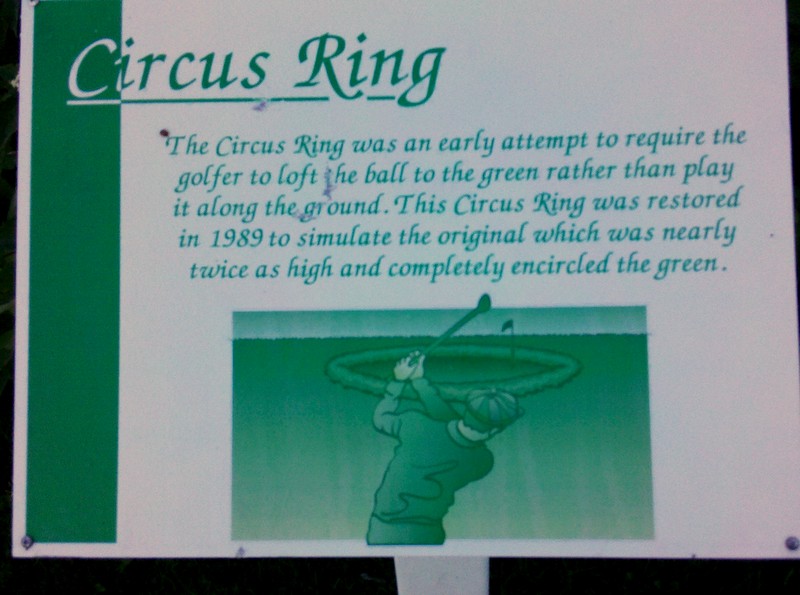
IMG_20130804_092803The putting surface (as you can see in the photo above) is surrounded by a thick fescue collar, which is called a Circus Ring. Its purpose is explained in the sign in the photo below:

IMG_20130804_092752

Jim continued:

Wawashkamo has two sets of tees, which change the length and angle of the holes a bit. It’s an easy walk: ninety minutes, max, for nine holes, then back on the bikes for the downhill ride to our families. The club’s pro, Chuck Olson, invited us to leave our clubs overnight and return to play the next morning, to ease our bike ride. We got the idea, from talking to him and a member, that the club’s budget is nil.

Here’s the clubhouse:

IMG_20130804_084705

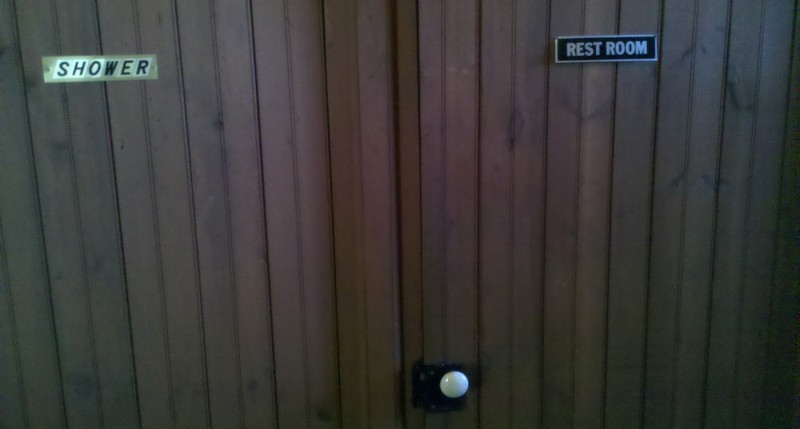
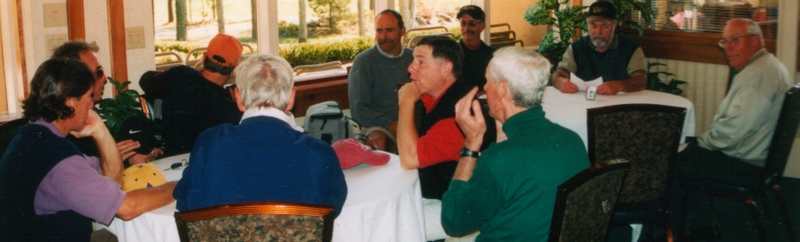
And here are two of the amenities, which are available to visitors as well as to members:

IMG_20130804_104341Wawashkamo is closed for the season (I’m pretty sure, based on the website), but it will be open again in early May. Fifty dollars for eighteen holes, walking. Let’s go!

A Ghost Course in Southern New Jersey

The Great Trial, Blue Heron Pines East, October, 2003.

The Great Trial, Blue Heron Pines East, October, 2003.

On the morning of the second day of the Sunday Morning Group’s fourth annual autumn golf trip to Atlantic City, in 2003, Hacker (real name) gave everyone printed driving directions to Blue Heron Pines East, the course we were scheduled to play that day, but then drove himself and Harry, his navigator, to a course called Harbor Pines, which we weren’t playing until the next day and which was twenty-five minutes from Blue Heron. We had to shuffle the tee times while we waited for them to realize they’d screwed up. Then, after the round, we held a trial in the clubhouse—there were several lawyers on the trip—and sentenced the two of them to buy everybody’s lunch. Harry never fully understood why he was being forced to pay for so many bacon cheeseburgers, but everyone else, including Hacker, thought the whole thing was pretty funny.

That's Hacker in the middle and Harry on the right. Harry claimed later that he'd been represented by incompetent counsel.

The reading of the charges. That’s Hacker in the middle and Harry on the right. Harry claimed later that he’d been represented by incompetent counsel.

Blue Heron Pines East, which was designed by Steve Smyers, was one of our favorite golf courses, but in 2007 a real-estate developer bought it, and announced a plan to build an enormous condominium complex right on top of most of the holes. A year later, the global economic implosion helped to kill the condominium project, but the golf course remained closed and was allowed to revert to New Jersey. Earlier this month, during this year’s S.M.G. trip, Hacker and I drove over to have a look at the ruins, after playing a round at what used to be called Blue Heron Pines West. (It was designed by our close personal friend Stephen Kay and is still doing business, as Ron Jaworski’s Blue Heron Pines). Here’s what used to be the sign at the entrance of the East course:

P1100102And here’s the old driving range and part of the old parking lot:

P1100084

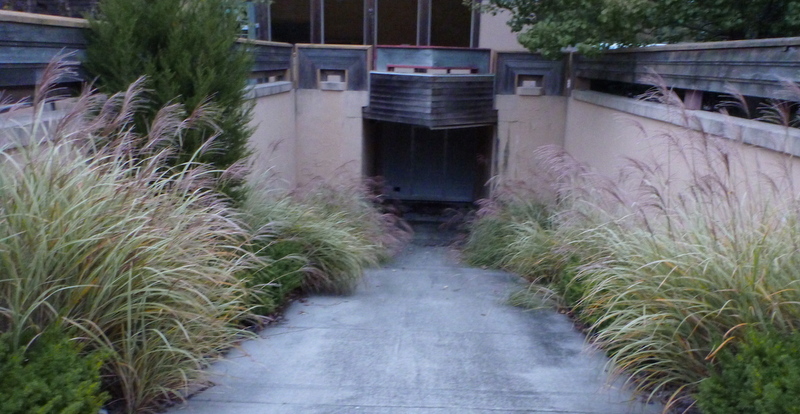
And here’s the ramp leading down into what used to be the cart barn:

P1100099

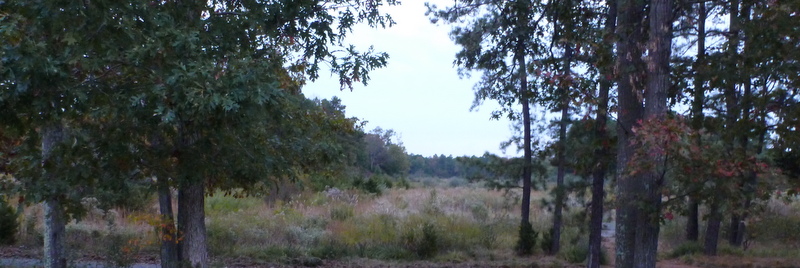
And here, through the opening in the trees, is what was once the fairway of the first hole, a really nice short, uphill par 4. The green was on the rise in front of that bank of trees in the distance:

P1100096

And here’s the patio outside the clubhouse. We held the trial on the other side of those double doors, in what was then the grillroom:

P1100087

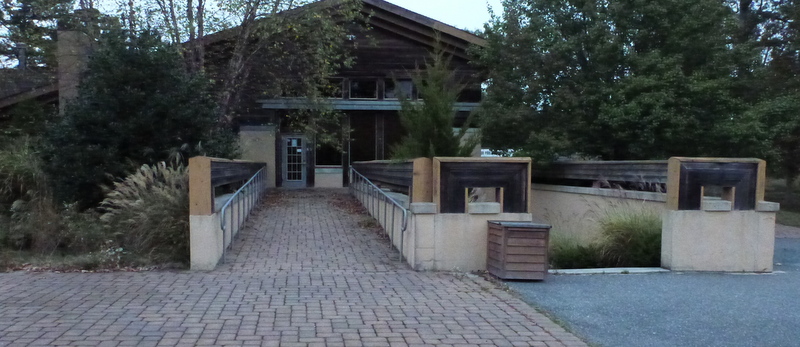
And here’s another view of the clubhouse, and of what used to be the entrance of the golf shop:

P1100082

We learned during this year’s trip that the property has a new owner, who just received approval for a new condominium plan. That means, I guess, that people aren’t suddenly going to come to their senses and give us back our golf course. We like the surviving course a lot, but it would be nice to have both. And if the condominiums really do get built we won’t even be able to explore the remains.

P1100098

A few years ago, for The New Yorker, I wrote about another ghost course, on an island in the Outer Hebrides, in northwestern Scotland. You can read about that lost golf course here.

Shep’s Cool Spinning-Golf-Ball Trick

During my Sunday Morning Group’s recent golf trip to Atlantic City, Shep—who used to play on a professional tour in South America and now is a stockbroker—demonstrated several cool golf-ball tricks, including the one shown in the video below. He got the ball spinning by bouncing it back and forth with his wedge, then held it, still spinning, on the clubface.

The trick, it turns out, is even harder than it looks, although Josh was able to make a ball spin (in the air) alternately clockwise and counterclockwise. Well, forget it. A little later, we saw two guys shooting a pistol at a target. They stopped while we teed off—which was nice, although it made no difference, since you could hear the gunshots all over the course.

Golf-Hating Masochist Builds House on Golf Course

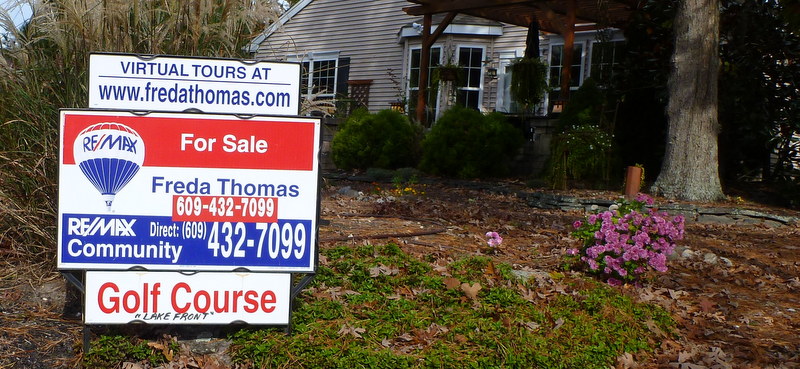
Most people who live on golf courses play golf, or like golf. This for-sale sign faces the course, not the street. The "lake front" it mentions is a swimming-pool-size water hazard. In other words, it's a dream house.

Most people who live on golf courses play golf, or, at the very least, like golf. This for-sale sign faces the course, not the street, because the real-estate agent knows that golfers are the people most likely to be interested in buying a house with a view of a fairway. The “lake front” mentioned down at the bottom of the sign refers to a water hazard the size of a swimming pool. In other words, this is a golfer’s dream house.

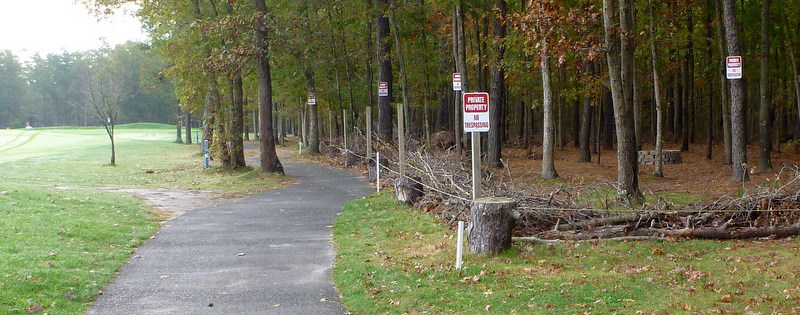
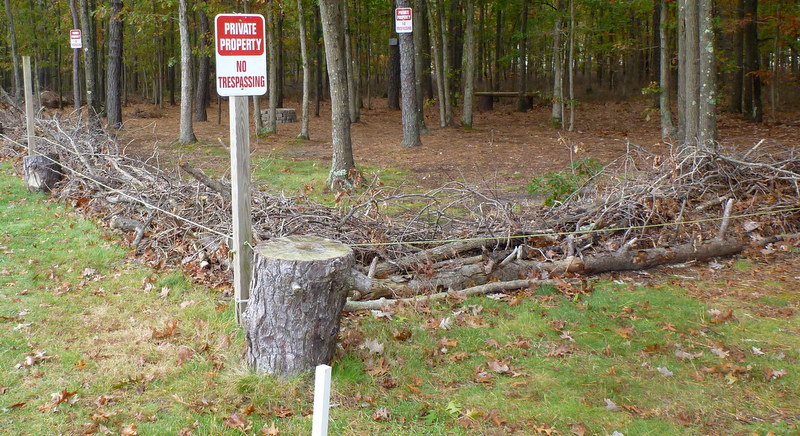
The Sunday Morning Group has just returned from its annual end-of-season golf trip to Atlantic City. We had a terrific time (and I’ll have more to say about the trip over the next couple of weeks). Two of the three courses we played had houses or condos along some of the fairways. People who live next to golf holes do so at least partly because they love golf—or so you would think. The guy whose property is shown in the photos below apparently does it to keep himself in a constant state of agitated fury.

P1100043

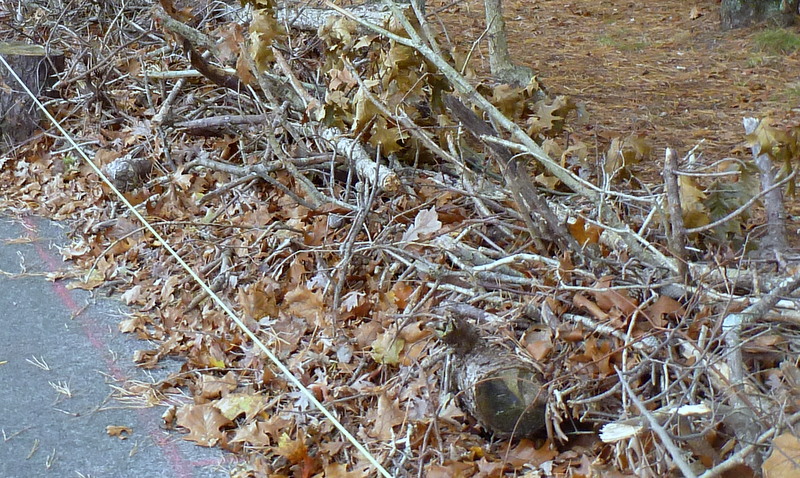
The brush fence shown in the photo above runs along the guy’s rear property line, and, lest anyone think those branches fell from the trees in neat piles and straight lines, he added no-trespassing signs, fence posts reinforced with rebar, nylon rope, out-of-bounds stakes, and a red line painted on part of the cart path where the asphalt apparently encroaches a few inches into his yard:

The red line painted on the edge of the cart path in the lower left-hand corner of the photo, just below the nylon rope, runs along the edge of the property. Did the owner hire a surveyor to  determine the exact location of the line?

The red line painted on the edge of the cart path in the lower left-hand corner of the photo, just under the nylon rope, runs along the edge of the property. Did the owner hire a surveyor to determine an exact location for the line?

The creation of this barrier was not the work of a single afternoon.

P1100045

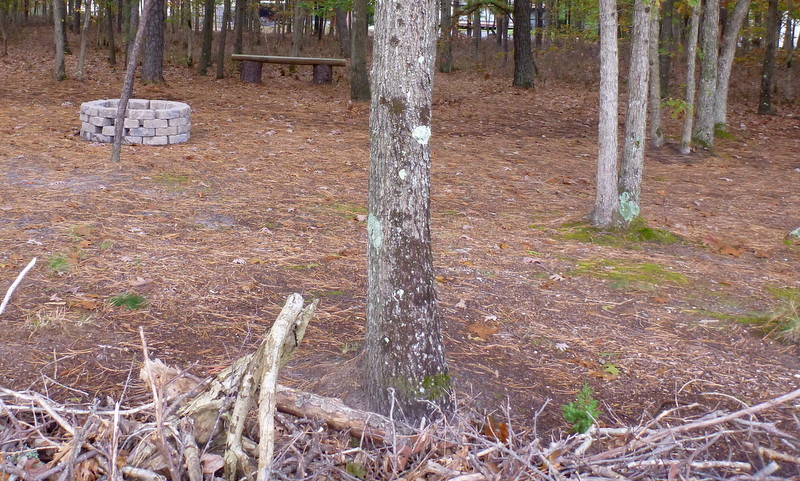
The owner also installed a bench and a fire pit near the brush fence, perhaps so that he can keep golfers under personal surveillance and incinerate balls that land inside the barrier.

P1100049

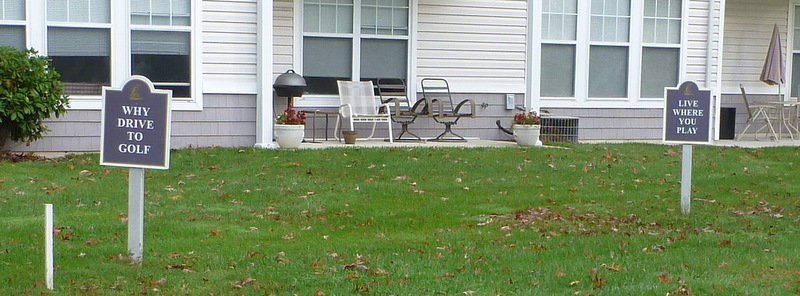
Last spring, I played a couple of rounds at Formby Golf Club, in England. A rich guy whose house backs up to the seventeenth tee had installed close-circuit video cameras on tall poles at the edge of his property, to keep an eye on the golfers. Wouldn’t it be easier to live somewhere else? Or maybe some people just enjoy feeling pissed-off all the time. The signs below are more in line with my own thinking.

P1100035

Further Thoughts on Packing for Golf Trips

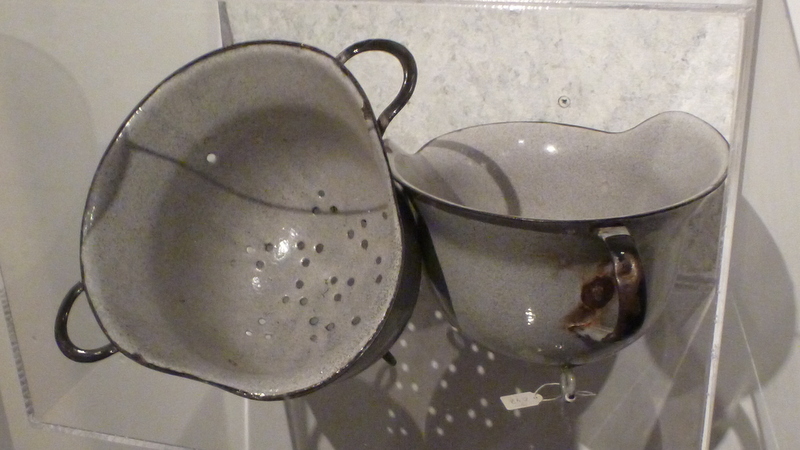
Strainer and chamber pot fashioned from German helmets after the end of the Second World War. Resistance Museum, Amsterdam, September 8, 2013.

Strainer and chamber pot fashioned from German helmets after the end of the Second World War. Resistance Museum, Amsterdam, September 8, 2013.

My wife and I just returned from Germany, the Netherlands, and Belgium, where we spent ten days celebrating our thirty-fifth wedding anniversary. Among the many interesting places we visited was a museum devoted to the Dutch resistance during the Second World War. (See photo above.) For reasons having to do with my desire to remain married for another thirty-five years, I didn’t play even one hole of golf. But I did do some golf-related luggage research, and I wife-tested a few ideas about minimalist packing.

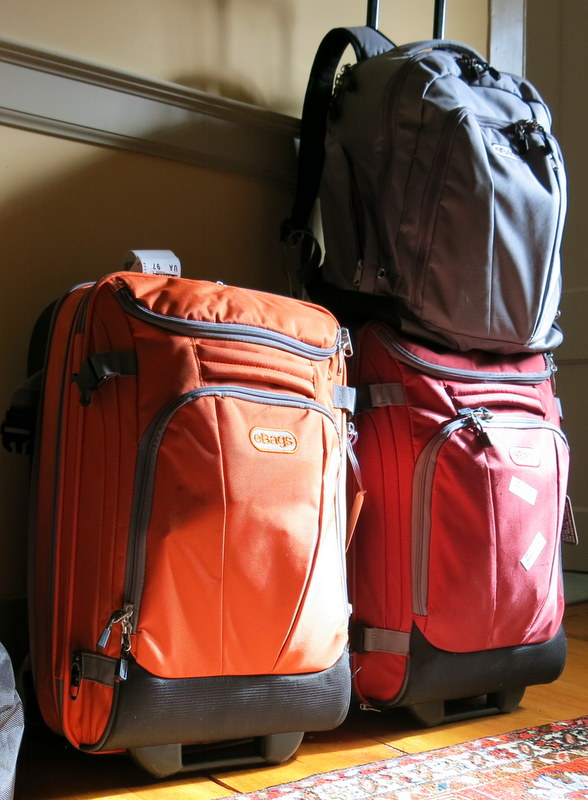
Our luggage. (My wife's backpack and purse are out of the frame.)

Our luggage. (My wife’s backpack and purse are out of the frame.)

We each took just a carry-on bag and a small backpack (plus my wife’s purse). All the luggage was from eBags, an online luggage company for which I am an unpaid shill. Here’s what we took: two eBags Mother Lode TLS Mini 21″ Wheeled Duffels; an eBags TLS Workstation Laptop Backpack; and a similar, older backpack, which eBags apparently no longer makes but is a lot like this one. My wife not only got along fine without a big suitcase but actually packed lighter than I did. We didn’t carry the carry-ons onto our plane—international flight, one checked bag free—but once we were in Europe our relatively light load made it easy to get on and off trains, climb stairs, take the tram instead of a taxi, etc., while still leaving room for souvenirs. The bags are perfectly designed, and the laptop backpack is like a mobile office—not that I did any work.

Souvenirs, outdoor flower market, Amsterdam.

Souvenirs, outdoor flower market, Amsterdam.

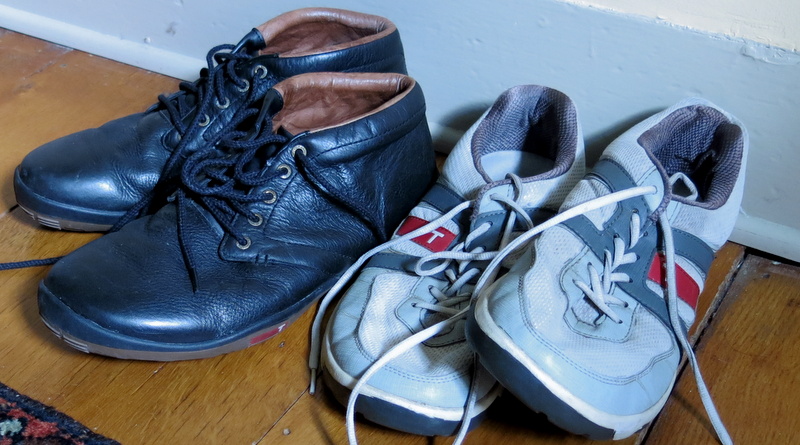
Although I left my golf clubs at home, I did take two pairs of golf shoes, both by True Linkswear, another company for which I am an unpaid shill. They were the only shoes I took on the trip, and (it turns out) I could have gotten by with just the black ones, a model called Chukka. (I took the others, called Sensei, because the Chukkas look a little spooky when worn with shorts—but then I ended up never wearing shorts.) Chukkas are waterproof; Senseis are not. Both are extremely comfortable, and, by comparison with some of the shoes that Europeans wear, Chukkas don’t look strange at all.

True Chukka (left) and Sensei (right).

True Chukka (left) and Sensei (right).

Before we left for Europe, I held tryouts for the position of Trip Pants. The pre-competition favorite was a pair of black Nike flat-front Dri-Fit Tech Golf Pants, which are 95 percent polyester and 5 percent spandex. But when I wore them for a test round on my home course I decided that they made too much noise when I walked, and that they felt too much as though they were made of bubble wrap. I had similar issues with a super-cheap pair of no-name pants I found on Amazon. The eventual winner was a pair of black Dockers Advantage 365 Khakis, which are 100 percent polyester microfiber. They don’t wrinkle, they don’t stain, they can be “laundered” in a hotel-room sink, and they look fine in the morning if you leave them in a heap on the floor overnight—yet they remain silent when you cross your legs.

Docker's 365 Advantage microfiber pants, in overnight storage.

Dockers 365 Advantage microfiber pants, in overnight storage. (Note belt with beer-opener buckle, by Bison Designs.)

I also took a pair of pre-wrinkled 100 percent cotton Dockers in a grayish color, which, unlike the Advantage 365s, don’t look like the bottom half of a limo driver’s uniform. But if I’d been on a golf trip with my pals, instead of a romantic getaway with my wife, I’d have taken a second pair of microfiber instead.

Four Miles From Muirfield is the Golf Course I Dream About

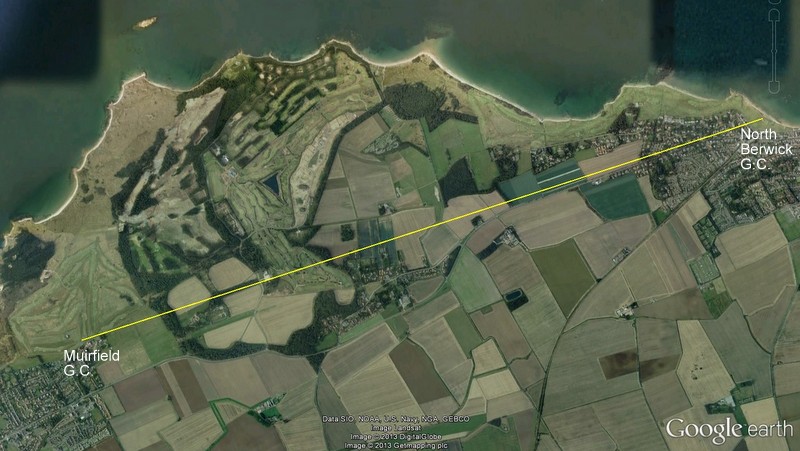
Four miles, as the golf ball flies.

Four miles, as the golf ball flies.

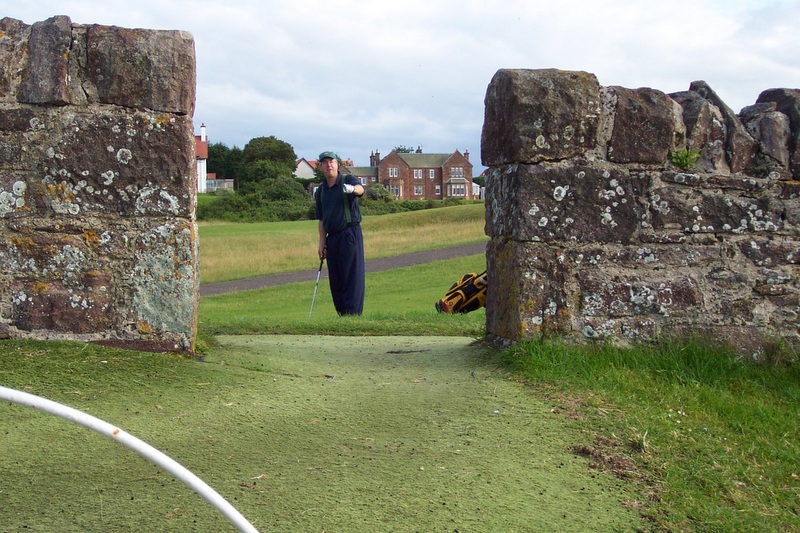
If my wife ever throws me out of the house and they won’t let me move into the Crow’s Nest at Augusta National, I’m going to hide out in North Berwick, Scotland, just a few miles along the coast from Muirfield Golf Club. I’ve played North Berwick pretty many times over the years, and it’s probably the course I think about the most, except for my home course. Among the many permanently memorable holes is the thirteenth, a par-four, on which the green is on the far side of a very old stone wall:

Thirteenth green, North Berwick Golf Club, Scotland, May, 2008.

Thirteenth green, North Berwick Golf Club, Scotland, May, 2008.

On a visit in 2004, I missed the green to the right and tried to chip through an opening:

DCP_3091I missed the gap, and then l was really in trouble. During two of my most recent visits to North Berwick, I stayed in a small hotel overlooking the course, called Blenheim House. Sad to say, the young couple who owned it, Milton and Ailsa, gave up last year and sold it to someone else. I don’t know if it’s back in business.

R.I.P.: Blenheim House Hotel, North Berwick, May, 2008.

R.I.P.: Blenheim House Hotel, North Berwick, May, 2008.

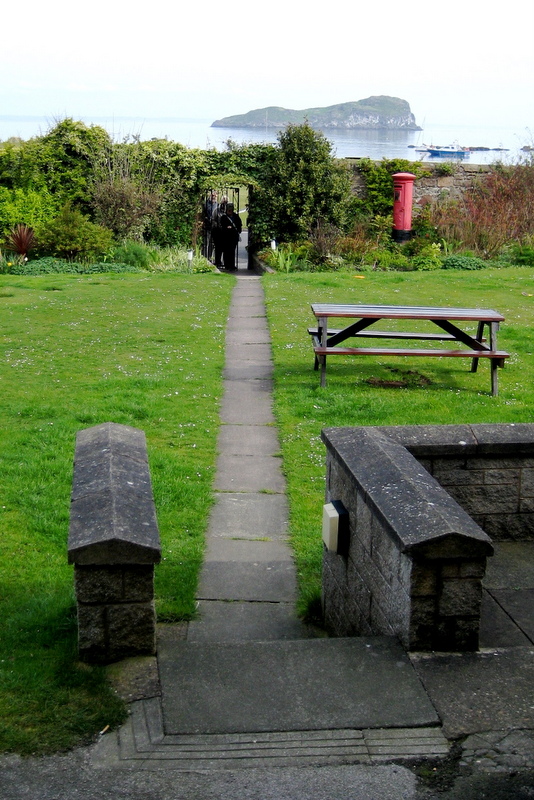
One of the great things about that hotel was that you could get to the golf course simply by walking through a gate in the back garden:

IMG_0015

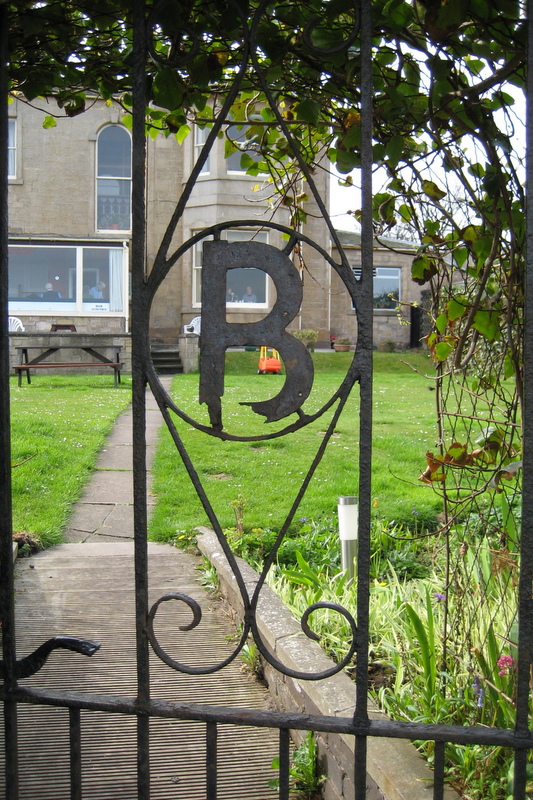
Here’s the gate, viewed from the golf-course side. The people in the windows are eating breakfast:

IMG_0019

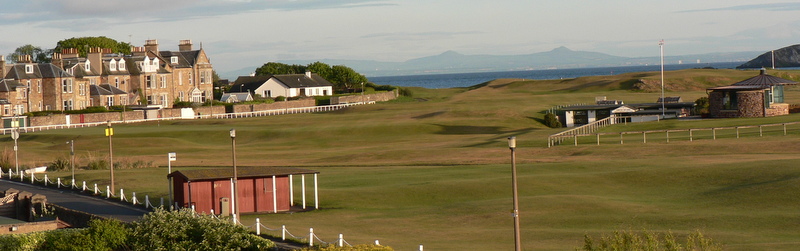
During the relatively few daylight moments when I wasn’t playing golf, I gazed at the golf course from the window in my room. Here’s what I saw:

P1030696

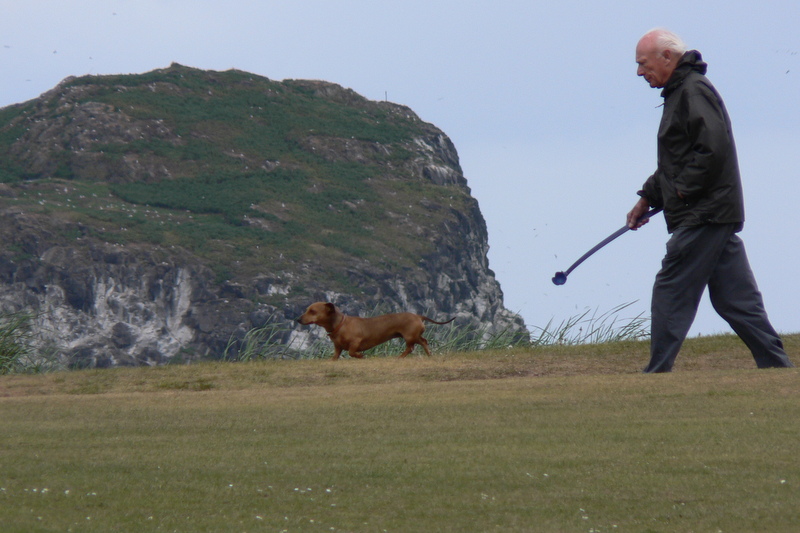
The cylindrical stone building at the far right is the starter’s shelter; the semi-subterranean white structure just to the left of it is the golf shop. The eighteenth green is at the far left, and the clubhouse is out of the picture to the left of that. The opening tee shot at North Berwick usually calls for something like a five-iron, and the second is essentially blind, and several of the other holes are almost as unusual. When I looked out my window one morning, before breakfast, I saw a guy walking a dachshund just east of the course:

P1030703

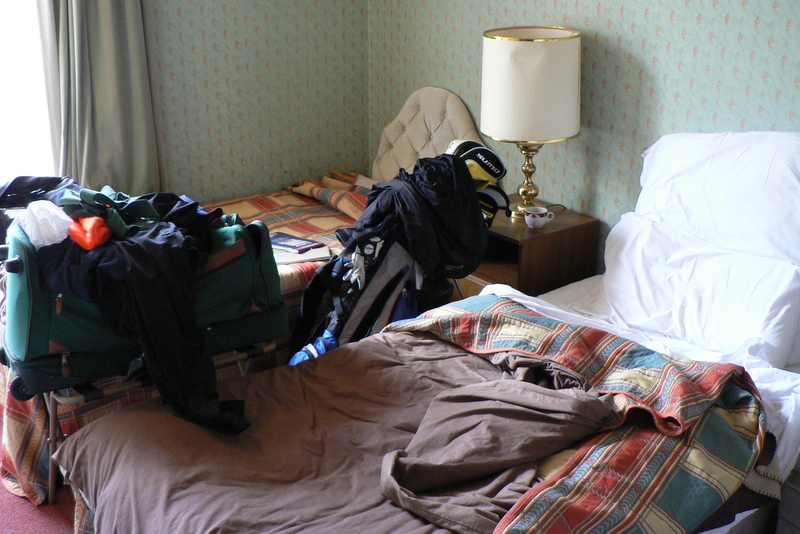
Here’s what my room looked like. As you can see from the size of the suitcase, this was before I had realized I could cram all the clothes I need for an overseas golf trip into a carry-on bag:

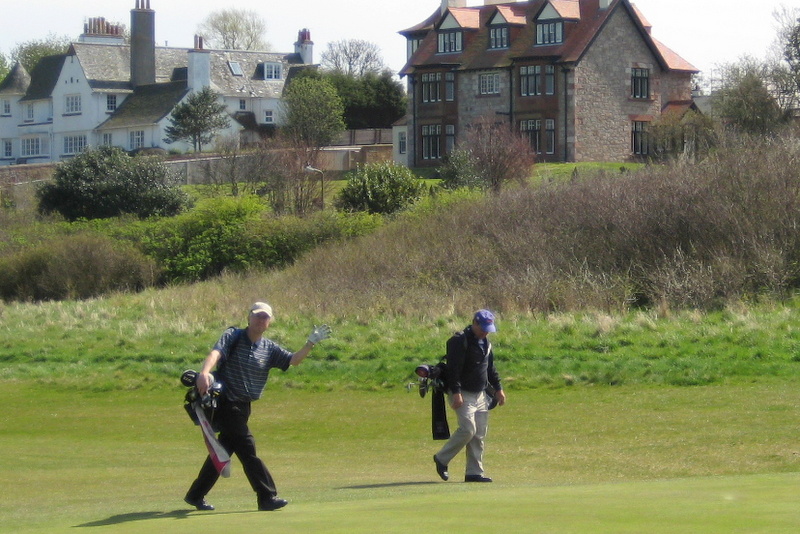
P1040668One afternoon in 2007, when I was in Scotland on a Golf Digest assignment, I teed off at North Berwick by myself. After a few holes I was joined by an old man, who had come through a gate leading to one of the houses overlooking the course. He had lost his wife sixteen years before, he said. He walked along with me and asked me questions and held the flag while I putted, and I played really well for as long as he was there. He said that if someone offered him a plane ticket to New York he would go in five minutes, and I briefly considered trying to work out a temporary life swap. He said that he had once been to Chicago, and that while he was there a shoeshine man had asked him if he was French. He said no, Scottish, and the shoeshine man said, “You speak English very well.”

IMG_0033

On the fourteenth hole, the old man and I caught up to and joined three Swedes. He knew them already, because he had run into them the night before, in the bar at the Blenheim. They were part of a group of six, and they had played Muirfield the previous day, and they were going home in the morning. One of them said that the flight from Edinburgh to Stockholm was just an hour, and that he would be going straight from the airport to his office—a thought that made everyone temporarily adopt a grim facial expression. The old man walked along with us until he got back to his gate. It turned out that he was very interested in Swedish girls, and other girls.

IMG_0034

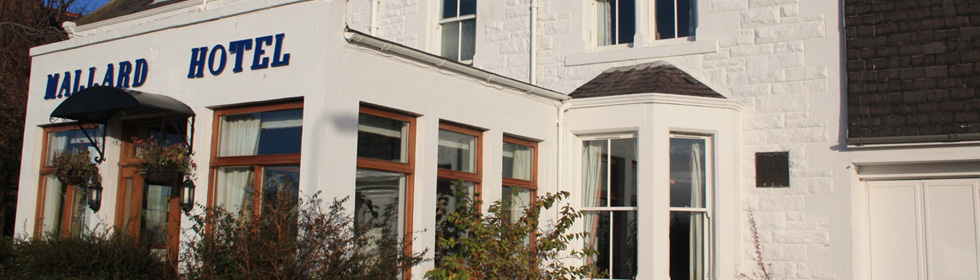
That night, I stayed not at Blenheim House but at the Mallard Hotel, in Gullane. Incidentally, “Berwick” is pronounced BARE-ick, and “Gullane” us pronounced GILL-en. There are three golf courses in Gullane: No. 1, No. 2, and No. 3. Muirfield Golf Club is virtually next door and can be seen from the top of Gullane Hill, and a caddie at Gullane once described it to me as Gullane No. 4—although Muirfield members don’t think of themselves that way.

mallard

I ate dinner that night at a pub called the Old Clubhouse. Directly across the street from both the pub and my hotel was the Gullane Golf Club’s six-hole children’s course, which costs nothing to play, as long as you’re not an adult. As I walked to dinner, I saw a man and his nine- or ten-year-old daughter. He was teeing up balls for her, and she was hitting the most gorgeous draws with a driver. She was hitting from a tee toward a green, but she was using the hole as a driving range. What a swing! And beyond the children’s course I could see Gullane No. 1 and No. 2.

First green, Gullane No. 1, looking back toward town. The knobby thing at  top right overlooks North Berwick and is visible in the photo with the rainbow, below.

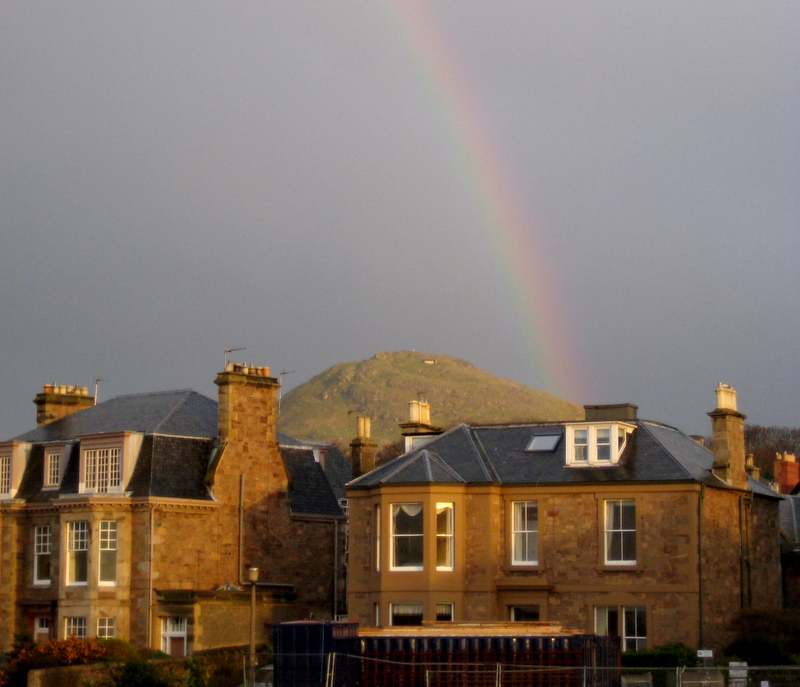
First green, Gullane No. 1, looking back toward town. The knobby thing at top right overlooks North Berwick and is also visible in the photo with the rainbow, below.

The next year, I went back to Scotland with eight friends from home, and we spent the first two nights of the trip in North Berwick. On the second day, we saw this:

IMG_0043

And that evening we saw this:

IMG_0042

I almost feel picking a fight with my wife, to see if I can’t tempt her to give me the boot.

The Muny Life: Orlando, Philadelphia, Brooklyn, and Elsewhere

Winsteads

I’m just back from Kansas City, where I grew up. Among other things, it’s the home of Winstead’s, which makes the best hamburgers in the world. When I was a kid, you could order from your car by shouting into a thing that looked like a speaker at a drive-in movie theater, and then a waitress would bring your stuff on a tray, which she would hook over a partly rolled-down window. There’s no more curb service at Winstead’s, but there’s a drive-through window, open 24/7. You can also eat inside. When you go, here’s what to order (no substitutions, please):

Double cheeseburger with extra P.M.K. (pickles, mustard, ketchup) and grilled onions.
Single cheeseburger, ditto (for topping yourself off—just take my word for it).
Fifty-fifty (half onion rings and half fries; ask for the fries to be “well done”).
Large cherry limeade (or, if you insist, large diet cherry limeade).
Frosty (technically speaking, this could be considered a dessert, but the proper way to eat it is as a side dish).

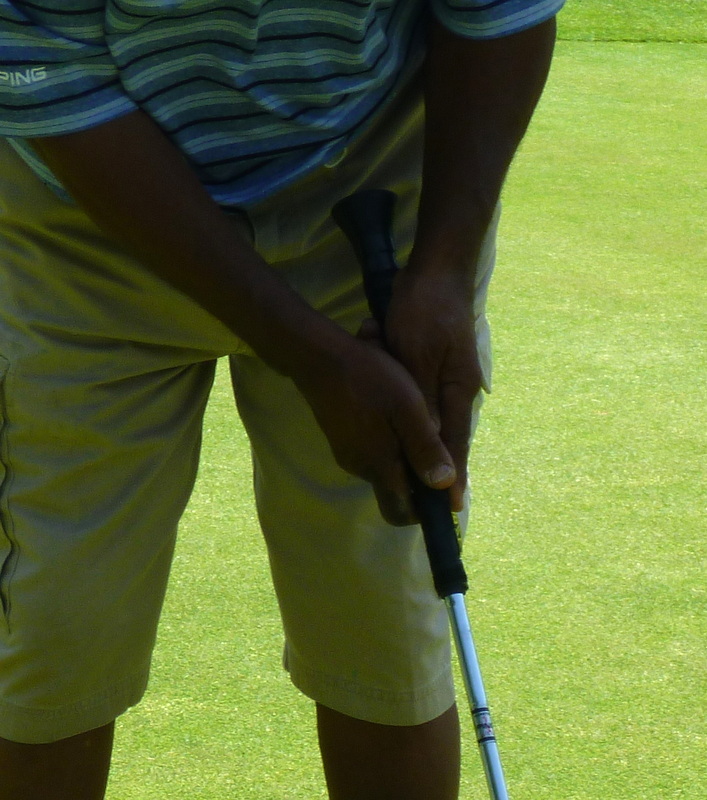
When I was in high school, my friends and I occasionally ate four meals a day at Winstead’s. You’d be crazy not to go, even if you weren’t planning to travel to Kansas City. Between trips there last week, I visited my mother and played three rounds on two terrific municipal golf courses, which I’ll write about in the September issue of Golf Digest, in my regular monthly column. Here, in the meantime, is a photo of the putting grip of one of the guys I played with, who I’m pretty sure is one of the three or four best putters in the world (his friends call him Drano):
P1070261

My Muny Life column in the May issue of Golf Digest was about Dubsdread Golf Course, in Orlando, Florida. The photo below is of two of the guys I played with there: Fletch, a semi-retired accountant, and Brian, his son-in-law, who is in the building-supply business. Brian lives near the course and gives Fletch hybrid clubs and gentle swing advice, plus the occasional grandchild.

Fletch and Brian.

Fletch and Brian, Dubsdread Golf Course, Orlando.

During another round, I watched a guy on the driving range talk on his phone, which he was holding in his right hand, while hitting one-handed wedges with his left hand and smoking a cigarette. As Dr. Johnson said, in a different context, “It is not done well; but you are surprised to find it done at all.”

P1040845

In the June issue, I wrote about Cobbs Creek Golf Club, which is just down the road (and creek) from Merion Golf Club, where the Open was held last week. Here’s the maintenance building at Cobbs Creek, which, like the clubhouse and the course, dates to the early nineteen-hundreds:
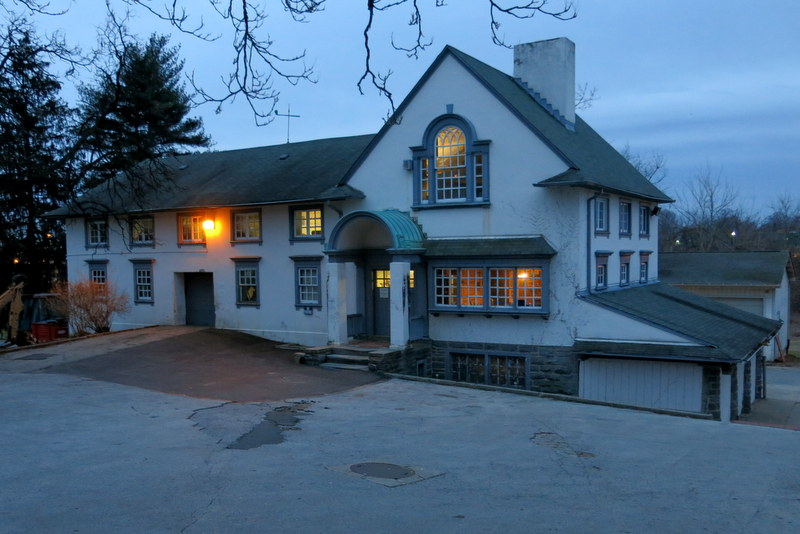
Cobbs Creek Golf Club, Philadelphia.

Cobbs Creek Golf Club, Philadelphia.

After one of my rounds, I met Hank Church, a regular, who didn’t play but dropped by the clubhouse to see his friends. “I had ten inches of my large intestine removed sixteen days ago,” he said, and he lifted his shirt to show the scar, which was barely visible. He wasn’t ready to swing a club yet, he said—but almost. And, like many of his friends, he served as a marshal at the U.S. Open, in his case on the eleventh hole, which is the one where Bobby Jones closed out Eugene Homans in the 1930 Amateur, thereby completing his Grand Slam.

hank Church, Cobbs Creek Golf Club.

Hank Church, Cobbs Creek Golf Club, Philadelphia.

For the July issue, I wrote about Dyker Beach Golf Course, in Brooklyn, where my friends and I often go to play during the winter, when our home course is covered with snow. A few months ago, eight of us set out a little before five in the morning so that we could get to Brooklyn in time to play as guests in the regular Sunday-morning game of Shore View Golf Club, a men’s group that plays at Dyker. John Perez, the club’s president, supervised the picking of the teams, using a handicap-based method that he referred to as Captain and His Men. It was kind of dark in the grill room when he did that, so one of the guys used his cell phone as a flashlight when it was his turn to choose:

That's John Perez at the far right. Dyker Beach Golf Course, Brooklyn.

That’s John Perez at the far right. Dyker Beach Golf Course, Brooklyn.

That day, my friend Hacker (real name) and I played with Ronnie Clyne, who works for a headhunter. “I grew up on the Brooklyn waterfront,” Clyne told us. “If you played golf, we beat you up and took your lunch money.” Like most Shore View guys, he’s self-taught and deeply addicted. “I had a hole-in-one once, at a course in the Catskills,” he said. “As I picked the ball out of the hole, a tear rolled down my cheek. It was the closest thing I’ve had to a religious experience.” Here’s Ronnie cleaning goose crap off his golf shoes on one of the tees:
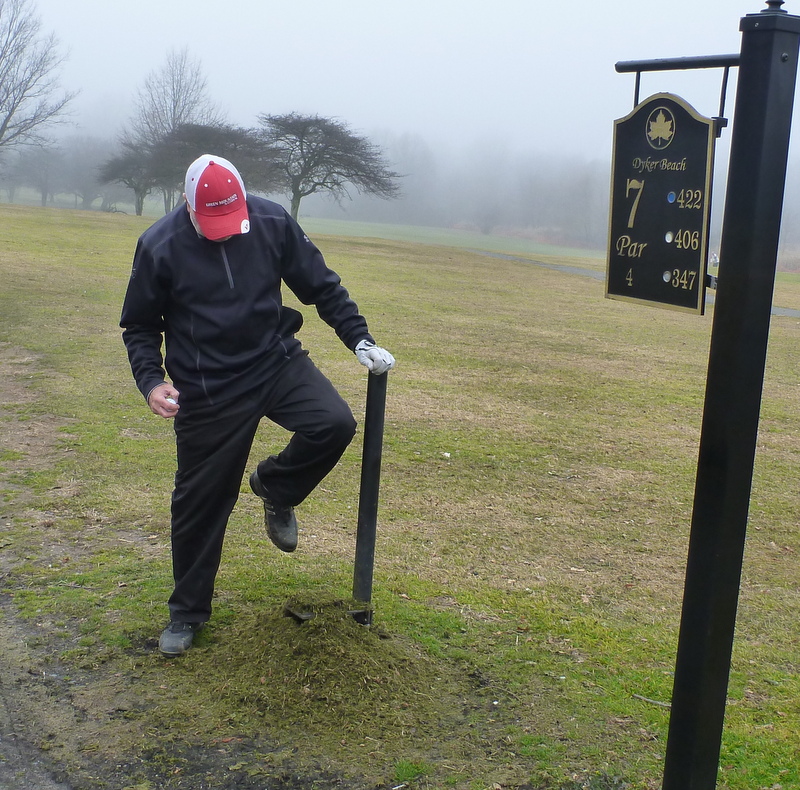
Ronnie Clyne, Dyker Beach Golf Course, Brooklyn.

Ronnie Clyne, Dyker Beach Golf Course, Brooklyn.

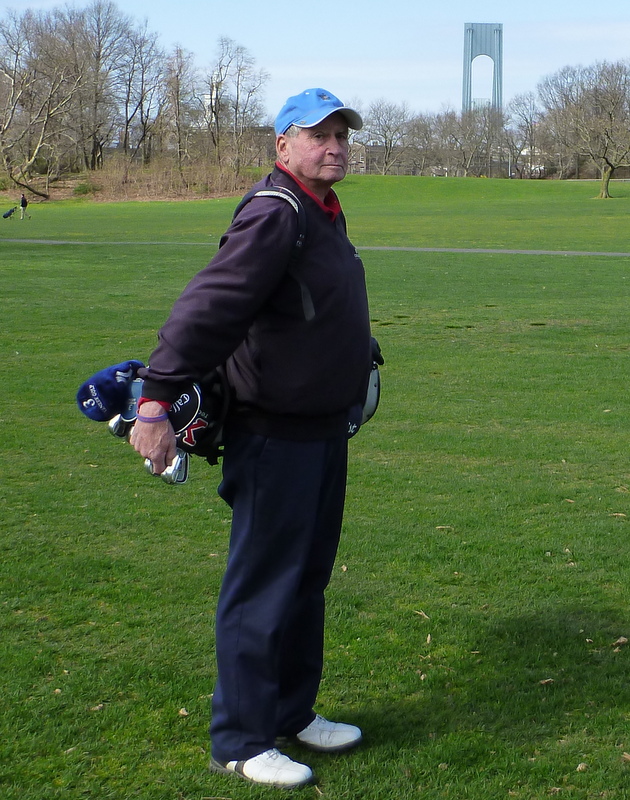
And here’s Hacker (looking very serious) with the Verrazano-Narrows Bridge in the background:
P1050604

On the morning we played with the Shore View guys, I picked up Other Gene. and Gary, our superintendent, at Gene’s house. They were waiting in front when I arrived, at 4:45 a.m., and when I opened the trunk of my car Gene’s dogs, which are huge, started barking inside his house. Gene was worried that the dogs would wake up his wife, so he kept saying “Shhhhhh, shhhhhhh, shhhhhh”—very quietly, so as not to make matters worse. I was standing next to him and could barely hear him, so I assume the dogs heard nothing, their famous ears notwithstanding. At any rate, they kept barking and, if anything, got louder. Miraculously, though (we learned later), Gene’s wife slept through the whole thing.