What’s In My Bag: Dana McQueen

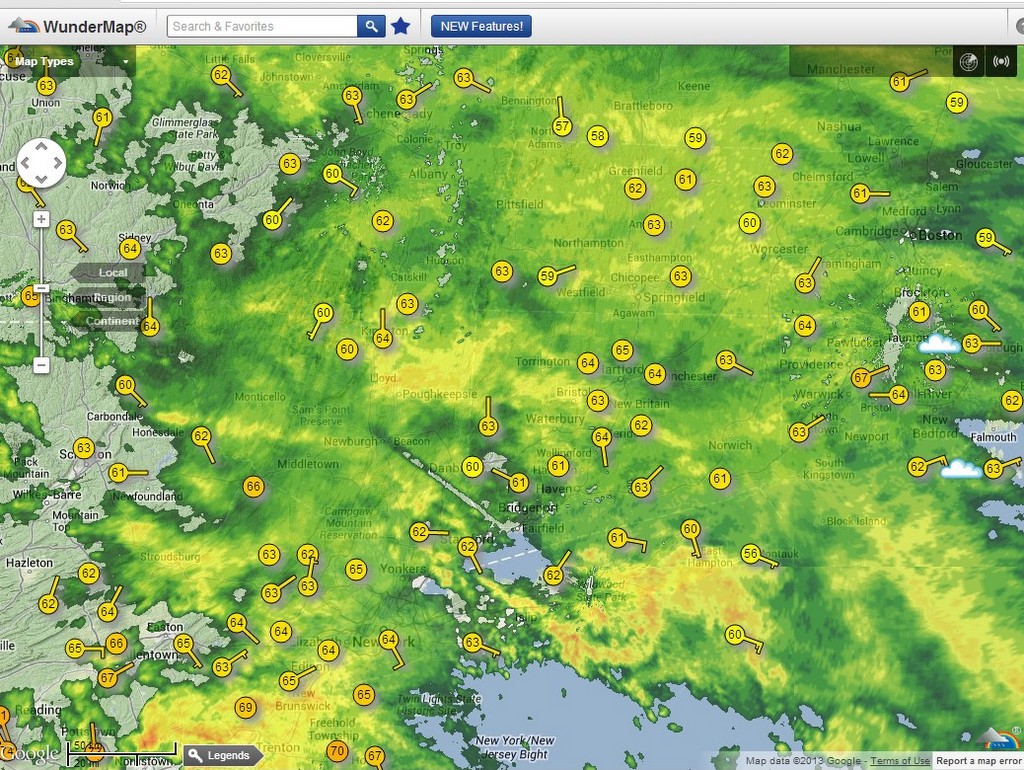
This is an aerial view of Tony's and my match this afternoon. We're somewhere there near the center of the map.

This is an aerial view of Tony’s and my match today. We’re somewhere near the center of that big green-and-orange thing.

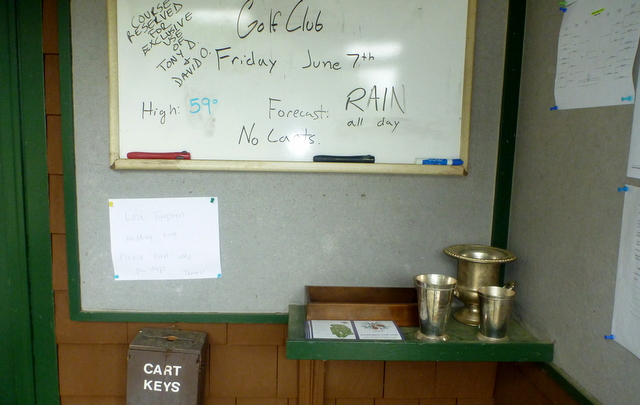
Tony and I happily played anotherA statewide tournament that I was supposed to play in tomorrow has been postponed because the rain that was falling when Tony and I played is expected to continue through the night. I was actually looking forward to slogging around all morning, then loading my soaking-wet golf bag into my travel case, racing a hundred miles to Newark Liberty International Airport without a shower, and taking a night flight to Kansas City to play golf on a Golf Digest assignment and visit my mother. In fact, my only chance to finish the tournament above the middle of the field was probably to go off in a downpour, since I actually like playing when the people I’m competing with don’t.

In 2006, I took back-to-back golf trips to Dubai and Ireland. During the Ireland portion of that two-climate packing adventure, I learned how to dry wet golf stuff with a hotel-room iron and hairdryer (after first blotting up the worst of the water by rolling up everything in bath towels and stomping):
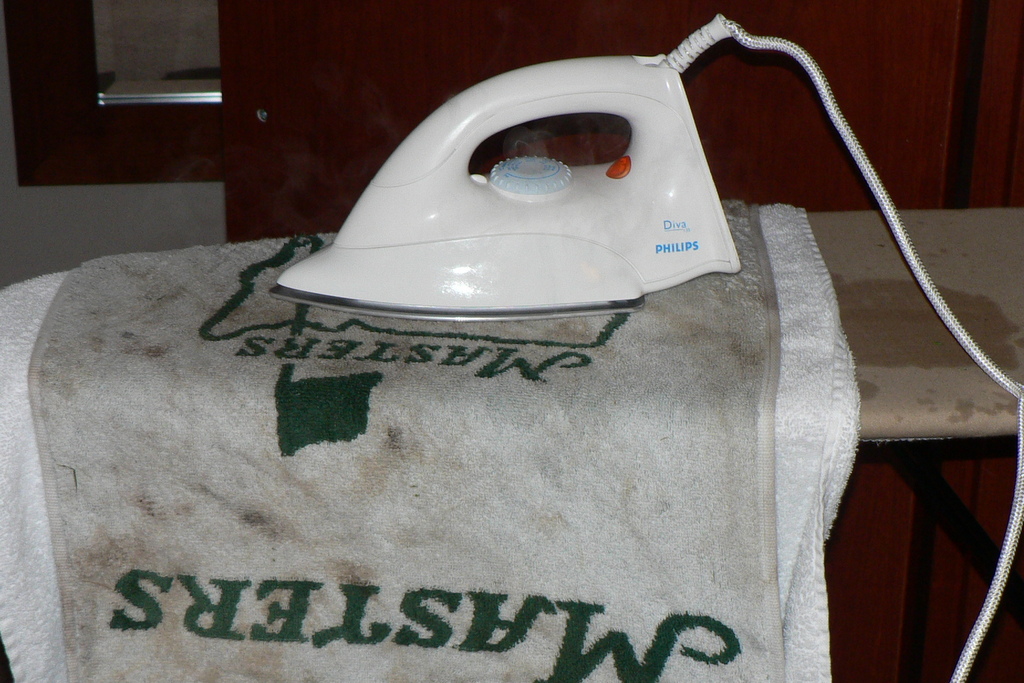
Doing this produced tremendous clouds of steam. Getting the towel half dry took forever.

Doing this produced tremendous clouds of steam. Getting the towel half dry took forever.

Before using the hairdryer, I tried drying my rain pants in my room's heated trouser press, but that didn't work.

Before using the hairdryer, I tried drying my rain pants in my room’s heated trouser press. That didn’t work.
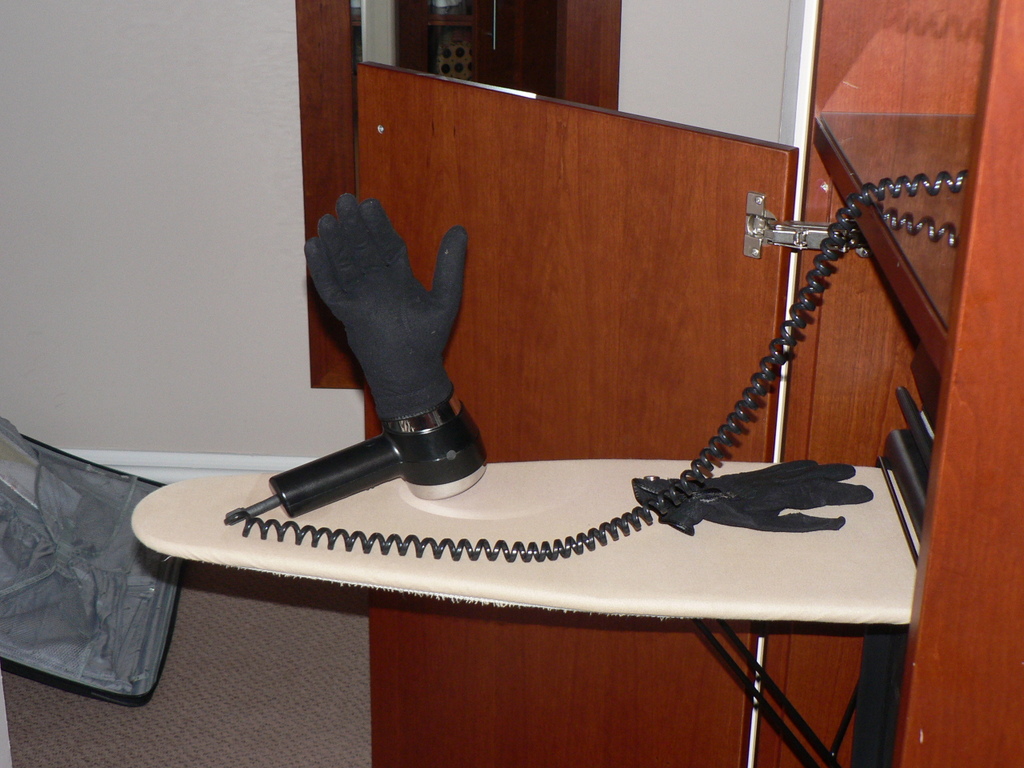
Rain gloves don't really need to be dry, but if you have the equipment why not?

Rain gloves don’t need to be dry, but if you have the equipment why not?

The hotel was in Killarney, and the golf course where I got so wet was Tralee—which is seldom ranked among the very best courses in Ireland but is plenty nice enough and is almost certainly the best course that Arnold Palmer ever designed. (It opened in 1985.) As we approached the middle of the (terrific) second nine, the wind reached the velocity necessary to propel liquid water through the fabric of my previously reliable Sunderland of Scotland rainsuit, and I stopped trying to clean my glasses between shots. It wasn’t just the worst weather I’d ever played golf in; it was the worst weather I’d ever been outside in. Nevertheless, my three companions and I all enjoyed ourselves immensely, and we played far better than you might think—perhaps because over-swinging and over-thinking are impossible when remaining upright requires most of your concentration. (I don’t know what our caddies thought.)

Recently, I heard from a reader who has also been to Tralee: Dana McQueen, who lives in Purcellville, Virginia, and is exactly the same age I am (fifty-eight). Here he is at Tralee last summer:
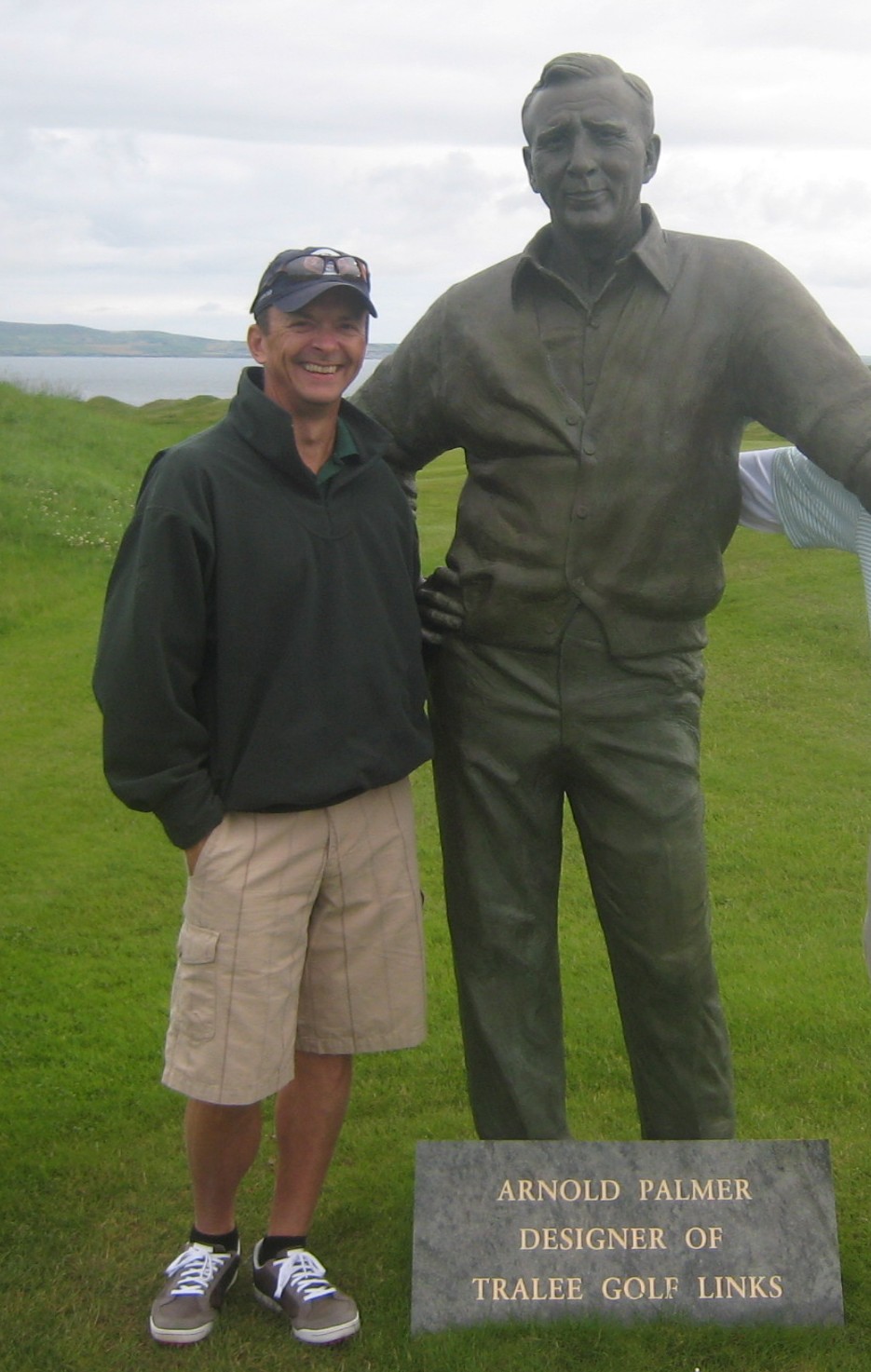
Dana McQueen and some other guy, Tralee, Ireland, July, 2012.

Dana McQueen and some other guy, Tralee, Ireland, July, 2012.

And here’s McQueen’s golf bag:

The first thing I notice about McQueen's golf clubs is that he keeps them a hell of a lot cleaner than I keep mine.

The first thing I notice about McQueen’s golf clubs is that he keeps them much cleaner than I keep mine.

Here’s what he’s got in there:

Cleveland Classic XL driver, 10.5 deg, stiff graphite
Cleveland FL fairway, 17 deg, stiff graphite
Cleveland Mashie hybrid, 18 deg, stiff graphite
Cleveland 588TT irons, 4 thru PW, stiff steel
Titleist Vokey 50 deg wedge
Titleist Vokey 57 deg wedge
Taylor Made ATV 60 deg wedge
Ping Redwood ZB putter

“Pretty standard stuff, overall,” he told me in an email. “Sometimes the 60-degree wedge comes out of the lineup, especially on courses with thick rough around the greens. I really haven’t gotten comfortable with the ATV bounce concept yet.” McQueen is a retired C.I.A. officer. He now works as a systems engineer for Stratos Solutions, and he also works for Britannia Golf, which puts together custom golf tours, mostly to Scotland and Ireland. He took up golf as a teenager.

“I started playing,” he wrote, “when I realized that my baseball career was going to come to a screeching halt, at about the same time that I got my driver’s license—trouble with the curve was reality, not a future movie title. I had a great mentor, and within three or four months I was shooting in the low eighties. As you might expect, dreams of grandeur invaded my thoughts. These lasted until I discovered that there were other golf courses on the planet, and that most of them were much more difficult than the little muny up in northern Ohio where I began my golf journey. Since that time, golf has been a series of peaks (nearly qualifying for the U.S. Amateur in the late nineteen-eighties) and valleys (being soundly trounced by an eighth grader in the club championship semifinals). Now I look forward to the weekly game with the Saturday morning group and the occasional trip to Scotland or Ireland. My favorite course (so far) is Royal Dornoch. Unfortunately, a sliver of beach on the North Sea is not exactly what my wife has in mind as a retirement spot.”

McQueen plays most of his golf at Stoneleigh Golf & Country Club, in Round Hill, Virginia. The course was designed by Lisa Maki, one of the very few women course architects in the history of the game. Anybody know if she’s still around?

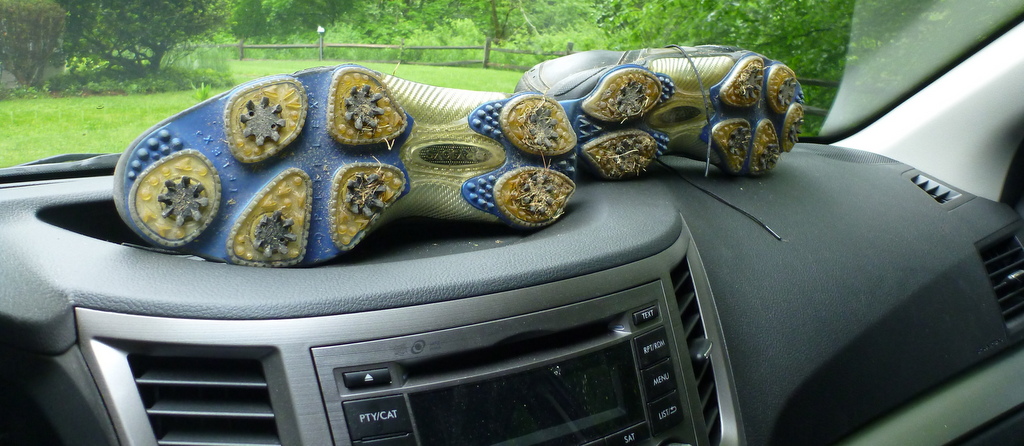
I have received a number of What’s In My Bag contributions. I’ll run them all eventually. In the meantime, send me yours. And here’s a bonus photo, showing how to dry wet golf shoes with the defroster of a rental car:
P1060642


Reader’s Trip Report: Bandon Dunes

P1070187

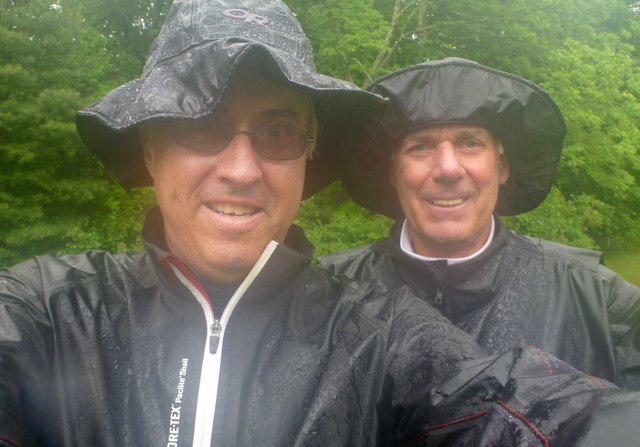
A bunch of us were supposed to play in a tournament today, but the rain started last night—over an inch so far—and everything was called off. Tony and I decided to play anyway, and because we couldn’t talk anyone into joining us we had the place to ourselves for a Two-Hour Eighteen™ (which actually took two hours and fifteen minutes). The golf shop was locked and empty, so we had to handle our own photography:

P1070196

The rain came down sideways for a while, and we were both reminded of a trip we took to Bandon Dunes with our friend Ray in February, 2007. On that trip, we had rain every day for five days, but still managed to play ten awesome rounds.  And although we got wet we didn’t get as wet as we might have. A starter told me that a few years before, on a day when the wind blew hard and the resort received almost seven inches of rain, all eighty-five golfers on the tee sheet played, as did two walk-ons, who were passing through the area and thought the day looked reasonable for golf. Like them, we had a great time, and ever since then we’ve been talking about going back.

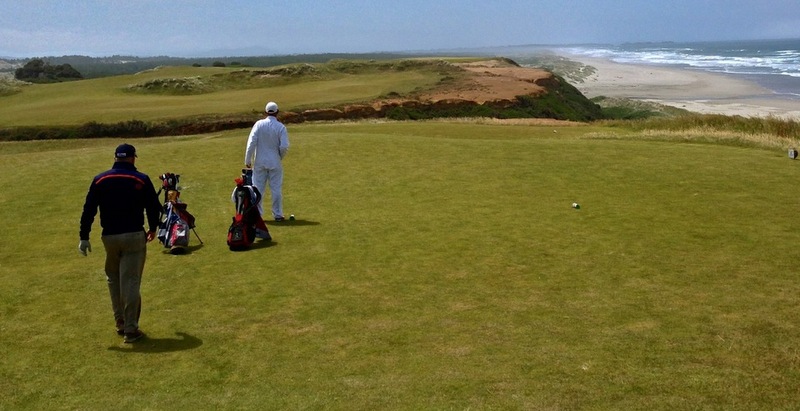
Pacific Dunes, February, 2007.

Ray, mystery person, Tony, caddies, Pacific Dunes, February, 2007.

Coincidentally, last night, just as the rain began, I heard from Tim Miles, a reader, who is at Bandon Dunes right now with a group of friends. He began his trip report with a quotation from my first golf book—an effective way to get my attention:

I suddenly had a vision of a sort of ideal community of golfers: a golfing monastery, or golfastery. Men who worship golf living humbly with other men who worship golf. Simple food. Lots of putting practice. A big driving range with well-spaced target greens. Excellent video-taping facilities. Careful study of the rules. Pilgrimages to the great courses of the world. Beer making in the evenings. Who wouldn’t want to live like that?

I’ve changed my mind about some of that—no more range balls for me!—but I agree with Miles that Bandon Dunes comes close to my monastic vision. Here’s Miles’s report, with photos taken by him and his friends:

Tim Miles, our Bandon correspondent, June, 2013.

Tim Miles, our Bandon correspondent, June, 2013.

Bandon Dunes gets everything right for golfers. There’s not an ounce of pretense in the place (save for the occasional jackass, pink-plaid-panted golfer). The food and lodging are not fancy but perfect in every way. The staff is shockingly good. Every employee of every course in America should be required to witness the level of kindness, engagement, and  service delivered throughout the resort. My caddie, Paul, said employees are trained to consider Bandon Dunes Golf Resort to be Disney for Golfers. It shows, except unlike Disney it’s not loud, flashy, or overstimulating. Bandon lets the courses and their settings overwhelm you. 

bandon miles

It’s not the easiest place to get to, and it’s not the cheapest (though big discounts on a second 18 each day are perhaps the best bargain in all of golf), but it’s worth it. Oh, is it worth it.

IMG_0599

One final note for your visit: when you’re there, do not dismiss Bandon Preserve, a thirteen-hole par-3 course whose net profits go to charity. In its first short season, in 2012 (it opened last May), our starter told us, Preserve donated more than $510,000 to local non-profits. Its goal for this year is more than $750,000. With great ocean views and an opportunity to play 100-yard 7-irons and 160-yards wedges, you’ll never laugh or experience more sheer joy per hole than you will at Preserve. Be sure to try the final hole—a 109-yard downhiller— with your putter.

The Miles party: Chris, Rush, Tim, Steve, Carolyn, Paul, Gerard. Bandon Dunes, June, 2013.

The Miles party: Chris, Rush, Tim, Steve, Carolyn, Paul, Gerard. Bandon Dunes, June, 2013.

Tips for Overseas Golf Travelers

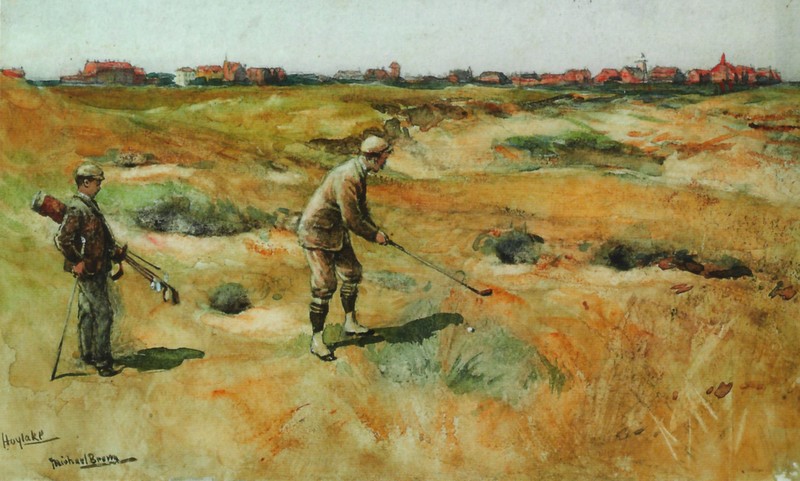
Royal Liverpool Michael Brown

I’ve taken quite a few golf trips to Scotland, Ireland, and England during the past twenty years—including my recent one to England’s “Golf Coast,” in Lancashire (see above)—and I’ve figured out a few things. Here are some of them:

1. The cure for jet lag is golf. You take the overnight nonstop from Newark, arrive bleary-eyed in Glasgow at 8:00 in the morning, drag your clubs past the bomb-sniffing dogs in customs, stumble into a men’s room designated “loo of the year,” change a tall stack of American dollars into a short stack of British pounds, drive fifty-five miles through Robert Burns country while trying to remember to admire the sheep-dotted hillsides, reach Turnberry in a daze—and tee it up on the Ailsa course, where Tom Watson and Jack Nicklaus fought their legendary Duel in the Sun, at the British Open in 1977. You haven’t slept since what seems like the day before yesterday, but your tee shot somehow finds the fairway, and a little mental arithmetic reveals that your colleagues back home are arriving, just now, at their desks. Suddenly, you feel happier than you’ve felt since the birth of your first child, or since the time you and your brother nearly won your flight in the member guest. (Not to worry: The cure for excessive cheerfulness is also golf.)

2. Alternatively, take a flight that arrives at night. I did this once on a non-golf reporting trip to London. I left New York mid-morning, arrived at Heathrow in the dark, took a taxi to my hotel, and immediately went to bed, at roughly 11:00 p.m., local time. I forced my brain to ignore the fact that even two-year-olds were still awake at home, and I slept all night and woke up refreshed, at a normal hour. If you travel all day instead of all night, you sacrifice a full day of potential golf, but you do less violence to your body clock—a possibly worthwhile trade-off for traveling golfers who aren’t as young as they used to be.

3. No matter when you travel, don’t go to sleep (after you’ve arrived) until it’s dark—not even a wee nap. My wife is incapable of doing this. In her view, a nice hotel room in Paris is the ideal place to spend several days recovering from the ordeal of traveling to France. Be strong! Go straight from the airport to a golf course and play thirty-six holes instead!

4. Beware of weekends. The toughest day of the week on which to get visitor tee times is usually Saturday; the second toughest is Sunday. If you plan a week-long trip that involves leaving for the British Isles on a Friday night and returning two Sundays later—something my friends and I have done several times—you’ll miss just five days of work but your golf itinerary will include the maximum number of nuisance days. And the problem will be compounded if your week also includes a “bank holiday” Monday—the equivalent of a three-day-weekend Monday at home. The solution is to miss a little more work. And you can check the bank-holiday schedule online, through the magic of Google. (On my recent trip, I left on Sunday night, arriving early Monday morning, and returned home the following Tuesday.)

5. Look into poor man’s business class. On my flight home, I paid United $99 for an “Economy Plus” seat, in an exit row. It had so much leg room that I could fully extend my legs without touching the seat in front of mine, and when I went to pee the guy sitting between me and the aisle didn’t have to get up and barely had to move his legs. I took a window seat so that I could lean against it to sleep and, as I had hoped, the middle seat stayed empty, because no one had been willing to pay extra to sit in it. I had so much room that I was able to comfortably type up all my notes from the trip—like getting a free day! And I could plug in my laptop, in an outlet under the seat, when the battery got low!

Never, Ever Take One of These on a Golf Trip to the British Isles

You won't need one of these if you travel to the British Isles to play golf. Royal Lytham & St. Annes, England, May 13, 2013.

You won’t need one of these if you travel to the British Isles to play golf. Royal Lytham & St. Annes, England, May 13, 2013.

I’m in northwestern England playing golf this week. I didn’t bring an umbrella, and I’m glad I didn’t, even though there’s rain in the forecast for every day from now until the end of time. The trash can on the second tee on almost any links course in England, Scotland, and Ireland often looks like the trash can in the photo above, because American golfers typically come to the British Isles prepared for the rain but not for the wind. One hole is usually enough to destroy almost any umbrella. And carrying a “wind-proof” model isn’t the solution, because if your umbrella can’t be turned inside out it will carry you to sea, assuming you’re strong enough to hang on. Here’s why:

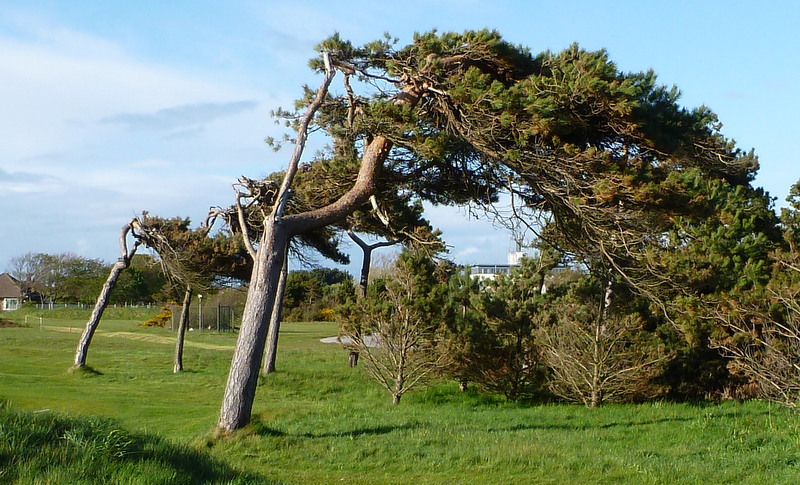
Wind-sculpted trees, thirteenth hole, Royal Lytham & St. Annes.

Wind-sculpted trees, thirteenth hole, Royal Lytham & St. Annes.

The wind was blowing hard yesterday, but the trees in the photo above look that way on calm days, too. Even scrubby little bushes get squashed in the direction of the prevailing wind. (I first wrote about the terrific golf courses of northwestern England almost twenty years ago. The opening sentence of my article was “You don’t need a weatherman to know which way the wind blows at Royal Lytham & St. Annes.” A Golf Digest copy editor, who apparently had never heard of Bob Dylan, changed “weatherman” to “weather report”—and that’s the way it ran.)

P1060129

Not carrying an umbrella will lighten your luggage by a couple of pounds, and it will spare you a lot of annoying housekeeping while you play. And you won’t miss it at all, if you have a rain suit, a rain hat, and a pair of rain gloves. The rain gloves are especially important, because if you have a pair of those you won’t need to even think about trying to keep your grips dry. In fact, if you have rain gloves you almost don’t need to carry a towel. And after my first trip to Scotland, in the early nineties, I stopped carrying an umbrella at home, too. Way too much trouble!

What’s In My Bag, Part Three: Let’s Have a Look Inside Those Pockets

Will, Brent, D.O., Ben, Liberty National Golf Course, Jersey City, New Jersey, May 5, 2013.

Famous building, Will, Brent, D.O., Ben, famous statue. Fourteenth tee, Liberty National Golf Course, Jersey City, New Jersey, May 5, 2013.

On Sunday, I had the tremendous good fortune to be invited to join a twelve-man outing at Liberty National Golf Course, in Jersey City, New Jersey, directly across the Hudson River from lower Manhattan. I employed a labor-saving technique I’ve often used during visits to other rich-guy golf clubs: I wore my sorriest-looking pair of shoes, knowing that the locker-room guy would fully resuscitate them while we were playing. During a multi-day trip Pine Valley ten or fifteen years ago, I took three sorry-looking pairs of shoes and left them outside my door sequentially. I went home feeling like a new man.

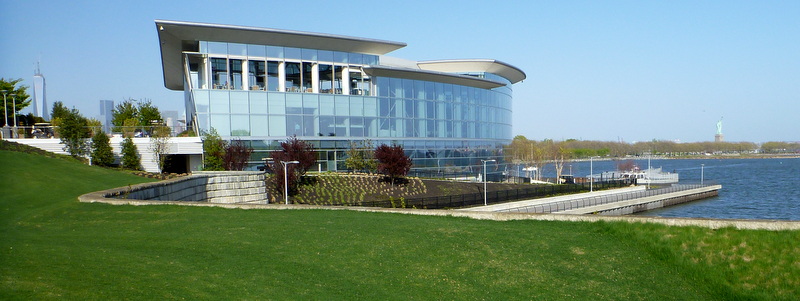
Cool clubhouse.

Cool clubhouse–and that statue again.

Liberty National was designed by Tom Kite and Bob Cupp, and it was built, in 2006, on a desolate industrial site. (I’ve seen a variety of cost estimates, all of which have nine digits.) The Barclays—which used to be known as the Westchester Classic, and then as the Buick Classic—was held there in 2009, and it will be held there again in August. Tour players grumbled about the course the first time. Since then, Kite and Cupp have made many changes, and either the changes have been effective or I don’t know what I’m talking about, because I liked the course a lot. And the clubhouse is the only starkly modernistical one I’ve ever been in that I fully approve of.

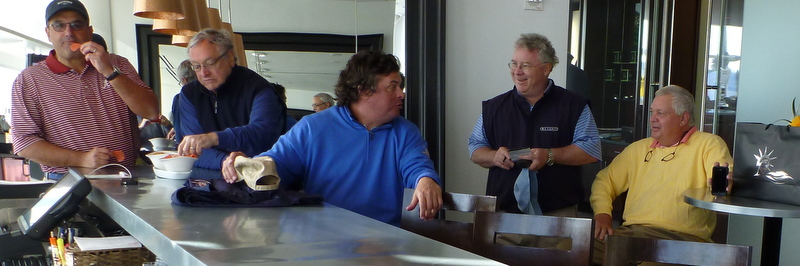
The bar, post-round.

The bar, post-round.

Partway through our round, I apologized to my caddie for having forgotten to remove a couple of nonessential items from my golf bag. (I’ve gotten a little lazy about on-course housekeeping in recent years, because at home I now almost always use a pushcart.) The bag can’t have been too bad, though, because I still occasionally carry it myself. Here is some of what was in it:

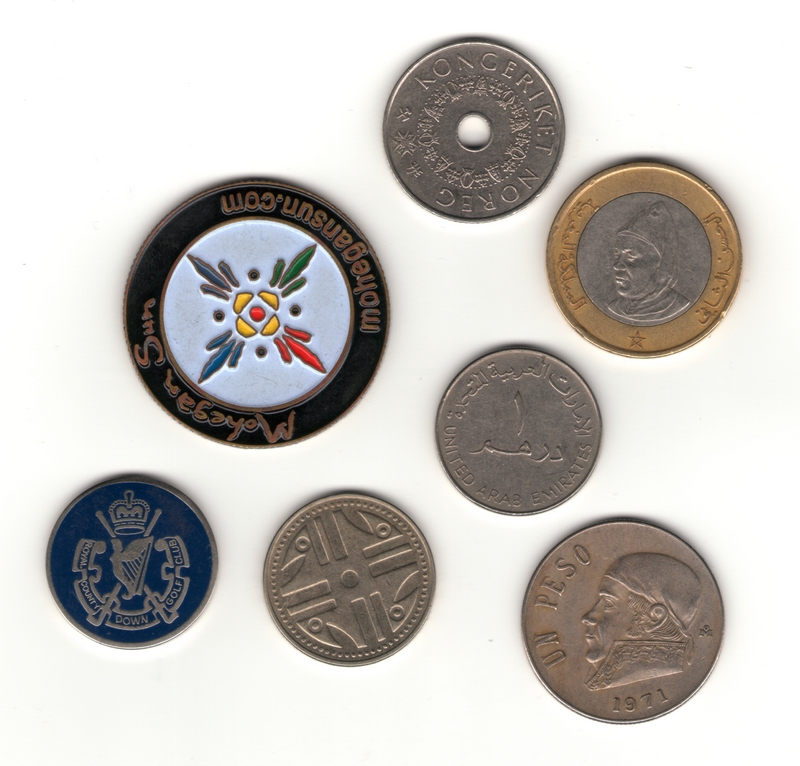
Ball markers

The photo above shows my selection of lucky ball markers for that day. Clockwise from lower left: a souvenir marker from Royal County Down, a necessity because of the sublimity, transcendence, immanence, etc., of that course; a souvenir marker from a casino in Connecticut, useful because it has four colored pointy things, any one of which can be aimed at the hole; a Norwegian coin with an actual hole in the middle of it; a Moroccan coin featuring King Hassan II, who loved golf, wore golf gloves on both hands, and was accompanied during golf rounds by a servant whose only job was to use a pair of silver tongs to hold the king’s cigarette while swung; a one-something coin from Dubai, which I often use when I absolutely have to one-putt; a big old Mexican coin with some guy on it; a Colombian coin featuring what appear to me to be balls, holes, and “aiming chutes.”

When I wrote about (a slightly different selection of) lucky ball markers, last year, I said that when I used a coin with a guy’s head on it I aimed the top the head at the hole. Michael Clark, a reader, wrote to say that, on the final day of a three-day-tournament at his club, he had discovered a better way. “The eyes of the coin had to be looking at the hole,” he wrote. “When the eyes lined up to the hole the putts were dropping! Also, it had to be the same coin. So, if the coin has eyes, line them up!” Since then, I have field-tested Clark’s method, and adopted it.

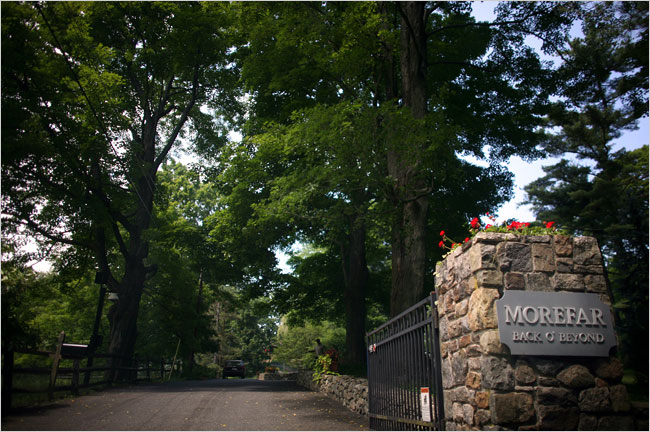
Morefar green repair tool

The photo above is of what is probably the luckiest green-repair tool I’ve ever owned. I got it at a super-secretive golf club called Morefar Back O’ Beyond, which straddles the border between Danbury, Connecticut, and Brewster, New York.

The course on the left is Morefar. The course on the right is Richter Park, which is owned by the city of Danbury, Connecticut, and is one of the best munys in the country.

The course on the left is Morefar. The course on the right is Richter Park, which is owned by the city of Danbury, Connecticut, and is one of the best munys in the country.

Morefar

Morefar used to be owned by the disgraced insurance company A.I.G. I played there a dozen years ago as the guest of one of the club’s handful of local members. Only a tiny number of golfers are allowed out each day, and the only other group on the course on the day we were there was that of the Sultan of Brunei, who teed off before we did. He and his retinue were almost comically slow, but, it turns out, you don’t play through the Sultan of Brunei. On an airplane recently, I saw a guy (in first class) who had a Morefar attaché case in his lap. I gave him the secret sign of brotherhood (by showing him my green-repair tool) as I walked past him on my way to the back of the plane, but he cut me dead.

coppertone

The item above is roll-on sunscreen, which I use as “lip balm.” The tube is at least half again as big as a ChapStick tube, and the stuff is waterproof. It’s especially handy in cold weather and in wind. I don’t carry ordinary sunscreen in my golf bag because I don’t believe in applying sunscreen in situ. I once told someone that if I ever ran for President my platform would have just three planks. I don’t recall what the first two were, but the third was that everyone would have to put on their sunscreen at home, before they went to the golf course, the swimming pool, or wherever. Sunscreen is much easier to apply when you aren’t wearing clothes, and it works better if it’s had some time to soak in. When I see young parents at the beach trying to squirt sunscreen onto squirming, uncooperative children, I think: “An hour ago, your children were naked and not covered with sand; why didn’t you think of doing this then? When I’m the President, we’ll have no more of this nonsense.”

Several readers have sent me descriptions of what’s in their own bag. As promised, I will soon create a new section and post several of them permanently. If you’d like to add your own bag to the pile, send an email to myusualgame@gmail.com. Include a golf-related description of yourself and at least one or two photos of your golf stuff.

(Read Part One and Part Two.)

What's In My Bag?

What’s In My Bag?

Is Golf the Key to World Peace?

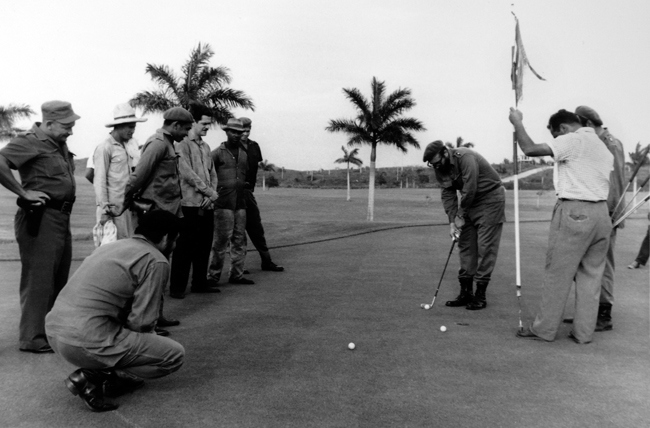
Fidel Castro and Che Guevara, 1962.

Fidel Castro and Che Guevara, Havana, 1961 or 1962.

In 2009, Hugo Chávez, who may or may not still be the president of Venezuela, dismissed golf as a “bourgeois sport.” A U.S. diplomat—clearly not a golfer himself—called Chávez’s statement “a mulligan.” (The annoying use of golf terminology for putatively humorous purposes is apparently irresistible; the Wall Street Journal described Chávez’s remarks as “ahem, par for the course.”) Chávez is a socialist revolutionary, a quasi-dictator, an American antagonist, a supporter of Iran, and, often, a buffoon. Nevertheless, it’s hard to argue with his main contention, which was that lush fairways are not the highest and best use of scarce real estate in places that lack even minimal housing for many impoverished residents.

Hard, but not impossible. In the late nineties, David Plotz, who is now the editor of Slate, suggested that golf might be a promoter of world peace. “Countries where golf is popular,” he wrote in the New York Times, “never fight other golfing nations—and don’t fight much at all—while countries without golf are strikingly belligerent.” The United States is an obvious exception, although, historically, we have focused our aggression on countries where golf is unknown, and on non-playing tyrants like Slobodan Milosevic, Osama Bin Laden, and Saddam Hussein. A commitment to golf-course construction, furthermore, has emerged as an important step in the rehabilitation of our former arch enemies, among them Russia, China, and North Vietnam. Will Baghdad, Kabul, and Pyongyang become prime American buddies-trip destinations a decade or two hence? We can only hope.

The explanation for golf’s pacific associations isn’t hard to understand. In fact, Chávez himself identified it: golf is a bourgeois sport. A country that embraces golf is a country that has reached a tranquil, non-belligerent middle age. Jihad is a young man’s game. You can foment revolution or you can fight your slice—life is too short for both. Fidel Castro and Che Guevara (who had played as a child in Argentina) famously posed on a putting green (in fatigues) in 1961 or 1962, but they weren’t really playing a match. And Castro showed what he really thought about golf by bulldozing Havana Country Club.

A passion for golf suggests a certain maturity of judgment, as well as a willingness to get along with others. A little more popularity for the game could be just what the world needs.

My Close Personal Friend (a Different) Tom Watson

Nick and Hacker (real name), Dyker Beach Golf Course, Brooklyn New York, 2006. That’s the Verrazano-Narrows Bridge in the background.

As soon as our home course closes for the season, my friends and I pack up our clubs, say goodbye to our wives and children, and head south for a while, to a place where golf can be played on real grass even in the middle of the winter. Which is to say, we go to the Bronx.

Many people don’t realize that there is a golf course inside the New York City limits, but there are more than a dozen, and almost all of them are public courses that are open year-round. Our favorites are probably Pelham Bay and Split Rock, in the Bronx, and Dyker Beach, in Brooklyn, but there are others and, because there’s no such thing as a bad golf course, we sometimes play them, too. (You can read more about winter golf in New York here and here.)

The drive south takes us down I-684 and the Hutchinson River Parkway and past still more golf courses, most of which don’t stay open all winter. One of those is Saxon Woods, which is one of six public courses owned by Westchester County, New York. Saxon Woods is so close to Winged Foot and Quaker Ridge that some people figure A. W. Tillinghast must have designed at least part of it, too. The evidence for that isn’t strong, to say the least, but as we drive by I look at it longingly (which is how I look at all golf courses).

Not long ago, I received an email from Tom Watson, a Saxon Woods regular, who wanted me to know about a game he had invented. Here he is:

Tom Watson (real name) playing in a charity outing at Westchester Country Club, Rye, New York, 2012.

Tom wrote:

“I simply keep my best score for each hole for the entire season, and add them up for a season’s best net total. So it allows a 19-handicapper to post a ‘score’ that’s closer to the pros than to guys who put their shoes on in the parking lot. And it gives you some real rooting interest as the season wanes. I was sitting on 68 last week when I stepped up to one of the only two holes I haven’t parred all year. A good drive, a yanked three-wood, a big flop shot over a bunker, and an easy three-footer later, I was writing down par and dropping my Season’s Best to 67. It’s a number I’m not usually acquainted with—and it made the round. I didn’t quite go all Ian Poulter on the green, but there was a discreet fist pump involved. It’s the only golf game I know of where your score always goes down over time!”

Tom’s invention is actually a re-invention. A cumulative score like the one he compiled is called a ringer score, and there are lots of clubs and leagues and groups that run season-long ringer competitions. (One of them is Wethersfield Country Club, in Connecticut, where Rick and I played in a state senior four-ball tournament this year.) Ringer scores are also fun to use as a side bet on golf trips, over multiple courses. Ray, Tony, and I did that during ten rounds on three courses at Bandon Dunes, not quite six years ago. I’m pretty sure I won, although I don’t recall collecting any money.

A Golfer’s Bucket List: No. 1

My luck-of-the-draw playing partners at Tarbat Golf Club, a ten-hole course in Portmahomack, Scotland, across Dornoch Firth from Royal Dornoch Golf Club. I don’t remember their names, but they lived nearby and worked in the oil industry. They were playing in a tournament but had no expectation of winning anything and so didn’t mind having me along. May, 2007.

Life, I discovered recently, is much shorter than it seemed to be when I was fifteen years old and waiting to get my driver’s license. I’m going to turn sixty in a little over two years, and not long ago I realized with distress that I scarcely have enough time left to paint the rest of my shutters, much less to qualify for the senior tour. And what about that twenty pounds I was going to lose?

Fortunately, I’ve already managed to accomplish more than I ever thought I would. In a club tournament a few years ago, I five-putted from six feet, turning a merely bad round into one that I’ll be able to boast about to my grandchildren. I also once spent part of a family vacation writing an apology letter to the entire membership of my golf club, after (allegedly) behaving like a man half my age.

Now that I really am my age, I intend to devote the dwindling remainder of my time on earth to telling other people what to do. Here is the first of ten important things that I think every serious golfer ought to try to accomplish before it’s too late:

1. Explore golf from the singles line. Like most golfers, I play most of my rounds with people I know already—guys I tend to think of as my best friends, even though I’m not sure where some of them work or whether they have kids. However, I’ve played more than a few of my favorite rounds with total strangers after showing up at an unfamiliar course by myself or with less than a full foursome. At various times over the years, on golf courses on four continents, I’ve fortuitously been paired with: a French real estate developer who had a weekend house in Morocco, a guy who owned and operated a souvlaki pushcart in Manhattan, the man who served as the Senate’s chief counsel during the Iran-Contra hearings, a retired Korean wigmaker, three guys who were playing hooky from their jobs on the assembly line at Boeing, a future chairman of the Securities and Exchange Commission, a teacher who had recently started a golf program at an inner-city high school, a retired cotton broker who had once been a colleague of Paul McCartney’s father, and an unemployed carpenter who looked like George Carlin and told me that the key to golf is to “swing easy as hard as you can.” How many other relatively ordinary activities throw you together with people like that for an afternoon?

To be continued.

The ninth/eighteenth at Tarbat. This is one of my favorite golf holes anywhere: a short par-four that plays either around, over, alongside, or into a cemetery, depending on the shape and length of your tee shot.

Remembering Uncle Frank

Every October for the past thirteen years, my Sunday-morning golf buddies and I have driven two hundred miles south, to Atlantic City, for a three-day late-season golf extravaganza (about which I’ll have more to say in a few days). For the past eight years, our trip has been dedicated to the memory of a friend we called Uncle Frank, who died, at the age of seventy, a month before our trip in 2004. This year, we honored him by using (and losing) twenty dozen golf balls with his name printed on them. They should be turning up in the woods of southern New Jersey for years.

Uncle Frank inspired one of the nine local rules printed on the back of our Sunday Morning Group scorecard: “No competitor shall dress in a black-and-white sun suit purchased by his wife.” When we held our first golf-club sleepover, a decade ago, he arrived in a blond wig and a blue feather boa (see photo, below). He smoked cigars as though they were cigarettes, and then he switched back to cigarettes, which he would have smoked two at a time if he hadn’t needed a free hand for storytelling. He discovered that he was sick after waking up one morning unable to speak above a whisper—the ultimate ironic disability for a man who lived to talk. The doctors found lung cancer and said that it had spread to his vocal cords. He died before the golf season ended.

People fell for Uncle Frank. If you needed to play a fully booked golf course, he was the guy you sent into the golf shop to negotiate. He’d come out ten minutes later with four tee times and an invitation to spend Christmas with the family of the pro. A couple of weeks after his funeral, his wife threw a party in his memory, and so many people wanted to come that she had to find a bigger room

Telling stories about Uncle Frank is hard to do because the teller is always aware that Uncle Frank would have told them better—like the one about the Japanese steakhouse in Myrtle Beach where he cracked up the joint by doing an impression of the chefs’ stylized food-preparation routines using a couple of sex aids he had borrowed from a bachelorette party one table over. Nothing about that performance was inoffensive; somehow, though, it didn’t offend. The only possible explanation is that Uncle Frank’s own disarming vulnerability showed through everything he did, even when he was flipping shrimp into his pocket with a dildo. As loud as he usually was, he was narrowly attuned to the feelings of others. When my father died, he was the first of my friends to call.

If Uncle Frank felt sorry for himself as he was dying, he didn’t show it. The nurses in the hospital all had crushes on him; doctors making rounds dropped by to share a joke. After his cancer had spread to his brain, he was given a marathon radiation treatment, during which his head had to be immobilized in a halo brace, a birdcage-like contraption that was anchored to his shoulders and his skull. When the session ended, eighteen hours after it began, he asked the nurses to take him to the children’s oncology ward before removing the brace. A couple of days before, at home, he had made a basketball backboard out of Styrofoam, and now he asked the nurses to attach it to the back of his head. He let the children in the ward shoot free throws with a Nerf ball, three shots for a dollars. “Hey,” he told me later, “I made twenty-three bucks.”

Three days after the radiation treatment, my friend Jim took Uncle Frank to the golf club for what would turn out to be his final round. I saw them in their cart in the parking lot afterward. Uncle Frank’s face was puffy from the steroids he’d been taking, and he had a bottle of oxygen on the seat beside him, but he was happy. “If this was baseball,” he said, “I’d be batting .750.” Four days later, he was gone.

Uncle Frank, Sunday Morning Group sleepover, 2002.


Back-Roads Scotland: Forfar Golf Club

Forfar Golf Club, Scotland, May, 2007.

Forfar, Scotland, is a small town about dozen miles northwest of Carnoustie. Its most famous resident may be Bon Scott, the lead singer of the rock band AC/DC, who was born there in 1949 and died, of acute alcohol poisoning, in 1980.

Brian.

Forfar—prounouced FOR-fer—has a golf course, which was designed by James Braid. I pulled in one evening in 2007, to make sure I’d be able to find it the following morning. It was almost time for dinner, and I wasn’t really planning to play, but suddenly I found myself in the golf shop handing my credit card to the wife of the head pro. On the course, I soon caught up to and joined three members: Brian, a local builder, who sounded a little like Sean Connery and carried his golf bag by the handle, like a suitcase; Gavin, a retired local cultural administrator; and Michael, a jeweler. Here’s the sort of golfers they were: all three, despite having played the course regularly for many years, were surprised to learn that the round blue marker in the center of each fairway was 150 yards from the green. Gavin told me that the three of them played together almost every Monday evening because “then there’s no one in front and no one behind.” They took lots and lots and lots of swings, although we still finished in just about exactly three hours.

The next morning (after breakfast and a bucket of balls at the local driving range, on the other side of town), I played a second round at Forfar. A ladies’ medal competition was going on just ahead of me, so I had plenty of time to admire the course, which is well inland and is surrounded by farms but feels very much like a links course, in part because most of the fairways have distinctive undulations, like gentle ocean rollers—remnants of ancient flax furrows, Brian had told me. (You can see the furrows, sort of, in the photo at the top of this post.) And when I finished I still had time to kill, so I went around again. And the following year I came back, with friends from home.

If I were sure I’d return to Forfar as often as I’d like to, I’d accept an email solicitation I received a few days ago:

15 months membership for the price of 12!

New members can join straight away for the 2012 price of £485 (£460 + £25 bar credit) and receive membership of the Club through until 31st December 2013!

To join call now on 01307 463773.

The 2013 subscriptions for the remainder of the year are as follows:

Full Membership: £485*

5 Day: waiting list in operation
Under 25: £260
Family: £970** (2 adults & unlimited children)
Junior: £100 (17 & 18)
            £75 (12-16)
            £50 (8-11)
Country: £310
*includes £25 bar credit
**includes £50 bar credit

You will be assured of a warm welcome so please don’t hesitate to contact us by telephoning or sending an enquiry to our email address.

For more information on the benefits of membership at Forfar Golf Club please see below.

  • Excellent layout for all ability of golfers to enjoy.
  • Comfortable clubhouse with refurbished lounge & dining room
  • Driving Range facilities
  • Competitions every Thursday, Saturday and Sundays
  • Online tee time booking & Members Website
  • Unlimited Members guest tickets
  • Reciprocal arrangements with other Clubs for reduced greenfees and a member of the Association of James Braid Courses
  • Membership categories to meet your needs
  • Monthly Newsletter
  • SKY tv
  • Free WiFi
  • Excellent Catering facilities 7 days a week
  • PGA Pro with fully stocked golf shop
  • Discounted rate for FGC members on the Angus Council ‘Be Active’ scheme

Payment can be made by all the usual methods and the Club offers a Direct Debit scheme through Premium Credit Ltd.