Horton Smith, Titanic Thompson, Bobby Jones, Alfred Bourne, and Me

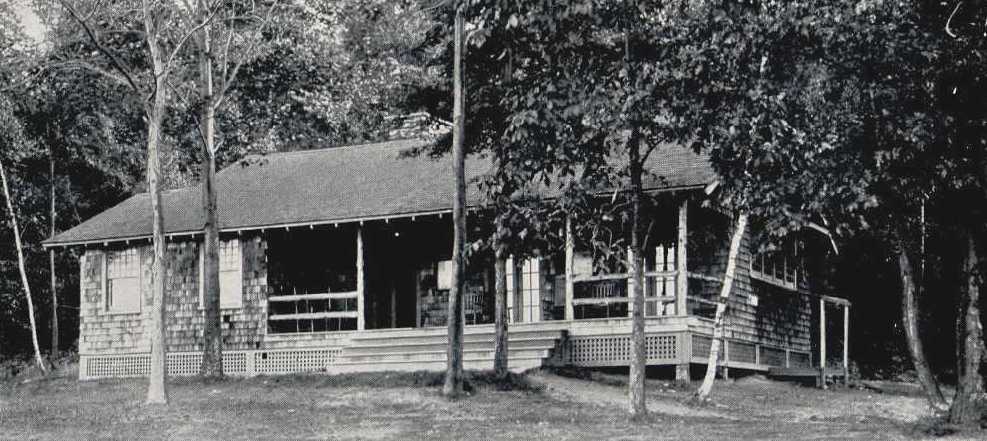
My golf club’s clubhouse as Horton Smith and Titanic Thompson knew it. It looks about the same today, although the trees and the porch have grown.

Horton Smith won the first Masters, in 1934, and he won again in 1936. Two and a half years after that, he got married in the little Connecticut town where I live, ninety miles north of New York City. The bride was Barbara Bourne, whose parents owned a 40-room weekend house here. The legendary golf hustler Titanic Thompson attended the wedding and, during a golf outing at our nine-hole club, gave a ten-dollar tip to his caddie, a local kid who, once he’d become an old man, sometimes played golf with me. (The regular rate in 1938 was 35 cents a loop, 60 cents for two bags.)

Barbara Bourne and Horton Smith (far left), along with lots of Bournes.

Barbara’s late grandfather, Frederick Gilbert Bourne, known as “Commodore,” had been a president of the Singer Sewing Machine Company. He owned a 110-room summer place on Long Island, a 28-room castle on the St. Lawrence Seaway, in the Thousand Islands, and the entire first floor of the Dakota apartment building, in New York.

Horton Smith’s late grandfather-in-law, “Commodore” Frederick Gilbert Bourne, 1851-1919.

Barbara’s father was Alfred Severin Bourne, who, in addition to being the 1934 men’s champion of my club, was a founding member of Augusta National. He served on the five-man Organization Committee, and was a vice-president until his death. Without him, the first Masters might never have been held.

Barbara Bourne and her father, Alfred Severin Bourne, in the late 1920s or early 1930s.

The Bournes spent winters in Augusta, which was popular as a resort destination partly because it was just about as far south as a New Yorker could travel overnight by train and still play golf on arrival. Alfred belonged to Augusta Country Club, and his playing partners there occasionally included Bobby Jones.

Kenneth Bourne (son of Alfred) and Bobby Jones, probably at Augusta Country Club.

In 1931, as Jones and Clifford Roberts were trying to get Augusta National going, next door, Bourne wrote them a check for $25,000—a quarter of the sum that Roberts figured they’d need to build their course. Bourne apologized that he couldn’t be more generous, and told them that if they’d come to him before the Crash he’d have underwritten the entire project. (Bourne missed the first three days of the first Masters because he was competing in—and winning—an amateur event in Aiken, South Carolina, twenty miles from Augusta.)

Alfred Bourne (center) and various playthings, Thousand Islands, 1930s.

Alfred Bourne died in 1956. His weekend house in my town is now the main building of a boarding school; not surprisingly, it’s called Bourne Hall. Each year for the past six or seven, the school and my club have held a tournament, called the Bourne Cup, in which eight or ten of the school’s alumni (some of whom are also members of my club) are almost always soundly defeated by eight or ten members of my club (some of whom are also alumni of the school).

Bourne cap, from Bourne Cup.

This year, the school’s team included a member of the class of 1951, named Dave. He told me that when he was a boy he spent several summers caddying at the club, and often caddied for Alfred Bourne. He said he once asked Bourne if it would be all right for him to use a fielder’s mitt to shag Bourne’s practice balls. (Dave loved baseball but lacked opportunities to hone his technique.) Bourne said that would be fine, and they made a game of it. Bourne was a generous tipper, Dave told me (although he squandered most of his  earnings, a nickel at a time, in the club’s Coke machine).

My club’s caddie corps in 1925, sitting on the front steps of the clubhouse. Note the neckties on the ten year olds. The gloomy-looking (and tie-less) grownup at right is the head pro. The wee lad in knee socks, two seats to his left, is his eventual successor.

A senior member of my club, whose name is Dick, also caddied for Bourne. He told me that he would warm up by hitting exactly thirty practice balls, which Dick would scoop up in a leather bag while keeping an eye out for players teeing off on the sixth hole. (The club’s driving range in those days was just the right side of the sixth fairway.) After counting the thirtieth shot, Dick would run back to Bourne, who would play the first hole, chip to the eight green, play the ninth hole, make the same circuit again, and go home.

Dick, who used to caddie for Alfred Bourne,at our town invitational tournament, October, 2008.

The day before this year’s Bourne Cup, I had the immense good fortune to play a round at Garden City Golf Club, also known as Garden City Men’s, where the U.S. Open was held in 1902. Before we teed off, I wandered around the clubhouse (where jackets are mandatory but shirts are not), and gazed at all the cool stuff. And among many other extremely interesting things I learned that the winner of the Garden City club championship in 1921 was Alfred Severin Bourne. I forgot to take a picture of the plaque with his name on it, but I remembered, later, to take a picture of a similar plaque, back home:

Early champions at my club: two Bournes and several missing years.

More About Foursomes: Muirfield, Troon, Prestwick, and Kümmel

The golfer's liqueur.

In 2009, I played a round at Muirfield, in eastern Scotland, where the Open Championship will be held in 2013. Alastair Brown, the secretary, described it to me (over lunch) as “a lunching club with a golf course attached to it.” A member, he said, once described an ideal day at Muirfield as “two-and-a-half, two-and-a-half, two-and-a-half”: a two-and-a-half-hour 18-hole foursomes match in the morning, followed by a two-and-a-half-hour lunch, followed by a two-and-a-half-hour 18-hole foursomes match in the afternoon.

In the United States, foursomes is usually known as Scotch foursomes or alternate shot, and it’s often a prelude to divorce; at Muirfield, it’s the signature game. Hitting just half the shots gets the non-lunch portions of the day over faster, and ensures that someone always has a hand free to hold the kümmel, a clear, anise-and-fennel-flavored beverage, which is sometimes called the golfer’s liqueur. “The way the club’s members play golf is the antithesis of championship golf,” Brown told me—and he meant that as praise. Muirfield has its own foursomes handicapping system, named after C. J. Y. Dallmeyer, a club captain in the 1950s, who invented it: if you go three-up in a match, you give strokes to your opponents until you’re back to one-up. Dallmeyer also initiated a heavily lunch-oriented New Year’s Day tournament, called the Captain’s Frolic.

Foursomes is also a historically significant game at Royal Troon and Prestwick, two other courses on the Open Rota, on Scotland’s west coast. Every year, members of the two clubs play a cross-country foursomes match over both courses, which abut each other. Half the field starts on the first tee at Prestwick, and half starts on the first tee at Troon. Everyone plays to the eighteenth green on the other course, breaks for lunch, and then plays all the way back. The two members I played with at Troon told me that, usually, a team scores better if it starts at Prestwick, because a typical Prestwick lunch includes so much alcohol that golfers who make the turn there sometimes have trouble finding their way home.

Before lunch, Royal Troon, May, 2009. I'm standing on the tee of the famous Postage Stamp. That's the green by my right arm.

Muirfield has an undeserved reputation for hostility to outsiders. It’s true that visitors are limited to specific tee times on Tuesdays and Thursdays, but the club actually welcomes thousands of unaccompanied non-members every year, and you can make reservations online. You have to wear a jacket and tie in the dining room, but the atmosphere is seductively informal, and even visitors are encouraged to linger. No table has fewer than six chairs, an arrangement that forces groups of golfers to mix, and the food is served cafeteria-style. Diners who don’t live in fear of their cardiologists sometimes bypass lunch itself and move straight from the bar to the dessert table, where the specialties include rhubarb crumble, sticky toffee pudding, and ice cream from S. Luca of Musselburgh, a locally famous dairy.

Muirfield’s locker room has modern, car-wash-caliber showers, like the ones at Merion and Pine Valley, but the other amenities are distinctly old-school, among them a pair of wooden dressing tables, each furnished with a shaving mirror, a nail file on a chain, and a single hairbrush and comb (and no beaker of blue Barbicide). And the members’ locker room at Prestwick is even cooler. Ninety of the lockers there date back to 1877. They look like Queequeg’s coffin.

Tour Players Lead Lives of Quiet Desperation

In 2003, I played in the pro-am at the Western Open, at Cog Hill, near Chicago. The pro on my team was J. P. Hayes, whom I wouldn’t necessarily have recognized if his name hadn’t been printed in huge letters on his golf bag. Nevertheless, I was excited. For a golf fan, playing in a pro-am is a fantasy come true. It’s a chance to spend five hours getting on the nerves of a real tour player, and it provides numerous opportunities to obtain personalized mementoes that can later be sold on eBay.

The excitement felt by the amateurs in any pro-am is almost exactly offset by the dread felt by the professionals, most of whom would prefer to be mowing their lawn, if not their neighbor’s lawn. But the tour requires even the top pros to take part, mainly because pro-ams generate favorable p.r. and make tournament sponsors happy.

My team, without even one useful contribution from me, finished sort of in the middle of the pack. The next day—the first day of the real tournament—I decided to lend comradely support to Hayes by following him in his round. His tee time was 1:09, exactly the same as Tiger Woods’s, although Hayes was assigned to the first tee (along with Justin Leonard and Stuart Appleby) while Woods was assigned to the tenth (along with Chris Smith and Cameron Beckman). Woods, who ended up winning the tournament, influences golf spectators the way a black hole influences cosmic dust: when he emerged from the driving range, at about 12:45, what appeared to be the entire human population of northeastern Illinois began to drift inexorably toward him.

Over on hole No. 1, in contrast, the crowd of spectators quickly reduced itself to a handful of friends, relatives, and stubborn contrarians. I walked with Hayes’s completely charming wife, Laura, who was pregnant with their second child; Amanda Leonard (also pregnant); Ashley Appleby; and a few of Hayes’s relatives, who were visiting from Wisconsin—about the same turnout you would expect for the final round of a club championship.

Non-golfers joke about how boring golf looks on television, but TV actually makes tournaments seem more exciting than they are, because it focuses on leaders and stars, and because the camera doesn’t linger once a shot has been hit. If you’ve ever attended a Tour event in person, you know that most of it consists of absolutely nothing—like a fireworks display at which the rockets go off ten minutes apart. Even if you’re following one of the superstars, you have more than enough time between strokes to read the newspaper, get caught up on your bills, or work out any lingering difficulties in your marriage.

It’s the pros who lead lives of quiet desperation—not regular golfers like us. If a pro hits a ball out of bounds, the other guys in his foursome never say, “Aw, forget it, just drop one up by the tree.” And nobody ever hooks them in the crotch from behind with a two-iron as they’re getting ready to play a shot. They have to hit practice balls and lift weights and take vitamins and live in hotels and worry about telling their wives they’ve been demoted to the Hooters Tour.They sacrifice the best years of their lives to entertain and inspire us, and how do we repay them? By hounding them for autographs, and calling them chokers when they lose, and nodding smugly when Johnny Miller says their swing looks a little laid-off. Then, to top it off, we ruin their Wednesdays with pro-ams.

We have a lot to atone for. And as I walked along with Laura Hayes I thought of a way to do that: by inaugurating a national program of amateur-professional events—“am-pros”—which will be just like pro-ams, except opposite. Rather than imposing ourselves on the pros at the very moment they’re trying to pull themselves together to compete, we’ll invite them to join us at our own clubs, and let them see, for a change, how real golf is played. Any pro who misses the cut at any tournament can simply show up that weekend at any participating club and play for free. We’ll give him a handicap of plus-five or plus-six, and we’ll choose teams the way we usually do, by throwing balls or pulling numbered poker chips out of a hat, and we’ll work him into our regular Saturday or Sunday games. Lunch, too. Want in?

Hacker (real name) counting the skins money at my club this past Sunday. J. P. Hayes and Tiger Woods: this life could be yours.

Want to Buy a Building Lot at Augusta National?

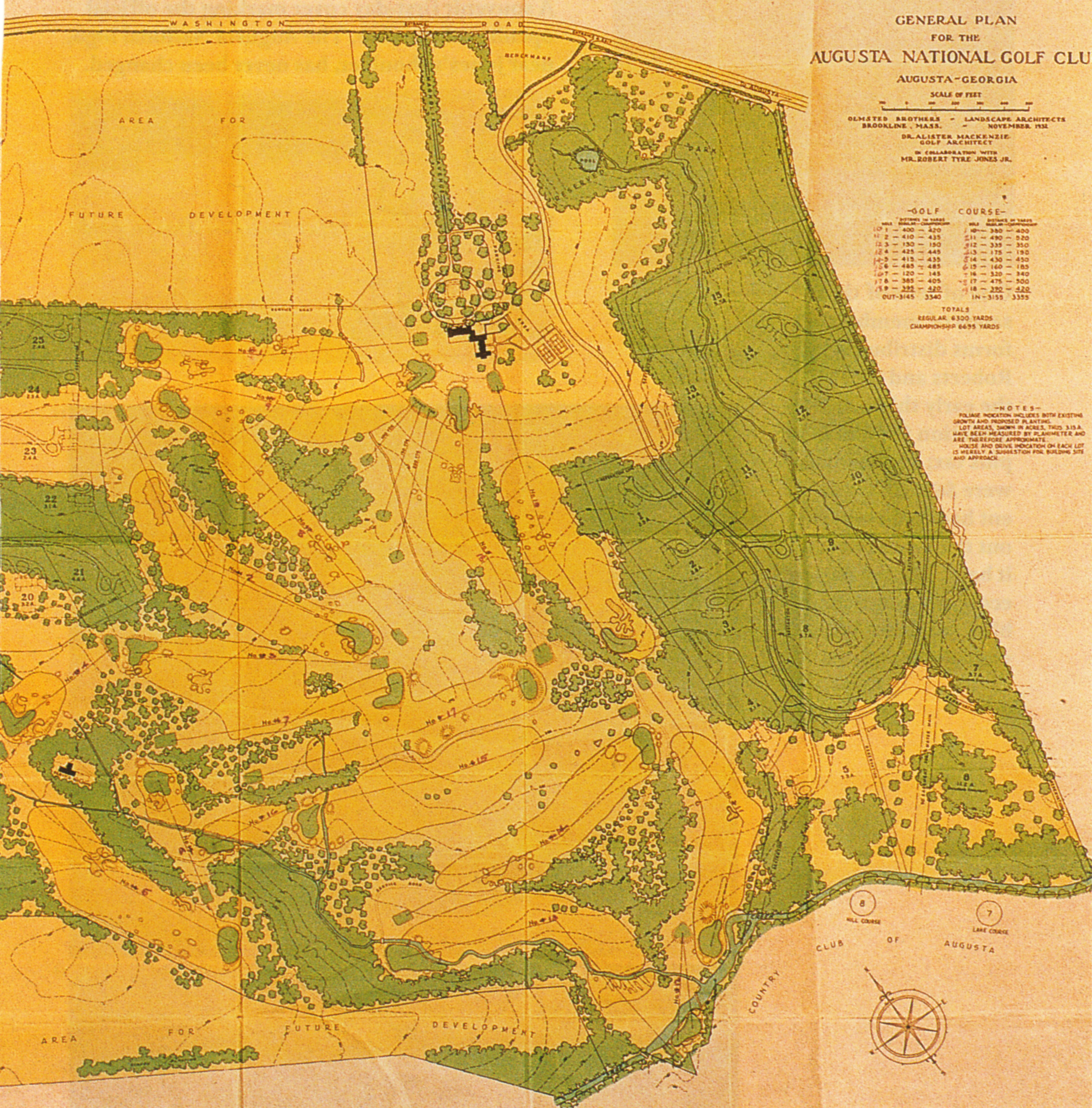
Olmsted Brothers' 1932 Augusta National real-estate development plan. If your eyes are good enough, note the tennis courts and the brand-new clubhouse—none of which were built. Also note the small practice area, between the ninth and eighteenth holes.

Augusta National Golf Club suffered severe financial problems during its first two decades, which coincided with the Great Depression and the Second World War. Its lenders actually foreclosed in 1935, just eight months after Gene Sarazen had seemingly secured the future of both the club and the Masters by hitting “the shot heard round the world.” (I explore those difficulties at some length in The Making of the Masters.)

One of the club’s best hopes for raising money in the early years was to sell building lots overlooking the course. Roughly a third of the club’s property was reserved for that purpose, and the lots were delineated and numbered on several early maps, including the plan reproduced above. For the most part, the lots occupied areas west of the second fairway and east of the tenth and eleventh. (Note to Laurentius: The spot where Rory McIlroy’s yanked tee shot on the tenth hole ended up during the final round of the 2011 Masters was near the edge of Lot No. 1.)

The club’s development plan, which was created by the landscape architecture firm Olmsted Brothers, called for two dozen building sites, and additional acreage was reserved for more. Most of the lots were between three and five acres; the largest, No. 6, was twelve acres. The club actively tried to sell those lots or others for more than twenty years. Boundary lines were cleared, access roads were built, lots were numbered with signs that faced the roads, and a major, continuing effort was made to stir up sales—all without success. In the early 1930s, W. Montgomery Harison, an early member, bought three adjoining lots just beyond the first green, but he was the only taker. He built a huge brick mansion, which stood until 1977, and the elder of his two sons built a much smaller house next door. (Harison’s younger son, Phil, was the tournament’s official starter for more than sixty years. He died 2008, at the age of 82. His own son is a member now.)

W. Montgomery Harison's house overlooking Augusta National's first green, during the Masters in 1941. (The photographer was standing near the ninth green and looking up the first fairway.) The house was torn down in 1977.

After the war, the club briefly considered leasing or renting the remaining lots, at annual charges ranging from $250 to $500 a year. When no enthusiasm for that idea was evident, the club gave up on the original subdivision and for four or five years pursued a more modest development plan in a different location. This new subdivision—which was to be called De Soto Trail—was situated just east of the area now occupied by the par 3 course. It consisted of twenty-four lots, most of them about a half-acre, and was targeted not at club members but at local middle-income families. To avoid the expense of building an access road and installing utilities, the club in 1949 offered the entire parcel to Augusta real-estate agents. There were no bids. The club then tried without success to sell the lots individually. Late in 1952, a developer offered $18,000 for fifteen acres. Roberts viewed that figure as too low, and the club eventually abandoned the entire idea.

Today, golf fans and even club members are almost always amazed to learn that Augusta National, in more than twenty years of conscientious effort, could turn up only one buyer interested in building a house near what today may be most fabled golf course in the world. If the same lots were offered for sale today, the bids would undoubtedly be astronomical. The failure of the real-estate projects underscores the immensity of the challenge that Clifford Roberts and Bobby Jones, Augusta National’s founders, faced in nearly every area of the club’s operation. As late as the early 1950s, Roberts couldn’t get local real-estate developers to return his calls.

It was only in the mid-1950s—when the tournament was securely established, and both the club and the country were on better financial footing—that Roberts began to view all development ideas as a mistake. A local club member named Julian Roberts (no relation) eventually bought Harison’s property and later sold it back to the club. One of Clifford Roberts’s last acts before taking his life, in 1977, was to walk to the first tee with the help of a waiter so that he could look up the fairway and assure himself that the house had been torn down.


18 Good Things About Golf: No. 9

Looking at clubhouses counts as sightseeing. Royal & Ancient Golf Club, Old Course, St. Andrews, Scotland, May, 2008.

9. Golf provides an organizing principle for travel. Mere idle globe-trotting doesn’t appeal to me; I like a trip to have a purpose. For that reason, I enjoy traveling with children. Having kids along forces you to do things you really enjoy (buying ice cream, visiting a dungeon museum, taste-testing foreign candy) and to skip things you really don’t (going to plays, touring the wine country, looking at statues). Keeping your kids from slitting each other’s throat compels you to find activities that actually are interesting, as opposed to merely sounding like the kinds of activities that people engage in when they go on vacation. When children are not available, golf can serve a similar function. Rather than tramping aimlessly around Scotland in the hope of being moved by the differences between it and America, you tramp around Scotland checking off names on your life list of Open Rota courses.

On a golf trip, every day has the same unimprovable agenda: wake up, take shower, drink coffee, eat bacon, play eighteen holes, eat lunch, play eighteen holes, drink beer, take shower, eat dinner, go to sleep. The best golf trips, unlike the vacations that wives plan, never leave you wondering what to do next, and there is never an empty three-hour time block in which you might suddenly be expected to look at a cathedral. You don’t have to wait between lunch and golf, or between golf and beer, or between beer and shower, or between shower and dinner. When one agreeable activity ends, another begins. And on the last day, during the long drive back to the airport, you can pass the time by planning the next trip.

I did actually have a look at a Scottish castle in April, but it was on the road between golf courses and I needed to take a whiz.

You Really Have to Play the TPC At Sawgrass

David O., John O., Tony, Gene, TPC at Sawgrass, February, 2009.

The thirteenth hole on Pete Dye’s Stadium Course at the Tournament Players Club at Sawgrass is a straightforward par 3 that measures 150 yards from the blue  tees. The hole is nowhere near as famous or as frightening as the island-green seventeenth, but if you draw the ball the green might as well be an island because  there’s water both in front and on the left.

Despite the dangers, I was briskly confident as I stepped up to the tee. The day before, during my practice round, I had chipped in from the fringe for a birdie, and I had birdied the following hole as well, and (because golf is an easy game) I had parred the hole after that. Now, waggling my 8-iron and visualizing a soaring draw, I glanced one last time at the flag, and half-shanked my ball into the trees on the right.

“I’d better hit a provisional,” I said, not feeling particularly concerned. I teed up another ball, and, with a swing grooved through long and patient repetition, half-shanked it into the same stand of trees.

“I see the second ball,” someone shouted. Five minutes of crawling through dense undergrowth failed to turn up the first. I crouched in a bush to survey my prospects.  To put my second ball on the green, I calculated, I would need to hit a crisp thirty-yard smother-hooked 4-iron through a window-sized gap in the branches, applying enough backspin to keep the ball from skidding off the green into low earth orbit. I declared the ball unplayable and returned to the tee. I took a deep breath and swung again. My third ball found the water on the left.

An eerie hush fell over my playing partners. I felt my consciousness rise slowly out of my body and gaze down, with ineffable pity, at my golf hat. I dropped a fourth ball, at the front of the teeing area, and, with my pitching wedge, yanked it safely onto the far left corner of the green, perhaps fifty feet from the pin. Three putts later, I had my ten.

From that point forward, my memories of my round are indistinct. I had been playing pretty well before my disaster, but I ended up with a 102, including double or triple bogeys on all the remaining holes except the celebrated seventeenth, on which I had a seven. (First ball into the water over the green; second ball into deep rough next to a piling at the rear of the green after bouncing hard and high off a piling at the front; chunky chip; three putts.) As I watched an official inscribe my score on the big board near the clubhouse, I wondered whether I ought not to give up golf altogether, for the good of the game.

All that happened twenty years ago. The tournament in which I was competing was not, quite obviously, the Players Championship, which is held at the Stadium Course each spring and is underway this week. It was an amateur event that no longer exists, alas—a bargain-priced multi-day event on what was then known as the Partners Tour.

But, even though the Partners Tour is defunct, you should find an excuse to play Sawgrass. Hacking your way around a memorable course that you can watch the pros play on TV is both exciting and instructive, and the Stadium Course is the most engaging regular tour venue that mere civilians can play for a somewhat reasonable price. Bay Hill, Cog Hill, Doral, Harbour Town, and Torrey Pines are also possibilities. So is Pebble Beach, although eighteen holes there, including obligatory add-ons, may cost more the annual dues at your home club, and your round will seem to last for several days, and the greens will disappoint you, and the people in the group in front of yours will turn out to have taken up golf the day before yesterday. The Stadium Course is fun to play, and when you later watch the Players Championship—the fifth major!—on TV (as I assume you are doing today, instead of working) you will recognize more than just the last two holes.  Playing a tour course will help you appreciate how the pros make their living, and the next time Rory or Tiger or Phil dumps one in the water on seventeen you can tell your buddies, “Hey, I’ve done that.”


Golfer’s Cure for Jet Lag

The cure for jet lag is golf. You take the overnight nonstop to Scotland from Newark, arrive bleary-eyed in Glasgow at 8:00 in the morning, drag your clubs past the bomb-sniffing dogs in customs, stumble into a men’s room designated “loo of the year,” change a tall stack of American dollars into a short stack of British pounds, drive 55 miles through Robert Burns country while trying to remember to admire the sheep-dotted hillsides, reach Turnberry in a daze—and tee it up on the Ailsa course, where Tom Watson and Jack Nicklaus fought their legendary Duel in the Sun, at the British Open in 1977. You haven’t slept since what seems like the day before yesterday, but your tee shot somehow finds the fairway, and a little mental arithmetic reveals that your colleagues back home are arriving, just now, at their desks. Suddenly, you feel happier than you’ve felt since the birth of your first child, or since the time you and your brother nearly won the member-guest. (Not to worry: The cure for excessive cheerfulness is also golf.)

Or so I’ve decided over the years, during a number of golf trips abroad: Hit the ground running, and keep running until dinner. I was gratified recently when a doctor who treats sleep disorders, whom I was interviewing for an article, recommended the same thing. To beat jet lag, he said, don’t take a nap upon arrival (my wife’s approach); keep your eyes open until the locals call it a day, or at least until the sun has gone down. That’s what I did this past week, in Scotland, and it’s what I did again yesterday, when I got back home. And I’ll do it again tomorrow, when six of my friends and I take off for a week of golf in Northern Ireland and northwestern Ireland.

Yesterday, my last day in Scotland, I had to interview someone in downtown Edinburgh, and I took a taxi from my hotel, which was at the airport. A guy up ahead of us did something stupid, but the taxi driver anticipated it—he told me he could read the guy’s mind—and he honked and said “What an idiot!” almost before the guy himself knew what a stupid thing he was about to do.

The taxi driver doesn’t own a car, he told me; when he and his wife need to go somewhere far away, they rent one. Usually, they pick it up at 11:00 a.m. and return it the next day at 11:00 a.m. Sometimes, 10:00. He rents from Arnold Clark, and gets a medium-size car, like a Corsa or a Focus. Once, he got upgraded to a really big car because they were out of medium-size cars, and some of his relatives felt initially that he was putting on airs. Occasionally, when he and his wife go to visit his wife’s mother, who lives near the English border, they will use his taxi, an old-fashioned English black cab, and his wife will ride in the back, “regally.” In fact, when he retires, a few years from now, he may keep his taxi, because he enjoys driving it, and sell just the “plate,” which is their equivalent of a medallion. He and his wife go on holiday every September; last year, they spent two weeks in Greece. That cost £3,000, for the two of them, including air fare. He likes to stay in four-star hotels, but in Greece they stayed in a five-star hotel. He likes to take “all-inclusive” trips—self-catering is too much trouble on vacation—but the Greek trip included only breakfast and dinner. That didn’t bother him too much, because when he’s traveling he eats a lot at breakfast—orange juice, corn flakes, yogurt, porridge, eggs, sausage, bacon, black pudding, haggis, beans, you name it—so much that has to let out his belt when he leaves the dining room. His wife, by contrast, eats nothing but toast and sometimes has trouble making it even till lunch. Keeping the weight off is harder than it used to be, even though he goes to the gym, but what choice do you have? The places he and his wife like to go are: Spain, the Canary Islands, Greece, Majorca. They usually go away in September, after the schools have started up again, because then you can get bargains, but just yesterday he looked into going away in July, too. The best the travel agent could do, though, was £1,000 apiece, all-inclusive, for a week—even in Greece! He thinks it might be possible to do better online, but hasn’t checked yet. At any rate, the travel agent said to come back in July or August and have a look at September then. Next year, for his sixtieth birthday, his wife wants to take him to New York City, where he (unlike her) has never been. He wants to go, but four hours is the limit for him, air-travel-wise. Two hours, two and a half hours? Fine. He doesn’t start to panic if he’s in the air longer, but he doesn’t like it. The best way to fly to New York might be with a stop somewhere on the way—maybe in Iceland—to break up the flight. That might make the ticket cheaper, too, since the flight wouldn’t be direct. He thinks that four days should be enough for New York, and he has been told that the part of New York that he and his wife should visit is midtown Manhattan. He was very glad to hear that I agreed with that recommendation.

The Capital of Left-Handed Golf (No, Bubba, It’s Not Augusta, GA)

Clubhouse, Kingussie Golf Club, Scotland.

In 1992, when I was new to the game, I took my first golf trip to Scotland. You can probably guess at least part of the itinerary. I played at Turnberry, Gleneagles, St. Andrews, Carnoustie, and Dornoch, and I finished at Tain, an Old Tom Morris course at the inland end of Dornoch Firth. That last round went by so fast that it left me with most of a day to fill, so I asked my playing partners, who were Tain regulars, if they could recommend a course on the long road to the airport—any course at all. They suggested Kingussie, just off the A9, about a third of the way between Dornoch and Glasgow, in what is now Cairngorms National Park. So that’s where I went.

My expectations were neither high nor low; I just wanted one more chance to swing my clubs. But during the decade and a half since then I’ve probably thought about Kingussie as often as Carnoustie. You could never hold a British Open there—among other reasons, the course is almost 2,000 yards too short—and golf-tour operators almost never send American travelers to play it. Nevertheless, it stuck in my mind. The course (which was expanded and redesigned by Harry Vardon in 1908) is set in and around the elevated valley of the River Gynack, in the rocky hills above the village. The first hole is a long, semi-blind par-three, and the sixth is a short par-4 that plays past the ruin of an old shieling, or shepherd’s hut, and the fourteenth, called the Dyke, runs along an old stone wall. It was a memorable finish to a memorable trip.

The Shepherd's Hut, Sixth Hole, Kingussie.

I returned to Kingussie in 2007 and played with three Scots, two of whom were on holiday from the Orkneys, a cluster of small islands north of the Scottish mainland. When we had finished, we had a drink with a group of regulars sitting at two picnic tables outside the clubhouse. One of them told me, “Kingussie has more left-handed and cross-handed players than any other golf club in the world”—a consequence, he said, of the town’s intense devotion to shinty, a bruising Highlands stick game that is similar to the Irish sport hurling (from which it evolved) and to field hockey, and in which there is apparently a tactical advantage to playing from the wrong side of the ball. No, no, another member insisted: there are more left-handed golfers in Newtonmore, Kingussie’s principal shinty rival, three miles to the west. The conversation then veered into a discussion of Newtonmore’s golf course, which my new friends unanimously dismissed as too flat to bother with.

One of my new friends from the Orkneys.

That evening (after a second eighteen), I drove over to Newtonmore and watched a youth shiny practice, the only form of the game available locally that evening. I stood with a group of shinty moms in a parking lot filled with Scottish minivans, and saw that grade-school shinty players, unlike the adult shinty players in the stories I had heard at the picnic table at Kingussie, wear helmets and still have their teeth.

Shinty practice, Newtonmore, Scotland, 2007.

Is Tiger Too Old?

Hogan before he was Hogan: Byron Nelson and Ben Hogan at the 1942 Masters, the last before the war. Note the grip on Hogan's driver. Also, of course, the cigarette.

People who think Tiger Woods is too old to dominate golf again should consider the career of Ben Hogan. At the time of the Masters in 1948, the year he turned 36—the age Woods is now—eight of his nine majors and a third of his tour victories still lay ahead of him, as did the automobile accident that nearly ended his life.

Why Golf Tournaments Last Four Days

Seventy-two-hole golf tournaments at the time of the first Masters, in 1934, were invariably scheduled for three days, with a thirty-six-hole final on Saturday—an accommodation to the nation’s blue laws. It was Bobby Jones who thought of expanding the schedule. “My idea in stringing out the medal play over four days,” he wrote in a letter to Clifford Roberts, the club’s chairman and co-founder, not long before the tournament, “was to give time for special events to be sandwiched in between.” These events included an optional alternate-shot match, an approach-and-putt contest (to be held on the practice putting green), an iron contest (to be held in the old practice area, which can still be seen between the ninth and eighteenth fairways), and a driving contest.

Roberts liked the four-round idea—one of many golf innovations introduced at the Masters—in part because it eliminated what he believed to be a disadvantage for players who were “unable to do their best scoring if forced to play thirty-six holes in one day.” He also liked the fact that the schedule would enable the club to sell four days’ worth of tournament-round tickets instead of just three. (Tournament-round tickets sold for $2.20, including tax; practice round tickets were $1.10; series tickets, good for all week, were $5.50.) Roberts had initially wanted the driving contest and other special events to be scheduled alongside the practice rounds—on Sunday, Monday, Tuesday, and Wednesday—partly because he hoped they would increase practice-round ticket sales, and partly because he thought a long schedule of activities might make the tournament seem more substantial to local hoteliers and merchants, whose support would be needed both that year and in the future.

Incidentally, Roberts loved the special events, and he helped to create many of them. One year, he arranged an exhibition for local children, who were given free practice-round tickets; he scheduled the exhibition late in the afternoon so that it wouldn’t conflict with school. Another year, he devised a competition in which the pros took turns trying to repeat Sarazen’s double-eagle shot from the fifteenth fairway. (None succeeded.) For the 1942 Masters, he wanted to hold a complex “ringer score contest” in which the seven tournament champions would compete against the rest of the field during the four practice rounds. The contest was never held, but not for lack of support from the chairman. (Among other things, he wrote, the competition would “give the newspaper boys something to write about” during the first half of the week.) According to one spectator from that era, “The contests were fun, because the pros were always so relaxed and having such a good time.”

Those early special events were the precursors of the Par 3 Contest—another Roberts innovation. The first was held in 1960 (and won by Sam Snead) after enthusiastic lobbying by Roberts. “I am really rather bullish on the idea of making use of the Par-3 course as a distinctive pre-tournament event,” he had written the year before. “If so, it can be quite a feather in the cap of the Masters Tournament.  I say this because no other club holding a tournament could duplicate what I am proposing we do at Augusta. So far as I know, no other club has a Par-3 layout and, even if they do, I am sure they don’t have anything to compare with ours.” The event has always drawn a huge and enthusiastic crowd. It is also popular with the players and their children—even though no winner of the Par 3 Contest has ever gone on to win the Masters. Yesterday’s event was shortened by rain and lightning. Padraig Harrington and Jonathan Byrd were leading, at 5 under, when it was called.