My Close Personal Friend Ivan Lendl

Ivan Lendl is the coach not only of Andy Murray but also of the men’s team at my golf club’s enemy club, on the other side of town, with which we’re currently playing our annual two-day match. Ordinarily, Lendl would be playing No. 1 on their team, since he won their club championship this year, but his obligations to Murray at the (tennis) U.S. Open came first. Still, he drove up on Friday to give his teammates a pep talk. He’s an impressive tutor, as Murray’s record shows. My club is still ahead, historically—the match has been played every year since 1948—but we’re running slightly behind in the decade since Lendl got involved. (He and I were paired last year, and he whupped me both days.)

Lendl and his wife, Samantha, have five daughters, three of whom—Marika, Isabelle, and Daniela, who has been known as Crash since she was a little girl—are terrific golfers. Marika graduated from the University of Florida last year; Isabelle is a senior at  Florida this year; and Crash plays for the University of Alabama.

Isabelle qualified for match play in the 2004 U.S. Women’s Amateur, when she was thirteen. I first saw her play two or three years before that, when she was already proficient at a shot I’ve never seen an adult amateur pull off: a low, short chip that bounced once or twice on a firm green sloping away from her, then spun to a stop right next to the hole. In Florida once, Isabelle was hitting balls on a driving range while a pro watched her. After she had methodically worked her way through one large basket of balls, she moved to the next station, kicked over the basket sitting next to it, to spill out the balls, and went to work on those. The part of her game that impressed the pro the most, he told me, was the kick: she had clearly done this many times before.

When Crash was eight, she told her father that she wanted to play ice hockey, and he let her stay up late one night to watch a televised women’s game, in the Olympics. Early in the first period, two players were pressed against the boards, trying to control the puck, and Crash asked, “Why didn’t she just smash her into the glass?” Ivan said, “There’s no checking in women’s hockey,” and Crash said, “You’re kidding.”  She watched for a few more minutes, then, disgusted, went up to bed.

One weekend a few years later, Ivan told Crash that he had to go out of town on Sunday and that if she wanted a golf game that day she’d better find someone else to play with. When he got up to go to the airport, he found her in the bathroom with a club directory open on her lap, and a cordless phone in her hand. “It was six o’clock in the morning,” Ivan told me, “and she was already up to the H’s.” One of the people she had called was a woman she had played with in the past. The woman had been to a party with her husband the night before and hadn’t got to bed until three a.m., and was not interested in golf. “What about your husband?” Crash asked. The woman said that he was asleep. Crash said, “Well, wake him up and ask him.”

I wrote about the Lendl girls here, in 2006.
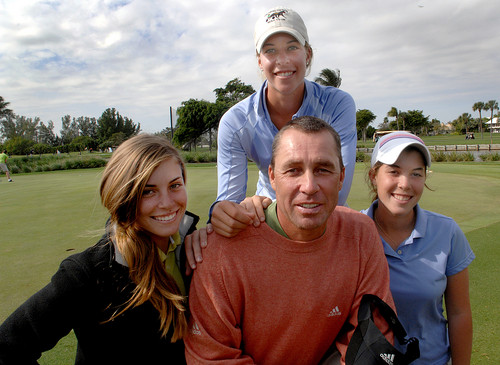
Marika, Isabelle, Crash, and their coach, 2009.

(Golf-match update: My club won, 15½-14½. So we hold the trophy till next year.)

How to Hold Your Own Golf Major

Hacker (real name), Ocean Course Scorecard, Les, August 12, 2012.

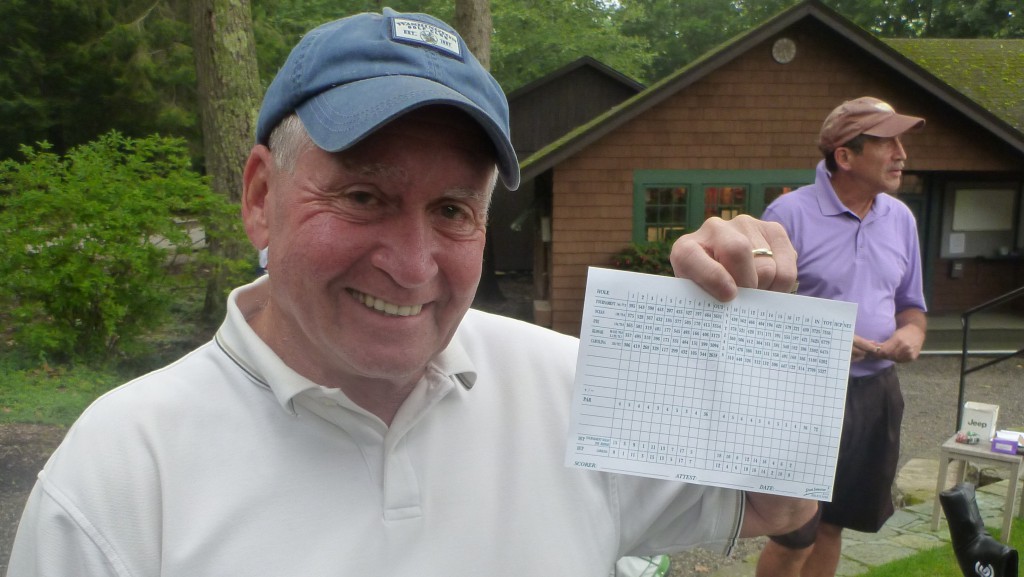
When my friends and I play on Sunday mornings, we use our Sunday Morning Group scorecard, which Jim created for us with a desktop publishing program that he uses in his job. Among other features, it lists our local rules, such as “You get an extra stroke if you wear shorts after November 1” and “No one gets a stroke on a par 3.” Some of the older guys complain about the par-3 rule, but what can we do? It’s printed right on the card.

This year, Hacker (real name) had the idea of celebrating golf’s four majors, on each major’s final day, by using not our own Sunday scorecard but the scorecard from whatever course the major was being played on. So during our regular game this weekend we used the scorecard of the Ocean Course at the Kiawah Island Golf Resort, where the PGA Championship was held. (You can download the Ocean Course card yourself, from either of the links in this paragraph.)

The main effect of using another course’s scorecard on your own course is that most of the handicap strokes fall in unfamiliar places. This impacts one of our local rules, because (for example) although our sixteenth hole is ordinarily a par 3 (meaning that no one gets a stroke on it), on the Ocean Course it’s a par 5 with a stroke index of 4 (meaning that anyone receiving 4 or more strokes that day gets a pop).

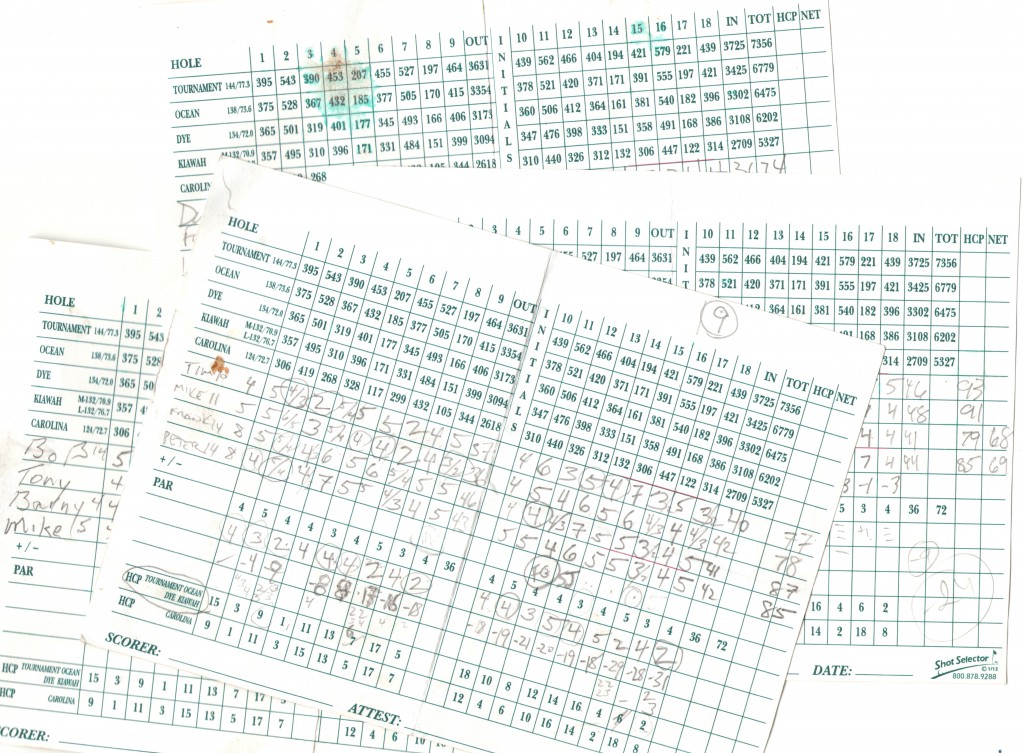
We compounded the impact by using a best-ball feature that I introduced a few years ago, called All Birdies. In All Birdies, all under-par scores on any hole count. On the sixteenth hole, for example, I had a 2 and my three teammates had net 2s. Since Kiawah’s sixteenth is a par 5, our four 2s counted as albatrosses and our team went -12 on that hole alone. That wasn’t enough to win, unfortunately, but we felt pretty tough for a while. (The winning team was Tim’s, at -31. Theirs is the top card on the pile in the photo below.)

Major results, Sunday Morning Group, August 12, 2012.

Golf in the (United) Kingdom: No Need to Pack Shorts

Lower right: the shorts rule at Hillside Golf Club, May, 2010.

When I played Royal Lytham & St. Annes in 2008, on assignment for Golf Digest, a local man in the group ahead of mine was wearing shorts—a great rarity on golf courses almost anywhere in the British Isles. A sign at Hillside Golf Club (a fantastic non-Open course, next door to Birkdale, where I’d played the afternoon before) warns golfers that shorts are permitted only if they are “tailored” and worn with “tall hose”—a requirement that neatly defeats the purpose of wearing shorts. Lytham used to have a similar rule, but relaxed it after a busload of barelegged Americans exhausted the golf shop’s supply of tall hose.

Tony at Hillside, properly attired, on a later trip, May, 2010.

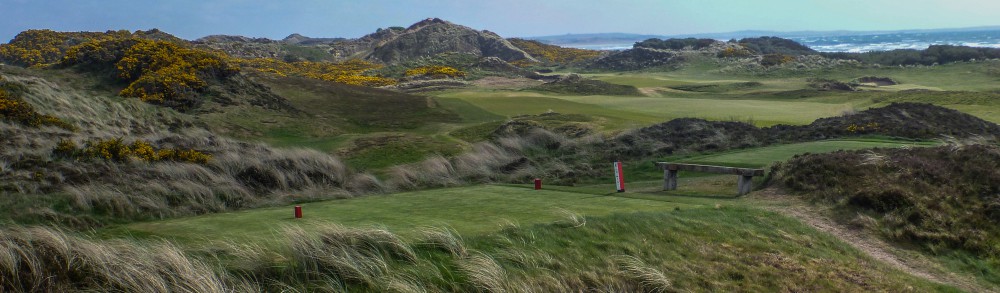
The first hole at Hillside doesn’t look like much, but the course gets better and better from there, and the second nine is really terrific. (Greg Norman once called it the greatest second nine in Britain.)  The tenth is a “short” par 3, which plays uphill and into the prevailing wind to a seemingly sheltered but impossible green. You watch the group ahead of you nosing around for lost balls on every side. They wave your group up, and then you lose all your balls, too.

Tenth hole, Hillside.

Toward the end of my round in 2008, I got stuck behind four bad golfers, one of whom was constantly throwing up grass to gauge the direction of wind that was so strong it was knocking over his golf bag. I passed the time by chatting with four visitors from the Isle of Man, who had caught up to me from behind. They gave me a British 10-pence coin with the Manx triskelion—the symbol of the Isle of Man—on the reverse. It was my favorite ball marker until I lost it.

The three legs of Man: my favorite ball marker until I lost it.


Memory Aid: You Moved Your Ball Marker?

Foolproof aide-mémoire, patent pending.

You mark your ball on a putting green. Your coin is in another player’s line, so he asks you to move it one putter-head length to the side. When it’s your turn to putt, you have to remember to move your coin back before replacing your ball and making your own putt, because if you don’t you incur a penalty of two strokes (in stroke play) or loss of hole (in match play).  (See Rule 20-7.)

This actually happens. At the Crowne Plaza Invitational, back in May, Zach Johnson forgot to replace his coin on the final green and incurred a two-stroke penalty for putting from the wrong place. Luckily, he had a three-stroke lead, and someone noticed the mistake before he’d signed an incorrect card.

In a local tournament many years ago, an opponent of mine moved his marker at my request, then forgot to move it back. I noticed and reminded him before he putted—and he was as astonished as if I had handed him a thousand dollars. “You’d have won the hole if you’d let me putt,” he said, suggesting that he wouldn’t have done the same for me. Who would want to win a hole that way? Him, I guess.

There’s a foolproof way to remember that you, a partner, or an opponent has moved a marker: stick a tee in your nose and leave it there until the marker is back where it began. That’s what I do, anyway. (See photo above.)

Recently, my friend Rick and I played in a state senior tournament, and my tee-in-nose trick kept us out of trouble with Rule 20-7. The course was nice, too, although its address was even better. Here’s a picture of the street sign on the corner nearest the clubhouse:

Actually, it’s kind of amazing that the sign was still there. If I’d been forty years younger, I might have swiped it myself. (No penalty under the Rules of Golf, in either stroke play or match play.) My home club is on Golf Course Rd. Here’s what our street sign looks like:

I swear I’m not the one who took it.

Beef Box*: Another Reason to Get Rid of All the Television Commentators

If you’ve been watching the Open on TV, you’ve undoubtedly heard the commentators refer to this or that hole as the “easiest” or “hardest” at Royal Lytham & St. Annes. They’re always wrong, and here’s why: there’s a difference between an easy hole and an easy par. A par 5 on which the scoring average is 4.5 is a harder hole than a par 3 on which the scoring average is 3.5, even though the par 5 is easier to birdie. The ease or difficulty of any golf hole is determined solely by the number of strokes taken to play it. Whether that number is higher or lower than “par” is immaterial.

A club near where I live recently shortened a par 5 by thirty yards and renamed it a par 4. The consensus among members is that this change made both the hole and the course “harder.” Actually, though, it made both of them easier, since the hole and the course are now thirty yards shorter than they were before—the same effect  as adding thirty yards to everyone’s tee shot. The hole is now tougher to par than it used to be, but it’s nevertheless an easier hole, since the average number of strokes needed to play it has come down.

To see this more clearly, forget about par for a moment. Imagine that Tiger Woods has challenged you to a two-hole match, on the second and twelfth holes at Augusta National, and that he has offered to give you one handicap stroke, which you may use on either hole. Would that stroke be more useful to you on the second (a 575-yard par 5) or on the twelfth (a 155-yard par 3 where Tom Weiskopf scored a cumulative 20 during the first two rounds of the Masters in 1980)?

Conventional wisdom says that Augusta’s twelfth is a “harder” hole than the second — Jack Nicklaus once called the twelfth “the toughest tournament hole in golf” — but wouldn’t you rather have your stroke on the second, which is 400 yards longer? If you wouldn’t, you should. Tom Weiskopf notwithstanding, the second is a harder hole. Woods has a very good chance of reaching the green in two, while you’ll have  to play well to get there in three.

*With apologies to Joe Pyne.

British Open Countdown: St. Annes Old Links Golf Club

Airplane, roller coaster, Yankees headcover, Other Gene, out of bounds: St. Annes Old Links has it all.

Just a few blocks from Royal Lytham & St. Annes, where this year’s Open is being held, is St. Annes Old Links Golf Club. From the parking lot, it looks like a down-at-heels muni, and it’s usually ignored by non-locals. You can see the whole course without turning your head, there’s an airfield over the fence, and the northern vista is dominated by the roller coaster at Blackpool, a seaside holiday spot whose nearest American analogs are Coney Island and some of the tawdrier parts of the New Jersey coast. (Prosperous Britons view Blackpool as beneath them, but your children wouldn’t.) Still, the course is far better than it looks, and it’s worth a visit (as is the roller coaster).

The roller coaster in Blackpool in 1983, when I rode it twice.

St. Annes is of historical interest as well, because it occupies part of Royal Lytham’s original site: the tenth and eighteenth holes are direct descendants of the earliest layout, and their greens are said to be the oldest in the region. The course has more than a few undistinguished holes, but it also has some tremendous ones. Maybe the best is the 450-yard, par-4 seventh, called Penance. Its left side is flanked by grassy ditches, which serve the same depraved purpose as the church-pew bunkers at Oakmont. Shots to the green generally play into a fierce wind, and they tend to end up at the bottom of a trench, in one of the numerous bunkers, under a spavined bush on a bank that hugs the rear left corner of the green, or against a shed just beyond the bushes. Another superb hole is the ninth, a claustrophobia-inducing par 3, which Bobby Jones liked well enough to measure, in 1926, for possible reproduction elsewhere.

Ninth green, St. Annes Old Links. That’s the clubhouse beyond it.

You might also see a helicopter. That’s Brendan on the left, walking toward the roller coaster.

British Open Countdown: The Masons Arms

The apostrophe is a relatively recent addition.

Alfie Fyles, who caddied for Tom Watson in all five of his Open victories, grew up in Birkdale and frequented a Southport pub and caddie hangout called the Masons Arms. On my first golf trip to the Lancashire coast, a little over fifteen years ago, I decided to make a pilgrimage. I found the pub on a forbidding side street and sailed through the door, anticipating an evening of colorful storytelling. Instantly, I wished I hadn’t come. The patrons looked like—well, they looked like British caddies, but they were indoors, boisterous, in a group, and drunk. The bartender was sitting on a foot-tall stool, so that his head was barely visible above the bar. Oddly, he seemed scarier in that position than he did when he stood up. I made the mistake of sitting at a small table directly below the wall-mounted television set, which most of the patrons were watching. During breaks in the action on the screen, they would permit their chilling gaze to drift downward. I drank my beer as fast as I could and fled back to my hotel, the dowdy Prince of Wales.

British Open Countdown: Birthplace of the Beatles

Other members of the tour group I joined in 1983, Strawberry Field, Liverpool. The photographer is Steve Shipman.

Almost thirty years ago, on assignment for a British newspaper and an American magazine, I traveled to England with a tour group of sixty-seven American Beatles fans. (The tour members’ interest in the Beatles was not casual; one woman had tried to kill herself, twice, after the murder of John Lennon.) Our itinerary was divided between London—where we visited EMI’s Abbey Road Studios, drove past the apartment where Brian Epstein committed suicide, and stripped leaves from a shrub on property formerly owned by Paul McCartney—and Liverpool, which the tour members viewed as the promised land, and which is twenty-five miles as the seagull flies from Royal Lytham & St. Annes, where the Open begins this week.

Penny Lane, Liverpool, 1983.

The statement “We’re going to Liverpool on holiday” has no exact equivalent in American English. (Roughly comparable: “We’re spending our honeymoon in Cleveland.”) Londoners snorted derisively when we mentioned our destination. “It’s an industrial city but not an industrious one,” I was told, through smirking laughter, in a London pub. Even Liverpuddlians were taken aback by the tour members’ enthusiasm. They were used to being the butt of jokes, not the objects of adoration.

The “shelter in the middle of the roundabout,” Penny Lane, Liverpool, 1983.

For a non-fanatic, Liverpool’s charms are harder to see, but they exist, as I’ve been reminded each time I’ve returned. The city’s suburbs and their fabled golf courses are lovely—specially Formby and the villages of the Wirral. The city itself is not as bleak as it’s made out to be; even in the seedier precincts along the wharves, you can catch glimpses of what used to be one of the world’s premier seaports. And, of course, the Beatles.

Celeste Simone Sabatini, American Beatles lover, Liverpool, 1983.

At the time of that initial trip, I was still almost a decade away from discovering golf; when I first went back, in the mid-1990s, I had time for nothing else. The Beatles were still a presence, though. One day, when I couldn’t get on anywhere else, I played a round at Southport Municipal Golf Club. The course wasn’t much, and many of the regulars were local lowlifes who had been prompted by the excitement of the Ryder Cup to give up rugby for golf, which they treated as a contact sport.

Still, I had fun, as I always do. One of my playing partners was a retired businessman who had recently given up tennis for golf but whose age, he said, made him undesirable as a candidate for membership at the distinguished private clubs in the area. When I asked him about his working years in Liverpool, he said, “I knew Jim McCartney, who was Paul’s father. We were both in the cotton business, and his office was next to mine. There was a time when we were both dealing in Iranian cotton. I had better shippers and was offering a better price, but Jim was getting all the business. I later found out why: he supplied a signed photograph of the Beatles with every order. He used to fret terribly about Paul’s future.  He desperately wanted him to go to university, because what sort of future could there be for a musician?”

Sunbathing, British-style, on the beach at Blackpool, 1983. The tower in the upper right hand corner is visible from Royal Lytham & St. Annes.


British Open Countdown: A Great Golf Trip

Tony, Rick, Hacker (real name), David O., Brendan, David W., Tim, Other Gene, Ray, Hillside Golf Club, England, May, 2010.

My friends and I have taken some terrific golf trips over the past dozen years, including one to Scotland and two to Ireland. Our best trip ever, though, may have been the one we took in the spring of 2010 to the part of England where the Open Championship will be played this week. England’s Lancashire coast—which is also known as the Golf Coast—contains one of the world’s densest concentrations of superb links courses, including three on the Open Rota (Royal Liverpool, Royal Birkdale, and this week’s venue, Royal Lytham & St. Annes.) My friends and I played fourteen rounds on eleven courses in eight days, and over dinner on the final night we went around the table and each named the one course we’d most like to play again. There were nine of us, and we picked eight different courses.

The do-over course I named at dinner on the final night: Southport & Ainsdale, which I hadn’t even expected to like. That’s Birkdale Cemetery in the distance.

One reason the trip worked so well is that we did very little driving. The distance by air between Royal Liverpool (at the southern end) and Royal Lytham (at the northern end) is less than thirty miles, and we rented three three-bedroom apartments in Southport, a resort town roughly halfway between them. The rent worked out to something like $30 per man per day. We had views of the Irish Sea, and we could walk into town.

Extremely light housekeeping: my bedroom in our apartment in Southport. Note the necktie, which was required for dinner in the clubhouse at Royal Lytham & St. Annes.

We spent just one night away from our apartments, in nine single rooms in the Dormy House at Royal Lytham. That club offers several package deals, and they’re a bargain. We got two rounds of golf on the championship course, three meals in the clubhouse, and a night in the Dormy House for less than the à-la-carte price of two rounds of golf.

The Dormy House at Royal Lytham & St. Annes.

My bedroom window looked out on the practice putting green, the eighteenth green, and the clubhouse (the building on the left).

The view from my room in the Dormy House.

Lytham is the only Open course that begins with a par 3, a 200-plus-yarder with a circular green surrounded by ravenous bunkers. My favorite hole on the course is another par 3, the ninth, which looks like a golf hole in a dream: the green is elevated and undulating, like a graduate-level problem in topology. It’s tucked into the farthest corner of the course, and a cluster of red-brick buildings rises directly behind it, and if you flub your tee shot, an assistant pro told me, you can easily make 10.

Ninth green: don’t be long; don’t be short; don’t go right; don’t go left.

Within the city limits of Southport are three excellent courses—Royal Birkdale, Hillside, and Southport & Ainsdale—and one quite good one: Hesketh, which is the home of the Hitler TreeThe first three are laid out almost continuously along the coast to the south of town; they are so close together that if you miss the driveway for Birkdale, heading south, the handiest place to turn around is the side street that leads to Hillside. And at Hillside it’s entirely possible to hook a ball onto Southport & Ainsdale. I’ll have more to say about all those courses, and the others we played, later this week.

David O., Gene P., Royal Lytham.

A More Effective Way to Talk to Your Golf Ball

Cristie Kerr talks to her ball the way dysfunctional moms talk to their kids in grocery stores.

I had to mute the TV during parts of the U.S. Women’s Open this past weekend, because Cristie Kerr was filling me with nervous agitation. As my colleague Ron Sirak reported on Saturday, she “yelled at her ball to ‘sit’ on No. 8 with so much anger in her voice that 300 people in the gallery sat down.” If you have a short fuse, it’s better for the victims of your fury to be inanimate objects, but I still find her yelling hard to take.

When my driver misbehaved recently, I didn’t scream at it; I put it in time-out. I didn’t make it sit on the stairs, the way I used to do with my kids, but I moved it to the back of my bag and pulled the head cover down tight. “I know you don’t like holes with out-of-bounds on the right,” I said in the calmest voice I could manage, “but you and I both need to think about what just happened.” The Cristie Kerr approach doesn’t work with golf equipment any better than it does with children. You can’t straighten a slice with violence and fear.

My time-out bag, in my “golf room,” on the third floor.

When my ball is hooking into a hazard, I don’t shout, “Get right!” or “Hit a frog!” I just stand quietly on the tee with a shattered look on my face, to show that I’m disappointed. If I find my ball in the water, I lift it out silently and dry it off. There is nothing I could say that would change the fact that I am now hitting three from the drop zone, so why speak? Throwing a tantrum would make things worse.

Rather than screaming at my equipment when it lets me down, I try to praise it when it does something right. Most golfers will curse a shank yet stand smugly silent when their seven-iron stripes a ball straight at the pin. How would you like it if your boss took credit for all your best efforts and never spoke to you except to pick on your mistakes? Even when a shot of mine goes wrong, I try to find something encouraging to say. “Wasn’t that a little draw I noticed just before you bounced into the parking lot?” “I don’t believe you’ve ever driven it farther into the pond.”

The most sensitive issue is probably the addition of a new club to the bag. I bought a 60-degree wedge a few years ago and was excited to try it, but I left it parked next to my driver for a couple of rounds, to reassure my old wedges that they were still important to me. Intra-bag rivalry can play havoc with a short game. You need to break in a new club slowly and with unglamorous assignments, such as retrieving balls from creeks or measuring the distance for free drops. By the time I used my new wedge for a real shot, my other irons had ceased to feel threatened. As a matter of fact, I think my sand wedge was relieved. The soft lob over trouble has never been its favorite shot.