Masters Countdown: The 1967 Television Strike

U.S. Walker Cup team, 1957. Charles Coe, the captain, is squatting in the center. Billy Joe Patton, in glasses, is standing behind him.

U.S. Walker Cup team, 1957. Charles Coe, the captain, is squatting in the center. Billy Joe Patton is fifth from the left.

The American Federation of Television and Radio Artists declared its first national strike on March 29, 1967. That meant that CBS’s usual golf commentators, who were members of that union, could not participate in that year’s Masters broadcast, the following week. Clifford Roberts, Augusta National’s chairman, conducted auditions among the club’s membership, and settled on two distinguished amateur players, Charles Coe and Billy Joe Patton, to fill two of the vacant spots. Coe had won the U.S. Amateur twice and had been the runner-up to Jack Nicklaus in 1959, and in the 1961 Masters he had finished tied for second with Palmer. Patton had led the Masters after two rounds in 1954, then ended up in third place behind Snead and Hogan. Both men had played the course for years—Coe with a handicap that varied between plus-6 and plus-7.

Coe and Patton did creditable jobs as commentators, and their minimalist dialogue confirmed Roberts’s belief that less is more in golf broadcasting. CBS was pleased as well, and William MacPhail, who was the network’s director of sports, passed along a sampling of the large volume of complimentary mail the network had received. One viewer wrote, “[T]he quiet, sincere comments of your members, which were entirely adequate, were a refreshing change from the glib, and sometimes overly talkative, ‘pros’ we usually hear.” Another wrote, “What an absolute pleasure it was to watch a player, under severe pressure, walk up to a putt in silence—the silence any gallery always accords a player, but which the announcers feel impelled to fill with chatter. In this case, one truly felt present, with a real sense of actual participation.” The broadcast turned out so well, in fact, that CBS executives credited it with breaking the strike, which ended the day after the tournament.

Not much silence nowadays. Worth trying?

My Close Personal Friend Moe Norman

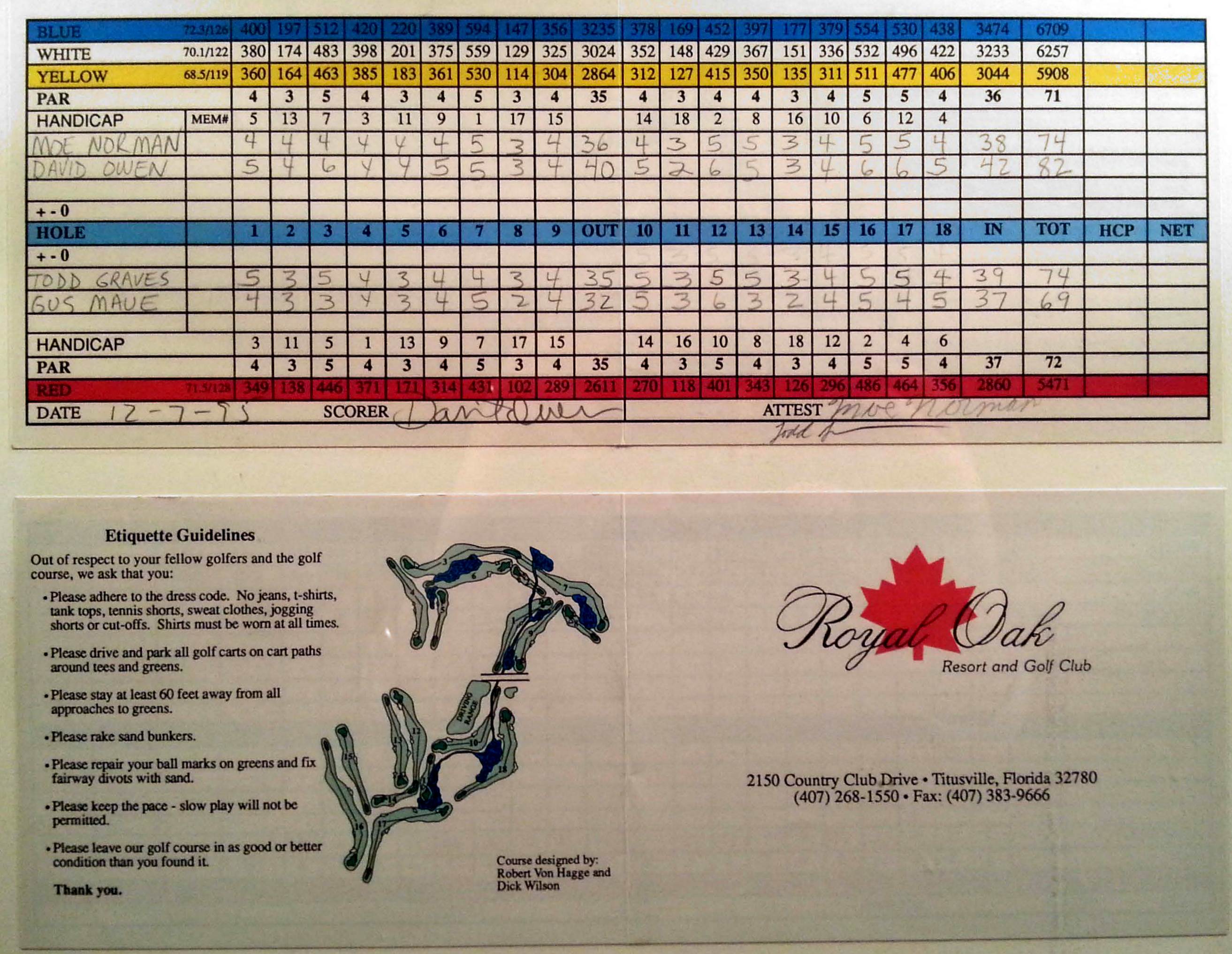
Moe Norman Scorecard

Many golfers nowadays look blank when you mention Moe Norman, who died in 2004, but to those who were lucky enough to see him play he was a legend. Lee Trevino ranked him with Ben Hogan and Byron Nelson as one of the greatest ball-strikers of all time. Paul Azinger first saw him hit balls on a driving range in Florida in 1980, when Azinger was in college. “He started ripping these drivers right off the ground at the 250-yard marker,” Azinger told Tim O’Connor, a Canadian sportswriter, “and he never hit one more than 10 yards to either side of it, and he hit at least 50.” In 2005, Tiger Woods told Jaime Diaz, now the editor of Golf World, that Norman and Hogan were the only two golfers in history who had “owned” their swing, and that one day he hoped to own his, too.

Moe Norman Golf World 9-2-66

Despite such accolades, Norman spent much of his forty-year competitive career in obscurity and poverty. He played almost exclusively in Canada, where he was born, and made only a brief attempt, in 1959, to play on the American tour. He sometimes carried his own bag in tournaments, because he couldn’t afford a caddie, and he sometimes slept in bunkers on the courses where he competed. He often hitchhiked to and from tournaments, and he had to juggle his competitive schedule with a succession of dreary factory jobs, including one stitching rubber boots. He spent the winter before the 1956 Masters, to which he had been invited as the reigning Canadian Amateur champion, setting pins in a bowling alley for a few cents a line. For years, he supported himself partly by selling the prizes he won in amateur tournaments, and as his confidence increased he sometimes sold the prizes before the tournaments began. (According to friends, on at least five occasions he intentionally finished second because he hadn’t been able to find a taker for the first-place prize and had been forced to sell the second.) In the late nineteen-eighties, he was so broke that only the last-minute intervention of friends prevented a bank from repossessing his car.

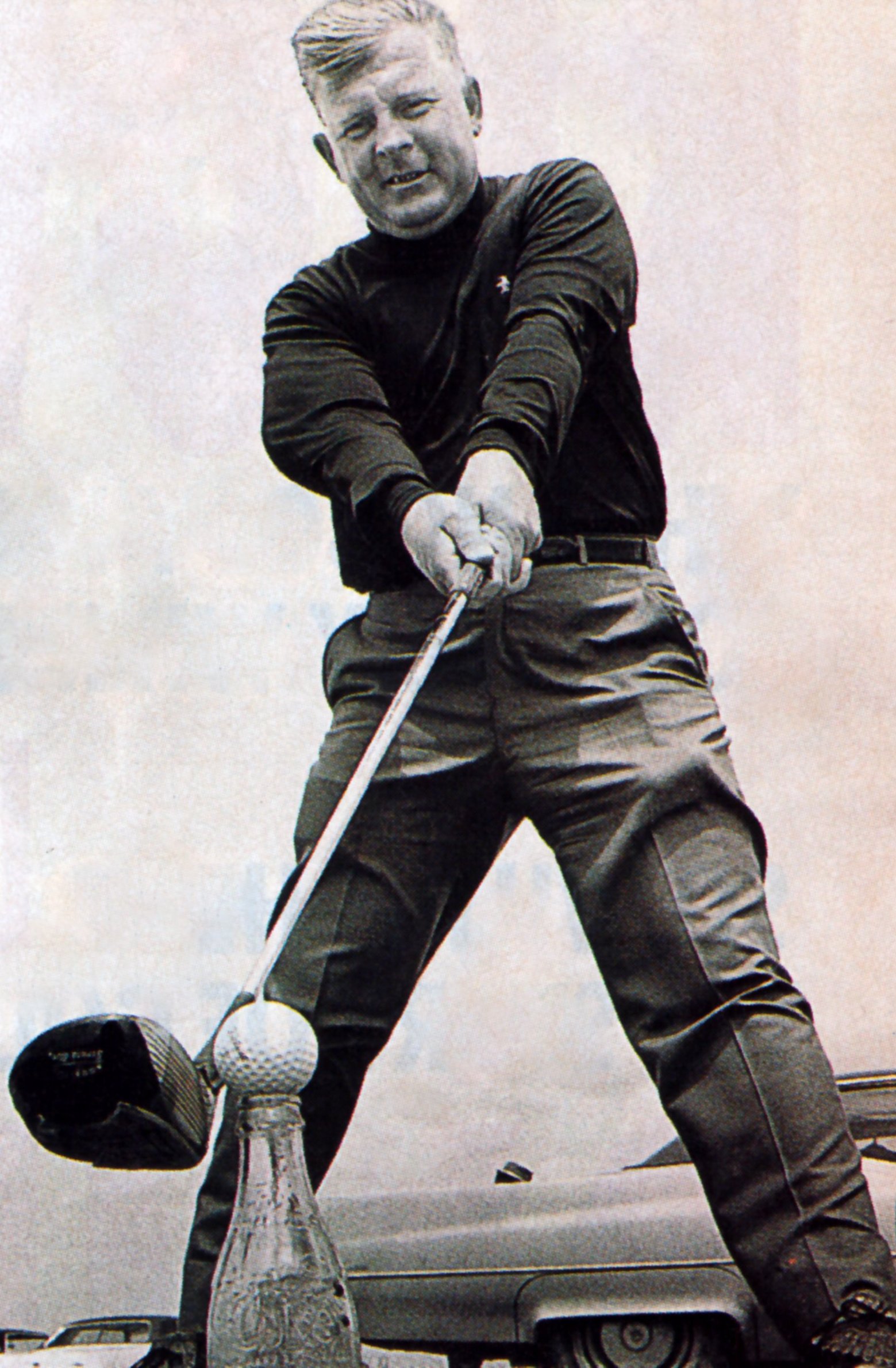
Moe Norman, 1950s.

Moe Norman, 1950s.

I watched Norman hit golf balls on a practice tee at Foxwood Country Club, in Kitchener, Ontario, his hometown, in the fall of 1995, when he was sixty-six. He warmed up with a pitching wedge, although “warming up” doesn’t really describe any part of his routine: the first shot was perfect, the second was identical to the first, the third was identical to the second. Then he switched to his four-iron. His swing—to all appearances, an effortless half-swing—was the same as it had been with the wedge. “How far you hitting those?” a spectator asked. “One-eighty,” Norman said. The shots were within a couple degrees of dead straight, despite a stiff cross wind, unless he announced ahead of time that he was going to hit a draw or a fade. The divots were identical, and surreally shallow.)

Moe Norman, 1990s.

Moe Norman, 1990s.

He switched to his driver. If you had looked only at his arms and hands, you wouldn’t have known he wasn’t still swinging his wedge. He would watch each ball in the air a moment, then bend over and place another on the tee—and I mean place it. The tee never moved. “I hit balls, not tees,” he said. On a driving range once, he hit 131 drives in a row from the same tee without having to straighten it. In tournaments, he sometimes entertained galleries by hitting a drive from the mouth of the Coke bottle from which he had just been drinking.

Moe Coke Bottle.bmp

In December, 1995, I got to play a round with Norman and his friends Gus Maue and Todd Graves (who calls himself Little Moe and teaches Norman’s highly unorthodox swing) at Royal Oak Resort and Golf Club, in Titusville, Florida. Royal Oak may no longer be a going concern—its website has been shut down for lack of payment—but in 1995 it was a favorite winter hangout of the Canadian P.G.A. The first hole was a 400-yard par 4, dogleg to the right. Maue, Graves, and I hit tee shots up the middle, and then Norman hit his over a row of trees to the right, toward a lake that ran the length of the hole. I thought, Hmmm—this is one of the greatest ball-strikers of all time? But it turned out that Norman always played the hole that way. There was a strip of grass, maybe ten yards wide, between the trees and the water, and from there he had an easy 9-iron to the green, while those of us in the fairway needed four-irons or five-irons.

Norman won his first tournament in 1949. “I didn’t know anything then,” he told me that day. “I didn’t even have a full set of clubs. Only had a driver, three-wood, three-iron, five-iron, seven-iron, nine-iron, and a putter. Didn’t even have a wedge. But one day everything fell into place and I shot a sixty-seven—four under.”

I said I was amazed he had played with so few clubs.

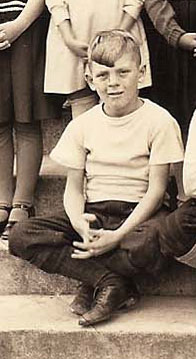
“Oh, I couldn’t afford them. Heck, when I was a kid you were lucky to have one club. And if you had a club your friends were always saying, Hey, can I use yours? Can I use yours? If someone had a driver we would hand it around—three of four guys playing together. If somebody had a nice putter, we all took turns putting with it. Goodness, back in Moe Norman youngthose days, there wasn’t a golf shoe in the foursome. And if the grass was wet your right foot would do a whirlwind, like a twist. But back then golf wasn’t a sport. It was just an exercise game. In fact, I was called a sissy by my father and my brothers, right at dinner. They would make big ears at me and call me a sissy. ‘Come on, play a man’s game,’ my father used to say. ‘Play baseball, or hockey—do like your brothers.’ I said, ‘No, Dad, I’m too light.’ I was a little skinny kid then, not over a hundred and thirty pounds, and I couldn’t play any other sport and be good at it, so I kept playing golf. But I had to hide my clubs under the front porch. My father was fat and I was real skinny, so I could dig a hole that he couldn’t get his head through but I could get my body through, and if I would push my clubs in far enough he couldn’t reach them.”

I wrote about Moe Norman in Golf Digest in 1995, and you can read that story here. The date in the opening anecdote is wrong, since Porky Oliver died in 1961. But other than that. . . .


Masters Countdown: Bobby Jones in Color

Bobby Jones in Color

The photograph above was taken in 1947, during the next to last Masters that Bobby Jones competed in. His badge identifies him as Player No. 1. The photographer was apparently experimenting with an early color film. The negatives were discovered in an envelope in an old file cabinet at Augusta National almost fifty years later, around the time I began researching my book The Making of the Masters. No prints are known to have been made before that time.

There is a great deal of confusion about Jones and his status as a player. Augusta National, in tournament publications, lists him as an amateur, but by the rules of the U.S.G.A he became a professional in 1930, when Warner Bros. hired him to make instructional films, and when, a little later, he began designing and promoting golf clubs for A.G. Spalding & Bros.

Jones retired from competition not because he had no worlds left to conquer; he retired because he abhorred the idea of being labeled a professional. In a letter to Clifford Roberts many years later, he described the typical pro as “an uneducated club servant”—a prejudice that dated to the early days of his competitive career, when only amateurs were accorded the honorific Mr., professionals weren’t allowed inside clubhouses, and tournament organizers distinguished between “gentlemen” and “players.”

“So long as I played as an amateur, there could be no question of subterfuge or concealment,” he wrote in 1960—a statement that clearly shows what he thought of playing golf for money. Roberts secured Jones’s participation in the first Masters, in 1934, by cleverly dodging the issue: in the tournament’s program listings and pairing sheets, he made no distinction between amateurs and professionals.

But the distinction was invariably noted elsewhere. The Associated Press and all other news organizations, in their coverage of the tournaments Jones competed in, listed him with the pros. Even O.B. Keeler, who had built his sportswriting career by celebrating Jones’s amateur accomplishments, took it for granted that Jones was now a professional. And so did Augusta National, officially.That’s why Charles Yates, not Jones, was honored as the low amateur in the first Masters, even though Yates’s score was three strokes worse than Jones’s.

Would Jones have played in the Masters if the club had been compelled to label him explicitly as a professional? Roberts said in later years that he suspected he probably would have, in order to help the club. But Roberts was uncertain enough that he never raised the matter with him, either then or later.

In Golf is My Game, Jones wrote that to give up his amateur status would have been “like giving up part of myself.” But, in fact, he gave it up in 1930. And he had a powerful incentive for doing so. His golf-related income in 1933, when the first tournament was being planned, was over $100,000; in contrast, Paul Runyan, who won nine events that year and was the tour’s leading money-winner, had gross tournament earnings of less than $6,500.

Memorable Golfers: The Strafaci Family

Michael Strafaci, possibly at Doral, where he became the director of golf in 1960.

Frank Strafaci, probably at Doral, where he became the director of golf in 1960.

On Sunday, seven of my friends and I left home at 4:30 a.m. so that we could drive to Brooklyn in time to play Dyker Beach Golf Course with members of Shore View Golf Club. I’ve written about Dyker and Shore View a couple of times recently, and I’ll have more to say about them in an upcoming Golf Digest column.

During our round at Dyker, I learned about the Strafacis, a historically significant Brooklyn golf family, and today I learned more. There were five Strafaci brothers, all talented players. The most accomplished was Frank, who won the U.S. Amateur Public Links Championship (on the thirty-seventh hole) in 1935, when he was nineteen. (He was described by the Brooklyn Eagle as “curly-haired little Frankie Strafaci.”) He finished ninth in the 1937 U.S. Open, ahead of Gene Sarazen, Jimmy Demaret, and Byron Nelson, among others, and that performance earned him an invitation to the 1938 Masters, from which he withdrew after three rounds. He was playing poorly and the tournament had been delayed by rain, and he knew that if he stayed for the fourth round he wouldn’t be able to qualify for the North and South Amateur—which he then won, both that year and the next.

Frank Strafaci and Bobby Dunkleberger, following the former's defeat of the latter on the thirty-sixth hole of the 1939 North and South, Pinehurst, North Carolina.

Frank Strafaci and Bobby Dunkleberger, following the former’s defeat of the latter on the thirty-sixth hole of the final match of the 1939 North and South, Pinehurst, North Carolina.

During the Second World War, Strafaci was a technical sergeant in the Army’s DUKW Command, which handled amphibious transport. He took part in the Battle of the Philippines, in 1944, and on the second day was pinned behind a tree by Japanese snipers. Shortly afterward, he described the experience in a letter to Morton Bogue, the president of the U.S.G.A.:

I couldn’t see them and so I held my fire, and it was at this time that I got to thinking  of the five foot putt I had to make to tie the 8th hole in an exhibition golf match played in Brisbane only a few weeks ago (Captain Bud Ward came down from Dutch New Guinea for five days, and I arranged a match for the benefit of the Australian Red Cross, which we lost 3-2). Our opponents, Alex College and Dick Coogan, played a bit too good for us. I thought of what a tough spot we would have been in if I missed the putt. I can assure you I’ll never try hard for another putt for as long as I live, at least it won’t seem like trying. 

The U.S.G.A. had sent a shipment of golf balls to the Red Cross in Australia, as a morale-booster, and Strafaci thanked Bogue. He also wrote:

[When] I get back to the States I hope to present the USGA with a golf ball that has already traveled over 43,000 miles and been used for 52 rounds of golf. It was used in America, Australia, Dutch New Guinea, I expect soon to use it in the Philippines, China and Japan. I used it for the first time at my club Sound View, and from there it went to Omaha, back to Sound View then to Frisco, Adelaide, Australia, Melbourne, Townsville, Cairns, Sydney, Cairns, Brisbane, Cairns, Brisbane, Dutch New Guinea (I didn’t have a club, I batted it around with a club made out of a branch.)

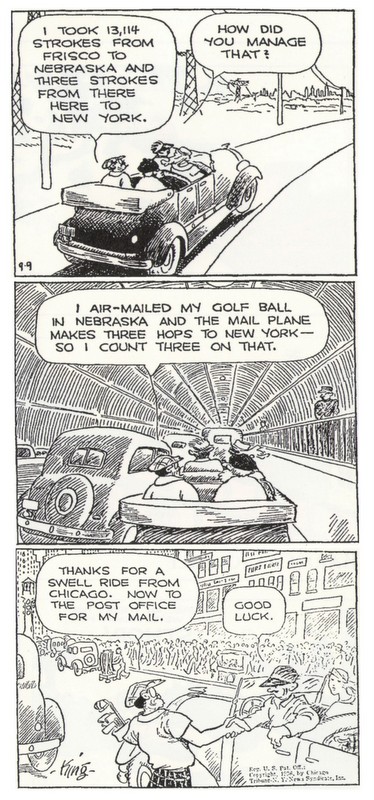
Dan Hubbard, who works in the communications department of the U.S.G.A. and, as it happens, is a member of my club, told me in an email: “We do not have a record of a golf ball coming in from Frank Strafaci, but we do have a five-peso bill issued by the Japanese government from the Philippines which he sent to Morton Bogue from Leyte in April of 1945.” Strafaci’s inspiration for his long-distance ball stunt may have been a series of cartoons in 1936 by Frank King, in his syndicated strip Gasoline Alley. In that series, Doc sets out to play a golf ball from San Francisco to New York—and in the strip below he’s nearing his goal:
Blog Photos1

In subsequent installments, Doc “breaks 80” between the post office and the East River, and finishes with a transcontinental score of 14,197. (In 1927, according to the book Golf in the Comic Strips, “a plumber and golfer by the name of Joe Grahame set out to achieve the same goal. He disappeared somewhere in the middle of Texas.”)

Strafaci played in a second Masters, in 1950, and he lost to Arnold Palmer on the eighteenth hole in the first match-play round in the 1954 U.S. Amateur. Palmer, who went on to win (and then to turn pro), said his match with Strafaci had been his toughest in the tournament. Strafaci became the director of golf at Doral in 1960, and named the Blue Monster. He died in 1988.

Frank’s father, Joseph Strafaci, owned a small farm that included the site now occupied by the Dyker clubhouse. Frank’s brother Thomas, and Thomas’s son Thomas, Jr., served as Dyker’s head professionals from 1958 until 1983. Frank’s grandnephew Paul is a recent past president of Shore View—the fifth Strafaci to hold that position—and a highly decorated New York City detective. Paul and a brother—another Frank—were members of the golf team at St. John’s University in the nineteen-eighties. And Jill Strafaci, who is the wife of Paul’s cousin Frank (the son of the one who tested Arnold Palmer), was a star golfer at the University of Florida and, later, an executive in the Miami Dolphins organization. Her husband was an executive of the Florida State Golf Association and is now a member of its advisory board.

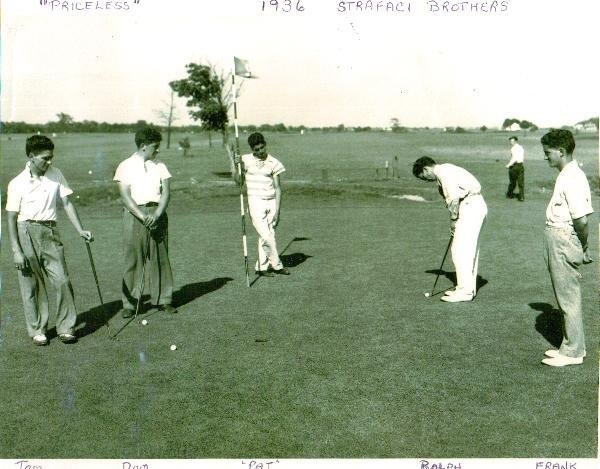
The fivesome in the photo below—which was taken in Queens in 1936, possibly at Oakland Golf Club, which was redesigned Seth Raynor in 1915 but buried by expressways in 1952 and 1960—consists of the five Strafaci brothers. From left to right they are Thomas, Dominick, Pasquale, Ralph, and Frank.
photo

Golfer to Watch: Isabelle Lendl

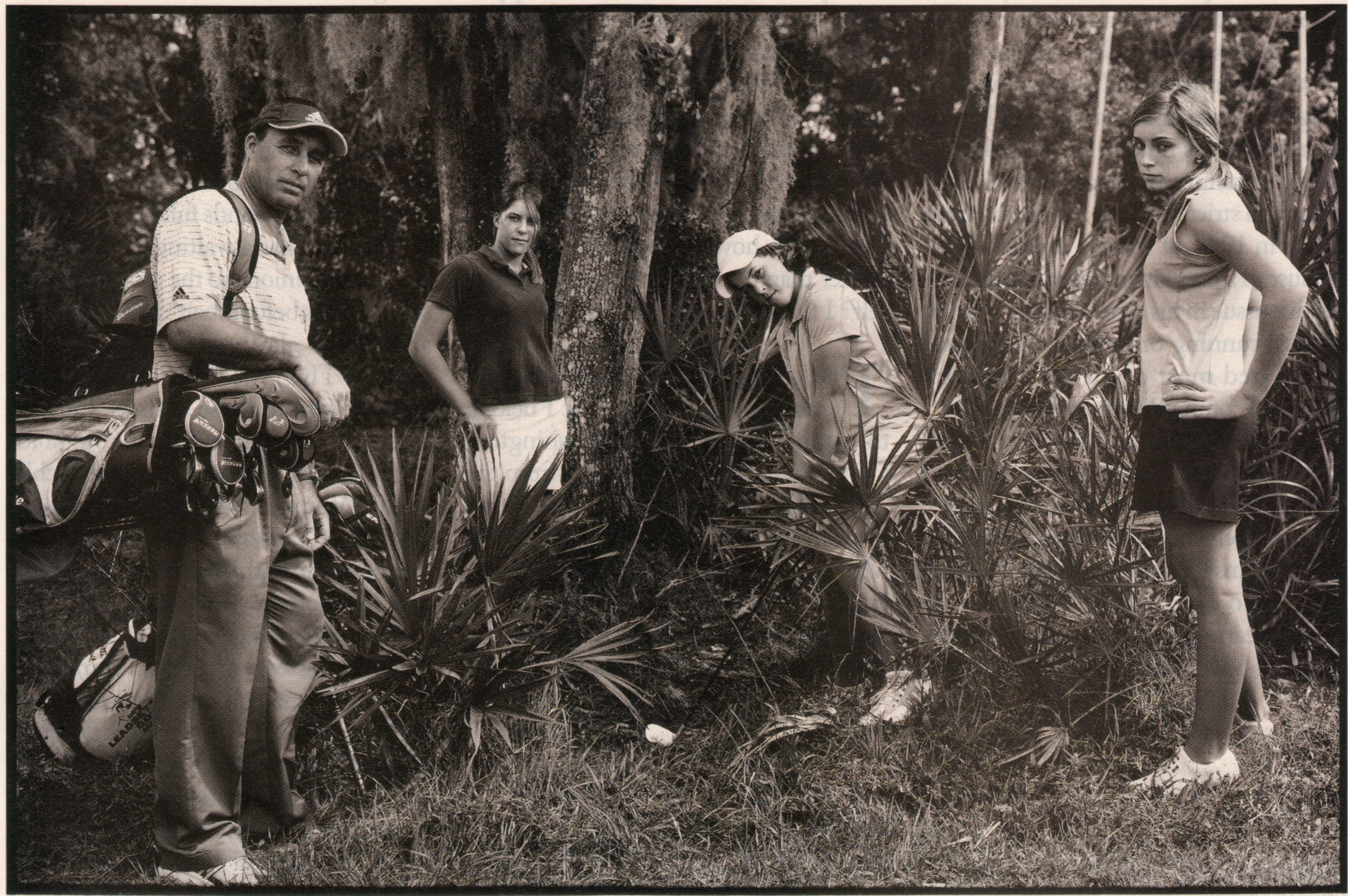
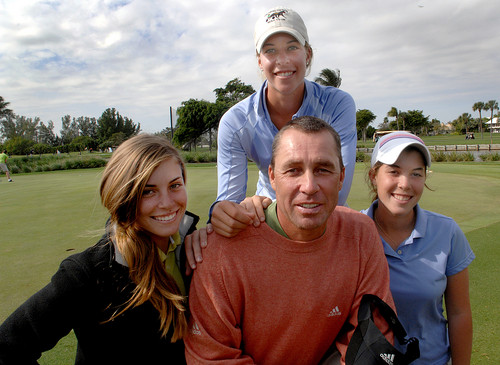
Ivan, Isabelle, Crash, and Marika Lendl, Bradenton, Florida, May, 2006. Photograph by Martin Shoeller.

Ivan, Isabelle, Crash, and Marika Lendl, Bradenton, Florida, May, 2006. Photograph by Martin Shoeller.

A week and a half ago, Isabelle Lendl, who is a senior at the University of Florida, won the women’s division of the Dixie Amateur, at Heron Bay Golf Club, in Coral Springs, Florida. She was five back after fifty-four holes, but shot 66 in the final round and won by four. Among those she beat was her younger sister Daniela, a sophomore at the University of Alabama, better known as Crash, who shot 67 and tied for sixteenth. It was Isabelle’s fourth win of the season.

Isabelle, Crash, and their sister Marika used to be junior members of my club—it’s where they took their first golf lessons, from our pro at the time, Fran Hoxie—and when Isabelle was eleven she and I played a nine-hole ladder match. (Since then, my club has abandoned ladder matches, but we still have the ladder and at some point I’ll explain how it worked.)

We played our match just before Isabelle’s game took off, at probably the last moment when a not-completely-terrible middle-aged guy could still beat her. She praised my decent shots and graciously conceded short putts, and we spent a very enjoyable hour and a half together. She said that her twin sister Caroline, whose main athletic interest was horses, was attending a birthday party that afternoon, and we agreed that that was a waste of a nice summer day. I said the thing about golf that grownups always say to kids, that it’s a game for a lifetime, and I also said that no matter what Isabelle and her sisters ended up doing with their lives I was certain that golf would always be part of it. I told her about my brother, who was the captain of his golf team in both high school and college and went on to work in advertising and sometimes got to play with clients. “No,” Isabelle said firmly, as we walked up the fifth fairway. “I’m going to play on tour.”

And she clearly will. I’ve played with her a couple of times since then, and she is not only terrifically talented (and nice!) but also mentally well-equipped to play competitive golf. When she was in high school, her father—the former tennis star Ivan Lendl, who now coaches Andy Murray—thought that on a golf course she was sometimes too eager to take unnecessary risks, but she has managed to tame that without becoming any less imaginative or aggressive. At the Dixie Amateur, playing with the young woman who had begun the day with a five-stroke lead, she birdied the first three holes, and, on the second nine, made three birdies in four holes exactly when she needed to.

In November, 2005, I watched Isabelle, who was fourteen, compete in a big junior tournament on the Seaside Course at Sea Island Golf Club, in Georgia. (The year before, at thirteen, she had been the youngest player to qualify for match play in the U.S. Women’s Amateur.) The wind was blowing so hard on Seaside that the clubhouse flag, which was approximately the size of the one that Francis Scott Key saw flying over Fort McHenry in 1814, was sticking straight out. Isabelle wasn’t unhappy, though, and afterward she told me, “I like playing in wind and rain better than in normal conditions. It’s more fun, and nobody else likes it. I think I trust more shots than other people usually do. If I have a shot that I want to hit, it really doesn’t matter if I haven’t practiced it, because I can just picture it and then I can hit it.”

There are five Lendl daughters, and all of them are more competitive than you and I are. Marika—who graduated from Florida last year and is now working in sports management—was a junior-tennis star before she switched to golf. Her tennis teacher was Kenyon Clark, who was then the pro at my club. Clark told me that, during one early lesson, he and Marika were using tubes to pick up practice balls. Without saying anything, he began picking up the balls faster, and Marika immediately went faster, too—an unspoken race, which she won, then exulted about. Clark’s wife, Manny, was sitting by the court with Marika’s mother, Samantha, and as they watched the race Manny said that her husband was the most competitive person in the world. “No,” Samantha said. “Mine is.”

Samantha grew up playing Scrabble with her family, and at some point she taught Ivan. “I beat him once, and that was it,” she told me. Ivan realized, as they played, that his wife’s strategy—trying to make the longest words possible—was not optimal. He bought a Scrabble dictionary and memorized every every two- and three-letter word in it (he has a near photographic memory), and since then he hasn’t been beaten. “He couldn’t stand losing,” Samantha said, “even in English, which is maybe his fifth language. And he’s the same way with the kids. He just hates to lose.”

I wrote about the Lendls in The New Yorker in 2006. You can read that article here.

Marika, Isabelle, Crash, and their coach, 2009.

Marika, Isabelle, Crash, and their coach, 2009.


Augusta National, Video Games, and “Hard Luck” Tony Sheehan

Eighth green, Augusta National, 1930. Photo by Tony Sheehan.

Eighth green, Augusta National, 1930s. Photo by Tony Sheehan.

My Golf Digest colleague Ron Whitten and I recently spent a couple of days in Orlando with the video-game designers at Electronic Arts, the creators of Tiger Woods PGA TOUR. The game’s next edition will include a recreation of the Augusta National course as it was in 1934, the year of the first Masters, and Ron and I had been asked to help the game’s “environment modelers” make the virtual course as historically accurate as possible. We offered suggestions about everything from green contours to mowing patterns to the size and placement of individual trees—an experience we’ll both be writing about for the April issue of Golf Digest.

Among the many historical resources the game’s designers consulted were photographs of the course taken in the 1930s by Tony Sheehan, who was Augusta National’s unofficial official photographer. (The picture at the top of this post, which also appears in my book The Making of the Masters, is one of his.) Sheehan’s nickname was “Hard Luck.” Clifford Roberts, the club’s co-founder and first chairman, wrote about Sheehan in his book, The Story of Augusta National Golf Club, which was published in 1976:

Tony was an oddball in appearance and dress, and he made comments at times that were just as unusual and unexpected. Neither he nor his battered old camera looked to be qualified to make even a passport photo, but he was a remarkably capable photographer . . . .

Many of us experience accidents as we go through life, but I doubt that any man endured bad luck so often and so continuously for so many years as Tony Sheehan. Every time an epidemic of any kind came to town, Tony was the first to catch it.

Tony tripped over something and broke one or more bones so often that it almost appeared to be a habit. On one occasion, while he was waving to friends, his car plowed into a large stone marker on Walton Way in Augusta, which cost him a number of teeth but gave him some distinctive battle scars on his face. . . .

Tony survived a half-dozen major operations, plus numerous patching-up jobs. His one lucky day was when he was married to the nurse, Eva Smith, who had looked after him in the hospital so many times that she felt lonesome between his visits.

Tony finally got himself into really serious trouble—his car was hit by a train. Over a year’s period the hospital lost track of the number of jobs that had to be done on Tony. Finally, the great day arrived when he could leave. His wife picked him up in her car and headed for home. When they arrived at the railroad track, the same one where Tony was wrecked, he asked her to stop the car. He then walked ahead and looked in both directions to make sure no train was approaching. As he was about to signal her that all was clear, her foot slipped off the clutch and she knocked Tony down. Whereupon she picked him up and took him back to the hospital for another stay.

Believe it or not, our friend Tony Sheehan lived to be eighty years of age, and died in 1974 of natural causes.

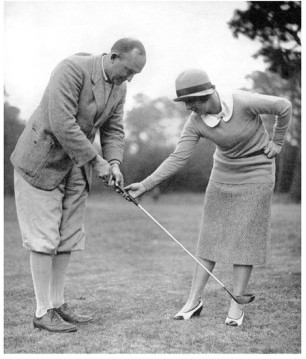
In 1931,Sheehan took this photograph of Ty Cobb receiving a golf lesson from Glenna Collett Vare, who won the U.S. Women's Amateur six times. Cobb was from Augusta, and this photograph was taken there--possibly at Augusta National.

In 1931,”Hard Luck” Tony Sheehan took this photograph of Ty Cobb receiving a golf lesson from Glenna Collett Vare, who won the U.S. Women’s Amateur six times. Cobb was from Augusta, and this photograph was taken there–possibly at Augusta National, although more likely at Augusta Country Club, next door, where Cobb was a member.

Roberts himself knew something about hard luck. He grew up poor in a succession of small towns, accidentally burned down his family’s house when he was sixteen, lost his mother to suicide when he was nineteen, earned a modest fortune and then lost it in the stock-market crash of 1929, and presided over Augusta National’s bankruptcy in 1935, a few months after the second Masters. Like Tony Sheehan, though, he persevered, and because he did we have the Masters—now just over three months away.

Does Practicing Making Golfers Worse?

Rory McIlroy during the final round of the 2011 Masters, on a day when he spent plenty of time at the driving range before teeing off.

Rory McIlroy during the final round of the 2011 Masters, on a day when he spent plenty of time at the driving range before teeing off.

I haven’t hit a ball on my club’s driving range in two years, and during that time I’ve played the best, most consistent golf I’ve ever played. I’m not sure that’s a coincidence. In fact, I’ve often wondered whether hitting range balls didn’t make me worse. My first few shots on the practice tee would inevitably include my best shot of the day. Then, as I worked my way through my bag, my swing would deteriorate until I was shanking my wedges, fatting my irons, and slapping weak leakers with my woods. And then I’d go play. One day, I decided to skip the warm-up.

I also stopped using the practice green, and almost immediately I became a better putter. One possible explanation: when I tee off now, I’m the only guy in the group who hasn’t missed a putt that day. I’ll watch other guys on the practice green, to get a feel for the speed, but I won’t stand there lipping six-footers.

The explanation is probably just that I’m a bad practicer. In the old days, when my swing would turn sour I would attempt a frantic intervention, by churning through two or three buckets in the hope that at some point quantity would metamorphose into quality. All I was really doing was cranking my tempo into the red zone and filling my head with negative thoughts. I was also rehearsing, and therefore ingraining, whatever problem had sent me to the range.

But even for players who practice well, hitting range balls before teeing off may be overrated—as Rory McIlroy demonstrated on the final day of the Ryder Cup this year, when he nearly missed his tee time for his singles match with Keegan Bradley. He didn’t have time to go to the range before teeing off, yet he birdied four of the first nine holes and beat Bradley two-and-one.

Rory McIlroy at the 2012 Ryder Cup, after not going to the driving range  before teeing off.

Rory McIlroy at the 2012 Ryder Cup, after defeating Keegan Bradley two-and-one in their singles match, on a day when he didn’t go to the driving range before teeing off.

Great Golf Invention: Improved Tournament Periscope

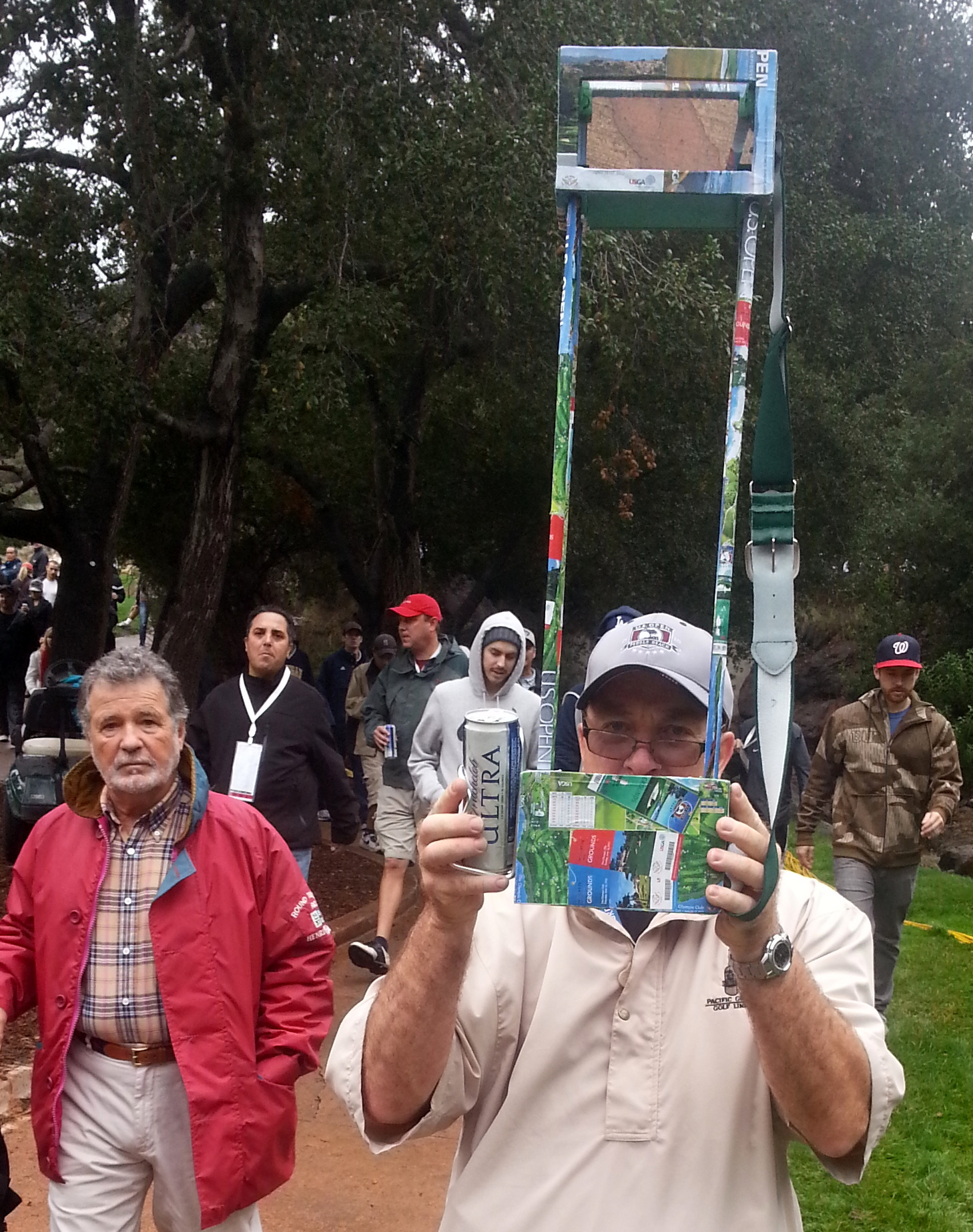
Steve Davis and his invention at Sherwood Country Club, Thousand Oaks, California, December 2, 2012.

On Sunday, at Tiger’s tournament, I ran into Steve Davis, who is the guy in the photo above. He invented the contraption he’s holding: a periscope that enables him to see over the heads of people standing in front of him. It’s an improvement over other golf periscopes because it doesn’t completely block the view of people standing behind him. Also, it has a shoulder strap and a beer holder:

Davis works for a copier company. He has “wallpapered” his invention with color copies of mementos from other golf tournaments he’s attended, including the 2010 U.S. Open. If you’d like to give him a lot of money to manufacture these things full time, let me know, and if you don’t sound like a nut I’ll put you in touch.

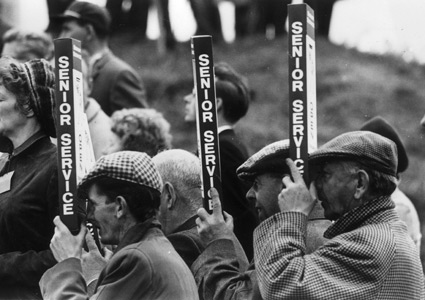
Periscopes used to be common at golf tournaments. The photo below is from the 1965 Ryder Cup, at Royal Birkdale. (Senior Service is a British cigarette brand.)

Many spectators at the 1993 Ryder Cup, which I attended (at the Belfry, in England), had periscopes that looked like the boxes that bottles of Johnny Walker scotch come in. (Johnny Walker sponsored the tournament.) The Belfry is a terrible course for spectators, and the periscopes made things better for the people who had them and worse for the people who didn’t. The only way to improve Davis’s invention, I think, would be to add a second beer holder.


Why Do Certain People Wear Certain Shoes at Certain Golf Tournaments?

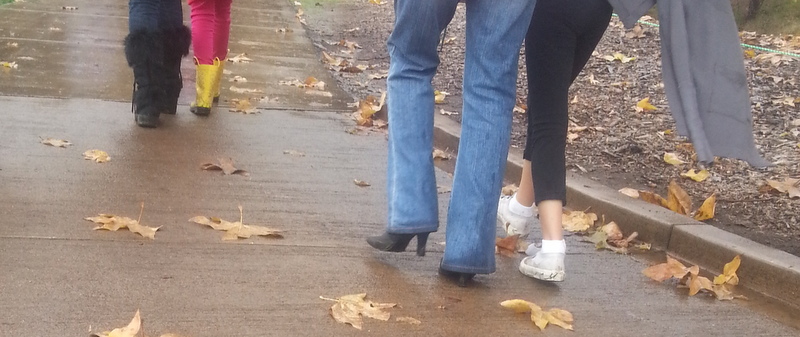
By “certain people,” I mean certain women; by “certain shoes,” I mean sandals, high-heeled boots, ballet-type slippers, and backless pumps; and by “certain golf tournaments” I mean golf tournaments during which there is so much rain that the lift-clean-and-place rule is in effect for all four rounds. Specifically, I mean Tiger Woods’s 2012 World Challenge presented by Northwestern Mutual, which was held in the mud last week at Sherwood Country Club, in Thousand Oaks, California:

The Man himself  (and Bo Van Pelt, plus various menials) on the first fairway at Sherwood Country Club on Sunday. Note the mud visible in the rough in the foreground.

The World Challenge is an unofficial, end-of-season event. It raises money for the Tiger Woods Foundation, and it features a small field of terrific players. By Sunday, the entire course was so thoroughly saturated that balls often plugged where they landed, even on some of the greens, and many spectator areas looked like this:

These men are wearing sensible shoes, relatively speaking.

Despite the weather, surprisingly many women wore shoes that were not well suited to the conditions:

The women whose feet are shown below were standing on pavement near the clubhouse and watching someone on the practice green, but shortly after I took this photograph they all followed their boyfriends or husbands onto the course:

In the photograph below, the woman in jeans had just had trouble traversing a muddy area under some trees. A friend of hers told her husband, “Erin is bothered about her shoes. Very bothered.” I don’t know what happened after that.

The heels on those boots made sucking sounds as the woman wearing them walked through the mud, which was ubiquitous. Note the evidence of capillary action at the bottom of her pants legs.

Even in a drought, why would someone wear high heels to a golf tournament, where spectators walk for miles?

Ready to follow Tiger for eighteen holes.

I can think of three semi-plausible explanations: 1) Fashion trumps all; 2) Someone’s boyfriend or husband didn’t mention that golf is played on grass; 3) Someone was attending the tournament against her will, and wearing inappropriate footwear was her passive-aggressive declaration of her discontent.

Walking “on pointe” to keep mud from coming over the sides.


A Golfer’s Bucket List: No. 2

Tony, Hacker (real name), Harry, Stanley, Ray. Bay Course, Seaview Resort, Atlantic City, New Jersey, October, 2007.

2. Go on a golf-only trip with people who love golf as much as you do.  The ideal itinerary consists of the British Open rota plus a dozen or so courses in Ireland and Northern Ireland, but the destination is actually secondary. The high point of my golf year is usually the Sunday Morning Group’s annual weekend excursion to Atlantic City—a trip that our wives let us take because we have been able to prove mathematically that sending us and our golf clubs away for a couple of days each fall is cheaper and more restful than keeping us at home. Absecon Bay ain’t the Firth of Forth, but golf is golf, and playing a full schedule with like-minded companions is bliss. Lying on a beach or lounging on the deck of a cruise ship won’t prevent you from brooding about your job, your debts, your disappointments, or the condition of the world. Playing thirty-six a day with favorite playing partners, in contrast, leaves room for nothing but your slice and deciding where to eat dinner.

To be continued.

Other Gene, Ray, David O., Tony, Old Course, St. Andrews, Scotland, May, 2008.