New Year’s Day for Golfers

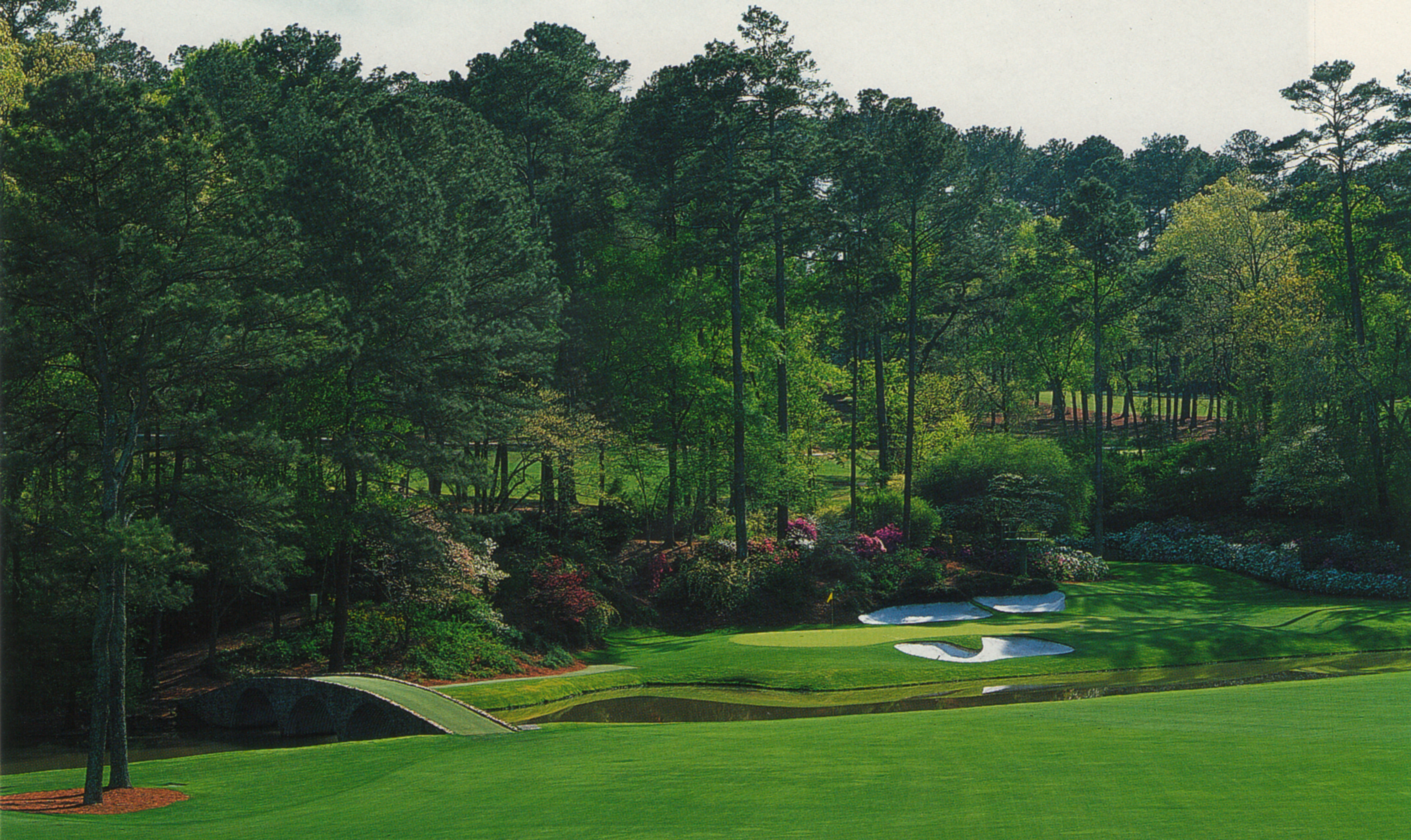
ANGC No 12

The modern golf season never ends, but it does begin. When the first contestant tees off at Augusta National Golf Club on Thursday morning during Masters week, golfers all over the world reset their internal clocks. The first page in a golfer’s calendar is April.

For the world’s best players, the Masters divides one season’s aspirations from another’s. A tour victory means recognition, money, autograph requests, endorsements, exemptions—and an invitation to Augusta. As the first full week of April draws near, winless players juggle their schedules to maximize their chances, and television commentators count down the tournaments remaining. When the Masters begins, every competitor has a theoretical chance of matching Bobby Jones’s unduplicated feat of winning all four major tournaments in one year; when the Masters ends, the Grand Slam field has shrunk to one.

For tournament spectators, the Masters is an annual reunion where the passage of time is measured not in years but in the names of champions. The principal viewing areas have the settled feel of old neighborhoods; the course is as familiar as a friend’s backyard. In countless gatherings beneath the pine trees, acquaintances are renewed and records are brought up to date: deaths, marriages, children, grandchildren, new houses, old jobs. The dogwood blossoms are compared with the dogwood blossoms of previous years. A rebuilt green is examined and approved. Two veterans discuss the careers of Jack Nicklaus and Arnold Palmer—and then Jack Nicklaus and Arnold Palmer walk by. A guest once said, “I rode here in the front seat and will be in the back seat going out so I can stay as long as I can.”

For distant golf fans, the first glimpse of Amen Corner on TV is proof that winter is gone. Northerners who haven’t swung a club since Halloween scrounge an old ball from the garage and roll a few wobbly putts across the family-room carpet during commercials. A swirling gray New England sky stops looking like a vestige of December and begins to seem like a harbinger of spring. The hours crawl from Saturday evening till Sunday afternoon. Meetings and social engagements are ignored or rescheduled; no avid golfer was ever married on Masters weekend. In 1987, two fans from Olympia Fields, Illinois, named their new daughter Tori Augusta National.

For sportswriters, the Masters is the plum assignment of the year. It is the first trip entered in a reporter’s appointment book, and it is written in ink. Journalists take the Masters personally. Herbert Warren Wind, The New Yorker’s incomparable golf correspondent for many years, once stopped another reporter upon arriving in Augusta’s airport and anxiously inquired about the state of the greens: “Are they firm?” Senior golf writers postpone hip replacements and cataract operations until just after the tournament, giving themselves a full fifty weeks to recover.

For non-golfers, the Masters is the one tournament of the year that compels attention. Over breakfast on Sunday morning, a golfer’s non-playing spouse may suddenly offer an informed observation about the chances of Woods, Mickelson, or McIlroy—the result of an hour’s seduction by the sports page or the TV. The beauty of the setting makes one’s love for golf comprehensible to the game’s antagonists. For four days, the national flower is the azalea.

Gary Player once said, “The Masters is the only tournament I ever knew where you choke when you drive through the front gate.”  The trip down Magnolia Lane may be the most dreamed-about entrance in sports. Although the Masters is not ancient as golf goes, no contest runs deeper in the imaginations of participants. Sam Snead once told me, “If you asked golfers what tournament they would rather win over all the others, I think every one of them to a man would say the Masters.”

ANGC clubhouse

Masters Countdown: Cattle, Turkeys, and Prisoners of War

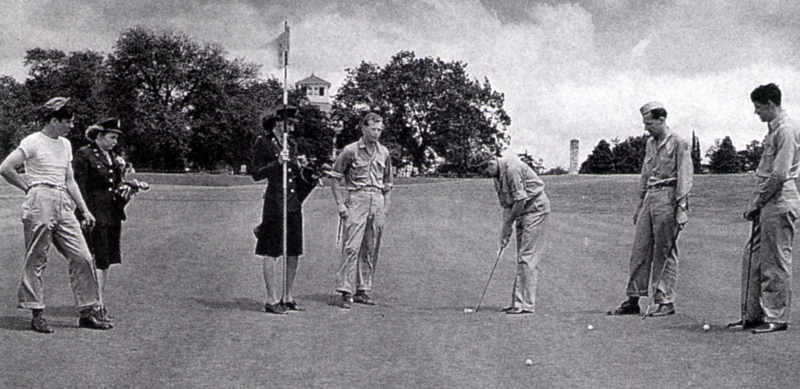
Soldiers from Camp Gordon, with WAC caddies, putting at Augusta National in 1942, before the club closed for the duration. You can see the clubhouse in the background.

Soldiers from Camp Gordon, with WAC caddies, putting at Augusta National in 1942, before the club closed for the duration. You can see the clubhouse in the background.

On Tuesday, I swapped spring weather in Connecticut for summer weather in Florida by flying to Orlando to talk about the history of Augusta National and the Masters on Morning Drive, on the Golf Channel. Among the many topics we covered was the club’s struggle to remain solvent through the Great Depression and the Second World War. Clifford Roberts, who co-founded the club and the tournament with Bobby Jones, said later that if he and Jones had known at the outset how long the Depression was going to last they wouldn’t have had the nerve to proceed. The Masters field actually shrank steadily during the early years—from seventy-two players in 1934 to forty-six in 1939—and then, just as the club’s fortune’s seemed to be turning, the country went to war.

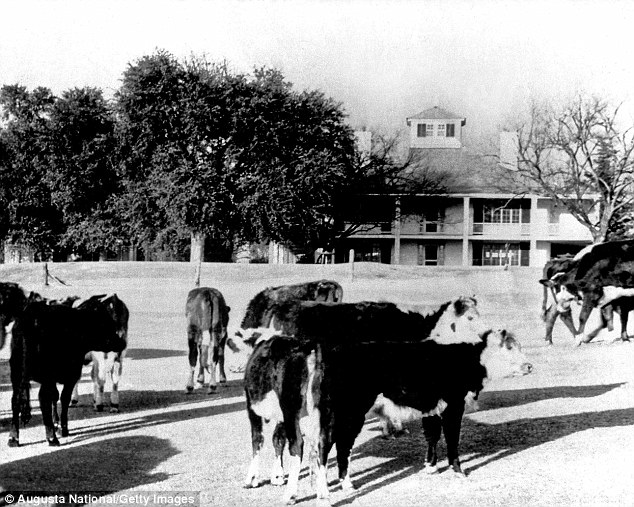
Augusta National closed for the duration after the tournament In 1942, and Jones suggested to Roberts that the club might both contribute to the war effort and improve its financial situation by raising cattle on the golf course.The idea was that the cattle would keep the Bermuda grass under control while fattening themselves to the point where they could be sold at a profit. One of the club’s members had a son who knew about livestock, and he determined that the club had enough grass to support two hundred or two hundred and fifty head. Roberts suggested that the club might also want to try raising turkeys, geese, fish, “and what-not.”

ANGC cattle

Towards the end of 1943, Roberts reported to the members that the club’s agricultural efforts were going well. The cattle herd numbered about two hundred, and the plan was to purchase another two hundred as soon as the original animals could be sold. “The Club also purchased 1,423 day-old turkeys and was successful in raising 1,004 of them,” Roberts wrote. “These turkeys will soon be ready for market but over 100 are to be retained for Christmas distribution to our members—one to each member.” (These Christmas presents were popular.  A member who had received one wrote to Roberts, “It was a peach all right and doubly welcome in these days of tight rationing.”) The club also harvested pecans from its own trees. It donated half the crop, through the wife of the sportswriter Grantland Rice, a founding member, to an Army canteen, and it sold the other half in ten-pound bags to members. There was talk of growing corn and peanuts in a field that is now the practice range, but that idea was abandoned as unlikely to succeed.

That's Grantland Rice on the left and Bobby Jones on the right, during an early Masters. I don't know who is in the middle.

That’s Grantland Rice on the left and Bobby Jones on the right, during an early Masters. I don’t know who is in the middle.

Despite Roberts’s enthusiasm, the livestock experiment was a failure. A price ceiling had been imposed on  turkeys but not on feed, and the market for beef was hurt by a sudden cattle glut resulting from drought conditions in the West. By the fall of 1944, the club had lost about $5,000 on the beef operation, not including the cost of damage to the course and its plantings. (The damage had been caused by what Roberts described as “the voracious appetite of the cattle.”) The loss was partly offset by a profit on the turkeys. But Roberts concluded, in a letter to the members, that “we have a better chance as a golf club rather than as live-stock feeders.”

Returning the course to playing condition began in late 1944, when the end of the war had begun to seem imminent. Military use of local hotels was slackening, and Roberts had calculated that the cost of restoring the course would no longer be significantly greater than the cost of maintaining it as it was. He announced that the club would reopen on December 23, 1944, and that the course would be ready for play sometime later.

Much of the restoration work on the course was done during a six-month period by forty-two German prisoners of war, who were being detained at Camp Gordon, in Augusta, and were available for hire as day laborers by local businesses. The prisoners had been part of an engineering crew in Rommel’s Afrika Korps. They had been surprised, upon arriving in America, to find that New York was still standing, because they had been told by Nazi propagandists that German bombers had leveled the city. The club arranged for transportation to pick them up at Camp Gordon each morning and return them at the end of the day. A local member, who used to bring them fruit and visit with them while they worked, told me that the army had sent them out “mostly just to give them something to do.”

This POW camp was in Williamston, North Carolina, not Augusta, Georgia, but it was similar to the one at Camp Gordon.

This POW camp was in Williamston, North Carolina, not Augusta, Georgia, but it was similar to the one at Camp Gordon.

In Africa, the German soldiers had built bridges for Rommel’s tanks. At Augusta National, they built a similar bridge over Rae’s Creek near the thirteenth tee. It was a truss bridge made of wood, and it was marked by a wooden sign on which the soldiers carved an inscription. The bridge, which is visible in a few old photographs, either washed away in a flood in the early fifties or was taken down in 1958 to make way for a stone bridge dedicated to Byron Nelson. The Ben Hogan Bridge, which crosses Rae’s Creek near the twelfth green, was built and dedicated at the same time.

The photographer Frank Christian, in his book Augusta National & The Masters, recalls spending summer afternoons on the course during this period, when he was a young boy. “[M]y older brother, Toni, and I would gather our playmates and walk the few blocks from our house to the inviting shores of Rae’s Creek, where we had discovered the ideal swimming hole in front of the twelfth green,” Christian writes. “We would take rocks and dam the creek to create several deep holes within the pond, just perfect for running jumps taken from the high side of the creek. . . . After swimming, a great part of our fun was to throw cow biscuits at one another and chase the cows up and down the fairways.” Fred Bennett, who would later become a caddie and then the club’s caddie master, also came to Rae’s Creek to swim and fish. “I remember those cows very well,” he told me in the late nineteen-nineties. “And when the war was over you could tell they’d been there, because all over the fairways there were circles of bright green grass about a foot across.”
Wounded soldiers watching the Masters from litters placed beside the eighteenth green in 1947. The club gave them free tickets and preferred seating.

Wounded soldiers watching the Masters from litters placed beside the eighteenth green in 1947. The club gave them free tickets and preferred seating.

Masters Countdown: The Origin of Magnolia Lane

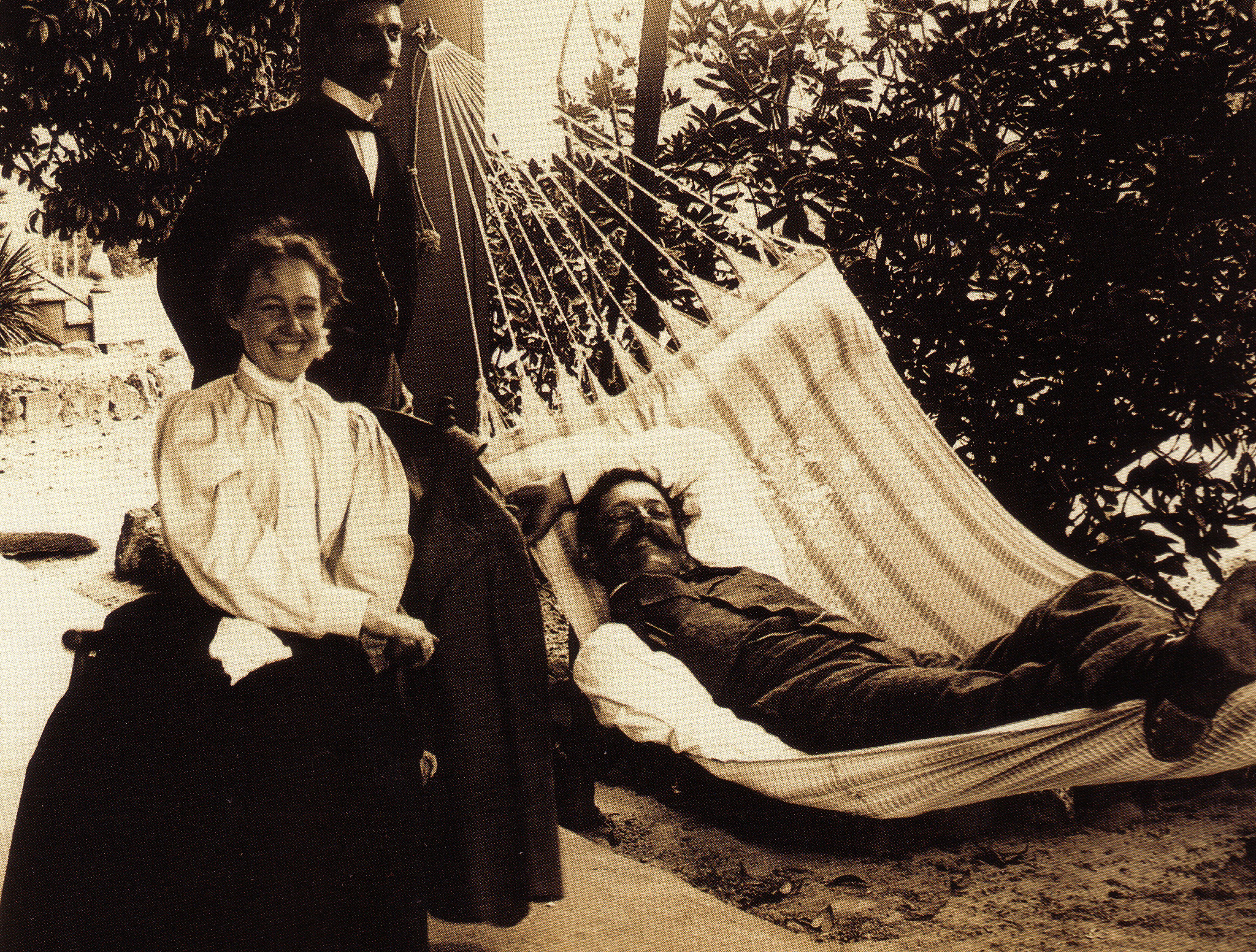
Members of the Berckmans family on the veranda of what is now the Augusta National clubhouse, late 1800s.

Members of the Berckmans family on the veranda of what is now the Augusta National clubhouse, late 1800s.

Shortly before the outbreak of the Civil War, a horticulturist and landscape architect named Prosper Julius Alphonse Berckmans planted a double row of magnolia trees leading into a piece of property that he and his father, a Belgian nobleman, had bought on the outskirts of Augusta. He grew the trees from seeds. The two rows were two hundred fifty yards long, and between them ran a bumpy dirt road that the Berckmans family used as a driveway.

Magnolia Lane, at Washington Road, 1900.

Prosper Berckmans’s double row of magnolias, at Washington Road, 1900.

In the late 1990s, Lawrence Bennett—who was the son of Augusta National’s director of outside personnel and a part-time employee of the club as well as a high-school history teacher—told me that his grandmother, whose own grandmother had been a slave, remembered noticing the magnolias just after the turn of the century, when her family came to town in a covered wagon once a month to buy supplies. By 1931, when Clifford Roberts and Bobby Jones, the club’s co-founders, first visited the property, the magnolias were good-size trees and the driveway was known locally as Magnolia Avenue. Because the branches were long and close to the ground, two cars could not pass side by side between the rows, and Roberts and Jones briefly considered placing the club’s main entrance well to the left.

The magnolia trees are on the right side of this  photograph, which was taken around the time of the first tournament. The road that Roberts and Jones considered using as the club's driveway is at the lower left.

The magnolia trees are on the right side of this photograph, which was taken around the time of the first tournament. Roberts and Jones considered using the dirt road that slants across the lower left as the club’s driveway, because they worried that two cars wouldn’t be able to pass each other in the narrow opening between the rows of trees.

Roberts loved the magnolias and worried about them, as he did about most of the trees on the club’s property. If a loblolly pine on the golf course died, he wanted to know why it had died, and he wanted the tree removed immediately in case the thing that had killed it was catching. He didn’t like deciduous trees, because in his view fallen leaves were a species of litter; he thinned oaks and maples in favor of half a dozen varieties of pine. He read scholarly articles about tree care and consulted forestry professors. When a contractor who was building a new tee ignored his warning to keep construction machinery away from some old trees that he was especially fond of, he ordered the contractor to leave the grounds.

One night in the nineteen-sixties, Roberts and his wife had dinner in New York with another Augusta National member and his wife. They got to talking about the plantings on the club’s property. The member asked how old the Magnolia Lane magnolias were. Roberts said they were a little more than a hundred years old, and that with proper care they ought to live another hundred or hundred and fifty years. The member’s wife said, “Well, that certainly ought to be long enough.”

Roberts turned on her the same fierce stare with which he pinned neglectful committee members to the backs of their chairs. “No,” he said, after what to the wife seemed like the better part of the life span of a magnolia, “that is not long enough.”

Fruitlands Catalogue

Masters Countdown: The First “Green Coats”

green jacket

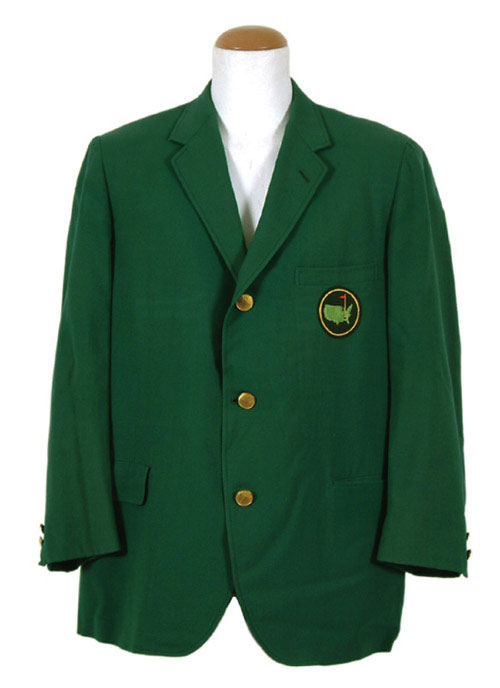
Green jackets were first worn at Augusta National in 1937, but they weren’t popular. “The members were not enthusiastic at first about wearing a conspicuous Kelly-green garment,” Clifford Roberts, the club’s co-founder and chairman, wrote in 1976. “Besides, the original coats were made of material that was too heavy, so that the wearer became uncomfortably warm.”

A few years later, the club offered an improved version, and on January 13, 1941, Helen Harris, who managed the club’s office, wrote a letter to the members informing them that “the Club’s Tailor is prepared to make the official Green Coats bearing the club’s Emblem for $18.50 and if you should wish to order one, please have your own tailor fill in the measurements on the enclosed blank and return it to me.”

The club had recently done some much-needed remodeling in the clubhouse, which had been a wreck when the club and tournament began. “With the improved Club facilities,” Harris continued, “most all our Members will likely spend more time here and these green coats come in handy for lounging. They are also quite serviceable during the Master’s [sic] Tournament as they make it unnecessary to wear a badge. Moreover, they identify the wearer as a member and thus give our gallery patrons a reliable means of securing information.”

The first Masters winner to be given a green jacket was Sam Snead, in 1949. A decade earlier, the club had photographed the first five winners in green jackets, but those had been borrowed from members—in a couple of cases, from members who had significantly different dimensions. The club keeps a selection of sizes on hand, and if a player who hasn’t won before is in contention the golf shop makes a few phone calls, to get an idea of likely measurements.

Horton Smith, Byron Nelson, Gene Sarazen, Henry Picard, and Ralph Guldahl, 1939. You can order a nice print of this swell photo from the Masters website.

Horton Smith, Byron Nelson, Gene Sarazen, Henry Picard, and Ralph Guldahl, 1939. You can order a nice print of this swell photo from the Masters website. No green jacket, though.

Golf Periscope Update

Periscope woman 3-17-2013

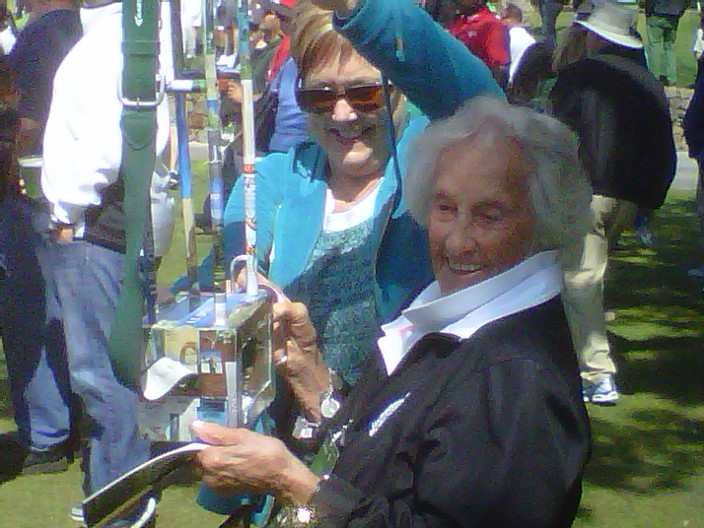
Steve Davis, whom I met at Tiger Woods’s World Challenge back in December, has been tweaking and field-testing his golf periscope, which is considered by some to be the most important golf-related invention of the current century—and not only because it has a shoulder strap and a beer holder. Last weekend, he took it to the Toshiba Classic, in Newport Beach, California, an event on the Champions Tour. “I was following the final group Sunday,” he told me in an email. “There was this little old lady who couldn’t see anything. She understood right away how the periscope worked. The smile that produced was priceless. It was my feel-good moment of the day—and we were only at the first green.”

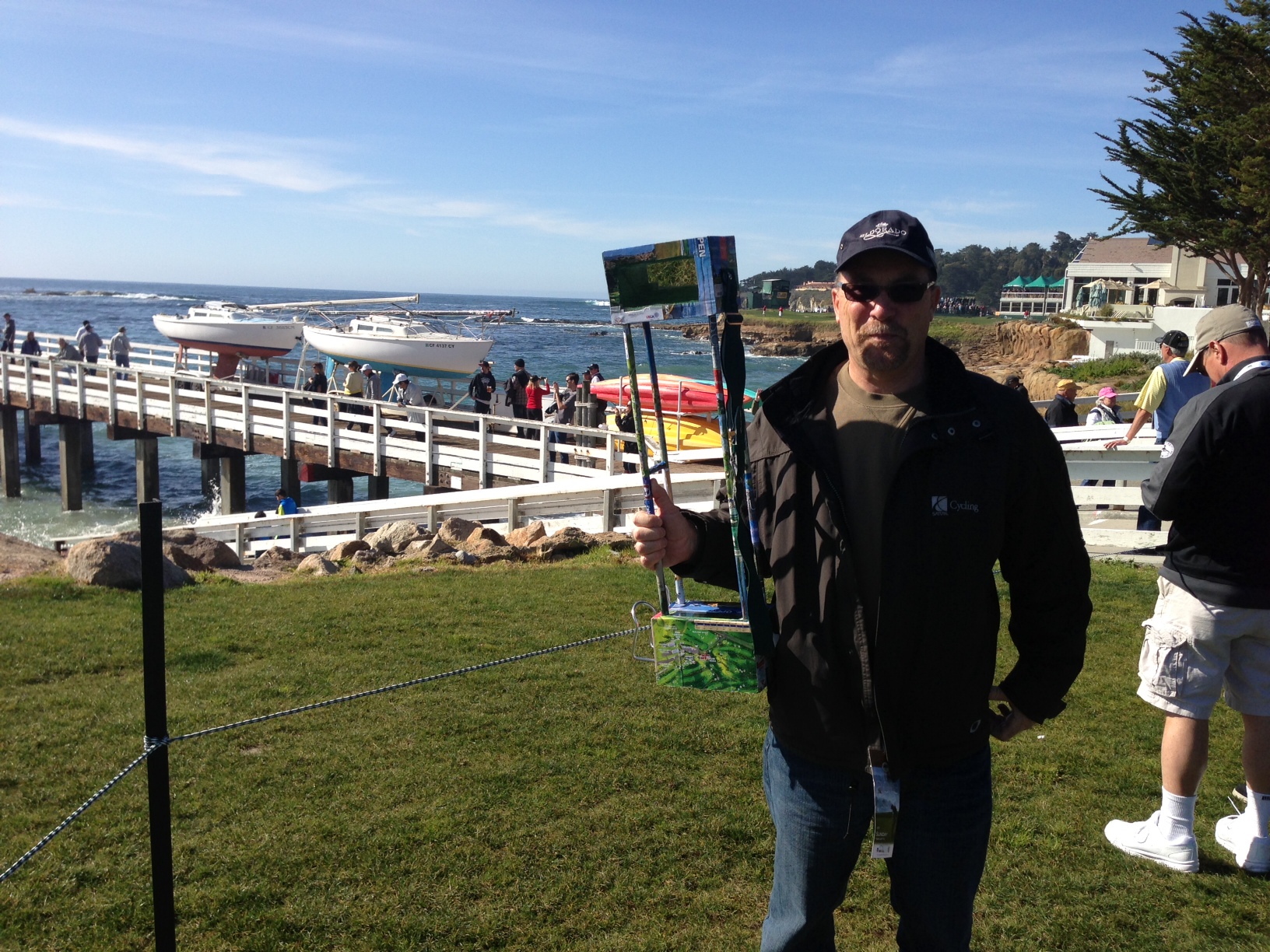
Steve Davis and his periscope at the Farmers Insurance Open, Torrey Pines Golf Course, La Jolla, California, where, he reports, "Tiger was Tiger of old."

Steve Davis and his periscope at the Farmers Insurance Open, at Torrey Pines Golf Course, in La Jolla, California–where, he reports, “Tiger was Tiger of old.”

Davis apparently spends all his time either working on his periscope or trying it out at golf tournaments. He watched Tiger win at Torrey Pines in January (photo above). And last month he attended the AT&T Pebble Beach National Pro-Am, which Brandt Snedeker won. In another email, Davis sounded almost disappointed that there weren’t more people standing between him and the action. “The big surprise was how small the crowd at Pebble was,” he wrote. “We could stand alongside the green on almost every hole. It got crowded only around the end, at 16, 17, and 18.” The photo below was taken at the AT&T, and it shows him holding a modified version of the device I tried at the World Challenge. The differences may not be obvious to a layman, but they are significant. “I have a new system and have been having problems with it,” Davis confided, “so I’m having trouble trusting it.”

AT&T ProAm Pebble Beach 2013

Davis also took his periscope to the Northern Trust Open, at Riviera, last month. “What can I say with a two-playoff-hole victory for Merrick’s first tour win?” The guy on the right in the photo below, which was taken at Riviera, looks to me like he was contemplating a smash-and-grab, but apparently he was just eyeing Davis’s beer.

2013 Northern Trust Play Off

More periscope news as it develops.

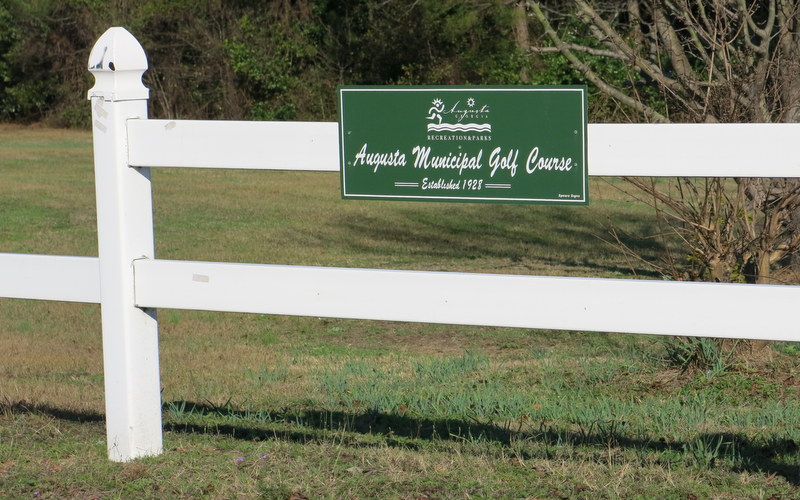
The Muny Life: Augusta Municipal (a.k.a. the Patch)

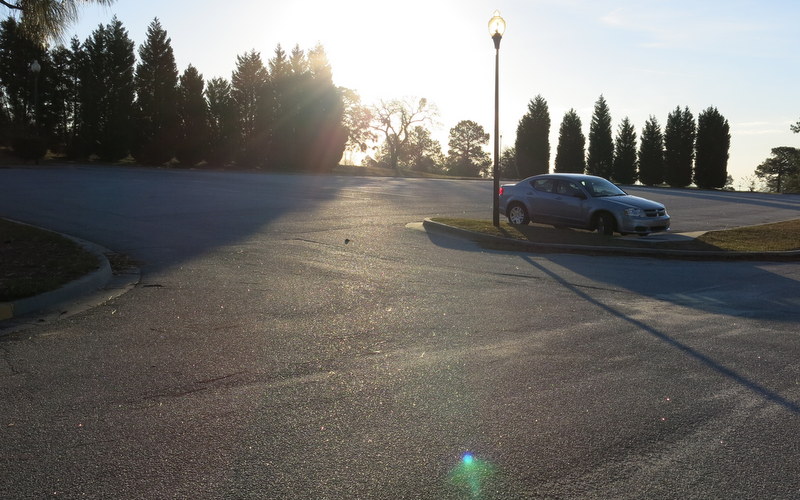
IMG_0025For my monthly column in the April issue of Golf Digest (on sale now), I played Augusta’s municipal golf course, which is known locally as the Patch—short for Cabbage Patch. There was frost when I got there, and the parking lot was virtually empty, so after nosing around a little bit I went to Krispy Kreme.

IMG_0022

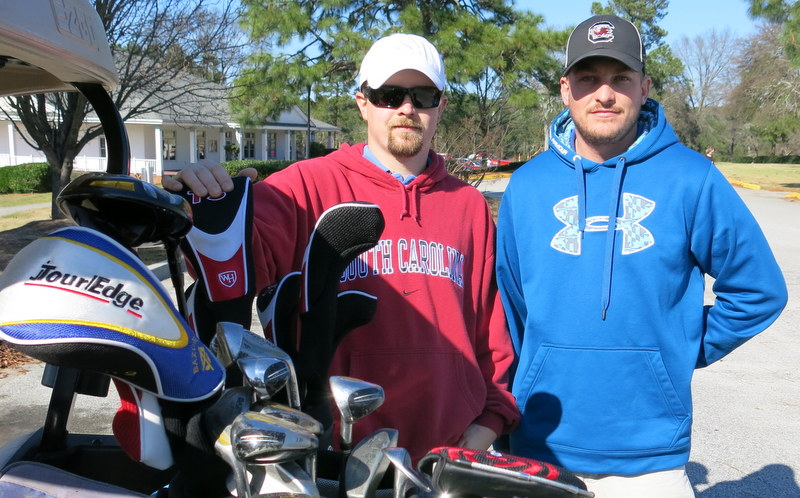
When I returned, I played with Josh and Steve, both journeymen pipefitters, who had driven over from Aiken, South Carolina. They’ve been working as welders on the Savannah River Salt Waste Processing Facility, a job that’s likely to last another two or three years. (“Salt waste” is a semi-euphemism for nuclear waste.) There was a golf-ball-shaped dent on the bottom of Steve’s driver. “That’s from the first time I played,” he said. “It was a sight.” Here they are (Steve is on the left):

IMG_0048

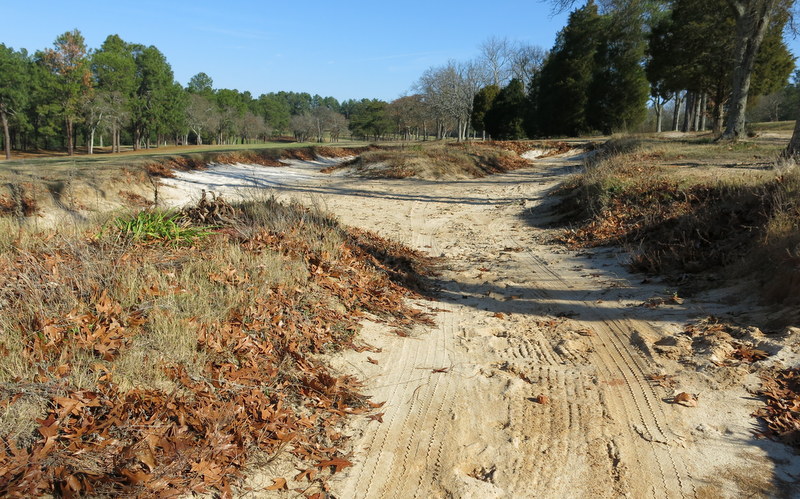
The Patch is scrappy, but it’s a good golf course, and it has some awesome bunkers, like this one, next to the first fairway:

IMG_0030

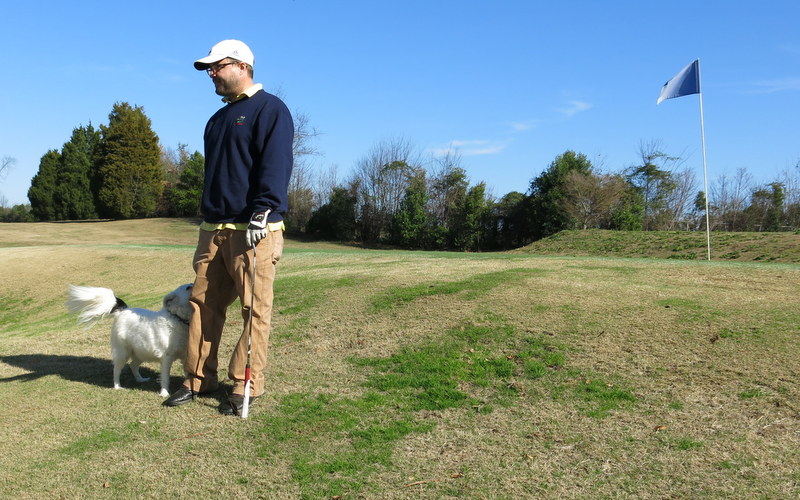
Later that day, I met the guy in the photo below, who was playing with his dog. He’s forty-five years old and has been a regular at the Patch since he was twelve. I asked him how the course had changed over the years. “Not at all,” he said. “It changes, but within a very narrow band. It has been twenty percent better, and it has been twenty percent worse, but it’s basically the same.” Once, during a single week, he played all the nearby golf courses with the word “Augusta” in their name: Augusta Country Club, North Augusta Country Club, Augusta Municipal, and Augusta National. He said that he and his dog had just played twenty-seven holes in three hours—a perfect day.

IMG_0052

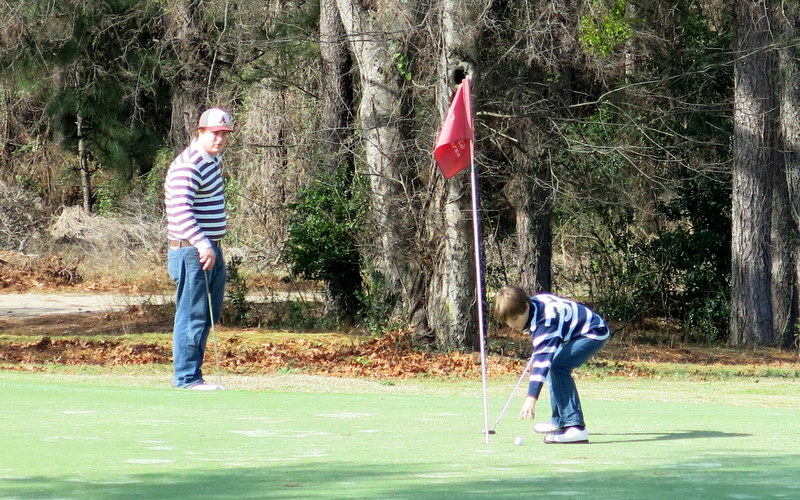
I also saw a couple of young dads, playing with sons:

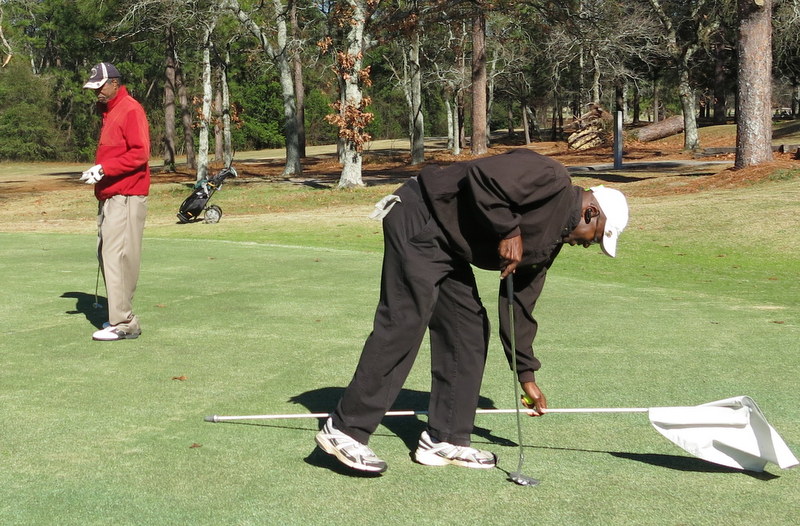
IMG_0037And the next day, I played with the guys I wrote about in my column, two of whom are in the photo below:

IMG_0076In the same issue, Ron Whitten and I have articles about two days we spent in Orlando helping the people at EA Sports recreate the Augusta National course as it was in 1934, the year of the first Masters, for their new video game “Tiger Woods PGA Tour 14: The Masters Historic Edition.” The result, Whitten writes in the magazine, is “the closest thing to a time machine that golfers will ever experience.” The level of detail is extraordinary. Here’s Whitten during one of our sessions at EA, pointing out an incorrectly positioned tree:

P1040827


Beef Box: Golf Idiots, and Neckties on TV Commentators

In 2001, I played 136 holes in one day at Doral with Jim McLean, who runs a golf school there. We started on the Blue Monster and averaged forty-five minutes per eighteen, and to save time we often teed off simultaneously, as in the photo above.

In 2001, I played 136 holes in one day at Doral with Jim McLean, who runs a golf school there. We started on the Blue Monster, where Tiger won over the weekend, and we averaged forty-five minutes per eighteen. To  save time, we often teed off simultaneously, as in the photo above.

David Lee, a reader in Appleton, Wisconsin, sent the following email to the PGA Tour over the weekend:

After hearing it again in today’s TV broadcast, I have a suggestion. I’m referring to a fan shouting out immediately after a Tiger hit: “IN THE HOLE!” It has become so obnoxious to hear these comments, seemingly elicited so that the fan can tell friends at home afterwards that it was his voice doing the shout-out—I’m guessing that that’s the reason because the comment occurs within a nanosecond of the clubhead contacting the ball, oftentimes on a very long shot and without regard to the quality of the shot. Current technology must make it easy for the TV networks to block out such shout-outs—I’m not talking about spontaneous outbursts of support—I think that you and I know which outbursts we’re discussing here. The PGA Tour should do some PR communicating to tournament spectator attendees that such comments are frowned upon and that they will not make it to the air-waves anyway—and take action to eliminate these outbursts from the telecasts. I think that the vast majority of your golfing fans would support this move, as well as would the Tour players.

I don’t know whether what he suggests is technologically possible, but if it is I’d be in favor of it. Or how about using something like a surgical staple gun to implant a device under the scalp of each spectator which would administer a painful but nonlethal electric shock each time the spectator shouted something stupid? And let’s do same to guys who sit behind home plate at baseball games and clap as each ball is pitched, in the hope of bothering the batter.

Nobody else at a golf tournament dresses like this. Why do they?

Nobody else at a golf tournament dresses like this. Why do they?

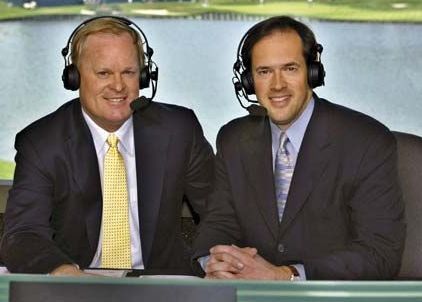
And, as long as I’m complaining, how about not allowing TV golf commentators to wear neckties? Golf courses should be tie-free zones for everyone but Tim Finchem and the manager of the grill room.

I don't mind seeing ties on ten-year-old caddies in 1925, as in this photo, which was taken at my golf club. The pro when I joined, in 1991, was the son of tiny kid who is fourth from the left in the front row.

I don’t mind seeing ties on ten-year-old caddies in 1925, as in this photo, which was taken at my golf club, but everyone else should knock it off. The pro when I joined, in 1991, was the son of tiny kid who is fourth from the left in the front row–who was the son of the (tie-less) man at the right, the pro in 1925.

Masters Countdown: How Augusta National Almost Built a Golf Hall of Fame

Bobby Jones, 1941 Masters.

Bobby Jones, 1941 Masters.

The National Baseball Hall of Fame and Museum opened in Cooperstown, New York, on June 12, 1939, and the Professional Golfers Association responded by inducting several legendary golfers, among them Bobby Jones, into its own hall. But the P.G.A.’s hall as yet had neither a building nor a plan for one.

Clifford Roberts, who was Augusta National’s chairman and co-founder, embraced the idea and suggested several sites on the club’s property. His favorite, initially, was an elevated six-acre parcel roughly two hundred fifty yards to the east of the tenth green. This was one of the building lots that the club had been trying to sell for a decade. Among the advantages of the site, Roberts wrote to Jones, was that visitors to the hall “would have four good views of the course instead of one.” He also liked the idea that “members using the golf course would have a good view of an attractive building”—though from a distance.

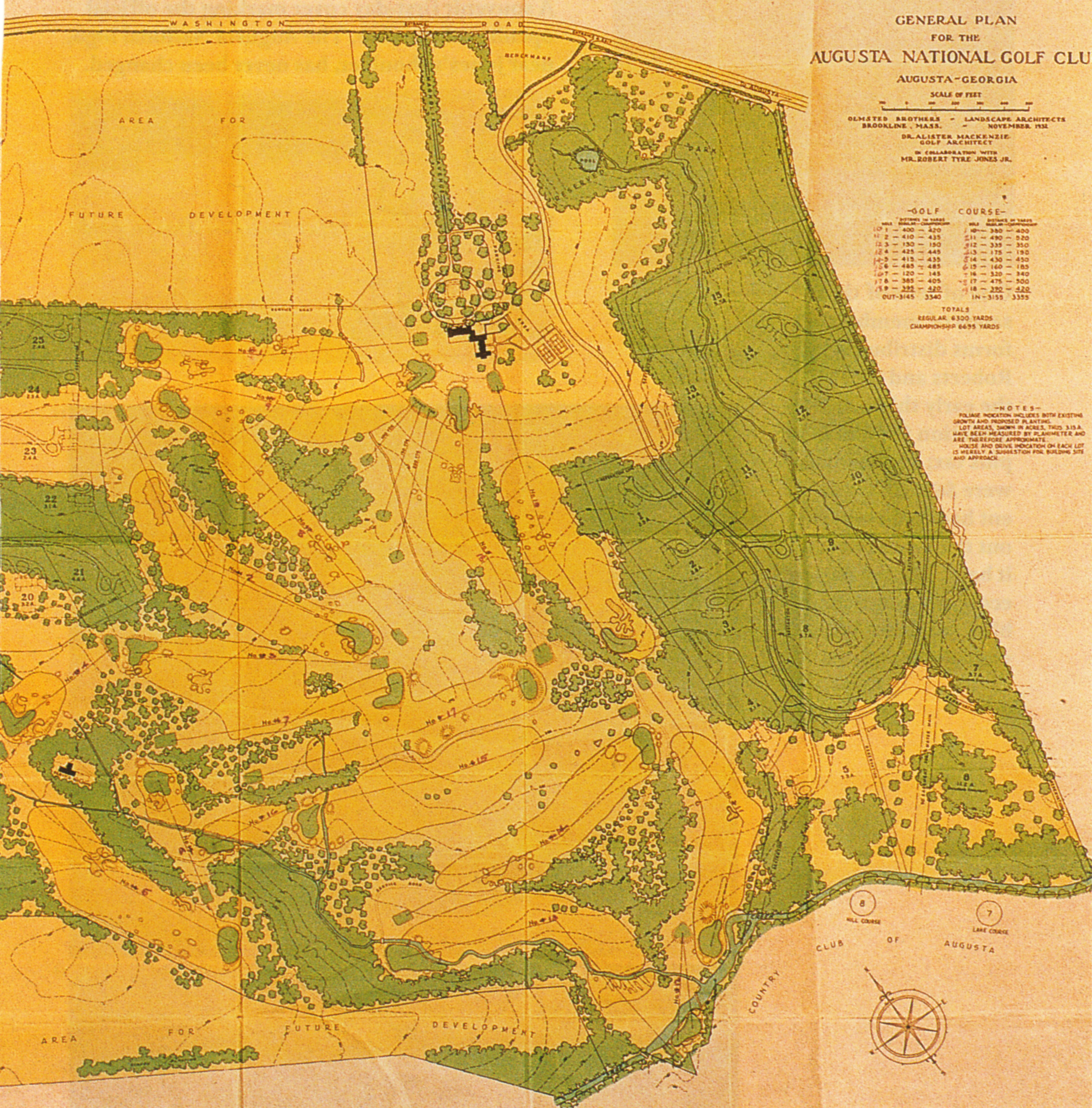
1932 Augusta National real-estate development plan, prepared for the club by Olmsted Bros.

1932 Augusta National real-estate development plan, prepared for the club by Olmsted Bros. Roberts’s initial choice for a hall of fame site was on the east side of the property, to the east of the modern eleventh tee–in the green stuff on the map above.

Roberts was especially concerned that golf’s hall of fame should be more compelling than baseball’s. A few days after the 1941 Masters, he wrote a lengthy letter to Olmsted Bros.—the club’s landscape architects at that time—in which he described a number of features that he thought ought to be included. “The more I think about it,” he wrote, “the more I feel that a building that houses a few plaques or a few bronze busts and that offers nothing else to the public, would prove to be a dull, worthless type of project, having no excuse for its existence except to attempt to glorify the leaders of golf. And I doubt that very much would be added to their fame.” One wing of the building, he continued, could contain “automatic movie machines,” which, for a quarter, would show instructional films by the game’s great teachers. Another wing could serve as both a comprehensive library and a bookstore. Visitors would be able to buy souvenir booklets, postcards depicting the Augusta National course, and “popular-priced copies” of some of the books in the library.

Roberts’s boldest suggestion was to construct “a miniature Augusta National course surrounding the Hall of Fame which would be a practical pitch and putt course and could be made a most attractive part of the landscaping scheme.” The holes would be scaled-down replicas of the holes on the big course. He proposed a fee of twenty-five cents per round. He also suggested building an “especially attractive” public driving range based on a plan that Jones had come across and thought highly of.

Despite Roberts’s enthusiasm, the project never came to anything, and there was no further discussion of building a miniature Augusta National. The two members that Roberts had been counting to pay for the project lost interest in it, and the club was not in a financial position to follow through on its own. And then news from Europe and the Pacific made other concerns more pressing.

Masters Countdown: Those Amazing Flowers

ANGC Circle 2

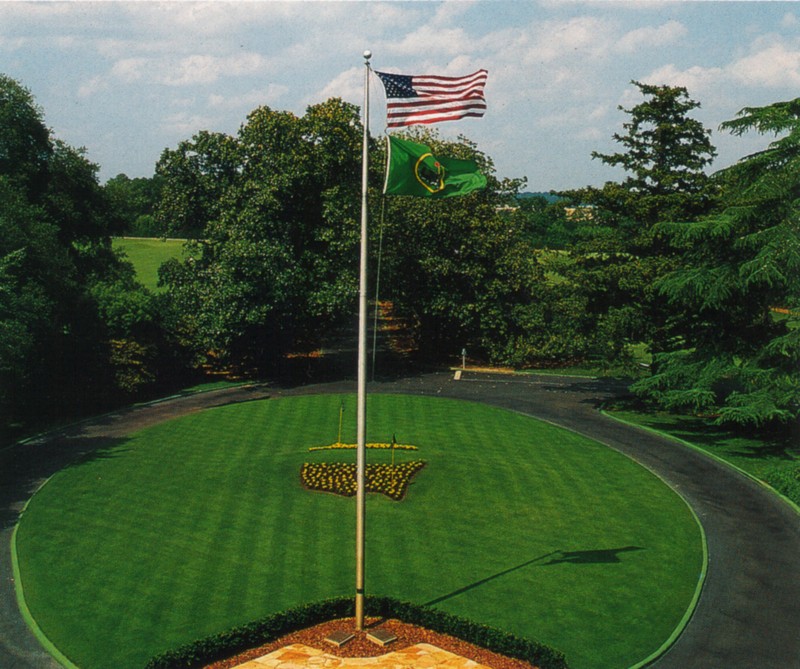
The photograph above shows the circle at the end of Magnolia Drive, in front of the Augusta National clubhouse. Everything is immaculate, including the green paint on the curbs—which is touched up frequently as the tournament approaches. The photograph below, which was taken in 1947, shows the same circle as it appeared during a period when the club was still strapped for money and couldn’t afford to pay the same attention to detail (or to pansies).

ANGC Circle 1

At the base of the flagpole in the photograph at the top of this post are plaques commemorating the co-founders of the club and the tournament: Clifford Roberts and Bobby Jones. The plaques are the only memorials to the men on the property. In 1941, two new Augusta National members—James Middleton Cox, a newspaper publisher, who years earlier had served three terms as the governor of Ohio, and his son, James, Jr.—proposed erecting a large statue of Jones near the clubhouse, not far from what would later become the site of the Eisenhower Cabin. Jones and Roberts were deeply unenthusiastic about the monument, and both were relieved when the Coxes, at Roberts’s suggestion, shifted their attention to the possibility of building a hall of fame on club property. I’ll have more to say about the hall of fame in a few days.

Great Golf Course: Riviera

2008 Joann Dost All Rights Reserved

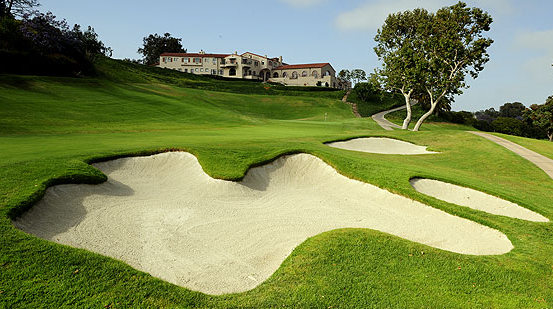
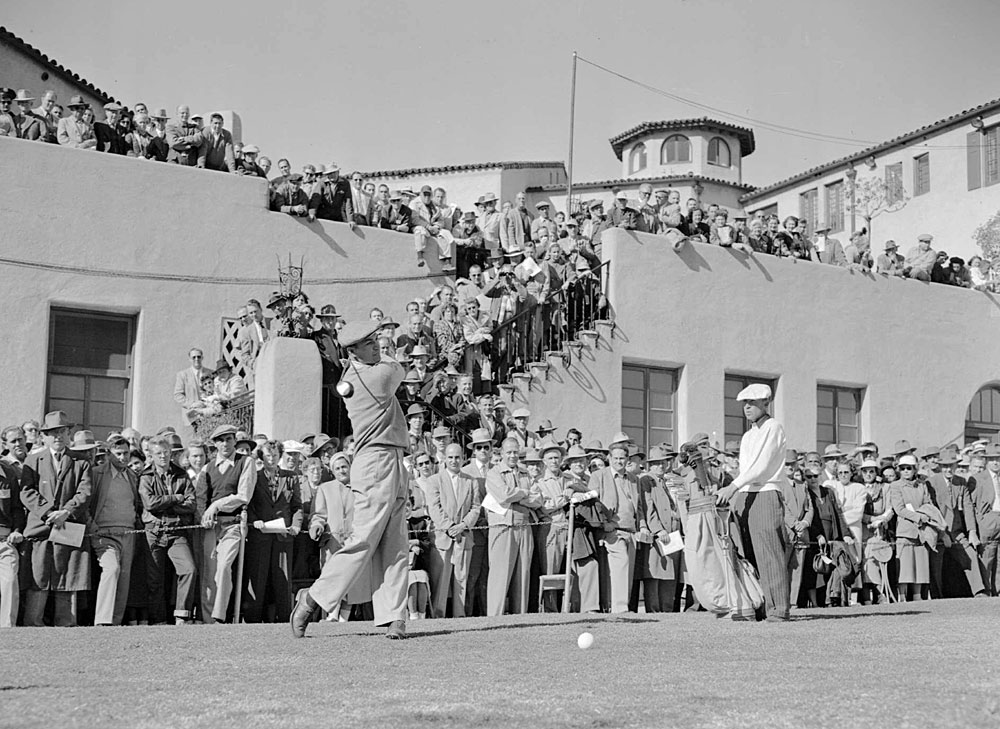
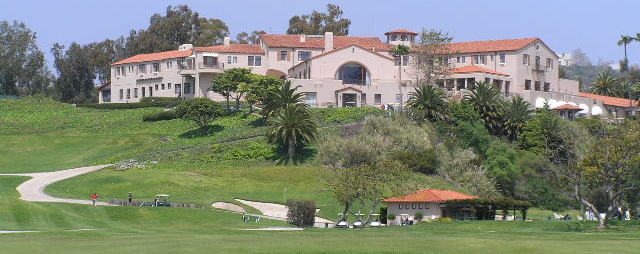
In 1947 and 1948, Ben Hogan competed in two Los Angeles Opens and a U.S. Open at Riviera (where the Northern Trust Open is currently being played). He finished first, first, and first. He would have won again, at the 1950 L.A. Open, his first tournament following his car accident, if Sam Snead hadn’t closed with consecutive birdies to tie him in regulation, then prevailed eight days later in an anticlimactic rain-delayed playoff. No wonder they still speak of Hogan’s game in the present tense at Riviera. His portrait hangs in the clubhouse over a fireplace that is always lighted, like an eternal flame.

Hogan, Riviera, 1950.

Hogan, Riviera, 1950 L.A. Open.

Riviera opened in 1926, in a flood-carved canyon in what was then sparsely populated farmland west of Los Angeles. It cost almost a quarter of a million dollars to build, and for a time it was the second-most expensive golf course on earth (after Yale). W.C. Fields, Douglas Fairbanks, Olivia De Havilland, Clark Gable, Katharine Hepburn, and Howard Hughes all played there regularly. Will Rogers, Gary Cooper, and Spencer Tracy competed every weekend on the polo grounds, which are the source of the kikuyu grass on the golf course. Elizabeth Taylor and Greta Garbo, whose house overlooked the thirteenth fairway, were often seen trotting along a bridle path that encircled the course. Television didn’t exist, and martinis and cigarettes weren’t bad for you yet, and golf at Riviera was a party.

Katharine Hepburn, golfer.

Katharine Hepburn, golfer.

The Los Angeles Open was a very big deal in those years—more of a major, in many ways, than some of the majors.  Humphrey Bogart, who in his prime was close to scratch, used to sit under a tree near the twelfth green and sip bourbon while Hogan, Mangrum, Snead, and Nelson played by.

Bogey, scratch.

Bogey, scratch.

I played quite a few rounds at Riviera in 1995, on assignment for Golf Digest. The P.G.A. Championship was going to be held at Riviera that year, and I was working on a preview article. I arrived in L.A. one afternoon, checked into my hotel, and, because it was too early to eat dinner, decided to make sure I could find the course. A guard waved me through the gate, A tournament official let me through the fence and told me I should meet the club’s greens chairman, who had just finished playing and was having a beer with friends. We chatted for a few minutes, and then he asked, “Where are your clubs?” I ran back to my car. We teed off maybe five minutes later, and got in twelve or thirteen holes before it was too dark to see. When we’d finished, my new best friend asked me where I was staying, and when I gave him the name of my hotel he said, “You ought to be staying here.” So I moved into a lovely bedroom in the clubhouse, overlooking the eighteenth green. I woke up the next morning to the sound of members rolling putts on the practice green, and after a quick shower I ran downstairs and joined them.

My home away from home for four days.

My home away from home for four days.

Over the next few days, I played with two lawyers, who met in court while representing opposite ends of a personal-injury lawsuit; a guy whose company publishes hotel room-service menus; a guy who had recently retired from the garment business; the actor who played Frank Fontana on “Murphy Brown”; the father of Robby Krieger, who played guitar for the Doors; and Larry David, the co-creator of “Seinfeld” (and later the star of his own show).

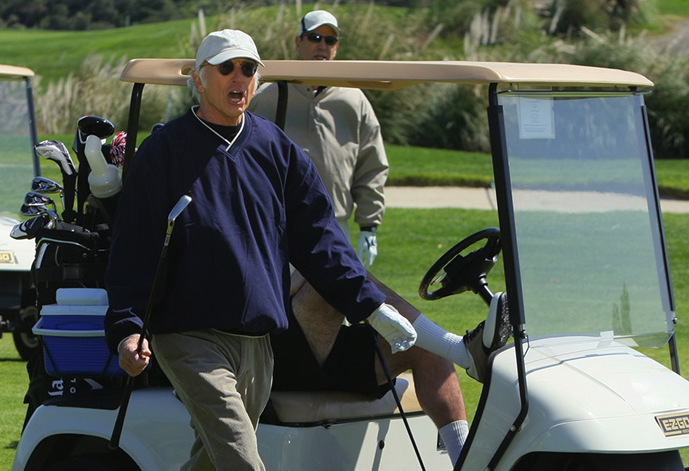
My close personal friend Larry David.

My close personal friend Larry David.

I also met Walter Keller, who was Amy Alcott’s teacher. He said that he first met Alcott on the practice tee at Riviera when she was a young girl. “I fell in love with the kid right there,” he told me. “She hit a beautiful shot, and I said, ‘Hit another.’ She did. ‘Hit another.’ She did. I turned to her mother and said, ‘You are a blessed woman.'” Keller arranged for Alcott to become a member of the club. She had a difficult relationship with her father, he said, but club members looked out for her. “She had twenty fathers here,” he said. “Dean Martin would see her on the driving range, swing by in his cart, and say, ‘Hey, Amy, let’s play nine holes.”

Amy Alcott, Walter Keller, and Tony Sills (who was also a student of Keller's) and a significant collection of junior-golf trophies.

Amy Alcott, Walter Keller, and Tony Sills (who was also a student of Keller’s) and a significant collection of junior-golf trophies.

Alcott won the first of her twenty-nine LPGA Tour events in 1975, when she was nineteen. Keller died in 2003, at the age of ninety-five.

Dino.

Dino.