
That’s Schoonie and his golf hat. Sometimes it’s hard to tell whether he’s giving you the evil eye.

That’s Schoonie and his golf hat. Sometimes it’s hard to tell whether he’s giving you the evil eye.
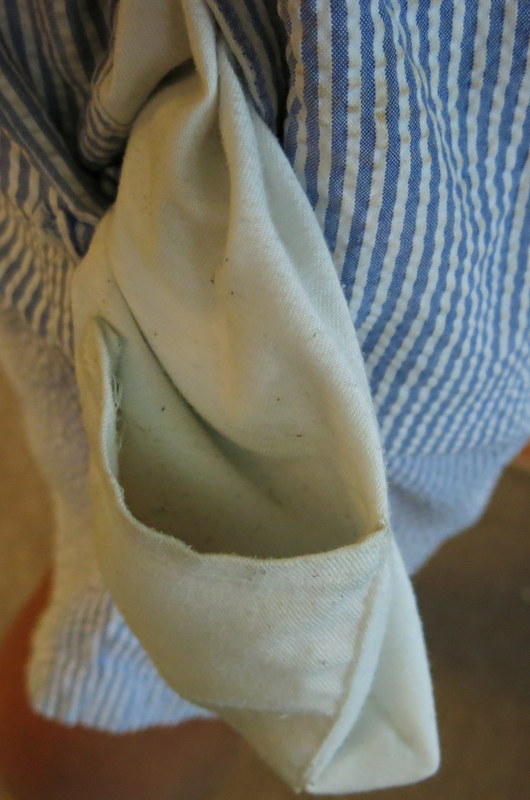
The tiny pocket inside the right-hand front pocket of some of the pants you own is for your pocket watch—which, you may have noticed, you stopped carrying in 1895. So why is the tiny pocket still there? Its only function, as far as I can see, is to become hopelessly clogged with change, tees, ball markers, golf pencils, and green-repair tools—which are especially insidious because if one of them gets in sideways you can’t extract it without undressing.
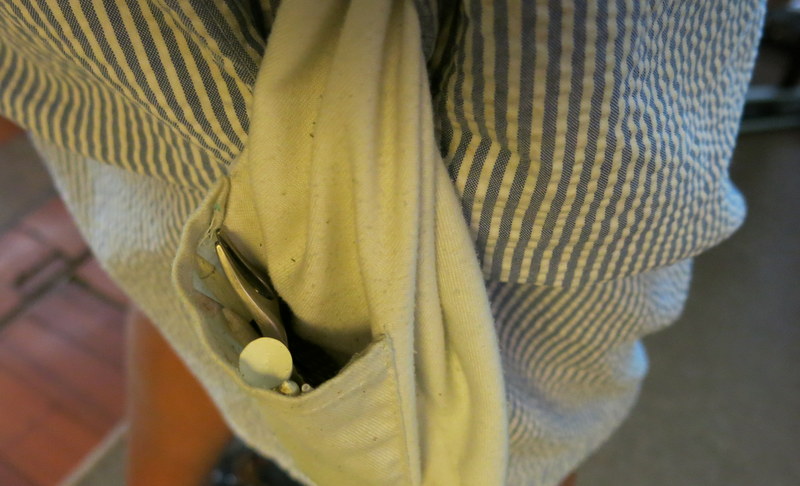
Clothing manufacturers don’t even sew tags in the collars of golf shirts anymore. Why do they splurge on pockets that serve no purpose?

Hopelessly golf-impacted “watch” pocket.
I own two pairs of golf pants that are even more annoying. Both pairs have a “scorecard pocket,” which is just inside the right-hand rear pocket and is almost exactly the same size. One pair also has an extra pocket in front, just inside the regular pocket, so that (supposedly) you can keep your keys and other non-golf stuff isolated from your tees and other golf stuff. The idea sounds sort of clever, but all it does is create frustration and confusion where none existed, because when you have two pockets in one place you have a fifty-fifty chance of sticking your hand in the wrong one.
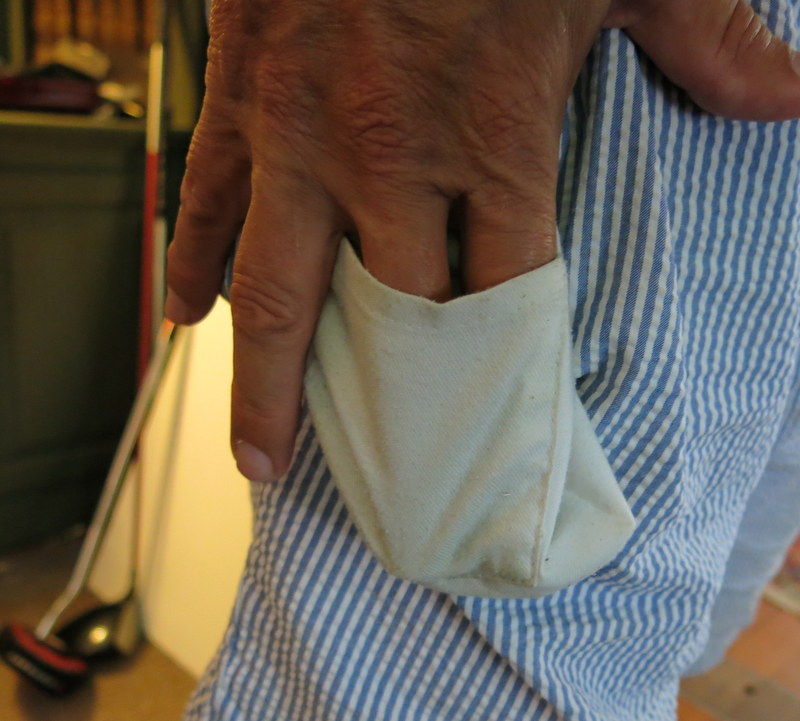
Hand in wrong pocket (a reenactment).
The only solution, other than buying pants with normal pockets, is to perform a partial pocketectomy:
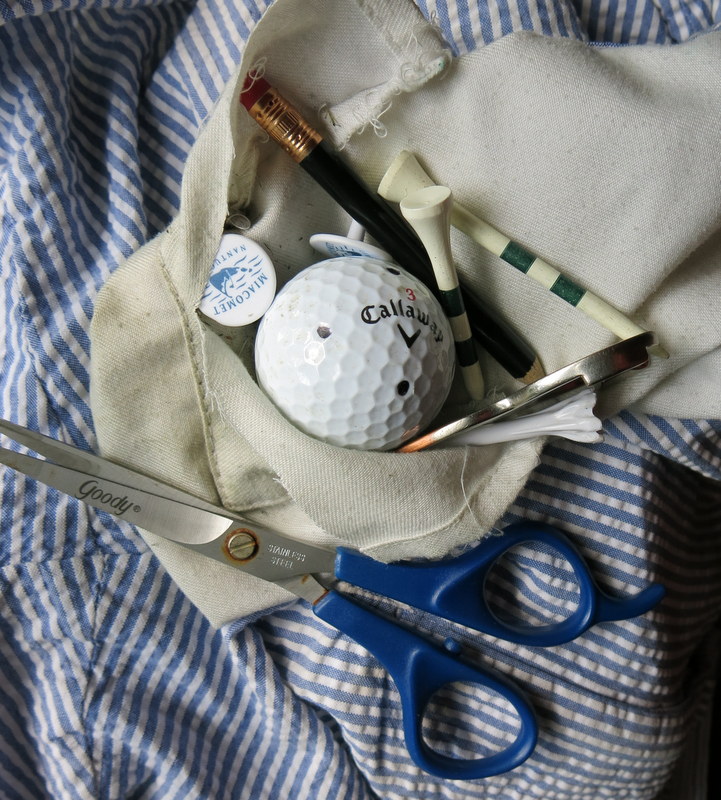
Problem solved: surgical implement, resected “watch” pocket.

Art-type shot of Shep, Josh, and Tony on the eighteenth tee at Yale, plus a padlocked water pump, July 23, 2013.
Not long ago, I wrote about using rain gloves as sweat gloves—a good thing, I said, because in hot, humid weather leather gloves become slimy and disgusting, while rain gloves continue to work even if they’re soaked with perspiration. A reader suggested trying Gorilla Gold Grip Enhancer, which is endorsed by Tiger Woods’s ex-coach Hank Haney. And, because I do what I’m told, I bought some.
On Tuesday, Tony, Shep, Josh, and I played Yale University’s terrific golf course, which was designed by C. B. MacDonald and Seth Raynor. (Incidentally, if you want to use the GHIN website to enter your score from Yale, you have to look under “T,” for “The Course at Yale.” How dumb is that?) The day was extremely humid, and after a couple of holes I decided to try Gorilla Gold. Here’s what it looks like:
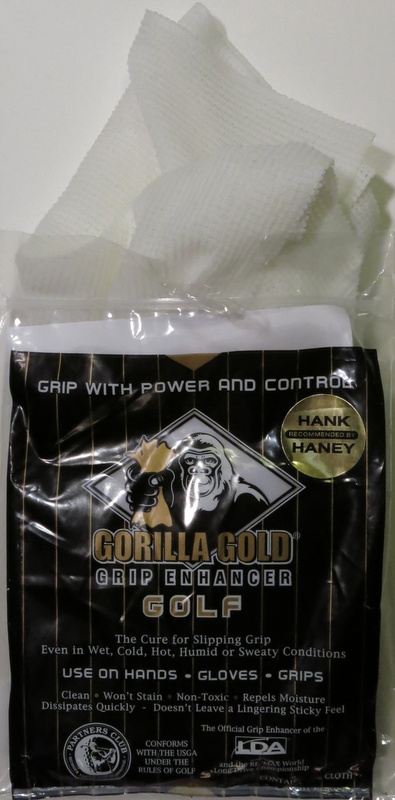
The package contains a sticky cloth, which you wipe on your hands, your glove, your grips, whatever. And it works as advertised, I would say, because it’s extremely sticky, and everything it touches becomes extremely sticky, too, even if it’s also wet. But after about five minutes I was cursing, because once you’ve got the sticky stuff on your hands you also get it on your ball, and that turns your ball into a magnet for dirt and pocket lint. And that, in addition to being a nuisance, almost certainly costs you distance, by altering the ball’s aerodynamics—like coating an airplane’s wings with ice.
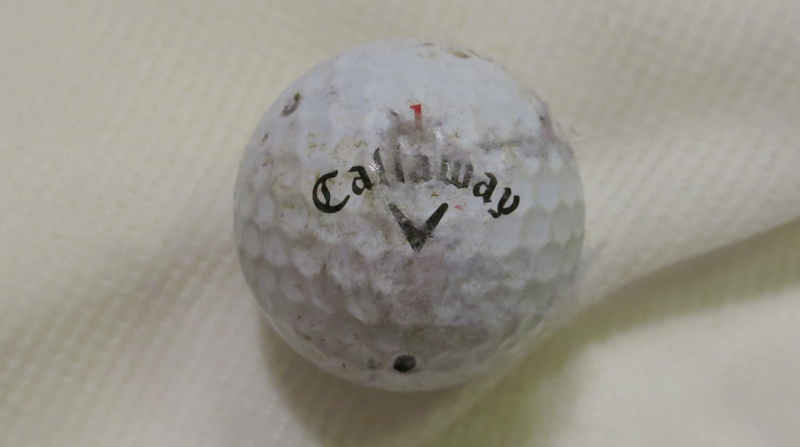
Golf ball coated with Gorilla Gold and pocket crud.
Long, repeated scrubbing in a ball washer did not remove all the sticky stuff: the next afternoon, the same ball was still picking up dirt from putting greens. And when I tried to use a towel to wipe the sticky stuff off the grip of my driver, the grip became covered with towel fuzz, which I’m still trying to remove. In fact, all the clubs I touched with sticky hands now feel like they need to be re-gripped, because the sticky stuff stops feeling sticky and starts feeling slick as soon as it’s coated with dirt or lint or towel fuzz. So I won’t be a repeat customer.

Tony and Shep at Yale.
Shep, who doesn’t like rain gloves, has another anti-wet technique: he saves all his old leather golf gloves in a Ziploc bag, and on rainy or humid days he works his way through the bag, swapping wet gloves for dry. All the wet gloves go into another Ziploc bag, and by the time he needs them again they’ve magically refreshed themselves.
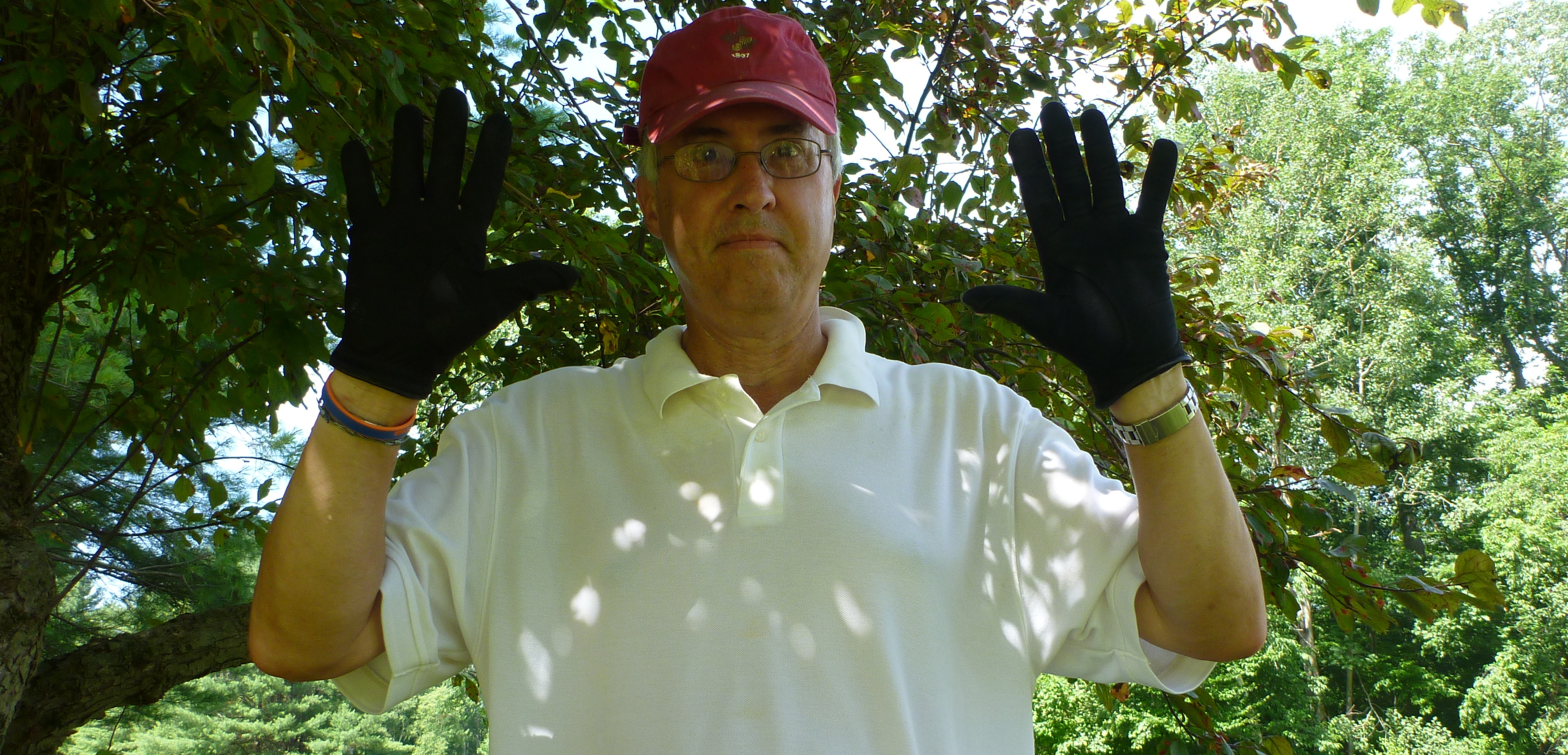
Sweat-soaked rain gloves, July 7, 2013.
It’s been so hot and humid around here that we’ve had to make some adjustments. I’ve started wearing rain gloves even when it isn’t raining, because regular gloves feel slick and slimy when they’re soaked with perspiration. We’ve also tried bracketing the worst parts of the day by playing at the five-thirties: a Two-Hour Eighteen™ at 5:30 a.m. followed by a Two-Hour Eighteen™ twelve hours later, at 5:30 p.m. The course is empty and relatively cool both times, and you have room for a full workday in between, assuming you don’t fall asleep at your desk. And after the second eighteen you get home in plenty of time to ask, “Hey, what’s for dinner?”

Tony, Ian, Other Gene, Tim-o, Rex, eighteenth green, dawn patrol, July 3, 2013.

Kevin, Addison, evening session.
Sunday Morning Group met at the regular time—7:30—and the temperature was around 90 by the time we finished. Doug got so hot that he had to cover his head with a towel:
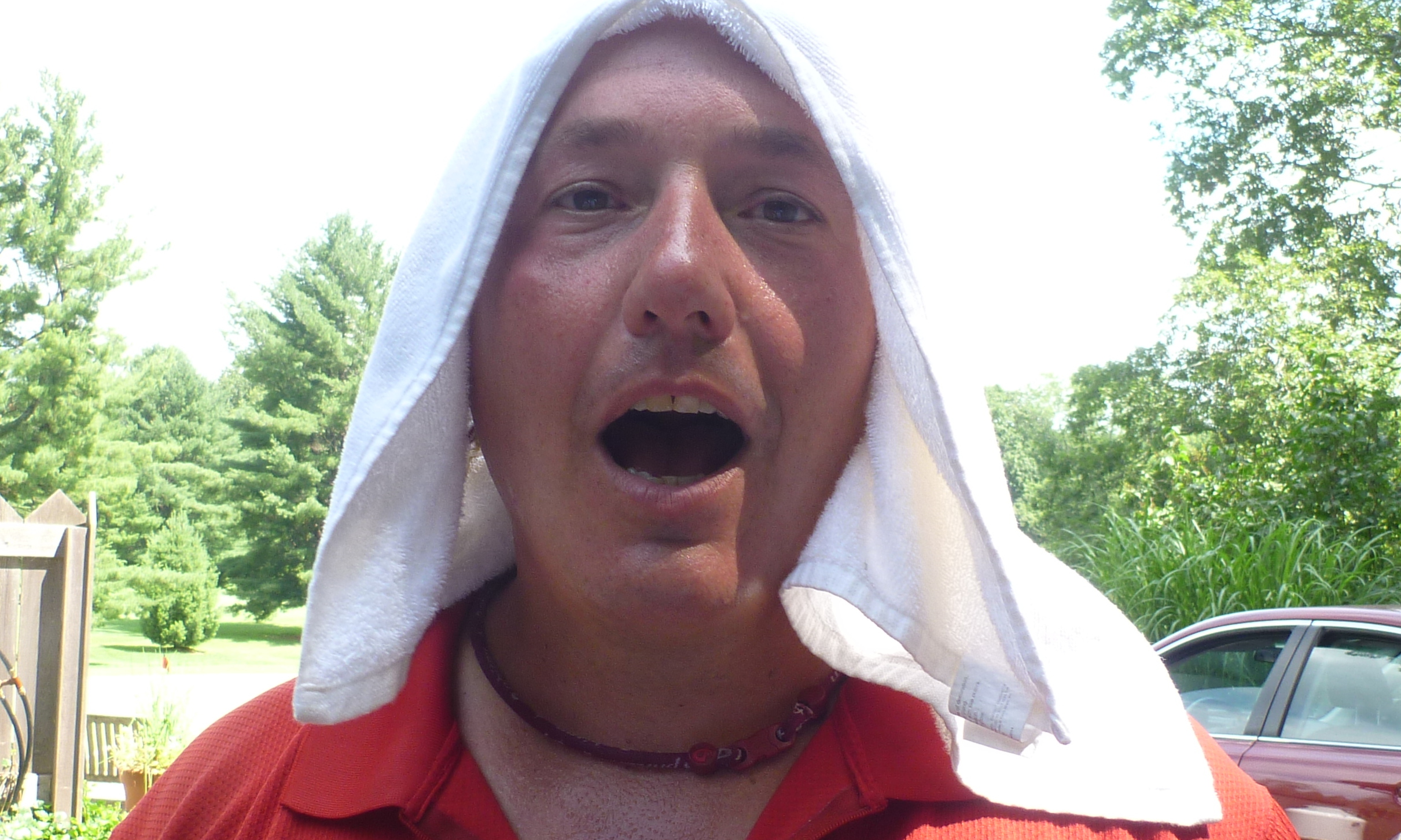
Corey (our pro) wore shorts, and for the first time in living memory we ate lunch on the porch, to get out of the sun.
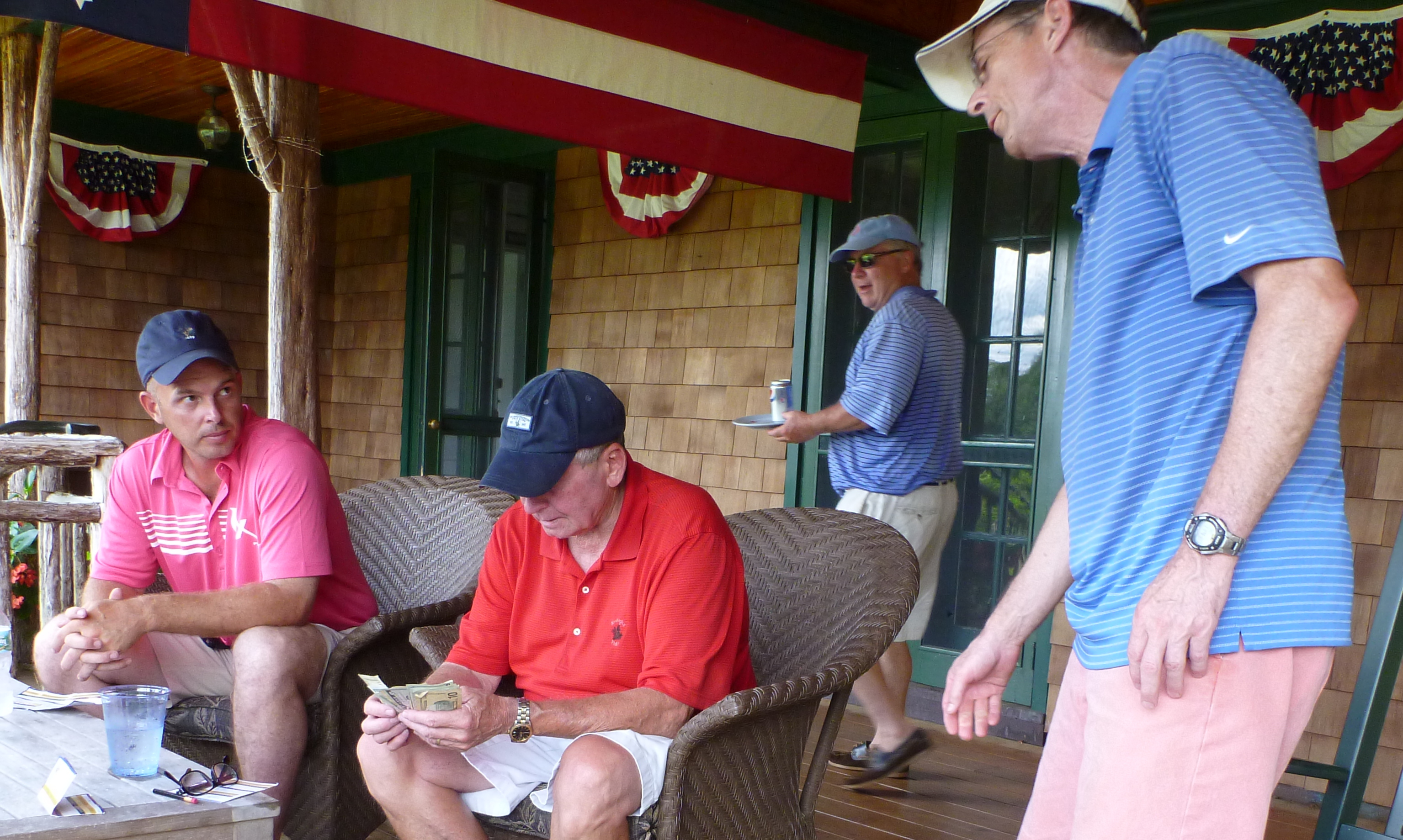
Settling up at lunch: Corey, Hacker (real name), Tom, Tim.
There were only three skins, and Tim got two of them. He was also on the winning team, so next week it will be his turn to bring lunch. Doug had a wife situation at home, so he left as soon as he had eaten. He doesn’t live very far from the course, so in decent weather he usually commutes by motor scooter:

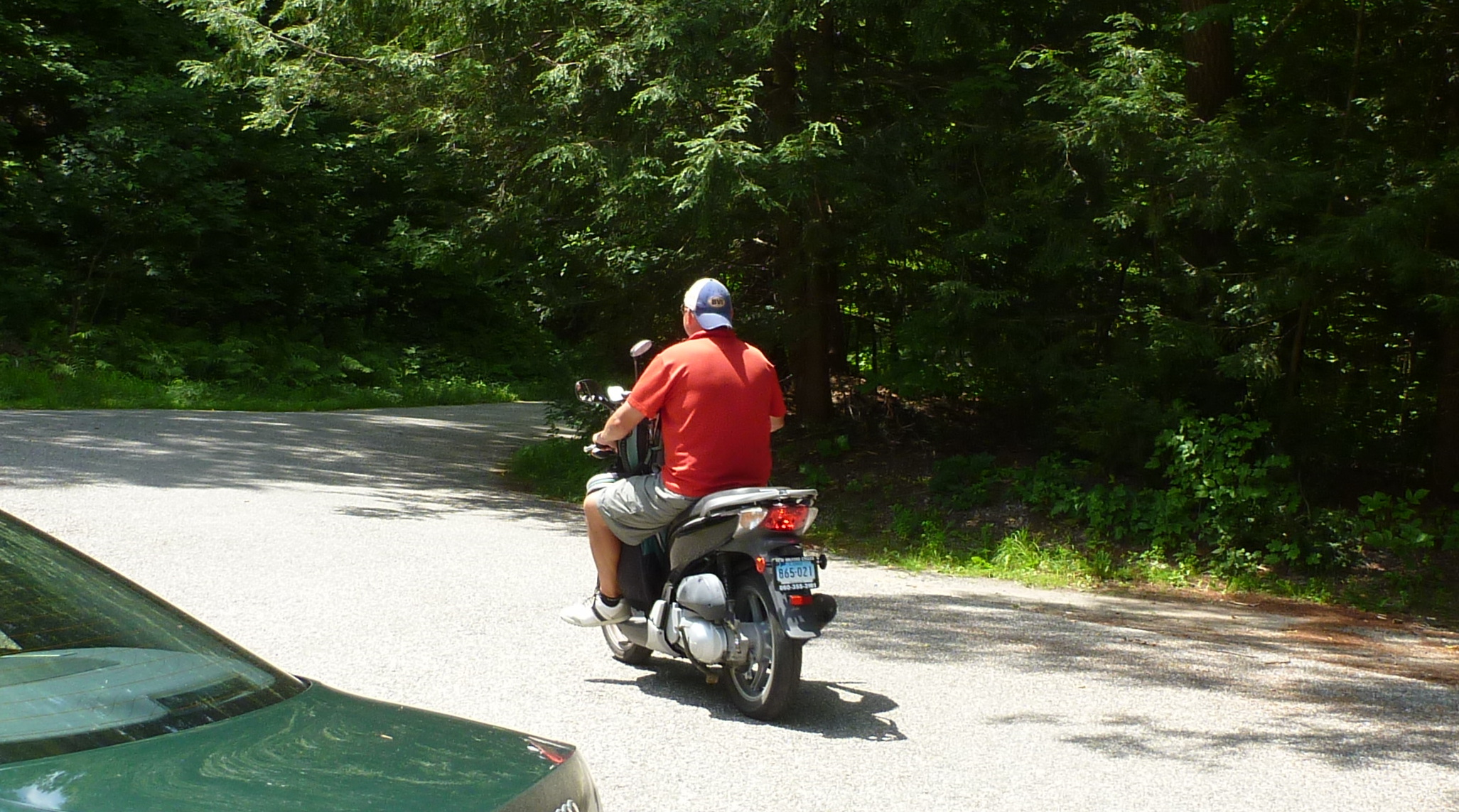
That’s a dual-purpose helmet he’s wearing: turn it the other way and it’s a golf cap.

Young Nick, first tee, 9:45 p.m., July 5, 2013.
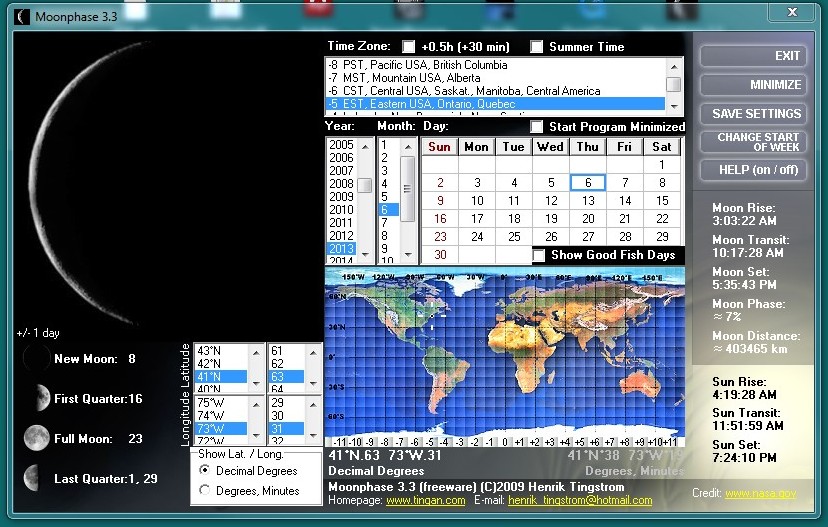
All golfers brood obsessively about the weather; my friends and I also track the phases of the moon. The reason is that we like to play at night, with glowing balls, and glowing balls look best against a truly black sky. The ideal time to play is an hour or two after sunset during a new moon, but other times of the month work, too, as long as the moon either hasn’t risen yet or has already gone down. I now monitor all that with a free program called Moonphase 3.3.
On Friday night, we met on the clubhouse porch at 7:00, for pizza from The Upper Crust, the official provisioner of the Sunday Morning Group.

Austin, John, pizza, clubhouse porch.
Then we played Putting for Dollars on the practice green while we waited for the sun to go away.
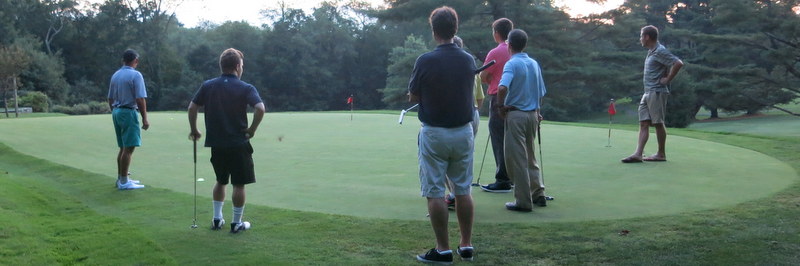
In all our putting contests, we use the stymie rule, which the rest of the golf world abandoned in the 1950s. Closest to the pin wins, double points if the ball goes in. Luke (second from left) was the only competitor to actually sink a putt.
When the sky finally began to seem sort of promising, we turned on our flashing light sabers, to let them warm up.
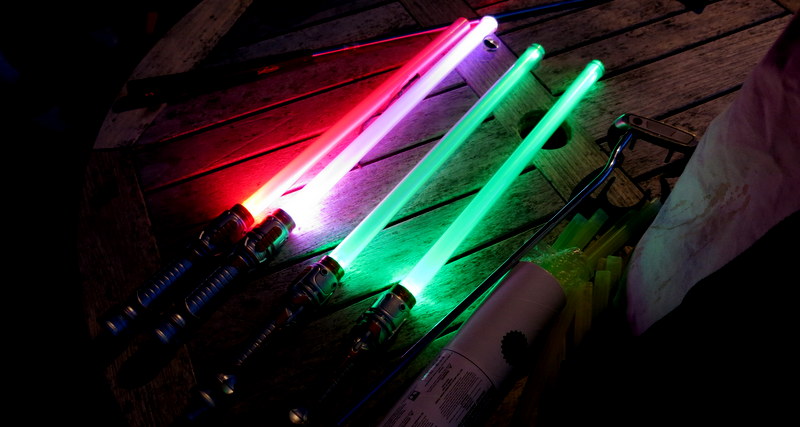
Then Hacker (real name) and Tim went out in a golf cart to place light sabers in the cups on the first second, seventh, eighth, and ninth greens, so that we’d be able to tell where the holes were. They also put glowing green rings in the bottoms of the cups.
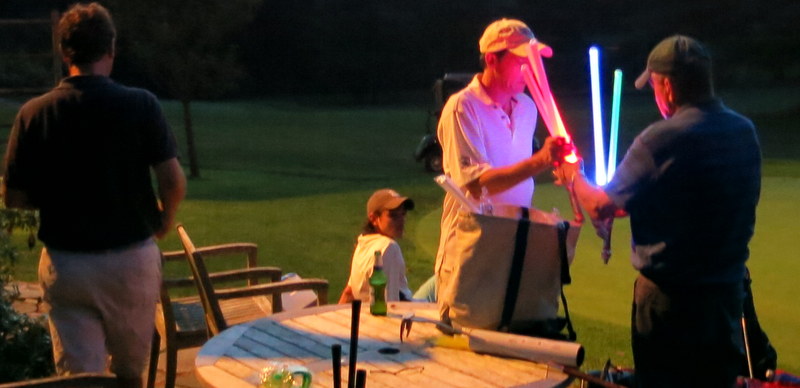
Paul, Middle Nick, Tim, Hacker.
Night golf has been a feature at my club for more than twenty years. For most of those years, we used translucent balls with glow-stick inserts. They were fun to play with, but they didn’t behave like real balls, and they didn’t fly anywhere near as far, and the glow sticks were sometimes hard to cram all the way in. Last year, we switched to Night Flyer balls ($70 a dozen, in six colors, at nightflyer.com). They’re self-illuminating—each one contains its own LED and battery, which isn’t replaceable but lasts for many rounds—and when they’re not lit up they’re visually indistinguishable from regular balls. You switch on the LED by hitting the ball or rapping it against anything hard, and it stays lit as long as you hit it again within eight or ten minutes, which is plenty of time to find it, even in the woods.

We had eleven guys. We played a scramble—each team with its own color—and we all played together. Hacker drove the beer cart. We teed up every shot, including chips, because divots are just about impossible to find at night. Here’s what the second green looked like when everyone was ready to putt:

The red balls look the coolest, both in the air and on the ground.

Austin made a brief video of someone missing a putt on the eighth green. Paul’s team had already clinched the title by then, so the miss didn’t matter.
Last year, I spoke with Pat Chapman, who is Night Flyer’s sales and marketing manager. She lives in New Hampshire but she grew up in New York, and when people give her a hard time she asks them, “Do you really want to mess with a girl from Brooklyn?” Largely as a result of her steady evangelism, night golf has rapidly grown in popularity all over the world. (“Not so much in France,” she said, “but France is France. What can I say?”) Scandinavians have been particularly enthusiastic, she added—perhaps because they spend so much of the year in the dark. She has organized full-scale night-golf events in many countries—for corporate outings, bachelor parties, wedding receptions, and other golf-appropriate occasions—and Night Flyer sells an almost comically extensive line of glowing accessories, including hole inserts, hazard stakes, tee-box markers, and black-stemmed margarita glasses. (That’s where we got the light sabers.)
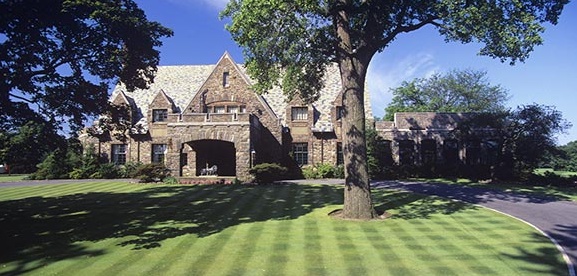
Winged Foot Golf Club, Mamaroneck, New York.
A few days ago, I wrote about the manhole-cover-size shower heads in the men’s locker room at Merion Golf Club, where the U.S. Open was just held. Showering at Merion is about as close as a human being can come to experiencing what a car experiences in a car wash. Winged Foot Golf Club, another Open venue, has similar showers, and two readers wrote to extol certain “blue stuff” available there and at Deepdale Golf Club—an unusually refreshing foot wash, which I myself have tried. “One can shower and use the ‘blue stuff’ and walk another 18 holes,” a reader wrote. He then asked me track it down, and I passed the question to Jerry Tarde, who is the editor of Golf Digest and a Winged Foot member. He said, “I can attest first-hand that the tingling liquid in the shower rooms, called something like ‘foot rub,’ has miraculous effect.” He passed the question to David Zona, who is Winged Foot’s caddie master, and this morning Zona supplied this photo:

That’s the stuff. It’s made by Ecker Bros., an eighty-year-old family-owned business in Mt. Vernon, New York. Ecker supplies health and beauty products to country clubs in the metropolitan area, among a relatively small number of other things. I called the company this morning and spoke to Arnie Ecker, a direct descendant of the original Bros. “Everyone who goes to Winged Foot loves it,” he told me. He also said that, because Ecco Foot Massage is a magical liquid, he couldn’t possibly tell me what’s in it—but he did say that he would be happy to sell it to anyone willing to order it by the case, which contains four one-gallon jugs.
The cost for one case, including next-day U.P.S., is about $300. Buying enough to fill an average-size backyard swimming pool, therefore, might run you a couple of million, depending on what sort of volume discount you were able negotiate with Arnie—who sounded, to me, like a guy who doesn’t fool around. If you’re interested, you can call him at 800-441-3226 or drop by the company in person, at 145 S. Fifth Avenue, Mt. Vernon, NY 10550. (Email and the Worldwide Web apparently haven’t gotten to Mt. Vernon yet.)
Thinking about Ecco Foot Massage started me thinking some other products that are seldom seen anywhere but in country-club locker rooms. Here’s one of them:

On and off for a couple of years—during the era of darkness before Google—I tried to track down the company that makes it, without success. Well, I didn’t try very hard. But I did ask a couple of pros where the Pinaud-Clubman stuff in their locker rooms came from, and they told me they didn’t know. (This was before I knew about David Zona.) Maybe those bottles of lilac vegetal aftershave lotion had always been there, and had been used so seldom that they’d never needed to be replaced.
Anyway, I checked again last year, and here’s what I learned: Edouard Pinaud was born in France in 1810. That’s his name—”Ed. Pinaud”—written sideways on the Clubman talc bottle, next to the guy in the top hat. Pinaud founded a perfume company in Paris in 1830, and he died in 1868, when he was just about exactly the age that I am now. The Clubman line must have arisen in there somewhere, although the date on the bottle is 1810, the year of Pinaud’s birth—a mystery we may never solve. In 1900, at the Exposition Universelle, in Paris, the Pinaud company introduced an oily hair preparation called Brilliantine, so maybe golfers should use that, too. Or maybe not, since by then Pinaud himself was long gone. Either way, why not surprise your wife by ordering a full line of Clubman products for your bathroom at home, along with several cases of Ecco Foot Massage, thereby recreating the ambience of some of the world’s greatest locker rooms? The website sells other possibly useful stuff, too, including the Jet Scream Emergency Whistle:

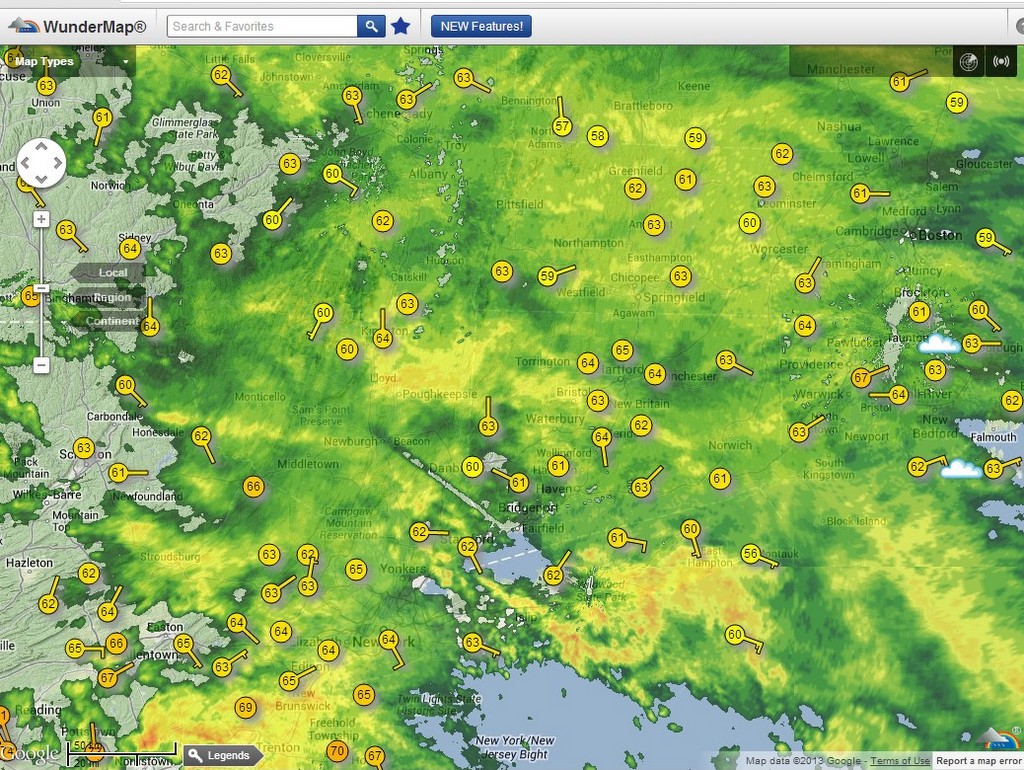
This is an aerial view of Tony’s and my match today. We’re somewhere near the center of that big green-and-orange thing.
Tony and I happily played anotherA statewide tournament that I was supposed to play in tomorrow has been postponed because the rain that was falling when Tony and I played is expected to continue through the night. I was actually looking forward to slogging around all morning, then loading my soaking-wet golf bag into my travel case, racing a hundred miles to Newark Liberty International Airport without a shower, and taking a night flight to Kansas City to play golf on a Golf Digest assignment and visit my mother. In fact, my only chance to finish the tournament above the middle of the field was probably to go off in a downpour, since I actually like playing when the people I’m competing with don’t.
In 2006, I took back-to-back golf trips to Dubai and Ireland. During the Ireland portion of that two-climate packing adventure, I learned how to dry wet golf stuff with a hotel-room iron and hairdryer (after first blotting up the worst of the water by rolling up everything in bath towels and stomping):
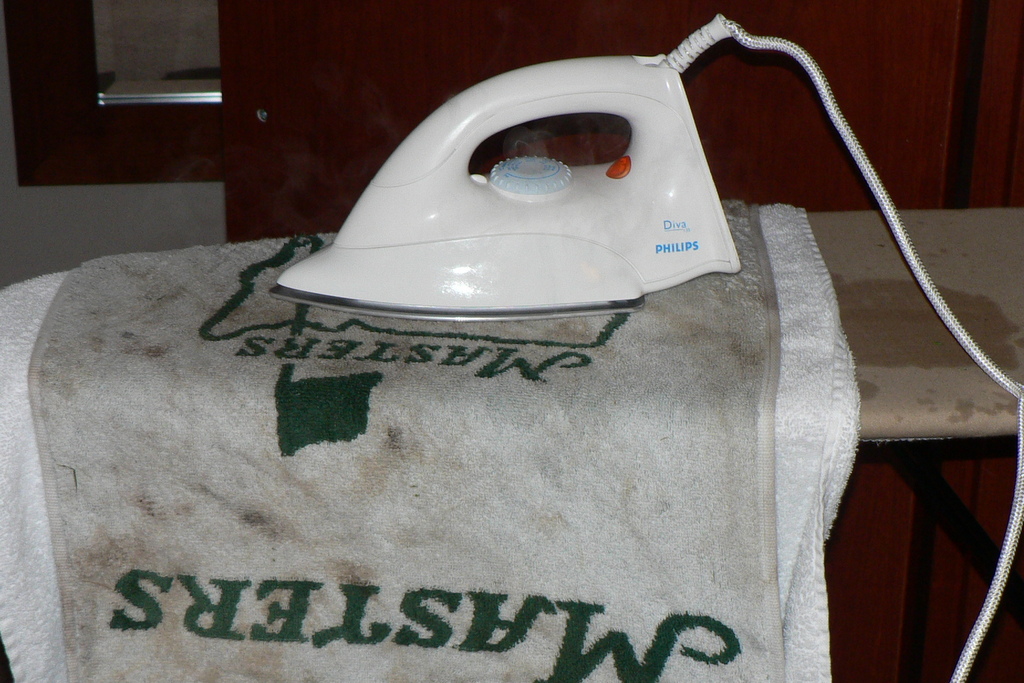
Doing this produced tremendous clouds of steam. Getting the towel half dry took forever.

Before using the hairdryer, I tried drying my rain pants in my room’s heated trouser press. That didn’t work.
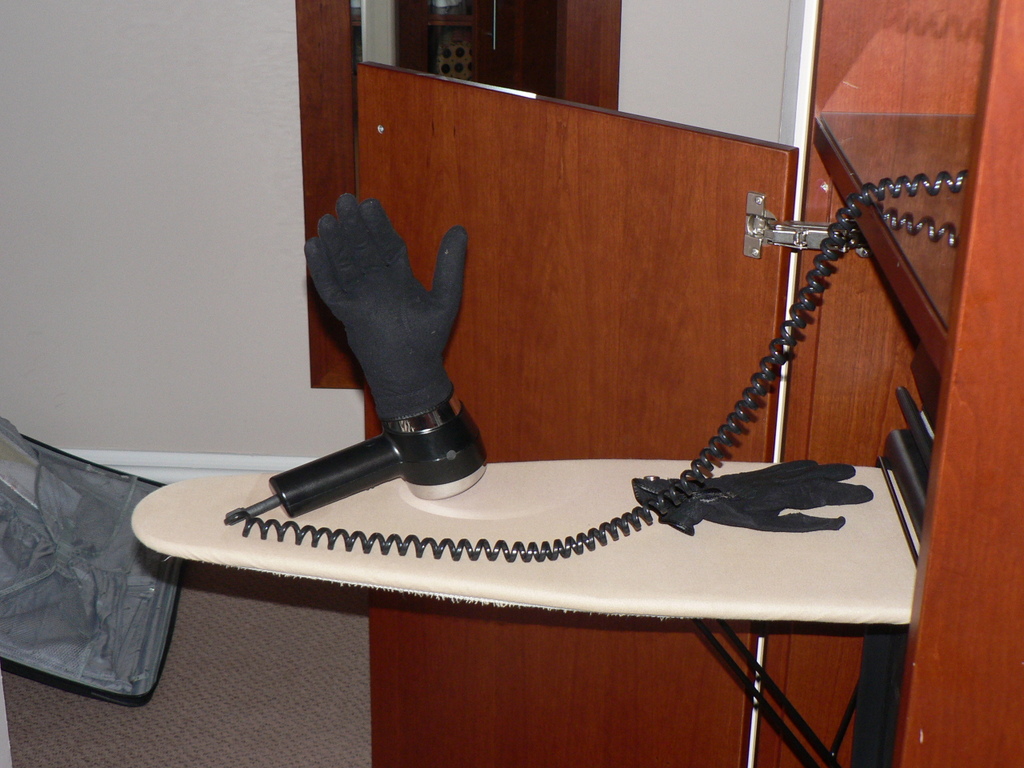
Rain gloves don’t need to be dry, but if you have the equipment why not?
The hotel was in Killarney, and the golf course where I got so wet was Tralee—which is seldom ranked among the very best courses in Ireland but is plenty nice enough and is almost certainly the best course that Arnold Palmer ever designed. (It opened in 1985.) As we approached the middle of the (terrific) second nine, the wind reached the velocity necessary to propel liquid water through the fabric of my previously reliable Sunderland of Scotland rainsuit, and I stopped trying to clean my glasses between shots. It wasn’t just the worst weather I’d ever played golf in; it was the worst weather I’d ever been outside in. Nevertheless, my three companions and I all enjoyed ourselves immensely, and we played far better than you might think—perhaps because over-swinging and over-thinking are impossible when remaining upright requires most of your concentration. (I don’t know what our caddies thought.)
Recently, I heard from a reader who has also been to Tralee: Dana McQueen, who lives in Purcellville, Virginia, and is exactly the same age I am (fifty-eight). Here he is at Tralee last summer:

Dana McQueen and some other guy, Tralee, Ireland, July, 2012.
And here’s McQueen’s golf bag:

The first thing I notice about McQueen’s golf clubs is that he keeps them much cleaner than I keep mine.
Here’s what he’s got in there:
Cleveland Classic XL driver, 10.5 deg, stiff graphite
Cleveland FL fairway, 17 deg, stiff graphite
Cleveland Mashie hybrid, 18 deg, stiff graphite
Cleveland 588TT irons, 4 thru PW, stiff steel
Titleist Vokey 50 deg wedge
Titleist Vokey 57 deg wedge
Taylor Made ATV 60 deg wedge
Ping Redwood ZB putter
“Pretty standard stuff, overall,” he told me in an email. “Sometimes the 60-degree wedge comes out of the lineup, especially on courses with thick rough around the greens. I really haven’t gotten comfortable with the ATV bounce concept yet.” McQueen is a retired C.I.A. officer. He now works as a systems engineer for Stratos Solutions, and he also works for Britannia Golf, which puts together custom golf tours, mostly to Scotland and Ireland. He took up golf as a teenager.
“I started playing,” he wrote, “when I realized that my baseball career was going to come to a screeching halt, at about the same time that I got my driver’s license—trouble with the curve was reality, not a future movie title. I had a great mentor, and within three or four months I was shooting in the low eighties. As you might expect, dreams of grandeur invaded my thoughts. These lasted until I discovered that there were other golf courses on the planet, and that most of them were much more difficult than the little muny up in northern Ohio where I began my golf journey. Since that time, golf has been a series of peaks (nearly qualifying for the U.S. Amateur in the late nineteen-eighties) and valleys (being soundly trounced by an eighth grader in the club championship semifinals). Now I look forward to the weekly game with the Saturday morning group and the occasional trip to Scotland or Ireland. My favorite course (so far) is Royal Dornoch. Unfortunately, a sliver of beach on the North Sea is not exactly what my wife has in mind as a retirement spot.”
McQueen plays most of his golf at Stoneleigh Golf & Country Club, in Round Hill, Virginia. The course was designed by Lisa Maki, one of the very few women course architects in the history of the game. Anybody know if she’s still around?
I have received a number of What’s In My Bag contributions. I’ll run them all eventually. In the meantime, send me yours. And here’s a bonus photo, showing how to dry wet golf shoes with the defroster of a rental car:
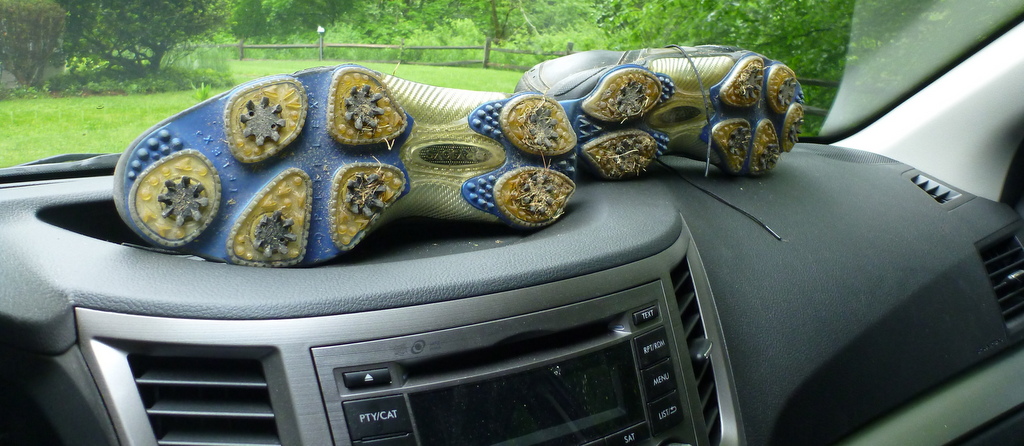

Ed Heimann, Hyde Park Golf & Country Club, Cincinnati, Ohio, May 9, 2013.
A couple of weeks ago, I had the tremendous good fortune to play a round of golf (and give an evening talk and slide show) at Hyde Park Golf & Country Club, in Cincinnati. The club’s original course, which had nine holes, was laid out by Tom Bendelow in 1909, and the current course, which has eighteen holes, all of them terrific, was designed by Donald Ross a little over a decade later.
Among the members I played with was Ed Heimann, who has won Hyde Park’s club championship twenty-one times, in six different decades. His first win was in 1964, when he was twenty-six; his most recent was in 2010, when he was seventy-two. And he’s been the runner-up half a dozen times, during years when (I guess) he was struggling with his game.
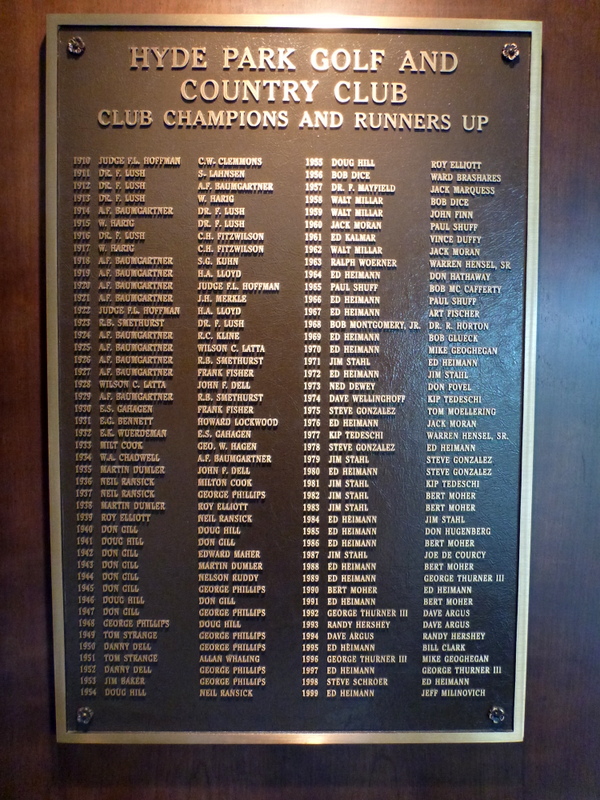
Ed Heimann has won the Hyde Park club championship so often that his victories spill over onto a second plaque.

His most recent victories. Still room for more.
Heimann isn’t very long off the tee anymore, but from inside a hundred yards he routinely gets the ball closer to the hole than many good players do from the fringe—a skill that’s especially devastating in match play, since guys who out-drive him by a hundred yards don’t expect to have to putt first. My advice to other golfers is to emulate everything Heimann does, including plumb-bobbing and wearing a green glove. And if you ever find yourself in a match with him you might as well just give him ten-footers.
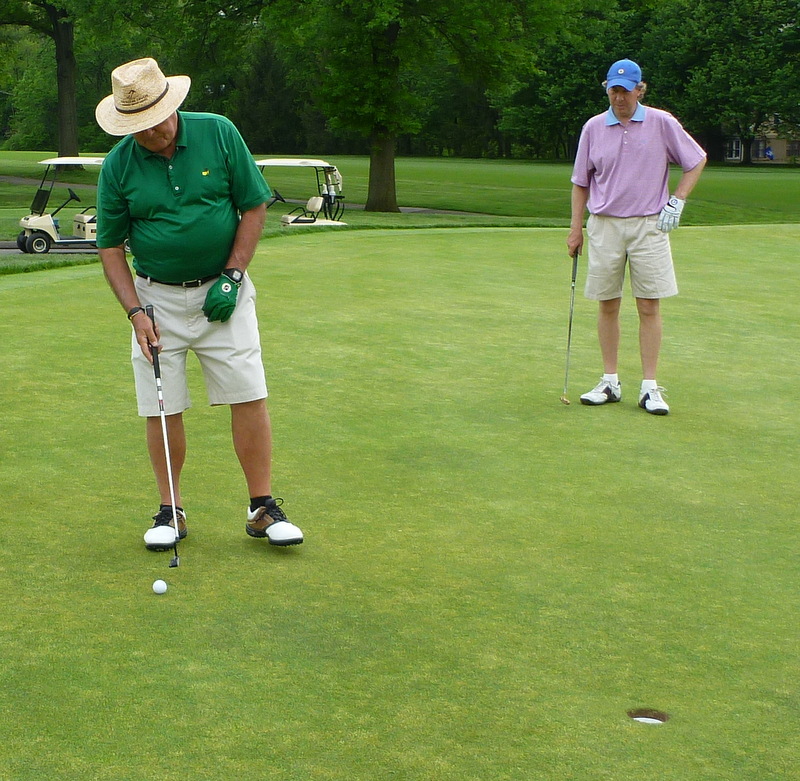
Ed Heimann and Ian Wilt. “That’s good, Ed.”
Heimann has a more interesting job than you do, too: he is the chairman of Hamilton Tailoring Company, in Avondale, which was founded the same year Hyde Park was. Hamilton has made clothing for customers as different as Perry Como and John Daly, and since 1967 it has been the exclusive manufacturer of the three-button, single-breasted sports coats worn by Augusta National members and Masters winners. (The exact shade of green: Pantone 342.) Heimann established his Augusta relationship by employing the same kind of creativity and determination that he has used to pick apart opponents in club matches for the past half-century. So watch it.

Royal Birkdale, May 19, 2013.
Today, I played Royal Birkdale with Paul Jones, a young member and a terrific golfer, whose swing finish you see here:
 Before we teed off, I bought my wife a sweater in the golf shop and decided not to buy myself an enameled ball marker. Then, during our round, I found an enameled ball marker that was even nicer than the one I had decided not to buy. The exact same thing (except for the part about my wife) happened to me a year ago, at Cruden Bay, in Scotland. The ball marker I found there turned out to be one of the luckiest I’ve ever owned, for about a month. Fingers crossed!
And that brings me to Jack Chesnutt, a reader in Colorado, who recently wrote:
I found the ball markers below (along with one from a course in Ireland I have since lost) on a fairway at Pacific Dunes in 2008. They did not seem to have been dropped accidentally from someone’s pocket. They were arranged in a small triangle with a well-worn repair tool in the middle. The last act of a frustrated golfer after watching one more drive arc toward the rocks and surf? Or maybe a little memorial to a departed golfing buddy? The view from that point in the fairway was wonderful.
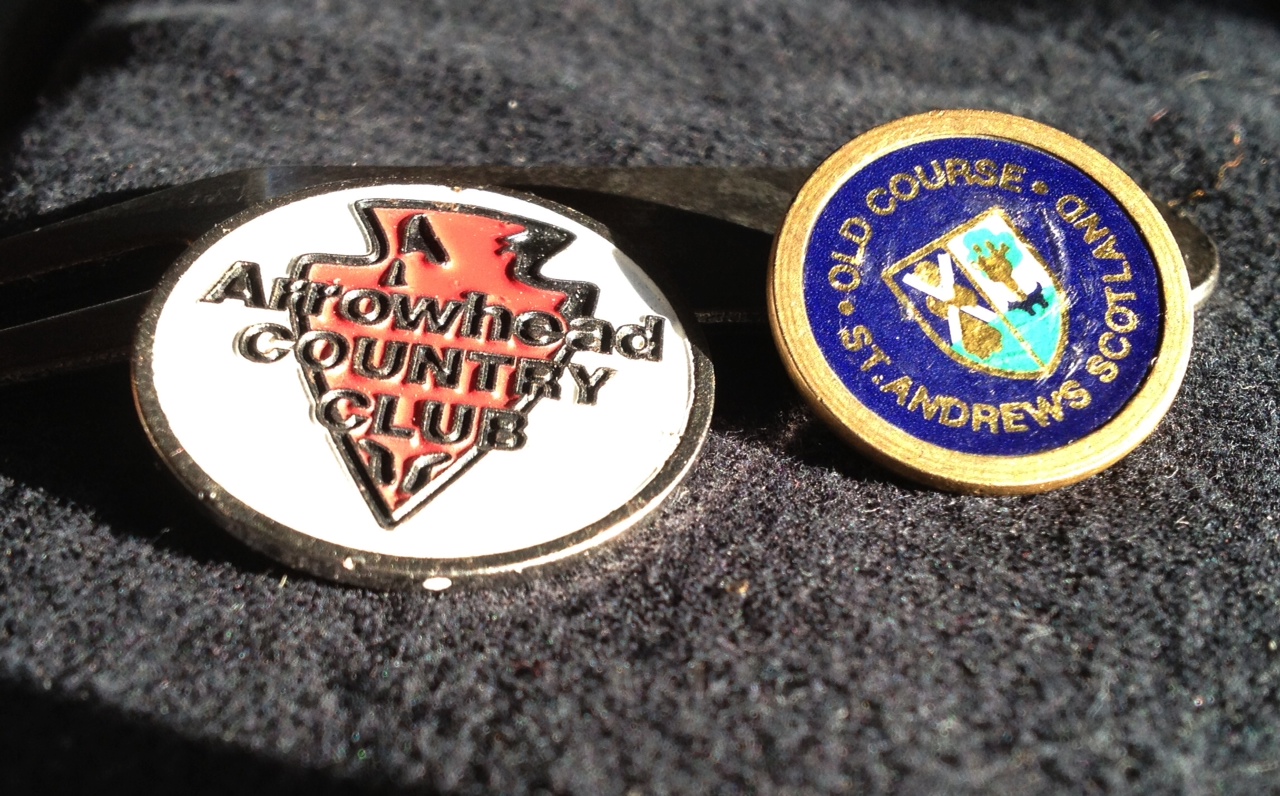 As I do with all the markers I keep in my golf bag, I rotate the Arrowhead marker in and out of my game. The first three-putt sends it into time-out. But I never use the Old Course marker. I don’t want to lose it. Maybe I will find the owner or his/her son/daughter someday.
Before claiming that these are yours, be prepared to reveal some telling piece of information that only you and Chesnutt could possibly know. Meanwhile, here’s what Chesnutt has to say about his own game:
I caddied for my dad back in the early sixties, but a huge banana slice and indifferent putting convinced me that tennis was more my game. When I turned fifty, my brother-in-law the pilot-golfer (what else do they have to do when they are not driving a 737?) persuaded me to play a round. I shot 99. I was hooked. My wife (hey, it was her brother who got me into this) made fun of my golf habit. “Why would any human being need more than ONE pair of golf shoes?” Luckily for me, she took up golf, became a 9-handicap, and soon bought her third pair of golf shoes. The trip to Bandon was our first big golf vacation together. The first round, at Pacific Dunes, was memorable not only for the stunning setting but also for finding the ball markers. It was so windy that my stand-bag blew over—twice. I’m now sixty-two years old, and my index is 4.5, and I keep about ten ball markers and three repair tools in the rotation. The repair tools don’t seem to have the same cosmic effect on my putting as the markers. I’m also up to four pair of golf shoes.
I’ll put up more What’s In My Bag items as soon as I’m back in the States. I’ve got several in the hopper, but there’s room for more. Keep ’em coming—and include at least one photo and a golf-oriented description of yourself.

You won’t need one of these if you travel to the British Isles to play golf. Royal Lytham & St. Annes, England, May 13, 2013.
I’m in northwestern England playing golf this week. I didn’t bring an umbrella, and I’m glad I didn’t, even though there’s rain in the forecast for every day from now until the end of time. The trash can on the second tee on almost any links course in England, Scotland, and Ireland often looks like the trash can in the photo above, because American golfers typically come to the British Isles prepared for the rain but not for the wind. One hole is usually enough to destroy almost any umbrella. And carrying a “wind-proof” model isn’t the solution, because if your umbrella can’t be turned inside out it will carry you to sea, assuming you’re strong enough to hang on. Here’s why:

Wind-sculpted trees, thirteenth hole, Royal Lytham & St. Annes.
The wind was blowing hard yesterday, but the trees in the photo above look that way on calm days, too. Even scrubby little bushes get squashed in the direction of the prevailing wind. (I first wrote about the terrific golf courses of northwestern England almost twenty years ago. The opening sentence of my article was “You don’t need a weatherman to know which way the wind blows at Royal Lytham & St. Annes.” A Golf Digest copy editor, who apparently had never heard of Bob Dylan, changed “weatherman” to “weather report”—and that’s the way it ran.)
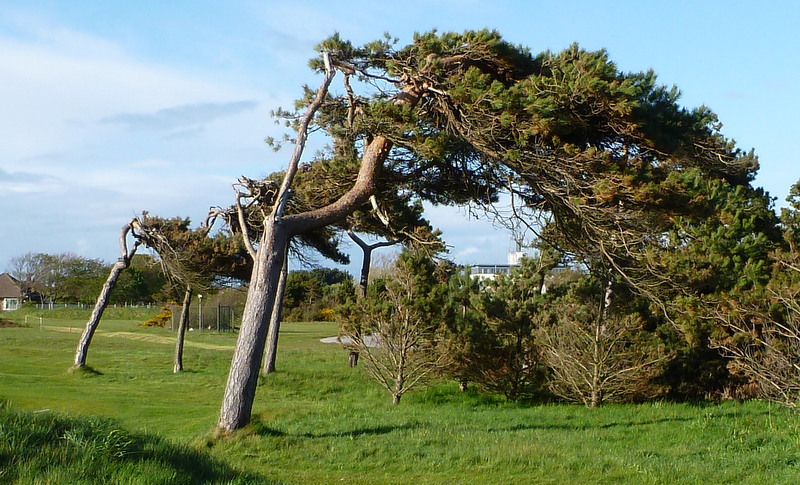
Not carrying an umbrella will lighten your luggage by a couple of pounds, and it will spare you a lot of annoying housekeeping while you play. And you won’t miss it at all, if you have a rain suit, a rain hat, and a pair of rain gloves. The rain gloves are especially important, because if you have a pair of those you won’t need to even think about trying to keep your grips dry. In fact, if you have rain gloves you almost don’t need to carry a towel. And after my first trip to Scotland, in the early nineties, I stopped carrying an umbrella at home, too. Way too much trouble!