What’s In My Bag, Part Three: Let’s Have a Look Inside Those Pockets

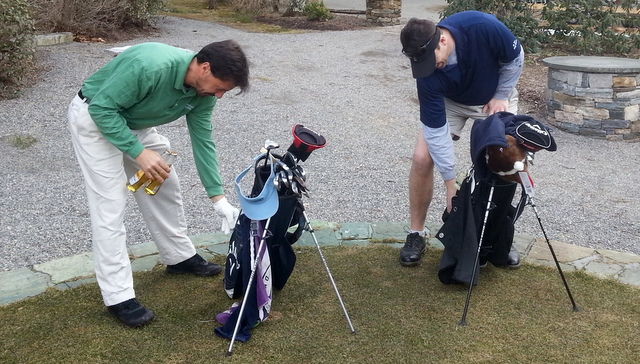
Will, Brent, D.O., Ben, Liberty National Golf Course, Jersey City, New Jersey, May 5, 2013.

Famous building, Will, Brent, D.O., Ben, famous statue. Fourteenth tee, Liberty National Golf Course, Jersey City, New Jersey, May 5, 2013.

On Sunday, I had the tremendous good fortune to be invited to join a twelve-man outing at Liberty National Golf Course, in Jersey City, New Jersey, directly across the Hudson River from lower Manhattan. I employed a labor-saving technique I’ve often used during visits to other rich-guy golf clubs: I wore my sorriest-looking pair of shoes, knowing that the locker-room guy would fully resuscitate them while we were playing. During a multi-day trip Pine Valley ten or fifteen years ago, I took three sorry-looking pairs of shoes and left them outside my door sequentially. I went home feeling like a new man.

Cool clubhouse.

Cool clubhouse–and that statue again.

Liberty National was designed by Tom Kite and Bob Cupp, and it was built, in 2006, on a desolate industrial site. (I’ve seen a variety of cost estimates, all of which have nine digits.) The Barclays—which used to be known as the Westchester Classic, and then as the Buick Classic—was held there in 2009, and it will be held there again in August. Tour players grumbled about the course the first time. Since then, Kite and Cupp have made many changes, and either the changes have been effective or I don’t know what I’m talking about, because I liked the course a lot. And the clubhouse is the only starkly modernistical one I’ve ever been in that I fully approve of.
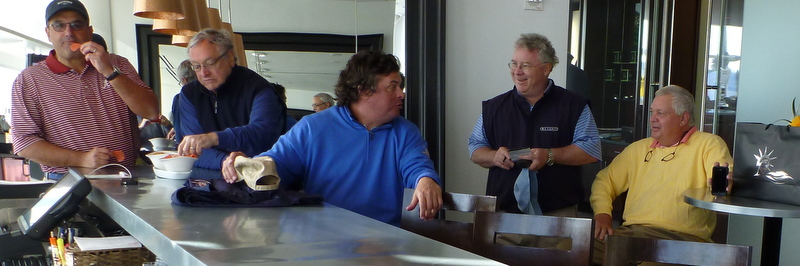
The bar, post-round.

The bar, post-round.

Partway through our round, I apologized to my caddie for having forgotten to remove a couple of nonessential items from my golf bag. (I’ve gotten a little lazy about on-course housekeeping in recent years, because at home I now almost always use a pushcart.) The bag can’t have been too bad, though, because I still occasionally carry it myself. Here is some of what was in it:
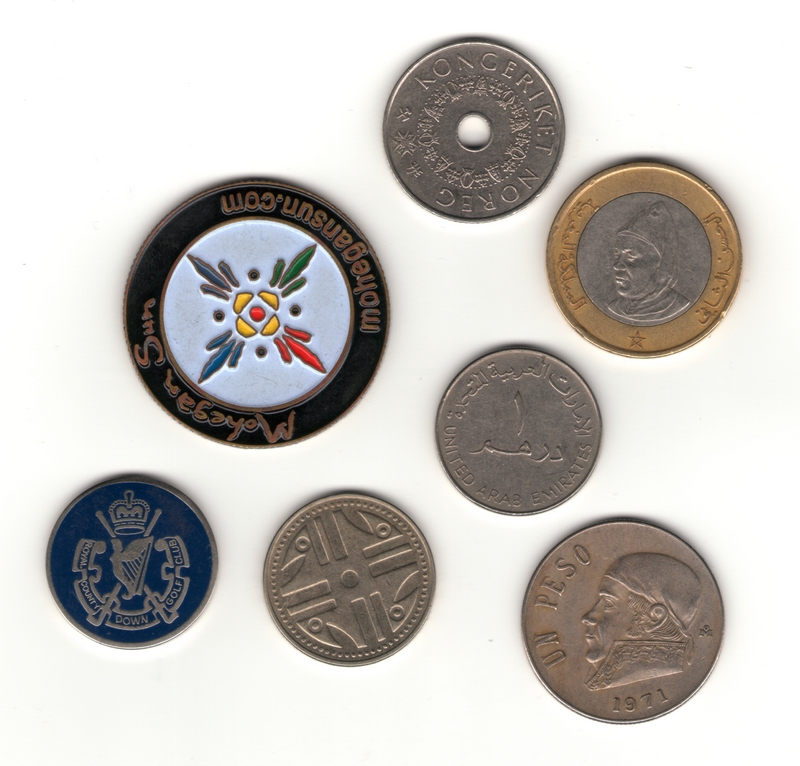
Ball markers

The photo above shows my selection of lucky ball markers for that day. Clockwise from lower left: a souvenir marker from Royal County Down, a necessity because of the sublimity, transcendence, immanence, etc., of that course; a souvenir marker from a casino in Connecticut, useful because it has four colored pointy things, any one of which can be aimed at the hole; a Norwegian coin with an actual hole in the middle of it; a Moroccan coin featuring King Hassan II, who loved golf, wore golf gloves on both hands, and was accompanied during golf rounds by a servant whose only job was to use a pair of silver tongs to hold the king’s cigarette while swung; a one-something coin from Dubai, which I often use when I absolutely have to one-putt; a big old Mexican coin with some guy on it; a Colombian coin featuring what appear to me to be balls, holes, and “aiming chutes.”

When I wrote about (a slightly different selection of) lucky ball markers, last year, I said that when I used a coin with a guy’s head on it I aimed the top the head at the hole. Michael Clark, a reader, wrote to say that, on the final day of a three-day-tournament at his club, he had discovered a better way. “The eyes of the coin had to be looking at the hole,” he wrote. “When the eyes lined up to the hole the putts were dropping! Also, it had to be the same coin. So, if the coin has eyes, line them up!” Since then, I have field-tested Clark’s method, and adopted it.

Morefar green repair tool

The photo above is of what is probably the luckiest green-repair tool I’ve ever owned. I got it at a super-secretive golf club called Morefar Back O’ Beyond, which straddles the border between Danbury, Connecticut, and Brewster, New York.

The course on the left is Morefar. The course on the right is Richter Park, which is owned by the city of Danbury, Connecticut, and is one of the best munys in the country.

The course on the left is Morefar. The course on the right is Richter Park, which is owned by the city of Danbury, Connecticut, and is one of the best munys in the country.

Morefar

Morefar used to be owned by the disgraced insurance company A.I.G. I played there a dozen years ago as the guest of one of the club’s handful of local members. Only a tiny number of golfers are allowed out each day, and the only other group on the course on the day we were there was that of the Sultan of Brunei, who teed off before we did. He and his retinue were almost comically slow, but, it turns out, you don’t play through the Sultan of Brunei. On an airplane recently, I saw a guy (in first class) who had a Morefar attaché case in his lap. I gave him the secret sign of brotherhood (by showing him my green-repair tool) as I walked past him on my way to the back of the plane, but he cut me dead.

coppertone

The item above is roll-on sunscreen, which I use as “lip balm.” The tube is at least half again as big as a ChapStick tube, and the stuff is waterproof. It’s especially handy in cold weather and in wind. I don’t carry ordinary sunscreen in my golf bag because I don’t believe in applying sunscreen in situ. I once told someone that if I ever ran for President my platform would have just three planks. I don’t recall what the first two were, but the third was that everyone would have to put on their sunscreen at home, before they went to the golf course, the swimming pool, or wherever. Sunscreen is much easier to apply when you aren’t wearing clothes, and it works better if it’s had some time to soak in. When I see young parents at the beach trying to squirt sunscreen onto squirming, uncooperative children, I think: “An hour ago, your children were naked and not covered with sand; why didn’t you think of doing this then? When I’m the President, we’ll have no more of this nonsense.”

Several readers have sent me descriptions of what’s in their own bag. As promised, I will soon create a new section and post several of them permanently. If you’d like to add your own bag to the pile, send an email to myusualgame@gmail.com. Include a golf-related description of yourself and at least one or two photos of your golf stuff.

(Read Part One and Part Two.)

What's In My Bag?

What’s In My Bag?

Opening Weekend: A Full Golf Report

20130308_070841-002

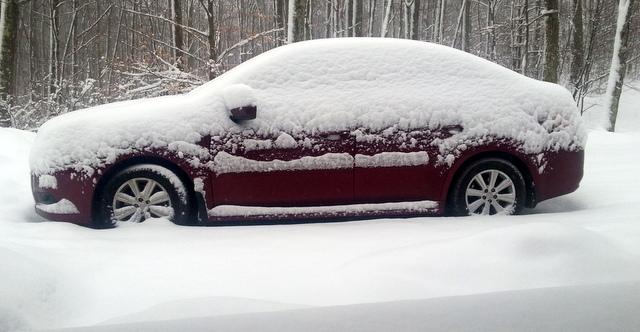
We had a snowstorm during the night three weeks ago, and you can see the result in the photo above. A few days later, my wife and I took our dog for a walk at the golf course. We got stuck in the Executive Parking Lot, which is back behind the clubhouse, between the Dumpster and the propane grill. Our retired superintendent, who still lives next door, helped me dig out, and as I rocked my car back and forth I figured I wouldn’t be playing golf until at least May. But Gary, our current superintendent, opened the course this past weekend, so everything is normal again. The only part of the course that was still out of play was the practice green:

20130330_114628

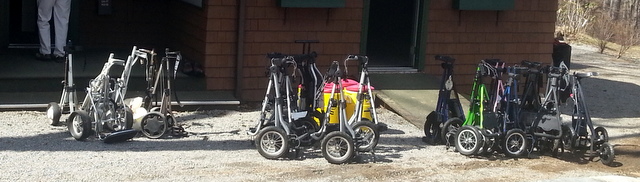
When I arrived, Nick, who is about to graduate from high school, was in the bag room performing pushcart triage. In the photo below, the pushcarts on the left are headed to the dump, the ones on the right are still fully functional, and the ones in the middle will be kept for parts:

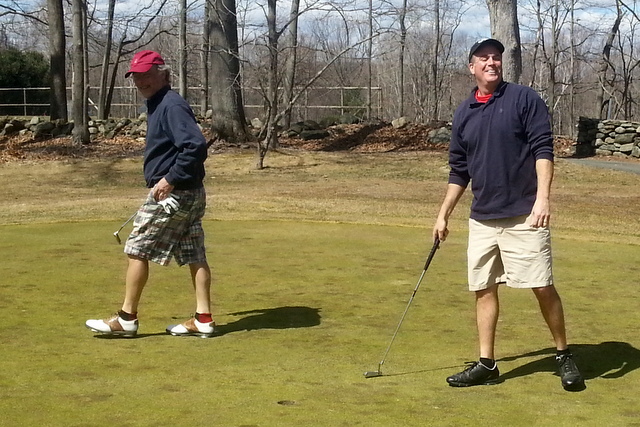
20130330_114646Quite a few of the guys wore shorts—apparently in the belief that our Shorts Rule (one extra handicap stroke if you wear them after November 1; two if you wear them after December 1) still applies once the new season has begun. It does not. 

Reese and Mike A, fourth green, no extra strokes.

Reese and Mike A, fourth green, no extra strokes.

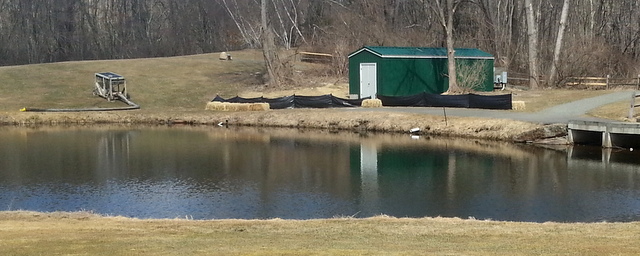
We inspected the new pump house, which Frank built over the winter. Here’s what it looked like before:

Pump house: before Frank.

Pump house: before Frank.

And here’s what it looks like now:

Pump house: after Frank.

Pump house: after Frank.

Unfortunately, Frank is taking a leave of absence this year. He’s having both knees replaced—something he has needed for a long time. A few years ago, during a storm, he helped me install an emergency patch on a hole in my roof, using a technique that he called “redundant half measures.” It worked great, but I had to do most of the kneeling.

When we finished playing, Mike G. and Chic were getting ready to tee off. Here they are, loading provisions into their golf bags:

20130330_151837

Addison had some new golf pants, which he got because he plays for the University of Hartford. The only other significant off-season acquisition I noticed was Tim’s golf bag, which is made by the same company that makes our favorite shoes:

20130330_151431

And the next day, I played again, with Addison and Reese. We had the place pretty much to ourselves:

P1050419

Reese and I played Addison in a series of close-out matches, with all our strokes. We won both World and Solar System, but Addison, with a par on the eighteenth, took Universe. Luckily, we have a full season to get it back.

Golf Periscope Update

Periscope woman 3-17-2013

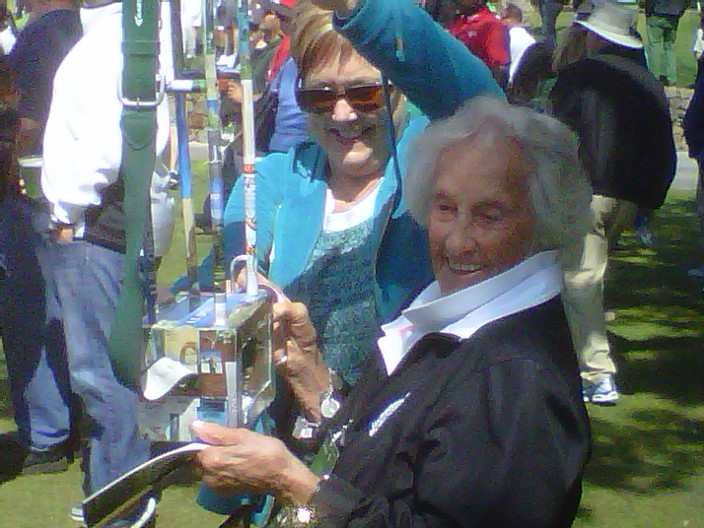
Steve Davis, whom I met at Tiger Woods’s World Challenge back in December, has been tweaking and field-testing his golf periscope, which is considered by some to be the most important golf-related invention of the current century—and not only because it has a shoulder strap and a beer holder. Last weekend, he took it to the Toshiba Classic, in Newport Beach, California, an event on the Champions Tour. “I was following the final group Sunday,” he told me in an email. “There was this little old lady who couldn’t see anything. She understood right away how the periscope worked. The smile that produced was priceless. It was my feel-good moment of the day—and we were only at the first green.”

Steve Davis and his periscope at the Farmers Insurance Open, Torrey Pines Golf Course, La Jolla, California, where, he reports, "Tiger was Tiger of old."

Steve Davis and his periscope at the Farmers Insurance Open, at Torrey Pines Golf Course, in La Jolla, California–where, he reports, “Tiger was Tiger of old.”

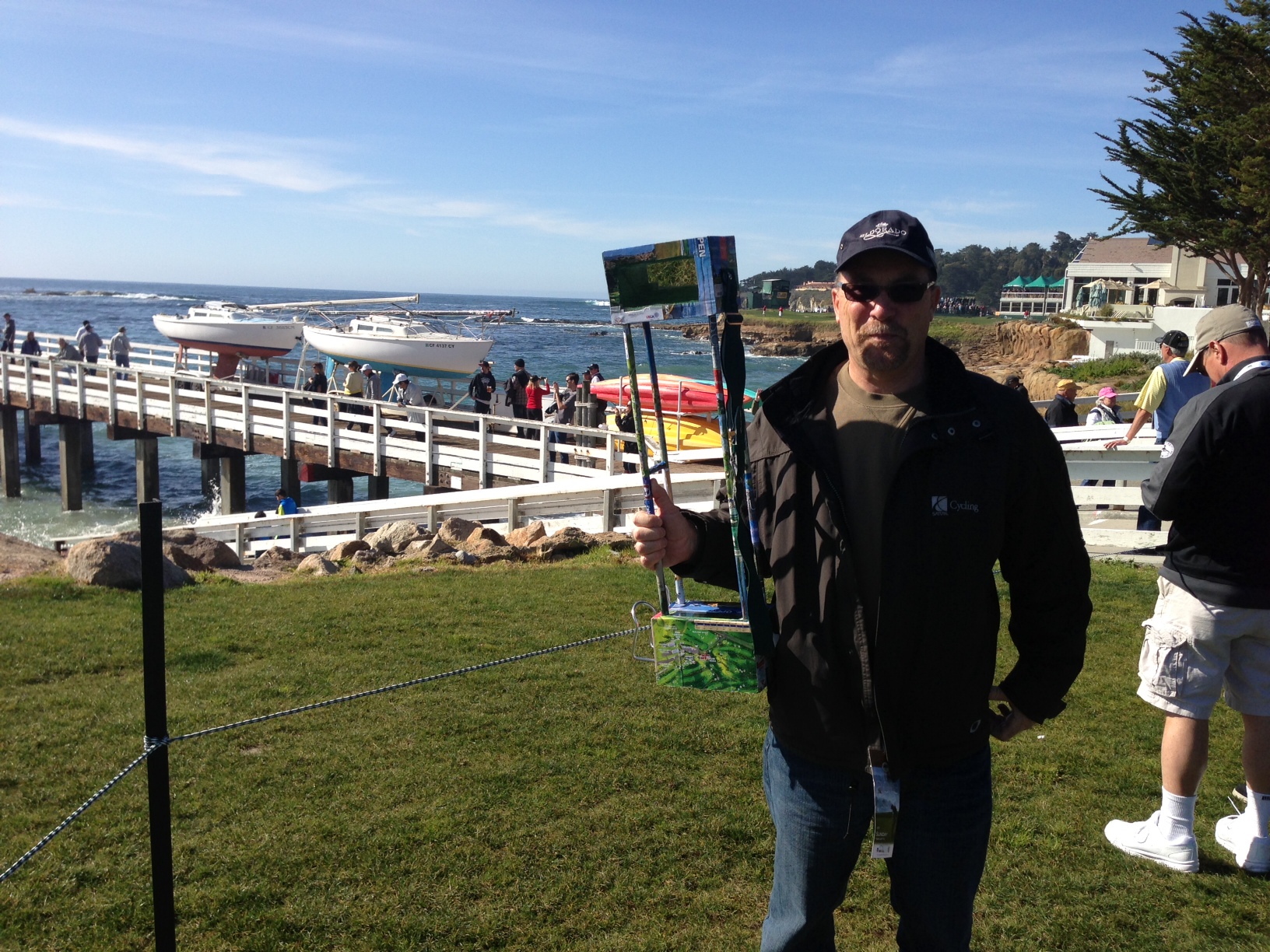
Davis apparently spends all his time either working on his periscope or trying it out at golf tournaments. He watched Tiger win at Torrey Pines in January (photo above). And last month he attended the AT&T Pebble Beach National Pro-Am, which Brandt Snedeker won. In another email, Davis sounded almost disappointed that there weren’t more people standing between him and the action. “The big surprise was how small the crowd at Pebble was,” he wrote. “We could stand alongside the green on almost every hole. It got crowded only around the end, at 16, 17, and 18.” The photo below was taken at the AT&T, and it shows him holding a modified version of the device I tried at the World Challenge. The differences may not be obvious to a layman, but they are significant. “I have a new system and have been having problems with it,” Davis confided, “so I’m having trouble trusting it.”

AT&T ProAm Pebble Beach 2013

Davis also took his periscope to the Northern Trust Open, at Riviera, last month. “What can I say with a two-playoff-hole victory for Merrick’s first tour win?” The guy on the right in the photo below, which was taken at Riviera, looks to me like he was contemplating a smash-and-grab, but apparently he was just eyeing Davis’s beer.

2013 Northern Trust Play Off

More periscope news as it develops.

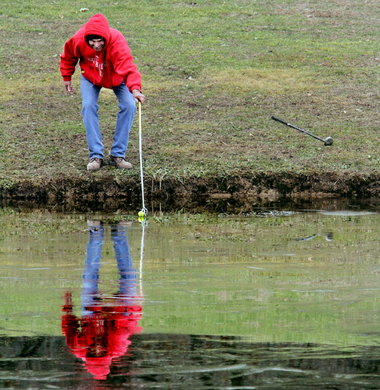
The Metaphysics of Ball Retrievers

retriever

There is a point of no return in a golfer’s life, and an older friend passed it. I knew he had, because I saw the evidence in his bag. It was right between his three-wood and his umbrella.

It was a ball retriever.

My friend used to play pretty well. He never won the club championship, but in his prime he was one of the guys a champion had to beat. In a nassau, you wanted him for a partner. In a scramble, you wanted him on your team. He would go for the green in two on a par-five, and he would sink a putt that mattered. He was, locally, a player.

Then his game began to turn. His draw faded. His fade sliced. He stopped signing up for tournaments. The putts that he gave (and therefore showed that he hoped to be given) crept into the leather, and then beyond the leather. Gradually, his focus as a golfer shifted from the hole to the pond.

Golfers who carry ball retrievers are gatherers, not hunters. They’ve given up the chase. They’ve climbed as far up the hill as they can climb, and now the paths lead only down. They’ve stopped tinkering with their grip. They don’t practice in the sand. Their dreams are no longer of conquest, but only of salvage.

Golfers who carry ball retrievers don’t walk down the center of the fairway anymore. They go the long way, through the tall grass, because that’s where the lost drives hide. They stir the weeds with nine-irons as they pass. When they step on something round, they freeze. Instead of searching the treetops for a change in the wind, the way they used to, they let their eyes drift lower: there are balls in the woods. If no one is pressing them from behind, they leave their bag and walk along the creek. By the end of the morning, their pockets are bulging. They will never buy another sleeve.

I used to know a man who still played a little but was just as happy not to. On Friday afternoons, I would see him in the marsh to the right of the first fairway. There’s a shallow, silt-choked pond back there. He wore rubber boots that came up to his knees. Most of the balls he found were dark and heavy, but he didn’t throw many back.

His hoard of balls, which he kept in the trunk of his car, was sure to outlast him. But he wasn’t thinking about that. Suddenly, he glimpsed something pale in a spot too deep for wading. He extended his ball retriever and threaded it through the cattails. He braced his boots in the muck and reached as far as he dared into the darkness at the bottom of the pond.

How to Pack for a Golf Trip to the British Isles

ebags

Quite a while ago, Tom Reynolds, a reader in Atlanta, asked me to suggest a packing list for a golf trip to Ireland. I said I would, then forgot all about it, and recently he asked again. So here it is.

This packing list is the result of two and a half decades of thoughtful experimentation. In making it, I’ve assumed that no spouse or health-department official will be in your group, and that you will buy at least one souvenir golf shirt, one souvenir golf sweater, and one souvenir golf hat while you’re abroad. I’ve also assumed that you are not planning to do anything rash, like meeting a client or going to a play. My strong preference with rain pants (which are also useful as wind pants) is to wear them as pants, if possible, rather than over pants. If the weather is nippy, I wear them over long johns.

The reason for minimalist packing is not to avoid airline luggage charges; the reason is to reduce the tonnage of the gear you have to lug from place to place, and to make the most efficient use of the storage space in whatever vehicle you’re traveling in. Packing light also leaves space for all the overpriced golf stuff that you are almost certainly going to buy and lug home.

Because linksland weather is highly unpredictable but within a relatively narrow range—I’ve played in shirtsleeves in Northern Ireland in November and been hailed on in Scotland in June—my list doesn’t change a whole lot from month to month. Think in terms of layers, and be prepared to allow time for wet items to dry out—especially shoes. Mike B. took his plug-in ski-boot driers on our most recent trip to Ireland. He never needed them, because our shoes never really got wet, but taking them wasn’t a terrible idea. On a golf trip to eastern Ireland twenty years ago, I took two rainsuits and needed them both.

It’s possible to pack more than this, of course. It’s also possible to pack less. My friend Tony gets by with just his rain pants and one pair of chef pants, and some people believe that he never changes his shirt. A few years ago, Golf Digest sent me to play all fourteen courses where the British Open has ever been held, and I realized toward the end of the trip, which lasted two weeks, that although I’d brought two pairs of pants I could have gotten by with one. The great thing about microfiber is that you can launder it with a hotel wash cloth, even if you’ve gotten chocolate on it. I recommend black.

Tony in chef pants, North Berwick, Scotland, May, 2008.

Tony in chef pants, North Berwick, Scotland, May, 2008.

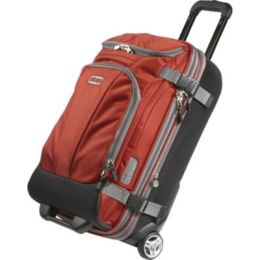
On my first golf trip to the British Isles, twenty years ago, I took a full-size suitcase. Now I take just a carry-on bag: a Mother Lode TLS Mini 21-inch rolling duffel, by eBags, which is currently selling for $190, shipping included (see photo at the top of this post). This is my favorite suitcase ever, even for non-golf trips. No matter what kind of suitcase you use, I recommend buying a selection of eBags Packing Cubes, which are soft, box-shaped modules that simplify intra-suitcase organization and make it easy to use your golf bag’s travel case for overflow packing.

Here’s what I take:

In the carry-on bag:

1 pair dark polyester microfiber pants (and a second pair worn on the plane—and I recommend black for both, because they never look dirty and you can remove stains, even chocolate, with a hotel wash cloth)
1 golf shirt (and a second one worn on the plane—and in cooler months I would make one or both of these shirts long-sleeved)
1 sweater (worn or packed, depending on the weather
1 pair of Under Armour-type long johns
1 long-sleeve Under Armour-type undershirt or turtleneck
1 tee shirt (to sleep in and serve in a pinch as an extra layer)
1 pair of “house pants”—fleece pants or nylon hiking pants or something similar (for lounging around, and for emergency duty under rain pants if the weather turns really foul, and for wearing on the trip home)
1 pair of shorts, maybe (something I’d never thought about before 2016, when sunburn was a bigger threat than rain in western Ireland)
Lots of cotton handkerchiefs (my new favorite golf accessory, useful for nose-wiping during wet, cold, windy, or allergen-dense rounds)
As many pairs of underpants and (wool) socks as I can cram into the remaining space

In the golf bag or golf-bag travel case (along with my golf clubs):

2 pairs of waterproof golf shoes
1 rain suit (the jacket of which, in combination with an undershirt, shirt, sweater, vest, etc., should be plenty of cold-weather protection, even for winter)
2 regular golf gloves and 2 pairs of rain gloves
1 Seattle Sombrero (or other truly good rain hat)
1 regular golf hat
1 knit cap
1 super-lightweight down vest, in its little stuff sack (weighs nothing, and is easy to cram into a golf bag; mine is by Uniqlo and is a recent addition to my packing)
As many golf balls as you think you’re going to need, because they’re cheaper here (a reasonable number is two balls a round; a couple of guys lost more, but some lost almost none)
A full box of Band-Aid or Compeed “blister cushions.” You won’t need them if you’re careful about the golf shoes you take, but if you have them in your bag you’ll be a hero to someone on your trip
Toiletry-type crap (if you put your toiletry kit in your checked bag you won’t need to worry about decanting your gels and liquids into tiny bottles and setting them aside in a Ziploc bag)

Other stuff:

1 or 2 twenty-four-inch bungee cords, for strapping your golf bag onto a pushcart (known abroad as a trolley), to keep the bag from falling off when you drag it into the dunes
1 water bottle (because on-course water isn’t common outside the United States; you can fill your bottle each day in your hotel room or in a golf-club locker room)
1 UK-and-Ireland-type plug adapter. Household current is 230 volts, but all your electronics will run on that with just the plug adapter—no need for a voltage converter. If all you’re going to need to charge is your phone, you can probably find a 110-volt shaver outlet (for an American-type plug) in the bathroom of your hotel room
1 mini-power strip (if, like me, you have a lot of stuff to plug in—mine’s made by Belkin—because no hotel room on earth has enough outlets, especially in other countries)
1 sleep mask (for creating darkness where there is none)
Earplugs (doubly useful if the locals are holding a Dallas-themed “Oil Barons’ Ball” in the main dining room—as happened to me in England a few years ago)

Travel clothes:

If you are going straight from the plane to a golf course—and that’s what you should be planning to do, in my opinion—you should wear golf clothes on the plane. For the trip home, it’s nice to have clean stuff. In my case, I flew home in a bought shirt, a bought sweater, and a pair of lightweight nylon pants that I hadn’t worn during golf.
If your golf shoes have nubs on the soles instead of spikes, you probably don’t need any other shoes—although you may be required to strip down to your socks in some parts of some golf clubs. On a recent trip to Ireland, I took a pair of “après-golf” shoes—which were actually just non-waterproof golf shoes—but wore them only a couple of times, because my two pairs of “working” golf shoes were just as comfortable and never really got wet. Tim brought two pairs of golf shoes plus a pair of Merrell Jungle Mocs, which he wore on the plane, on the bus, and when we weren’t playing golf—an idea I intend to steal next time

If you prefer to receive your packing instructions in video form, you can do so here:

For many years, I’ve accessorized my rain paints with farmer-type suspenders, my first pair of which I ordered from the Vermont Country Store. (I now use a different kind, which you can order here.) Suspenders eliminate the main problem of rain paints, which is that they creep down every time you put wet hands into the pockets. I also own, and sometimes use, a pair of Velcro bicycle clips, which are handy if the legs of your rain pants are so long they drag on the ground, as many are.

Vermont Country Store suspenders with rain pants, Scotland, 2004.

Vermont Country Store suspenders with rain pants, Scotland, 2004.

On a golf trip to England in 2010, my friends and I had to take sports coats so that we could eat dinner in the clubhouse at Royal Lytham & St. Annes. Hacker (real name) took a crummy old one, intending to abandon it there—a plan I foiled by spotting it in a closet on the day we left and returning it to him at the airport. But the concept is brilliant: clothes you can wear to extinction, then leave behind.

My bedroom in the Dormy House at Royal Lytham & St. Annes, May, 2010. My sports coat is in that pile somewhere.

My bedroom in the Dormy House at Royal Lytham & St. Annes, May, 2010. My sports coat is in that pile somewhere.

On our trip to Scotland and Ireland in 2014, Peter A. brought many pairs of super-cheap socks, and threw away each pair after a single use. This seemed smart in the abstract, but he ended up being the only person on the trip who got blisters. For this most recent trip, he brought more expensive throwaway socks (roughly a dollar a pair versus roughly fifteen cents) and didn’t have a problem. My personal preference is to pack the best wool socks I feel I can afford, and lots of them.

I’ve always thought it was crazy to take shorts on a golf trip to the U.K. or Ireland, because indigenous golfers hardly ever wear them and some golf clubs have semi-ridiculous rules about them—like Hillside, in England, which allows shorts only if they’re worn with knee-height socks. (Dress codes abroad are kind of unpredictable. In 2016, the starter at Lahinch asked Matt to roll down the cuffs of his pants, which he had turned up maybe an inch, but let a local kid tee off in surfer shorts and an untucked tee shirt.)

It’s possible to pack more than this, of course. It’s also possible to pack less. On a non-golf trip to Europe a few years ago, my wife surprised me by packing lighter than I did. You don’t need to plan a lot of different “looks.”

My Sixth Pair of True Linkswear Golf Shoes!

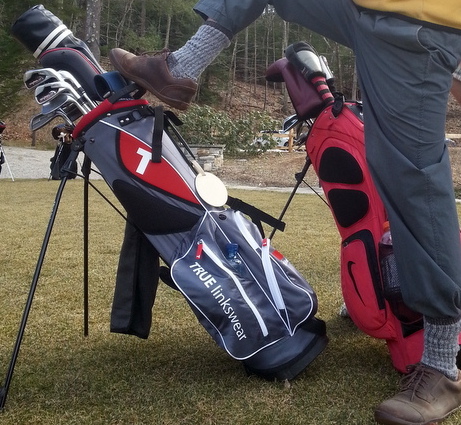
True Linkswear Chukka.

True Linkswear Chukka.

My one reservation about my beloved True Linkswear golf shoes is that, even though almost all the models are waterproof, the shoes’ low profile makes them vulnerable in wet grass. The company’s new Chukkas, shown above, have eliminated that issue, by lifting their gunwales to ankle-bone height. If you’re the sort of middle-aged male golfer who dreams of seducing the beverage-cart girl, don’t wear them with shorts. But, if you own long pants and don’t stay home when the weather turns lousy, they’re great, as I proved to myself in Brooklyn last weekend. And they bring my personal True collection to six pairs.


The Best Winter Golf Gloves

The glove storage section of my mobile locker room.

The glove storage section of my mobile locker room.

I own many golf gloves. I keep most of them in the trunk of my car, which I think of as my mobile locker room, and I use their Velcro closures to stick them to the trunk’s carpet-like liner—a trick I learned from my golf buddy Billy. The rain gloves and winter gloves, which are black, look a little like the sleeping bats that used to hang upside down from the roof of my garage.

For winter golf, I always used to just wear rain gloves, and on really cold days I would wear two pairs, one on top of the other. But this year I bought several pairs of actual winter gloves, made by FootJoy and Snake Eyes. The FootJoy gloves, which are called WinterSof and cost $20 a pair at Golfsmith, look like this:

fj wintersof

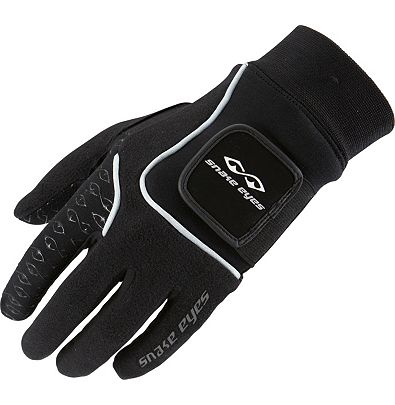
The Snake Eyes gloves, which are called Cool Weather Gloves and cost $13 a pair at Golfsmith, look like this:

snake eyes

Two of the four Golfsmith customer reviews of the Snake Eyes gloves mention crummy stitching, which is a problem I haven’t noticed with mine. I have found that my FootJoy gloves are slightly warmer. (In a recent scientific trial, I wore both kinds, one right and one left, and switched at the turn.) I like the grippy silicone webbing on the palms and fingers of the Snake Eyes gloves, even though the silicone feels creepy when I hold something made of metal, like a club shaft. I’ve worn both kinds, without incident, while walking the dog with my wife.

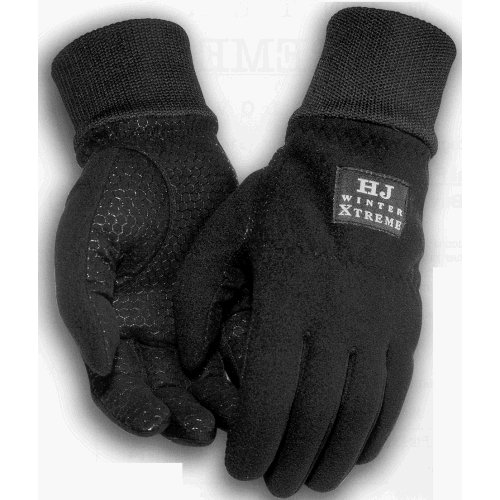
At the PGA Golf Merchandise Show a year ago, I tried some winter gloves I liked a lot, although I’ve never actually played in them. They’re call HJ Winter Xtreme, and they’re made by a 40-year-old Korean company called HJ Glove. They’re hard to find online—Golfsmith and Edwin Watts don’t carry them, and Amazon, at the moment, is out of stock in all sizes—but based on my brief indoor test a year ago I’d say that, at least theoretically, they combine some of the most appealing features of the FootJoy and Snake Eyes gloves: tall cuffs, grippy silicone stuff, extra warmth.

hj extreme

My friend Tim recently pointed out that rain gloves and winter gloves tend to wear out first in the thumbs. This is especially true if your swing isn’t everything it could be—holes in golf-glove thumb pads are usually a consequence of mid-swing re-gripping or some other bad habit—but rain gloves and winter gloves are made of stuff that isn’t as tough as leather, and they wear out faster no matter who’s wearing them. Because of what Tim said, I got the idea of buying some little iron-on patches and using them to reinforce my winter gloves, by turning the gloves inside out and ironing one carefully trimmed patch onto the inside of each thumb. I kept the patches in a pile of stuff on my desk, and they were constantly getting in my way. Then I forgot about them. Last week, I suddenly remembered them but couldn’t find them anywhere. Oh, well. I probably wouldn’t have gotten around to ironing them on anyway.

Speaking of gloves: when I was in Oslo in August (researching a non-golf article for the January 21, 2013 issue of The New Yorker), I took a tour of the Norwegian National Opera and Ballet, at the edge of the Oslo Fjord. Among many other things, I saw a bird costume intended for an upcoming performance of the opera “Flaggermusen.” It had been stitched together from dozens of yellow dish-washing gloves, whose dangling rubber fingers resembled feathers. Maybe my wife would be interested in making something similar from my old golf gloves:

P1030432

A Few Words About Golf Socks

In 1981, the host was Robin Ward, who was born in Canada and is considered by some to be the poor man's Alex Trebek.

In 1981, the host of To Tell the Truth was Robin Ward, who is considered by some to be second only to Alex Trebek among U.S. game-show hosts born in Canada in the 1940s.

In 1981, I was a contestant on the television show To Tell the Truth. I had just written a book to which Barry Manilow had optioned both the movie and the song rights. (The book, called High School, was about a semester I’d spent pretending to be a senior at a large public high school in Connecticut—a stunt for which, if you tried it today, you’d probably end up in prison.) On the show, only one of the panelists—Kitty Carlisle Hart—picked me as the non-impostor. My co-contestants and I fooled Nipsey Russell, Rex Reed, and an actress named Marcia Rodd, and we each received a hundred dollars, a case of Quaker State motor oil, and a fifty-dollar gift certificate from Kinney Shoes, a national chain that’s now (deservedly) defunct. I couldn’t find shoes I liked at Kinney, so I used my certificate to buy fifty pairs of tube socks.

Kitty Carlisle during the show's golden age. I watched it when I was home sick from school.

Kitty Carlisle and her fellow cast members Tom Poston, Bud Collyer, and Orson Bean, during the show’s golden age. I used to love to watch To Tell the Truth, along with practically anything else, when I was home sick from school.

Those Kinney socks, which were calf-height and had colorful stripes near the top, lasted me almost a decade—although for several years near the end I wore them only under jeans, so that no one would see them. Nowadays, hardly anyone wears tube socks, unless they’re participating in one of the tall-sock sports, like rugby, or they’re trying to be funny, like these members of the University of North Carolina women’s golf team:

This photograph appeared originally in Golfweek.

This photograph appeared originally in Golfweek.

My brother used to belong to a country club that didn’t allow men in shorts to play golf in socks that ended at or below the ankle bone. I was unaware of the rule but I did deduce its existence one day when I played there in quarter-height socks, which I had bought at the Gap. I noticed (first) that a surprising number of people in the clubhouse were staring at my feet and (second) that every male golfer I saw on the course was wearing crew socks, which were otherwise out of fashion with shorts. It was like a Star Trek episode in which a planet’s inhabitants look and act almost exactly like humans, but not quite. I deduced, furthermore, that my socks must be just tall enough to be considered borderline compliant, because, despite all the staring, no one asked me to change.

Fifty years ago, my father, and just about everyone else, played golf in Izod socks like these.

Fifty years ago, during the era of pulling pants way up, my father and his friends  played golf in Izod socks like the ones these guys are wearing. (The pictures ran in Golf Digest in the early 1960s.) I had a pair, too. They didn’t stay up very well, among other undesirable features.

My brother used to satisfy his club’s sock-height requirement by wearing Wigwam all-wool crew socks, which he claimed were self-laundering. (He kept them in the trunk of his car, along with his golf shoes and his clubs, and believed that the high temperatures had a sanitizing effect.) He continued to wear crew socks with shorts while playing golf for several years after joining a different club, out of habit, but eventually he came around, and now he wears normal, short golf socks. I got a little worried this past summer when I spotted a young guy in shorts at my own club wearing old-man-taking-his-grandchildren-to-Disney-World socks. (See photo below.) I thought, “Crap—are sock styles changing again?” But now I think it was just a fluke.

Are the ugly black socks on the left a harbinger or a fluke? I'm hoping fluke.

Are the ugly black socks on the young guy on the left a harbinger or a fluke? I’m hoping fluke.

When my kids were little, my wife and I got lazy about putting away laundry. We kept everyone’s socks in a single basket, like fruit in a cafeteria, and when any of us needed socks we would pick through the basket. There were always so many orphan socks that only about a third of the total were available for use at any one time. (The orphan socks accumulated at the bottom of the basket. They were like the big pieces of lettuce under the fruit salad which you aren’t supposed to eat.) Life at our house would have been simpler if we all could have agreed on a single color, style, and size. Now that the children have grown up and moved away, I have tried to institute a similar system for myself, with some success, by severely streamlining my own sock choices. I now have just two kinds of golf socks: quarter-height black ones, which I wear with shorts, and crew-height black ones, which I wear with long pants and which can pass as regular socks when I travel. The taller ones, which are nice and thick, are made by Thorlos. I bought them from Zappos.com. The short ones, which I bought from the Gap, apparently aren’t made anymore, if the Gap’s website is to be believed.

My wife, Ann Hodgman, at the Four Seasons in 1973

My wife in the kitchen at Four Seasons, in New York, in 1970, when she was fourteen.

Here’s an example of the cruelty of fate: when my wife, Ann Hodgman, was in ninth grade, Seventeen Magazine named her Teen Gourmet of the Year. They flew her to New York, and she got to hang around the magazine’s offices and the kitchen at Four Seasons, where she met the chef. After she’d flown back home, she was invited to return to New York and be a contestant on To Tell the Truth—and her parents said no. As a result, she and I missed a chance to be one of what must be a vanishingly small number of married couples who have both appeared on To Tell the Truth, albeit in different decades. What if Kitty Carlisle had picked her out, too? Alas, we’ll never know.

Hillside Golf Club, which is next door to Royal Birkdale, in Southport, England, is one of the few golf clubs where my Kinney tube socks would be considered too short.

Hillside Golf Club, which is next door to Royal Birkdale, in Southport, England, is one of the few golf clubs where my Kinney tube socks, if I still owned any of them, would be considered too short.

Great Golf Invention: Improved Tournament Periscope

Steve Davis and his invention at Sherwood Country Club, Thousand Oaks, California, December 2, 2012.

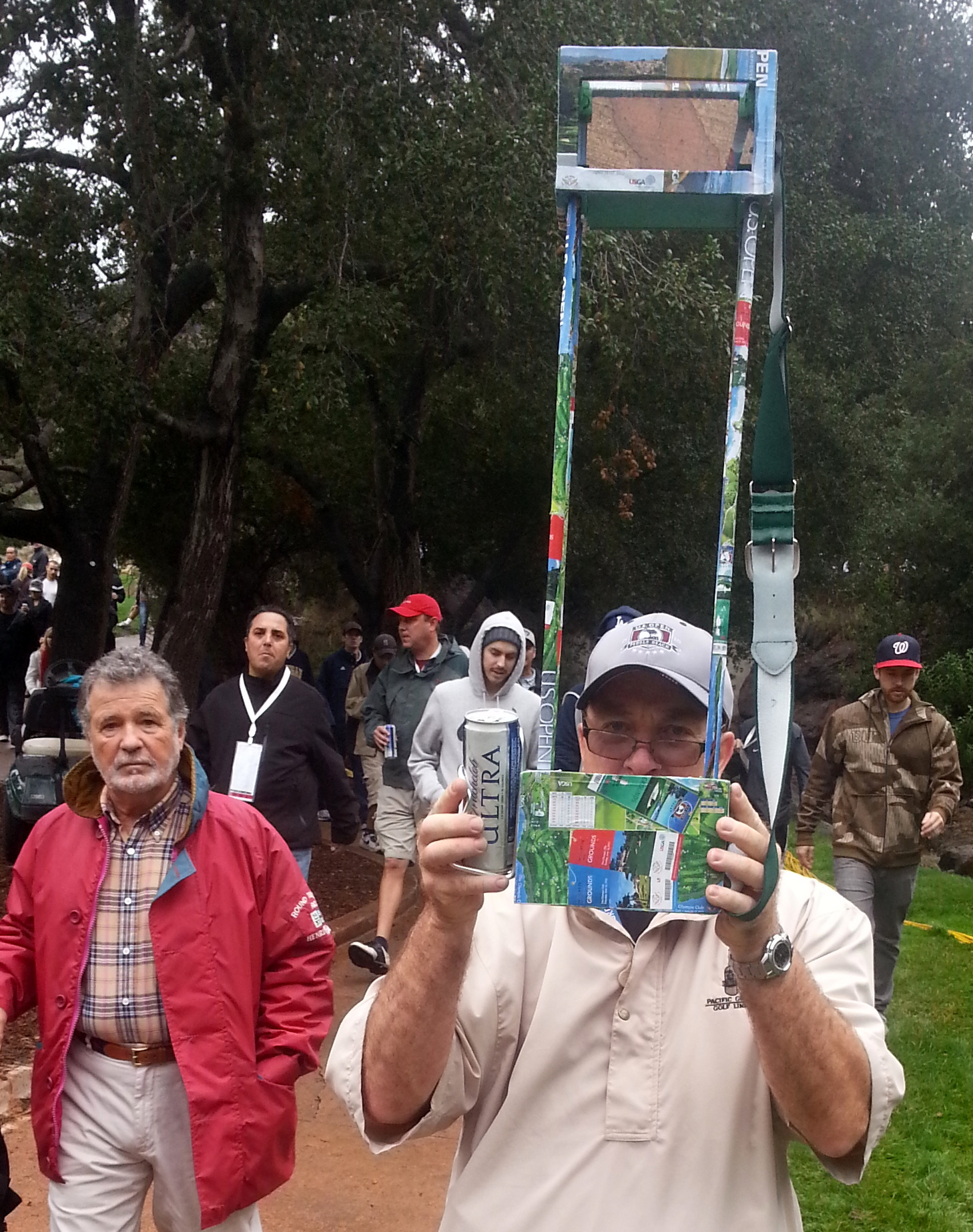
On Sunday, at Tiger’s tournament, I ran into Steve Davis, who is the guy in the photo above. He invented the contraption he’s holding: a periscope that enables him to see over the heads of people standing in front of him. It’s an improvement over other golf periscopes because it doesn’t completely block the view of people standing behind him. Also, it has a shoulder strap and a beer holder:

Davis works for a copier company. He has “wallpapered” his invention with color copies of mementos from other golf tournaments he’s attended, including the 2010 U.S. Open. If you’d like to give him a lot of money to manufacture these things full time, let me know, and if you don’t sound like a nut I’ll put you in touch.

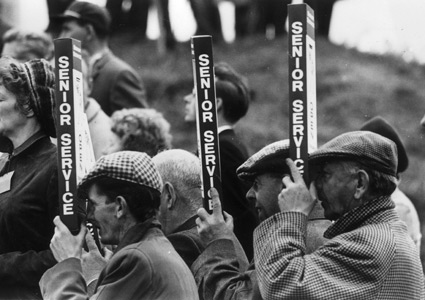
Periscopes used to be common at golf tournaments. The photo below is from the 1965 Ryder Cup, at Royal Birkdale. (Senior Service is a British cigarette brand.)

Many spectators at the 1993 Ryder Cup, which I attended (at the Belfry, in England), had periscopes that looked like the boxes that bottles of Johnny Walker scotch come in. (Johnny Walker sponsored the tournament.) The Belfry is a terrible course for spectators, and the periscopes made things better for the people who had them and worse for the people who didn’t. The only way to improve Davis’s invention, I think, would be to add a second beer holder.


Why Do Certain People Wear Certain Shoes at Certain Golf Tournaments?

By “certain people,” I mean certain women; by “certain shoes,” I mean sandals, high-heeled boots, ballet-type slippers, and backless pumps; and by “certain golf tournaments” I mean golf tournaments during which there is so much rain that the lift-clean-and-place rule is in effect for all four rounds. Specifically, I mean Tiger Woods’s 2012 World Challenge presented by Northwestern Mutual, which was held in the mud last week at Sherwood Country Club, in Thousand Oaks, California:

The Man himself  (and Bo Van Pelt, plus various menials) on the first fairway at Sherwood Country Club on Sunday. Note the mud visible in the rough in the foreground.

The World Challenge is an unofficial, end-of-season event. It raises money for the Tiger Woods Foundation, and it features a small field of terrific players. By Sunday, the entire course was so thoroughly saturated that balls often plugged where they landed, even on some of the greens, and many spectator areas looked like this:

These men are wearing sensible shoes, relatively speaking.

Despite the weather, surprisingly many women wore shoes that were not well suited to the conditions:

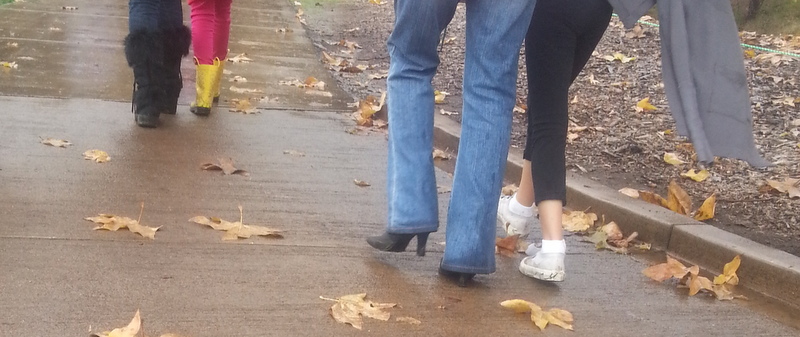
The women whose feet are shown below were standing on pavement near the clubhouse and watching someone on the practice green, but shortly after I took this photograph they all followed their boyfriends or husbands onto the course:

In the photograph below, the woman in jeans had just had trouble traversing a muddy area under some trees. A friend of hers told her husband, “Erin is bothered about her shoes. Very bothered.” I don’t know what happened after that.

The heels on those boots made sucking sounds as the woman wearing them walked through the mud, which was ubiquitous. Note the evidence of capillary action at the bottom of her pants legs.

Even in a drought, why would someone wear high heels to a golf tournament, where spectators walk for miles?

Ready to follow Tiger for eighteen holes.

I can think of three semi-plausible explanations: 1) Fashion trumps all; 2) Someone’s boyfriend or husband didn’t mention that golf is played on grass; 3) Someone was attending the tournament against her will, and wearing inappropriate footwear was her passive-aggressive declaration of her discontent.

Walking “on pointe” to keep mud from coming over the sides.