4 Things You Need to Know About Golf Hats

The photo above shows how to “fold” a golf cap, by bringing the rear band underneath and sliding it over the bill. The band preserves the curve of the bill, and  you can easily slip the whole thing into a golf bag or a suitcase. If you own more golf caps than you will conceivably be able to wear out during the years remaining to you, as you probably do, you can fold your excess inventory and store it in gym bags, like this:

You can keep one of these bags in the trunk of your car and store the others in the attic of your house, rotating every season or so. (When you take off your cap upon entering a clubhouse or a grill room, you don’t need to fold it. Just tuck the bill into the back of your pants, the way a waiter does with an order pad. That way, many beers later, you won’t leave your cap lying on the table.)

To keep your favorite golf caps clean, you need one of these:

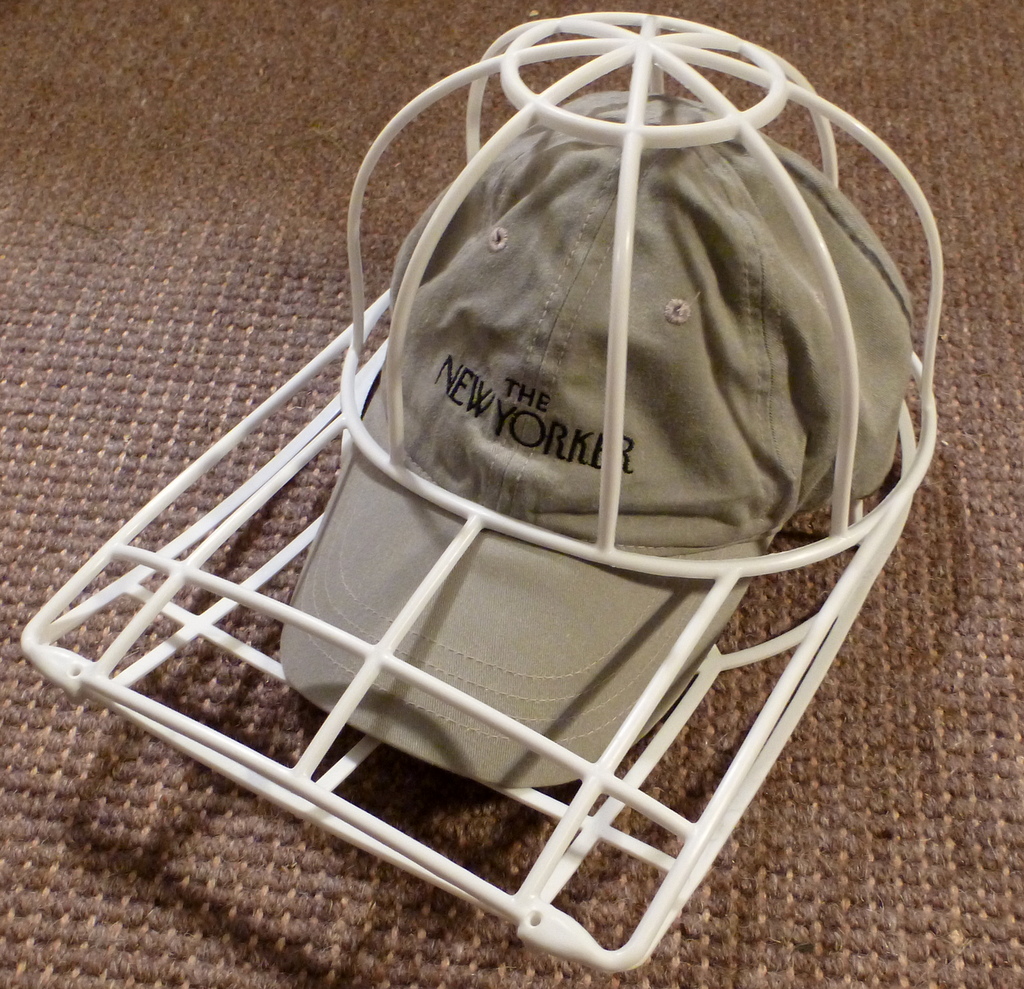
It’s a plastic frame that lets you wash your caps in the dishwasher, one at a time. You snap the cap inside it and run it through a complete washing cycle, then allow it to air dry. (No heat.) Amazon sells several versions. Here’s what a cap looks like when it’s in the frame:

The frame does a good job of preserving the cap’s shape, and the dishwasher kills cooties.

If you play golf in the rain, as you should, you need a good rain hat. Unfortunately, no golf-equipment company makes a really great one. Fortunately, Outdoor Research does. It’s called a Seattle Sombrero, and although it’s intended mainly for kayakers, hikers, and fishermen it’s perfect for golfers. It comes in real sizes and is adjustable; it has a chinstrap, which is useful in high winds; it has a brim that is broad enough to keep water from spattering your glasses or running down your neck; it has Velcro strips that let you stick the sides of the brim to the crown when you don’t need them. You can also throw it in the washing machine, if you need to. It’s a great hat:


These are the Best Golf Shoes, and I’m Not Kidding

The True Linkswear golf shoes of Tony, David O., Tim-o, & Tim. Royal Portrush Golf Club, Northern Ireland, April, 2012.

Among the hits of last year’s PGA Golf Merchandise Show were some unusual golf shoes, made by True Linkswear. They look a little like Earth Shoes and a little like Crocs: the front end is wide, allowing your toes to spread out the way they do when you walk barefoot, and there’s almost no heel. A teaching pro who now works for the company told me, “It took me a week to get over it, visually.” But golfers learn to love the look, he said, and are often able to throw away their orthotics, like crutches at a revival meeting. (It’s also possible that True Linkswear shoes promote a slightly better swing, by making it harder for you to lean over your toes.) The company’s reps brought 300 pairs to Orlando but had to stop selling them after just a few hours because they were running out of samples. By the time I got to the booth, they no longer had a pair in my size, but the ones I tried on—which were half a size too small—were still the most comfortable golf shoes I’d ever worn. I now own four pairs.

I took two of those pairs to Ireland this month, along with some New Balance walking shoes. I figured that the walking shoes would be good for après-golf—but I was wrong about that, because by comparison with my golf shoes they felt like army boots. I wore the walking shoes when we went out to dinner our first evening in Ireland but left them in the car after that, and wore only my golf shoes. And I never felt even a twinge, despite the fact that, according to Tim-o’s Fitbit Ultra, we walked between eighteen and twenty-two miles a day (while playing 36 holes and searching for balls among the dunes). And I wore my Trues on the flight home, too.

I wasn’t the only True believer on the trip: Tony, Tim-o, Tim, and I all wore them, in various models and colors—as you can see in the photo above.That’s four of the seven golfers on the group. And Jack wore FootJoy Contour Casuals, which look and feel like sneakers and which he also didn’t bother to take off. It’s now hard for me to believe that golfers ever played in shoes that had stiff soles and metal spikes and had to be broken in.

I’ve retired my original pair of Trues from active golf duty, but I wear them when I work in the yard, walk the dog, and wander through the woods. I’d wear them in the house, too, if I ever wore shoes in the house. And a day will come, I predict, when I will own no other shoes.

Brendan icing a foot rubbed raw by a week of links golf in conventional golf shoes. Cullen Golf Club, Scotland, May, 2008.

In Love With Ireland

Portstewart Golf Club, Northern Ireland, April, 2012.

Six friends and I returned this afternoon from eight days and fourteen rounds of golf in Northern Ireland and Ireland, and earlier this month I spent a similar week, by myself, in northeastern Scotland. I’ll have more to say both trips as soon as I’ve reintroduced myself to my wife and gotten caught up with the pile of stuff on my desk. In the meantime, I’ve been thinking about an earlier Ireland trip, back in 2006, and something that happened on the evening I arrived in Shannon (from Dubai!).

The baggage carousel was still revolving, but several minutes had passed since the last suitcase tumbled onto the conveyor. A young woman in a green Aer Lingus uniform walked over to me. “Is your bag missing?” she asked, her eyes radiating concern. I looked around. The other passengers had departed. The truth sank in. “My g-golf clubs,” I said.

It’s the traveling golfer’s nightmare. I had come to Ireland to spend a week playing southwestern seaside courses, and now, I thought with horror, I was going to have to play Ballybunion with rented equipment—with battered, mismatched irons and woods contaminated by the bad-swing juju of who-knew-how-many anonymous choppers, shankers, and honeymooning beginners. How could I face Waterville without my very own Banzai-shafted 10.5-degree jumbo driver, not to mention my humiliatingly extensive but indispensable collection of hybrids?  I followed the Aer Lingus woman into her office, where she helped me file a claim.

Fifteen minutes later, I was sitting numbly in a taxi, on my way to the tiny resort town of Lahinch (which is famous in Ireland not only for golf but also for surfing, of all things). Three Golf Digest colleagues would be joining me there the following afternoon, along with two rental cars. I was trying hard to appreciate the lush landscape on either side of the road, but I couldn’t stop thinking about my clubs. Why couldn’t the airline have lost Jodie Foster’s daughter instead? Then the driver’s cell phone rang.

“Right,” the driver said, after a brief conversation. “You’ll have your golf clubs by noon tomorrow. I’ll probably deliver them myself.” The young woman in the lost-baggage office, it turned out, had located my bag, in London, and had then taken the time to locate me, by telephoning the taxi dispatcher and asking if a Mr. Owen had been sent to Lahinch. I leaned back against the seat and smiled, finally able to relax. The next morning, I borrowed a set of clubs from Robert McCavery, just the fourth head professional in Lahinch’s 120-year history—he succeeded his father, Bill, who got the job in 1927—and played eighteen holes with two middle-aged women from Switzerland, who were traveling without their husbands.  My golf bag arrived just as we finished.

A week later, I was back at Shannon Airport, killing time before my flight home. And sitting at a table on the other side of the coffee shop, I suddenly noticed, was the young woman from the lost-baggage office—the woman who, a week before, had tracked me down in my taxi. I rushed over, and thanked her for her kindness.

She looked startled for a moment, then smiled. “Mr. Owen,” she said.

We have a responsibility, as golfers and as Americans, not to abuse the hospitality of this gracious, enchanting country.

Tony, Tim-o, Dave-o, Tim, David W., Howard, Jack: Enniscrone Golf Club, Ireland, April, 2012.

Improved Golf Transit

Trolleys, Portstewart Golf Club, Northern Ireland, April, 2012.

At home, my friends and I have almost always walked and carried our bags. In Scotland four years ago, though, we became semi-converted to pull carts–which are called trolleys in the U.K. and Ireland (and are called buggies in Australia). At first, we weren’t very good at handling them and were constantly tipping them over and crashing them into one other, as you can see in the photo below, from Cruden Bay in 2008. (Those are the steps that connect the first tee and the clubhouse. A trolley ramp is built into them, but we still managed to screw everything up.)

Trolley accident, Cruden Bay Golf Club, Scotland, 2008.

Unfortunately, the standard rental trolley is ill-designed for the only job it has to do. An easy way to make up for its major defect is to travel with your own bungee cord, as I do, and use it to secure your bag to the frame, as in this photo, from Enniscrone, where we played yesterday:

Golf bag secured to rental trolley with bungee cord, Enniscrone Golf Club, Ireland, April, 2012.

I still overturn my trolley fairly often, but when I do my bag doesn’t usually fall completely off. The only time I got into serious trouble yesterday was as I was leaving the fourteenth green. I took a path that was meant not for trolleys but for mountain goats, and eventually had to pick up the trolley itself (with the bag securely attached) and carry it.

Ireland: Tony’s Amazing Inflatable Rainsuit

Today, six friends and I played 36 holes at Narin & Portnoo Golf Club, in northwestern Ireland. I wrote about the course and that part of the country last year, in Golf Digest, in an article called The Road Less Traveled. Today, the wind was blowing several hundred miles an hour–as you can see in the video above, which shows Tony and his amazing inflatable rainsuit on the eighth tee–but there was hardly any rain and only a tiny bit of sleet. Between rounds, I asked a couple of older members, who were hanging around the golf shop, to explain the meaning of the symbols in the club’s  logo, but they couldn’t. Someone eventually looked it up online, and the answer was extremely interesting, although now I don’t remember what it was or where they found it. The simplest thing would probably be for you to go yourself, and ask them to look it up again–and you really should do that, because the course is A-plus-plus. (I’d post an image of the logo, but I can’t find a decent one on the Web–another good reason to visit in person.)

The day before, at Portsalon, we had an incident (referred to in court documents as the Incident) that may be of interest to legal scholars. Howard (referred to in court documents as Player H) had a three-foot putt for par which was well outside our standard gimme distance (the length of the longest foot in the foursome). He picked it up because Tim had a par already. On the next tee, we realized that Howard had had a stroke, meaning that his putt had actually been for net birdie. What to do? We decided that the fair thing would be to recreate the putt on the following green, and credit Howard with the birdie if he made it (which he did). Amazingly, the guys on the other team agreed with this ruling, and we have adopted it group-wide.

Here’s another look at that wind:

The Ladies of Ballyliffin Were Victorious

Ballyliffin Golf Club, Ireland, April, 2012.

Six friends of mine and I arrived in Belfast, Northern Ireland, late Saturday morning. We played Portstewart that afternoon with Kevin Markham—who has played every eighteen-hole course in Ireland and written an extremely useful guide to them all, called Hooked—and the next day we played two rounds at Royal Portrush, where the Irish Open will be held in June. Then we drove to Ballyliffin, where we played both the new course (which is called the Glashedy, after a big rock off the coast) and the old course (which is called the Old Course). So far, all four courses we’ve played on this trip are our favorite.

We shared the the Old Course with the ladies of Ballyliffin, who were playing a match against the ladies of Narin & Portnoo (where we’re headed tomorrow, after two rounds at Portsalon). The ladies turned down our offer to caddie for them, and/but they were victorious anyway, and they let us hang around with them in the clubhouse afterward, while they celebrated. Ballyliffin is just about the friendliest place we’ve ever been, except for all the other places we’ve been in Ireland. And this morning, when we got up, both courses—which I could see from the window of my hotel room, at the Strand—were covered in fog. That’s the clubhouse on the right, in the photo below.

The links of Ballyliffin, from the Strand Hotel, April 24, 2012.

18 Good Things About Golf: No. 8

8. Golf reminds you that, all things considered, the world would probably be a better place if all the truly important decisions were made by women. Male golfers have a much greater tendency than female golfers to view playing golf as the most important non-work, non-family activity in their lives, and to conduct themselves accordingly. At my own small club, the men, as a group, are far more likely to: play in rain, hail, burning heat, darkness, and snow; keep score; offer unsolicited, counterproductive swing advice to their playing partners; practice their short game; buy a stupid thing they saw in a Golf Channel infomercial; describe, shot by shot, a dreary recent round; employ a caddie; refuse to play without having something on the line; play more than eighteen holes in a day; travel anywhere at all for the sole purpose of playing golf; and regularly watch women’s golf tournaments on TV. The women, meanwhile, are generally more likely, as a group, to: believe that luncheons and dinner dances are essential club activities; skip a tournament if they feel it’s someone else’s turn to win the trophy; call it a day after nine holes; hold no particular opinion about the condition of the greens; view changing the color of the club-house trim as a capital-spending priority; refuse to play for money; and not even think of going for a swim in the pond on the fourth hole in their underpants. In other words, if women golfers viewed golf the same way men golfers do, civilization would have come to an end long ago. So good for them.


Blood-sucking Arachnids and Golfers’ Legs

The summer before last, I was sitting on a bench on a golf course on Martha’s Vineyard, waiting for the slowpokes ahead of me to putt out, and passing the time by admiring the sharply demarcated tan lines around my ankles. As is the case with many avid golfers, in high summer I appear to be wearing white socks even when I’m barefoot. (“Your feet look like replacement parts,” a non-player told me once. “Too bad they didn’t have them in your color.”) For variety, I also studied my shins, and marveled that so many of my freckles resembled tiny bugs.

Then I gasped: Quite a few of those freckles were tiny bugs. Even without my bifocals, I could tell that they were deer ticks, at least a dozen of them on each leg. About an hour before, I had waded into a patch of tall grass (in order to take a whiz), and the ticks must have ambushed me there. I carefully removed all of them before teeing off, and made a mental note to add a pair of tweezers to my golf bag.

Lyme disease, which is transmitted by tick bites, is a significant hazard for golfers in my part of the country—especially for those of us who occasionally venture beyond closely mown areas, seldom play in long pants tucked into socks, and sometimes forget to bathe in DEET. I didn’t get sick that time—deer ticks usually can’t infect you unless they’re embedded for a day or two—but the experience reminded me to be more careful.

Nevertheless, in 2006 I did come down with Lyme, for the third time in ten years. (I’ve had it once more since then, and so has my dog.) Because I’m a veteran, I recognized the symptoms right away: flu-like aches and pains, throbbing head, a hip that hurt every time I swung a club. My doctor, whose handicap is 14, prescribed an antibiotic, even though neither of us could find evidence of a bite. I began taking the pills immediately, but still got so sick that I had to miss not only a week’s worth of golf but also my daughter’s college graduation. A blood test later proved that I’d had both Lyme and ehrlichiosis, another tick-borne disease, which is like Lyme delivered by sledge hammer. It is possible to get Lyme and ehrlichiosis from the same tick bite, as I probably did—most likely while playing golf.

While my daughter was receiving her diploma, I was shivering in bed at home. I felt so ill that I called my wife and told her that I was going to check myself into the hospital. She called my regular golf buddy Bill, who drove over immediately and took me back to his house instead. Bill’s wife, Martha—who introduced me to golf, twenty years ago, by taking me out for nine holes—is a registered nurse. She gave me orange Jell-o and a Popsicle, and Bill made me white toast cut into star shapes. That night, they put me to bed in their son’s old room, and the next morning I felt well enough to go home. When I thanked them for taking such good care of me, Bill said, “Hey, what are golf buddies for?”

Two great things about about links golf in the British Isles and Ireland: hardly any lightning and no Lyme-bearing ticks. In 2008, eight friends from home and I spent a week playing golf in Scotland. Toward the end of the trip, Stanley suddenly got the sweats and felt lousy. He knew it was Lyme—he’s had it more often than I have—so he went to the medical clinic just down the road from Cruden Bay Golf Club. The doctor there had heard about Lyme but never seen a case. He looked it up in a book, agreed that Stanley’s symptoms matched the description, and prescribed doxycycline—no charge for the visit or the pills. It was Stanley’s seventieth birthday, so we all pitched in and got him a caddie. That’s Stanley below, on the mend at Cruden Bay, holding a birthday balloon that we also gave him. (We found it in a trash can.) Hey, what are golf buddies for?

Stanley, Cruden Bay Golf Club, Scotland, 2008.

Golfer’s Cure for Jet Lag

The cure for jet lag is golf. You take the overnight nonstop to Scotland from Newark, arrive bleary-eyed in Glasgow at 8:00 in the morning, drag your clubs past the bomb-sniffing dogs in customs, stumble into a men’s room designated “loo of the year,” change a tall stack of American dollars into a short stack of British pounds, drive 55 miles through Robert Burns country while trying to remember to admire the sheep-dotted hillsides, reach Turnberry in a daze—and tee it up on the Ailsa course, where Tom Watson and Jack Nicklaus fought their legendary Duel in the Sun, at the British Open in 1977. You haven’t slept since what seems like the day before yesterday, but your tee shot somehow finds the fairway, and a little mental arithmetic reveals that your colleagues back home are arriving, just now, at their desks. Suddenly, you feel happier than you’ve felt since the birth of your first child, or since the time you and your brother nearly won the member-guest. (Not to worry: The cure for excessive cheerfulness is also golf.)

Or so I’ve decided over the years, during a number of golf trips abroad: Hit the ground running, and keep running until dinner. I was gratified recently when a doctor who treats sleep disorders, whom I was interviewing for an article, recommended the same thing. To beat jet lag, he said, don’t take a nap upon arrival (my wife’s approach); keep your eyes open until the locals call it a day, or at least until the sun has gone down. That’s what I did this past week, in Scotland, and it’s what I did again yesterday, when I got back home. And I’ll do it again tomorrow, when six of my friends and I take off for a week of golf in Northern Ireland and northwestern Ireland.

Yesterday, my last day in Scotland, I had to interview someone in downtown Edinburgh, and I took a taxi from my hotel, which was at the airport. A guy up ahead of us did something stupid, but the taxi driver anticipated it—he told me he could read the guy’s mind—and he honked and said “What an idiot!” almost before the guy himself knew what a stupid thing he was about to do.

The taxi driver doesn’t own a car, he told me; when he and his wife need to go somewhere far away, they rent one. Usually, they pick it up at 11:00 a.m. and return it the next day at 11:00 a.m. Sometimes, 10:00. He rents from Arnold Clark, and gets a medium-size car, like a Corsa or a Focus. Once, he got upgraded to a really big car because they were out of medium-size cars, and some of his relatives felt initially that he was putting on airs. Occasionally, when he and his wife go to visit his wife’s mother, who lives near the English border, they will use his taxi, an old-fashioned English black cab, and his wife will ride in the back, “regally.” In fact, when he retires, a few years from now, he may keep his taxi, because he enjoys driving it, and sell just the “plate,” which is their equivalent of a medallion. He and his wife go on holiday every September; last year, they spent two weeks in Greece. That cost £3,000, for the two of them, including air fare. He likes to stay in four-star hotels, but in Greece they stayed in a five-star hotel. He likes to take “all-inclusive” trips—self-catering is too much trouble on vacation—but the Greek trip included only breakfast and dinner. That didn’t bother him too much, because when he’s traveling he eats a lot at breakfast—orange juice, corn flakes, yogurt, porridge, eggs, sausage, bacon, black pudding, haggis, beans, you name it—so much that has to let out his belt when he leaves the dining room. His wife, by contrast, eats nothing but toast and sometimes has trouble making it even till lunch. Keeping the weight off is harder than it used to be, even though he goes to the gym, but what choice do you have? The places he and his wife like to go are: Spain, the Canary Islands, Greece, Majorca. They usually go away in September, after the schools have started up again, because then you can get bargains, but just yesterday he looked into going away in July, too. The best the travel agent could do, though, was £1,000 apiece, all-inclusive, for a week—even in Greece! He thinks it might be possible to do better online, but hasn’t checked yet. At any rate, the travel agent said to come back in July or August and have a look at September then. Next year, for his sixtieth birthday, his wife wants to take him to New York City, where he (unlike her) has never been. He wants to go, but four hours is the limit for him, air-travel-wise. Two hours, two and a half hours? Fine. He doesn’t start to panic if he’s in the air longer, but he doesn’t like it. The best way to fly to New York might be with a stop somewhere on the way—maybe in Iceland—to break up the flight. That might make the ticket cheaper, too, since the flight wouldn’t be direct. He thinks that four days should be enough for New York, and he has been told that the part of New York that he and his wife should visit is midtown Manhattan. He was very glad to hear that I agreed with that recommendation.
Golf Holes With Ghost Names

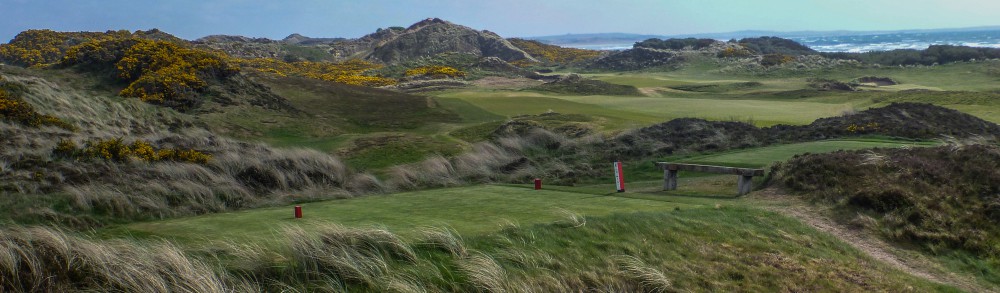
Newburgh-on-Ythan Golf Club, Scotland, April, 2012.

Last week, I played a round at Newburgh-on-Ythan Golf Club, in northeastern Scotland. The twelfth hole is called Home—an odd name for a hole far from the clubhouse. The explanation is that the course, which was first laid out in 1888 and originally had just nine holes, used to end there, across the Ythan estuary from the Udny Arms Hotel. The original clubhouse, which is cottage-size, still exists and stands nearby, although it hasn’t been used in many years. The current tenth hole, which was once the seventh, is a short par 4, just 339 yards. It was the same length in 1888, when it was called Long. (In those days, it was the only hole over 300 yards, and one of just two over 250.)  The fifteenth, near the old third, is called Boat House, because the old hole’s green was next to the hotel’s boat house. And the thirteenth, Majuba, was named after a battle in the Boer War, which was a topic of discussion during the club’s early years.

Newburgh-on-Ythan Golf Club, Scotland, early 1900s.

One of my favorite courses anywhere is the Island, in Donabete, Ireland, a few miles north of Dublin. Its fourteenth hole—which may be the world’s most intimidating short par 4—is called Old Clubhouse, because the old clubhouse used to stand where the tee box does today. In fact, the teeing ground is framed by the old foundation. And the club is called the Island because that’s what it looked like to the original members, who got to it by rowing across the estuary of the River Broadmeadow from Malahide, where golf-playing on Sundays was forbidden.