Choosing Teams in Scotland

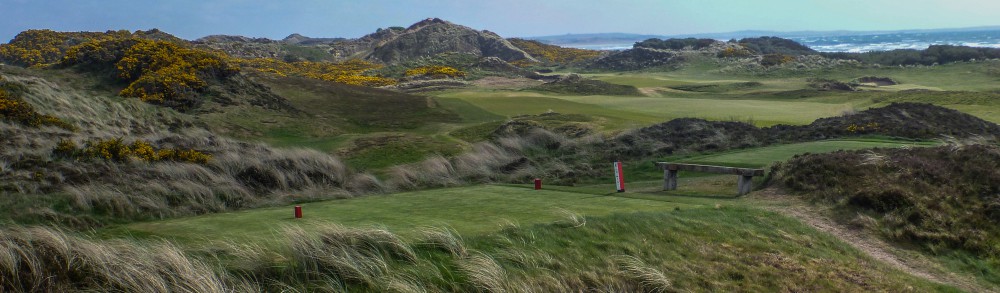
Cruden Bay Golf Club, Scotland, 2008. That's the green of the fifth hole, a par 5, in the upper right-hand corner.

At five o’clock yesterday afternoon, I stopped by Cruden Bay Golf Club, in northeastern Scotland, on my way back to my hotel. I had played there the day before, and I thought maybe the pro would let me sneak out for five or six holes before dinner. He said OK–but the course was empty, so why stop? Snow began falling as I teed off on 5, but the sun was out again by the time I reached the green. I ended up playing all 18, in a little over two hours, and then ate dinner in the clubhouse, which has huge windows that overlook most of the course.

Spring snow, Cruden Bay, Scotland, April 2012.

This morning, there was snow on my rental car, which is a kind of MG I’d never seen before, and I had to scrape the windshield with one of my golf shoes. I played at 8:00 at Fraserburgh Golf Club, a wonderful links course up the coast from Cruden Bay. The Sunday-morning regulars at Fraserburgh choose teams the way my friends and I usually do at home, by pulling balls out of someone’s hat. The temperature was in the mid-30s, and the wind was blowing hard. The golfers below fortified themselves with quite a lot of Budweiser, which one of them referred to as coffee.

Choosing teams, Fraserburgh Golf Club, Scotland, April 2012.

In the afternoon, I played at Peterhead Golf Club, which is just a few miles south of Fraserburgh. You park in a public lot on the town side of the Ugie River and cross a footbridge to get to the golf club. They manage tee order slightly differently there:

Peterhead Golf Club, Scotland, April 2012.

I played with Peterhead’s pro, Harry Dougal, who has a crushing handshake and sometimes carries his golf bag like a briefcase. He lost his wife in a car accident eight years ago. He said that swallows nest in the club’s rain shelters–that green shed in the photo is one of them–and return (from South Africa) on the same day every year.

Harry Dougal, Peterhead Golf Club.

Snow fell hard a couple of holes before I took the photograph above, but it didn’t last very long. I brought four pairs of rain gloves on this trip, and I’ve worn them every round, for warmth. I’ve wiped my nose on them so often that they’re all sort of shiny and stiff. At Fraserburgh, I played with a semi-retired furniture-store owner and a semi-retired fisherman. The fisherman didn’t wear gloves of any kind, because a fisherman’s hands, by comparison with fishing, are never cold.

18 Good Things About Golf: No. 7

Strokes: member-guest, 2011.

7. Golf, like all sports, is perfectly meritocratic: If you shoot the best score, you win. At the same time, though, golf is highly socialistic. In fact, it’s the world’s only welfare state that works. The U.S.G.A.’s handicapping system takes strokes from each according his ability and gives them to each according to his need—communism with a human face. Unlike raw capitalism, golf has figured out how to foster individual achievement without smothering the hopes of those who can’t keep up. Like most golfers, I am proud to give strokes yet unashamed to receive them.

Because of handicaps, competitive matches can be played by players of greatly different levels of skill. If Rory McIlroy, for some reason, could find no one else to play with, he could play with me and, after spotting me one or two dozen strokes, still hope to have an interesting contest. Golf is the only sport I know of in which direct competition between pros and amateurs, or between men and women, or between adults and children, or between young women and old men, or between old women and touring professionals, is routinely feasible. The use of different tees makes it possible to adapt the course to the abilities of the players, and the handicapping system allows further adjustments. As a result, you can play golf on an equal footing not only with your wife but also with your kids or grandkids. Thus, golf simultaneously enhances sexual parity (important to liberals) and traditional family values (ditto to conservatives).

You’d think that a system designed to facilitate gambling among strangers would be fatally vulnerable to inconsistencies and abuses. In fact, though, the handicapping system, like the post office, works better than we have any right to expect. I often play nassaus with people I don’t know—people whose ideas about reportable scores may differ wildly from my own—and yet, far more often than the laws of probability would predict, our matches come down to the final press or the final hole or the final putt. How does that happen?

The explanation, I believe, is that human nature makes the handicap system almost magically self-correcting. A golfer with a pop has a mindset different from that of a golfer playing naked. Players with too many strokes inevitably find ways to waste them, and players with too few are often inspired to shoot better than they know how. (Ben Hogan—or was it Sam Snead?—once played a match with an amateur who complained that he wasn’t receiving enough strokes, and Snead—or was it Gene Sarazen?—replied, “Then you’re just going to have to play harder.”) Every club has its sandbaggers, chiselers, pretenders, and poseurs, but, over the course of a season or two, the bets tend to even out. One way or another, most of us manage to live up or down to our innermost expectations.

Alzheimer’s and Golf

I’m in Scotland. Yesterday, I played two courses on the east coast, north of Aberdeen: Inverallochy, which I knew nothing about, and Cruden Bay, which is one of my all-time favorites. The wind blew hard all day–that’s the flag on Inverallochy’s eighteenth green in the video above–but there was hardly any rain, and I was wearing plenty of clothes. Inverallochy isn’t the world’s greatest course, but it has some terrific holes, and you can see (and hear) the North Sea from all of them. I arrived before anyone else and accidentally set off the clubhouse burglar alarm by trying the front door. The club secretary pulled up a few minutes later and turned off the siren, and two young policemen got there a little after that and declined to arrest me, even though I said I’d go quietly. One of the cops was wearing a short-sleeve shirt. I, in contrast, had on two long-sleeve shirts, a sweater, long johns, and my rain jacket–just enough.

At Cruden Bay, I played with the pro, Neil Murray. When we were on the first green, a single golfer played up behind us, and we stepped aside to let him through. Neil explained that he was a longtime member and that he had Alzheimer’s. They try to keep him on the club’s nine-hole course, which is enclosed by the central part of the the big course, because he’s more out of the way there, but he wanders, and plays holes out of order, and, occasionally, plays holes in the wrong direction. His decline had been rapid, Neil said; just two years ago, he was working on the course as a ranger.

He had lost his ball, and looked confused. Neil invited him to play through, and after hesitating a moment he dropped a ball about ten feet from the hole and putted it with a hybrid–and sank it. Then he wandered off toward the second tee and dropped a ball and hit it. He was accompanied by a dog–one of the herding breeds, like a border collie–and it sort of moved him along, and lay down on the green while he putted, and ran in circles around him as he headed into the rough. Neil told me that he thought the dog guided him to and from the course–his house is nearby–and kept him out of serious trouble. The man is sometimes a danger to other players, Neil said, because he will hit into groups ahead of him, but the club was reluctant to do anything because letting him wander on the course gave his wife a break of a couple of hours every day. I saw him again later, wandering up near the clubhouse.

One of the best old players at my club at home died of Alzheimer’s. I saw him playing by himself occasionally when I first joined, and decided that maybe Alzheimer’s wouldn’t be completely terrible if you could keep playing golf–never remembering your bad shots or worrying about your next shot, just as Bob Rotella recommends. I asked my doctor about that, and he said that, unfortunately, the disease affects more than your memory, and eventually destroys your ability to swing. But for a while before he died the old guy at my club looked fairly content, at least from a distance.

Why a Golf Course is Not a “Links”

Rosapenna, Ireland, 2011.

Most people think of the word “links” as a synonym for golf course, but it’s actually a geological term. Linksland is a specific type of sandy, wind-sculpted coastal terrain—the word comes from the Old English hlinc, “rising ground”—and in its authentic form it exists in only a few places on earth, the most famous of which are in Great Britain and Ireland. Linksland arose at the end of the most recent ice age, when the retreat of the northern glacial sheet, accompanied by changes in sea level, exposed sand deposits and what had once been coastal shelves. Wind pushed the sand into dunes and rippling plains; ocean storms added more sand; and coarse grasses covered everything. Early Britons used linksland mainly for livestock grazing, since the ground closest to the sea was usually too starved and too exposed for growing crops. When significant numbers of Scotsmen became interested in smacking small balls with curved wooden sticks, as they first did in 1400 or so, the links was where they went (or were sent), perhaps because there they were in no one’s way. In some parts of Scotland, linksland is called machair, a Gaelic word. It’s pronounced “mocker,” more or less, but with the two central consonants represented by what sounds like a clearing of the throat. (Machair is the root of Machrihanish, a legendary links course on the Kintyre Peninsula, in western Scotland.)

Askernish, South Uist, Scotland, 2007.

The major design elements of a modern golf course are the synthetic analogues of various existing features of those early Scottish playing fields, and the fact that golf arose so directly from a particular landscape helps explain why, more than any other mainstream sport, it remains a game with a Jerusalem: it was permanently shaped by the ground on which it was invented. Groomed fairways are the descendants of the well-grazed valleys between the old linksland dunes; bunkers began as sandy depressions worn through thin turf by livestock huddling against coastal gales; the first greens and teeing grounds were flattish, elevated areas whose relatively short grass—closely grazed by rabbits and other animals, and stunted by brutal weather—made them the logical places to begin and end holes. (“A rabbit’s jawbone allows it to graze grass lower than a sheep,” the Scottish links consultant Gordon Irvine told me, “and both those animals can graze grass lower than a cow.”)

Askernish, South Uist, Scotland, 2007.

On the great old courses in the British Isles, the most celebrated holes often owe more to serendipity and to the vicissitudes of animal husbandry than they do to picks and shovels, since in the early years course design was more nearly an act of imagination and discovery than of physical construction. One of Old Tom Morris’s best-known holes, the fifth at Lahinch, in southwestern Ireland, is a short par 3 whose green is concealed behind a tall dune, so that the golfer’s target is invisible from the tee—a feature that almost any modern architect would have eliminated with a bulldozer. The greatest hole on the Old Course is often said to be the seventeenth, a long par 4 called the Road Hole, which violates a long list of modern design rules: the tee shot not only is blind but must be hit over the top of a tall wooden structure that reproduces the silhouette of a cluster of nineteenth-century coal sheds; the green repels approach shots from every direction and is fronted by a vortex-like circular bunker, from which the most prudent escape is often backward; a paved road runs directly alongside the green and is treated as a part of the course, meaning that golfers who play their way onto it must also play their way off.

The Road Hole, 2008.

Over the centuries, every idiosyncratic inch of the Old Course has acquired, for the faithful, an almost numinous aura. Alister MacKenzie once wrote, “I believe the real reason St. Andrews Old Course is infinitely superior to anything else is owing to the fact that it was constructed when no-one knew anything about the subject at all, and since then it has been considered too sacred to be touched.”

Royal Aberdeen, Scotland, 2008.

The Capital of Left-Handed Golf (No, Bubba, It’s Not Augusta, GA)

Clubhouse, Kingussie Golf Club, Scotland.

In 1992, when I was new to the game, I took my first golf trip to Scotland. You can probably guess at least part of the itinerary. I played at Turnberry, Gleneagles, St. Andrews, Carnoustie, and Dornoch, and I finished at Tain, an Old Tom Morris course at the inland end of Dornoch Firth. That last round went by so fast that it left me with most of a day to fill, so I asked my playing partners, who were Tain regulars, if they could recommend a course on the long road to the airport—any course at all. They suggested Kingussie, just off the A9, about a third of the way between Dornoch and Glasgow, in what is now Cairngorms National Park. So that’s where I went.

My expectations were neither high nor low; I just wanted one more chance to swing my clubs. But during the decade and a half since then I’ve probably thought about Kingussie as often as Carnoustie. You could never hold a British Open there—among other reasons, the course is almost 2,000 yards too short—and golf-tour operators almost never send American travelers to play it. Nevertheless, it stuck in my mind. The course (which was expanded and redesigned by Harry Vardon in 1908) is set in and around the elevated valley of the River Gynack, in the rocky hills above the village. The first hole is a long, semi-blind par-three, and the sixth is a short par-4 that plays past the ruin of an old shieling, or shepherd’s hut, and the fourteenth, called the Dyke, runs along an old stone wall. It was a memorable finish to a memorable trip.

The Shepherd's Hut, Sixth Hole, Kingussie.

I returned to Kingussie in 2007 and played with three Scots, two of whom were on holiday from the Orkneys, a cluster of small islands north of the Scottish mainland. When we had finished, we had a drink with a group of regulars sitting at two picnic tables outside the clubhouse. One of them told me, “Kingussie has more left-handed and cross-handed players than any other golf club in the world”—a consequence, he said, of the town’s intense devotion to shinty, a bruising Highlands stick game that is similar to the Irish sport hurling (from which it evolved) and to field hockey, and in which there is apparently a tactical advantage to playing from the wrong side of the ball. No, no, another member insisted: there are more left-handed golfers in Newtonmore, Kingussie’s principal shinty rival, three miles to the west. The conversation then veered into a discussion of Newtonmore’s golf course, which my new friends unanimously dismissed as too flat to bother with.

One of my new friends from the Orkneys.

That evening (after a second eighteen), I drove over to Newtonmore and watched a youth shiny practice, the only form of the game available locally that evening. I stood with a group of shinty moms in a parking lot filled with Scottish minivans, and saw that grade-school shinty players, unlike the adult shinty players in the stories I had heard at the picnic table at Kingussie, wear helmets and still have their teeth.

Shinty practice, Newtonmore, Scotland, 2007.

My Grandfather’s Passport

My golf clubs and I are leaving for Scotland in a couple of days, so I’ve started piling up stuff. I used a big paperclip to attach my passport to my itinerary, to make me less likely to forget it, and while I was digging around for some other things I found an old passport of my grandfather’s:

It was issued the summer of 1927, when he was thirty-nine and my grandmother was thirty-one. Wives in those days didn’t need their own passports, because under what conceivable circumstances would a married woman travel abroad by herself? My grandmother didn’t even need to sign the photograph. (Women, by that point, had been allowed to vote in just two U.S. presidential elections. Travel-wise, they were still luggage.)

Visas were minor works of art in the 1920s, and they included real signatures by real officials. Here’s the British one:

And the Italian one:

International travel was far less common—U.S. passports were valid for just two years and could be limited to less—and going abroad involved extraordinary quantities of luggage. I remember playing with my grandparents’ old steamer trunks, almost forty years later, in my grandmother’s attic. The trunks were the size of small rooms, and they had drawers and doors and shelves and clothes rods, and travelers didn’t necessarily limit themselves to one.

I, in contrast, am going to try to get by with my golf bag, a carry-on bag, and my laptop. I’m not even going to pack a tuxedo. More on all that later.

18 Good Things About Golf: No. 6

Member-Guest 2008: D.O., K.T., J.P.N.

6. Golf, when used properly, promotes a healthy sense of play. Most grownups don’t play enough, in the kid sense. In fact, most of what passes for play in the adult world is just work by other means. Many golfers treat golf not as a game but as a job they wish they had the guts to quit. But it doesn’t have to be that way. Golf is ideally suited to pretending.

Like most adults, I have watched my childhood powers of fantasy atrophy into powers of self-delusion. When I was eight years old, I had no trouble pretending that the monthly meetings of my Cub Scout pack were the conferences of a secret international intelligence organization whose members happened to wear blue shorts, neckerchiefs, and beanies. Nowadays, I mostly accept reality for what it is: no more slow-motion touchdown receptions, very little air guitar. On a golf course, however, I occasionally find myself playing in the old way—for example, pretending that my club’s three-day member-guest is the Walker Cup. Of course, doing that requires a herculean suspension of disbelief. (Not many world-class amateurs follow a sliced drive with a shanked approach, a sculled pitch, a chunked chip, and three feeble putts.) But there are occasional moments of transcendence.

To be continued.

Member-Guest 2010: Barney, Paul.

Is Tiger Too Old?

Hogan before he was Hogan: Byron Nelson and Ben Hogan at the 1942 Masters, the last before the war. Note the grip on Hogan's driver. Also, of course, the cigarette.

People who think Tiger Woods is too old to dominate golf again should consider the career of Ben Hogan. At the time of the Masters in 1948, the year he turned 36—the age Woods is now—eight of his nine majors and a third of his tour victories still lay ahead of him, as did the automobile accident that nearly ended his life.

Why Golf Tournaments Last Four Days

Seventy-two-hole golf tournaments at the time of the first Masters, in 1934, were invariably scheduled for three days, with a thirty-six-hole final on Saturday—an accommodation to the nation’s blue laws. It was Bobby Jones who thought of expanding the schedule. “My idea in stringing out the medal play over four days,” he wrote in a letter to Clifford Roberts, the club’s chairman and co-founder, not long before the tournament, “was to give time for special events to be sandwiched in between.” These events included an optional alternate-shot match, an approach-and-putt contest (to be held on the practice putting green), an iron contest (to be held in the old practice area, which can still be seen between the ninth and eighteenth fairways), and a driving contest.

Roberts liked the four-round idea—one of many golf innovations introduced at the Masters—in part because it eliminated what he believed to be a disadvantage for players who were “unable to do their best scoring if forced to play thirty-six holes in one day.” He also liked the fact that the schedule would enable the club to sell four days’ worth of tournament-round tickets instead of just three. (Tournament-round tickets sold for $2.20, including tax; practice round tickets were $1.10; series tickets, good for all week, were $5.50.) Roberts had initially wanted the driving contest and other special events to be scheduled alongside the practice rounds—on Sunday, Monday, Tuesday, and Wednesday—partly because he hoped they would increase practice-round ticket sales, and partly because he thought a long schedule of activities might make the tournament seem more substantial to local hoteliers and merchants, whose support would be needed both that year and in the future.

Incidentally, Roberts loved the special events, and he helped to create many of them. One year, he arranged an exhibition for local children, who were given free practice-round tickets; he scheduled the exhibition late in the afternoon so that it wouldn’t conflict with school. Another year, he devised a competition in which the pros took turns trying to repeat Sarazen’s double-eagle shot from the fifteenth fairway. (None succeeded.) For the 1942 Masters, he wanted to hold a complex “ringer score contest” in which the seven tournament champions would compete against the rest of the field during the four practice rounds. The contest was never held, but not for lack of support from the chairman. (Among other things, he wrote, the competition would “give the newspaper boys something to write about” during the first half of the week.) According to one spectator from that era, “The contests were fun, because the pros were always so relaxed and having such a good time.”

Those early special events were the precursors of the Par 3 Contest—another Roberts innovation. The first was held in 1960 (and won by Sam Snead) after enthusiastic lobbying by Roberts. “I am really rather bullish on the idea of making use of the Par-3 course as a distinctive pre-tournament event,” he had written the year before. “If so, it can be quite a feather in the cap of the Masters Tournament.  I say this because no other club holding a tournament could duplicate what I am proposing we do at Augusta. So far as I know, no other club has a Par-3 layout and, even if they do, I am sure they don’t have anything to compare with ours.” The event has always drawn a huge and enthusiastic crowd. It is also popular with the players and their children—even though no winner of the Par 3 Contest has ever gone on to win the Masters. Yesterday’s event was shortened by rain and lightning. Padraig Harrington and Jonathan Byrd were leading, at 5 under, when it was called.

Masters Countdown: Ninth Hole

Augusta National's ninth green, 1935.

Clifford Roberts, Augusta National’s co-founder and first chairman, liked to say that he made only one contribution to the original design of the course. During the construction of the ninth hole, he persuaded the contractor to create a level landing area in the steeply tilting fairway at the distance he normally drove the ball (about 180 yards). “The engineer was not at all enthusiastic about accommodating me,” Roberts wrote in his book about the club, “but finally agreed to bring back a tractor and do the job.” Roberts later told friends that he had requested the change because he didn’t want any of his matches with Bobby Jones to be decided by his luck at hitting a fairway wood to an elevated green from a downhill, sidehill lie. The current ninth hole was then the eighteenth, and Jones customarily either gave Roberts nine strokes or allowed him to begin their matches with a nine-up edge. Even so, Roberts needed all the help he could get.

(Augusta National doesn’t use the U.S.G.A.’s handicapping method. It has its own simple system, devised by Roberts, which is based on the number of pars a player ordinarily shoots, with a small adjustment for birdies. Essentially, if you make six pars, your handicap is twelve. The Roberts system works well, is easy to compute, and allows daily modification.)

Roberts’s difficulties with the second shot on the ninth hole were shared by most of the club’s other members, who, like him and unlike Jones, weren’t long enough off the tee to come close to the ideal driving area, at the bottom of the hill. And neither Jones nor Alister MacKenzie, who designed the course, was at all disapproving of Roberts’s modification. In consultations among the three, Roberts’s role was to supply the viewpoint of the average golfer, and Jones and MacKenzie both solicited his opinion. Roberts’s landing area is still visible in the ninth fairway, and it still receives plentiful use from members and guests, as well as from occasional Masters competitors.

Hord Hardin, who was the president of the U.S.G.A. from 1968-69 and was Augusta National’s third chairman, between 1980 and 1991, told me a story in 1996, shortly before he died, that I’ve heard in several versions. Augusta National had a few women associate members in the early years. (Most, if not all, were members’ wives—possibly including Roberts’s first wife, Mary Agnes Bishop, whom he married in 1937 and from whom he was divorced not long afterward.) In the clubhouse one day, one of the women told Roberts that she had just made a hole-in-one on the eighth—a 500-plus-yard uphill par 5—and Roberts asked how that was possible. Hardin told me, “She was playing the ninth, and flat missed her tee shot. The ball hit a something off to the right, flopped up in the air, and went in the hole on the eighth green, no more than fifty yards away. When he heard that, Mr. Roberts is supposed to have said, ‘That’s it. No more women members.'” Roberts and Jones’s original plan for the club had included a second course, intended mostly for women, and a large women’s locker room, which was to have been situated in the huge new clubhouse they intended to build as soon as they could afford to tear down the dilapidated old plantation house. The Great Depression forced them to scale back their ambitions, and prevented them from demolishing what today is probably the most recognizable building in golf.

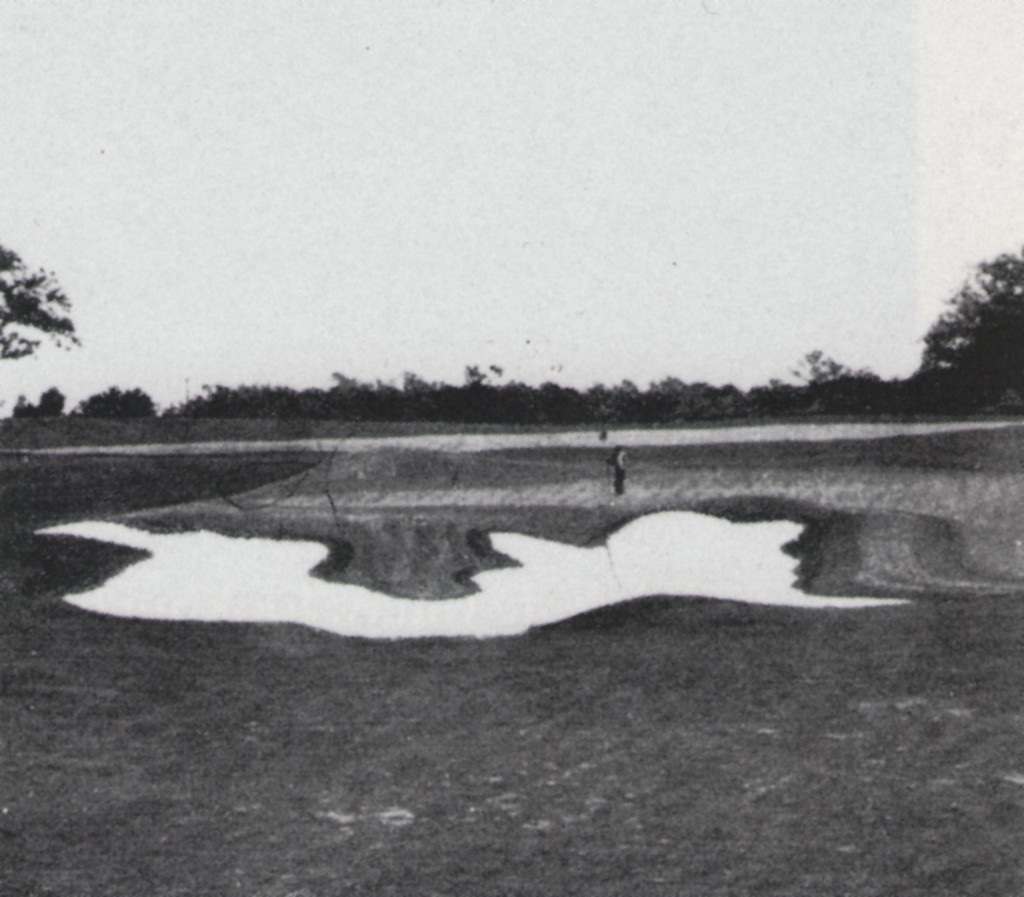
As the photograph above shows, the ninth green’s famous false front, which contributed to Greg Norman’s spectacular final-round collapse in 1996, was originally more pronounced. (Look at the far right-hand edge of the photo.) The ninth hole is also seventy yards longer than it was during the first tournament. The most recent extension was during the summer of 2001, when the Masters tee was moved back thirty yards and a high stone wall was built to seclude it from a service road just beyond it. At the same time, additional trees were planted on the left between the new tee and the members’ tee, to eliminate the possibility of tournament players’ using the first fairway as an alternate driving area, and new pine trees were planted along the right side of the ninth fairway, to tighten the landing zone. Even though the hole today is 460 yards long from the tournament tee, Masters competitors often have as little as a nine-iron or a wedge for their second shot.

Players, fans, and television commentators who claim that Augusta National had no rough until Hootie Johnson added the “second cut,” in 1999, should study the photograph below, which was taken at the 1949 Masters. The rough in the foreground is several times the height of any grass on the course today. And note the greenside bunker configuration. MacKenzie’s original large bunker was later reconfigured and divided into three, and then at some point after 1949 the bunker nearest the tee was removed.

Ninth hole, Augusta National, 1949 Masters.

That’s the end of my hole-by-hole Masters Countdown for this year. I’ll take it up again next spring, beginning with the tenth hole—although I’ll have one or two more things to say about the Masters before this year’s tournament is over.