Push Carts on Tee Boxes? On Greens?

Push carts on putting green, Victoria Golf Club, Melbourne, Australia, June, 2010.

During the women’s member-guest at my club, a couple of weeks ago, a few guys from my Sunday Morning Group played a travel round at our enemy club, on the other side of town. (We have a reciprocal arrangement for tournament days, etc.)  A member strode up at some point and told them to stop rolling their push carts onto the tee boxes—and later he strode up to again and told them not to put their golf bags on the tee boxes, either. (Hey, maybe they should remove their golf shoes, too.)

I took the photos above and below at Victoria Golf Club, near Melbourne, Australia, in 2010. (The Australian Masters was played at Victoria that year and the next.) Players there are asked to roll their push carts and pull carts not just over the tee boxes but across the greens, to keep the fringes from being beaten up by concentrated foot traffic. Other Sandbelt courses have the same policy—including Royal Melbourne and Kingston Heath, which are ranked No. 22 and No. 11, respectively, on Golf Digest’s list of the 100 Best Courses Outside the United States.  Ditto Bandon Dunes (although at Bandon golfers with carts are asked to cross the greens only, and not to park their carts on them).

These practices makes perfect sense, because a push cart weighs much less than a greens mower. Or a tee mower. Or any of the guys that you or I play golf with. So lighten up, enemy club.


Golf Innovation: Slow-Play Workaround

There’s a birdhouse near the ninth tee at my home course, and if you’re stuck behind slowpokes you can use it to pass the time. A hundred points for chipping a ball through the opening, five for hitting any part of the birdhouse, one for hitting the tree—or whatever. That’s Addison in the photos above and below, and, as you can see, he has the kind of short game you need to excel in this game. Tony had the idea of putting a dollar in the birdhouse each time you play, winner take all.

I learned another slow-course game from Reese, who is Addison’s father. It’s called Poison. Each person in your group, in turn, uses his driver to chip a ball from one tee marker to the other. (If you hit it, you get to go again.) Once you’ve hit it, you chip back to the other tee marker, and once you’ve hit that one your ball becomes poison and you can eliminate other players by hitting their ball with yours. There’s more strategy than you would think, especially once multiple balls have become poison. Suggestion: assign someone to keep an eye on the group ahead, so that your slow-play solution doesn’t become part of the problem.

Sharpiegate Redux

It’s dumb to get worked up about dumb things, but, ever since I complained about golf bags that have pen holders (good idea) which aren’t deep enough to securely engage the pocket clip of the one kind of pen that all golfers use (idiotic idea), I keep noticing other golf bags with the same problem. Here’s one from Founders Club:

Callaway makes a bag with the same defect, and somewhere I have a photograph to prove it, but I can’t find it at the moment so you’re just going to have to take my word for it. People who say these slots are intended for golf pencils rather than permanent markers are wrong, because if you put a golf pencil in one of them you’ll need a surgical clamp to get it out again.

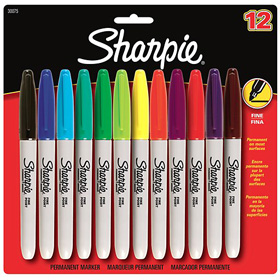
While we wait for the world to come to its senses, here’s a related question: Why doesn’t Sharpie sell its non-black markers one pen or one color at a time? If you want to mark your golf balls with, let’s say, a purple marker, you can’t buy just one, or even just three of the same color; you have to buy something like this:

Come on, Sharpie! You invented this market. Show some ball-marking leadership!


Reader’s Trip Report: Sand Hills Golf Club

Sand Hills Golf Club, 16th hole.

Adam Sachs, a reader from Kansas City, recently returned from a trip to Sand Hills Golf Club, near Mullen, Nebraska. Excerpts from his report:

Sand Hills is a sublime private venue for purists willing to travel ten hours or more to The Middle of Nowhere, Nebraska. Here’s the pre-game formula:

(1) Either fly to Denver or Omaha and drive four hours on I-80, then another one to two hours through a landscape that looks like what you might think you’d see on the moon, including sand-dune craters; or fly private or commercial into North Platte and drive an hour and fifteen minutes up state highway 97 to mile maker 55.  (Note: if you reach Mullen, the closest town, you’ve gone about thirteen miles too far north.)

(2) Drive about two and a half miles down a winding road, free from power lines or really much of anything, veer straight/left past Crenshaw Drive.

(3) Introduce yourself to the nice lady at the reception desk, identify your host, get your cabin assignment, load up your travel bags on a golf cart and take a short drive around back to some sparse but comfortable cabins: two firm queen mattresses, a couple of small TVs, a completely adequate bathroom with a shower, and a telephone for calls up to the Clubhouse and long distance collect calls. (There is almost no cell phone coverage and only limited Wi-Fi, in the lobby of the decidedly humble clubhouse.)

Seventeenth green.

I convinced my wife I had to go because my new client invited me. Turned out he checked himself into the hospital the night before the trip with chest pains. He’s fine—a little blood-pressure issue—but he never made it to Sand Hills. I played with ten guys I had never met and hardly know a thing about (besides their home courses: Castle Pines, Robert Trent Jones Golf Club, etc.) and had a fantastic time.

You can read Adam’s blow-by-blow account of his favorite holes here.The photos are his, too—including this one:

Dan Daly, the chef at the halfway house, preparing the staple meal of my own Sunday Morning Group.

How to Hold Your Own Golf Major

Hacker (real name), Ocean Course Scorecard, Les, August 12, 2012.

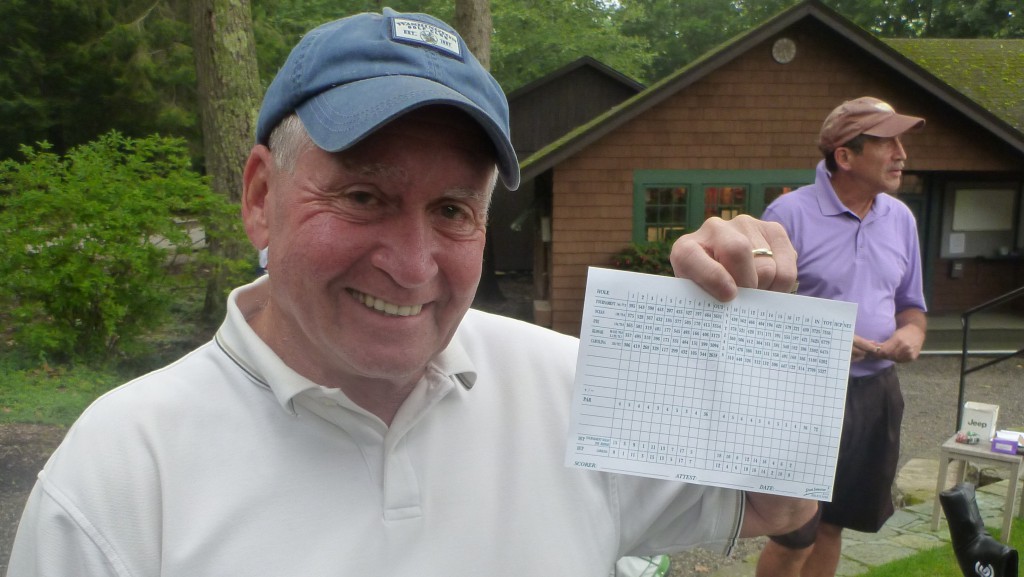
When my friends and I play on Sunday mornings, we use our Sunday Morning Group scorecard, which Jim created for us with a desktop publishing program that he uses in his job. Among other features, it lists our local rules, such as “You get an extra stroke if you wear shorts after November 1” and “No one gets a stroke on a par 3.” Some of the older guys complain about the par-3 rule, but what can we do? It’s printed right on the card.

This year, Hacker (real name) had the idea of celebrating golf’s four majors, on each major’s final day, by using not our own Sunday scorecard but the scorecard from whatever course the major was being played on. So during our regular game this weekend we used the scorecard of the Ocean Course at the Kiawah Island Golf Resort, where the PGA Championship was held. (You can download the Ocean Course card yourself, from either of the links in this paragraph.)

The main effect of using another course’s scorecard on your own course is that most of the handicap strokes fall in unfamiliar places. This impacts one of our local rules, because (for example) although our sixteenth hole is ordinarily a par 3 (meaning that no one gets a stroke on it), on the Ocean Course it’s a par 5 with a stroke index of 4 (meaning that anyone receiving 4 or more strokes that day gets a pop).

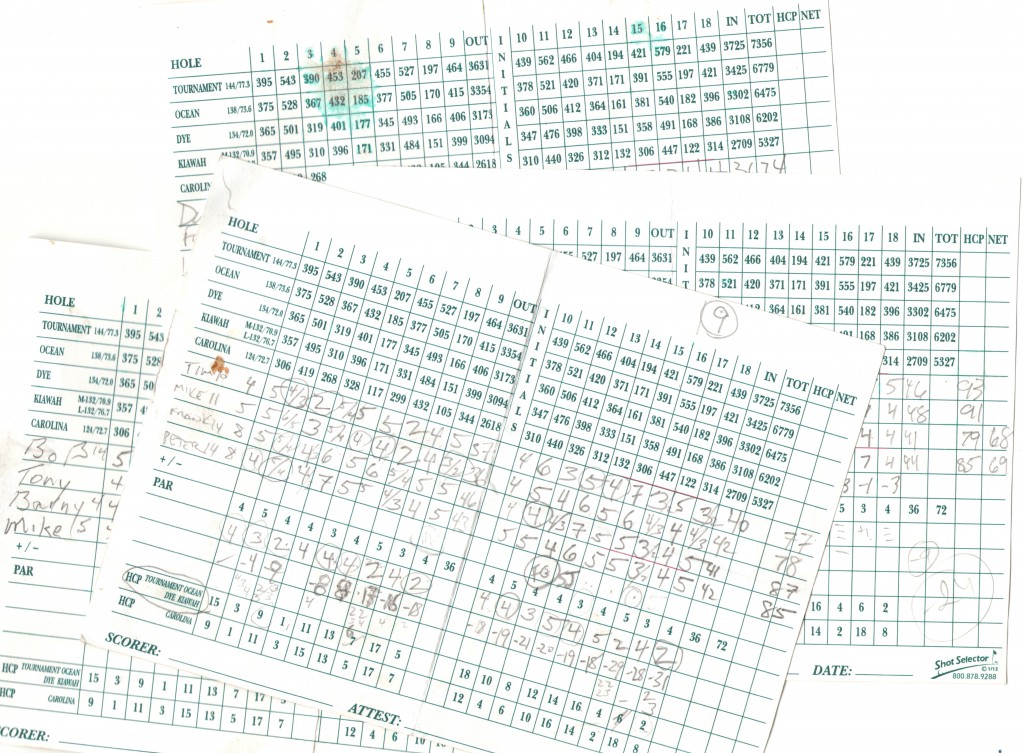
We compounded the impact by using a best-ball feature that I introduced a few years ago, called All Birdies. In All Birdies, all under-par scores on any hole count. On the sixteenth hole, for example, I had a 2 and my three teammates had net 2s. Since Kiawah’s sixteenth is a par 5, our four 2s counted as albatrosses and our team went -12 on that hole alone. That wasn’t enough to win, unfortunately, but we felt pretty tough for a while. (The winning team was Tim’s, at -31. Theirs is the top card on the pile in the photo below.)

Major results, Sunday Morning Group, August 12, 2012.

Important Golf Concept: Divot Forwarding

Fresh divot, Heritage Village Country Club, Southbury, Connecticut, August 9. 2012.

Years ago, my brother, John, invented divot forwarding: instead of putting your divot back in its own divot hole, you put it in the next empty divot hole you come to as you walk toward the green. This has the effect not only of saving steps for you but also (as he pointed out to me recently) of “helping better players”—who, usually, are longer off the tee than you are.

The divot in the photo above is from Heritage Village Country Club, in Southbury, Connecticut. An L.P.G.A. Tour event, the Heritage Village Open, was held there in the early 1970s. The Connecticut State Golf Association’s Super Senior Tournament will take place there next week. Tony, who turned 65 this year, is playing in it. Today, Addison and I accompanied him on a practice round.

On one hole, we encountered a surprisingly aggressive doe, who made it clear she didn’t want us to pass:

Tony vs. doe, all-square.

Then we saw why: her fawn was with her, and we must have looked threatening.

Doe and fawn, one-up.

We stood around for a while. Then I let my push cart go on the path, and they ran off.

My cart vs. doe: back to even.

Beef Box*: Golf Shirt + Golf Glove = Trouble

One of the most surprising features of modern life, to someone who went to high school in the early 1970s, is the renewed popularity of clothing made of synthetic fibers. Not that long ago, a clear indication that someone was completely out of it was that they still made jokes about golfers wearing “polyester pants.” But golfers are again wearing polyester pants.

Actually, polyester pants are great for golf trips, because they’re somewhat rain-resistant and they don’t wrinkle when you wad them up and throw them on the floor. But I would never wear mine anyplace where a non-golf-playing friend, such as my wife, might see me. I’ve also got a few polyester golf shirts. They’re supposedly better than cotton at keeping you cool, but they feel like they’re made of pantyhose.

And now I have a new reason to complain. Today, I noticed a growing constellation of snags on the front of a brand-new Ashworth polyester golf shirt, and after about fourteen holes I realized what the problem was: every time my glove brushed against the fabric, the bristly part of the Velcro closure yanked some of the threads. Photographing snags in golf-shirt fabric turns out to be really difficult, but the picture at the top of this post should give you the idea.

*With apologies to Joe Pyne.

News From the 2012 Member-Guest

Amazing member-guest discovery: golf-cart Surround Sound.

My brother, John, and I played in my club’s member-guest tournament this past weekend. One of our five matches was against Fritz and Klinger, whose golf cart you see in the photograph above. That’s Klinger’s iPhone, in the one cup holder that isn’t holding a beer. It’s playing “Send Her My Love,” by Journey, and If you could hear the music you’d be blown away, because Fritz and Klinger have discovered that a golf cart cup holder acts like both an amplifier and a Surround Sound speaker system. Try it with your own iPhone or iPod if you don’t believe me.
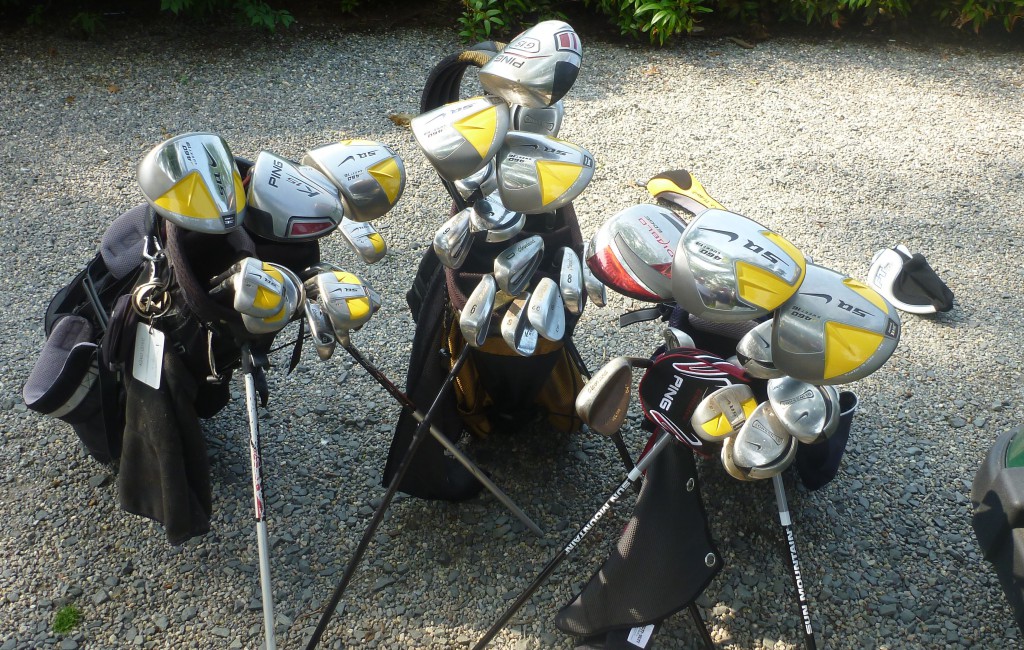
Three golfers, nine drivers.

The golf bags in the photo above belong to (from left to right) me, Tim-o, and Tony.  You will notice that the three of us, in addition to apparently being infatuated with obsolete Nike products, carry three drivers each. The lofts are 10.5, 13, and 16 degrees. I’ll have more to say about this club selection in a week or two. (Full disclosure: after the 9-hole stroke-play opener, on Friday—which John and I won, at 7 under—I removed my 13-degree driver, which I’d bought on eBay the week before, to make room for a second 6-hybrid.

Rob and miscellaneous member-guest stuff.

Usually, the so-called gifts you get at a member-guest are pretty crummy, but this year the ones at my club were great: a golf hat, a golf towel with a zipper pocket and a semi-mysterious Velcro strip, and a belt with a buckle that’s also a beer opener. In the photo above, Rob is wearing his belt on the outside, for easier access (although he’s got it upside down). He’s also wearing his give-’em-a-brake safety-yellow golf shirt and carrying a beer, two putters, and a portable cooler.
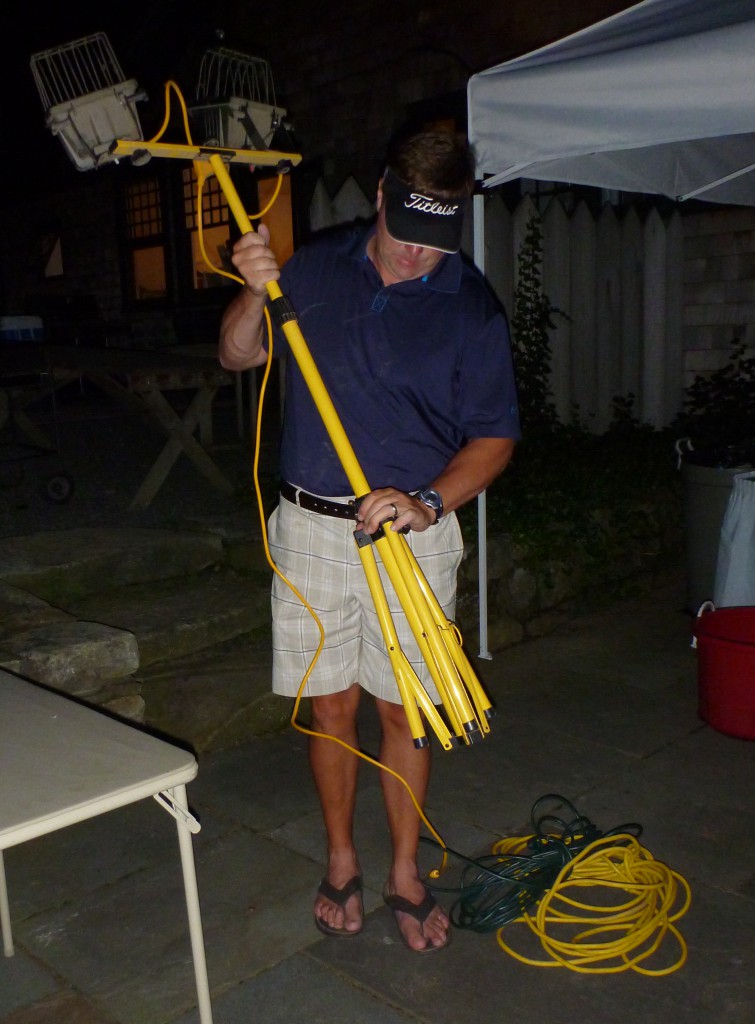
Jaws, lighting the putting-contest qualifier.

On Friday night, after the stag dinner, so many guys wanted to keep trying to qualify for the putting contest that Jaws drove home and brought back his big workshop lights. That’s him in the photo above, setting up one of the units. My brother and I qualified but were eliminated the next evening, in a four-hole playoff for the last three spots in the final.

Putting-contest qualifier, under the lights.

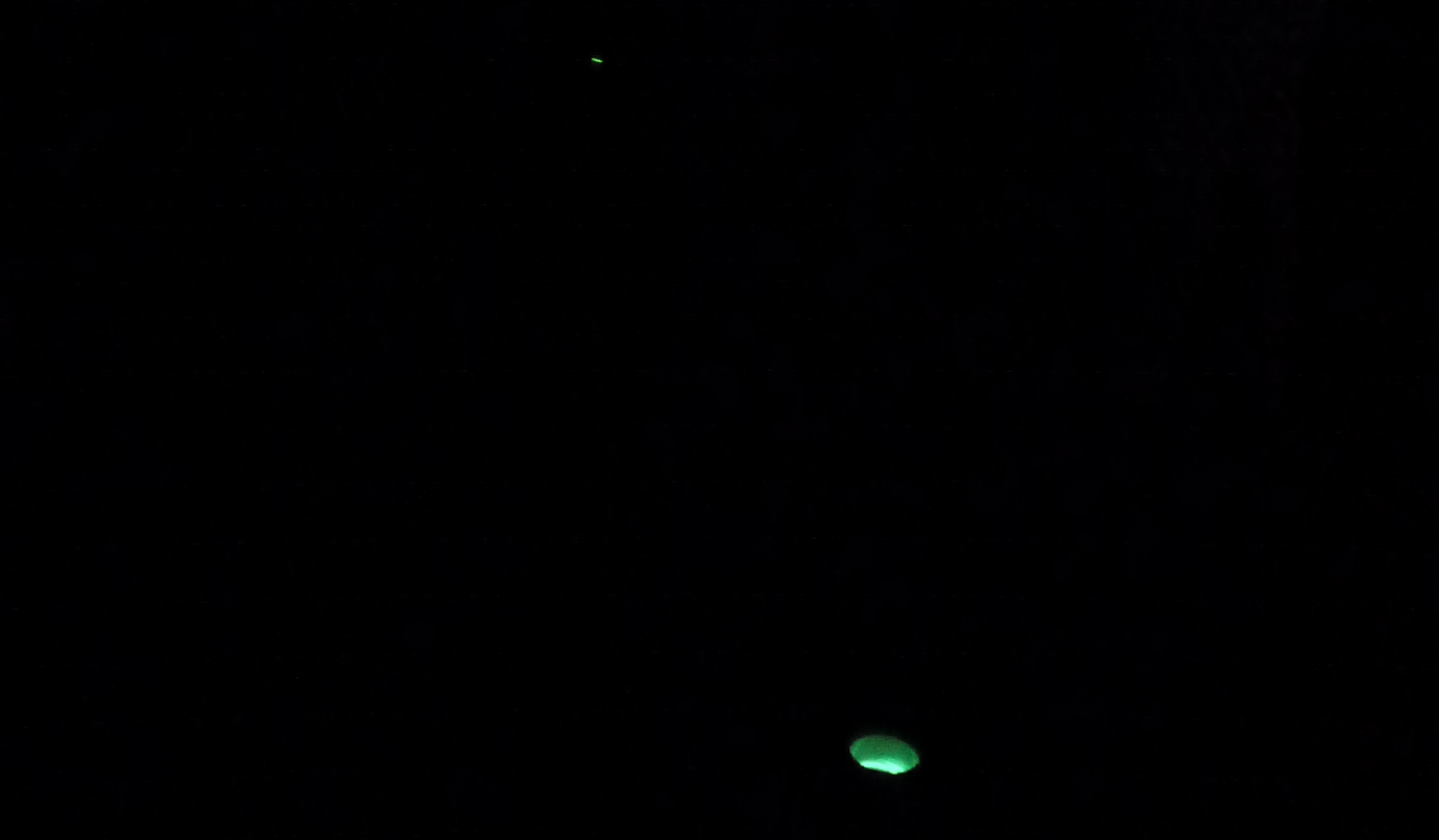
On Saturday night, after Fritz and Klinger had won the putting contest and a dozen of us had played a five-hole one-club tournament in a race with the setting sun, we held an unofficial supplemental putting contest, using glowing balls and glowing cup inserts—items about which I’ll have more to say in a week or two. The winners were Tim and Chick. Here’s what the putting green looked like in the dark:

Glowing ball, glowing hole.

Also here:
Doc, Jr.

There were thunderstorms in the forecast all weekend, but the rain and lightning held off until halfway through the final shoot-out, on Sunday afternoon. Here’s what the rain looked like when it was coming down:
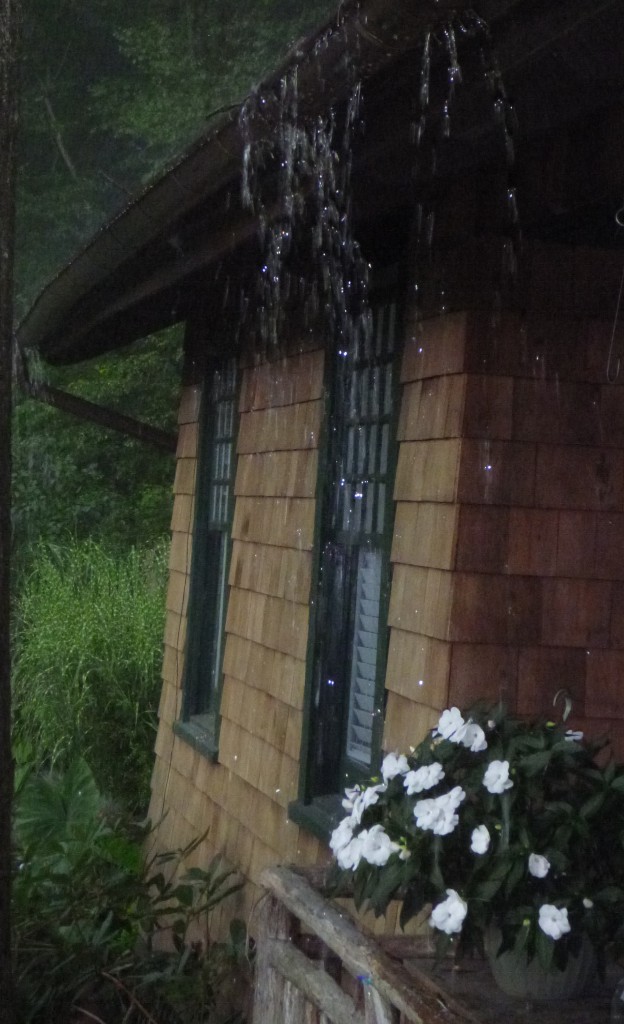
The gutter in that photo has been clogged for ten or fifteen years, but when it’s raining no one wants to go up on a ladder to unclog it and when it isn’t raining it doesn’t overflow. During most of the rest of the weekend, though, the weather looked like this:
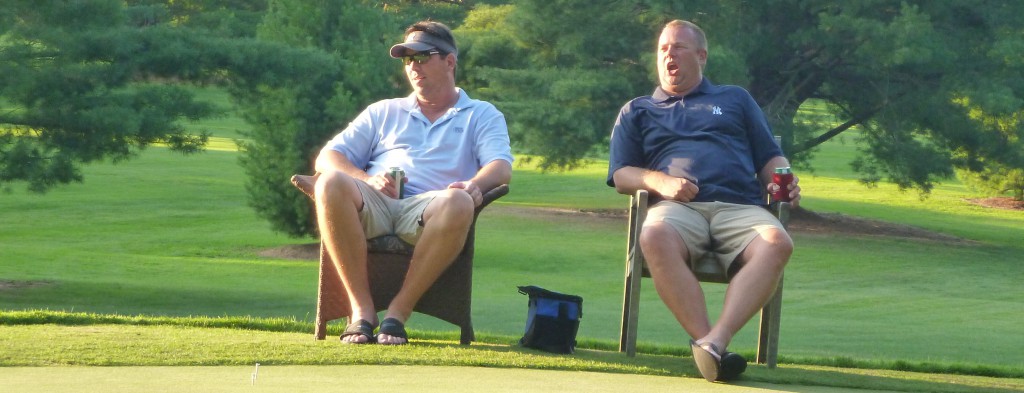
Chick, Rob, putting-contest qualifier.

The overall winners of the member-guest were Ray and Mike. My brother and I beat them, one-up, in our final match of the weekend, but that wasn’t enough to knock them out of first place in our flight. Here’s Ray resting during the lightning delay. (Mike was on the phone apologizing to his wife for already being several hours later than he had said he was going to be.)

Ray, resting in the clubhouse during the lightning delay.

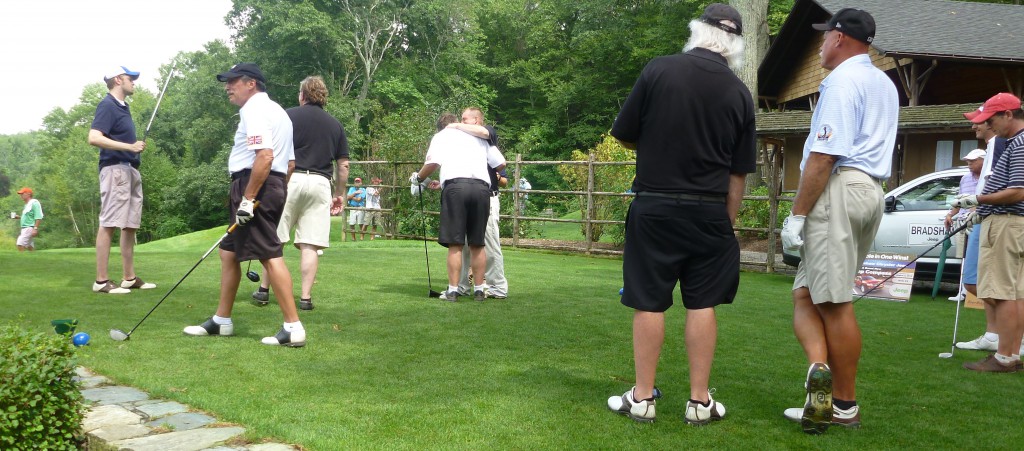
And here’s what the shoot-out field looked like on the first tee. We determined honors by using the Sunday Morning Group’s limited-edition collection of numbered poker chips. Art and Scribby (on the right, with the white hair and the no hair) were the first to be eliminated, when they bogeyed the first hole.

18 Good Things About Golf: No. 11

Four walkers, Old Head Golf Links, Kinsale, Ireland, May, 2006.

11. If you walk and play fairly quickly, golf provides real exercise—not aerobic exercise, usually, but a mildly elevated level of metabolic activity. Golf doesn’t ruin your knees the way running and tennis do, and the time you spend playing golf is time you can’t also spend sitting in front of the TV eating coffee ice cream and drinking Yoo-hoo. Mark Twain famously dismissed golf as “a good walk spoiled,” but it’s actually a walk improved, since golf, unlike mere walking, gives you something challenging to think about, as well as something interesting to do with your hands. Golf is a walk with a purpose.

Member-guest, 2007.

Golf-certified Acoustic Engineer Needed

Pump house, fourth hole. The roof is made of corrugated metal.

The main source of irrigation water on my home course is a pond on the fourth hole. The pump is housed in a corrugated-metal building concealed in some bushes near the pond’s far right-hand corner, about 180 yards from the main men’s tees—a location, that, coincidentally, is the universal crummy-tee-shot sweet spot for the average male golfer. (A pro at a golf development in Arizona once told me that you should never buy a house or building lot on the right-hand side of any golf hole 180 yards from the regular men’s tees, unless you wouldn’t mind building a dome over your swimming pool and glazing your windows with Lexan.) Sliced drives that don’t land in the pond often hit the roof of the pump house, making a distinctive clang that you can hear over much of the course.

Fourth hole. The men’s tee is in the lower right-hand corner of the photo. The pump house is at the other end of the banana-shaped red line, 180 yards away.

By now, that sound is almost as much a part of our club’s culture as the window conveniently situated above the urinal in the men’s locker room. So here’s the problem: the pump house has been falling down for years—it’s currently being held up by the gray building jack you see in the center of the photo at the top of this post—and we just received approval from the town’s Inland Wetlands Commission to replace it. What I’m wondering is whether there’s a way to “tune” the new pump-house roof so that, when slicers hit it with their drives, it will sound exactly the same as the old pump-house roof. We can’t simply re-use the old roof—an early suggestion—because by this point large parts of it are made mostly of rust.