The Andrews Plan for Improving Golf Behavior

My erstwhile Golf Digest colleague Peter Andrews once wrote that golf clubs should allow their employees to throw out one member per year—a policy that would beneficially shrink the game’s stock of fairway sociopaths, and improve behavior all around. For a few years, some clubs would have the equivalent of an expulsion waiting list, as staff members worked their way through local backlogs of gripers, moochers, abusers, needlers, no-shows, and under-tippers. Eventually, though, a lasting tranquility would be achieved.

In 2009, I wrote about Flint Hills National Golf Club, near Wichita, Kansas. The club’s founder, Tom Devlin, told me how he makes membership decisions. “You’ll laugh,” he said, “but what we like to do is call the shoeshine guy at the prospective member’s club, because it’s the servers and the locker-room attendants who can really tell you what kind of person somebody is. I don’t want to talk to the owners, because those kinds of guys always treat the owners great. I want to talk to the help. Because, if you think about it, if a guy is good to a locker-room attendant, he’s probably a pretty good person. And I can promise you that if you treat our employees poorly we’ll find out, and you won’t be a member for long.”

Hunting in Hazards

Two examples, from Monday afternoon. That’s a great blue heron in the photo above. It’s looking for dinner at the junction of two streams on the fifteenth hole. And that’s Rick in the photo below, looking for his drive in the lateral to the left of the thirteenth fairway. He, Adam K., Hacker (real name), and I teed off at 4:00, and we had just about run out of daylight by the time we finished, at 7:00. I missed my first opportunity in several months to play golf in a sweater. Oh, well. More opportunities ahead.

My Close Personal Friend Ivan Lendl

Ivan Lendl is the coach not only of Andy Murray but also of the men’s team at my golf club’s enemy club, on the other side of town, with which we’re currently playing our annual two-day match. Ordinarily, Lendl would be playing No. 1 on their team, since he won their club championship this year, but his obligations to Murray at the (tennis) U.S. Open came first. Still, he drove up on Friday to give his teammates a pep talk. He’s an impressive tutor, as Murray’s record shows. My club is still ahead, historically—the match has been played every year since 1948—but we’re running slightly behind in the decade since Lendl got involved. (He and I were paired last year, and he whupped me both days.)

Lendl and his wife, Samantha, have five daughters, three of whom—Marika, Isabelle, and Daniela, who has been known as Crash since she was a little girl—are terrific golfers. Marika graduated from the University of Florida last year; Isabelle is a senior at  Florida this year; and Crash plays for the University of Alabama.

Isabelle qualified for match play in the 2004 U.S. Women’s Amateur, when she was thirteen. I first saw her play two or three years before that, when she was already proficient at a shot I’ve never seen an adult amateur pull off: a low, short chip that bounced once or twice on a firm green sloping away from her, then spun to a stop right next to the hole. In Florida once, Isabelle was hitting balls on a driving range while a pro watched her. After she had methodically worked her way through one large basket of balls, she moved to the next station, kicked over the basket sitting next to it, to spill out the balls, and went to work on those. The part of her game that impressed the pro the most, he told me, was the kick: she had clearly done this many times before.

When Crash was eight, she told her father that she wanted to play ice hockey, and he let her stay up late one night to watch a televised women’s game, in the Olympics. Early in the first period, two players were pressed against the boards, trying to control the puck, and Crash asked, “Why didn’t she just smash her into the glass?” Ivan said, “There’s no checking in women’s hockey,” and Crash said, “You’re kidding.”  She watched for a few more minutes, then, disgusted, went up to bed.

One weekend a few years later, Ivan told Crash that he had to go out of town on Sunday and that if she wanted a golf game that day she’d better find someone else to play with. When he got up to go to the airport, he found her in the bathroom with a club directory open on her lap, and a cordless phone in her hand. “It was six o’clock in the morning,” Ivan told me, “and she was already up to the H’s.” One of the people she had called was a woman she had played with in the past. The woman had been to a party with her husband the night before and hadn’t got to bed until three a.m., and was not interested in golf. “What about your husband?” Crash asked. The woman said that he was asleep. Crash said, “Well, wake him up and ask him.”

I wrote about the Lendl girls here, in 2006.
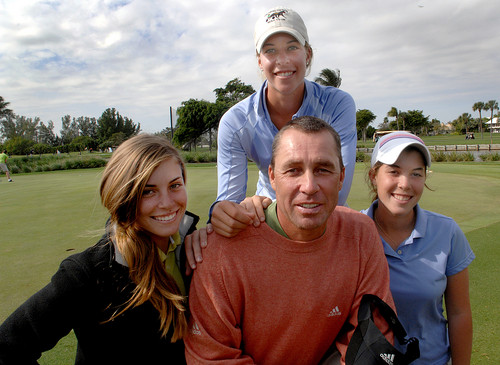
Marika, Isabelle, Crash, and their coach, 2009.

(Golf-match update: My club won, 15½-14½. So we hold the trophy till next year.)

Your Portal to Unlimited Golf Power

The Big Three.

At the PGA Golf Merchandise Show, back in January, I acquired a bunch of wristbands and other accessories that are supposed to give golfers an edge by allowing them to personally harness the power of titanium, magnets, ions (or “ions”), and the kind of shimmery holographic images you see on credit cards. I made fun of all that stuff in a column and a video. Since the show, though, I’ve discovered that I kind of like wearing worthless crap on my wrist while I play golf. In the photo above are the three wristbands I’m wearing at the moment. From left to right:

  • An IonLoop, which provides “all the natural benefits of earth magnets and negative ions: quicker sports recovery, better sleep, stress management, natural energy, better concentration and focus, less stiffness and soreness.” Also rust, apparently. But I’ve started wearing it magnet-side-down, to keep the rust out of view. Besides, who says a little rust on your wrist doesn’t give you ten extra yards off the tee?
  • A barbed-wire thing, which I got in Bogota, Colombia, on a non-golf reporting assignment for The New Yorker.  A woman I interviewed was wearing about a dozen of them, and when I asked about them she gave me one. It’s meant as a protest against Venezuelan kidnappers, who sometimes hogtie their victims with barbed wire. It’s made of plastic, rather than wire, so wearing it doesn’t hurt, and it attracts a lot of attention. Plus, ten extra yards off the tee.
  • A Tri-Balance bracelet, which allows me to hedge my gullibility bet by harnessing “the power of a hologram wristband, an ionic bracelet, and magnet therapy in one easy to wear bracelet.” This, according to a website, is also known as “the power of 3.” Result? Ten extra yards off the tee.

The Guys I Usually Play Golf With Golf School

Meet our faculty.

Like most casual players, I receive the bulk of my golf instruction not from PGA professionals but from the guys in my regular weekend group. When I loop a screamer out of bounds, for example, they don’t hesitate to tell me what I did wrong—and I return the favor. We all have a solid grounding in swing mechanics, which we acquired from magazines, books, Johnny Miller, and the Golf Channel.

We know so much, in fact, that we could probably help you, too. And that’s exactly what we’re going to do at our new golf school, The Guys I Usually Play Golf With Golf School. The instructors are my buddies and me, and we will devote the same thoughtful attention to your swing that we have always devoted to our own.

The main thing you should know about our school is that we’re not going to change your grip. That’s because there are only two things that can go wrong with a golf swing, in our opinion: getting a little quick and moving your head. When you get a little quick, one of us will say “Little quick there,” or “Nice ‘n’ easy now,” or “Low and slow, ol’ buddy.” That usually does the trick. If it doesn’t, Nick will say, “Keep your head down, stupid”—which is not an insult, because he says the same thing to himself before every swing.

If you’re having trouble off the tee, we’re probably going to suggest that you try Brendan’s new driver. Brendan has hardly ever hit a bad shot with it, and when he hurt his thumb last fall and couldn’t play for a month, we snuck it out of his bag and passed it around. Hacker (real name) later bought a driver just like it, but Brendan’s actual new driver is the only one that truly works almost all the time. When your turn with it is over, we’ll send you into the golf shop to buy a new driver of your own. The brand you choose won’t matter, as long as it’s one of the expensive ones, which always work for a week or two.

We own every training aid ever manufactured, and you can take your pick, if you don’t mind wading through the junk in our garages. Help yourself to my old snow tires, too. Our short-game clinic is taught by Bruce and George. Watching those guys chipping and putting for an hour will turn you into Phil Mickelson, by comparison. (An hour’s the limit, though; overexposure could turn you into them.) They also teach a class in deep-water ball-retrieval.

All our lessons are playing lessons, by the way. Net best ball, first-tee do-over, no junk, no gimmes, no strokes on par-3s. We’ll explain the rest when you get here. The first round of beers, needless to say, is on you.

Don’t worry—we’re not going to mess with your grip. Or your wardrobe.

We Almost Lost Hacker (Real Name)!

Hacker’s leg, earlier this week.

For reasons too boring to go into, I’m in Norway without my golf clubs. Earlier this week, in celebration of Addison’s twenty-first birthday, Reese took everyone who wasn’t in Norway to the Yale Golf Course, which was designed by Charles Blair Macdonald and is one of my favorites anywhere. While Hacker was looking for a ball in the tall grass on the seventh hole, Doug hit a power slice from the eighth tee and clobbered Hacker in the thigh (see result above).

Ladies, avert your eyes. That’s Doug icing down Hacker’s injury with a beer, a few minutes after impact.

Hacker is a trooper. Years ago, he felt a twinge in his chest as he was hitting an explosion shot from the bunker in front of our eighteenth hole. He drank a couple of beers with the guys, then went home and mowed his lawn. Only after he had finished the yard did he drive himself to the hospital and learn that he’d had a heart attack.

The Yale accident happened on Tuesday, and I’ve been rushing home ever since. I’ll probably see Hacker tomorrow, when the gang tees off for a bonus round following the Labor Day mixed event.


I Bought a New Push Cart!

Trolleys: Brendan, Tim, Tony, Rick, Hillside Golf Club, Birkdale, England, May, 2010.

Two years ago, during a buddies trip to England, I became a convert to what the British call trolleys. My first was a Sun Mountain Micro-Cart, which I gradually customized:

This is my old push cart. If my wife played golf, I’d give it to her.

I ran it pretty hard, for more than a thousand miles, and a couple of months ago a friend commented that it had started to look like a farm vehicle. That’s not manure in the photo below, but I see his point:

Not manure, but almost.

Anyway, a couple of days ago I did something I’d kind of been hoping I’d do: I busted it beyond repair. I was pushing it up the fourth fairway, and suddenly it started wobbling and making a funny noise. Eventually, I realized that a spoke in one of the wheels had broken.

Busted Micro-Cart wheel–at last!

Replacing the wheel probably wouldn’t be expensive, and I’ve been very happy with my Micro-Cart, but I was itching to try something new. So as soon as I got home I ordered a Clicgear 3.0, from Amazon, for a little less than $200. Unfolding and folding it is tricky, but I got the hang of it out after a couple of tries. I’ll be pimping it a bit in the coming weeks, of course. And there are lots of official accessories, several of which I want to buy. More about that later.

My new ride.

My Clicgear 3.0 weighs more than my Micro-Cart, but it actually folds down slightly smaller. That’s important because this year I also bought a new car, which is slightly smaller than my old car. At the moment, I’m dealing with that by throwing all my extra golf junk into the back seat, along with all my other extra junk. Eventually, though, I’ll have to get the trunk organized. So, really, I had no choice but to buy a new cart.

My new cart is heavier than my old cart, but it’s a teensy bit more compact when folded up. Or so I claim.


Members Caddying for Members

Brad (now our club president) making the official call on who is taller: Tim (light blue shirt) or Ben (with SoBe bottle), who is Tim’s son (and caddie). Summer, 2007.

Many years ago, my friend Art caddied for my friend Jim in the chump flight of our club championship. When Art showed up on the practice tee with a damp towel draped over his shoulder, Jim’s opponent threw a fit. “You can’t have a caddie,” he said. “It isn’t fair.” Art’s handicap was very low, and Jim’s and his opponent’s were very high. With Art reading Jim’s putts, the opponent complained, Jim would have an unreasonable advantage.

Our pro overruled his objection, naturally, and, using the rule book, proved to him that caddies are as much a part of golf as bunkers and casual water. Jim’s opponent remained upset, however. Conciliatorily, Art agreed to turn his back whenever he swung, so as not to make him nervous.

Since that time, members caddying for members during important tournaments has  become a tradition at my club—as I mentioned in my previous post. Friends caddie for friends, sons for fathers, fathers for sons, brothers for brothers, victims for victors. Caddying takes some of the sting out of the octuple-bogey that kept you from advancing to match play. It also turns an individual match into a team event, and, in a thought-provoking way, inverts the chemistry of rivalry.

I’ve caddied for several friends over the years, and several friends have caddied for me; mostly, I’ve caddied for my friend Ray, who is one of my club’s best players. One year, when he and I met in the first round of a big tournament, we agreed that the loser of our match would caddie for the winner the rest of the way. That was pretty much the same thing as my agreeing that I would caddie for him, since he was the defending champion and I had barely survived the qualifier. And, in fact, that’s the way it worked out.

Caddying is a challenge because it requires you to maintain a precise but shifting balance between involvement and invisibility. My worst failure as a caddie came during the final round of the club championship one year, when, intoxicated by the emotion of the match, I loudly disputed a rules interpretation made by our pro. My biggest contribution occurred during the same tournament a few years before, on a par-5 where Ray had hit his drive into a terrible position from which to go for the green. Ray is a stubborn, aggressive player, and he doesn’t like to lay up. He took a long look at his lie, though, and said, morosely, “I guess I should just knock it down there with a wedge”—the sensible play, and, as he knew, exactly what I myself would have done.

But I swallowed hard and said, “That doesn’t sound like you.” The gloomy look vanished from his face. He took his three-wood, and—from a sidehill, downhill lie—hammered his ball just short of the green. It was a dangerous shot, which I would never have attempted and could never have pulled off. But (as I had to keep reminding myself that day) I wasn’t the guy playing the match.

Report from the Club Championship

On Sunday, Addison and I played in the final match of our club championship. At 5:25 the evening before, I received this email from him:

Headed to the course if you’re interested in a quick nine right now. Will wait til 5:40 for a response. Or just be there by 5:40.

He sent the email from his phone, in his driveway, but I beat him to the course, and we teed off at 5:38, for a practice round. On the fourth hole, we saw a red-tailed hawk fussing with something on the ground—maybe a chipmunk. When we got close, the hawk moved to a tree and turned its back to us:

Except for the hawk and whatever it was eating, the course was empty, and we played half of a Two-Hour Eighteen™ in 55 minutes. Then we went to dinner at our favorite restaurant, Popey’s—which is pronounced “Poppy’s.” (Don’t bother searching for it on Google, unless you’re interested in Popeye.)  One topic of discussion: how easy it would be, with a little red, blue, black, and white paint, to make the name on the sign look the way it’s pronounced. Also, we got ice cream.

Our club championship final is 27 holes. The next morning, Addison and I teed off at 8:00, and played the first 18 holes in two hours and fifteen minutes. It was too early to start the final nine—the Sunday Morning Group was still playing, among other reasons—so, to kill time, we went to lunch at our second favorite restaurant, the Hidden Valley Eatery,  with Tony, who was caddying for me. (One of our club’s best traditions is members caddying for members. In last year’s final, Gary, our superintendent, caddied for Ray, who won.)

Hidden Valley wasn’t serving lunch yet—too early—so all three of us ordered breakfast pizzas, a house specialty. Bacon, cheese, tomatoes, something, something, and two fried eggs. Then, back to the course for the final nine, with the usual gallery:

(I won!)

Ominous Development on Fifth Hole

Tree on slice side of fifth fairway. Yes, those leaves are red. This photograph was taken last weekend.

The driveway that leads to my club’s practice range bisects a cornfield. When the range opens for the year, on April 1, the field is muddy and covered with stubble, and as I cross it I know that months and months of golf stretch out ahead. But I also know, in the back of my mind, that the season is already expiring. Our golf year usually ends just before or after Thanksgiving, depending on the snow, and the cornfield is like a living clock, ticking away what’s left.

By Memorial Day, there are neat rows of green corn shoots—still eons of golf to go. On the Fourth of July, the stalks are almost as tall as the door handles on my car, and I wonder what happened to June. In August, the leaves brush my windows as I pass, and, if someone is leaving when I arrive, one of us has to back up. Then, one autumn afternoon, I decide to try to de-shank myself at the range, and on the way in I notice, with alarm, that the cornfield is stubble again, and that the maples at the edges are more orange and red than green. Some of the year’s best golf weather is still to come, along with more opportunities to wear my Royal Portrush sweater, but now there’s no denying that golf is almost done.

Car driving to range last Wednesday. Photo by Hacker (real name).

There are clocks all over our course. Every spring, I forget about the fruit trees until they blossom. Then the blossoms fall, and it’s like pressing the snooze button: I don’t think of them again until crabapples and chokecherries have covered the ground near the eighth and ninth tees. Hitting crabs with pitching wedges is fun, but it’s also a reminder that time is growing short. The big oak that overhangs the clubhouse begins to drop ripe acorns in late July. They sound like golf balls when they hit the roof, and some of them bounce onto the putting green. By September, the turkey chicks that wander in and out of the woods at the bottom of the range are getting hard to tell from the hens. Then the leaf blowers begin again: maybe ten Sundays to go.

Not long from now, we will have our first serious snowfall, and that other clock will begin to tick, the one that measures the empty weeks until spring. It will move as slowly as the clock on a classroom wall, but it will move. And when it starts I will know that in just four months, give or take a week, the range will open again.