Scary Icons Create Tee Times

Whenever rain is in the forecast, even if it’s only a 20 percent chance of showers, play at my club goes way down. Seeing a thunderstorm icon in their web browser apparently causes many members to make non-golf plans for the day. On Sunday, twenty guys showed up for our regular game—a good turnout—but we had the course to ourselves until noon, I think because the Weather Channel icon that morning had lightning bolts in it. There was enough drizzle at one point to make me put on rain gloves, but there was never any lightning or even real rain, and the sun was shining by the time we finished. Our club’s website has a weather app. Maybe someone could modify it to show lightning bolts all the time.

In honor of the Ryder Cup, we used scorecards from Medinah, which Hacker (real name) had downloaded from the club’s website. (We did the same thing during the PGA Championship with scorecards from the Ocean Course at Kiawah.) The only real effect was to shuffle the holes where the handicap strokes fell, but using the scorecard of a major venue is a respectful way to acknowledge the efforts of the big boys, and, besides, variety is interesting.

We also randomly divided into Ryder Cup teams—ten guys representing the United States and ten representing Europe—and played five four-ball matches, for one point each. I was on the U.S. team, which won, 4½ points to ½. We all assumed that the real U.S. team would win, too, by annihilating the Europeans in the singles matches, in the afternoon. Imagine our surprise. The Sunday Morning Group’s record in using golf to predict important events is now 2-1-0; matches of ours correctly called the outcome of the 2008 presidential election and the 2012 Super Bowl.

We’ll play our Presidential Special game again on Election Day. It was created by Tim, who is the inventor of several core concepts, including negative skins, “shooting your pants,” and the mathematical formula by which we predict the winning team score in our regular Sunday games (13 minus the lowest handicap in the field, times -1). Half the field will represent Obama and half Romney, and each hole will have an Electoral College value equal to the sum of its number and its handicap stroke index.(Our 16th hole has a stroke index of 17, so it’s worth 33 electoral votes—16 plus 17.) An entire golf course adds up to 342 electoral votes—172 needed to win.

Future trivia question: Who made the winning putt in the 2012 Ryder Cup Matches? Answer: It wasn’t Martin Kaymer, whose 1-up victory over Steve Stricker guaranteed only a 14-14 tie (and thus a European “retention” of the trophy). The winning putt was the short par putt that Tiger Woods conceded to Francesco Molinari on the eighteenth hole, because their halved match gave Europe a 14½ -13½ victory. If Tiger had made his putt, 2012 would have been the third tie in Ryder Cup history.

The Best Way to Watch the Ryder Cup

No, that’s not a medical office building. It’s the premium grandstand beside the eighteenth green at the 1993 Ryder Cup, which was held at The Belfry, in England.

The best way to watch almost any golf tournament is on TV. That’s especially true of the Ryder Cup, because at any moment there’s hardly anything going on. I’ve been to just one Ryder Cup in person—in 1993, on the Brabazon course at The Belfry, in England—and it was a spectator’s nightmare. The most coveted seats, initially, were in an enclosed multistory grandstand beside the eighteenth green, and people who had passes for it began arriving long before the first match teed off. They then waited for almost twelve hours with nothing to watch except one another getting drunk, because on the first day only one of the eight matches—the afternoon four-ball between Nick Faldo and Colin Montgomerie, for the Europeans, and Paul Azinger and Fred Couples, for the United States—made it to the eighteenth hole.

The Belfry, like most of the courses where the Europeans hold the Ryder Cup, is a dud. The nicest thing that Ron Whitten could find to say about it, in Golf Digest’s 1993 Ryder Cup preview, was that its blandness would prevent it from intruding on the golf—perhaps the faintest possible praise for a championship layout. It’s also the opposite of a stadium course. There are no hillsides or mounds for spectators to stand on, and in 1993 the trees  were way too small to climb. I saw one man standing on a paint can, which he had somehow smuggled past the guards at the gate, and I saw many people standing on small stools, also smuggled. Because the viewing opportunities were so meager, there were crowds surrounding the few available television sets. There was one in the Lloyd’s pharmacy tent, and one in the exhibition tent, and one in a rowdy refreshment tent near the tenth fairway. Medinah Country Club is far more spectator-friendly, but if you’re watching from home you should still count yourself lucky.

You should also be grateful that the broadcast isn’t being handled by the BBC. In 1993, Tom Kite would be putting for eagle somewhere, but on the screen you would see Colin Montgomerie practicing a putt he had just missed, or Nick Faldo standing by his golf bag, chatting with his caddie. The camera operators couldn’t track balls in the air and had trouble finding them when they were on the ground. The producers would suddenly cut to Barry Lane, picking him up in mid-follow-through, and the sound equipment on the course looked like Second World War surplus. The BBC has improved since then, but not enough. In the TV Cup, the USA wins every time.

Ryder Cup: Win, Lose, Draw, “Retain”

The first tie in Ryder Cup history occurred in 1969. It was secured on the final hole of the final match, when Jack Nicklaus conceded a short putt to Tony Jacklin, halving the hole, halving their match, and halving the Cup. After picking up Jacklin’s marker, Nicklaus said, “I don’t think you would have missed it, but I wasn’t going to give you the chance, either.” Ever since, Nicklaus’s gesture has been celebrated as one of the greatest acts of sportsmanship in the history of competition.

On the other hand, it could be viewed as one of the greatest acts of gamesmanship. By giving Jacklin the putt, Nicklaus made the half look less like an accomplishment by the British (who had won the cup only once since 1933) than like a personal gift from Nicklaus. It also left forever hanging the possibility that the reigning British Open champion might have gagged over his eighteen-incher. That’s one of the cool things about match play.

Because the United States had won the previous Matches, in 1967, it “retained” the trophy in 1969. Television commentators and others often speak of “retention” as though it were a form of victory, but it’s not. The only possible outcomes in any match, or in the overall event, are win, lose, and draw. “Retention” is just a housekeeping issue: who will hold the hardware till next time if the two teams tie? Players don’t go to the Ryder Cup hoping to “retain.” They go hoping to win.

Huge Falling Tree Crushes Golf Carts

On the right-hand side of the photo above—which I took this past Saturday morning, at the beginning of an annual mixed event called the Fall Classic—you can see a huge, ancient, two-trunked oak tree just past the end of the golf shop. About three and a half hours later, toward the end of the tournament, the tree suddenly fell down. My foursome was on the far side of the course when it went, but even from that distance the sound was like an explosion. Here’s what I saw when when I got back to the first tee:

The course was full of golfers, but, amazingly, no one was standing near the tree when it fell, and no one was sitting in any of the golf carts parked beside it. Bob W. and Nick-who-works-in-the-golf-shop were playing a putting game on the practice green, and they watched it go down.

The roots picked up the water cooler near the first tee and flipped it over the split-rail fence, onto its roof:

That’s Margaret’s coffee mug. It was unharmed.

Within an hour, our favorite tree guy, who played with Gene B. in the member-guest this year, was on the job. He and his crew cleaned up everything but the two main trunks, which were too big for the chipper.

The next morning, my friends and I posed on the trunks before we teed off. We’re thinking about turning them into a bench. Or maybe we’ll just leave them where they are. That would definitely be easier. Maybe we’ll leave the squashed golf carts there, too, as a reminder that golf carts don’t last forever.


Back-Roads Scotland: Forfar Golf Club

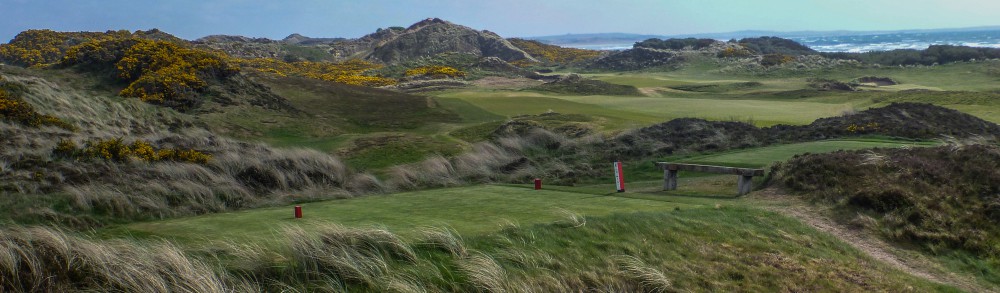
Forfar Golf Club, Scotland, May, 2007.

Forfar, Scotland, is a small town about dozen miles northwest of Carnoustie. Its most famous resident may be Bon Scott, the lead singer of the rock band AC/DC, who was born there in 1949 and died, of acute alcohol poisoning, in 1980.

Brian.

Forfar—prounouced FOR-fer—has a golf course, which was designed by James Braid. I pulled in one evening in 2007, to make sure I’d be able to find it the following morning. It was almost time for dinner, and I wasn’t really planning to play, but suddenly I found myself in the golf shop handing my credit card to the wife of the head pro. On the course, I soon caught up to and joined three members: Brian, a local builder, who sounded a little like Sean Connery and carried his golf bag by the handle, like a suitcase; Gavin, a retired local cultural administrator; and Michael, a jeweler. Here’s the sort of golfers they were: all three, despite having played the course regularly for many years, were surprised to learn that the round blue marker in the center of each fairway was 150 yards from the green. Gavin told me that the three of them played together almost every Monday evening because “then there’s no one in front and no one behind.” They took lots and lots and lots of swings, although we still finished in just about exactly three hours.

The next morning (after breakfast and a bucket of balls at the local driving range, on the other side of town), I played a second round at Forfar. A ladies’ medal competition was going on just ahead of me, so I had plenty of time to admire the course, which is well inland and is surrounded by farms but feels very much like a links course, in part because most of the fairways have distinctive undulations, like gentle ocean rollers—remnants of ancient flax furrows, Brian had told me. (You can see the furrows, sort of, in the photo at the top of this post.) And when I finished I still had time to kill, so I went around again. And the following year I came back, with friends from home.

If I were sure I’d return to Forfar as often as I’d like to, I’d accept an email solicitation I received a few days ago:

15 months membership for the price of 12!

New members can join straight away for the 2012 price of £485 (£460 + £25 bar credit) and receive membership of the Club through until 31st December 2013!

To join call now on 01307 463773.

The 2013 subscriptions for the remainder of the year are as follows:

Full Membership: £485*

5 Day: waiting list in operation
Under 25: £260
Family: £970** (2 adults & unlimited children)
Junior: £100 (17 & 18)
            £75 (12-16)
            £50 (8-11)
Country: £310
*includes £25 bar credit
**includes £50 bar credit

You will be assured of a warm welcome so please don’t hesitate to contact us by telephoning or sending an enquiry to our email address.

For more information on the benefits of membership at Forfar Golf Club please see below.

  • Excellent layout for all ability of golfers to enjoy.
  • Comfortable clubhouse with refurbished lounge & dining room
  • Driving Range facilities
  • Competitions every Thursday, Saturday and Sundays
  • Online tee time booking & Members Website
  • Unlimited Members guest tickets
  • Reciprocal arrangements with other Clubs for reduced greenfees and a member of the Association of James Braid Courses
  • Membership categories to meet your needs
  • Monthly Newsletter
  • SKY tv
  • Free WiFi
  • Excellent Catering facilities 7 days a week
  • PGA Pro with fully stocked golf shop
  • Discounted rate for FGC members on the Angus Council ‘Be Active’ scheme

Payment can be made by all the usual methods and the Club offers a Direct Debit scheme through Premium Credit Ltd.

Critical Golf Accessory: Pocket Handkerchief

There are several New Yorker writers and at least one award-winning novelist in this group. Lido Golf Club, Lido Beach, New York, September 21, 2012.

On Friday, at Lido Golf Club, three members of my foursome had an odd thing in common: we were carrying little packs of Kleenex, in response to a tenacious cold that’s been burning its way through the Northeast. Kleenex isn’t an ideal golf accessory, because it goes airborne in a breeze and doesn’t hold up to rain or even dew. On Saturday, back at home, I remembered to carry a handkerchief. As a result, I never did what I have often done when my nose was running on a golf course: find the least disgusting square inch of my golf towel and blow my nose into it.

Handkerchiefs have fallen out of use in the general population, but they’re good for golfers, especially in high winds, or during cold or allergy season. I paid fourteen dollars for a thirteen-pack of Van Heusen cotton handkerchiefs—just right for a week-long golf trip to Scotland or Ireland. If I had any sense, I’d keep at least one clean handkerchief in my golf bag all the time.

Incidentally, Kleenex facial tissues were introduced in 1924 as a “sanitary cold cream remover,” but sales remained modest until six years later, when Kimberly-Clark re-positioned them as disposable handkerchiefs. Times change.  In 2003, one of my nieces, who was eleven, saw her grandfather using a handkerchief and asked, with astonishment, “Is that a cloth Kleenex?” I had handkerchiefs when I was a kid—some with monograms—but I would bet that neither of my children, who are in their twenties, has ever used one.

Daniel Wexler, in his terrific book The Missing Links, devotes a chapter to the original Lido, which was designed by Charles Blair Macdonald and Seth Raynor. Bernard Darwin called it “the finest course in the world,” and Claude Harmon called it “the greatest golf course ever.” Part of the current course—which was designed by Robert Trent Jones in 1965—occupies part of the original property, but suburban tract houses cover much of the old layout, and Jones’s course is nothing special. Anyone interested in golf history should own a copy of The Missing Links—and not only because Wexler was a college roommate of my brother’s.

The modern Lido, with smoke stacks and a landfill on the far shore. JFK International Airport is about nine miles to the left.

Beef Box: Hotel & Motel Electrical Outlets

Power drain hidden behind motel-room refrigerator/minibar/microwave console.

Traveling golfers have stuff they need to plug in overnight: phones, cameras, GPS devices, laptops, tablets, CPAP machines, whatever. Yet many hotel and motel rooms make power extremely hard to access. Often, the only electrical outlets are hidden behind huge pieces of furniture and are already fully in use. The photo above is of a six-outlet adapter plugged into a standard duplex receptacle—the motel’s work-around solution to its own power shortage. All six outlets were in use already, so I had to unplug both the refrigerator and the alarm clock to plug in my Kindle cord, which also works on my phone. (Amazon pointlessly made its adapter too wide to fit side by side with even a normal-size plug.) To get at this mess, I had to move the fridge, which had a microwave on top of it. And the only place I could find to plug in my laptop was behind the bed:

Behind the bed: a duplex with a quad adapter.

I couldn’t plug in my laptop in the bathroom, because my camera battery was already charging in there. A friend of mine travels with a power strip and an extension cord—although in this room he still would have needed to move either the fridge or the bed.

Alien or Shooting Star? Mystery Golf Photo

I took the photo above the other night and shared it with Graham Stevens, the reader who was kind enough to write about his recent experience at a carts-only course in North Carolina. He used his iPhone to show the picture to his daughter, who is seven, and asked her to guess what it was. Her responses, in order:

  1.  A skinny alien.
  2.  Saturn and a shooting star.
  3. A spooky person staring through the crack of a door with a glow stick on their ankle.

Stevens, in an email, told me: “She then used her fingers to zoom in on the bottom of the picture and said, ‘It looks like a green golf hole.’  I said, ‘Correct!  It is a golf hole.’ She said, ‘Tell your friend he needs a new camera.’ I said, ‘He was playing at night.’ She said, ‘Is he crazy?'”

My crazy friends and I did play golf at night last week, and I’ll be writing about our experience in a future issue of Golf Digest. If you’ve never played golf in the dark, or if you haven’t done it recently, you should watch for the story. As with every other aspect of the game, the technology has improved.

My glowing red ball.


Reader’s Trip Report: North Carolina

Graham Stevens, a reader, sent the following report. He doesn’t name the course, but I’ve encountered the same policy and it drives me bats.

I called a semi-private course I’d never played near the mountain town I was visiting on vacation, and made my usual request: “I would love to be first out. I play fast and I’m a solid golfer (6 handicap). I will play with anyone from any tees as long as they play fast, too. My typical rounds take less than two hours when I play by myself, and I hate playing in more than three hours.”

They said, “No problem. We’ll see you at 7:30 and take good care of you.”

I showed up a little after 7:00 and the guy at the pro shop was great. He gave me tips on which holes were quirky, and told me how to get to the practice areas and the first tee.

At my allotted time, I striped one down the middle. As I walked toward my drive, though, three carts came racing over the tee boxes and down the hill. Their drivers—the entire early-morning staff of the clubhouse—were shouting, “Wait!” “Sir!” “Excuse me!”

The starter, breathing hard, explained that I couldn’t walk. I told him that I had perfectly good legs and that I could walk. He said he couldn’t let me go off first unless I took a cart. I told him I would play faster on foot. He said that wasn’t possible on a mountain course. I said, “I bet you $5,000 I can play faster walking than riding on this course.”

He pleaded with me: “Please, sir, I can lose my job if someone sees you walking.”

I have heard a lot of crazy excuses, but this was a first. 

In the end, I didn’t want to argue. I love this time of day for the solitude, long shadows, and fresh moist air, not for endless irrational discussions. More important, I wanted to play quickly and get back home before my wife and daughter noticed I was missing. I took the cart and played 18 holes in an hour and fifty-one minutes. The starter (still employed!) approached me after I putted out on 18 and he said, “Wow, that was fast!”

I told him, “I would have been in my car ten minutes ago if you had let me walk.”

He smiled and said, “I appreciate you being accommodating this morning and I hope you will come back and see us.”

I said, “You have a great golf course here on a beautiful piece of land, but there is not a chance I will be back unless you change your policy on walking.”


Improve Your Golf Game by Using Luckier Coins

As I remove my clubs from the trunk of my car and put on my golf shoes (while being semi-careful not to scrape the bumper), I often agonize about which ball markers to carry that day. I have a huge collection, consisting mostly of foreign coins, and I realized recently that I won’t possibly live long enough to make full use of them. During a typical round, I carry between four and six markers in my pocket, and I try to spread the selection around—although I hate to abandon a lucky marker just to be egalitarian. Coaches face this dilemma. You’d like to play everyone on the bench, but, on the other hand, you’d like to win.

The image above shows some of my current favorites. On the far left is a Moroccan 10-dirham coin. The guy in the pointed hat is King Hassan II, who was a tyrant but also a golfaholic. (He wore golf gloves on both hands, and, before swinging, gave his cigarette to a servant, who held it with silver tongs.) Next is a Colombian 200-peso piece. It’s good because it has aiming lines and round things that look like golf holes and golf balls. Then an old Mexican peso—nice because the guy looks strange but also friendly and wise. (And lucky.) Then a Norwegian 5-kroner coin, which has a golf hole in it—get it? Last, on the right, is an Indian 2-rupee coin, which I sometimes use when I absolutely have to two-putt. (There are aiming lines on the other side.)

Here are some more:

The coin on the far left is an old favorite: an Irish 20-pence piece. If I pointed the nose of the horse at my ball when I marked it, the next putt would almost always go in or come very, very close. I stopped using it, though, when I realized how many unused (and potentially even luckier) coins I had in the trunk of my car. (I keep my markers in a yellow plastic tackle box.) Next to it is an Australian 20-cent piece. The image is of a duck-billed platypus swimming around, and the curvy lines—which represent the platypus’s curvy path through the water—seem to go well with putts that break a lot. Then another Australian coin, a dodecahedral one, which I like because the many tiny athletes depicted on it don’t include a golfer. Next is a Moroccan 1-dirham coin, which is good for one-putts (because of the 1). And last is a huge, magnetic, fake-pewter Golf Digest thing, which I used for a while out of company loyalty but then abandoned because what’s with the lion?

Not all my markers are coins or coin-like objects. I also have several thousand souvenir markers—the kind with the prong thing that you stick into the ground:

Of the markers in the picture above, my least favorite is the Starr Pass one, because I have no idea what Starr Pass is and don’t care enough even to Google it. I’ve never used it. My favorite may be the impossible-to-decipher one near the lower right-hand corner. The symbol on it looks a little like the presidential seal, so maybe it belonged to an important government official, up to and possibly including the commander-in-chief. Not depicted is my all-time favorite in this category: my marker from Morefar Golf Club, which I seem to have lost. The one time I played Morefar, there was only one other foursome on the course, and my foursome was stuck behind it. But the slowpoke was the Sultan of Brunei, and, apparently, you’re not allowed to play through him. My consolation was the marker, which I now can’t find. Oh, woe is me.