My Close Personal Friend Mike Keiser and his New Golf Course, in Nova Scotia

Back in May, I went to dinner in Chicago with my close personal friend Mike Keiser, the founder and owner of Bandon Dunes. The restaurant was Moto, which serves a four-hour tasting menu (see above) accompanied by fifteen different wines. Our “Spring Lamb” course was actually a tasting menu in itself: a thing of lamb paté, a thing of lamb sausage, a thing of smoked lamb shoulder, a thing of “baconized” lamb, a thing of leg of lamb, and a couple of other lamb-based things, all served on a chef’s cleaver. “Explosion” was a stick of dynamite made from white chocolate and filled with a syrupy liquid that I wouldn’t have minded drinking a quart of, plus a cherry-stem fuse—and the waiter made it explode by dropping it on its plate. He said that my explosion was the best one he’d done so far, and that he was still working on his technique because the dessert was so new. “After Dinner Menu” was the actual menu printed on a slab of marshmallow, which was brought to the table in a saucepan of liquid nitrogen, then placed on top of three kinds of fruit and three kinds of mint and broken to pieces with spoon. Most surprisingly good thing: beet meringue.

Moto’s famous Cuban pork sandwich, which looks like a cigar and is served in an ashtray. It wasn’t on the menu the night Keiser and were there, I’m sorry to say.

The next day, Keiser and I played a round at Chicago Golf Club, which was built in 1895 and is the oldest eighteen-hole golf course in the United States. (The club was founded in 1892, on a different site.) The course was designed by Charles Blair Macdonald and later tinkered with by Seth Raynor, among others. There’s a convent next door, and one of the guys we played with told a funny story about a golfer who took a whiz in the bushes next to it, but I didn’t write the story down and now I don’t remember any of it. Take my word for it, though: that story was funny. C.G.C.’s motto is “Far and Sure,” which is also the motto of Royal Liverpool Golf Club, where Macdonald had lots of friends. In fact, when Macdonald’s new Chicago friends realized how much they loved golf he had his old Liverpool friends send him six sets of clubs.

Keiser’s newest course is Cabot Links Golf Course, in Nova Scotia. Ron Whitten, who is Golf Digest’s architecture editor, has written an article about both it and Donald Trump‘s newest course, which is in Scotland. Whitten’s article will be in the February issue, and while you wait to read it you can watch this video:

The video was made in October by Don Snyder, whose company is called World Golf Movies. Snyder worked as a caddie at the Old Course, among other places, and one day he had the idea of creating video tours of the world’s best courses. Several of his videos are available as apps in the iTunes store, and more are coming. Perry Golf, the tour company, is a partner of his. “Starting next season,” Snyder told me in an email recently, “we will also shoot little fifteen-minute movies of Perry Golf’s clients out playing on their journey, and then sitting down in a pub and talking about what their trip has meant to them.”

Chicago Golf Club, Wheaton, Illinois.

A Golfer’s Bucket List: No. 2

Tony, Hacker (real name), Harry, Stanley, Ray. Bay Course, Seaview Resort, Atlantic City, New Jersey, October, 2007.

2. Go on a golf-only trip with people who love golf as much as you do.  The ideal itinerary consists of the British Open rota plus a dozen or so courses in Ireland and Northern Ireland, but the destination is actually secondary. The high point of my golf year is usually the Sunday Morning Group’s annual weekend excursion to Atlantic City—a trip that our wives let us take because we have been able to prove mathematically that sending us and our golf clubs away for a couple of days each fall is cheaper and more restful than keeping us at home. Absecon Bay ain’t the Firth of Forth, but golf is golf, and playing a full schedule with like-minded companions is bliss. Lying on a beach or lounging on the deck of a cruise ship won’t prevent you from brooding about your job, your debts, your disappointments, or the condition of the world. Playing thirty-six a day with favorite playing partners, in contrast, leaves room for nothing but your slice and deciding where to eat dinner.

To be continued.

Other Gene, Ray, David O., Tony, Old Course, St. Andrews, Scotland, May, 2008.

Hurricane Sandy Update: Lido Golf Club

One of the water holes at Lido Golf Club, during an event I played in back in September. There are more water holes now.

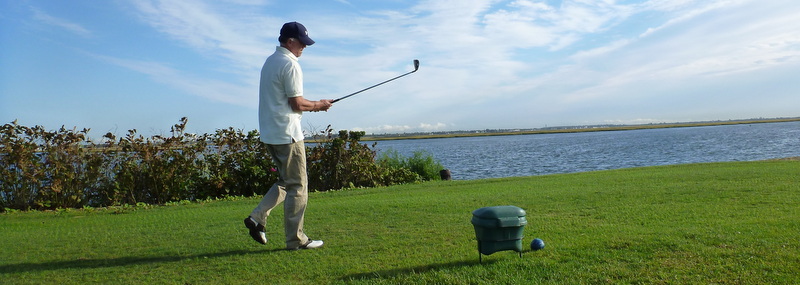
Back in September, I played in a literary golf outing, called the Grudge Cup, at Lido Golf Club, in Lido Beach, New York. That’s one of the competitors in the photo above, teeing off on (I think) the fifth hole, a par 3. A little over a month later, Hurricane Sandy hit Lido hard. Here’s a post-storm aerial photo, which Golf World ran a couple of weeks ago to illustrate a story by Bill Fields:

Postdiluvian Lido Golf Club. The green of the hole in the photo at the top of this post is at the upper left. (Photo from Golf World.)

The golf course was inundated—and, it goes without saying, the neighbors got it worse. The Google Earth screenshot below, which predates the storm, shows just how vulnerable those neighbors were. (The body of water at the bottom of the image is the Atlantic Ocean.)

The golf course is near the center of this Google Earth screenshot. The course and the adjacent neighborhoods were flooded from both sides.

Lido Golf Club is still closed, and the front page of its website has a button you can click to make a donation to the Red Cross.

Lido Golf Club in better times.

Normal Golf Guy Sort of Replicates Famous Road Hole Shot

Mike A. trying to bounce his ball off the boundary wall beyond the first green.

Just six of us showed up this morning. Nobody else was on the course, so we played as a single group. The game was our regular Sunday-morning stuff,  and because we were a sixsome we also played 3-2-1.

Mike A. overshot the first green, and his ball ended up so close to the stone wall that he had to try the shot Miguel Angel Jimenez hit during the 2010 British Open, on the Road Hole at the Old Course at St. Andrews:

Mike, unlike Jimenez, didn’t get his ball onto the green, but he did end up with a better score. (Jimenez made triple-bogey.) I’ve tried Mike’s shot, both successfully and unsuccessfully. It works best if your ball is in front of a stone with a flat side facing the flag.

Even though there were six of us, we got around in a little over three hours. There are several keys to playing quickly in a large group. One is never taking a practice swing. Another is hitting shots when you’re ready, rather than waiting till it’s your turn. Another, on tees, is always having a player “on deck,” in addition to the one actually teeing off, like this:

Gary (left, teeing off) and Mike A. (right, on deck), fifth hole.


Black Friday Special: Still More Holiday Gift Ideas for Golfers

Not many shopping days left. Here are some more gift ideas from the Golf Digest Time Machine.

This ad is from almost exactly fifty-five years ago. Even then, selling these would have been a slow way to get rich. There’s still a Rome Paper Company, although it’s in Georgia, not Indiana. Among its many products: a “germ-shaped stress reliever” (not suitable for children under three).

Golf umbrellas, transparent or otherwise, strike me as more trouble than they’re worth, but some people like them. If you forget to take yours on a golf trip to Scotland or Ireland, you can usually find one or two inside-out ones in the trashcan on the second tee of whatever course you’re playing in the rain.

A golf bag that’s also a chair, from 1958. The ad says it’s lightweight, but to me it looks heavy enough to make itself necessary. Could that be Mr. Moreland himself?

This is similar to Stanley’s eBay club carrier, though probably more useful as a weapon. Is that Sam Snead in the photo on the right?

The Sit-n-Rest, from 1959, combines the best (as well as the worst) features of the previous two items. Note the four-club head cover in the bottom right hand corner. Order now!

18 Good Things About Golf: No. 13

Maybe try adding a cigar: Fuzz and Les, August, 2010.

13. Golf is continually challenging. I used to play frequently with a low-handicap player and long-time student of the game named Art. During one round, he was having trouble with his driver, and on the second tee he said to me in exasperation, “I can’t remember how I take the club back.” Every golfer knows that situation. One day, your swing is there; the next day (or hole), it’s not. No matter how good your game may seem at any particular moment, there’s always some part in need of tinkering, and you always know that the parts which now seem sound may suddenly disintegrate. This prospect of arbitrary, undeserved disaster causes strange behavior. Nick Faldo doesn’t trim his fingernails once a tournament has begun. Tom Watson carries an odd number of coins.

Because the golf swing is so ephemeral, it requires special treatment. My own theory is that you should always be changing something about your game, even when you’re playing well. Your swing won’t stay still, so you mustn’t either. Your only chance of keeping up is to stay a step ahead. Maybe strengthen your grip slightly, or open your stance a bit, or think a little harder about the position of your chin—anything to distract the game-destroying gremlins that are always standing on your shoulder, waiting for you to become complacent. Once when I was playing especially well, I decided suddenly to stop wearing a glove. I wasn’t unhappy with gloves; I just needed something different to think about. And, if my game suddenly went south the following week, I wanted something dumb to blame it on.

In Praise of Winter Rules

Gary, our superintendent, had to mow the fairways today (see above), but he and his crew also put the snow cover on the practice green (see below). The grass is still growing, but winter is coming.

This is the time of year when every round is a bonus round. It’s also the time of year when my friends and I permit ourselves to lift, clean, and creatively place our balls within a foot or two of where we find them, even in bunkers. I used to fret about this brazen violation of the game’s rules; golf’s most sacred imperative, after all, is “play the ball as it lies.” But I’ve stopped feeling bad about rolling them over. As Tim said once, “There’s a genuine art to improving a lie.”

Adopting so-called winter rules creates shot-making possibilities that few of us would experience otherwise. There’s a par-five on my course that I seldom reach in two—unless I’ve sliced my drive into the weedy wasteland to the right of the fairway and perched my ball on the crest of a tee-like tuft of desiccated scrub, so that I can smack it with my driver. Even I can produce backspin with my wedges if I’m hitting them from a patch of frost-burned turf. Fluffing up the rough on the edge of a greenside bunker enables me to hit parabolic flop shots, just like Phil’s.

Golf courses would be cheaper to maintain if we all played all the time by winter rules. Fairways wouldn’t have to be manicured; in fact, inconsistent playing conditions would be prized, because they would offer a spectrum of exploitable lies. Casual cheating would be neutralized, since the guys who now depend on foot-wedges would lose their competitive advantage. Divot holes and clumps of mud would cease to matter. Equipment manufacturers would thrive, as players rethought their choice of clubs. (How about a huge-headed wedge for plucking a ball from the peak of a carefully molded cone of bunker sand?)

Of course, we would lose something, too. Preferred lies are like wild cards: real royal flushes are devalued when threes and nines are wild. For most of us, though, the gain would more than offset the loss. There’s something thrilling about launching a big banana from the tee and shouting, “Get in the rough!”

We had the course virtually to ourselves, so we played as a sevensome and got around in three and a half hours.

A Hole-in-One Fund That Doesn’t Defraud Golfers

Chic paying his fifteen-dollar entry fee to Hacker before teeing off on Sunday morning. No twenties, please. Chic’s shorts (after November 1) earned him one extra handicap stroke.

The Sunday Morning Group has a five-hundred-dollar hole-in-one prize. The money comes from our regular Sunday-morning entry fee, which is fifteen dollars. (Five goes into a pool for the winning team, five goes to skins, two goes into a pot that’s shared by everyone who matches the morning’s best net score on the so-called Money Hole, which is announced before we tee off, and three goes into the S.M.G. slush fund, which pays for things like the hole-in-one prize.)  The last person to make a hole-in-one during one of our Sunday games was Reese, but he did it before we had a hole-in-one prize so he got nothing. Last week, though, Hacker (real name) decided that the slush fund had become so huge that Reese ought to get something anyway, so he gave him two hundred and fifty dollars. Reese used the money to buy liquor and other stuff for a bar at lunch:

Reese’s hole-in-one bar is on the left. That’s Howard on the right, tending the grill.

Lunch itself was provided by Howard. Our town’s grocery store had shut down its hamburger-patty-pressing machine for the winter (for some reason), so Howard had to buy ground beef in bulk and shape our cheeseburgers with his own hands—very possibly the first time that’s ever happened. He also brought two kinds of fancy mustard (but no regular mustard).

The fact that Hacker paid out a hole-in-one prize that, technically speaking, no one had earned distinguishes him from much of the rest of the golf world—which, apparently, is always thinking of reasons not to pay up. You can read about several such cases on the website GolfDisputeResolution.com, which covers “the intersection of golf and law” and was created by Rob Harris, a Connecticut lawyer. Harris writes about an especially interesting hole-in-one dispute here.

This is what Harris has to say about his own golf: “At the age of 11, on a very hot day, I lost the 9 hole junior boys championship at Tuscarora Country Club on the second hole of sudden death; I proceeded to throw up at the post-event lunch.” Hey, Harris—come join us on Sunday. You’ll fit right in.

These two were curled up in the Dumpster during lunch on Sunday. Gary, our superintendent, says they come and go.

Why Can’t Certain Golfers Put the Flag Back Straight?

Second green. The ball is Doug’s. The flag is as it was left by the group ahead of ours.

Six of us played behind a couple of senior members today, and on three consecutive holes we found the flag as in the photo above. Is this an age-related thing? An old-guy insertion problem?

And speaking of that: I can never remember which HDTV channels are which, so I usually just flip around until I see golfers. Once, while I was doing that, I came to a commercial for erectile-dysfunction medicine (naked middle-aged couples lounging in bathtubs), and thought, “This must be the golf tournament”—and it was. Another usually accurate indicator: commercials for enlarged-prostate medicine (clothed middle-aged guys running to the bathroom).

Today, we started with five guys, so we played Perfect Skins. Then Peter P. arrived—he’d had trouble breaking through his Invisible Fence—so at the turn we switched to 3-2-1, which is a game we made up for sixsomes. Here’s how it works: you divide into two three-man teams, by pulling balls from a hat. Then you play regular best-ball, except that if the best ball is a tie you break the tie with the second-best ball, and if that ball’s a tie, too, you break it with the third. Your team gets three points if you win a hole on the first ball, two if you win on the second, and one if you win on the third, and if all three balls push no one gets anything.

This is really just the six-man version of a very good four-man game called Second Ball Decides. So if they don’t allow sixsomes on your course, or you don’t have five friends, you can play that. And if both balls tie in that game you can award the hole to the side that sank the longest putt—gimmes not included.

Peter P., Doug, Mike A., Fritz.


My Close Personal Friend (a Different) Tom Watson

Nick and Hacker (real name), Dyker Beach Golf Course, Brooklyn New York, 2006. That’s the Verrazano-Narrows Bridge in the background.

As soon as our home course closes for the season, my friends and I pack up our clubs, say goodbye to our wives and children, and head south for a while, to a place where golf can be played on real grass even in the middle of the winter. Which is to say, we go to the Bronx.

Many people don’t realize that there is a golf course inside the New York City limits, but there are more than a dozen, and almost all of them are public courses that are open year-round. Our favorites are probably Pelham Bay and Split Rock, in the Bronx, and Dyker Beach, in Brooklyn, but there are others and, because there’s no such thing as a bad golf course, we sometimes play them, too. (You can read more about winter golf in New York here and here.)

The drive south takes us down I-684 and the Hutchinson River Parkway and past still more golf courses, most of which don’t stay open all winter. One of those is Saxon Woods, which is one of six public courses owned by Westchester County, New York. Saxon Woods is so close to Winged Foot and Quaker Ridge that some people figure A. W. Tillinghast must have designed at least part of it, too. The evidence for that isn’t strong, to say the least, but as we drive by I look at it longingly (which is how I look at all golf courses).

Not long ago, I received an email from Tom Watson, a Saxon Woods regular, who wanted me to know about a game he had invented. Here he is:

Tom Watson (real name) playing in a charity outing at Westchester Country Club, Rye, New York, 2012.

Tom wrote:

“I simply keep my best score for each hole for the entire season, and add them up for a season’s best net total. So it allows a 19-handicapper to post a ‘score’ that’s closer to the pros than to guys who put their shoes on in the parking lot. And it gives you some real rooting interest as the season wanes. I was sitting on 68 last week when I stepped up to one of the only two holes I haven’t parred all year. A good drive, a yanked three-wood, a big flop shot over a bunker, and an easy three-footer later, I was writing down par and dropping my Season’s Best to 67. It’s a number I’m not usually acquainted with—and it made the round. I didn’t quite go all Ian Poulter on the green, but there was a discreet fist pump involved. It’s the only golf game I know of where your score always goes down over time!”

Tom’s invention is actually a re-invention. A cumulative score like the one he compiled is called a ringer score, and there are lots of clubs and leagues and groups that run season-long ringer competitions. (One of them is Wethersfield Country Club, in Connecticut, where Rick and I played in a state senior four-ball tournament this year.) Ringer scores are also fun to use as a side bet on golf trips, over multiple courses. Ray, Tony, and I did that during ten rounds on three courses at Bandon Dunes, not quite six years ago. I’m pretty sure I won, although I don’t recall collecting any money.