Back-Roads Scotland: Gairloch

In 2007, a Scottish guy told me that I absolutely had to play Gairloch Golf Club, a nine-hole links course in an isolated village on the country’s west coast. Gairloch was a solid hour and a half out of my way, but he insisted. So I went.

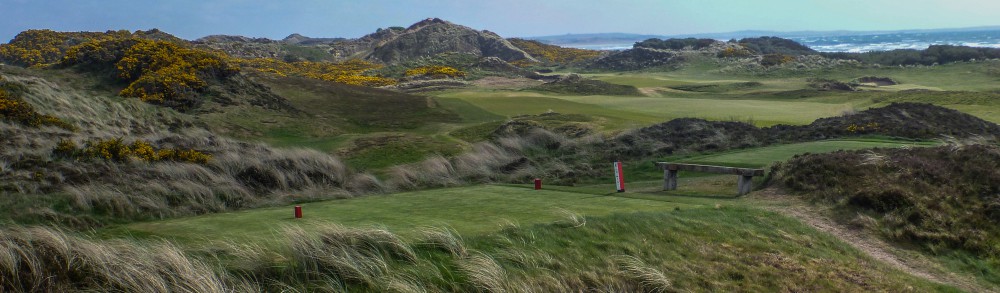
I’m glad I did, in part because the drive—through the desolate mountains of Wester Ross and along the southwestern shore of Loch Maree, on a road that sometimes narrowed to a single lane—was beautiful:

I got a room at a small hotel on Gairloch’s harbor, and was awakened during the night by what sounded like a hundred-year typhoon lashing against my window. In the morning, the BBC said that the weather that day would be pretty good in all of Scotland except the part where I happened to be, for which the forecast was “heavy rain” and “gales.”

I drove through both on my way to the golf course, a short distance down the coast road, and found the parking lot empty and the clubhouse locked. So I zipped up my rain suit, let myself through the gate, and teed off alone.

Gairloch is just nine holes, and six of the nine are par-threes, and you have to go around three times to push your golfometer past six thousand yards, but it’s a wonderful course and I’m not a bit sorry I went to so much trouble to play it, even in driving rain. (How’s that for a recommendation?)

To get to the medal tee on the eighth/seventeenth, the course’s sole par-five, you climb a slippery path up the rocks to a spot from which you can see the course, the clubhouse, the town, the mountains, the harbor, and (I think) the isle of Skye, among other stirring sights.

And the hole’s a corker, too.

A club employee had arrived by the time I finished my first nine. I watched her raise the Gairloch flag in a wind that was almost strong enough to rip it from the pole, then made breakfast of a couple of candy bars from the golf shop. Then I played nine more holes, returned to my hotel, took a hot shower, and checked out.

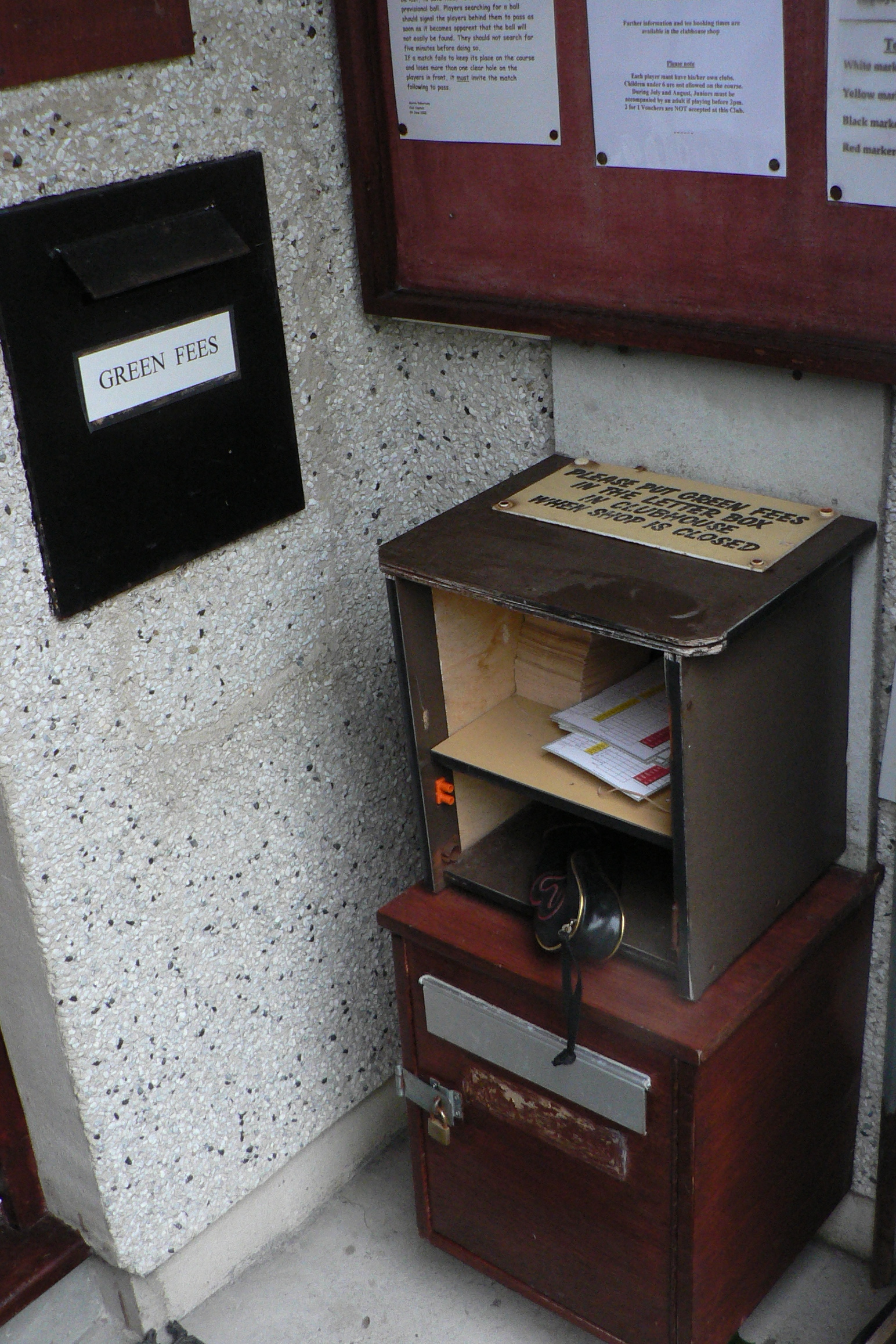
And here’s a photo of Gairloch’s Honesty Box, which is mentioned in one of the comments below:
The Late-Season-Golf Problem, in Diagram Form

Several years ago, I played a few rounds in northern Scotland in December. The sun began setting almost as soon as it had risen, and even at noon it practically sat on the horizon. The late-season golf window here in Connecticut isn’t as narrow, but you have to pay attention. Five of us teed off at 1:00 this afternoon. We played in just over three hours, but by the end I was having trouble following drives. Mornings are tough, too:

Rick, November sun, Sunday morning, seventeenth hole.

Last week, I spent a couple of days in Kansas City without my golf clubs. My mother told me about a local country club, which a few years ago assessed its members for major improvements to the golf course. The assessment was substantial, and quite a few members left the club rather than pay it. Four of my mother’s friends went to the club one day for their regular bridge game, and when lunch was over they discovered that none of them could sign the check. All four, it turned out, had dropped their membership without telling the others.

Stanley on the second tee last Sunday, with his Crocodile Dundee hat (bought on eBay) and late-season club-carrier thing.

A Golfer’s Bucket List: No. 1

My luck-of-the-draw playing partners at Tarbat Golf Club, a ten-hole course in Portmahomack, Scotland, across Dornoch Firth from Royal Dornoch Golf Club. I don’t remember their names, but they lived nearby and worked in the oil industry. They were playing in a tournament but had no expectation of winning anything and so didn’t mind having me along. May, 2007.

Life, I discovered recently, is much shorter than it seemed to be when I was fifteen years old and waiting to get my driver’s license. I’m going to turn sixty in a little over two years, and not long ago I realized with distress that I scarcely have enough time left to paint the rest of my shutters, much less to qualify for the senior tour. And what about that twenty pounds I was going to lose?

Fortunately, I’ve already managed to accomplish more than I ever thought I would. In a club tournament a few years ago, I five-putted from six feet, turning a merely bad round into one that I’ll be able to boast about to my grandchildren. I also once spent part of a family vacation writing an apology letter to the entire membership of my golf club, after (allegedly) behaving like a man half my age.

Now that I really am my age, I intend to devote the dwindling remainder of my time on earth to telling other people what to do. Here is the first of ten important things that I think every serious golfer ought to try to accomplish before it’s too late:

1. Explore golf from the singles line. Like most golfers, I play most of my rounds with people I know already—guys I tend to think of as my best friends, even though I’m not sure where some of them work or whether they have kids. However, I’ve played more than a few of my favorite rounds with total strangers after showing up at an unfamiliar course by myself or with less than a full foursome. At various times over the years, on golf courses on four continents, I’ve fortuitously been paired with: a French real estate developer who had a weekend house in Morocco, a guy who owned and operated a souvlaki pushcart in Manhattan, the man who served as the Senate’s chief counsel during the Iran-Contra hearings, a retired Korean wigmaker, three guys who were playing hooky from their jobs on the assembly line at Boeing, a future chairman of the Securities and Exchange Commission, a teacher who had recently started a golf program at an inner-city high school, a retired cotton broker who had once been a colleague of Paul McCartney’s father, and an unemployed carpenter who looked like George Carlin and told me that the key to golf is to “swing easy as hard as you can.” How many other relatively ordinary activities throw you together with people like that for an afternoon?

To be continued.

The ninth/eighteenth at Tarbat. This is one of my favorite golf holes anywhere: a short par-four that plays either around, over, alongside, or into a cemetery, depending on the shape and length of your tee shot.

More Holiday Gift Ideas for Golfers

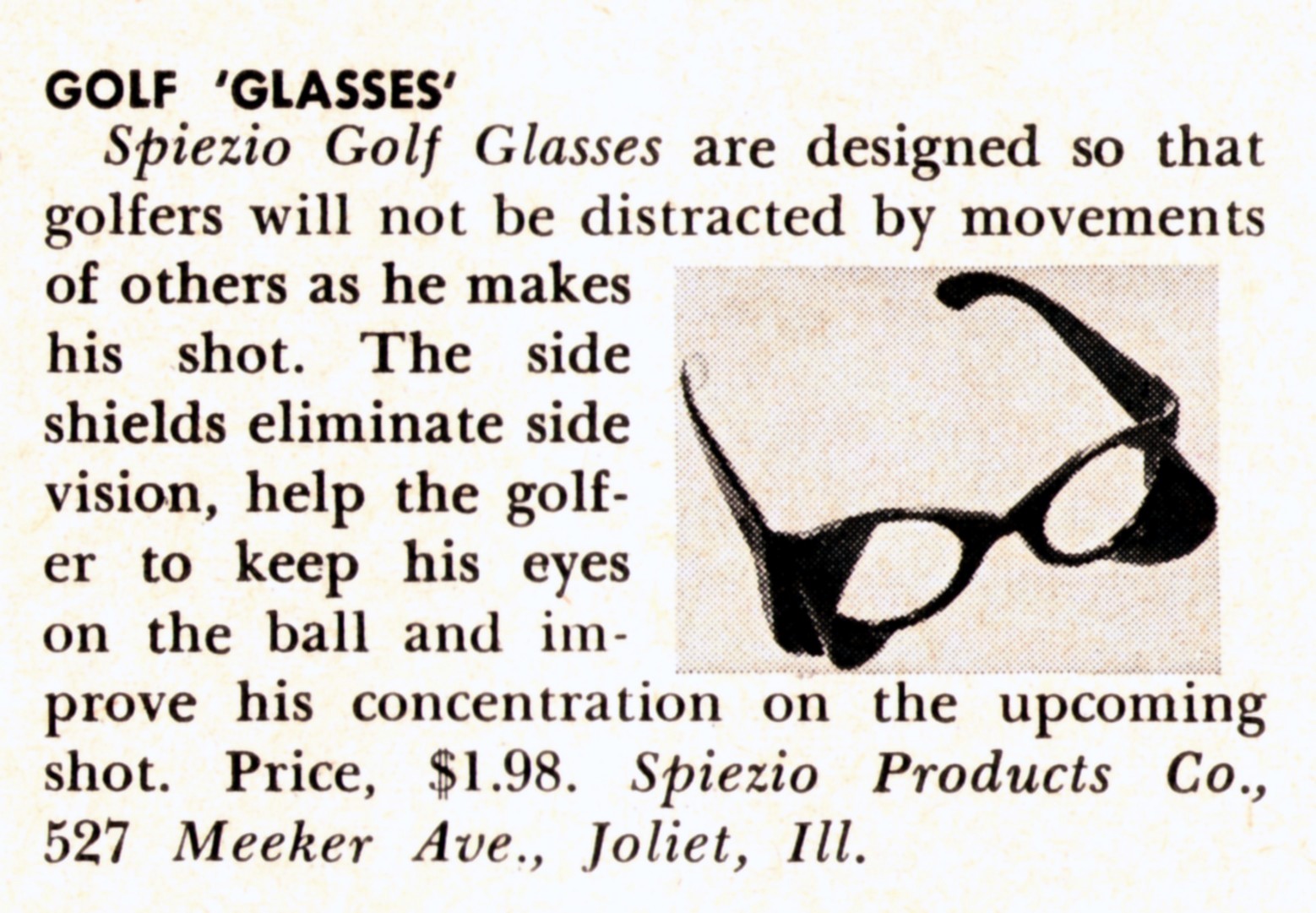
Every year, my secret Christmas wish is “Please don’t buy me golf balls from the big sale display at Dick’s.” Instead of those, how about something from the pages of Golf Digest fifty years ago:

These glasses are from 1958. They wouldn’t do me any good, because I play better with distractions, but I can think of guys they might help. If you could move the side shields to the top, they would be useful in the rain. (Tip: the best way to dry your glasses is with the fingers of your cotton rain gloves, which work almost as well as a chamois.)

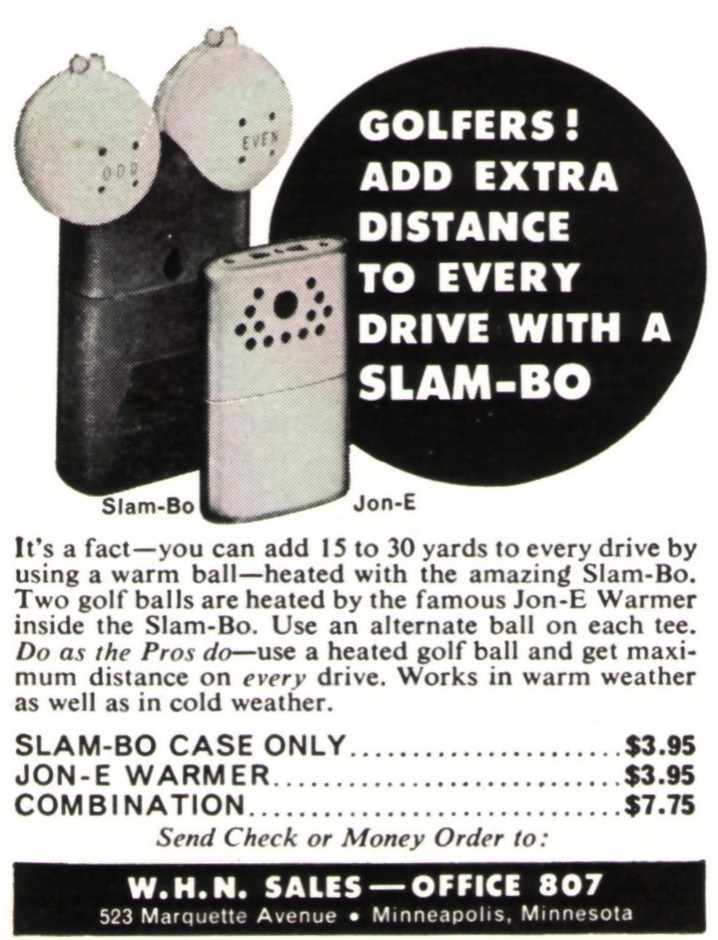
Did the pros really heat their balls in 1961, when this advertisement ran? Whether they did or not, is it legal today? If so, Zippo makes a gizmo that looks a lot like the Jon-E Warmer. (You can buy one here.) Gary, our superintendent, usually brings hand-warmers for everyone when we play in the winter. I don’t really care for them, although I did once play while wearing a back warmer. Note the handy “odd” and “even” designations, to prevent confusion on the tee.

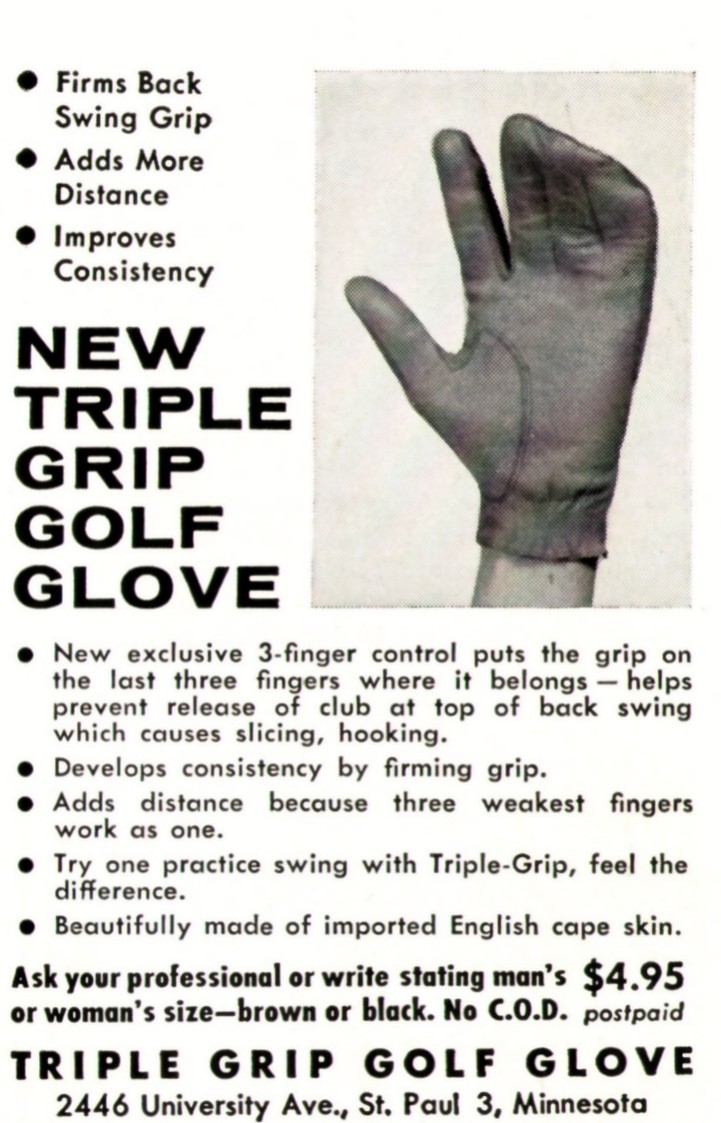
This Creature-form-the-Black-Lagoon glove is also from 1961, and also possibly illegal. The digital cluster on the right looks as though it’s about to divide into separate fingers—including, possibly, a sixth one.

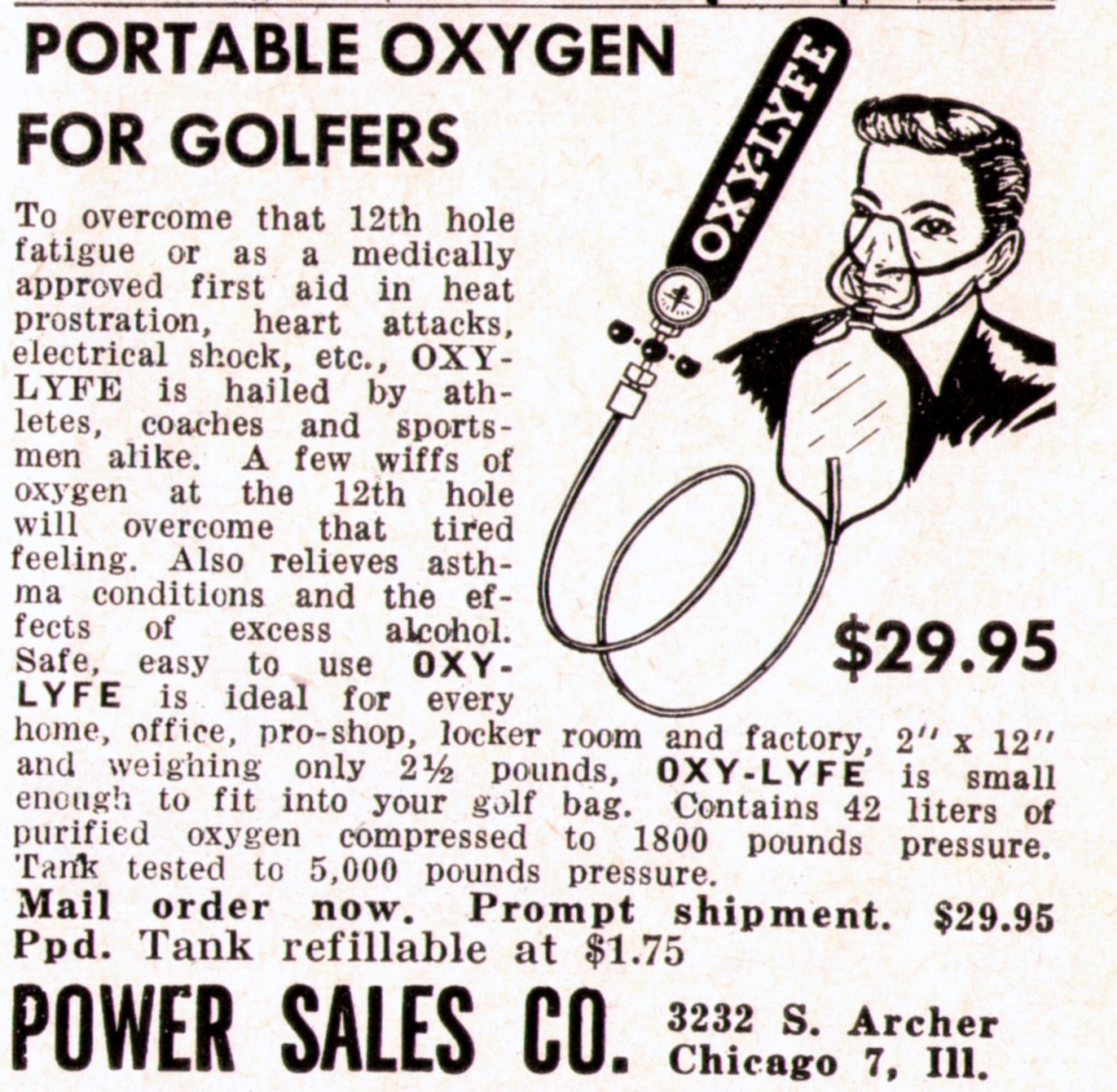
Is this the sort of thing Lance Armstrong was doing? Also: why the emphasis on the twelfth hole?

This device, from 1961, might actually be a partial solution to the dirty-pocket-rim problem, which I complained about over the summer. Maybe add a tee bandoleer and some magnetic ball markers?

Still baffled about what to give (or ask for)? More soon.

Five Holiday Gift Ideas for Golfers

It’s never too early to start shopping for the golfer in your family. These gift ideas are from the pages of Golf Digest in the late 1950s and early 1960s:

This item is from 1957, when golf, cocktail-drinking, and home refrigeration were all ascendant in the United States. U.S. Royal was a trade name of the United States Rubber Company, which renamed itself Uniroyal in 1961. It no longer makes golf balls, although it may still make ice trays.

The reflective metallic golf hat, also from 1957, is an idea that never caught on, for unknown reasons. The hat was probably most useful in match play, since by standing in the right place and tilting your head you could temporarily blind your opponent. The logo notwithstanding, I don’t think anyone ever wore one in the Masters.

Wehrmacht surplus? Somebody must have bought a load of these, because they were advertised all over, and not just in golf publications. This ad is from 1960. Hats like this are still available, although they’re of interest mainly to Third Reich fetishists.

Also from 1960. Golf ball repair is a concept that doesn’t really exist anymore.

This ad is from 1958, but versions of it ran for several years. The price is per week, not per night, and it includes room, golf, meals, tips, and just about everything else. (Dove hunting may have been extra.) Today, you’d pay almost as much at Pinehurst for a dozen Pro V1s.

Don’t see anything you want? More gift ideas soon.

Golf Carts: Fairway or Rough?

The winning team, by a record margin: Chic, Gary, and Doug. Second hole, November 4, 2012.

Beginning November 1, the Sunday Morning Group gives an extra handicap stroke to anyone who wears shorts. Chic and Doug both did this morning—and Doug didn’t wear a hat, and after a few holes he took off his jacket—even though it was 35 degrees when we started. We had three threesomes, and we played two best balls, net, off the low handicap, which was four. Chic and Doug ended up on the same team, along with Gary, our superintendent, but the extra strokes were meaningless because they shot 12 under, which was 16 shots better than the second-place team (mine). That’s a record, as far as anyone can remember. Incidentally, the Sunday Morning Group’s record worst round is 9 over par, net, on one best ball; it was set on October 22, 2001, by Frank D., Rick, and me.

November 1 is also the day the golf shop closes for the year, and that means no golf carts from now till spring. (The carts are stored for the winter in a building behind the ninth green which somehow survived Hurricane Sandy—see the photo below.) The course always looks great once the carts have been put away, because there aren’t tire tracks running everywhere.

Thinking about that made me think about an unresolved controversy at many clubs, including mine: do golf carts do more damage on fairways or in the rough? Gnarly old rough seems “stronger” than manicured fairways, but cart tracks are usually harder to see in short grass than in long. I’ve played courses where players were told to keep their carts off the fairways, and I’ve played others where they were told to keep them out of the rough.

Several years ago, I asked Stacy Bonos, an agronomist in the Turfgrass Breeding Project at Rutgers University, who was right. She hesitated, but when I pressed her she said that, all in all, carts probably probably did less damage to fairways than to rough.

No more carts till spring.

Two Great Golf Recipes

Bob, eating a cookie.

Last month, my club beat our No. 2 enemy club in a tournament named after our retired superintendent, who is shown eating a cookie in the photo above. (You can read more about him here, in an essay I wrote for Golf Digest ten years ago.) The tournament is named after him because before he came to work at our club, in the mid-1960s, he worked at their club. Our victory gave us a sweep of this year’s majors in our area: our two big annual men’s inter-club matches and a regional senior tournament, in which last year’s winners were so confident they’d win again that they’d already had their name engraved on the cup. Now we have to get that removed.

One of the best things about our match with our No. 2 enemy club is the soup that Dan, who works there, always prepares for the competitors:

Dan, in the tournament kitchen.

Dan’s soup has two ingredients: (1) clam chowder, and (2) hot sauce. You add the hot sauce yourself:

Note the recycled plastic-spoon holder, far right.

Hot sauce keeps clam chowder—which I like—from tasting a little bit like library paste.

My wife, Ann Hodgman—who has written several cookbooks, among many other things—has an even better golf recipe, which is in the 2011 edition of her first cookbook, Beat This! It’s for deep-fried dill pickles, and it’s from Robert Johnson, who used to be a chef at Augusta National. Ann wrote, “Since the recipe the chef gave me might be too challenging for people unused to deep-frying (‘add as much Cholula hot sauce as you will like to use’), I’ve expanded it a bit.” The complete recipe is on pages 122-23. If you give the book to the person in your house who does the cooking, maybe you’ll get to have them for Thanksgiving.

Halloween at Augusta National

Former Secretary of State George Schultz explaining golf to the mayor of San Francisco in 2005. (Photo by Luke Thomas.)

Condoleezza Rice isn’t the only former U.S. Secretary of State who belongs to Augusta National Golf Club: George Schultz, who ran Ronald Reagan’s State Department, is a member as well. In 1983, Schultz brought his boss and Donald Regan, the White House chief of staff, to the club as guests, and in addition to playing golf they discussed the U.S. invasion of Grenada, which began three days later, on October 25.

During that visit, a forty-five-year-old Augusta resident named Charles R. Harris rammed his pickup truck through a locked gate, took hostages at gunpoint in the golf shop, and demanded an audience with Reagan, who was playing the sixteenth hole. Secret Service agents surrounded the shop, and sharpshooters set up on the putting green. (One of them told a club member that the scope on his rifle was so precise that he would be able to hit a half-dollar coin on the first green, more than four hundred and fifty yards away.)

Harris eventually released all his hostages except David Spencer, the co-professional. Harris kept a pistol to Spencer’s head, and he threatened to shoot off Spencer’s fingers one at a time if Reagan wasn’t brought to see him. To prove that he was serious, he fired a bullet through a window in the front of the shop. (Today, a piece of the window frame with a bullet hole in it hangs on Spencer’s living-room wall.) Spencer was held at gunpoint for two tense hours (not twenty-one, as some Web accounts say). He managed to escape during a moment of confusion when food was sent in for Harris.

“Dave ran out the door and saw Mr. Johnson, the club’s barber, and myself standing there,” Dr. Stephen W. Brown, a member, told me in 1996, “and he more or less collapsed in our arms. I took Dave up to the clubhouse and sat with him awhile, and I told him that his wife knew he was out and all right. He said he wanted to cry. I said, ‘Well, go ahead. Nobody’s here but the two of us.’ He quickly wiped his eyes and turned to me and said, ‘Dr. Brown, I was just as nervous as if I was standing over a three-foot putt and Mr. Roberts told me I had to make it.” That’s Clifford Roberts, of course—the club’s legendary co-founder and longtime chairman.

One October evening fifteen years later—after Schultz had played a round with Nicholas Brady, who served as Secretary of the Treasury under Reagan and the first George Bush and is also a member—Schultz gave  everyone in the dining room a handmade Halloween favor: a small orange-and-black gift bag containing an orange golf ball on which he had used a black marker to draw a smiling jack-o’-lantern face. I got one because I was there working on my book The Making of the Masters. (See photo below.)

Orange and black, not coincidentally, are the colors of Schultz’s alma mater, Princeton University—which he also honored by having a tiger tattooed on his rear end.

Top-Flite jack-o’-lantern, hand-painted by my close personal friend George Schultz. (Collection of the author.)

Hurricane Sandy Golf Update

The huge old oak tree near the fourth green, which was nearly destroyed in the Halloween storm a year ago, dropped one more branch yesterday, during Hurricane Sandy, creating a shortcut to the fifth tee.

Playing golf during the hurricane turned out to be impractical, but five of us did play an inspection round Tuesday afternoon, after the storm had passed. There was surprisingly little damage to the course, other than the busted fence in the photo above and a white pine that had fallen across the fifth tee, visible in the photo below. We decided to play the pine trunk “as it lies,” and, because it was lying between the white tee markers, that meant getting the ball up fairly quickly.

Adam teeing off on the fifth hole.

Thirteen years ago, on the first night of the Sunday Morning Group’s first annual October golf trip to Atlantic City, we ate dinner at a terrific Italian place downtown. We looked for it again a couple of times during the next few years, but no one could remember its name or exactly where it had been, and we eventually gave up, although we didn’t stop talking about it. (“Remember that great Italian place we ate dinner at in 2000?” etc.) Last night, during the storm, while I was watching the Weather Channel and searching the Web for frightening pictures of hurricane damage, I noticed a photo on the MSNBC site of a flooded street in Atlantic City, and scared my wife by shouting “That’s it!”

And that truly is it: Angelo’s Fairmount Tavern, on Fairmount Avenue. Someone please tell me that the hurricane didn’t sweep it away.

Hurricane Sandy Golf

On Sunday, two three-man teams tied at -10, so we held a playoff: wrong-handed overhand throw over the fence between the first tee and the putting green, closest to the pin. This was supposed to present a “perfect storm” of difficulty, but Corey (our new pro) and Nick (who works in the golf shop and plays three sports at a local high school) can throw better lefty than most of the rest of us can throw righty, and since the two of them were on the same team it wasn’t close. That’s Corey, throwing, in the photo above. At the far right is Stanley, nervously practicing.

While the burgers were grilling, Hacker (real name) suggested that we play golf during the hurricane “to monitor the storm and protect the course.” We’re going to try that on whichever day the weather seems worst, assuming that trees haven’t fallen across our driveways. Someone said that we might as well play naked, because if we didn’t the hundred-mile-an-hour winds would “blow our clothes off.”

This hurricane has made everyone think about the storm we had exactly a year ago, when we lost power for a week and I had to fly to Chicago to take a shower. Here’s what things looked like then:

And here’s what the golf course looked like a week later, when I got back from Chicago:

No one thought we’d play again that year, but, thanks to Gary and his crew, we were open again as soon as the snow had melted, and we stayed open through New Year’s Day—a record by almost a month.