Why Golfers Should Watch the Radar, Not the Forecast

Smallest Sunday Morning Group on record, Sunday, December 16, 2012.

Smallest Sunday Morning Group on record, Sunday, December 16, 2012.

We had a good group and decent weather this past Saturday, but the forecast for Sunday was horrible—rain, snow, “ice pellets”—so Hacker (real name) decided the prudent thing would be to cancel the regular meeting of the Sunday Morning Group (because of “upcoming weather”) and concentrate on planning our second annual S.M.G. Christmas party and Global Warming Invitational.

When I woke up on Sunday morning, however, there was no precipitation of any kind, either in my yard or on my Wundermap (the most important piece of golf equipment after the 34-degree hybrid). Just to be sure, I checked Raindar, on my smartphone. Yup: nothing. I then sent an emergency email, to which I received just one response, from Mike A. (Hacker had recklessly committed to taking his grandchildren to Cabela’s.) Mike and I met at the course at 10:00.

There was a tiny bit of icy precipitation of some kind, which accumulated in trace amounts on the wheels of my pushcart:

Slight icy build-up, after eighteen holes.

Slight icy build-up, after eighteen holes.

But the weather was actually decent, and there was no one else on the course, and we finished in a little over two hours. We played our regular Sunday game (net best ball, stroke play, plus skins), but with one-man teams (of which we had two). I was a stroke ahead after nine holes, but Mike annihilated me on the back and finished with a total of 8 over par—the best score ever recorded by a one-man team. We split the skins (with five each) and tied the Money Hole (No. 2, because there were two of us), so he ended up winning five dollars. Here’s our scorecard, which I kept in Sharpie on a torn-apart Titleist box:

Scorecard 12-16-12

The moral of this story is: make no irrevocable golf decision based on a forecast alone.,

18 Good Things About Golf: No. 14

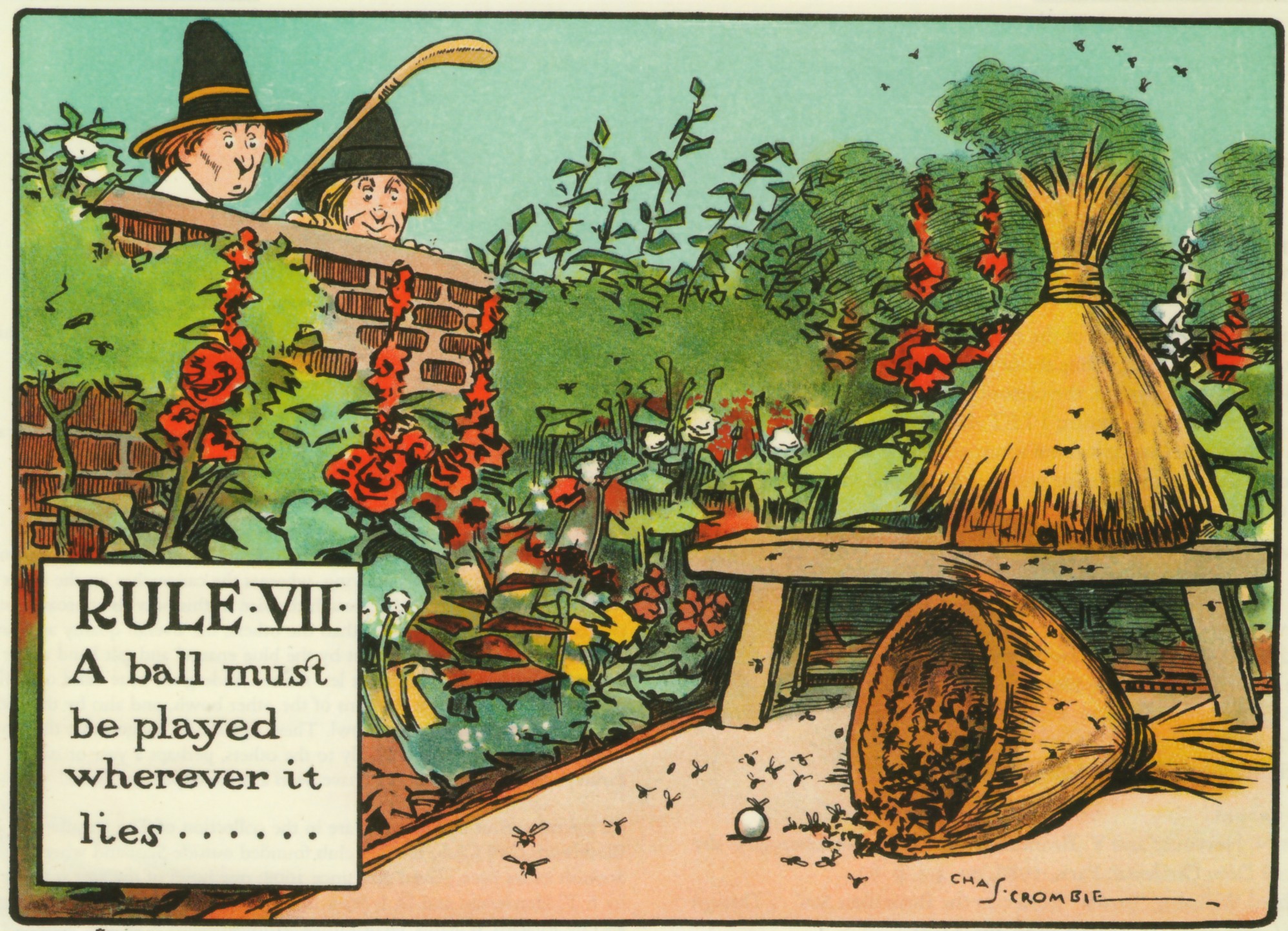
Charles Crombie, The Rules of Golf Illustrated, 1905.

Charles Crombie, The Rules of Golf Illustrated, London, 1905.

[A list that can be cited during golf-related domestic crises.]

14. Golf is a game of good and bad luck. It is played on purpose under circumstances which ensure that superior skill alone will not always determine the victor. A perfectly struck drive may land on a sprinkler head and carom out of bounds: double-bogey. A ball sliced out of bounds may hit a tree and ricochet back to the middle of the fairway: birdie. In an attractively thought-provoking way, golf is frequently unfair. The player who drains a sixty-foot putt to close out a match knows that his victorious stroke was the sum of a thousand offsetting errors and accidents, which could have added up in a different way. The tension between lucky breaks and undeserved disasters helps turn hackers into obsessives and philosophers. To make tennis comparably sublime, you’d have to shift the lines during rallies and randomly lift and lower the net. Perhaps as a consequence, golfers tend to be more gracious in defeat and less pompous in victory than other athletes. (I’ve heard this, anyway.)

To be continued.

Paul, Matt, Ray, August, 2010.

Paul, Ray, Matt, August, 2010.


Winter Update: Wearing Shorts, Trimming Trees, Rebuilding the Pump House, and Using Air Horns to Improve Pace of Play

20121214_135605Nobody wore shorts on Friday (see above), so nobody got extra handicap strokes. But Doug wore shorts on Saturday (see below) and therefore got two.

20121215_105641

He also wore his daughter’s hat and brought three swing aids. His team still lost, though.

During our round on Friday, some tree guys were trimming and cabling the two huge oaks in front of the clubhouse:

20121214_135830

During our round on Saturday, some construction guys were laying a concrete-block foundation for our new pump house, next to the pond on the fourth hole. (See photo below.) We played that hole from the women’s tees, because when we play from the men’s tees bad drives that miss the pond often hit the pump house.

20121215_125611

Friday’s round took more than four hours—an inexcusable pace, we agreed, even though we were playing as a sevensome. One reason we were slow is that one of the guys was a newcomer, and he still does things the rest of us stopped doing years ago, such as taking practice swings and not hitting or putting unless it’s his turn. But we’ll break him.

On Saturday, we played as two foursomes and finished in less than three hours. During that round, Tim, who was in my group, thought of a way to incorporate speed into our regular game, by allowing teams that finish early to replay holes until the slowest team has putted out on its final hole. Here’s how it would work: We would shot-gun all the groups, so that nobody had a head start, and each group would carry one of these:

air horn

When your group finished its regulation round, you would blast your air horn to let the other groups know that you were now playing bonus holes and potentially improving your score. And you would get to keep playing bonus holes until the final group’s horn had sounded. Further study.

Does Practicing Making Golfers Worse?

Rory McIlroy during the final round of the 2011 Masters, on a day when he spent plenty of time at the driving range before teeing off.

Rory McIlroy during the final round of the 2011 Masters, on a day when he spent plenty of time at the driving range before teeing off.

I haven’t hit a ball on my club’s driving range in two years, and during that time I’ve played the best, most consistent golf I’ve ever played. I’m not sure that’s a coincidence. In fact, I’ve often wondered whether hitting range balls didn’t make me worse. My first few shots on the practice tee would inevitably include my best shot of the day. Then, as I worked my way through my bag, my swing would deteriorate until I was shanking my wedges, fatting my irons, and slapping weak leakers with my woods. And then I’d go play. One day, I decided to skip the warm-up.

I also stopped using the practice green, and almost immediately I became a better putter. One possible explanation: when I tee off now, I’m the only guy in the group who hasn’t missed a putt that day. I’ll watch other guys on the practice green, to get a feel for the speed, but I won’t stand there lipping six-footers.

The explanation is probably just that I’m a bad practicer. In the old days, when my swing would turn sour I would attempt a frantic intervention, by churning through two or three buckets in the hope that at some point quantity would metamorphose into quality. All I was really doing was cranking my tempo into the red zone and filling my head with negative thoughts. I was also rehearsing, and therefore ingraining, whatever problem had sent me to the range.

But even for players who practice well, hitting range balls before teeing off may be overrated—as Rory McIlroy demonstrated on the final day of the Ryder Cup this year, when he nearly missed his tee time for his singles match with Keegan Bradley. He didn’t have time to go to the range before teeing off, yet he birdied four of the first nine holes and beat Bradley two-and-one.

Rory McIlroy at the 2012 Ryder Cup, after not going to the driving range  before teeing off.

Rory McIlroy at the 2012 Ryder Cup, after defeating Keegan Bradley two-and-one in their singles match, on a day when he didn’t go to the driving range before teeing off.

Back-Roads Scotland: Newburgh-on-Ythan

One of the Daves I played with at Newburgh-on-Ythan, in Scotland. He’s teeing off on the 18th hole, a par-5, which was once said to be the longest golf hole in Scotland. Snow began to fall as we reached the green, although it didn’t fall for very long.

Last April, I played a round at Newburgh-on-Ythan Golf Club, on the east coast of Scotland about halfway between Royal Aberdeen and Cruden Bay. The round was unusual in that all three members of my threesome were named Dave. (One of the Daves was the club’s captain, but I no longer remember which one.) Newburgh was founded in 1888, a year before my golf club at home. Originally, it had nine holes and was only a little over two thousand yards long. (The hole called “Long” was just three hundred and thirty-three yards.) It was laid out like this:

The second nine of the current course occupies the same piece of ground as the original course, although the layout has changed. The new nine is situated on the hill shown in the upper left-hand corner of the map above. One of the new holes incorporates an ancient wall thing, and if your ball ends up inside the enclosure you may have trouble hitting it out, as one of the Daves did:

A rare photo, showing both of the non-me Daves at the same time. No photo of all three Daves is known to exist.

The most famous person ever to take golf lessons at Newburgh is probably Prince Phra Bat Somdet Phra Poramentharamaha Vajiravudh Phra Mongkut Klao Chao Yu Hua (later King Vajiravudh) of Siam (later Thailand), who learned to play there in 1897, the same year the map above was drawn. Here’s what the Prince looked like after he became King:

The future king learned to play golf while staying for a month at the Udny Arms Hotel, across from what was then the first tee and is now (more or less) the thirteenth. The hotel still exists, and from the outside it looks pretty much the same as it did in 1897. I had a nice meal there the day after I played the course.

The wind blows hard on Scotland’s east coast, and one result is the mountain-size pile of sand in the photo below. It’s on the far side of the estuary of the River Ythan, directly across from the golf course:

The Sands of Forvie, across the Ythan estuary from Newburgh-on-Ythan Golf Club.

The mountain of sand is part of Forvie National Nature Reserve. You can enter the reserve from a parking lot a mile north of Newburgh and walk all the way across it to the sea:

I hiked across the reserve along this road.

A large part of the reserve was closed when I was there, to protect nesting terns, but I was able to explore the ruins of the village of Forvie, which was buried by blowing sand in the early 1400s. All that’s left are some piles of stones and part of the village church, which was built on high ground:
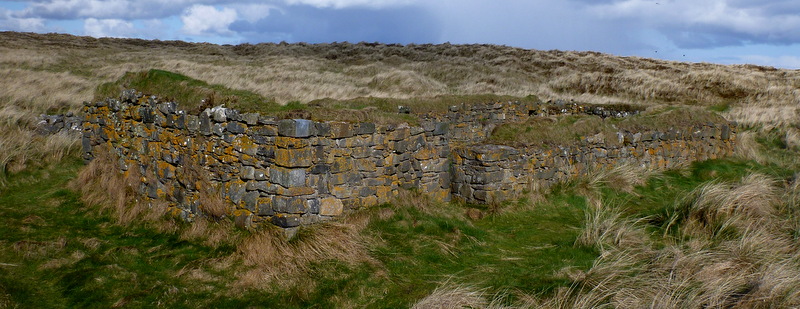
What’s left of Forvie Kirk, and of Forvie itself.

Forvie Kirk was built in the 1100s and was dedicated to St. Adamnan, who was born in Ireland in the seventh century. Adamnan visited Scotland in the late 600s and, apparently, made an impression. He didn’t bring luck to the residents of Forvie, however.

I took this picture for my wife, who, for unknown reasons, has become interested in moss and lichen. To make up for the fact that I’d abandoned her for a week, I smuggled home a golf-ball-size chunk of moss from Aberdeen, as a present. (Never bring your wife a golf shirt or golf hat, no matter how much you loved the course.)

Near the path I followed into the reserve were several stations like the one below, which were equipped with tools I could have used to stamp out any fires I happened to have started. Luckily, I didn’t start any.

I’m not sure that I need to play Newburgh-on-Ythan again, but I’m glad I played it once, and I’m glad I met the Daves, and I’m glad I found that old ruined church. And the chunk of moss I brought my wife is now growing near our back door. It didn’t make up for the trip, but it probably helped.

Golfers Are Morons, Experts Say

Polara Golf, a company that makes balls that go too far and wedges that are (supposedly) shank-proof, recently conducted an online survey, which found that most golfers don’t care about the Rules of Golf and therefore have no problem purchasing and playing with illegal equipment, such as the equipment that Polara Golf sells. That didn’t surprise me. What did surprise me was that, according to the survey, more than a quarter of golfers claim “to have never broken the rules during play.”

Never broken the rules? Never taken a mulligan? Never brushed a detached leaf, a grain of sand, or a loose twig while taking a back swing in a hazard? Never played by “winter rules”?  Never lifted a ball on a putting green without marking it first? Never moved a marker for another player and then forgot to move it back? Never penalized himself incorrectly or unnecessarily? Never made a suggestion to another player which could influence that player’s play (“Keep your head down, you idiot”)? Never pointed out a rules infraction by another player, then agreed to ignore it? Never played out of turn in stroke play (for which there’s no penalty or correction, although it’s still a violation of the rules)? More than a quarter of golfers???

Golf Digest conducted an experiment a few years ago in which a rules official, without saying what he was doing, observed a round of golf by four ordinary guys and kept track of their rules violations. There were so many that he almost couldn’t write fast enough to record them all.

The illustration below is from an old book about the rules. Anyone who can guess which rule it’s illustrating will win a disappointing prize. Meanwhile, anyone who feels like a rules expert should try one of the quizzes on the website of the U.S. Golf Association.


Great Golf Invention: Improved Tournament Periscope

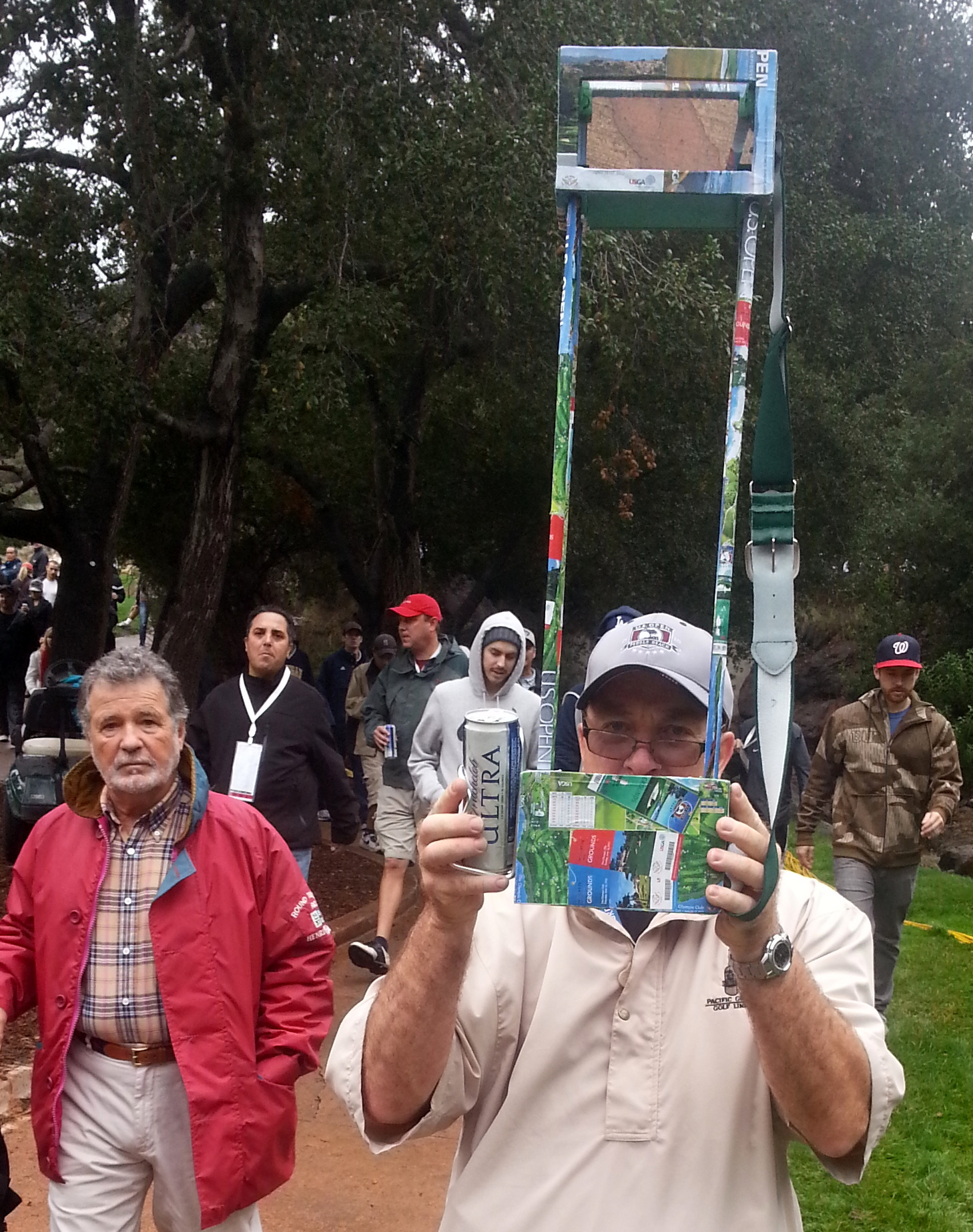
Steve Davis and his invention at Sherwood Country Club, Thousand Oaks, California, December 2, 2012.

On Sunday, at Tiger’s tournament, I ran into Steve Davis, who is the guy in the photo above. He invented the contraption he’s holding: a periscope that enables him to see over the heads of people standing in front of him. It’s an improvement over other golf periscopes because it doesn’t completely block the view of people standing behind him. Also, it has a shoulder strap and a beer holder:

Davis works for a copier company. He has “wallpapered” his invention with color copies of mementos from other golf tournaments he’s attended, including the 2010 U.S. Open. If you’d like to give him a lot of money to manufacture these things full time, let me know, and if you don’t sound like a nut I’ll put you in touch.

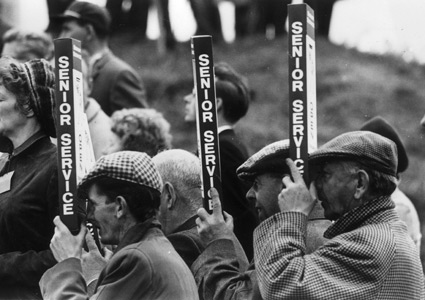
Periscopes used to be common at golf tournaments. The photo below is from the 1965 Ryder Cup, at Royal Birkdale. (Senior Service is a British cigarette brand.)

Many spectators at the 1993 Ryder Cup, which I attended (at the Belfry, in England), had periscopes that looked like the boxes that bottles of Johnny Walker scotch come in. (Johnny Walker sponsored the tournament.) The Belfry is a terrible course for spectators, and the periscopes made things better for the people who had them and worse for the people who didn’t. The only way to improve Davis’s invention, I think, would be to add a second beer holder.


Why Do Certain People Wear Certain Shoes at Certain Golf Tournaments?

By “certain people,” I mean certain women; by “certain shoes,” I mean sandals, high-heeled boots, ballet-type slippers, and backless pumps; and by “certain golf tournaments” I mean golf tournaments during which there is so much rain that the lift-clean-and-place rule is in effect for all four rounds. Specifically, I mean Tiger Woods’s 2012 World Challenge presented by Northwestern Mutual, which was held in the mud last week at Sherwood Country Club, in Thousand Oaks, California:

The Man himself  (and Bo Van Pelt, plus various menials) on the first fairway at Sherwood Country Club on Sunday. Note the mud visible in the rough in the foreground.

The World Challenge is an unofficial, end-of-season event. It raises money for the Tiger Woods Foundation, and it features a small field of terrific players. By Sunday, the entire course was so thoroughly saturated that balls often plugged where they landed, even on some of the greens, and many spectator areas looked like this:

These men are wearing sensible shoes, relatively speaking.

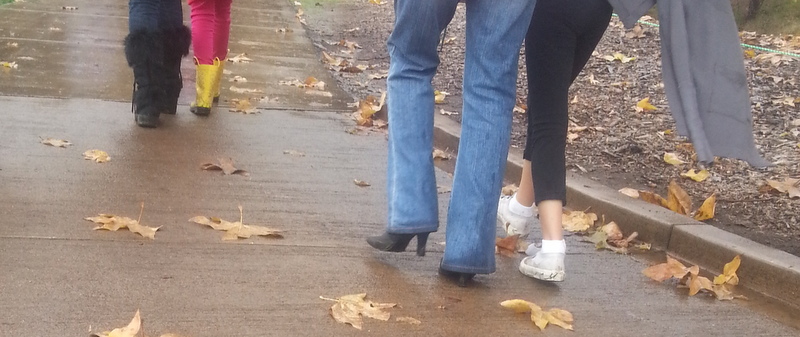
Despite the weather, surprisingly many women wore shoes that were not well suited to the conditions:

The women whose feet are shown below were standing on pavement near the clubhouse and watching someone on the practice green, but shortly after I took this photograph they all followed their boyfriends or husbands onto the course:

In the photograph below, the woman in jeans had just had trouble traversing a muddy area under some trees. A friend of hers told her husband, “Erin is bothered about her shoes. Very bothered.” I don’t know what happened after that.

The heels on those boots made sucking sounds as the woman wearing them walked through the mud, which was ubiquitous. Note the evidence of capillary action at the bottom of her pants legs.

Even in a drought, why would someone wear high heels to a golf tournament, where spectators walk for miles?

Ready to follow Tiger for eighteen holes.

I can think of three semi-plausible explanations: 1) Fashion trumps all; 2) Someone’s boyfriend or husband didn’t mention that golf is played on grass; 3) Someone was attending the tournament against her will, and wearing inappropriate footwear was her passive-aggressive declaration of her discontent.

Walking “on pointe” to keep mud from coming over the sides.


How to Keep Your Ears Warm on a Cold Golf Course

For the first time since March, nobody wore shorts on Sunday. From left to right: Doug, Tim, Gary, Mike A., Hacker (real name).

Turnout was low last Sunday. The weather was cold and windy—so much so that everyone wore long pants, even though the Sunday Morning Group gives an extra handicap stroke to anyone who wears shorts after November 1 (and two extra strokes after December 1). Also, probably, some guys were still recovering from overexposure to their in-laws during Thanksgiving week.

Because of the weather, I wore two hats plus a thing I got in Norway back in September. (I was there on a New Yorker assignment unrelated to golf.) I don’t know what the thing is called, but here’s what it looks like:

This is the thing I got in Norway.

It’s a fabric tube. You can wear it around your neck or around your ears or around your whole head, and you can also use it as a do-rag-like hat. The person who gave it to me—a guide in a national park—wore hers just around her ears, like this:

A guide in a Norwegian national park.

Last Sunday, I wore mine like that for a while, and then I wore it just around my neck, and then, when the wind picked up, I wore it like this:

I realize that this looks ridiculous, but it was very warm, and it kept my Enniscrone Golf Club stocking cap from popping off the top of my head.

Is the Norwegian thing a snood? I can’t say, because I don’t really know what a snood is, and the dictionary and Google aren’t entirely helpful. Many years ago, a woman on a street in Cambridge, Massachusetts, asked my wife’s grandmother, “Where do you buy your snoods?” and my wife’s grandmother didn’t know how to answer because, even way back then, she didn’t really know what a snood was. (It turned out that the woman was referring to her headband, which my wife’s grandmother had bought at Woolworth’s.) Anyway, I now keep my Norwegian thing in my golf bag, in the same pocket as my winter gloves. It weighs almost nothing, but in cold weather it’s an emergency head heater.