I have a new monthly column in Golf Digest, called The Muny Life, beginning with the March issue, which is on newsstands now. For the inaugural column, I played the three courses in Griffith Park, in Los Angeles: Wilson, Harding, and Roosevelt, all named after presidents. The wildlife was almost as interesting as the people:
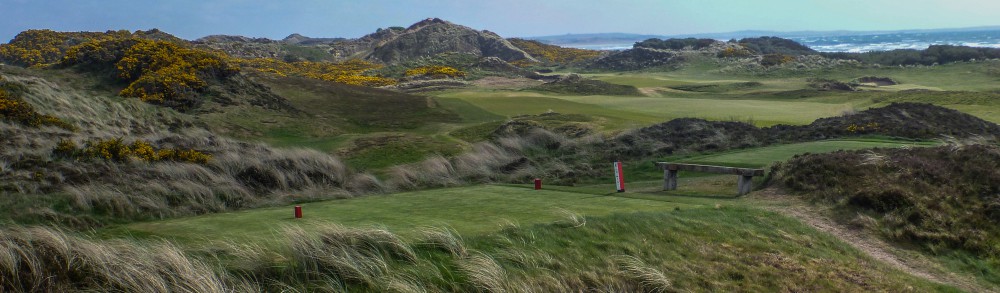
Wilson Golf Course, Griffith Park, Los Angeles.
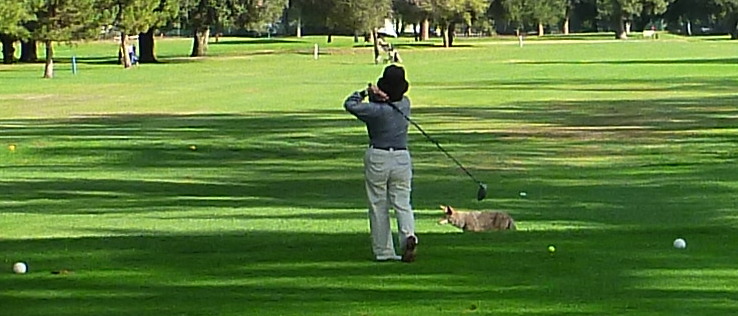
The woman in the photo above, who was playing with her husband, had to tee off over the head of that coyote:
She didn’t hit the ball very far, and she was barely taller than her driver, but she played fast and you would not beat her in a match. Her husband used to be a member at Riviera.
Roosevelt Golf Course, Griffith Park, Los Angeles.
I didn’t see any rattlesnakes, but there were deer everywhere, including the threesome in the photo below, at Roosevelt. The second one from the left, you’ll notice, is taking a whiz:
Roosevelt Golf Course, Griffith Park, Los Angeles.
The guy in the photo above is Francis, who is a service manager at a car dealership. It rained hard while we played, and we were literally the only golfers on the course, but, as he said, “I can only watch so many reruns of ‘Law and Order.'” His hat says “Playboy Golf.” He got it from a friend of a former girlfriend—a woman who works at Playboy Mansion West. He’s divorced, but he and his ex-wife took golf lessons together, in the hope of getting their son interested in the game. He once took three women to a concert—three women who, unbeknownst to them, he was dating simultaneously—partly to see what would happen. The evening turned out better than you might think. He invited me to join him and some friends at another public golf course the next day, but I couldn’t go because I had to play golf—with, as it turned out, these two guys:
Harding Golf Course, Griffith Park, Los Angeles.
I’m not sure where the Pine Valley hat came from. (His English wasn’t great.) Nice day, though. And when it was over I drove up to the Griffith Observatory, which you can see from several holes on Roosevelt:
The observatory, which was built in the 1930s, is beautiful, and so is the view of the city:
U.S. Walker Cup team, 1957. Charles Coe, the captain, is squatting in the center. Billy Joe Patton is fifth from the left.
The American Federation of Television and Radio Artists declared its first national strike on March 29, 1967. That meant that CBS’s usual golf commentators, who were members of that union, could not participate in that year’s Masters broadcast, the following week. Clifford Roberts, Augusta National’s chairman, conducted auditions among the club’s membership, and settled on two distinguished amateur players, Charles Coe and Billy Joe Patton, to fill two of the vacant spots. Coe had won the U.S. Amateur twice and had been the runner-up to Jack Nicklaus in 1959, and in the 1961 Masters he had finished tied for second with Palmer. Patton had led the Masters after two rounds in 1954, then ended up in third place behind Snead and Hogan. Both men had played the course for years—Coe with a handicap that varied between plus-6 and plus-7.
Coe and Patton did creditable jobs as commentators, and their minimalist dialogue confirmed Roberts’s belief that less is more in golf broadcasting. CBS was pleased as well, and William MacPhail, who was the network’s director of sports, passed along a sampling of the large volume of complimentary mail the network had received. One viewer wrote, “[T]he quiet, sincere comments of your members, which were entirely adequate, were a refreshing change from the glib, and sometimes overly talkative, ‘pros’ we usually hear.” Another wrote, “What an absolute pleasure it was to watch a player, under severe pressure, walk up to a putt in silence—the silence any gallery always accords a player, but which the announcers feel impelled to fill with chatter. In this case, one truly felt present, with a real sense of actual participation.” The broadcast turned out so well, in fact, that CBS executives credited it with breaking the strike, which ended the day after the tournament.
Doug, Gary, Mike A., Goodwin Park Golf Course, Hartford, Connecticut, Super Sunday, February 5, 2012.
On Super Sunday XLVI, last year, my golf buddies and I successfully predicted the outcome of that night’s football game by playing a golf match on the municipal course at Goodwin Park, in Hartford. The course was ideally situated for our match, because it’s pretty close to halfway between New York and Boston. And the park was designed, in the early nineteen hundreds, by the sons of Frederick Law Olmsted. Olmsted Sr. designed Central Park, in Manhattan, but lived in a suburb of Boston. (His sons’ firm, which by then was called Olmsted Bros., also created the original landscaping and real-estate plan for Augusta National Golf Club.)
Goodwin Park is somewhat flat and featureless, and—despite the enticing photograph on its website—there are no snow-capped mountains in the distance. But the areas around the greens were interesting, and playing cost less than a buck a hole. Also, we saw an aquatic mammal swimming across the pond you see in the lower right-hand cover of the photo above. Here’s the mammal:
Probably just a muskrat–rather than a beaver, as we originally hoped.
After the round, Hacker (real name) spoke the phrase “bacon cheeseburger” into the voice-search thing on his smartphone, and we ended up at a sports bar called Damon’s Tavern, which is the greatest sports bar we’ve ever been to because it has flat-screen TVs mounted above the urinals in the men’s room.
If we had thought to bring sleeping bags, we could have taken our naps at Damon’s, and hung on to our table for the football game that night. Instead, we drove home and slept in our own beds until just before kickoff. The game was slightly anticlimactic, however, because we already knew that the Giants were going to win.
Quite a while ago, Tom Reynolds, a reader in Atlanta, asked me to suggest a packing list for a golf trip to Ireland. I said I would, then forgot all about it, and recently he asked again. So here it is.
This packing list is the result of two and a half decades of thoughtful experimentation. In making it, I’ve assumed that no spouse or health-department official will be in your group, and that you will buy at least one souvenir golf shirt, one souvenir golf sweater, and one souvenir golf hat while you’re abroad. I’ve also assumed that you are not planning to do anything rash, like meeting a client or going to a play. My strong preference with rain pants (which are also useful as wind pants) is to wear them as pants, if possible, rather than over pants. If the weather is nippy, I wear them over long johns.
The reason for minimalist packing is not to avoid airline luggage charges; the reason is to reduce the tonnage of the gear you have to lug from place to place, and to make the most efficient use of the storage space in whatever vehicle you’re traveling in. Packing light also leaves space for all the overpriced golf stuff that you are almost certainly going to buy and lug home.
Because linksland weather is highly unpredictable but within a relatively narrow range—I’ve played in shirtsleeves in Northern Ireland in November and been hailed on in Scotland in June—my list doesn’t change a whole lot from month to month. Think in terms of layers, and be prepared to allow time for wet items to dry out—especially shoes. Mike B. took his plug-in ski-boot driers on our most recent trip to Ireland. He never needed them, because our shoes never really got wet, but taking them wasn’t a terrible idea. On a golf trip to eastern Ireland twenty years ago, I took two rainsuits and needed them both.
It’s possible to pack more than this, of course. It’s also possible to pack less. My friend Tony gets by with just his rain pants and one pair of chef pants, and some people believe that he never changes his shirt. A few years ago, Golf Digest sent me to play all fourteen courses where the British Open has ever been held, and I realized toward the end of the trip, which lasted two weeks, that although I’d brought two pairs of pants I could have gotten by with one. The great thing about microfiber is that you can launder it with a hotel wash cloth, even if you’ve gotten chocolate on it. I recommend black.
Tony in chef pants, North Berwick, Scotland, May, 2008.
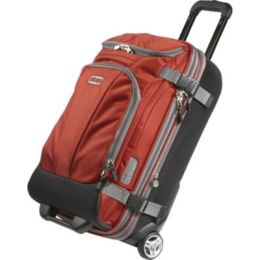
On my first golf trip to the British Isles, twenty years ago, I took a full-size suitcase. Now I take just a carry-on bag: a Mother Lode TLS Mini 21-inch rolling duffel, by eBags, which is currently selling for $190, shipping included (see photo at the top of this post). This is my favorite suitcase ever, even for non-golf trips. No matter what kind of suitcase you use, I recommend buying a selection of eBags Packing Cubes, which are soft, box-shaped modules that simplify intra-suitcase organization and make it easy to use your golf bag’s travel case for overflow packing.
Here’s what I take:
In the carry-on bag:
1 pair dark polyester microfiber pants (and a second pair worn on the plane—and I recommend black for both, because they never look dirty and you can remove stains, even chocolate, with a hotel wash cloth)
1 golf shirt (and a second one worn on the plane—and in cooler months I would make one or both of these shirts long-sleeved)
1 sweater (worn or packed, depending on the weather
1 pair of Under Armour-type long johns
1 long-sleeve Under Armour-type undershirt or turtleneck
1 tee shirt (to sleep in and serve in a pinch as an extra layer)
1 pair of “house pants”—fleece pants or nylon hiking pants or something similar (for lounging around, and for emergency duty under rain pants if the weather turns really foul, and for wearing on the trip home)
1 pair of shorts, maybe (something I’d never thought about before 2016, when sunburn was a bigger threat than rain in western Ireland)
Lots of cotton handkerchiefs (my new favorite golf accessory, useful for nose-wiping during wet, cold, windy, or allergen-dense rounds)
As many pairs of underpants and (wool) socks as I can cram into the remaining space
In the golf bag or golf-bag travel case (along with my golf clubs):
2 pairs of waterproof golf shoes
1 rain suit (the jacket of which, in combination with an undershirt, shirt, sweater, vest, etc., should be plenty of cold-weather protection, even for winter)
2 regular golf gloves and 2 pairs of rain gloves
1 Seattle Sombrero (or other truly good rain hat)
1 regular golf hat
1 knit cap
1 super-lightweight down vest, in its little stuff sack (weighs nothing, and is easy to cram into a golf bag; mine is by Uniqlo and is a recent addition to my packing)
As many golf balls as you think you’re going to need, because they’re cheaper here (a reasonable number is two balls a round; a couple of guys lost more, but some lost almost none)
A full box of Band-Aid or Compeed “blister cushions.” You won’t need them if you’re careful about the golf shoes you take, but if you have them in your bag you’ll be a hero to someone on your trip
Toiletry-type crap (if you put your toiletry kit in your checked bag you won’t need to worry about decanting your gels and liquids into tiny bottles and setting them aside in a Ziploc bag)
Other stuff:
1 or 2 twenty-four-inch bungee cords, for strapping your golf bag onto a pushcart (known abroad as a trolley), to keep the bag from falling off when you drag it into the dunes
1 water bottle (because on-course water isn’t common outside the United States; you can fill your bottle each day in your hotel room or in a golf-club locker room)
1 UK-and-Ireland-type plug adapter. Household current is 230 volts, but all your electronics will run on that with just the plug adapter—no need for a voltage converter. If all you’re going to need to charge is your phone, you can probably find a 110-volt shaver outlet (for an American-type plug) in the bathroom of your hotel room
1 mini-power strip (if, like me, you have a lot of stuff to plug in—mine’s made by Belkin—because no hotel room on earth has enough outlets, especially in other countries)
1 sleep mask (for creating darkness where there is none)
Earplugs (doubly useful if the locals are holding a Dallas-themed “Oil Barons’ Ball” in the main dining room—as happened to me in England a few years ago)
Travel clothes:
If you are going straight from the plane to a golf course—and that’s what you should be planning to do, in my opinion—you should wear golf clothes on the plane. For the trip home, it’s nice to have clean stuff. In my case, I flew home in a bought shirt, a bought sweater, and a pair of lightweight nylon pants that I hadn’t worn during golf.
If your golf shoes have nubs on the soles instead of spikes, you probably don’t need any other shoes—although you may be required to strip down to your socks in some parts of some golf clubs. On a recent trip to Ireland, I took a pair of “après-golf” shoes—which were actually just non-waterproof golf shoes—but wore them only a couple of times, because my two pairs of “working” golf shoes were just as comfortable and never really got wet. Tim brought two pairs of golf shoes plus a pair of Merrell Jungle Mocs, which he wore on the plane, on the bus, and when we weren’t playing golf—an idea I intend to steal next time
If you prefer to receive your packing instructions in video form, you can do so here:
For many years, I’ve accessorized my rain paints with farmer-type suspenders, my first pair of which I ordered from the Vermont Country Store. (I now use a different kind, which you can order here.) Suspenders eliminate the main problem of rain paints, which is that they creep down every time you put wet hands into the pockets. I also own, and sometimes use, a pair of Velcro bicycle clips, which are handy if the legs of your rain pants are so long they drag on the ground, as many are.
Vermont Country Store suspenders with rain pants, Scotland, 2004.
On a golf trip to England in 2010, my friends and I had to take sports coats so that we could eat dinner in the clubhouse at Royal Lytham & St. Annes. Hacker (real name) took a crummy old one, intending to abandon it there—a plan I foiled by spotting it in a closet on the day we left and returning it to him at the airport. But the concept is brilliant: clothes you can wear to extinction, then leave behind.
My bedroom in the Dormy House at Royal Lytham & St. Annes, May, 2010. My sports coat is in that pile somewhere.
On our trip to Scotland and Ireland in 2014, Peter A. brought many pairs of super-cheap socks, and threw away each pair after a single use. This seemed smart in the abstract, but he ended up being the only person on the trip who got blisters. For this most recent trip, he brought more expensive throwaway socks (roughly a dollar a pair versus roughly fifteen cents) and didn’t have a problem. My personal preference is to pack the best wool socks I feel I can afford, and lots of them.
I’ve always thought it was crazy to take shorts on a golf trip to the U.K. or Ireland, because indigenous golfers hardly ever wear them and some golf clubs have semi-ridiculous rules about them—like Hillside, in England, which allows shorts only if they’re worn with knee-height socks. (Dress codes abroad are kind of unpredictable. In 2016, the starter at Lahinch asked Matt to roll down the cuffs of his pants, which he had turned up maybe an inch, but let a local kid tee off in surfer shorts and an untucked tee shirt.)
It’s possible to pack more than this, of course. It’s also possible to pack less. On a non-golf trip to Europe a few years ago, my wife surprised me by packing lighter than I did. You don’t need to plan a lot of different “looks.”
Many golfers nowadays look blank when you mention Moe Norman, who died in 2004, but to those who were lucky enough to see him play he was a legend. Lee Trevino ranked him with Ben Hogan and Byron Nelson as one of the greatest ball-strikers of all time. Paul Azinger first saw him hit balls on a driving range in Florida in 1980, when Azinger was in college. “He started ripping these drivers right off the ground at the 250-yard marker,” Azinger told Tim O’Connor, a Canadian sportswriter, “and he never hit one more than 10 yards to either side of it, and he hit at least 50.” In 2005, Tiger Woods told Jaime Diaz, now the editor of Golf World, that Norman and Hogan were the only two golfers in history who had “owned” their swing, and that one day he hoped to own his, too.
Despite such accolades, Norman spent much of his forty-year competitive career in obscurity and poverty. He played almost exclusively in Canada, where he was born, and made only a brief attempt, in 1959, to play on the American tour. He sometimes carried his own bag in tournaments, because he couldn’t afford a caddie, and he sometimes slept in bunkers on the courses where he competed. He often hitchhiked to and from tournaments, and he had to juggle his competitive schedule with a succession of dreary factory jobs, including one stitching rubber boots. He spent the winter before the 1956 Masters, to which he had been invited as the reigning Canadian Amateur champion, setting pins in a bowling alley for a few cents a line. For years, he supported himself partly by selling the prizes he won in amateur tournaments, and as his confidence increased he sometimes sold the prizes before the tournaments began. (According to friends, on at least five occasions he intentionally finished second because he hadn’t been able to find a taker for the first-place prize and had been forced to sell the second.) In the late nineteen-eighties, he was so broke that only the last-minute intervention of friends prevented a bank from repossessing his car.
Moe Norman, 1950s.
I watched Norman hit golf balls on a practice tee at Foxwood Country Club, in Kitchener, Ontario, his hometown, in the fall of 1995, when he was sixty-six. He warmed up with a pitching wedge, although “warming up” doesn’t really describe any part of his routine: the first shot was perfect, the second was identical to the first, the third was identical to the second. Then he switched to his four-iron. His swing—to all appearances, an effortless half-swing—was the same as it had been with the wedge. “How far you hitting those?” a spectator asked. “One-eighty,” Norman said. The shots were within a couple degrees of dead straight, despite a stiff cross wind, unless he announced ahead of time that he was going to hit a draw or a fade. The divots were identical, and surreally shallow.)
Moe Norman, 1990s.
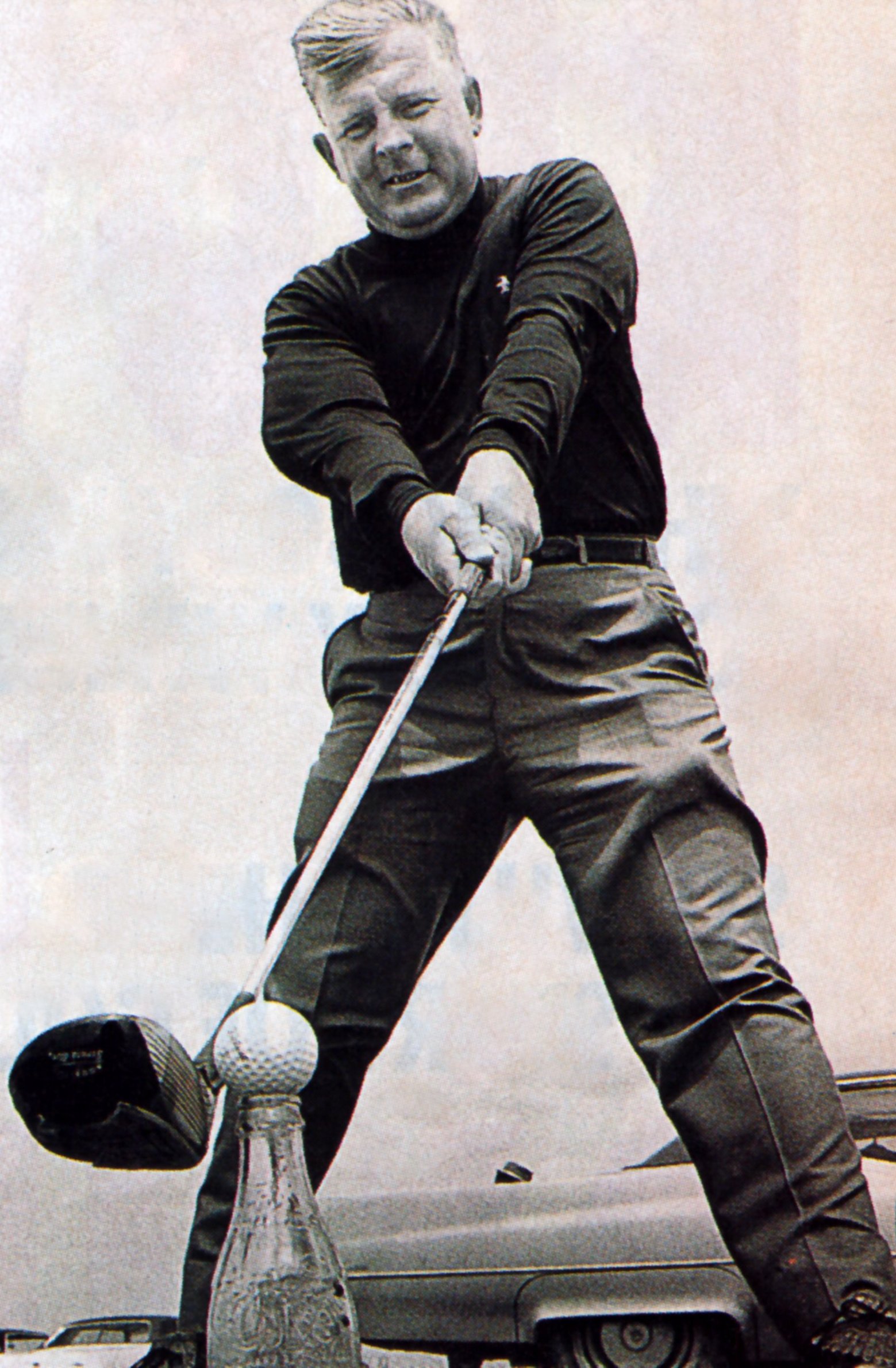
He switched to his driver. If you had looked only at his arms and hands, you wouldn’t have known he wasn’t still swinging his wedge. He would watch each ball in the air a moment, then bend over and place another on the tee—and I mean place it. The tee never moved. “I hit balls, not tees,” he said. On a driving range once, he hit 131 drives in a row from the same tee without having to straighten it. In tournaments, he sometimes entertained galleries by hitting a drive from the mouth of the Coke bottle from which he had just been drinking.
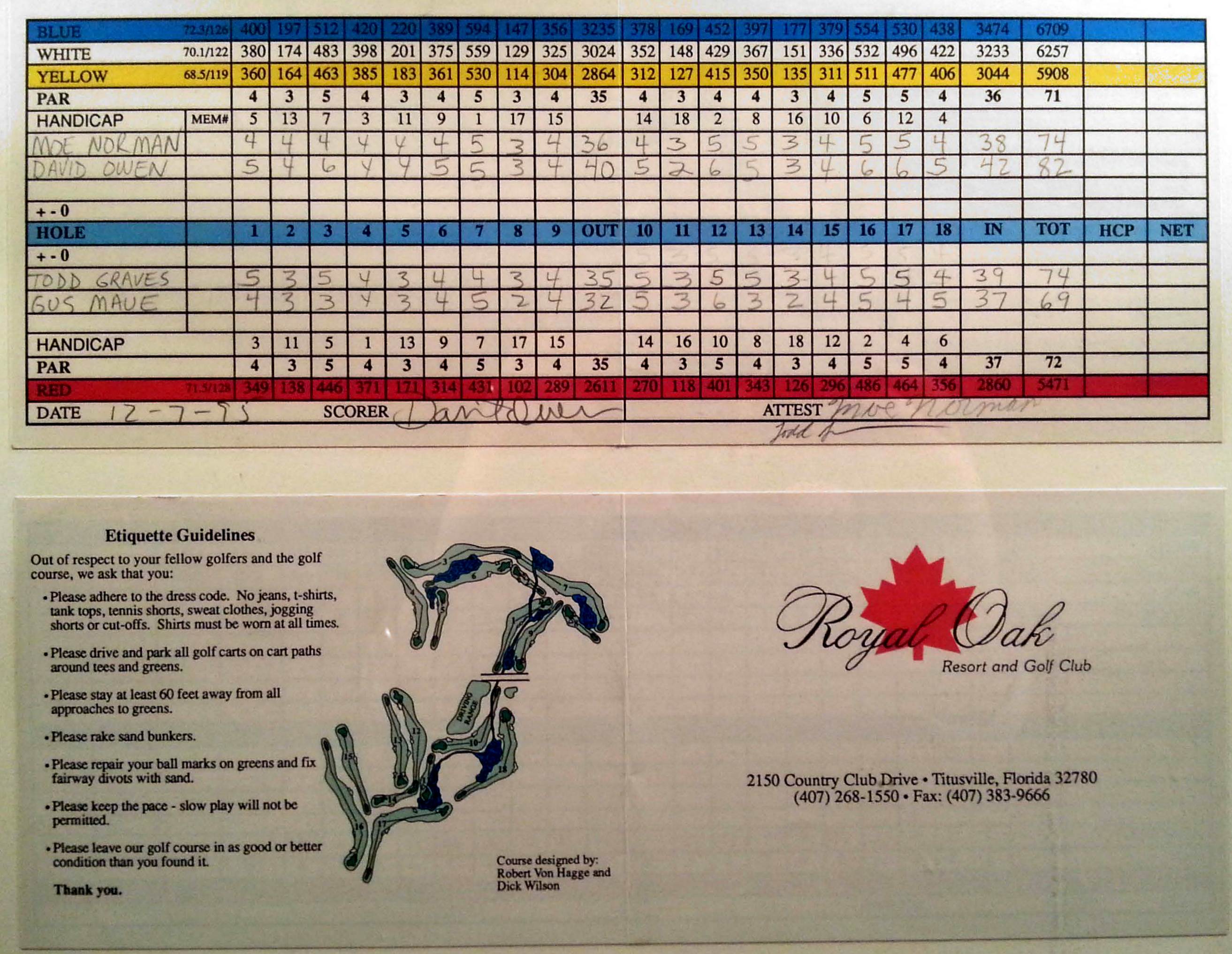
In December, 1995, I got to play a round with Norman and his friends Gus Maue and Todd Graves (who calls himself Little Moe and teaches Norman’s highly unorthodox swing) at Royal Oak Resort and Golf Club, in Titusville, Florida. Royal Oak may no longer be a going concern—its website has been shut down for lack of payment—but in 1995 it was a favorite winter hangout of the Canadian P.G.A. The first hole was a 400-yard par 4, dogleg to the right. Maue, Graves, and I hit tee shots up the middle, and then Norman hit his over a row of trees to the right, toward a lake that ran the length of the hole. I thought, Hmmm—this is one of the greatest ball-strikers of all time? But it turned out that Norman always played the hole that way. There was a strip of grass, maybe ten yards wide, between the trees and the water, and from there he had an easy 9-iron to the green, while those of us in the fairway needed four-irons or five-irons.
Norman won his first tournament in 1949. “I didn’t know anything then,” he told me that day. “I didn’t even have a full set of clubs. Only had a driver, three-wood, three-iron, five-iron, seven-iron, nine-iron, and a putter. Didn’t even have a wedge. But one day everything fell into place and I shot a sixty-seven—four under.”
I said I was amazed he had played with so few clubs.
“Oh, I couldn’t afford them. Heck, when I was a kid you were lucky to have one club. And if you had a club your friends were always saying, Hey, can I use yours? Can I use yours? If someone had a driver we would hand it around—three of four guys playing together. If somebody had a nice putter, we all took turns putting with it. Goodness, back in those days, there wasn’t a golf shoe in the foursome. And if the grass was wet your right foot would do a whirlwind, like a twist. But back then golf wasn’t a sport. It was just an exercise game. In fact, I was called a sissy by my father and my brothers, right at dinner. They would make big ears at me and call me a sissy. ‘Come on, play a man’s game,’ my father used to say. ‘Play baseball, or hockey—do like your brothers.’ I said, ‘No, Dad, I’m too light.’ I was a little skinny kid then, not over a hundred and thirty pounds, and I couldn’t play any other sport and be good at it, so I kept playing golf. But I had to hide my clubs under the front porch. My father was fat and I was real skinny, so I could dig a hole that he couldn’t get his head through but I could get my body through, and if I would push my clubs in far enough he couldn’t reach them.”
I wrote about Moe Norman in Golf Digest in 1995, and you can read that story here. The date in the opening anecdote is wrong, since Porky Oliver died in 1961. But other than that. . . .
The photograph above was taken in 1947, during the next to last Masters that Bobby Jones competed in. His badge identifies him as Player No. 1. The photographer was apparently experimenting with an early color film. The negatives were discovered in an envelope in an old file cabinet at Augusta National almost fifty years later, around the time I began researching my book The Making of the Masters. No prints are known to have been made before that time.
There is a great deal of confusion about Jones and his status as a player. Augusta National, in tournament publications, lists him as an amateur, but by the rules of the U.S.G.A he became a professional in 1930, when Warner Bros. hired him to make instructional films, and when, a little later, he began designing and promoting golf clubs for A.G. Spalding & Bros.
Jones retired from competition not because he had no worlds left to conquer; he retired because he abhorred the idea of being labeled a professional. In a letter to Clifford Roberts many years later, he described the typical pro as “an uneducated club servant”—a prejudice that dated to the early days of his competitive career, when only amateurs were accorded the honorific Mr., professionals weren’t allowed inside clubhouses, and tournament organizers distinguished between “gentlemen” and “players.”
“So long as I played as an amateur, there could be no question of subterfuge or concealment,” he wrote in 1960—a statement that clearly shows what he thought of playing golf for money. Roberts secured Jones’s participation in the first Masters, in 1934, by cleverly dodging the issue: in the tournament’s program listings and pairing sheets, he made no distinction between amateurs and professionals.
But the distinction was invariably noted elsewhere. The Associated Press and all other news organizations, in their coverage of the tournaments Jones competed in, listed him with the pros. Even O.B. Keeler, who had built his sportswriting career by celebrating Jones’s amateur accomplishments, took it for granted that Jones was now a professional. And so did Augusta National, officially.That’s why Charles Yates, not Jones, was honored as the low amateur in the first Masters, even though Yates’s score was three strokes worse than Jones’s.
Would Jones have played in the Masters if the club had been compelled to label him explicitly as a professional? Roberts said in later years that he suspected he probably would have, in order to help the club. But Roberts was uncertain enough that he never raised the matter with him, either then or later.
In Golf is My Game, Jones wrote that to give up his amateur status would have been “like giving up part of myself.” But, in fact, he gave it up in 1930. And he had a powerful incentive for doing so. His golf-related income in 1933, when the first tournament was being planned, was over $100,000; in contrast, Paul Runyan, who won nine events that year and was the tour’s leading money-winner, had gross tournament earnings of less than $6,500.
My one reservation about my beloved True Linkswear golf shoes is that, even though almost all the models are waterproof, the shoes’ low profile makes them vulnerable in wet grass. The company’s new Chukkas, shown above, have eliminated that issue, by lifting their gunwales to ankle-bone height. If you’re the sort of middle-aged male golfer who dreams of seducing the beverage-cart girl, don’t wear them with shorts. But, if you own long pants and don’t stay home when the weather turns lousy, they’re great, as I proved to myself in Brooklyn last weekend. And they bring my personal True collection to six pairs.
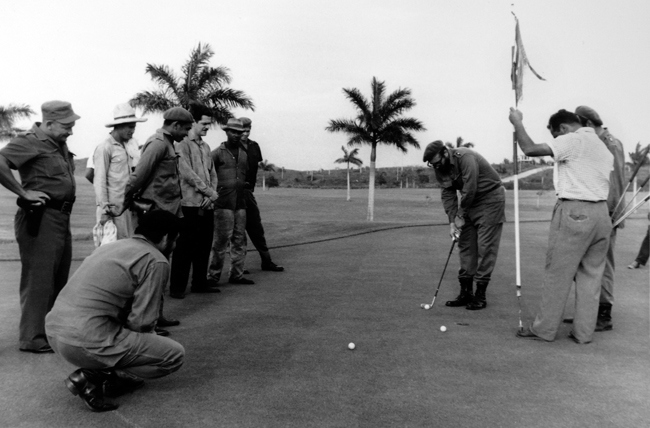
Fidel Castro and Che Guevara, Havana, 1961 or 1962.
In 2009, Hugo Chávez, who may or may not still be the president of Venezuela, dismissed golf as a “bourgeois sport.” A U.S. diplomat—clearly not a golfer himself—called Chávez’s statement “a mulligan.” (The annoying use of golf terminology for putatively humorous purposes is apparently irresistible; the Wall Street Journal described Chávez’s remarks as “ahem, par for the course.”) Chávez is a socialist revolutionary, a quasi-dictator, an American antagonist, a supporter of Iran, and, often, a buffoon. Nevertheless, it’s hard to argue with his main contention, which was that lush fairways are not the highest and best use of scarce real estate in places that lack even minimal housing for many impoverished residents.
Hard, but not impossible. In the late nineties, David Plotz, who is now the editor of Slate, suggested that golf might be a promoter of world peace. “Countries where golf is popular,” he wrote in the New York Times, “never fight other golfing nations—and don’t fight much at all—while countries without golf are strikingly belligerent.” The United States is an obvious exception, although, historically, we have focused our aggression on countries where golf is unknown, and on non-playing tyrants like Slobodan Milosevic, Osama Bin Laden, and Saddam Hussein. A commitment to golf-course construction, furthermore, has emerged as an important step in the rehabilitation of our former arch enemies, among them Russia, China, and North Vietnam. Will Baghdad, Kabul, and Pyongyang become prime American buddies-trip destinations a decade or two hence? We can only hope.
The explanation for golf’s pacific associations isn’t hard to understand. In fact, Chávez himself identified it: golf is a bourgeois sport. A country that embraces golf is a country that has reached a tranquil, non-belligerent middle age. Jihad is a young man’s game. You can foment revolution or you can fight your slice—life is too short for both. Fidel Castro and Che Guevara (who had played as a child in Argentina) famously posed on a putting green (in fatigues) in 1961 or 1962, but they weren’t really playing a match. And Castro showed what he really thought about golf by bulldozing Havana Country Club.
A passion for golf suggests a certain maturity of judgment, as well as a willingness to get along with others. A little more popularity for the game could be just what the world needs.
Frank Strafaci, probably at Doral, where he became the director of golf in 1960.
On Sunday, seven of my friends and I left home at 4:30 a.m. so that we could drive to Brooklyn in time to play Dyker Beach Golf Course with members of Shore View Golf Club. I’ve written about Dyker and Shore View a couple of times recently, and I’ll have more to say about them in an upcoming Golf Digest column.
During our round at Dyker, I learned about the Strafacis, a historically significant Brooklyn golf family, and today I learned more. There were five Strafaci brothers, all talented players. The most accomplished was Frank, who won the U.S. Amateur Public Links Championship (on the thirty-seventh hole) in 1935, when he was nineteen. (He was described by the Brooklyn Eagle as “curly-haired little Frankie Strafaci.”) He finished ninth in the 1937 U.S. Open, ahead of Gene Sarazen, Jimmy Demaret, and Byron Nelson, among others, and that performance earned him an invitation to the 1938 Masters, from which he withdrew after three rounds. He was playing poorly and the tournament had been delayed by rain, and he knew that if he stayed for the fourth round he wouldn’t be able to qualify for the North and South Amateur—which he then won, both that year and the next.
Frank Strafaci and Bobby Dunkleberger, following the former’s defeat of the latter on the thirty-sixth hole of the final match of the 1939 North and South, Pinehurst, North Carolina.
During the Second World War, Strafaci was a technical sergeant in the Army’s DUKW Command, which handled amphibious transport. He took part in the Battle of the Philippines, in 1944, and on the second day was pinned behind a tree by Japanese snipers. Shortly afterward, he described the experience in a letter to Morton Bogue, the president of the U.S.G.A.:
I couldn’t see them and so I held my fire, and it was at this time that I got to thinking of the five foot putt I had to make to tie the 8th hole in an exhibition golf match played in Brisbane only a few weeks ago (Captain Bud Ward came down from Dutch New Guinea for five days, and I arranged a match for the benefit of the Australian Red Cross, which we lost 3-2). Our opponents, Alex College and Dick Coogan, played a bit too good for us. I thought of what a tough spot we would have been in if I missed the putt. I can assure you I’ll never try hard for another putt for as long as I live, at least it won’t seem like trying.
The U.S.G.A. had sent a shipment of golf balls to the Red Cross in Australia, as a morale-booster, and Strafaci thanked Bogue. He also wrote:
[When] I get back to the States I hope to present the USGA with a golf ball that has already traveled over 43,000 miles and been used for 52 rounds of golf. It was used in America, Australia, Dutch New Guinea, I expect soon to use it in the Philippines, China and Japan. I used it for the first time at my club Sound View, and from there it went to Omaha, back to Sound View then to Frisco, Adelaide, Australia, Melbourne, Townsville, Cairns, Sydney, Cairns, Brisbane, Cairns, Brisbane, Dutch New Guinea (I didn’t have a club, I batted it around with a club made out of a branch.)
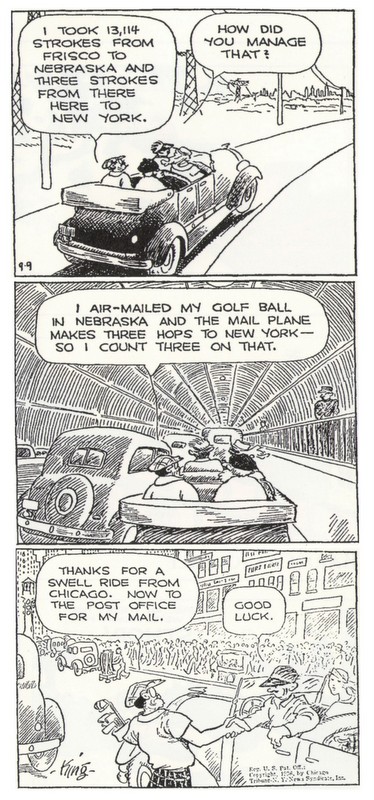
Dan Hubbard, who works in the communications department of the U.S.G.A. and, as it happens, is a member of my club, told me in an email: “We do not have a record of a golf ball coming in from Frank Strafaci, but we do have a five-peso bill issued by the Japanese government from the Philippines which he sent to Morton Bogue from Leyte in April of 1945.” Strafaci’s inspiration for his long-distance ball stunt may have been a series of cartoons in 1936 by Frank King, in his syndicated strip Gasoline Alley. In that series, Doc sets out to play a golf ball from San Francisco to New York—and in the strip below he’s nearing his goal:
In subsequent installments, Doc “breaks 80” between the post office and the East River, and finishes with a transcontinental score of 14,197. (In 1927, according to the book Golf in the Comic Strips, “a plumber and golfer by the name of Joe Grahame set out to achieve the same goal. He disappeared somewhere in the middle of Texas.”)
Strafaci played in a second Masters, in 1950, and he lost to Arnold Palmer on the eighteenth hole in the first match-play round in the 1954 U.S. Amateur. Palmer, who went on to win (and then to turn pro), said his match with Strafaci had been his toughest in the tournament. Strafaci became the director of golf at Doral in 1960, and named the Blue Monster. He died in 1988.
Frank’s father, Joseph Strafaci, owned a small farm that included the site now occupied by the Dyker clubhouse. Frank’s brother Thomas, and Thomas’s son Thomas, Jr., served as Dyker’s head professionals from 1958 until 1983. Frank’s grandnephew Paul is a recent past president of Shore View—the fifth Strafaci to hold that position—and a highly decorated New York City detective. Paul and a brother—another Frank—were members of the golf team at St. John’s University in the nineteen-eighties. And Jill Strafaci, who is the wife of Paul’s cousin Frank (the son of the one who tested Arnold Palmer), was a star golfer at the University of Florida and, later, an executive in the Miami Dolphins organization. Her husband was an executive of the Florida State Golf Association and is now a member of its advisory board.
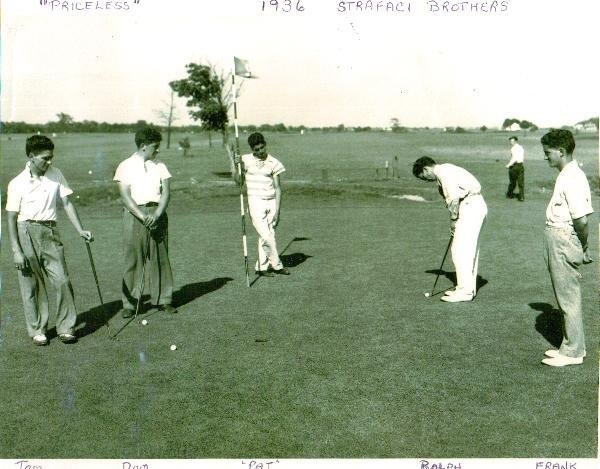
The fivesome in the photo below—which was taken in Queens in 1936, possibly at Oakland Golf Club, which was redesigned Seth Raynor in 1915 but buried by expressways in 1952 and 1960—consists of the five Strafaci brothers. From left to right they are Thomas, Dominick, Pasquale, Ralph, and Frank.
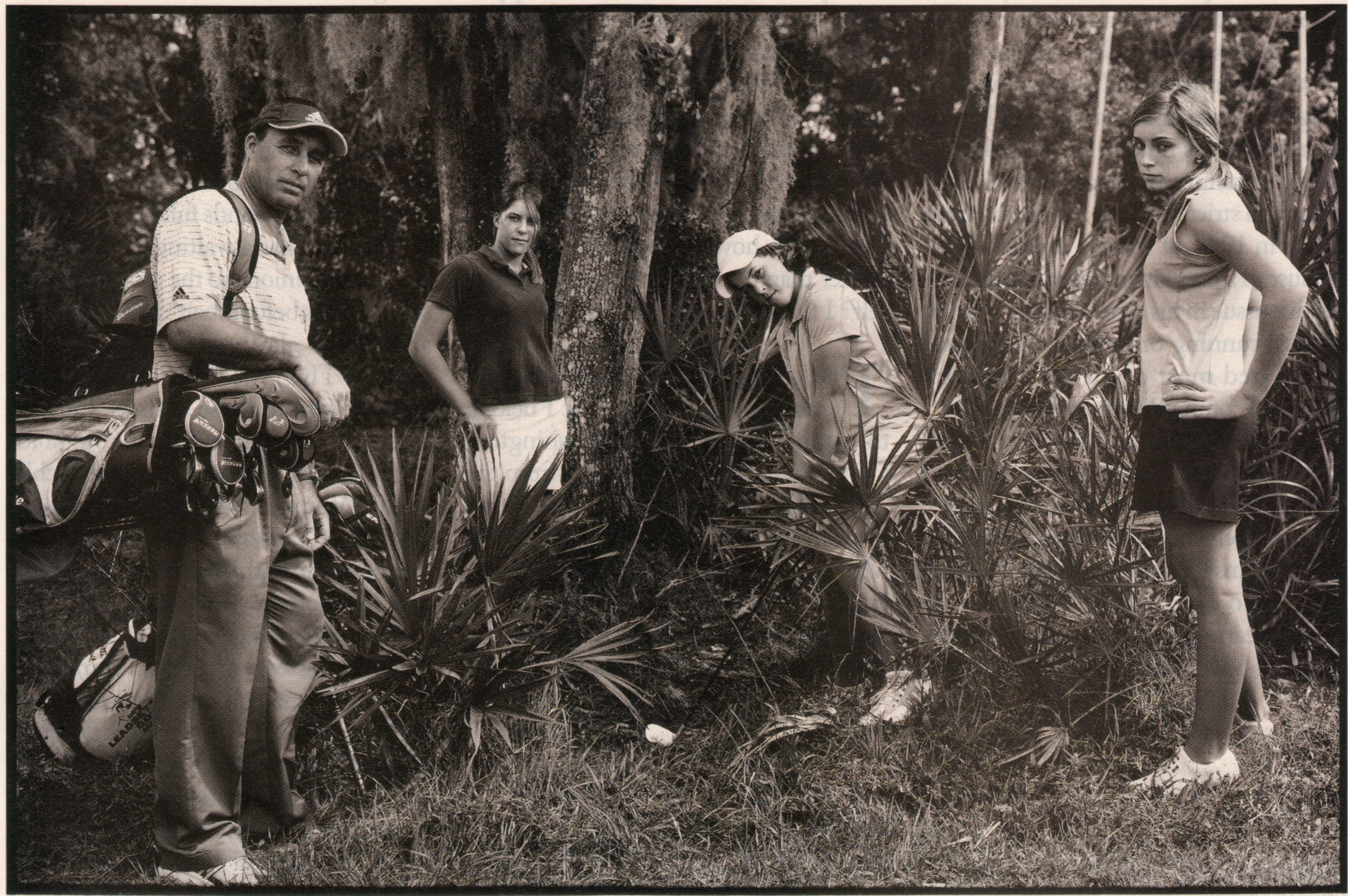
Ivan, Isabelle, Crash, and Marika Lendl, Bradenton, Florida, May, 2006. Photograph by Martin Shoeller.
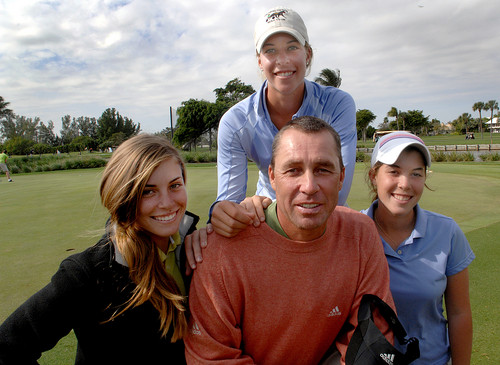
A week and a half ago, Isabelle Lendl, who is a senior at the University of Florida, won the women’s division of the Dixie Amateur, at Heron Bay Golf Club, in Coral Springs, Florida. She was five back after fifty-four holes, but shot 66 in the final round and won by four. Among those she beat was her younger sister Daniela, a sophomore at the University of Alabama, better known as Crash, who shot 67 and tied for sixteenth. It was Isabelle’s fourth win of the season.
Isabelle, Crash, and their sister Marika used to be junior members of my club—it’s where they took their first golf lessons, from our pro at the time, Fran Hoxie—and when Isabelle was eleven she and I played a nine-hole ladder match. (Since then, my club has abandoned ladder matches, but we still have the ladder and at some point I’ll explain how it worked.)
We played our match just before Isabelle’s game took off, at probably the last moment when a not-completely-terrible middle-aged guy could still beat her. She praised my decent shots and graciously conceded short putts, and we spent a very enjoyable hour and a half together. She said that her twin sister Caroline, whose main athletic interest was horses, was attending a birthday party that afternoon, and we agreed that that was a waste of a nice summer day. I said the thing about golf that grownups always say to kids, that it’s a game for a lifetime, and I also said that no matter what Isabelle and her sisters ended up doing with their lives I was certain that golf would always be part of it. I told her about my brother, who was the captain of his golf team in both high school and college and went on to work in advertising and sometimes got to play with clients. “No,” Isabelle said firmly, as we walked up the fifth fairway. “I’m going to play on tour.”
And she clearly will. I’ve played with her a couple of times since then, and she is not only terrifically talented (and nice!) but also mentally well-equipped to play competitive golf. When she was in high school, her father—the former tennis star Ivan Lendl, who now coaches Andy Murray—thought that on a golf course she was sometimes too eager to take unnecessary risks, but she has managed to tame that without becoming any less imaginative or aggressive. At the Dixie Amateur, playing with the young woman who had begun the day with a five-stroke lead, she birdied the first three holes, and, on the second nine, made three birdies in four holes exactly when she needed to.
In November, 2005, I watched Isabelle, who was fourteen, compete in a big junior tournament on the Seaside Course at Sea Island Golf Club, in Georgia. (The year before, at thirteen, she had been the youngest player to qualify for match play in the U.S. Women’s Amateur.) The wind was blowing so hard on Seaside that the clubhouse flag, which was approximately the size of the one that Francis Scott Key saw flying over Fort McHenry in 1814, was sticking straight out. Isabelle wasn’t unhappy, though, and afterward she told me, “I like playing in wind and rain better than in normal conditions. It’s more fun, and nobody else likes it. I think I trust more shots than other people usually do. If I have a shot that I want to hit, it really doesn’t matter if I haven’t practiced it, because I can just picture it and then I can hit it.”
There are five Lendl daughters, and all of them are more competitive than you and I are. Marika—who graduated from Florida last year and is now working in sports management—was a junior-tennis star before she switched to golf. Her tennis teacher was Kenyon Clark, who was then the pro at my club. Clark told me that, during one early lesson, he and Marika were using tubes to pick up practice balls. Without saying anything, he began picking up the balls faster, and Marika immediately went faster, too—an unspoken race, which she won, then exulted about. Clark’s wife, Manny, was sitting by the court with Marika’s mother, Samantha, and as they watched the race Manny said that her husband was the most competitive person in the world. “No,” Samantha said. “Mine is.”
Samantha grew up playing Scrabble with her family, and at some point she taught Ivan. “I beat him once, and that was it,” she told me. Ivan realized, as they played, that his wife’s strategy—trying to make the longest words possible—was not optimal. He bought a Scrabble dictionary and memorized every every two- and three-letter word in it (he has a near photographic memory), and since then he hasn’t been beaten. “He couldn’t stand losing,” Samantha said, “even in English, which is maybe his fifth language. And he’s the same way with the kids. He just hates to lose.”
I wrote about the Lendls in The New Yorker in 2006. You can read that article here.