Golf and Sinkholes

golfer in sinkhole

A week ago, Mark Mihal disappeared into the fairway of the fourteenth hole at Annbriar Golf Course, in Waterloo, Illinois, a suburb of St. Louis. “I felt the ground start to collapse and it happened so fast that I couldn’t do anything,” he said later (as reported by his wife). “I reached for the ground as I was going down and it gave way, too. It seemed like I was falling for a long time. The real scary part was I didn’t know when I would hit bottom and what I would land on.” You can read a longer account on Mihal’s fantasy-golf website.

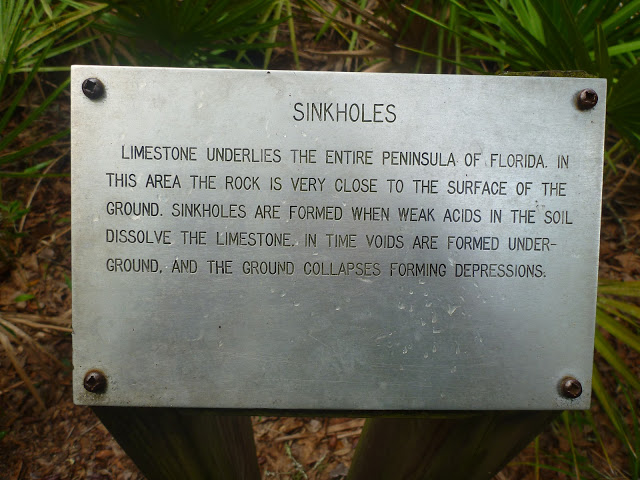
As it happens, I have a long article about sinkholes in the current New Yorker. (You won’t be able to read it online unless you’re a subscriber, I’m afraid.) The sign in the photo below, from a state park in Florida—which has even more sinkholes than Illinois does—explains what they are:

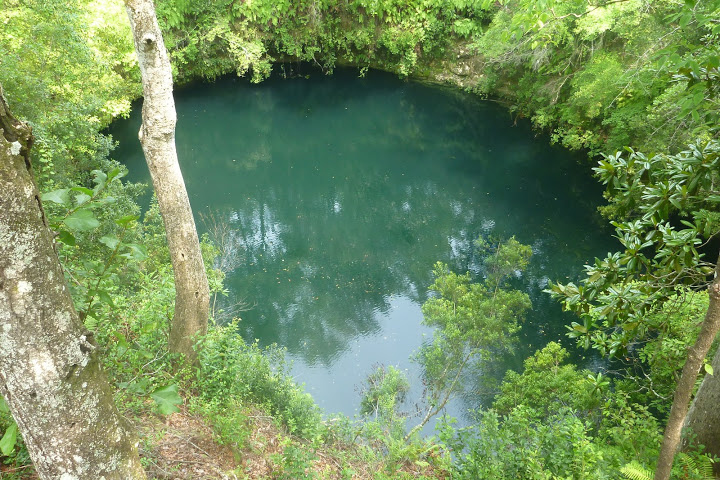
sinkhole signMost of the lakes in Florida were formed by the same processes that form sinkholes, and if you do a quick flyover of the state on Google Earth you will see lots of bodies of water that look similar to the one in the photo below, which is in another state park. It’s called Big Dismal Sink, and an old swinging rope overhangs it. If you decide to jump in, you won’t need to worry about hitting bottom, since it’s more than eighty feet deep.

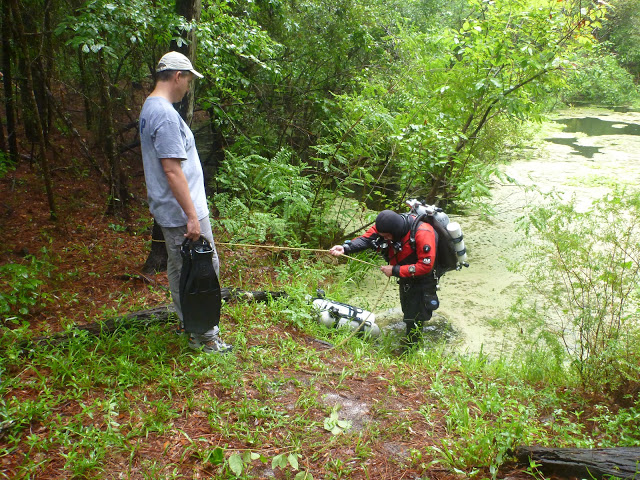
big dismalWhen I was working on my New Yorker article, I spent a couple of days with these guys, whose specialty is diving in sinkholes and subterranean caves:

turner sink

I also visited Lake Jackson, just north of Tallahassee. It’s a four-thousand-acre natural body of water that occasionally disappears down a sinkhole, like a bathtub emptying down a drain. When it goes, it takes everything with it—fish, turtles, alligators, range balls, everything. You can read more about that in my article, and you can actually watch it happening here:


The Muny Life: Augusta Municipal (a.k.a. the Patch)

IMG_0025For my monthly column in the April issue of Golf Digest (on sale now), I played Augusta’s municipal golf course, which is known locally as the Patch—short for Cabbage Patch. There was frost when I got there, and the parking lot was virtually empty, so after nosing around a little bit I went to Krispy Kreme.

IMG_0022

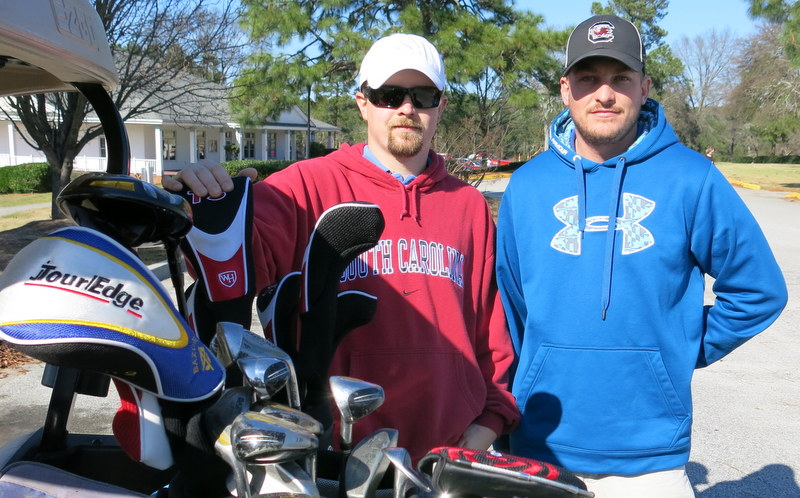
When I returned, I played with Josh and Steve, both journeymen pipefitters, who had driven over from Aiken, South Carolina. They’ve been working as welders on the Savannah River Salt Waste Processing Facility, a job that’s likely to last another two or three years. (“Salt waste” is a semi-euphemism for nuclear waste.) There was a golf-ball-shaped dent on the bottom of Steve’s driver. “That’s from the first time I played,” he said. “It was a sight.” Here they are (Steve is on the left):

IMG_0048

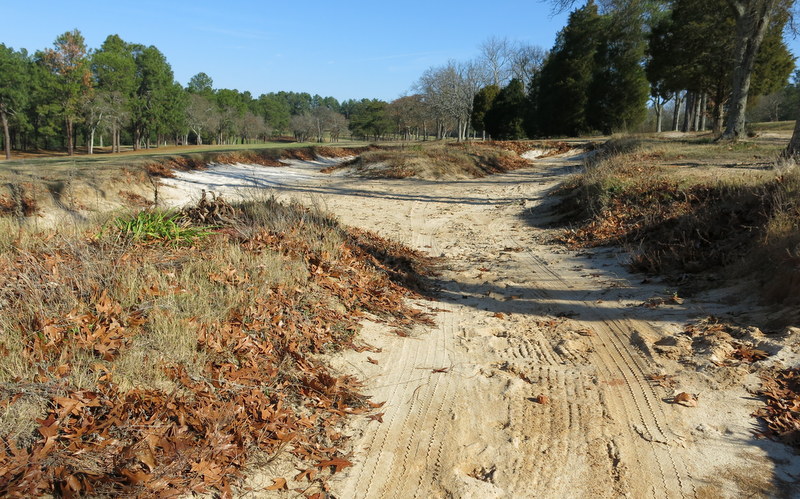
The Patch is scrappy, but it’s a good golf course, and it has some awesome bunkers, like this one, next to the first fairway:

IMG_0030

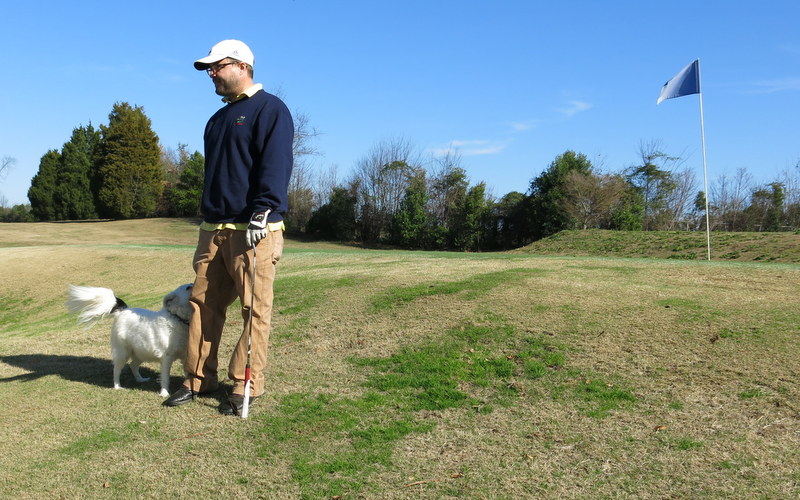
Later that day, I met the guy in the photo below, who was playing with his dog. He’s forty-five years old and has been a regular at the Patch since he was twelve. I asked him how the course had changed over the years. “Not at all,” he said. “It changes, but within a very narrow band. It has been twenty percent better, and it has been twenty percent worse, but it’s basically the same.” Once, during a single week, he played all the nearby golf courses with the word “Augusta” in their name: Augusta Country Club, North Augusta Country Club, Augusta Municipal, and Augusta National. He said that he and his dog had just played twenty-seven holes in three hours—a perfect day.

IMG_0052

I also saw a couple of young dads, playing with sons:

IMG_0037And the next day, I played with the guys I wrote about in my column, two of whom are in the photo below:

IMG_0076In the same issue, Ron Whitten and I have articles about two days we spent in Orlando helping the people at EA Sports recreate the Augusta National course as it was in 1934, the year of the first Masters, for their new video game “Tiger Woods PGA Tour 14: The Masters Historic Edition.” The result, Whitten writes in the magazine, is “the closest thing to a time machine that golfers will ever experience.” The level of detail is extraordinary. Here’s Whitten during one of our sessions at EA, pointing out an incorrectly positioned tree:

P1040827


Beef Box: Golf Idiots, and Neckties on TV Commentators

In 2001, I played 136 holes in one day at Doral with Jim McLean, who runs a golf school there. We started on the Blue Monster and averaged forty-five minutes per eighteen, and to save time we often teed off simultaneously, as in the photo above.

In 2001, I played 136 holes in one day at Doral with Jim McLean, who runs a golf school there. We started on the Blue Monster, where Tiger won over the weekend, and we averaged forty-five minutes per eighteen. To  save time, we often teed off simultaneously, as in the photo above.

David Lee, a reader in Appleton, Wisconsin, sent the following email to the PGA Tour over the weekend:

After hearing it again in today’s TV broadcast, I have a suggestion. I’m referring to a fan shouting out immediately after a Tiger hit: “IN THE HOLE!” It has become so obnoxious to hear these comments, seemingly elicited so that the fan can tell friends at home afterwards that it was his voice doing the shout-out—I’m guessing that that’s the reason because the comment occurs within a nanosecond of the clubhead contacting the ball, oftentimes on a very long shot and without regard to the quality of the shot. Current technology must make it easy for the TV networks to block out such shout-outs—I’m not talking about spontaneous outbursts of support—I think that you and I know which outbursts we’re discussing here. The PGA Tour should do some PR communicating to tournament spectator attendees that such comments are frowned upon and that they will not make it to the air-waves anyway—and take action to eliminate these outbursts from the telecasts. I think that the vast majority of your golfing fans would support this move, as well as would the Tour players.

I don’t know whether what he suggests is technologically possible, but if it is I’d be in favor of it. Or how about using something like a surgical staple gun to implant a device under the scalp of each spectator which would administer a painful but nonlethal electric shock each time the spectator shouted something stupid? And let’s do same to guys who sit behind home plate at baseball games and clap as each ball is pitched, in the hope of bothering the batter.

Nobody else at a golf tournament dresses like this. Why do they?

Nobody else at a golf tournament dresses like this. Why do they?

And, as long as I’m complaining, how about not allowing TV golf commentators to wear neckties? Golf courses should be tie-free zones for everyone but Tim Finchem and the manager of the grill room.

I don't mind seeing ties on ten-year-old caddies in 1925, as in this photo, which was taken at my golf club. The pro when I joined, in 1991, was the son of tiny kid who is fourth from the left in the front row.

I don’t mind seeing ties on ten-year-old caddies in 1925, as in this photo, which was taken at my golf club, but everyone else should knock it off. The pro when I joined, in 1991, was the son of tiny kid who is fourth from the left in the front row–who was the son of the (tie-less) man at the right, the pro in 1925.

Masters Countdown: How Augusta National Almost Built a Golf Hall of Fame

Bobby Jones, 1941 Masters.

Bobby Jones, 1941 Masters.

The National Baseball Hall of Fame and Museum opened in Cooperstown, New York, on June 12, 1939, and the Professional Golfers Association responded by inducting several legendary golfers, among them Bobby Jones, into its own hall. But the P.G.A.’s hall as yet had neither a building nor a plan for one.

Clifford Roberts, who was Augusta National’s chairman and co-founder, embraced the idea and suggested several sites on the club’s property. His favorite, initially, was an elevated six-acre parcel roughly two hundred fifty yards to the east of the tenth green. This was one of the building lots that the club had been trying to sell for a decade. Among the advantages of the site, Roberts wrote to Jones, was that visitors to the hall “would have four good views of the course instead of one.” He also liked the idea that “members using the golf course would have a good view of an attractive building”—though from a distance.

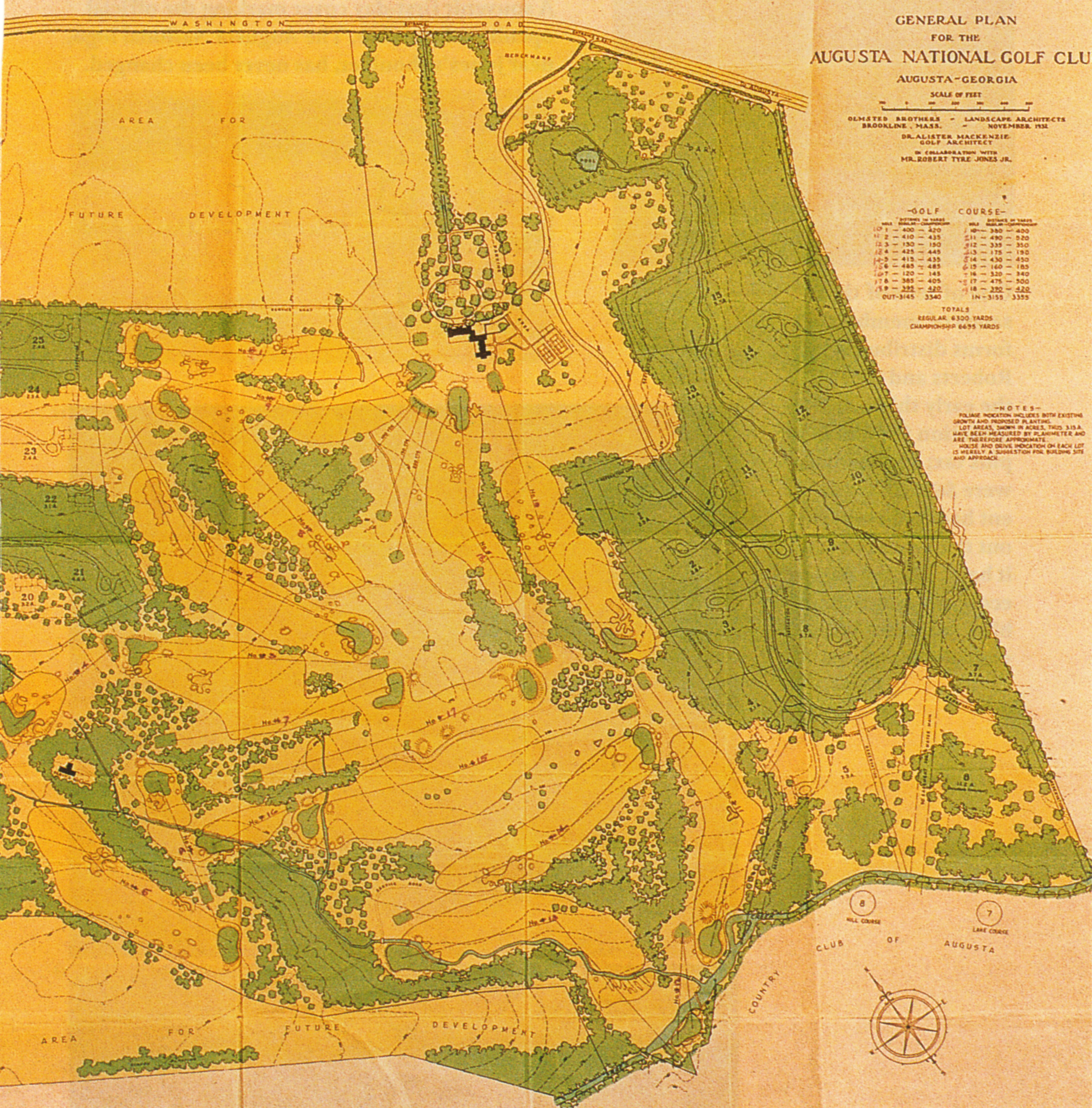
1932 Augusta National real-estate development plan, prepared for the club by Olmsted Bros.

1932 Augusta National real-estate development plan, prepared for the club by Olmsted Bros. Roberts’s initial choice for a hall of fame site was on the east side of the property, to the east of the modern eleventh tee–in the green stuff on the map above.

Roberts was especially concerned that golf’s hall of fame should be more compelling than baseball’s. A few days after the 1941 Masters, he wrote a lengthy letter to Olmsted Bros.—the club’s landscape architects at that time—in which he described a number of features that he thought ought to be included. “The more I think about it,” he wrote, “the more I feel that a building that houses a few plaques or a few bronze busts and that offers nothing else to the public, would prove to be a dull, worthless type of project, having no excuse for its existence except to attempt to glorify the leaders of golf. And I doubt that very much would be added to their fame.” One wing of the building, he continued, could contain “automatic movie machines,” which, for a quarter, would show instructional films by the game’s great teachers. Another wing could serve as both a comprehensive library and a bookstore. Visitors would be able to buy souvenir booklets, postcards depicting the Augusta National course, and “popular-priced copies” of some of the books in the library.

Roberts’s boldest suggestion was to construct “a miniature Augusta National course surrounding the Hall of Fame which would be a practical pitch and putt course and could be made a most attractive part of the landscaping scheme.” The holes would be scaled-down replicas of the holes on the big course. He proposed a fee of twenty-five cents per round. He also suggested building an “especially attractive” public driving range based on a plan that Jones had come across and thought highly of.

Despite Roberts’s enthusiasm, the project never came to anything, and there was no further discussion of building a miniature Augusta National. The two members that Roberts had been counting to pay for the project lost interest in it, and the club was not in a financial position to follow through on its own. And then news from Europe and the Pacific made other concerns more pressing.

The Muny Life: Hidden Art Treasures of New York City Golf

Hacker, Pelham Bay, Bronx, New York, March 1, 2013.

Hacker, Pelham Bay Golf Course, Bronx, New York, March 1, 2013.

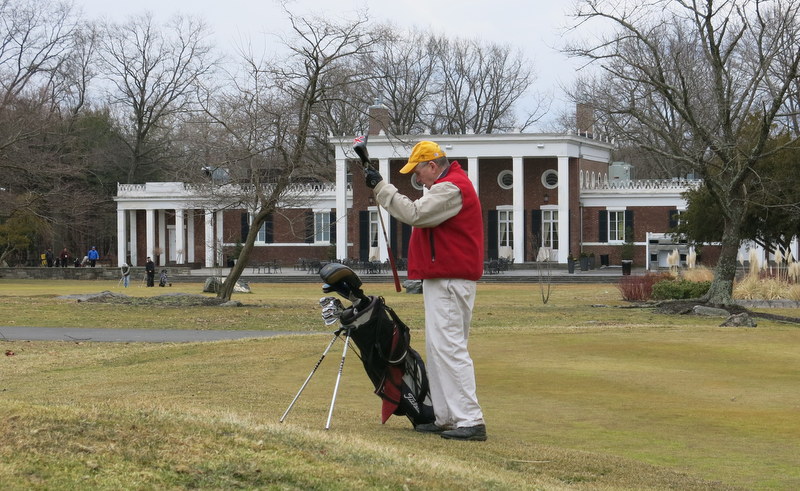
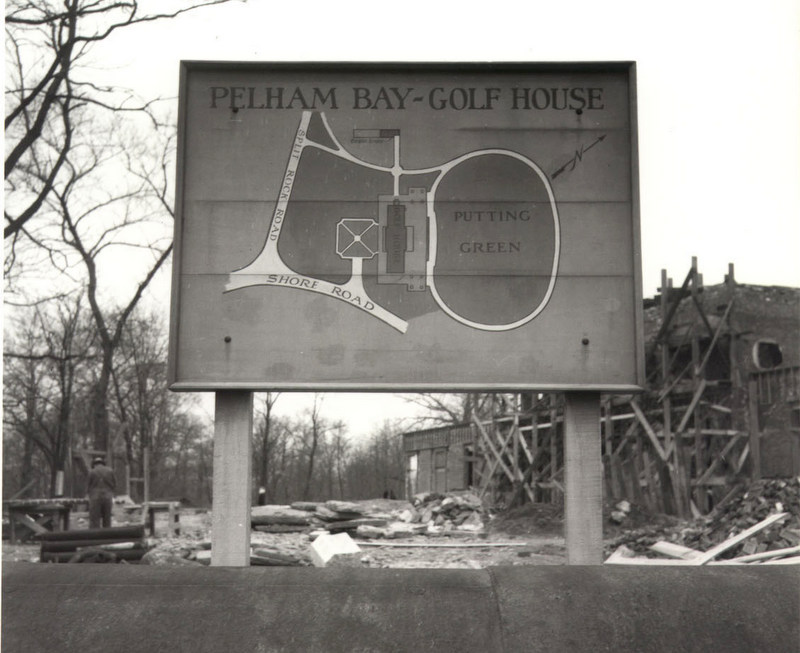
Hacker (real name), Rick, and I played in Pelham Bay Park, in the Bronx, on Friday. There are two golf courses, both owned by the City of New York—Pelham Bay and Split Rock—and they share a clubhouse, which you can see in the background in the photo above. It was built in 1936, and it has a cobblestoned driveway and front courtyard, and it has neoclassical columns made of white Tuckahoe marble. Here’s what the building looked like when it was under construction (beyond the sign):

Pelham Bay, 1936.

Pelham Bay clubhouse, under construction, 1936.

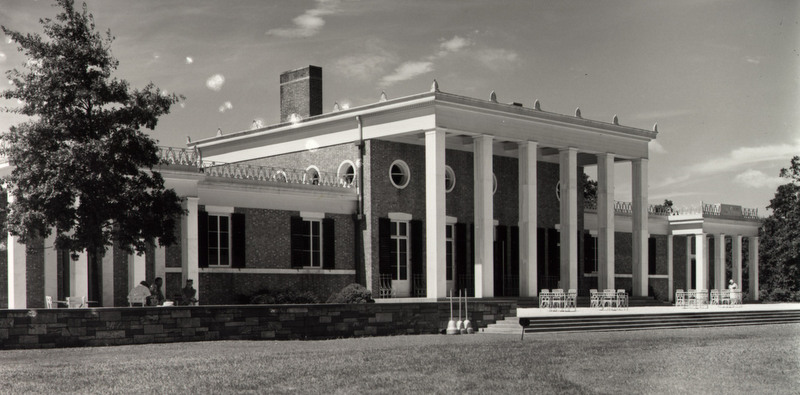
And here’s what it looked like when it was finished:

Pelham clubhouse, 1936.

Pelham Bay clubhouse, 1930s.

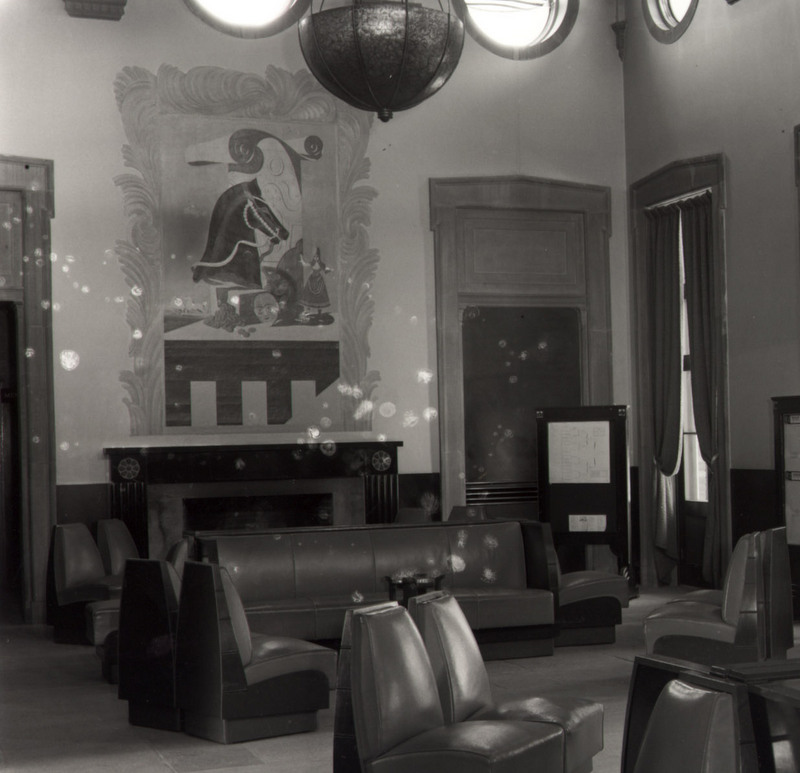
The first time my friends and I played Pelham and Split Rock, in 2004, the clubhouse was a mess. Glass was missing from many windows, and the front door had a hole that was big enough for rats to walk through on their hind legs. The Parks Department had bolted cheap outdoor floodlights to a pair of hemispherical hammered-bronze light fixtures in the Club Room, and it had installed an institutional drinking fountain in front of one of two basalt-and-marble fireplaces. The building was no longer heated, if it ever had been, and on one frosty winter morning we saw piles of construction debris burning in both fireplaces—Irish guys in front of one, Korean guys in front of the other. Here’s what the Club Room looked like in the 1930s:

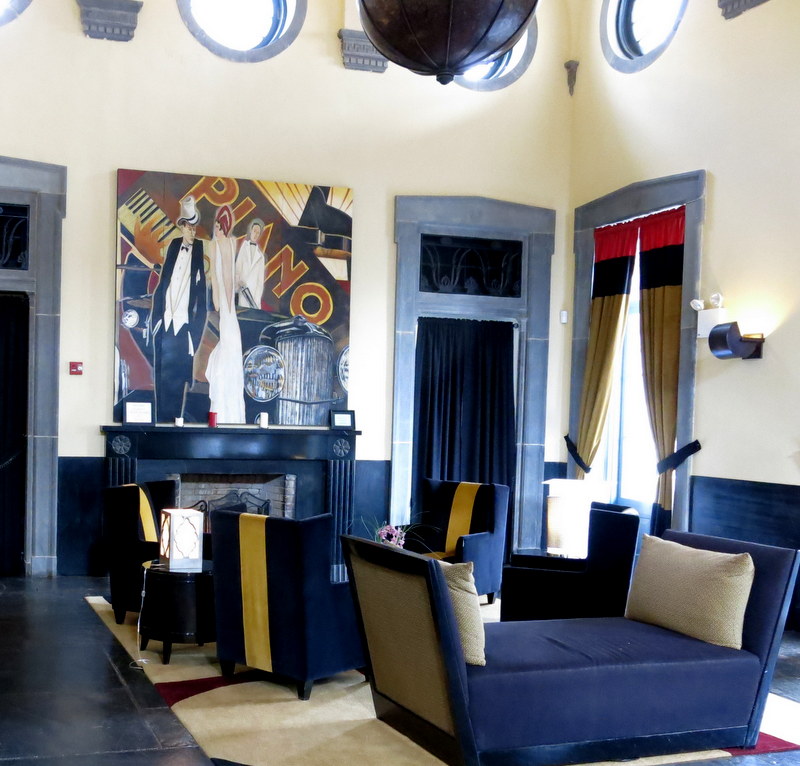
Club Room, 1930s. The Parks Department later bolted flood lights to the Art Deco light fixture at the top of the picture, and installed a drinking fountain in front of the fireplace.

Club Room, 1930s. The Parks Department later bolted flood lights to the Art Deco light fixture at the top of the picture, and installed a drinking fountain in front of the fireplace.

A year or two after we first played there, American Golf, which operates both courses on a twenty-year lease from the city, spent millions to restore the clubhouse. The architect was Page Ayres Cowley, and she and her colleagues did an extraordinary job. Here’s what the Club Room looked like on Friday:

Club Room, 2013.

Club Room, 2013. The floodlights have been removed from the hammered-bronze light fixtures. Why don’t you quit fooling around, and rent the clubhouse for your daughter’s wedding reception?

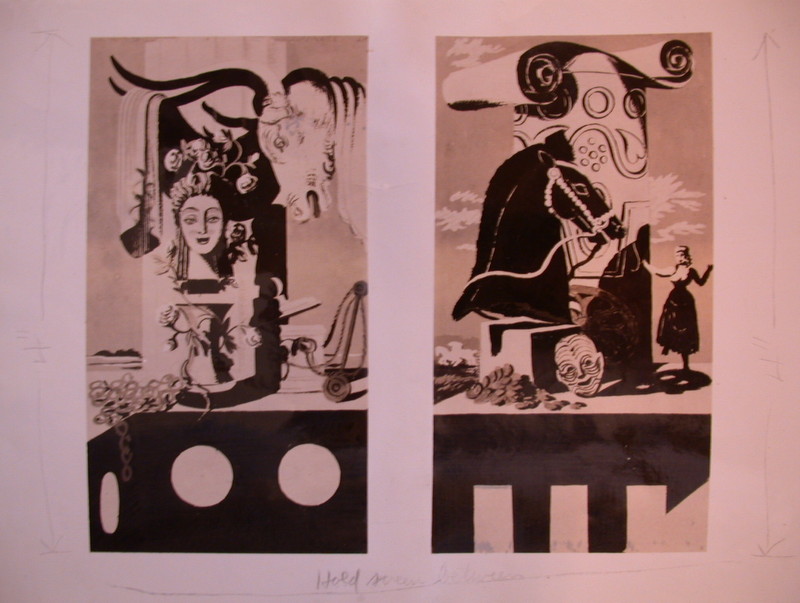
When the Pelham clubhouse was built, the artist Allen Saalburg created a Surrealist mural for the wall above each mantle. (Saalburg was a friend of Dorothy Parker, S.J. Perelman, Robert Benchley, and other early New Yorker contributors.)  His murals—one of which is visible in the 1930s Club Room photograph—were still there when my friends and I first played the courses, but today the spaces they occupied are filled by a pair of hokey recent paintings, which depict what are supposed to be period scenes. The murals, Cowley told me, haven’t been destroyed, unlike similar ones that Saalburg painted, at around the same time, for the restaurant Tavern on the Green. But they need significant restoration work before they can go back up. Here is one of Saalburg’s sketches for the murals:

P DSCN5451

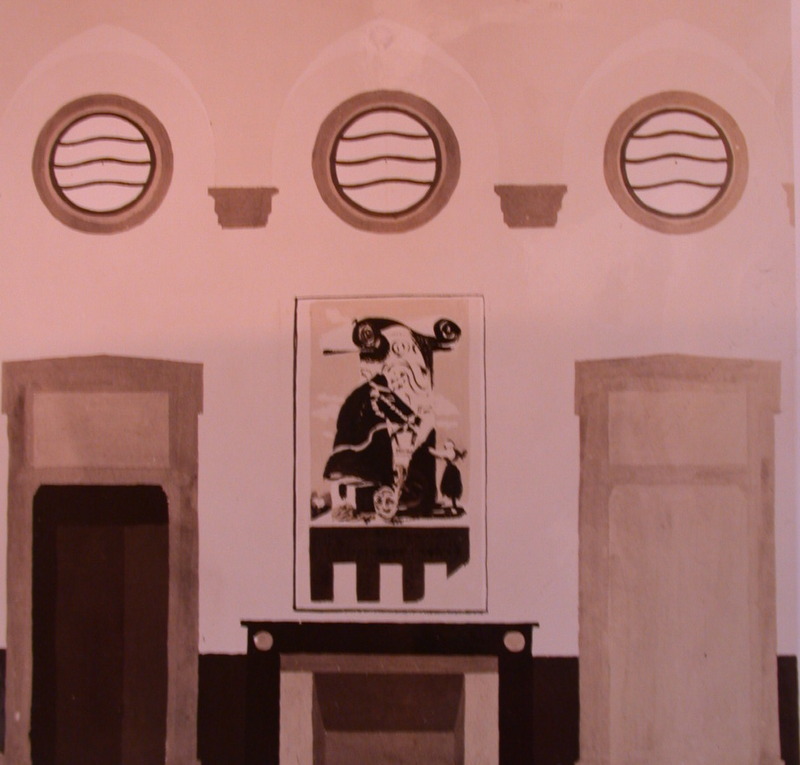
There’s not a lot of golf iconography in there, at least as far as I can see, but I hope somebody rich steps up and pays for their restoration. (Hey, Donald Trump!) And here’s how Saalburg visualized the fireplace wall you can see in the photos above:

P artist rendition2

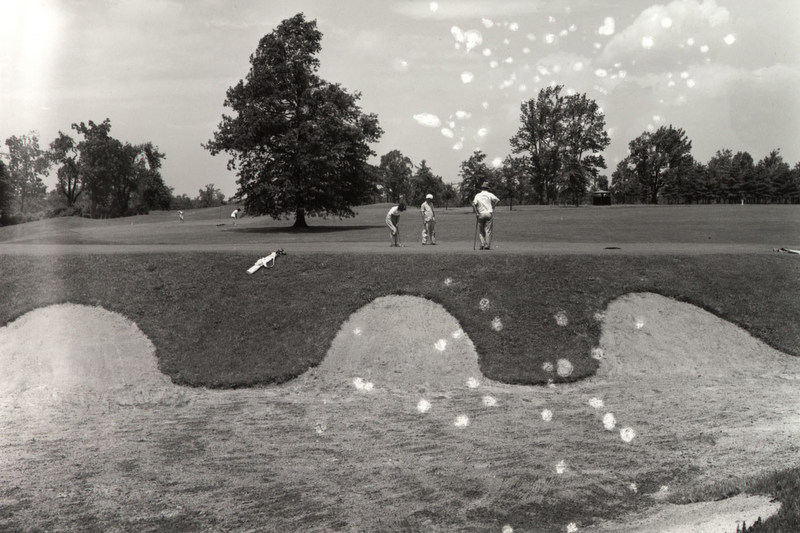
The round windows, and their wavy muntins, are still there—and they have glass in them now. Cowley told me she thinks some of the original bunkers on the course may have been designed to echo the shape of the windows, or vice versa. Here’s one of them, from the 1930s:

Pelham-neg23624.1

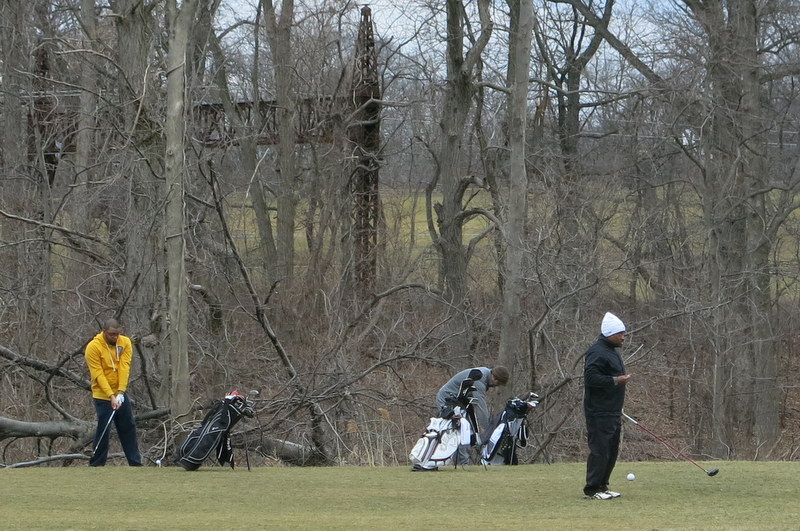
Maybe so. Anyway, Hacker, Rick, and I arrived at 10:30, and teed off almost immediately. (My greens fee was $39, walking; theirs, because they’re seniors, was $20.) There were pretty many other golfers, although we weren’t held up too seriously. We played skins and Ball Marker Stymies, and we finished in less than four hours. These guys were teeing off on the first hole as we putted out on the ninth:

IMG_0386The big rusty thing you see in the woods beyond them is part of a commuter rail line, which separates the two courses. And the grass you see through the trees is the eighteenth hole at Split Rock, which was closed—probably because it has more trees and takes longer to dry out than Pelham Bay does. I got home at 4:30 and took the dog for a nice long walk.

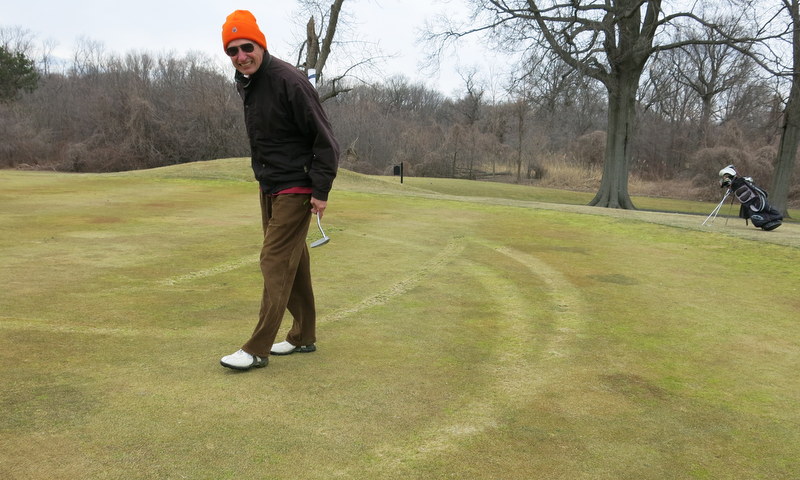
Some moron re-contoured several greens at Pelham by driving an R.V. over them.  This one didn't  look too bad.

Some moron re-contoured several greens at Pelham by driving an R.V. over them. This one didn’t look too bad.

Earliest Known Photo of My Father Playing Golf: 1927

My father trying golf in 1927, with a corner of my grandmother's rose garden in the background.

My father trying golf in 1927, with a corner of my grandmother’s rose garden in the background.

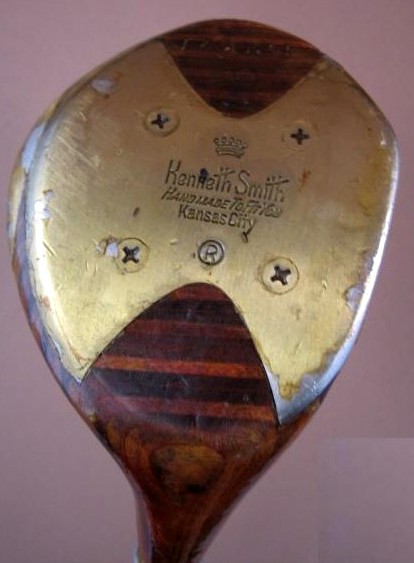
He was two, and his grip was close to the one he used as an adult. I took up golf in my mid-thirties, and when my brother watched me hit a weak slice with a five-iron, shortly after I’d started playing, he said, “You’re already the second best golfer in the family.” The clubs in the photo belonged to my grandfather, who was a decent player. They were custom-made by Kenneth Smith, who was also from Kansas City and hadn’t been making golf clubs for very long. Among the other golfers who played with Kenneth Smiths, eventually, were Bob Hope, Sammy Davis, Jr., Mickey Mantle, Lyndon Johnson, Dwight Eisenhower, and the King of Morocco. I played golf a little when I was twelve and thirteen, and the driver I carried (which I hated) was a cut-down Kenneth Smith.

Here’s a Kenneth Smith advertisement from the December 1961 issue of Golf Digest:

GD Kenneth Smith 12-61

My father underwent major surgery when he was in his seventies, a few years before he died. The operation lasted for six hours, and he ended up with sixty-one staples in his abdomen. When he finally began to come around, a couple of days later, the doctors had to put restraints on his arms to keep him from inadvertently ripping out various tubes and catheters and monitoring devices. He was on a ventilator for a while, too. It was a rough time for him, and an even rougher one for my mom, who, after all, was conscious through it all. She was at his side when he opened his eyes. The first thing he said, in a voice that was weak but filled with hope, was “Am I at the country club?”—exactly what I would have asked in the same situation.

Kenneth Smith

Playing Golf Indoors at Maggie McFly’s

Carl Matz wagon 1891.BMP

The blizzard that was supposed to pummel New England this weekend was a bust, at least as far as my town is concerned. We had a soft drizzle on Sunday morning, but that was as close as we came to getting buried under two feet of snow. The storm was still in the forecast when my friends and I made our weekend plans, though, so I ended up spending the day paying bills, doing the crossword, and obsessively touching up some old photographs that I borrowed from my mother last week, in Kansas City. The guy in the photograph above is my grandfather, in 1891, at the age of three. He never played golf, but he did join a country club, eventually. That’s the only connection I can think of. I like the picture, though.
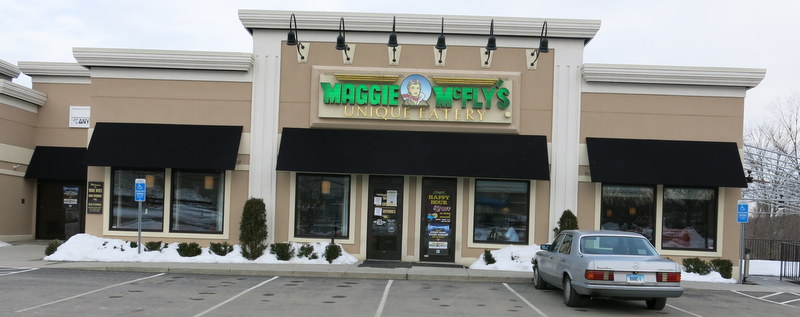
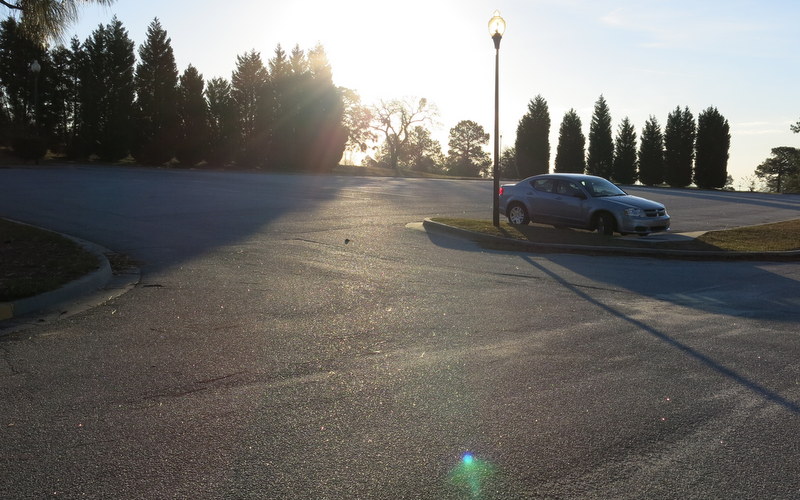
This doesn't look like a golf course, but it is one. I don't know who that car belongs to. Some guy with head covers on his irons, probably.

This doesn’t look like a golf course, but it is one. I don’t know who that fancy car belongs to. Some guy with head covers on his irons, probably.

Two weeks ago, Hacker (real name) reserved one of the three simulators at Maggie McFly’s, a restaurant and bar not far from where we live. We first played there three winters ago, when snow covered the ground for months and we couldn’t find anyplace to play on grass. Since then, the simulators have become so popular that the only tee time we could get was for Wednesday afternoon.
IMG_0219

Simulator technology has improved tremendously since the first time I played indoors, in the early 1990s. As always, you hit shots toward a picture on a screen, and a computer takes over once the ball is in the air. What has changed is the sophistication of the imagery and the accuracy with which the sensors pick up your ball’s velocity, trajectory, and spin. The machine we played was manufactured by a company called aboutGolf and is endorsed by the PGA Tour. It’s what you see on the Golf Channel.

That's Rick.

That’s Rick, getting ready to hit a lob over a bunker. It’s a shot he’s good at because–unfairly, some would say–he practices.

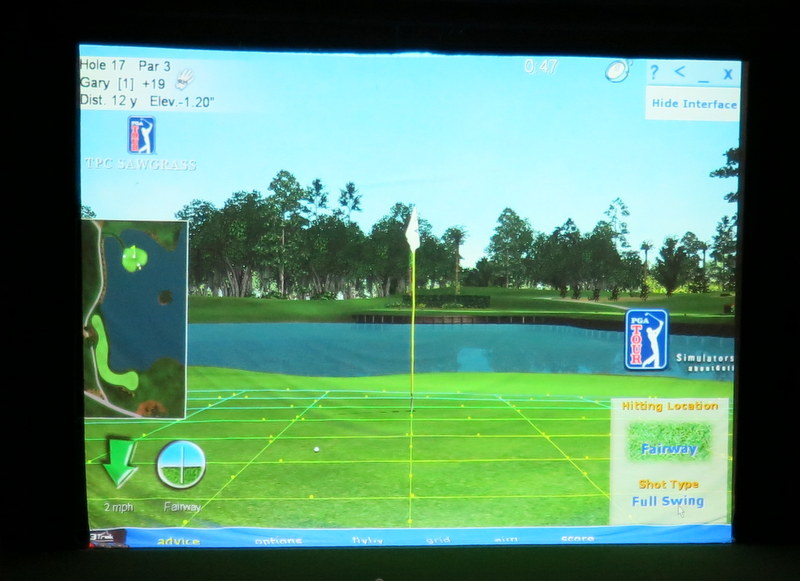
In the past, we’ve played Pebble Beach, Spyglass Hill, and the Old Course at St. Andrews, among other courses you may have heard of. This time we played the TPC at Sawgrass. Here’s what the famous 17th hole looks like when you’re standing on the fringe at the back of the green, looking toward the tee. I had a birdie putt, which I just missed:
IMG_0201

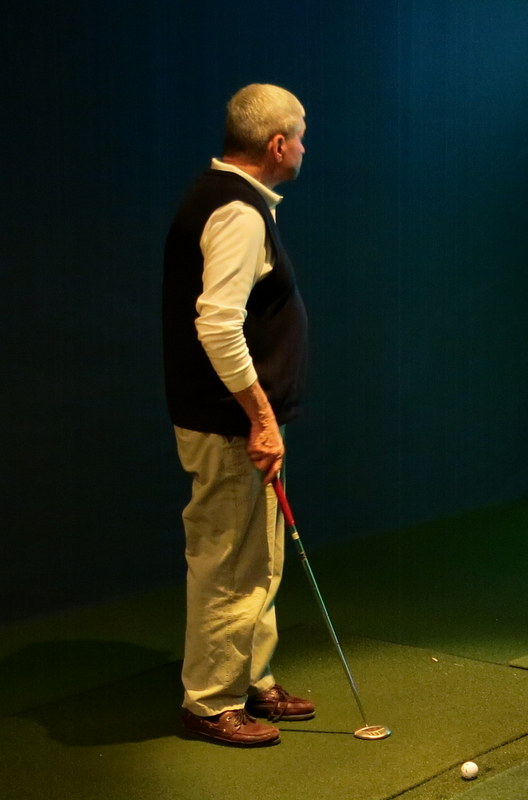
Simulator putting takes some getting used to: to read the breaks, you have to analyze the movements of dozens of virtual marbles rolling around on a projected grid that looks like a college-textbook illustration of the curvature of space-time. Once you get used to it, though, you begin to wish your home course had virtual marbles, too. Here’s Hacker—who was my partner—reading one of the many critical putts he drained:
IMG_0205

The simulators at Maggie McFly’s are great, because they’re in wood-paneled rooms that look like something you’d find in a fancy clubhouse. A waiter brought us beers and cheeseburgers, and there were four guys in the room next to ours who looked almost exactly like us, and if we had been able to figure out how to turn on the TV we would have been able to watch the football game. And about an hour into our round a woman with a cane walked in and sat down on our couch: our first gallery ever!
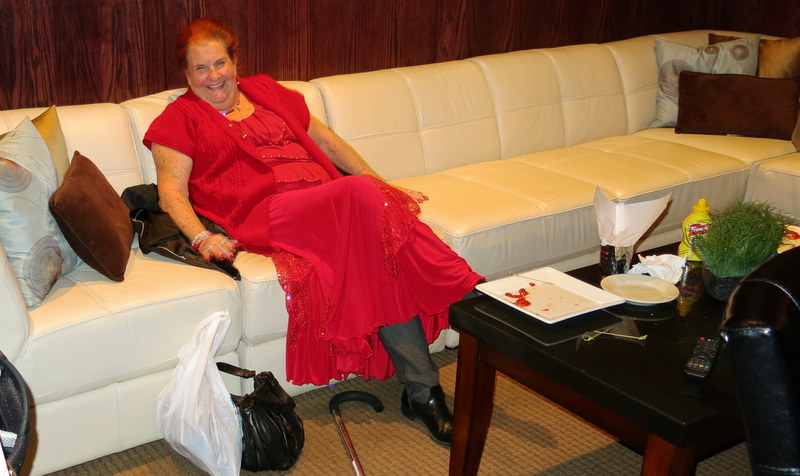
IMG_0178Her name is Linda, and she’s seventy-two years old. She said there was going to be karaoke at Maggie McFly’s that night, a favorite of hers, but that she would probably go home for a nap at some point, rather than hanging around for eight hours. Her husband, who died fifteen years ago, was an engineer. He worked on the Manhattan Project (though not on the bomb part) and on the Suez Canal, and he was a champion skeet shooter.
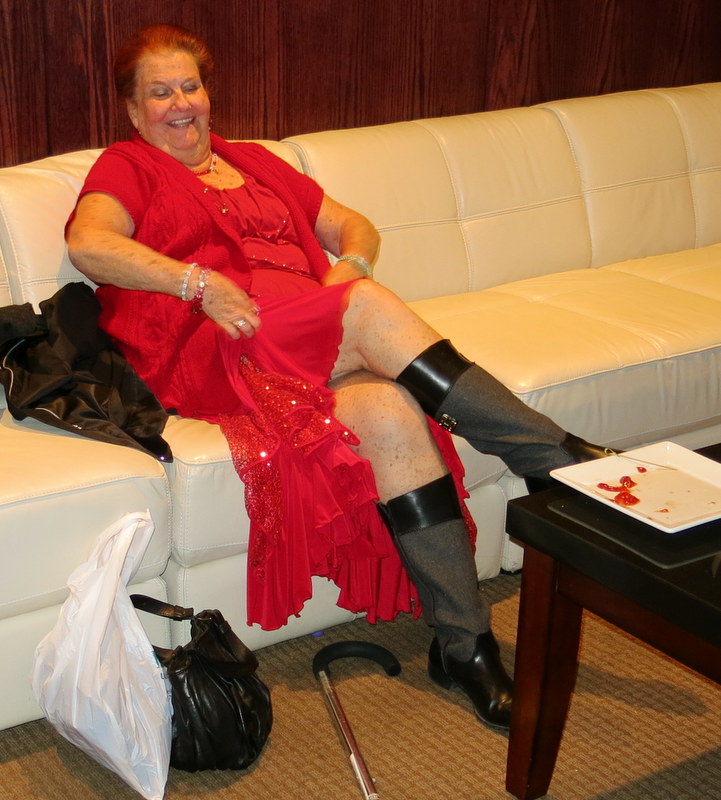
IMG_0176

She said she had played a little golf when she was younger but hadn’t swung a club since sometime in the nineteen-seventies. She was very interested in how the simulator worked, and when we tried to explain it we sounded the way I did when my son, at the age of three or four, asked me what makes the car go. At one point, the manager came in to tell her to beat it, but we had already bought her a drink so we told him to beat it. I happened to mention that the following day was going to be my birthday, and when we weren’t paying attention she ordered dessert for all four of us. I got to pick the one I wanted, and then a waitress put a candle in it and lit it.

IMG_0199Linda wanted to try the simulator, so as soon as Hacker and I had wiped out Rick and Gary we gave her Hacker’s three-wood and let her rip a few. She went right under the first one, but after that she nailed it, repeatedly:

IMG_0212

The only problem with simulator golf is that it’s the opposite of exercise, because between shots you don’t walk anywhere, or even climb in and out of a cart; you just plop down on the couch and steal a few more of Gary’s french fries.
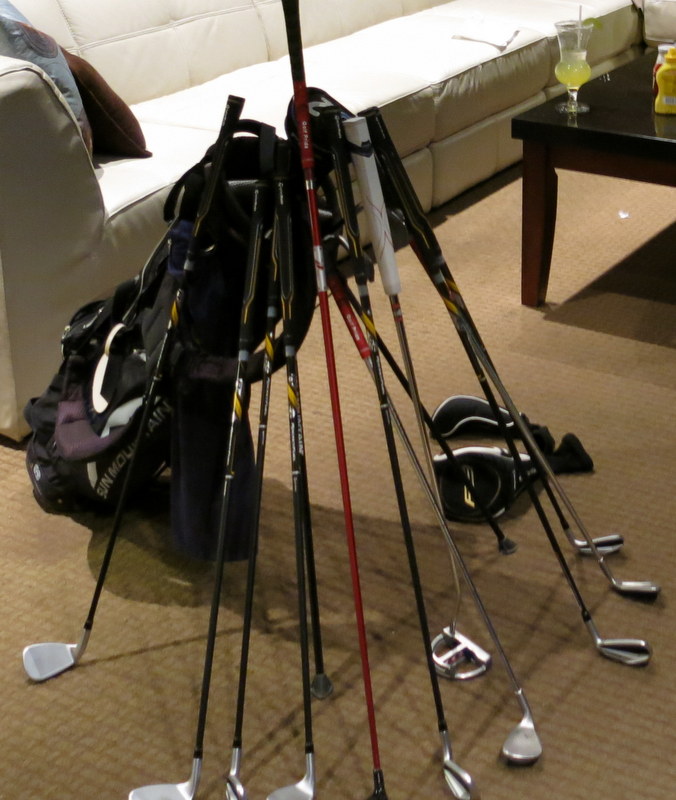
IMG_0216-001

My brother, John, used to play in a winter simulator league at a health club in Brooklyn. He said that it was embarrassing to stand around drinking beer and eating Doritos while beautiful women in butt-floss leotards trotted back and forth between the racquetball courts and the Nautilus machines. He suggested that the club install a treadmill next to the golf simulators, so that you could pick up your bag and pretend to walk to your ball while you waited for your turn to hit. That way, at least, you’d break a sweat.
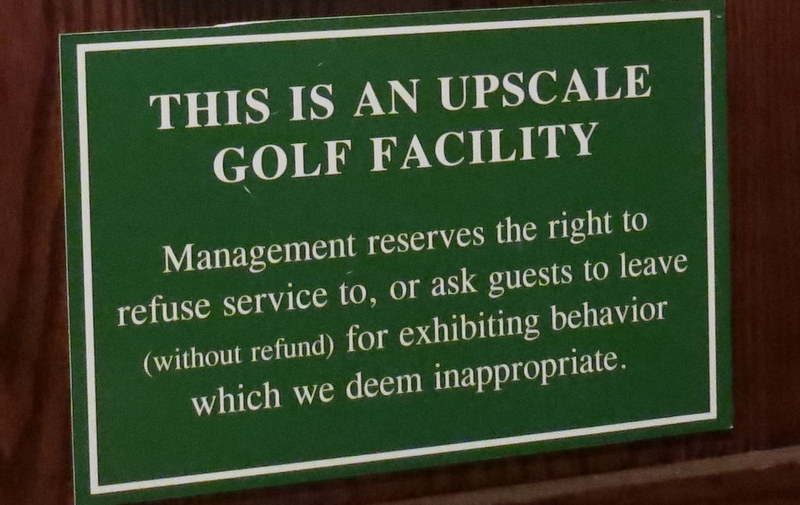
This may be a direct reference to an early customer--a cop!--who took a whiz in a potted plant and was banished for life.

This may be a direct reference to an early customer–a cop!–who took a whiz in a potted plant and was banished for life.

Masters Countdown: Those Amazing Flowers

ANGC Circle 2

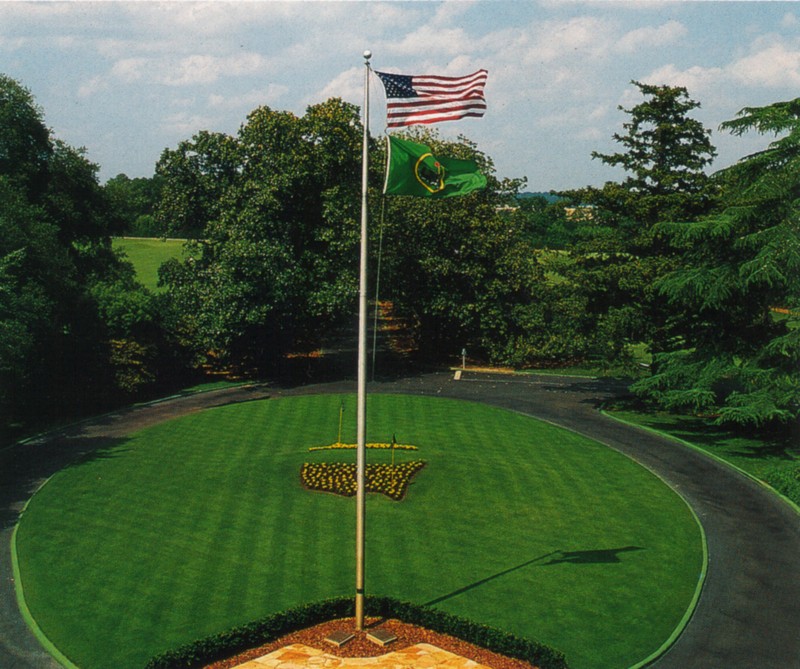
The photograph above shows the circle at the end of Magnolia Drive, in front of the Augusta National clubhouse. Everything is immaculate, including the green paint on the curbs—which is touched up frequently as the tournament approaches. The photograph below, which was taken in 1947, shows the same circle as it appeared during a period when the club was still strapped for money and couldn’t afford to pay the same attention to detail (or to pansies).

ANGC Circle 1

At the base of the flagpole in the photograph at the top of this post are plaques commemorating the co-founders of the club and the tournament: Clifford Roberts and Bobby Jones. The plaques are the only memorials to the men on the property. In 1941, two new Augusta National members—James Middleton Cox, a newspaper publisher, who years earlier had served three terms as the governor of Ohio, and his son, James, Jr.—proposed erecting a large statue of Jones near the clubhouse, not far from what would later become the site of the Eisenhower Cabin. Jones and Roberts were deeply unenthusiastic about the monument, and both were relieved when the Coxes, at Roberts’s suggestion, shifted their attention to the possibility of building a hall of fame on club property. I’ll have more to say about the hall of fame in a few days.

Great Golf Course: Riviera

2008 Joann Dost All Rights Reserved

In 1947 and 1948, Ben Hogan competed in two Los Angeles Opens and a U.S. Open at Riviera (where the Northern Trust Open is currently being played). He finished first, first, and first. He would have won again, at the 1950 L.A. Open, his first tournament following his car accident, if Sam Snead hadn’t closed with consecutive birdies to tie him in regulation, then prevailed eight days later in an anticlimactic rain-delayed playoff. No wonder they still speak of Hogan’s game in the present tense at Riviera. His portrait hangs in the clubhouse over a fireplace that is always lighted, like an eternal flame.

Hogan, Riviera, 1950.

Hogan, Riviera, 1950 L.A. Open.

Riviera opened in 1926, in a flood-carved canyon in what was then sparsely populated farmland west of Los Angeles. It cost almost a quarter of a million dollars to build, and for a time it was the second-most expensive golf course on earth (after Yale). W.C. Fields, Douglas Fairbanks, Olivia De Havilland, Clark Gable, Katharine Hepburn, and Howard Hughes all played there regularly. Will Rogers, Gary Cooper, and Spencer Tracy competed every weekend on the polo grounds, which are the source of the kikuyu grass on the golf course. Elizabeth Taylor and Greta Garbo, whose house overlooked the thirteenth fairway, were often seen trotting along a bridle path that encircled the course. Television didn’t exist, and martinis and cigarettes weren’t bad for you yet, and golf at Riviera was a party.

Katharine Hepburn, golfer.

Katharine Hepburn, golfer.

The Los Angeles Open was a very big deal in those years—more of a major, in many ways, than some of the majors.  Humphrey Bogart, who in his prime was close to scratch, used to sit under a tree near the twelfth green and sip bourbon while Hogan, Mangrum, Snead, and Nelson played by.

Bogey, scratch.

Bogey, scratch.

I played quite a few rounds at Riviera in 1995, on assignment for Golf Digest. The P.G.A. Championship was going to be held at Riviera that year, and I was working on a preview article. I arrived in L.A. one afternoon, checked into my hotel, and, because it was too early to eat dinner, decided to make sure I could find the course. A guard waved me through the gate, A tournament official let me through the fence and told me I should meet the club’s greens chairman, who had just finished playing and was having a beer with friends. We chatted for a few minutes, and then he asked, “Where are your clubs?” I ran back to my car. We teed off maybe five minutes later, and got in twelve or thirteen holes before it was too dark to see. When we’d finished, my new best friend asked me where I was staying, and when I gave him the name of my hotel he said, “You ought to be staying here.” So I moved into a lovely bedroom in the clubhouse, overlooking the eighteenth green. I woke up the next morning to the sound of members rolling putts on the practice green, and after a quick shower I ran downstairs and joined them.

My home away from home for four days.

My home away from home for four days.

Over the next few days, I played with two lawyers, who met in court while representing opposite ends of a personal-injury lawsuit; a guy whose company publishes hotel room-service menus; a guy who had recently retired from the garment business; the actor who played Frank Fontana on “Murphy Brown”; the father of Robby Krieger, who played guitar for the Doors; and Larry David, the co-creator of “Seinfeld” (and later the star of his own show).

My close personal friend Larry David.

My close personal friend Larry David.

I also met Walter Keller, who was Amy Alcott’s teacher. He said that he first met Alcott on the practice tee at Riviera when she was a young girl. “I fell in love with the kid right there,” he told me. “She hit a beautiful shot, and I said, ‘Hit another.’ She did. ‘Hit another.’ She did. I turned to her mother and said, ‘You are a blessed woman.'” Keller arranged for Alcott to become a member of the club. She had a difficult relationship with her father, he said, but club members looked out for her. “She had twenty fathers here,” he said. “Dean Martin would see her on the driving range, swing by in his cart, and say, ‘Hey, Amy, let’s play nine holes.”

Amy Alcott, Walter Keller, and Tony Sills (who was also a student of Keller's) and a significant collection of junior-golf trophies.

Amy Alcott, Walter Keller, and Tony Sills (who was also a student of Keller’s) and a significant collection of junior-golf trophies.

Alcott won the first of her twenty-nine LPGA Tour events in 1975, when she was nineteen. Keller died in 2003, at the age of ninety-five.

Dino.

Dino.


Bowling as Wintertime Golf Methadone

SMG BowlingEight years ago, my regular golf buddies and I decided that, instead of moping around all winter, as usual, we would go bowling. Eight guys showed up the first Sunday. Ferris, it turned out, had bowled in high school, and Billy had been a member of a hippie team in college. Nick and Gene already owned their own balls and shoes. Ray brought his old ball but couldn’t use it because his fingers no longer fit into the holes.

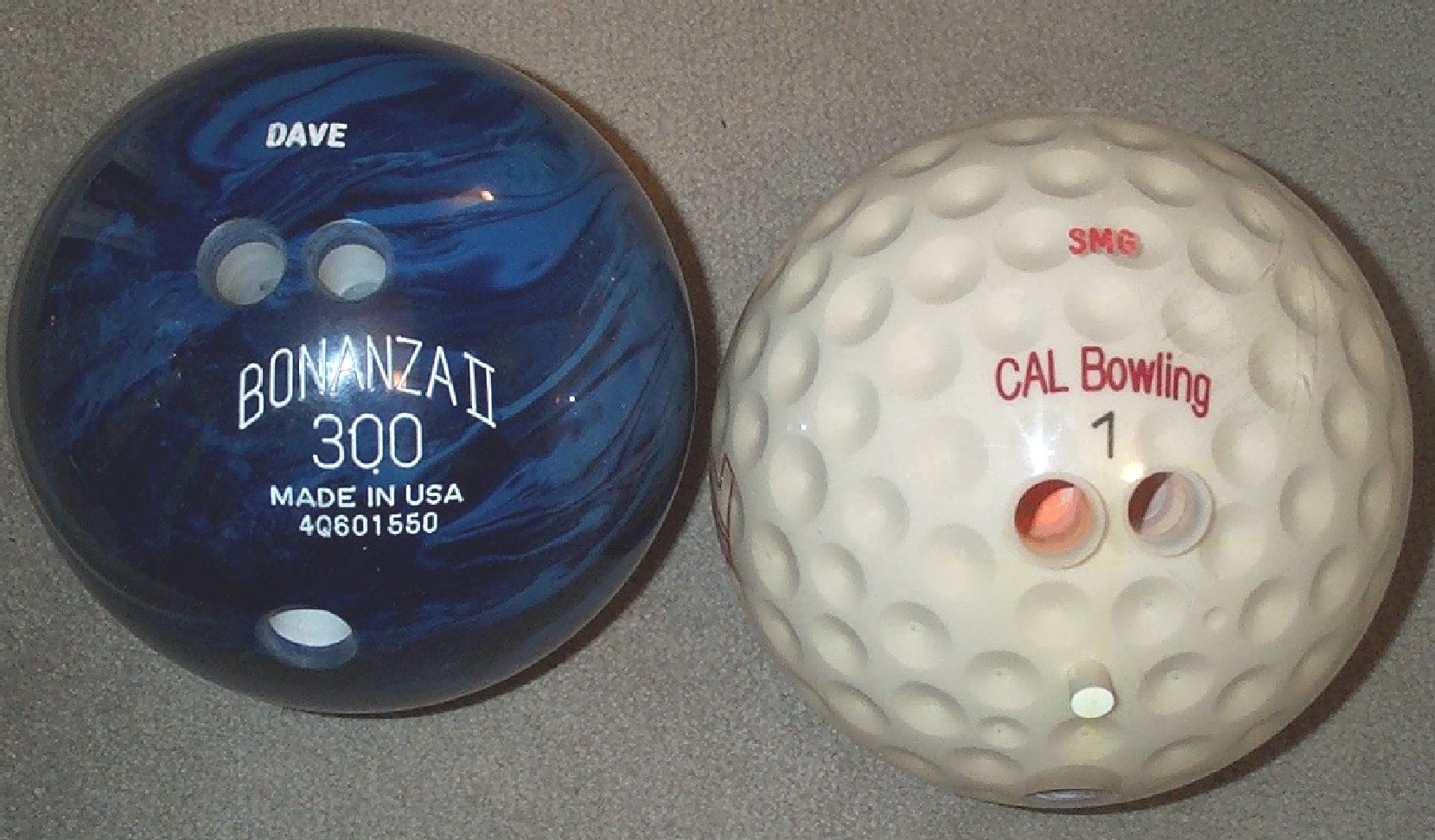
As soon as I got home, I went online and ordered bowling shoes, a bowling instruction book, and a bowling ball that looks like a giant golf ball. Two weeks later, I bought a second ball (with more spin) and a two-ball bag, to which I attached my golf-club bag tag. I had my name engraved on one of the balls, and “SMG” (for Sunday Morning Group) engraved on the other.

bowling ball

Taking up bowling was like discovering a previously unsuspected continent of things that you can buy. (Did you know that good bowling shoes have different right and left soles—one to grip and one to slide?) We transferred over all our regular junk, including skins, negative skins, nassaus, presses, and the money hole. We bowled in golf clothes and golf hats. We referred to frames as holes and to games as rounds. We used golf towels to wipe lane oil from our balls. I even managed to preserve most of my swing flaws: I came over the top in bowling, too.
I created an Excel spreadsheet that automatically updated everybody’s average and handicap whenever I entered new scores. In one of our earliest outings, after shooting a depressingly characteristic 82, I had six consecutive strikes, a spare, another strike, and two nines, for 226. Hacker (real name) said, “Aren’t you kind of sad that you’ve already shot the best round you’ll ever shoot?”

A bowling alley is one of the few sporting venues where a golfer can feel almost like an athlete. There were so many smokers at one of the ones we went to that even the parking lot smelled like cigarettes. Most of the regulars, who gave us dirty looks when we collapsed in hysterics over somebody’s double gutter ball, had very low centers of gravity—they were shaped like bowling pins—and their bowling bags had  wheels on them. The specialty at the snack counter was panzarotti, which is made by combining all the things your doctor tells you never to eat and deep-frying them.

Bowling is fun, but it’s just golf methadone. We bowled for two winters, but then winters around here started seeming more like late fall or early spring. We found several open golf courses within an hour or two of where we live, and they made us forget all about our fancy bowling shoes. This winter, though, we’ve had a couple of big snowstorms, including a huge one this past weekend. We’re probably not going to see grass around here again for a while, even if it doesn’t snow this coming weekend, the way it’s supposed to. So who knows?

smb reminder