What’s In My Bag, Part Three: Let’s Have a Look Inside Those Pockets

Will, Brent, D.O., Ben, Liberty National Golf Course, Jersey City, New Jersey, May 5, 2013.

Famous building, Will, Brent, D.O., Ben, famous statue. Fourteenth tee, Liberty National Golf Course, Jersey City, New Jersey, May 5, 2013.

On Sunday, I had the tremendous good fortune to be invited to join a twelve-man outing at Liberty National Golf Course, in Jersey City, New Jersey, directly across the Hudson River from lower Manhattan. I employed a labor-saving technique I’ve often used during visits to other rich-guy golf clubs: I wore my sorriest-looking pair of shoes, knowing that the locker-room guy would fully resuscitate them while we were playing. During a multi-day trip Pine Valley ten or fifteen years ago, I took three sorry-looking pairs of shoes and left them outside my door sequentially. I went home feeling like a new man.
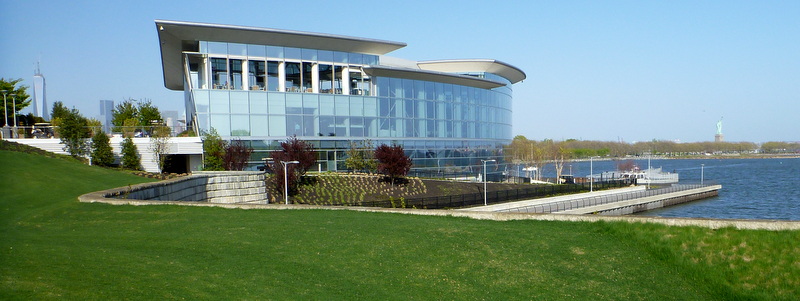
Cool clubhouse.

Cool clubhouse–and that statue again.

Liberty National was designed by Tom Kite and Bob Cupp, and it was built, in 2006, on a desolate industrial site. (I’ve seen a variety of cost estimates, all of which have nine digits.) The Barclays—which used to be known as the Westchester Classic, and then as the Buick Classic—was held there in 2009, and it will be held there again in August. Tour players grumbled about the course the first time. Since then, Kite and Cupp have made many changes, and either the changes have been effective or I don’t know what I’m talking about, because I liked the course a lot. And the clubhouse is the only starkly modernistical one I’ve ever been in that I fully approve of.
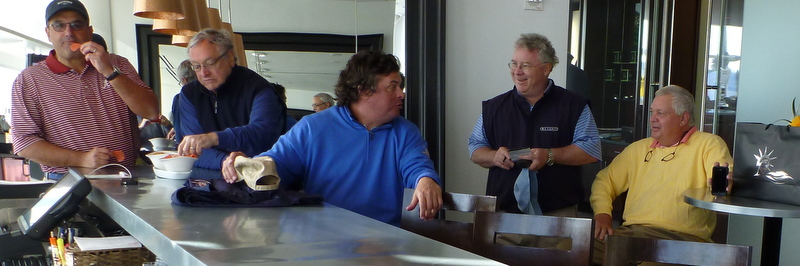
The bar, post-round.

The bar, post-round.

Partway through our round, I apologized to my caddie for having forgotten to remove a couple of nonessential items from my golf bag. (I’ve gotten a little lazy about on-course housekeeping in recent years, because at home I now almost always use a pushcart.) The bag can’t have been too bad, though, because I still occasionally carry it myself. Here is some of what was in it:
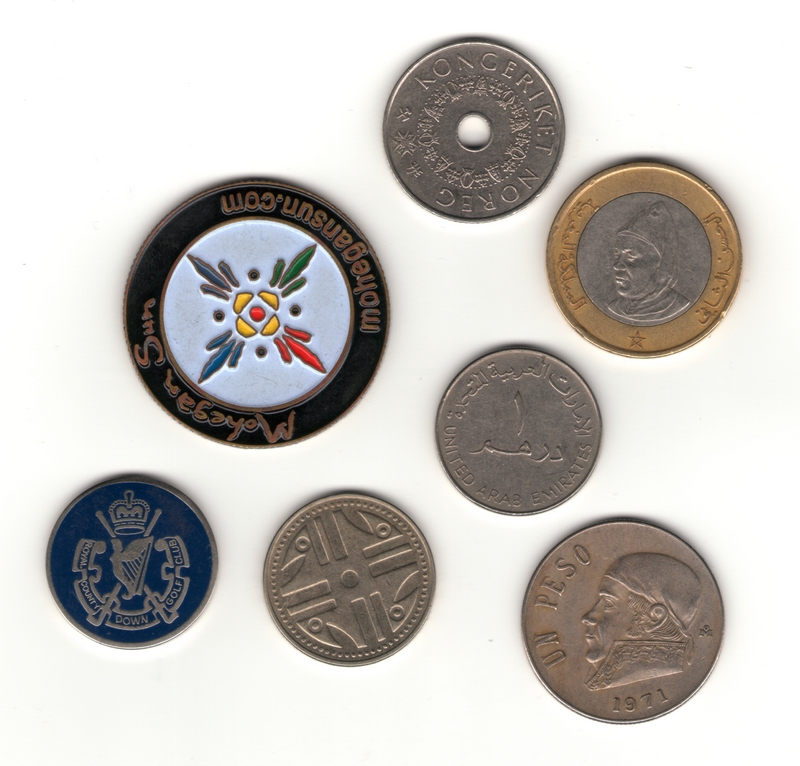
Ball markers

The photo above shows my selection of lucky ball markers for that day. Clockwise from lower left: a souvenir marker from Royal County Down, a necessity because of the sublimity, transcendence, immanence, etc., of that course; a souvenir marker from a casino in Connecticut, useful because it has four colored pointy things, any one of which can be aimed at the hole; a Norwegian coin with an actual hole in the middle of it; a Moroccan coin featuring King Hassan II, who loved golf, wore golf gloves on both hands, and was accompanied during golf rounds by a servant whose only job was to use a pair of silver tongs to hold the king’s cigarette while swung; a one-something coin from Dubai, which I often use when I absolutely have to one-putt; a big old Mexican coin with some guy on it; a Colombian coin featuring what appear to me to be balls, holes, and “aiming chutes.”

When I wrote about (a slightly different selection of) lucky ball markers, last year, I said that when I used a coin with a guy’s head on it I aimed the top the head at the hole. Michael Clark, a reader, wrote to say that, on the final day of a three-day-tournament at his club, he had discovered a better way. “The eyes of the coin had to be looking at the hole,” he wrote. “When the eyes lined up to the hole the putts were dropping! Also, it had to be the same coin. So, if the coin has eyes, line them up!” Since then, I have field-tested Clark’s method, and adopted it.

Morefar green repair tool

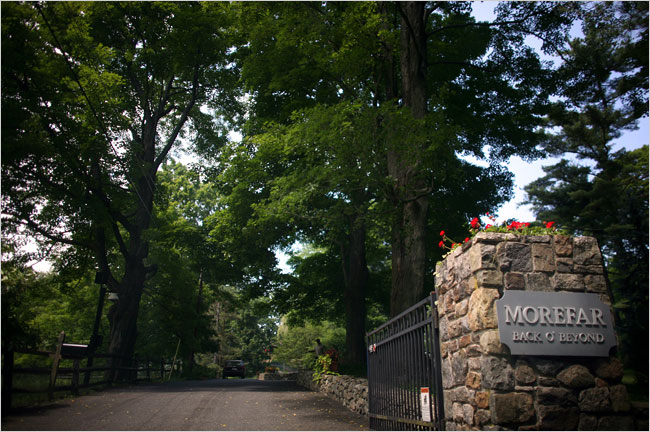
The photo above is of what is probably the luckiest green-repair tool I’ve ever owned. I got it at a super-secretive golf club called Morefar Back O’ Beyond, which straddles the border between Danbury, Connecticut, and Brewster, New York.

The course on the left is Morefar. The course on the right is Richter Park, which is owned by the city of Danbury, Connecticut, and is one of the best munys in the country.
The course on the left is Morefar. The course on the right is Richter Park, which is owned by the city of Danbury, Connecticut, and is one of the best munys in the country.

Morefar

Morefar used to be owned by the disgraced insurance company A.I.G. I played there a dozen years ago as the guest of one of the club’s handful of local members. Only a tiny number of golfers are allowed out each day, and the only other group on the course on the day we were there was that of the Sultan of Brunei, who teed off before we did. He and his retinue were almost comically slow, but, it turns out, you don’t play through the Sultan of Brunei. On an airplane recently, I saw a guy (in first class) who had a Morefar attaché case in his lap. I gave him the secret sign of brotherhood (by showing him my green-repair tool) as I walked past him on my way to the back of the plane, but he cut me dead.

coppertone

The item above is roll-on sunscreen, which I use as “lip balm.” The tube is at least half again as big as a ChapStick tube, and the stuff is waterproof. It’s especially handy in cold weather and in wind. I don’t carry ordinary sunscreen in my golf bag because I don’t believe in applying sunscreen in situ. I once told someone that if I ever ran for President my platform would have just three planks. I don’t recall what the first two were, but the third was that everyone would have to put on their sunscreen at home, before they went to the golf course, the swimming pool, or wherever. Sunscreen is much easier to apply when you aren’t wearing clothes, and it works better if it’s had some time to soak in. When I see young parents at the beach trying to squirt sunscreen onto squirming, uncooperative children, I think: “An hour ago, your children were naked and not covered with sand; why didn’t you think of doing this then? When I’m the President, we’ll have no more of this nonsense.”

Several readers have sent me descriptions of what’s in their own bag. As promised, I will soon create a new section and post several of them permanently. If you’d like to add your own bag to the pile, send an email to myusualgame@gmail.com. Include a golf-related description of yourself and at least one or two photos of your golf stuff.

(Read Part One and Part Two.)

What's In My Bag?

What’s In My Bag?
Reader’s Report: Pace of Play

My friends and I played as a sixsome on Thursday afternoon. We played in three and a half hours and kept ahead of the high-school matches behind us. We played T-Bone, and my team came back on the final six holes to halve the match and win two presses.

My friends and I played as a sixsome on Thursday afternoon. We played eighteen holes in three and a half hours, and kept ahead of  a cluster of high-school matches behind us. The game was T-Bone, and on the final six holes–during which all six balls counted–my team came back from far behind to halve the match and win two presses. We won four dollars apiece. 

I’ll get back to anatomizing my golf bag in a couple of days—I still haven’t told you what’s in the pockets—but I want to share an email I received from Kent Manning, a reader in North Carolina. He describes himself as “an ugly eighteen-handicap, trending upward due to the onset of chipping yips (or ‘chomits,’ as a buddy calls them—chipping vomits).” His personal credo, he says, is “If I can see the fringe, it’s putt-able.” His email:

A few things have led me to this letter:

1) having gone to Scotland in the last year—where they REALLY encourage a  three-and-a-half-hour round, and you get the stink eye if you’re slowing things down;

2) having read your Two-Hour Eighteen™ missives;

3) having read about the Golf Digest Time for Nine campaign;

 4) the constant drumbeats about slow play;

Why is it everyone THINKS they play fast when they really don’t? I’ve gotten so seized up on playing fast that the least dawdling by my playing partners drives me batty. When you play in some of your fivesomes at your blistering paces—how have you gotten everyone to buy into the idea of such fast play?

It’s funny—our club is always struggling to get members. I went so far as suggesting to our Manager that the club institute a 3:45 time limit on rounds and then aggressively market that fact. In a world in which you are trying to differentiate yourself in the marketplace—if I found a course that I KNEW I would get my round done in less than four hours it would be a win/win for everyone.

Do we just take every swing too seriously? When we played Crail Balcomie, in Scotland, it was awesome to watch all the local folks (including senior men and women) pulling their trolleys. They would just hustle up to their ball, yank out a club, hit, watch for about three seconds, stuff their club back into the bag, and get gone. That would be great to see hereThanks for letting me vent.

Pace of play ought to be a burning issue for every golfer, because the slower golf gets the more golfers will quit, and the more golfers quit the more expensive and annoying the game will become. And if it’s the speedy players who give up and go away we’ll be left with nothing but slowpokes. I personally don’t think nine-hole rounds are the answer, since a two-and-a-half-hour nine is every bit as aggravating as a five-hour eighteen. Time’s a-wastin’!

Kent Manning and his regular, non-slowpoke foursome. Kent is the guy holding his club upside down--"kind of a microcosm of my game, actually."

Kent Manning and his regular, non-slowpoke foursome. Kent is the guy holding his club upside down–“kind of a microcosm of my game, actually.” This photo proves, incidentally, that middle-aged golf buddies are 100 percent interchangeable.

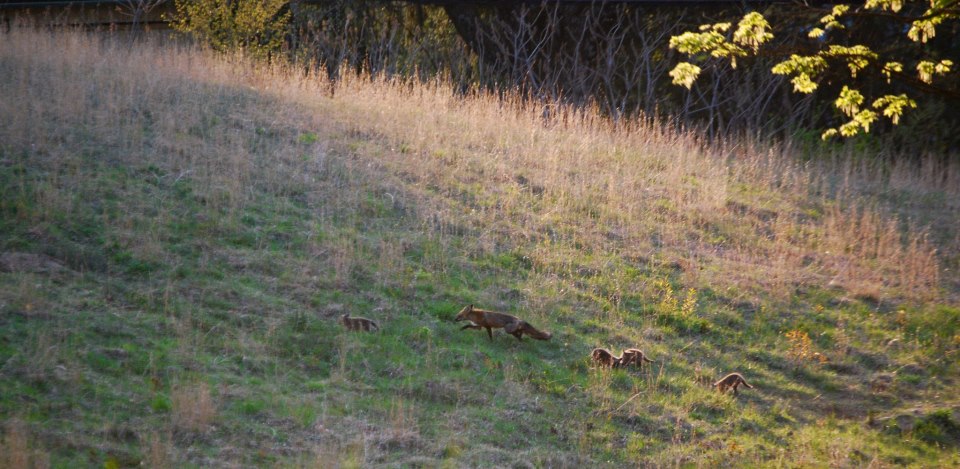
Bonus photo, from Reese’s yard:

foxes

What’s In My Bag, Part Two: Why Two Drivers?

drivers

Ben Hogan, before teeing off at Riviera Country Club, was asked why he wasn’t carrying a 4-iron. “Because there are no 4-iron shots on this course,” he said.

Or maybe he didn’t say that. With sports anecdotes you can never be sure. Apocryphal or not, though, the point was a good one. No two golf courses are alike, so each one makes unique demands not only on golfers but also on golfers’ equipment. When Hogan benched his 4-iron at Riviera, assuming he really did, he made room in his bag for a club that he believed would be more useful on that particular course. Based on my own experience at Riviera, I would guess that the replacement was a sledge hammer, to be used for extracting wayward drives from the dense kikuyu rough.

I  often tinker, Hogan-style, with my club selection, in an effort to tailor my equipment to my surroundings and my shifting abilities. My home course is short and tight, and, therefore, it usually rewards finesse more than raw power. When I play at home, I carry a putter, three wedges (60°, 52°, 46°), two hybrid irons (9, 8), six old-man hybrids (34°, 30°, 25°, 23°, 18°, 17°), and two drivers (a 10.5-degree Ping K15 and a 16-degree Nike Sumo Sweet 16—both antiques). All shafts are stiff.

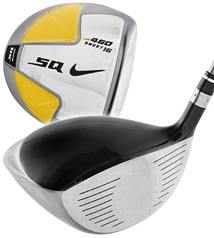
Nike Sumo Sweet 16.

Nike Sumo Sweet 16.

The 17-degree hybrid and the 18-degree hybrid are both made by Nike and are both called 2-hybrids—but they’re different models, and the 18-degree one actually goes farther, although I find it harder to hit. (As I mentioned in my previous post, I think of it as a fairway wood.) It and the 16-degree driver probably seem redundant, or almost redundant, but they’re not. My longer 2-hybrid is at least theoretically easy to hit off the ground, but its head is so small that, when my ball is sitting on a tee, it gives me the heebie-jeebies, especially in the heat of competition. My course has a several short, narrow par-4s on which it might be the perfect choice for tee shots if it didn’t have a head that appeared to have been designed to slide between the bottom of a teed ball and the ground. For those tee shots, I hit my 16-degree driver, which I call Baby Driver. It goes about the same distance as the hybrid—200 yards, plus or minus ten percent—but has a head the size of a battleship. (I also have a 13-degree Mama Driver, currently in Time Out.)

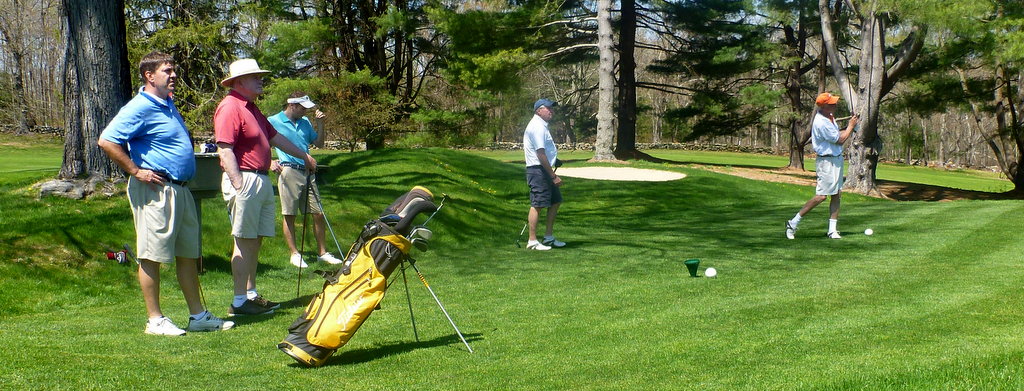
During the first, stroke-play round of the men's member-guest last year, Tony, Tony's son Tim, and I carried nine drivers between us. That's my bag on the left, Tony's on the right.

During the first, stroke-play round of the men’s member-guest last year, Tony, Tony’s son Tim, and I carried nine drivers between us. That’s my bag on the left, Tony’s on the right.

When I first bought Baby Driver, five or six years ago, I used it only on short par-4s and tight par-5s. But it’s so easy to hit that, since then, I’ve found more and more uses for it. Last year, Rick and I played in a senior tournament run by our state golf association. The course had five par-3s, all of which were fairly long. I hit Baby Driver on all five of them, and in two rounds it and I were cumulatively two over par on those ten holes. In Northern Ireland last year, I hit Baby Driver on a downhill 134-yard par-3 and was the only player in our group to put a ball on the green. And sometimes I hit it off the ground.

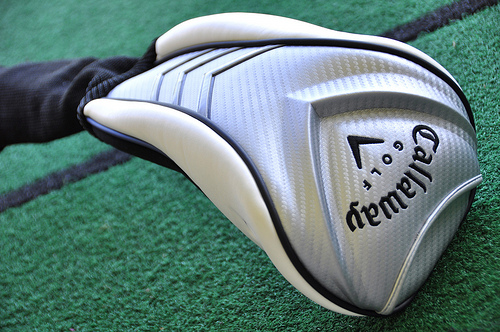
I'll address headcovers at surprising length later, but I can tell you now that I have just two of them: one for my putter, because if I don't use it the putter's saber teeth lock onto the shafts of my other clubs; and one for Baby Driver which I got from the lost-and-found box in the golf shop. Appropriately, I guess, it's for a women's driver, and it has a vaguely obstetric-seeming pouch on top. I use it to keep my two drivers from clanking annoyingly as I walk.

I’ll address head covers at surprising length later, but I can tell you now that I have just two of them: one for my putter, because if I don’t use it the putter’s saber teeth lock onto the shafts of my other clubs and are hard to pry loose; and one for Baby Driver (see photo). The Baby Driver one I got  from the lost-and-found box in the golf shop. Appropriately, I guess, it’s from a women’s driver, and it has a vaguely obstetric-seeming pouch on top. I use it only because without it my two drivers would clank annoyingly as I walked.

If at least two readers will send me descriptions (with one or more photos) of their own equipment, I will create a permanent What’s In My Bag department, and publish them there, along with any future contributions. Send all that stuff to myusualgame@gmail.com.

To be continued. (Read Part One.)

What's In My Bag?
What’s In My Bag.

What’s In My Bag, Part One: Where are the Irons?

wimbI’ve been asked by many readers—well, actually, by just one reader, but he asked twice—to publish a poor man’s version of my favorite regular feature in Golf Digest. I’ve been somewhat hesitant to do so, for who-asked-you reasons, but I also know that most golfers enjoy snooping in other golfers’ bags, and my own assortment may be peculiar enough to be of interest. So why not?  Furthermore, if at least two readers will send me descriptions (with one or more photos) of their own equipment, I will create a permanent What’s In My Bag department, and publish them there, along with any future contributions. Send all that stuff to myusualgame@gmail.com.

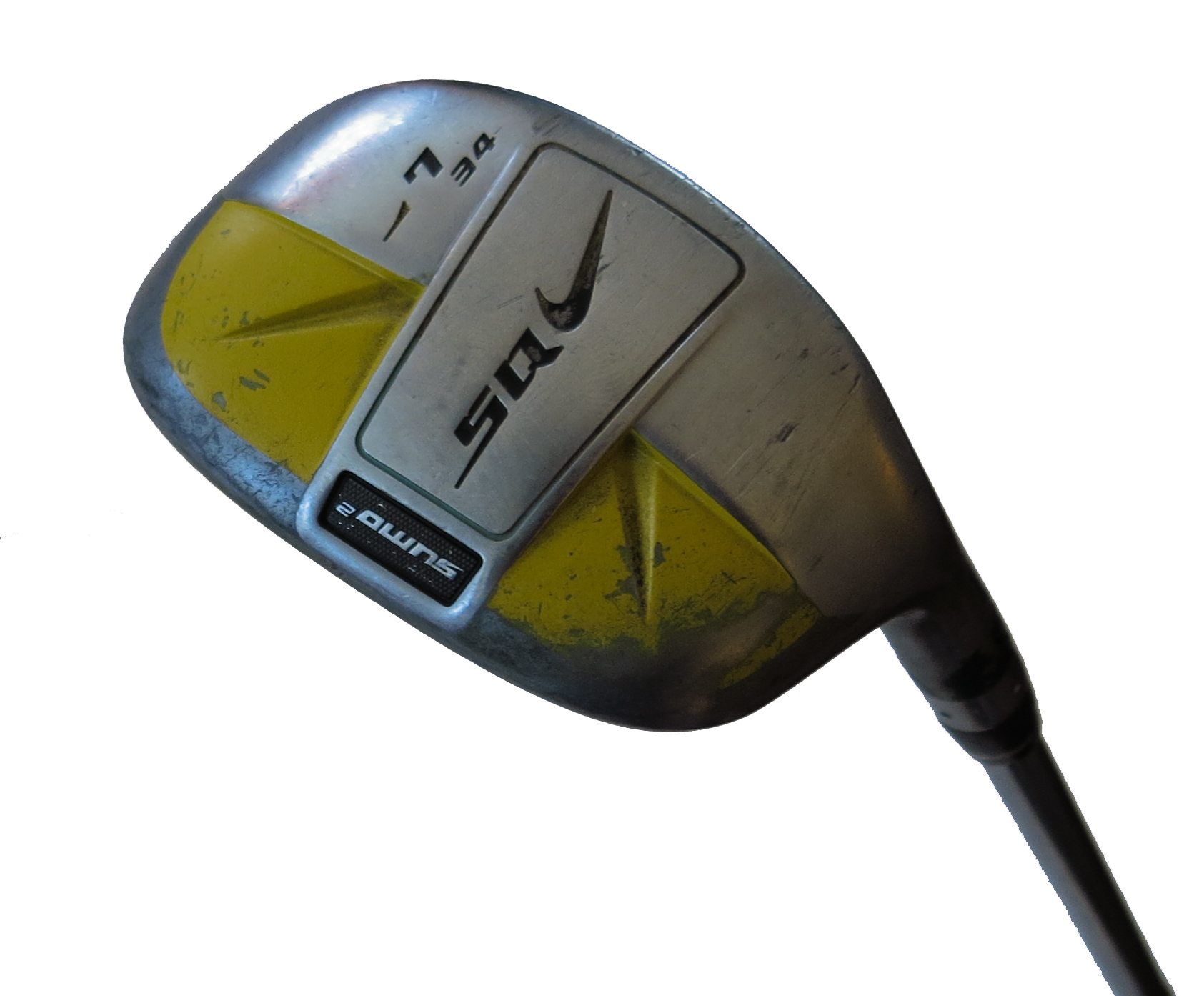
The first thing you will notice, if you have read this far, is that my bag doesn’t contain any conventional irons. My friend Tony and I now lead what we call the Hybrid Lifestyle. It consists of playing as much golf as possible while other people are at work, and not using normal equipment. It was Tony who introduced me, six or seven years ago, to what we both now think of as a magic golf club: a 34-degree 7-hybrid, made by Nike, which a single-digit friend of his had urged him to try. As Tony promised, I hit it longer, higher, straighter, and more consistently well than my 7-iron, which I’d had custom-fitted in Arizona a couple of years before, and as soon as I got home I ordered one just like Tony’s. Not long after that, Tony and I played a round with a visiting friend of his, and we used our magic clubs on a 150-yard par-3. We both hit high draws to within six feet of the hole, and the friend said, “Gee, you guys could play on the L.P.G.A. Tour.” He meant to be devastating, but I’ve adopted his remark as a swing thought.

This is the magic golf club. Nike not only doesn't make it now, but also, according to Nike, never made it the past. (Tony Dabbs told me the company had never made a 34-degree hybrid.) Tony and I know better.

This is the magic golf club. Nike not only doesn’t sell it now, but also, according to Nike, never sold it the past. (A Nike rep told me the company had never made a 34-degree hybrid.) My friend Tony and I know better.

Almost everyone now agrees that low-numbered hybrids are easier to hit than the corresponding long irons. That’s true even for pros, who stopped carrying 1-irons years ago, and now often don’t carry 2-irons or 3-irons, either. But Tony’s and my experience has convinced me that the hybrid advantage extends deep into the bag, and that hardly anybody carries enough. I would bet that’s true even of many tour players, but it’s definitely true of golfers who aren’t paid to play. Today, Tony’s longest iron is a 9. Mine—now that I’ve supplemented my six Nike hybrids with two Cleveland HB3 “hybrid irons”—is a pitching wedge. As a result, I’m convinced, we’re both now playing our best golf ever.

(I’m not sure I like the HB3s; they make a weird noise when you hit them, causing even pure shots to sound like chunks. But I like being able to say I don’t have any irons. Tony calls his 9-iron his 1-iron, because it’s his one iron—get it?)

The great Karsten Solheim.

The great Karsten Solheim.

Almost twenty years ago, I got to spend time with Karsten Solheim, the founder of Ping, who invented the modern, perimeter-weighted golf club. Solheim told me that hitting a ball with an old-fashioned club, in which the weight of the head was uniformly distributed along the blade, was “like hitting a tennis ball with a Ping-Pong paddle.” A similar principle applies to hybrids. Tony Dabbs, a Nike product line manager, told me, “With a hybrid you’ve got a lower and deeper center of gravity, so it gets your launch angle up—more than what an iron can possibly do. A hybrid is essentially a mini-fairway wood, or a small driver.” The weighting and the shape of the head also make a hybrid easier to hit well out of the rough, since the club is less likely to twist. Dabbs told me that the advantage is greatest for slower swing speeds, but I think stronger players gain, too, and that that benefit compounds over time because once you begin hitting decent shots with a comfortable swing you’re less likely to lash at the ball from over the top with any of your clubs.

Tragically, from my point of view, Nike no longer makes SQ Sumo2 hybrids, which I prefer to all subsequent models. (I do carry a second 2-hybrid, a Nike VR S model that Nike also doesn’t make anymore. It goes farther than my other Nike 2-hybrid, although I find it harder to hit well. I think of it as a fairway wood, which it resembles.) And Nike no longer makes even a 6 hybrid. (Dabbs told me there’s “a point of diminishing returns” as lofts get higher. Hmph.) If you’re a seller—right hand, steel, stiff—please speak up.

To be continued. (I’m going to stretch this out for quite a while. Next, I’ll explain why I’ve got two drivers.)

Reader’s Golf Report: Springtime Comes to Sweden, Sort Of

Stadium Course, Bro Hof Slott Golf Club, Stockholm, Sweden, February 7, 2013.

Stadium Course, Bro Hof Slott Golf Club, Stockholm, Sweden, February 7, 2013.

Patrick Kroos is a German golfer and blogger, who has been living in Sweden for the past five years. He’s also a publicist, whose main current project is persuading non-Swedes to travel to Sweden to play golf. That’s something I’ve been wanting to do for a long time, mainly because Sweden, despite having what might seem to be a crippling meteorological disadvantage, is one of the golfiest places on earth. It has fewer than ten million inhabitants, but a million of them are regular players—a significantly higher percentage than in the United States.

One in a million.

One of the million.

Sweden’s golf season is even shorter than Connecticut’s, however. Kroos took the photo at the top of this post in early February, at Bro Hof Slott Golf Club, in Stockholm. (The club has two courses, both of which were designed by Robert Trent Jones, Jr.) The weather has improved quite a bit since he took the picture, but it still has a ways to go. Here’s what it will look like once the weather decides to be cooperative:

This is what the Stadium Course looks like when it thaws.

This is what the Stadium Course at Bro Hof Slott looks like in season.

In a recent email, Kroos wrote:

Winter is loosening its grip on Stockholm slowly and very late this year. Only yesterday did the ice finally break open on Lake Mälaren, the third biggest lake in the country. For Swedish golfers, the wait has been painful and long. Usually, the driving ranges open up in early April, and the eighteen-hole courses follow suit. Not this year, though. By now, only a handful of courses are open, and temperatures are still pretty low. 

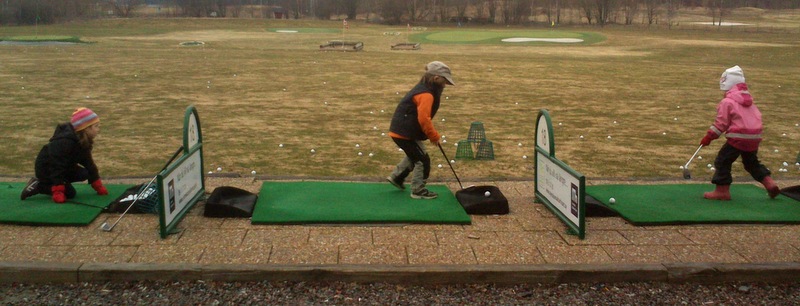
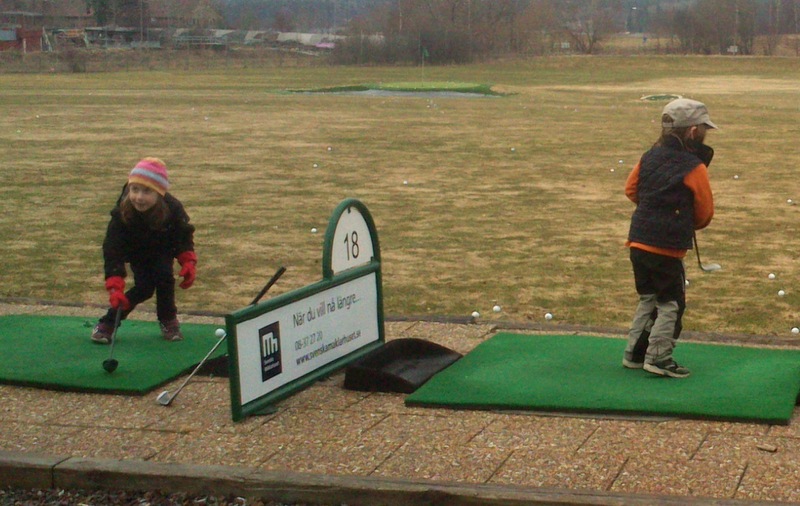
That hasn’t stopped the youngsters, however. Kroos took the photo below this past Monday at Hässelby Golfklubb, a nine-hole course with a year-round driving range just outside Stockholm.

2013-04-22 18.45.54

Kroos continued:

My son Paul and some other kids come together every Monday to play golf. And I really mean they play. They are only four and five years old, so at any given moment the tree next to range could become more interesting. But we believe that tree climbing is good for their balance and strength, and that it will make them better players in the future. 

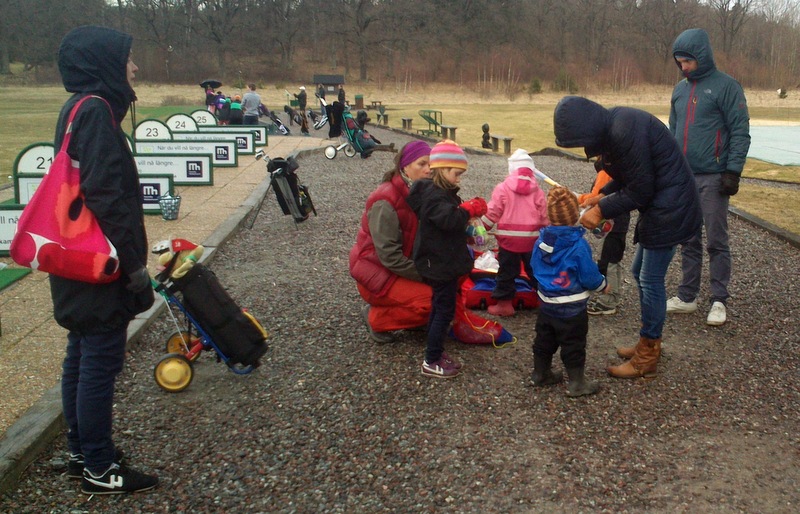
Note the junior push cart. Recent studies have suggested that all young golfers should use push carts at least until they've stopped growing. Golf clubs are heavy, and the load is one-sided.

Note the junior push cart. Recent studies have suggested that all young golfers should use push carts, at least until they’ve stopped growing. Golf bags are heavy, and the load on young shoulders is one-sided, even with two straps.

Kroos and his wife are expecting another future golfer in their family in the next couple of weeks. He continued:

All the parents here are golfers as well, and you can see how much they enjoy seeing their kids having fun. I am sure they all envision a not to distant future when they can go play with their own children on a Sunday morning. 

2013-04-22 18.45.37There’s another compelling reason to visit Sweden with your golf clubs: on the Summer Solstice, Swedes are able to play even more holes than my friends and I did last year. I’ll get there eventually.

New Golf Game: Tony! Toni! Toné! (a.k.a. T-Bone)

Tony and D.O., Royal Aberdeen Golf Club, Scotland, May, 2008.

Tony and D.O., Royal Aberdeen Golf Club, Scotland, May, 2008.

Tony, who is a member of my Sunday Morning Group, lives in Atlanta for almost half the year. His golf buddies there are smarter, richer, and better-looking than his S.M.G. friends, and they hit the ball farther and have better short games. I’ve met several of them, though, and they’re not as bad as that makes them sound. They haven’t invented as many golf games as we have, but they do occasionally come up with something interesting, including a best-ball game that Tony told us about recently (by email, since he’s still down there). We played it Saturday, and decided to name it after him.

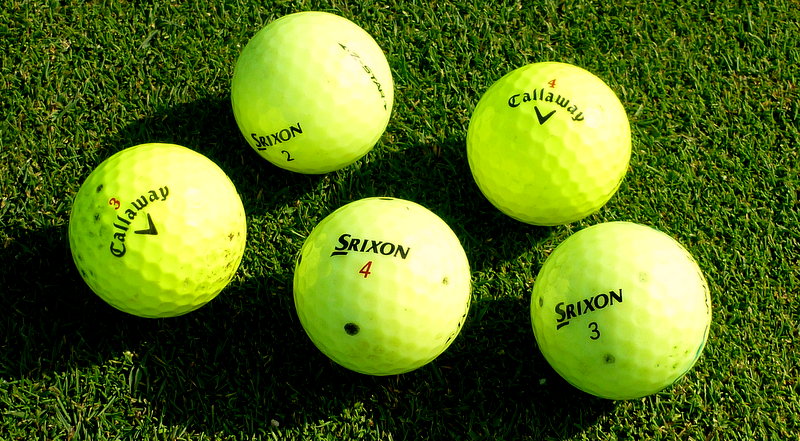
To play T-Bone (as we call both him and it), you need a group that’s evenly divisible into threesomes, foursomes, or fivesomes. Each group counts one best ball on the first six holes, two on the second, and three on the third. On Saturday, we had ten guys. We were going to pick two teams randomly, by pulling balls out of my hat, but once the balls were in the hat I noticed that there were five white ones and five yellow ones, so we just went by color. I was on the yellow team, and if you know anything about yellow balls you know that, technically, we had an overwhelming advantage. Somehow, though, we lost by six shots.

Five yellow balls plus Hacker (real name), eighth green.

Five yellow balls plus Hacker (real name), eighth green.

Even when you have five guys on your team, counting three balls puts serious pressure on slicers, hookers, shankers, yippers, dubbers, flubbers, and choppers—in other words, on pretty much everyone. In an earlier test round, on Thursday, we tried T-Bone with two threesomes, and the trailing group came very close to making up a ten-shot deficit on the final six holes. There was quite a lot of pressure, too, because by that point we were all playing together, as a sixsome, on account of being stuck behind a slow group.

P1050715

On Sunday, we played what might be thought of as modified T-Bone. We had eighteen guys, so we divided into six threesomes. The Committee realized that counting all three balls for the final third of the round would be too brutal and time-consuming, especially early in the season, so we decided to count two best balls on the first seventeen holes and all three on the eighteenth, which was also the Money Hole. That was brutal enough.

On Sundays, we pick teams by drawing numbered poker chips instead of balls—like this:

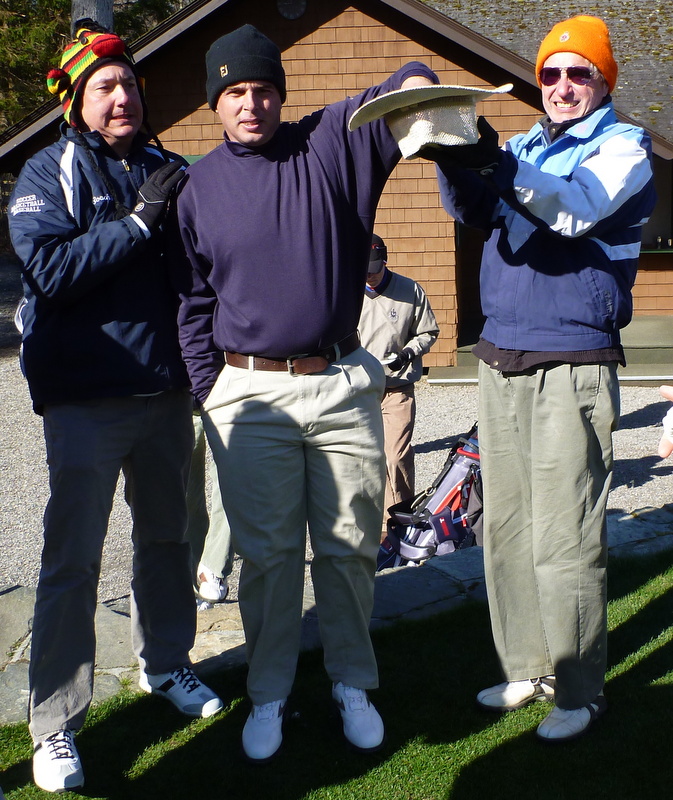
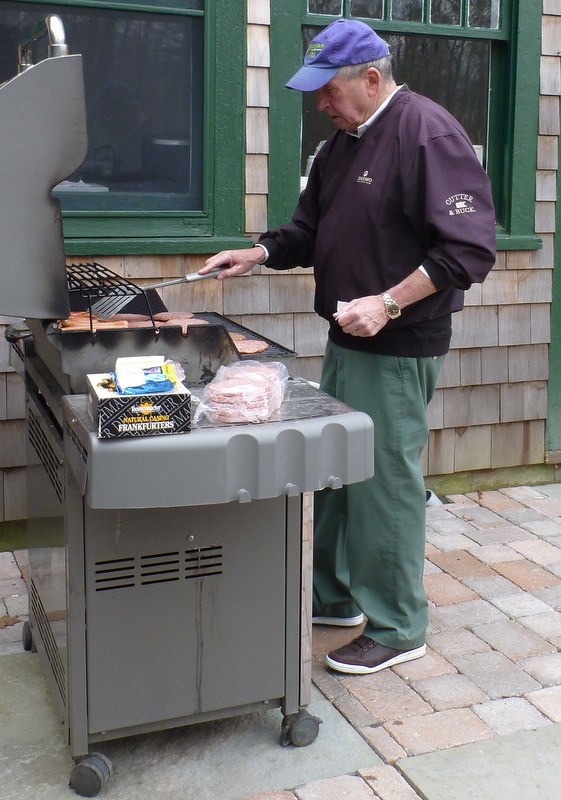
P1050736The guy in the middle is Corey, our pro. We’ve decided to call him a plus-2. Everybody gets excited when Corey plays, because we feel like we’re getting extra shots, but the advantage is an illusion because Corey, unlike the rest of us, can reliably play to his handicap, even when we have the kind of cold, windy weather that made Tony buy a place in Atlanta, as we did on Sunday.

It was a good day, though, as always. My team came in not-last, and Schoonie (whose hat Corey has his hand in in the photo above) brought lunch (although he forgot cheese for the cheeseburgers).

P1050739

When we tried T-Bone for the first time, on Thursday, we shared the course with a nine-hole high-school tri-match. One of the teams was the boys’ varsity team from a boarding school in our town. The No. 2 player on that team is a girl (see photo below). She doesn’t hit the ball as far as Corey or Tony’s Atlanta friends, but she does hit it farther than any of us. They won, of course.

P1050427

Reader’s Trip Report: Annie Stegall’s First Masters

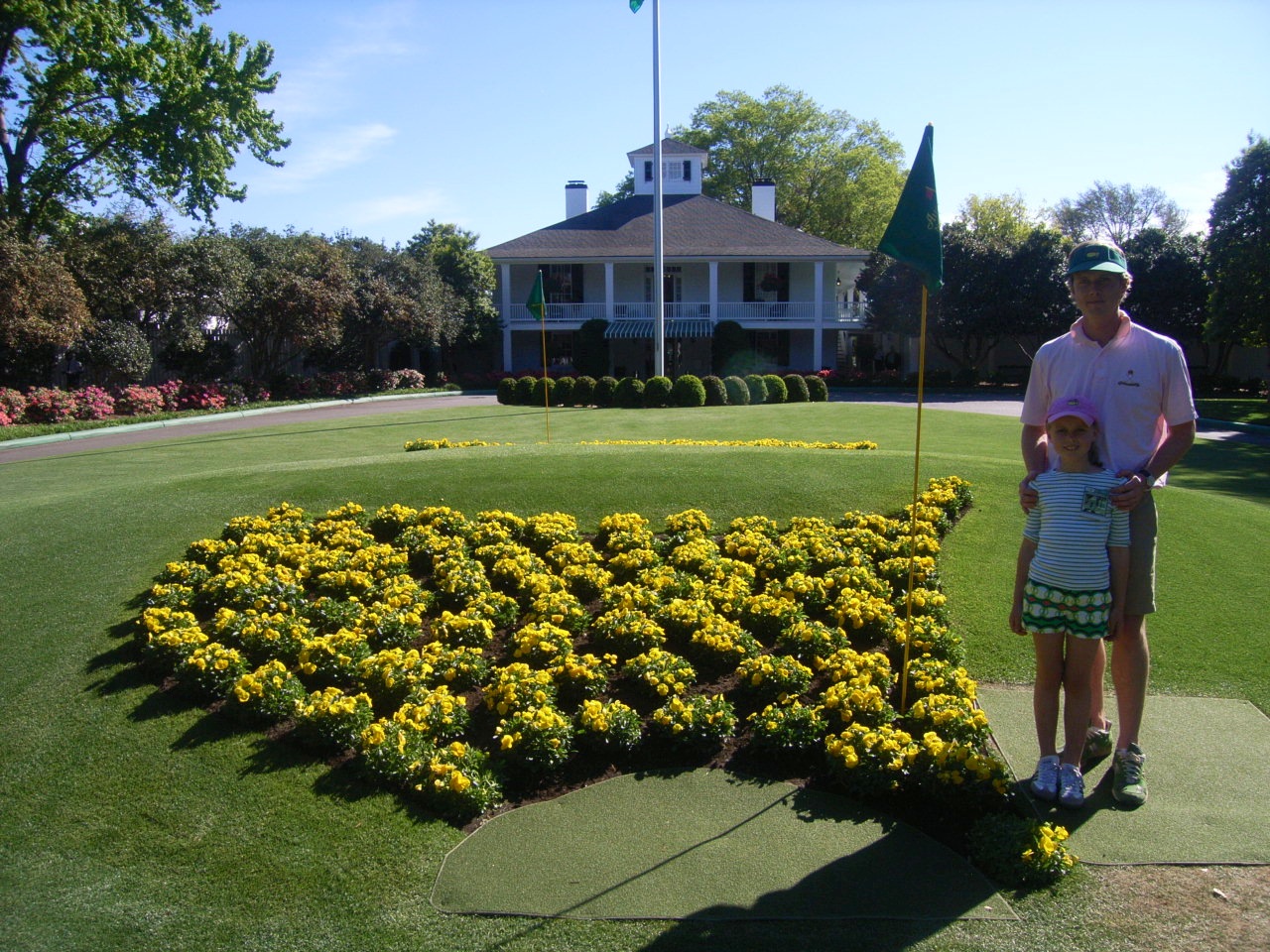
Annie Stegall and Will Stegall, Masters 2013.

Annie Stegall and Will Stegall, Masters 2013.

Will Stegall attended the Masters for the first time in 1993, when he was a teenager. “My grandfather would always give me a crumpled old copy of a Herbert Warren Wind article from The New Yorker to read as we drove from Birmingham to Augusta,” he told me in an email back in March. “I remember sitting on No. 16, about hole-high, on Sunday in 1996. Raymond Floyd’s ball landed on the front of the green, rolled up the ridge to the right, back down, and into the cup. The ball must have rolled for forty-plus feet and the whole crowd knew what was coming from the time it landed. It was the first time I had ever witnessed a hole-in-one and it almost inspired me to start wearing pants with just one back pocket.”

This year, Stegall, who now lives in San Francisco, took his daughter, Annie, who turned nine on practice-round Monday. At my request, Annie took notes during the tournament. She had a highly favorable impression of the Georgia Peach Ice Cream Sandwiches, which are new, and which she managed to try before the sportswriters in the Press Building had eaten all of them. More from her report:

This year was the seventy-seventh Masters. My great-grandfather got tickets a long time ago and always loved it. Once my grandfather was old enough, he started going and has now gone to fifty of them, my dad has gone to twenty, and this year was my first.

My dad and I flew from San Francisco to Atlanta on Friday, April 12, and drove to my aunt’s house in Augusta. I didn’t sleep very well because of the time change, but when it was finally morning we were so excited that we got up early. We had to get to the course to put our chairs on the left side of the eighteenth green. When I got out of the car in the parking lot, the first thing I said was, “It smells really good.”

Before I tell you about golf, I am going to tell you about the Augusta National golf course. First of all, let me tell you how green it was! It was so perfect that at first I thought the grass was fake. The grandstands were green, the concessions stands were green, the trash picker-uppers’ uniforms and their pokey things were green, along with the sandwich wrappers and even the beer cups.

And now to the main thing: the golfers. They could hit the ball so high and so long I couldn’t believe my eyes. I loved that you could be so close and nobody would tell you to step back. It was awesome watching an eighth grader beat Bubba Watson and other Masters winners. Angel Cabrera rolled me one of his balls and the forecaddie of the 16th hole gave me Tiger Woods’s tee. I also got an autograph from Brandt Snedeker.

My dad and I kept a notebook of bets on who would win, who would have the lowest round each day, and who would hit the closest on each hole. I crushed my dad. He predicted Brandt Snedeker would win but I said Snedeker would have a bad round at the end and Adam Scott would win. I was right!

Among Annie Stegall’s favorite Masters features was the absolute ban on cell phones, because it kept her father focused on the tournament and on her, rather than on his work. And her father didn’t feel deprived. “The Masters is a far more social event than some folks might expect,” he told me afterward. “And coordinating to meet up with buddies without the aid of cell phones is as much a throwback as the hand-operated leader boards. Pick a spot like the sixteenth tee, as Annie and I did on Sunday, and you end up chatting with strangers. Many of them have been sitting in that spot for decades and have great stories about miraculous or horrible shots through the years. I have some favorite Masters (several from the nineties, 2007, 2010) but they always have more to do with the people I’m with and less to do with the outcome of the tournament. It’s probably my favorite week of the year.”

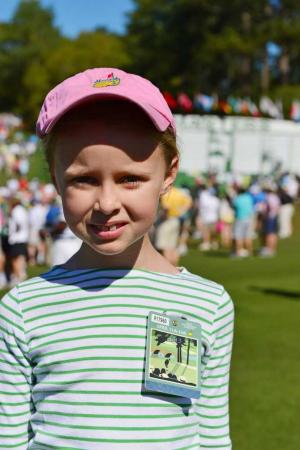
On Saturday, Annie was picked by the Augusta Chronicle as the Junior Patron of the Day, so she got her picture in the newspaper, too (see below). Next year, I’m going get her press credentials, then turn everything over to her.

Annie Stegall, MyUsualGame special correspondent and Augusta Chronicle Junior Patron of the Day, April 13, 2013.

Annie Stegall: MyUsualGame.com special correspondent and Augusta Chronicle Junior Patron of the Day, Augusta, Georgia, April 13, 2013.

Masters Week Obituary

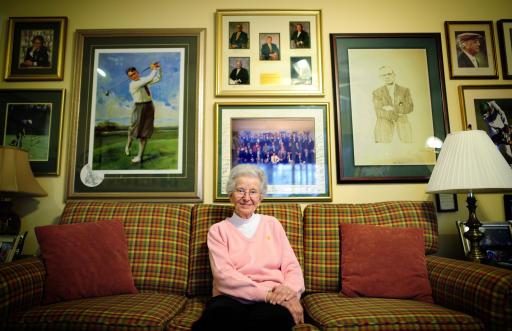
Photo: Augusta Chronicle.

Photo: Augusta Chronicle.

One of the best things about working on my book The Making of the Masters was getting to know Kathryn Murphy, shown in her home in the photo above. She first worked on the tournament, as a secretary, in 1962, and she became an indispensable assistant to Clifford Roberts, Augusta National’s co-founder and the tournament’s original chairman. She knew an extraordinary number of Masters facts, and if I suddenly wondered about something truly obscure, such as who had teed off fourth in the sixth Masters, she knew exactly where to look it up. She loved the tournament, and she loved the club, and neither would have been the same without her.

Murphy had many opportunities to observe Roberts. She told me that she would sometimes find him hunched over his desk on autumn afternoons, working in the gloom. She would flick on the lights, and he would straighten up in his chair but show no other sign of having noticed the change. She always kept a stenographer’s pad next to the phone by her bed at home, because there was no telling at what hour he might call to dictate a letter.

Among her many contributions to my book was her insider’s perspective on the conclusion of the 1968 Masters, when Roberto de Vicenzo signed his scorecard for one stroke more than he had actually shot, and was kept out of a playoff with Bob Goalby. A few sportswriters and others have alleged that Roberts must not have wanted a foreigner to win, and had therefore made a ruling that gave the green jacket to an American. But the ruling was the only one possible under the Rules of Golf at that time, and it was made not by Roberts but by the tournament’s chief rules official, Isaac Grainger, who was a past president of the U.S.G.A.

Furthermore, as Murphy told me, the idea that Roberts had been out to get de Vicenzo was absurd, since it was partly at Roberts’s urging that he had come to play in the Masters in the first place, in 1950. (That year, his manager wrote to accept his invitation to compete in “the Annual Teacher’s Competition” — a mistaken retranslation from a Spanish version of the invitation.) The two men were close friends, Murphy said, and de Vicenzo and his wife often spent Masters week in the home of Wilda Gwin, who was another of Roberts’s secretaries. De Vicenzo’s birthday fell on Masters Sunday in 1968, and the tournament staff, with Roberts’s assistance, planned a surprise party for him. Murphy told me that she remembered sadly throwing away the birthday cake when it became clear that holding the party would now be impossible.

Roberts always held a dinner for the tournament winner at the end of each Masters, and Murphy told me that that night he broke convention by inviting de Vicenzo to attend as well.  She said that Roberts worried that the outcome had harmed both men—by depriving de Vicenzo of a shot at the financial bonanza that followed a Masters win and by overshadowing the spectacular charge that Goalby had made in his own final round. Like all Masters winners, Goalby received a silver cigarette case on which had been engraved the signatures of all the players in the field. Murphy said that Roberts quietly had an identical box made for de Vicenzo, as a private acknowledgment of his ordeal, and that he asked J. Richard Ryan, the attorney who handled the club’s television and movie contracts, to offer his services to both men as an agent—an occupation that had just begun to have an impact among the better players on tour. He especially hoped that Ryan could help de Vicenzo make up for opportunities he had foregone.

This year, Murphy visited the club twice during Masters Week, spent time with her family, including a great-grandson, and threw a weekend Masters party. She watched the final round on TV, and was delighted when Adam Scott won. About two hours later, she died, at the age of eighty-one.

Kathryn Murphy and Gene Sarazen. Photo: Augusta Chronicle.

Kathryn Murphy and Gene Sarazen. Photo: Augusta Chronicle.


The Last Unscrewed-up Major Event in Sports

Let’s take a moment to remind ourselves how lucky we are to have the Masters, the last unscrewed-up major event in sports. I spent much of Sunday afternoon switching between my TV-watching glasses and my household-appliance-degunking glasses. The dishwasher had developed a bad smell, which my wife had asked me to eliminate, but the big kitchen TV is all the way on the other side of the room, so I had to keep running back and forth. Masters commercial breaks are so short that I barely had time to take a whiz, much less to figure out how to disassemble the main spray arm, and I ended up needing almost five hours to do a chore that ought to have taken ten or fifteen minutes—although I was glad to have an outlet for my nervous energy. What a tournament! And the next one is just fifty-one weeks away.

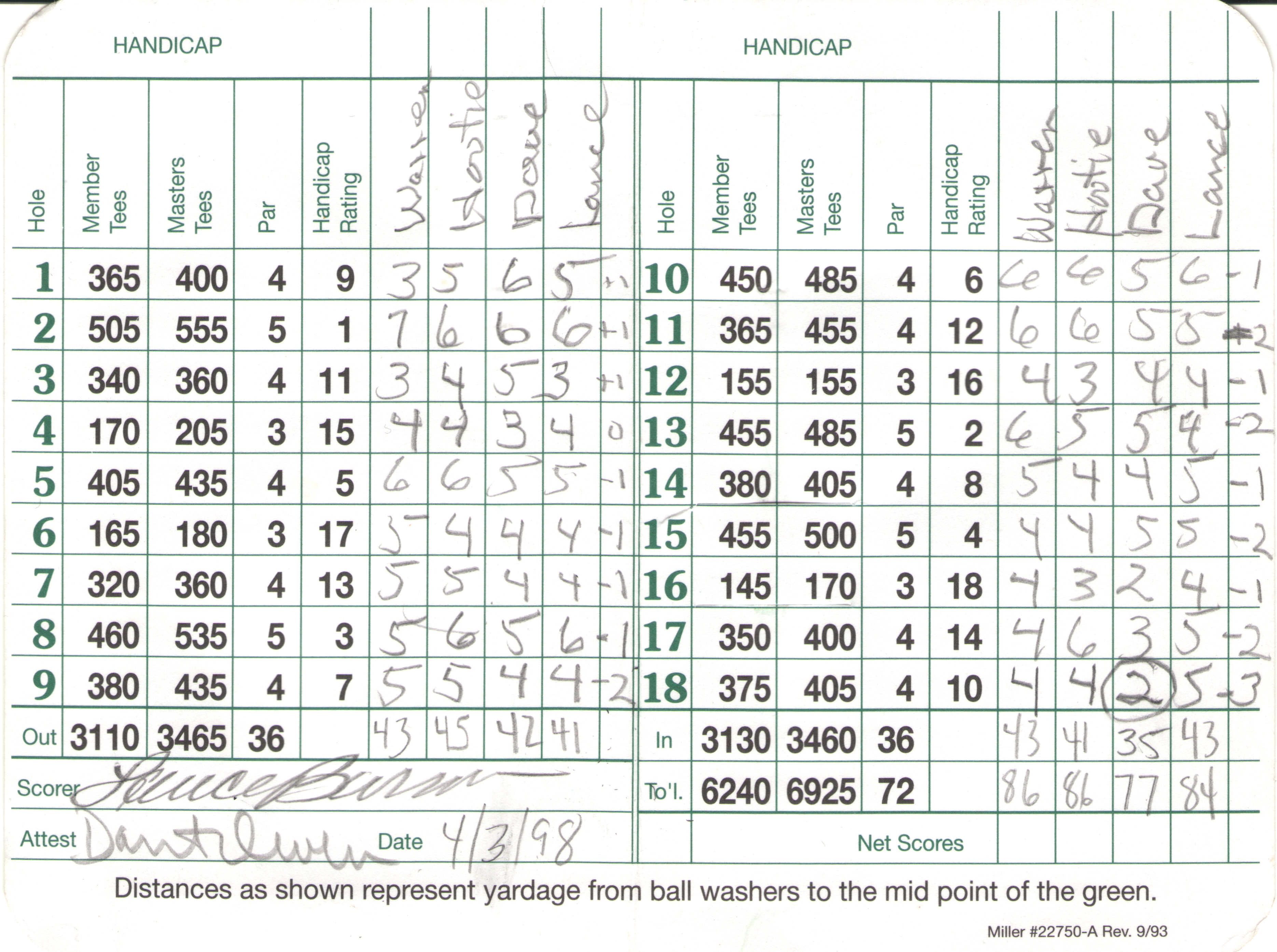
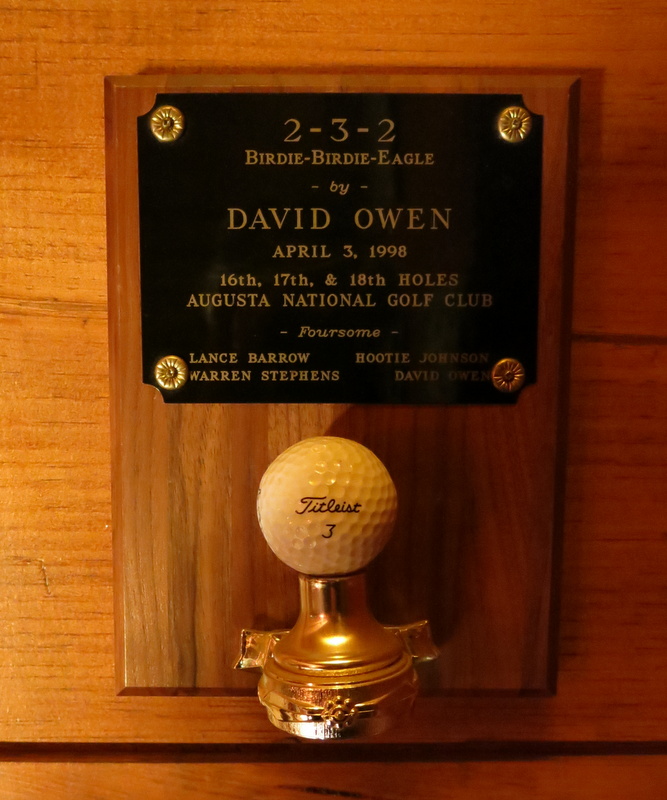
Now for some idle speculation. If Tiger Woods, despite his extraordinary troubles on Saturday and his putting problems on Sunday, had played the tournament’s final three holes in four under par, he would have been in the playoff with Angel Cabrera and Adam Scott. Plausible? Well, I can’t speak for Woods, but it’s happened before. The weekend before the 1998 Masters, Warren Stephens (whose father, Jack, was Augusta National’s chairman at the time) and Hootie Johnson (who succeeded Jack a month later) played a tense five-dollar nassau against Lance Barrow (the producer of CBS’s tournament broadcast) and me. I was on the grounds doing research for my book The Making of the Masters, and the most important element of that research (in my opinion) was becoming intimate with the golf course.

ANGC DLO 2-3-2

The match went back and forth, and things looked dark for Barrow and me. But then I birdied the sixteenth (eight-iron, six-foot putt). And then I birdied the seventeenth (driver, lob wedge, fifteen-foot putt). And then I eagled the eighteenth (three-wood, pitching wedge). That’s four under par on the last three holes—2-3-2—and I have the scorecard (above) and the plaque (below) to prove it. If Tiger had managed the same on Sunday—well, who knows? I didn’t see my final shot go in the hole, but Ernie Els and Lee Janzen, who had been playing a practice round just in front of us, did. Then they joined us for a beer.

IMG_0971

That round was fun, obviously, but on a regular basis I actually have more fun playing golf with my friends at home. This Sunday, we did what we always do during the majors: we used the scorecard from the tournament course (available online) instead of our own. The only effect that has is to make the handicap strokes fall in unexpected places, but it’s our way of participating vicariously. We had four foursomes, and we counted two best balls from each group. My team came in last, by fifteen shots. Hacker (real name) brought lunch:

P1050576

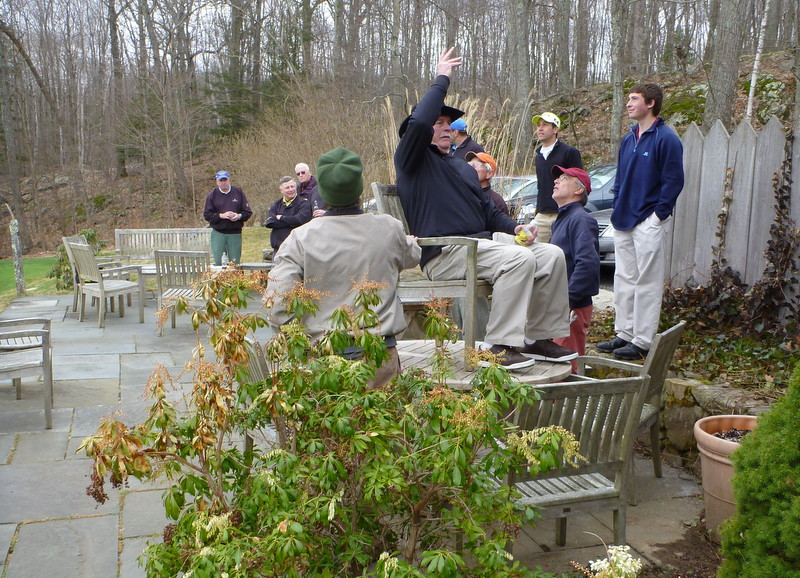
Two teams tied, at sixteen under, so we had a playoff, just like at the real Masters. We didn’t use sudden death, though; we used a backwards throw to the practice green from a chair balanced on top of one of the tables on the patio, closest to the pin. Here’s Stan, at the top of his follow-through:

P1050592-002

And here’s Fritz, on the practice green, pacing off the winning throw (which turned out to be Reese’s):

P1050593

Then home for a one-hour nap. Then sublimity.

Bobby Jones’s Father Makes a Masters Rules Decision

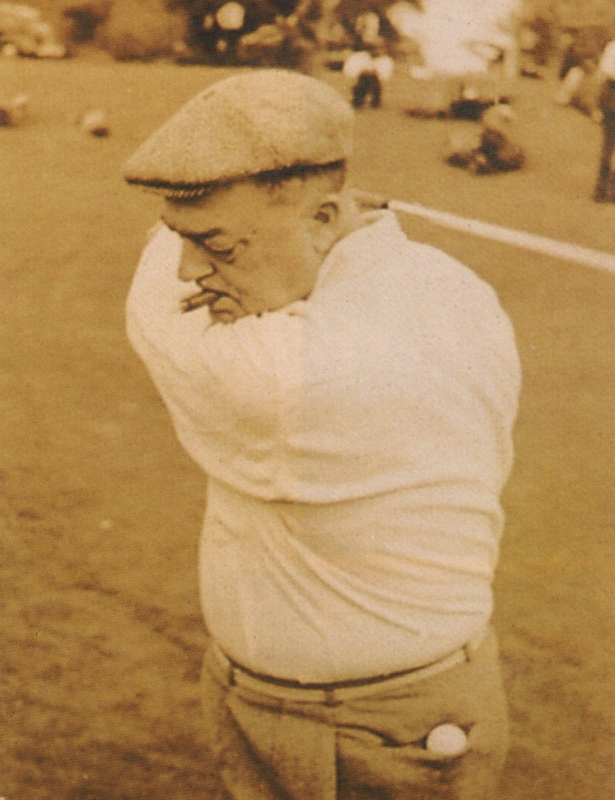
The Colonel.

The Colonel.

In the early years of the Masters, the club sometimes had trouble finding knowledgeable volunteers to serve as rules officials. “On one occasion,” Clifford Roberts, the club’s co-founder, wrote in 1970 in a letter to Lincoln Werden of the New York Times, “the shortage was such that we appealed to Bob Jones for suggestions as to whom we might enlist. Bob said that we might in a pinch request his dad.” Jones’s father, who was known as the Colonel, was accordingly posted to the twelfth hole on the final day of the tournament. There had been a great deal of rain during the night, and the course was very wet. One player hit a poor shot that landed in a soggy area near the creek. The player spotted the Colonel, called him over, and asked whether he was entitled to relief from casual water. The Colonel asked him where he stood in relation to par. “Eighteen over,” the player said. The Colonel demanded, “Then what in the goddamn hell difference does it make? Tee the thing up on a peg for all I give a hoot!” [The word “hoot” may not be historically accurate.]

In the early years, a small pot bunker was originally positioned in the center of the eleventh fairway at roughly the distance of a reasonable drive. The bunker, which could not be seen from the tee, was Bobby Jones’s idea. He had wanted the course to have a hazard that could be avoided only with good luck or local knowledge—the sort of seemingly arbitrary booby trap that is plentiful on the Old Course. The Colonel drove into the hidden hazard during his first round on the course, in 1932. When he found his ball in the sand, he shouted, “What goddamned fool put a goddamned bunker right in the goddamned center of the goddamned fairway?” or words to that effect. His son, who was playing with him (along with Roberts), had to answer, “I did.” The bunker was eventually filled in.

The Colonel was one of the club’s most colorful personages. Roberts, in his book about the club, wrote, “When I first knew the Colonel, he could play to a handicap of about eight. When he played worse than that it was the fault of the ball, the way some green had been mowed, a divot hole, an unraked bunker, or some bad luck demon. On such days he was prone to express his feelings with swearwords; not just the usual kind of swearing, but original, lengthy, and complex imprecations that were classics. Numbers of people who were regular companions felt disappointed when the Colonel played well, as they always looked forward to a prolonged blast of cussing that they had never previously heard.” On a trip to Philadelphia for the 1934 U. S. Open, Roberts and Bobby Jones lost track of the Colonel in the hotel where they were staying. After a lengthy search, they found him in the ballroom. Roberts wrote, “The Colonel, baton in hand, was directing the orchestra, and at the same time singing the words for the music that he was conducting.” The Colonel died in 1956.