New Golf Game: 10-Ball, 20-Ball, 30-Ball, 40-Ball

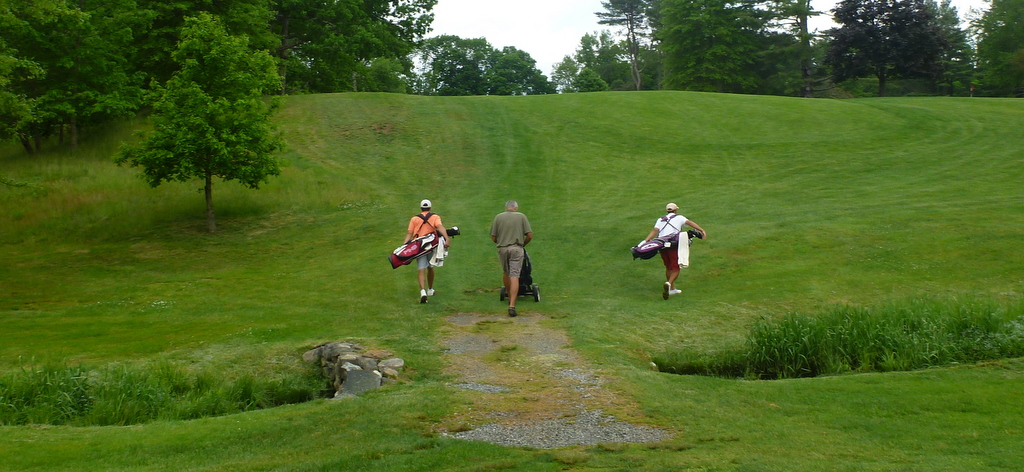
Kevin, Tony, Addison, 20-Ball World Championship, sixth hole, June 3, 2013.

Kevin, Tony, Addison, 20-Ball World Championship, sixth hole, June 3, 2013.

When Tony returned from Atlanta, where he and his wife hide every winter, he brought us a good new golf game, which he learned from his friends down there. Here’s how it works: Let’s say you have four guys, playing two against two. Each pair counts just twenty of the thirty-six hole scores they collectively make during the round, and the winning pair is the one with the lower twenty-score total. After finishing a hole, each pair has to decide, before teeing off on the next hole, whether to count one, both, or neither of the scores they just made. The effect is similar to that of Stableford scoring, since disasters can usually be ignored.

Let’s say that you make a net birdie the first hole, while your partner makes a net double-bogey. You presumably want to forget all about the double-bogey, so you announce (before hitting your tee shots on No. 2) that you’re going to count only the birdie.That makes you one under par after one hole, and leaves you with nineteen scores still to tally before the end of the round. Let’s also say that your opponents, on that first hole, both make net pars. They have to decide whether to count one or both—or to ignore them in order to leave plenty of room for birdies and eagles later on. The truly tough decisions come toward the end of the round, as opportunities dwindle. You don’t want to arrive on seventeenth tee knowing that, no matter what, you and your partner will have to count all four of your scores on the final two holes.

The game can be played with any number of players, in any combination. If you have four-man teams, each team counts forty scores; if you are playing as individuals, each player counts ten. If you have a threesome versus a foursome, the threesome counts thirty balls, then divides by three, while the foursome counts forty balls, then divides by four.

My friends and I reckon all hole scores only in relation to par, so that a five on a par 5 is the same as a three on a par 3. But you could make the game both more interesting and more complicated by counting absolute scores instead.

Kevin and Addison preparing to hit their 3-woods farther than Tony and I can hit our drivers.

Kevin and Addison preparing to hit their 3-woods much, much farther than Tony and I can hit our drivers.

A Golfer’s Bucket List: No. 5

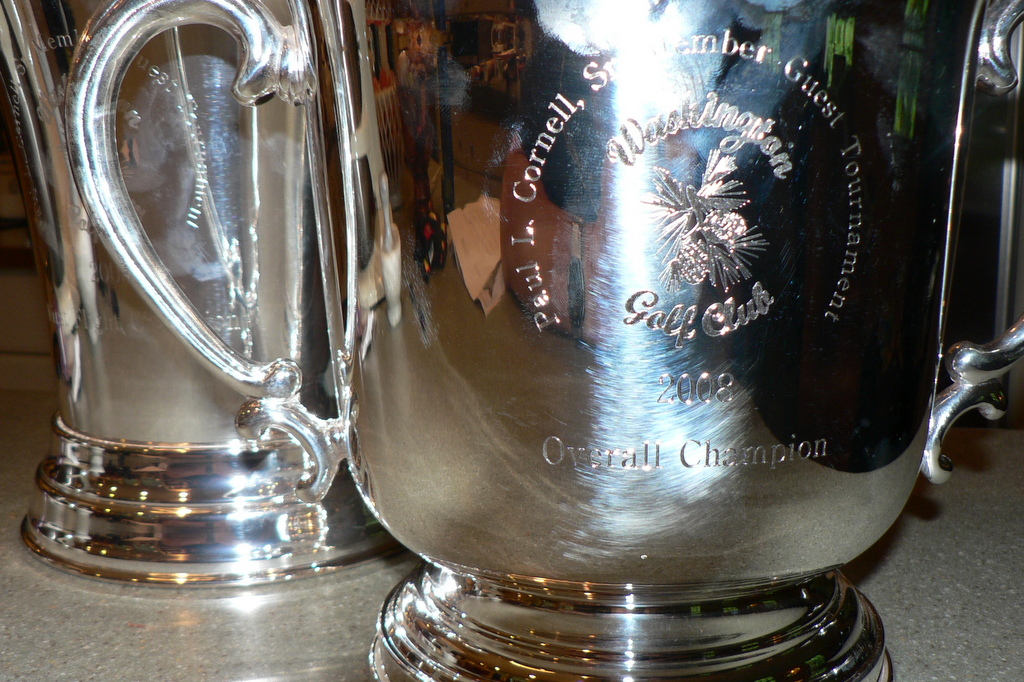
The Lord, Other Gene, Member-Guest, 2008.

The Lord, Other Gene, Member-Guest, 2010.

Win something.  Not the U.S. Open, probably—maybe not even the super senior flight of the Memorial Day Scotch Foursome—but a title of some kind in a contest that makes your heart pound when you’re called to the first tee. Surprisingly many golfers pass through the game without ever entering an organized competition and, therefore, without ever sampling their own adrenaline on a golf course. Competing is a good way to meet other golfers, and making a putt that means something while others watch is a thrill that doesn’t fade quickly. Harry Hurt III, in his book Chasing the Dream (about his failed attempt, during his early forties, to become a professional golfer), writes that his father, on his deathbed, didn’t know the day, the year, or the name his doctor, but did remember what he had shot when he won the pro-am at Seminole: “One over.” (In fact, those were his last words). My own father was a terrible golfer—when he talked about “one over,” he meant 101—but he had a golf trophy on his dresser, and for a number years he kept his clubs in a leather bag that was too heavy even to put on a golf cart. Both the trophy and the bag were prizes from some long-ago member-guest, forgotten by everyone but him.

P1050176

Ed Heimann Has a Better Short Game Than You Do

Ed Heimann, Hyde Park Golf and Country Club, Cincinnati, Ohio, May 9, 2013.

Ed Heimann, Hyde Park Golf & Country Club, Cincinnati, Ohio, May 9, 2013.

A couple of weeks ago, I had the tremendous good fortune to play a round of golf (and give an evening talk and slide show) at Hyde Park Golf & Country Club, in Cincinnati. The club’s original course, which had nine holes, was laid out by Tom Bendelow in 1909, and the current course, which has eighteen holes, all of them terrific, was designed by Donald Ross a little over a decade later.

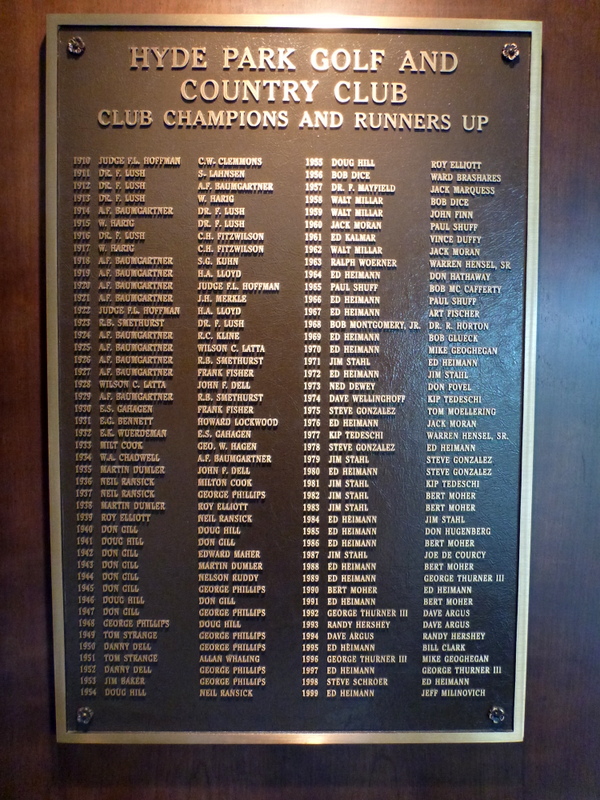
Among the members I played with was Ed Heimann, who has won Hyde Park’s club championship twenty-one times, in six different decades. His first win was in 1964, when he was twenty-six; his most recent was in 2010, when he was seventy-two. And he’s been the runner-up half a dozen times, during years when (I guess) he was struggling with his game.

Ed Heimann has won the Hyde Park club championship so often that his victories won't all fit on one plaque.

Ed Heimann has won the Hyde Park club championship so often that his victories spill over onto a second plaque.

His most recent victories. Still room for more.

His most recent victories. Still room for more.

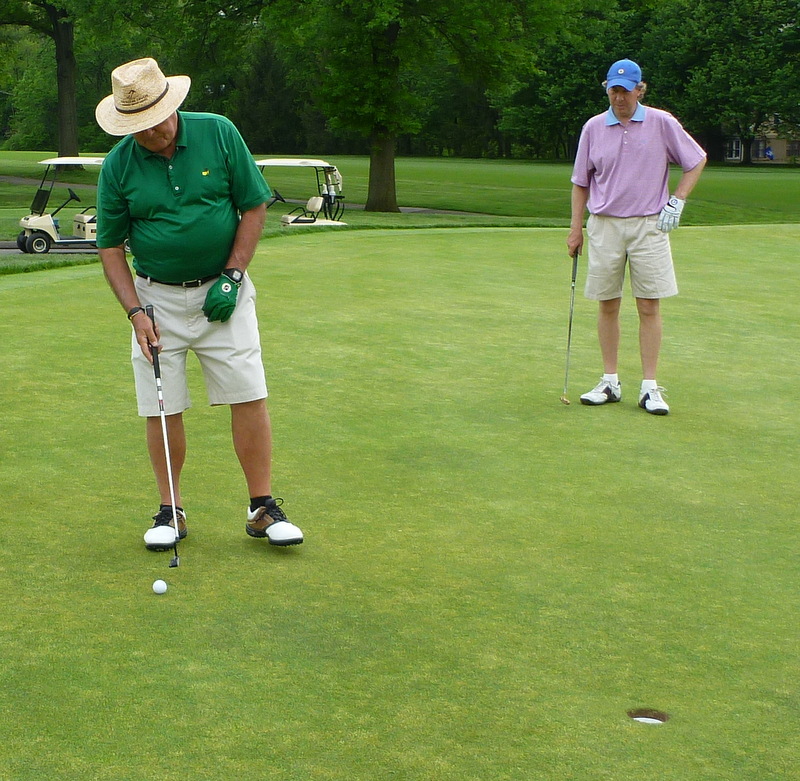
Heimann isn’t very long off the tee anymore, but from inside a hundred yards he routinely gets the ball closer to the hole than many good players do from the fringe—a skill that’s especially devastating in match play, since guys who out-drive him by a hundred yards don’t expect to have to putt first. My advice to other golfers is to emulate everything Heimann does, including plumb-bobbing and wearing a green glove. And if you ever find yourself in a match with him you might as well just give him ten-footers.

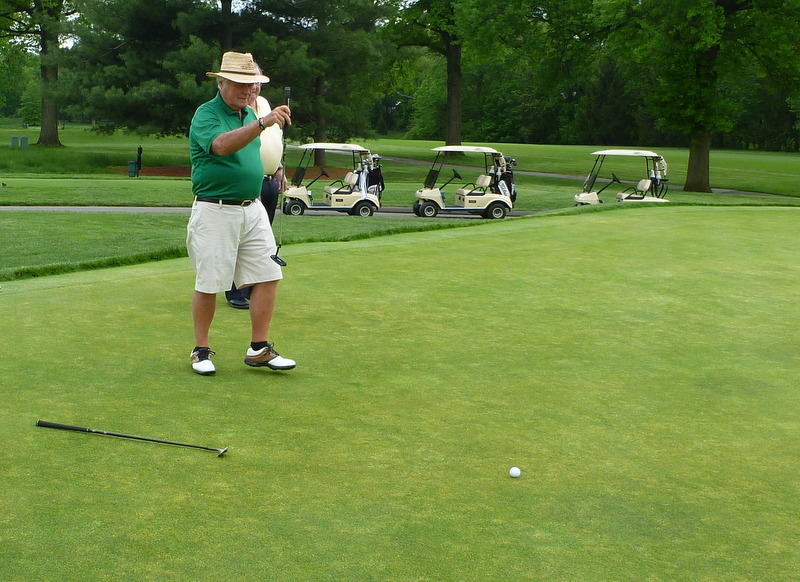
Ed Heimann and Ian Wilt.

Ed Heimann and Ian Wilt. “That’s good, Ed.”

Heimann has a more interesting job than you do, too: he is the chairman of Hamilton Tailoring Company, in Avondale, which was founded the same year Hyde Park was. Hamilton has made clothing for customers as different as Perry Como and John Daly, and since 1967 it has been the exclusive manufacturer of the three-button, single-breasted sports coats worn by Augusta National members and Masters winners. (The exact shade of green: Pantone 342.) Heimann established his Augusta relationship by employing the same kind of creativity and determination that he has used to pick apart opponents in club matches for the past half-century. So watch it.

Did Bobby Jones Use an Illegal Putting Stroke?

Bobby Jones Putting

Last week, the U. S. Golf Association and the Royal & Ancient Golf Club of St. Andrews adopted Rule 14-1b, which prohibits so-called “anchored” putting strokes. (The rule will go into effect in 2016.) Nate Burns, a reader in New York City, writes:

In their recent rules decision, the U.S.G.A. and R. & A. claim that “the essence of the traditional method of golf stroke involves the player swinging the club with both the club and the gripping hands being held away from the body,” but I question whether that is actually the case. If you look at video of golfers in the nineteen-twenties and nineteen-thirties, you see that many of them anchored a hand or forearm against their leg to create a hinge (a technique that will become illegal under the new rule). It makes me wonder how the stroke has evolved over time and whether there really is an “essence” of the traditional stroke. (It seems to me like the U.S.G.A. might be making stuff up.)  Is it possible that anchored putting is actually more “traditional” than non-anchored putting? 

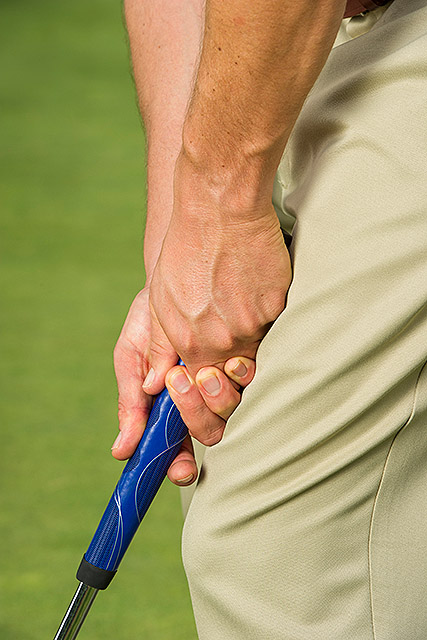
To see what Burns means, compare the photo above with the photo below—which is from the U.S.G.A.’s website and depicts a putting technique that will be banned under the new rule. (To see a U.S.G.A. album of prohibited putting strokes, go here.)

USGA photo

As Burns observes, putting techniques like Bobby Jones’s, in which one or both hands were held against a leg during at least part of the stroke, were common in the old days. Here’s Jones demonstrating how to do it:

Burns has found additional evidence in old film clips on the U.S.G.A.’s own website. In an email to me, he called particular attention to the ones showing “Bobby Jones winning the 1930 U.S. Amateur, Tommy Armour winning the 1927 Open, and Lawson Little at the 1940 Open.”

What do you think?

Burns, incidentally, is a student at Columbia Business School. He has a handicap index of 3.4, and plays mainly at Knickerbocker Country Club, in Tenafly, New Jersey. “I played all my golf out at Bethpage State Park until I got a junior membership at K.C.C., about a year ago,” he told me. “I grew up in Northern Virginia playing junior golf with Steve Marino (he was awesome), and I was in the same class at Wake Forest as Bill Haas (although I wasn’t on the golf team and didn’t really know him). I don’t currently use an anchored stroke, but I have tried pretty much every type of putter and grip, in casual rounds and in club and Metropolitan Golf Association competitions. Unfortunately, none has worked particularly well.”

Tips for Overseas Golf Travelers

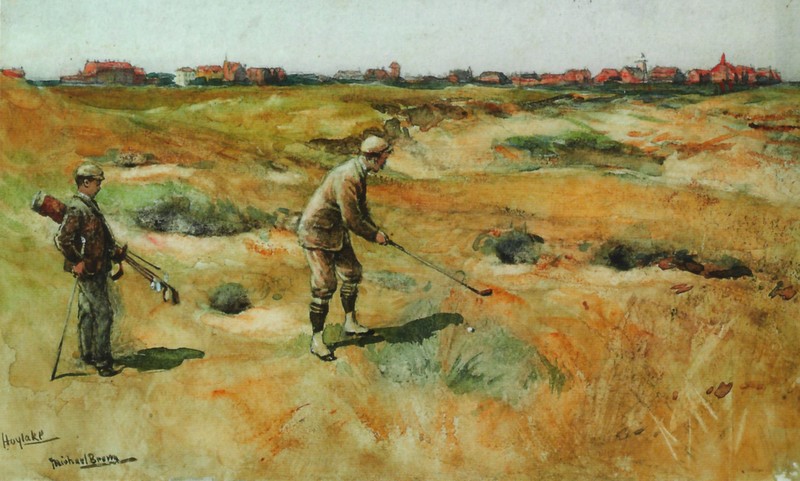
Royal Liverpool Michael Brown

I’ve taken quite a few golf trips to Scotland, Ireland, and England during the past twenty years—including my recent one to England’s “Golf Coast,” in Lancashire (see above)—and I’ve figured out a few things. Here are some of them:

1. The cure for jet lag is golf. You take the overnight nonstop from Newark, arrive bleary-eyed in Glasgow at 8:00 in the morning, drag your clubs past the bomb-sniffing dogs in customs, stumble into a men’s room designated “loo of the year,” change a tall stack of American dollars into a short stack of British pounds, drive fifty-five miles through Robert Burns country while trying to remember to admire the sheep-dotted hillsides, reach Turnberry in a daze—and tee it up on the Ailsa course, where Tom Watson and Jack Nicklaus fought their legendary Duel in the Sun, at the British Open in 1977. You haven’t slept since what seems like the day before yesterday, but your tee shot somehow finds the fairway, and a little mental arithmetic reveals that your colleagues back home are arriving, just now, at their desks. Suddenly, you feel happier than you’ve felt since the birth of your first child, or since the time you and your brother nearly won your flight in the member guest. (Not to worry: The cure for excessive cheerfulness is also golf.)

2. Alternatively, take a flight that arrives at night. I did this once on a non-golf reporting trip to London. I left New York mid-morning, arrived at Heathrow in the dark, took a taxi to my hotel, and immediately went to bed, at roughly 11:00 p.m., local time. I forced my brain to ignore the fact that even two-year-olds were still awake at home, and I slept all night and woke up refreshed, at a normal hour. If you travel all day instead of all night, you sacrifice a full day of potential golf, but you do less violence to your body clock—a possibly worthwhile trade-off for traveling golfers who aren’t as young as they used to be.

3. No matter when you travel, don’t go to sleep (after you’ve arrived) until it’s dark—not even a wee nap. My wife is incapable of doing this. In her view, a nice hotel room in Paris is the ideal place to spend several days recovering from the ordeal of traveling to France. Be strong! Go straight from the airport to a golf course and play thirty-six holes instead!

4. Beware of weekends. The toughest day of the week on which to get visitor tee times is usually Saturday; the second toughest is Sunday. If you plan a week-long trip that involves leaving for the British Isles on a Friday night and returning two Sundays later—something my friends and I have done several times—you’ll miss just five days of work but your golf itinerary will include the maximum number of nuisance days. And the problem will be compounded if your week also includes a “bank holiday” Monday—the equivalent of a three-day-weekend Monday at home. The solution is to miss a little more work. And you can check the bank-holiday schedule online, through the magic of Google. (On my recent trip, I left on Sunday night, arriving early Monday morning, and returned home the following Tuesday.)

5. Look into poor man’s business class. On my flight home, I paid United $99 for an “Economy Plus” seat, in an exit row. It had so much leg room that I could fully extend my legs without touching the seat in front of mine, and when I went to pee the guy sitting between me and the aisle didn’t have to get up and barely had to move his legs. I took a window seat so that I could lean against it to sleep and, as I had hoped, the middle seat stayed empty, because no one had been willing to pay extra to sit in it. I had so much room that I was able to comfortably type up all my notes from the trip—like getting a free day! And I could plug in my laptop, in an outlet under the seat, when the battery got low!

What’s In My Bag: Jack Chesnutt

Royal Birkdale, May 19, 2013.

Royal Birkdale, May 19, 2013.

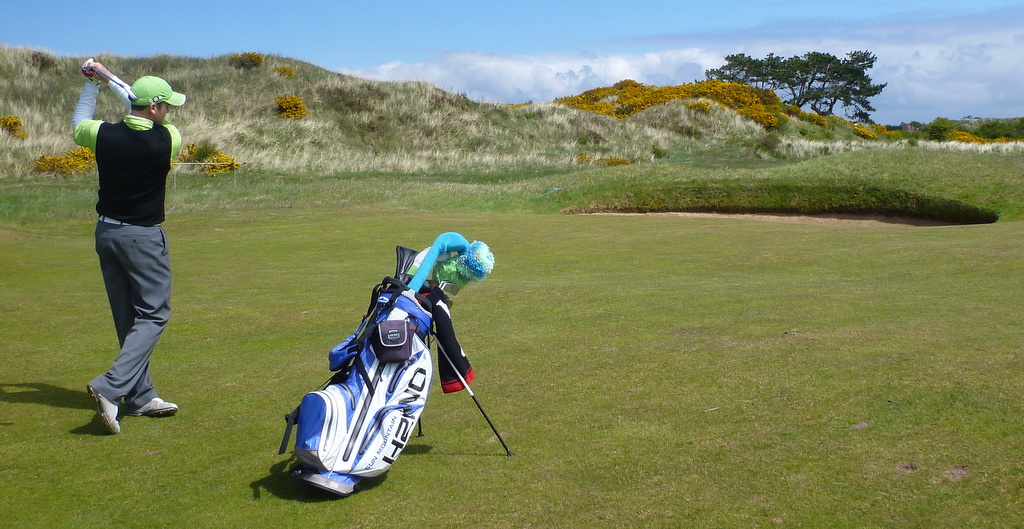
Today, I played Royal Birkdale with Paul Jones, a young member and a terrific golfer, whose swing finish you see here:

P1060461Before we teed off, I bought my wife a sweater in the golf shop and decided not to buy myself an enameled ball marker. Then, during our round, I found an enameled ball marker that was even nicer than the one I had decided not to buy. The exact same thing (except for the part about my wife) happened to me a year ago, at Cruden Bay, in Scotland. The ball marker I found there turned out to be one of the luckiest I’ve ever owned, for about a month. Fingers crossed!

And that brings me to Jack Chesnutt, a reader in Colorado, who recently wrote:

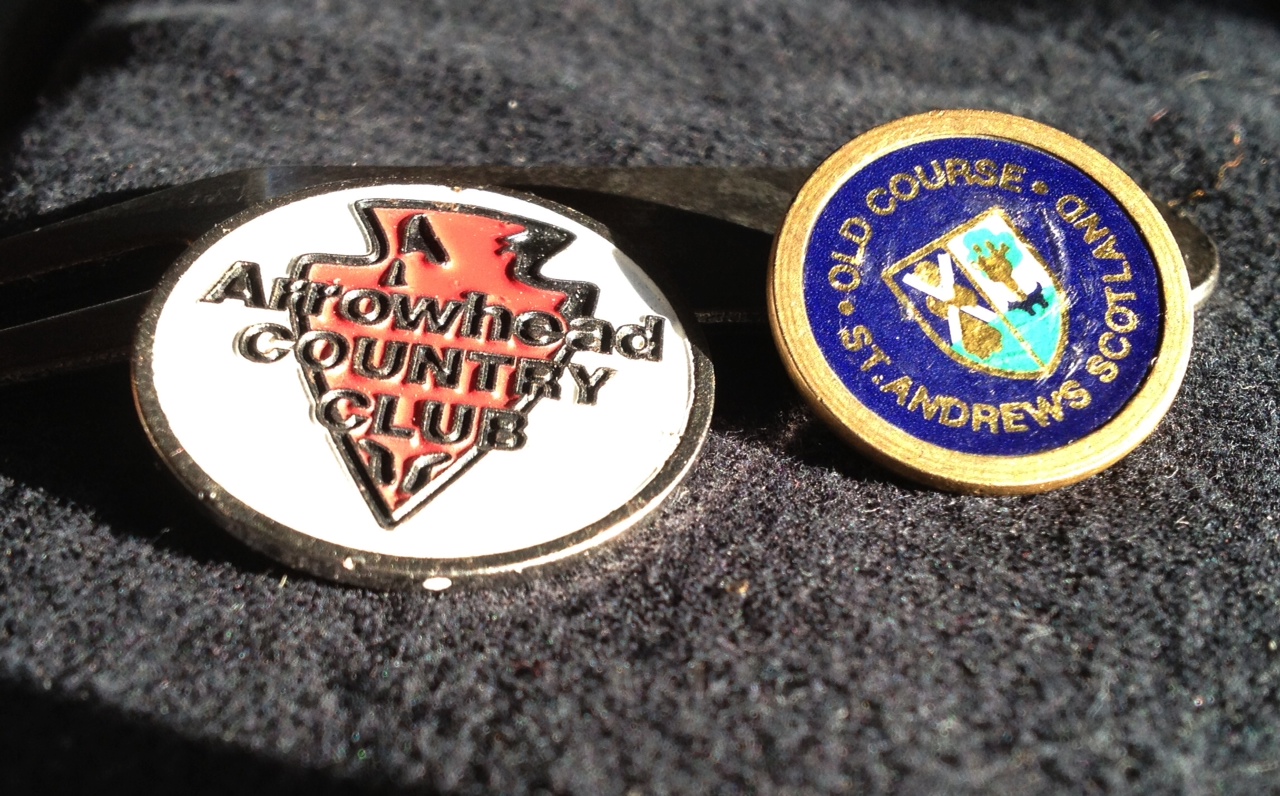
I found the ball markers below (along with one from a course in Ireland I have since lost) on a fairway at Pacific Dunes in 2008. They did not seem to have been dropped accidentally from someone’s pocket. They were arranged in a small triangle with a well-worn repair tool in the middle. The last act of a frustrated golfer after watching one more drive arc toward the rocks and surf? Or maybe a little memorial to a departed golfing buddy? The view from that point in the fairway was wonderful.

photoAs I do with all the markers I keep in my golf bag, I rotate the Arrowhead marker in and out of my game. The first three-putt sends it into time-out. But I never use the Old Course marker. I don’t want to lose it. Maybe I will find the owner or his/her son/daughter someday.

Before claiming that these are yours, be prepared to reveal some telling piece of information that only you and Chesnutt could possibly know. Meanwhile, here’s what Chesnutt has to say about his own game:

I caddied for my dad back in the early sixties, but a huge banana slice and indifferent putting convinced me that tennis was more my game. When I turned fifty, my brother-in-law the pilot-golfer (what else do they have to do when they are not driving a 737?)  persuaded me to play a round. I shot 99. I was hooked. My wife (hey, it was her brother who got me into this) made fun of my golf habit. “Why would any human being need more than ONE pair of golf shoes?” Luckily for me, she took up golf, became a 9-handicap, and soon bought her third pair of golf shoes. The trip to Bandon was our first big golf vacation together. The first round, at Pacific Dunes, was memorable not only for the stunning setting but also for finding the ball markers. It was so windy that my stand-bag blew over—twice. I’m now sixty-two years old, and my index is 4.5, and I keep about ten ball markers and three repair tools in the rotation. The repair tools don’t seem to have the same cosmic effect on my putting as the markers. I’m also up to four pair of golf shoes. 

I’ll put up more What’s In My Bag items as soon as I’m back in the States. I’ve got several in the hopper, but there’s room for more. Keep ’em coming—and include at least one photo and a golf-oriented description of yourself.

This Should be the Patron Bird of Golf

Eurasian Skylark, Wallasey Golf Club, England, May 14, 2013.

Eurasian Skylark, Wallasey Golf Club, England, May 14, 2013.

If you’ve ever played links golf in the British Isles, you’ve seen and heard Eurasian skylarks, which nest in tall grass and sing while hovering above the ground, often in strong winds, sometimes for as long as an hour.

At Wallasey Golf Club (virtually next door to Royal Liverpool) I got closer to a skylark than I ever have before:

P1060153

The U.K.’s skylark population has fallen by something like ninety percent in the past thirty years, primarily as a result of changes in British agricultural practices which I don’t completely understand. One environment in which they continue to thrive is linksland, and their singing has provided the soundtrack for many of my favorite golf rounds during the past twenty years.

Wallasey Golf Club. Music provided by skylarks.

Wallasey Golf Club. Background music provided by skylarks.

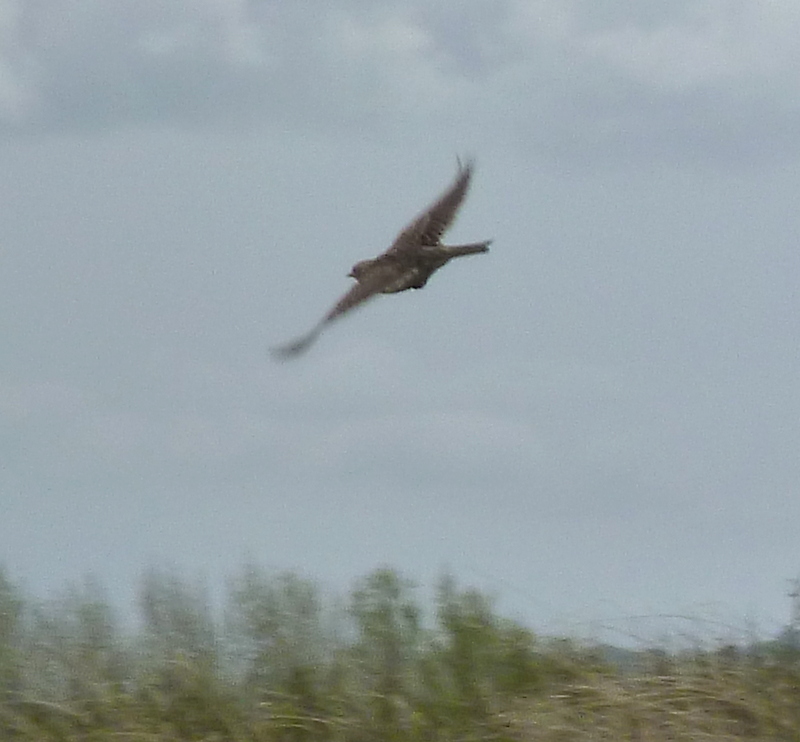
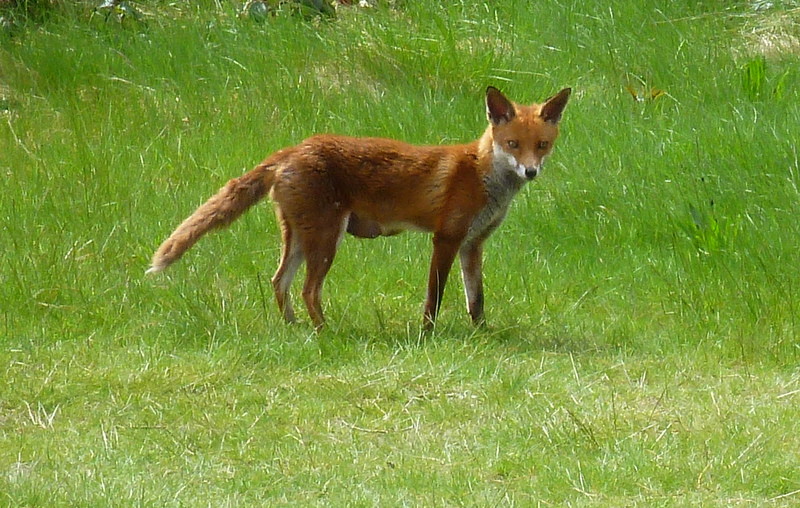
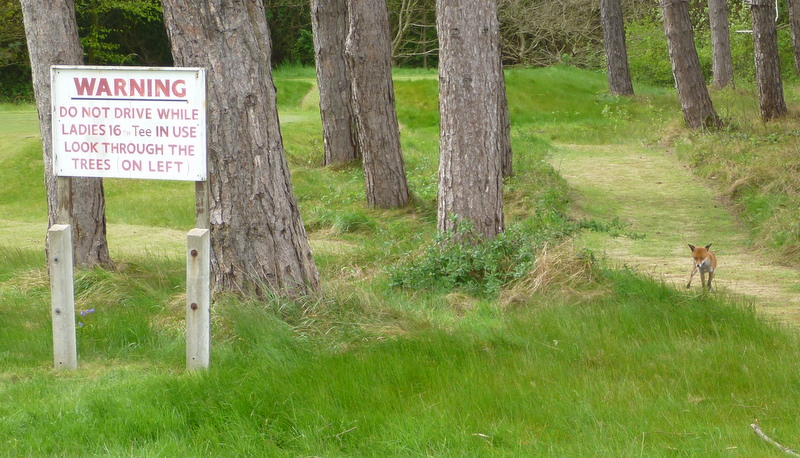
At Formby Golf Club, yesterday, I didn’t see any skylarks, but I did see this, near the seventeenth tee:

P1060330

She was hunting for mice, and when she spotted one in the rough she jumped:

P1060336

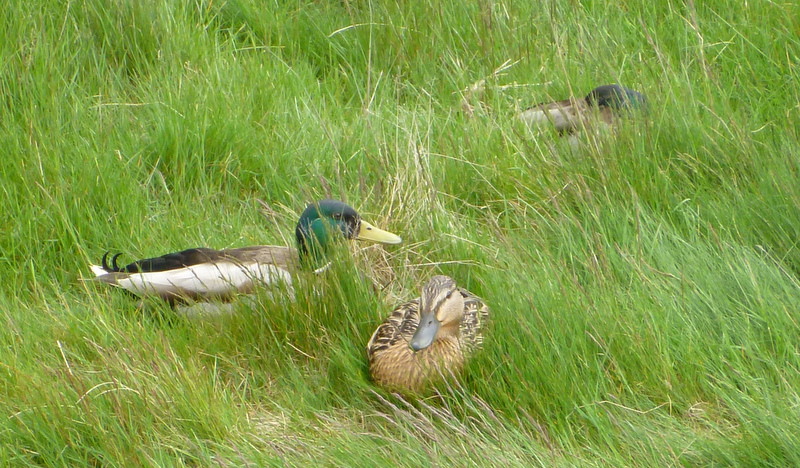
I also saw these—which, for some reason, were sitting in the grass. (Maybe they were trying to hatch golf balls.)

P1060297

And I saw lots of these, especially on the practice green:

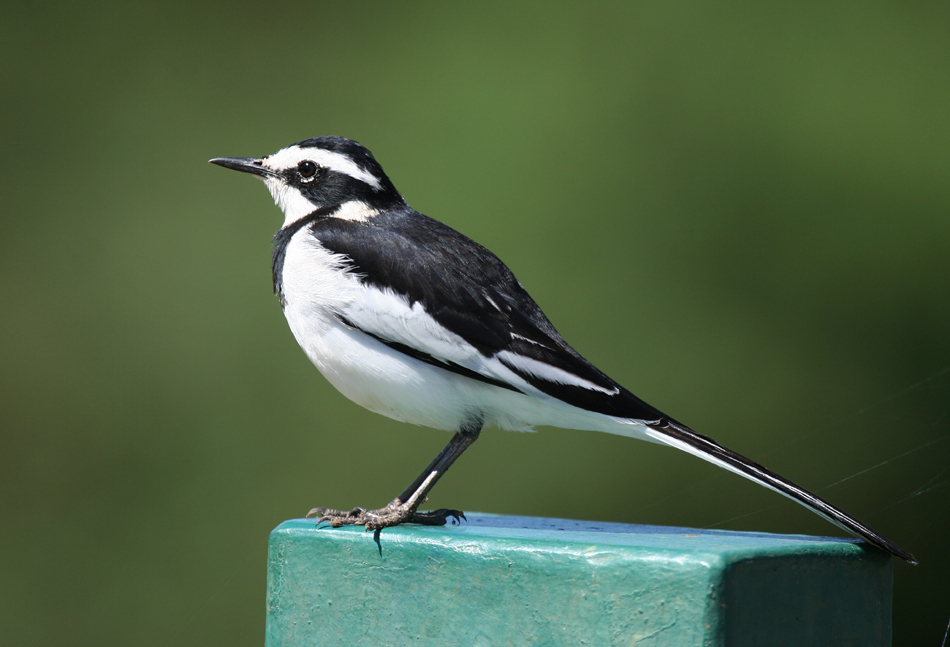
wagtailThat bird is called a wagtail, because—duh—it wags its tail.


Never, Ever Take One of These on a Golf Trip to the British Isles

You won't need one of these if you travel to the British Isles to play golf. Royal Lytham & St. Annes, England, May 13, 2013.

You won’t need one of these if you travel to the British Isles to play golf. Royal Lytham & St. Annes, England, May 13, 2013.

I’m in northwestern England playing golf this week. I didn’t bring an umbrella, and I’m glad I didn’t, even though there’s rain in the forecast for every day from now until the end of time. The trash can on the second tee on almost any links course in England, Scotland, and Ireland often looks like the trash can in the photo above, because American golfers typically come to the British Isles prepared for the rain but not for the wind. One hole is usually enough to destroy almost any umbrella. And carrying a “wind-proof” model isn’t the solution, because if your umbrella can’t be turned inside out it will carry you to sea, assuming you’re strong enough to hang on. Here’s why:

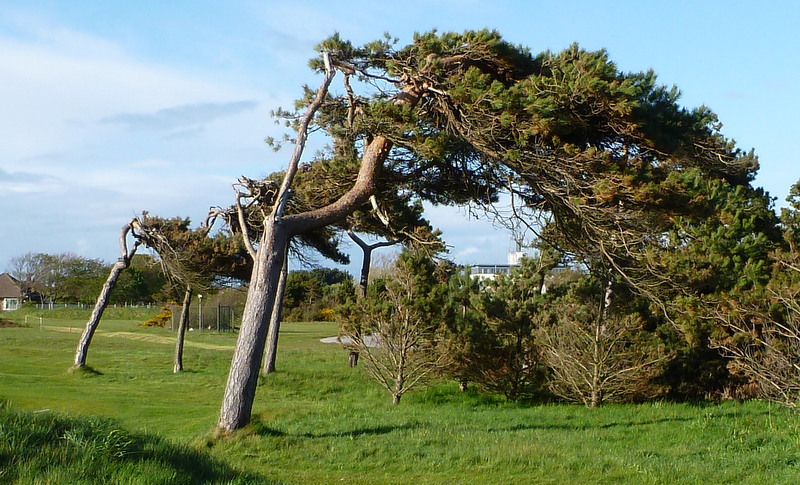
Wind-sculpted trees, thirteenth hole, Royal Lytham & St. Annes.

Wind-sculpted trees, thirteenth hole, Royal Lytham & St. Annes.

The wind was blowing hard yesterday, but the trees in the photo above look that way on calm days, too. Even scrubby little bushes get squashed in the direction of the prevailing wind. (I first wrote about the terrific golf courses of northwestern England almost twenty years ago. The opening sentence of my article was “You don’t need a weatherman to know which way the wind blows at Royal Lytham & St. Annes.” A Golf Digest copy editor, who apparently had never heard of Bob Dylan, changed “weatherman” to “weather report”—and that’s the way it ran.)

P1060129

Not carrying an umbrella will lighten your luggage by a couple of pounds, and it will spare you a lot of annoying housekeeping while you play. And you won’t miss it at all, if you have a rain suit, a rain hat, and a pair of rain gloves. The rain gloves are especially important, because if you have a pair of those you won’t need to even think about trying to keep your grips dry. In fact, if you have rain gloves you almost don’t need to carry a towel. And after my first trip to Scotland, in the early nineties, I stopped carrying an umbrella at home, too. Way too much trouble!

The Other Island Green at the TPC at Sawgrass

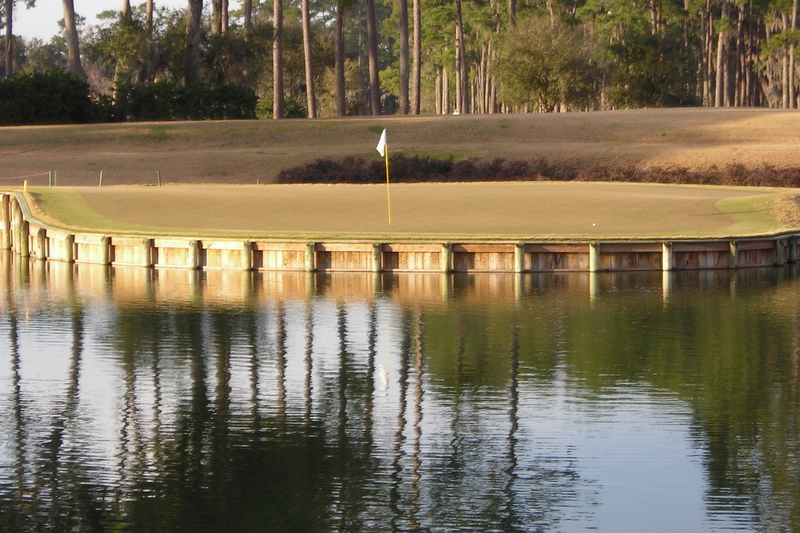
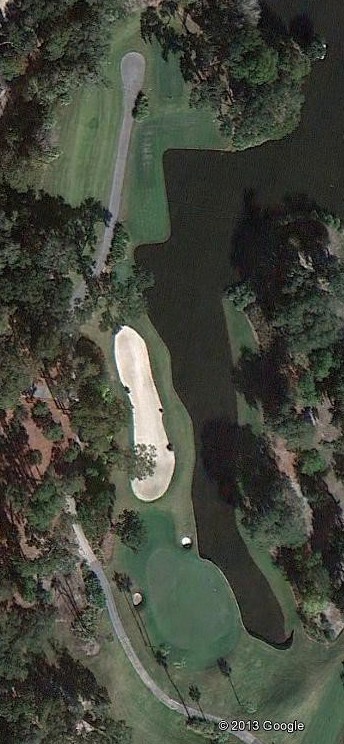
The seventeenth hole at the TPC at Sawgrass is deservedly famous, but the thirteenth, which is also a par-3, can be almost as intimidating, since from the farthest tournament tee it’s more than 180 yards long, and, to a right-handed player who draws the ball, its green might as well be an island.
TPC 13

I had a demoralizing encounter with the thirteenth twenty years ago, during a tournament on the Partners Tour, a short-lived (and almost certainly money-losing) program that the PGA Tour briefly offered to ordinary golfers. For $1,275, I got one practice round (on the Stadium Course), three tournament rounds (one on the Stadium Course, one on the adjacent Valley Course, and one at Jacksonville Country Club), unlimited extra golf on the Stadium and Valley courses, four nights at the Marriott at Sawgrass, three breakfasts, three lunches, two dinners, and a money clip made of goldium. I also got a locker with my name on it. It was next to the locker of Deane Beman, who at the time was the commissioner of the PGA Tour. I didn’t see Beman, but I did get a pretty good look at his shoe trees and a pair of his socks.

During the first round of the tournament, I was briskly confident as I stepped up to the thirteenth tee. We were playing from the blue tees, from which the hole measures about 150 yards. (The same tees were used during the second round of the Players Championship this year.) The day before, during my practice round, I had chipped in from the fringe for a birdie, and I had birdied the following hole as well, and (because golf is an easy game) I had parred the hole after that. Now, waggling my 8-iron and visualizing a soaring draw, I glanced one last time at the flag, and half-shanked my ball into the trees on the right.

No 13

“I’d better hit a provisional,” I said, without feeling particularly concerned. I teed up another ball, and, with a swing grooved through long and patient repetition, half-shanked it into the same stand of trees.

“I see the second ball,” someone shouted. Five minutes of crawling through dense undergrowth failed to turn up the first. I crouched in a bush to survey my prospects. To put my second ball on the green, I calculated, I would need to hit a crisp thirty-yard smother-hooked 4-iron through a window-size gap in the branches, applying enough backspin to keep the ball from skidding into low earth orbit. I declared the ball unplayable and returned to the tee. Taking a deep breath, I swung again. My third ball found the water on the left.

Sawgrass 13th

An eerie hush fell over my playing partners. I felt my consciousness rise slowly out of my body and gaze down, with ineffable pity, at my golf hat. I dropped a fourth ball, at the front of the teeing area, and with my pitching wedge yanked it safely onto the far left corner of the green, perhaps fifty feet from the pin. Three putts later, I had my ten.

From that point forward, my memories of my round are indistinct. I had been playing pretty well before my disaster, but I ended up with a 102, including double- or triple-bogeys on all the remaining holes except the celebrated seventeenth, on which I had a seven. (First ball into the water over the green; second ball into deep rough next to a piling at the rear of the green after bouncing hard and high off a piling at the front; chunky chip; three putts.) As I watched an official inscribe my score on the big board near the clubhouse, I wondered whether I ought not to give up golf altogether, for the good of the game.

Because I had played so poorly in the first round, I was demoted to the old-guy flight for the second round, which we played at the TPC’s Valley Course. The Valley Course, which is right next to the Stadium Course, is very different—it was designed by Pete Dye and Bobby Weed—but it’s still a good, challenging course. (The N.A.I.A. championship had been played there two days earlier.) I was grouped with an old guy from Texas named John, an old guy from South Carolina named Glen, and a regular guy from Florida named Gerry. Like me, Gerry had had a terrible round the day before. (He was a seven-handicap, but had shot 95.) I started out quadruple-bogey, double-bogey, double-bogey—a string of trouble that began when I decided to hit a big tee shot in front of Holly, a nice woman from the Tour office who was sitting at a table by the first tee. This triple disaster was doubly annoying, because the evening before I had parred all three holes in a quick nine-hole practice round with a fellow competitor and a photographer from Golf Digest.

Fourteenth hole, Valley Course.

Fourteenth hole, Valley Course.

One thing that makes me nervous on a golf course is wondering when disaster is going to strike. Once disaster has actually struck, I feel a sense of relief: now I know. Finding myself eight over par after three holes, I gave up hope, settled down, and began to make pars. I eased up on my swing, and my shots became longer and straighter. I no longer cared so much about my putts, and they began to drop. I even made a couple of birdies. Part of the credit belongs to my playing partners. John (whose golf shirt had a picture of an oil derrick on it) and Glen made flattering noises every time Gerry or I hit a ball more than 150 yards. Under their benevolent, calming gaze on one hole, I unwound a mighty two-wood—my fraidy-cat driver at that time—and hit what turned out to be the longest drive of the day. My prize was an attaché case with a PGA Tour emblem on it. I was thrilled to receive it—the long-drive winner in a previous tournament had been the mother of the Tour player Robert Gamez—although I later threw it away.

A Golfer’s Bucket List: No. 4 (T.P.C. Edition)

TPC at Sawgrass, February 9, 2009.

TPC at Sawgrass, February 9, 2009.

Play the Stadium Course at the TPC at Sawgrass. Hacking your way around a memorable course that you can watch the pros play on TV is both exciting and instructive, and the Stadium Course is the most engaging regular tour venue that mere civilians can play for a somewhat reasonable price. Bay Hill, Cog Hill, Doral, Harbour Town, and Torrey Pines are also possibilities. So is Pebble Beach, although eighteen holes there, including the obligatory add-ons, may cost more than the annual dues at your home club, and your round will seem to last for several days, and the greens will disappoint you, and the people in the group in front of yours will turn out to have taken up golf the day before yesterday. The Stadium Course is fun to play, and when you later watch The Players Championship—the fifth major!—on TV you will recognize more than just the last two holes. Playing a tour course will help you appreciate how the pros make their living, and the next time Tiger or Rory or Rickie dumps one in the water on seventeen you can tell your buddies, “Hey, I’ve done that.”

Seventeenth green, TPC at Sawgrass.

Seventeenth green, TPC at Sawgrass.