What’s In My Bag: I Bought New Wedges!

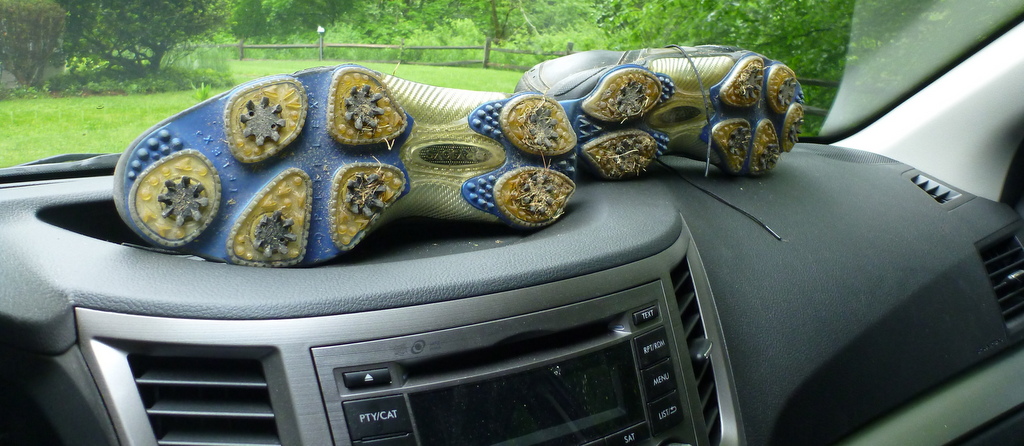
Now retired: the 52- and 60-degree wedges I bought in 2005.

Now retired: the 52- and 60-degree wedges I bought in 2005. The grass and dirt you see in the grooves on the 52 were an integral part of the clubface.

Last week, as several friends and I approached the midpoint of a thirty-six-hole day, Kevin looked in my golf bag and said, “You really ought to get new wedges.” Because I do anything that people in their twenties tell me to do, I went into the golf shop between rounds and came out with two Cleveland 588-RTXs, their heads and grips still wrapped in plastic. I liked them so much that, two days later, I bought a third, and made room for it in my bag by moving my 3-hybrid into the trunk of my car. And Corey, our pro, said I really ought to replace my wedges every couple of years, so I’ve now added “BUY BUY BUY” to July 1 in my calendar in every odd-numbered year between now and the end of time.

I’m still getting used to my new clubs. The ball checks up more than it did with the old ones, even from light rough, so I’ve had to make some adjustments—although worrying about excessive backspin, for a golfer like me, is like worrying about having too many interesting things to say to Jennifer Anniston. Most of the time, I don’t even bother to clean my grooves, never mind using them to terrorize my opponents.

My new wedges. I bought the 52, 56, and 60.

My new wedges. I bought the 52, 56, and 60.

The pros sometimes cause trouble for themselves by spinning their shots too much, but it’s hard for an average player to think of that as a problem. If every approach I hit came zipping back into a bunker, I’d feel as proud as if I’d taught myself to breathe underwater. Anybody can accidentally hit the ball close to the hole; the awesome thing is to look like you’ve got an inside line on the laws of physics. I myself manage it occasionally—usually from a bunker, or on a day when the greens are soft, or when I’ve swayed so far forward during my downswing that I’ve unexpectedly hit my ball before hitting the ground—and it’s always a thrill.

Even in its truly malignant forms, ball rotation can be exciting. I once played a round with a guy who had a two-fairway slice. His wife was riding in the cart with him, and she’d never seen him play before, and when he hit an unusually spectacular banana she gasped, “How do you make the ball curve like that?” A slice is just backspin lying on its side, so we should treat it the way the guy’s wife did: with respect.

I can think of only one thing that would make me happier than routinely making balls shift into reverse. Some winter, I want the Sunday Morning Group to hire a couple of high-school kids to meet with us every weekend, in the club hall, and teach us double dutch jump rope. We’ll work and work and practice and practice, and then, at the big cocktail party in the spring, we’ll suddenly break into our routine—a dozen overweight middle-aged men doing snappers and caterpillars and buck splits and scissor jumps. We’ll blow everybody away. Here’s what we’ll look like (age-adjusted):

New Playoff Format: From Bag Room to Practice Green

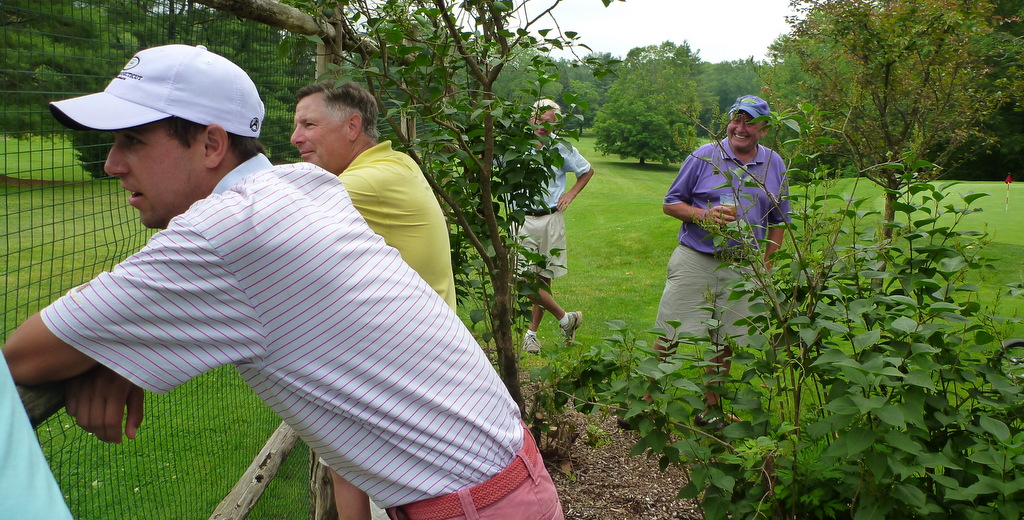
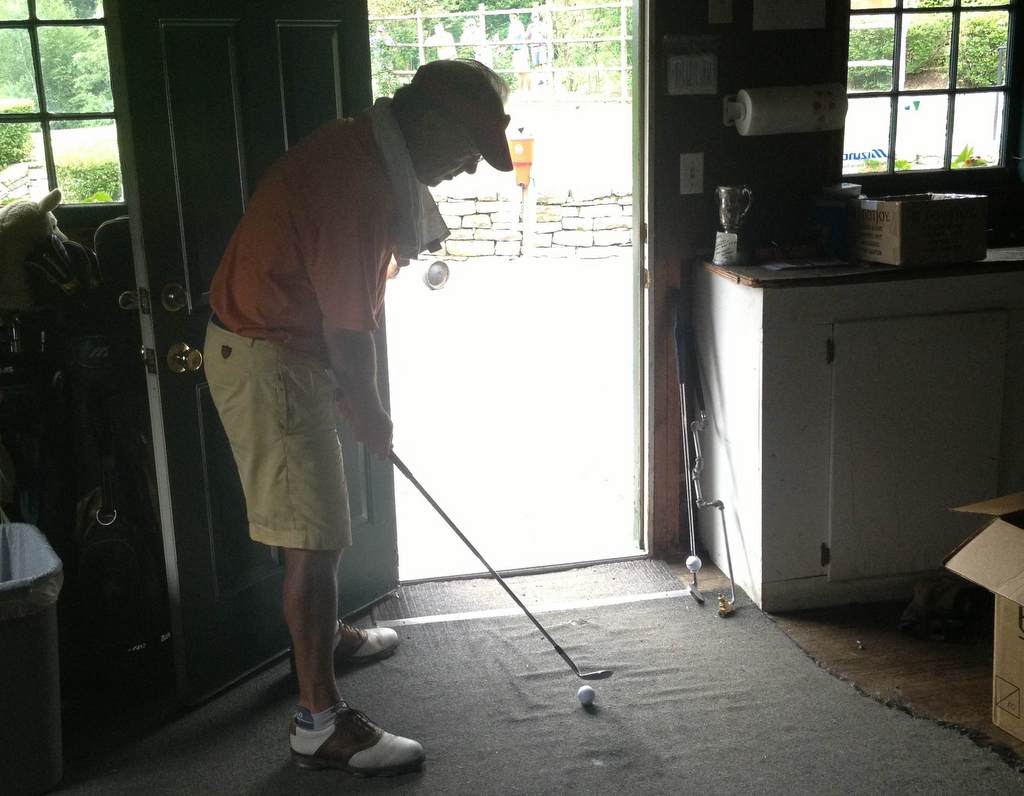
Brendan (third from the right, in the bag-room doorway) is about to pitch to the practice green in the Sunday Morning Group's most recent playoff. Sunday, June 30, 2013.

Brendan (third from the right, in the bag-room doorway) is about to pitch to the practice green in the Sunday Morning Group’s most recent playoff. Sunday, June 30, 2013.

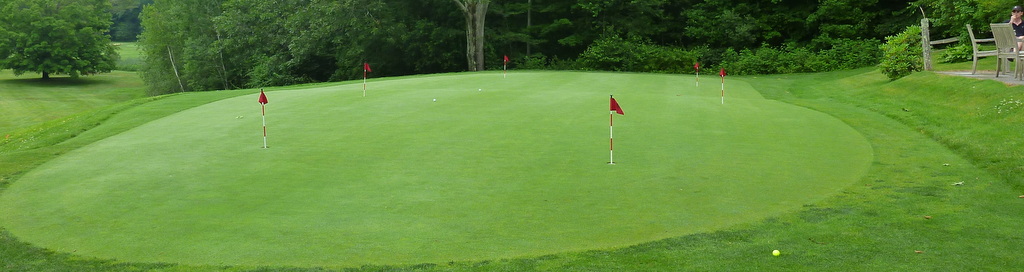
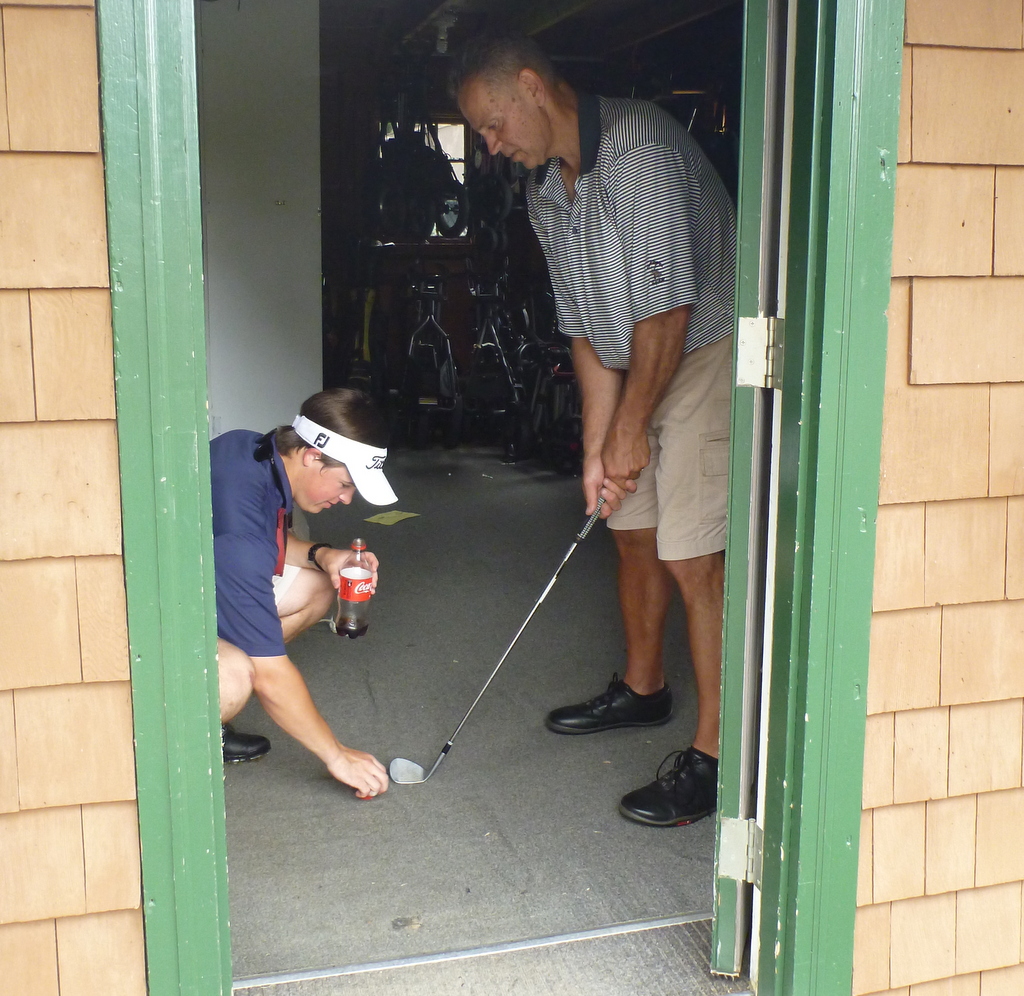
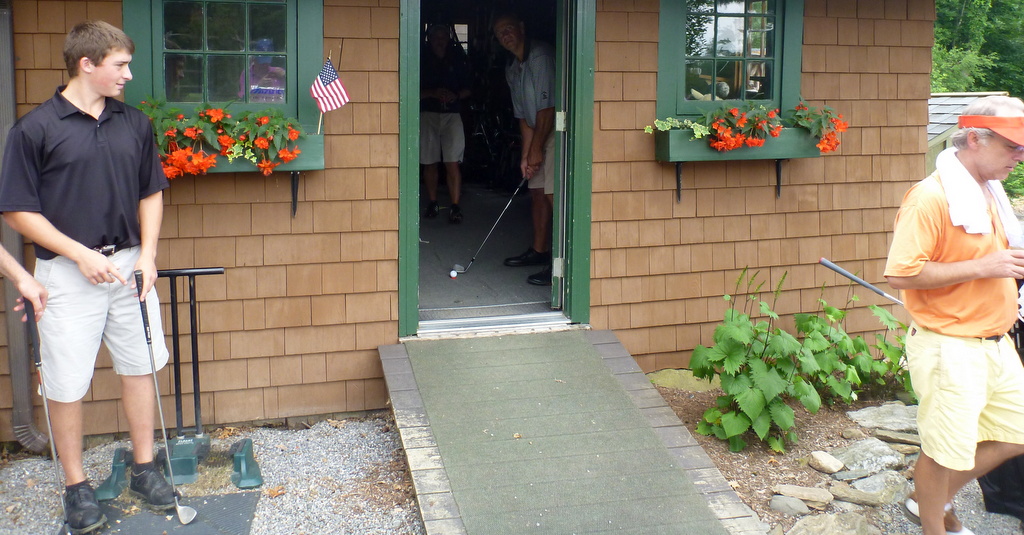
On Sunday, two teams finished at 14-under, so we held a playoff—a form of competition in which, I think it’s safe to say, my club leads the world. The format was a pitch shot from the bag-room floor to the farthest pin on the practice green, a distance of a little more than sixty yards. The shot had to carry the ball washer, the first tee, the first-tee fence, and a small tree, and in order to count it had to stay on the putting surface. As always, closest to the pin wins.

Young Nick, Mike U. (officiating), Gary (our superintendent), and Reese. Gary has teed his ball on a Coca-Cola bottle cap.

Young Nick, Mike U. (officiating), Gary (our superintendent), and Reese. Gary has teed his ball on a Coca-Cola bottle cap.

Several non-competitors, including me, watched from behind the first-tee fence, which we had to add to the first tee because somebody’s guest in the Men’s Member-Guest once hit a tee shot that ricocheted off the pay phone that used to be on the clubhouse porch. A couple of shots in the playoff hit the fence, but not very hard.

Addison, Peter A.., Rick, Hacker (real name).

Addison, Peter A.., Rick, Hacker (real name). The target is off to the right.

The first shot to stay on the green was Mike A.’s. The second was Reese’s. When Reese’s ball was in the air, I was sure it was going to finish closer to the pin than Mike’s, but it was spinning so much that it skidded to a halt and maybe even backed up a little. The reason is that Reese hit his shot directly off the crappy bag-room carpet, rather than teeing it up on a bottle cap, as almost everyone else did. Live and learn.

Reese, about to hit. Quiet, please.

Reese, about to hit. Quiet, please. Notice the tight lie.

Here’s how Mike A.’s and Reese’s balls ended up (if your eyes are good enough to see the tiny white dots on the far side of the green). I’m not sure who hit the yellow ball in the fringe. It may be the one that hit the tree.

P1070599

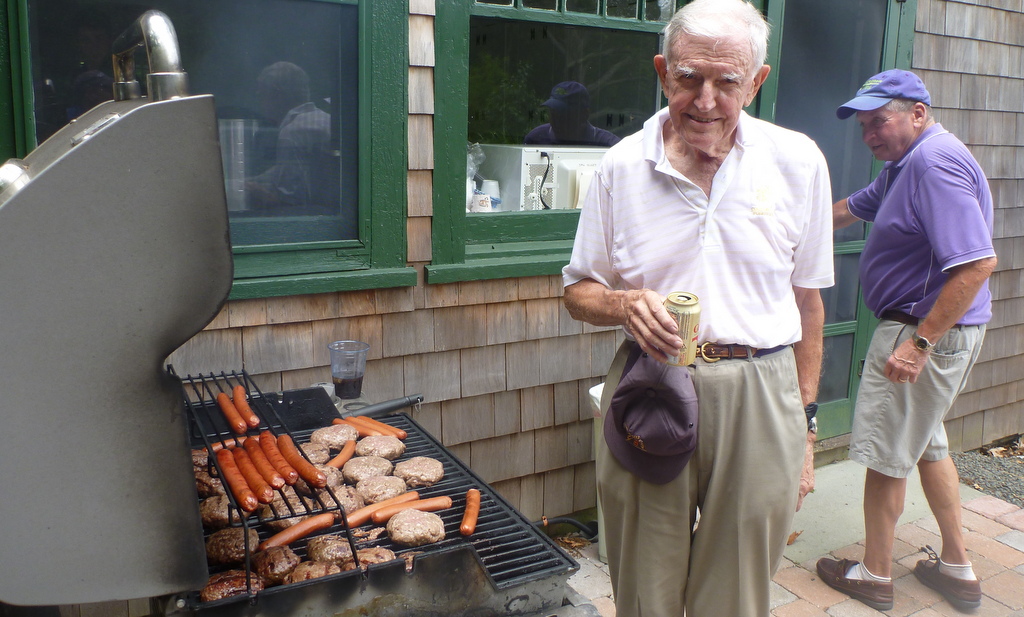
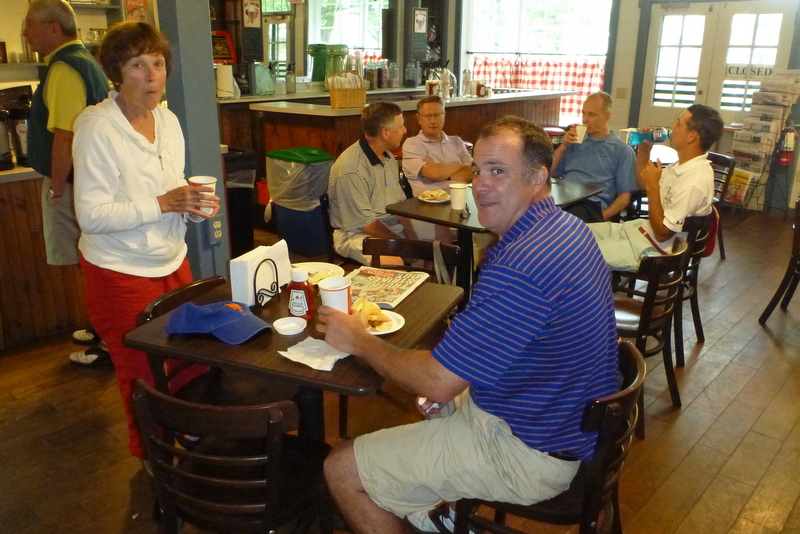
The best thing about Sunday, for those of us who didn’t finish in the money, was lunch, which was provided by Slade. Slade is old-school, lunch-wise, and Sunday was the first time in many years that we had burger patties shaped by human hands—in this case, Slade’s wife’s.

Lunch, Slade, Hacker.

Lunch, Slade, Hacker.

Also, we had twenty-nine guys, if you include Rick and Addison, who were playing a match in the Governors’ Cup, which is our handicap championship. Addison won, and I will now play him in the final as soon as he has returned from a summer trip with his family. Also, several of the guys washed down their burgers and dogs with a new Sunday lunch beverage, which we have (tentatively) called an S.M.G. The main (but not the only) ingredient is beer. I’ll have more to say about it later.

Mike U., Coca-Cola cap, Gary.

Mike U., Coca-Cola bottle cap, Gary.

Reader’s Trip Report: Merion (as a Spectator) and a New Game

Moe Dweck (left).

Moe Dweck (left).

Moe Dweck, a reader in Maryland, who (like me) writes a golf blog and (also like me) probably has a real job of some kind, wrote recently to describe his experience at the U.S. Open, which he attended with friends:

A bunch of guys traveled up to Merion on the Friday of the Open for some spectating and a cheese-steak. (By the way, the cheese-steak at Mama’s Pizzeria in Bala Cynwyd is off the charts. Went classic: white cheese, green peppers, and grilled onions. It is the Philly bread that makes these unbelievable.) The course looked the same to me as it did twenty years ago, but with much narrower landing areas. I think the U.S.G.A. overdid that aspect of the set-up more than slightly. But, overall, the presentation of the course was just awesome to witness in person.

(Parenthetically, let me add that I agree with Dweck about the severity of the set-up, and that I don’t share the U.S.G.A.’s crippling anxiety about birdies. Bubba Watson’s recovery from the pine trees on the first playoff hole in the 2012 Masters would be at or near the top of almost any golfer’s list of the coolest meaningful shots in majors in recent years, but nothing like it would be possible in an Open, because if Watson had missed an Open fairway by the same margin he would have been up to his knees in fescue.) Back to Dweck:

The truth is that the course stood up to the challenge, like it did in 1971 and 1981, because of the greens. One of the writers in Golf World pointed out that it is not the undulations of the greens at Merion that make it tough but the tilts. Could not agree more. On the short eighth, it was nearly impossible to get a ball to stay close, even with a sand-iron in the hands of a pro. Nothing more needs to be said about tilt than the lean on No. 5. I hope the U.S.G.A. continues to present the men’s and women’s Opens on classic old courses like these. Taking the driver out of the hands of a pro is not a federal crime, so I am not sure what all the whining is about. 

Back in April, Dweck wrote to describe a game that he and his regular golf buddies had played on their home course during Masters weekend—a game they called Virtual Pro-Schmo. What they did was take the best Masters rounds from the previous day and treat the guys who shot them as virtual partners in their own game. They transposed each Master’s competitor’s hole scores, in relation to par, onto a scorecard from their own course, then put all the cards into a hat and picked. If a schmo’s virtual pro partner had birdied Augusta’s first hole the day before, for example, then the only way the schmo could improve their best ball on the first hole would be to make an eagle; if the virtual pro had made a bogey, then the schmo had work to do. My friends and I meant to try Dweck’s game during the U.S. Open, but we forgot. We’re going to try to remember during the British.

Actually, we might use another format Dweck told me about, which he and his friends used during the Open. “We called it Beat the Pro,” Dweck said. “Thirty-two guys participated. Each one picked a pro-opponent scorecard from a hat. (We used eight guys’ scores, in relation to par, from the Thursday round at Merion.)  We gave our guys 110 percent of their handicap, and they played a quasi-skins format, in which they got three points for every hole on which they beat their pro and one point for every hole they pushed. Winners were the guys who had the most points against the field. I got to knock around Luke Donald. The guys who drew Sergio had to deal with an eagle on No. 2 (which is a par-3 on our course, so they needed a hole-in-one to push) and a quad on No. 15 (a par-5 for us, so a net nine or better scored points there.) Lots of fun.”

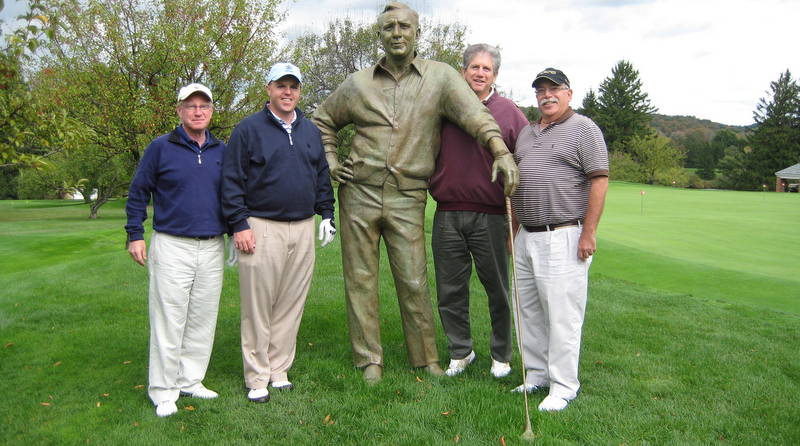
My friends and I are going to try this, too, sometime, if we remember. Here’s a picture of Dweck and some of his friends:

Alan Levine, Josh Tremblay, some guy, Rusty Minkoff, and Moe Dweck at some point in the past, during a buddies trip to Laurel Valley Golf Club, Ligonier, Pennsylvania.

Alan Levine, Josh Tremblay, some guy, Rusty Minkoff, and Moe Dweck, during a buddies trip to Laurel Valley Golf Club, Ligonier, Pennsylvania.

Back-Roads Scotland: Cullen Golf Club

P1020782

In 2007, I traveled to Scotland on an unusual Golf Digest assignment. I landed in Glasgow without tee times or an itinerary, and I rented a car and set out in a more or less random direction, with the goal of playing only courses I’d never heard of before. You can read my article about that trip here or here.

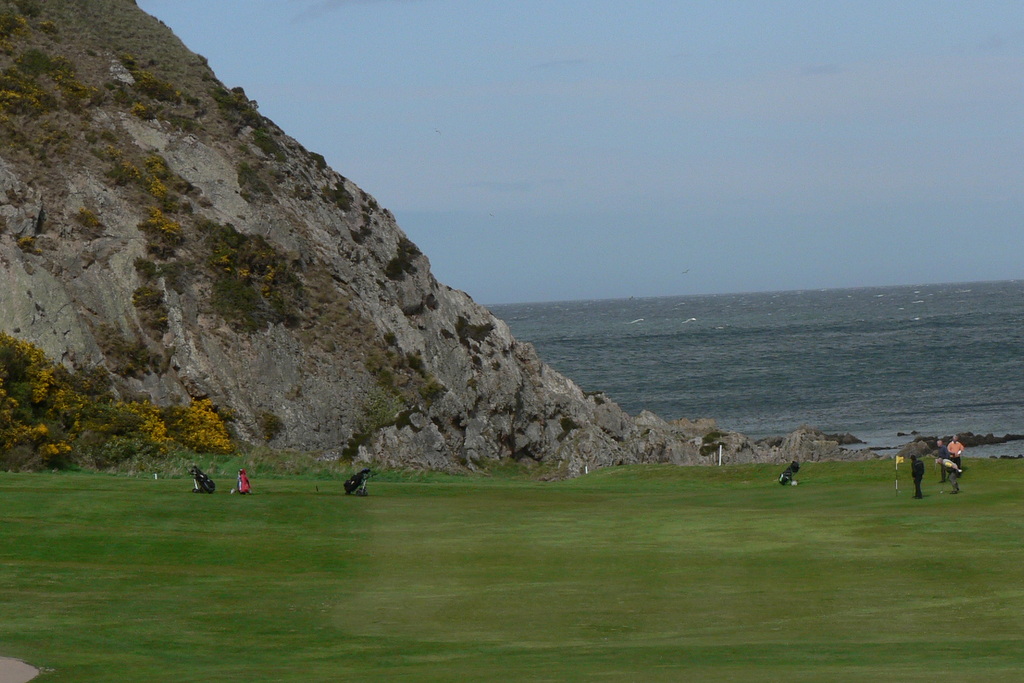
The bent flag shows how hard the wind was blowing. Cullen Golf Club, Scotland, May, 2007.

One of my favorite stops was a quirky course called Cullen, in Aberdeenshire, on the southern coast of the Moray Firth. The original nine holes were laid out by Old Tom Morris, and the course has blind shots, crossing fairways, otherworldly topography, and a cool tee shot that you hit from the top of a cliff.

Looking down from the top of the cliff, Cullen Golf Club.

Looking down from the top of the cliff, Cullen Golf Club.

Partway through my round, I joined (as the fifth player) a group of older golfers from a club called Hopeman, about thirty miles to the west.

Hopeman Golf Club, Scotland, May, 2007.

Hopeman Golf Club, Scotland, May, 2007.

They were on a golf outing, and this was their second round of the day, and they were playing a scramble, in competition with three other groups from their club.

The boys from Hopeman. That’s Cullen’s eighteenth green in the distance.

Most of them were carrying flasks, from which they were sipping a mixture of something and Drambuie—I couldn’t quite make out the recipe—and their golf bags were so full of empty beer bottles that they clanked when the wind, which was fierce, knocked them over. They urged me to have a swig from one of their flasks. I declined, because I’d quit drinking about a year before, but they were so relentless that I eventually decided it would be better to risk falling off the wagon than to come to blows. (The other ingredient turned out to be scotch.)

The boys from Hopeman and some of their beverages.

P1030571

As soon as I’d drunk a capful, though, they began to worry about their supply. “Are you driving?” one asked. His brow was furrowed with concern. When I said I was, he and the others concluded that offering me another swig or a beer would be unwise. Toward the end of the round, one of them asked, in a slurry brogue, “Wha hoe wah noo?” and only I could understand him: “What hole are we on now?” (It was the seventeenth.) A year later, I went back with friends.

P1030502

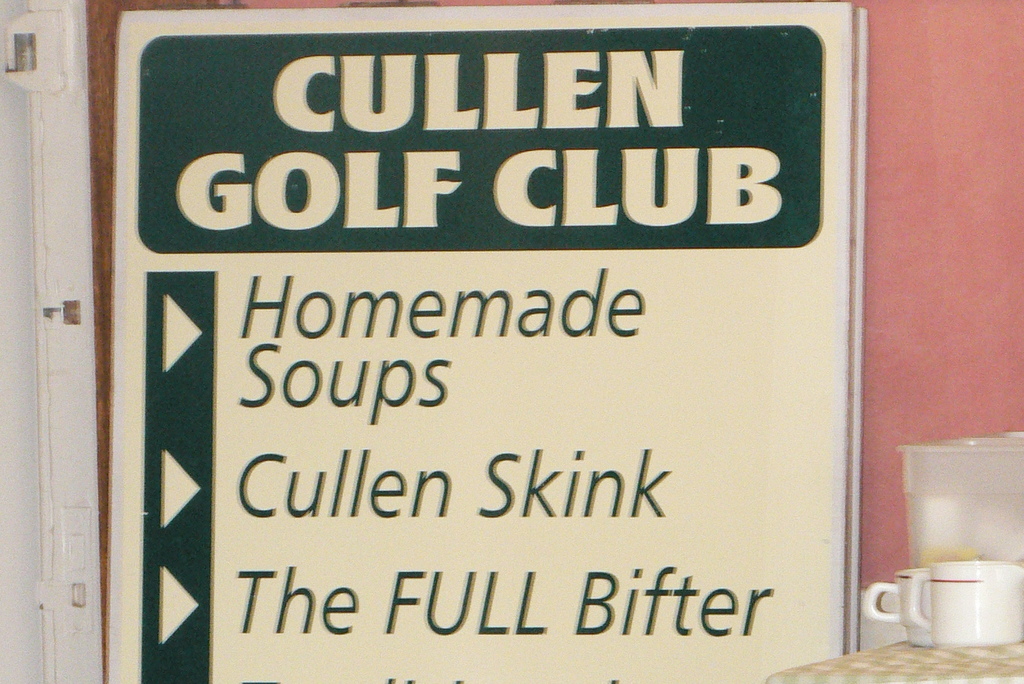
The specialty in the clubhouse—at left in the photo above, behind the big rock—is Cullen Skink, a fish soup that has its own Wikipedia entry.

P1050056

Here’s where my friends and I stayed in Cullen when we went back the following year. It’s my favorite kind of hotel, because you are never in danger of thinking you are in a Holiday Inn.

I’ve had dreams about both the golf course and the hotel. Someday, I will go back.

P1030553

Summer Begins: Longest-Day Marathon and Other Golf News

IMG_1846

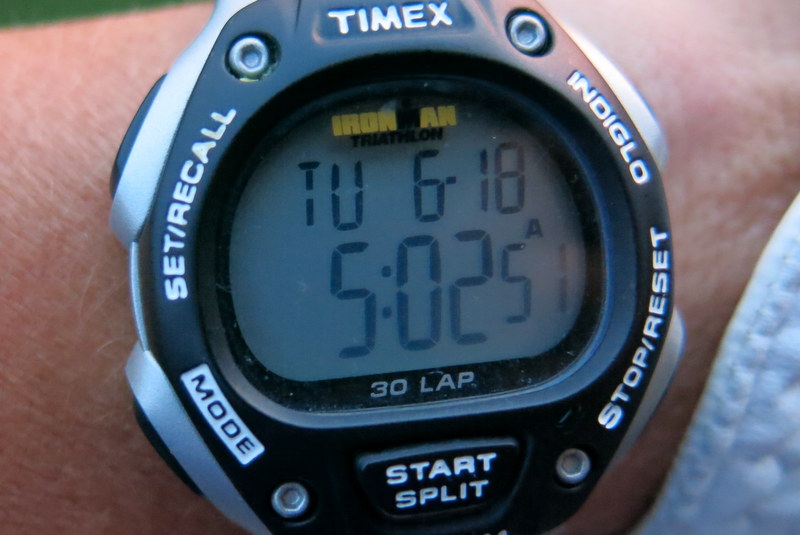
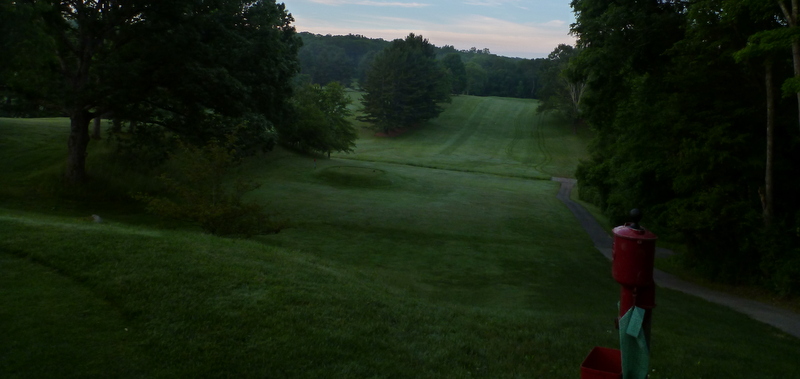
The longest day of 2013 fell on a Friday—not a good day of the week to try to commandeer a golf course. The day before, my club had a senior outing—also not good. And the day before that was Ladies’ Day—ditto. So my friends and I conducted our second annual Summer Solstice Marathon three days early, on Tuesday, June 18. The idea was to play “from can to can’t”—from when you can see until you can’t. I set my alarm for 3:30, and six of us teed off a little before 5:00, when the first hole looked like this:

IMG_1838

It was still pretty dark when we got to the fifth tee:

P1070446On the sixth green, we ran into Gary, who had just cut a new hole for us, in a diabolical location:

P1070450

After eighteen holes, we went to the little cafe on our town’s green for breakfast burritos, apple fritters, and coffee, just like we did last year. I forgot to take my camera, so the picture below is from last year. The participants were pretty much the same, though, except that Bob G. didn’t show up until after lunch, David W. had broken a rib, Addison was playing in the state amateur, and we didn’t run into Mike A.’s mother. I think Mike was wearing the same shirt, though—for continuity.

That's Mike A. on the right and Mike A's mother on the left. She just happened to be there.

That’s Mike A. on the right and Mike A’s mother on the left. She doesn’t follow him around. She just happened to be there.

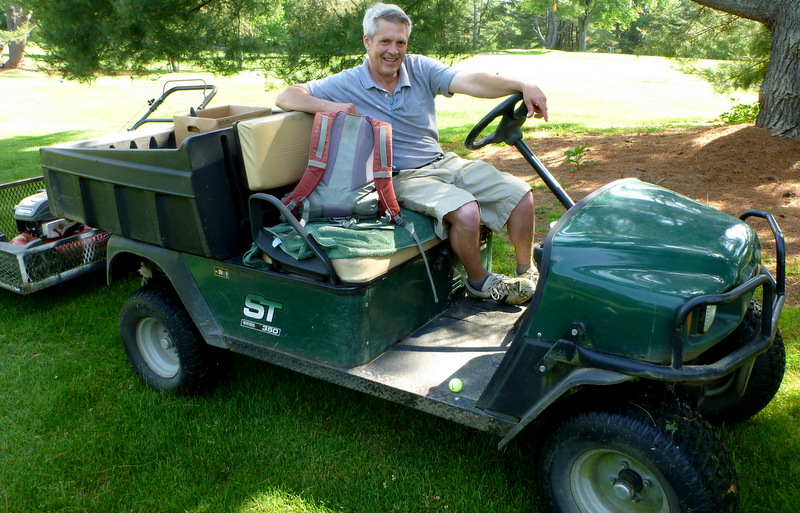
When we got back to the course, I hit what felt like a pretty good fairway wood, but the ball tailed off, and instead of going into the hole it went into Steve’s mower cart. Steve said I could play it from the cart, but I elected to take relief.

P1070457

After forty-five holes, we stopped for lunch—hot dogs and freezer-burned hamburgers from the kitchen fridge—and then went back out.

Young Nick, Kevin, Bob G.

Young Nick, Kevin, Bob G., post-lunch.

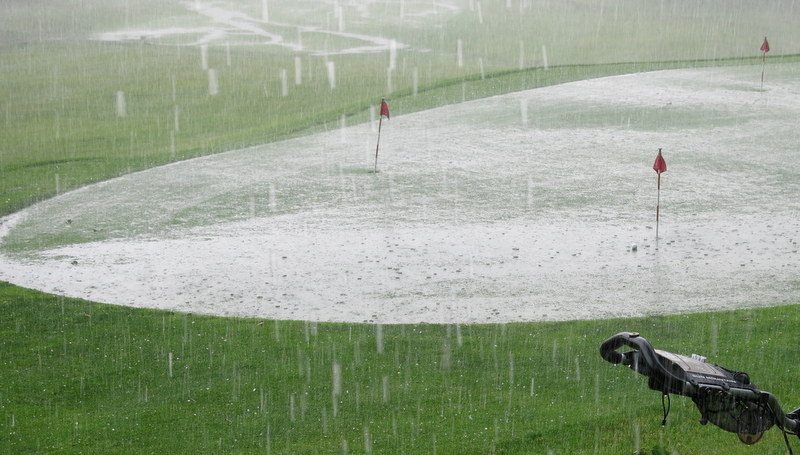
The weather forecast the night before had been decent, but when we got to our fiftieth hole we thought we heard thunder, and when we got to our fifty-second hole we were sure we did. The lightning horn in the golf shop blew, and we all humped back to the clubhouse. The rain and hail started a few minutes later, and pretty soon the first fairway and practice green looked like water hazards:

IMG_1862

I had left some socks and a pair of golf shoes on the roof of my car. Should I risk my life by running across the parking lot to get them? I decided I should. Then we all hung around on the clubhouse porch for half an hour or so, watching the gutters overflow:

P1070477

P1070468

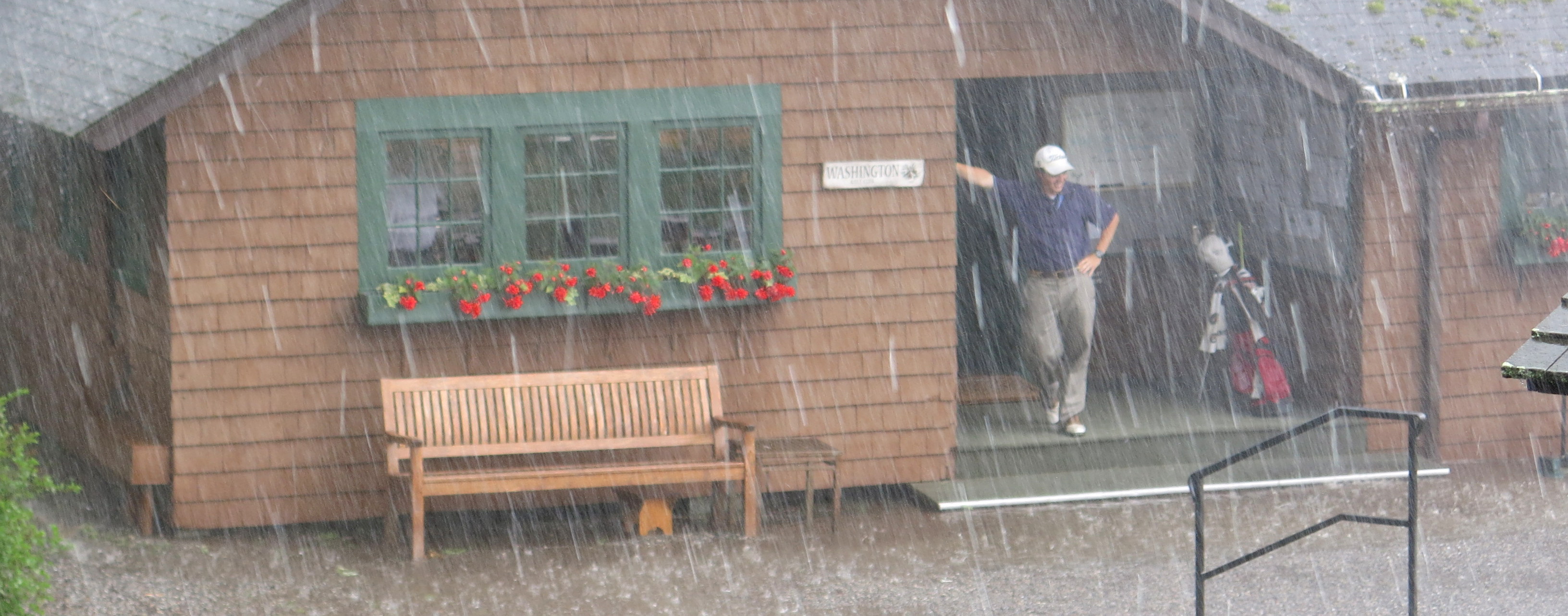
The rain came down so hard that Mike U. couldn’t get from the golf shop to the clubhouse. Here he is, stranded in the doorway:

IMG_1872

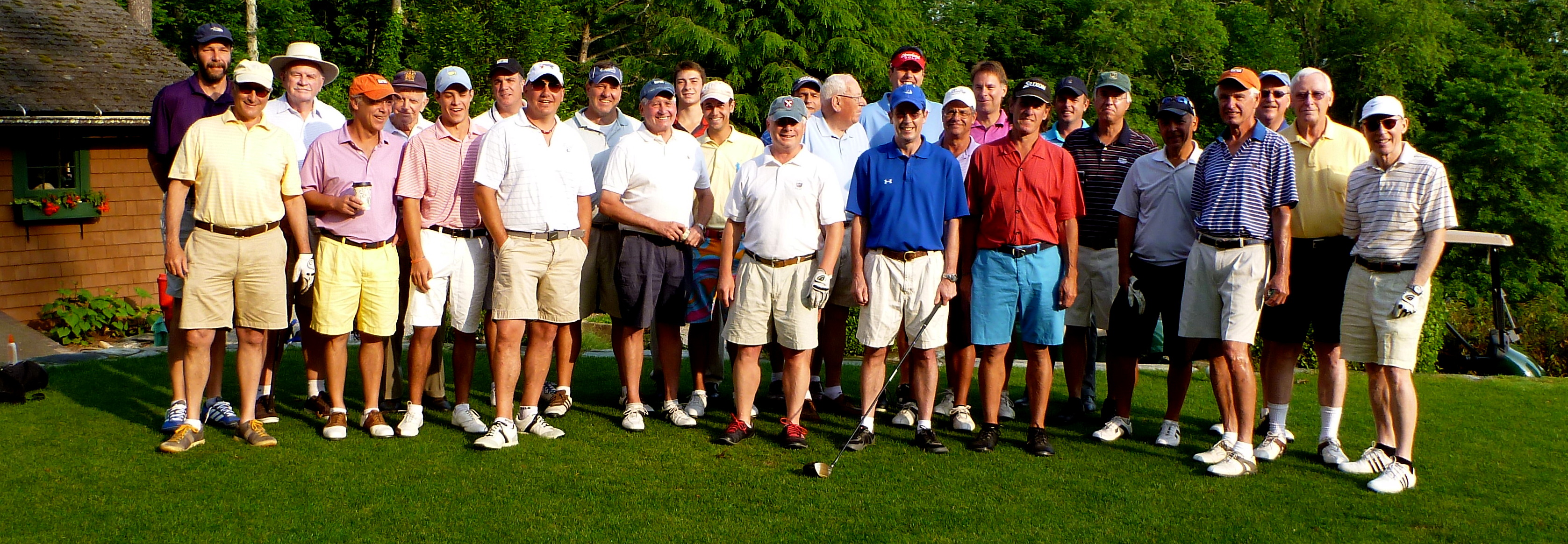
We ended up playing just half as many holes as we played last year. That was disappointing, but a few days later twenty-six guys showed up for Sunday Morning Group—very possibly a record. We choose teams by drawing numbered poker chips from a hat, and because we have only twenty-four chips we thought for a while that we might have to send two guys home. But then Hacker (real name) came up with a workaround. Here’s the group:

Sunday Morning Group, June 25, 2013.

Sunday Morning Group, June 25, 2013.

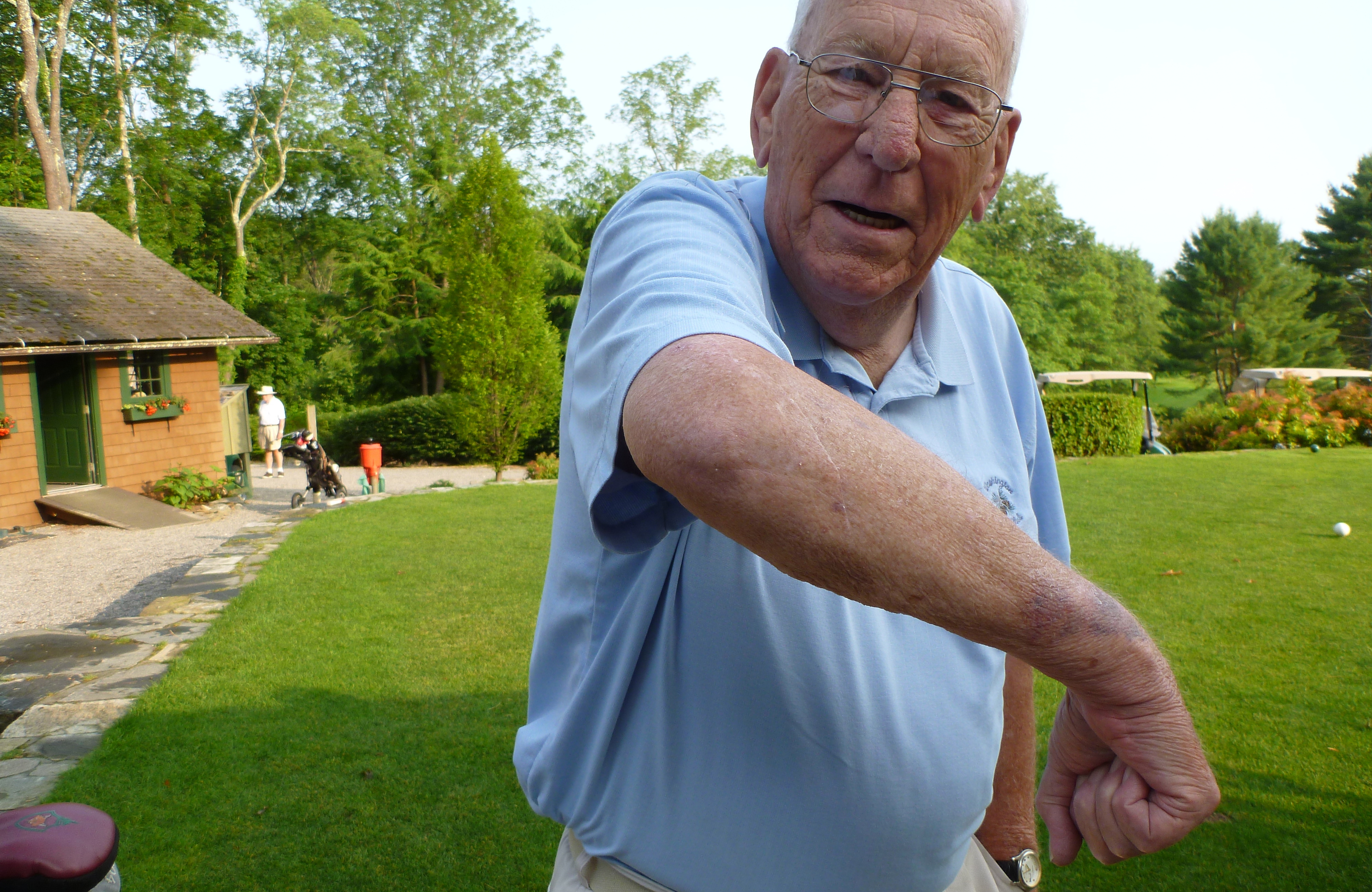
If you count the heads in the photo above, you’ll notice that there are twenty-seven, not twenty-six. The extra guy is Harry, who used to play with us all the time but now lives in another state, on account of his wife. He had played with Hacker the day before, but he broke his elbow a couple of years ago and can’t really swing anymore. On Sunday, he dropped by just to say so long before heading home. You can see the scar on his arm where they tried to put his elbow back together:

P1070494He has finally stopped smoking, though. So give him credit for that.

Mystery Solved: The Blue Stuff in the Shower Room at Winged Foot

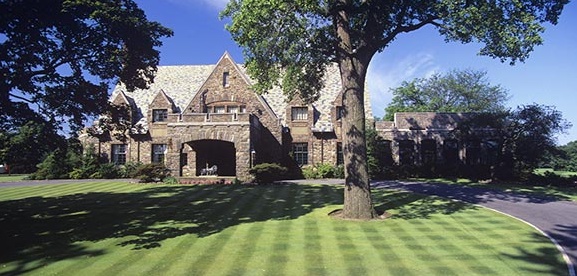
Winged Foot Golf Club, Mamaroneck, New York.

Winged Foot Golf Club, Mamaroneck, New York.

A few days ago, I wrote about the manhole-cover-size shower heads in the men’s locker room at Merion Golf Club, where the U.S. Open was just held. Showering at Merion is about as close as a human being can come to experiencing what a car experiences in a car wash. Winged Foot Golf Club, another Open venue, has similar showers, and two readers wrote to extol certain “blue stuff” available there and at Deepdale Golf Club—an unusually refreshing foot wash, which I myself have tried. “One can shower and use the ‘blue stuff’ and walk another 18 holes,” a reader wrote. He then asked me track it down, and I passed the question to Jerry Tarde, who is the editor of Golf Digest and a Winged Foot member. He said, “I can attest first-hand that the tingling liquid in the shower rooms, called something like ‘foot rub,’ has miraculous effect.” He passed the question to David Zona, who is Winged Foot’s caddie master, and this morning Zona supplied this photo:

ecco blue

That’s the stuff. It’s made by Ecker Bros., an eighty-year-old family-owned business in Mt. Vernon, New York. Ecker supplies health and beauty products to country clubs in the metropolitan area, among a relatively small number of other things. I called the company this morning and spoke to Arnie Ecker, a direct descendant of the original Bros. “Everyone who goes to Winged Foot loves it,” he told me. He also said that, because Ecco Foot Massage is a magical liquid, he couldn’t possibly tell me what’s in it—but he did say that he would be happy to sell it to anyone willing to order it by the case, which contains four one-gallon jugs.

The cost for one case, including next-day U.P.S., is about  $300. Buying enough to fill an average-size backyard swimming pool, therefore, might run you a couple of million, depending on what sort of volume discount you were able negotiate with Arnie—who sounded, to me, like a guy who doesn’t fool around. If you’re interested, you can call him at 800-441-3226 or drop by the company in person, at 145 S. Fifth Avenue, Mt. Vernon, NY 10550. (Email and the Worldwide Web apparently haven’t gotten to Mt. Vernon yet.)

Thinking about Ecco Foot Massage started me thinking some other products that are seldom seen anywhere but in country-club locker rooms. Here’s one of them:

On and off for a couple of years—during the era of darkness before Google—I tried to track down the company that makes it, without success. Well, I didn’t try very hard. But I did ask a couple of pros where the Pinaud-Clubman stuff in their locker rooms came from, and they told me they didn’t know. (This was before I knew about David Zona.)  Maybe those bottles of lilac vegetal aftershave lotion had always been there, and had been used so seldom that they’d never needed to be replaced.

Anyway, I checked again last year, and here’s what I learned: Edouard Pinaud was born in France in 1810. That’s his name—”Ed. Pinaud”—written sideways on the Clubman talc bottle, next to the guy in the top hat. Pinaud founded a perfume company in Paris in 1830, and he died in 1868, when he was just about exactly the age that I am now. The Clubman line must have arisen in there somewhere, although the date on the bottle is 1810, the year of Pinaud’s birth—a mystery we may never solve. In 1900, at the Exposition Universelle, in Paris, the Pinaud company introduced an oily hair preparation called Brilliantine, so maybe golfers should use that, too. Or maybe not, since by then Pinaud himself was long gone. Either way, why not surprise your wife by ordering a full line of Clubman products for your bathroom at home, along with several cases of Ecco Foot Massage, thereby recreating the ambience of some of the world’s greatest locker rooms? The website sells other possibly useful stuff, too, including the Jet Scream Emergency Whistle:

The Muny Life: Orlando, Philadelphia, Brooklyn, and Elsewhere

Winsteads

I’m just back from Kansas City, where I grew up. Among other things, it’s the home of Winstead’s, which makes the best hamburgers in the world. When I was a kid, you could order from your car by shouting into a thing that looked like a speaker at a drive-in movie theater, and then a waitress would bring your stuff on a tray, which she would hook over a partly rolled-down window. There’s no more curb service at Winstead’s, but there’s a drive-through window, open 24/7. You can also eat inside. When you go, here’s what to order (no substitutions, please):

Double cheeseburger with extra P.M.K. (pickles, mustard, ketchup) and grilled onions.
Single cheeseburger, ditto (for topping yourself off—just take my word for it).
Fifty-fifty (half onion rings and half fries; ask for the fries to be “well done”).
Large cherry limeade (or, if you insist, large diet cherry limeade).
Frosty (technically speaking, this could be considered a dessert, but the proper way to eat it is as a side dish).

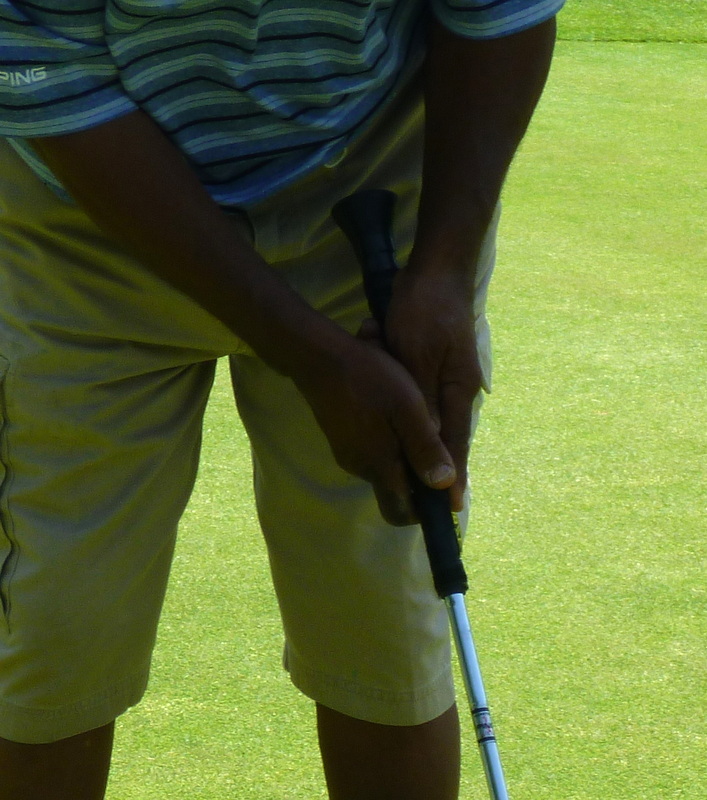
When I was in high school, my friends and I occasionally ate four meals a day at Winstead’s. You’d be crazy not to go, even if you weren’t planning to travel to Kansas City. Between trips there last week, I visited my mother and played three rounds on two terrific municipal golf courses, which I’ll write about in the September issue of Golf Digest, in my regular monthly column. Here, in the meantime, is a photo of the putting grip of one of the guys I played with, who I’m pretty sure is one of the three or four best putters in the world (his friends call him Drano):

P1070261

My Muny Life column in the May issue of Golf Digest was about Dubsdread Golf Course, in Orlando, Florida. The photo below is of two of the guys I played with there: Fletch, a semi-retired accountant, and Brian, his son-in-law, who is in the building-supply business. Brian lives near the course and gives Fletch hybrid clubs and gentle swing advice, plus the occasional grandchild.

Fletch and Brian.

Fletch and Brian, Dubsdread Golf Course, Orlando.

During another round, I watched a guy on the driving range talk on his phone, which he was holding in his right hand, while hitting one-handed wedges with his left hand and smoking a cigarette. As Dr. Johnson said, in a different context, “It is not done well; but you are surprised to find it done at all.”

P1040845

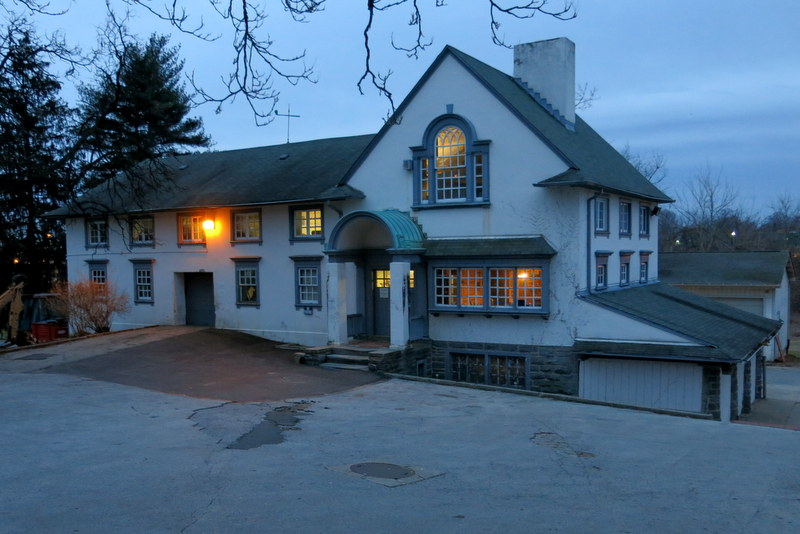
In the June issue, I wrote about Cobbs Creek Golf Club, which is just down the road (and creek) from Merion Golf Club, where the Open was held last week. Here’s the maintenance building at Cobbs Creek, which, like the clubhouse and the course, dates to the early nineteen-hundreds:

Cobbs Creek Golf Club, Philadelphia.

Cobbs Creek Golf Club, Philadelphia.

After one of my rounds, I met Hank Church, a regular, who didn’t play but dropped by the clubhouse to see his friends. “I had ten inches of my large intestine removed sixteen days ago,” he said, and he lifted his shirt to show the scar, which was barely visible. He wasn’t ready to swing a club yet, he said—but almost. And, like many of his friends, he served as a marshal at the U.S. Open, in his case on the eleventh hole, which is the one where Bobby Jones closed out Eugene Homans in the 1930 Amateur, thereby completing his Grand Slam.

hank Church, Cobbs Creek Golf Club.

Hank Church, Cobbs Creek Golf Club, Philadelphia.

For the July issue, I wrote about Dyker Beach Golf Course, in Brooklyn, where my friends and I often go to play during the winter, when our home course is covered with snow. A few months ago, eight of us set out a little before five in the morning so that we could get to Brooklyn in time to play as guests in the regular Sunday-morning game of Shore View Golf Club, a men’s group that plays at Dyker. John Perez, the club’s president, supervised the picking of the teams, using a handicap-based method that he referred to as Captain and His Men. It was kind of dark in the grill room when he did that, so one of the guys used his cell phone as a flashlight when it was his turn to choose:

That's John Perez at the far right. Dyker Beach Golf Course, Brooklyn.

That’s John Perez at the far right. Dyker Beach Golf Course, Brooklyn.

That day, my friend Hacker (real name) and I played with Ronnie Clyne, who works for a headhunter. “I grew up on the Brooklyn waterfront,” Clyne told us. “If you played golf, we beat you up and took your lunch money.” Like most Shore View guys, he’s self-taught and deeply addicted. “I had a hole-in-one once, at a course in the Catskills,” he said. “As I picked the ball out of the hole, a tear rolled down my cheek. It was the closest thing I’ve had to a religious experience.” Here’s Ronnie cleaning goose crap off his golf shoes on one of the tees:

Ronnie Clyne, Dyker Beach Golf Course, Brooklyn.

Ronnie Clyne, Dyker Beach Golf Course, Brooklyn.

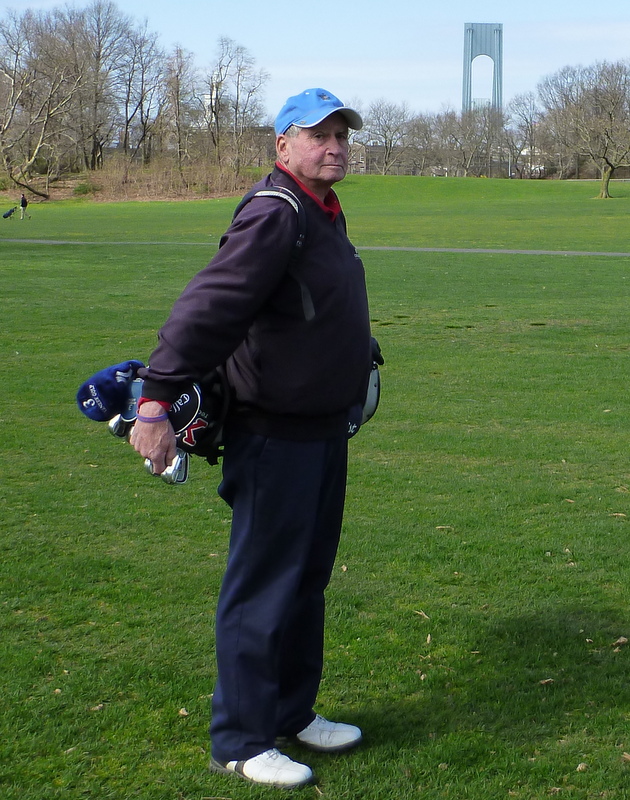
And here’s Hacker (looking very serious) with the Verrazano-Narrows Bridge in the background:

P1050604

On the morning we played with the Shore View guys, I picked up Other Gene. and Gary, our superintendent, at Gene’s house. They were waiting in front when I arrived, at 4:45 a.m., and when I opened the trunk of my car Gene’s dogs, which are huge, started barking inside his house. Gene was worried that the dogs would wake up his wife, so he kept saying “Shhhhhh, shhhhhhh, shhhhhh”—very quietly, so as not to make matters worse. I was standing next to him and could barely hear him, so I assume the dogs heard nothing, their famous ears notwithstanding. At any rate, they kept barking and, if anything, got louder. Miraculously, though (we learned later), Gene’s wife slept through the whole thing.

Let’s Have a Look at Those Famous Merion Showers

Men's locker room, Merion Golf Club.

Men’s locker room, Merion Golf Club.

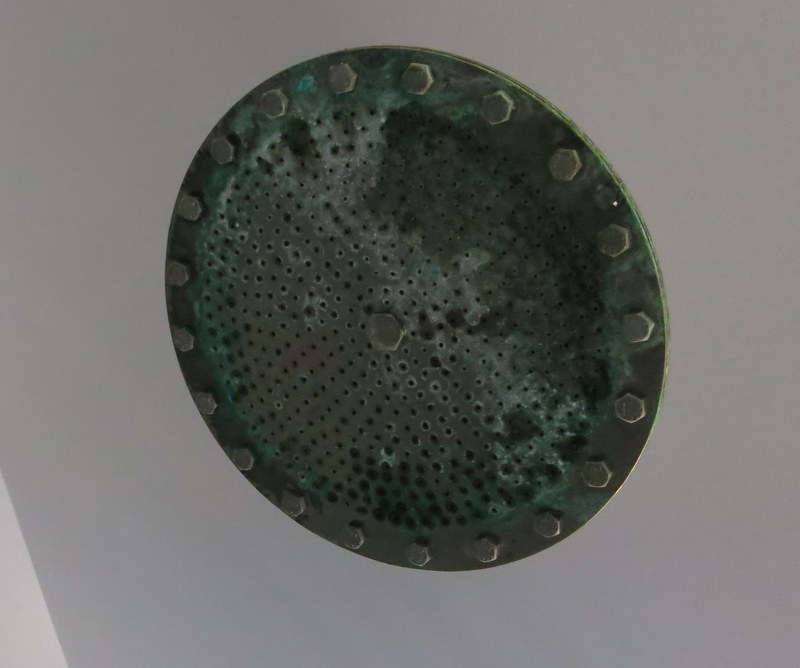
Like any sensible golf fan, I’m at home playing with my friends and, between rounds, watching the Open on TV. I visited Merion back in March, though, and while I was there I took a close look at the club’s famous showers, which have heads the size of manhole covers. Using one is like bathing in a car wash—in a good way.

IMG_0537

The showers require not just oversize supply pipes but also oversize drains. In the nineteen-forties, as the club struggled to overcome the economic impact of both the Great Depression and the Second World War, the house committee replaced them with conventional fixtures, in the hope of reducing the club’s water bill. J. Howard Pew, who was the president of the Sun Oil Company, demanded that the old fixtures be put back, and instructed the committee to add the club’s water expense to his own house account—as it did for years. (Merion didn’t retire its mortgage until 1971.)

The view from below. Don't try this while the water is flowing.

The view from below. Don’t try this while the water is flowing.

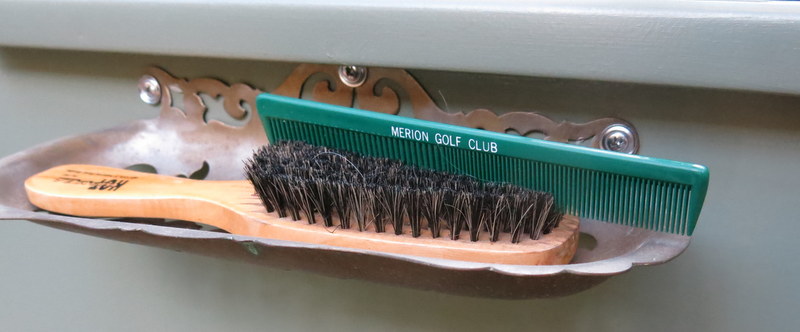
Merion-style shower heads have become standard fixtures at go-to-hell golf clubs all over. Pine Valley (which was founded by pretty much the same group of guys who founded Merion) has them. So, surprisingly, do a few clubs in the British Isles, which may be the source of this grooming arrangement:

If this were England, there would also be a nail brush and a nail file hanging from a chain.

If this were England, there would be a nail brush in there, too, plus a nail file hanging from a chain.

When Merion remodeled its women’s locker room, the women decided they wanted Merion-style showers, too. But then one of them realized that if they had them they would no longer be able to avoid getting their hair wet, so they stuck with wall-mounted fixtures. Their loss.

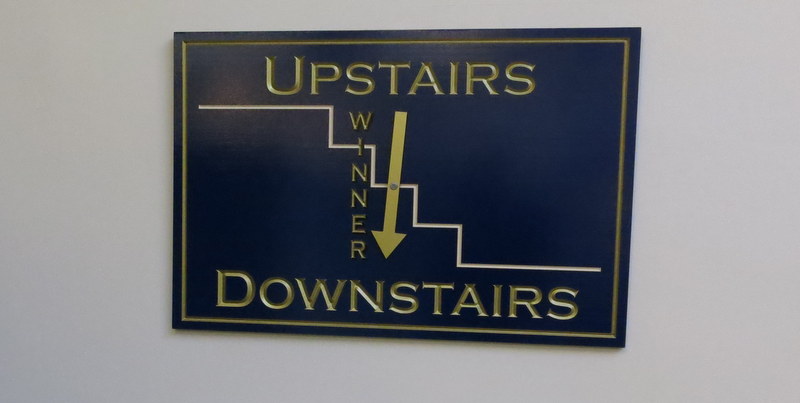
Merion’s men’s locker room has two levels, whose residents compete every year in an upstairs/downstairs tournament. (Winged Foot members do the same.) The current titleholder is indicated by a clock-like dial on the upper level, although I was told, confidentially, that members of the vanquished side will sometimes move the pointer.

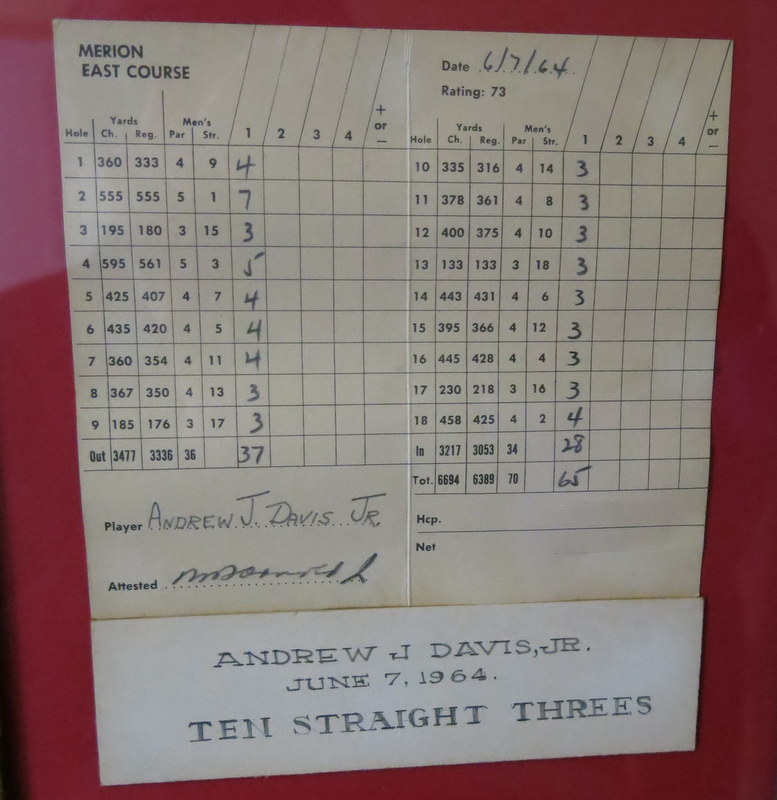
IMG_0575On the wall outside the downstairs shower room are several framed scorecards. One of them commemorates a round in 1964 during which a member named Andrew J. Davis, Jr., played the first seven holes in two over par (after hitting a ball out of bounds on the second) and then made ten consecutive 3s. He finished with what must, by that point, have seemed like a disappointing 4, on the club’s 450-yard closing hole, for a score of 65.
IMG_0530

On a winter evening a decade ago, a member named Edward Slevin, Jr., organized a dinner for a small group of his golf buddies in the bar on the second floor of the Merion clubhouse. They were marking time till spring and, not incidentally, trying to spend down their food minimums. In the years since then, their informal gathering has evolved into a monthly off-season party, and it’s now so popular that the only club space large enough to accommodate it is the men’s locker room. I attended the March dinner, two weeks before the East Course was scheduled to reopen for 2013. Slevin sat at the head of a very long table, which was almost a full lob wedge from end to end, and when dessert and various announcements were over much of the group reconvened downstairs, in the bar. Here’s what the table looked like before we all sat down:

IMG_0528

Hey, how about a shower before dessert?

What’s In My Bag: Dana McQueen

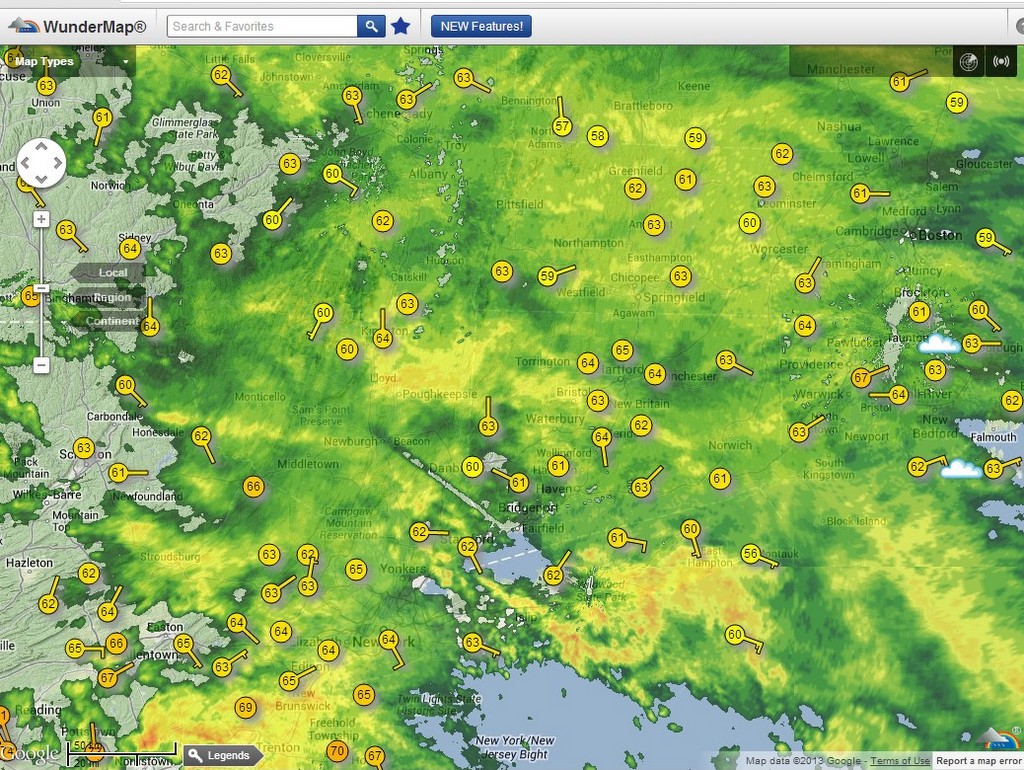
This is an aerial view of Tony's and my match this afternoon. We're somewhere there near the center of the map.

This is an aerial view of Tony’s and my match today. We’re somewhere near the center of that big green-and-orange thing.

Tony and I happily played anotherA statewide tournament that I was supposed to play in tomorrow has been postponed because the rain that was falling when Tony and I played is expected to continue through the night. I was actually looking forward to slogging around all morning, then loading my soaking-wet golf bag into my travel case, racing a hundred miles to Newark Liberty International Airport without a shower, and taking a night flight to Kansas City to play golf on a Golf Digest assignment and visit my mother. In fact, my only chance to finish the tournament above the middle of the field was probably to go off in a downpour, since I actually like playing when the people I’m competing with don’t.

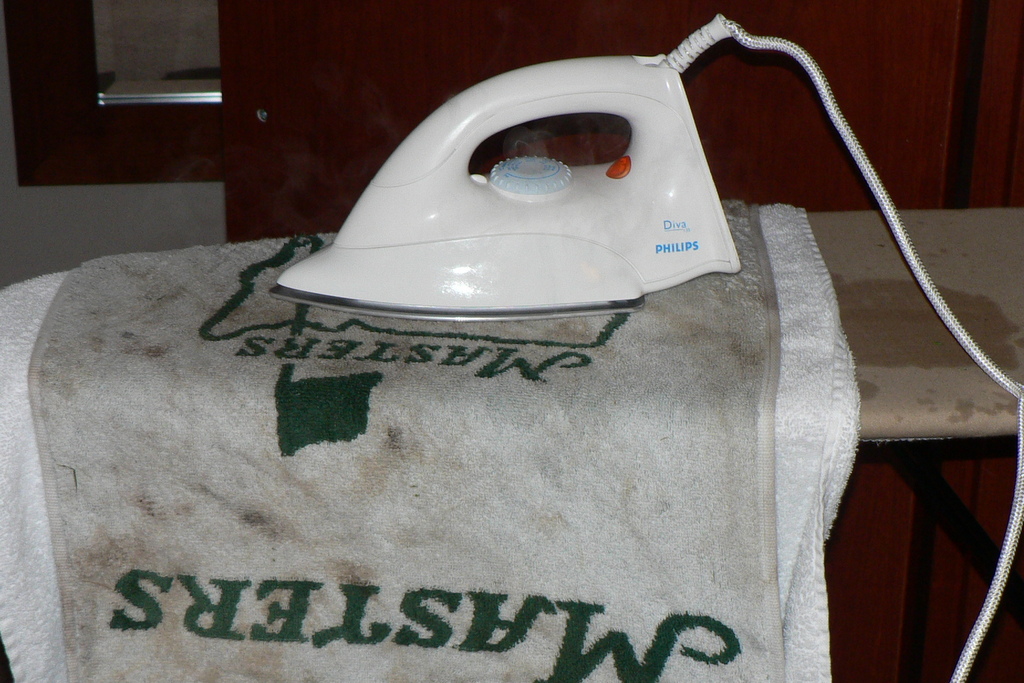
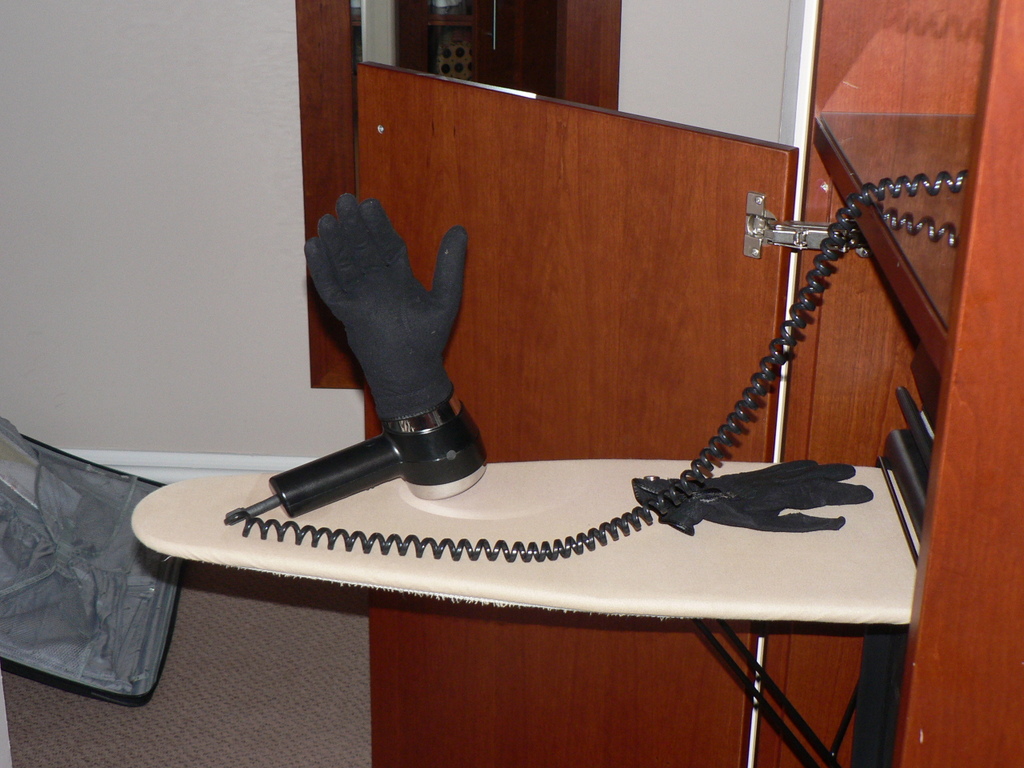
In 2006, I took back-to-back golf trips to Dubai and Ireland. During the Ireland portion of that two-climate packing adventure, I learned how to dry wet golf stuff with a hotel-room iron and hairdryer (after first blotting up the worst of the water by rolling up everything in bath towels and stomping):

Doing this produced tremendous clouds of steam. Getting the towel half dry took forever.

Doing this produced tremendous clouds of steam. Getting the towel half dry took forever.

Before using the hairdryer, I tried drying my rain pants in my room's heated trouser press, but that didn't work.

Before using the hairdryer, I tried drying my rain pants in my room’s heated trouser press. That didn’t work.

Rain gloves don't really need to be dry, but if you have the equipment why not?

Rain gloves don’t need to be dry, but if you have the equipment why not?

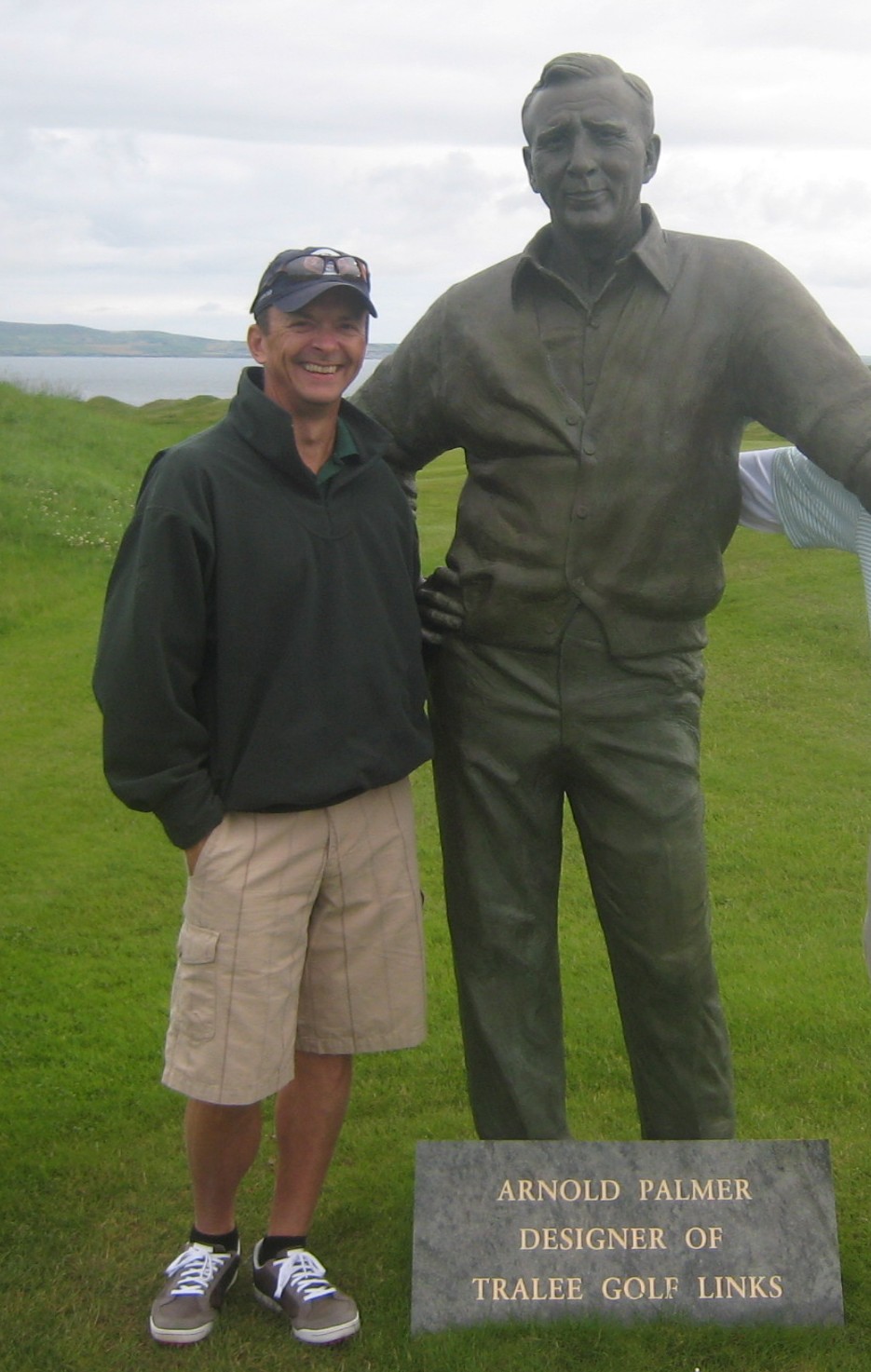
The hotel was in Killarney, and the golf course where I got so wet was Tralee—which is seldom ranked among the very best courses in Ireland but is plenty nice enough and is almost certainly the best course that Arnold Palmer ever designed. (It opened in 1985.) As we approached the middle of the (terrific) second nine, the wind reached the velocity necessary to propel liquid water through the fabric of my previously reliable Sunderland of Scotland rainsuit, and I stopped trying to clean my glasses between shots. It wasn’t just the worst weather I’d ever played golf in; it was the worst weather I’d ever been outside in. Nevertheless, my three companions and I all enjoyed ourselves immensely, and we played far better than you might think—perhaps because over-swinging and over-thinking are impossible when remaining upright requires most of your concentration. (I don’t know what our caddies thought.)

Recently, I heard from a reader who has also been to Tralee: Dana McQueen, who lives in Purcellville, Virginia, and is exactly the same age I am (fifty-eight). Here he is at Tralee last summer:

Dana McQueen and some other guy, Tralee, Ireland, July, 2012.

Dana McQueen and some other guy, Tralee, Ireland, July, 2012.

And here’s McQueen’s golf bag:

The first thing I notice about McQueen's golf clubs is that he keeps them a hell of a lot cleaner than I keep mine.

The first thing I notice about McQueen’s golf clubs is that he keeps them much cleaner than I keep mine.

Here’s what he’s got in there:

Cleveland Classic XL driver, 10.5 deg, stiff graphite
Cleveland FL fairway, 17 deg, stiff graphite
Cleveland Mashie hybrid, 18 deg, stiff graphite
Cleveland 588TT irons, 4 thru PW, stiff steel
Titleist Vokey 50 deg wedge
Titleist Vokey 57 deg wedge
Taylor Made ATV 60 deg wedge
Ping Redwood ZB putter

“Pretty standard stuff, overall,” he told me in an email. “Sometimes the 60-degree wedge comes out of the lineup, especially on courses with thick rough around the greens. I really haven’t gotten comfortable with the ATV bounce concept yet.” McQueen is a retired C.I.A. officer. He now works as a systems engineer for Stratos Solutions, and he also works for Britannia Golf, which puts together custom golf tours, mostly to Scotland and Ireland. He took up golf as a teenager.

“I started playing,” he wrote, “when I realized that my baseball career was going to come to a screeching halt, at about the same time that I got my driver’s license—trouble with the curve was reality, not a future movie title. I had a great mentor, and within three or four months I was shooting in the low eighties. As you might expect, dreams of grandeur invaded my thoughts. These lasted until I discovered that there were other golf courses on the planet, and that most of them were much more difficult than the little muny up in northern Ohio where I began my golf journey. Since that time, golf has been a series of peaks (nearly qualifying for the U.S. Amateur in the late nineteen-eighties) and valleys (being soundly trounced by an eighth grader in the club championship semifinals). Now I look forward to the weekly game with the Saturday morning group and the occasional trip to Scotland or Ireland. My favorite course (so far) is Royal Dornoch. Unfortunately, a sliver of beach on the North Sea is not exactly what my wife has in mind as a retirement spot.”

McQueen plays most of his golf at Stoneleigh Golf & Country Club, in Round Hill, Virginia. The course was designed by Lisa Maki, one of the very few women course architects in the history of the game. Anybody know if she’s still around?

I have received a number of What’s In My Bag contributions. I’ll run them all eventually. In the meantime, send me yours. And here’s a bonus photo, showing how to dry wet golf shoes with the defroster of a rental car:

P1060642


Reader’s Trip Report: Bandon Dunes

P1070187

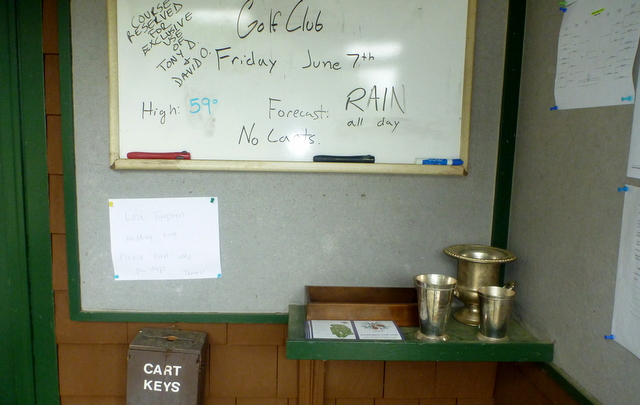
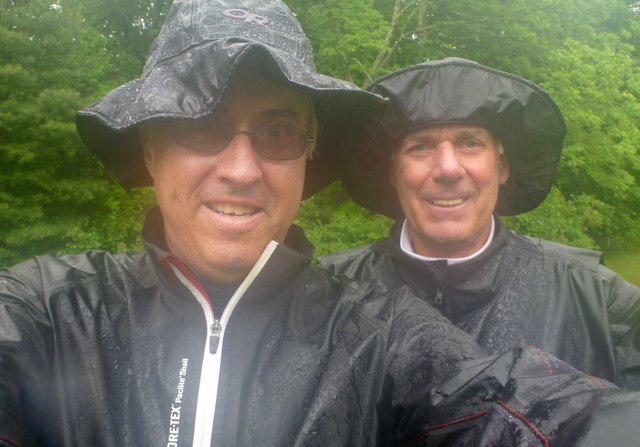
A bunch of us were supposed to play in a tournament today, but the rain started last night—over an inch so far—and everything was called off. Tony and I decided to play anyway, and because we couldn’t talk anyone into joining us we had the place to ourselves for a Two-Hour Eighteen™ (which actually took two hours and fifteen minutes). The golf shop was locked and empty, so we had to handle our own photography:

P1070196

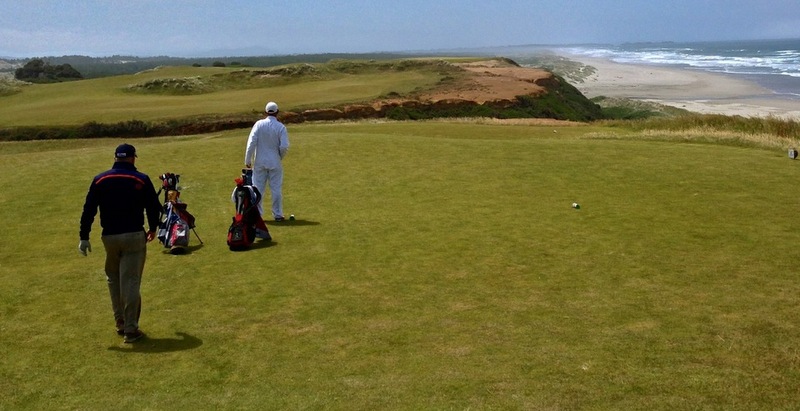
The rain came down sideways for a while, and we were both reminded of a trip we took to Bandon Dunes with our friend Ray in February, 2007. On that trip, we had rain every day for five days, but still managed to play ten awesome rounds.  And although we got wet we didn’t get as wet as we might have. A starter told me that a few years before, on a day when the wind blew hard and the resort received almost seven inches of rain, all eighty-five golfers on the tee sheet played, as did two walk-ons, who were passing through the area and thought the day looked reasonable for golf. Like them, we had a great time, and ever since then we’ve been talking about going back.

Pacific Dunes, February, 2007.

Ray, mystery person, Tony, caddies, Pacific Dunes, February, 2007.

Coincidentally, last night, just as the rain began, I heard from Tim Miles, a reader, who is at Bandon Dunes right now with a group of friends. He began his trip report with a quotation from my first golf book—an effective way to get my attention:

I suddenly had a vision of a sort of ideal community of golfers: a golfing monastery, or golfastery. Men who worship golf living humbly with other men who worship golf. Simple food. Lots of putting practice. A big driving range with well-spaced target greens. Excellent video-taping facilities. Careful study of the rules. Pilgrimages to the great courses of the world. Beer making in the evenings. Who wouldn’t want to live like that?

I’ve changed my mind about some of that—no more range balls for me!—but I agree with Miles that Bandon Dunes comes close to my monastic vision. Here’s Miles’s report, with photos taken by him and his friends:

Tim Miles, our Bandon correspondent, June, 2013.

Tim Miles, our Bandon correspondent, June, 2013.

Bandon Dunes gets everything right for golfers. There’s not an ounce of pretense in the place (save for the occasional jackass, pink-plaid-panted golfer). The food and lodging are not fancy but perfect in every way. The staff is shockingly good. Every employee of every course in America should be required to witness the level of kindness, engagement, and  service delivered throughout the resort. My caddie, Paul, said employees are trained to consider Bandon Dunes Golf Resort to be Disney for Golfers. It shows, except unlike Disney it’s not loud, flashy, or overstimulating. Bandon lets the courses and their settings overwhelm you. 

bandon miles

It’s not the easiest place to get to, and it’s not the cheapest (though big discounts on a second 18 each day are perhaps the best bargain in all of golf), but it’s worth it. Oh, is it worth it.

IMG_0599

One final note for your visit: when you’re there, do not dismiss Bandon Preserve, a thirteen-hole par-3 course whose net profits go to charity. In its first short season, in 2012 (it opened last May), our starter told us, Preserve donated more than $510,000 to local non-profits. Its goal for this year is more than $750,000. With great ocean views and an opportunity to play 100-yard 7-irons and 160-yards wedges, you’ll never laugh or experience more sheer joy per hole than you will at Preserve. Be sure to try the final hole—a 109-yard downhiller— with your putter.

The Miles party: Chris, Rush, Tim, Steve, Carolyn, Paul, Gerard. Bandon Dunes, June, 2013.

The Miles party: Chris, Rush, Tim, Steve, Carolyn, Paul, Gerard. Bandon Dunes, June, 2013.