Possible World Record for Ground Under Repair, and the Attack of the Red-winged Blackbird

Bob G., ground under repair, Glen Arbor Golf Club, Bedford Hills, New York, June, 2013.

Bob G., ground under repair, Glen Arbor Golf Club, Bedford Hills, New York, June, 2013.

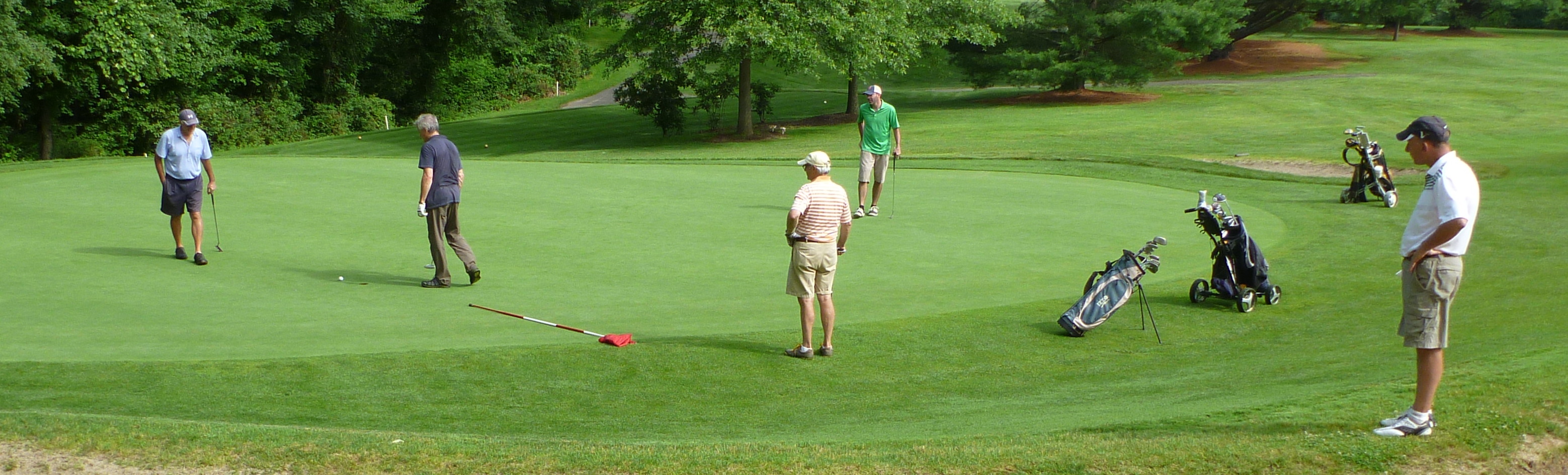
Bob G., an honorary member of the Sunday Morning Group, treated my brother and me to a day of golf not long ago, and during our round we encountered what may be the world’s largest G.U.R. Part of one fairway had begun behaving in a puzzling manner, so the course maintenance crew decided to see what was down there. Here’s some of what they found:

P1070410

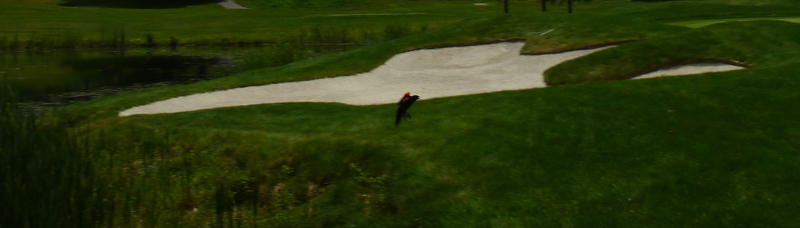
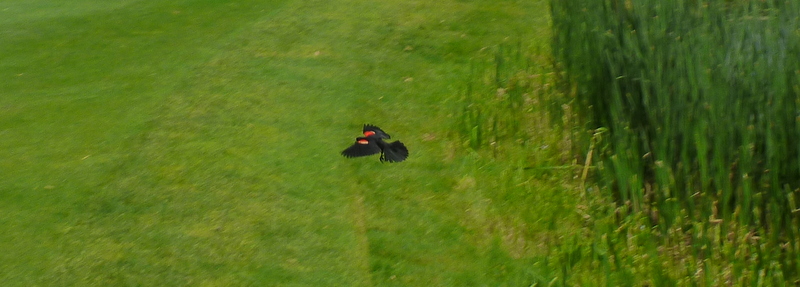
Later in the round, a red-winged blackbird let me know I’d gotten too close to its nest. It flew in circles around my head and yelled at me until I got to the green.

P1070416

P1070418

P1070417

P1070419

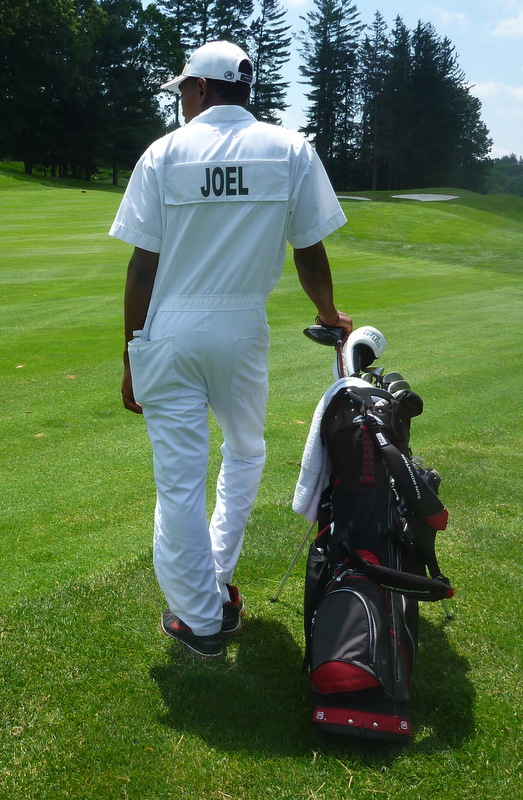
We had two terrific caddies that day. They wore white coveralls with their name on the back. It would solve a big problem for me if, from now on, everyone would wear their name on their back. Maybe wear it on their front, too:

Think how much easier remembering names would be if everyone would just do this.

Think how much easier remembering names would be if everyone dressed like this.

It started raining just as we were putting out on the eighteenth green, and almost immediately the lightning siren blew. That means we didn’t waste a single minute of the day.

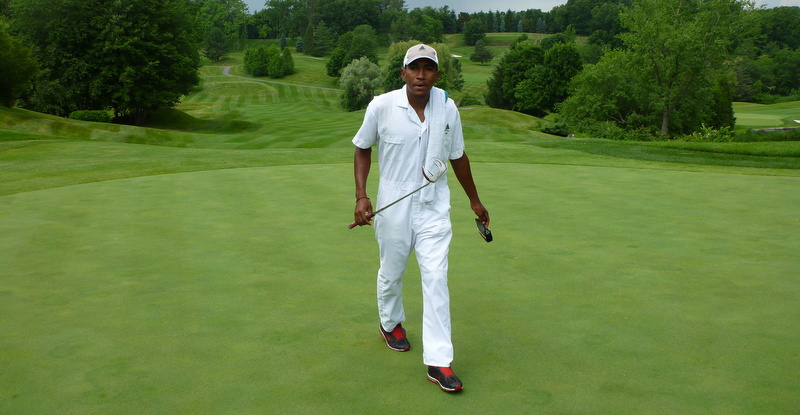
Joel, on the eighteenth green. (See? I remembered his name.) You can sort of see the thunderstorm in the distance.

Joel, on the eighteenth green. (See? I remembered his name.) You can see some thunderstorm sky in the distance.

A Golfer’s Bucket List: No. 6

Home course, flooded fairways, September, 2011.

Home course, flooded fairways, September, 2011.

Play in weather so miserable (lightning excluded) that yours is the only group left on the course. Old golf joke: An obsessed golfer heads to the club in pouring rain for his regular Saturday-morning game. The storm turns out to be too intense even for him, so he returns home, takes off his wet clothes, and slides back into bed next to his wife. “The weather’s horrible,” he whispers, and she says, “And can you believe it? My idiot husband is out there playing golf.”

Gairloch, Scotland, May, 2007.

Gairloch, Scotland, May, 2007.

He should have stayed at the club. Golf was invented in a country where bad weather is almost the only kind, so to take the game’s full measure you have to play it occasionally when all the sensible people are indoors watching Sports Center. There’s something sublime about putting through casual water or over pea-size hail, especially if you have the course to yourself.

On the road to Tralee, Ireland, May, 2006.

On the road to Tralee, Ireland, May, 2006.

What’s In My Bag: Bruno Corbeil

No Baby Driver here. In fact, no driver at all.

No Baby Driver here. In fact, no driver at all.

Bruno Corbeil, a reader in Montreal, writes:

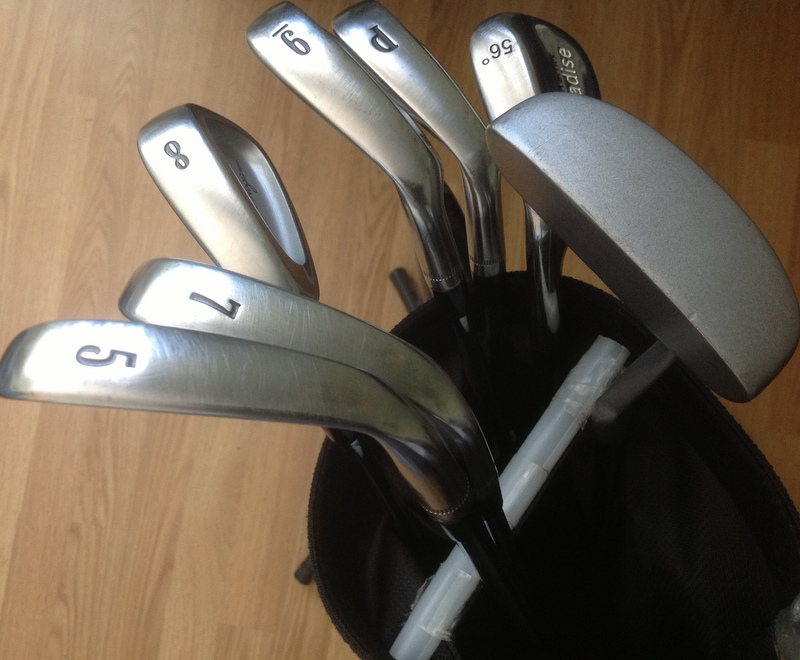
As I play mostly par-3 courses, with my kids, I carry a light Sunday bag with about seven clubs in it. I do it mostly because I don’t need a whole set, and also because I have grown to like carrying my bag.  I also hate playing the same course over and over again, so I have built a schedule that lets me play about six different ones in rotation, over the course of a season. This means that, depending on which course I’m playing, I need to decide which clubs I’ll bench for the week. I do have a whole set of irons (Ben Hogan BH-5), from pitching wedge through 3-iron. The sand wedge and my putter are both from Paradise. However, when I’m playing a small par-3 course, my usual set is S-5 and putter. Depending on the length of some holes and the weather, I’ll swap the 5-iron for a 4-iron or a 6-iron.  If I’m playing a course without bunkers, I might bench the sand wedge. I have tried some hybrid clubs but being more of an iron player than a wood player. My workhorse on regular-length courses has always been the 3-iron. Maybe a hybrid with a steel shaft might be a more pleasurable experience.

ATTDMLI2

Seven is a very reasonable number of clubs. My friend Tony once won our club championship with exactly that many, and Francis Ouimet won the 1913 U.S. Open, at The Country Club, in Brookline, Massachusetts, with just three more—and all of Ouimet’s had hickory shafts. In 1913, there was no rule limiting the number of clubs a player could carry, so Ouimet could have used twenty or thirty, as some players in those days did. Maybe he lightened his bag out of consideration for his caddie, Eddie Lowery, who was just ten years old.

Francis Ouimet (with horseshoe) and Eddie Lowery (with towel and seven-club golf bag), The Country Club, September 20, 1913.

Francis Ouimet (to the left of the horseshoe) and Eddie Lowery (with towel and seven-club golf bag), The Country Club, September 20, 1913.

Corbeil continues:

This summer, we went on a car tour of western Canada, and I took the opportunity to play golf in all the western provinces (Manitoba, Saskatchewan, Alberta and British Columbia).  Par-3 seemed the right choice as it didn’t not require much time to play, and would allow me to play with the kids and play after driving some 400 miles and still have somewhat of a game. That little Sunday bag—or those little Sunday bags, as the whole family has them—didn’t take up too much space in the car, and allowed us, if we chose wisely, to have our essential clubs to play the Par 3 golf courses.

Here’s a picture of Corbeil and his family on a par-3 course in Calgary:

100_1529

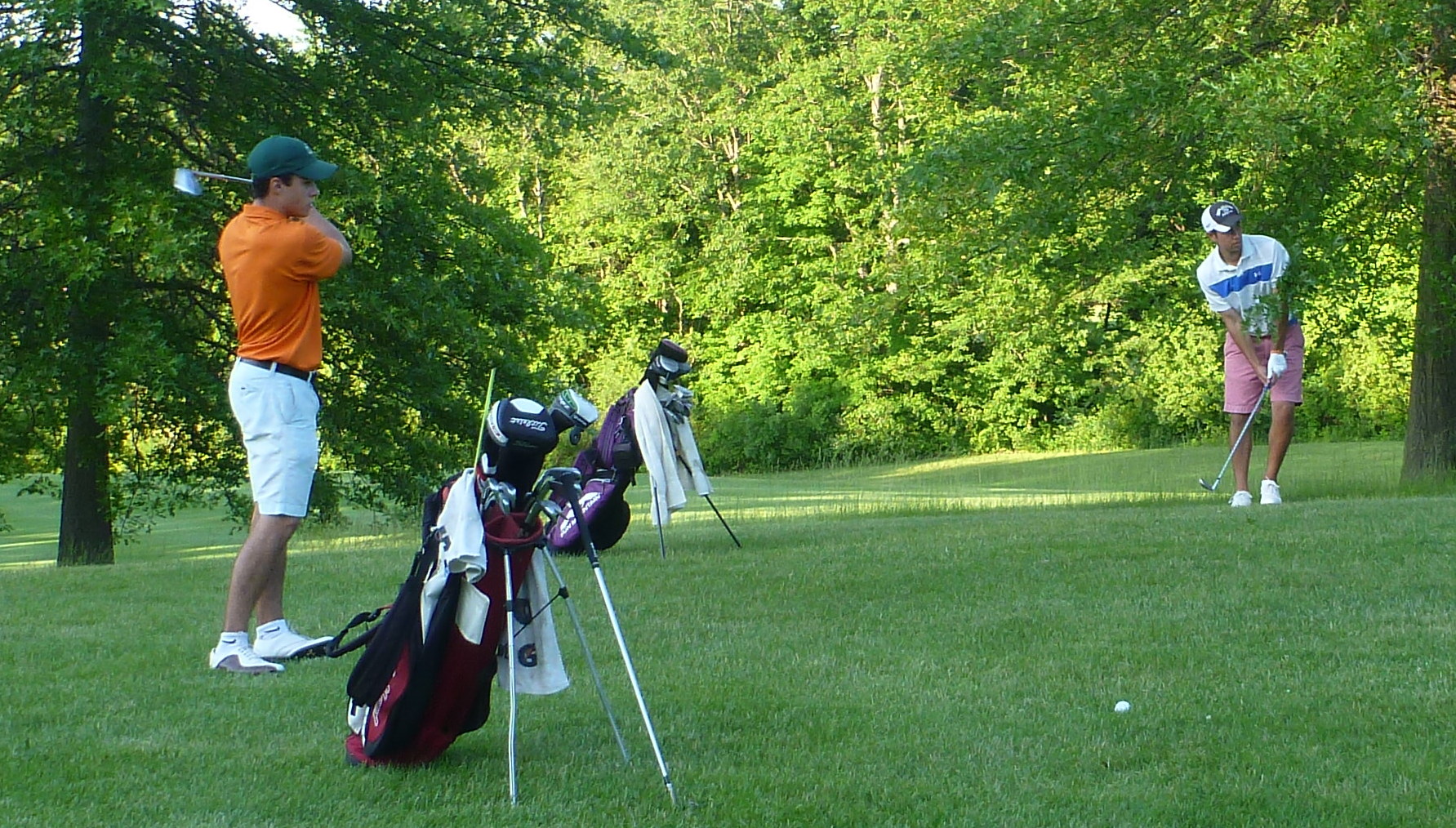
On a November weekend quite a few years ago, the Sunday Morning Group imposed a five-club limit on the day’s competition, as a novelty. I chose my putter, sand wedge, 8-iron, 6-iron, and 3-wood—a fairly typical line-up, it turned out. (This was before I’d become an almost total convert to hybrids.) Surprisingly, I shot about what I usually shoot, and so did everyone else. In fact, the score of the winning team that morning was two shots better than the score of the winning team the week before, when we had observed no limit on hand luggage more stringent than the U.S.G.A.’s. Still more unsettling, our course superintendent played along for a few holes with just an antique adjustable club, which he had set to 6-iron, and he would have won two skins if we hadn’t ungraciously disqualified him after the fact.

The day’s results lent a meditative air to the beer-swilling after the round. “Maybe we ought to play with five clubs all the time,” someone said—and the comment, unlike most post-round comments, was considered thoughtfully. Someone else pointed out that the scores during our club’s annual two-club tournament, which had been held a few weeks before, had been indistinguishable from regular scores—except for guy who had managed to post a new personal best.

Maybe the number of clubs we carry is less important than the selection. Five clubs may truly be all I need—as long as none of the five is the elusive Unhittable Club of the Day (U.C.D.), which moves unpredictably around my golf bag and was recently, for no known reason, my brand-new 60-degree wedge.

Field Test: Dealing With Sweaty Hands, Plus Playing Golf at Yale

Art-type shot of Shep, Josh, and Tony on the eighteenth tee at Yale, plus a padlocked water pump, July 23, 2013.

Art-type shot of Shep, Josh, and Tony on the eighteenth tee at Yale, plus a padlocked water pump, July 23, 2013.

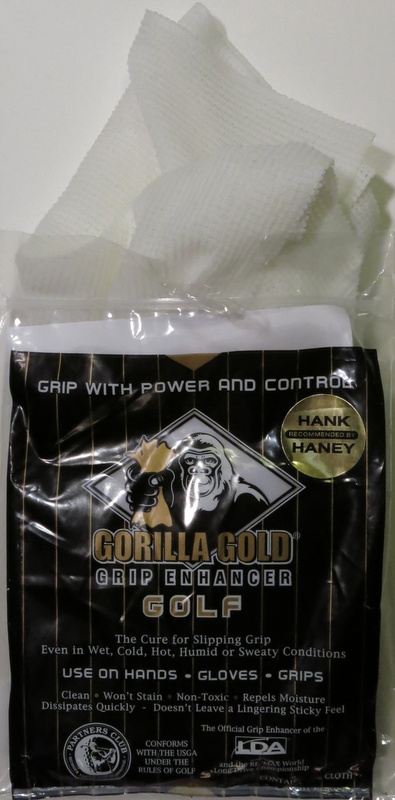
Not long ago, I wrote about using rain gloves as sweat gloves—a good thing, I said, because in hot, humid weather leather gloves become slimy and disgusting, while rain gloves continue to work even if they’re soaked with perspiration. A reader suggested trying Gorilla Gold Grip Enhancer, which is endorsed by Tiger Woods’s ex-coach Hank Haney. And, because I do what I’m told, I bought some.

On Tuesday, Tony, Shep, Josh, and I played Yale University’s terrific golf course, which was designed by C. B. MacDonald and Seth Raynor. (Incidentally, if you want to use the GHIN website to enter your score from Yale, you have to look under “T,” for “The Course at Yale.” How dumb is that?) The day was extremely humid, and after a couple of holes I decided to try Gorilla Gold. Here’s what it looks like:

IMG_2180

The package contains a sticky cloth, which you wipe on your hands, your glove, your grips, whatever. And it works as advertised, I would say, because it’s extremely sticky, and everything it touches becomes extremely sticky, too, even if it’s also wet. But after about five minutes I was cursing, because once you’ve got the sticky stuff on your hands you also get it on your ball, and that turns your ball into a magnet for dirt and pocket lint. And that, in addition to being a nuisance, almost certainly costs you distance, by altering the ball’s aerodynamics—like coating an airplane’s wings with ice.

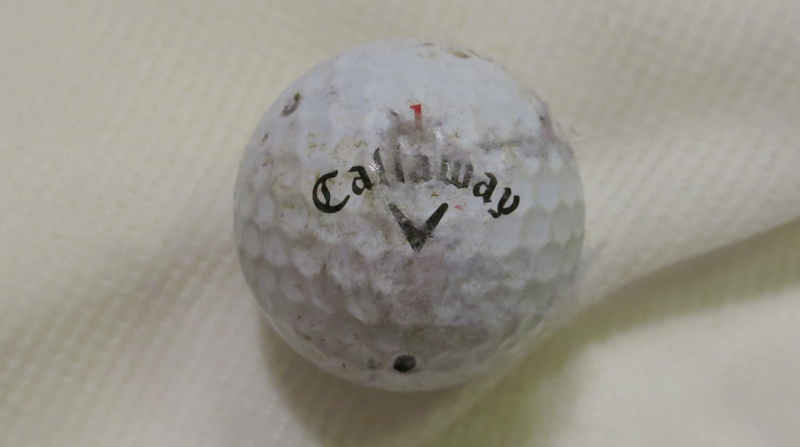
Golf ball coated with Gorilla  Gold and pocket crud.

Golf ball coated with Gorilla Gold and pocket crud.

Long, repeated scrubbing in a ball washer did not remove all the sticky stuff: the next afternoon, the same ball was still picking up dirt from putting greens. And when I tried to use a towel to wipe the sticky stuff off the grip of my driver, the grip became covered with towel fuzz, which I’m still trying to remove. In fact, all the clubs I touched with sticky hands now feel like they need to be re-gripped, because the sticky stuff stops feeling sticky and starts feeling slick as soon as it’s coated with dirt or lint or towel fuzz. So I won’t be a repeat customer.

Tony and Shep at Yale.

Tony and Shep at Yale.

Shep, who doesn’t like rain gloves, has another anti-wet technique: he saves all his old leather golf gloves in a Ziploc bag, and on rainy or humid days he works his way through the bag, swapping wet gloves for dry. All the wet gloves go into another Ziploc bag, and by the time he needs them again they’ve magically refreshed themselves.

Phil Mickelson’s Open Victory and the Difficulty of Mentally Influencing the Outcome of Recorded Sporting Events

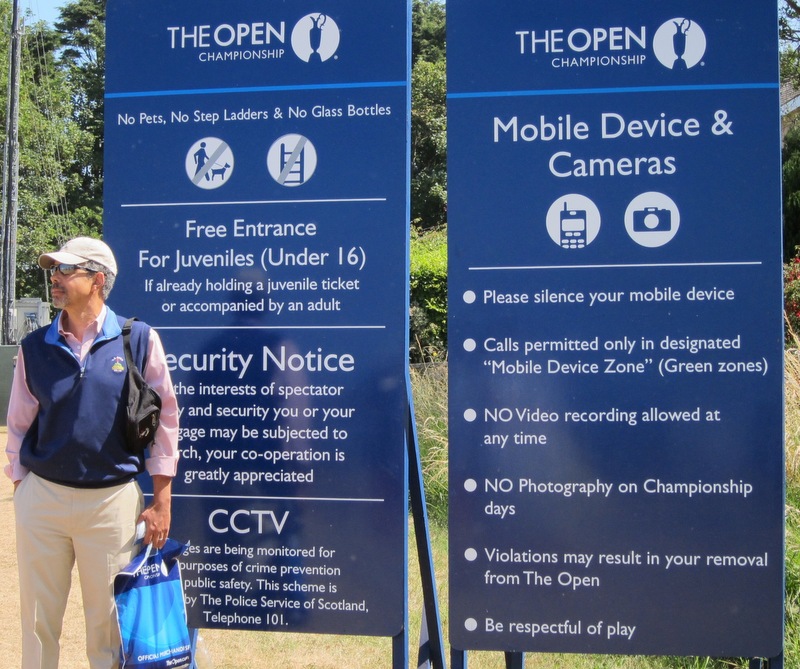
Rick Hunt, a reader, was at the Open both days this weekend. He took this photo on Saturday

Rick Hunt, a reader, was at the Open both days this weekend. He took this photo on Saturday

In 2006, my wife and our two children and I flew from New York to Las Vegas so that we could rent an R.V. and spend ten days visiting the remarkable national parks in southern Utah and northern Arizona, after first taking a guided tour of the greatest man-made object in the universe, the Hoover Dam.

Me, standing in awe before one of the many fascinating dioramas in the visitors' center at the Hoover Dam, June, 2006.

Me, standing in awe before one of the many fascinating dioramas in the visitors’ center at the Hoover Dam, June, 2006.

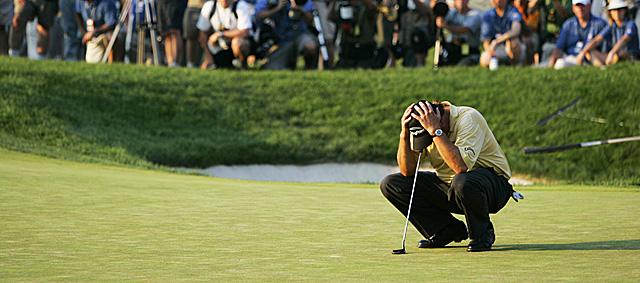
Our flight coincided almost exactly with the final round of the 2006 U.S. Open, and because I am a good father I grumbled very little about having to spend the afternoon traveling with my loved ones rather than lying on the couch at home and staring at the TV. My saintly attitude was rewarded during the flight: there were video screens in the backs of the seats on our plane, and I got to watch the tournament anyway. In fact, the broadcast lasted almost exactly as long as the flight. The picture broke up as we were touching down at McCarran International Airport, in Vegas, but by then the tournament was all but over. Phil Mickelson had just pushed his tee shot on the final hole into the corporate tents to the left of the eighteenth fairway, but he had the thing sewn up, and, besides, the guy’s a magician. Good show, Phil!

The next morning, in my wife’s and my room at the Bellagio (or wherever), I turned on the TV to watch Open highlights. Weirdly, the guys on Golf Central weren’t talking about Mickelson; they were talking about Geoff Ogilvy, whom I scarcely remembered having noticed during my life, much less during the broadcast the day before. Suddenly, I worried that what I had watched on the plane had been not a live program but a videotape of some historical triumph of Mickelson’s. It took me five minutes of careful Golf Channel viewing to figure out what had happened.

Mickelson winged foot

Naturally, I blamed myself for Mickelson’s last-hole double-bogey, since I was mentally rooting for him toward the end of the tournament, and the in-flight broadcast cut out at the moment when he needed me most. And this week I blame myself for his victory, at Muirfield, because I wanted Tiger Woods to win but was unable to mentally undermine his opponents: instead of watching the golf tournament on TV, I was (selfishly) playing in a golf tournament of my own.

Rick Hunt, at the Open. If I'd been there myself, I might have had better luck influencing the outcome.

Rick Hunt, at the Open. If I’d been there myself, I might have had better luck at influencing the outcome.

Influencing the outcome of televised sporting events is harder than many people believe, because a technique that brings victory today may have the opposite effect tomorrow. Mumbling obscenities, swaying hypnotically, and making hula-like hand motions in front of the screen will usually keep a long putt from going in—especially if the hole remains on camera and the putter is Lee Westwood—but the same method sometimes fails disastrously, perhaps by accidentally nudging an errant ball onto the correct line.

Curiously, the best method for salvaging victory when things are going poorly is to turn off the TV—a tactic whose effectiveness is explained by quantum mechanics: unless they are observed directly, athletic competitions, like muons and mesons, exist in all possible states simultaneously. Turning off the TV during a big tournament restores the universe’s indifference to the final score, thereby giving Tiger (let’s say) a chance to rediscover his swing. This quantum effect may also explain why viewers are able to influence even videotaped sporting events—as long as the viewers don’t know in advance how everything came out.

For that reason, I had planned to remain ignorant of the Open outcome so that I could watch a recording of the final round when I got home and bring in the winner I wanted. Sadly, though, as I was standing in line at the scorer’s table I overheard some guy telling some other guy that Mickelson had won.

I watched the recording anyway, but without much enthusiasm. I had to hit the mute button many times, because the announcers were so annoying, and I found myself wishing that someone would invent an app (or whatever) that would turn Curtis Strange’s accent into something less grating (converting nahn, fahn, and mahn into nine, fine, and mine, for example); would automatically bleep out the phrase “plenty of green to work with”; and would prevent Andy North from referring to Royal Birkdale, where the Senior Open Championship will be played next week, as a “links-style” golf course.   

Hacker (real name), Royal Birkdale, May, 2010.

Hacker (real name), Royal Birkdale, May, 2010.


Four Miles From Muirfield is the Golf Course I Dream About

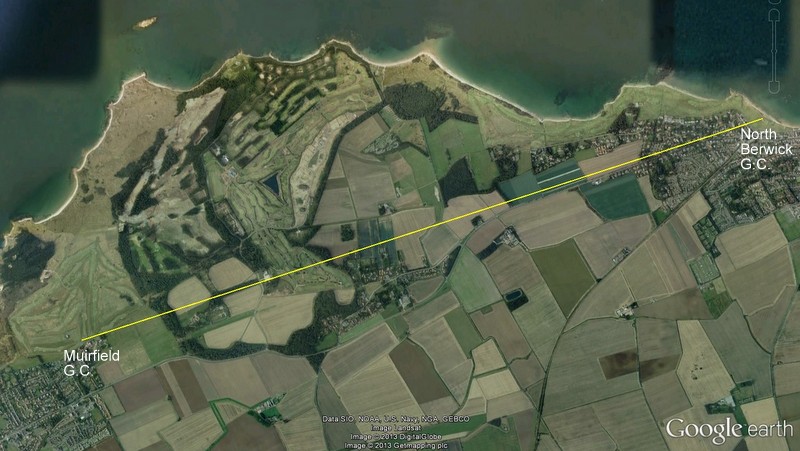
Four miles, as the golf ball flies.

Four miles, as the golf ball flies.

If my wife ever throws me out of the house and they won’t let me move into the Crow’s Nest at Augusta National, I’m going to hide out in North Berwick, Scotland, just a few miles along the coast from Muirfield Golf Club. I’ve played North Berwick pretty many times over the years, and it’s probably the course I think about the most, except for my home course. Among the many permanently memorable holes is the thirteenth, a par-four, on which the green is on the far side of a very old stone wall:

Thirteenth green, North Berwick Golf Club, Scotland, May, 2008.

Thirteenth green, North Berwick Golf Club, Scotland, May, 2008.

On a visit in 2004, I missed the green to the right and tried to chip through an opening:
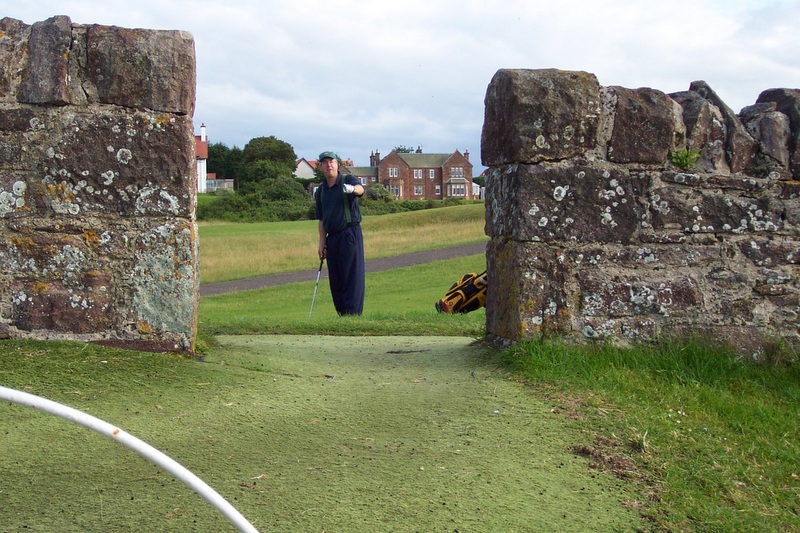
DCP_3091I missed the gap, and then l was really in trouble. During two of my most recent visits to North Berwick, I stayed in a small hotel overlooking the course, called Blenheim House. Sad to say, the young couple who owned it, Milton and Ailsa, gave up last year and sold it to someone else. I don’t know if it’s back in business.

R.I.P.: Blenheim House Hotel, North Berwick, May, 2008.

R.I.P.: Blenheim House Hotel, North Berwick, May, 2008.

One of the great things about that hotel was that you could get to the golf course simply by walking through a gate in the back garden:
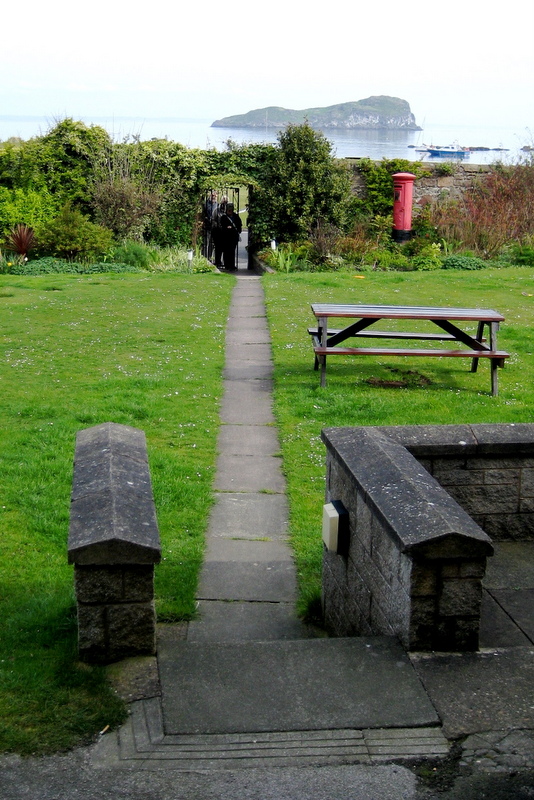
IMG_0015

Here’s the gate, viewed from the golf-course side. The people in the windows are eating breakfast:
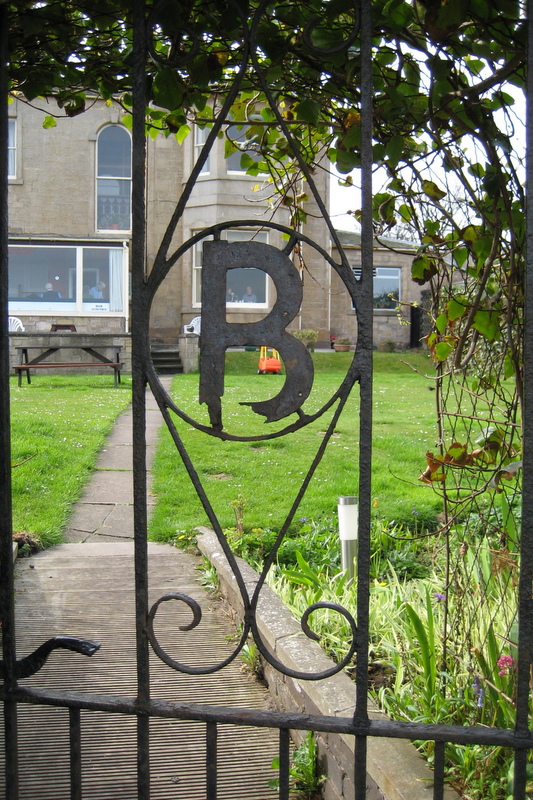
IMG_0019

During the relatively few daylight moments when I wasn’t playing golf, I gazed at the golf course from the window in my room. Here’s what I saw:
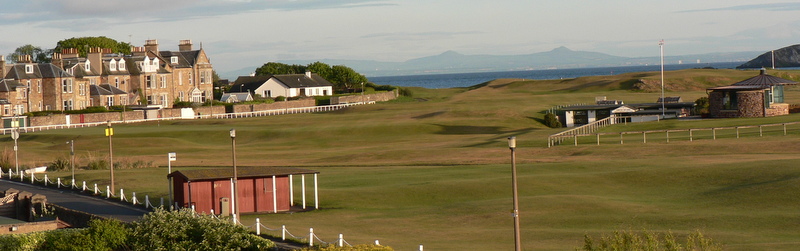
P1030696

The cylindrical stone building at the far right is the starter’s shelter; the semi-subterranean white structure just to the left of it is the golf shop. The eighteenth green is at the far left, and the clubhouse is out of the picture to the left of that. The opening tee shot at North Berwick usually calls for something like a five-iron, and the second is essentially blind, and several of the other holes are almost as unusual. When I looked out my window one morning, before breakfast, I saw a guy walking a dachshund just east of the course:
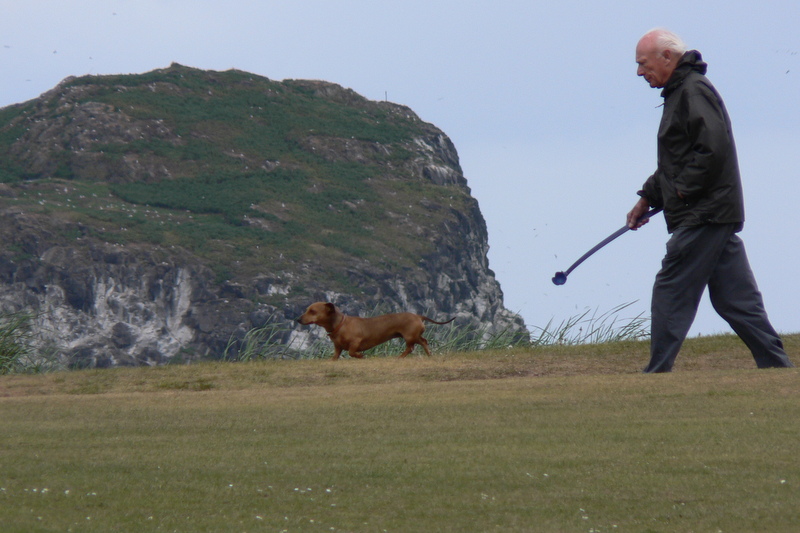
P1030703

Here’s what my room looked like. As you can see from the size of the suitcase, this was before I had realized I could cram all the clothes I need for an overseas golf trip into a carry-on bag:
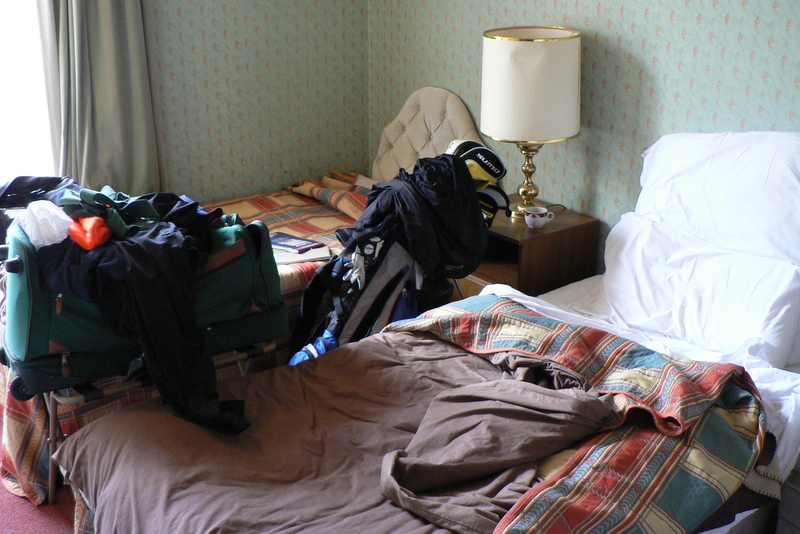
P1040668One afternoon in 2007, when I was in Scotland on a Golf Digest assignment, I teed off at North Berwick by myself. After a few holes I was joined by an old man, who had come through a gate leading to one of the houses overlooking the course. He had lost his wife sixteen years before, he said. He walked along with me and asked me questions and held the flag while I putted, and I played really well for as long as he was there. He said that if someone offered him a plane ticket to New York he would go in five minutes, and I briefly considered trying to work out a temporary life swap. He said that he had once been to Chicago, and that while he was there a shoeshine man had asked him if he was French. He said no, Scottish, and the shoeshine man said, “You speak English very well.”
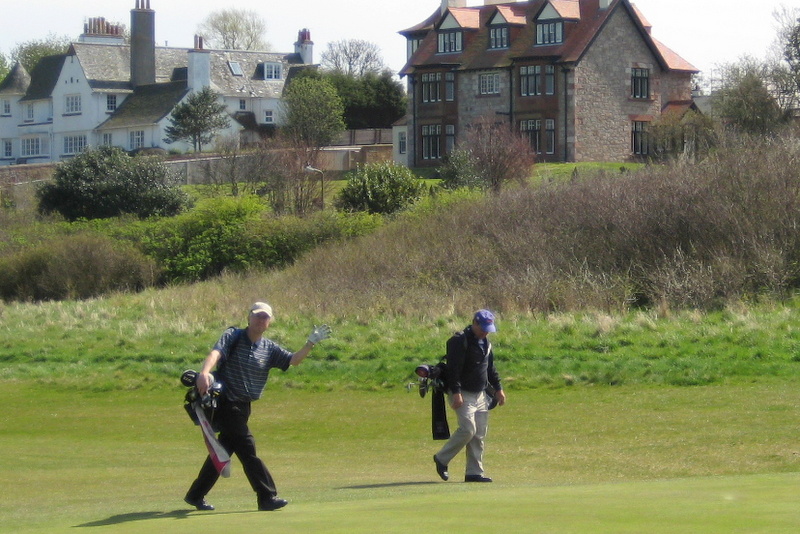
IMG_0033

On the fourteenth hole, the old man and I caught up to and joined three Swedes. He knew them already, because he had run into them the night before, in the bar at the Blenheim. They were part of a group of six, and they had played Muirfield the previous day, and they were going home in the morning. One of them said that the flight from Edinburgh to Stockholm was just an hour, and that he would be going straight from the airport to his office—a thought that made everyone temporarily adopt a grim facial expression. The old man walked along with us until he got back to his gate. It turned out that he was very interested in Swedish girls, and other girls.

IMG_0034

That night, I stayed not at Blenheim House but at the Mallard Hotel, in Gullane. Incidentally, “Berwick” is pronounced BARE-ick, and “Gullane” us pronounced GILL-en. There are three golf courses in Gullane: No. 1, No. 2, and No. 3. Muirfield Golf Club is virtually next door and can be seen from the top of Gullane Hill, and a caddie at Gullane once described it to me as Gullane No. 4—although Muirfield members don’t think of themselves that way.
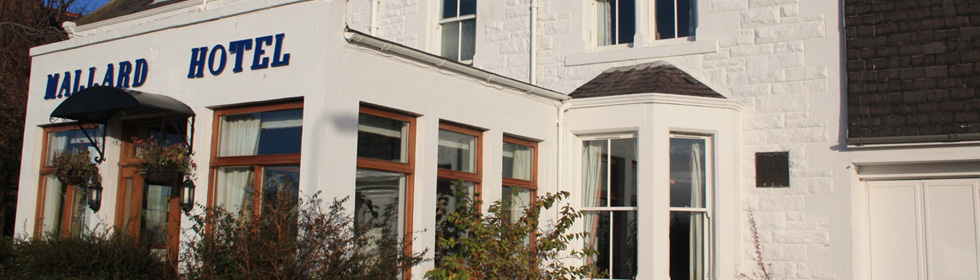
mallard

I ate dinner that night at a pub called the Old Clubhouse. Directly across the street from both the pub and my hotel was the Gullane Golf Club’s six-hole children’s course, which costs nothing to play, as long as you’re not an adult. As I walked to dinner, I saw a man and his nine- or ten-year-old daughter. He was teeing up balls for her, and she was hitting the most gorgeous draws with a driver. She was hitting from a tee toward a green, but she was using the hole as a driving range. What a swing! And beyond the children’s course I could see Gullane No. 1 and No. 2.

First green, Gullane No. 1, looking back toward town. The knobby thing at  top right overlooks North Berwick and is visible in the photo with the rainbow, below.

First green, Gullane No. 1, looking back toward town. The knobby thing at top right overlooks North Berwick and is also visible in the photo with the rainbow, below.

The next year, I went back to Scotland with eight friends from home, and we spent the first two nights of the trip in North Berwick. On the second day, we saw this:
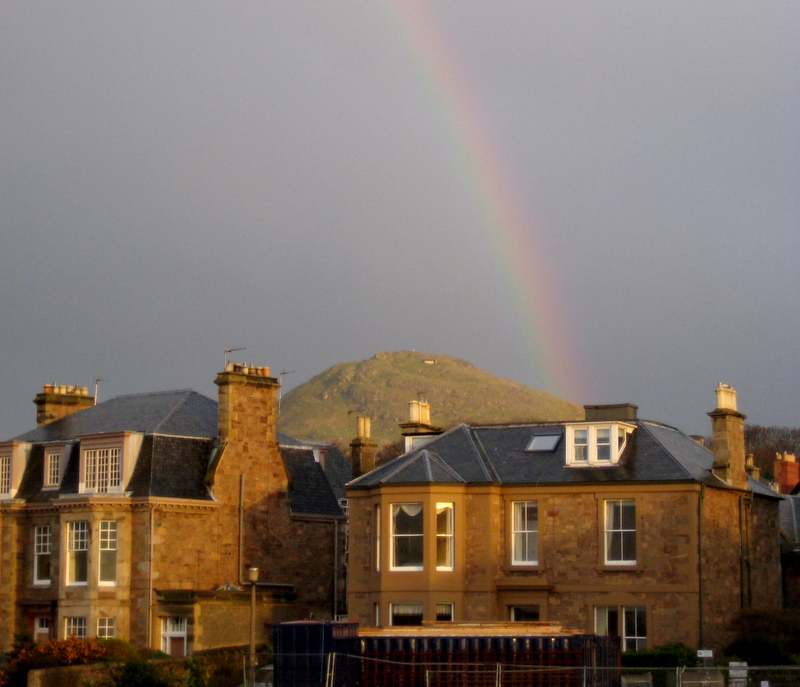
IMG_0043

And that evening we saw this:

IMG_0042

I almost feel picking a fight with my wife, to see if I can’t tempt her to give me the boot.
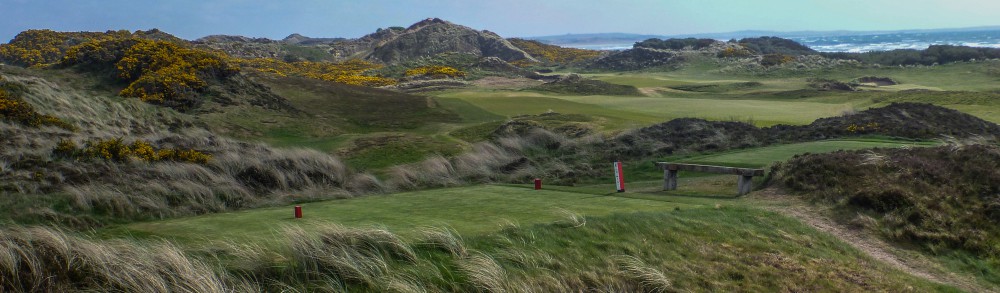
How to Get Properly Inebriated at the British Open

Muirfield Golf Club. Lunch, anyone?

Muirfield Golf Club. Lunch, anyone?

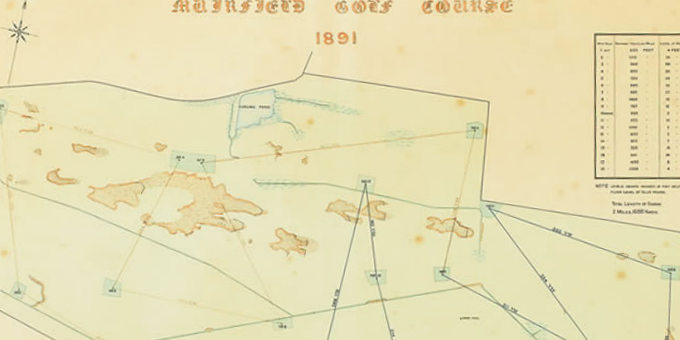
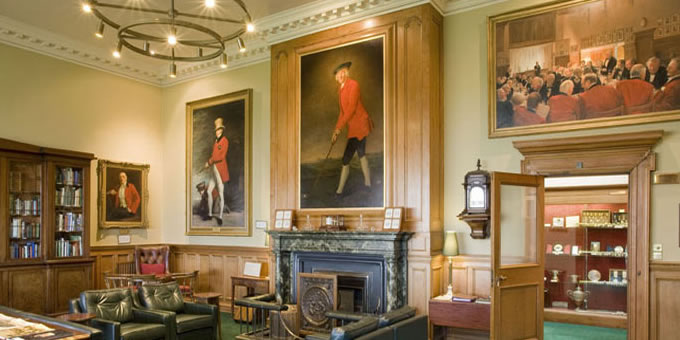
In 1891, the Honourable Company of Edinburgh Golfers—the world’s oldest golf organization, whose members created the game’s first written rules, in 1744—moved from Musselburgh to Muirfield, a short distance to the east, and hired Old Tom Morris to create a private course for them. Today, Muirfield Golf Club has a deserved reputation for being tough on Open competitors and an undeserved reputation for being hostile to visiting Americans. It’s true that outsiders are limited to specific tee times on Tuesdays and Thursdays, but the club actually welcomes thousands of unaccompanied non-members every year, and you can now make your reservations online. Once the Open crowd has cleared out (and the tournament rough has been harvested and fed to area livestock), you should go.

OTM layout

The modern Muirfield is mostly the work of Harry S. Colt, who reshaped and enlarged Morris’s layout in 1928, and Tom Simpson, who removed a hundred of Colt’s bunkers a few years later. (The first three holes follow the routing of Morris’s first four; the rest are different.) The course is every bit as good as people say it is, although the most appealing activity on the grounds may be not playing golf but hanging around the clubhouse. A few years ago, Alastair Brown, the secretary, described Muirfield to me (over lunch) as “a lunching club with a golf course attached to it,” and a playing partner at a course nearby described it to me as “a retirement place for men who like to get pissed and play golf.” An ideal day at Muirfield, Brown said, was once described as “two-and-a-half, two-and-a-half, two-and-a-half”: a brisk 18-hole foursomes match in the morning, followed by a two-and-a-half-hour lunch, followed by a brisk 18-hole foursomes match in the afternoon. George Pottinger, in a history of the club published in 1972, described one former captain as “a great post-lunch player”—a compliment that presumably had less to do with his skill as a golfer than with his ability to handle alcohol.

muirfield clubhouse

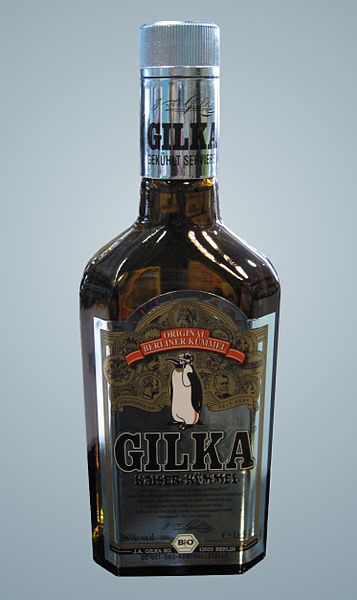
In the United States, foursomes is usually known as Scotch foursomes or alternate shot; it’s the signature game at Muirfield. Members play it fast: you walk up the fairway while your partner is hitting his drive, and you don’t wait for him or anyone else before playing the next shot. Hitting just half the shots gets the non-lunch portions of the day over faster, and ensures that someone always has a hand free to hold the kümmel, a clear, anise-and-fennel-flavored beverage, which is sometimes called the golfer’s liqueur. (It’s also a favorite at Prestwick and Troon, two other Scottish clubs where foursomes is a cherished game.)

The golfer's liqueur.

The golfer’s liqueur.

Muirfield has its own handicapping system, named after C. J. Y. Dallmeyer, a club captain in the 1950s, who invented it: if you go three-up in a match, you give strokes to your opponents until you’re back to one-up. Dallmeyer also initiated a heavily lunch-oriented New Year’s Day tournament, called the Captain’s Frolic, in which serious drinking is virtually mandatory. (The rules of the competition, Pottinger wrote, are “as hilarious as possible.”) Brown told me, “The way the members play golf is the antithesis of championship golf.” The paradox, of course, is that championship golf is also a club specialty, and has been for more than a century.

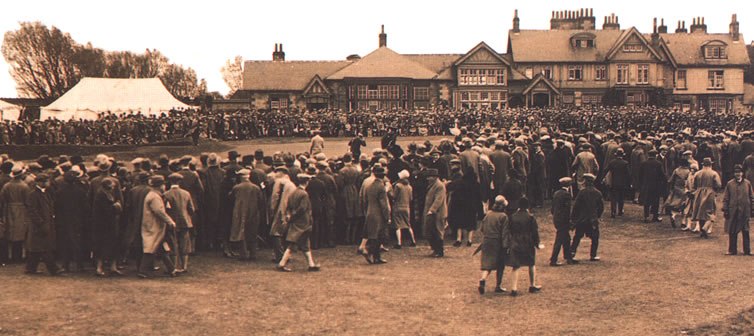
muirfield open

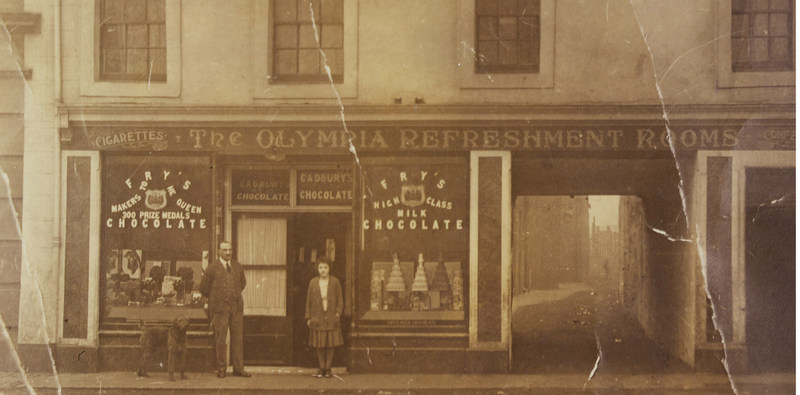
You have to wear a jacket and tie in the Muirfield dining room, but the atmosphere in the entire club is seductively informal. The gate looks imposing, but there’s no bag drop and there are no guys standing around waiting to wipe off your clubs. You change your shoes in the locker room and get on with it, and even visitors are encouraged to linger. In the dining room, no table has fewer than six chairs, an arrangement that forces groups of golfers to mix, and the food is served cafeteria-style. And diners who don’t live in fear of their cardiologists sometimes bypass lunch itself and move straight from the bar to the dessert table, where the specialties include rhubarb crumble, sticky toffee pudding, and ice cream from S. Luca of Musselburgh, a locally famous dairy—which might be a good place to stop on your way back to your hotel, assuming you’re still in a condition to find it.

S. Luca's original location.
S. Luca’s original location.

Sankaty Head Caddie Camp and Other Nantucket Wonders

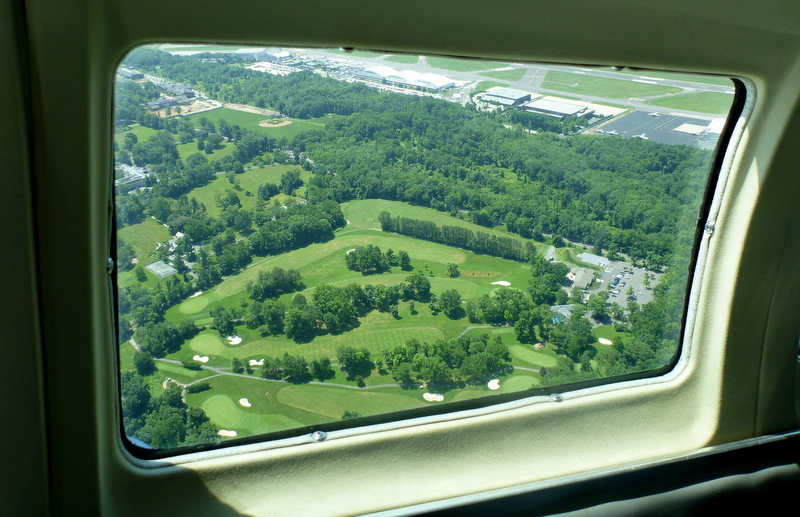
Bruce Memorial Golf Course and Westchester County Airport, July 8, 2013.

Bruce Memorial Golf Course and Westchester County Airport, July 8, 2013.

My wife and I flew to Nantucket earlier this week. In the air, we felt kind of rich, because we were the only passengers on the flight, but also kind of poor, because the plane was just a crappy Cape Air twin-engine Cessna eight-seater. I’d flown Cape Air before, on trips to and from Martha’s Vineyard, where my wife and I have spent summer vacations for many years. The weather during those flights was almost always terrible, and I spent most of each one gripping my seat and thinking, “We’re almost certainly going to die, but, if we don’t, this sure is faster than taking the ferry.” The weather this time was perfect, and from the plane I saw lots of golf courses, including the one in the photo above, a public course in Greenwich, Connecticut, right next to the airport. It was almost like visiting Google Earth!

This was our pilot. He never asked me to take the controls, but I studied them, just in case, when I wasn't scanning the ground for golf courses.

This was our pilot. He never asked me to take the controls, but I studied them, just in case, when I wasn’t scanning the ground for golf courses.

When we got to Nantucket, my wife took a nap, and Bob G.—an honorary member of the Sunday Morning Group, who had made our trip possible by arranging for me to give a talk in a local lecture series—took me on a tour of the island. Because our wives weren’t with us, our tour consisted solely of golf courses.

20130708_155350

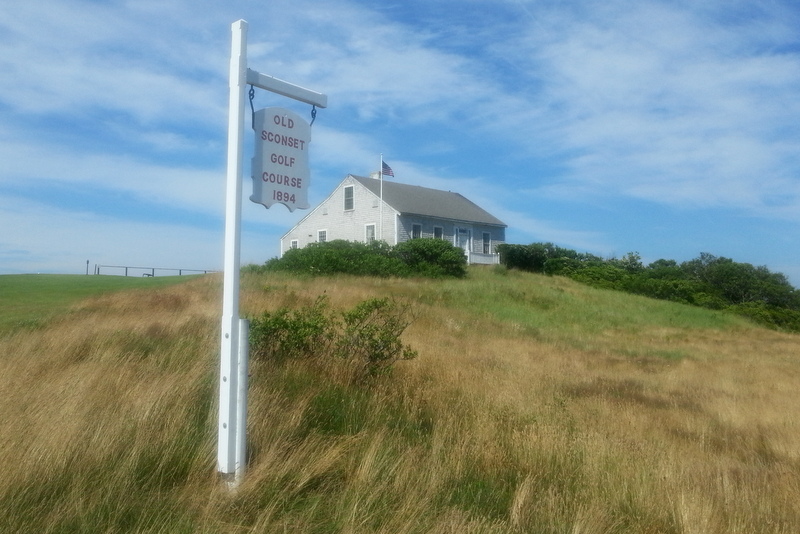
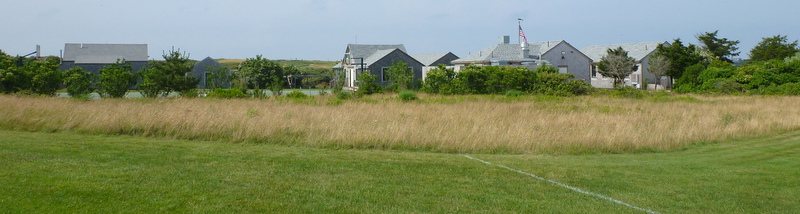
Old Sconset—the first stop on our tour—is known locally as Skinner’s, because Skinner was the middle name of one of the people who owned it for a while. (It’s now owned by the Nantucket Islands Land Bank.) You can read about the history of the course here.

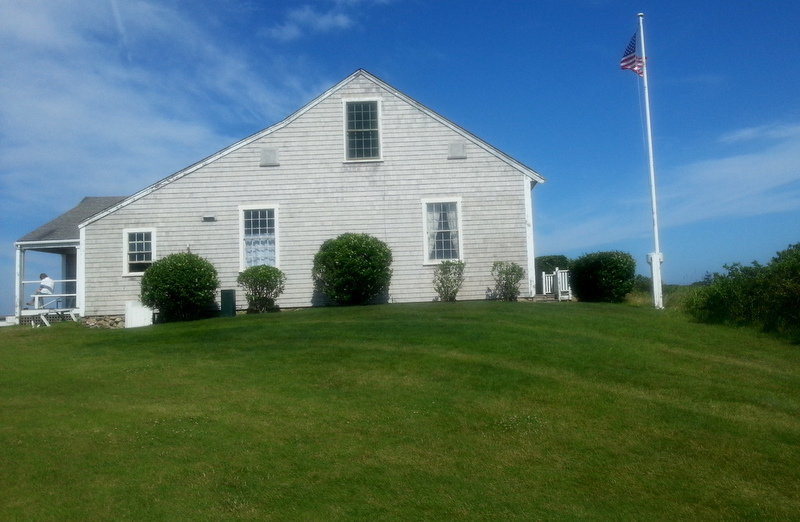
Inside the clubhouse, Old Sconset Golf Course.

Inside the clubhouse, Old Sconset Golf Course.

When Skinner’s is crowded, players reserve their place on the first tee by placing a ball in a sloping chute on top of the fence:

20130708_155507

The next day, Bob and I actually played golf, at Sankaty Head Golf Club, a course that’s been on my to-play list for a long time.

Sankaty Head lighthouse, which recently had to be moved farther from the cruel, cruel sea, and the somewhat less cruel fifth fairway.

Sankaty Head lighthouse, which recently had to be moved farther from the cruel, cruel sea, and the somewhat less cruel fifth fairway.

There’s lots of cool stuff in the Sankaty clubhouse, including the plaque in the photo below, which hangs on a wall in the men’s locker room. Note that each result is annotated with a description of the day’s weather:

P1070790

Maybe the very best thing about Sankaty is its caddie camp. Every summer, sixty boys spend two months living at the club and caddying for members. They have their own bunkhouses and dining hall, and there are organized games, trips into town, and other activities, in addition to lots of after-hours golf.

Tom, Bob G., Charlie, and Peter. The caddies get Garmin G.P.S. watches, hats with their name on them, and other stuff, and they make good money. Also, they are so polite that they make you almost reluctant to use bad words in their presence.

Tom, Bob G., Charlie, and Peter. The caddies get Garmin G.P.S. watches, hats with their name on them, and other stuff, and they make good money. Also, they are so polite that they make you almost reluctant to use bad words in their presence.

Here’s the camp, which is near the eleventh, twelfth, and thirteenth holes:

P1070784

And here are more caddies, on the driving range. I felt angry at myself for not knowing, when I was thirteen or fourteen, that spending a summer like this was possible:

P1070751

The next day, Bob and I played golf at Miacomet Golf Course, which, like Skinner’s, is public and is owned by the Land Bank. We played with Phil Truono, the director of golf.

Phil Truono, Miacomet Golf Course, Nantucket, July 10, 2013.

Phil Truono, Miacomet Golf Course, Nantucket, July 10, 2013.

Miacomet used to have just nine holes, but in 2003 the Land Bank added a second nine and renovated the whole thing. It’s a terrific golf course, and playing it is a relative bargain. People on Nantucket sometimes say that Sankaty Head is for millionaires and Nantucket Golf Club (where we didn’t play) is for billionaires. If that’s true, then I guess Miacomet is for thousandaires and Skinner’s is for hundredaires—so there’s something for everyone, as there always should be. (Non-golfers can look out for themselves.)

20130708_160201


Rain Gloves Are Also Sweat Gloves

Sweat-soaked rain gloves, July 7, 2013.

Sweat-soaked rain gloves, July 7, 2013.

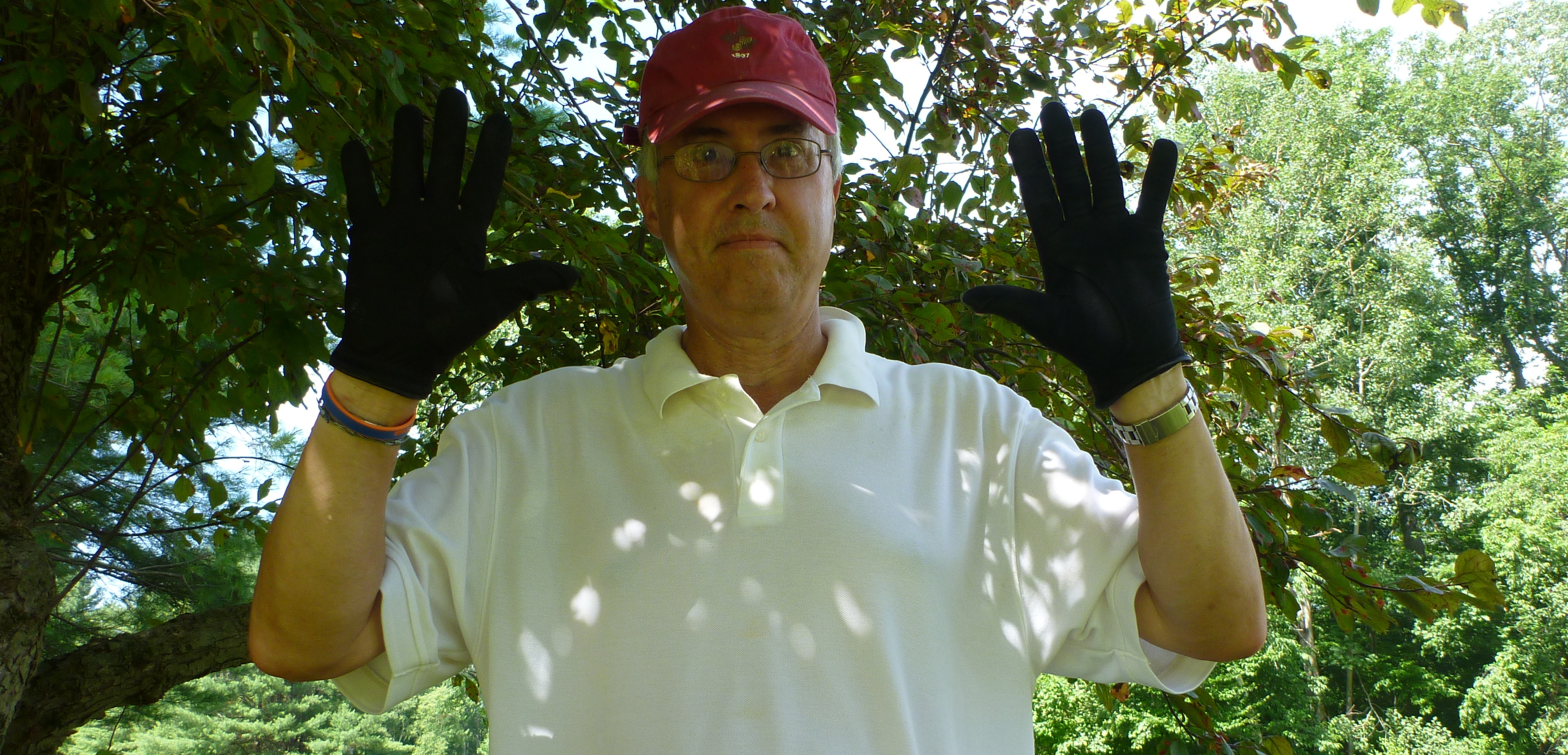
It’s been so hot and humid around here that we’ve had to make some adjustments. I’ve started wearing rain gloves even when it isn’t raining, because regular gloves feel slick and slimy when they’re soaked with perspiration. We’ve also tried bracketing the worst parts of the day by playing at the five-thirties: a Two-Hour Eighteen™ at 5:30 a.m. followed by a Two-Hour Eighteen™ twelve hours later, at 5:30 p.m. The course is empty and relatively cool both times, and you have room for a full workday in between, assuming you don’t fall asleep at your desk. And after the second eighteen you get home in plenty of time to ask, “Hey, what’s for dinner?”

Tony, Ian, Other Gene, Tim-o, Rex, eighteenth green, dawn patrol

Tony, Ian, Other Gene, Tim-o, Rex, eighteenth green, dawn patrol, July 3, 2013.

Kevin, Addison, evening session.

Kevin, Addison, evening session.

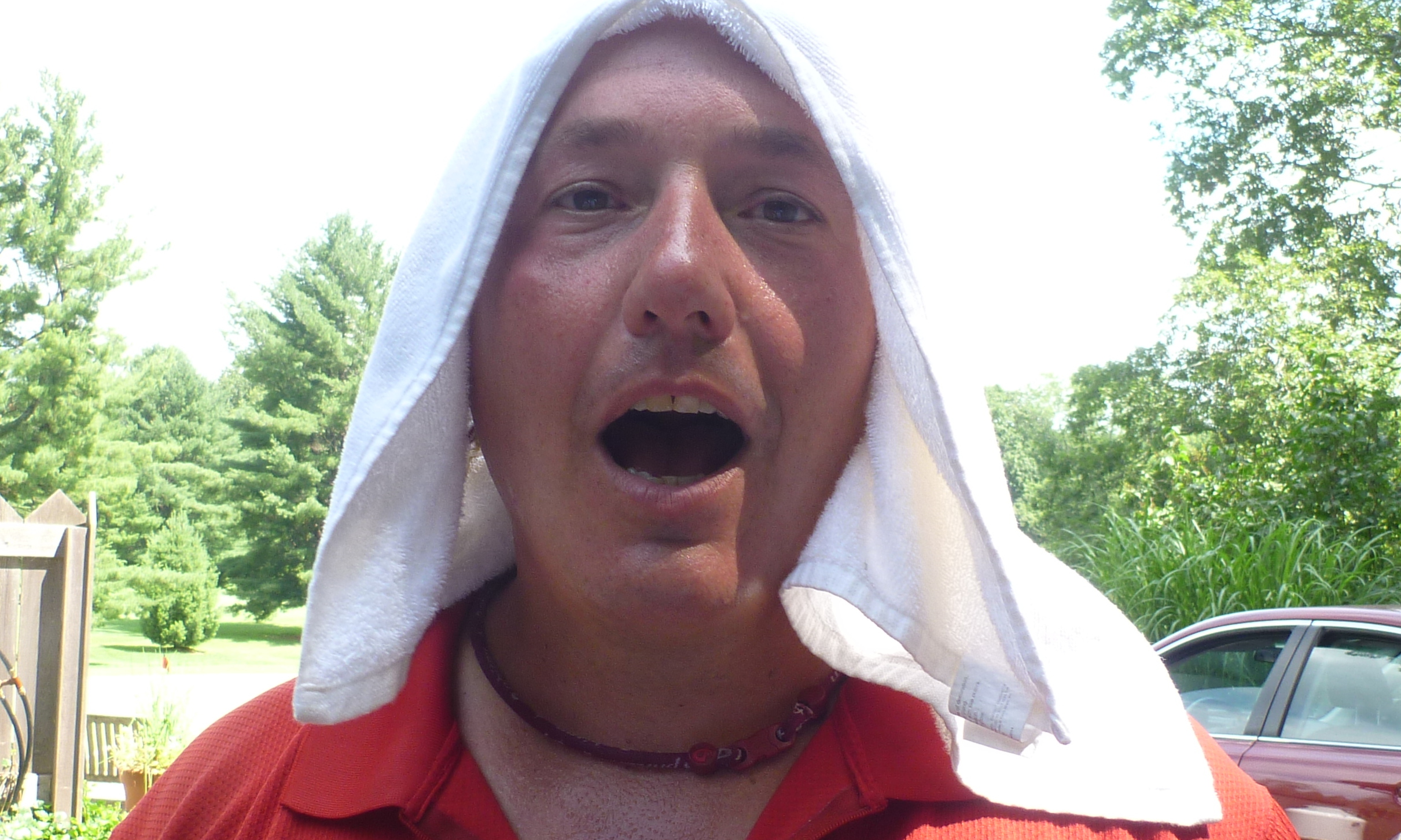
Sunday Morning Group met at the regular time—7:30—and the temperature was around 90 by the time we finished. Doug got so hot that he had to cover his head with a towel:

P1070679

Corey (our pro) wore shorts, and for the first time in living memory we ate lunch on the porch, to get out of the sun.

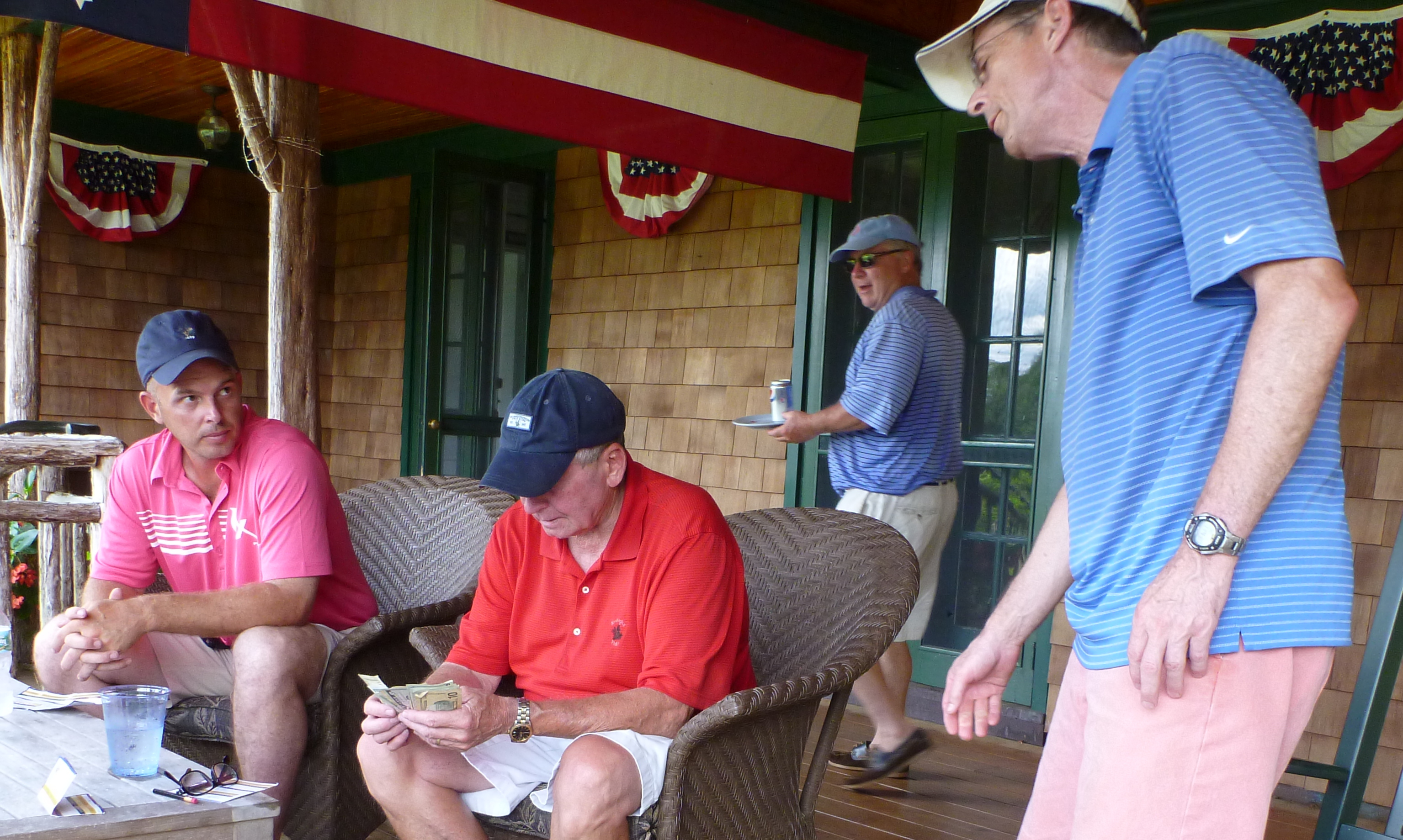
Settling up at lunch: Corey (our pro), Hacker (real name), Tom, Tim.

Settling up at lunch: Corey, Hacker (real name), Tom, Tim.

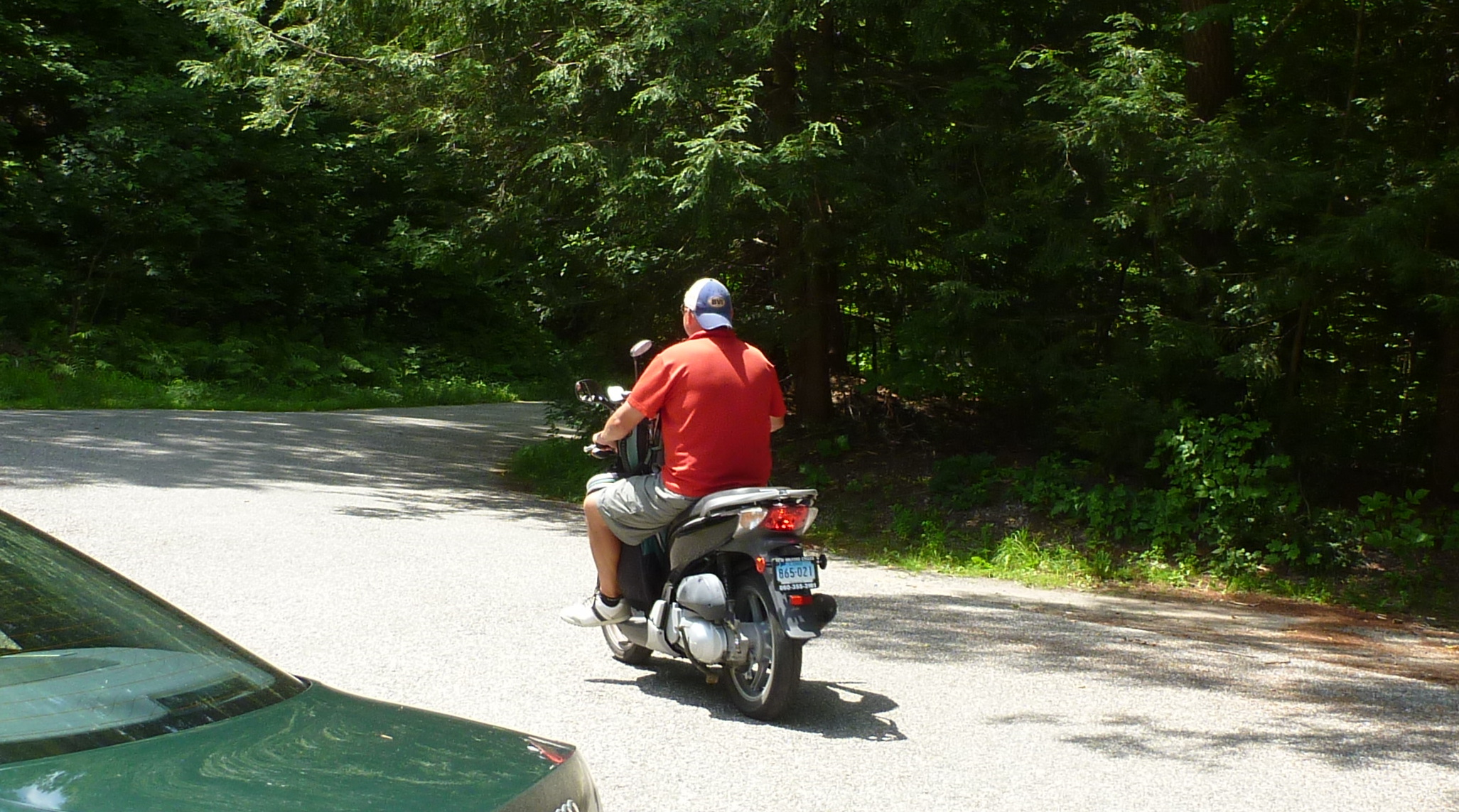
There were only three skins, and Tim got two of them. He was also on the winning team, so next week it will be his turn to bring lunch. Doug had a wife situation at home, so he left as soon as he had eaten. He doesn’t live very far from the course, so in decent weather he usually commutes by motor scooter:

P1070713 P1070715

That’s a dual-purpose helmet he’s wearing: turn it the other way and it’s a golf cap.

My Friends and I Like to Play With Glowing Balls

Young Nick, first tee, 9:45 p.m., July 5, 2013.

Young Nick, first tee, 9:45 p.m., July 5, 2013.

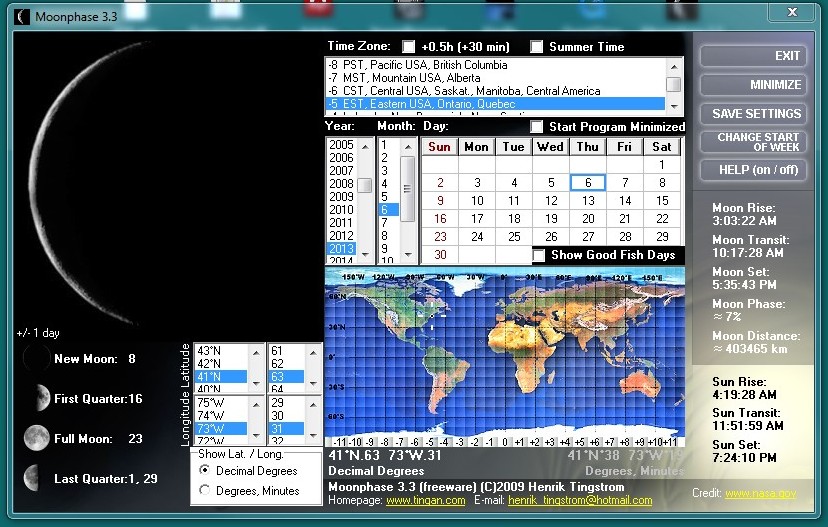
All golfers brood obsessively about the weather; my friends and I also track the phases of the moon. The reason is that we like to play at night, with glowing balls, and glowing balls look best against a truly black sky. The ideal time to play is an hour or two after sunset during a new moon, but other times of the month work, too, as long as the moon either hasn’t risen yet or has already gone down. I now monitor all that with a free program called Moonphase 3.3.

Moonphase

On Friday night, we met on the clubhouse porch at 7:00, for pizza from The Upper Crust, the official provisioner of the Sunday Morning Group.

Austin, John.

Austin, John, pizza, clubhouse porch.

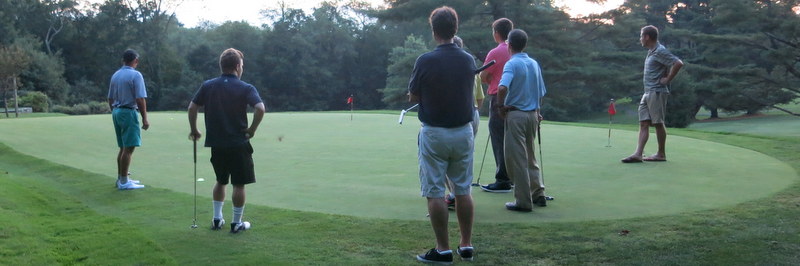
Then we played Putting for Dollars on the practice green while we waited for the sun to go away.

In all our putting contests, we use the stymie rule, which the rest of the golf world abandoned in the 1950s.  Closest to the pin wins, double points if the ball goes in. Luke (second from left) was the only competitor to actually sink a putt.

In all our putting contests, we use the stymie rule, which the rest of the golf world abandoned in the 1950s. Closest to the pin wins, double points if the ball goes in. Luke (second from left) was the only competitor to actually sink a putt.

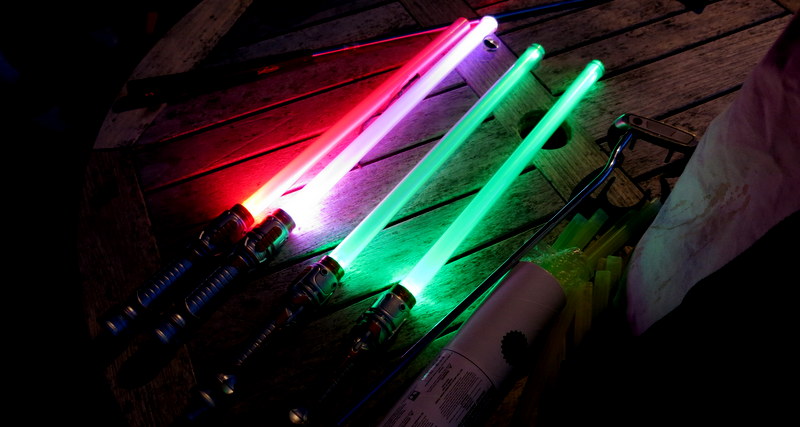
When the sky finally began to seem sort of promising, we turned on our flashing light sabers, to let them warm up.

IMG_2127

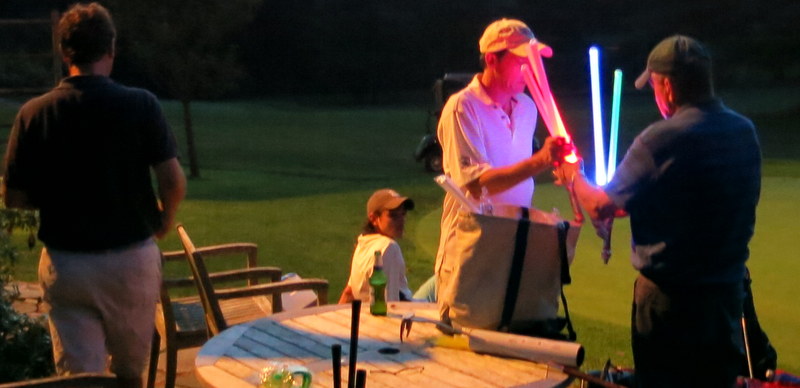
Then Hacker (real name) and Tim went out in a golf cart to place light sabers in the cups on the first second, seventh, eighth, and ninth greens, so that we’d be able to tell where the holes were. They also put glowing green rings in the bottoms of the cups.

Paul, Middle Nick, Tim, Hacker.

Paul, Middle Nick, Tim, Hacker.

Night golf has been a feature at my club for more than twenty years. For most of those years, we used translucent balls with glow-stick inserts. They were fun to play with, but they didn’t behave like real balls, and they didn’t fly anywhere near as far, and the glow sticks were sometimes hard to cram all the way in. Last year, we switched to Night Flyer balls ($70 a dozen, in six colors, at nightflyer.com). They’re self-illuminating—each one contains its own LED and battery, which isn’t replaceable but lasts for many rounds—and when they’re not lit up they’re visually indistinguishable from regular balls. You switch on the LED by hitting the ball or rapping it against anything hard, and it stays lit as long as you hit it again within eight or ten minutes, which is plenty of time to find it, even in the woods.

IMG_2152-002

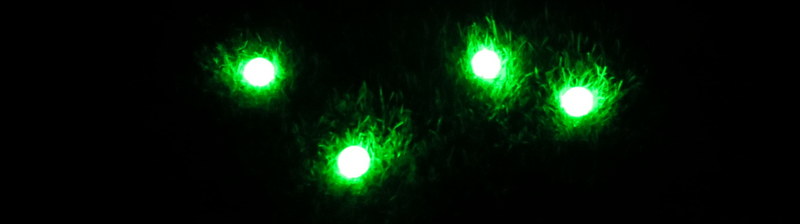
We had eleven guys. We played a scramble—each team with its own color—and we all played together. Hacker drove the beer cart. We teed up every shot, including chips, because divots are just about impossible to find at night. Here’s what the second green looked like when everyone was ready to putt:

IMG_2148-002

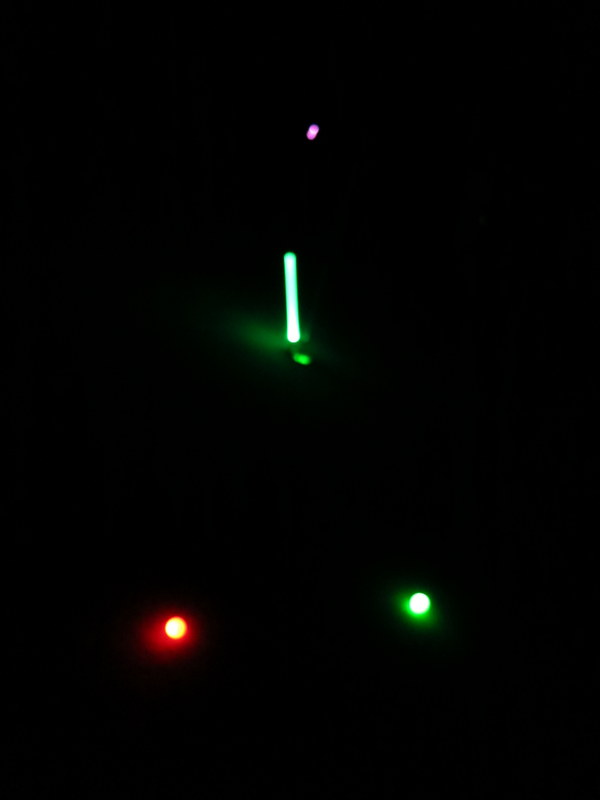
The red balls look the coolest, both in the air and on the ground.

IMG_2159

Austin made a brief video of someone missing a putt on the eighth green. Paul’s team had already clinched the title by then, so the miss didn’t matter.

Last year, I spoke with Pat Chapman, who is Night Flyer’s sales and marketing manager. She lives in New Hampshire but she grew up in New York, and when people give her a hard time she asks them, “Do you really want to mess with a girl from Brooklyn?” Largely as a result of her steady evangelism, night golf has rapidly grown in popularity all over the world. (“Not so much in France,” she said, “but France is France. What can I say?”) Scandinavians have been particularly enthusiastic, she added—perhaps because they spend so much of the year in the dark. She has organized full-scale night-golf events in many countries—for corporate outings, bachelor parties, wedding receptions, and other golf-appropriate occasions—and Night Flyer sells an almost comically extensive line of glowing accessories, including hole inserts, hazard stakes, tee-box markers, and black-stemmed margarita glasses. (That’s where we got the light sabers.)