
Travel Crisis: Missing Golf Bag

P1100916

Three pieces of luggage failed to make it to Austin, Texas, on the nonstop flight I took from Newark, New Jersey: a young family’s car seat; some guns (in a case) that belonged to two young hillbillies; and my golf clubs. As we filled out claim forms in lost-luggage office, I performed mental triage, assigning highest priority to the car seat (for humanitarian reasons) and lowest to the guns (since there was at least an outside chance that the hillbillies were planning mayhem).
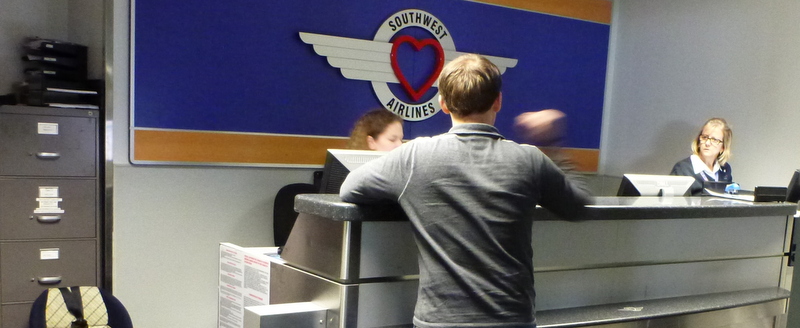
Car-seat guy. No, that's not his car seat at the left.

Car-seat guy. No, that’s not his car seat at the  lower left.

I myself was headed to San Antonio (by rental car), to play a municipal golf course there, on assignment for Golf Digest. The woman on the right in the photo above told me that my clubs, assuming they arrived on the next flight from Newark, would have to be flown to Dallas and then to San Antonio before they could be delivered to me at my hotel, sometime the next day, even though San Antonio is just an hour and a half from Austin by car. She said that Southwest would reimburse me for a sleeve of balls, a glove, a pair of shoes (up to fifty dollars), and rental clubs. This has happened to me before, and I wasn’t too bummed. But that evening she called to say that my clubs had arrived in Austin and would be sent by car after all, although they wouldn’t be at my hotel until three or four in the morning. Hooray!

I told the clerk at the front desk that my golf clubs would be delivered after midnight, and asked him just to hold them for me until I picked them up. “Right,” the clerk said. “We’ll call you when they get here.” I said, “No. Please listen. They’ll be arriving at three or four in the morning, and I’ll be sound asleep, and I don’t want you to call me. I won’t need them in the middle of the night, and I won’t need to know that they’ve arrived. Just hold them at the desk and I’ll pick them up in the morning.” The clerk said, “Right,” and in large letters I wrote PLEASE DO NOT CALL ME on the form he’d asked me to fill out.

A little after three that morning, the phone in my room rang. “Your golf clubs are here,” the clerk said.

Well, maybe I’d have done the same thing if I’d been stuck behind a hotel reception desk at three in the morning, with nothing but my thoughts to keep me company. When I was twenty, I spent a summer working on the lawn-maintenance crew at an apartment complex in Colorado Springs, and we used to drag our shovels across the parking lot each morning at six-thirty, to make sure the residents were awake, too.

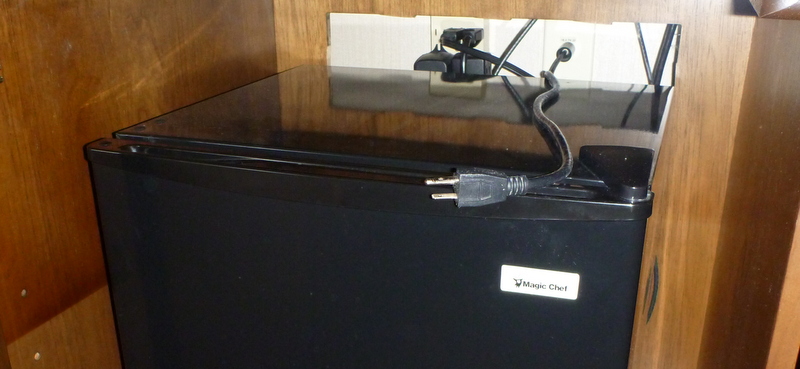
I was sound asleep when the clerk called because I had taken several critical steps to keep down the noise and light levels in my room. Among other things, I had pushed a chair against the curtains to keep them fully shut, turned off the wheezing fan in the room’s HVAC system, and unplugged the empty mini-refrigerator under the TV, to prevent the compressor from repeatedly cycling on and off:
P1100925

I had also disabled the electric eye on the bathroom light switch:

P1100923The electric eye turns on all the bathroom lights whenever it detects motion. That may or may not be a good thing during the day, but it’s a nuisance in the middle of the night, because, if you are only getting up to take a whiz, the last that you want (or, at any rate, the last thing that I want) is to be suddenly blasted with daylight-level illumination, as though you had been caught trying to cut your way through a barbed-wire perimeter fence. Hey, why not turn on the TV and the radio, too, and have the desk clerk call to make sure everything’s O.K.?

Here’s how I foiled the electric eye, before going to bed, by using the Kleenex box and a hand towel:

P1100924Other than that, all was well. I’ll have more to say about my trip later, both here and in the magazine.
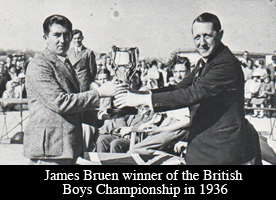
Remarkable Golf Swing: The Bruen Loop

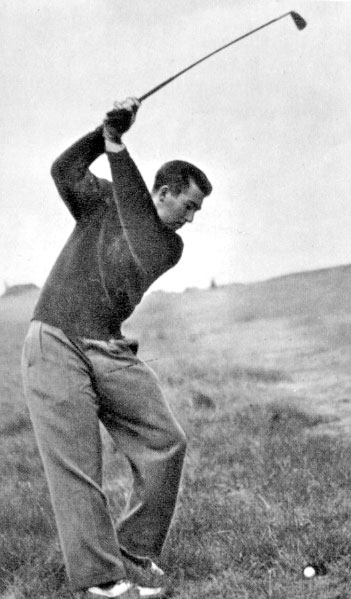
bruen loopWhen I was in Northern Ireland recently, I saw a photograph of a golfer I knew nothing about: Jimmy Bruen, shown above, who was born in Belfast in 1920 and held the course record at Royal County Down for twenty-nine years. He won the British Boys’ Championship, at Royal Birkdale, when he was sixteen.

This, remarkably, is what sixteen-year-olds looked like in the olden days.

This, remarkably, is what sixteen-year-olds looked like in the olden days.

He played in the Walker Cup two years later, and was credited by his teammates with inspiring Britain and Ireland’s first-ever victory over the United States (and their last until 1971). He had qualified for the team by shooting 71-71-68-72 on the Old Course at St. Andrews, a feat that caused Henry Cotton, who had won the Open in 1934 and 1937, to write: “Fancy a 17-year-old doing 282 in four rounds on the Old Lady of St. Andrews. I know what a stern course it is, long, difficult and tricky, but here was a mere boy playing it with a wise head and a technique which left everyone gasping.”

That technique—which came to be known as the Bruen Loop—was highly unconventional, as you can see in the photo at the top of this post and in the video below. The British golf writer Pat Ward-Thomas described it this way:

He drew the club back outside the line of flight and turned his wrists inward, to such an extent that at the top of the swing the clubhead would be pointing in the direction of the teebox. It was then whipped, no other word describes the action, inside and down into the hitting area with a terrible force. There was therefore in his swing a fantastic loop, defying all the canons of orthodoxy, which claims that the back and downswing should, as near as possible, follow the same arc. There must have been a foot or more between Bruen’s arcs of swing.

Henry Cotton, Open Championship, 1937.

Henry Cotton, Open Championship, 1937.

Bruen routinely drove the ball over three hundred yards, and he had a deadly short game. (He won the British Boys’ by chipping in for eagle on the twenty-seventh hole of the final, making him eleven up with nine holes to play.) He lit up Irish golf before the war, and he won the first post-war British Amateur, in 1946. (He was the first Irishman ever to win it.) Cotton called him “the best golfer—professional or amateur—in the world.” He was widely favored to win the 1946 Open, but withdrew because, he said, his business left him insufficient time to practice. (He was an insurance broker.) He severely injured his wrist while working in his garden in 1947, and, following surgery that was only semi-successful, virtually stopped playing competitive golf. His last Walker Cup was 1951. He died in 1972, at the age of fifty-one.

Ward-Thomas wrote: “Bruen was the most fascinating golfer I have ever seen or probably will ever see. There was no limit to what he might have achieved had not the War come and had he so desired.” George F. Crosbie published a biography in 1999. The Golfing Union of Ireland established the Jimmy Bruen Shield in his memory in 1978.

Bruen Shield

Dressing for Golf in Cold Weather

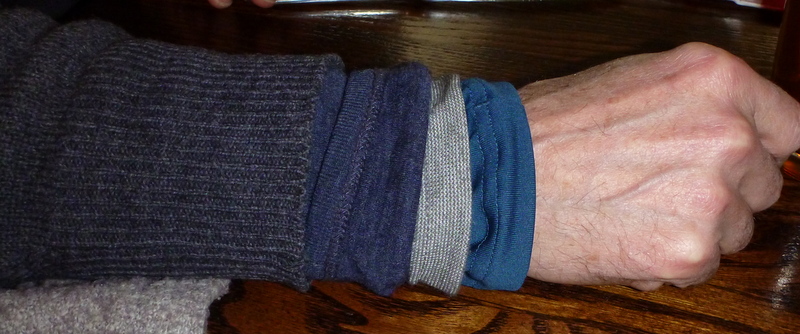
P1100899-001I’m working on a Golf Digest story about dressing for cold-weather golf. Tim, Hacker (real name), and I did some research on Sunday (see photo above). The temperature (21 degrees) equaled the wind speed (21 miles per hour), yielding a windchill factor of -459.67. Among the keys to staying warm was layering. Here are the five layers that Tim wore above his waist:

P1100905

There were so many leaves blowing across the greens that trying to clear the line of a putt was usually pointless. Tim said he wished that Edwin Watts or Golfsmith or someone would sell a Tee Gun, like a nail gun, for driving tees into frozen ground:

Tee Gun (artist's conception).

Porter + Cable tee gun (artist’s conception).

Here’s Tim struggling to get a tee in the ground on the eighteenth hole (note the howling of the wind):

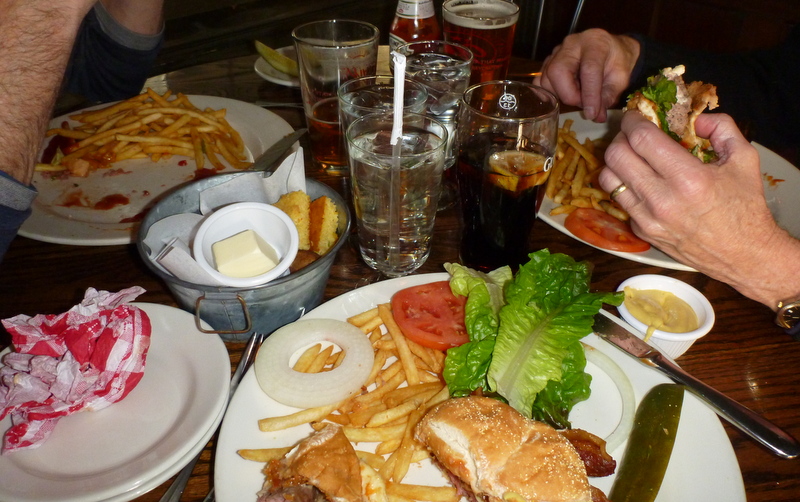
Afterwards, we warmed up over cheeseburgers at one of our several winter clubhouses, the G.W. Tavern:

P1100910-001The day before, I’d done some preliminary cold-weather research in New Haven, at the Harvard-Yale football game. It has become traditional, apparently, for residents of Yale’s Saybrook College to take off their shirts for a little while toward the end of the game—a ritual known as the Saybrook Strip. As in most of the schemes that men cook up for getting women to take off their clothes, virtually all of the clothes that were taken off were taken off by men:

IMG_3357-001

My father was a Saybrook man. As far as I know, this ritual did not exist in his day. He and I did have a Game-related ritual of our own, however. We had a standing five-dollar bet, which the loser paid off in ways that did the winner no good. In 1983, when Harvard won, 16-7, he paid me with a check embedded in a block of Lucite:

IMG_3366

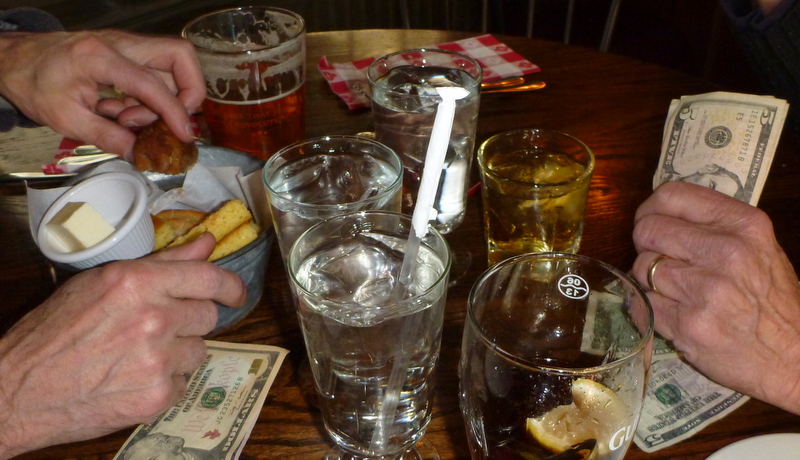
If the Sunday Morning Group used the same payment method, I wouldn’t have been the big loser this past weekend. None of the cash you see in the photo below is moving toward me:

P1100908

Nevertheless, it was a perfect day for golf, and you can never be sure how many of those we have left.

P1100891

What Does It Mean If You Dream About the Rules of Golf?

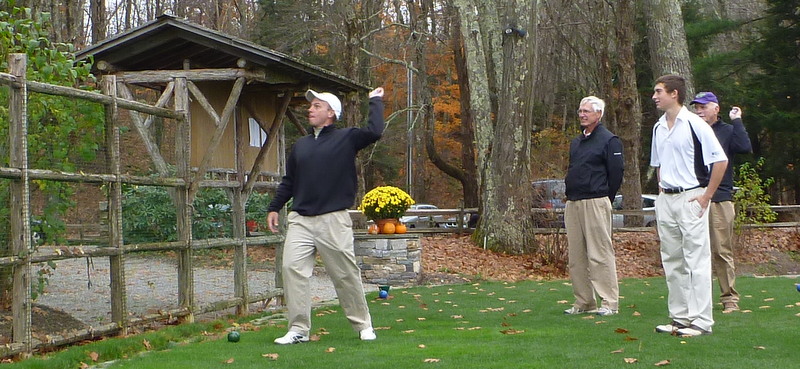
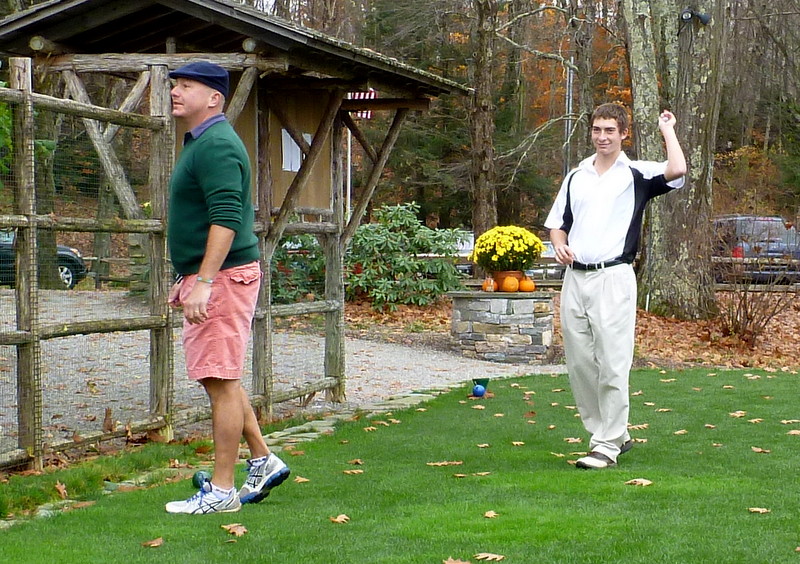
One of the Sunday Morning Group's many playoff formats: wrong-handed throw over the fence from the first tee to the practice green. Corey (throwing), Rick, Nick, Stan. Notice that Stan is practicing--a possible rules violation. October, 2012.

One of the Sunday Morning Group’s many playoff formats: wrong-handed overhand throw over the fence from the first tee to the practice green. Corey (throwing), Rick, Nick, Stan. Notice that Stan is practicing–a possible rules violation. October, 2012.

When my friend Roz’s daughter, Nina, was quite young, she asked Roz where babies come from. Roz explained (within reason), and Nina, astonished, said, “I feel like I’m dweaming!”

Recently, I myself had an interesting dweam, although it was about golf: I was either playing in or attending a tournament of some kind—or maybe I was a caddie. One of the competitors made a succession of poor chips and putts, and his ball ended up in a clump of tall grass next to a tee marker. Another player—or maybe it was the first player’s caddie—attempted to extricate the ball by swatting at it with a driver. The attempt failed, and a rules official said that the player was now required to make “a throw”—that is, to pick up his ball and throw it into a better lie, or onto the green, at a penalty of a stroke.

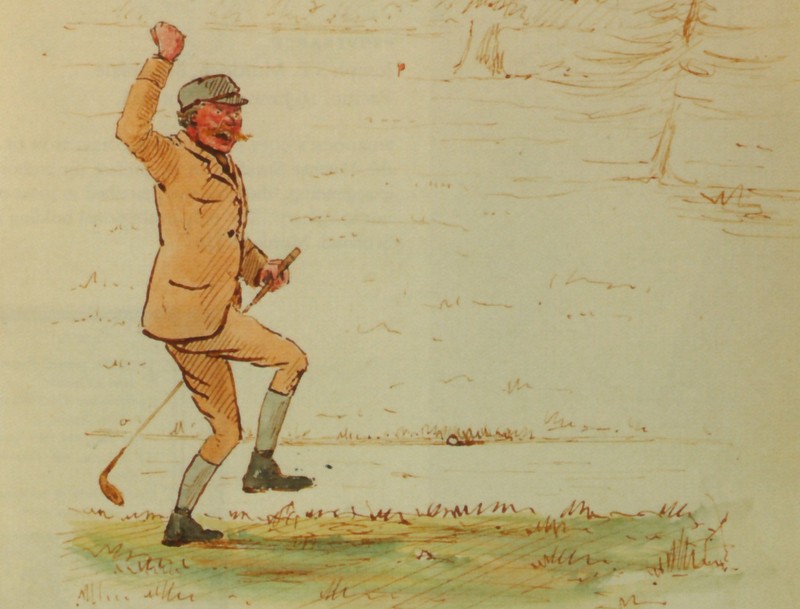
watercolor 1892

I said that I had read the rule book from cover to cover several times (a lie), yet didn’t remember anything about “throwing.” My friend Rick (see photo at the top of this post) and Jim Nantz (the television announcer), who were both there, for some reason, assured me that the official was correct. Nantz did acknowledge that the rule book referred to throws by a different name, which I’ve now forgotten, but that it was all explained in a book called The Begnin’ Throw, although he said I’d be unlikely to find a copy because it was “the rarest of all golf books.” (Even in the dweam, I didn’t know what “Begnin'” means.) I thought, Wow—this will make a great Golf Digest article! But then, after a few other things happened, I woke up.

Doug, examining the result of his own lousy throe, while Nick practices.

Doug, examining the result of his own lousy throw, while Nick practices.

When I woke up, I was in the house of a member of our Enemy Club who died several years ago, in his early forties, and I was crushed when I realized that all that stuff about throwing hadn’t been real and that, therefore, I wouldn’t be able to write an article about it. Meanwhile, I was involved in an important match, and at some point I accidentally interfered with my opponent’s putt by leaving a pair of nail scissors on a green. Then I woke up againthis time in my own actual bed—and realized that the throwing part had been a super-rare dweam-within-a-dweam, a first for me. (Most of my golf dweams are just about me playing an ordinary round on my home course. I once told my friend Jim, “You’d think that I could at least dream about playing someplace exotic, like St. Andrews or Pebble Beach,” and Jim said, “Yeah. After all, it’s free.”)

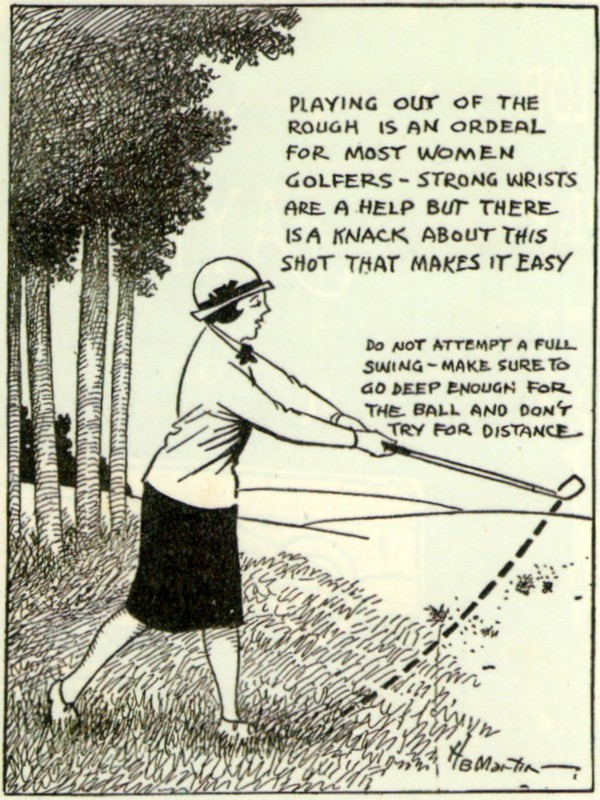
Anyway, upon reflection, I’ve decided that throwing might have a place in golf, and not just in S.M.G. playoffs. Some guys I know occasionally allow “a throw a side” as a handicap alternative: instead of receiving strokes, you are allowed to throw your ball out of trouble once per nine holes, at no penalty. In one memorable instance, a player won a match by using his throw to sink a six-foot putt. He reached over his head, fell forward, and slam-dunked his ball into the hole. Similarly, a throw might have been a better choice here:

Ladies in the rough-001

Reader’s Trip Report: Mackinac Island, Michigan

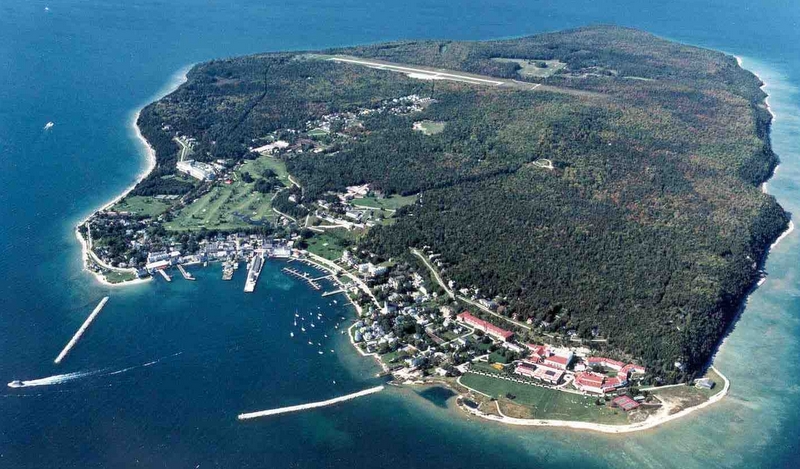
IMG_20130804_104132Jim Doherty, a reader in Chicago, wrote to me toward the end of the summer about a family vacation he had taken to Mackinac Island, Michigan—which is in Lake Huron all the way up next to Canada. (Mackinac, incidentally, is pronounced Mackinaw.) Jim is one of the guys in the photo above; the other is his brother-in-law, Mike. Because male golfers are essentially interchangeable, it doesn’t matter which is which. Here’s what the island looks like from the air.

Mackinac

Jim wrote:

Mackinac Island doesn’t allow any motorized vehicles. You ferry over with bikes, and there are horses and carriages that you can use to get around as well. The island had some military importance way back in 1812 and is now a beautiful spot to visit. There are a lot of fudge shops, for some reason. Anyway, even though our wives had chosen this non-golf-hotspot for our vacation, Mike and I brought our sticks on the theory that at some point our families would be equally sick of us (seven-hour drive) and be happy to see us exit to a golf course for a while.

Mackinac has two courses. One belongs to the Grand Hotel, where Jim, Mike, and their families were staying. It’s made up of two non-contiguous nines, called the Jewel and the Woods, and golfers are transported from one to the other by horse-drawn carriage. According to the hotel’s website, “The leisurely 15-minute ride includes parts of the island unseen by many visitors.” That sounds mildly interesting, but I think Jim and Mike were right to skip it. Jim wrote, “I try to avoid non-golf resorts that have a course. I find that they are usually full of very slow, non-regular golfers who are just trying to kill time, theirs and mine.” (The hotel and its golf course are visible in the photo above, in the lower part of the island.)

Instead, Jim and Mike played a nine-hole course called Wawashkamo Golf Club, which you can see, sort of, in the clearing in the woods near the runway at the top of the photo of the island. Here’s what the club’s front gate looks like:

Wawashkamo

Jim continued:

Remember, there are no motorized vehicles, so we rode our bikes, with our bags on our backs, up to the course. The inclines early in the ride were steep enough that we needed to walk the bikes, but it was worth it. Wawashkamo is a gem. No irrigation in the fairways or rough. Fescue-lined holes. Tiny hand-mowed greens in great shape, and tees that are literally about twenty square feet. I guarantee that the area rug under your dining-room table is bigger.

IMG_20130804_101313

Wawashkamo was laid out in 1898 by a Scotsman (from Carnoustie!) named Alex Smith. The club’s first pro was Frank Dufina, a Chippewa Indian, who played in the 1911 Western Open. He was fourteen years old when he went to work at Wawashkamo, and eighty-four when he retired, in 1968. Among the course’s unique features is its third green:

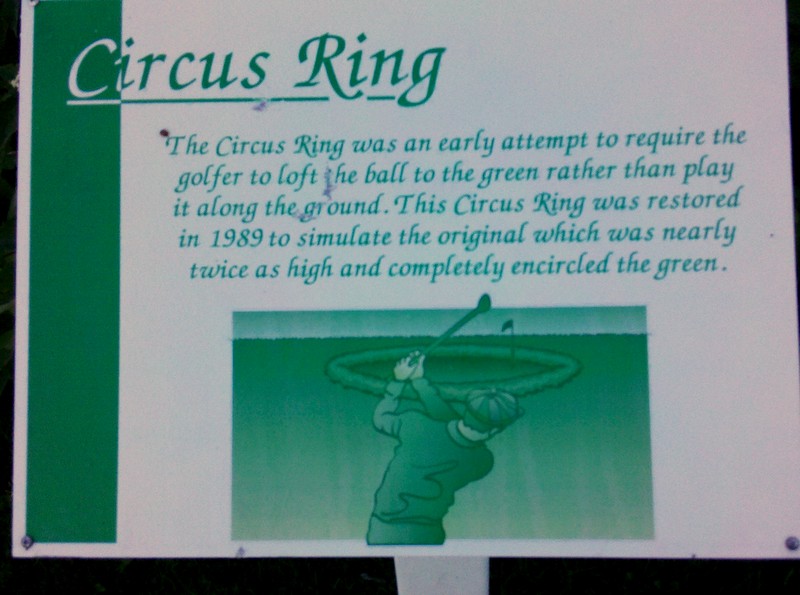
IMG_20130804_092803The putting surface (as you can see in the photo above) is surrounded by a thick fescue collar, which is called a Circus Ring. Its purpose is explained in the sign in the photo below:

IMG_20130804_092752

Jim continued:

Wawashkamo has two sets of tees, which change the length and angle of the holes a bit. It’s an easy walk: ninety minutes, max, for nine holes, then back on the bikes for the downhill ride to our families. The club’s pro, Chuck Olson, invited us to leave our clubs overnight and return to play the next morning, to ease our bike ride. We got the idea, from talking to him and a member, that the club’s budget is nil.

Here’s the clubhouse:

IMG_20130804_084705

And here are two of the amenities, which are available to visitors as well as to members:

IMG_20130804_104341Wawashkamo is closed for the season (I’m pretty sure, based on the website), but it will be open again in early May. Fifty dollars for eighteen holes, walking. Let’s go!

Did My Friends See a Gray Wolf on Our Golf Course?

P1100847A lot happened at home while I was in Ireland. For one thing, it snowed, and—as you can see in the photo above, which I took in a shady spot in front of the first tee—not all the snow had melted by the time we played on Thursday afternoon. Luckily, the forecast for the weekend is more Irish-sounding: no precipitation to speak of, and highs in the upper fifties.

Wolf food, fourth hole, November 14, 2013.

Wolf appetizers, fourth hole, November 14, 2013.

A second thing that happened while I was out of the country is that several of the guys saw a wolf on our golf course. Hacker (real name) saw it first, and Corey, Gary, Chic, and a couple of other guys saw it, too, They watched it walk from the ninth tee to the far side of the first fairway, and a little later they heard it howl in the woods. We have lots of coyotes around here, and everyone knows what they look and sound like, so they’re positive it wasn’t one of those. We also have lots of dogs (ditto). Wolves have been making their way into New England from Canada in recent years, attracted primarily by our burgeoning population of Lyme-disease-bearing white-tailed deer. The wolves are welcome to all the deer, as far as I’m concerned, although I hope they will continue to spare the almost entirely white piebald fawn that my wife and I have been watching in our yard since mid-summer:

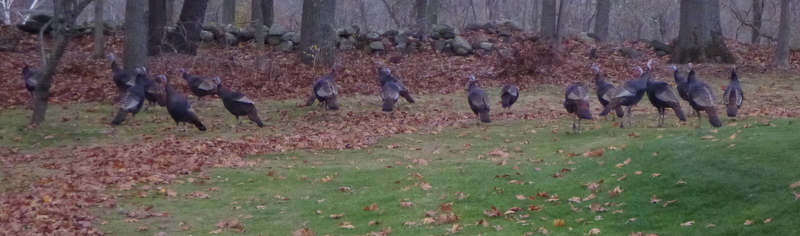
IMG_2040On the golf course, my friends and I have also seen foxes and bears, and I once watched a bobcat circling a flock of nervously gobbling wild turkeys in the middle of the driving range. Nature red in tooth and claw, etc. Talking about the wolf this afternoon made someone suggest that we play a game we often talk about playing but can never quite remember the rules of: Wolf. But we couldn’t quite remember the rules, and we had six guys, so we played 30-Ball instead.

Austin an Corey, fifteenth hole.

Austin and Corey, fifteenth hole.

We played kind of slowly, even considering that there were six of us—almost three and a half hours—and it was getting genuinely dark by the time we finished. In just six more weeks, though, the days will begin getting longer again, and once that happens spring will be practically around the corner.

4:30 p.m. EDT. Bummer.

4:30 p.m. EDT. Bummer.

November Golf in Northern Ireland

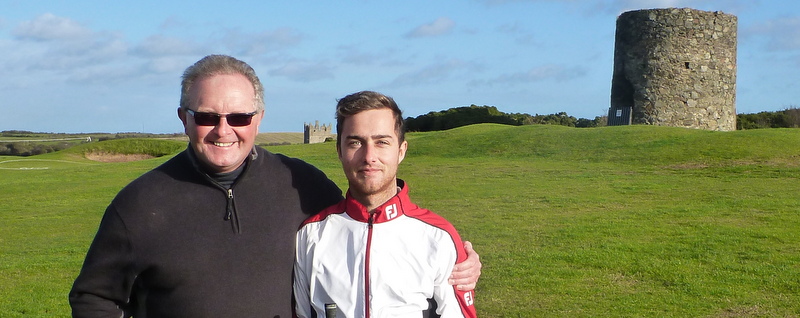
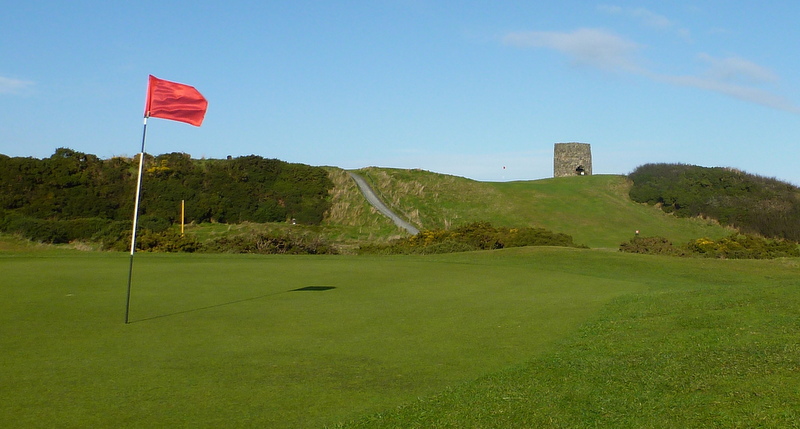
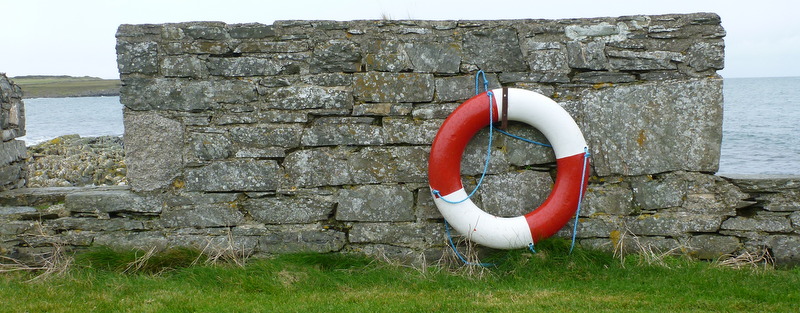
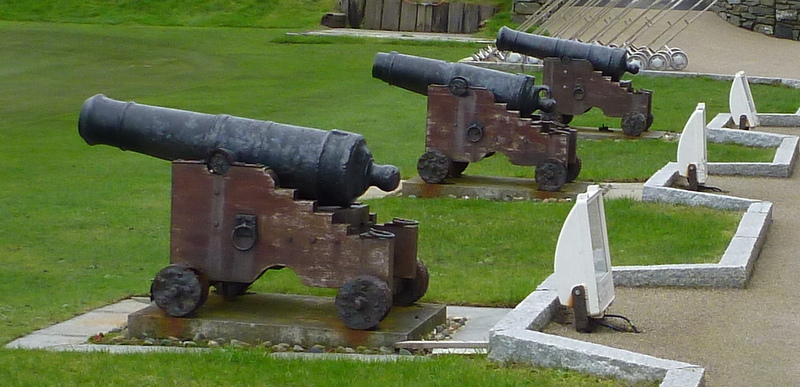
P1100471The mystery golf course in my previous entry is Kirkistown Castle, on the Ards Peninsula, in Northern Ireland. (Adam Heyes, who also identified Ardglass Golf Club, from photographs of some cannons and a life preserver, got Kirkistown right, too, but he let me know by email so that others would have a chance. Tralee wasn’t a terrible guess, but it credited me with the ability to teletransport myself and my golf clubs to the other side of Ireland and back.) I played Kirkistown last week with Kevin Gallagher and Jonny Breen, both members, shown above. You can see the ruins of the eponymous castle in the distance, between their heads. The structure on the right is the remains not of a castle but of an old tower windmill. It stands on one of the two sand hills that are the most conspicuous topographical features of Kirkistown:

P1100456

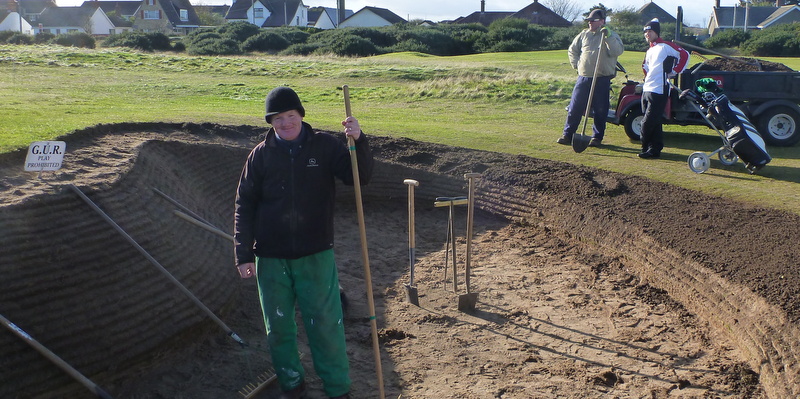
Kirkistown was founded in 1902, and the modern routing was created by James Braid in 1934. Among the few significant changes since then has been the sod-revetting of quite a few of the bunkers, a project undertaken with enthusiasm by the current greenkeeper, shown here in one of his ongoing creations:

P1100468

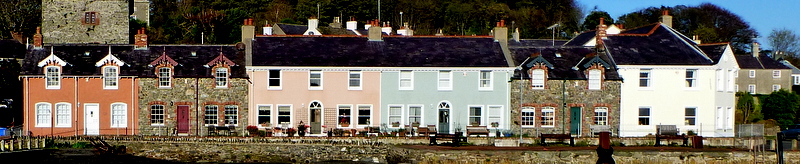
To get to Kirkistown, I drove from Newcastle to Strangford, through an area that a road sign identified, correctly, as an Area of Outstanding Natural Beauty (A.O.N.B). There was also quite a lot of unnatural beauty, including this row of houses along the Strangford wharf:

P1100407-001

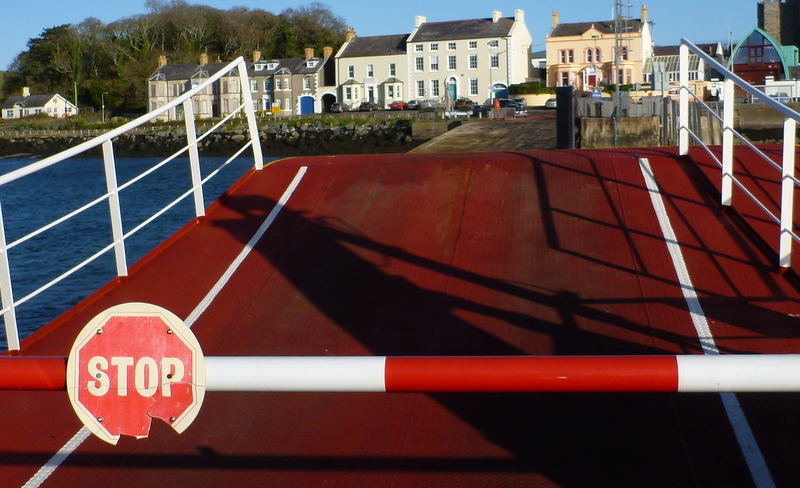
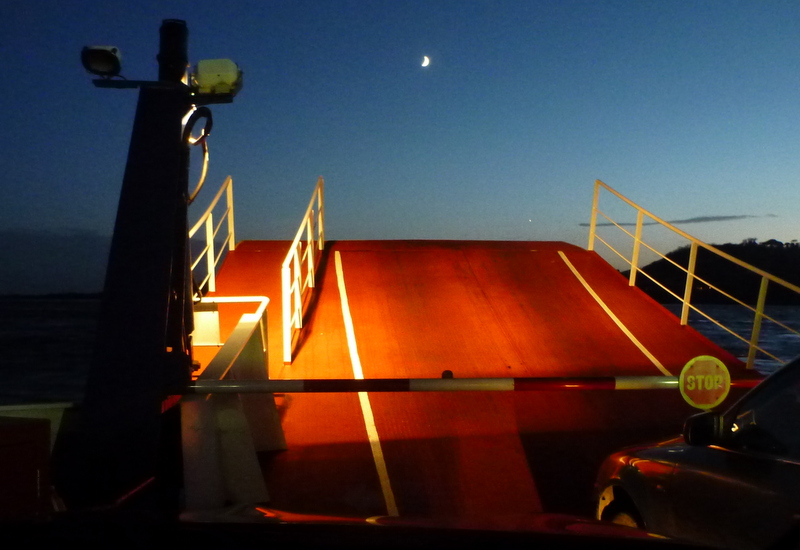
I then had to cross Strangford Lough on a small ferry—which, naturally, was pulling away as I arrived:

P1100403Small ferries are one of my favorite things in the world. I wrote about some even smaller ones in the Atlantic Monthly a long time ago. The Strangford ferry runs every thirty minutes, so I didn’t have to wait long for the next one. Here we are arriving at Portaferry, on the other side:

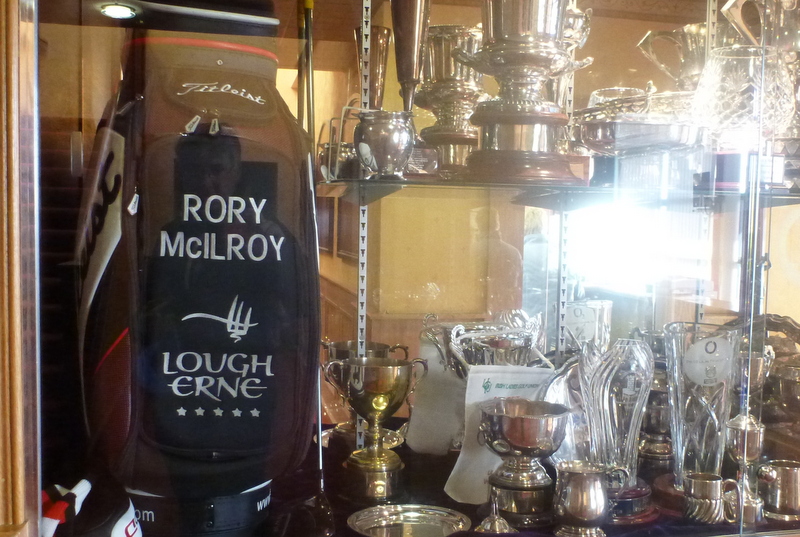
P1100435Kirkistown is just a few miles up the road from the ferry landing, on the other side of the peninsula. Rory McIlroy—who would have arrived from the opposite direction, since he grew up in a suburb of Belfast—played at Kirkistown often as a junior. A recent golf bag of his is displayed in the trophy case in the lobby of the clubhouse:

P1100440

I intentionally took an unnessarily long way home, by doing a sort of figure-eight loop around the entire peninsula. The sun was gone by the time I got back to Portaferry—where, once again, I just missed the boat:

P1100499I was in Northern Ireland mainly to write about Royal County Down for an upcoming issue of Golf Digest. The weather during my rounds there was mostly spectacular, too—much better than the weather at home:

P1100392

P1100273

P1100228On my first day at Royal County Down, I played with Kevin Markham, who has played every eighteen-hole golf course in Ireland:

P1100253-001

We were accompanied for nine holes by Kevan Whitson, the club’s longtime professional. (Nearly everyone I played golf with on this trip was named either Kevin, Kevan, or Johnny.)

P1100239

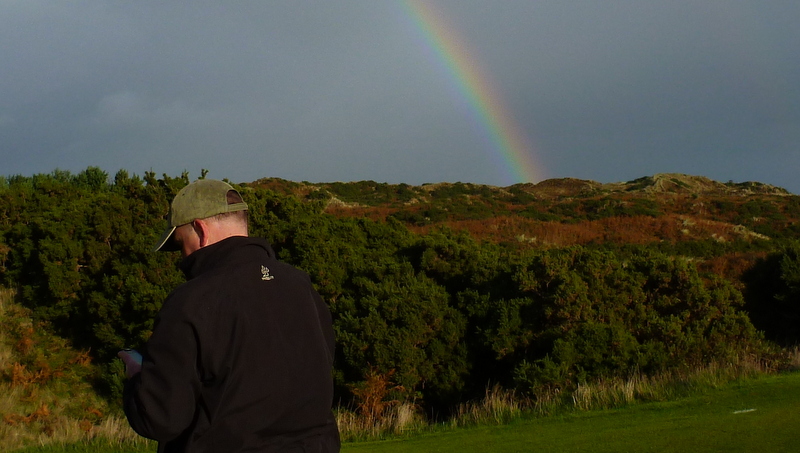
I’ll have more to say about Royal County Down in the magazine—and here, too, probably. Toward the end of our round, I told Kevin I was never going to take another picture of a rainbow on a golf course, or anywhere else. But then I did.

P1100288

New Golf Challenge: Name That Other Course

P1100323-001

Adam Heyes is right. The golf course shown in the two photos in my previous post is Ardglass Golf Club, in County Down, Northern Ireland. In the photo above, Ian Duff, a longtime member, is looking for my ball to the left of the green on the second hole, a par 3 that plays over a chasm. The photo below shows a less perilous part of the same course.

P1100342The course I played yesterday may not be easy for even Adam to identify. Here’s the second green:

P1100452

And here’s something I saw on my way home:

P1100505

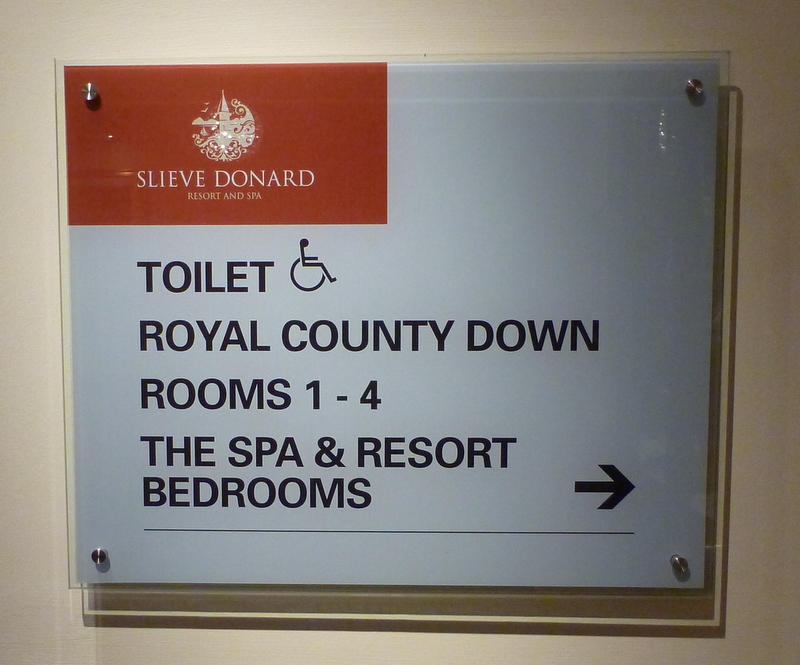
Today, I’m going back to the course I played the first day I was here. You can get to it by following signs in the lobby of my hotel:

P1100400


Extra-Handicap-Stroke-for-Shorts Rule Now in Effect

photo 3

The Sunday Morning Group gives an extra handicap stroke to anyone who wears shorts after November 1. My first grandchild—Alice Calbraith O’Keefe, shown above—was born November 2, just in time to qualify, assuming diapers count. The first Sunday in November was very cold and very windy, but several guys took advantage of the rule, including Fritz, on the left in the photo below.

P1100176The red plastic cup contains beer from one of our two new Kegerators. Hacker (real name) has planned a Kegerator-emptying party for this coming weekend. Guests welcome.

While S.M.G. was in session last weekend, eight of us were busy defeating our No. 2 Enemy Club in our annual two-day home-and-home match. My partner on Sunday was Corey, our pro, shown below, who did not wear shorts. (The matches were played at scratch, so there was nothing to gain.) Corey’s fiance is from Thailand. Before moving to the United States, last month, she had never felt weather colder than 58 degrees. She’s still playing golf, though, unlike some people I could mention. And we give two extra strokes for shorts after December 1.P1100178