A Golfer’s Bucket List: No. 1

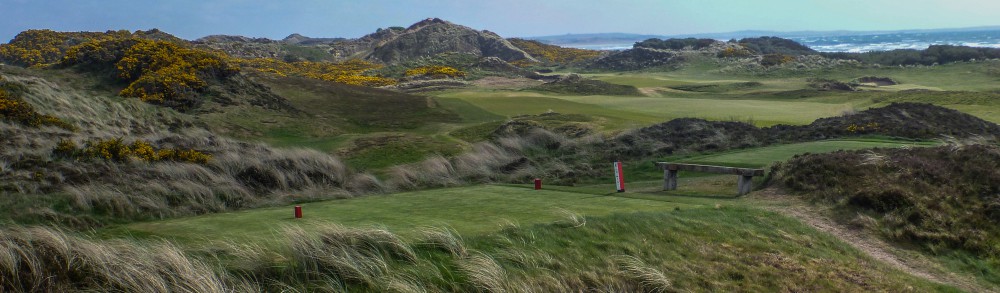
My luck-of-the-draw playing partners at Tarbat Golf Club, a ten-hole course in Portmahomack, Scotland, across Dornoch Firth from Royal Dornoch Golf Club. I don’t remember their names, but they lived nearby and worked in the oil industry. They were playing in a tournament but had no expectation of winning anything and so didn’t mind having me along. May, 2007.

Life, I discovered recently, is much shorter than it seemed to be when I was fifteen years old and waiting to get my driver’s license. I’m going to turn sixty in a little over two years, and not long ago I realized with distress that I scarcely have enough time left to paint the rest of my shutters, much less to qualify for the senior tour. And what about that twenty pounds I was going to lose?

Fortunately, I’ve already managed to accomplish more than I ever thought I would. In a club tournament a few years ago, I five-putted from six feet, turning a merely bad round into one that I’ll be able to boast about to my grandchildren. I also once spent part of a family vacation writing an apology letter to the entire membership of my golf club, after (allegedly) behaving like a man half my age.

Now that I really am my age, I intend to devote the dwindling remainder of my time on earth to telling other people what to do. Here is the first of ten important things that I think every serious golfer ought to try to accomplish before it’s too late:

1. Explore golf from the singles line. Like most golfers, I play most of my rounds with people I know already—guys I tend to think of as my best friends, even though I’m not sure where some of them work or whether they have kids. However, I’ve played more than a few of my favorite rounds with total strangers after showing up at an unfamiliar course by myself or with less than a full foursome. At various times over the years, on golf courses on four continents, I’ve fortuitously been paired with: a French real estate developer who had a weekend house in Morocco, a guy who owned and operated a souvlaki pushcart in Manhattan, the man who served as the Senate’s chief counsel during the Iran-Contra hearings, a retired Korean wigmaker, three guys who were playing hooky from their jobs on the assembly line at Boeing, a future chairman of the Securities and Exchange Commission, a teacher who had recently started a golf program at an inner-city high school, a retired cotton broker who had once been a colleague of Paul McCartney’s father, and an unemployed carpenter who looked like George Carlin and told me that the key to golf is to “swing easy as hard as you can.” How many other relatively ordinary activities throw you together with people like that for an afternoon?

To be continued.

The ninth/eighteenth at Tarbat. This is one of my favorite golf holes anywhere: a short par-four that plays either around, over, alongside, or into a cemetery, depending on the shape and length of your tee shot.

Back-Roads Scotland: Forfar Golf Club

Forfar Golf Club, Scotland, May, 2007.

Forfar, Scotland, is a small town about dozen miles northwest of Carnoustie. Its most famous resident may be Bon Scott, the lead singer of the rock band AC/DC, who was born there in 1949 and died, of acute alcohol poisoning, in 1980.

Brian.

Forfar—prounouced FOR-fer—has a golf course, which was designed by James Braid. I pulled in one evening in 2007, to make sure I’d be able to find it the following morning. It was almost time for dinner, and I wasn’t really planning to play, but suddenly I found myself in the golf shop handing my credit card to the wife of the head pro. On the course, I soon caught up to and joined three members: Brian, a local builder, who sounded a little like Sean Connery and carried his golf bag by the handle, like a suitcase; Gavin, a retired local cultural administrator; and Michael, a jeweler. Here’s the sort of golfers they were: all three, despite having played the course regularly for many years, were surprised to learn that the round blue marker in the center of each fairway was 150 yards from the green. Gavin told me that the three of them played together almost every Monday evening because “then there’s no one in front and no one behind.” They took lots and lots and lots of swings, although we still finished in just about exactly three hours.

The next morning (after breakfast and a bucket of balls at the local driving range, on the other side of town), I played a second round at Forfar. A ladies’ medal competition was going on just ahead of me, so I had plenty of time to admire the course, which is well inland and is surrounded by farms but feels very much like a links course, in part because most of the fairways have distinctive undulations, like gentle ocean rollers—remnants of ancient flax furrows, Brian had told me. (You can see the furrows, sort of, in the photo at the top of this post.) And when I finished I still had time to kill, so I went around again. And the following year I came back, with friends from home.

If I were sure I’d return to Forfar as often as I’d like to, I’d accept an email solicitation I received a few days ago:

15 months membership for the price of 12!

New members can join straight away for the 2012 price of £485 (£460 + £25 bar credit) and receive membership of the Club through until 31st December 2013!

To join call now on 01307 463773.

The 2013 subscriptions for the remainder of the year are as follows:

Full Membership: £485*

5 Day: waiting list in operation
Under 25: £260
Family: £970** (2 adults & unlimited children)
Junior: £100 (17 & 18)
            £75 (12-16)
            £50 (8-11)
Country: £310
*includes £25 bar credit
**includes £50 bar credit

You will be assured of a warm welcome so please don’t hesitate to contact us by telephoning or sending an enquiry to our email address.

For more information on the benefits of membership at Forfar Golf Club please see below.

  • Excellent layout for all ability of golfers to enjoy.
  • Comfortable clubhouse with refurbished lounge & dining room
  • Driving Range facilities
  • Competitions every Thursday, Saturday and Sundays
  • Online tee time booking & Members Website
  • Unlimited Members guest tickets
  • Reciprocal arrangements with other Clubs for reduced greenfees and a member of the Association of James Braid Courses
  • Membership categories to meet your needs
  • Monthly Newsletter
  • SKY tv
  • Free WiFi
  • Excellent Catering facilities 7 days a week
  • PGA Pro with fully stocked golf shop
  • Discounted rate for FGC members on the Angus Council ‘Be Active’ scheme

Payment can be made by all the usual methods and the Club offers a Direct Debit scheme through Premium Credit Ltd.

My Close Personal Friend Donald Trump

Donald T. and David O. in front of the waterfall at Trump International Golf Club, West Palm Beach, Florida, March, 2012.

For the July issue of Golf Digest, I wrote an article about Donald Trump and his newest golf course, Trump International Golf Links, near Aberdeen, Scotland. Back in March, Trump and I played  a round at his course in Palm Beach (photo above), and I spent one night at Mar-a-Lago, which Trump saved from demolition in the 1980s and now operates as a private club (photo of in-room amenities below).

Mar-a-Lago: only the best.

Trump is unimpressed by golf courses he doesn’t own, especially when he compares them with his Scottish course (which will open next week). “I know Bandon Dunes,” he told me over lunch. “The biggest dune there is like one tenth the size of our smallest dune. It’s a toy. And they get such great reviews. Every one of my courses is, like, amazing.”

Trump’s courses really are amazing; the one in Bedminster, New Jersey, was recently chosen by the U.S.G.A. to host the 2017 U.S. Women’s Open, and the others are stand-outs, too, although they aren’t necessarily as great as he says they are. A few years ago, he bought a bankrupt course in southern New Jersey, called Pine Hill, and turned it into Trump National Golf Club Philadelphia (it’s just over the state line from Pennsylvania). According to him, it should probably be considered the best course in the world (other than his course in Scotland).

“It’s a better course than Pine Valley,” he told me, “because it has much better elevation. And I love Pine Valley, but this course is better. Now, it will never be judged better, because nobody will ever give me the fair shake of doing that. But that’s OK. It’s a better course than Pine Valley—and the Pine Valley people say that, too, although they won’t say it publicly. Two of them came over to me and said, ‘Mr. Trump, this is better than Pine Valley, but please don’t ever quote me.'”

Trump’s courses, wherever they are, do often have cool cars parked in front of them:

Three Ferraris plus my rented maroon Kia, Trump International Golf Club, West Palm Beach.

Automobile arrangements like that don’t happen by accident. When I told the parking attendant I didn’t think I’d ever seen three Ferraris in a row, he said the boss had told him to be sure I noticed.

Trump is a very good golfer, even though he says he is.

In the photo above, Trump’s hair is hidden by his hat, which he didn’t take off during golf or at lunch, but I got to study it over dinner that night, at Mar-a-Lago. From straight on—which is presumably how he sees it in a mirror—it looks almost normal, but if you get any kind of an angle on it you can tell how structurally complex it is. And he must do it himself, because his wife wasn’t with him and I don’t think he was traveling with a hairdresser. I was impressed.

D.T. and John Nieporte, the head pro.

Off the record, I had a swell time hanging around with Trump. (Trump uses “off the record” not to protect confidences but to give emphasis to public knowledge he hopes you’ll quote—as in, “Off the record, I took down the trees and made the front page of the Washington Post four days in a row”—and I’m going to start doing that, too.) He’s a little exhausting to be with, because his only real topic of conversation is himself, but he doesn’t make you feel nervous or inferior, the way so many billionaires seem to do nowadays.

He’s also accessible. A decade ago, I wrote a long article for The New Yorker about concrete, and in it I quoted him at some length, since he built the first concrete office building in New York and knows a lot about the subject—although he was sometimes hard to understand because during our entire telephone conversation he was eating an apple. But he took my call, and he had interesting things to say.

Back-Roads Scotland: Fraserburgh

Fifteenth green, Fraserburgh Golf Club, Scotland. Photo by Ian Stephen.

For the July issue of Golf Digest, which is on sale now, I wrote an article about Donald Trump and his newest golf course, Trump International Golf Links, in Scotland. The course is on the North Sea coast, a two-and-a-half-hour drive north from the Old Course at St. Andrews and about ten miles beyond the port city of Aberdeen. You should definitely play it if you have a chance—it will open July 10—and after you’ve done that you should get back on the A90 and drive another hour north, to the town of Fraserburgh, at the easternmost end of the Moray Firth. It’s the home not only of the Kinnaird Head Lighthouse and the Museum of Scottish Lighthouses, but also of Fraserburgh Golf Club, the seventh oldest in the world.

Fraserburgh foghorn, April, 2012. It was built in 1902. It's not still in use, but the museum keeps it painted.

I played Fraserburgh with two older members: Bill Maitland, who owns a furniture store in town, and Andrew Tait, a member of family of extremely successful fishermen. The morning was cold and the wind was blowing hard, and I wore two pairs of rain gloves, one on top of the other, in the hope of maintaining feeling in my fingers. Tait, in contrast, didn’t wear even one glove, and the explanation was what I guessed: after you’ve spent  a few decades fishing in the North Sea, it takes more than wind to make your hands feel cold on land.

Town of Fraserburgh, viewed from the golf course. April, 2012.

Fraserburgh’s first and eighteenth holes are flat and forgettable, but nearly everything in between is brilliant, beginning with the second, a par 4 that plays up what looks like the surface of the moon, on the flank of a mountainous dune called Corbie Hill:

Second Hole, Fraserburgh Golf Club. Photo by Ian Stephen.

Golf in the region goes back a long way. Local church records show that a parishioner named John Burnett was sent to the “maisters stool” for “playing gouff” on the links of Fraserburgh in 1613. The club was founded a century and a half later, in 1777, and it has the documents to prove it. At lunch after our round, Maitland showed me a copy of the original membership register. “These names are still well known to us,” he said—and by that point they were well known to me, too, because I had seen them on plaques and trophies in clubhouses along the coast:

"These names are still well known to us," Bill Maitland told me.

Fraserburgh’s original members got together for lunch after they played, just as they do nowadays, and they were required to pay their share of the bill whether they showed up or not—an excellent rule that my own gang ought to adopt. After we’d eaten, Tait took me to the wharf to see his family’s three fishing boats. He lives on a farm a few miles down the road and has his own five-hole golf course, which he plays when he’s too busy to get to the club.

Andrew Tait, Fraserburgh wharf, April, 2012. The boat is named for his parents.

Fraserburgh’s eighteenth hole is called Bridge, after a footbridge over some railroad tracks along the western edge of the course. The rail line connected Fraserburgh with Aberdeen and the villages and golf courses in between—a sort of Linksland Express. It closed in 1965, though, and the footbridge was demolished, so Fraserburgh’s eighteenth is now a golf hole with a ghost name. The course is still there, though, and it’s one of many worthy destinations along the coast for links-golf pilgrims who can be persuaded not to turn around after playing Carnoustie.


More About Foursomes: Muirfield, Troon, Prestwick, and Kümmel

The golfer's liqueur.

In 2009, I played a round at Muirfield, in eastern Scotland, where the Open Championship will be held in 2013. Alastair Brown, the secretary, described it to me (over lunch) as “a lunching club with a golf course attached to it.” A member, he said, once described an ideal day at Muirfield as “two-and-a-half, two-and-a-half, two-and-a-half”: a two-and-a-half-hour 18-hole foursomes match in the morning, followed by a two-and-a-half-hour lunch, followed by a two-and-a-half-hour 18-hole foursomes match in the afternoon.

In the United States, foursomes is usually known as Scotch foursomes or alternate shot, and it’s often a prelude to divorce; at Muirfield, it’s the signature game. Hitting just half the shots gets the non-lunch portions of the day over faster, and ensures that someone always has a hand free to hold the kümmel, a clear, anise-and-fennel-flavored beverage, which is sometimes called the golfer’s liqueur. “The way the club’s members play golf is the antithesis of championship golf,” Brown told me—and he meant that as praise. Muirfield has its own foursomes handicapping system, named after C. J. Y. Dallmeyer, a club captain in the 1950s, who invented it: if you go three-up in a match, you give strokes to your opponents until you’re back to one-up. Dallmeyer also initiated a heavily lunch-oriented New Year’s Day tournament, called the Captain’s Frolic.

Foursomes is also a historically significant game at Royal Troon and Prestwick, two other courses on the Open Rota, on Scotland’s west coast. Every year, members of the two clubs play a cross-country foursomes match over both courses, which abut each other. Half the field starts on the first tee at Prestwick, and half starts on the first tee at Troon. Everyone plays to the eighteenth green on the other course, breaks for lunch, and then plays all the way back. The two members I played with at Troon told me that, usually, a team scores better if it starts at Prestwick, because a typical Prestwick lunch includes so much alcohol that golfers who make the turn there sometimes have trouble finding their way home.

Before lunch, Royal Troon, May, 2009. I'm standing on the tee of the famous Postage Stamp. That's the green by my right arm.

Muirfield has an undeserved reputation for hostility to outsiders. It’s true that visitors are limited to specific tee times on Tuesdays and Thursdays, but the club actually welcomes thousands of unaccompanied non-members every year, and you can make reservations online. You have to wear a jacket and tie in the dining room, but the atmosphere is seductively informal, and even visitors are encouraged to linger. No table has fewer than six chairs, an arrangement that forces groups of golfers to mix, and the food is served cafeteria-style. Diners who don’t live in fear of their cardiologists sometimes bypass lunch itself and move straight from the bar to the dessert table, where the specialties include rhubarb crumble, sticky toffee pudding, and ice cream from S. Luca of Musselburgh, a locally famous dairy.

Muirfield’s locker room has modern, car-wash-caliber showers, like the ones at Merion and Pine Valley, but the other amenities are distinctly old-school, among them a pair of wooden dressing tables, each furnished with a shaving mirror, a nail file on a chain, and a single hairbrush and comb (and no beaker of blue Barbicide). And the members’ locker room at Prestwick is even cooler. Ninety of the lockers there date back to 1877. They look like Queequeg’s coffin.

Want to Buy a Building Lot at Augusta National?

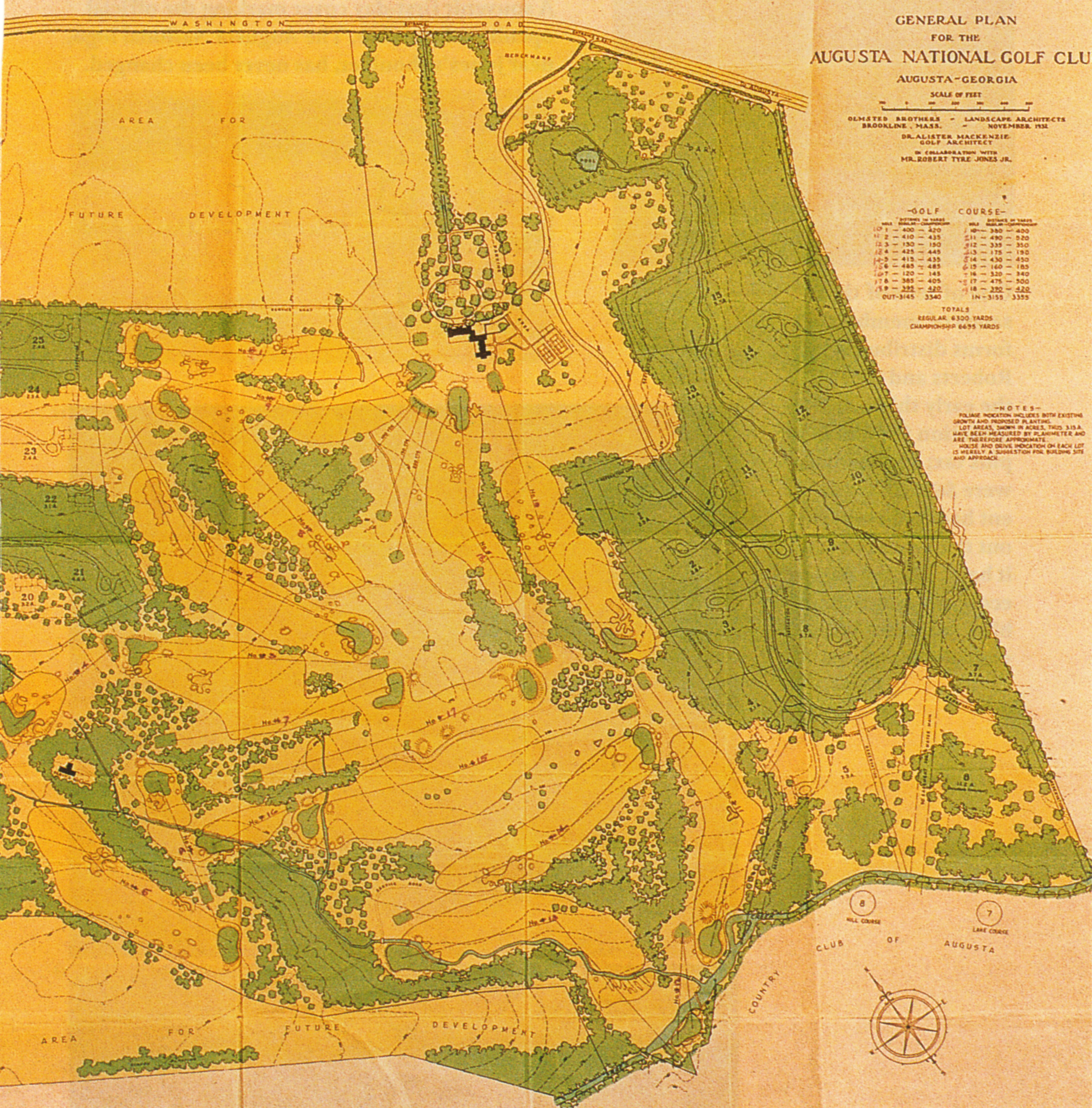
Olmsted Brothers' 1932 Augusta National real-estate development plan. If your eyes are good enough, note the tennis courts and the brand-new clubhouse—none of which were built. Also note the small practice area, between the ninth and eighteenth holes.

Augusta National Golf Club suffered severe financial problems during its first two decades, which coincided with the Great Depression and the Second World War. Its lenders actually foreclosed in 1935, just eight months after Gene Sarazen had seemingly secured the future of both the club and the Masters by hitting “the shot heard round the world.” (I explore those difficulties at some length in The Making of the Masters.)

One of the club’s best hopes for raising money in the early years was to sell building lots overlooking the course. Roughly a third of the club’s property was reserved for that purpose, and the lots were delineated and numbered on several early maps, including the plan reproduced above. For the most part, the lots occupied areas west of the second fairway and east of the tenth and eleventh. (Note to Laurentius: The spot where Rory McIlroy’s yanked tee shot on the tenth hole ended up during the final round of the 2011 Masters was near the edge of Lot No. 1.)

The club’s development plan, which was created by the landscape architecture firm Olmsted Brothers, called for two dozen building sites, and additional acreage was reserved for more. Most of the lots were between three and five acres; the largest, No. 6, was twelve acres. The club actively tried to sell those lots or others for more than twenty years. Boundary lines were cleared, access roads were built, lots were numbered with signs that faced the roads, and a major, continuing effort was made to stir up sales—all without success. In the early 1930s, W. Montgomery Harison, an early member, bought three adjoining lots just beyond the first green, but he was the only taker. He built a huge brick mansion, which stood until 1977, and the elder of his two sons built a much smaller house next door. (Harison’s younger son, Phil, was the tournament’s official starter for more than sixty years. He died 2008, at the age of 82. His own son is a member now.)

W. Montgomery Harison's house overlooking Augusta National's first green, during the Masters in 1941. (The photographer was standing near the ninth green and looking up the first fairway.) The house was torn down in 1977.

After the war, the club briefly considered leasing or renting the remaining lots, at annual charges ranging from $250 to $500 a year. When no enthusiasm for that idea was evident, the club gave up on the original subdivision and for four or five years pursued a more modest development plan in a different location. This new subdivision—which was to be called De Soto Trail—was situated just east of the area now occupied by the par 3 course. It consisted of twenty-four lots, most of them about a half-acre, and was targeted not at club members but at local middle-income families. To avoid the expense of building an access road and installing utilities, the club in 1949 offered the entire parcel to Augusta real-estate agents. There were no bids. The club then tried without success to sell the lots individually. Late in 1952, a developer offered $18,000 for fifteen acres. Roberts viewed that figure as too low, and the club eventually abandoned the entire idea.

Today, golf fans and even club members are almost always amazed to learn that Augusta National, in more than twenty years of conscientious effort, could turn up only one buyer interested in building a house near what today may be most fabled golf course in the world. If the same lots were offered for sale today, the bids would undoubtedly be astronomical. The failure of the real-estate projects underscores the immensity of the challenge that Clifford Roberts and Bobby Jones, Augusta National’s founders, faced in nearly every area of the club’s operation. As late as the early 1950s, Roberts couldn’t get local real-estate developers to return his calls.

It was only in the mid-1950s—when the tournament was securely established, and both the club and the country were on better financial footing—that Roberts began to view all development ideas as a mistake. A local club member named Julian Roberts (no relation) eventually bought Harison’s property and later sold it back to the club. One of Clifford Roberts’s last acts before taking his life, in 1977, was to walk to the first tee with the help of a waiter so that he could look up the fairway and assure himself that the house had been torn down.


Should You Live on a Golf Course?

Houses overlooking the second fairway, Cruden Bay Golf Club, Scotland, May, 2008.

To live on a golf course is not a universal aspiration. At a club where I sometimes play, a dozen houses back up to various fairways. Over the years, the owners of those houses have taken pains to obliterate their views of the course. They’ve built fences, planted bushes and trees, and hung No Trespassing signs. One scary old guy patrols the boundary of his yard the way East German soldiers once patrolled the Berlin Wall. Follow a bad drive into his garden and he unchains his dog.

It’s not that the course is ugly or the golfers rude. It’s just that to some people a fairway is no more attractive than a freeway. Golf, to them, is a public nuisance. (You can’t sunbathe in your underpants when local slicers treat your patio as a cart path.) Some people live next to golf courses because they figure they can’t afford to live someplace nice.

Howard indicating the house I'm going to buy as soon as this blog has made me rich. Royal Portrush Golf Club, Northern Ireland, April, 2012.

I belong to the opposing camp, the folks who view an adjacent par 4 not as an invasion of privacy but as a big, free, weedless lawn. At least, I would if I lived next to one. The perfect neighborhood, in my view, would be the one in the photo above, next to the fourth fairway at Royal Portrush, in Northern Ireland. Or how about something ocean-oriented at Cypress Point, in California? I’ve even picked out a building site: that wind-swept knob to the right of the sixteenth green:

Sixteenth hole, Cypress Point Club, Pebble Beach, California.

I wouldn’t care if a stray shot shattered my front window every once in a while. Heck, I wouldn’t care if you and your foursome cut through my kitchen on your way to the seventeenth tee. Help yourselves to beer! I’d just like to be able to step out my back door and tee it up whenever I wanted to.

I'd also be happy with any of these. North Berwick Golf Club, Scotland, April, 2008.

Next: Would you be willing to spend a few hundred dollars for a building lot at Augusta National? You (or your parents or grandparents) could have, but didn’t.

18 Good Things About Golf: No. 9

Looking at clubhouses counts as sightseeing. Royal & Ancient Golf Club, Old Course, St. Andrews, Scotland, May, 2008.

9. Golf provides an organizing principle for travel. Mere idle globe-trotting doesn’t appeal to me; I like a trip to have a purpose. For that reason, I enjoy traveling with children. Having kids along forces you to do things you really enjoy (buying ice cream, visiting a dungeon museum, taste-testing foreign candy) and to skip things you really don’t (going to plays, touring the wine country, looking at statues). Keeping your kids from slitting each other’s throat compels you to find activities that actually are interesting, as opposed to merely sounding like the kinds of activities that people engage in when they go on vacation. When children are not available, golf can serve a similar function. Rather than tramping aimlessly around Scotland in the hope of being moved by the differences between it and America, you tramp around Scotland checking off names on your life list of Open Rota courses.

On a golf trip, every day has the same unimprovable agenda: wake up, take shower, drink coffee, eat bacon, play eighteen holes, eat lunch, play eighteen holes, drink beer, take shower, eat dinner, go to sleep. The best golf trips, unlike the vacations that wives plan, never leave you wondering what to do next, and there is never an empty three-hour time block in which you might suddenly be expected to look at a cathedral. You don’t have to wait between lunch and golf, or between golf and beer, or between beer and shower, or between shower and dinner. When one agreeable activity ends, another begins. And on the last day, during the long drive back to the airport, you can pass the time by planning the next trip.

I did actually have a look at a Scottish castle in April, but it was on the road between golf courses and I needed to take a whiz.

Scientist Identifies Evolutionary Basis of Love for Golf

Ur-golfers, working on their short game.

In his new book, The Social Conquest of Earth, the retired Harvard sociobiologist Edward O. Wilson writes about the “innate affiliation” that humans feel with landscapes that resemble “those environments in which our species evolved over millions of years in Africa.”  That is to say, golf courses.

“Studies have shown,” Wilson writes, “that given freedom to choose the setting of their homes or offices, people across cultures gravitate toward an environment that combines three features, intuitively understood by landscape architects and real estate entrepreneurs. They want to be on a height looking down [tee boxes], they prefer open savanna-like terrain [fairways] with scattered trees and copses [rough], and they want to be close to a body of water, such as a river, lake, or ocean [hazards].” For a good example of just such a landscape, you need look no farther than the photograph at the top of this page, which I took last spring at Royal County Down Golf Club, in Newcastle, Northern Ireland. Here’s another, from Cruden Bay Golf Club, in Scotland:

Cruden Bay Golf Club, Scotland, April, 2008.

And the game itself is biologically resonant. Part of its addictiveness, for those of us who are hooked, arises from the thrill of effecting action at a distance—a form of satisfaction that must also have been known to our spear-throwing ancestors. A golfer is a hunter. Stiffing it on a par 3 and felling a woolly mammoth are parallel thrills. We are as nature made us.

Women don’t necessarily feel the same way about golf, and there’s an evolutionary explanation for that, too: men are chromosomally predisposed to doing virtually anything their wives don’t want them to do. (My first literary agent, an enlightened woman, provides ironic support for this hypothesis. For many years, she has tried to persuade her husband to take up golf—“I want to be a golf widow,” she told me once—but he has refused.) Such innate contrariness must have given our humanoid ancestors a powerful evolutionary advantage. A possible scenario: Female cave people implored their mates to spend more time around the cave, picking up saber-tooth tiger bones and entertaining the children; those who complied watched their families slowly starve to death, while those who ignored their mates and went hunting instead survived. In such beneficent behavior we may be seeing evidence of the forerunner of the modern golf gene.

These are the Best Golf Shoes, and I’m Not Kidding

The True Linkswear golf shoes of Tony, David O., Tim-o, & Tim. Royal Portrush Golf Club, Northern Ireland, April, 2012.

Among the hits of last year’s PGA Golf Merchandise Show were some unusual golf shoes, made by True Linkswear. They look a little like Earth Shoes and a little like Crocs: the front end is wide, allowing your toes to spread out the way they do when you walk barefoot, and there’s almost no heel. A teaching pro who now works for the company told me, “It took me a week to get over it, visually.” But golfers learn to love the look, he said, and are often able to throw away their orthotics, like crutches at a revival meeting. (It’s also possible that True Linkswear shoes promote a slightly better swing, by making it harder for you to lean over your toes.) The company’s reps brought 300 pairs to Orlando but had to stop selling them after just a few hours because they were running out of samples. By the time I got to the booth, they no longer had a pair in my size, but the ones I tried on—which were half a size too small—were still the most comfortable golf shoes I’d ever worn. I now own four pairs.

I took two of those pairs to Ireland this month, along with some New Balance walking shoes. I figured that the walking shoes would be good for après-golf—but I was wrong about that, because by comparison with my golf shoes they felt like army boots. I wore the walking shoes when we went out to dinner our first evening in Ireland but left them in the car after that, and wore only my golf shoes. And I never felt even a twinge, despite the fact that, according to Tim-o’s Fitbit Ultra, we walked between eighteen and twenty-two miles a day (while playing 36 holes and searching for balls among the dunes). And I wore my Trues on the flight home, too.

I wasn’t the only True believer on the trip: Tony, Tim-o, Tim, and I all wore them, in various models and colors—as you can see in the photo above.That’s four of the seven golfers on the group. And Jack wore FootJoy Contour Casuals, which look and feel like sneakers and which he also didn’t bother to take off. It’s now hard for me to believe that golfers ever played in shoes that had stiff soles and metal spikes and had to be broken in.

I’ve retired my original pair of Trues from active golf duty, but I wear them when I work in the yard, walk the dog, and wander through the woods. I’d wear them in the house, too, if I ever wore shoes in the house. And a day will come, I predict, when I will own no other shoes.

Brendan icing a foot rubbed raw by a week of links golf in conventional golf shoes. Cullen Golf Club, Scotland, May, 2008.