In Love With Ireland

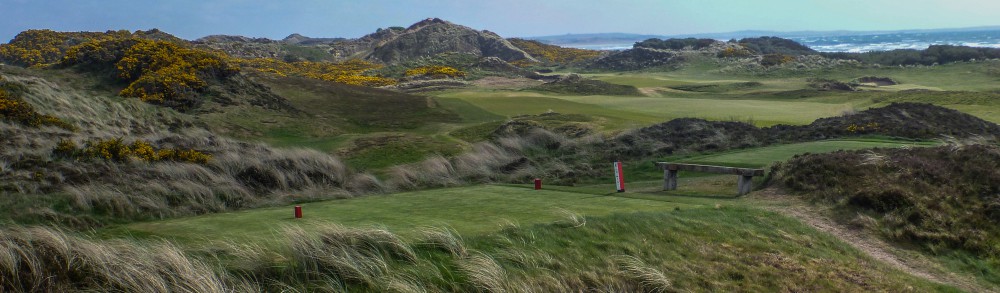
Portstewart Golf Club, Northern Ireland, April, 2012.

Six friends and I returned this afternoon from eight days and fourteen rounds of golf in Northern Ireland and Ireland, and earlier this month I spent a similar week, by myself, in northeastern Scotland. I’ll have more to say both trips as soon as I’ve reintroduced myself to my wife and gotten caught up with the pile of stuff on my desk. In the meantime, I’ve been thinking about an earlier Ireland trip, back in 2006, and something that happened on the evening I arrived in Shannon (from Dubai!).

The baggage carousel was still revolving, but several minutes had passed since the last suitcase tumbled onto the conveyor. A young woman in a green Aer Lingus uniform walked over to me. “Is your bag missing?” she asked, her eyes radiating concern. I looked around. The other passengers had departed. The truth sank in. “My g-golf clubs,” I said.

It’s the traveling golfer’s nightmare. I had come to Ireland to spend a week playing southwestern seaside courses, and now, I thought with horror, I was going to have to play Ballybunion with rented equipment—with battered, mismatched irons and woods contaminated by the bad-swing juju of who-knew-how-many anonymous choppers, shankers, and honeymooning beginners. How could I face Waterville without my very own Banzai-shafted 10.5-degree jumbo driver, not to mention my humiliatingly extensive but indispensable collection of hybrids?  I followed the Aer Lingus woman into her office, where she helped me file a claim.

Fifteen minutes later, I was sitting numbly in a taxi, on my way to the tiny resort town of Lahinch (which is famous in Ireland not only for golf but also for surfing, of all things). Three Golf Digest colleagues would be joining me there the following afternoon, along with two rental cars. I was trying hard to appreciate the lush landscape on either side of the road, but I couldn’t stop thinking about my clubs. Why couldn’t the airline have lost Jodie Foster’s daughter instead? Then the driver’s cell phone rang.

“Right,” the driver said, after a brief conversation. “You’ll have your golf clubs by noon tomorrow. I’ll probably deliver them myself.” The young woman in the lost-baggage office, it turned out, had located my bag, in London, and had then taken the time to locate me, by telephoning the taxi dispatcher and asking if a Mr. Owen had been sent to Lahinch. I leaned back against the seat and smiled, finally able to relax. The next morning, I borrowed a set of clubs from Robert McCavery, just the fourth head professional in Lahinch’s 120-year history—he succeeded his father, Bill, who got the job in 1927—and played eighteen holes with two middle-aged women from Switzerland, who were traveling without their husbands.  My golf bag arrived just as we finished.

A week later, I was back at Shannon Airport, killing time before my flight home. And sitting at a table on the other side of the coffee shop, I suddenly noticed, was the young woman from the lost-baggage office—the woman who, a week before, had tracked me down in my taxi. I rushed over, and thanked her for her kindness.

She looked startled for a moment, then smiled. “Mr. Owen,” she said.

We have a responsibility, as golfers and as Americans, not to abuse the hospitality of this gracious, enchanting country.

Tony, Tim-o, Dave-o, Tim, David W., Howard, Jack: Enniscrone Golf Club, Ireland, April, 2012.

Improved Golf Transit

Trolleys, Portstewart Golf Club, Northern Ireland, April, 2012.

At home, my friends and I have almost always walked and carried our bags. In Scotland four years ago, though, we became semi-converted to pull carts–which are called trolleys in the U.K. and Ireland (and are called buggies in Australia). At first, we weren’t very good at handling them and were constantly tipping them over and crashing them into one other, as you can see in the photo below, from Cruden Bay in 2008. (Those are the steps that connect the first tee and the clubhouse. A trolley ramp is built into them, but we still managed to screw everything up.)

Trolley accident, Cruden Bay Golf Club, Scotland, 2008.

Unfortunately, the standard rental trolley is ill-designed for the only job it has to do. An easy way to make up for its major defect is to travel with your own bungee cord, as I do, and use it to secure your bag to the frame, as in this photo, from Enniscrone, where we played yesterday:

Golf bag secured to rental trolley with bungee cord, Enniscrone Golf Club, Ireland, April, 2012.

I still overturn my trolley fairly often, but when I do my bag doesn’t usually fall completely off. The only time I got into serious trouble yesterday was as I was leaving the fourteenth green. I took a path that was meant not for trolleys but for mountain goats, and eventually had to pick up the trolley itself (with the bag securely attached) and carry it.

Blood-sucking Arachnids and Golfers’ Legs

The summer before last, I was sitting on a bench on a golf course on Martha’s Vineyard, waiting for the slowpokes ahead of me to putt out, and passing the time by admiring the sharply demarcated tan lines around my ankles. As is the case with many avid golfers, in high summer I appear to be wearing white socks even when I’m barefoot. (“Your feet look like replacement parts,” a non-player told me once. “Too bad they didn’t have them in your color.”) For variety, I also studied my shins, and marveled that so many of my freckles resembled tiny bugs.

Then I gasped: Quite a few of those freckles were tiny bugs. Even without my bifocals, I could tell that they were deer ticks, at least a dozen of them on each leg. About an hour before, I had waded into a patch of tall grass (in order to take a whiz), and the ticks must have ambushed me there. I carefully removed all of them before teeing off, and made a mental note to add a pair of tweezers to my golf bag.

Lyme disease, which is transmitted by tick bites, is a significant hazard for golfers in my part of the country—especially for those of us who occasionally venture beyond closely mown areas, seldom play in long pants tucked into socks, and sometimes forget to bathe in DEET. I didn’t get sick that time—deer ticks usually can’t infect you unless they’re embedded for a day or two—but the experience reminded me to be more careful.

Nevertheless, in 2006 I did come down with Lyme, for the third time in ten years. (I’ve had it once more since then, and so has my dog.) Because I’m a veteran, I recognized the symptoms right away: flu-like aches and pains, throbbing head, a hip that hurt every time I swung a club. My doctor, whose handicap is 14, prescribed an antibiotic, even though neither of us could find evidence of a bite. I began taking the pills immediately, but still got so sick that I had to miss not only a week’s worth of golf but also my daughter’s college graduation. A blood test later proved that I’d had both Lyme and ehrlichiosis, another tick-borne disease, which is like Lyme delivered by sledge hammer. It is possible to get Lyme and ehrlichiosis from the same tick bite, as I probably did—most likely while playing golf.

While my daughter was receiving her diploma, I was shivering in bed at home. I felt so ill that I called my wife and told her that I was going to check myself into the hospital. She called my regular golf buddy Bill, who drove over immediately and took me back to his house instead. Bill’s wife, Martha—who introduced me to golf, twenty years ago, by taking me out for nine holes—is a registered nurse. She gave me orange Jell-o and a Popsicle, and Bill made me white toast cut into star shapes. That night, they put me to bed in their son’s old room, and the next morning I felt well enough to go home. When I thanked them for taking such good care of me, Bill said, “Hey, what are golf buddies for?”

Two great things about about links golf in the British Isles and Ireland: hardly any lightning and no Lyme-bearing ticks. In 2008, eight friends from home and I spent a week playing golf in Scotland. Toward the end of the trip, Stanley suddenly got the sweats and felt lousy. He knew it was Lyme—he’s had it more often than I have—so he went to the medical clinic just down the road from Cruden Bay Golf Club. The doctor there had heard about Lyme but never seen a case. He looked it up in a book, agreed that Stanley’s symptoms matched the description, and prescribed doxycycline—no charge for the visit or the pills. It was Stanley’s seventieth birthday, so we all pitched in and got him a caddie. That’s Stanley below, on the mend at Cruden Bay, holding a birthday balloon that we also gave him. (We found it in a trash can.) Hey, what are golf buddies for?

Stanley, Cruden Bay Golf Club, Scotland, 2008.

Golfer’s Cure for Jet Lag

The cure for jet lag is golf. You take the overnight nonstop to Scotland from Newark, arrive bleary-eyed in Glasgow at 8:00 in the morning, drag your clubs past the bomb-sniffing dogs in customs, stumble into a men’s room designated “loo of the year,” change a tall stack of American dollars into a short stack of British pounds, drive 55 miles through Robert Burns country while trying to remember to admire the sheep-dotted hillsides, reach Turnberry in a daze—and tee it up on the Ailsa course, where Tom Watson and Jack Nicklaus fought their legendary Duel in the Sun, at the British Open in 1977. You haven’t slept since what seems like the day before yesterday, but your tee shot somehow finds the fairway, and a little mental arithmetic reveals that your colleagues back home are arriving, just now, at their desks. Suddenly, you feel happier than you’ve felt since the birth of your first child, or since the time you and your brother nearly won the member-guest. (Not to worry: The cure for excessive cheerfulness is also golf.)

Or so I’ve decided over the years, during a number of golf trips abroad: Hit the ground running, and keep running until dinner. I was gratified recently when a doctor who treats sleep disorders, whom I was interviewing for an article, recommended the same thing. To beat jet lag, he said, don’t take a nap upon arrival (my wife’s approach); keep your eyes open until the locals call it a day, or at least until the sun has gone down. That’s what I did this past week, in Scotland, and it’s what I did again yesterday, when I got back home. And I’ll do it again tomorrow, when six of my friends and I take off for a week of golf in Northern Ireland and northwestern Ireland.

Yesterday, my last day in Scotland, I had to interview someone in downtown Edinburgh, and I took a taxi from my hotel, which was at the airport. A guy up ahead of us did something stupid, but the taxi driver anticipated it—he told me he could read the guy’s mind—and he honked and said “What an idiot!” almost before the guy himself knew what a stupid thing he was about to do.

The taxi driver doesn’t own a car, he told me; when he and his wife need to go somewhere far away, they rent one. Usually, they pick it up at 11:00 a.m. and return it the next day at 11:00 a.m. Sometimes, 10:00. He rents from Arnold Clark, and gets a medium-size car, like a Corsa or a Focus. Once, he got upgraded to a really big car because they were out of medium-size cars, and some of his relatives felt initially that he was putting on airs. Occasionally, when he and his wife go to visit his wife’s mother, who lives near the English border, they will use his taxi, an old-fashioned English black cab, and his wife will ride in the back, “regally.” In fact, when he retires, a few years from now, he may keep his taxi, because he enjoys driving it, and sell just the “plate,” which is their equivalent of a medallion. He and his wife go on holiday every September; last year, they spent two weeks in Greece. That cost £3,000, for the two of them, including air fare. He likes to stay in four-star hotels, but in Greece they stayed in a five-star hotel. He likes to take “all-inclusive” trips—self-catering is too much trouble on vacation—but the Greek trip included only breakfast and dinner. That didn’t bother him too much, because when he’s traveling he eats a lot at breakfast—orange juice, corn flakes, yogurt, porridge, eggs, sausage, bacon, black pudding, haggis, beans, you name it—so much that has to let out his belt when he leaves the dining room. His wife, by contrast, eats nothing but toast and sometimes has trouble making it even till lunch. Keeping the weight off is harder than it used to be, even though he goes to the gym, but what choice do you have? The places he and his wife like to go are: Spain, the Canary Islands, Greece, Majorca. They usually go away in September, after the schools have started up again, because then you can get bargains, but just yesterday he looked into going away in July, too. The best the travel agent could do, though, was £1,000 apiece, all-inclusive, for a week—even in Greece! He thinks it might be possible to do better online, but hasn’t checked yet. At any rate, the travel agent said to come back in July or August and have a look at September then. Next year, for his sixtieth birthday, his wife wants to take him to New York City, where he (unlike her) has never been. He wants to go, but four hours is the limit for him, air-travel-wise. Two hours, two and a half hours? Fine. He doesn’t start to panic if he’s in the air longer, but he doesn’t like it. The best way to fly to New York might be with a stop somewhere on the way—maybe in Iceland—to break up the flight. That might make the ticket cheaper, too, since the flight wouldn’t be direct. He thinks that four days should be enough for New York, and he has been told that the part of New York that he and his wife should visit is midtown Manhattan. He was very glad to hear that I agreed with that recommendation.

Golf Holes With Ghost Names

Newburgh-on-Ythan Golf Club, Scotland, April, 2012.

Last week, I played a round at Newburgh-on-Ythan Golf Club, in northeastern Scotland. The twelfth hole is called Home—an odd name for a hole far from the clubhouse. The explanation is that the course, which was first laid out in 1888 and originally had just nine holes, used to end there, across the Ythan estuary from the Udny Arms Hotel. The original clubhouse, which is cottage-size, still exists and stands nearby, although it hasn’t been used in many years. The current tenth hole, which was once the seventh, is a short par 4, just 339 yards. It was the same length in 1888, when it was called Long. (In those days, it was the only hole over 300 yards, and one of just two over 250.)  The fifteenth, near the old third, is called Boat House, because the old hole’s green was next to the hotel’s boat house. And the thirteenth, Majuba, was named after a battle in the Boer War, which was a topic of discussion during the club’s early years.

Newburgh-on-Ythan Golf Club, Scotland, early 1900s.

One of my favorite courses anywhere is the Island, in Donabete, Ireland, a few miles north of Dublin. Its fourteenth hole—which may be the world’s most intimidating short par 4—is called Old Clubhouse, because the old clubhouse used to stand where the tee box does today. In fact, the teeing ground is framed by the old foundation. And the club is called the Island because that’s what it looked like to the original members, who got to it by rowing across the estuary of the River Broadmeadow from Malahide, where golf-playing on Sundays was forbidden.

Choosing Teams in Scotland

Cruden Bay Golf Club, Scotland, 2008. That's the green of the fifth hole, a par 5, in the upper right-hand corner.

At five o’clock yesterday afternoon, I stopped by Cruden Bay Golf Club, in northeastern Scotland, on my way back to my hotel. I had played there the day before, and I thought maybe the pro would let me sneak out for five or six holes before dinner. He said OK–but the course was empty, so why stop? Snow began falling as I teed off on 5, but the sun was out again by the time I reached the green. I ended up playing all 18, in a little over two hours, and then ate dinner in the clubhouse, which has huge windows that overlook most of the course.

Spring snow, Cruden Bay, Scotland, April 2012.

This morning, there was snow on my rental car, which is a kind of MG I’d never seen before, and I had to scrape the windshield with one of my golf shoes. I played at 8:00 at Fraserburgh Golf Club, a wonderful links course up the coast from Cruden Bay. The Sunday-morning regulars at Fraserburgh choose teams the way my friends and I usually do at home, by pulling balls out of someone’s hat. The temperature was in the mid-30s, and the wind was blowing hard. The golfers below fortified themselves with quite a lot of Budweiser, which one of them referred to as coffee.

Choosing teams, Fraserburgh Golf Club, Scotland, April 2012.

In the afternoon, I played at Peterhead Golf Club, which is just a few miles south of Fraserburgh. You park in a public lot on the town side of the Ugie River and cross a footbridge to get to the golf club. They manage tee order slightly differently there:

Peterhead Golf Club, Scotland, April 2012.

I played with Peterhead’s pro, Harry Dougal, who has a crushing handshake and sometimes carries his golf bag like a briefcase. He lost his wife in a car accident eight years ago. He said that swallows nest in the club’s rain shelters–that green shed in the photo is one of them–and return (from South Africa) on the same day every year.

Harry Dougal, Peterhead Golf Club.

Snow fell hard a couple of holes before I took the photograph above, but it didn’t last very long. I brought four pairs of rain gloves on this trip, and I’ve worn them every round, for warmth. I’ve wiped my nose on them so often that they’re all sort of shiny and stiff. At Fraserburgh, I played with a semi-retired furniture-store owner and a semi-retired fisherman. The fisherman didn’t wear gloves of any kind, because a fisherman’s hands, by comparison with fishing, are never cold.

Alzheimer’s and Golf

I’m in Scotland. Yesterday, I played two courses on the east coast, north of Aberdeen: Inverallochy, which I knew nothing about, and Cruden Bay, which is one of my all-time favorites. The wind blew hard all day–that’s the flag on Inverallochy’s eighteenth green in the video above–but there was hardly any rain, and I was wearing plenty of clothes. Inverallochy isn’t the world’s greatest course, but it has some terrific holes, and you can see (and hear) the North Sea from all of them. I arrived before anyone else and accidentally set off the clubhouse burglar alarm by trying the front door. The club secretary pulled up a few minutes later and turned off the siren, and two young policemen got there a little after that and declined to arrest me, even though I said I’d go quietly. One of the cops was wearing a short-sleeve shirt. I, in contrast, had on two long-sleeve shirts, a sweater, long johns, and my rain jacket–just enough.

At Cruden Bay, I played with the pro, Neil Murray. When we were on the first green, a single golfer played up behind us, and we stepped aside to let him through. Neil explained that he was a longtime member and that he had Alzheimer’s. They try to keep him on the club’s nine-hole course, which is enclosed by the central part of the the big course, because he’s more out of the way there, but he wanders, and plays holes out of order, and, occasionally, plays holes in the wrong direction. His decline had been rapid, Neil said; just two years ago, he was working on the course as a ranger.

He had lost his ball, and looked confused. Neil invited him to play through, and after hesitating a moment he dropped a ball about ten feet from the hole and putted it with a hybrid–and sank it. Then he wandered off toward the second tee and dropped a ball and hit it. He was accompanied by a dog–one of the herding breeds, like a border collie–and it sort of moved him along, and lay down on the green while he putted, and ran in circles around him as he headed into the rough. Neil told me that he thought the dog guided him to and from the course–his house is nearby–and kept him out of serious trouble. The man is sometimes a danger to other players, Neil said, because he will hit into groups ahead of him, but the club was reluctant to do anything because letting him wander on the course gave his wife a break of a couple of hours every day. I saw him again later, wandering up near the clubhouse.

One of the best old players at my club at home died of Alzheimer’s. I saw him playing by himself occasionally when I first joined, and decided that maybe Alzheimer’s wouldn’t be completely terrible if you could keep playing golf–never remembering your bad shots or worrying about your next shot, just as Bob Rotella recommends. I asked my doctor about that, and he said that, unfortunately, the disease affects more than your memory, and eventually destroys your ability to swing. But for a while before he died the old guy at my club looked fairly content, at least from a distance.

Why a Golf Course is Not a “Links”

Rosapenna, Ireland, 2011.

Most people think of the word “links” as a synonym for golf course, but it’s actually a geological term. Linksland is a specific type of sandy, wind-sculpted coastal terrain—the word comes from the Old English hlinc, “rising ground”—and in its authentic form it exists in only a few places on earth, the most famous of which are in Great Britain and Ireland. Linksland arose at the end of the most recent ice age, when the retreat of the northern glacial sheet, accompanied by changes in sea level, exposed sand deposits and what had once been coastal shelves. Wind pushed the sand into dunes and rippling plains; ocean storms added more sand; and coarse grasses covered everything. Early Britons used linksland mainly for livestock grazing, since the ground closest to the sea was usually too starved and too exposed for growing crops. When significant numbers of Scotsmen became interested in smacking small balls with curved wooden sticks, as they first did in 1400 or so, the links was where they went (or were sent), perhaps because there they were in no one’s way. In some parts of Scotland, linksland is called machair, a Gaelic word. It’s pronounced “mocker,” more or less, but with the two central consonants represented by what sounds like a clearing of the throat. (Machair is the root of Machrihanish, a legendary links course on the Kintyre Peninsula, in western Scotland.)

Askernish, South Uist, Scotland, 2007.

The major design elements of a modern golf course are the synthetic analogues of various existing features of those early Scottish playing fields, and the fact that golf arose so directly from a particular landscape helps explain why, more than any other mainstream sport, it remains a game with a Jerusalem: it was permanently shaped by the ground on which it was invented. Groomed fairways are the descendants of the well-grazed valleys between the old linksland dunes; bunkers began as sandy depressions worn through thin turf by livestock huddling against coastal gales; the first greens and teeing grounds were flattish, elevated areas whose relatively short grass—closely grazed by rabbits and other animals, and stunted by brutal weather—made them the logical places to begin and end holes. (“A rabbit’s jawbone allows it to graze grass lower than a sheep,” the Scottish links consultant Gordon Irvine told me, “and both those animals can graze grass lower than a cow.”)

Askernish, South Uist, Scotland, 2007.

On the great old courses in the British Isles, the most celebrated holes often owe more to serendipity and to the vicissitudes of animal husbandry than they do to picks and shovels, since in the early years course design was more nearly an act of imagination and discovery than of physical construction. One of Old Tom Morris’s best-known holes, the fifth at Lahinch, in southwestern Ireland, is a short par 3 whose green is concealed behind a tall dune, so that the golfer’s target is invisible from the tee—a feature that almost any modern architect would have eliminated with a bulldozer. The greatest hole on the Old Course is often said to be the seventeenth, a long par 4 called the Road Hole, which violates a long list of modern design rules: the tee shot not only is blind but must be hit over the top of a tall wooden structure that reproduces the silhouette of a cluster of nineteenth-century coal sheds; the green repels approach shots from every direction and is fronted by a vortex-like circular bunker, from which the most prudent escape is often backward; a paved road runs directly alongside the green and is treated as a part of the course, meaning that golfers who play their way onto it must also play their way off.

The Road Hole, 2008.

Over the centuries, every idiosyncratic inch of the Old Course has acquired, for the faithful, an almost numinous aura. Alister MacKenzie once wrote, “I believe the real reason St. Andrews Old Course is infinitely superior to anything else is owing to the fact that it was constructed when no-one knew anything about the subject at all, and since then it has been considered too sacred to be touched.”

Royal Aberdeen, Scotland, 2008.

The Capital of Left-Handed Golf (No, Bubba, It’s Not Augusta, GA)

Clubhouse, Kingussie Golf Club, Scotland.

In 1992, when I was new to the game, I took my first golf trip to Scotland. You can probably guess at least part of the itinerary. I played at Turnberry, Gleneagles, St. Andrews, Carnoustie, and Dornoch, and I finished at Tain, an Old Tom Morris course at the inland end of Dornoch Firth. That last round went by so fast that it left me with most of a day to fill, so I asked my playing partners, who were Tain regulars, if they could recommend a course on the long road to the airport—any course at all. They suggested Kingussie, just off the A9, about a third of the way between Dornoch and Glasgow, in what is now Cairngorms National Park. So that’s where I went.

My expectations were neither high nor low; I just wanted one more chance to swing my clubs. But during the decade and a half since then I’ve probably thought about Kingussie as often as Carnoustie. You could never hold a British Open there—among other reasons, the course is almost 2,000 yards too short—and golf-tour operators almost never send American travelers to play it. Nevertheless, it stuck in my mind. The course (which was expanded and redesigned by Harry Vardon in 1908) is set in and around the elevated valley of the River Gynack, in the rocky hills above the village. The first hole is a long, semi-blind par-three, and the sixth is a short par-4 that plays past the ruin of an old shieling, or shepherd’s hut, and the fourteenth, called the Dyke, runs along an old stone wall. It was a memorable finish to a memorable trip.

The Shepherd's Hut, Sixth Hole, Kingussie.

I returned to Kingussie in 2007 and played with three Scots, two of whom were on holiday from the Orkneys, a cluster of small islands north of the Scottish mainland. When we had finished, we had a drink with a group of regulars sitting at two picnic tables outside the clubhouse. One of them told me, “Kingussie has more left-handed and cross-handed players than any other golf club in the world”—a consequence, he said, of the town’s intense devotion to shinty, a bruising Highlands stick game that is similar to the Irish sport hurling (from which it evolved) and to field hockey, and in which there is apparently a tactical advantage to playing from the wrong side of the ball. No, no, another member insisted: there are more left-handed golfers in Newtonmore, Kingussie’s principal shinty rival, three miles to the west. The conversation then veered into a discussion of Newtonmore’s golf course, which my new friends unanimously dismissed as too flat to bother with.

One of my new friends from the Orkneys.

That evening (after a second eighteen), I drove over to Newtonmore and watched a youth shiny practice, the only form of the game available locally that evening. I stood with a group of shinty moms in a parking lot filled with Scottish minivans, and saw that grade-school shinty players, unlike the adult shinty players in the stories I had heard at the picnic table at Kingussie, wear helmets and still have their teeth.

Shinty practice, Newtonmore, Scotland, 2007.

My Grandfather’s Passport

My golf clubs and I are leaving for Scotland in a couple of days, so I’ve started piling up stuff. I used a big paperclip to attach my passport to my itinerary, to make me less likely to forget it, and while I was digging around for some other things I found an old passport of my grandfather’s:

It was issued the summer of 1927, when he was thirty-nine and my grandmother was thirty-one. Wives in those days didn’t need their own passports, because under what conceivable circumstances would a married woman travel abroad by herself? My grandmother didn’t even need to sign the photograph. (Women, by that point, had been allowed to vote in just two U.S. presidential elections. Travel-wise, they were still luggage.)

Visas were minor works of art in the 1920s, and they included real signatures by real officials. Here’s the British one:

And the Italian one:

International travel was far less common—U.S. passports were valid for just two years and could be limited to less—and going abroad involved extraordinary quantities of luggage. I remember playing with my grandparents’ old steamer trunks, almost forty years later, in my grandmother’s attic. The trunks were the size of small rooms, and they had drawers and doors and shelves and clothes rods, and travelers didn’t necessarily limit themselves to one.

I, in contrast, am going to try to get by with my golf bag, a carry-on bag, and my laptop. I’m not even going to pack a tuxedo. More on all that later.