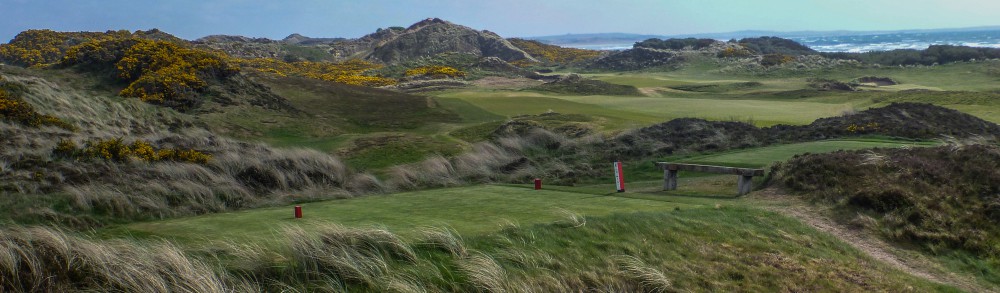
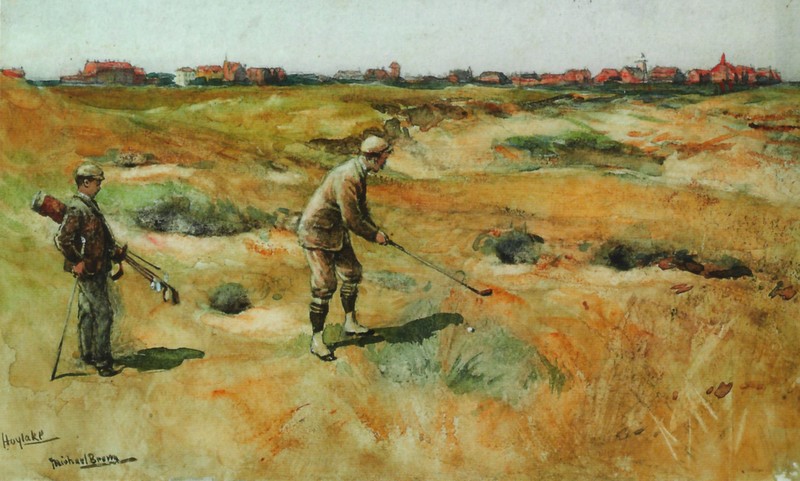
I’ve taken quite a few golf trips to Scotland, Ireland, and England during the past twenty years—including my recent one to England’s “Golf Coast,” in Lancashire (see above)—and I’ve figured out a few things. Here are some of them:
1. The cure for jet lag is golf. You take the overnight nonstop from Newark, arrive bleary-eyed in Glasgow at 8:00 in the morning, drag your clubs past the bomb-sniffing dogs in customs, stumble into a men’s room designated “loo of the year,” change a tall stack of American dollars into a short stack of British pounds, drive fifty-five miles through Robert Burns country while trying to remember to admire the sheep-dotted hillsides, reach Turnberry in a daze—and tee it up on the Ailsa course, where Tom Watson and Jack Nicklaus fought their legendary Duel in the Sun, at the British Open in 1977. You haven’t slept since what seems like the day before yesterday, but your tee shot somehow finds the fairway, and a little mental arithmetic reveals that your colleagues back home are arriving, just now, at their desks. Suddenly, you feel happier than you’ve felt since the birth of your first child, or since the time you and your brother nearly won your flight in the member guest. (Not to worry: The cure for excessive cheerfulness is also golf.)
2. Alternatively, take a flight that arrives at night. I did this once on a non-golf reporting trip to London. I left New York mid-morning, arrived at Heathrow in the dark, took a taxi to my hotel, and immediately went to bed, at roughly 11:00 p.m., local time. I forced my brain to ignore the fact that even two-year-olds were still awake at home, and I slept all night and woke up refreshed, at a normal hour. If you travel all day instead of all night, you sacrifice a full day of potential golf, but you do less violence to your body clock—a possibly worthwhile trade-off for traveling golfers who aren’t as young as they used to be.
3. No matter when you travel, don’t go to sleep (after you’ve arrived) until it’s dark—not even a wee nap. My wife is incapable of doing this. In her view, a nice hotel room in Paris is the ideal place to spend several days recovering from the ordeal of traveling to France. Be strong! Go straight from the airport to a golf course and play thirty-six holes instead!
4. Beware of weekends. The toughest day of the week on which to get visitor tee times is usually Saturday; the second toughest is Sunday. If you plan a week-long trip that involves leaving for the British Isles on a Friday night and returning two Sundays later—something my friends and I have done several times—you’ll miss just five days of work but your golf itinerary will include the maximum number of nuisance days. And the problem will be compounded if your week also includes a “bank holiday” Monday—the equivalent of a three-day-weekend Monday at home. The solution is to miss a little more work. And you can check the bank-holiday schedule online, through the magic of Google. (On my recent trip, I left on Sunday night, arriving early Monday morning, and returned home the following Tuesday.)
5. Look into poor man’s business class. On my flight home, I paid United $99 for an “Economy Plus” seat, in an exit row. It had so much leg room that I could fully extend my legs without touching the seat in front of mine, and when I went to pee the guy sitting between me and the aisle didn’t have to get up and barely had to move his legs. I took a window seat so that I could lean against it to sleep and, as I had hoped, the middle seat stayed empty, because no one had been willing to pay extra to sit in it. I had so much room that I was able to comfortably type up all my notes from the trip—like getting a free day! And I could plug in my laptop, in an outlet under the seat, when the battery got low!
You won’t need one of these if you travel to the British Isles to play golf. Royal Lytham & St. Annes, England, May 13, 2013.
I’m in northwestern England playing golf this week. I didn’t bring an umbrella, and I’m glad I didn’t, even though there’s rain in the forecast for every day from now until the end of time. The trash can on the second tee on almost any links course in England, Scotland, and Ireland often looks like the trash can in the photo above, because American golfers typically come to the British Isles prepared for the rain but not for the wind. One hole is usually enough to destroy almost any umbrella. And carrying a “wind-proof” model isn’t the solution, because if your umbrella can’t be turned inside out it will carry you to sea, assuming you’re strong enough to hang on. Here’s why:
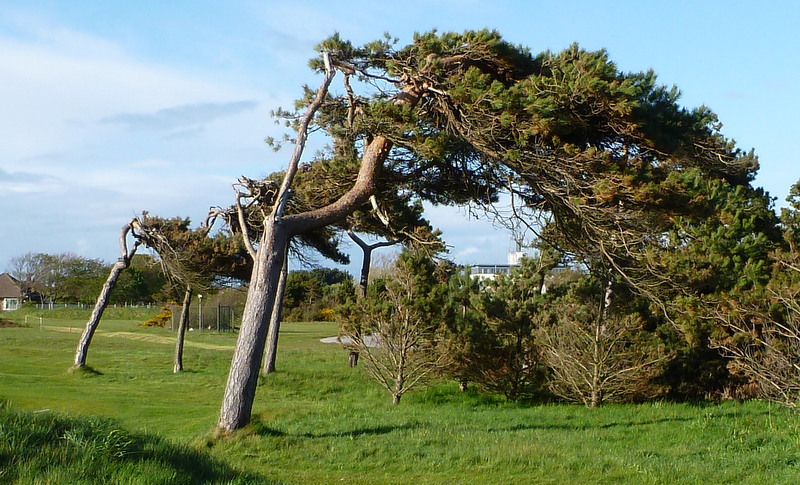
Wind-sculpted trees, thirteenth hole, Royal Lytham & St. Annes.
The wind was blowing hard yesterday, but the trees in the photo above look that way on calm days, too. Even scrubby little bushes get squashed in the direction of the prevailing wind. (I first wrote about the terrific golf courses of northwestern England almost twenty years ago. The opening sentence of my article was “You don’t need a weatherman to know which way the wind blows at Royal Lytham & St. Annes.” A Golf Digest copy editor, who apparently had never heard of Bob Dylan, changed “weatherman” to “weather report”—and that’s the way it ran.)
Not carrying an umbrella will lighten your luggage by a couple of pounds, and it will spare you a lot of annoying housekeeping while you play. And you won’t miss it at all, if you have a rain suit, a rain hat, and a pair of rain gloves. The rain gloves are especially important, because if you have a pair of those you won’t need to even think about trying to keep your grips dry. In fact, if you have rain gloves you almost don’t need to carry a towel. And after my first trip to Scotland, in the early nineties, I stopped carrying an umbrella at home, too. Way too much trouble!
The blizzard that was supposed to pummel New England this weekend was a bust, at least as far as my town is concerned. We had a soft drizzle on Sunday morning, but that was as close as we came to getting buried under two feet of snow. The storm was still in the forecast when my friends and I made our weekend plans, though, so I ended up spending the day paying bills, doing the crossword, and obsessively touching up some old photographs that I borrowed from my mother last week, in Kansas City. The guy in the photograph above is my grandfather, in 1891, at the age of three. He never played golf, but he did join a country club, eventually. That’s the only connection I can think of. I like the picture, though.
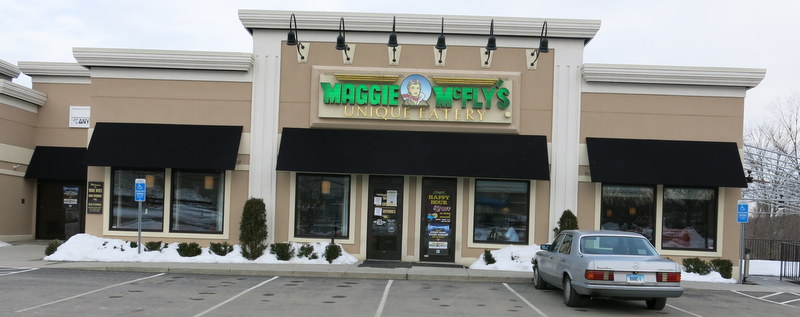
This doesn’t look like a golf course, but it is one. I don’t know who that fancy car belongs to. Some guy with head covers on his irons, probably.
Two weeks ago, Hacker (real name) reserved one of the three simulators at Maggie McFly’s, a restaurant and bar not far from where we live. We first played there three winters ago, when snow covered the ground for months and we couldn’t find anyplace to play on grass. Since then, the simulators have become so popular that the only tee time we could get was for Wednesday afternoon.
Simulator technology has improved tremendously since the first time I played indoors, in the early 1990s. As always, you hit shots toward a picture on a screen, and a computer takes over once the ball is in the air. What has changed is the sophistication of the imagery and the accuracy with which the sensors pick up your ball’s velocity, trajectory, and spin. The machine we played was manufactured by a company called aboutGolf and is endorsed by the PGA Tour. It’s what you see on the Golf Channel.
That’s Rick, getting ready to hit a lob over a bunker. It’s a shot he’s good at because–unfairly, some would say–he practices.
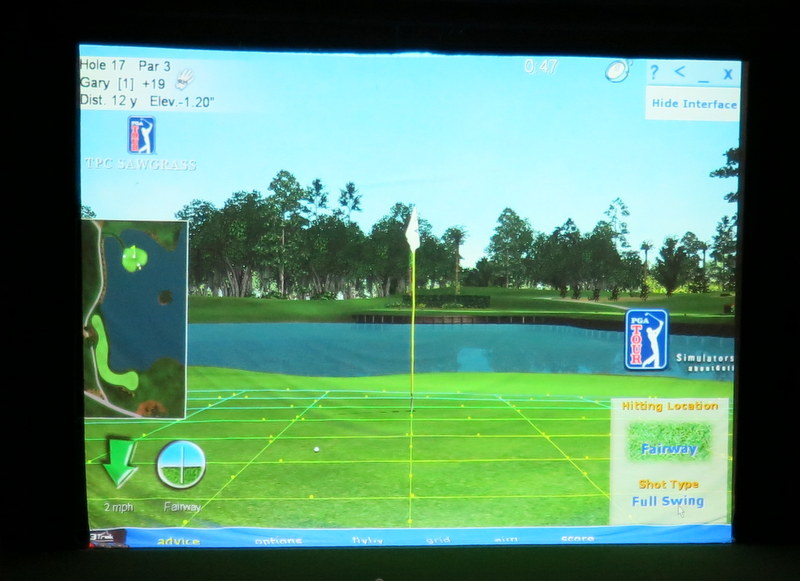
In the past, we’ve played Pebble Beach, Spyglass Hill, and the Old Course at St. Andrews, among other courses you may have heard of. This time we played the TPC at Sawgrass. Here’s what the famous 17th hole looks like when you’re standing on the fringe at the back of the green, looking toward the tee. I had a birdie putt, which I just missed:
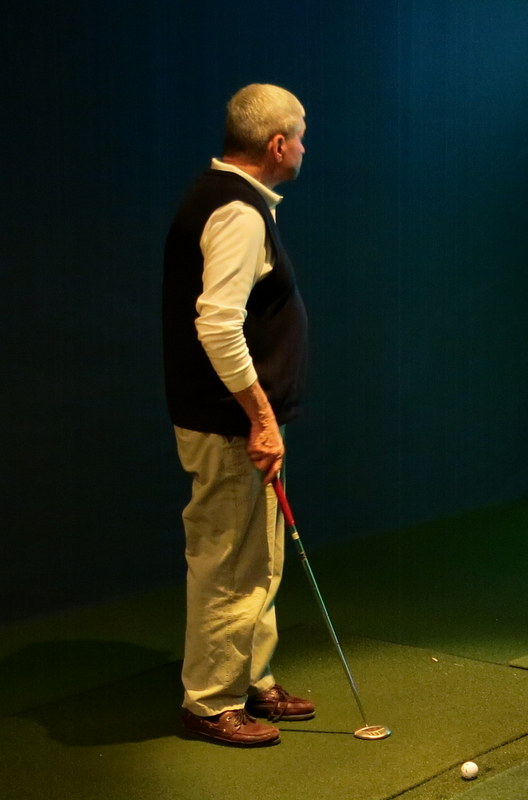
Simulator putting takes some getting used to: to read the breaks, you have to analyze the movements of dozens of virtual marbles rolling around on a projected grid that looks like a college-textbook illustration of the curvature of space-time. Once you get used to it, though, you begin to wish your home course had virtual marbles, too. Here’s Hacker—who was my partner—reading one of the many critical putts he drained:
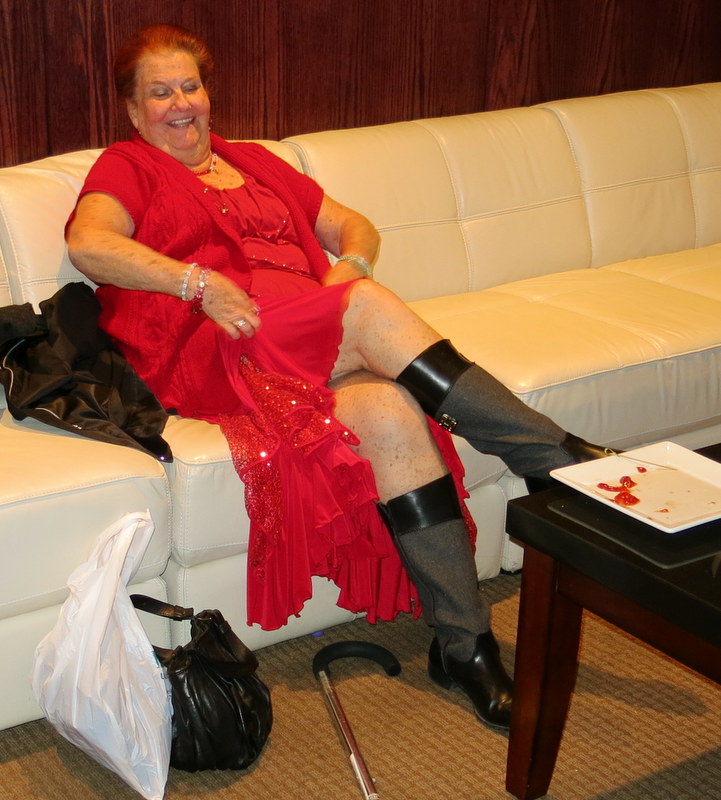
The simulators at Maggie McFly’s are great, because they’re in wood-paneled rooms that look like something you’d find in a fancy clubhouse. A waiter brought us beers and cheeseburgers, and there were four guys in the room next to ours who looked almost exactly like us, and if we had been able to figure out how to turn on the TV we would have been able to watch the football game. And about an hour into our round a woman with a cane walked in and sat down on our couch: our first gallery ever!
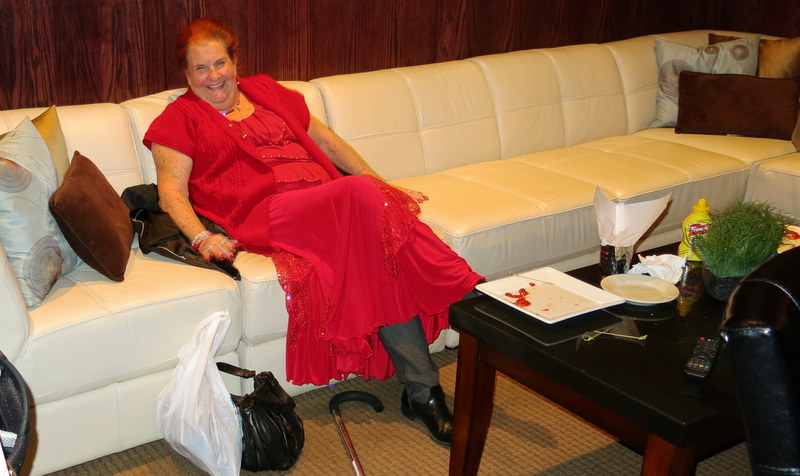
Her name is Linda, and she’s seventy-two years old. She said there was going to be karaoke at Maggie McFly’s that night, a favorite of hers, but that she would probably go home for a nap at some point, rather than hanging around for eight hours. Her husband, who died fifteen years ago, was an engineer. He worked on the Manhattan Project (though not on the bomb part) and on the Suez Canal, and he was a champion skeet shooter.
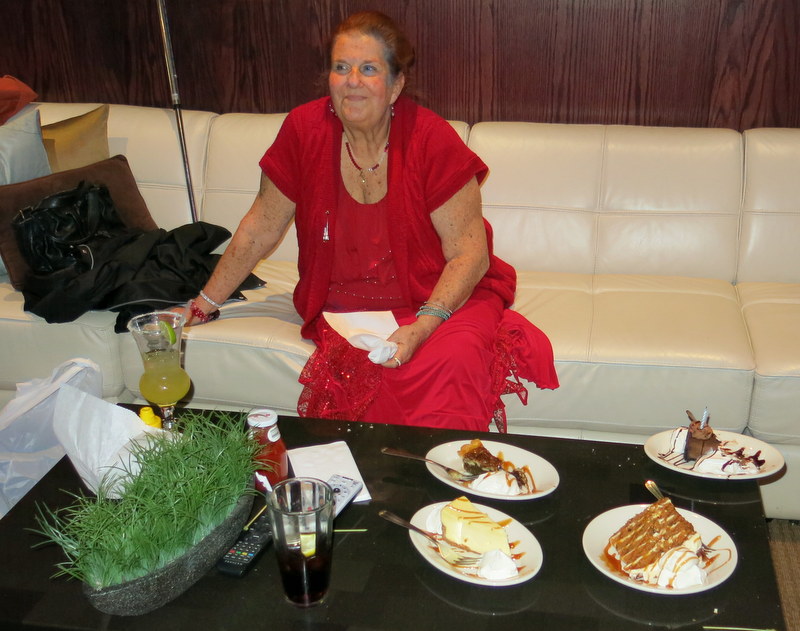
She said she had played a little golf when she was younger but hadn’t swung a club since sometime in the nineteen-seventies. She was very interested in how the simulator worked, and when we tried to explain it we sounded the way I did when my son, at the age of three or four, asked me what makes the car go. At one point, the manager came in to tell her to beat it, but we had already bought her a drink so we told him to beat it. I happened to mention that the following day was going to be my birthday, and when we weren’t paying attention she ordered dessert for all four of us. I got to pick the one I wanted, and then a waitress put a candle in it and lit it.
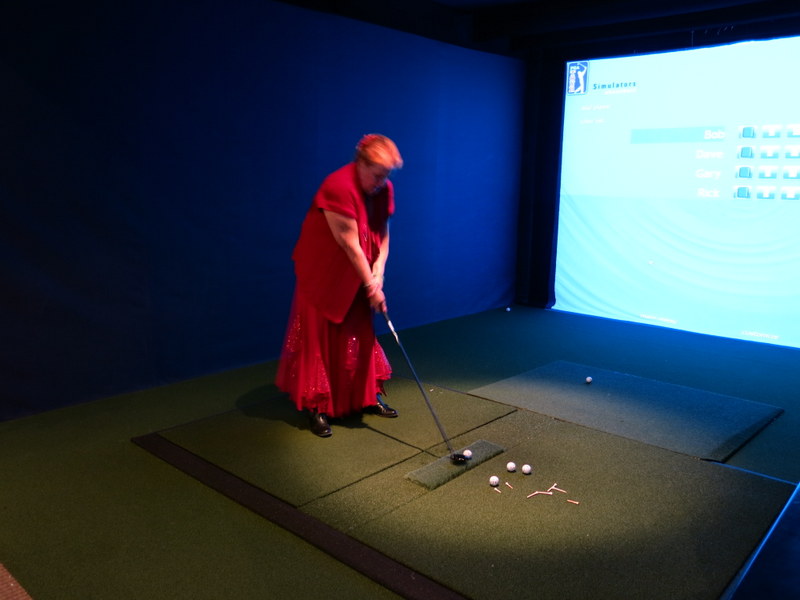
Linda wanted to try the simulator, so as soon as Hacker and I had wiped out Rick and Gary we gave her Hacker’s three-wood and let her rip a few. She went right under the first one, but after that she nailed it, repeatedly:
The only problem with simulator golf is that it’s the opposite of exercise, because between shots you don’t walk anywhere, or even climb in and out of a cart; you just plop down on the couch and steal a few more of Gary’s french fries.
My brother, John, used to play in a winter simulator league at a health club in Brooklyn. He said that it was embarrassing to stand around drinking beer and eating Doritos while beautiful women in butt-floss leotards trotted back and forth between the racquetball courts and the Nautilus machines. He suggested that the club install a treadmill next to the golf simulators, so that you could pick up your bag and pretend to walk to your ball while you waited for your turn to hit. That way, at least, you’d break a sweat.
This may be a direct reference to an early customer–a cop!–who took a whiz in a potted plant and was banished for life.
Quite a while ago, Tom Reynolds, a reader in Atlanta, asked me to suggest a packing list for a golf trip to Ireland. I said I would, then forgot all about it, and recently he asked again. So here it is.
This packing list is the result of two and a half decades of thoughtful experimentation. In making it, I’ve assumed that no spouse or health-department official will be in your group, and that you will buy at least one souvenir golf shirt, one souvenir golf sweater, and one souvenir golf hat while you’re abroad. I’ve also assumed that you are not planning to do anything rash, like meeting a client or going to a play. My strong preference with rain pants (which are also useful as wind pants) is to wear them as pants, if possible, rather than over pants. If the weather is nippy, I wear them over long johns.
The reason for minimalist packing is not to avoid airline luggage charges; the reason is to reduce the tonnage of the gear you have to lug from place to place, and to make the most efficient use of the storage space in whatever vehicle you’re traveling in. Packing light also leaves space for all the overpriced golf stuff that you are almost certainly going to buy and lug home.
Because linksland weather is highly unpredictable but within a relatively narrow range—I’ve played in shirtsleeves in Northern Ireland in November and been hailed on in Scotland in June—my list doesn’t change a whole lot from month to month. Think in terms of layers, and be prepared to allow time for wet items to dry out—especially shoes. Mike B. took his plug-in ski-boot driers on our most recent trip to Ireland. He never needed them, because our shoes never really got wet, but taking them wasn’t a terrible idea. On a golf trip to eastern Ireland twenty years ago, I took two rainsuits and needed them both.
It’s possible to pack more than this, of course. It’s also possible to pack less. My friend Tony gets by with just his rain pants and one pair of chef pants, and some people believe that he never changes his shirt. A few years ago, Golf Digest sent me to play all fourteen courses where the British Open has ever been held, and I realized toward the end of the trip, which lasted two weeks, that although I’d brought two pairs of pants I could have gotten by with one. The great thing about microfiber is that you can launder it with a hotel wash cloth, even if you’ve gotten chocolate on it. I recommend black.
Tony in chef pants, North Berwick, Scotland, May, 2008.
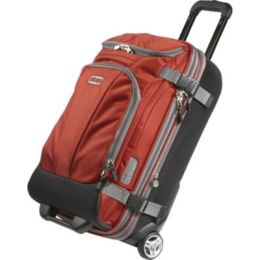
On my first golf trip to the British Isles, twenty years ago, I took a full-size suitcase. Now I take just a carry-on bag: a Mother Lode TLS Mini 21-inch rolling duffel, by eBags, which is currently selling for $190, shipping included (see photo at the top of this post). This is my favorite suitcase ever, even for non-golf trips. No matter what kind of suitcase you use, I recommend buying a selection of eBags Packing Cubes, which are soft, box-shaped modules that simplify intra-suitcase organization and make it easy to use your golf bag’s travel case for overflow packing.
Here’s what I take:
In the carry-on bag:
1 pair dark polyester microfiber pants (and a second pair worn on the plane—and I recommend black for both, because they never look dirty and you can remove stains, even chocolate, with a hotel wash cloth)
1 golf shirt (and a second one worn on the plane—and in cooler months I would make one or both of these shirts long-sleeved)
1 sweater (worn or packed, depending on the weather
1 pair of Under Armour-type long johns
1 long-sleeve Under Armour-type undershirt or turtleneck
1 tee shirt (to sleep in and serve in a pinch as an extra layer)
1 pair of “house pants”—fleece pants or nylon hiking pants or something similar (for lounging around, and for emergency duty under rain pants if the weather turns really foul, and for wearing on the trip home)
1 pair of shorts, maybe (something I’d never thought about before 2016, when sunburn was a bigger threat than rain in western Ireland)
Lots of cotton handkerchiefs (my new favorite golf accessory, useful for nose-wiping during wet, cold, windy, or allergen-dense rounds)
As many pairs of underpants and (wool) socks as I can cram into the remaining space
In the golf bag or golf-bag travel case (along with my golf clubs):
2 pairs of waterproof golf shoes
1 rain suit (the jacket of which, in combination with an undershirt, shirt, sweater, vest, etc., should be plenty of cold-weather protection, even for winter)
2 regular golf gloves and 2 pairs of rain gloves
1 Seattle Sombrero (or other truly good rain hat)
1 regular golf hat
1 knit cap
1 super-lightweight down vest, in its little stuff sack (weighs nothing, and is easy to cram into a golf bag; mine is by Uniqlo and is a recent addition to my packing)
As many golf balls as you think you’re going to need, because they’re cheaper here (a reasonable number is two balls a round; a couple of guys lost more, but some lost almost none)
A full box of Band-Aid or Compeed “blister cushions.” You won’t need them if you’re careful about the golf shoes you take, but if you have them in your bag you’ll be a hero to someone on your trip
Toiletry-type crap (if you put your toiletry kit in your checked bag you won’t need to worry about decanting your gels and liquids into tiny bottles and setting them aside in a Ziploc bag)
Other stuff:
1 or 2 twenty-four-inch bungee cords, for strapping your golf bag onto a pushcart (known abroad as a trolley), to keep the bag from falling off when you drag it into the dunes
1 water bottle (because on-course water isn’t common outside the United States; you can fill your bottle each day in your hotel room or in a golf-club locker room)
1 UK-and-Ireland-type plug adapter. Household current is 230 volts, but all your electronics will run on that with just the plug adapter—no need for a voltage converter. If all you’re going to need to charge is your phone, you can probably find a 110-volt shaver outlet (for an American-type plug) in the bathroom of your hotel room
1 mini-power strip (if, like me, you have a lot of stuff to plug in—mine’s made by Belkin—because no hotel room on earth has enough outlets, especially in other countries)
1 sleep mask (for creating darkness where there is none)
Earplugs (doubly useful if the locals are holding a Dallas-themed “Oil Barons’ Ball” in the main dining room—as happened to me in England a few years ago)
Travel clothes:
If you are going straight from the plane to a golf course—and that’s what you should be planning to do, in my opinion—you should wear golf clothes on the plane. For the trip home, it’s nice to have clean stuff. In my case, I flew home in a bought shirt, a bought sweater, and a pair of lightweight nylon pants that I hadn’t worn during golf.
If your golf shoes have nubs on the soles instead of spikes, you probably don’t need any other shoes—although you may be required to strip down to your socks in some parts of some golf clubs. On a recent trip to Ireland, I took a pair of “après-golf” shoes—which were actually just non-waterproof golf shoes—but wore them only a couple of times, because my two pairs of “working” golf shoes were just as comfortable and never really got wet. Tim brought two pairs of golf shoes plus a pair of Merrell Jungle Mocs, which he wore on the plane, on the bus, and when we weren’t playing golf—an idea I intend to steal next time
If you prefer to receive your packing instructions in video form, you can do so here:
For many years, I’ve accessorized my rain paints with farmer-type suspenders, my first pair of which I ordered from the Vermont Country Store. (I now use a different kind, which you can order here.) Suspenders eliminate the main problem of rain paints, which is that they creep down every time you put wet hands into the pockets. I also own, and sometimes use, a pair of Velcro bicycle clips, which are handy if the legs of your rain pants are so long they drag on the ground, as many are.
Vermont Country Store suspenders with rain pants, Scotland, 2004.
On a golf trip to England in 2010, my friends and I had to take sports coats so that we could eat dinner in the clubhouse at Royal Lytham & St. Annes. Hacker (real name) took a crummy old one, intending to abandon it there—a plan I foiled by spotting it in a closet on the day we left and returning it to him at the airport. But the concept is brilliant: clothes you can wear to extinction, then leave behind.
My bedroom in the Dormy House at Royal Lytham & St. Annes, May, 2010. My sports coat is in that pile somewhere.
On our trip to Scotland and Ireland in 2014, Peter A. brought many pairs of super-cheap socks, and threw away each pair after a single use. This seemed smart in the abstract, but he ended up being the only person on the trip who got blisters. For this most recent trip, he brought more expensive throwaway socks (roughly a dollar a pair versus roughly fifteen cents) and didn’t have a problem. My personal preference is to pack the best wool socks I feel I can afford, and lots of them.
I’ve always thought it was crazy to take shorts on a golf trip to the U.K. or Ireland, because indigenous golfers hardly ever wear them and some golf clubs have semi-ridiculous rules about them—like Hillside, in England, which allows shorts only if they’re worn with knee-height socks. (Dress codes abroad are kind of unpredictable. In 2016, the starter at Lahinch asked Matt to roll down the cuffs of his pants, which he had turned up maybe an inch, but let a local kid tee off in surfer shorts and an untucked tee shirt.)
It’s possible to pack more than this, of course. It’s also possible to pack less. On a non-golf trip to Europe a few years ago, my wife surprised me by packing lighter than I did. You don’t need to plan a lot of different “looks.”
In 1889, a twenty-one-year-old Englishman named Frederick Rea was offered a job running a small school on South Uist, an island in the Outer Hebrides, more than fifty miles off the west coast of Scotland. He didn’t recall having applied for the position, and when he accepted it his relatives thought he’d lost his mind. South Uist was windswept, treeless, and only intermittently accessible, and it was seldom visited by anyone from the mainland except a few wealthy sportsmen, who came to hunt and fish.
South Uist, May, 2007.
Rea’s students were the children of crofters, or small tenant farmers, the island’s principal residents. The crofters subsisted mainly by growing potatoes and grain, raising starved-looking cattle and sheep, and gathering seaweed, which they used as fertilizer or sold. Most spoke only Gaelic. The children went barefoot year-round and often walked miles to school, even in snow, and on winter mornings each was expected to bring a chunk of peat for the schoolhouse hearth. The Scottish historian John Lorne Campbell wrote that South Uist in those days was so primitive that “the appearance of a pedal bicycle was sufficient to send the island’s horses and cattle careering in panic.” Yet Rea was captivated. He didn’t return to the mainland permanently until 1913, by which time his students had included two of his own children.
Rea’s schoolhouse stood near (and resembled) this old house. Garrynamonie, South Uist, December, 2008.
When Rea arrived, South Uist and several neighboring islands were owned by Lady Emily Eliza Steele Gordon Cathcart, a wealthy Scotswoman, who had inherited them from her first husband, who had inherited them from his father. She is said to have visited South Uist only once, but she made business investments, including the construction of hotels and commercial fishing piers. In 1891, probably hoping to make South Uist more attractive to wealthy tourists, she commissioned a golf course near a tiny farming settlement known as Askernish.
The evening view from one of the guestrooms at the Lochboisdale Hotel, which was commissioned by Lady Cathcart and opened in 1882. Lochboisdale, South Uist, December, 2008.
Rea, the schoolmaster, played the golf course with a friend when it was new, and he described the experience in his memoir, A School in South Uist, which was published in 1927 and is still highly readable. Lady Cathcart’s factor, or estate agent, Rea wrote, “told me that a professional golfer from St. Andrews had been to the island and had specially laid out an eighteen-hole course along the machair near his house, expressing the opinion that this part was a natural golf-link course.” Machair is the Gaelic word for “linksland”; it’s the root of Machrihanish, and it’s pronounced mocker, more or less, but with the two central consonants represented by what sounds like a clearing of the throat.
The machair of Askernish, May, 2007.
The factor invited Rea and a friend to play the new golf course one Saturday, and they met at his house. “Here we found quite a small party assembled,” Rea wrote; “beside his wife and children were a young lady cousin from Inverness, two or three clergymen and two junior clerks. Introductions over, we selected balls and clubs.” Rea didn’t say so, but the St. Andrews professional who had created the course was the most famous golfer of his day, Tom Morris, Sr., better known as Old Tom Morris.
The house of Lady Cathcart’s factor, mentioned by Frederick Rea in “A School in South Uist.” Old Tom Morris’s golf course began not far from its door. Rea’s friend dismissed golf, initially, as “a silly, stupid game,” but both men quickly became hooked. Askernish, May, 2007.
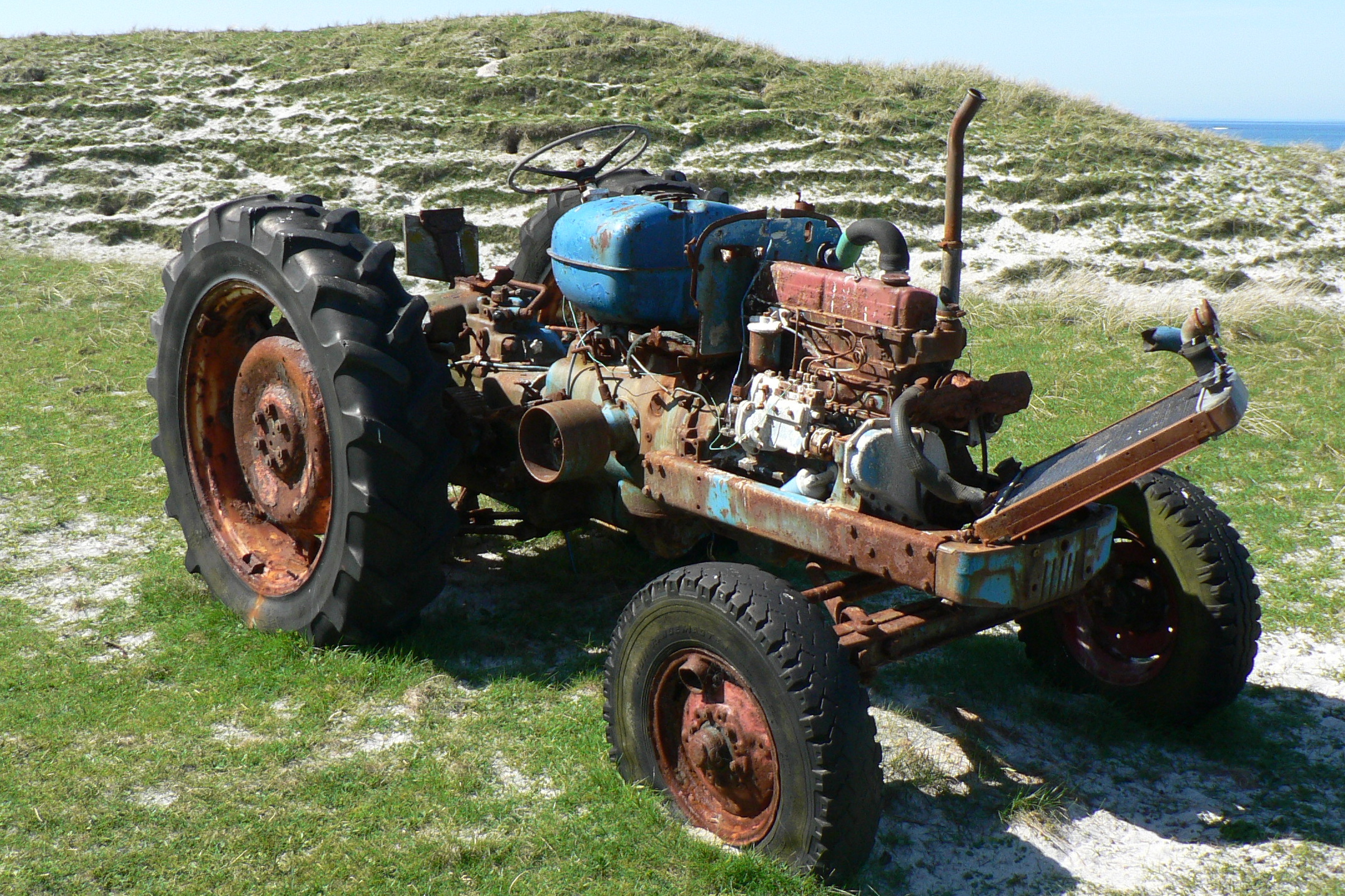
Lady Cathcart died in 1932. Her will included a provision for the perpetuation of the golf course. In 1936, a small airstrip was built near its northern end to accommodate wealthy tourists. (The passenger service was commercial but unscheduled; when a pickup was desired, the proprietor of a local hotel would send a homing pigeon to North Uist—the island still lacked telephones and, for that matter, electricity—and Scottish and Northern Airways would dispatch a plane.) Then the war came. The number of golfers dwindled. The course was reduced to twelve holes, then to nine, and the connection to Old Tom Morris devolved to legend. By 2000, what was left of the course was maintained by a small group of local diehards, who mowed the putting greens with a rusting gang mower, which they pulled behind a tractor.
Askernish , May, 2007.
I first visited South Uist on assignment for Golf Digest during the spring of 2007, and I visited it again in December of the following year, on assignment for The New Yorker. My New Yorker article about Askernish, called “The Ghost Course,” was published in 2009. Below are some more photographs I took during those two trips.
South Uist doesn’t have an airport. On my first trip, I flew from Inverness to Benbecula, one island to the north. It’s connected to South Uist by a causeway, as is the island of Eriskay, at the southern end. The only other passengers on my flight were two bank couriers, who were accompanying a load of cash, for ATMs. All the other seats were filled with “Bennetts Seat Converters” containing the day’s newspapers:
On my second visit, I took the car ferry from Oban. That trip took almost seven hours. We passed islands called Mull, Coll, Muck, Eig, Rum, Sanday, Sundray, Vatersay, Hellisay, Gighay, and Stack, among others. We also passed this lighthouse, on a tiny island called Eilean Musdile. It’s just off the shore of a larger island, called Lismore, which has a population of a hundred and forty-six. The lighthouse was built in 1833:
Most of the roads on South Uist are a single lane, and you share them with sheep. There are frequent bump-outs for yielding to oncoming traffic. Resident drivers become adept at gauging each other’s speed, and often slip past each other without seeming to slow down:
During my first visit to South Uist, I stayed at the Borrodale Hotel, about a mile and a half down the road from Askernish. The hotel’s laundry facility was just outside the door:
My guide to Askernish was Ralph Thompson, who was born on the mainland in 1955 and spent summers on South Uist, where his grandparents lived. One reason he liked those visits, he told me, was that he was allowed to go for weeks without bathing, because his grandparents’ house, like almost all the houses on the island at that time, had no running water.
His wife, Flora, was born on Barra, two islands to the south. Barra was even more isolated and primitive than South Uist, although today it has a small airport. Takeoffs and landings on Barra are scheduled to coincide with low tide, because the runway is a beach. Here’s one of the planes, which I photographed as it passed over Asknerish:
At the time of my first visit, Ralph Thompson was working with two links-course experts—Gordon Irvine, who is a turf consultant and a former greenkeeper, and Martin Ebert, who is a golf architect—in an effort to restore Old Tom Morris’s course at Askernish. In the photo below, Irvine is on the left and Ebert is on the right, and the flag in the background marks what they had decided was probably one of the original green locations:
I played all of the holes I could on that trip, and, with some of Ralph’s friends, helped test a few of the rediscovered ones:
We often had to play around cows and sheep, which grazed on the same stretch of linksland:
Even when there were no animals, the shot-making was challenging. This is a friend of Thompson’s:
When I returned to Askernish in 2008, the golf course had begun to look and play much more like a real golf course. The green in the photo below was puttable, and it had a single-strand barbed-wire fence surrounding it, to keep cattle and sheep from trampling it:
There isn’t much daylight in northern Scotland in December, but we had time for eighteen holes, and the weather was milder than the weather at home:
Since then, the golf course has come a very long way—as you’ll see if you visit the Askernish website. Someday, I’ll go back.
My most recent round at Askernish, December, 2008.
One of the Daves I played with at Newburgh-on-Ythan, in Scotland. He’s teeing off on the 18th hole, a par-5, which was once said to be the longest golf hole in Scotland. Snow began to fall as we reached the green, although it didn’t fall for very long.
Last April, I played a round at Newburgh-on-Ythan Golf Club, on the east coast of Scotland about halfway between Royal Aberdeen and Cruden Bay. The round was unusual in that all three members of my threesome were named Dave. (One of the Daves was the club’s captain, but I no longer remember which one.) Newburgh was founded in 1888, a year before my golf club at home. Originally, it had nine holes and was only a little over two thousand yards long. (The hole called “Long” was just three hundred and thirty-three yards.) It was laid out like this:
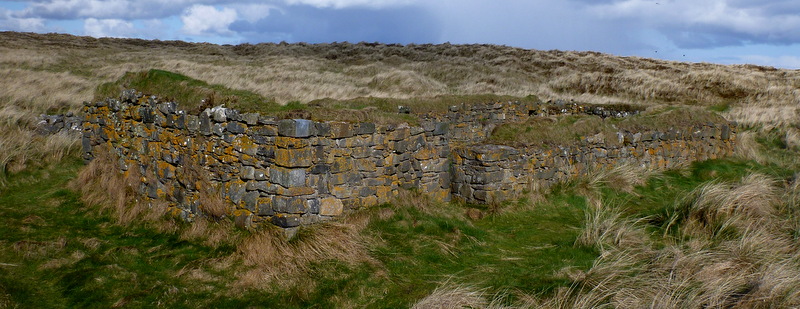
The second nine of the current course occupies the same piece of ground as the original course, although the layout has changed. The new nine is situated on the hill shown in the upper left-hand corner of the map above. One of the new holes incorporates an ancient wall thing, and if your ball ends up inside the enclosure you may have trouble hitting it out, as one of the Daves did:
A rare photo, showing both of the non-me Daves at the same time. No photo of all three Daves is known to exist.
The most famous person ever to take golf lessons at Newburgh is probably Prince Phra Bat Somdet Phra Poramentharamaha Vajiravudh Phra Mongkut Klao Chao Yu Hua (later King Vajiravudh) of Siam (later Thailand), who learned to play there in 1897, the same year the map above was drawn. Here’s what the Prince looked like after he became King:
The future king learned to play golf while staying for a month at the Udny Arms Hotel, across from what was then the first tee and is now (more or less) the thirteenth. The hotel still exists, and from the outside it looks pretty much the same as it did in 1897. I had a nice meal there the day after I played the course.
The wind blows hard on Scotland’s east coast, and one result is the mountain-size pile of sand in the photo below. It’s on the far side of the estuary of the River Ythan, directly across from the golf course:
The Sands of Forvie, across the Ythan estuary from Newburgh-on-Ythan Golf Club.
The mountain of sand is part of Forvie National Nature Reserve. You can enter the reserve from a parking lot a mile north of Newburgh and walk all the way across it to the sea:
I hiked across the reserve along this road.
A large part of the reserve was closed when I was there, to protect nesting terns, but I was able to explore the ruins of the village of Forvie, which was buried by blowing sand in the early 1400s. All that’s left are some piles of stones and part of the village church, which was built on high ground:
What’s left of Forvie Kirk, and of Forvie itself.
Forvie Kirk was built in the 1100s and was dedicated to St. Adamnan, who was born in Ireland in the seventh century. Adamnan visited Scotland in the late 600s and, apparently, made an impression. He didn’t bring luck to the residents of Forvie, however.
I took this picture for my wife, who, for unknown reasons, has become interested in moss and lichen. To make up for the fact that I’d abandoned her for a week, I smuggled home a golf-ball-size chunk of moss from Aberdeen, as a present. (Never bring your wife a golf shirt or golf hat, no matter how much you loved the course.)
Near the path I followed into the reserve were several stations like the one below, which were equipped with tools I could have used to stamp out any fires I happened to have started. Luckily, I didn’t start any.
I’m not sure that I need to play Newburgh-on-Ythan again, but I’m glad I played it once, and I’m glad I met the Daves, and I’m glad I found that old ruined church. And the chunk of moss I brought my wife is now growing near our back door. It didn’t make up for the trip, but it probably helped.
Back in May, I went to dinner in Chicago with my close personal friend Mike Keiser, the founder and owner of Bandon Dunes. The restaurant was Moto, which serves a four-hour tasting menu (see above) accompanied by fifteen different wines. Our “Spring Lamb” course was actually a tasting menu in itself: a thing of lamb paté, a thing of lamb sausage, a thing of smoked lamb shoulder, a thing of “baconized” lamb, a thing of leg of lamb, and a couple of other lamb-based things, all served on a chef’s cleaver. “Explosion” was a stick of dynamite made from white chocolate and filled with a syrupy liquid that I wouldn’t have minded drinking a quart of, plus a cherry-stem fuse—and the waiter made it explode by dropping it on its plate. He said that my explosion was the best one he’d done so far, and that he was still working on his technique because the dessert was so new. “After Dinner Menu” was the actual menu printed on a slab of marshmallow, which was brought to the table in a saucepan of liquid nitrogen, then placed on top of three kinds of fruit and three kinds of mint and broken to pieces with spoon. Most surprisingly good thing: beet meringue.
Moto’s famous Cuban pork sandwich, which looks like a cigar and is served in an ashtray. It wasn’t on the menu the night Keiser and were there, I’m sorry to say.
The next day, Keiser and I played a round at Chicago Golf Club, which was built in 1895 and is the oldest eighteen-hole golf course in the United States. (The club was founded in 1892, on a different site.) The course was designed by Charles Blair Macdonald and later tinkered with by Seth Raynor, among others. There’s a convent next door, and one of the guys we played with told a funny story about a golfer who took a whiz in the bushes next to it, but I didn’t write the story down and now I don’t remember any of it. Take my word for it, though: that story was funny. C.G.C.’s motto is “Far and Sure,” which is also the motto of Royal Liverpool Golf Club, where Macdonald had lots of friends. In fact, when Macdonald’s new Chicago friends realized how much they loved golf he had his old Liverpool friends send him six sets of clubs.
Keiser’s newest course is Cabot Links Golf Course, in Nova Scotia. Ron Whitten, who is Golf Digest’s architecture editor, has written an article about both it and Donald Trump‘s newest course, which is in Scotland. Whitten’s article will be in the February issue, and while you wait to read it you can watch this video:
The video was made in October by Don Snyder, whose company is called World Golf Movies. Snyder worked as a caddie at the Old Course, among other places, and one day he had the idea of creating video tours of the world’s best courses. Several of his videos are available as apps in the iTunes store, and more are coming. Perry Golf, the tour company, is a partner of his. “Starting next season,” Snyder told me in an email recently, “we will also shoot little fifteen-minute movies of Perry Golf’s clients out playing on their journey, and then sitting down in a pub and talking about what their trip has meant to them.”
Mike A. trying to bounce his ball off the boundary wall beyond the first green.
Just six of us showed up this morning. Nobody else was on the course, so we played as a single group. The game was our regular Sunday-morning stuff, and because we were a sixsome we also played 3-2-1.
Mike A. overshot the first green, and his ball ended up so close to the stone wall that he had to try the shot Miguel Angel Jimenez hit during the 2010 British Open, on the Road Hole at the Old Course at St. Andrews:
Mike, unlike Jimenez, didn’t get his ball onto the green, but he did end up with a better score. (Jimenez made triple-bogey.) I’ve tried Mike’s shot, both successfully and unsuccessfully. It works best if your ball is in front of a stone with a flat side facing the flag.
Even though there were six of us, we got around in a little over three hours. There are several keys to playing quickly in a large group. One is never taking a practice swing. Another is hitting shots when you’re ready, rather than waiting till it’s your turn. Another, on tees, is always having a player “on deck,” in addition to the one actually teeing off, like this:
Gary (left, teeing off) and Mike A. (right, on deck), fifth hole.
In 2007, a Scottish guy told me that I absolutely had to play Gairloch Golf Club, a nine-hole links course in an isolated village on the country’s west coast. Gairloch was a solid hour and a half out of my way, but he insisted. So I went.
I’m glad I did, in part because the drive—through the desolate mountains of Wester Ross and along the southwestern shore of Loch Maree, on a road that sometimes narrowed to a single lane—was beautiful:
I got a room at a small hotel on Gairloch’s harbor, and was awakened during the night by what sounded like a hundred-year typhoon lashing against my window. In the morning, the BBC said that the weather that day would be pretty good in all of Scotland except the part where I happened to be, for which the forecast was “heavy rain” and “gales.”
I drove through both on my way to the golf course, a short distance down the coast road, and found the parking lot empty and the clubhouse locked. So I zipped up my rain suit, let myself through the gate, and teed off alone.
Gairloch is just nine holes, and six of the nine are par-threes, and you have to go around three times to push your golfometer past six thousand yards, but it’s a wonderful course and I’m not a bit sorry I went to so much trouble to play it, even in driving rain. (How’s that for a recommendation?)
To get to the medal tee on the eighth/seventeenth, the course’s sole par-five, you climb a slippery path up the rocks to a spot from which you can see the course, the clubhouse, the town, the mountains, the harbor, and (I think) the isle of Skye, among other stirring sights.
And the hole’s a corker, too.
A club employee had arrived by the time I finished my first nine. I watched her raise the Gairloch flag in a wind that was almost strong enough to rip it from the pole, then made breakfast of a couple of candy bars from the golf shop. Then I played nine more holes, returned to my hotel, took a hot shower, and checked out.
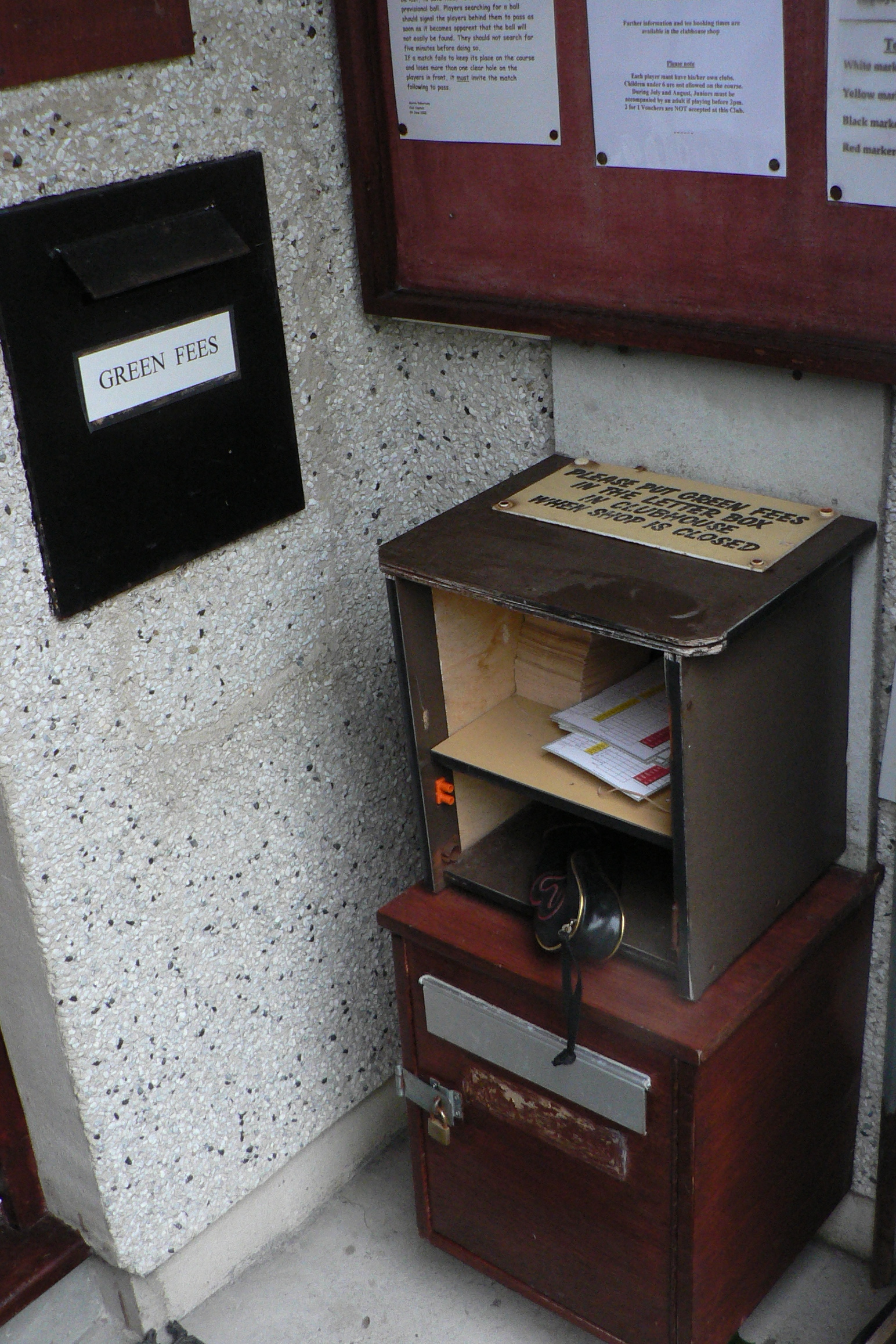
And here’s a photo of Gairloch’s Honesty Box, which is mentioned in one of the comments below:
Several years ago, I played a few rounds in northern Scotland in December. The sun began setting almost as soon as it had risen, and even at noon it practically sat on the horizon. The late-season golf window here in Connecticut isn’t as narrow, but you have to pay attention. Five of us teed off at 1:00 this afternoon. We played in just over three hours, but by the end I was having trouble following drives. Mornings are tough, too:
Rick, November sun, Sunday morning, seventeenth hole.
Last week, I spent a couple of days in Kansas City without my golf clubs. My mother told me about a local country club, which a few years ago assessed its members for major improvements to the golf course. The assessment was substantial, and quite a few members left the club rather than pay it. Four of my mother’s friends went to the club one day for their regular bridge game, and when lunch was over they discovered that none of them could sign the check. All four, it turned out, had dropped their membership without telling the others.
Stanley on the second tee last Sunday, with his Crocodile Dundee hat (bought on eBay) and late-season club-carrier thing.