Push Carts on Tee Boxes? On Greens?

Push carts on putting green, Victoria Golf Club, Melbourne, Australia, June, 2010.

During the women’s member-guest at my club, a couple of weeks ago, a few guys from my Sunday Morning Group played a travel round at our enemy club, on the other side of town. (We have a reciprocal arrangement for tournament days, etc.)  A member strode up at some point and told them to stop rolling their push carts onto the tee boxes—and later he strode up to again and told them not to put their golf bags on the tee boxes, either. (Hey, maybe they should remove their golf shoes, too.)

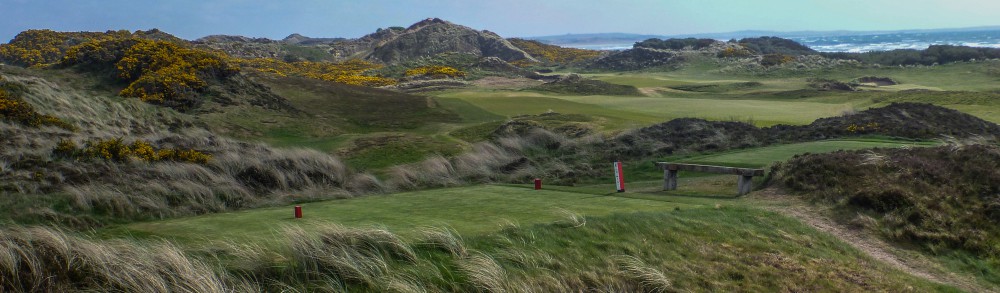
I took the photos above and below at Victoria Golf Club, near Melbourne, Australia, in 2010. (The Australian Masters was played at Victoria that year and the next.) Players there are asked to roll their push carts and pull carts not just over the tee boxes but across the greens, to keep the fringes from being beaten up by concentrated foot traffic. Other Sandbelt courses have the same policy—including Royal Melbourne and Kingston Heath, which are ranked No. 22 and No. 11, respectively, on Golf Digest’s list of the 100 Best Courses Outside the United States.  Ditto Bandon Dunes (although at Bandon golfers with carts are asked to cross the greens only, and not to park their carts on them).

These practices makes perfect sense, because a push cart weighs much less than a greens mower. Or a tee mower. Or any of the guys that you or I play golf with. So lighten up, enemy club.


Reader’s Trip Report: Sand Hills Golf Club

Sand Hills Golf Club, 16th hole.

Adam Sachs, a reader from Kansas City, recently returned from a trip to Sand Hills Golf Club, near Mullen, Nebraska. Excerpts from his report:

Sand Hills is a sublime private venue for purists willing to travel ten hours or more to The Middle of Nowhere, Nebraska. Here’s the pre-game formula:

(1) Either fly to Denver or Omaha and drive four hours on I-80, then another one to two hours through a landscape that looks like what you might think you’d see on the moon, including sand-dune craters; or fly private or commercial into North Platte and drive an hour and fifteen minutes up state highway 97 to mile maker 55.  (Note: if you reach Mullen, the closest town, you’ve gone about thirteen miles too far north.)

(2) Drive about two and a half miles down a winding road, free from power lines or really much of anything, veer straight/left past Crenshaw Drive.

(3) Introduce yourself to the nice lady at the reception desk, identify your host, get your cabin assignment, load up your travel bags on a golf cart and take a short drive around back to some sparse but comfortable cabins: two firm queen mattresses, a couple of small TVs, a completely adequate bathroom with a shower, and a telephone for calls up to the Clubhouse and long distance collect calls. (There is almost no cell phone coverage and only limited Wi-Fi, in the lobby of the decidedly humble clubhouse.)

Seventeenth green.

I convinced my wife I had to go because my new client invited me. Turned out he checked himself into the hospital the night before the trip with chest pains. He’s fine—a little blood-pressure issue—but he never made it to Sand Hills. I played with ten guys I had never met and hardly know a thing about (besides their home courses: Castle Pines, Robert Trent Jones Golf Club, etc.) and had a fantastic time.

You can read Adam’s blow-by-blow account of his favorite holes here.The photos are his, too—including this one:

Dan Daly, the chef at the halfway house, preparing the staple meal of my own Sunday Morning Group.

How to Hold Your Own Golf Major

Hacker (real name), Ocean Course Scorecard, Les, August 12, 2012.

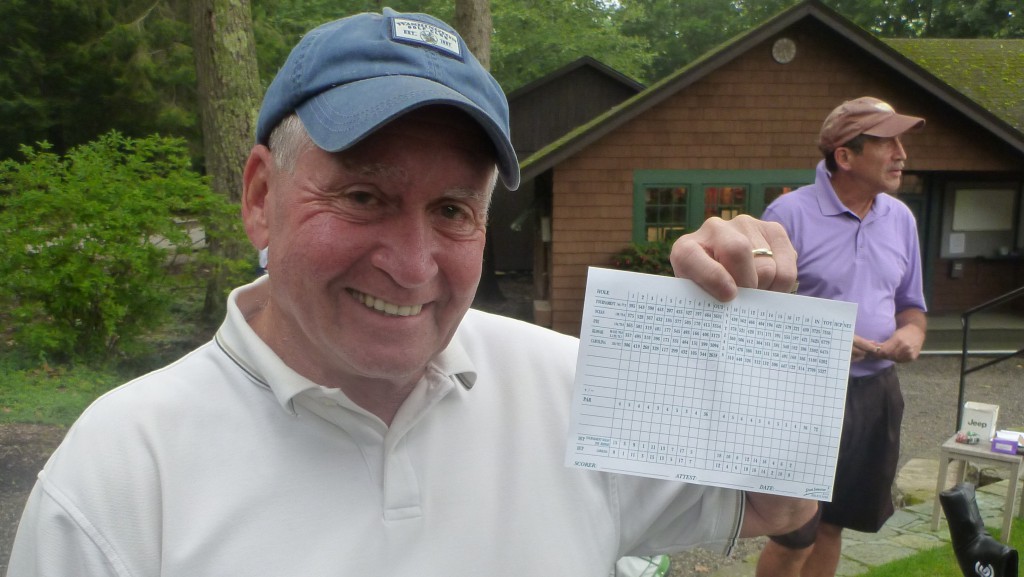
When my friends and I play on Sunday mornings, we use our Sunday Morning Group scorecard, which Jim created for us with a desktop publishing program that he uses in his job. Among other features, it lists our local rules, such as “You get an extra stroke if you wear shorts after November 1” and “No one gets a stroke on a par 3.” Some of the older guys complain about the par-3 rule, but what can we do? It’s printed right on the card.

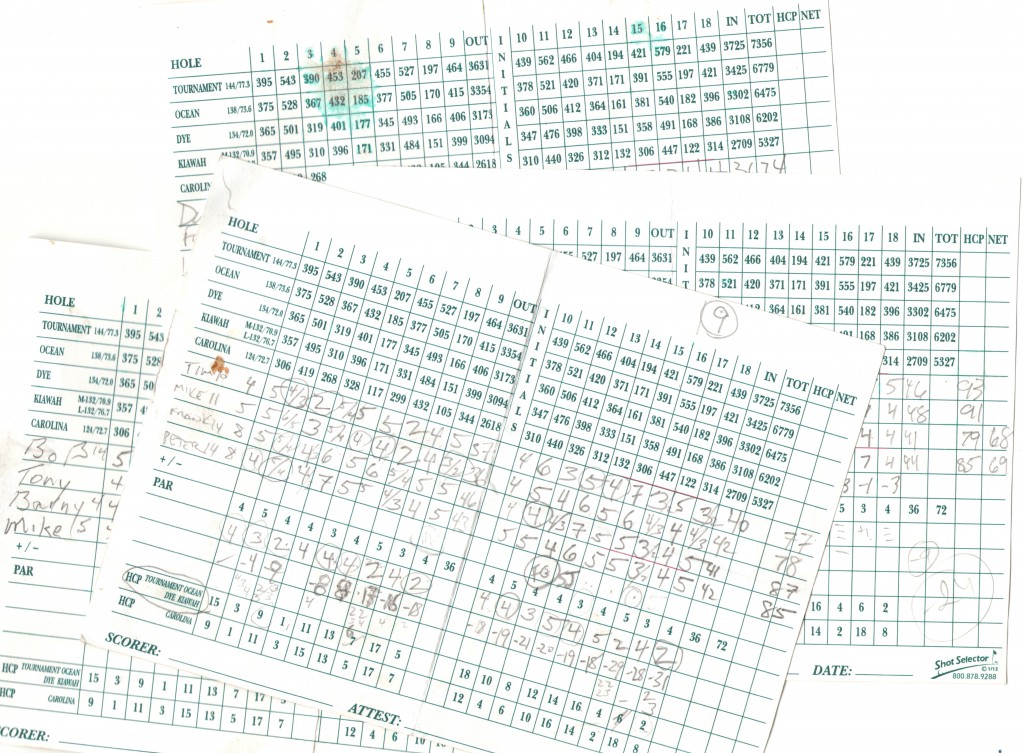
This year, Hacker (real name) had the idea of celebrating golf’s four majors, on each major’s final day, by using not our own Sunday scorecard but the scorecard from whatever course the major was being played on. So during our regular game this weekend we used the scorecard of the Ocean Course at the Kiawah Island Golf Resort, where the PGA Championship was held. (You can download the Ocean Course card yourself, from either of the links in this paragraph.)

The main effect of using another course’s scorecard on your own course is that most of the handicap strokes fall in unfamiliar places. This impacts one of our local rules, because (for example) although our sixteenth hole is ordinarily a par 3 (meaning that no one gets a stroke on it), on the Ocean Course it’s a par 5 with a stroke index of 4 (meaning that anyone receiving 4 or more strokes that day gets a pop).

We compounded the impact by using a best-ball feature that I introduced a few years ago, called All Birdies. In All Birdies, all under-par scores on any hole count. On the sixteenth hole, for example, I had a 2 and my three teammates had net 2s. Since Kiawah’s sixteenth is a par 5, our four 2s counted as albatrosses and our team went -12 on that hole alone. That wasn’t enough to win, unfortunately, but we felt pretty tough for a while. (The winning team was Tim’s, at -31. Theirs is the top card on the pile in the photo below.)

Major results, Sunday Morning Group, August 12, 2012.

18 Good Things About Golf: No. 11

Four walkers, Old Head Golf Links, Kinsale, Ireland, May, 2006.

11. If you walk and play fairly quickly, golf provides real exercise—not aerobic exercise, usually, but a mildly elevated level of metabolic activity. Golf doesn’t ruin your knees the way running and tennis do, and the time you spend playing golf is time you can’t also spend sitting in front of the TV eating coffee ice cream and drinking Yoo-hoo. Mark Twain famously dismissed golf as “a good walk spoiled,” but it’s actually a walk improved, since golf, unlike mere walking, gives you something challenging to think about, as well as something interesting to do with your hands. Golf is a walk with a purpose.

Member-guest, 2007.

Golf-certified Acoustic Engineer Needed

Pump house, fourth hole. The roof is made of corrugated metal.

The main source of irrigation water on my home course is a pond on the fourth hole. The pump is housed in a corrugated-metal building concealed in some bushes near the pond’s far right-hand corner, about 180 yards from the main men’s tees—a location, that, coincidentally, is the universal crummy-tee-shot sweet spot for the average male golfer. (A pro at a golf development in Arizona once told me that you should never buy a house or building lot on the right-hand side of any golf hole 180 yards from the regular men’s tees, unless you wouldn’t mind building a dome over your swimming pool and glazing your windows with Lexan.) Sliced drives that don’t land in the pond often hit the roof of the pump house, making a distinctive clang that you can hear over much of the course.

Fourth hole. The men’s tee is in the lower right-hand corner of the photo. The pump house is at the other end of the banana-shaped red line, 180 yards away.

By now, that sound is almost as much a part of our club’s culture as the window conveniently situated above the urinal in the men’s locker room. So here’s the problem: the pump house has been falling down for years—it’s currently being held up by the gray building jack you see in the center of the photo at the top of this post—and we just received approval from the town’s Inland Wetlands Commission to replace it. What I’m wondering is whether there’s a way to “tune” the new pump-house roof so that, when slicers hit it with their drives, it will sound exactly the same as the old pump-house roof. We can’t simply re-use the old roof—an early suggestion—because by this point large parts of it are made mostly of rust.

Martha’s Vineyard, Golf, Lyme Disease

Penny (left) and deer tick.

My wife and I are on Martha’s Vineyard, where the vacation activities include looking for, finding, and removing deer ticks, which carry Lyme disease.  None of this is easy, because the ticks are extraordinarily small. Here’s an enlarged detail from the photo above, in case you’re having trouble spotting the tick.

Penny and deer tick (detail).

I found the tick above between two of my toes and stuck it to a piece of paper with Scotch tape. It’s one of several dozen I’ve found so far, all of them on my feet and legs. I’ll let you know in a week or two whether I’ve contracted Lyme again.

Luckily, tick-hunting isn’t the only vacation activity around here. There’s also golf, on a course I like a lot, Farm Neck Golf Club, in Oak Bluffs. Here’s one of my favorite holes, the fourth, a par 3, on which you don’t want to be right, long, left, or short, but especially not right or long.

I forgot to mention the wind.

And here are the people I played with today, a roughly my-age guy, whose name was Richard, and his two sons-in-law. In the photo, Richard has just missed a short par putt after making a semi-miraculous chip shot from the edge of the cart path.

That’s Richard, on the right. I hit the green but three-putted.

I didn’t notice any ticks on the golf course, but there were lots of these other things, which are almost as annoying:

British Open Countdown: St. Annes Old Links Golf Club

Airplane, roller coaster, Yankees headcover, Other Gene, out of bounds: St. Annes Old Links has it all.

Just a few blocks from Royal Lytham & St. Annes, where this year’s Open is being held, is St. Annes Old Links Golf Club. From the parking lot, it looks like a down-at-heels muni, and it’s usually ignored by non-locals. You can see the whole course without turning your head, there’s an airfield over the fence, and the northern vista is dominated by the roller coaster at Blackpool, a seaside holiday spot whose nearest American analogs are Coney Island and some of the tawdrier parts of the New Jersey coast. (Prosperous Britons view Blackpool as beneath them, but your children wouldn’t.) Still, the course is far better than it looks, and it’s worth a visit (as is the roller coaster).

The roller coaster in Blackpool in 1983, when I rode it twice.

St. Annes is of historical interest as well, because it occupies part of Royal Lytham’s original site: the tenth and eighteenth holes are direct descendants of the earliest layout, and their greens are said to be the oldest in the region. The course has more than a few undistinguished holes, but it also has some tremendous ones. Maybe the best is the 450-yard, par-4 seventh, called Penance. Its left side is flanked by grassy ditches, which serve the same depraved purpose as the church-pew bunkers at Oakmont. Shots to the green generally play into a fierce wind, and they tend to end up at the bottom of a trench, in one of the numerous bunkers, under a spavined bush on a bank that hugs the rear left corner of the green, or against a shed just beyond the bushes. Another superb hole is the ninth, a claustrophobia-inducing par 3, which Bobby Jones liked well enough to measure, in 1926, for possible reproduction elsewhere.

Ninth green, St. Annes Old Links. That’s the clubhouse beyond it.

You might also see a helicopter. That’s Brendan on the left, walking toward the roller coaster.

British Open Countdown: Birthplace of the Beatles

Other members of the tour group I joined in 1983, Strawberry Field, Liverpool. The photographer is Steve Shipman.

Almost thirty years ago, on assignment for a British newspaper and an American magazine, I traveled to England with a tour group of sixty-seven American Beatles fans. (The tour members’ interest in the Beatles was not casual; one woman had tried to kill herself, twice, after the murder of John Lennon.) Our itinerary was divided between London—where we visited EMI’s Abbey Road Studios, drove past the apartment where Brian Epstein committed suicide, and stripped leaves from a shrub on property formerly owned by Paul McCartney—and Liverpool, which the tour members viewed as the promised land, and which is twenty-five miles as the seagull flies from Royal Lytham & St. Annes, where the Open begins this week.

Penny Lane, Liverpool, 1983.

The statement “We’re going to Liverpool on holiday” has no exact equivalent in American English. (Roughly comparable: “We’re spending our honeymoon in Cleveland.”) Londoners snorted derisively when we mentioned our destination. “It’s an industrial city but not an industrious one,” I was told, through smirking laughter, in a London pub. Even Liverpuddlians were taken aback by the tour members’ enthusiasm. They were used to being the butt of jokes, not the objects of adoration.

The “shelter in the middle of the roundabout,” Penny Lane, Liverpool, 1983.

For a non-fanatic, Liverpool’s charms are harder to see, but they exist, as I’ve been reminded each time I’ve returned. The city’s suburbs and their fabled golf courses are lovely—specially Formby and the villages of the Wirral. The city itself is not as bleak as it’s made out to be; even in the seedier precincts along the wharves, you can catch glimpses of what used to be one of the world’s premier seaports. And, of course, the Beatles.

Celeste Simone Sabatini, American Beatles lover, Liverpool, 1983.

At the time of that initial trip, I was still almost a decade away from discovering golf; when I first went back, in the mid-1990s, I had time for nothing else. The Beatles were still a presence, though. One day, when I couldn’t get on anywhere else, I played a round at Southport Municipal Golf Club. The course wasn’t much, and many of the regulars were local lowlifes who had been prompted by the excitement of the Ryder Cup to give up rugby for golf, which they treated as a contact sport.

Still, I had fun, as I always do. One of my playing partners was a retired businessman who had recently given up tennis for golf but whose age, he said, made him undesirable as a candidate for membership at the distinguished private clubs in the area. When I asked him about his working years in Liverpool, he said, “I knew Jim McCartney, who was Paul’s father. We were both in the cotton business, and his office was next to mine. There was a time when we were both dealing in Iranian cotton. I had better shippers and was offering a better price, but Jim was getting all the business. I later found out why: he supplied a signed photograph of the Beatles with every order. He used to fret terribly about Paul’s future.  He desperately wanted him to go to university, because what sort of future could there be for a musician?”

Sunbathing, British-style, on the beach at Blackpool, 1983. The tower in the upper right hand corner is visible from Royal Lytham & St. Annes.


British Open Countdown: A Great Golf Trip

Tony, Rick, Hacker (real name), David O., Brendan, David W., Tim, Other Gene, Ray, Hillside Golf Club, England, May, 2010.

My friends and I have taken some terrific golf trips over the past dozen years, including one to Scotland and two to Ireland. Our best trip ever, though, may have been the one we took in the spring of 2010 to the part of England where the Open Championship will be played this week. England’s Lancashire coast—which is also known as the Golf Coast—contains one of the world’s densest concentrations of superb links courses, including three on the Open Rota (Royal Liverpool, Royal Birkdale, and this week’s venue, Royal Lytham & St. Annes.) My friends and I played fourteen rounds on eleven courses in eight days, and over dinner on the final night we went around the table and each named the one course we’d most like to play again. There were nine of us, and we picked eight different courses.

The do-over course I named at dinner on the final night: Southport & Ainsdale, which I hadn’t even expected to like. That’s Birkdale Cemetery in the distance.

One reason the trip worked so well is that we did very little driving. The distance by air between Royal Liverpool (at the southern end) and Royal Lytham (at the northern end) is less than thirty miles, and we rented three three-bedroom apartments in Southport, a resort town roughly halfway between them. The rent worked out to something like $30 per man per day. We had views of the Irish Sea, and we could walk into town.

Extremely light housekeeping: my bedroom in our apartment in Southport. Note the necktie, which was required for dinner in the clubhouse at Royal Lytham & St. Annes.

We spent just one night away from our apartments, in nine single rooms in the Dormy House at Royal Lytham. That club offers several package deals, and they’re a bargain. We got two rounds of golf on the championship course, three meals in the clubhouse, and a night in the Dormy House for less than the à-la-carte price of two rounds of golf.

The Dormy House at Royal Lytham & St. Annes.

My bedroom window looked out on the practice putting green, the eighteenth green, and the clubhouse (the building on the left).

The view from my room in the Dormy House.

Lytham is the only Open course that begins with a par 3, a 200-plus-yarder with a circular green surrounded by ravenous bunkers. My favorite hole on the course is another par 3, the ninth, which looks like a golf hole in a dream: the green is elevated and undulating, like a graduate-level problem in topology. It’s tucked into the farthest corner of the course, and a cluster of red-brick buildings rises directly behind it, and if you flub your tee shot, an assistant pro told me, you can easily make 10.

Ninth green: don’t be long; don’t be short; don’t go right; don’t go left.

Within the city limits of Southport are three excellent courses—Royal Birkdale, Hillside, and Southport & Ainsdale—and one quite good one: Hesketh, which is the home of the Hitler TreeThe first three are laid out almost continuously along the coast to the south of town; they are so close together that if you miss the driveway for Birkdale, heading south, the handiest place to turn around is the side street that leads to Hillside. And at Hillside it’s entirely possible to hook a ball onto Southport & Ainsdale. I’ll have more to say about all those courses, and the others we played, later this week.

David O., Gene P., Royal Lytham.

My Close Personal Friend Donald Trump

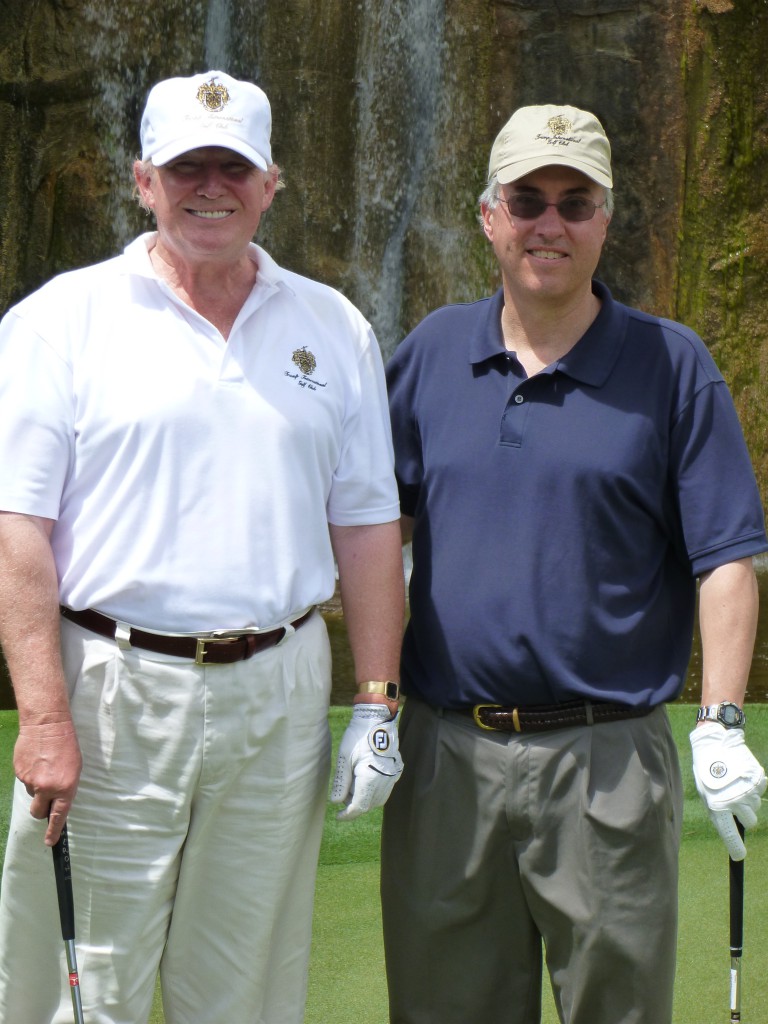
Donald T. and David O. in front of the waterfall at Trump International Golf Club, West Palm Beach, Florida, March, 2012.

For the July issue of Golf Digest, I wrote an article about Donald Trump and his newest golf course, Trump International Golf Links, near Aberdeen, Scotland. Back in March, Trump and I played  a round at his course in Palm Beach (photo above), and I spent one night at Mar-a-Lago, which Trump saved from demolition in the 1980s and now operates as a private club (photo of in-room amenities below).

Mar-a-Lago: only the best.

Trump is unimpressed by golf courses he doesn’t own, especially when he compares them with his Scottish course (which will open next week). “I know Bandon Dunes,” he told me over lunch. “The biggest dune there is like one tenth the size of our smallest dune. It’s a toy. And they get such great reviews. Every one of my courses is, like, amazing.”

Trump’s courses really are amazing; the one in Bedminster, New Jersey, was recently chosen by the U.S.G.A. to host the 2017 U.S. Women’s Open, and the others are stand-outs, too, although they aren’t necessarily as great as he says they are. A few years ago, he bought a bankrupt course in southern New Jersey, called Pine Hill, and turned it into Trump National Golf Club Philadelphia (it’s just over the state line from Pennsylvania). According to him, it should probably be considered the best course in the world (other than his course in Scotland).

“It’s a better course than Pine Valley,” he told me, “because it has much better elevation. And I love Pine Valley, but this course is better. Now, it will never be judged better, because nobody will ever give me the fair shake of doing that. But that’s OK. It’s a better course than Pine Valley—and the Pine Valley people say that, too, although they won’t say it publicly. Two of them came over to me and said, ‘Mr. Trump, this is better than Pine Valley, but please don’t ever quote me.'”

Trump’s courses, wherever they are, do often have cool cars parked in front of them:
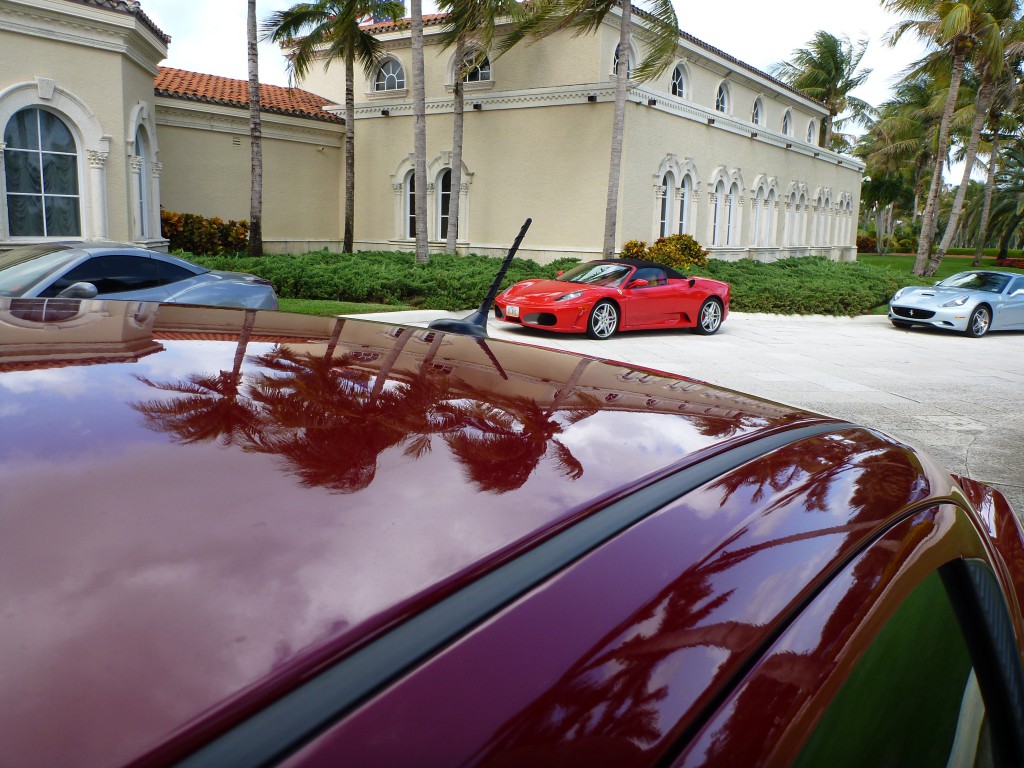
Three Ferraris plus my rented maroon Kia, Trump International Golf Club, West Palm Beach.

Automobile arrangements like that don’t happen by accident. When I told the parking attendant I didn’t think I’d ever seen three Ferraris in a row, he said the boss had told him to be sure I noticed.
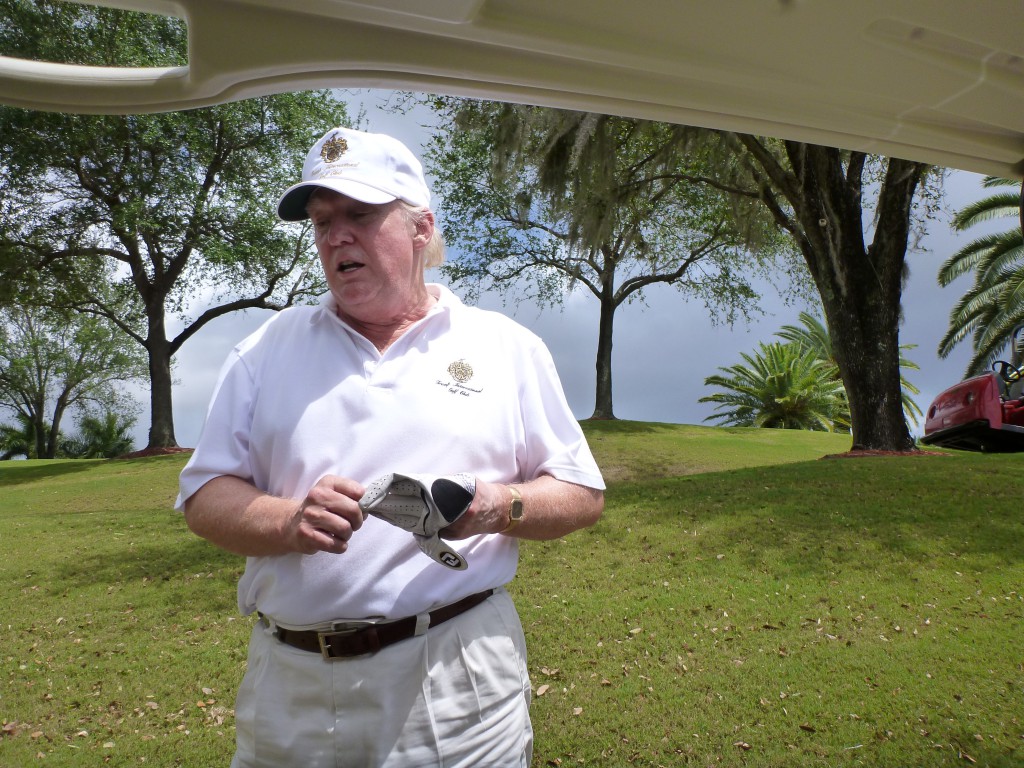
Trump is a very good golfer, even though he says he is.

In the photo above, Trump’s hair is hidden by his hat, which he didn’t take off during golf or at lunch, but I got to study it over dinner that night, at Mar-a-Lago. From straight on—which is presumably how he sees it in a mirror—it looks almost normal, but if you get any kind of an angle on it you can tell how structurally complex it is. And he must do it himself, because his wife wasn’t with him and I don’t think he was traveling with a hairdresser. I was impressed.
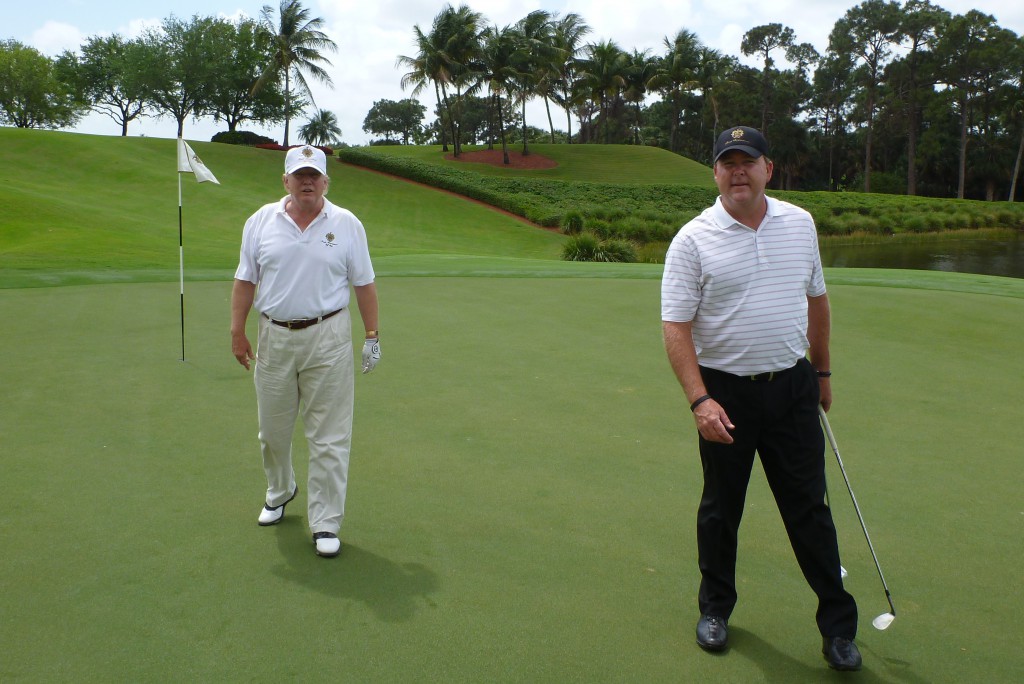
D.T. and John Nieporte, the head pro.

Off the record, I had a swell time hanging around with Trump. (Trump uses “off the record” not to protect confidences but to give emphasis to public knowledge he hopes you’ll quote—as in, “Off the record, I took down the trees and made the front page of the Washington Post four days in a row”—and I’m going to start doing that, too.) He’s a little exhausting to be with, because his only real topic of conversation is himself, but he doesn’t make you feel nervous or inferior, the way so many billionaires seem to do nowadays.

He’s also accessible. A decade ago, I wrote a long article for The New Yorker about concrete, and in it I quoted him at some length, since he built the first concrete office building in New York and knows a lot about the subject—although he was sometimes hard to understand because during our entire telephone conversation he was eating an apple. But he took my call, and he had interesting things to say.