Horton Smith, Titanic Thompson, Bobby Jones, Alfred Bourne, and Me

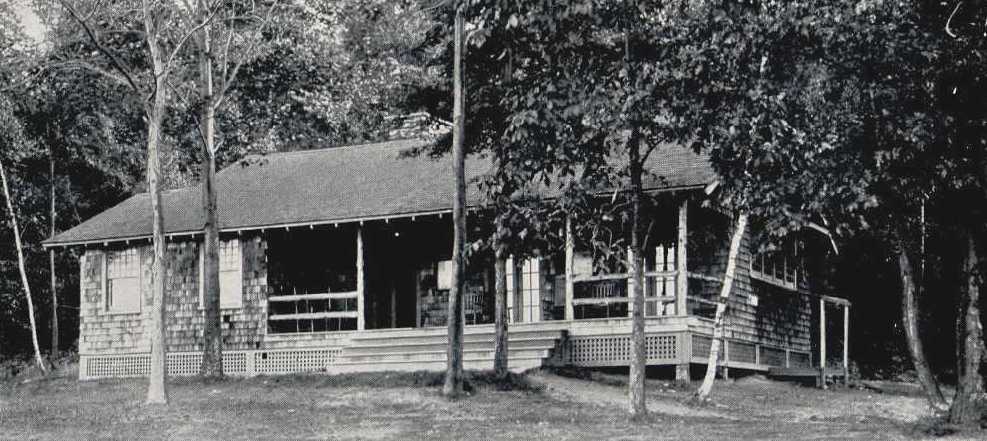
My golf club’s clubhouse as Horton Smith and Titanic Thompson knew it. It looks about the same today, although the trees and the porch have grown.

Horton Smith won the first Masters, in 1934, and he won again in 1936. Two and a half years after that, he got married in the little Connecticut town where I live, ninety miles north of New York City. The bride was Barbara Bourne, whose parents owned a 40-room weekend house here. The legendary golf hustler Titanic Thompson attended the wedding and, during a golf outing at our nine-hole club, gave a ten-dollar tip to his caddie, a local kid who, once he’d become an old man, sometimes played golf with me. (The regular rate in 1938 was 35 cents a loop, 60 cents for two bags.)

Barbara Bourne and Horton Smith (far left), along with lots of Bournes.

Barbara’s late grandfather, Frederick Gilbert Bourne, known as “Commodore,” had been a president of the Singer Sewing Machine Company. He owned a 110-room summer place on Long Island, a 28-room castle on the St. Lawrence Seaway, in the Thousand Islands, and the entire first floor of the Dakota apartment building, in New York.

Horton Smith’s late grandfather-in-law, “Commodore” Frederick Gilbert Bourne, 1851-1919.

Barbara’s father was Alfred Severin Bourne, who, in addition to being the 1934 men’s champion of my club, was a founding member of Augusta National. He served on the five-man Organization Committee, and was a vice-president until his death. Without him, the first Masters might never have been held.

Barbara Bourne and her father, Alfred Severin Bourne, in the late 1920s or early 1930s.

The Bournes spent winters in Augusta, which was popular as a resort destination partly because it was just about as far south as a New Yorker could travel overnight by train and still play golf on arrival. Alfred belonged to Augusta Country Club, and his playing partners there occasionally included Bobby Jones.

Kenneth Bourne (son of Alfred) and Bobby Jones, probably at Augusta Country Club.

In 1931, as Jones and Clifford Roberts were trying to get Augusta National going, next door, Bourne wrote them a check for $25,000—a quarter of the sum that Roberts figured they’d need to build their course. Bourne apologized that he couldn’t be more generous, and told them that if they’d come to him before the Crash he’d have underwritten the entire project. (Bourne missed the first three days of the first Masters because he was competing in—and winning—an amateur event in Aiken, South Carolina, twenty miles from Augusta.)

Alfred Bourne (center) and various playthings, Thousand Islands, 1930s.

Alfred Bourne died in 1956. His weekend house in my town is now the main building of a boarding school; not surprisingly, it’s called Bourne Hall. Each year for the past six or seven, the school and my club have held a tournament, called the Bourne Cup, in which eight or ten of the school’s alumni (some of whom are also members of my club) are almost always soundly defeated by eight or ten members of my club (some of whom are also alumni of the school).

Bourne cap, from Bourne Cup.

This year, the school’s team included a member of the class of 1951, named Dave. He told me that when he was a boy he spent several summers caddying at the club, and often caddied for Alfred Bourne. He said he once asked Bourne if it would be all right for him to use a fielder’s mitt to shag Bourne’s practice balls. (Dave loved baseball but lacked opportunities to hone his technique.) Bourne said that would be fine, and they made a game of it. Bourne was a generous tipper, Dave told me (although he squandered most of his  earnings, a nickel at a time, in the club’s Coke machine).

My club’s caddie corps in 1925, sitting on the front steps of the clubhouse. Note the neckties on the ten year olds. The gloomy-looking (and tie-less) grownup at right is the head pro. The wee lad in knee socks, two seats to his left, is his eventual successor.

A senior member of my club, whose name is Dick, also caddied for Bourne. He told me that he would warm up by hitting exactly thirty practice balls, which Dick would scoop up in a leather bag while keeping an eye out for players teeing off on the sixth hole. (The club’s driving range in those days was just the right side of the sixth fairway.) After counting the thirtieth shot, Dick would run back to Bourne, who would play the first hole, chip to the eight green, play the ninth hole, make the same circuit again, and go home.

Dick, who used to caddie for Alfred Bourne,at our town invitational tournament, October, 2008.

The day before this year’s Bourne Cup, I had the immense good fortune to play a round at Garden City Golf Club, also known as Garden City Men’s, where the U.S. Open was held in 1902. Before we teed off, I wandered around the clubhouse (where jackets are mandatory but shirts are not), and gazed at all the cool stuff. And among many other extremely interesting things I learned that the winner of the Garden City club championship in 1921 was Alfred Severin Bourne. I forgot to take a picture of the plaque with his name on it, but I remembered, later, to take a picture of a similar plaque, back home:

Early champions at my club: two Bournes and several missing years.

Back-Roads Scotland: Fraserburgh

Fifteenth green, Fraserburgh Golf Club, Scotland. Photo by Ian Stephen.

For the July issue of Golf Digest, which is on sale now, I wrote an article about Donald Trump and his newest golf course, Trump International Golf Links, in Scotland. The course is on the North Sea coast, a two-and-a-half-hour drive north from the Old Course at St. Andrews and about ten miles beyond the port city of Aberdeen. You should definitely play it if you have a chance—it will open July 10—and after you’ve done that you should get back on the A90 and drive another hour north, to the town of Fraserburgh, at the easternmost end of the Moray Firth. It’s the home not only of the Kinnaird Head Lighthouse and the Museum of Scottish Lighthouses, but also of Fraserburgh Golf Club, the seventh oldest in the world.

Fraserburgh foghorn, April, 2012. It was built in 1902. It's not still in use, but the museum keeps it painted.

I played Fraserburgh with two older members: Bill Maitland, who owns a furniture store in town, and Andrew Tait, a member of family of extremely successful fishermen. The morning was cold and the wind was blowing hard, and I wore two pairs of rain gloves, one on top of the other, in the hope of maintaining feeling in my fingers. Tait, in contrast, didn’t wear even one glove, and the explanation was what I guessed: after you’ve spent  a few decades fishing in the North Sea, it takes more than wind to make your hands feel cold on land.

Town of Fraserburgh, viewed from the golf course. April, 2012.

Fraserburgh’s first and eighteenth holes are flat and forgettable, but nearly everything in between is brilliant, beginning with the second, a par 4 that plays up what looks like the surface of the moon, on the flank of a mountainous dune called Corbie Hill:

Second Hole, Fraserburgh Golf Club. Photo by Ian Stephen.

Golf in the region goes back a long way. Local church records show that a parishioner named John Burnett was sent to the “maisters stool” for “playing gouff” on the links of Fraserburgh in 1613. The club was founded a century and a half later, in 1777, and it has the documents to prove it. At lunch after our round, Maitland showed me a copy of the original membership register. “These names are still well known to us,” he said—and by that point they were well known to me, too, because I had seen them on plaques and trophies in clubhouses along the coast:

"These names are still well known to us," Bill Maitland told me.

Fraserburgh’s original members got together for lunch after they played, just as they do nowadays, and they were required to pay their share of the bill whether they showed up or not—an excellent rule that my own gang ought to adopt. After we’d eaten, Tait took me to the wharf to see his family’s three fishing boats. He lives on a farm a few miles down the road and has his own five-hole golf course, which he plays when he’s too busy to get to the club.

Andrew Tait, Fraserburgh wharf, April, 2012. The boat is named for his parents.

Fraserburgh’s eighteenth hole is called Bridge, after a footbridge over some railroad tracks along the western edge of the course. The rail line connected Fraserburgh with Aberdeen and the villages and golf courses in between—a sort of Linksland Express. It closed in 1965, though, and the footbridge was demolished, so Fraserburgh’s eighteenth is now a golf hole with a ghost name. The course is still there, though, and it’s one of many worthy destinations along the coast for links-golf pilgrims who can be persuaded not to turn around after playing Carnoustie.


Why Rain is a Golfer’s Best Friend

Golf weather. Second fairway and third green, September, 2011. The pond in the foreground is a stream you can usually step across.

There have been showers in the forecast every day this week, and as a consequence my home course has been empty. Hardly any rain has actually fallen, except at night, but an image of raindrops in an icon on a weather website is apparently all it takes to keep most members cowering at home. On a cloudless 100-degree day in August, my friends and I often have to wait on every shot, but if the evening news mentions even a ten percent chance of occasional sprinkles we’ll usually have the place to ourselves. Earlier this week, Tony, Addison, and I played 27 holes in three and a half hours, on foot, and during that whole time we encountered just one other group: a dad and his ten-year-old son, who waved us through. The temperature was perfect—it hovered near the point where you sort of begin to think about maybe putting on a sweater—but we never got truly wet, and although I wore my rain hat for a little while I never had to wipe off my glasses. And no need for sunscreen.

Tony, light rain, empty course, eighteenth fairway, June, 2012.

Later this summer, my wife and I will spend some time on Martha’s Vineyard. There’s a golf course there that I like a lot, called Farm Neck, but it’s so popular that tee times can be hard to come by, especially on short notice. What I usually do is wait for the sky to cloud over and then show up unannounced, confident that the forecast will have created openings in the tee sheet. And if it actually rains, who cares? If you have the right equipment, there are only two kinds of weather you can’t play golf in: lightning and dark. And dark isn’t necessarily an insurmountable problem, as you can tell from the photo below:

Closing hole, Sunday Morning Group, annual end-of-season golf trip to Atlantic City, October, 2007.

Tour Players Lead Lives of Quiet Desperation

In 2003, I played in the pro-am at the Western Open, at Cog Hill, near Chicago. The pro on my team was J. P. Hayes, whom I wouldn’t necessarily have recognized if his name hadn’t been printed in huge letters on his golf bag. Nevertheless, I was excited. For a golf fan, playing in a pro-am is a fantasy come true. It’s a chance to spend five hours getting on the nerves of a real tour player, and it provides numerous opportunities to obtain personalized mementoes that can later be sold on eBay.

The excitement felt by the amateurs in any pro-am is almost exactly offset by the dread felt by the professionals, most of whom would prefer to be mowing their lawn, if not their neighbor’s lawn. But the tour requires even the top pros to take part, mainly because pro-ams generate favorable p.r. and make tournament sponsors happy.

My team, without even one useful contribution from me, finished sort of in the middle of the pack. The next day—the first day of the real tournament—I decided to lend comradely support to Hayes by following him in his round. His tee time was 1:09, exactly the same as Tiger Woods’s, although Hayes was assigned to the first tee (along with Justin Leonard and Stuart Appleby) while Woods was assigned to the tenth (along with Chris Smith and Cameron Beckman). Woods, who ended up winning the tournament, influences golf spectators the way a black hole influences cosmic dust: when he emerged from the driving range, at about 12:45, what appeared to be the entire human population of northeastern Illinois began to drift inexorably toward him.

Over on hole No. 1, in contrast, the crowd of spectators quickly reduced itself to a handful of friends, relatives, and stubborn contrarians. I walked with Hayes’s completely charming wife, Laura, who was pregnant with their second child; Amanda Leonard (also pregnant); Ashley Appleby; and a few of Hayes’s relatives, who were visiting from Wisconsin—about the same turnout you would expect for the final round of a club championship.

Non-golfers joke about how boring golf looks on television, but TV actually makes tournaments seem more exciting than they are, because it focuses on leaders and stars, and because the camera doesn’t linger once a shot has been hit. If you’ve ever attended a Tour event in person, you know that most of it consists of absolutely nothing—like a fireworks display at which the rockets go off ten minutes apart. Even if you’re following one of the superstars, you have more than enough time between strokes to read the newspaper, get caught up on your bills, or work out any lingering difficulties in your marriage.

It’s the pros who lead lives of quiet desperation—not regular golfers like us. If a pro hits a ball out of bounds, the other guys in his foursome never say, “Aw, forget it, just drop one up by the tree.” And nobody ever hooks them in the crotch from behind with a two-iron as they’re getting ready to play a shot. They have to hit practice balls and lift weights and take vitamins and live in hotels and worry about telling their wives they’ve been demoted to the Hooters Tour.They sacrifice the best years of their lives to entertain and inspire us, and how do we repay them? By hounding them for autographs, and calling them chokers when they lose, and nodding smugly when Johnny Miller says their swing looks a little laid-off. Then, to top it off, we ruin their Wednesdays with pro-ams.

We have a lot to atone for. And as I walked along with Laura Hayes I thought of a way to do that: by inaugurating a national program of amateur-professional events—“am-pros”—which will be just like pro-ams, except opposite. Rather than imposing ourselves on the pros at the very moment they’re trying to pull themselves together to compete, we’ll invite them to join us at our own clubs, and let them see, for a change, how real golf is played. Any pro who misses the cut at any tournament can simply show up that weekend at any participating club and play for free. We’ll give him a handicap of plus-five or plus-six, and we’ll choose teams the way we usually do, by throwing balls or pulling numbered poker chips out of a hat, and we’ll work him into our regular Saturday or Sunday games. Lunch, too. Want in?

Hacker (real name) counting the skins money at my club this past Sunday. J. P. Hayes and Tiger Woods: this life could be yours.

Want to Buy a Building Lot at Augusta National?

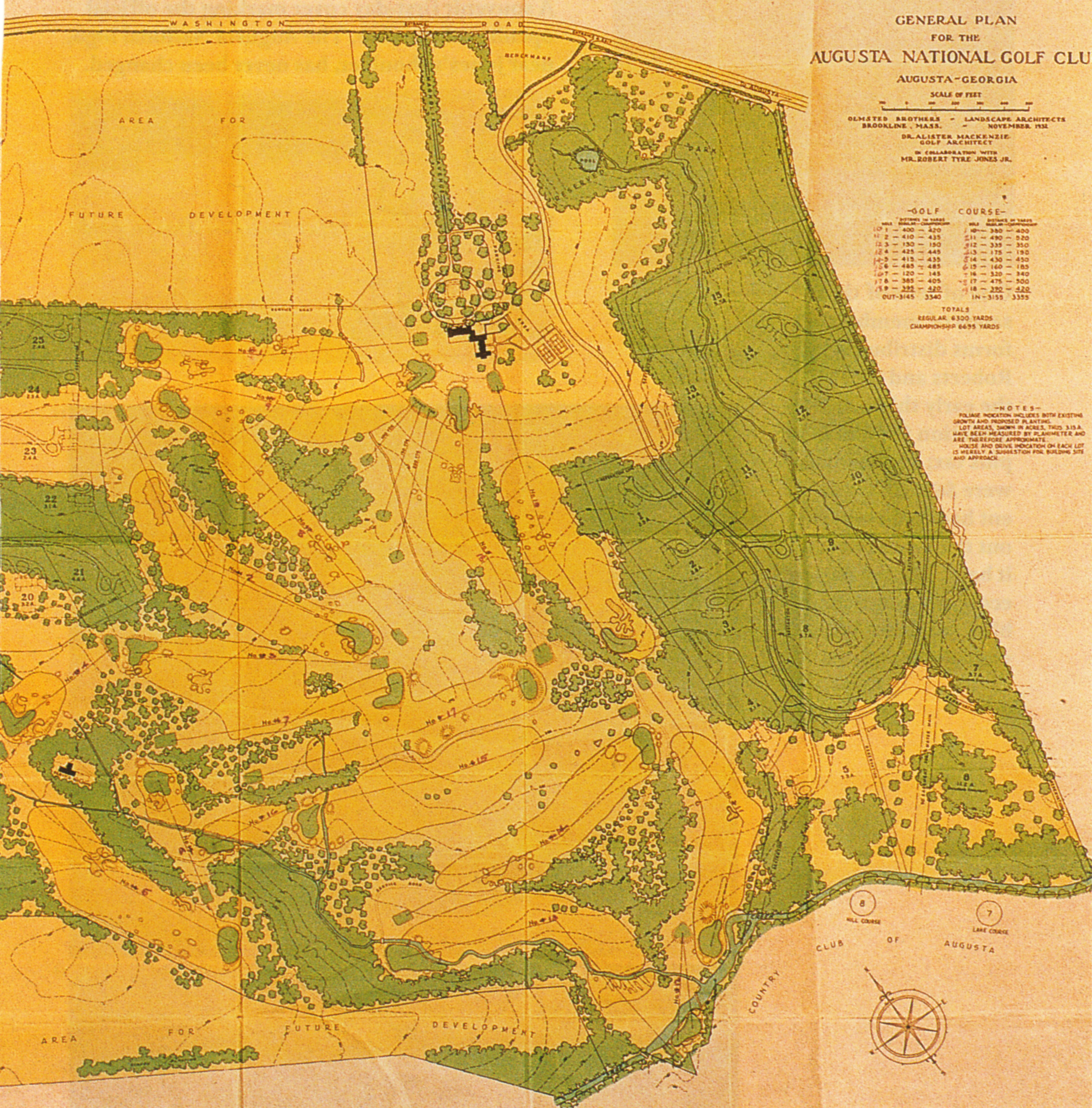
Olmsted Brothers' 1932 Augusta National real-estate development plan. If your eyes are good enough, note the tennis courts and the brand-new clubhouse—none of which were built. Also note the small practice area, between the ninth and eighteenth holes.

Augusta National Golf Club suffered severe financial problems during its first two decades, which coincided with the Great Depression and the Second World War. Its lenders actually foreclosed in 1935, just eight months after Gene Sarazen had seemingly secured the future of both the club and the Masters by hitting “the shot heard round the world.” (I explore those difficulties at some length in The Making of the Masters.)

One of the club’s best hopes for raising money in the early years was to sell building lots overlooking the course. Roughly a third of the club’s property was reserved for that purpose, and the lots were delineated and numbered on several early maps, including the plan reproduced above. For the most part, the lots occupied areas west of the second fairway and east of the tenth and eleventh. (Note to Laurentius: The spot where Rory McIlroy’s yanked tee shot on the tenth hole ended up during the final round of the 2011 Masters was near the edge of Lot No. 1.)

The club’s development plan, which was created by the landscape architecture firm Olmsted Brothers, called for two dozen building sites, and additional acreage was reserved for more. Most of the lots were between three and five acres; the largest, No. 6, was twelve acres. The club actively tried to sell those lots or others for more than twenty years. Boundary lines were cleared, access roads were built, lots were numbered with signs that faced the roads, and a major, continuing effort was made to stir up sales—all without success. In the early 1930s, W. Montgomery Harison, an early member, bought three adjoining lots just beyond the first green, but he was the only taker. He built a huge brick mansion, which stood until 1977, and the elder of his two sons built a much smaller house next door. (Harison’s younger son, Phil, was the tournament’s official starter for more than sixty years. He died 2008, at the age of 82. His own son is a member now.)

W. Montgomery Harison's house overlooking Augusta National's first green, during the Masters in 1941. (The photographer was standing near the ninth green and looking up the first fairway.) The house was torn down in 1977.

After the war, the club briefly considered leasing or renting the remaining lots, at annual charges ranging from $250 to $500 a year. When no enthusiasm for that idea was evident, the club gave up on the original subdivision and for four or five years pursued a more modest development plan in a different location. This new subdivision—which was to be called De Soto Trail—was situated just east of the area now occupied by the par 3 course. It consisted of twenty-four lots, most of them about a half-acre, and was targeted not at club members but at local middle-income families. To avoid the expense of building an access road and installing utilities, the club in 1949 offered the entire parcel to Augusta real-estate agents. There were no bids. The club then tried without success to sell the lots individually. Late in 1952, a developer offered $18,000 for fifteen acres. Roberts viewed that figure as too low, and the club eventually abandoned the entire idea.

Today, golf fans and even club members are almost always amazed to learn that Augusta National, in more than twenty years of conscientious effort, could turn up only one buyer interested in building a house near what today may be most fabled golf course in the world. If the same lots were offered for sale today, the bids would undoubtedly be astronomical. The failure of the real-estate projects underscores the immensity of the challenge that Clifford Roberts and Bobby Jones, Augusta National’s founders, faced in nearly every area of the club’s operation. As late as the early 1950s, Roberts couldn’t get local real-estate developers to return his calls.

It was only in the mid-1950s—when the tournament was securely established, and both the club and the country were on better financial footing—that Roberts began to view all development ideas as a mistake. A local club member named Julian Roberts (no relation) eventually bought Harison’s property and later sold it back to the club. One of Clifford Roberts’s last acts before taking his life, in 1977, was to walk to the first tee with the help of a waiter so that he could look up the fairway and assure himself that the house had been torn down.


Should You Live on a Golf Course?

Houses overlooking the second fairway, Cruden Bay Golf Club, Scotland, May, 2008.

To live on a golf course is not a universal aspiration. At a club where I sometimes play, a dozen houses back up to various fairways. Over the years, the owners of those houses have taken pains to obliterate their views of the course. They’ve built fences, planted bushes and trees, and hung No Trespassing signs. One scary old guy patrols the boundary of his yard the way East German soldiers once patrolled the Berlin Wall. Follow a bad drive into his garden and he unchains his dog.

It’s not that the course is ugly or the golfers rude. It’s just that to some people a fairway is no more attractive than a freeway. Golf, to them, is a public nuisance. (You can’t sunbathe in your underpants when local slicers treat your patio as a cart path.) Some people live next to golf courses because they figure they can’t afford to live someplace nice.

Howard indicating the house I'm going to buy as soon as this blog has made me rich. Royal Portrush Golf Club, Northern Ireland, April, 2012.

I belong to the opposing camp, the folks who view an adjacent par 4 not as an invasion of privacy but as a big, free, weedless lawn. At least, I would if I lived next to one. The perfect neighborhood, in my view, would be the one in the photo above, next to the fourth fairway at Royal Portrush, in Northern Ireland. Or how about something ocean-oriented at Cypress Point, in California? I’ve even picked out a building site: that wind-swept knob to the right of the sixteenth green:

Sixteenth hole, Cypress Point Club, Pebble Beach, California.

I wouldn’t care if a stray shot shattered my front window every once in a while. Heck, I wouldn’t care if you and your foursome cut through my kitchen on your way to the seventeenth tee. Help yourselves to beer! I’d just like to be able to step out my back door and tee it up whenever I wanted to.

I'd also be happy with any of these. North Berwick Golf Club, Scotland, April, 2008.

Next: Would you be willing to spend a few hundred dollars for a building lot at Augusta National? You (or your parents or grandparents) could have, but didn’t.

18 Good Things About Golf: No. 9

Looking at clubhouses counts as sightseeing. Royal & Ancient Golf Club, Old Course, St. Andrews, Scotland, May, 2008.

9. Golf provides an organizing principle for travel. Mere idle globe-trotting doesn’t appeal to me; I like a trip to have a purpose. For that reason, I enjoy traveling with children. Having kids along forces you to do things you really enjoy (buying ice cream, visiting a dungeon museum, taste-testing foreign candy) and to skip things you really don’t (going to plays, touring the wine country, looking at statues). Keeping your kids from slitting each other’s throat compels you to find activities that actually are interesting, as opposed to merely sounding like the kinds of activities that people engage in when they go on vacation. When children are not available, golf can serve a similar function. Rather than tramping aimlessly around Scotland in the hope of being moved by the differences between it and America, you tramp around Scotland checking off names on your life list of Open Rota courses.

On a golf trip, every day has the same unimprovable agenda: wake up, take shower, drink coffee, eat bacon, play eighteen holes, eat lunch, play eighteen holes, drink beer, take shower, eat dinner, go to sleep. The best golf trips, unlike the vacations that wives plan, never leave you wondering what to do next, and there is never an empty three-hour time block in which you might suddenly be expected to look at a cathedral. You don’t have to wait between lunch and golf, or between golf and beer, or between beer and shower, or between shower and dinner. When one agreeable activity ends, another begins. And on the last day, during the long drive back to the airport, you can pass the time by planning the next trip.

I did actually have a look at a Scottish castle in April, but it was on the road between golf courses and I needed to take a whiz.

Scientist Identifies Evolutionary Basis of Love for Golf

Ur-golfers, working on their short game.

In his new book, The Social Conquest of Earth, the retired Harvard sociobiologist Edward O. Wilson writes about the “innate affiliation” that humans feel with landscapes that resemble “those environments in which our species evolved over millions of years in Africa.”  That is to say, golf courses.

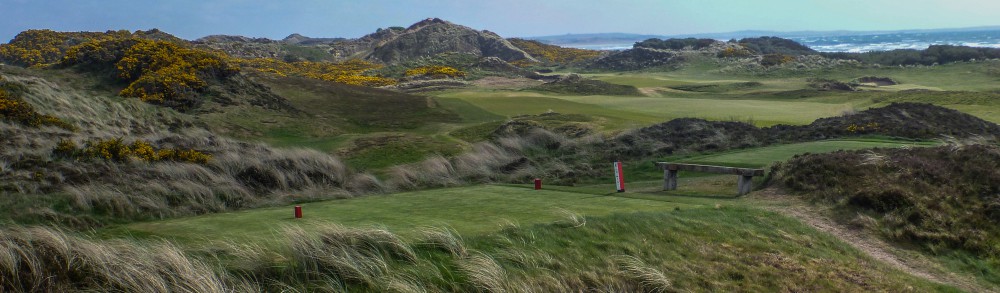
“Studies have shown,” Wilson writes, “that given freedom to choose the setting of their homes or offices, people across cultures gravitate toward an environment that combines three features, intuitively understood by landscape architects and real estate entrepreneurs. They want to be on a height looking down [tee boxes], they prefer open savanna-like terrain [fairways] with scattered trees and copses [rough], and they want to be close to a body of water, such as a river, lake, or ocean [hazards].” For a good example of just such a landscape, you need look no farther than the photograph at the top of this page, which I took last spring at Royal County Down Golf Club, in Newcastle, Northern Ireland. Here’s another, from Cruden Bay Golf Club, in Scotland:

Cruden Bay Golf Club, Scotland, April, 2008.

And the game itself is biologically resonant. Part of its addictiveness, for those of us who are hooked, arises from the thrill of effecting action at a distance—a form of satisfaction that must also have been known to our spear-throwing ancestors. A golfer is a hunter. Stiffing it on a par 3 and felling a woolly mammoth are parallel thrills. We are as nature made us.

Women don’t necessarily feel the same way about golf, and there’s an evolutionary explanation for that, too: men are chromosomally predisposed to doing virtually anything their wives don’t want them to do. (My first literary agent, an enlightened woman, provides ironic support for this hypothesis. For many years, she has tried to persuade her husband to take up golf—“I want to be a golf widow,” she told me once—but he has refused.) Such innate contrariness must have given our humanoid ancestors a powerful evolutionary advantage. A possible scenario: Female cave people implored their mates to spend more time around the cave, picking up saber-tooth tiger bones and entertaining the children; those who complied watched their families slowly starve to death, while those who ignored their mates and went hunting instead survived. In such beneficent behavior we may be seeing evidence of the forerunner of the modern golf gene.

You Really Have to Play the TPC At Sawgrass

David O., John O., Tony, Gene, TPC at Sawgrass, February, 2009.

The thirteenth hole on Pete Dye’s Stadium Course at the Tournament Players Club at Sawgrass is a straightforward par 3 that measures 150 yards from the blue  tees. The hole is nowhere near as famous or as frightening as the island-green seventeenth, but if you draw the ball the green might as well be an island because  there’s water both in front and on the left.

Despite the dangers, I was briskly confident as I stepped up to the tee. The day before, during my practice round, I had chipped in from the fringe for a birdie, and I had birdied the following hole as well, and (because golf is an easy game) I had parred the hole after that. Now, waggling my 8-iron and visualizing a soaring draw, I glanced one last time at the flag, and half-shanked my ball into the trees on the right.

“I’d better hit a provisional,” I said, not feeling particularly concerned. I teed up another ball, and, with a swing grooved through long and patient repetition, half-shanked it into the same stand of trees.

“I see the second ball,” someone shouted. Five minutes of crawling through dense undergrowth failed to turn up the first. I crouched in a bush to survey my prospects.  To put my second ball on the green, I calculated, I would need to hit a crisp thirty-yard smother-hooked 4-iron through a window-sized gap in the branches, applying enough backspin to keep the ball from skidding off the green into low earth orbit. I declared the ball unplayable and returned to the tee. I took a deep breath and swung again. My third ball found the water on the left.

An eerie hush fell over my playing partners. I felt my consciousness rise slowly out of my body and gaze down, with ineffable pity, at my golf hat. I dropped a fourth ball, at the front of the teeing area, and, with my pitching wedge, yanked it safely onto the far left corner of the green, perhaps fifty feet from the pin. Three putts later, I had my ten.

From that point forward, my memories of my round are indistinct. I had been playing pretty well before my disaster, but I ended up with a 102, including double or triple bogeys on all the remaining holes except the celebrated seventeenth, on which I had a seven. (First ball into the water over the green; second ball into deep rough next to a piling at the rear of the green after bouncing hard and high off a piling at the front; chunky chip; three putts.) As I watched an official inscribe my score on the big board near the clubhouse, I wondered whether I ought not to give up golf altogether, for the good of the game.

All that happened twenty years ago. The tournament in which I was competing was not, quite obviously, the Players Championship, which is held at the Stadium Course each spring and is underway this week. It was an amateur event that no longer exists, alas—a bargain-priced multi-day event on what was then known as the Partners Tour.

But, even though the Partners Tour is defunct, you should find an excuse to play Sawgrass. Hacking your way around a memorable course that you can watch the pros play on TV is both exciting and instructive, and the Stadium Course is the most engaging regular tour venue that mere civilians can play for a somewhat reasonable price. Bay Hill, Cog Hill, Doral, Harbour Town, and Torrey Pines are also possibilities. So is Pebble Beach, although eighteen holes there, including obligatory add-ons, may cost more the annual dues at your home club, and your round will seem to last for several days, and the greens will disappoint you, and the people in the group in front of yours will turn out to have taken up golf the day before yesterday. The Stadium Course is fun to play, and when you later watch the Players Championship—the fifth major!—on TV (as I assume you are doing today, instead of working) you will recognize more than just the last two holes.  Playing a tour course will help you appreciate how the pros make their living, and the next time Rory or Tiger or Phil dumps one in the water on seventeen you can tell your buddies, “Hey, I’ve done that.”


Golf Logos Explained: Narin & Portnoo Golf Club, Ireland

Narin & Portnoo Golf Club is situated among the dunes on a knock-you-over nub of the Atlantic Ocean called Gweebarra Bay, on the northwest coast of County Donegal. The club’s entrance is not captivating: you reach it by driving into the sort of tawdry-looking trailer park that the Irish and British seem to plant on all their choicest oceanfront real estate. But the course is tremendous. Kevin Markham, who has played every 18-hole course in the country, has described the seventh through eleventh as “maybe the best run of holes in Ireland.” The fifteenth, which measures 530 yards and plays into the prevailing wind between a line of dunes and the sea, is the hole that the ninth and tenth at Pebble Beach are trying to be. And the encampment of caravans—whose occupants, it should be said, sustain both the club and its bar—are invisible after a few holes.

On my first visit to the course, in 2011, I played with Connor Mallon, the club’s pro at the time, and set a new record for conversational tedium by saying “Wow! Great hole!” almost every time I opened my mouth other than to comment on the wind, which was intense. (Usually, when you mention wind on a links course, the natives you’re playing with dismiss whatever’s blowing as a breeze, even if you’re having trouble standing. But Mallon, good man, said he’d never known such a gale.) Later, on my way out the gate, I mentally composed an email to my wife, beginning: “Darling, how would you feel about living in a mobile home 750 miles from the Arctic Circle?”

I returned to N & P last month, with six friends from home. Between rounds, I asked a couple of older members, who were hanging around the golf shop, to explain the meaning of the symbols in the club’s logo, but they couldn’t. Eventually, someone looked it up online, and we discovered that the crest was created in 1982, at the request of the club, by a local art teacher. It is “unusual in not featuring any golfing imagery, focusing instead on the historic roots of the area,” the club’s website says. Here are the elements:

The Stonehenge-y thing at the upper left is the Kilclooney Dolmen, which stands above a 4,000-year-old tomb a few miles south of the course, near the village of Ardara (population 578):

Kilclooney Dolmen, near Ardara, Ireland.

The structure at the upper right is known as the Doon Fort, the Bawan, or O’Boyle’s Fort. It’s a circular defensive stone enclosure, and it stands on a crannóg, or artificial island, in Doon Lough, a lake a couple of miles southwest of the course. It was built in 1500 or so by the O’Boyles, who had troublesome neighbors:

O'Boyle's Fort, Doon Loch, County Donegal, Ireland.

Filling the bottom two panels is the Atlantic Ocean, which is a major presence at Narin & Portnoo. The green peak in the middle is the island of Inishkeel, which in decent weather is visible from parts of the course. The island used to have two churches, one for nuns and one for monks. Both are now ruins:

Ruined church, Inishkeel Island, County Donegal, Ireland.

And the U-shaped object in the center of the logo isn’t a horseshoe, as certain of my friends guessed. It’s the Drumboghill Gold Lunulaa Bronze Age necklace shaped like a crescent moon. It was found in a bog near the course in 1909, and is now in the collection of the National Museum. The club’s website says that its shape “matches the arc of the sixth hole.”

Connor Mallon, my host in 2011, took his life on March 14, 2012, at the age of 35. I’d been looking forward to seeing him again, and to having a rematch. At every stop on our 2012 trip, I met people who had known and loved him. In 2011, I bought a shirt from him exactly like the one he’s wearing in the picture below, because I thought that maybe its color held the secret to his golf swing.

Connor Mallon, Narin & Portnoo, near the ninth tee, May 1, 2011.