A December Golf Story

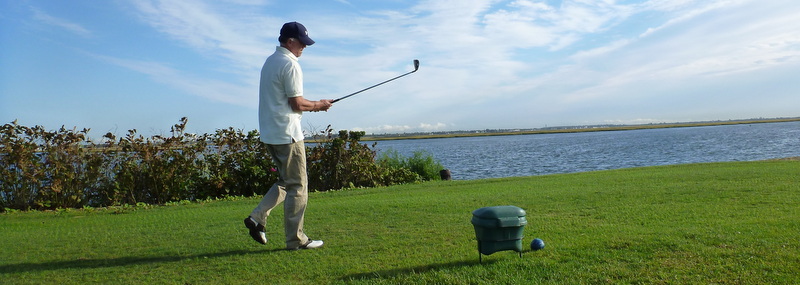
Jim in December, 2007, fifteen years after the rounds described below. Split Rock Golf Course, Pelham Bay Park, Bronx, New York.

Jim in December, 2007, fifteen years after the rounds described below. The green in the photo is the eighteenth at Split Rock Golf Course, Pelham Bay Park, Bronx, New York.

On the first day of December twenty years ago, my friend Jim and I played our final round of the season. The temperature was in the low fifties, but heavy clouds were moving in from the north. The rain was supposed to begin that afternoon, and it was supposed to turn to sleet the following day, and the temperature was supposed to drop below freezing and stay there. It was the last real golf day we would have on our home course for months.

We had the place to ourselves, and we both played well. I hit almost every fairway, and Jim sank two chips. After eighteen holes we were even. The temperature was dropping, but the rain hadn’t come yet, so we decided to go around again. I was one down after eight, but I birdied the last hole and pulled back to level. The wind was picking up. We decided to stop there.

I felt sad that the golf year was over, but not terribly sad. My swing felt solid, and I figured it would keep till spring. We stood on the first tee for quite a while, just looking at the course. “A good finish to a good season,” Jim said, and I agreed. I was reluctant to leave, so I dug a few old balls out of my bag, and we hit them into the woods. We cleaned our stuff out of the bag room. I found an old hat of mine in the lost-and-found box. Then Jim and I shook hands, and we went home.

The rain came down so hard that night it woke me. A couple of hours later, my son, who was three, woke me again. He had had a bad dream. As I got him a drink of water and put him back to bed, I noticed that the rain had stopped. There was still no rain at six, when the kids and I got up for good. We had breakfast, and I read them some books. As I did, I kept glancing at the window. The sky was dark gray, and the clouds were churning. The temperature was in the low forties, but there was no rain and no frost. At nine, I called Jim.

Ten minutes later, we were back on the first tee. “The first round of the new season,” Jim said. And we teed off.

Jim took this picture of me a a month or two later, after our course really had closed. I'll have something to say about snow golf at some point. All I'll say now is that I own a pair of snow shoes that I've never used for anything but golf.

Jim took this picture of me a month or two after the rounds described above. I’ll write something about snow golf at some point. All I’ll say now is that I own a pair of snowshoes that I’ve never used for anything but golf.

Back-Roads Scotland: Newburgh-on-Ythan

One of the Daves I played with at Newburgh-on-Ythan, in Scotland. He’s teeing off on the 18th hole, a par-5, which was once said to be the longest golf hole in Scotland. Snow began to fall as we reached the green, although it didn’t fall for very long.

Last April, I played a round at Newburgh-on-Ythan Golf Club, on the east coast of Scotland about halfway between Royal Aberdeen and Cruden Bay. The round was unusual in that all three members of my threesome were named Dave. (One of the Daves was the club’s captain, but I no longer remember which one.) Newburgh was founded in 1888, a year before my golf club at home. Originally, it had nine holes and was only a little over two thousand yards long. (The hole called “Long” was just three hundred and thirty-three yards.) It was laid out like this:

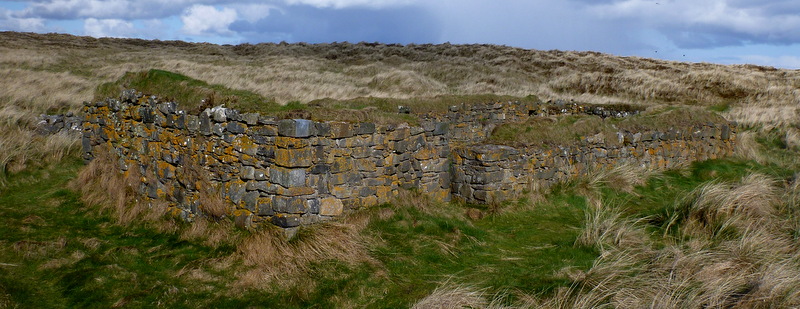
The second nine of the current course occupies the same piece of ground as the original course, although the layout has changed. The new nine is situated on the hill shown in the upper left-hand corner of the map above. One of the new holes incorporates an ancient wall thing, and if your ball ends up inside the enclosure you may have trouble hitting it out, as one of the Daves did:

A rare photo, showing both of the non-me Daves at the same time. No photo of all three Daves is known to exist.

The most famous person ever to take golf lessons at Newburgh is probably Prince Phra Bat Somdet Phra Poramentharamaha Vajiravudh Phra Mongkut Klao Chao Yu Hua (later King Vajiravudh) of Siam (later Thailand), who learned to play there in 1897, the same year the map above was drawn. Here’s what the Prince looked like after he became King:

The future king learned to play golf while staying for a month at the Udny Arms Hotel, across from what was then the first tee and is now (more or less) the thirteenth. The hotel still exists, and from the outside it looks pretty much the same as it did in 1897. I had a nice meal there the day after I played the course.

The wind blows hard on Scotland’s east coast, and one result is the mountain-size pile of sand in the photo below. It’s on the far side of the estuary of the River Ythan, directly across from the golf course:

The Sands of Forvie, across the Ythan estuary from Newburgh-on-Ythan Golf Club.

The mountain of sand is part of Forvie National Nature Reserve. You can enter the reserve from a parking lot a mile north of Newburgh and walk all the way across it to the sea:

I hiked across the reserve along this road.

A large part of the reserve was closed when I was there, to protect nesting terns, but I was able to explore the ruins of the village of Forvie, which was buried by blowing sand in the early 1400s. All that’s left are some piles of stones and part of the village church, which was built on high ground:

What’s left of Forvie Kirk, and of Forvie itself.
Forvie Kirk was built in the 1100s and was dedicated to St. Adamnan, who was born in Ireland in the seventh century. Adamnan visited Scotland in the late 600s and, apparently, made an impression. He didn’t bring luck to the residents of Forvie, however.

I took this picture for my wife, who, for unknown reasons, has become interested in moss and lichen. To make up for the fact that I’d abandoned her for a week, I smuggled home a golf-ball-size chunk of moss from Aberdeen, as a present. (Never bring your wife a golf shirt or golf hat, no matter how much you loved the course.)

Near the path I followed into the reserve were several stations like the one below, which were equipped with tools I could have used to stamp out any fires I happened to have started. Luckily, I didn’t start any.

I’m not sure that I need to play Newburgh-on-Ythan again, but I’m glad I played it once, and I’m glad I met the Daves, and I’m glad I found that old ruined church. And the chunk of moss I brought my wife is now growing near our back door. It didn’t make up for the trip, but it probably helped.

Great Golf Invention: Improved Tournament Periscope

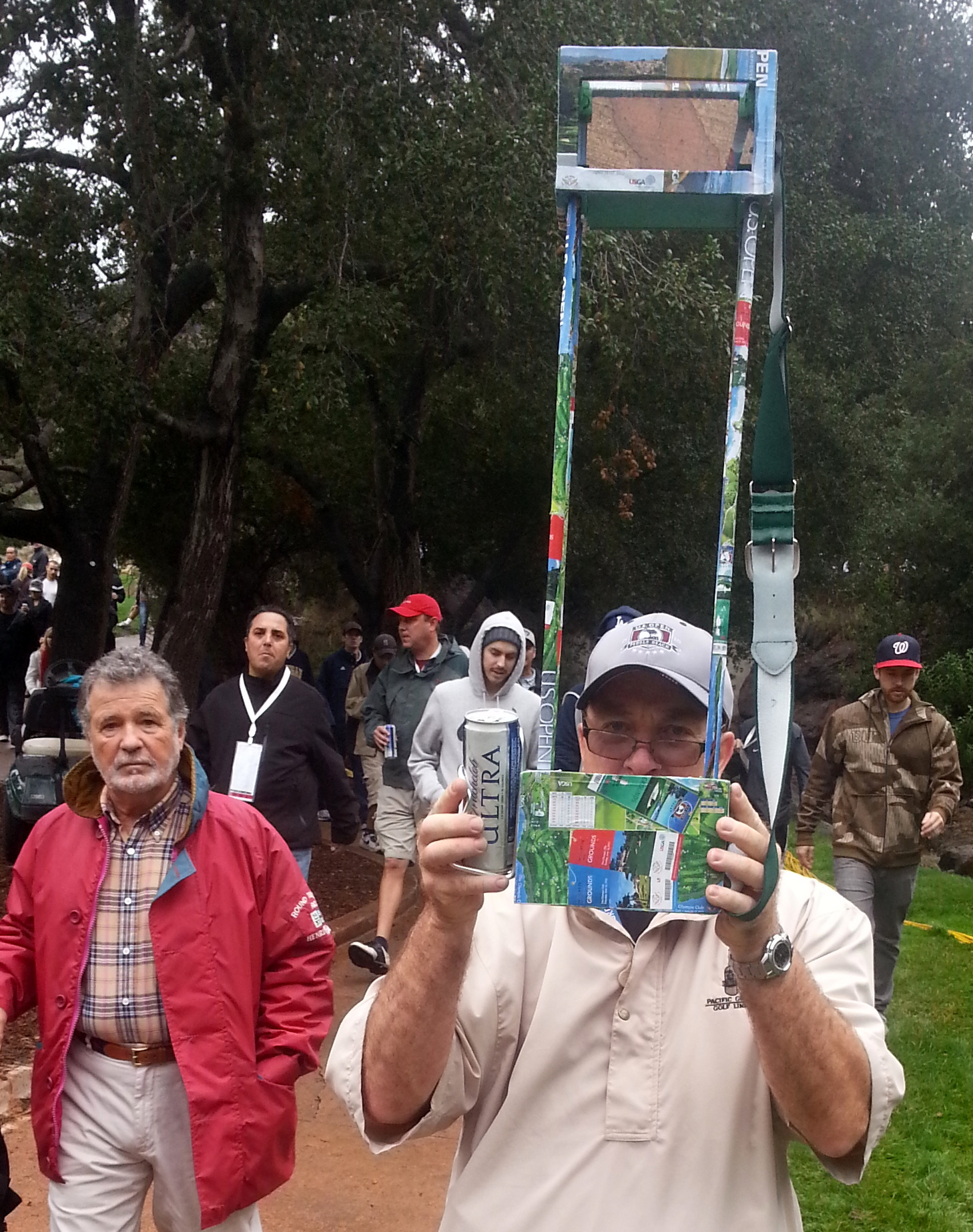
Steve Davis and his invention at Sherwood Country Club, Thousand Oaks, California, December 2, 2012.

On Sunday, at Tiger’s tournament, I ran into Steve Davis, who is the guy in the photo above. He invented the contraption he’s holding: a periscope that enables him to see over the heads of people standing in front of him. It’s an improvement over other golf periscopes because it doesn’t completely block the view of people standing behind him. Also, it has a shoulder strap and a beer holder:

Davis works for a copier company. He has “wallpapered” his invention with color copies of mementos from other golf tournaments he’s attended, including the 2010 U.S. Open. If you’d like to give him a lot of money to manufacture these things full time, let me know, and if you don’t sound like a nut I’ll put you in touch.

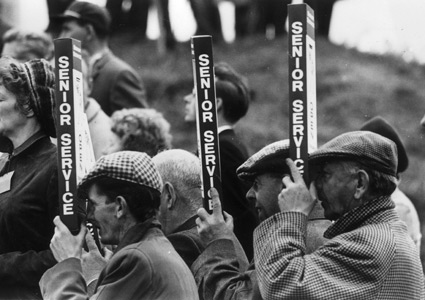
Periscopes used to be common at golf tournaments. The photo below is from the 1965 Ryder Cup, at Royal Birkdale. (Senior Service is a British cigarette brand.)

Many spectators at the 1993 Ryder Cup, which I attended (at the Belfry, in England), had periscopes that looked like the boxes that bottles of Johnny Walker scotch come in. (Johnny Walker sponsored the tournament.) The Belfry is a terrible course for spectators, and the periscopes made things better for the people who had them and worse for the people who didn’t. The only way to improve Davis’s invention, I think, would be to add a second beer holder.


Why Do Certain People Wear Certain Shoes at Certain Golf Tournaments?

By “certain people,” I mean certain women; by “certain shoes,” I mean sandals, high-heeled boots, ballet-type slippers, and backless pumps; and by “certain golf tournaments” I mean golf tournaments during which there is so much rain that the lift-clean-and-place rule is in effect for all four rounds. Specifically, I mean Tiger Woods’s 2012 World Challenge presented by Northwestern Mutual, which was held in the mud last week at Sherwood Country Club, in Thousand Oaks, California:

The Man himself  (and Bo Van Pelt, plus various menials) on the first fairway at Sherwood Country Club on Sunday. Note the mud visible in the rough in the foreground.

The World Challenge is an unofficial, end-of-season event. It raises money for the Tiger Woods Foundation, and it features a small field of terrific players. By Sunday, the entire course was so thoroughly saturated that balls often plugged where they landed, even on some of the greens, and many spectator areas looked like this:

These men are wearing sensible shoes, relatively speaking.

Despite the weather, surprisingly many women wore shoes that were not well suited to the conditions:

The women whose feet are shown below were standing on pavement near the clubhouse and watching someone on the practice green, but shortly after I took this photograph they all followed their boyfriends or husbands onto the course:

In the photograph below, the woman in jeans had just had trouble traversing a muddy area under some trees. A friend of hers told her husband, “Erin is bothered about her shoes. Very bothered.” I don’t know what happened after that.

The heels on those boots made sucking sounds as the woman wearing them walked through the mud, which was ubiquitous. Note the evidence of capillary action at the bottom of her pants legs.

Even in a drought, why would someone wear high heels to a golf tournament, where spectators walk for miles?

Ready to follow Tiger for eighteen holes.

I can think of three semi-plausible explanations: 1) Fashion trumps all; 2) Someone’s boyfriend or husband didn’t mention that golf is played on grass; 3) Someone was attending the tournament against her will, and wearing inappropriate footwear was her passive-aggressive declaration of her discontent.

Walking “on pointe” to keep mud from coming over the sides.


My Close Personal Friend Mike Keiser and his New Golf Course, in Nova Scotia

Back in May, I went to dinner in Chicago with my close personal friend Mike Keiser, the founder and owner of Bandon Dunes. The restaurant was Moto, which serves a four-hour tasting menu (see above) accompanied by fifteen different wines. Our “Spring Lamb” course was actually a tasting menu in itself: a thing of lamb paté, a thing of lamb sausage, a thing of smoked lamb shoulder, a thing of “baconized” lamb, a thing of leg of lamb, and a couple of other lamb-based things, all served on a chef’s cleaver. “Explosion” was a stick of dynamite made from white chocolate and filled with a syrupy liquid that I wouldn’t have minded drinking a quart of, plus a cherry-stem fuse—and the waiter made it explode by dropping it on its plate. He said that my explosion was the best one he’d done so far, and that he was still working on his technique because the dessert was so new. “After Dinner Menu” was the actual menu printed on a slab of marshmallow, which was brought to the table in a saucepan of liquid nitrogen, then placed on top of three kinds of fruit and three kinds of mint and broken to pieces with spoon. Most surprisingly good thing: beet meringue.

Moto’s famous Cuban pork sandwich, which looks like a cigar and is served in an ashtray. It wasn’t on the menu the night Keiser and were there, I’m sorry to say.

The next day, Keiser and I played a round at Chicago Golf Club, which was built in 1895 and is the oldest eighteen-hole golf course in the United States. (The club was founded in 1892, on a different site.) The course was designed by Charles Blair Macdonald and later tinkered with by Seth Raynor, among others. There’s a convent next door, and one of the guys we played with told a funny story about a golfer who took a whiz in the bushes next to it, but I didn’t write the story down and now I don’t remember any of it. Take my word for it, though: that story was funny. C.G.C.’s motto is “Far and Sure,” which is also the motto of Royal Liverpool Golf Club, where Macdonald had lots of friends. In fact, when Macdonald’s new Chicago friends realized how much they loved golf he had his old Liverpool friends send him six sets of clubs.

Keiser’s newest course is Cabot Links Golf Course, in Nova Scotia. Ron Whitten, who is Golf Digest’s architecture editor, has written an article about both it and Donald Trump‘s newest course, which is in Scotland. Whitten’s article will be in the February issue, and while you wait to read it you can watch this video:

The video was made in October by Don Snyder, whose company is called World Golf Movies. Snyder worked as a caddie at the Old Course, among other places, and one day he had the idea of creating video tours of the world’s best courses. Several of his videos are available as apps in the iTunes store, and more are coming. Perry Golf, the tour company, is a partner of his. “Starting next season,” Snyder told me in an email recently, “we will also shoot little fifteen-minute movies of Perry Golf’s clients out playing on their journey, and then sitting down in a pub and talking about what their trip has meant to them.”

Chicago Golf Club, Wheaton, Illinois.

Hurricane Sandy Update: Lido Golf Club

One of the water holes at Lido Golf Club, during an event I played in back in September. There are more water holes now.

Back in September, I played in a literary golf outing, called the Grudge Cup, at Lido Golf Club, in Lido Beach, New York. That’s one of the competitors in the photo above, teeing off on (I think) the fifth hole, a par 3. A little over a month later, Hurricane Sandy hit Lido hard. Here’s a post-storm aerial photo, which Golf World ran a couple of weeks ago to illustrate a story by Bill Fields:

Postdiluvian Lido Golf Club. The green of the hole in the photo at the top of this post is at the upper left. (Photo from Golf World.)

The golf course was inundated—and, it goes without saying, the neighbors got it worse. The Google Earth screenshot below, which predates the storm, shows just how vulnerable those neighbors were. (The body of water at the bottom of the image is the Atlantic Ocean.)

The golf course is near the center of this Google Earth screenshot. The course and the adjacent neighborhoods were flooded from both sides.

Lido Golf Club is still closed, and the front page of its website has a button you can click to make a donation to the Red Cross.

Lido Golf Club in better times.

A Hole-in-One Fund That Doesn’t Defraud Golfers

Chic paying his fifteen-dollar entry fee to Hacker before teeing off on Sunday morning. No twenties, please. Chic’s shorts (after November 1) earned him one extra handicap stroke.

The Sunday Morning Group has a five-hundred-dollar hole-in-one prize. The money comes from our regular Sunday-morning entry fee, which is fifteen dollars. (Five goes into a pool for the winning team, five goes to skins, two goes into a pot that’s shared by everyone who matches the morning’s best net score on the so-called Money Hole, which is announced before we tee off, and three goes into the S.M.G. slush fund, which pays for things like the hole-in-one prize.)  The last person to make a hole-in-one during one of our Sunday games was Reese, but he did it before we had a hole-in-one prize so he got nothing. Last week, though, Hacker (real name) decided that the slush fund had become so huge that Reese ought to get something anyway, so he gave him two hundred and fifty dollars. Reese used the money to buy liquor and other stuff for a bar at lunch:

Reese’s hole-in-one bar is on the left. That’s Howard on the right, tending the grill.

Lunch itself was provided by Howard. Our town’s grocery store had shut down its hamburger-patty-pressing machine for the winter (for some reason), so Howard had to buy ground beef in bulk and shape our cheeseburgers with his own hands—very possibly the first time that’s ever happened. He also brought two kinds of fancy mustard (but no regular mustard).

The fact that Hacker paid out a hole-in-one prize that, technically speaking, no one had earned distinguishes him from much of the rest of the golf world—which, apparently, is always thinking of reasons not to pay up. You can read about several such cases on the website GolfDisputeResolution.com, which covers “the intersection of golf and law” and was created by Rob Harris, a Connecticut lawyer. Harris writes about an especially interesting hole-in-one dispute here.

This is what Harris has to say about his own golf: “At the age of 11, on a very hot day, I lost the 9 hole junior boys championship at Tuscarora Country Club on the second hole of sudden death; I proceeded to throw up at the post-event lunch.” Hey, Harris—come join us on Sunday. You’ll fit right in.

These two were curled up in the Dumpster during lunch on Sunday. Gary, our superintendent, says they come and go.

My Close Personal Friend (a Different) Tom Watson

Nick and Hacker (real name), Dyker Beach Golf Course, Brooklyn New York, 2006. That’s the Verrazano-Narrows Bridge in the background.

As soon as our home course closes for the season, my friends and I pack up our clubs, say goodbye to our wives and children, and head south for a while, to a place where golf can be played on real grass even in the middle of the winter. Which is to say, we go to the Bronx.

Many people don’t realize that there is a golf course inside the New York City limits, but there are more than a dozen, and almost all of them are public courses that are open year-round. Our favorites are probably Pelham Bay and Split Rock, in the Bronx, and Dyker Beach, in Brooklyn, but there are others and, because there’s no such thing as a bad golf course, we sometimes play them, too. (You can read more about winter golf in New York here and here.)

The drive south takes us down I-684 and the Hutchinson River Parkway and past still more golf courses, most of which don’t stay open all winter. One of those is Saxon Woods, which is one of six public courses owned by Westchester County, New York. Saxon Woods is so close to Winged Foot and Quaker Ridge that some people figure A. W. Tillinghast must have designed at least part of it, too. The evidence for that isn’t strong, to say the least, but as we drive by I look at it longingly (which is how I look at all golf courses).

Not long ago, I received an email from Tom Watson, a Saxon Woods regular, who wanted me to know about a game he had invented. Here he is:

Tom Watson (real name) playing in a charity outing at Westchester Country Club, Rye, New York, 2012.

Tom wrote:

“I simply keep my best score for each hole for the entire season, and add them up for a season’s best net total. So it allows a 19-handicapper to post a ‘score’ that’s closer to the pros than to guys who put their shoes on in the parking lot. And it gives you some real rooting interest as the season wanes. I was sitting on 68 last week when I stepped up to one of the only two holes I haven’t parred all year. A good drive, a yanked three-wood, a big flop shot over a bunker, and an easy three-footer later, I was writing down par and dropping my Season’s Best to 67. It’s a number I’m not usually acquainted with—and it made the round. I didn’t quite go all Ian Poulter on the green, but there was a discreet fist pump involved. It’s the only golf game I know of where your score always goes down over time!”

Tom’s invention is actually a re-invention. A cumulative score like the one he compiled is called a ringer score, and there are lots of clubs and leagues and groups that run season-long ringer competitions. (One of them is Wethersfield Country Club, in Connecticut, where Rick and I played in a state senior four-ball tournament this year.) Ringer scores are also fun to use as a side bet on golf trips, over multiple courses. Ray, Tony, and I did that during ten rounds on three courses at Bandon Dunes, not quite six years ago. I’m pretty sure I won, although I don’t recall collecting any money.

More Holiday Gift Ideas for Golfers

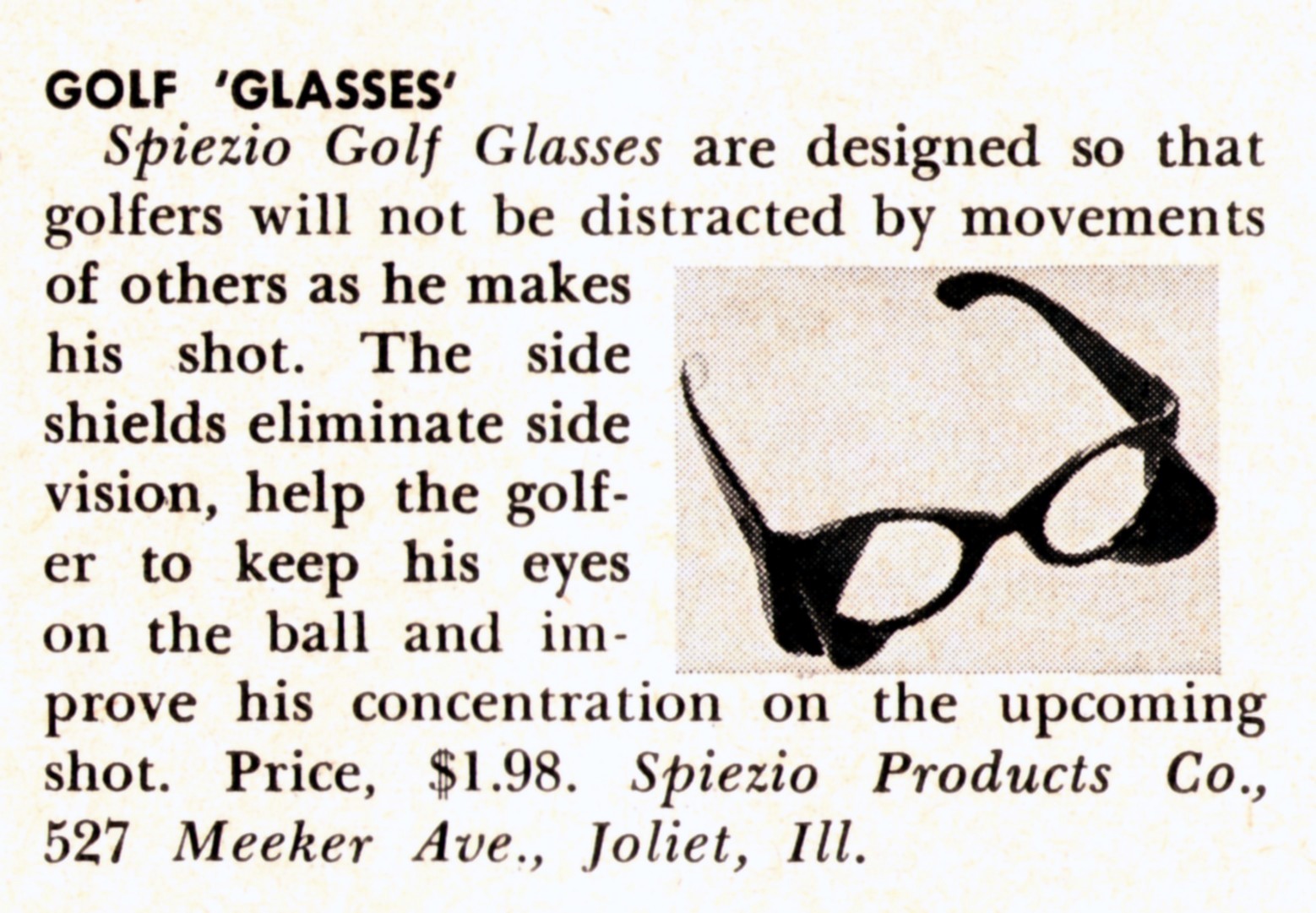
Every year, my secret Christmas wish is “Please don’t buy me golf balls from the big sale display at Dick’s.” Instead of those, how about something from the pages of Golf Digest fifty years ago:

These glasses are from 1958. They wouldn’t do me any good, because I play better with distractions, but I can think of guys they might help. If you could move the side shields to the top, they would be useful in the rain. (Tip: the best way to dry your glasses is with the fingers of your cotton rain gloves, which work almost as well as a chamois.)

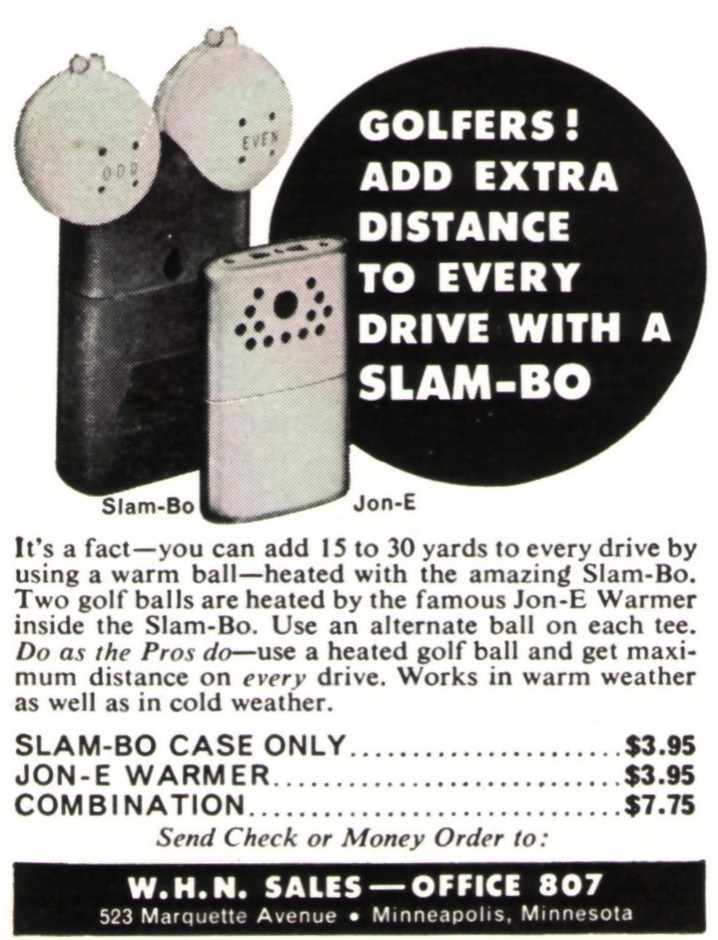
Did the pros really heat their balls in 1961, when this advertisement ran? Whether they did or not, is it legal today? If so, Zippo makes a gizmo that looks a lot like the Jon-E Warmer. (You can buy one here.) Gary, our superintendent, usually brings hand-warmers for everyone when we play in the winter. I don’t really care for them, although I did once play while wearing a back warmer. Note the handy “odd” and “even” designations, to prevent confusion on the tee.

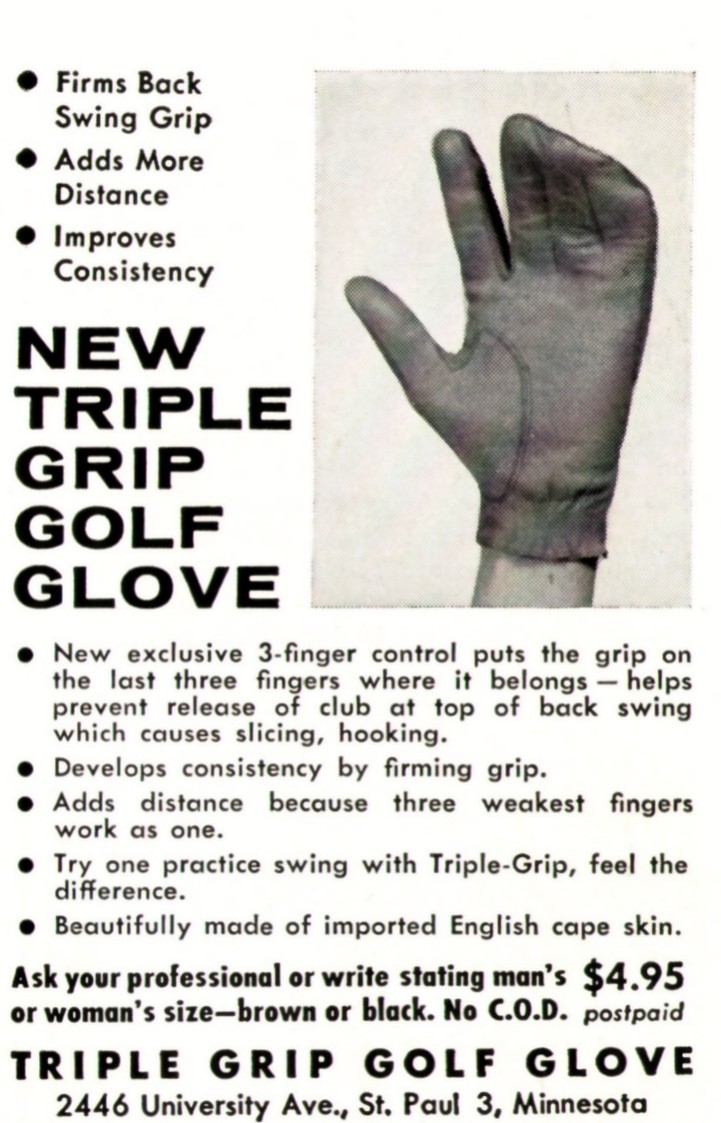
This Creature-form-the-Black-Lagoon glove is also from 1961, and also possibly illegal. The digital cluster on the right looks as though it’s about to divide into separate fingers—including, possibly, a sixth one.

Is this the sort of thing Lance Armstrong was doing? Also: why the emphasis on the twelfth hole?

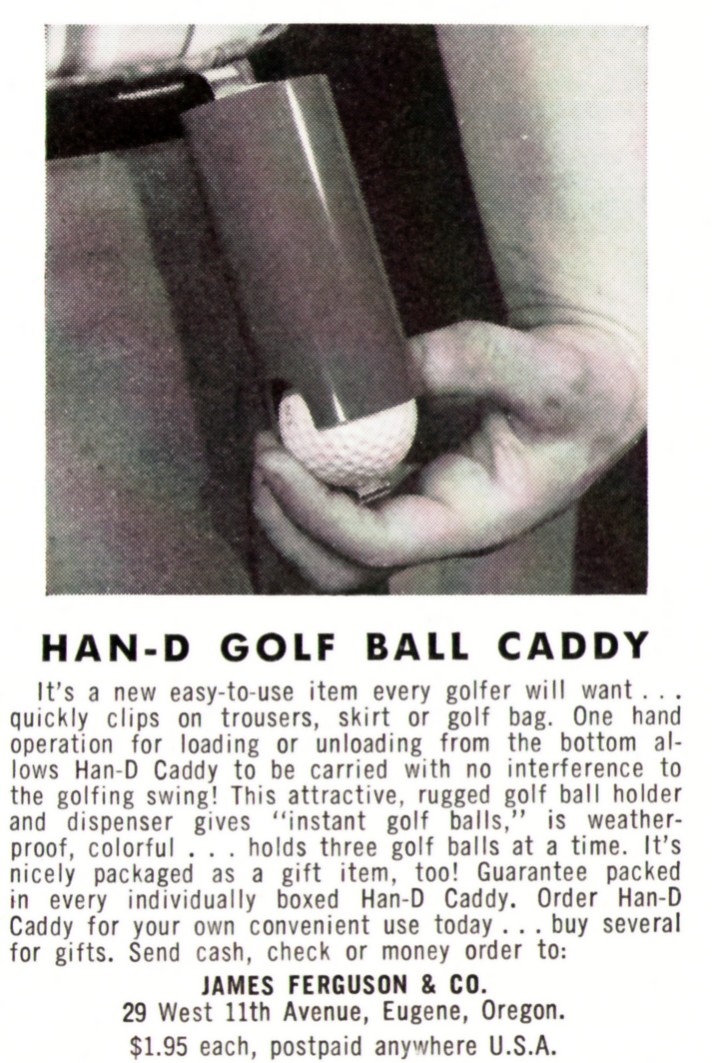
This device, from 1961, might actually be a partial solution to the dirty-pocket-rim problem, which I complained about over the summer. Maybe add a tee bandoleer and some magnetic ball markers?

Still baffled about what to give (or ask for)? More soon.

Five Holiday Gift Ideas for Golfers

It’s never too early to start shopping for the golfer in your family. These gift ideas are from the pages of Golf Digest in the late 1950s and early 1960s:

This item is from 1957, when golf, cocktail-drinking, and home refrigeration were all ascendant in the United States. U.S. Royal was a trade name of the United States Rubber Company, which renamed itself Uniroyal in 1961. It no longer makes golf balls, although it may still make ice trays.

The reflective metallic golf hat, also from 1957, is an idea that never caught on, for unknown reasons. The hat was probably most useful in match play, since by standing in the right place and tilting your head you could temporarily blind your opponent. The logo notwithstanding, I don’t think anyone ever wore one in the Masters.

Wehrmacht surplus? Somebody must have bought a load of these, because they were advertised all over, and not just in golf publications. This ad is from 1960. Hats like this are still available, although they’re of interest mainly to Third Reich fetishists.

Also from 1960. Golf ball repair is a concept that doesn’t really exist anymore.

This ad is from 1958, but versions of it ran for several years. The price is per week, not per night, and it includes room, golf, meals, tips, and just about everything else. (Dove hunting may have been extra.) Today, you’d pay almost as much at Pinehurst for a dozen Pro V1s.

Don’t see anything you want? More gift ideas soon.