My Close Personal Friend Moe Norman

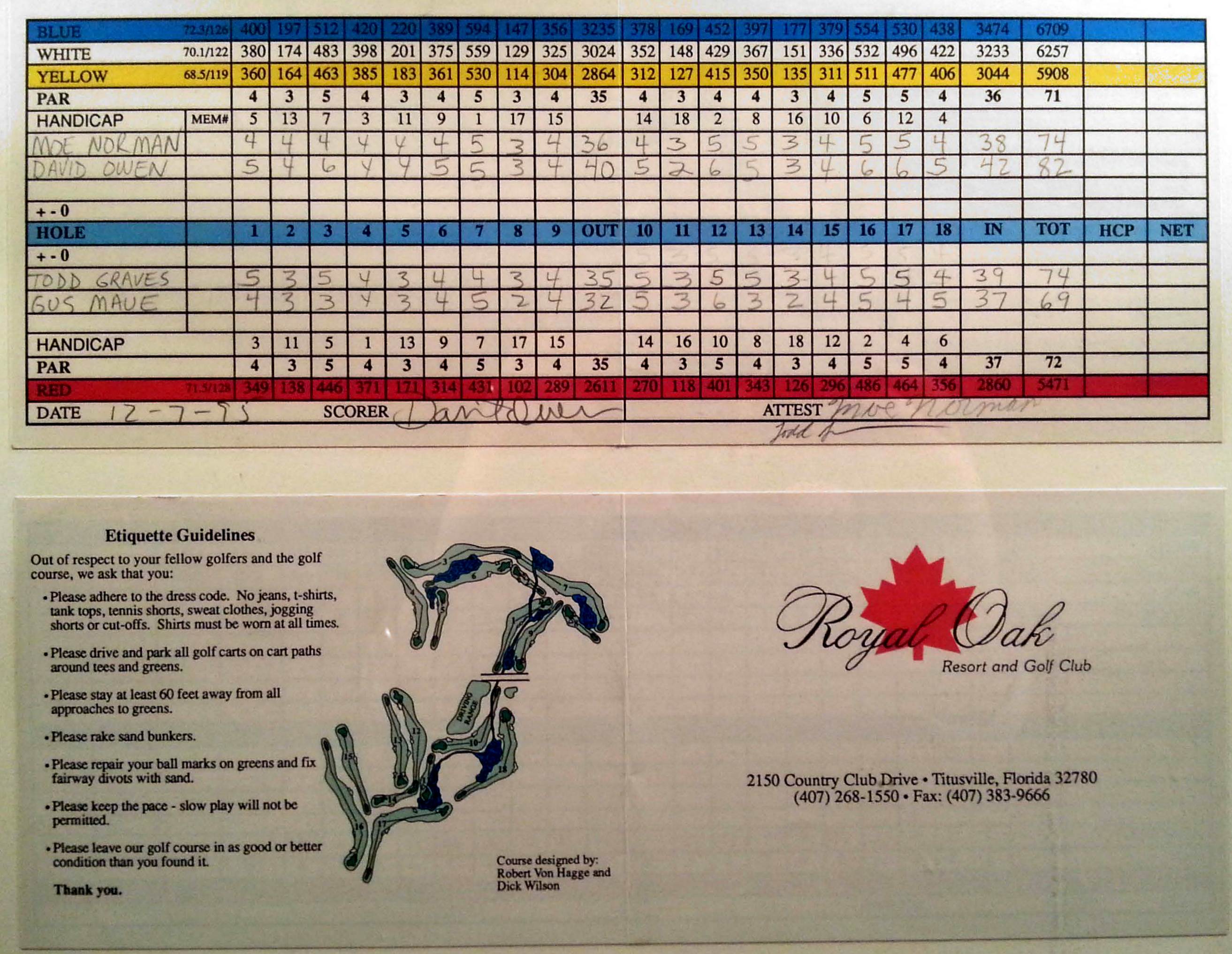
Moe Norman Scorecard

Many golfers nowadays look blank when you mention Moe Norman, who died in 2004, but to those who were lucky enough to see him play he was a legend. Lee Trevino ranked him with Ben Hogan and Byron Nelson as one of the greatest ball-strikers of all time. Paul Azinger first saw him hit balls on a driving range in Florida in 1980, when Azinger was in college. “He started ripping these drivers right off the ground at the 250-yard marker,” Azinger told Tim O’Connor, a Canadian sportswriter, “and he never hit one more than 10 yards to either side of it, and he hit at least 50.” In 2005, Tiger Woods told Jaime Diaz, now the editor of Golf World, that Norman and Hogan were the only two golfers in history who had “owned” their swing, and that one day he hoped to own his, too.

Moe Norman Golf World 9-2-66

Despite such accolades, Norman spent much of his forty-year competitive career in obscurity and poverty. He played almost exclusively in Canada, where he was born, and made only a brief attempt, in 1959, to play on the American tour. He sometimes carried his own bag in tournaments, because he couldn’t afford a caddie, and he sometimes slept in bunkers on the courses where he competed. He often hitchhiked to and from tournaments, and he had to juggle his competitive schedule with a succession of dreary factory jobs, including one stitching rubber boots. He spent the winter before the 1956 Masters, to which he had been invited as the reigning Canadian Amateur champion, setting pins in a bowling alley for a few cents a line. For years, he supported himself partly by selling the prizes he won in amateur tournaments, and as his confidence increased he sometimes sold the prizes before the tournaments began. (According to friends, on at least five occasions he intentionally finished second because he hadn’t been able to find a taker for the first-place prize and had been forced to sell the second.) In the late nineteen-eighties, he was so broke that only the last-minute intervention of friends prevented a bank from repossessing his car.

Moe Norman, 1950s.

Moe Norman, 1950s.

I watched Norman hit golf balls on a practice tee at Foxwood Country Club, in Kitchener, Ontario, his hometown, in the fall of 1995, when he was sixty-six. He warmed up with a pitching wedge, although “warming up” doesn’t really describe any part of his routine: the first shot was perfect, the second was identical to the first, the third was identical to the second. Then he switched to his four-iron. His swing—to all appearances, an effortless half-swing—was the same as it had been with the wedge. “How far you hitting those?” a spectator asked. “One-eighty,” Norman said. The shots were within a couple degrees of dead straight, despite a stiff cross wind, unless he announced ahead of time that he was going to hit a draw or a fade. The divots were identical, and surreally shallow.)

Moe Norman, 1990s.

Moe Norman, 1990s.

He switched to his driver. If you had looked only at his arms and hands, you wouldn’t have known he wasn’t still swinging his wedge. He would watch each ball in the air a moment, then bend over and place another on the tee—and I mean place it. The tee never moved. “I hit balls, not tees,” he said. On a driving range once, he hit 131 drives in a row from the same tee without having to straighten it. In tournaments, he sometimes entertained galleries by hitting a drive from the mouth of the Coke bottle from which he had just been drinking.
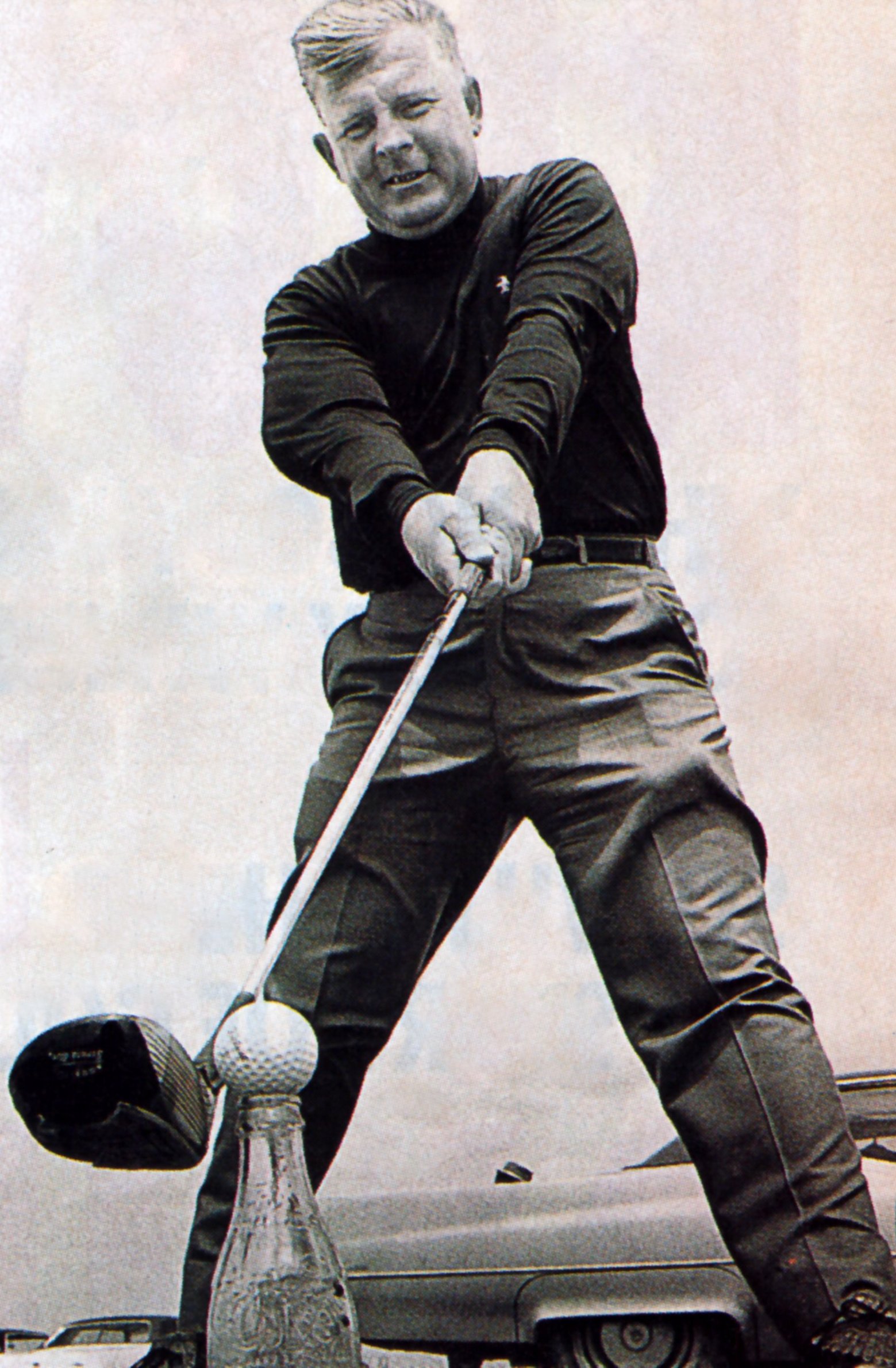
Moe Coke Bottle.bmp

In December, 1995, I got to play a round with Norman and his friends Gus Maue and Todd Graves (who calls himself Little Moe and teaches Norman’s highly unorthodox swing) at Royal Oak Resort and Golf Club, in Titusville, Florida. Royal Oak may no longer be a going concern—its website has been shut down for lack of payment—but in 1995 it was a favorite winter hangout of the Canadian P.G.A. The first hole was a 400-yard par 4, dogleg to the right. Maue, Graves, and I hit tee shots up the middle, and then Norman hit his over a row of trees to the right, toward a lake that ran the length of the hole. I thought, Hmmm—this is one of the greatest ball-strikers of all time? But it turned out that Norman always played the hole that way. There was a strip of grass, maybe ten yards wide, between the trees and the water, and from there he had an easy 9-iron to the green, while those of us in the fairway needed four-irons or five-irons.

Norman won his first tournament in 1949. “I didn’t know anything then,” he told me that day. “I didn’t even have a full set of clubs. Only had a driver, three-wood, three-iron, five-iron, seven-iron, nine-iron, and a putter. Didn’t even have a wedge. But one day everything fell into place and I shot a sixty-seven—four under.”

I said I was amazed he had played with so few clubs.

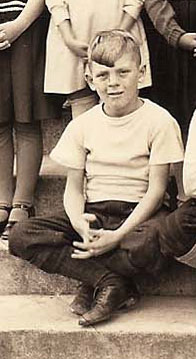
“Oh, I couldn’t afford them. Heck, when I was a kid you were lucky to have one club. And if you had a club your friends were always saying, Hey, can I use yours? Can I use yours? If someone had a driver we would hand it around—three of four guys playing together. If somebody had a nice putter, we all took turns putting with it. Goodness, back in Moe Norman youngthose days, there wasn’t a golf shoe in the foursome. And if the grass was wet your right foot would do a whirlwind, like a twist. But back then golf wasn’t a sport. It was just an exercise game. In fact, I was called a sissy by my father and my brothers, right at dinner. They would make big ears at me and call me a sissy. ‘Come on, play a man’s game,’ my father used to say. ‘Play baseball, or hockey—do like your brothers.’ I said, ‘No, Dad, I’m too light.’ I was a little skinny kid then, not over a hundred and thirty pounds, and I couldn’t play any other sport and be good at it, so I kept playing golf. But I had to hide my clubs under the front porch. My father was fat and I was real skinny, so I could dig a hole that he couldn’t get his head through but I could get my body through, and if I would push my clubs in far enough he couldn’t reach them.”
I wrote about Moe Norman in Golf Digest in 1995, and you can read that story here. The date in the opening anecdote is wrong, since Porky Oliver died in 1961. But other than that. . . .

 

Masters Countdown: Bobby Jones in Color

Bobby Jones in Color

The photograph above was taken in 1947, during the next to last Masters that Bobby Jones competed in. His badge identifies him as Player No. 1. The photographer was apparently experimenting with an early color film. The negatives were discovered in an envelope in an old file cabinet at Augusta National almost fifty years later, around the time I began researching my book The Making of the Masters. No prints are known to have been made before that time.

There is a great deal of confusion about Jones and his status as a player. Augusta National, in tournament publications, lists him as an amateur, but by the rules of the U.S.G.A he became a professional in 1930, when Warner Bros. hired him to make instructional films, and when, a little later, he began designing and promoting golf clubs for A.G. Spalding & Bros.

Jones retired from competition not because he had no worlds left to conquer; he retired because he abhorred the idea of being labeled a professional. In a letter to Clifford Roberts many years later, he described the typical pro as “an uneducated club servant”—a prejudice that dated to the early days of his competitive career, when only amateurs were accorded the honorific Mr., professionals weren’t allowed inside clubhouses, and tournament organizers distinguished between “gentlemen” and “players.”

“So long as I played as an amateur, there could be no question of subterfuge or concealment,” he wrote in 1960—a statement that clearly shows what he thought of playing golf for money. Roberts secured Jones’s participation in the first Masters, in 1934, by cleverly dodging the issue: in the tournament’s program listings and pairing sheets, he made no distinction between amateurs and professionals.

But the distinction was invariably noted elsewhere. The Associated Press and all other news organizations, in their coverage of the tournaments Jones competed in, listed him with the pros. Even O.B. Keeler, who had built his sportswriting career by celebrating Jones’s amateur accomplishments, took it for granted that Jones was now a professional. And so did Augusta National, officially.That’s why Charles Yates, not Jones, was honored as the low amateur in the first Masters, even though Yates’s score was three strokes worse than Jones’s.

Would Jones have played in the Masters if the club had been compelled to label him explicitly as a professional? Roberts said in later years that he suspected he probably would have, in order to help the club. But Roberts was uncertain enough that he never raised the matter with him, either then or later.

In Golf is My Game, Jones wrote that to give up his amateur status would have been “like giving up part of myself.” But, in fact, he gave it up in 1930. And he had a powerful incentive for doing so. His golf-related income in 1933, when the first tournament was being planned, was over $100,000; in contrast, Paul Runyan, who won nine events that year and was the tour’s leading money-winner, had gross tournament earnings of less than $6,500.

Is Golf the Key to World Peace?

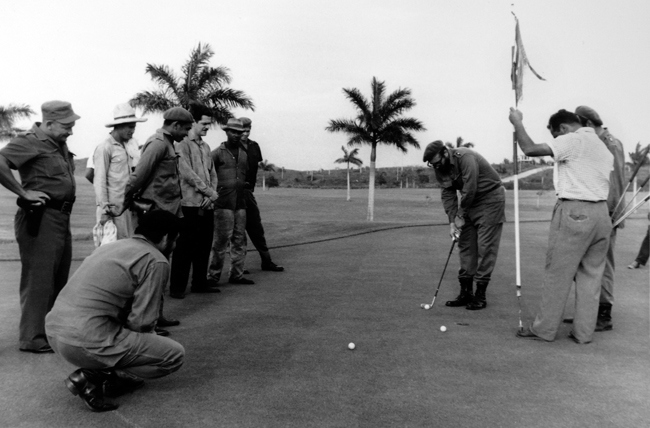
Fidel Castro and Che Guevara, 1962.

Fidel Castro and Che Guevara, Havana, 1961 or 1962.

In 2009, Hugo Chávez, who may or may not still be the president of Venezuela, dismissed golf as a “bourgeois sport.” A U.S. diplomat—clearly not a golfer himself—called Chávez’s statement “a mulligan.” (The annoying use of golf terminology for putatively humorous purposes is apparently irresistible; the Wall Street Journal described Chávez’s remarks as “ahem, par for the course.”) Chávez is a socialist revolutionary, a quasi-dictator, an American antagonist, a supporter of Iran, and, often, a buffoon. Nevertheless, it’s hard to argue with his main contention, which was that lush fairways are not the highest and best use of scarce real estate in places that lack even minimal housing for many impoverished residents.

Hard, but not impossible. In the late nineties, David Plotz, who is now the editor of Slate, suggested that golf might be a promoter of world peace. “Countries where golf is popular,” he wrote in the New York Times, “never fight other golfing nations—and don’t fight much at all—while countries without golf are strikingly belligerent.” The United States is an obvious exception, although, historically, we have focused our aggression on countries where golf is unknown, and on non-playing tyrants like Slobodan Milosevic, Osama Bin Laden, and Saddam Hussein. A commitment to golf-course construction, furthermore, has emerged as an important step in the rehabilitation of our former arch enemies, among them Russia, China, and North Vietnam. Will Baghdad, Kabul, and Pyongyang become prime American buddies-trip destinations a decade or two hence? We can only hope.

The explanation for golf’s pacific associations isn’t hard to understand. In fact, Chávez himself identified it: golf is a bourgeois sport. A country that embraces golf is a country that has reached a tranquil, non-belligerent middle age. Jihad is a young man’s game. You can foment revolution or you can fight your slice—life is too short for both. Fidel Castro and Che Guevara (who had played as a child in Argentina) famously posed on a putting green (in fatigues) in 1961 or 1962, but they weren’t really playing a match. And Castro showed what he really thought about golf by bulldozing Havana Country Club.

A passion for golf suggests a certain maturity of judgment, as well as a willingness to get along with others. A little more popularity for the game could be just what the world needs.

Memorable Golfers: The Strafaci Family

Michael Strafaci, possibly at Doral, where he became the director of golf in 1960.

Frank Strafaci, probably at Doral, where he became the director of golf in 1960.

On Sunday, seven of my friends and I left home at 4:30 a.m. so that we could drive to Brooklyn in time to play Dyker Beach Golf Course with members of Shore View Golf Club. I’ve written about Dyker and Shore View a couple of times recently, and I’ll have more to say about them in an upcoming Golf Digest column.

During our round at Dyker, I learned about the Strafacis, a historically significant Brooklyn golf family, and today I learned more. There were five Strafaci brothers, all talented players. The most accomplished was Frank, who won the U.S. Amateur Public Links Championship (on the thirty-seventh hole) in 1935, when he was nineteen. (He was described by the Brooklyn Eagle as “curly-haired little Frankie Strafaci.”) He finished ninth in the 1937 U.S. Open, ahead of Gene Sarazen, Jimmy Demaret, and Byron Nelson, among others, and that performance earned him an invitation to the 1938 Masters, from which he withdrew after three rounds. He was playing poorly and the tournament had been delayed by rain, and he knew that if he stayed for the fourth round he wouldn’t be able to qualify for the North and South Amateur—which he then won, both that year and the next.

Frank Strafaci and Bobby Dunkleberger, following the former's defeat of the latter on the thirty-sixth hole of the 1939 North and South, Pinehurst, North Carolina.

Frank Strafaci and Bobby Dunkleberger, following the former’s defeat of the latter on the thirty-sixth hole of the final match of the 1939 North and South, Pinehurst, North Carolina.

During the Second World War, Strafaci was a technical sergeant in the Army’s DUKW Command, which handled amphibious transport. He took part in the Battle of the Philippines, in 1944, and on the second day was pinned behind a tree by Japanese snipers. Shortly afterward, he described the experience in a letter to Morton Bogue, the president of the U.S.G.A.:

I couldn’t see them and so I held my fire, and it was at this time that I got to thinking  of the five foot putt I had to make to tie the 8th hole in an exhibition golf match played in Brisbane only a few weeks ago (Captain Bud Ward came down from Dutch New Guinea for five days, and I arranged a match for the benefit of the Australian Red Cross, which we lost 3-2). Our opponents, Alex College and Dick Coogan, played a bit too good for us. I thought of what a tough spot we would have been in if I missed the putt. I can assure you I’ll never try hard for another putt for as long as I live, at least it won’t seem like trying. 

The U.S.G.A. had sent a shipment of golf balls to the Red Cross in Australia, as a morale-booster, and Strafaci thanked Bogue. He also wrote:

[When] I get back to the States I hope to present the USGA with a golf ball that has already traveled over 43,000 miles and been used for 52 rounds of golf. It was used in America, Australia, Dutch New Guinea, I expect soon to use it in the Philippines, China and Japan. I used it for the first time at my club Sound View, and from there it went to Omaha, back to Sound View then to Frisco, Adelaide, Australia, Melbourne, Townsville, Cairns, Sydney, Cairns, Brisbane, Cairns, Brisbane, Dutch New Guinea (I didn’t have a club, I batted it around with a club made out of a branch.)

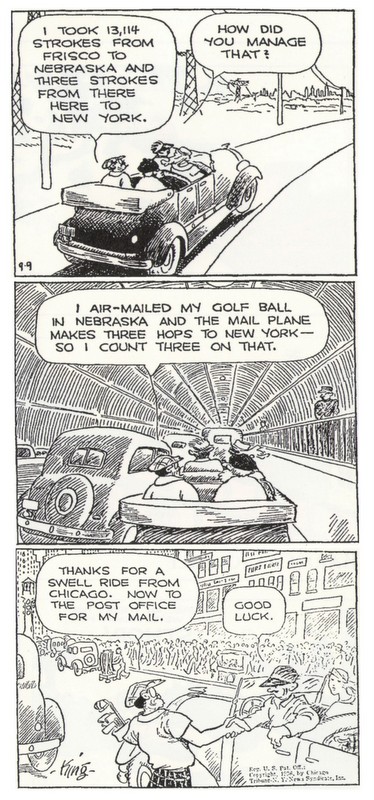
Dan Hubbard, who works in the communications department of the U.S.G.A. and, as it happens, is a member of my club, told me in an email: “We do not have a record of a golf ball coming in from Frank Strafaci, but we do have a five-peso bill issued by the Japanese government from the Philippines which he sent to Morton Bogue from Leyte in April of 1945.” Strafaci’s inspiration for his long-distance ball stunt may have been a series of cartoons in 1936 by Frank King, in his syndicated strip Gasoline Alley. In that series, Doc sets out to play a golf ball from San Francisco to New York—and in the strip below he’s nearing his goal:

Blog Photos1

In subsequent installments, Doc “breaks 80” between the post office and the East River, and finishes with a transcontinental score of 14,197. (In 1927, according to the book Golf in the Comic Strips, “a plumber and golfer by the name of Joe Grahame set out to achieve the same goal. He disappeared somewhere in the middle of Texas.”)

Strafaci played in a second Masters, in 1950, and he lost to Arnold Palmer on the eighteenth hole in the first match-play round in the 1954 U.S. Amateur. Palmer, who went on to win (and then to turn pro), said his match with Strafaci had been his toughest in the tournament. Strafaci became the director of golf at Doral in 1960, and named the Blue Monster. He died in 1988.

Frank’s father, Joseph Strafaci, owned a small farm that included the site now occupied by the Dyker clubhouse. Frank’s brother Thomas, and Thomas’s son Thomas, Jr., served as Dyker’s head professionals from 1958 until 1983. Frank’s grandnephew Paul is a recent past president of Shore View—the fifth Strafaci to hold that position—and a highly decorated New York City detective. Paul and a brother—another Frank—were members of the golf team at St. John’s University in the nineteen-eighties. And Jill Strafaci, who is the wife of Paul’s cousin Frank (the son of the one who tested Arnold Palmer), was a star golfer at the University of Florida and, later, an executive in the Miami Dolphins organization. Her husband was an executive of the Florida State Golf Association and is now a member of its advisory board.

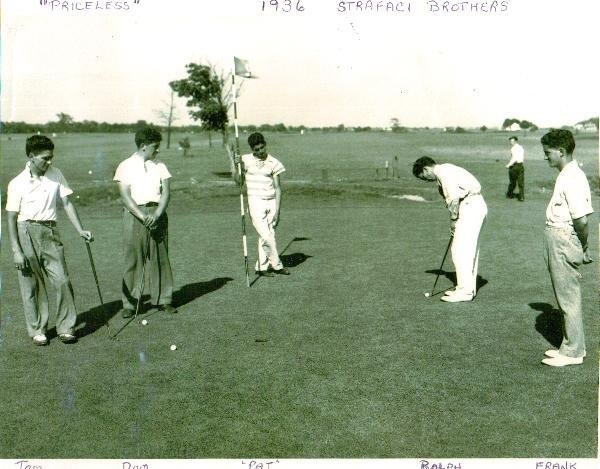
The fivesome in the photo below—which was taken in Queens in 1936, possibly at Oakland Golf Club, which was redesigned Seth Raynor in 1915 but buried by expressways in 1952 and 1960—consists of the five Strafaci brothers. From left to right they are Thomas, Dominick, Pasquale, Ralph, and Frank.

photo

Back-Roads Scotland: Askernish

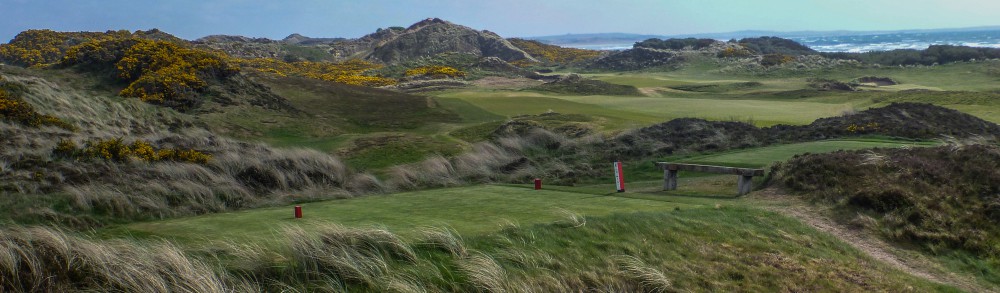
Askernish, South Uist, Scotland, May, 2007.

Askernish, South Uist, Scotland, May, 2007.

In 1889, a twenty-one-year-old Englishman named Frederick Rea was offered a job running a small school on South Uist, an island in the Outer Hebrides, more than fifty miles off the west coast of Scotland. He didn’t recall having applied for the position, and when he accepted it his relatives thought he’d lost his mind. South Uist was windswept, treeless, and only intermittently accessible, and it was seldom visited by anyone from the mainland except a few wealthy sportsmen, who came to hunt and fish.

May, 2007.

South Uist, May, 2007.

Rea’s students were the children of crofters, or small tenant farmers, the island’s principal residents. The crofters subsisted mainly by growing potatoes and grain, raising starved-looking cattle and sheep, and gathering seaweed, which they used as fertilizer or sold. Most spoke only Gaelic. The children went barefoot year-round and often walked miles to school, even in snow, and on winter mornings each was expected to bring a chunk of peat for the schoolhouse hearth. The Scottish historian John Lorne Campbell wrote that South Uist in those days was so primitive that “the appearance of a pedal bicycle was sufficient to send the island’s horses and cattle careering in panic.” Yet Rea was captivated. He didn’t return to the mainland permanently until 1913, by which time his students had included two of his own children.

Rea's schoolhouse stood near this old house, South Uist, Scotland, December, 2008.

Rea’s schoolhouse stood near (and resembled) this old house. Garrynamonie, South Uist, December, 2008.

When Rea arrived, South Uist and several neighboring islands were owned by Lady Emily Eliza Steele Gordon Cathcart, a wealthy Scotswoman, who had inherited them from her first husband, who had inherited them from his father. She is said to have visited South Uist only once, but she made business investments, including the construction of hotels and commercial fishing piers. In 1891, probably hoping to make South Uist more attractive to wealthy tourists, she commissioned a golf course near a tiny farming settlement known as Askernish.

The view from my room at the Lochboisdale Hotel, which was commissioned by Lady Cathcart and opened in 1882.

The evening view from one of the guestrooms at the Lochboisdale Hotel, which was commissioned by Lady Cathcart and opened in 1882. Lochboisdale, South Uist, December, 2008.

Rea, the schoolmaster, played the golf course with a friend when it was new, and he described the experience in his memoir, A School in South Uist, which was published in 1927 and is still highly readable. Lady Cathcart’s factor, or estate agent, Rea wrote, “told me that a professional golfer from St. Andrews had been to the island and had specially laid out an eighteen-hole course along the machair near his house, expressing the opinion that this part was a natural golf-link course.” Machair is the Gaelic word for “linksland”; it’s the root of Machrihanish, and it’s pronounced mocker, more or less, but with the two central consonants represented by what sounds like a clearing of the throat.

The machair of Askernish, May, 2007.

The machair of Askernish, May, 2007.

The factor invited Rea and a friend to play the new golf course one Saturday, and they met at his house. “Here we found quite a small party assembled,” Rea wrote; “beside his wife and children were a young lady cousin from Inverness, two or three clergymen and two junior clerks. Introductions over, we selected balls and clubs.” Rea didn’t say so, but the St. Andrews professional who had created the course was the most famous golfer of his day, Tom Morris, Sr., better known as Old Tom Morris.

The house of Lady Cathcart's estate agent, mention by Frederick Rea in "A School in South Uist." Old tom Morris's golf course began not far from its door.

The house of Lady Cathcart’s factor, mentioned by Frederick Rea in “A School in South Uist.” Old Tom Morris’s golf course began not far from its door. Rea’s friend dismissed golf, initially, as “a silly, stupid game,” but both men quickly became hooked.  Askernish, May, 2007.

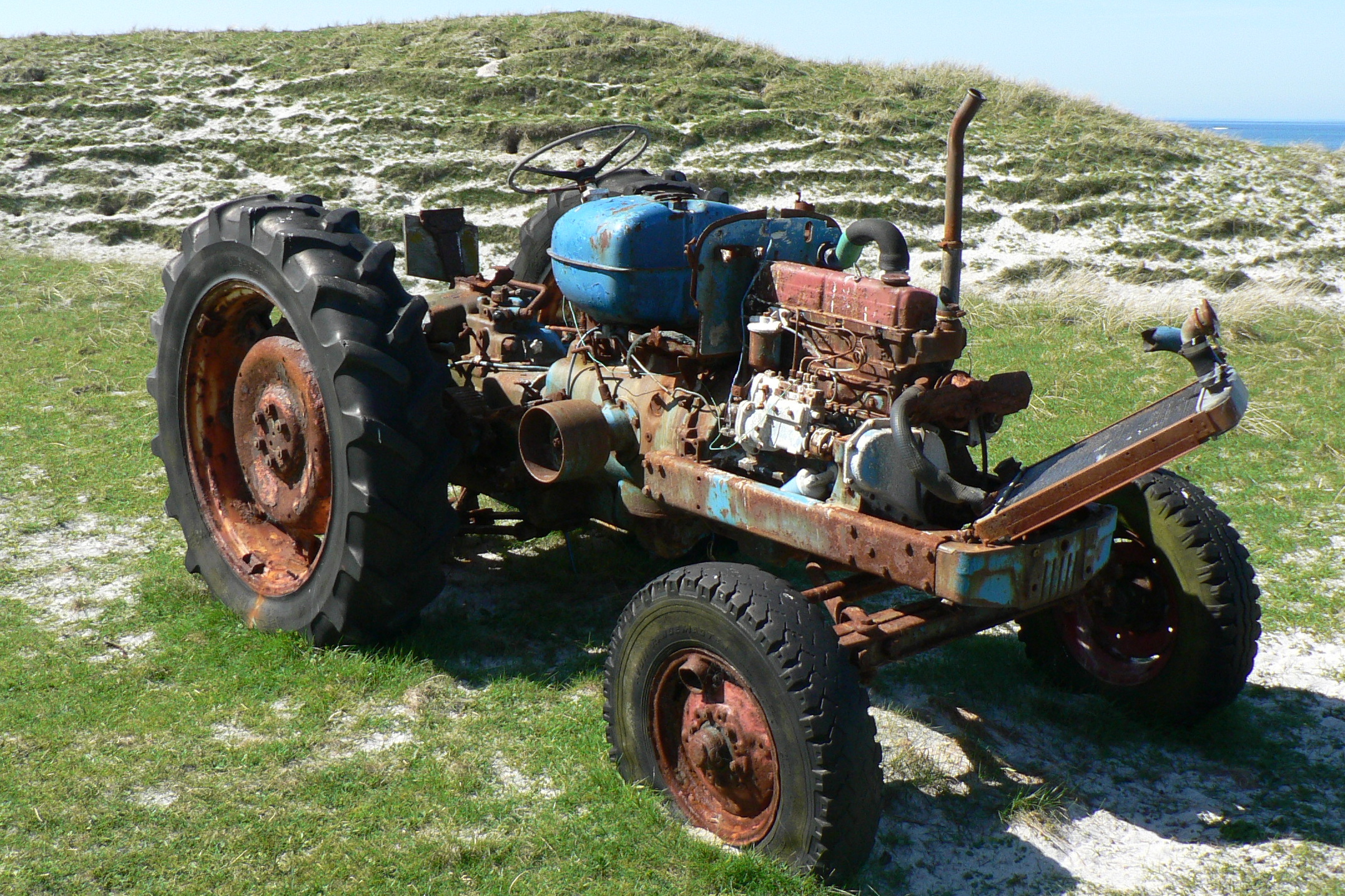
Lady Cathcart died in 1932. Her will included a provision for the perpetuation of the golf course. In 1936, a small airstrip was built near its northern end to accommodate wealthy tourists. (The passenger service was commercial but unscheduled; when a pickup was desired, the proprietor of a local hotel would send a homing pigeon to North Uist—the island still lacked telephones and, for that matter, electricity—and Scottish and Northern Airways would dispatch a plane.) Then the war came. The number of golfers dwindled. The course was reduced to twelve holes, then to nine, and the connection to Old Tom Morris devolved to legend. By 2000, what was left of the course was maintained by a small group of local diehards, who mowed the putting greens with a rusting gang mower, which they pulled behind a tractor.

Askernish Golf Course, South Uist, Scotland, May, 2007.

Askernish , May, 2007.

I first visited South Uist on assignment for Golf Digest during the spring of 2007, and I visited it again in December of the following year, on assignment for The New Yorker. My New Yorker article about Askernish, called “The Ghost Course,” was published in 2009. Below are some more photographs I took during those two trips.

Askernish, May, 2007.

South Uist doesn’t have an airport. On my first trip, I flew from Inverness to Benbecula, one island to the north. It’s connected to South Uist by a causeway, as is the island of Eriskay, at the southern end. The only other passengers on my flight were two bank couriers, who were accompanying a load of cash, for ATMs. All the other seats were filled with “Bennetts Seat Converters” containing the day’s newspapers:

South Uist doesn't have an airport. On my first trip, I flew from Inverness to Benbecula, one island to the north, and drove south, across a causeway. The only other passengers were two bank couriers, who were accompanying a load of cash for ATMs. All the other seats were filled with "Bennetts Seat Converters," containing the day's newspapers.

On my second visit, I took the car ferry from Oban. That trip took almost seven hours. We passed islands called Mull, Coll, Muck, Eig, Rum, Sanday, Sundray, Vatersay, Hellisay, Gighay, and Stack, among others. We also passed this lighthouse, on a tiny island called Eilean Musdile. It’s just off the shore of a larger island, called Lismore, which has a population of a hundred and forty-six. The lighthouse was built in 1833:

P1050801

Most of the roads on South Uist are a single lane, and you share them with sheep. There are frequent bump-outs for yielding to oncoming traffic. Resident drivers become adept at gauging each other’s speed, and often slip past each other without seeming to slow down:

P1050789

During my first visit to South Uist, I stayed at the Borrodale Hotel, about a mile and a half down the road from Askernish. The hotel’s laundry facility was just outside the door:

P1030001

My guide to Askernish was Ralph Thompson, who was born on the mainland in 1955 and spent summers on South Uist, where his grandparents lived. One reason he liked those visits, he told me, was that he was allowed to go for weeks without bathing, because his grandparents’ house, like almost all the houses on the island at that time, had no running water.

P1020961

His wife, Flora, was born on Barra, two islands to the south. Barra was even more isolated and primitive than South Uist, although today it has a small airport. Takeoffs and landings on Barra are scheduled to coincide with low tide, because the runway is a beach. Here’s one of the planes, which I photographed as it passed over Asknerish:

P1030038

At the time of my first visit, Ralph Thompson was working with two links-course experts—Gordon Irvine, who is a turf consultant and a former greenkeeper, and Martin Ebert, who is a golf architect—in an effort to restore Old Tom Morris’s course at Askernish. In the photo below, Irvine is on the left and Ebert is on the right, and the flag in the background marks what they had decided was probably one of the original green locations:

P1020926

I played all of the holes I could on that trip, and, with some of Ralph’s friends, helped test a few of the rediscovered ones:

P1030083

We often had to play around cows and sheep, which grazed on the same stretch of linksland:

P1030097

Even when there were no animals, the shot-making was challenging. This is a friend of Thompson’s:

P1030094

When I returned to Askernish in 2008, the golf course had begun to look and play much more like a real golf course. The green in the photo below was puttable, and it had a single-strand barbed-wire fence surrounding it, to keep cattle and sheep from trampling it:

P1050724

There isn’t much daylight in northern Scotland in December, but we had time for eighteen holes, and the weather was milder than the weather at home:

P1050705

Since then, the golf course has come a very long way—as you’ll see if you visit the Askernish website. Someday, I’ll go back.

My most recent round at Askernish, December, 2008.

My most recent round at Askernish, December, 2008.

An Anthropologist in Brooklyn: Dyker Beach Golf Course

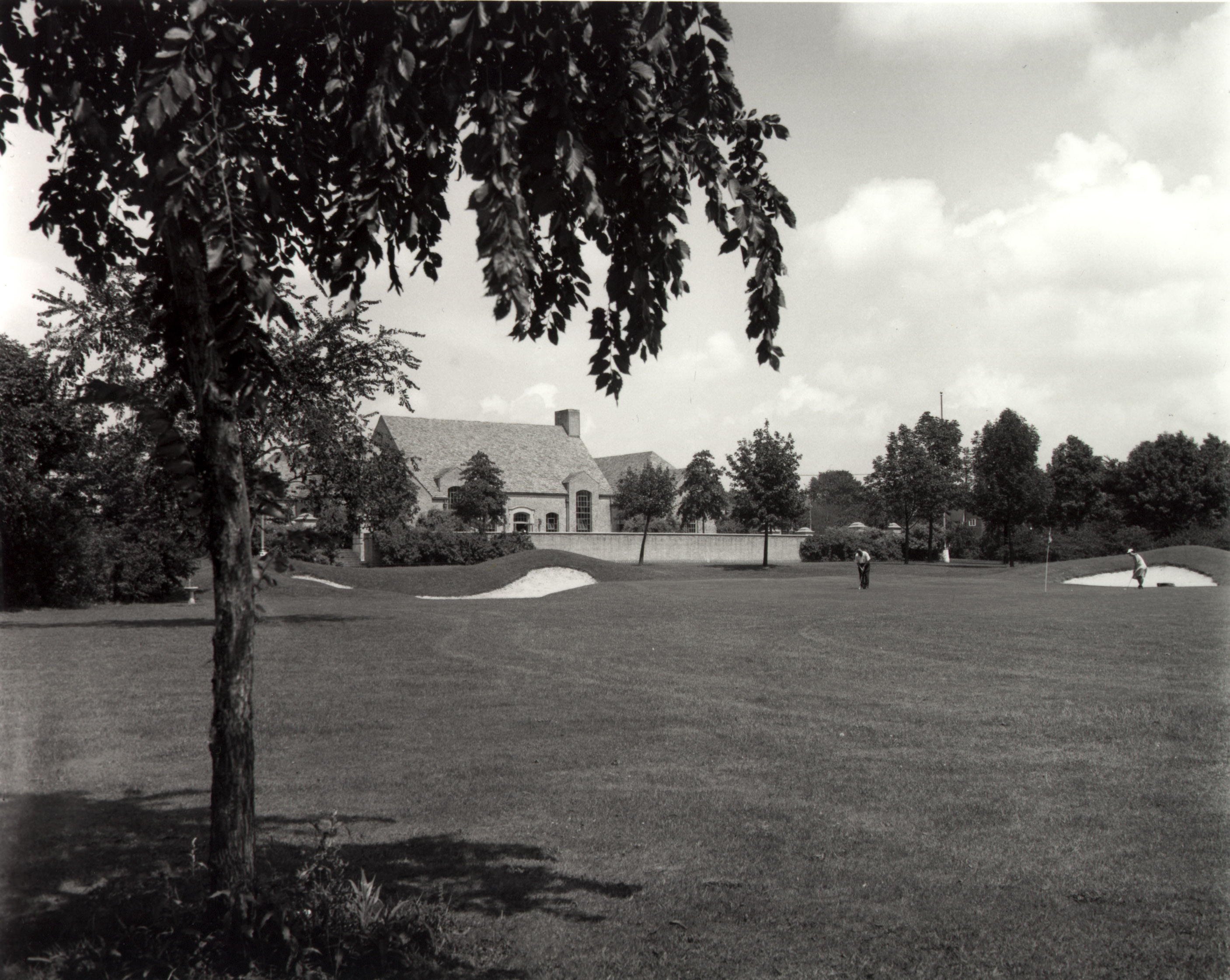
Clubhouse, Dyker Beach Golf Course, 1930s.

Clubhouse, Dyker Beach Golf Course, 1930s. At the right edge of the image is the old starter’s booth, near the first tee.

Dyker Beach Golf Course, where my friends and I played on New Year’s Day, was designed in the late 1890s by Thomas Bendelow and reworked in 1935 by John Van Kleek. Van Kleek was a prominent golf architect who fell on hard times after the Crash and was hired by Robert Moses to oversee a major citywide golf project, which was eventually funded by the Works Progress Administration. (Van Kleek is responsible for the three best courses inside the city limits: La Tourette, in Staten Island; Split Rock, in the Bronx; and Dyker. He also redesigned Split Rock’s sister course, Pelham Bay, in 1934.) The photo above shows Dyker’s clubhouse under construction, in the 1930s; the photo below shows it completed, not long afterward.

Clubhouse, Dyker Beach Golf Course, 1930s.

Clubhouse, Dyker Beach Golf Course, 1930s.

The green you see in the photo above is the second. The photo below shows what the same green and the clubhouse look like from a somewhat similar angle today. The tee on the right is the third:

Dyker Beach Clubhouse

Clubhouse, second green, and third tee, Dyker Beach Golf Course, 2013. The red-brick wing on the far right-hand side of the clubhouse, visible through the trees, was added a few years ago, during a major renovation. The slates on the main roof are mostly original.

On a crisp but snow-less Sunday morning in February, 2005, Hacker (real name) and I drove to Brooklyn for a bonus round at Dyker. We stopped in Westchester to buy gas and doughnuts, and as I was filling my tank I noticed a guy at another pump who was wearing golf shoes: a brother. Traffic was light, and we arrived long before our tee time. We drank coffee in Dyker’s clubhouse, most of which hadn’t been renovated since the 1930s, and ran into Terry Byrne, who was the president of the Shore View Golf Club, a group of a hundred and forty men who play most of their golf at Dyker. The club is six years older than the clubhouse. Its members include carpenters, cops, lawyers, firefighters, accountants, masons, city employees—a typical mix for a New York City golf course. (Byrne, whose parents were born in Ireland, was—and may still be—a plumbing supervisor for the New York City Housing Authority.) Shore View used to have a dark, dank, semi-secret meeting-and-card room in a back corner of the clubhouse, but it disappeared during the renovation.

Another view of the Dyker clubhouse in the 1930s. Page Ayres Cowley, the architect who designed the renovation and expansion of the building, described it to me, accurately, as "a French-inspired gentleman's house."

Another view of the Dyker clubhouse in the 1930s. Page Ayres Cowley, the architect who designed the renovation and expansion of the building, described it to me, accurately, as “a French-inspired gentleman’s house.”

Just before nine o’clock, the starter put Hacker and me with a Manhattan structural engineer who had moved to this country from Italy twenty years before and took up golf in 2004, and a grumbling Brooklyn guy. There are linguistically distinct ancient tribes in the Kalahari Desert region whose members are known as the click-speaking people of southern Africa, and there are linguistically distinct ancient tribes in the Brooklyn region whose members could be known as the fuck-speaking people of New York—and this guy was one of those. “Where the fuck is my ball? I don’t mind losing a ball if I hit it in the fuckin’ woods, but that drive was right up the fuckin’ middle of the fuckin’ fairway. What the fuck!” We got along great, however. And two days later, Hacker and I played two more rounds in the city, at Van Cortlandt Golf Course, in the Bronx, and Clearview Park Golf Course, in Queens.

The Dyker clubhouse in the 1930s again. today, there's a little dog park not far from the spot where the photographer was standing.

The Dyker clubhouse in the 1930s. Today, there’s a little dog park not far from the spot where the photographer was standing.

New Year’s Day Golf in New York City

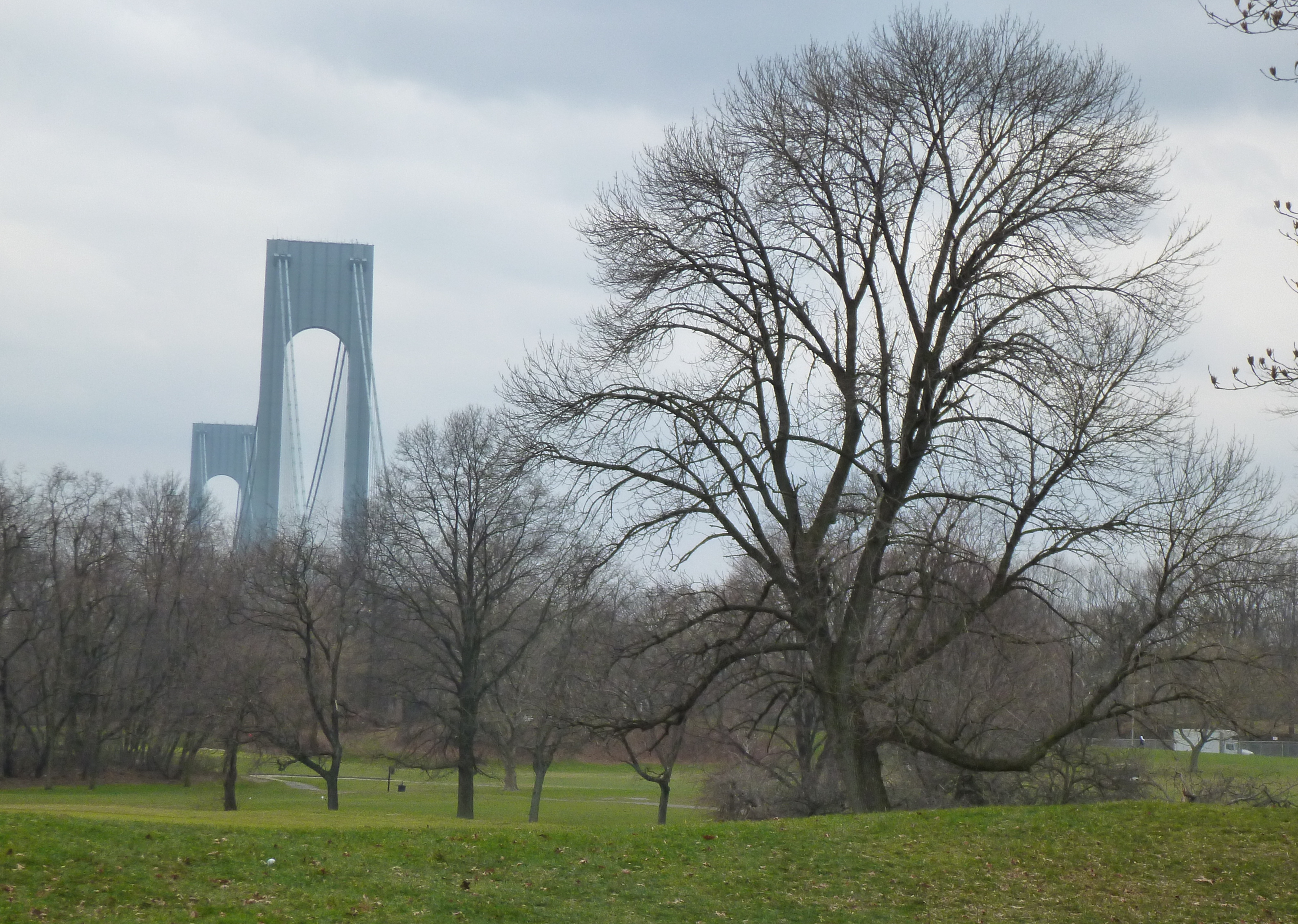
Dyker Beach Golf Course, Brooklyn, New York, January 1, 2013. That's the Verrazano-Narrows Bridge in the background. There are good municipal golf courses on the other end of it, too (in Staten Island).

Dyker Beach Golf Course, Brooklyn, New York, January 1, 2013. That’s the Verrazano-Narrows Bridge in the background. There are good municipal golf courses on the other end of it, too (in Staten Island).

For the past six years, my friends and I have played golf on either New Year’s Day or New Year’s Eve—usually in New York City, which seldom gets much snow. On January 1, 2008, we played at Dyker Beach Golf Course, in Brooklyn. In 2009, we had to drive a couple of hours south of the city, to Galloway, New Jersey, to find a course where we could play on grass. One year, we played in the Bronx, on one of the two courses in Pelham Bay Park. In 2012, for the first time, we were able to play on our home course, which didn’t close for the season until the following day.

Bay Course, Seaview Inn, Galloway, New Jersey, January 1, 2009.

Hacker (real name), Bay Course, Seaview Hotel & Golf Club, Galloway, New Jersey, January 1, 2009.

This year, our home course had closed on Christmas Eve Eve and Pelham Bay still had snow, so we returned to Dyker Beach. Other Gene drove us, in his wife’s car, which has millions of cool features that he doesn’t know how to use. The three guys who sat in the back seat didn’t bother to remove the dog seat cover, which was quilted and was actually sort of comfortable. We saw snow on the way down:

Interstate 84, near the Connecticut-New York border.

Rt. 7, in Connecticut, on our way to I-84.

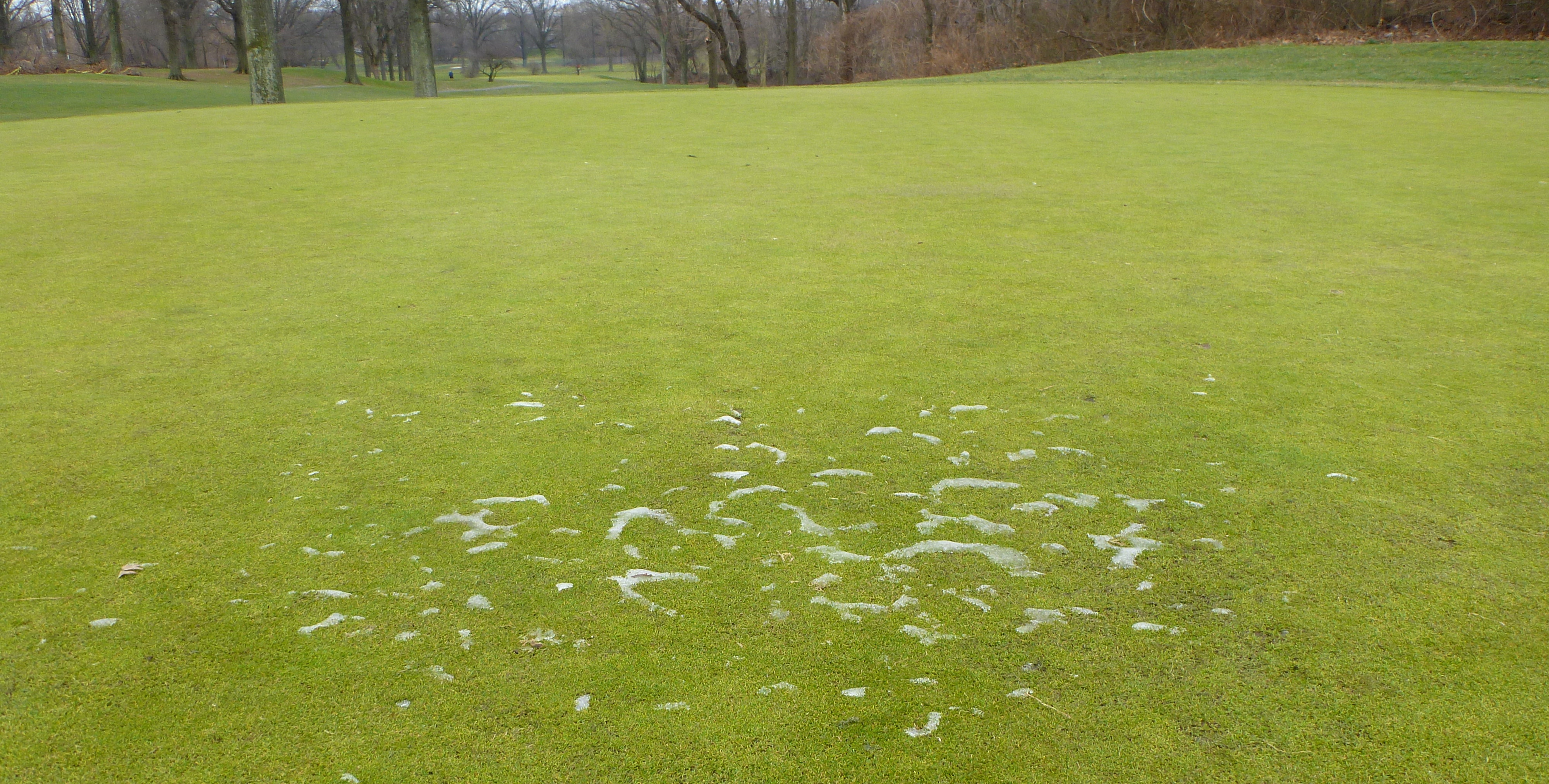
We made great time because everyone else in the tri-state area either was still passed out or was trying to treat their hangover. And there was no snow at Dyker, except for this patch, on one of the greens:

P1050060

The guy in the golf shop let us play as a fivesome—or, at any rate, he didn’t guess that we were planning to play as a fivesome and therefore didn’t specifically tell us not to. We saw some leftover damage from Hurricane Sandy, but it didn’t affect play:

P1050018

Overall, the course was in terrific shape. Some of the grass was bright green and obviously still growing, and the greens were fast and unfrozen.

Dyker's ninth fairway rounds quite close  to Seventh Avenue in Bay Ridge--a good reason not to park on that block.

Dyker’s ninth fairway runs parallel, and quite close, to Seventh Avenue in Bay Ridge–a good reason not to park on that block. In fact, you probably shouldn’t walk on that sidewalk, or drive on that street.

Even though there were five of us, we kept pace with the single playing one hole ahead of us and stayed ahead of the single playing one hole behind us (in a cart). We finished in just under three hours.

Eighth Green. That's Poly Prep Country Day School in the background.

Seventh Green. That’s Poly Prep Country Day School in the background.

Gene P., the night before, had warned us in an email that the forecast was for temperatures in the low teens, and he suggested that we consider rescheduling. But he must have been looking at the forecast for Alaska, because the temperature in Brooklyn never got below about 40.

Sixteenth green. We might be interested in buying one of those houses across the street, and using it as a winter clubhouse.

Sixteenth green. We might be interested in buying one of those houses, across the street, and using it as our winter clubhouse.

We played Double Skins, with an added feature that I suddenly thought of on the third hole: Ball Marker Stymies—in which the old Stymie Rule is applied to ball markers rather than balls. That means that if somebody’s ball marker is in your line on a green you have to putt over it or around it. (And you can’t mark your ball with a hockey puck. Each marker—we decided—must be poker-chip-size or smaller.)

Stymied.

Stymied, on a breaking putt.

After golf, we had lunch at Pipin’s Pub, in Bay Ridge, the home of the famous Pipin Burger (bacon cheeseburger with American cheese). The fries at Pipin’s Pub need work, but we have nothing bad to say about the Pipin Burger. Our waiter took this photograph, despite making it clear that he believed he had better things to do:

Pipin's Pub, January 1, 2013.

Pipin’s Pub, January 1, 2013.

On New Year’s Day 2008, we had lunch at Pipin’s Pub, too—and at the same table. Here’s proof:

Pipin's Pub, January 1, 2008.

Pipin’s Pub, January 1, 2008.

Happy New Year, and so forth.

Fritz, Dyker Beach, January 1, 2008.

Fritz, Dyker Beach, January 1, 2008.

Let’s Get Rid of All the Bunker Rakes!

Eighteenth hole, Pine Valley: many bunkers, no rakes.

Eighteenth hole, Pine Valley: many bunkers, no rakes.

Many golfers, rather than savoring the game’s sublime inconsistency, yearn for courses as predictable as tennis courts. They grumble when greens aren’t flawless, when fairways aren’t uniformly carpet-like, when sand is either too fluffy or not fluffy enough.

Complaints about “unfair” bunkers are especially contrary to the spirit of the game: aren’t hazards supposed to be hazardous? On TV, the standard greenside-bunker shot is about as thrilling to watch as a two-foot putt. You know the guy is going to spin it close, and he knows he’s going to spin it close—otherwise, he wouldn’t have yelled “Get in the bunker!” when his ball was in the air. Sand’s function in a tour event is often just to make the surrounding grass seem troublesome.

There’s a simple remedy: follow the example of Pine Valley, the legendary New Jersey golf club, which for decades has been listed at or near the top of nearly every ranking of the best courses in the world. Pine Valley has many, many bunkers—some small, some large, some soft, some hard, some coffin-shaped, some bottomless, some seemingly miles across, some filled with vegetation—but no rakes. If your ball ends up in a footprint (or behind a rock or under a cactus), that’s your tough luck. Deal with it.

Rake-free bunkers would make televised golf more interesting. They would even be good for choppers like you and me. Pristine, consistent bunkers are expensive to build and maintain. Why not let a course’s sandy areas take care of themselves, and spend the savings on something more obviously beneficial, like cutting back overgrown trees? Most golfers can’t hit sand shots, anyway. Everyone else either would learn an arsenal of new shots or would get better at doing what bunkers are supposed to make golfers want to do: stay out of them in the first place.

My home course became Pine Valley-like in late November, when our superintendent put bunker rakes away till spring.

My home course becomes quite Pine Valley-like in late November, when our superintendent puts all the bunker rakes away till spring.

Augusta National, Video Games, and “Hard Luck” Tony Sheehan

Eighth green, Augusta National, 1930. Photo by Tony Sheehan.

Eighth green, Augusta National, 1930s. Photo by Tony Sheehan.

My Golf Digest colleague Ron Whitten and I recently spent a couple of days in Orlando with the video-game designers at Electronic Arts, the creators of Tiger Woods PGA TOUR. The game’s next edition will include a recreation of the Augusta National course as it was in 1934, the year of the first Masters, and Ron and I had been asked to help the game’s “environment modelers” make the virtual course as historically accurate as possible. We offered suggestions about everything from green contours to mowing patterns to the size and placement of individual trees—an experience we’ll both be writing about for the April issue of Golf Digest.

Among the many historical resources the game’s designers consulted were photographs of the course taken in the 1930s by Tony Sheehan, who was Augusta National’s unofficial official photographer. (The picture at the top of this post, which also appears in my book The Making of the Masters, is one of his.) Sheehan’s nickname was “Hard Luck.” Clifford Roberts, the club’s co-founder and first chairman, wrote about Sheehan in his book, The Story of Augusta National Golf Club, which was published in 1976:

Tony was an oddball in appearance and dress, and he made comments at times that were just as unusual and unexpected. Neither he nor his battered old camera looked to be qualified to make even a passport photo, but he was a remarkably capable photographer . . . .
Many of us experience accidents as we go through life, but I doubt that any man endured bad luck so often and so continuously for so many years as Tony Sheehan. Every time an epidemic of any kind came to town, Tony was the first to catch it.

Tony tripped over something and broke one or more bones so often that it almost appeared to be a habit. On one occasion, while he was waving to friends, his car plowed into a large stone marker on Walton Way in Augusta, which cost him a number of teeth but gave him some distinctive battle scars on his face. . . .

Tony survived a half-dozen major operations, plus numerous patching-up jobs. His one lucky day was when he was married to the nurse, Eva Smith, who had looked after him in the hospital so many times that she felt lonesome between his visits.

Tony finally got himself into really serious trouble—his car was hit by a train. Over a year’s period the hospital lost track of the number of jobs that had to be done on Tony. Finally, the great day arrived when he could leave. His wife picked him up in her car and headed for home. When they arrived at the railroad track, the same one where Tony was wrecked, he asked her to stop the car. He then walked ahead and looked in both directions to make sure no train was approaching. As he was about to signal her that all was clear, her foot slipped off the clutch and she knocked Tony down. Whereupon she picked him up and took him back to the hospital for another stay.

Believe it or not, our friend Tony Sheehan lived to be eighty years of age, and died in 1974 of natural causes.

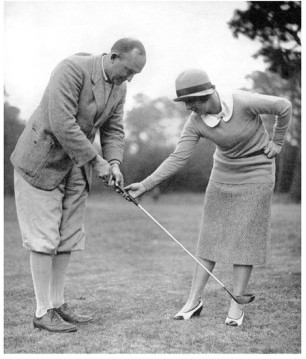
In 1931,Sheehan took this photograph of Ty Cobb receiving a golf lesson from Glenna Collett Vare, who won the U.S. Women's Amateur six times. Cobb was from Augusta, and this photograph was taken there--possibly at Augusta National.

In 1931,”Hard Luck” Tony Sheehan took this photograph of Ty Cobb receiving a golf lesson from Glenna Collett Vare, who won the U.S. Women’s Amateur six times. Cobb was from Augusta, and this photograph was taken there–possibly at Augusta National, although more likely at Augusta Country Club, next door, where Cobb was a member.

Roberts himself knew something about hard luck. He grew up poor in a succession of small towns, accidentally burned down his family’s house when he was sixteen, lost his mother to suicide when he was nineteen, earned a modest fortune and then lost it in the stock-market crash of 1929, and presided over Augusta National’s bankruptcy in 1935, a few months after the second Masters. Like Tony Sheehan, though, he persevered, and because he did we have the Masters—now just over three months away.

Golf on the Winter Solstice

This isn't the Sunday Morning Group, but it's close. It's a bunch of self-styled Druids celebrating the 2012 Winter Solstice at Stonehenge, an archaeological site not far from the Salisbury & South Wilts Golf Club, which was founded in 1888, a year before my club at home. This photo is from the National Geographic website.

This isn’t the Sunday Morning Group, but it’s close. It’s a group of modern-day Druids celebrating the 2012 Winter Solstice at Stonehenge, an English archaeological site not far from the Salisbury & South Wilts Golf Club, which was founded in 1888, a year before my home club. (This photo is from the website of National Geographic.)

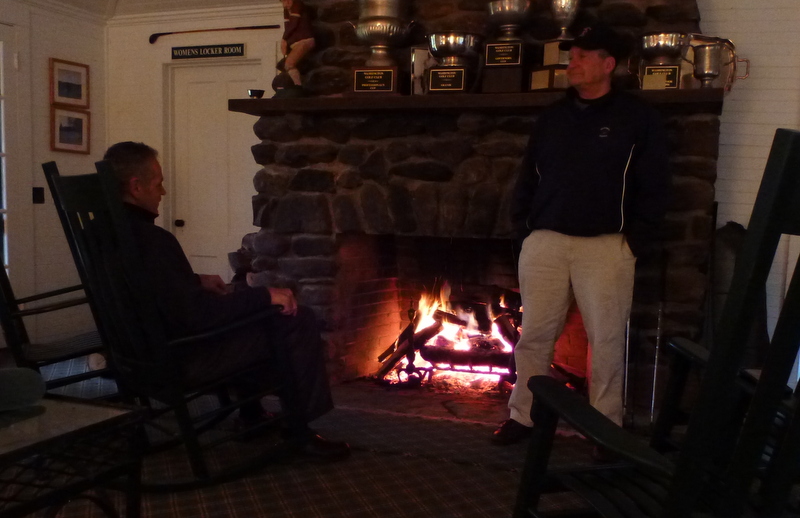
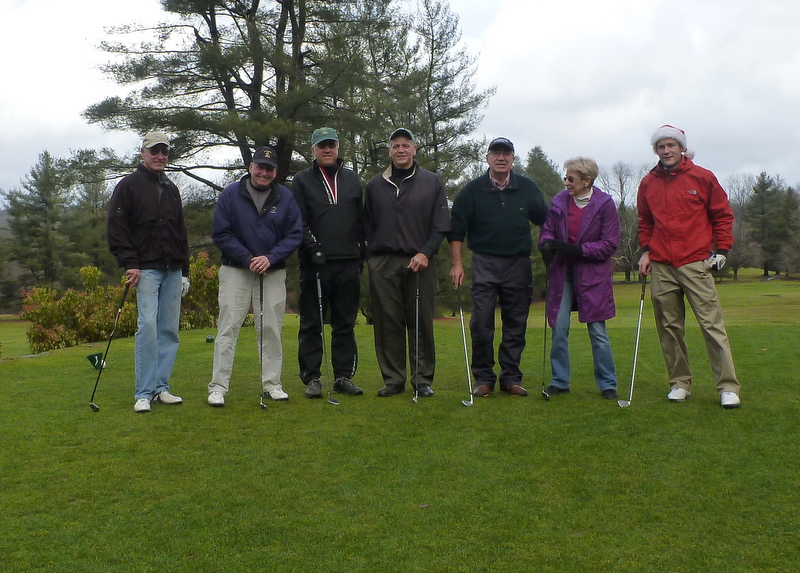
The world didn’t end on December 21, 2012, although we had so much rain during the night that I occasionally worried we were done for. The storm continued through most of the morning, and, as a consequence, just three of us showed up at 10:00 for the Sunday Morning Group’s second annual Winter Solstice Scramble and Holiday Party, With Gift Exchange. Gary, our superintendent, built a fire in the clubhouse fireplace, and he, Hacker (real name), and I sat in front of it and used our cell phones to send sarcastic emails to everyone else.

Gary and Hacker: where's everyone else?

Gary and Hacker: where are Doug and Mrs. Doug, among other people?

The rain slackened after about an hour, and we could tell from Raindar that it was going to end soon. By 11:30, we had seven participants, including Mrs. Hacker, who had been delayed by a fallen tree.

P1040901

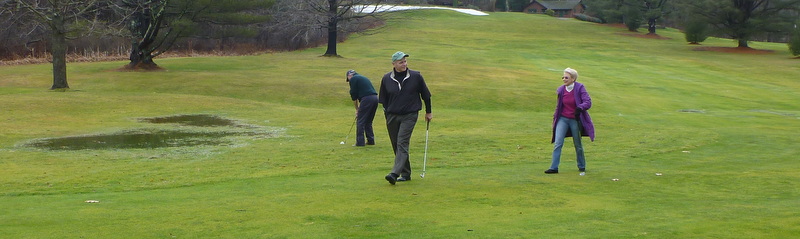
We ordered four pizzas from Upper Crust Cucina, the official caterers not only of the Sunday Morning Group but also of the Men’s Member-Guest. Then we played a five-hole warm-up round with one club each while we waited for the pizzas to be delivered. (Upper Crust doesn’t deliver to anyone but us, so don’t bother asking.)

P1040903

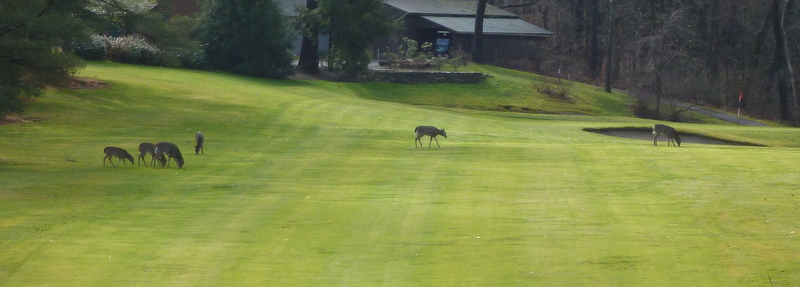
During the one-club, we saw six deer on the ninth fairway (photo below). When the pizzas arrived, we paid for them out of the Sunday Morning Group’s Slush Fund, which Hacker keeps in an envelope.

P1040922

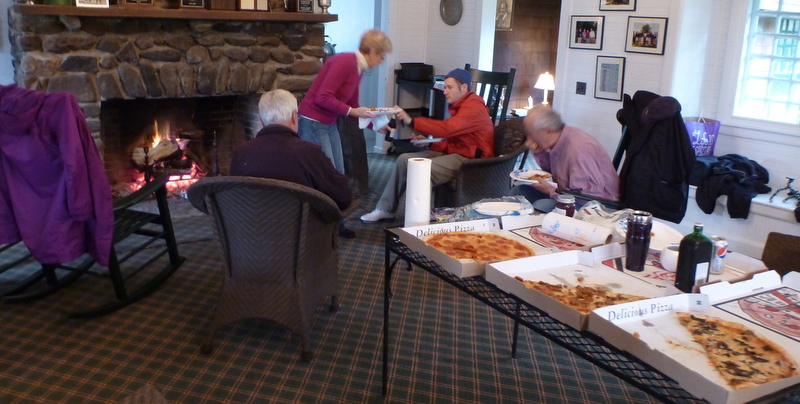
The pizza was terrific, as it always is, and during the gift exchange I received, from Hacker, a coffee cup that looks like a softball-size golf ball. He hadn’t bought it—he had just found it on a shelf—but I still like it. You can see part of it in the bottom right hand corner of the photo below, between my Thermos brand coffee travel mug and the communal bottle of Jägermeister, the official cold-weather intoxicant of the Sunday Morning Group. I poured my Diet Pepsi into it, as a gesture of gratitude and respect.

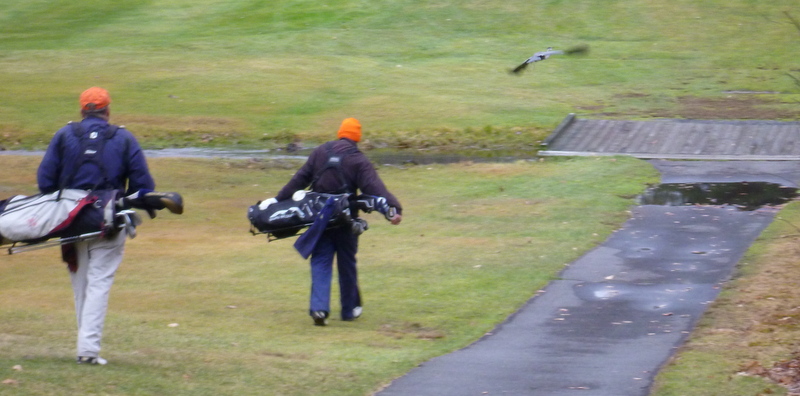
P1040928After lunch, four of us played eighteen holes with all our clubs, and I lost twelve dollars, on account of having forgotten how to play golf, apparently. We got pretty close to a great blue heron, which hangs out near the stream that runs across the lowest part of our course, between the out-of-bounds woods on the right side of the fifth hole and the pond on the fourth. You can see it taking off in the photo below. It’s the gray blur above the bridge:

P1040935

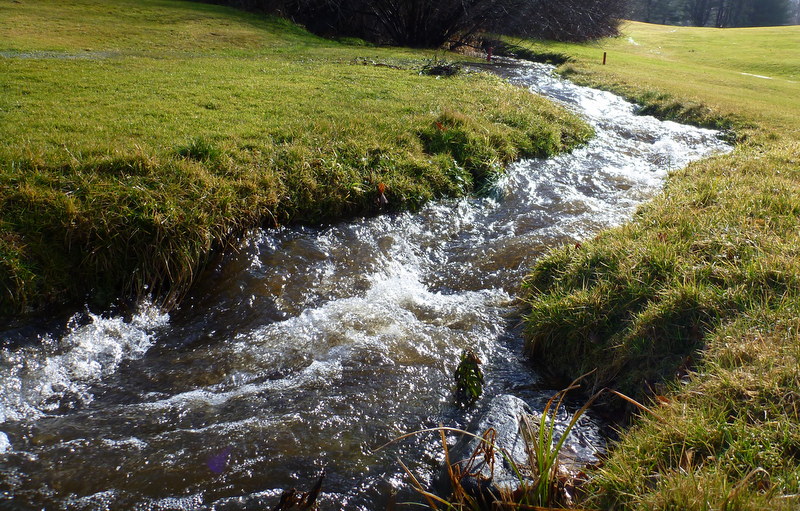
Here’s one of the places where the heron had been fishing. Ordinarily, this stream is about a foot wide.

P1040917

We discussed holding a contest to name the heron. One possibility: “Uncle Frank,” after our dearly departed old friend Uncle Frank. It’s remotely conceivable that the heron actually is Uncle Frank, in bird form, although it doesn’t smoke or tell funny stories, and it doesn’t appear to be married to a retired soap-opera star.

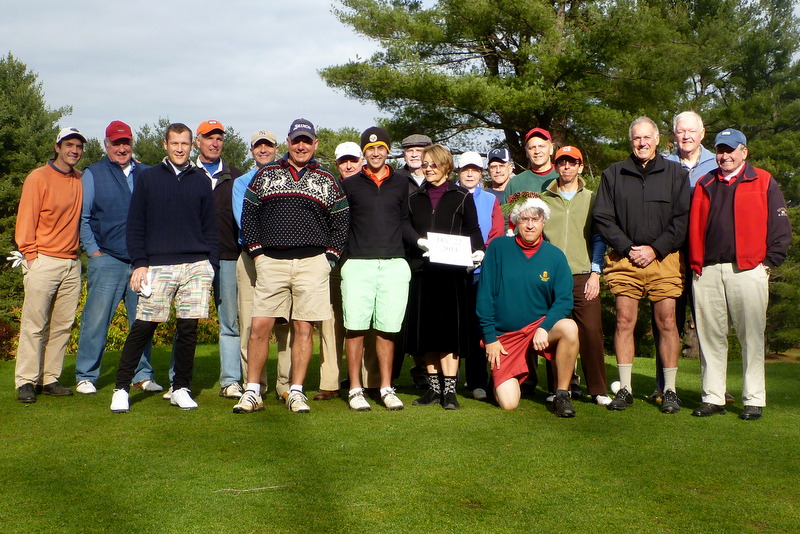
We didn’t have as big a turnout for the 2012 Winter Solstice as we did for either the 2011 Winter Solstice (see photo immediately below) or the 2012 Summer Solstice (see photo below that). But seven is still pretty good for a day when nobody in their right mind played golf.

Winter Solstice tournament field December, 2011.

Winter Solstice tournament field December, 2011.

Summer Solstice 2012.

Summer Solstice all-day golf event, 101 holes, June, 2012.