Masters Countdown: Bobby Jones in Color

Bobby Jones in Color

The photograph above was taken in 1947, during the next to last Masters that Bobby Jones competed in. His badge identifies him as Player No. 1. The photographer was apparently experimenting with an early color film. The negatives were discovered in an envelope in an old file cabinet at Augusta National almost fifty years later, around the time I began researching my book The Making of the Masters. No prints are known to have been made before that time.

There is a great deal of confusion about Jones and his status as a player. Augusta National, in tournament publications, lists him as an amateur, but by the rules of the U.S.G.A he became a professional in 1930, when Warner Bros. hired him to make instructional films, and when, a little later, he began designing and promoting golf clubs for A.G. Spalding & Bros.

Jones retired from competition not because he had no worlds left to conquer; he retired because he abhorred the idea of being labeled a professional. In a letter to Clifford Roberts many years later, he described the typical pro as “an uneducated club servant”—a prejudice that dated to the early days of his competitive career, when only amateurs were accorded the honorific Mr., professionals weren’t allowed inside clubhouses, and tournament organizers distinguished between “gentlemen” and “players.”

“So long as I played as an amateur, there could be no question of subterfuge or concealment,” he wrote in 1960—a statement that clearly shows what he thought of playing golf for money. Roberts secured Jones’s participation in the first Masters, in 1934, by cleverly dodging the issue: in the tournament’s program listings and pairing sheets, he made no distinction between amateurs and professionals.

But the distinction was invariably noted elsewhere. The Associated Press and all other news organizations, in their coverage of the tournaments Jones competed in, listed him with the pros. Even O.B. Keeler, who had built his sportswriting career by celebrating Jones’s amateur accomplishments, took it for granted that Jones was now a professional. And so did Augusta National, officially.That’s why Charles Yates, not Jones, was honored as the low amateur in the first Masters, even though Yates’s score was three strokes worse than Jones’s.

Would Jones have played in the Masters if the club had been compelled to label him explicitly as a professional? Roberts said in later years that he suspected he probably would have, in order to help the club. But Roberts was uncertain enough that he never raised the matter with him, either then or later.

In Golf is My Game, Jones wrote that to give up his amateur status would have been “like giving up part of myself.” But, in fact, he gave it up in 1930. And he had a powerful incentive for doing so. His golf-related income in 1933, when the first tournament was being planned, was over $100,000; in contrast, Paul Runyan, who won nine events that year and was the tour’s leading money-winner, had gross tournament earnings of less than $6,500.

The Best Winter Golf Gloves

The glove storage section of my mobile locker room.

The glove storage section of my mobile locker room.

I own many golf gloves. I keep most of them in the trunk of my car, which I think of as my mobile locker room, and I use their Velcro closures to stick them to the trunk’s carpet-like liner—a trick I learned from my golf buddy Billy. The rain gloves and winter gloves, which are black, look a little like the sleeping bats that used to hang upside down from the roof of my garage.

For winter golf, I always used to just wear rain gloves, and on really cold days I would wear two pairs, one on top of the other. But this year I bought several pairs of actual winter gloves, made by FootJoy and Snake Eyes. The FootJoy gloves, which are called WinterSof and cost $20 a pair at Golfsmith, look like this:

fj wintersof

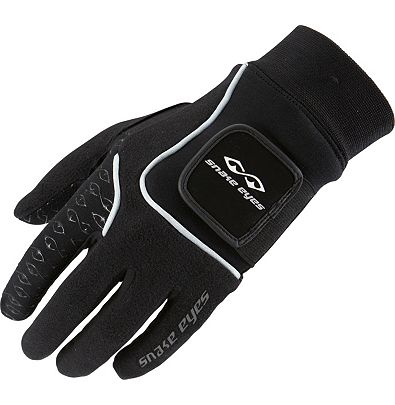
The Snake Eyes gloves, which are called Cool Weather Gloves and cost $13 a pair at Golfsmith, look like this:

snake eyes

Two of the four Golfsmith customer reviews of the Snake Eyes gloves mention crummy stitching, which is a problem I haven’t noticed with mine. I have found that my FootJoy gloves are slightly warmer. (In a recent scientific trial, I wore both kinds, one right and one left, and switched at the turn.) I like the grippy silicone webbing on the palms and fingers of the Snake Eyes gloves, even though the silicone feels creepy when I hold something made of metal, like a club shaft. I’ve worn both kinds, without incident, while walking the dog with my wife.

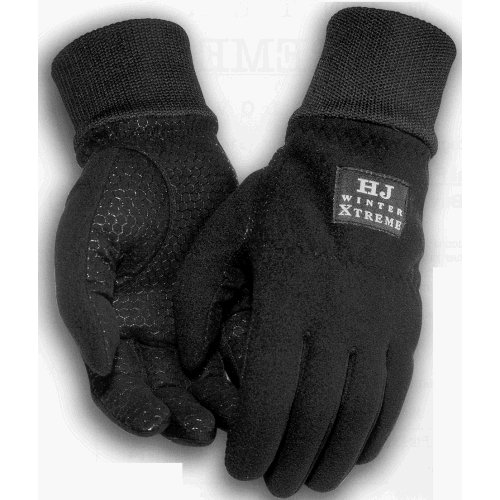
At the PGA Golf Merchandise Show a year ago, I tried some winter gloves I liked a lot, although I’ve never actually played in them. They’re call HJ Winter Xtreme, and they’re made by a 40-year-old Korean company called HJ Glove. They’re hard to find online—Golfsmith and Edwin Watts don’t carry them, and Amazon, at the moment, is out of stock in all sizes—but based on my brief indoor test a year ago I’d say that, at least theoretically, they combine some of the most appealing features of the FootJoy and Snake Eyes gloves: tall cuffs, grippy silicone stuff, extra warmth.

hj extreme

My friend Tim recently pointed out that rain gloves and winter gloves tend to wear out first in the thumbs. This is especially true if your swing isn’t everything it could be—holes in golf-glove thumb pads are usually a consequence of mid-swing re-gripping or some other bad habit—but rain gloves and winter gloves are made of stuff that isn’t as tough as leather, and they wear out faster no matter who’s wearing them. Because of what Tim said, I got the idea of buying some little iron-on patches and using them to reinforce my winter gloves, by turning the gloves inside out and ironing one carefully trimmed patch onto the inside of each thumb. I kept the patches in a pile of stuff on my desk, and they were constantly getting in my way. Then I forgot about them. Last week, I suddenly remembered them but couldn’t find them anywhere. Oh, well. I probably wouldn’t have gotten around to ironing them on anyway.

Speaking of gloves: when I was in Oslo in August (researching a non-golf article for the January 21, 2013 issue of The New Yorker), I took a tour of the Norwegian National Opera and Ballet, at the edge of the Oslo Fjord. Among many other things, I saw a bird costume intended for an upcoming performance of the opera “Flaggermusen.” It had been stitched together from dozens of yellow dish-washing gloves, whose dangling rubber fingers resembled feathers. Maybe my wife would be interested in making something similar from my old golf gloves:

P1030432

Golfers Are Morons, Experts Say

Polara Golf, a company that makes balls that go too far and wedges that are (supposedly) shank-proof, recently conducted an online survey, which found that most golfers don’t care about the Rules of Golf and therefore have no problem purchasing and playing with illegal equipment, such as the equipment that Polara Golf sells. That didn’t surprise me. What did surprise me was that, according to the survey, more than a quarter of golfers claim “to have never broken the rules during play.”

Never broken the rules? Never taken a mulligan? Never brushed a detached leaf, a grain of sand, or a loose twig while taking a back swing in a hazard? Never played by “winter rules”?  Never lifted a ball on a putting green without marking it first? Never moved a marker for another player and then forgot to move it back? Never penalized himself incorrectly or unnecessarily? Never made a suggestion to another player which could influence that player’s play (“Keep your head down, you idiot”)? Never pointed out a rules infraction by another player, then agreed to ignore it? Never played out of turn in stroke play (for which there’s no penalty or correction, although it’s still a violation of the rules)? More than a quarter of golfers???

Golf Digest conducted an experiment a few years ago in which a rules official, without saying what he was doing, observed a round of golf by four ordinary guys and kept track of their rules violations. There were so many that he almost couldn’t write fast enough to record them all.

The illustration below is from an old book about the rules. Anyone who can guess which rule it’s illustrating will win a disappointing prize. Meanwhile, anyone who feels like a rules expert should try one of the quizzes on the website of the U.S. Golf Association.


Black Friday Special: Still More Holiday Gift Ideas for Golfers

Not many shopping days left. Here are some more gift ideas from the Golf Digest Time Machine.

This ad is from almost exactly fifty-five years ago. Even then, selling these would have been a slow way to get rich. There’s still a Rome Paper Company, although it’s in Georgia, not Indiana. Among its many products: a “germ-shaped stress reliever” (not suitable for children under three).

Golf umbrellas, transparent or otherwise, strike me as more trouble than they’re worth, but some people like them. If you forget to take yours on a golf trip to Scotland or Ireland, you can usually find one or two inside-out ones in the trashcan on the second tee of whatever course you’re playing in the rain.

A golf bag that’s also a chair, from 1958. The ad says it’s lightweight, but to me it looks heavy enough to make itself necessary. Could that be Mr. Moreland himself?

This is similar to Stanley’s eBay club carrier, though probably more useful as a weapon. Is that Sam Snead in the photo on the right?

The Sit-n-Rest, from 1959, combines the best (as well as the worst) features of the previous two items. Note the four-club head cover in the bottom right hand corner. Order now!

More Holiday Gift Ideas for Golfers

Every year, my secret Christmas wish is “Please don’t buy me golf balls from the big sale display at Dick’s.” Instead of those, how about something from the pages of Golf Digest fifty years ago:

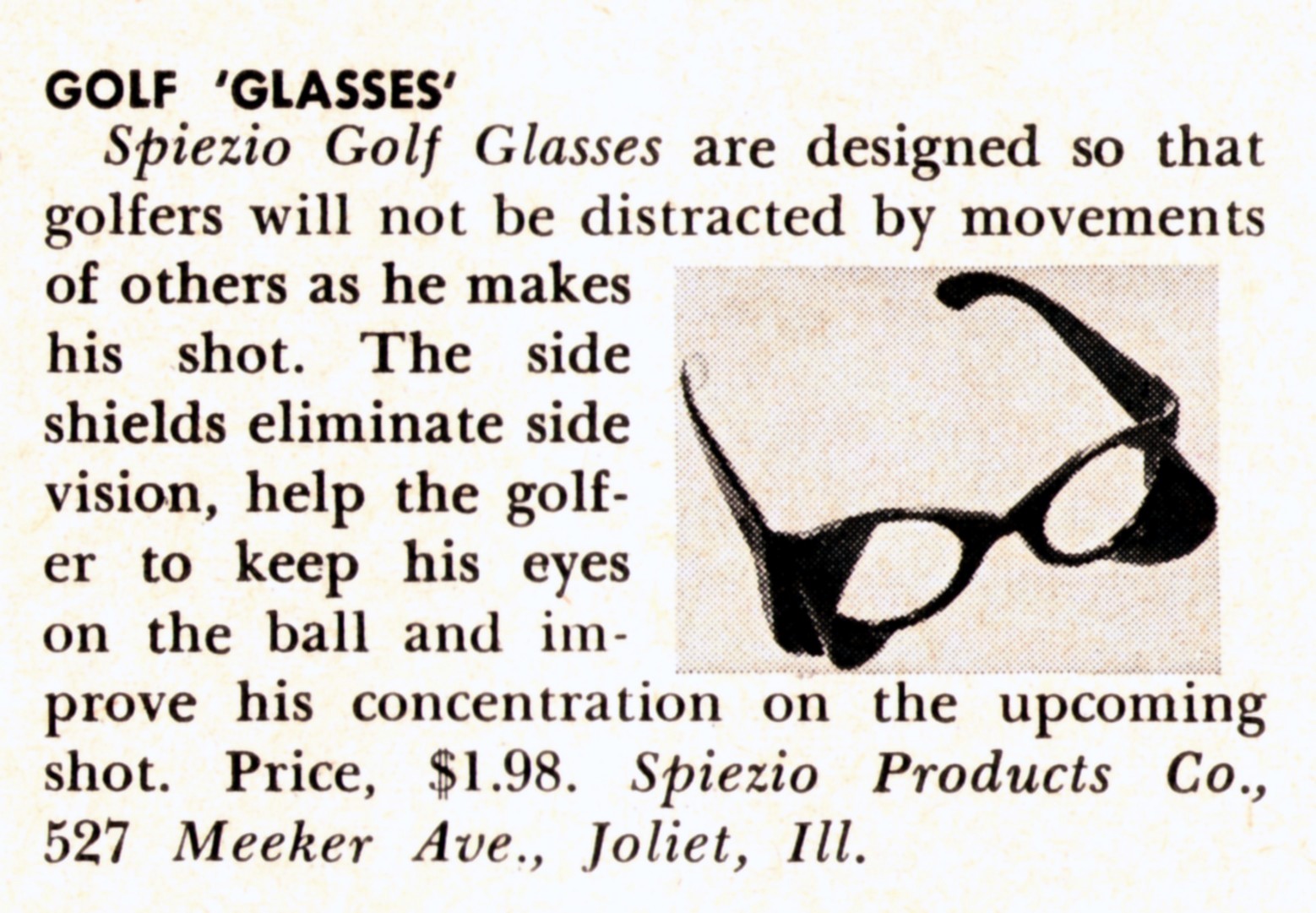
These glasses are from 1958. They wouldn’t do me any good, because I play better with distractions, but I can think of guys they might help. If you could move the side shields to the top, they would be useful in the rain. (Tip: the best way to dry your glasses is with the fingers of your cotton rain gloves, which work almost as well as a chamois.)

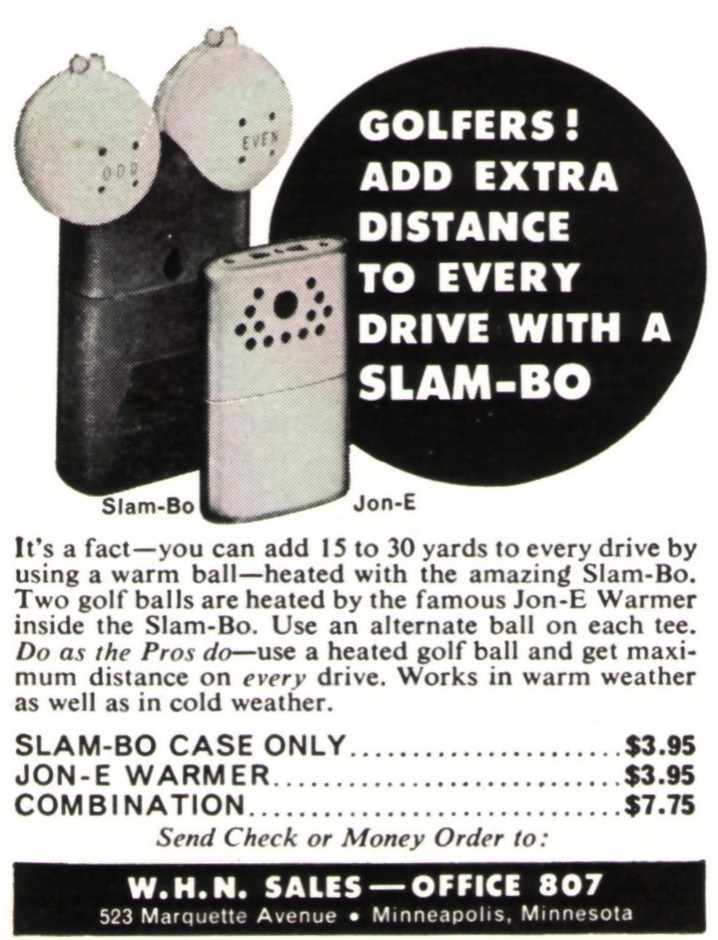
Did the pros really heat their balls in 1961, when this advertisement ran? Whether they did or not, is it legal today? If so, Zippo makes a gizmo that looks a lot like the Jon-E Warmer. (You can buy one here.) Gary, our superintendent, usually brings hand-warmers for everyone when we play in the winter. I don’t really care for them, although I did once play while wearing a back warmer. Note the handy “odd” and “even” designations, to prevent confusion on the tee.

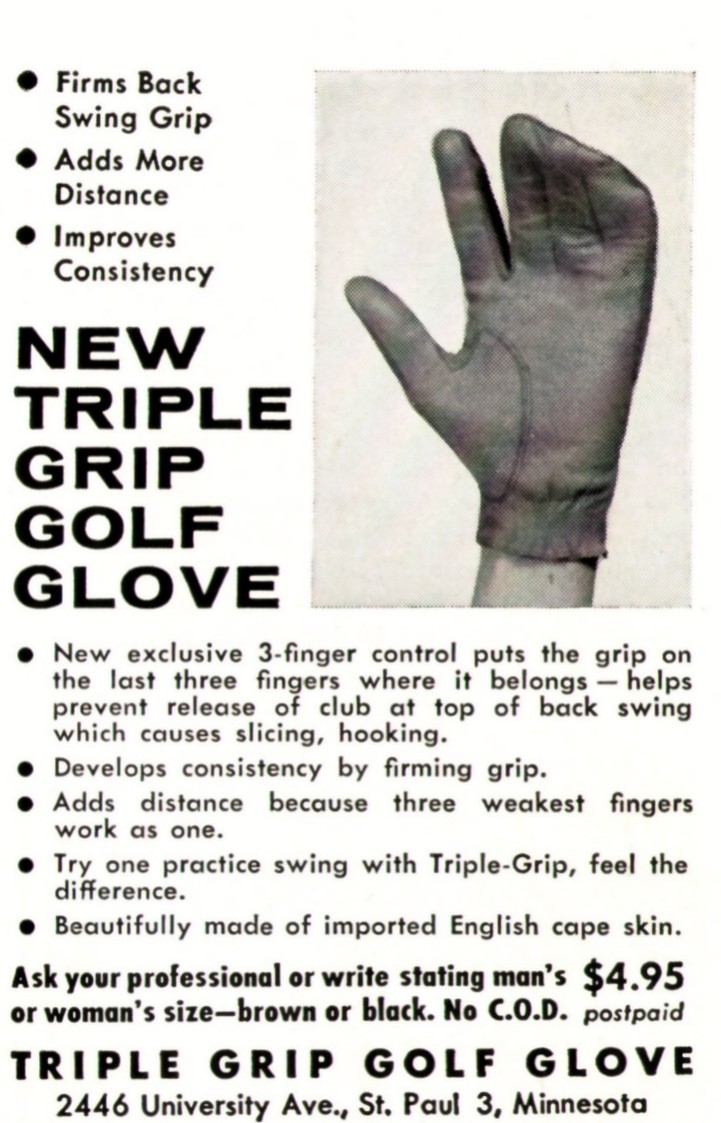
This Creature-form-the-Black-Lagoon glove is also from 1961, and also possibly illegal. The digital cluster on the right looks as though it’s about to divide into separate fingers—including, possibly, a sixth one.

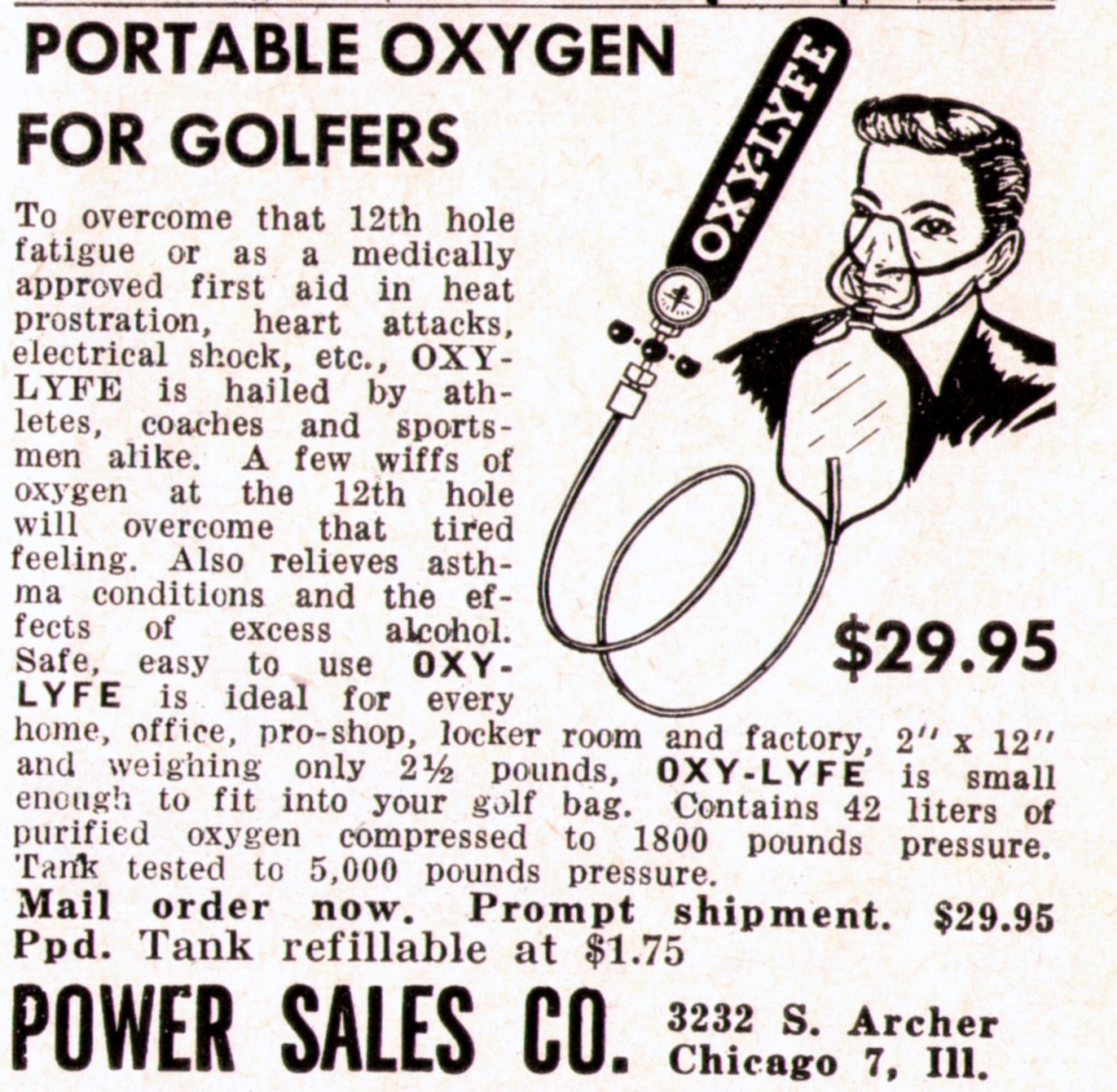
Is this the sort of thing Lance Armstrong was doing? Also: why the emphasis on the twelfth hole?

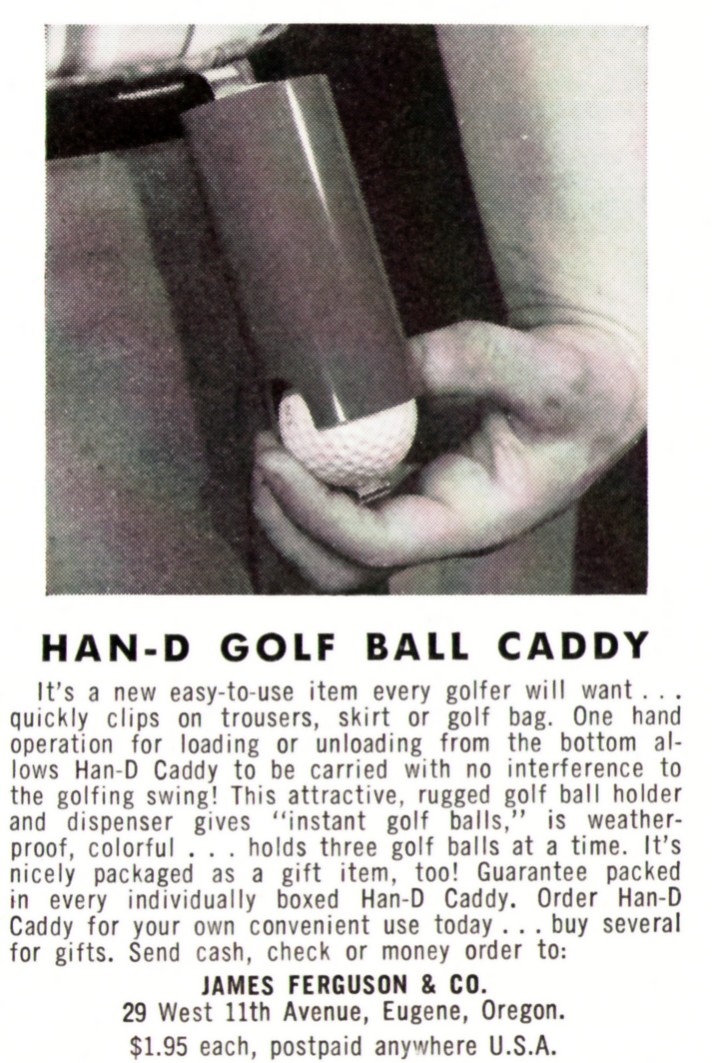
This device, from 1961, might actually be a partial solution to the dirty-pocket-rim problem, which I complained about over the summer. Maybe add a tee bandoleer and some magnetic ball markers?

Still baffled about what to give (or ask for)? More soon.

Five Holiday Gift Ideas for Golfers

It’s never too early to start shopping for the golfer in your family. These gift ideas are from the pages of Golf Digest in the late 1950s and early 1960s:

This item is from 1957, when golf, cocktail-drinking, and home refrigeration were all ascendant in the United States. U.S. Royal was a trade name of the United States Rubber Company, which renamed itself Uniroyal in 1961. It no longer makes golf balls, although it may still make ice trays.

The reflective metallic golf hat, also from 1957, is an idea that never caught on, for unknown reasons. The hat was probably most useful in match play, since by standing in the right place and tilting your head you could temporarily blind your opponent. The logo notwithstanding, I don’t think anyone ever wore one in the Masters.

Wehrmacht surplus? Somebody must have bought a load of these, because they were advertised all over, and not just in golf publications. This ad is from 1960. Hats like this are still available, although they’re of interest mainly to Third Reich fetishists.

Also from 1960. Golf ball repair is a concept that doesn’t really exist anymore.

This ad is from 1958, but versions of it ran for several years. The price is per week, not per night, and it includes room, golf, meals, tips, and just about everything else. (Dove hunting may have been extra.) Today, you’d pay almost as much at Pinehurst for a dozen Pro V1s.

Don’t see anything you want? More gift ideas soon.

More About My Awesome Golf Shoes

In recognition of my services as an unpaid shill for their products, True Linkswear sent me a pair of their newest golf shoes, which are shown in the photo above and will be available to the world at large on November 4. I subjected them to the severest shoe test I know: wearing them in front of my wife. She said, “Those are nice.” (Her No. 1 golf-related footwear rule is “no saddle shoes on overweight middle-aged men.” Her No. 2 rule is “no red laces.”) I then took them for a test walk with the dog. They passed.

I now own five pairs of True golf shoes. I also still own three or four pairs of non-True golf shoes, which I wear occasionally so that I can use them up and get rid of them without feeling guilty about throwing them away. On Wednesday, the course was so muddy that I wore an old pair of Nike shoes, which I used to love, and halfway through the round I noticed that the sole of one of them was starting to come loose: Out they went as soon as I got home.

Six or seven members of my club now own True shoes—including our superintendent. Over the summer, I got to play a round at Quaker Ridge, in Scarsdale, New York, as the guest of the father of the husband of a friend. One of our caddies, a young woman from Germany, was wearing Trues. She said she was worried they looked dorky—and they do, generally, although they didn’t on her—but that she was going to keep wearing them anyway, because they were so comfortable.

Angela the caddie, Quaker Ridge, summer, 2012.

Comfortable shoes are going to take over the game the way spikeless shoes did. There are more choices all the time, from FootJoy, Ecco, Nike, and others. There is no reason, anymore, to own golf shoes that don’t feel good the moment you put them on, or to walk for miles over uneven ground in what are essentially wingtips. My friend Hacker (real name) has a pair of golf shoes that he says he’s been breaking in for four years. Enough!

Critical Golf Accessory: Pocket Handkerchief

There are several New Yorker writers and at least one award-winning novelist in this group. Lido Golf Club, Lido Beach, New York, September 21, 2012.

On Friday, at Lido Golf Club, three members of my foursome had an odd thing in common: we were carrying little packs of Kleenex, in response to a tenacious cold that’s been burning its way through the Northeast. Kleenex isn’t an ideal golf accessory, because it goes airborne in a breeze and doesn’t hold up to rain or even dew. On Saturday, back at home, I remembered to carry a handkerchief. As a result, I never did what I have often done when my nose was running on a golf course: find the least disgusting square inch of my golf towel and blow my nose into it.

Handkerchiefs have fallen out of use in the general population, but they’re good for golfers, especially in high winds, or during cold or allergy season. I paid fourteen dollars for a thirteen-pack of Van Heusen cotton handkerchiefs—just right for a week-long golf trip to Scotland or Ireland. If I had any sense, I’d keep at least one clean handkerchief in my golf bag all the time.

Incidentally, Kleenex facial tissues were introduced in 1924 as a “sanitary cold cream remover,” but sales remained modest until six years later, when Kimberly-Clark re-positioned them as disposable handkerchiefs. Times change.  In 2003, one of my nieces, who was eleven, saw her grandfather using a handkerchief and asked, with astonishment, “Is that a cloth Kleenex?” I had handkerchiefs when I was a kid—some with monograms—but I would bet that neither of my children, who are in their twenties, has ever used one.

Daniel Wexler, in his terrific book The Missing Links, devotes a chapter to the original Lido, which was designed by Charles Blair Macdonald and Seth Raynor. Bernard Darwin called it “the finest course in the world,” and Claude Harmon called it “the greatest golf course ever.” Part of the current course—which was designed by Robert Trent Jones in 1965—occupies part of the original property, but suburban tract houses cover much of the old layout, and Jones’s course is nothing special. Anyone interested in golf history should own a copy of The Missing Links—and not only because Wexler was a college roommate of my brother’s.

The modern Lido, with smoke stacks and a landfill on the far shore. JFK International Airport is about nine miles to the left.

Alien or Shooting Star? Mystery Golf Photo

I took the photo above the other night and shared it with Graham Stevens, the reader who was kind enough to write about his recent experience at a carts-only course in North Carolina. He used his iPhone to show the picture to his daughter, who is seven, and asked her to guess what it was. Her responses, in order:

  1.  A skinny alien.
  2.  Saturn and a shooting star.
  3. A spooky person staring through the crack of a door with a glow stick on their ankle.

Stevens, in an email, told me: “She then used her fingers to zoom in on the bottom of the picture and said, ‘It looks like a green golf hole.’  I said, ‘Correct!  It is a golf hole.’ She said, ‘Tell your friend he needs a new camera.’ I said, ‘He was playing at night.’ She said, ‘Is he crazy?'”

My crazy friends and I did play golf at night last week, and I’ll be writing about our experience in a future issue of Golf Digest. If you’ve never played golf in the dark, or if you haven’t done it recently, you should watch for the story. As with every other aspect of the game, the technology has improved.

My glowing red ball.


The Guys I Usually Play Golf With Golf School

Meet our faculty.

Like most casual players, I receive the bulk of my golf instruction not from PGA professionals but from the guys in my regular weekend group. When I loop a screamer out of bounds, for example, they don’t hesitate to tell me what I did wrong—and I return the favor. We all have a solid grounding in swing mechanics, which we acquired from magazines, books, Johnny Miller, and the Golf Channel.

We know so much, in fact, that we could probably help you, too. And that’s exactly what we’re going to do at our new golf school, The Guys I Usually Play Golf With Golf School. The instructors are my buddies and me, and we will devote the same thoughtful attention to your swing that we have always devoted to our own.

The main thing you should know about our school is that we’re not going to change your grip. That’s because there are only two things that can go wrong with a golf swing, in our opinion: getting a little quick and moving your head. When you get a little quick, one of us will say “Little quick there,” or “Nice ‘n’ easy now,” or “Low and slow, ol’ buddy.” That usually does the trick. If it doesn’t, Nick will say, “Keep your head down, stupid”—which is not an insult, because he says the same thing to himself before every swing.

If you’re having trouble off the tee, we’re probably going to suggest that you try Brendan’s new driver. Brendan has hardly ever hit a bad shot with it, and when he hurt his thumb last fall and couldn’t play for a month, we snuck it out of his bag and passed it around. Hacker (real name) later bought a driver just like it, but Brendan’s actual new driver is the only one that truly works almost all the time. When your turn with it is over, we’ll send you into the golf shop to buy a new driver of your own. The brand you choose won’t matter, as long as it’s one of the expensive ones, which always work for a week or two.

We own every training aid ever manufactured, and you can take your pick, if you don’t mind wading through the junk in our garages. Help yourself to my old snow tires, too. Our short-game clinic is taught by Bruce and George. Watching those guys chipping and putting for an hour will turn you into Phil Mickelson, by comparison. (An hour’s the limit, though; overexposure could turn you into them.) They also teach a class in deep-water ball-retrieval.

All our lessons are playing lessons, by the way. Net best ball, first-tee do-over, no junk, no gimmes, no strokes on par-3s. We’ll explain the rest when you get here. The first round of beers, needless to say, is on you.

Don’t worry—we’re not going to mess with your grip. Or your wardrobe.