Golf Logos Explained: Narin & Portnoo Golf Club, Ireland

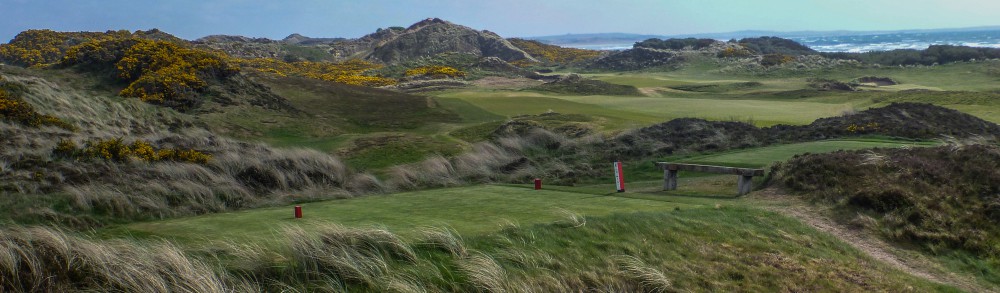
Narin & Portnoo Golf Club is situated among the dunes on a knock-you-over nub of the Atlantic Ocean called Gweebarra Bay, on the northwest coast of County Donegal. The club’s entrance is not captivating: you reach it by driving into the sort of tawdry-looking trailer park that the Irish and British seem to plant on all their choicest oceanfront real estate. But the course is tremendous. Kevin Markham, who has played every 18-hole course in the country, has described the seventh through eleventh as “maybe the best run of holes in Ireland.” The fifteenth, which measures 530 yards and plays into the prevailing wind between a line of dunes and the sea, is the hole that the ninth and tenth at Pebble Beach are trying to be. And the encampment of caravans—whose occupants, it should be said, sustain both the club and its bar—are invisible after a few holes.

On my first visit to the course, in 2011, I played with Connor Mallon, the club’s pro at the time, and set a new record for conversational tedium by saying “Wow! Great hole!” almost every time I opened my mouth other than to comment on the wind, which was intense. (Usually, when you mention wind on a links course, the natives you’re playing with dismiss whatever’s blowing as a breeze, even if you’re having trouble standing. But Mallon, good man, said he’d never known such a gale.) Later, on my way out the gate, I mentally composed an email to my wife, beginning: “Darling, how would you feel about living in a mobile home 750 miles from the Arctic Circle?”

I returned to N & P last month, with six friends from home. Between rounds, I asked a couple of older members, who were hanging around the golf shop, to explain the meaning of the symbols in the club’s logo, but they couldn’t. Eventually, someone looked it up online, and we discovered that the crest was created in 1982, at the request of the club, by a local art teacher. It is “unusual in not featuring any golfing imagery, focusing instead on the historic roots of the area,” the club’s website says. Here are the elements:

The Stonehenge-y thing at the upper left is the Kilclooney Dolmen, which stands above a 4,000-year-old tomb a few miles south of the course, near the village of Ardara (population 578):

Kilclooney Dolmen, near Ardara, Ireland.

The structure at the upper right is known as the Doon Fort, the Bawan, or O’Boyle’s Fort. It’s a circular defensive stone enclosure, and it stands on a crannóg, or artificial island, in Doon Lough, a lake a couple of miles southwest of the course. It was built in 1500 or so by the O’Boyles, who had troublesome neighbors:

O'Boyle's Fort, Doon Loch, County Donegal, Ireland.

Filling the bottom two panels is the Atlantic Ocean, which is a major presence at Narin & Portnoo. The green peak in the middle is the island of Inishkeel, which in decent weather is visible from parts of the course. The island used to have two churches, one for nuns and one for monks. Both are now ruins:

Ruined church, Inishkeel Island, County Donegal, Ireland.

And the U-shaped object in the center of the logo isn’t a horseshoe, as certain of my friends guessed. It’s the Drumboghill Gold Lunulaa Bronze Age necklace shaped like a crescent moon. It was found in a bog near the course in 1909, and is now in the collection of the National Museum. The club’s website says that its shape “matches the arc of the sixth hole.”

Connor Mallon, my host in 2011, took his life on March 14, 2012, at the age of 35. I’d been looking forward to seeing him again, and to having a rematch. At every stop on our 2012 trip, I met people who had known and loved him. In 2011, I bought a shirt from him exactly like the one he’s wearing in the picture below, because I thought that maybe its color held the secret to his golf swing.

Connor Mallon, Narin & Portnoo, near the ninth tee, May 1, 2011.


These are the Best Golf Shoes, and I’m Not Kidding

The True Linkswear golf shoes of Tony, David O., Tim-o, & Tim. Royal Portrush Golf Club, Northern Ireland, April, 2012.

Among the hits of last year’s PGA Golf Merchandise Show were some unusual golf shoes, made by True Linkswear. They look a little like Earth Shoes and a little like Crocs: the front end is wide, allowing your toes to spread out the way they do when you walk barefoot, and there’s almost no heel. A teaching pro who now works for the company told me, “It took me a week to get over it, visually.” But golfers learn to love the look, he said, and are often able to throw away their orthotics, like crutches at a revival meeting. (It’s also possible that True Linkswear shoes promote a slightly better swing, by making it harder for you to lean over your toes.) The company’s reps brought 300 pairs to Orlando but had to stop selling them after just a few hours because they were running out of samples. By the time I got to the booth, they no longer had a pair in my size, but the ones I tried on—which were half a size too small—were still the most comfortable golf shoes I’d ever worn. I now own four pairs.

I took two of those pairs to Ireland this month, along with some New Balance walking shoes. I figured that the walking shoes would be good for après-golf—but I was wrong about that, because by comparison with my golf shoes they felt like army boots. I wore the walking shoes when we went out to dinner our first evening in Ireland but left them in the car after that, and wore only my golf shoes. And I never felt even a twinge, despite the fact that, according to Tim-o’s Fitbit Ultra, we walked between eighteen and twenty-two miles a day (while playing 36 holes and searching for balls among the dunes). And I wore my Trues on the flight home, too.

I wasn’t the only True believer on the trip: Tony, Tim-o, Tim, and I all wore them, in various models and colors—as you can see in the photo above.That’s four of the seven golfers on the group. And Jack wore FootJoy Contour Casuals, which look and feel like sneakers and which he also didn’t bother to take off. It’s now hard for me to believe that golfers ever played in shoes that had stiff soles and metal spikes and had to be broken in.

I’ve retired my original pair of Trues from active golf duty, but I wear them when I work in the yard, walk the dog, and wander through the woods. I’d wear them in the house, too, if I ever wore shoes in the house. And a day will come, I predict, when I will own no other shoes.

Brendan icing a foot rubbed raw by a week of links golf in conventional golf shoes. Cullen Golf Club, Scotland, May, 2008.

In Love With Ireland

Portstewart Golf Club, Northern Ireland, April, 2012.

Six friends and I returned this afternoon from eight days and fourteen rounds of golf in Northern Ireland and Ireland, and earlier this month I spent a similar week, by myself, in northeastern Scotland. I’ll have more to say both trips as soon as I’ve reintroduced myself to my wife and gotten caught up with the pile of stuff on my desk. In the meantime, I’ve been thinking about an earlier Ireland trip, back in 2006, and something that happened on the evening I arrived in Shannon (from Dubai!).

The baggage carousel was still revolving, but several minutes had passed since the last suitcase tumbled onto the conveyor. A young woman in a green Aer Lingus uniform walked over to me. “Is your bag missing?” she asked, her eyes radiating concern. I looked around. The other passengers had departed. The truth sank in. “My g-golf clubs,” I said.

It’s the traveling golfer’s nightmare. I had come to Ireland to spend a week playing southwestern seaside courses, and now, I thought with horror, I was going to have to play Ballybunion with rented equipment—with battered, mismatched irons and woods contaminated by the bad-swing juju of who-knew-how-many anonymous choppers, shankers, and honeymooning beginners. How could I face Waterville without my very own Banzai-shafted 10.5-degree jumbo driver, not to mention my humiliatingly extensive but indispensable collection of hybrids?  I followed the Aer Lingus woman into her office, where she helped me file a claim.

Fifteen minutes later, I was sitting numbly in a taxi, on my way to the tiny resort town of Lahinch (which is famous in Ireland not only for golf but also for surfing, of all things). Three Golf Digest colleagues would be joining me there the following afternoon, along with two rental cars. I was trying hard to appreciate the lush landscape on either side of the road, but I couldn’t stop thinking about my clubs. Why couldn’t the airline have lost Jodie Foster’s daughter instead? Then the driver’s cell phone rang.

“Right,” the driver said, after a brief conversation. “You’ll have your golf clubs by noon tomorrow. I’ll probably deliver them myself.” The young woman in the lost-baggage office, it turned out, had located my bag, in London, and had then taken the time to locate me, by telephoning the taxi dispatcher and asking if a Mr. Owen had been sent to Lahinch. I leaned back against the seat and smiled, finally able to relax. The next morning, I borrowed a set of clubs from Robert McCavery, just the fourth head professional in Lahinch’s 120-year history—he succeeded his father, Bill, who got the job in 1927—and played eighteen holes with two middle-aged women from Switzerland, who were traveling without their husbands.  My golf bag arrived just as we finished.

A week later, I was back at Shannon Airport, killing time before my flight home. And sitting at a table on the other side of the coffee shop, I suddenly noticed, was the young woman from the lost-baggage office—the woman who, a week before, had tracked me down in my taxi. I rushed over, and thanked her for her kindness.

She looked startled for a moment, then smiled. “Mr. Owen,” she said.

We have a responsibility, as golfers and as Americans, not to abuse the hospitality of this gracious, enchanting country.

Tony, Tim-o, Dave-o, Tim, David W., Howard, Jack: Enniscrone Golf Club, Ireland, April, 2012.

Improved Golf Transit

Trolleys, Portstewart Golf Club, Northern Ireland, April, 2012.

At home, my friends and I have almost always walked and carried our bags. In Scotland four years ago, though, we became semi-converted to pull carts–which are called trolleys in the U.K. and Ireland (and are called buggies in Australia). At first, we weren’t very good at handling them and were constantly tipping them over and crashing them into one other, as you can see in the photo below, from Cruden Bay in 2008. (Those are the steps that connect the first tee and the clubhouse. A trolley ramp is built into them, but we still managed to screw everything up.)

Trolley accident, Cruden Bay Golf Club, Scotland, 2008.

Unfortunately, the standard rental trolley is ill-designed for the only job it has to do. An easy way to make up for its major defect is to travel with your own bungee cord, as I do, and use it to secure your bag to the frame, as in this photo, from Enniscrone, where we played yesterday:

Golf bag secured to rental trolley with bungee cord, Enniscrone Golf Club, Ireland, April, 2012.

I still overturn my trolley fairly often, but when I do my bag doesn’t usually fall completely off. The only time I got into serious trouble yesterday was as I was leaving the fourteenth green. I took a path that was meant not for trolleys but for mountain goats, and eventually had to pick up the trolley itself (with the bag securely attached) and carry it.

Ireland: Tony’s Amazing Inflatable Rainsuit

Today, six friends and I played 36 holes at Narin & Portnoo Golf Club, in northwestern Ireland. I wrote about the course and that part of the country last year, in Golf Digest, in an article called The Road Less Traveled. Today, the wind was blowing several hundred miles an hour–as you can see in the video above, which shows Tony and his amazing inflatable rainsuit on the eighth tee–but there was hardly any rain and only a tiny bit of sleet. Between rounds, I asked a couple of older members, who were hanging around the golf shop, to explain the meaning of the symbols in the club’s  logo, but they couldn’t. Someone eventually looked it up online, and the answer was extremely interesting, although now I don’t remember what it was or where they found it. The simplest thing would probably be for you to go yourself, and ask them to look it up again–and you really should do that, because the course is A-plus-plus. (I’d post an image of the logo, but I can’t find a decent one on the Web–another good reason to visit in person.)

The day before, at Portsalon, we had an incident (referred to in court documents as the Incident) that may be of interest to legal scholars. Howard (referred to in court documents as Player H) had a three-foot putt for par which was well outside our standard gimme distance (the length of the longest foot in the foursome). He picked it up because Tim had a par already. On the next tee, we realized that Howard had had a stroke, meaning that his putt had actually been for net birdie. What to do? We decided that the fair thing would be to recreate the putt on the following green, and credit Howard with the birdie if he made it (which he did). Amazingly, the guys on the other team agreed with this ruling, and we have adopted it group-wide.

Here’s another look at that wind:

Blood-sucking Arachnids and Golfers’ Legs

The summer before last, I was sitting on a bench on a golf course on Martha’s Vineyard, waiting for the slowpokes ahead of me to putt out, and passing the time by admiring the sharply demarcated tan lines around my ankles. As is the case with many avid golfers, in high summer I appear to be wearing white socks even when I’m barefoot. (“Your feet look like replacement parts,” a non-player told me once. “Too bad they didn’t have them in your color.”) For variety, I also studied my shins, and marveled that so many of my freckles resembled tiny bugs.

Then I gasped: Quite a few of those freckles were tiny bugs. Even without my bifocals, I could tell that they were deer ticks, at least a dozen of them on each leg. About an hour before, I had waded into a patch of tall grass (in order to take a whiz), and the ticks must have ambushed me there. I carefully removed all of them before teeing off, and made a mental note to add a pair of tweezers to my golf bag.

Lyme disease, which is transmitted by tick bites, is a significant hazard for golfers in my part of the country—especially for those of us who occasionally venture beyond closely mown areas, seldom play in long pants tucked into socks, and sometimes forget to bathe in DEET. I didn’t get sick that time—deer ticks usually can’t infect you unless they’re embedded for a day or two—but the experience reminded me to be more careful.

Nevertheless, in 2006 I did come down with Lyme, for the third time in ten years. (I’ve had it once more since then, and so has my dog.) Because I’m a veteran, I recognized the symptoms right away: flu-like aches and pains, throbbing head, a hip that hurt every time I swung a club. My doctor, whose handicap is 14, prescribed an antibiotic, even though neither of us could find evidence of a bite. I began taking the pills immediately, but still got so sick that I had to miss not only a week’s worth of golf but also my daughter’s college graduation. A blood test later proved that I’d had both Lyme and ehrlichiosis, another tick-borne disease, which is like Lyme delivered by sledge hammer. It is possible to get Lyme and ehrlichiosis from the same tick bite, as I probably did—most likely while playing golf.

While my daughter was receiving her diploma, I was shivering in bed at home. I felt so ill that I called my wife and told her that I was going to check myself into the hospital. She called my regular golf buddy Bill, who drove over immediately and took me back to his house instead. Bill’s wife, Martha—who introduced me to golf, twenty years ago, by taking me out for nine holes—is a registered nurse. She gave me orange Jell-o and a Popsicle, and Bill made me white toast cut into star shapes. That night, they put me to bed in their son’s old room, and the next morning I felt well enough to go home. When I thanked them for taking such good care of me, Bill said, “Hey, what are golf buddies for?”

Two great things about about links golf in the British Isles and Ireland: hardly any lightning and no Lyme-bearing ticks. In 2008, eight friends from home and I spent a week playing golf in Scotland. Toward the end of the trip, Stanley suddenly got the sweats and felt lousy. He knew it was Lyme—he’s had it more often than I have—so he went to the medical clinic just down the road from Cruden Bay Golf Club. The doctor there had heard about Lyme but never seen a case. He looked it up in a book, agreed that Stanley’s symptoms matched the description, and prescribed doxycycline—no charge for the visit or the pills. It was Stanley’s seventieth birthday, so we all pitched in and got him a caddie. That’s Stanley below, on the mend at Cruden Bay, holding a birthday balloon that we also gave him. (We found it in a trash can.) Hey, what are golf buddies for?

Stanley, Cruden Bay Golf Club, Scotland, 2008.

Golfer’s Cure for Jet Lag

The cure for jet lag is golf. You take the overnight nonstop to Scotland from Newark, arrive bleary-eyed in Glasgow at 8:00 in the morning, drag your clubs past the bomb-sniffing dogs in customs, stumble into a men’s room designated “loo of the year,” change a tall stack of American dollars into a short stack of British pounds, drive 55 miles through Robert Burns country while trying to remember to admire the sheep-dotted hillsides, reach Turnberry in a daze—and tee it up on the Ailsa course, where Tom Watson and Jack Nicklaus fought their legendary Duel in the Sun, at the British Open in 1977. You haven’t slept since what seems like the day before yesterday, but your tee shot somehow finds the fairway, and a little mental arithmetic reveals that your colleagues back home are arriving, just now, at their desks. Suddenly, you feel happier than you’ve felt since the birth of your first child, or since the time you and your brother nearly won the member-guest. (Not to worry: The cure for excessive cheerfulness is also golf.)

Or so I’ve decided over the years, during a number of golf trips abroad: Hit the ground running, and keep running until dinner. I was gratified recently when a doctor who treats sleep disorders, whom I was interviewing for an article, recommended the same thing. To beat jet lag, he said, don’t take a nap upon arrival (my wife’s approach); keep your eyes open until the locals call it a day, or at least until the sun has gone down. That’s what I did this past week, in Scotland, and it’s what I did again yesterday, when I got back home. And I’ll do it again tomorrow, when six of my friends and I take off for a week of golf in Northern Ireland and northwestern Ireland.

Yesterday, my last day in Scotland, I had to interview someone in downtown Edinburgh, and I took a taxi from my hotel, which was at the airport. A guy up ahead of us did something stupid, but the taxi driver anticipated it—he told me he could read the guy’s mind—and he honked and said “What an idiot!” almost before the guy himself knew what a stupid thing he was about to do.

The taxi driver doesn’t own a car, he told me; when he and his wife need to go somewhere far away, they rent one. Usually, they pick it up at 11:00 a.m. and return it the next day at 11:00 a.m. Sometimes, 10:00. He rents from Arnold Clark, and gets a medium-size car, like a Corsa or a Focus. Once, he got upgraded to a really big car because they were out of medium-size cars, and some of his relatives felt initially that he was putting on airs. Occasionally, when he and his wife go to visit his wife’s mother, who lives near the English border, they will use his taxi, an old-fashioned English black cab, and his wife will ride in the back, “regally.” In fact, when he retires, a few years from now, he may keep his taxi, because he enjoys driving it, and sell just the “plate,” which is their equivalent of a medallion. He and his wife go on holiday every September; last year, they spent two weeks in Greece. That cost £3,000, for the two of them, including air fare. He likes to stay in four-star hotels, but in Greece they stayed in a five-star hotel. He likes to take “all-inclusive” trips—self-catering is too much trouble on vacation—but the Greek trip included only breakfast and dinner. That didn’t bother him too much, because when he’s traveling he eats a lot at breakfast—orange juice, corn flakes, yogurt, porridge, eggs, sausage, bacon, black pudding, haggis, beans, you name it—so much that has to let out his belt when he leaves the dining room. His wife, by contrast, eats nothing but toast and sometimes has trouble making it even till lunch. Keeping the weight off is harder than it used to be, even though he goes to the gym, but what choice do you have? The places he and his wife like to go are: Spain, the Canary Islands, Greece, Majorca. They usually go away in September, after the schools have started up again, because then you can get bargains, but just yesterday he looked into going away in July, too. The best the travel agent could do, though, was £1,000 apiece, all-inclusive, for a week—even in Greece! He thinks it might be possible to do better online, but hasn’t checked yet. At any rate, the travel agent said to come back in July or August and have a look at September then. Next year, for his sixtieth birthday, his wife wants to take him to New York City, where he (unlike her) has never been. He wants to go, but four hours is the limit for him, air-travel-wise. Two hours, two and a half hours? Fine. He doesn’t start to panic if he’s in the air longer, but he doesn’t like it. The best way to fly to New York might be with a stop somewhere on the way—maybe in Iceland—to break up the flight. That might make the ticket cheaper, too, since the flight wouldn’t be direct. He thinks that four days should be enough for New York, and he has been told that the part of New York that he and his wife should visit is midtown Manhattan. He was very glad to hear that I agreed with that recommendation.

Back-Roads Scotland: Moray Coast

Lossiemouth, Scotland, March 26, 2012. Photo by John Thomson.

The photo above was taken this past Monday evening in Lossiemouth, Scotland, about two hours’ drive northwest of Aberdeen. You are looking across a corner of the North Sea toward the Moray Golf Club, the Lossiemouth Lighthouse, and both the waxing crescent moon and Venus. The photo was taken by John Thomson, a Moray member, whose Uncle Alistair was the club’s professional for thirty-one years and whose father was responsible for the construction of the club’s second eighteen. I haven’t played Moray, but I’ve gazed longingly at both the course and the clubhouse from the Stotfield Hotel, across the street. Here’s what I saw from the hotel’s front door during a trip in 2007:

Moray Golf Club, Lossiemouth, Scotland, 2007.

Moray is one of a number of fine links courses along on the Moray Firth’s southern edge, a hundred-mile stretch of golf-friendly coastline that runs between Inverness and Fraserburgh. Traveling golfers are probably most familiar with two courses at the western end, Castle Stuart and Nairn, which are popular stops for Americans on their way to Royal Dornoch. But those aren’t the only worthy courses on the Moray coast. Others: Nairn DunbarHopeman, Spey Bay, Buckpool, Strathlene, my beloved Cullen, Duff House Royal (not a links course, but significant because it was redesigned, in 1923, by Alister MacKenzie), Royal Tarlair, Rosehearty, and Fraserburgh. And there are many good inland courses nearby as well.

Lossiemouth would make a convenient base camp for any golf trip to the Moray coast. John Thomson, who took the photograph at the top of this post, owns the Links Lodge, a guest house next to the Stotfield; he also owns an adjacent three-bedroom self-catering apartment, the Beach View, which sleeps six. (If there are four golfers in your group, you can do what three Golf Digest editors and I did during a trip to southwestern Ireland in 2006: play a match to determine who will have to double up.) The Links Lodge served as Moray’s clubhouse for the first three years of the club’s existence, between 1889 and 1892; it was then replaced by the building in the photograph below. (The building has been enlarged considerably since then.)

Moray Golf Club, first dedicated clubhouse, 1892.

Thomson told me, “We only found out the Links Lodge was the original clubhouse while replacing a window: we took out a piece of frame with the carpenters’ delivery note still stuck to it.” The first owner, Thomson said, must have been one of the gentlemen in this photograph:

Founding members, Moray Golf Club, 1893.

He continued, “We boast not one but two prime ministers as members—and expelled one of them. We have one of the longest associations of any club in the world with our own labeled malt whiskey (since among the founders were some distillers). Dai Rees, Max Faulkner, and Fred Daly played exhibition matches here, and regular visitors included Ted Ray, Harry Vardon, J. H. Taylor, and James Braid.”

I’ll be in northeastern Scotland next month. My itinerary won’t take me to Lossiemouth, I’m sorry to say, although it will take me to Fraserburgh. I’ll report, eventually. In the meantime, here are a few photos of Hopeman, about four miles west of Moray. I took them in 2007. As you can see from the first, a breeze was blowing the day I played.


How to Take a Golf Trip With Friends


How to stock a golf-trip refrigerator. (Ferris's house, Pinehurst, 2006)

My regular golf buddies and I have taken many trips together, and, by trial and error, we’ve learned a lot about what works and what doesn’t. Here are some tips:

Do give one person the overall responsibility for managing the itinerary, keeping track of reservation deadlines, reminding laggards to make their deposits, and deciding which minor tasks can safely be delegated. Having a single, reliable leader makes it less likely that critical details (such as tee times) will be forgotten, and creates a clear blame path if things go wrong.

Don’t automatically assume that nobody will be up for more than eighteen holes a day or (equally important) that everybody will. During a buddies trip that eight friends and I took to Scotland in 2008, we designated one round as the official eighteen for each day, so that oldsters could flake out in the afternoon without losing their place in the standings. On the final day of an earlier, ten-day trip to Ireland, when even the golf obsessives had begun to fade, we revived everyone’s spirits by playing a scramble in the afternoon.

Do establish a centralized rule-making authority with the power to silence whiners, naysayers, and independent thinkers. Among my friends, this authority is called the Committee, and it typically consists of Hacker (real name) plus one or two people who, over the years, have satisfied Hacker that they are likely to agree with him. The Committee has many responsibilities, including picking the games, choosing the stakes, deciding whether or not Gene will be allowed to play from the senior tees, and settling minor but potentially divisive issues as they arise, such as do we get a first-tee do-over or not, and what about handicap strokes on par-threes? The Committee’s decision is always final—a relief to most people, who go on golf trips to escape their current responsibilities, not to acquire new ones.

The Committee.

Don’t allow trip-threatening behavior to go unpunished. On the second morning of our annual Atlantic City trip a few years ago, one foursome drove to the wrong golf course (with Hacker, of all people, at the wheel), even though all five cars had left our hotel at the same time and everybody had been given printed driving directions. The resulting confusion came close to ruining the whole trip, or so we said. When the round was over, we restored order by conducting a trial in the clubhouse—taking advantage of the fact that two of the participants that year were lawyers—and sentenced the offenders to pay for everybody’s lunch.

Do collect all wagers before anyone tees off. Losers always outnumber winners, and on a large golf trip that means that if the prize money isn’t in hand when the scores are tabulated the victors will have to collect from a sullen mob. We handle this on our golf trips by collecting a single buy-in on the first morning of the whole trip—currently, a hundred bucks a man—and paying all prizes for the trip out of that fund.

Don’t let the stakes get out of hand. The purpose of playing for money is to make three-foot putts seem important, not to let anyone get rich. We try to spread the prize money around by having lots of complicated side bets, all paid off from the same hundred bucks. The big winner, furthermore, is expected to buy lunch on the last day.

Do establish community-building trip traditions, such as our rule that recovering alcoholics drink free.

Don’t feel you have to do everything as a group. We often split up for dinner, primarily to eliminate tedious late-afternoon arguments about who is willing to pay how much to eat what. Doing this also occasionally generates interesting demographic data, as it did on the night when (as someone realized later) all the Democrats went to a sushi bar while all the Republicans went to Outback. (Figuring out that this had happened took some deductive work, because in our group, as in all successful golf groups, we almost never mention politics, even with people we agree with.)

Do be careful about the guest list. We usually open up our trips to friends from outside our club, and even to friends of friends. This has beneficially expanded our acquaintance with overweight middle-aged men from outside our immediate geographical area, but it has occasionally led to problems. One year, one guy invited an old high-school friend of his, whom he hadn’t seen in years. The old friend, who began drinking as soon as he got into Hacker’s car, bought a dozen condoms at a convenience store during the first refueling stop, then stashed the box under his seat and forgot all about it. A week after we got back, Hacker’s wife discovered the condoms and—here’s the problem—didn’t believe, even for a minute, that they belonged to any of us.

Don’t let a buddies trip end without establishing a Committee to pick the next destination.

How to load a rental car. (Cruden Bay, Scotland, 2008)

Coolest Place to Stay in St. Andrews

A terrific guide to golf in Scotland is Golf in Scotland, by Allan McAllister Ferguson, a personal travel planner. The fourth edition has just been published. If you’re going to Scotland, or if you dream of going to Scotland, you need a copy. You should also get sign up for Ferguson’s newsletter.

I took a golf trip to Scotland in 2008 with eight friends from home. Our best lodgings were in St. Andrews, where we spent two nights in a nineteenth-century house on North Street, a short walk from the Old Course. The house, which was designed by the same man who designed the main part of the R. & A. clubhouse, was recommended to me by Ferguson. It had five double bedrooms, and it came stocked with orange juice and candy bars, and there was a gas grill and a lighted artificial putting green in the backyard. And it set us back just $70 per man per night. If we’d known how cool it was going to be, we might have thrown out our itinerary and stayed there the whole time. Here’s a photo of the backyard:

This is how you're supposed to spend the evening after you've played 36 holes on the Old Course.

Unfortunately, the house doesn’t seem to be available at the moment. Ferguson told me he thinks it may be closed for good, but the house’s website is tantalizing. (It also has more pictures.) You might also try sending a begging email to the owner, Stuart Lloyd, who is an English urologist and an R & A member. (The address is on the website.)

Lloyd loves golf more than you do. He and his wife, who is also a doctor, live in Leeds, five hours away, but they spend a lot of time in St. Andrews. They also own a second house there, and in the backyard of that one Stuart built a three-quarter-scale replica of the Road Hole bunker:

If you can’t talk Lloyd into putting you up in St. Andrews, Ferguson has other suggestions—some of which he saves for his newsletter.