Undeniable Signs That the Local Golf Season is Drawing to a Close

International Leaf Rule now in effect:

p1170131

Acorns everywhere:

Ominously large collection of half-empty condiment containers on the Sunday Morning Group’s shelf in the clubhouse refrigerator:

Furniture from the SMG’s official Patio and Burial Ground moved to the clubhouse porch:

Different hats:

Daylight savings time:

Hungry wildlife emerging from the woods:

No more bunker rakes:

Frost delays:

Back-Roads Scotland: Tain Golf Club

Tain is an Old Tom Morris layout on southern side of Dornoch Firth. It’s less than five miles in a straight line from Royal Dornoch, and less than ten miles by car. I played it in 1992, on my first golf trip to Scotland. Jerry Quinlan, of Celtic Golf, who planned my trip, had arranged for me to play with the club’s general manager and one of the members. I got lost in the town and didn’t arrive at the club until exactly eight, when we were supposed to tee off. Here’s where I got lost:

The manager, whose name was Norman, and the member, whose name was Ian, were already on the tee when I pulled up. Ian looked peeved and impatient. I jumped from my car, pulled on my shoes, breathlessly hit a drive without a practice swing or a waggle, and took off after them.

Norman and Ian, it turned out, where playing in a club competition. Even so, they played at a pace that would have staggered the average American golfer. I have friends at home who think I play ridiculously fast, but I had to concentrate to keep up. I watched them closely, to make sure I put down my bag on the side of the green that was nearest the next tee, and I always had to be aware of whose turn it was to do what. No plumb-bobbing!

If there was any doubt about the playing order, one of them would quickly establish it. “First David, then myself, then Ian,” Norman said on one hole as he pulled the pin. Each golfer was expected to line up his putt or select his next club while the others were putting or hitting. Even so, we played more slowly than the two players behind us, who occasionally had to wait.

Tain is surrounded by farms and separated from Dornoch Firth by fields full of sheep; at one point, I had to retrieve my ball from a pigpen, which was out of bounds. Still, my round was one of the happiest of my trip. After I had jogged along with Norman and Ian for a couple of holes, they apparently forgave me for being late, and from then on we chatted between shots. Norman told me where to aim on every tee—the bunker on the left, the last tree on the right—and I manged to hit my ball on the proper line surprisingly often. Later, it occurred to me that my unaccustomed accuracy was probably the result of my aiming at something. Before that day, I don’t think I had ever aimed a drive at anything smaller than the entire fairway—in effect, aiming at nothing.

tain17

After our round, Norman and Ian bought me a beer in the clubhouse bar. The two players who had been behind us were also there. Ian good-naturedly complained to them that they had talked too loudly during their match, and that their voices had bothered him. “If you had been playing at the proper pace,” one of them said, “you would have been too far ahead to hear me.”

An Indispensable Accessory for the Locker Room in the Trunk of Your Car

The so-called locker room at my golf club doesn’t really have lockers, so I keep all my golf stuff in the trunk and back seat of my car (and also in the front seat). I try to be organized, with separate canvas bags for rain gear, extra clothes, winter gear, extra shoes, and so forth:

I store extra balls and several hundred lucky ball markers in a yellow plastic tackle box. (I keep more lucky ball makers in my office, and I have so many that even if I lose one or two per round from now on I won’t possibly live long enough to get to the end of them.) That white thing hanging above the tackle box in the photo below is a glove. I used its Velcro closure to stick it to the carpet-like lining of the trunk:

I keep sun screen and bug spray in a crappy shoe bag that was a freebie at some tournament I played in:

That green-and-white fabric you see in the background of the two photos above is an old table cloth, which my wife and I used on our screened porch until my wife said it had become too gross even for that. It’s heavy and, doubled over, it makes a great trunk liner. I can shake it out, and when it starts to smell bad I can throw it into the wash. The dark spot on the left in the photo below was made by my water bottle, which has a leaky top:

My best recent addition to my trunk is a small whisk broom — a kind the Fuller Brush man used to sell door-to-door. (For those of you who are younger than I am, the Fuller Brush man was a sort of 1960s brush-and-broom version of Amazon Prime.) I bought it because one day this past summer I saw that Gene had one in his trunk. I use it to remove leaves, dirt, and grass clippings from my golf bag and the wheels of my push cart before I put them back in my car:

It even works on really nasty stuff, like this:

Atlantic City Country Club: Great Golf Course, Great Locker Room, Great Bar

p1200073

Every autumn, the Sunday Morning Group takes an end-of-season golf trip to Atlantic City, which, in addition to being a cesspool of sin, depravity, and despair, is a terrific low-cost, high-quality golf destination. During this year’s trip—our seventeenth—we added a new course to our rotation: Atlantic City Country Club. It’s now one of our all-time favorites, along with Twisted Dune, the Bay Course at Seaview, Renault Winery, and Scotland Run—courses that would stand out anywhere. Here are a few reasons to visit ACCC, which has been open to the public since 2007:

  • The club was founded in 1897, so next year will be its 120th anniversary.
  • In the olden days, a bell was rung to warn golfers that the last trolley back to Atlantic City was about to depart. Timing was an issue because high tide sometimes covered the tracks, making the schedule irregular. Also, everyone was drunk.

  • The term “birdie,” in its golf application, was coined there in 1903, when Abner Smith, a member from Philadelphia, hit his approach stiff on the what was then the twelfth hole. He exclaimed that he had hit “a bird of a shot,” and the term caught on, partly thorough his own encouragement. (That hole, with a different green, is now the second. The original second green has been preserved, for historical reasons, as a remote practice area.)
  • The men’s locker room is one of the greatest male sanctuaries on earth:

p1200049

  • The U.S. Amateur was held there in 1901.
  • The U. S. Women’s Open has been held there three times. In 1948, it was won by Babe Zaharias, who celebrated afterward by playing the piano in the club’s Taproom.
  • Arnold Palmer played there often in the 1950s, when he was in the Coast Guard and stationed nearby, and he has an honorary locker (which was shrouded in black, to mark his death, during our visit):

  • Al Capone, Bob Hope, Willie Mays, and Joe Namath also played there and also have honorary lockers.
  • Oh, yeah, and the course—which was designed partly by Willie Park, Jr., among others, and was reworked in 1999 by Tom Doak—is swell, too:

My Latest Favorite Golf Accessory

In May, eleven buddies and I spent a week playing golf in Ireland, and one of the guys on the trip, Mike B., brought a travel accessory I’d never heard of: a pair of cigar-shaped electric boot dryers, which he takes on ski trips. When I’m traveling, I usually dry wet golf shoes by balancing them upside down on the shade of a bedside lamp in my hotel room (a method made both less hazardous and less effective by the death of the incandescent bulb) or by wedging them between the dashboard and windshield in my rental car and blasting them with the defroster. At home, I’ve always leaned wet golf shoes against a wall in front of a small portable fan.

We had such great weather in Ireland that Mike never had to use his boot dryers, but they got me to thinking. Recently, I bought a larger, at home-version: a shoe-and-boot dryer made by a company called Peet. It stands just under two feet tall and consists of two cylindrical plastic chimneys mounted on a sturdy plastic base. You place wet shoes upside down on the chimneys, and by morning they’re dry and toasty, inside and out. The device is silent, and it’s so gentle that it won’t harm fancy leather, but it thoroughly dries even shoes you’ve worn while playing all day in the rain.

boot-dryer

When I bought my Peet dryer, I expected to use it only on golf shoes I’d worn in crummy weather, but since then I’ve realized that it’s great for shoes and boots of all kinds, and that even on nice days ordinary perspiration can make the inside of your shoes damp to the touch. Dry shoes last longer, and they don’t get stinky. My wife now uses my Peet dryer on her hockey skates, too. In fact, before long we may have to trade up to the two-pair model.

Your Golf Course is Too Long For You

Every October since 2000, the Sunday Morning Group has taken an end-of-season weekend golf trip to Atlantic City.
p1200107

For the past four years, we’ve allowed every player on the trip to play from any set of tees. Some guys worried at first that our matches and team competitions would be unfair unless everyone was “playing the same course.” But we have discovered that, as long as you calculate the handicaps correctly, the competition actually works better if golfers are able to make rational decisions about the trade-off between course yardage and handicap strokes. And that’s true even when the skill spread is huge. (Handicaps this year ranged from 0 to more than 30.)

Our experience aligns perfectly with the findings of the USGA and the PGA of America, which in 2011 introduced Tee It Forward, an initiative that “encourages players to play from a set of tees best suited to their driving distance.” According to the USGA:

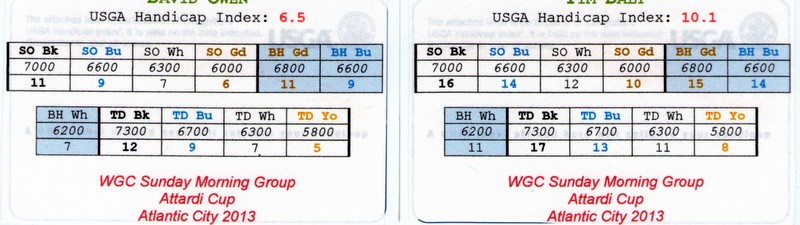
I firmly believe all of that. But there are reasons you haven’t heard much about Tee It Forward since 2011, and the main one is probably the USGA’s semi-incomprehensible two-step system for calculating course handicaps when players compete from different tees. Virtually no one understands how the USGA’s system works, including, in my experience, most PGA of America head professionals. My friends and I are able to do what we do mainly because Tim, who is SMG’s mathematician-in-residence, created an Excel spreadsheet that does all the figgerin’ in the background and eliminates a potentially huge rounding error inherent in the USGA’s method. Every player on the trip, before we leave home, receives a handicap for every set of tees on every course we’re going to play, and is then free to choose:

card-example

Another impediment to Teeing It Forward is that most golf courses stigmatize their forward tees by suggesting that they’re intended only for certain players — as at Twisted Dune, in Egg Harbor Township (a course we nevertheless all love):

It’s far, far better to rate all sets of tees for both men and women, and to give the tees gender-and-age-neutral names—as at Wintonbury Hills, in Bloomfield, Connecticut:

One discovery we’ve made during the past four years is that virtually all players, including many with single-digit handicaps, play better and have more fun if they move up — even way up. At Twisted Dune, Addison, who hits his driver 300 yards and has USGA Handicap Index of 0.4, played the black tees, from which the course measures 7,300 yards. But Brendan (8.3), Tim (12.3), and I (7.1) all played the “Senior Tees”—the yellows —from which the course is 1,500 yards shorter. When we started, Addison was so far behind us that we could barely see him. In the photo below, the red V is just above his head:

Addison loves playing from the tips, and he has more than enough game to do it. The rest of us, though, were very, very happy to move as far forward as we could.

What’s in My Bag: An Old Curmudgeon

Nat Ehrlich, a reader in Ann Arbor, Michigan, is a retired university professor whose main academic interests are human-performance psychology and statistics. He took up golf in 1961, and he was the golf coach at the University of Michigan-Flint in 1971 and 1972. He’s 76 years old now, and although he hasn’t shot his age he’s come close. He’s a regular at Radrick Farms, the University of Michigan’s golf course and one of Pete Dye’s earliest designs:

Looking down on the green at the par-5 fifth hole at Radrick Farms Golf Club.
Lon Horwedel | AnnArbor.com

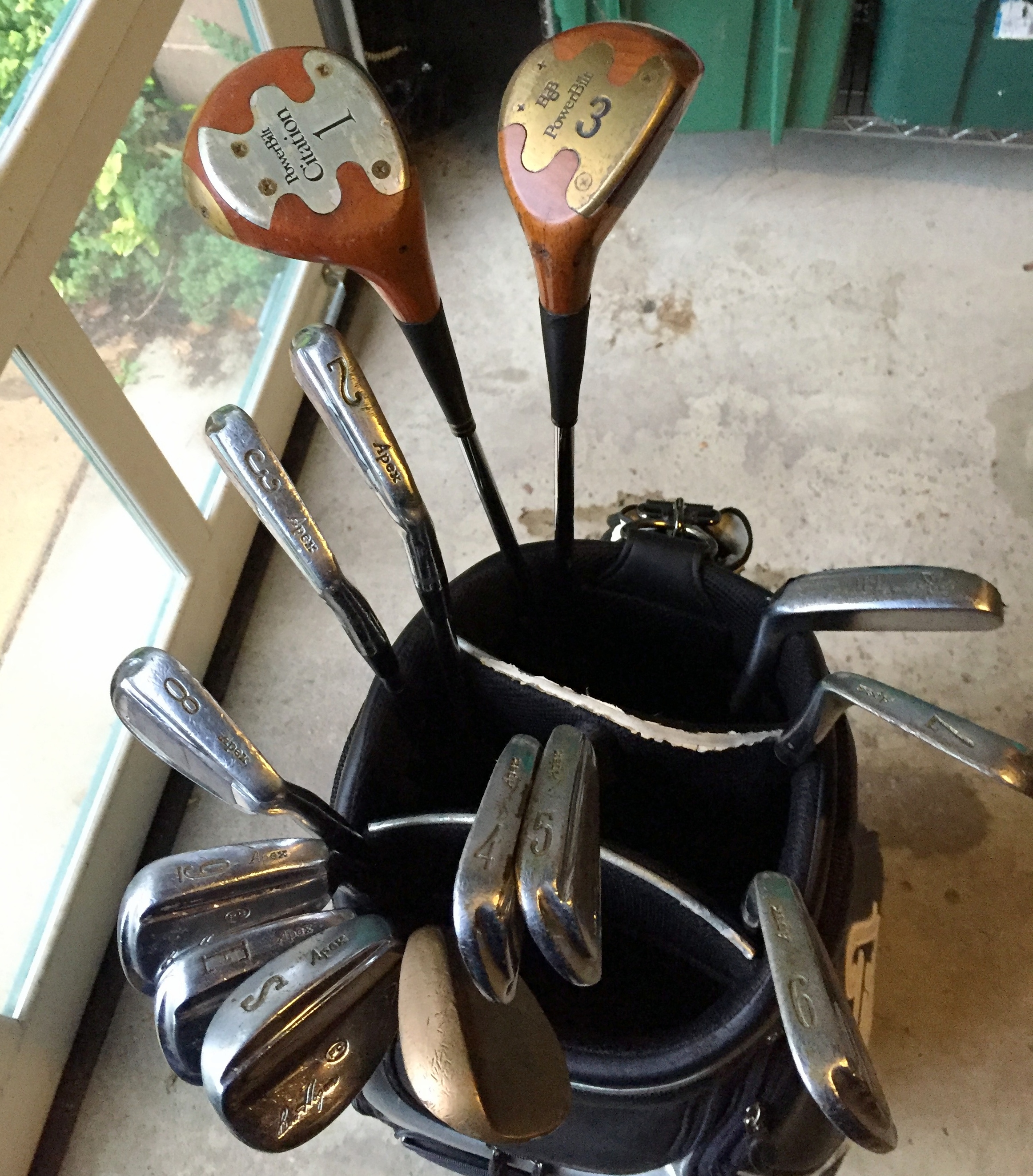
He’s also an old curmudgeon. Recently, he sent me a photograph of his golf bag, which is totally from opposite land by comparison with mine:

img_0315

He wrote:

“During most of this season, I used modern equipment — TaylorMade SLDR, Ping 4-wood, Titleist hybrids (19 and 21 degrees), and Callaway Big Berthas — but I shot my best round of the year (age +3) after switching back to the Hogan Apex PCs and the Citation driver and 3-wood. And that was with 35 putts. The Hogans have no offset and zero bounce, except for the two sand wedges. That makes them easier to aim (no offset) and better at slicing through the rough. And I have no problem hitting the driver from a decent lie in the fairway. Here are two pictures that show why my bag is full of ancient equipment:”

“As you can see, the ball looks bigger in close proximity to a smaller clubhead. That signals the brain that it’s an easier target to hit. Also, the smaller clubhead is a signal to the brain to be more accurate. No learning required. Of course, the degree to which one misses the 1/16th-inch sweet spot, which is the same for all clubs, gives you more feedback with the smaller head, and that makes you swing more accurately.

(He’s right about the “sweet spot” being the same size on all clubs—it’s a spot—although modern, perimeter-weighted clubs yield better results when you miss it.)

Back to Ehrlich:

“More accurately doesn’t mean much more slowly, though. Yes, I get about 4 mph more from the 45.5-inch driver shaft than the 42.5-inch shaft on the old Citation, but my percentage of fairways hit drops from 75-80 per cent to about 45-50 per cent. And 4 mph translates into about 10 yards, whereas I lose 20 yards hitting from the rough vs. the fairway. And, of course, I don’t need to tee the ball way up or way forward. As for club fitting — don’t make me laugh! When I play every round off a perfectly level mat. . . . not even then.”

How to Keep Your Golf Bag Dry in the Rain

My part of the country is now more than a year into one of its longest droughts ever. Gary, our terrific superintendent, has done a remarkable job of keeping our course in great condition, but you can tell that we need rain. Here’s what the creek that feeds our irrigation pond looks like:

Here’s what the same creek looked like exactly three years ago, when we had the opposite problem:

The ideal, of course, would be something in between. Anyway, on a recent Sunday we finally got a semi-decent amount of rain, and I was able to test my new Rain Tek bag-and-pushcart cover:

p1190955

It’s easy to put on —you don’t need to remove your bag from your pushcart to do it — and it has zippered openings that let you reach through to the pockets in your bag. The top is stiffened with foam and has a handle, so it’s easy to open and close:

When you play in the rain, it’s impossible to keep almost any of your stuff from becoming at least slightly wet, but using a bag cover shortens the post-round drying time considerably.

Do the Rules of Golf Violate the Rules of Golf?

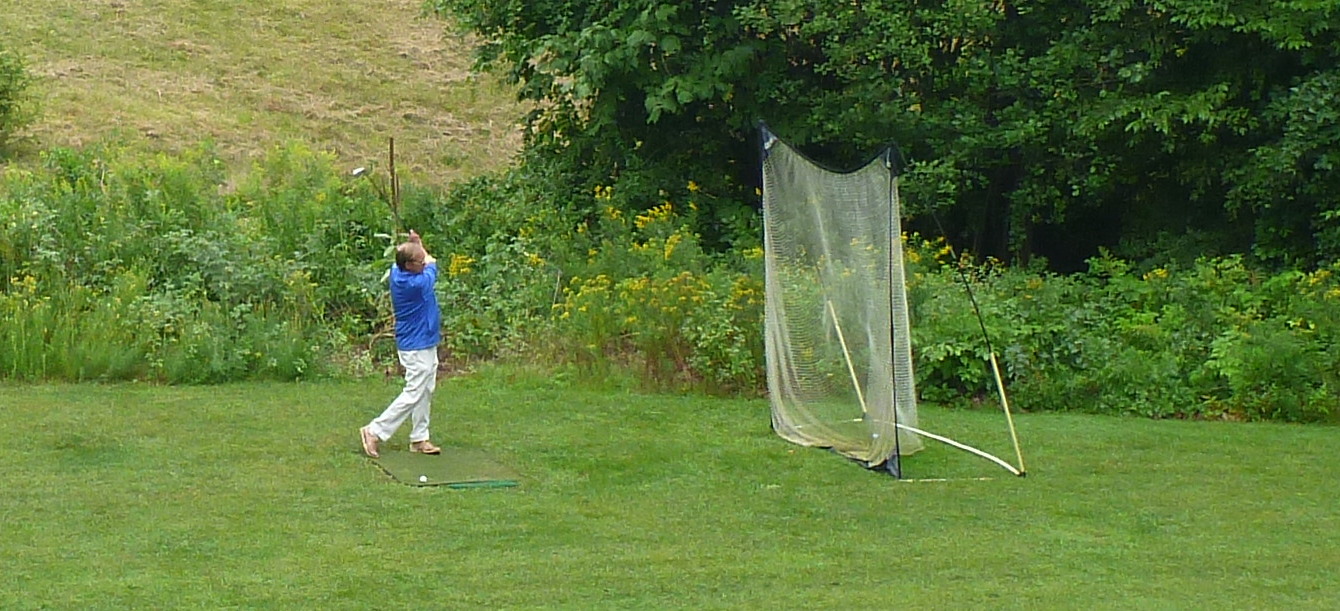
Not long ago, I played in an inter-club tournament on a nine-hole course in the northern part of my state. The club has two features I like a lot (in addition to the course): a curling club next door, and my favorite kind of driving range:
p1190691

On one hole during the tournament, I lipped out a par putt, leaving a tap-in for bogey. I tapped it, but it didn’t go in. The head of my putter looks like this:

I had struck the ball with what I guess would be considered the putter’s “toe,” and the wingy thing made it squirt off at a weird angle, and I ended up with a double bogey. I told my pro later that, at least, I knew I’d never make THAT mistake again, but he said that, based on his own experience, I was probably safe for only about five years.

Later, I got to wondering: was my stupid muffed tap-in even legal? And that made me think of Bill Collins, a reader in Scotland, who has written to me several times to complain about what he believes to be a serious inconsistency in the Rules of Golf. Bill is eighty years old. He lives in Edinburgh with his wife, Mary, and he plays two or three times a week, all year long, at Silverknowes Golf Club, which has swell views of the Firth of Forth and beyond:

“I served an apprenticeship in a shipyard in Leith on the River Forth and have been in engineering most of my working life,” he told me in an email. “For the last 15 years of my career, I was offered a position in quality control, because of my engineering background, and was quite happy to put down my tools. I picked up a lot of information on specifications and their importance in maintaining procedures. That is why I can’t get Rule 4 and Rule 14 out of my head. They are not compatible.” Here’s another look at Silverknowes:

Collins’s concerns first arose during the 1996 Open, at Royal Lytham & St. Annes (won by Tom Lehman). “During the tournament, it was indicated by a well-known golfer and what I took to be a representative of the R&A that one could strike a ball with the face, back, heel or toe of a putter. I phoned the R&A and the BBC reps at the Lytham course, and I managed to reach the R&A desk. My message was accepted by a lady, but I received no reply from the BBC, and no reply from the R&A.”

His question was prompted by what was then part of Rule 4.1, governing the form and make of clubs (the text now appears in Appendix II)—”The clubhead shall have only one striking face, except that a putter may have two such faces if their characteristics are the same, and they are opposite each other”—and what seemed to him to be a conflict between those requirements and Rule 14.1: “The ball must be fairly struck at with the head of the club and must not be pushed, scraped or spooned.” Collins continued, “Over the past 20 years, I have allowed the above to take over large amounts of my time trying to convince people. From reading magazines and listening to comments, I know there are lots of golfers who agree with me. What convinces me even more is the lack of response to my enquiries. I have been informed by the R&A, but not convinced, that one may strike a ball with the face, back, heel or toe of a putter.”

If a putter may have only two striking faces, why are you allowed to strike a ball with a third? Furthermore, Collins wrote, “Take a moment on the green, if you have a Ping-type putter—and, if not, borrow one—and scoop up the ball. Just before you flick it up into your hand, look at the ball nestling in the back of the putter. What do you see? You see a ball resting between two striking faces. Nice way to pitch. Is it legal? Rule 14.1 says yes; Rule 4.1/Appendix II says no.”

On the other hand, pondering the Rules of Golf can send your brain into a tailspin. I once saw someone — Chi-Chi Rodriguez?—successfully extract an embedded ball from the wall of a bunker by fiercely striking the sand just below the ball with the toe of his putter, as though he were swinging an ax. In effect, he used the putter head as wedge, compressing the sand and causing the ball to squirt onto the green. Cool shot! But should it be legal? For that matter, is the ball “fairly struck at” in ANY bunker shot, since when you play the shot what you are actually striking at is sand?

Three non-conforming putters, from the Rules of Golf.

I haven’t done full justice to Collins’s argument, but I’m afraid that if I do I’ll spend the next 20 years brooding about it, too. If you want to pursue this with Collins himself, get in touch with me the way he did, through the link below, and if you don’t seem too much like a nut I’ll forward your email to him. Curling season is almost here, and that means we’ll soon have lots of time for idle cogitation. Now, about the out-of-bounds rule. . . .

The Indescribably Ineffable Awesomeness of Match Play

It’s not just for the Ryder Cup.

Every year since 1948, my club has played a home-and-home match against our Enemy Club, on the other side of town. Across those seven decades, the results are roughly even, although in recent years my club has dominated. During the first round this year, my partner was Rick, who played basketball for the University of Maryland shortly after the Civil War but can still shoot his age:
p1190794

I’ve played a lot of matches with Rick, both as a teammate and as an opponent, and one of the many lessons I’ve learned from him is that, although in stroke play a lousy shot is often a prelude to disaster, in match play it can sometimes give you an advantage that a good shot can’t.

During the first round, Rick hit an uncharacteristically lousy drive on our ninth hole, a par 4 that measures only about 260 yards, uphill. Rick is long enough to drive the green, but he started his shot too far to the right, and his ball hit some trees and kicked way back, to a bad lie on a downslope in the rough only 50 yards ahead of the tee—between the bald spot and the clump of brush in the lower right hand corner of the photo below:

His opponent then hit the kind of drive that’s easy to hit when the guy you’re playing is out of the hole: a high draw that ended up just short of the putting surface, in a little collar of rough to the left of the bunker in front of the green, maybe 30 feet from the cup. Some guys in Rick’s situation would have conceded the hole right then, just to get out of there. But Rick knew that his opponent was already mentally penciling in a win, and that if he could somehow hit a good recovery shot he could take emotional control of the hole. He also knew that he had nothing to lose. If your opponent birdies a hole in match play, a quadruple bogey by you doesn’t hurt you any worse than a par. But if you can turn a hopeless situation into a half . . .

Rick cut a fairway wood around the crap directly in front of him, and his ball ended up on the slope to the left of the green, pin-high. The hole that day was cut close to that side of the green, and the putting surface runs away, but he managed to chip it close.
His opponent now had a pitch for eagle, but suddenly his shot didn’t seem so easy. His ball came out of the rough hot, and ended up 25 feet beyond the hole, leaving a curling downhill putt for birdie — which he left well short. Rick then made his putt, and that meant that his opponent was no longer putting to win the hole, but only to tie it. He missed, and from that moment forward Rick was playing a bowl of oatmeal.

p1190766