You Could Win This Contest!

Over the weekend, I tied for fourth in the Mega Millions lottery. That is to say, I finished ahead of all the suckers who bought tickets (except for the three who get to split $640 million). I’m still kind of overwhelmed by the whole thing. I hope I don’t squander my windfall on something dumb!

In the meantime, here’s a contest you could actually win. It’s sponsored by Sun Mountain, the company that makes the golf pushcart I use. A month ago, in a post called Pimp My Ride, I described some enhancements I’d made to my cart, including the addition of a Lego shim, which prevents my laser rangefinder from interfering with the door of the cart’s storage compartment, and a Lego divider, which prevents my extensive collection of scorecard pencils from falling into the place where I keep my rangefinder (see photo below). Sun Mountain was so utterly blown away by what I had done that they decided to give people who aren’t me a chance to win some cool stuff for doing the same kind of thing.

Do you own a pushcart that you have customized in some way? If you do, you should follow the contest’s instructions, and submit photos and a description to Sun Mountain, by way of the company’s Facebook page. You have until April 15, 2012.

Sunday Morning on Friday Afternoon

The Friday-afternoon version of my regular Sunday Morning Group met the other day. Seven players showed up: three retirees, one semi-retiree, two self-employees, and one college student home for the weekend. We picked teams by drawing balls from my hat, three vs. four. As always, the threesome started two under par (an adjustment we borrowed from Augusta National) and no one got two strokes on any hole. The wager was twelve dollars a man: five dollars for best-ball, five dollars for skins, and two dollars for the Money Hole (which, because there were seven of us, was the seventh). Because it was Friday, not Sunday, we allowed strokes on par-threes. 

The course had been open for more than a week and the weather was flawless, but our cars were the only ones in the parking lot so we played as a sevensome. Later,  we picked up an eighth player: a self-employee, but one who runs a real company and has young children and so sometimes runs late. Even as an eightsome, we played faster than most foursomes, perhaps partly because Ray, over the winter, had eliminated a few redundant elements from his pre-shot routine. He’s just about the last member of the group who still believes in practice swings, although he now limits himself to one, plus waggles.

My team went a stroke ahead on the seventeenth, with a net birdie by Jim. He is recently divorced and hadn’t played in two years, except for a single round during an otherwise golf-free trip to Ireland a couple of weeks ago. On the eighteenth, Ray, on the enemy team, made a natural eagle, retaking the lead—but Jim answered him with a second consecutive net birdie, and we finished in a tie. Rick, as always, suggested giving everyone their money back, but Hacker (real name) reminded him that, in our group, “money doesn’t flow backward,” and told him to forget it. We held a playoff on the practice green—putting to the second hole from the top of one of the teak side tables on the patio, closest to the pin—and my team won.

Hacker, on the seventeenth tee, proving that intact rotator cuffs are overrated.

Back-Roads Scotland: Moray Coast

Lossiemouth, Scotland, March 26, 2012. Photo by John Thomson.

The photo above was taken this past Monday evening in Lossiemouth, Scotland, about two hours’ drive northwest of Aberdeen. You are looking across a corner of the North Sea toward the Moray Golf Club, the Lossiemouth Lighthouse, and both the waxing crescent moon and Venus. The photo was taken by John Thomson, a Moray member, whose Uncle Alistair was the club’s professional for thirty-one years and whose father was responsible for the construction of the club’s second eighteen. I haven’t played Moray, but I’ve gazed longingly at both the course and the clubhouse from the Stotfield Hotel, across the street. Here’s what I saw from the hotel’s front door during a trip in 2007:

Moray Golf Club, Lossiemouth, Scotland, 2007.

Moray is one of a number of fine links courses along on the Moray Firth’s southern edge, a hundred-mile stretch of golf-friendly coastline that runs between Inverness and Fraserburgh. Traveling golfers are probably most familiar with two courses at the western end, Castle Stuart and Nairn, which are popular stops for Americans on their way to Royal Dornoch. But those aren’t the only worthy courses on the Moray coast. Others: Nairn DunbarHopeman, Spey Bay, Buckpool, Strathlene, my beloved Cullen, Duff House Royal (not a links course, but significant because it was redesigned, in 1923, by Alister MacKenzie), Royal Tarlair, Rosehearty, and Fraserburgh. And there are many good inland courses nearby as well.

Lossiemouth would make a convenient base camp for any golf trip to the Moray coast. John Thomson, who took the photograph at the top of this post, owns the Links Lodge, a guest house next to the Stotfield; he also owns an adjacent three-bedroom self-catering apartment, the Beach View, which sleeps six. (If there are four golfers in your group, you can do what three Golf Digest editors and I did during a trip to southwestern Ireland in 2006: play a match to determine who will have to double up.) The Links Lodge served as Moray’s clubhouse for the first three years of the club’s existence, between 1889 and 1892; it was then replaced by the building in the photograph below. (The building has been enlarged considerably since then.)

Moray Golf Club, first dedicated clubhouse, 1892.

Thomson told me, “We only found out the Links Lodge was the original clubhouse while replacing a window: we took out a piece of frame with the carpenters’ delivery note still stuck to it.” The first owner, Thomson said, must have been one of the gentlemen in this photograph:

Founding members, Moray Golf Club, 1893.

He continued, “We boast not one but two prime ministers as members—and expelled one of them. We have one of the longest associations of any club in the world with our own labeled malt whiskey (since among the founders were some distillers). Dai Rees, Max Faulkner, and Fred Daly played exhibition matches here, and regular visitors included Ted Ray, Harry Vardon, J. H. Taylor, and James Braid.”

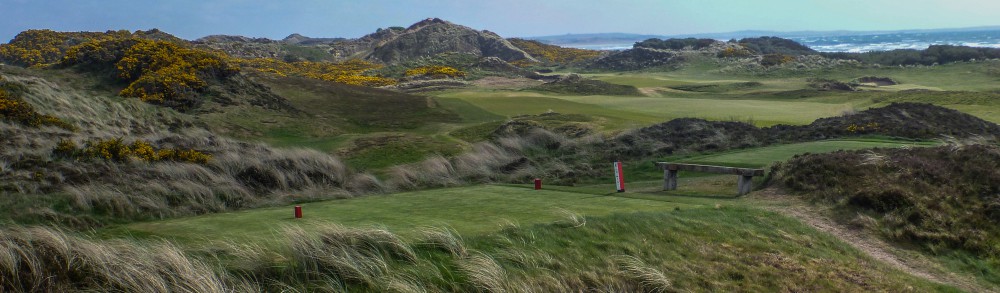
I’ll be in northeastern Scotland next month. My itinerary won’t take me to Lossiemouth, I’m sorry to say, although it will take me to Fraserburgh. I’ll report, eventually. In the meantime, here are a few photos of Hopeman, about four miles west of Moray. I took them in 2007. As you can see from the first, a breeze was blowing the day I played.


Masters Countdown: Eighth Hole

Augusta National's eighth green, 1935.

When the eighth green was built, it looked very much the way it does today, with tall, steeply contoured mounds on either side. In 1956, though, Clifford Roberts, the club’s co-founder and chairman, had the mounds removed. “That’s the only time I can really remember Mr. Jones getting mad at Cliff,” Phil Harison, a longtime member, told me in the late 1990s. “But he removed the mounds for a reason. They blocked the view of the spectators at the tournament, and once they were gone the spectators could see a lot better. But Mr. Jones got awfully upset about that. He really did, because without the mounds the hole was much less interesting, and the green didn’t look like any other green on the golf course.”

Augusta National's eighth green in 1956, after the mounds had been removed to improve sight lines for spectators.

Roberts never thought that removing the mounds improved the hole—and, indeed, the new green was dreadful. It was featureless and vaguely hourglass-shaped, and it could be approached without trepidation from almost any angle. But Roberts felt strongly that spectators ought to be able to see. Not long before he died, though, he decided that the sacrifice had been too great and that the mounds should be restored. The change was finally made in 1979, not quite two years after his death. Byron Nelson led the project, along with Joseph S. Finger, an architect who, among other accomplishments, had played golf at Rice University in the thirties on a team that was coached by Jimmy Demaret. In restoring the mounds, Nelson and Finger relied heavily on photographs taken during the thirties and forties. Harison—who had grown up in a house that used to stand just beyond the first green—consulted on the project as well. During the Second World War, when the course was closed, he had often ridden a motor bike over the mounds, and he told me that he retained a sort of physical memory of their shape.

Jones and Roberts used to ask Harison to fill out groups in Augusta National’s main member-member event, the Jamboree, beginning when he was thirteen; he and a partner won the event in 1941, when he was sixteen. He didn’t officially become a member until 1946, when he turned twenty-one, but at that time, he told me, Jones and Roberts kidded him by saying, “Oh, you’ve been a member for years.” Harison attended every Masters, beginning with the first, and was the tournament’s official starter for more than sixty years: it was he who introduced each player on the first tee—everyone from Bobby Jones to Tiger Woods. He died 2008, at the age of 82.

During 2001, the tournament tee on the eighth hole was moved back and to the players’ right—part of a course-wide effort, supervised primarily by Tom Fazio, to lengthen the course and increase the premium on accuracy and controlled shot shape off the tee. The fairway bunker was doubled in size and stretched toward the green. (The old bunker ended roughly at the peninsula of turf near the left center of the new bunker. See the photo below.)

The eighth hole has had a fairway bunker in approximately the same position since the course opened. Changes in its size and in the location of the tournament tee—all of which were made, in part, to keep the bunker in play—provide a good indication of how much tournament players’ driving distance has increased since the early 1930s: the far edge of the bunker today is roughly a hundred yards farther from the tee than it was during the first Masters.

Looking back toward the tee from the eighth green. The hole's single bunker is on the left.

Masters Countdown: Seventh Hole


A not especially intelligible drawing of Augusta National's seventh green, from the program for the first Masters, in 1934, when the seventh had no bunkers.

The seventh wasn’t much of a hole in the early days. (The consensus, as described by Clifford Roberts, the club’s co-founder and chairman, was that it was “the only weak hole out of the eighteen.”) Alister MacKenzie, who designed the course, likened it to the eighteenth at St. Andrews, but the resemblance was superficial. Both holes were short, and both had large greens and no bunkers, but in comparison with the venerable and surprisingly difficult closing hole of the Old Course, the seventh at Augusta was a pushover. Many players today would have been able to drive it.

In a letter to MacKenzie in 1933, Roberts wrote, “I think the real criticism . . . is that it lacks character. Ed Dudley [the club’s first professional] made a suggestion which appealed very much to me. He proposed putting a bunker in the middle of the face of the green and letting it wedge into the green. In other words, his thought is to partly develop this green into two sections, the same as is true of one of the greens at Lakeside, California. Bob [Bobby Jones] did not have very much to say about this proposal, but I do not think he was much impressed by it. I think, in truth, that Bob is really hesitant about making any alterations or incidental refinements till you can come here and see the layout.”

Perry Maxwell

Nothing significant happened until 1938, when Horton Smith—who had won the first and third tournaments—suggested elevating the green and fronting it with several deep bunkers. He also suggested moving the green twenty yards back and to the right. Jones and Roberts both approved. The design work was done by Perry
Maxwell, an Oklahoma banker-turned-architect, whose best-known course is probably Tulsa’s Southern Hills. Maxwell had been a partner of MacKenzie’s during the final years of MacKenzie’s life. (Their last joint project, completed in 1933, was Crystal Downs, in Frankfort, Michigan.) The transformation of the seventh green, which cost $2,500, was paid for by Lewis B. Maytag, who was one of the club’s earliest members and was the head of the Maytag Company. In addition, the driving area was tightened through the addition of a grove of pine trees on the left side of the fairway. (There were already trees on the right.)

Maxwell made several less dramatic changes in other greens—among them the first and the fourteenth, to which he added pronounced undulations. Such undulations were his trademark and were known as “Maxwell rolls.” MacKenzie was no longer alive at that time, but he undoubtedly would have approved: he loved dramatic contours. In The Spirit of St. Andrews, he wrote wistfully about the early greens at Machrihanish, a legendary links course, designed by Old Tom Morris, on the Kintyre peninsula in western Scotland: “Some of the natural greens were so undulating that at times one had to putt twenty or thirty yards round to lay dead at a hole only five yards away. These greens have all gone and today one loses all the joy of outwitting an opponent by making spectacular putts of this description.” For the disappearance of such features, MacKenzie blamed a preoccupation with the elimination of “unfairness”—a word that he scornfully placed in quotation marks.

Today, the seventh is 450 yards long—110 yards longer than it was for the first Masters—and the landing area is narrow. Just fifteen years ago, the seventh was considered a birdie hole, even by members. Now it’s a tough par for any player whose tee shot ends up in the pine straw.

How to Take a Golf Trip With Friends


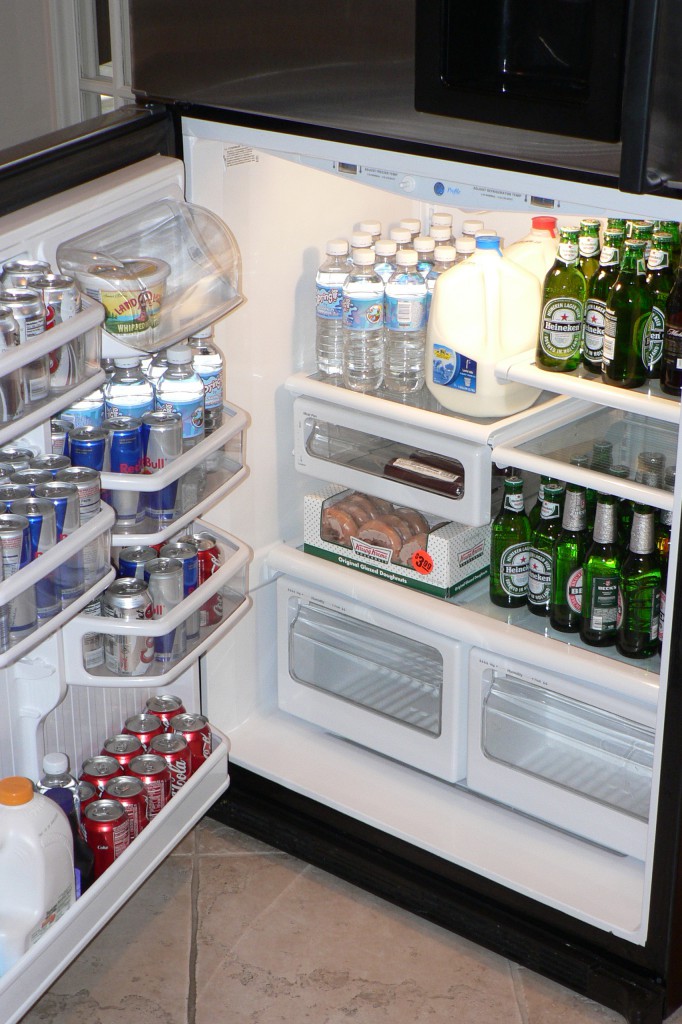
How to stock a golf-trip refrigerator. (Ferris's house, Pinehurst, 2006)

My regular golf buddies and I have taken many trips together, and, by trial and error, we’ve learned a lot about what works and what doesn’t. Here are some tips:

Do give one person the overall responsibility for managing the itinerary, keeping track of reservation deadlines, reminding laggards to make their deposits, and deciding which minor tasks can safely be delegated. Having a single, reliable leader makes it less likely that critical details (such as tee times) will be forgotten, and creates a clear blame path if things go wrong.

Don’t automatically assume that nobody will be up for more than eighteen holes a day or (equally important) that everybody will. During a buddies trip that eight friends and I took to Scotland in 2008, we designated one round as the official eighteen for each day, so that oldsters could flake out in the afternoon without losing their place in the standings. On the final day of an earlier, ten-day trip to Ireland, when even the golf obsessives had begun to fade, we revived everyone’s spirits by playing a scramble in the afternoon.

Do establish a centralized rule-making authority with the power to silence whiners, naysayers, and independent thinkers. Among my friends, this authority is called the Committee, and it typically consists of Hacker (real name) plus one or two people who, over the years, have satisfied Hacker that they are likely to agree with him. The Committee has many responsibilities, including picking the games, choosing the stakes, deciding whether or not Gene will be allowed to play from the senior tees, and settling minor but potentially divisive issues as they arise, such as do we get a first-tee do-over or not, and what about handicap strokes on par-threes? The Committee’s decision is always final—a relief to most people, who go on golf trips to escape their current responsibilities, not to acquire new ones.

The Committee.

Don’t allow trip-threatening behavior to go unpunished. On the second morning of our annual Atlantic City trip a few years ago, one foursome drove to the wrong golf course (with Hacker, of all people, at the wheel), even though all five cars had left our hotel at the same time and everybody had been given printed driving directions. The resulting confusion came close to ruining the whole trip, or so we said. When the round was over, we restored order by conducting a trial in the clubhouse—taking advantage of the fact that two of the participants that year were lawyers—and sentenced the offenders to pay for everybody’s lunch.

Do collect all wagers before anyone tees off. Losers always outnumber winners, and on a large golf trip that means that if the prize money isn’t in hand when the scores are tabulated the victors will have to collect from a sullen mob. We handle this on our golf trips by collecting a single buy-in on the first morning of the whole trip—currently, a hundred bucks a man—and paying all prizes for the trip out of that fund.

Don’t let the stakes get out of hand. The purpose of playing for money is to make three-foot putts seem important, not to let anyone get rich. We try to spread the prize money around by having lots of complicated side bets, all paid off from the same hundred bucks. The big winner, furthermore, is expected to buy lunch on the last day.

Do establish community-building trip traditions, such as our rule that recovering alcoholics drink free.

Don’t feel you have to do everything as a group. We often split up for dinner, primarily to eliminate tedious late-afternoon arguments about who is willing to pay how much to eat what. Doing this also occasionally generates interesting demographic data, as it did on the night when (as someone realized later) all the Democrats went to a sushi bar while all the Republicans went to Outback. (Figuring out that this had happened took some deductive work, because in our group, as in all successful golf groups, we almost never mention politics, even with people we agree with.)

Do be careful about the guest list. We usually open up our trips to friends from outside our club, and even to friends of friends. This has beneficially expanded our acquaintance with overweight middle-aged men from outside our immediate geographical area, but it has occasionally led to problems. One year, one guy invited an old high-school friend of his, whom he hadn’t seen in years. The old friend, who began drinking as soon as he got into Hacker’s car, bought a dozen condoms at a convenience store during the first refueling stop, then stashed the box under his seat and forgot all about it. A week after we got back, Hacker’s wife discovered the condoms and—here’s the problem—didn’t believe, even for a minute, that they belonged to any of us.

Don’t let a buddies trip end without establishing a Committee to pick the next destination.

How to load a rental car. (Cruden Bay, Scotland, 2008)
Masters Countdown: Sixth Hole

Sixth hole, Augusta National, 1935.

Augusta National is viewed as sacred ground by many golfers, who sometimes assume that the holes have remained inviolate for decades, if not since the beginning of time. But the course has never been a museum. In fact, it has almost certainly undergone more significant changes, beginning in the 1930s, than any other important golf course in the world. Revenues from the Masters, along with substantial contributions from members, have financed numerous alterations, some of them monumental. Almost every summer, greens are regraded or rebuilt, tees are moved, hazards are added or eliminated, new trees are planted in strategic positions, and mounds are reshaped, raised, flattened, moved, created, or carted away. Since the very earliest years of the club, the only thing sacred about the course has been a belief that it must continually be modified and improved.

Changes to the course have had numerous designers. The club has been receptive to—and has steadily solicited—suggestions from players, members, guests, spectators, sportswriters, television viewers, television commentators, distinguished architects, and others. Even as early as the early fifties, Bobby Jones could say with accuracy that the course was “truly of national design.” He viewed that miscellaneous heritage as one of the course’s greatest strengths, and his assessment became still more apt in subsequent years, as increases in tournament revenues expanded the scope of what the club could afford to try.

The same tributary of Rae’s Creek that runs in front of the thirteenth green and along the left side of the thirteenth fairway used to run also between the sixth tee and sixth green. The stream ran so far short of the green, though, that it virtually never came into play. The club dammed the stream to create a more formidable hazard. But the new pond was still thirty yards from the front of the putting surface, making the water a nearly irrelevant hazard even for high-handicap players. (It couldn’t even be seen from the tournament tees.) In 1959, the pond was removed and the stream was buried. You can see part of the old pond in the photo below.

Important Rule Change Regarding Legs

Hacker (real name) and Tony: what's the rule?

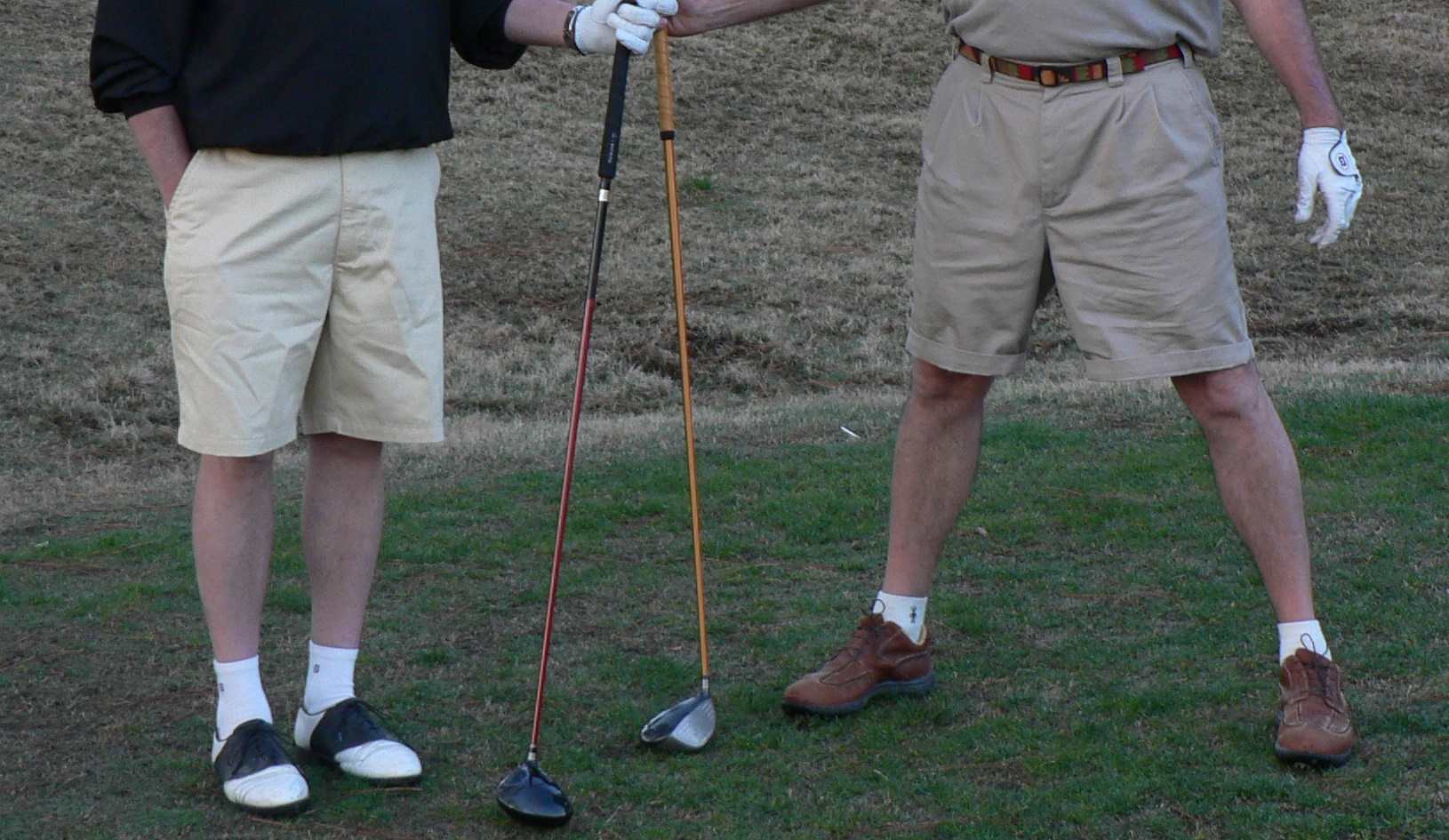
My regular Sunday Morning Group has its own rules, which are printed on the back of our scorecard. The most important ones: nobody gets a stroke on a par-3; nobody gets more than one stroke on any hole; you can’t win a skin if you aren’t present when we go over the scorecards; and “money doesn’t flow backward” (i.e., no refunds on wagers or anything else, even if somebody screwed up). We also give an extra stroke to anyone who wears shorts after November 1.

Our course stayed open so long last year—until New Year’s Day—that we added a new rule: anyone who wears shorts after December 1 gets two extra strokes. I was a beneficiary on our home course in December and on courses we visited in January, February, and early March, after our home course had closed. On one of those days, in the Bronx, I just about froze. But having two extra chances at skins is a powerful inducement—even though, when we’re on the road, we usually just throw the whole pot toward lunch.

Now that our home course is open again—six weeks earlier than normal—we face a dilemma. It’s still technically winter (since at this time last year most of the course was covered with snow), but yesterday the temperature was in the eighties. So do we give strokes for shorts, or not?

Luckily, Hacker (real name) thought of a solution: tomorrow, when our Sunday Morning Group plays its first official round at home since January 1, anyone who doesn’t wear shorts will lose a stroke. Deservedly.

Masters Countdown: Fifth Hole

Augusta National's fifth green in 1935.

The fifth hole is the centerpiece of what has sometimes been called Augusta National’s other Amen Corner. It’s ranked by more than a few players as the second best par-four on the course (after the tenth), and television cameras don’t do justice to its dramatic topography. Alister MacKenzie, who designed the course, felt that the fifth was descended in spirit from the Road Hole—the much feared seventeenth hole on the Old Course at St. Andrews. The main similarity may be in the difficulty of the approach shot, since balls that land short invariably stay short, while balls that are hit long occasionally disappear for good in the trees and shrubbery beyond the green. The perils of the green make Jack Nicklaus’s achievement during the 1996 Masters seem all the more astonishing: he eagled the fifth twice, in consecutive rounds.

The pair of large, steep bunkers on the left side of the fairway are a characteristic MacKenzie hazard. (Equally characteristically, Bobby Jones initially felt that the bunkers were superfluous, and they were not added until after the course had opened.) As originally positioned, they were more of a visual hazard than an actual one, since even in the early years players didn’t have much trouble driving over them or playing safely to the right. (The bunkers often aided less skilled players, by stopping pulled or hooked drives that might otherwise have run down the steep hill and out of play—as Wendell Miller, the contractor, predicted they would, in May, 1933, while making an unsuccessful attempt to interest Jones in adding the bunkers then.) MacKenzie, throughout his career as an architect, made frequent use of course features that were essentially optical illusions: seemingly narrow fairways that were ampler than they appeared from the tee; seemingly ample fairways on which the ideal landing areas were narrow and precise; large greens that seemed to provide huge targets but were contoured so that reasonably simple putts could be earned only with brilliant approaches—and bunkers that looked threatening from a distance but were easy to carry. He felt that easily avoided fairway bunkers were good for a player’s self-confidence and sense of achievement.

By 2002, the bunkers had long since ceased to serve even as visual hazards for the vast majority of Masters competitors. Under the direction of Tom Fazio, the tournament tees were moved back, the fairway was reconfigured, and the bunkers were reshaped, deepened, and moved closer to the green. The carry over the farther bunker from the Masters tees is now more than 315 yards, uphill, and both bunkers are so deep that reaching the green from either one is impossible, or nearly so. Each bunker has an almost vertical forward face, on which a thin layer of sand is held in place by a fabric liner, which also prevents balls from becoming embedded.

The fifth fairway caused problems for many years. Buried stones continually worked their way to the surface, where they were a threat to golf swings and mower blades. Finally, in 1962, the club resurfaced the fairway (and also the seventh) with new topsoil. When the job was complete, Clifford Roberts, the club’s co-founder and chairman, devised a characteristically simple method of testing the results: he asked Phil Wahl, the club’s manager, to drive a golf cart up and down the fairway at full speed and report back on the smoothness of the ride.

Cell Phones and Golf Courses

For a long time, I refused to own a cell phone. I hated those guys who tie up golf courses by talking at full volume to their secretary or their stockbroker when it’s their turn to hit, and I hated the thought of losing my ability to tell people, “Sorry, for the next four hours I’m going to be absolutely impossible to reach.” One of the great things about playing golf is that it takes up virtually your entire brain, and prevents you from thinking about the stuff that keeps you awake at night. A ringing cell phone breaks that spell—and not just for the phone’s owner but for everyone within earshot.

Well, I still hate all that, but, like everyone else in the world, I have a cool phone now, and I’ve discovered that it has a golf-related redeeming feature: When you use a cell phone to tell your wife that you may be just a teensy bit late for dinner with her parents, the Caller ID on the kitchen phone displays your cell number, not the name of the golf course you’re calling from. In exchange for surrendering one of the last remaining vestiges of your privacy, you gain the time you need to create and rehearse a more convincing explanation. Isn’t that all we can ask of technology?  To incrementally improve our quality of life?

E-mail and the World Wide Web have made even deeper encroachments into personal privacy, but they, too, offer compensations to golfers. In the old days, arranging a game with friends could involve an hour or more of high-risk telephone use, during which all the participants were nakedly vulnerable to discovery by their wife, kids, or boss. Now, thanks to the Internet, you can handle it all quickly, silently, and privately—and you get in trouble only for the rounds you actually play, not for the rounds you were unsuccessful in setting up. The only guys in my circle who are problematic are Nick, whose wife, Mary Anne, handles the email for both of them, and Gene, who doesn’t have a computer. But, luckily, Mary Anne likes having Nick out of the house, and Gene always gets the word eventually—usually via telephone from Nick.