Horton Smith, Titanic Thompson, Bobby Jones, Alfred Bourne, and Me

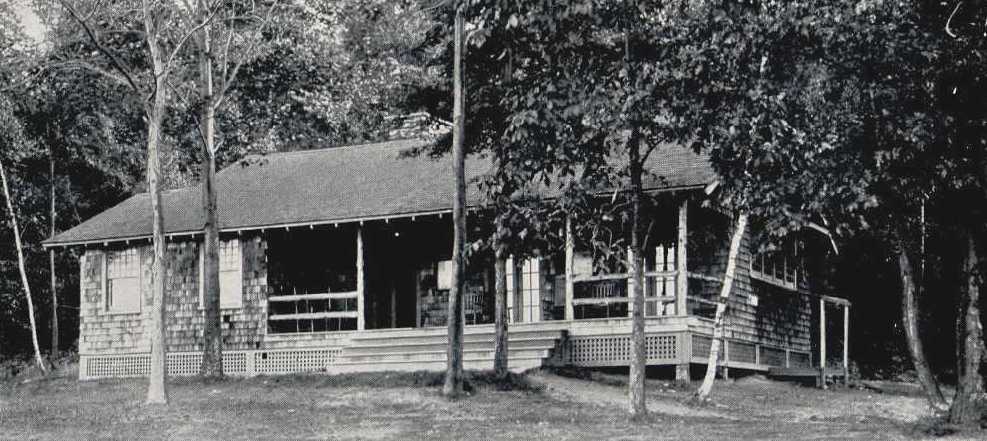
My golf club’s clubhouse as Horton Smith and Titanic Thompson knew it. It looks about the same today, although the trees and the porch have grown.

Horton Smith won the first Masters, in 1934, and he won again in 1936. Two and a half years after that, he got married in the little Connecticut town where I live, ninety miles north of New York City. The bride was Barbara Bourne, whose parents owned a 40-room weekend house here. The legendary golf hustler Titanic Thompson attended the wedding and, during a golf outing at our nine-hole club, gave a ten-dollar tip to his caddie, a local kid who, once he’d become an old man, sometimes played golf with me. (The regular rate in 1938 was 35 cents a loop, 60 cents for two bags.)

Barbara Bourne and Horton Smith (far left), along with lots of Bournes.

Barbara’s late grandfather, Frederick Gilbert Bourne, known as “Commodore,” had been a president of the Singer Sewing Machine Company. He owned a 110-room summer place on Long Island, a 28-room castle on the St. Lawrence Seaway, in the Thousand Islands, and the entire first floor of the Dakota apartment building, in New York.

Horton Smith’s late grandfather-in-law, “Commodore” Frederick Gilbert Bourne, 1851-1919.

Barbara’s father was Alfred Severin Bourne, who, in addition to being the 1934 men’s champion of my club, was a founding member of Augusta National. He served on the five-man Organization Committee, and was a vice-president until his death. Without him, the first Masters might never have been held.

Barbara Bourne and her father, Alfred Severin Bourne, in the late 1920s or early 1930s.

The Bournes spent winters in Augusta, which was popular as a resort destination partly because it was just about as far south as a New Yorker could travel overnight by train and still play golf on arrival. Alfred belonged to Augusta Country Club, and his playing partners there occasionally included Bobby Jones.

Kenneth Bourne (son of Alfred) and Bobby Jones, probably at Augusta Country Club.

In 1931, as Jones and Clifford Roberts were trying to get Augusta National going, next door, Bourne wrote them a check for $25,000—a quarter of the sum that Roberts figured they’d need to build their course. Bourne apologized that he couldn’t be more generous, and told them that if they’d come to him before the Crash he’d have underwritten the entire project. (Bourne missed the first three days of the first Masters because he was competing in—and winning—an amateur event in Aiken, South Carolina, twenty miles from Augusta.)

Alfred Bourne (center) and various playthings, Thousand Islands, 1930s.

Alfred Bourne died in 1956. His weekend house in my town is now the main building of a boarding school; not surprisingly, it’s called Bourne Hall. Each year for the past six or seven, the school and my club have held a tournament, called the Bourne Cup, in which eight or ten of the school’s alumni (some of whom are also members of my club) are almost always soundly defeated by eight or ten members of my club (some of whom are also alumni of the school).

Bourne cap, from Bourne Cup.

This year, the school’s team included a member of the class of 1951, named Dave. He told me that when he was a boy he spent several summers caddying at the club, and often caddied for Alfred Bourne. He said he once asked Bourne if it would be all right for him to use a fielder’s mitt to shag Bourne’s practice balls. (Dave loved baseball but lacked opportunities to hone his technique.) Bourne said that would be fine, and they made a game of it. Bourne was a generous tipper, Dave told me (although he squandered most of his  earnings, a nickel at a time, in the club’s Coke machine).

My club’s caddie corps in 1925, sitting on the front steps of the clubhouse. Note the neckties on the ten year olds. The gloomy-looking (and tie-less) grownup at right is the head pro. The wee lad in knee socks, two seats to his left, is his eventual successor.

A senior member of my club, whose name is Dick, also caddied for Bourne. He told me that he would warm up by hitting exactly thirty practice balls, which Dick would scoop up in a leather bag while keeping an eye out for players teeing off on the sixth hole. (The club’s driving range in those days was just the right side of the sixth fairway.) After counting the thirtieth shot, Dick would run back to Bourne, who would play the first hole, chip to the eight green, play the ninth hole, make the same circuit again, and go home.

Dick, who used to caddie for Alfred Bourne,at our town invitational tournament, October, 2008.

The day before this year’s Bourne Cup, I had the immense good fortune to play a round at Garden City Golf Club, also known as Garden City Men’s, where the U.S. Open was held in 1902. Before we teed off, I wandered around the clubhouse (where jackets are mandatory but shirts are not), and gazed at all the cool stuff. And among many other extremely interesting things I learned that the winner of the Garden City club championship in 1921 was Alfred Severin Bourne. I forgot to take a picture of the plaque with his name on it, but I remembered, later, to take a picture of a similar plaque, back home:

Early champions at my club: two Bournes and several missing years.

18 Good Things About Golf: No. 10

Stanley, with a golf accessory designed to speed up play.

10.  Although golf is expensive in absolute terms, on an hourly basis it isn’t much costlier than bowling. A perfectly serviceable set of used clubs can be had for a couple of hundred dollars—or less, if you know an obsessive with a garage full of equipment he can no longer stand to look at. An hour or two spent poking through the bushes on virtually any course will turn up a month’s supply of balls. Sneakers can usually be worn instead of golf shoes, especially now that golf shoes increasingly look like sneakers. Even relatively fancy courses now offer recession-inspired discounts on greens fees and memberships. I know hunters and fishermen who spend more.

The truly oppressive cost of golf is the cost in time: dawdling choppers make life miserable for everyone stuck behind them. They transform what ought to be a pleasurable diversion into an all-day slog, and they hurt the game itself, by increasing the national supply of player frustration and spousal resentment. The ideal solution would be for everyone to play faster, but since that’s unlikely to happen the best remedy is to bypass the slowpokes, by avoiding, whenever possible, the most popular times, days, weeks, and months. My friends and I often go out late in the afternoon for what we call a Two-Hour Eighteen™: a full round, on foot, faster than most Americans play nine holes in a cart. We pick times when our course is likely to be empty or nearly so, and we don’t take practice swings, agonize about where to aim putts we weren’t going to make anyway, or stand still while other people hit. When you can comfortably play eighteen holes in two hours or two hours and fifteen minutes, you can put in a reasonable day’s work, get in a full round, enjoy a beer with your pals, and still be home in time to ask, “Hey, Honey, what’s for dinner?”

When I took up golf, twenty years ago, I worried that I was too horrible to swing in public. But I soon realized that, bad though I was, I wasn’t much worse than most of the other golfers I saw, and that even the good ones didn’t mind playing with me as long as I kept up. In fact, they scarcely noticed me at all, so absorbed were they in their own struggles. As my friend Jim explained, “Nobody ever gave a shit about how anybody else played golf.

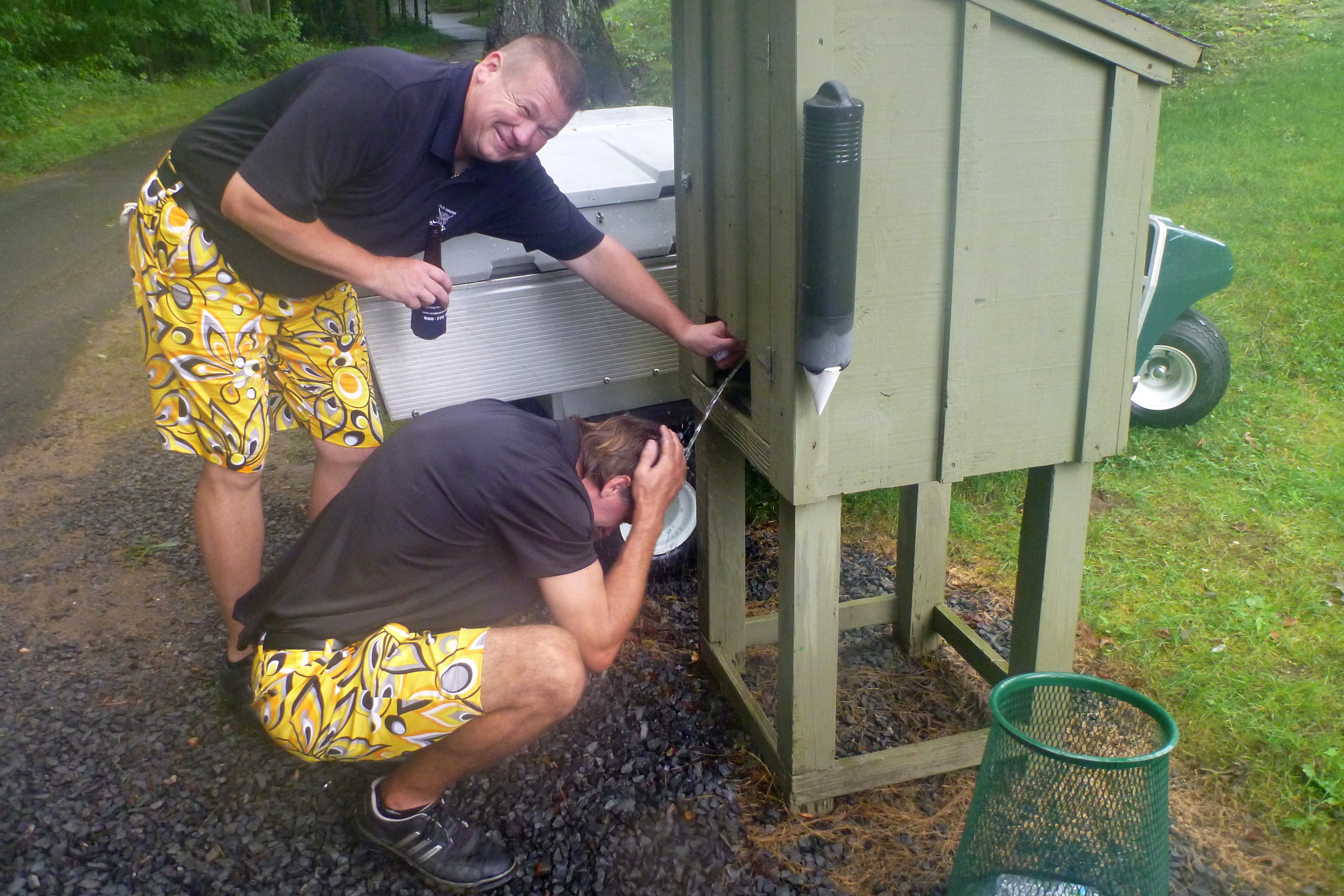
Save time by showering at the course. Member-Guest 2011.

Back-Roads Scotland: Fraserburgh

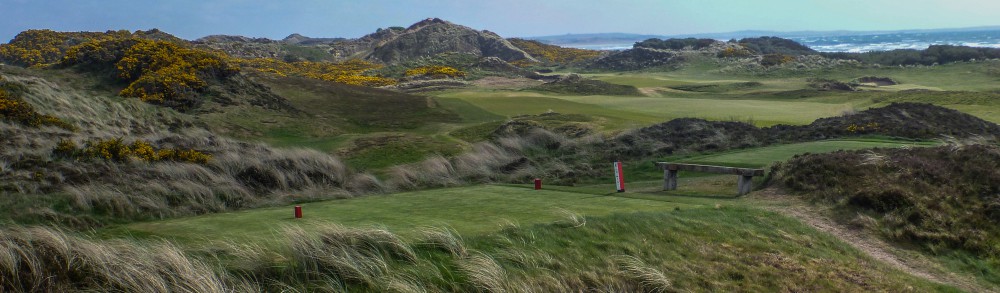
Fifteenth green, Fraserburgh Golf Club, Scotland. Photo by Ian Stephen.

For the July issue of Golf Digest, which is on sale now, I wrote an article about Donald Trump and his newest golf course, Trump International Golf Links, in Scotland. The course is on the North Sea coast, a two-and-a-half-hour drive north from the Old Course at St. Andrews and about ten miles beyond the port city of Aberdeen. You should definitely play it if you have a chance—it will open July 10—and after you’ve done that you should get back on the A90 and drive another hour north, to the town of Fraserburgh, at the easternmost end of the Moray Firth. It’s the home not only of the Kinnaird Head Lighthouse and the Museum of Scottish Lighthouses, but also of Fraserburgh Golf Club, the seventh oldest in the world.

Fraserburgh foghorn, April, 2012. It was built in 1902. It's not still in use, but the museum keeps it painted.

I played Fraserburgh with two older members: Bill Maitland, who owns a furniture store in town, and Andrew Tait, a member of family of extremely successful fishermen. The morning was cold and the wind was blowing hard, and I wore two pairs of rain gloves, one on top of the other, in the hope of maintaining feeling in my fingers. Tait, in contrast, didn’t wear even one glove, and the explanation was what I guessed: after you’ve spent  a few decades fishing in the North Sea, it takes more than wind to make your hands feel cold on land.

Town of Fraserburgh, viewed from the golf course. April, 2012.

Fraserburgh’s first and eighteenth holes are flat and forgettable, but nearly everything in between is brilliant, beginning with the second, a par 4 that plays up what looks like the surface of the moon, on the flank of a mountainous dune called Corbie Hill:

Second Hole, Fraserburgh Golf Club. Photo by Ian Stephen.

Golf in the region goes back a long way. Local church records show that a parishioner named John Burnett was sent to the “maisters stool” for “playing gouff” on the links of Fraserburgh in 1613. The club was founded a century and a half later, in 1777, and it has the documents to prove it. At lunch after our round, Maitland showed me a copy of the original membership register. “These names are still well known to us,” he said—and by that point they were well known to me, too, because I had seen them on plaques and trophies in clubhouses along the coast:

"These names are still well known to us," Bill Maitland told me.

Fraserburgh’s original members got together for lunch after they played, just as they do nowadays, and they were required to pay their share of the bill whether they showed up or not—an excellent rule that my own gang ought to adopt. After we’d eaten, Tait took me to the wharf to see his family’s three fishing boats. He lives on a farm a few miles down the road and has his own five-hole golf course, which he plays when he’s too busy to get to the club.

Andrew Tait, Fraserburgh wharf, April, 2012. The boat is named for his parents.

Fraserburgh’s eighteenth hole is called Bridge, after a footbridge over some railroad tracks along the western edge of the course. The rail line connected Fraserburgh with Aberdeen and the villages and golf courses in between—a sort of Linksland Express. It closed in 1965, though, and the footbridge was demolished, so Fraserburgh’s eighteenth is now a golf hole with a ghost name. The course is still there, though, and it’s one of many worthy destinations along the coast for links-golf pilgrims who can be persuaded not to turn around after playing Carnoustie.


Why Fathers Should Boycott Father’s Day

Father and daughter, New York Hospital, June 29, 1984.

We were standing around drinking beer on Friday evening at my brother’s member-guest fifteen years ago when one of the participants suddenly moaned, “Oh, [very bad word], I’ve got to go to my wife’s [extremely bad word] birthday party.” Nasty rub of the green, there. What are the odds of marrying someone who was born on the exact date of the steak-and-calcutta stag dinner? (My own wife’s birthday occurs in the fall somewhere. No problem!)

At my brother’s member-guest a couple of years later, I noticed that one of the regulars was missing. “His wife wouldn’t let him play,” someone explained, “because it’s Father’s Day.”

Let that one sink in for a moment.

I’d always hated Father’s Day without knowing why; suddenly, I knew why: Father’s Day has nothing to do with fathers. It’s just a passive-aggressive reprise of the day that inspired it; it’s Mother’s Day, Part Two. You would think, in theory, that Father’s Day would be the one Sunday of the year when a married man could get away with playing just as much golf and drinking just as much beer and smoking just as many cigars as he wanted to. But it doesn’t work that way.

“Oh, you can’t play golf in the morning,” your wife says, smiling cruelly, “because the children are going to make you a nice Father’s Day breakfast. And you can’t play at lunchtime, because the children want to give you the presents they made for you at school. And you can’t play in the afternoon, because your mother and I have planned a lovely Father’s Day dinner for you and your dad.” Which means, of course, that your father can’t play, either.

Appropriate Father’s Day activity, three sons and their father, 2011 Member-Guest.

Mother’s Day, paradoxically, has a higher Golfability Index than Father’s Day does, because your wife isn’t in charge of making the plans. You can buy her some jewelry, or you can make a dinner reservation for the two of you—say, at ten p.m., after the course has safely closed—or you can blow the whole thing off (she isn’t your mother, after all) and endure her scorn for a week or two. If your kids are determined to serve her breakfast in bed, you can put a box of cereal on the kitchen counter before you leave for the club.

The only solution to the problem of Father’s Day is to move it out of prime golf season. Will that require an act of Congress? I don’t know, but here’s what I propose: henceforth, Father’s Day shall fall on the first rainy or snowy Monday in November. Like Passover, it shall begin at sundown. And it shall be ignored, or celebrated over the telephone, if you happen to be in Myrtle Beach with your pals.

Father and daughter, St. John’s Episcopal Church, September 17, 2011.

More About Coping With Rain

Tony, Dave, Ray, Bandon Dunes, February, 2007

Everyone agrees that you can’t change the weather by worrying about it. Shouldn’t it follow, then, that you can change the weather by not worrying about it? I tested this concept on a Saturday six years ago. The sky was growing dark, so, in the hope of diverting the approaching thunderstorm, I purposely didn’t check the Weather Channel or become agitated before heading to the golf course.

Well, it didn’t work. As Hacker (real name), Ray, Tony, and I were getting ready to tee off, Fran, our pro, came out of the golf shop and said, “When I blow the horn, come straight in. There’s a huge cell heading for us.”

The thunder began as we were putting out on five, and moderately heavy rain was falling by the time we got back to the clubhouse. Ray went inside to estimate how quickly the angry green-and-orange amoeba was moving across the radar screen.

“About an hour,” he said when he came back. Hacker and I keep decks of cards in our glove compartments. The four of us sat at a table on the clubhouse porch and played setback, while water overflowed the gutters. I used to belong to a golf club where the old guys played setback all winter. The pro would knock on the card-room door in early April, to let them know it was spring.

We could still hear thunder after an hour, so we all went home. I stomped around the house for a while—“Hey, look! I’m not playing golf!”—then took a nap, which I had been planning to do anyway. When I woke up, I checked my computer: the last of the angry amoeba was almost east of us. I started e-mailing people.

E-mail is the most important golf-related discovery since the sand wedge, because, unlike the telephone, it lets you set up a golf game without anybody’s wife catching on until it’s too late. Tony and I met on the first tee at 4:00, and we had the place to ourselves for five or six holes. The sun came out. We watched swallows skimming the fairways, gorging on mosquitoes. We listened to the trees shaking themselves dry in the breeze: rain’s echo.

And then it was just like the hour after a rainstorm when you were a kid: in ones and twos and threes, our friends came back out to play. As Tony and I walked to the eighth tee, we passed Gillen and Tim, on the second green. Tim was saying, “We putted pretty well, but we didn’t sink anything over ten or twelve feet, and to do well in a scramble you have to sink long ones”—today’s version of the permanent conversation, resuming after a lightning delay. Gene and Nick and Frank were a hole behind them. Mike joined Tony and me on fourteen, by way of the range.

I ended up playing twenty-seven holes—nine more than I would have played if it hadn’t rained. Maybe not worrying works, after all.


Why Rain is a Golfer’s Best Friend

Golf weather. Second fairway and third green, September, 2011. The pond in the foreground is a stream you can usually step across.

There have been showers in the forecast every day this week, and as a consequence my home course has been empty. Hardly any rain has actually fallen, except at night, but an image of raindrops in an icon on a weather website is apparently all it takes to keep most members cowering at home. On a cloudless 100-degree day in August, my friends and I often have to wait on every shot, but if the evening news mentions even a ten percent chance of occasional sprinkles we’ll usually have the place to ourselves. Earlier this week, Tony, Addison, and I played 27 holes in three and a half hours, on foot, and during that whole time we encountered just one other group: a dad and his ten-year-old son, who waved us through. The temperature was perfect—it hovered near the point where you sort of begin to think about maybe putting on a sweater—but we never got truly wet, and although I wore my rain hat for a little while I never had to wipe off my glasses. And no need for sunscreen.

Tony, light rain, empty course, eighteenth fairway, June, 2012.

Later this summer, my wife and I will spend some time on Martha’s Vineyard. There’s a golf course there that I like a lot, called Farm Neck, but it’s so popular that tee times can be hard to come by, especially on short notice. What I usually do is wait for the sky to cloud over and then show up unannounced, confident that the forecast will have created openings in the tee sheet. And if it actually rains, who cares? If you have the right equipment, there are only two kinds of weather you can’t play golf in: lightning and dark. And dark isn’t necessarily an insurmountable problem, as you can tell from the photo below:

Closing hole, Sunday Morning Group, annual end-of-season golf trip to Atlantic City, October, 2007.

Sports Psychologists Are Wrong About This


Member-Guest 2010: “Smooth stroke. Back of the cup.”

I had a side-hill three-footer in a team match, in which a partner and I were playing two guys from our enemy club. I studied my little slider while one of the other guys failed to chip in. My putt was slick, but I felt confident. I could see the line as clearly as if it were painted on the grass.

When it was my turn, my partner—who had been in his pocket since hitting both his drive and his provisional drive out of bounds—suddenly spoke. “Take your time,” he said.

Now, there’s a golf injunction I hate. I had been doing little for the past fifteen minutes except waiting for other people to play themselves out of the hole. How much more time was I supposed to take? I ignored my partner and got comfortable over my ball. One long, last look at my target, and—he spoke again.

“Back of the cup,” he said. “Smooth stroke.”

He had me now. Was I missing something? I backed away and reexamined my line. Maybe the putt did break less than I’d been thinking. I picked a different blade of grass to aim for, and stroked the ball a little harder.

It dipped below the rim but didn’t fall.

The conventional wisdom among sports psychologists is that chat between partners should always be positive. The human brain can’t process negative instructions, they say. Tell a golfer to avoid that bunker over there and he’ll think of nothing but sand. Therefore, you say “Back of the cup,” not “Don’t jab it, you loser.”

I disagree. When a partner turns gravely supportive, I can’t help wondering what he’s worried about. Invariably, I come up with a list.

A better strategy, I think, is to confront golf anxieties squarely. Recently, some buddies and I tested this hypothesis. Our foursome was playing three other foursomes, and our pro, Fran, had a crucial putt.

“Hey, Fran,” I said. “Don’t screw up.”

He laughed. Then he drained it.

On the next hole, as I was teeing up my ball, Tony said, “Keep it out of the woods, for a change, O. K.?” Boom—straight up the middle. And long.

When your partner tells you to make a good swing, he is indirectly expressing his uneasiness about your ability to play golf; when your partner tells you not to screw up, he is using a joke to acknowledge the pressure you’re feeling and, in effect, forgiving you in advance for letting down the side, if that’s how things turn out.

On the final green, I was able to return the favor to Tony. “We need this one,” I said, “How about not blowing it?”

He took his time, made a smooth stroke, and nailed the back of the cup.

Some Surprising Truths About Lightning Safety

My column in the July 2012 Golf Digest, which is on sale now, is about lightning detection. Thinking about lightning made me think about an all-day woodworking class that two friends and I took several years before I discovered golf. The instructor devoted the first half-hour to an emotional lecture on safety. We must never even think about using our power tools, he told us, without first putting on eye and ear protection, which we had been required to bring to class. He showed us a type of earplug that he said we ought to buy, and he said that woodworkers are as prone to hearing problems as rock stars. He told us stories about people who had been blinded by flying wood chips, or who had fed their fingers into spinning blades. He said that whenever he entered his shop he kept safety foremost in his mind.

Then he turned on his router—essentially, a hand-held lawnmower engine with a drill bit attached to—and the whole class crowded around to watch him work. Despite the lecture we had just listened to, we left our safety goggles and ear plugs lying on our desks. And so did the instructor. To get a better view of what he was doing, he put his face a few inches from the whirring bit, which was spewing out a blizzard of tiny chip. To keep the chips from streaming into his eyes, he sort of squinted, turning his eyelashes into a protective screen.

Most of the golfers I know, including me, have a similar attitude toward lightning. We respect it in theory, but we do little to actually protect ourselves. Lightning safety is an idea to which we pay homage rather than a series of procedures that we actually carry out. When my friends and I hear the pro’s warning horn, we dutifully head back to the clubhouse. But then, as often as not, we hang around chatting in front of the golf shop—on the highest point of the property, directly beneath the two tallest trees. We’ve sacrificed golf, so we feel virtuous and responsible, but we’re almost certainly in greater peril than we were on the course.

One of lightning’s most frightening characteristics is its failure to consistently follow the safety rules that we have established for it. Several trees on my course have been hit, yet none of them are ones you would have picked in the lightning pool at work. The most recent was the shortest tree in a row of white pines at the bottom of a valley—exactly the sort of tree that, in an emergency, you might decide you’d be safe to hide under.

The only one member of my club who invariably does the right thing in a thunderstorm is Nancy, a past club champion. (Nancy owns a restaurant, called The Upper Crust, and she caters many events at my club, including the men’s member-guest. She will become the club’s president in the fall.) When Nancy hears thunder, that’s it, she’s done: she heads for her car and drives home, and she doesn’t come back until long after the storm has passed. The reason for her caution is first-hand experience. When she was a little girl, two children she knew were killed by lightning. One was sharing a sleeping bag with her in a cabin at summer camp. (A ground current from a lightning strike apparently traveled through the cabin’s plumbing, up a metal leg of the cot in which the girls were lying, and through their sleeping bag’s metal zipper, against which the other little girl, who was wearing a wet bathing suit, was pressed.) The other dead child was playing in Nancy’s front yard while Nancy watched from the window—in bright sunshine, thirty minutes after the rain had stopped.

Nancy and her head chef, Bill, grilling steaks at the 2011 men's member-guest.

More About Foursomes: Muirfield, Troon, Prestwick, and Kümmel

The golfer's liqueur.

In 2009, I played a round at Muirfield, in eastern Scotland, where the Open Championship will be held in 2013. Alastair Brown, the secretary, described it to me (over lunch) as “a lunching club with a golf course attached to it.” A member, he said, once described an ideal day at Muirfield as “two-and-a-half, two-and-a-half, two-and-a-half”: a two-and-a-half-hour 18-hole foursomes match in the morning, followed by a two-and-a-half-hour lunch, followed by a two-and-a-half-hour 18-hole foursomes match in the afternoon.

In the United States, foursomes is usually known as Scotch foursomes or alternate shot, and it’s often a prelude to divorce; at Muirfield, it’s the signature game. Hitting just half the shots gets the non-lunch portions of the day over faster, and ensures that someone always has a hand free to hold the kümmel, a clear, anise-and-fennel-flavored beverage, which is sometimes called the golfer’s liqueur. “The way the club’s members play golf is the antithesis of championship golf,” Brown told me—and he meant that as praise. Muirfield has its own foursomes handicapping system, named after C. J. Y. Dallmeyer, a club captain in the 1950s, who invented it: if you go three-up in a match, you give strokes to your opponents until you’re back to one-up. Dallmeyer also initiated a heavily lunch-oriented New Year’s Day tournament, called the Captain’s Frolic.

Foursomes is also a historically significant game at Royal Troon and Prestwick, two other courses on the Open Rota, on Scotland’s west coast. Every year, members of the two clubs play a cross-country foursomes match over both courses, which abut each other. Half the field starts on the first tee at Prestwick, and half starts on the first tee at Troon. Everyone plays to the eighteenth green on the other course, breaks for lunch, and then plays all the way back. The two members I played with at Troon told me that, usually, a team scores better if it starts at Prestwick, because a typical Prestwick lunch includes so much alcohol that golfers who make the turn there sometimes have trouble finding their way home.

Before lunch, Royal Troon, May, 2009. I'm standing on the tee of the famous Postage Stamp. That's the green by my right arm.

Muirfield has an undeserved reputation for hostility to outsiders. It’s true that visitors are limited to specific tee times on Tuesdays and Thursdays, but the club actually welcomes thousands of unaccompanied non-members every year, and you can make reservations online. You have to wear a jacket and tie in the dining room, but the atmosphere is seductively informal, and even visitors are encouraged to linger. No table has fewer than six chairs, an arrangement that forces groups of golfers to mix, and the food is served cafeteria-style. Diners who don’t live in fear of their cardiologists sometimes bypass lunch itself and move straight from the bar to the dessert table, where the specialties include rhubarb crumble, sticky toffee pudding, and ice cream from S. Luca of Musselburgh, a locally famous dairy.

Muirfield’s locker room has modern, car-wash-caliber showers, like the ones at Merion and Pine Valley, but the other amenities are distinctly old-school, among them a pair of wooden dressing tables, each furnished with a shaving mirror, a nail file on a chain, and a single hairbrush and comb (and no beaker of blue Barbicide). And the members’ locker room at Prestwick is even cooler. Ninety of the lockers there date back to 1877. They look like Queequeg’s coffin.

Foursomes: the Joy of Hitting Half the Shots


Colleen & Joe, mixed foursomes, 2010.

The great British golf correspondent Henry Longhurst once recounted (with disapproval) an old joke about a golfer who was “alternately playing and kicking his ball” because he was “practicing for the mixed foursomes.” Longhurst loved foursomes—in which two golfers take turns playing the same ball, a game that in this country is better known as “Scotch foursomes” or “alternate shot”—and he especially loved mixed foursomes, in which each team consists of a man and a woman. I don’t know many golfers who would agree. But I do understand what he meant.

The first time I played nine holes in 36 strokes, I did it in a Memorial Day mixed-foursome event, as the partner of the wife of a friend of mine. We didn’t look like a promising team. Her handicap was 45 or 50, and we had never played together before, and my swing hadn’t fully thawed from a long, snowy winter. We teed off with no expectation of doing well. After three or four holes, though, I realized that we had made only pars. When my partner hit a bad shot, I somehow followed it with a great one, and when I left a 20-foot putt five feet short, she somehow stuffed it in the hole. We double-bogeyed the sixth, a par-four, despite having been 12 feet from the cup in two, but we closed with a chip-in birdie on the ninth. We won both gross and net by a shocking number of shots.

How had we managed to play so much better as a team than either of us was then capable of playing alone? The answer, I think, is that foursomes can fool you into playing golf the way great competitors do instinctively. When you stand over a bunker shot in a foursomes match, your arms don’t tense up with embarrassment and regret, because it wasn’t your slice that put you in the sand. And when you line up a six-foot putt, you don’t panic, because you know the come-backer, if there is one, won’t be your responsibility. In foursomes, you can only be a hero. The problems you are asked to solve are not problems that you yourself created, and if you make a mess someone else has to clean it up. You focus only on the task at hand—just as Bob Rotella says you should.

(None of this applies to married couples, who bicker like tennis players. Best advice: play with a stranger.)