News Bulletin: Will Miles Pars No. 6

Tim Miles is a follower of this blog. He is also a marketing consultant and the creator of a website called The Daily Blur. “In 2005,” he writes, “my worldview shifted when our son was diagnosed with autism. Since then, our family has learned to separate the truly important from the merely urgent.”

Tim’s son, whose name is Will, is now seven, and he’s a golfer. On Tuesday evening, Tim told me in an email, Will made his first par, on a 100-yard par 3. Fortunately, Tim was present with a video camera:

“He didn’t speak until he was almost four,” Tim writes, “but he hasn’t stopped since. On the way home, we talked about golf, lightning bugs, forms of government and Richard Nixon.” (Incidentally, Will insists on playing the ball down: “real golf.”)

Sharpiegate: An Update

A couple of weeks ago, I wrote about two beefs I have with my golf bag, here and here. Yesterday, I received a response from Steve Snyders, who handles public relations for Sun Mountain. (I’m delighted to learn that the Sharpie problem I complained about was solved not just quickly but, apparently, retroactively.) Here’s what Snyders wrote:

With regards to your concern about the depth of the pen holder pocket on Sun Mountain golf bags, I think you will be pleased to learn that as of 2012 all pen holder pockets on all of our bags are at a standard depth that will allow a full size Sharpie marker to be inserted and for the clip on the lid to be clipped to the bag. For bags older than 2012, depending upon the exact model of the bag, some of the pockets may be deep enough for the clip to reach and some may not. In all instances, the pocket is deep enough that the majority of the pen fits within the pocket while allowing enough of the pen to stick out so can be easily grabbed for removal. If owners of a bag that is older than 2012 are having issues with their pens falling out of the pockets when their bag is inverted, some of the comments on your post offer good suggestions to include: using a mini-Sharpie or inserting the pen upside down so the fit is tighter and the pen will not slide out.

Sun Mountain does not make public, information about other brands for whom it manufacturers products, but as of 2012, any bag designed and manufactured by Sun Mountain that incorporates a pen holder pocket has this standardized depth pocket.

Also, as some of your astute readers pointed out, the 2012 Three 5 stand bag has two pockets, one for a scorecard pencil and one for permanent marker. And, Sun Mountain carts bags have two pen holder pockets, one of each side of the bag, so easily accessible regardless of which side of the cart your bag is placed.

Regarding the legs on Sun Mountain stand bags, all decisions with regards to materials used on Sun Mountain products are strongly scrutinized within the company. All parts used are judged first for function and durability and then for weight with a goal of finding the perfect balance. A number of years ago the decision was made to switch from a harder, more brittle, heavier plastic on the stand bag leg joints, to a softer, more flexible, lighter material.

The older, harder plastic kept its shape forever but it was prone to breakage due to its rigidity. And, it was heavier. The newer plastic parts are more flexible so less prone to breaking and are significantly lighter. The company made the determination that the benefits of the lighter more flexible leg joints outweighed the benefits of the harder, more rigid, heavier joints.

If you were to call Sun Mountain customer service with the issue you describe in your blog, the representative would suggest a replacement leg set and talk you through the simple process of replacement. If within the one year warranty, the leg set would be no charge. Outside of the warranty period, a replacement leg set is $9 plus shipping.

For any issues with Sun Mountain products – legs, zippers, etc —  please call Sun Mountain customer service at 800-227-9224.

Thanks again for using Sun Mountain products and for caring enough to try to help us continually improve to meet your needs.


New Golf Game: Shoot Your Pants

Chick, pants, winnings, August 2010.

I wrote about golf pants the other day. And here I am, writing about them again.

My friend Bernie shoots his age fairly often—an impressive achievement for a guy in his eighties. But Chick, who is half his age, came fairly close to doing something even more impressive. He shot 38 on the front nine and, therefore, as Tim pointed out, had a rare opportunity to shoot his pants—waistband on the front, inseam on the back. Chick is tall, so this was remotely possible, even though he usually scores in the mid or upper eighties. Golf being what it is, he ended up playing the back nine in closer to his sports coat—the result, primarily, of shooting his hat size on a couple of par 4s.

If you count handicap strokes, playing a round in even pants is a reasonable goal for many golfers, because waist size tends to vary directly with U.S.G.A. index. The two members of my club who are the most likely to turn in low gross scores, Addison and Kevin, are in their early twenties and wear belts that look like wristbands. Playing 18 holes in net Dockers is as challenging for them as it is for my contemporary Billy, whose gut gives him what appears, on paper, to be an overwhelming advantage. As for myself, I’ve often been under pants, gross, on our front nine, but have never shot my inseam on the back, a consequence of being tragically long-waisted for a golfer of my height and handicap.

Billy, big pants, follow-through, May, 2012.

My father, who was a stockbroker, used to reckon par the way they do in the bond market, at 100. To him and his friends, “five under” meant 95; “three over” was 103. Even with that generous scoring system, though, he had trouble getting into red figures. I took up the game late, in my mid-thirties, and when my brother, who had been the captain of his high school and college golf teams, saw me hit a weak slice with a five-iron, shortly after I’d started playing, he said, “You’re already the second best golfer in the family.” My brother, incidentally, has shot his pants several times, despite being cursed with a 34-inch waist.

A More Effective Way to Talk to Your Golf Ball

Cristie Kerr talks to her ball the way dysfunctional moms talk to their kids in grocery stores.

I had to mute the TV during parts of the U.S. Women’s Open this past weekend, because Cristie Kerr was filling me with nervous agitation. As my colleague Ron Sirak reported on Saturday, she “yelled at her ball to ‘sit’ on No. 8 with so much anger in her voice that 300 people in the gallery sat down.” If you have a short fuse, it’s better for the victims of your fury to be inanimate objects, but I still find her yelling hard to take.

When my driver misbehaved recently, I didn’t scream at it; I put it in time-out. I didn’t make it sit on the stairs, the way I used to do with my kids, but I moved it to the back of my bag and pulled the head cover down tight. “I know you don’t like holes with out-of-bounds on the right,” I said in the calmest voice I could manage, “but you and I both need to think about what just happened.” The Cristie Kerr approach doesn’t work with golf equipment any better than it does with children. You can’t straighten a slice with violence and fear.

My time-out bag, in my “golf room,” on the third floor.

When my ball is hooking into a hazard, I don’t shout, “Get right!” or “Hit a frog!” I just stand quietly on the tee with a shattered look on my face, to show that I’m disappointed. If I find my ball in the water, I lift it out silently and dry it off. There is nothing I could say that would change the fact that I am now hitting three from the drop zone, so why speak? Throwing a tantrum would make things worse.

Rather than screaming at my equipment when it lets me down, I try to praise it when it does something right. Most golfers will curse a shank yet stand smugly silent when their seven-iron stripes a ball straight at the pin. How would you like it if your boss took credit for all your best efforts and never spoke to you except to pick on your mistakes? Even when a shot of mine goes wrong, I try to find something encouraging to say. “Wasn’t that a little draw I noticed just before you bounced into the parking lot?” “I don’t believe you’ve ever driven it farther into the pond.”

The most sensitive issue is probably the addition of a new club to the bag. I bought a 60-degree wedge a few years ago and was excited to try it, but I left it parked next to my driver for a couple of rounds, to reassure my old wedges that they were still important to me. Intra-bag rivalry can play havoc with a short game. You need to break in a new club slowly and with unglamorous assignments, such as retrieving balls from creeks or measuring the distance for free drops. By the time I used my new wedge for a real shot, my other irons had ceased to feel threatened. As a matter of fact, I think my sand wedge was relieved. The soft lob over trouble has never been its favorite shot.

Invention Needed: Pocket Protector for Golf Pants

Cotton golf shorts with incipient pocket-grunge problem.

Anyone who has played golf in warm weather while wearing light-colored cotton pants or shorts knows that after eighteen holes the area around the pocket opening becomes gross-looking and hard to clean. What golfers need is some kind of pants-pocket protector or pocket alternative—maybe a pocket-shaped insert (with a stabilizing external flap), which could be laundered separately or thrown away, or maybe a holster-like pouch that would attach to your belt and hang at your side (but not interfere with your swing). Or how about a miraculous spray that would prevent golf-related grime from adhering to pants fabric? Get to work, inventors!

While we’re on the subject of pants, I’d like to complain about something else. I own several pairs that are supposedly designed for golfers. One of their supposedly golf-friendly features is extra pockets, for scorecards and tees. That may sound like a good idea, but it’s not. The scorecard pocket and the tee pocket are right on top of regular pockets (one front, one back), and that means that every time you reach for either your scorecard or a tee you have a fifty percent chance of sliding your hand into the wrong opening. Anyway, why isolate tees from the other stuff you carry around? I keep meaning to sew those extra pockets shut, and someday I will.

Stupid Pants: PGA Tour Ultimate Performance golf pants, with annoying extra pockets for tees and a scorecard.

My Close Personal Friend Donald Trump

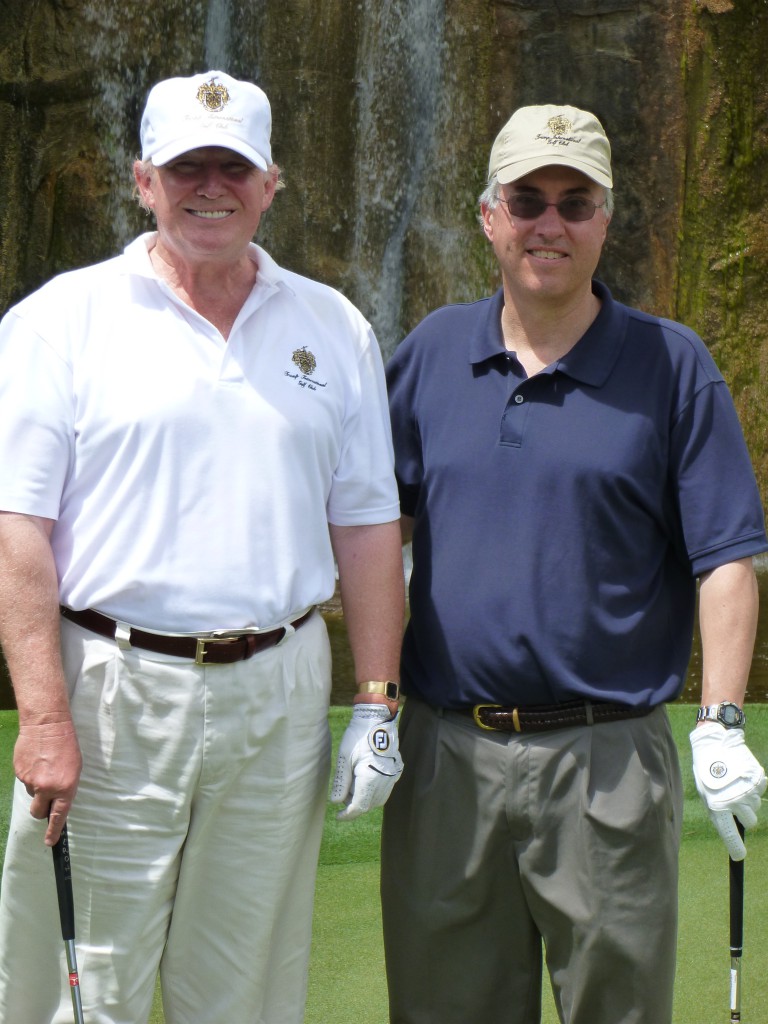
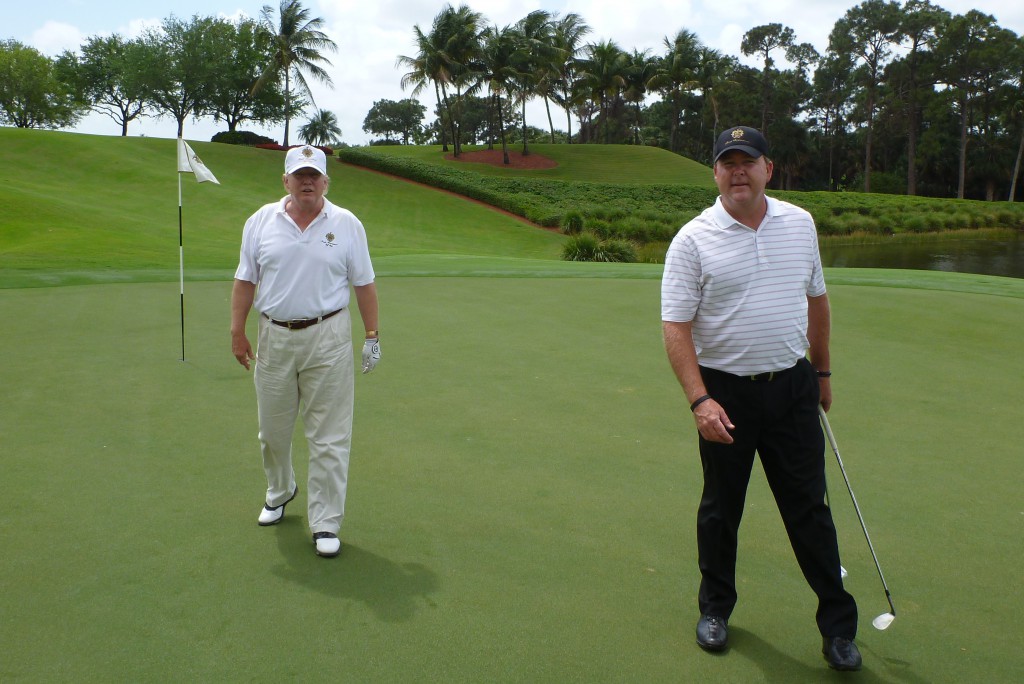
Donald T. and David O. in front of the waterfall at Trump International Golf Club, West Palm Beach, Florida, March, 2012.

For the July issue of Golf Digest, I wrote an article about Donald Trump and his newest golf course, Trump International Golf Links, near Aberdeen, Scotland. Back in March, Trump and I played  a round at his course in Palm Beach (photo above), and I spent one night at Mar-a-Lago, which Trump saved from demolition in the 1980s and now operates as a private club (photo of in-room amenities below).

Mar-a-Lago: only the best.

Trump is unimpressed by golf courses he doesn’t own, especially when he compares them with his Scottish course (which will open next week). “I know Bandon Dunes,” he told me over lunch. “The biggest dune there is like one tenth the size of our smallest dune. It’s a toy. And they get such great reviews. Every one of my courses is, like, amazing.”

Trump’s courses really are amazing; the one in Bedminster, New Jersey, was recently chosen by the U.S.G.A. to host the 2017 U.S. Women’s Open, and the others are stand-outs, too, although they aren’t necessarily as great as he says they are. A few years ago, he bought a bankrupt course in southern New Jersey, called Pine Hill, and turned it into Trump National Golf Club Philadelphia (it’s just over the state line from Pennsylvania). According to him, it should probably be considered the best course in the world (other than his course in Scotland).

“It’s a better course than Pine Valley,” he told me, “because it has much better elevation. And I love Pine Valley, but this course is better. Now, it will never be judged better, because nobody will ever give me the fair shake of doing that. But that’s OK. It’s a better course than Pine Valley—and the Pine Valley people say that, too, although they won’t say it publicly. Two of them came over to me and said, ‘Mr. Trump, this is better than Pine Valley, but please don’t ever quote me.'”

Trump’s courses, wherever they are, do often have cool cars parked in front of them:
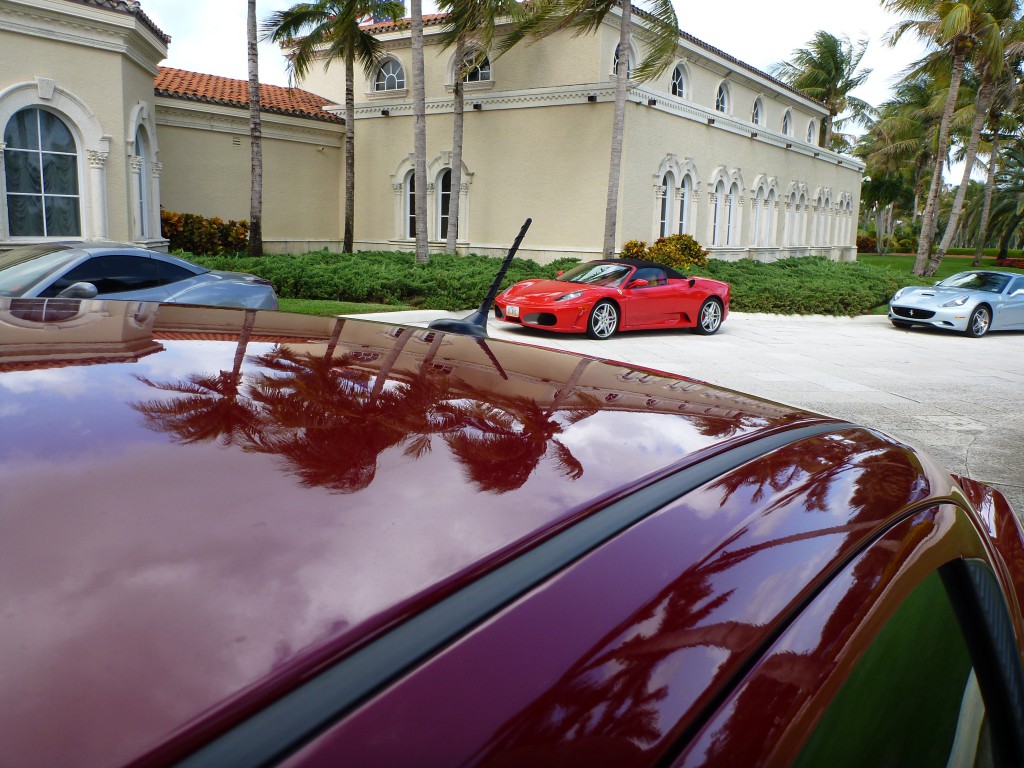
Three Ferraris plus my rented maroon Kia, Trump International Golf Club, West Palm Beach.

Automobile arrangements like that don’t happen by accident. When I told the parking attendant I didn’t think I’d ever seen three Ferraris in a row, he said the boss had told him to be sure I noticed.
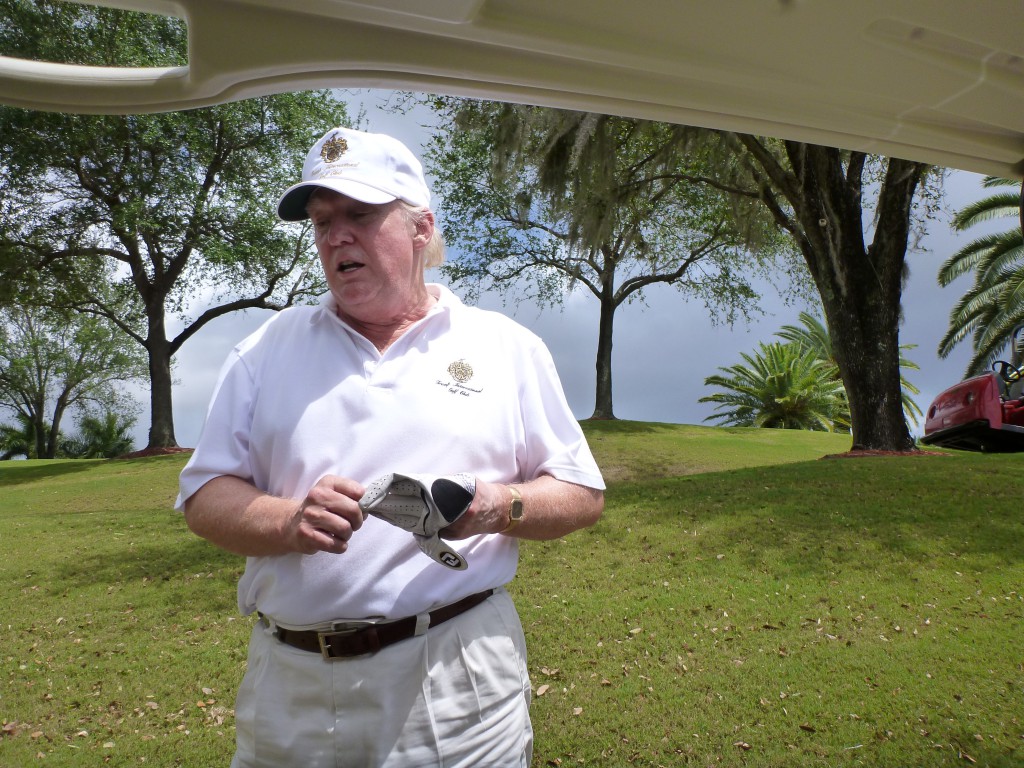
Trump is a very good golfer, even though he says he is.

In the photo above, Trump’s hair is hidden by his hat, which he didn’t take off during golf or at lunch, but I got to study it over dinner that night, at Mar-a-Lago. From straight on—which is presumably how he sees it in a mirror—it looks almost normal, but if you get any kind of an angle on it you can tell how structurally complex it is. And he must do it himself, because his wife wasn’t with him and I don’t think he was traveling with a hairdresser. I was impressed.
D.T. and John Nieporte, the head pro.

Off the record, I had a swell time hanging around with Trump. (Trump uses “off the record” not to protect confidences but to give emphasis to public knowledge he hopes you’ll quote—as in, “Off the record, I took down the trees and made the front page of the Washington Post four days in a row”—and I’m going to start doing that, too.) He’s a little exhausting to be with, because his only real topic of conversation is himself, but he doesn’t make you feel nervous or inferior, the way so many billionaires seem to do nowadays.

He’s also accessible. A decade ago, I wrote a long article for The New Yorker about concrete, and in it I quoted him at some length, since he built the first concrete office building in New York and knows a lot about the subject—although he was sometimes hard to understand because during our entire telephone conversation he was eating an apple. But he took my call, and he had interesting things to say.

Another Beef About My Golf Bag

The annoying part in question, lower right-hand corner.

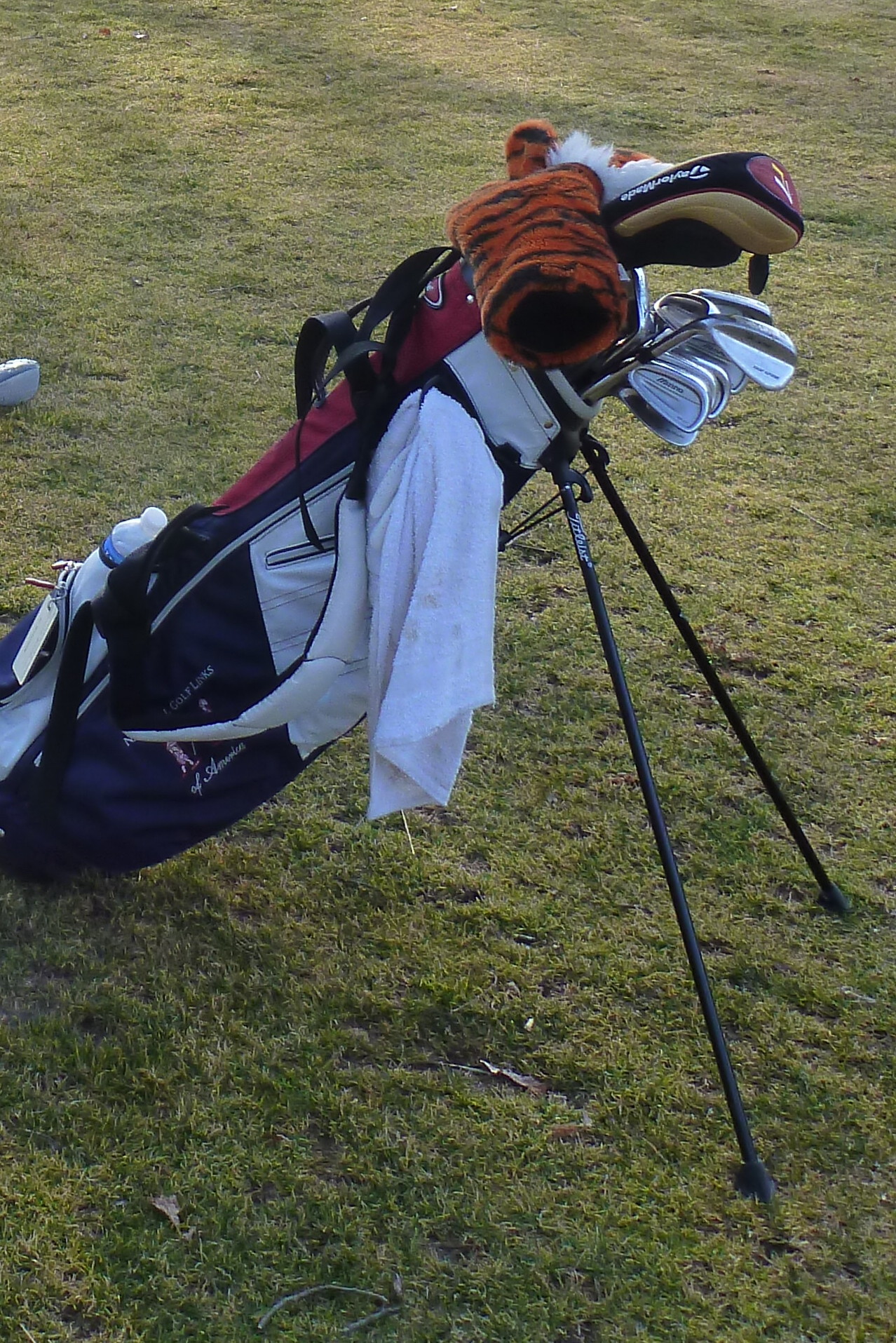
While we’re on the subject of golf-bag design, I’d like to raise the topic of legs. My first Sun Mountain bag (which had the Titleist name on it) worked great, and I liked it so much that I wore it out. My second, third, and fourth Sun Mountain bags, however, had a problem that it took me some time to diagnose. After a while, the bag stand on each would become noticeably harder to use, and eventually I found that I had to really slam the bag on the ground to get the legs to extend far enough to make it stand up.

Titleist bag (made by Sun Mountain) with the same problematic leg joint.

The problem, I finally realized, was that that the plastic joint connecting the leg to the bag had twisted, from the stress of repeated use, and no longer pushed the legs out as far or as easily as it had originally. That couldn’t happen with the original design, because on those bags the joint was super-sturdy—a solid hunk of plastic that couldn’t be torqued out of alignment.

Bag with original, untwistable leg joint.

I solved this problem for myself by performing a radical legectomy on my first Sun Mountain bag (which I still had in my garage because I never throw away golf stuff) and transplanting those legs onto my current Sun Mountain bag—which now works great. I mentioned this to Rick Reimers, the C.E.O. of Sun Mountain (whom we should all bow down to for his long record of fearless innovation), at the P.G.A. Golf Merchandise Show, in Orlando, back in January. He wrote down my gripe on an index card but said he’d never heard of it before. I know I’m not making this up, because other guys I play golf with have noticed it, too. Or maybe we just play insanely many rounds and therefore have difficulties that normal people don’t. Thoughts?

Sun Mountain, Please Fix This Problem

Sharpie inserted all the way into the pen holder on Tony’s Sun Mountain golf bag.

I own pretty many Sun Mountain products—golf bag, push cart, rain suit, travel case—and I’m generally satisfied with all of them. I even defended Sun Mountain’s rain suits after all that trouble at the Ryder Cup. But Sun Mountain golf bags (and golf bags that Sun Mountain makes for Titleist) have an annoying defect that I first pointed out to the company, to no avail, eight or ten years ago: the pen holder on the bag (see photo above) is too shallow to engage the pocket clip on the cap of a Sharpie, which is the de facto official indelible ball-marking pen of the game of golf. As a result, the pen holder cannot be used for the only thing it’s meant to be used for. If you put a Sharpie in the pen holder on a Sun Mountain golf bag, the Sharpie will fall out, either during your golf round or, later, when you throw your bag into the trunk of your car. Making the pen holder a half-inch deeper would cost nothing but would solve the problem. Why hasn’t this been done?

A Better Way to Play Skins

Gillen (right) and a close personal friend.

A big problem with almost any skins game is that it gives an unfair advantage to players with high handicaps. My friend Tim—who is the mathematician-in-residence of my regular Sunday Morning Group—invented an improved version seven or eight years ago, and my regular golf buddies and I have played it ever since. Tim’s version eliminates all the weaknesses of the regular game. It’s so good, in fact, that we call it Perfect Skins. Here’s how it works:

Each player, on the first tee, throws in some mutually agreed-upon sum—say, ten bucks. That money is divided into two skins pools, one for the front nine and one for the back, and every skin won is worth a proportional share of its pool. (If three skins are won on the front nine, for example, each is worth a third of the front-nine skin pool; if a single player finishes with two of those three skins, he wins two-thirds of the pool.) The object is the same as in any skins game: to win holes outright, with scores unequaled by other players. But there’s a twist: in Perfect Skins, a player who loses a hole outright, with a score that’s worse than everyone else’s, gives up a skin—or acquires a negative one, if he has none to give up. Let’s say the sixth hole is birdied by one player, parred by two players, and bogeyed by the fourth; in that case, the player with the birdie wins a skin while the player with the bogey loses one. We call negative skins “Gillens,” after the last name of the particular player whose long-running success at regular skins Tim was trying to thwart with his invention. Gillen hates Perfect Skins.

Any player with a negative skin balance may buy himself back to zero before teeing off on any hole during the nine-hole match, at the price of one dollar per negative skin, with the money going into the pool for that nine—but he may do so only once during the nine. That leads to the really interesting part of the game: Winning a skin when your balance is negative feels like a waste, because it merely moves you back toward zero rather than earning you a share of the pool. But buying back too early in a match raises the risk that one or two bad holes near the end of the nine could give you a deficit too large to eliminate before the end of the nine.

If you haven’t used your buyback yet, acquiring a negative skin is often less costly than permitting another player to win a positive one and thereby gain a share of the pool. That means that attempting a very risky shot may be to your advantage, if there’s a chance that doing so will prevent another player from winning the hole, or if doing so will ensure an outright loss by a player who now has a positive balance—unless you yourself hold a couple of skins, in which case your best strategy may be to play defensively. A player who ends the nine with a negative skin balance—say, because he lost the final two holes outright—owes the pot two dollars for each negative skin still in his possession at the end of the nine.

Perfect Skins eliminates all the shortcomings of regular skins: it greatly reduces the influence of luck, because erratic players are punished for their disasters in addition to being rewarded for their fluky good fortune; it eliminates the high-handicap advantage, because the players with the most strokes are also the ones who are the most likely to suffer the kinds of disasters that lead to negative skins; it keeps everyone in the game, because not losing a hole can be just as important as winning it, and players who suffer a string of bad holes can redeem themselves by buying back into the game; it adds a new level of pressure, especially on the final tee, because skins aren’t safe until the last putt has fallen.

I’ve played Perfect Skins in threesomes, foursomes, and fivesomes, and it works beautifully, though somewhat differently, in all those combinations. With three players, for example, the skin balance changes on every hole unless all three players tie—meaning that the standings can shift dramatically over just a few holes. With five players, in contrast, outright victories are harder to come by, so that a single skin successfully held to the end of the match could end up being worth the entire pool. In all combinations, the most important issue for any player with a negative balance is deciding when to buy back to zero. You have to think realistically about how well or poorly you’re likely to play the holes that lie ahead, and who still has strokes, where you yourself have strokes, and where you can afford to be aggressive.

Summer Solstice Golf Marathon

First group off the tee, 5:00 a.m., June 19, 2012: Hacker (real name), Peter A., Addison.

This past Tuesday, to celebrate the summer solstice, eight friends and I played golf from shortly after it was light enough to see until shortly before it was too dark to go on. I’ll have a report in the September Golf Digest, which will go on sale in a little over a month. In the meantime, I can tell you that we were extraordinarily lucky with the weather. It was cloudy and breezy all day, and the temperature never got above 70. If we’d played on the actual solstice (one day later) or on the day after that, we’d have had to cope with bright sun, high humidity, and temperatures in the upper 90s. As it was, I never felt uncomfortably warm, although I did drink extraordinary volumes of coffee, water, and Diet Coke.

Twelve years ago, on assignment for Golf Digest, I played golf all day at the Doral Golf Resort and Spa with Jim McLean, the famous teacher. We were raising money for junior golf, and I managed to play 136 holes in 11 hours—a few more than my friends and I managed on Tuesday. But McLean and I had carts (one each), and the resort’s maintenance staff had disabled their governors, giving them a top speed of more than 40 miles an hour. The best Doral course for hammer-down ball-chasing turned out to be the Great White, where the fairways are flanked by vast waste areas filled with crushed and compacted coquina shells—an ideal surface for Le Mans-style over-steering. The White course also has steeply banked turns along the edges of its water hazards, as well as palm trees spaced like slalom gates.

That was fun, of course, but what we did was almost as much like go-cart racing as it was like golf, and McLean and I were so busy hot-rodding around that we never managed to have more than fragments of a conversation. My friends and I didn’t want to our day to be like that.

Everyone played both fast and well—no surprise to me, since I’m convinced that non-dawdling forces even mediocre golfers to adopt beneficial habits. Fast players never get bogged down on mechanics, because they don’t have time for swing thoughts. They pick a target and whack their ball, and they don’t fret about how many knuckles were visible on their left hand. And when fast golfers have bad holes they forget them immediately, just as Bob Rotella says successful competitors must, because they have to get to the next tee. They don’t have time to piss and moan, or rehearse their pivot, or take practice swings, or brood about their yardage, or ask a playing partner to monitor the position of their left buttock. Time’s a-wastin’!

Incidentally, my friends and I also played on the winter solstice—as you can see here:

Winter Solstice Scramble, December 22, 2011. Two extra handicap strokes for anyone wearing shorts or a skirt (without long johns or leggings).

Come to think of it, I’m pretty sure we played on the equinoxes, too.