Did My Friends See a Gray Wolf on Our Golf Course?

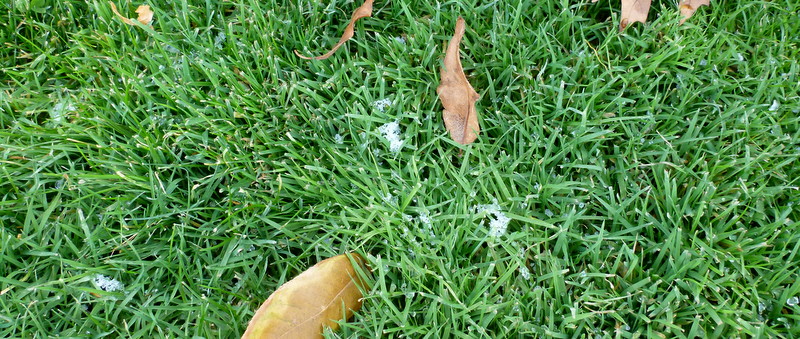
P1100847A lot happened at home while I was in Ireland. For one thing, it snowed, and—as you can see in the photo above, which I took in a shady spot in front of the first tee—not all the snow had melted by the time we played on Thursday afternoon. Luckily, the forecast for the weekend is more Irish-sounding: no precipitation to speak of, and highs in the upper fifties.
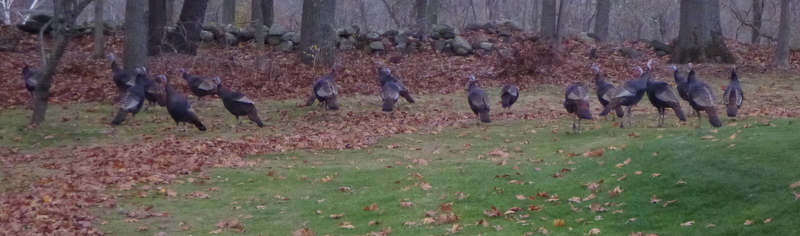
Wolf food, fourth hole, November 14, 2013.

Wolf appetizers, fourth hole, November 14, 2013.

A second thing that happened while I was out of the country is that several of the guys saw a wolf on our golf course. Hacker (real name) saw it first, and Corey, Gary, Chic, and a couple of other guys saw it, too, They watched it walk from the ninth tee to the far side of the first fairway, and a little later they heard it howl in the woods. We have lots of coyotes around here, and everyone knows what they look and sound like, so they’re positive it wasn’t one of those. We also have lots of dogs (ditto). Wolves have been making their way into New England from Canada in recent years, attracted primarily by our burgeoning population of Lyme-disease-bearing white-tailed deer. The wolves are welcome to all the deer, as far as I’m concerned, although I hope they will continue to spare the almost entirely white piebald fawn that my wife and I have been watching in our yard since mid-summer:

IMG_2040On the golf course, my friends and I have also seen foxes and bears, and I once watched a bobcat circling a flock of nervously gobbling wild turkeys in the middle of the driving range. Nature red in tooth and claw, etc. Talking about the wolf this afternoon made someone suggest that we play a game we often talk about playing but can never quite remember the rules of: Wolf. But we couldn’t quite remember the rules, and we had six guys, so we played 30-Ball instead.
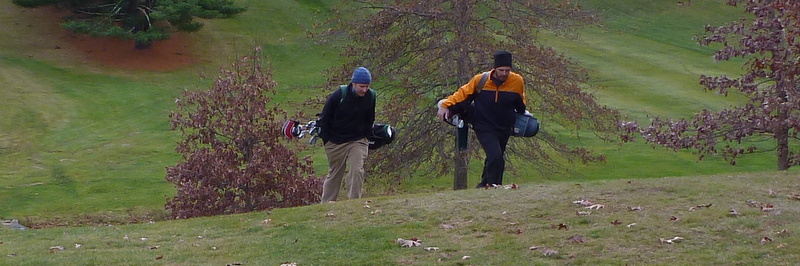
Austin an Corey, fifteenth hole.

Austin and Corey, fifteenth hole.

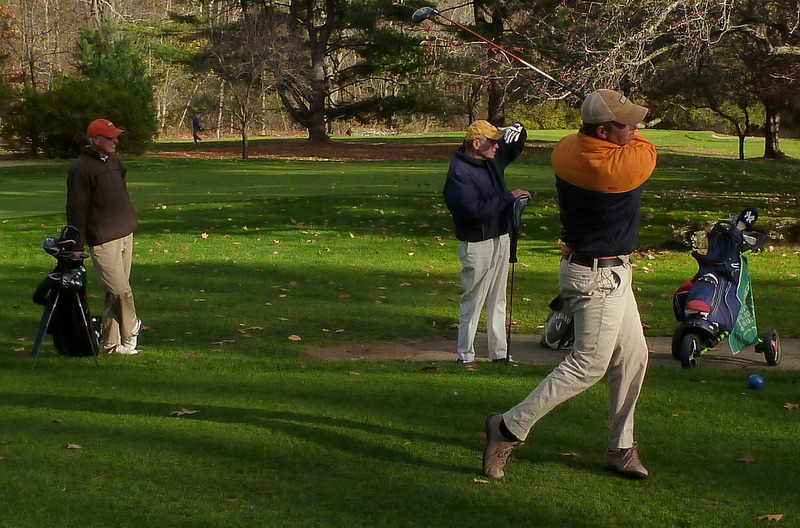
We played kind of slowly, even considering that there were six of us—almost three and a half hours—and it was getting genuinely dark by the time we finished. In just six more weeks, though, the days will begin getting longer again, and once that happens spring will be practically around the corner.

4:30 p.m. EDT. Bummer.
4:30 p.m. EDT. Bummer.
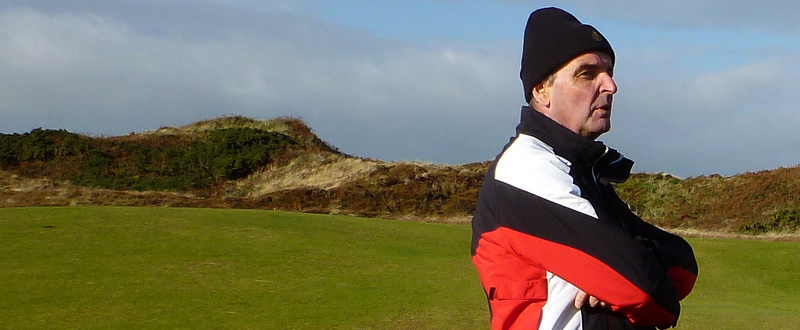
November Golf in Northern Ireland

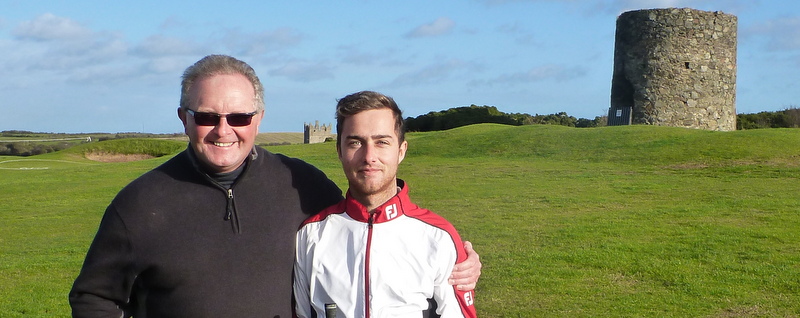
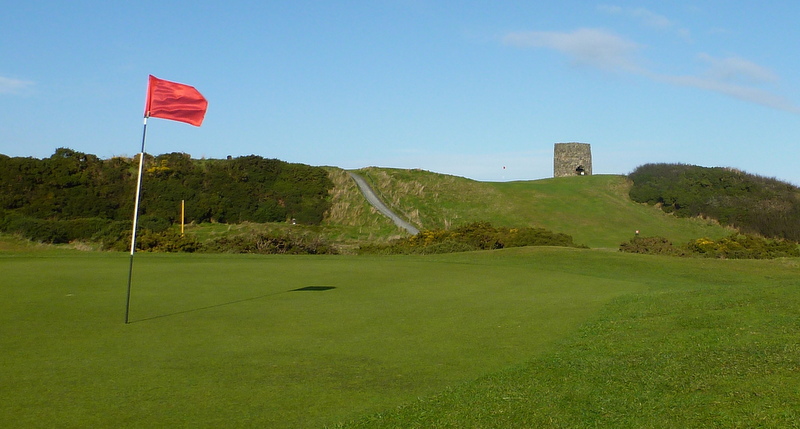
P1100471The mystery golf course in my previous entry is Kirkistown Castle, on the Ards Peninsula, in Northern Ireland. (Adam Heyes, who also identified Ardglass Golf Club, from photographs of some cannons and a life preserver, got Kirkistown right, too, but he let me know by email so that others would have a chance. Tralee wasn’t a terrible guess, but it credited me with the ability to teletransport myself and my golf clubs to the other side of Ireland and back.) I played Kirkistown last week with Kevin Gallagher and Jonny Breen, both members, shown above. You can see the ruins of the eponymous castle in the distance, between their heads. The structure on the right is the remains not of a castle but of an old tower windmill. It stands on one of the two sand hills that are the most conspicuous topographical features of Kirkistown:

P1100456

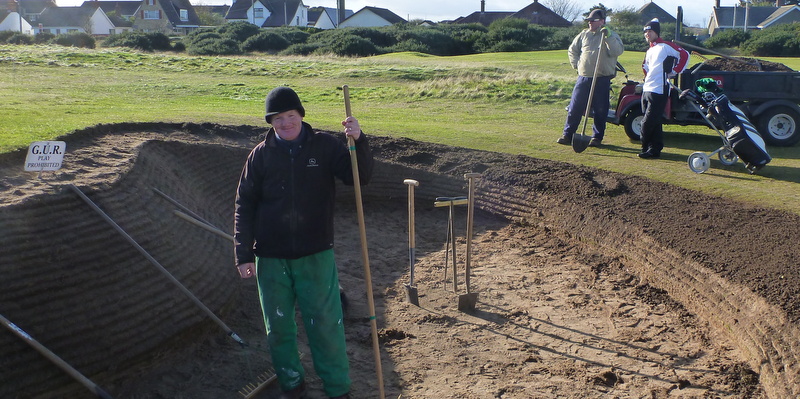
Kirkistown was founded in 1902, and the modern routing was created by James Braid in 1934. Among the few significant changes since then has been the sod-revetting of quite a few of the bunkers, a project undertaken with enthusiasm by the current greenkeeper, shown here in one of his ongoing creations:

P1100468

To get to Kirkistown, I drove from Newcastle to Strangford, through an area that a road sign identified, correctly, as an Area of Outstanding Natural Beauty (A.O.N.B). There was also quite a lot of unnatural beauty, including this row of houses along the Strangford wharf:

P1100407-001

I then had to cross Strangford Lough on a small ferry—which, naturally, was pulling away as I arrived:

P1100403Small ferries are one of my favorite things in the world. I wrote about some even smaller ones in the Atlantic Monthly a long time ago. The Strangford ferry runs every thirty minutes, so I didn’t have to wait long for the next one. Here we are arriving at Portaferry, on the other side:

P1100435Kirkistown is just a few miles up the road from the ferry landing, on the other side of the peninsula. Rory McIlroy—who would have arrived from the opposite direction, since he grew up in a suburb of Belfast—played at Kirkistown often as a junior. A recent golf bag of his is displayed in the trophy case in the lobby of the clubhouse:

P1100440

I intentionally took an unnessarily long way home, by doing a sort of figure-eight loop around the entire peninsula. The sun was gone by the time I got back to Portaferry—where, once again, I just missed the boat:

P1100499I was in Northern Ireland mainly to write about Royal County Down for an upcoming issue of Golf Digest. The weather during my rounds there was mostly spectacular, too—much better than the weather at home:

P1100392

P1100273

P1100228On my first day at Royal County Down, I played with Kevin Markham, who has played every eighteen-hole golf course in Ireland:

P1100253-001

We were accompanied for nine holes by Kevan Whitson, the club’s longtime professional. (Nearly everyone I played golf with on this trip was named either Kevin, Kevan, or Johnny.)

P1100239

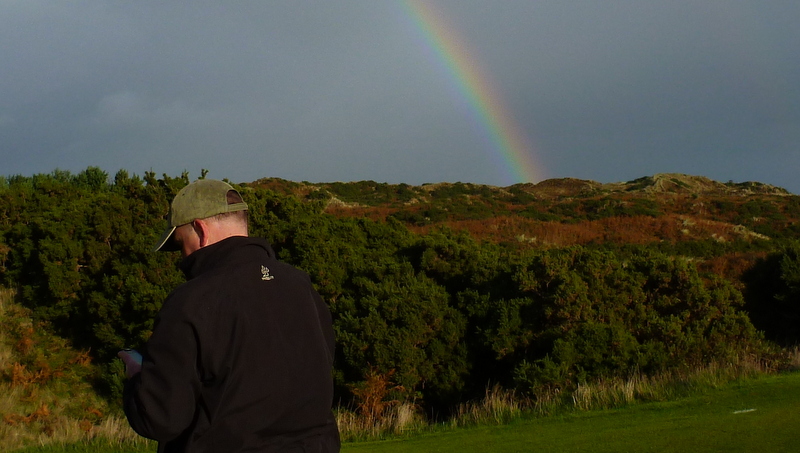
I’ll have more to say about Royal County Down in the magazine—and here, too, probably. Toward the end of our round, I told Kevin I was never going to take another picture of a rainbow on a golf course, or anywhere else. But then I did.

P1100288

Extra-Handicap-Stroke-for-Shorts Rule Now in Effect

photo 3

The Sunday Morning Group gives an extra handicap stroke to anyone who wears shorts after November 1. My first grandchild—Alice Calbraith O’Keefe, shown above—was born November 2, just in time to qualify, assuming diapers count. The first Sunday in November was very cold and very windy, but several guys took advantage of the rule, including Fritz, on the left in the photo below.

P1100176The red plastic cup contains beer from one of our two new Kegerators. Hacker (real name) has planned a Kegerator-emptying party for this coming weekend. Guests welcome.

While S.M.G. was in session last weekend, eight of us were busy defeating our No. 2 Enemy Club in our annual two-day home-and-home match. My partner on Sunday was Corey, our pro, shown below, who did not wear shorts. (The matches were played at scratch, so there was nothing to gain.) Corey’s fiance is from Thailand. Before moving to the United States, last month, she had never felt weather colder than 58 degrees. She’s still playing golf, though, unlike some people I could mention. And we give two extra strokes for shorts after December 1.P1100178

My Latest Contribution to the Divot Museum

P1100167

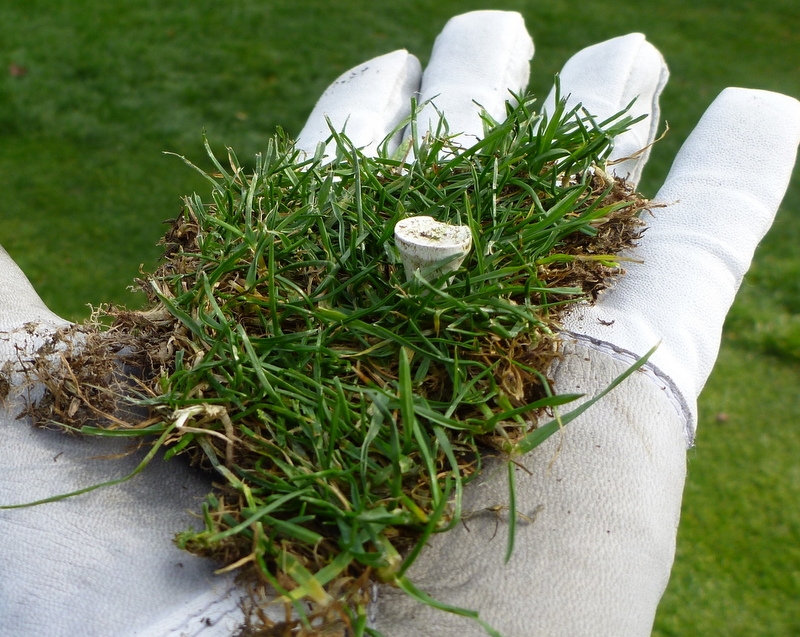
The seventh hole on my home course is a 125-yard par 3. I hit 9-iron the other day, and I took a divot that was just about perfect—uniform depth, playing-card size and shape—except that it began a couple of inches behind the ball and extended a couple of inches beyond it. In addition, my tee peg (a half-length stub I’d found nearby) remained upright near the center of it, untouched. Even so, my ball finished just twenty yards short of the green, meaning that I’d hit what was essentially a 90-yard explosion shot. And they say the long bunker shot is the toughest shot in golf.

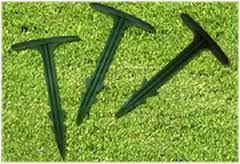
If I hadn’t sent my divot to the Divot Museum, I could have used the tee stub to refasten it to the golf course. Believe it or not, a company called McDivot makes biodegradable anchors that do exactly that. Here’s what they look like:

mcdivot

I saw a bowl of McDivots on the counter in the golf shop at Royal Portrush Golf Club a few years ago, and one of the assistants told me that using them prevents wind, rain, mowers, and crows from flipping replaced divots out of their holes. (The same company also makes an industrial-size version, called GreenStakes, which can be used to hold down entire fairways.) I took a McDivot home as a souvenir, and displayed it on my desk for several years. At some point, though, I must have thrown it out, because I just spent almost an hour unsuccessfully searching for it in my office. So the photo above, which is from the McDivot website, will have to do.

Anyway, divots aside, it was a nice day for golf, as you can see here:

P1100162

P1100155

P1100161

How Autumn Leaves are Deposited on New England Golf Courses

If you don’t live around here, you may not be familiar with the process shown in the video above. The leaves are imported from China, or someplace, and the wind does most of the work. The colors are nice. P1090888 I shot the video on Monday at our Enemy Club No. 2, where I played with Hacker (real name) and Paul. We have a big team match coming up there in early November, and Hacker and I were studying the greens. Paul joined us because he had nothing better to do. We played 10-Ball with a Snake add-on.

Hacker, seventh green, Enemy Club No. 2.

Hacker, seventh hole, Enemy Club No. 2.

The course is my second favorite nine-holer in our part of the state—after our home course, naturally. It was built on the former estate of some rich guy, and it has lots of old apple trees, which are left to look after themselves. P1090894 Whenever I play there in the fall, I cram apples into my golf bag. They taste a million times better than any of the apples in a grocery store. In fact, I hate apples, except for these.

I had a little trouble zipping this back up.

I had a little trouble zipping this back up.

There were very few other people on the course—a surprise, given how nice the day was. We saw a guy on the practice green who said he was trying to become a less crappy putter.

I think the thing on his left arm may be a practice gadget, too.

I think the thing on his left arm may be a practice gadget, too.

And we saw a kid who, apparently, had invented a game that’s even more complicated than the stuff that Hacker and Tim come up with. P1090930

Golf in the Rain—But Not the Presidents Cup

P1090651

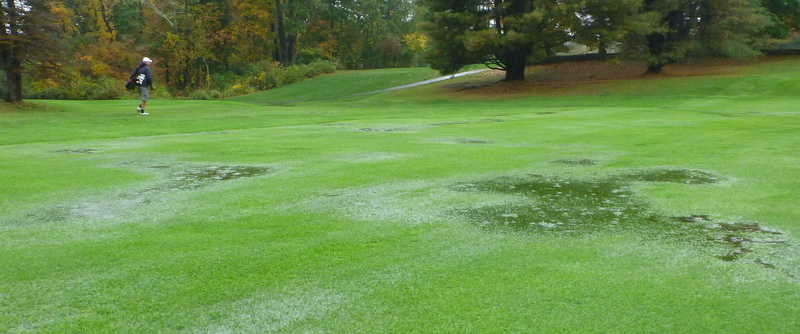
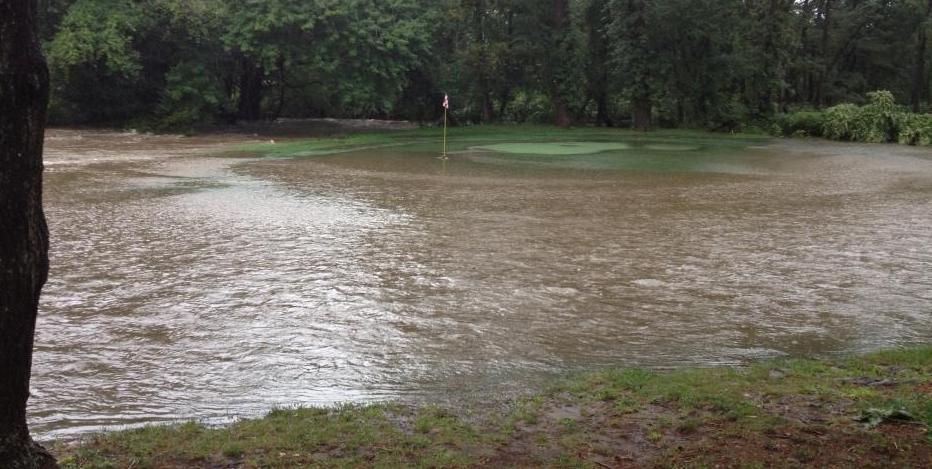
The rain that caused delays at the Presidents Cup reached my part of the world on Saturday night. It was still coming down on Sunday morning, when my friends and I assembled. We couldn’t tee off right away, because the greens were submerged.

P1090638

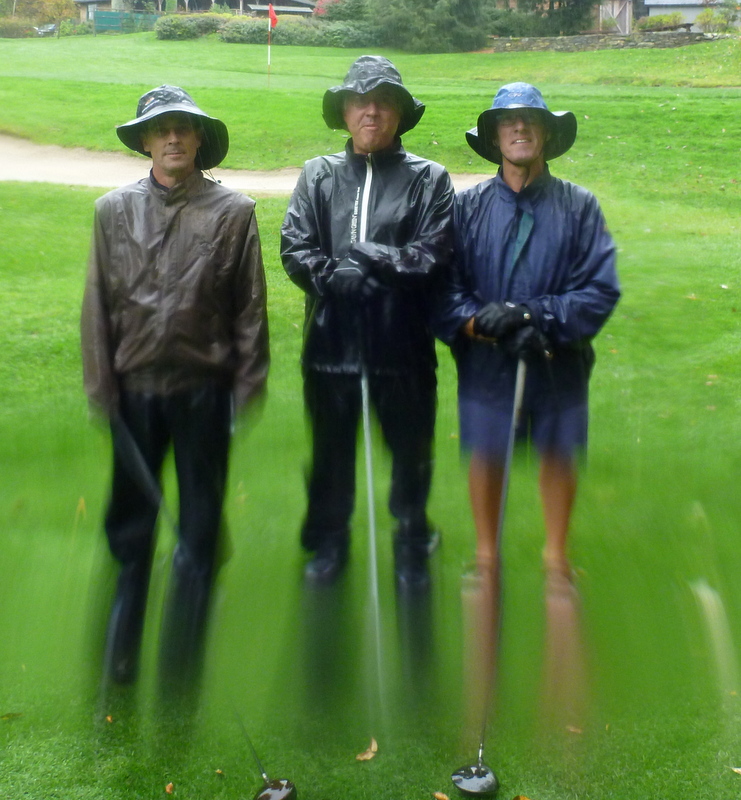
Barney went to get coffee, and we talked about going out to breakfast. After an hour, though, we said the hell with it and teed off. We had eight guys plus Peter P., who is still recovering from his car accident and so was playing in absentia.

P1090724

The course was wet, but it was playable, and when the rain let up a little bit most of the puddles disappeared.

P1090677

On a dry day, you can step across this creek:

P1090764

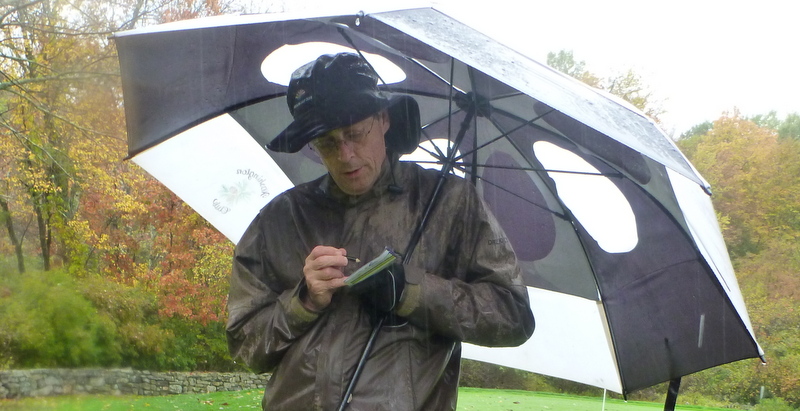
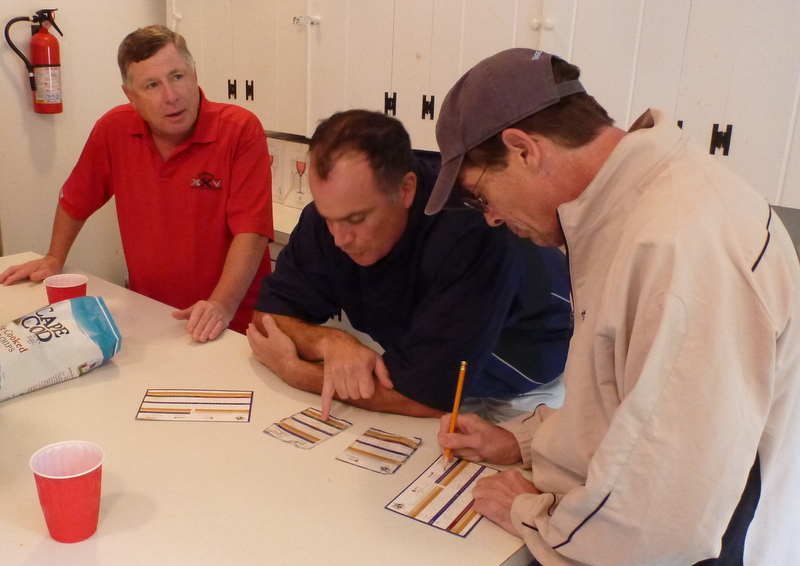
Keeping the scorecards dry was problematic:

P1090737So was keeping water off the lens of my camera:

P1090771

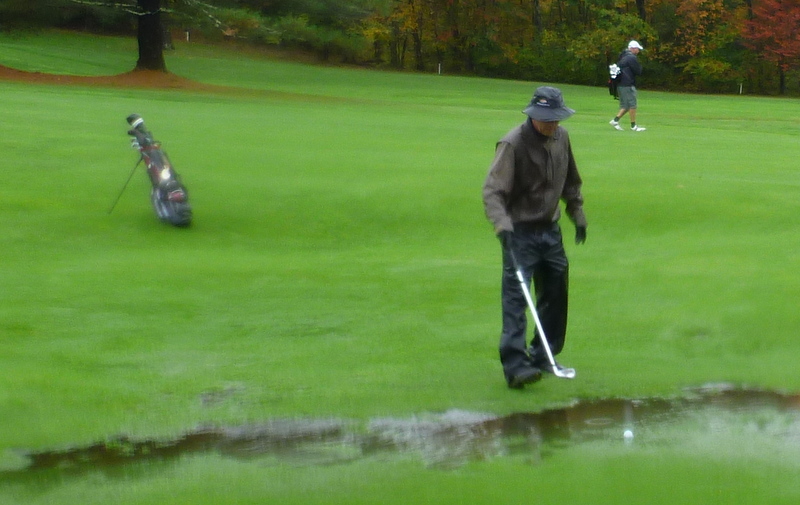
But playing was better than going home and doing chores, and in areas where the water was too deep you could take relief.

P1090788

The tee shot from on No. 13, which on Sundays we play from the tips, was even more intimidating than it usually is, but after thinking about it for a while Barney decided not to lay up.

P1090748

The round took just over three hours, and we all shot about what we usually shoot. Then we grilled cheeseburgers, as always. We ate them in the clubhouse kitchen rather than on the patio, though. That’s also where we did skins, after reconstructing the scorecards.

P1090811

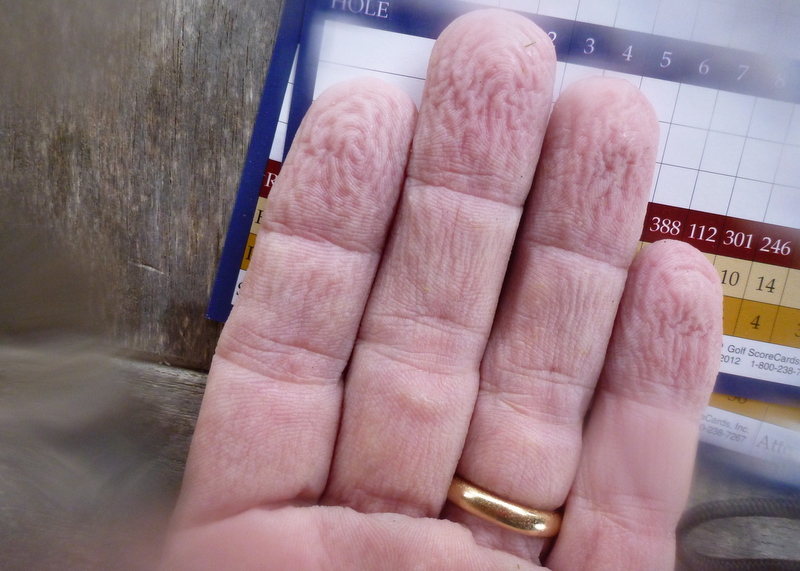
My team won, and I won two skins. My fingers looked the way my kids’ used to after their baths.

P1090803

Then it was time to go home.

P1090664

International Leaf Rule Now in Effect

P1090578All the big tournaments are over now. The club championship has been decided. The kids who worked in the golf shop all summer are back at school. Our Enemy Club has been defeated. The deer eating acorns between the fifth and sixth holes have grown so used to us that they scarcely look up when we play through. The International Leaf Rule is in effect. 
P1090604

I know people who live in places where golf can be played in shorts year-round. To them, the cycle of the seasons is a kind of poverty. But I think they are the ones who are deprived. For them, golf has no beginning and no end. They don’t get to savor a year’s two most consequential rounds: its first and its last. One season blends into the next, and they never reach a point from which they are forced to assess their golf game’s progress or decline.

P1090609Hacker (real name) and I had the course to ourselves for our first nine holes on Tuesday afternoon. Barney, who didn’t have to pick up his daughter until four-fifteen, joined us at the turn. We waved to an older member who used to play by himself but now is always accompanied by his son. He uses something called Martini Tees, and when he misplaced one the other day he had his son call the golf shop to report it missing. His son acts as his caddie and navigator, guiding him from hole to hole. Golf is almost over, but not yet.

P1090582

The Muny Life: The Wrath of Cobbs Creek

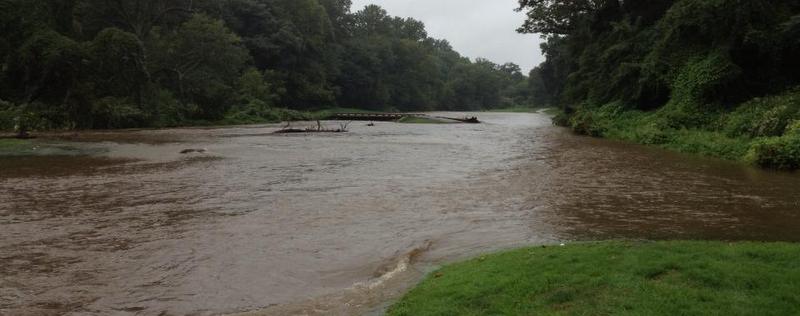
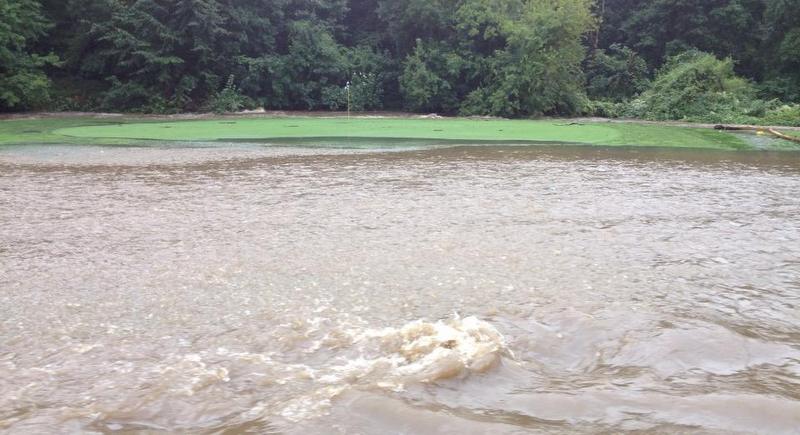
Cobbs Creek 7I wrote about Cobbs Creek Golf Club, in western Philadelphia, in the June issue of Golf Digest. The main course—which regulars call the Crick—was named after its most diabolical hazard, which also runs along the eastern edge of Merion Golf Club, a few miles away. The Crick’s creek has always been both an asset and a liability. Hugh Wilson, who also designed Merion, brilliantly incorporated it into his routing, and Charles Barkley once got so angry at it—on the third hole, a short par 4—that he threw his clubs into the water, then stormed back to the golf shop and bought another set. But when the creek floods, as it did on Labor Day, it can carry away entire greens. Most of the photos in this post were sent to me by Paul Cornely, the head of the regular men’s group, which is called the Cobbs Creek Publinks Golf Club. Cornely and I played back in March, when the water was better behaved.

Cobbs Creek 5-001

Cornely writes:

The rain started at 10:45, and in an hour the course and nearby area got four-plus inches. We had twenty-five guys, and the last group was on the eighteenth green when the rain started. It was coming down so hard that we had to stay in the clubhouse. These pictures were taken between about 11:45 and 12:15.

In normal weather, this is a golf hole with a creek running down the center of the fairway.

In normal weather, this is a golf hole with a creek running down the center of the fairway, as you can see in the photo below.

Here’s what the hole in the photo above looked like back in March:

IMG_0461-001

The next photo, below, was taken near the clubhouse during the rainstorm. The river you see at the bottom of the hill had been the first fairway until an hour or two before. As bad as things look in these pictures, though, they were worse in 2006, when an August flood swept away the third and fourth greens.

Cobbs Creek 1-001

In recent years, a group of Crick aficionados led by Chris Lange,a local businessman, has developed a plan to deal with the flooding problem, which also affects a neighboring facility owned by the city’s transit authority. The group also wants to repair many years’ worth of erosion damage and restore Wilson’s routing, which was modified in 1950, when most of the original thirteenth fairway was appropriated for a missile base. (Today, it’s a driving range.)

Here's the driving range next door. During the early years of the Cold War, it was a missile base.
Here’s the driving range next door, four months before the flood. During the early years of the Cold War, it was a missile base.

The 1950 reconfiguration, by George Fazio, was cleverly done, since it preserved all eighteen of the Crick’s original greens. But no one believes the current course is as good as the one that Wilson designed, and the architects Gil Hanse and Jim Wagner, whose office is nearby, have created a restoration plan. The Golf Association of Philadelphia has endorsed the project, most of which will be financed privately, and has agreed to move its headquarters to the course if the city approves it. Maybe the Labor Day Flood will move things along.

Cobbs Creek 3-001

Am I Related By Marriage to the Inventor of the Golf Rainsuit?

GD Hodgman 2 9-61

My wife’s last name is Hodgman. In 1838, a distant relative of hers—that is to say, a relative not related to her by money—founded the Hodgman Rubber Co., which still sort of exists. In fact, my wife has a Hodgman camo rain jacket (which she never wears). She also has an old box of Hodgman rubber bands, and she claims that the company was once famous for manufacturing horse condoms.

Hodgman Rubber Co., 1913.

Hodgman Rubber Co., 1913.

In 1913, Hodgman Rubber published a self-celebratory book, on the occasion of its seventy-fifth birthday. “The orderly business man at his desk is lulled by the harmonious music of the rubber band,” the book’s author wrote; “the eager traveler hastens swiftly on his unwearied way in the glad knowledge that not he but his motor car is rubber tired. Rubber is the main spring of sport in football and in tennis. The urgencies of business are sped by messages over telephones that are rubber wired.” And so forth. Also, eventually, rainsuits for golfers.

GD Hodgman 9-58

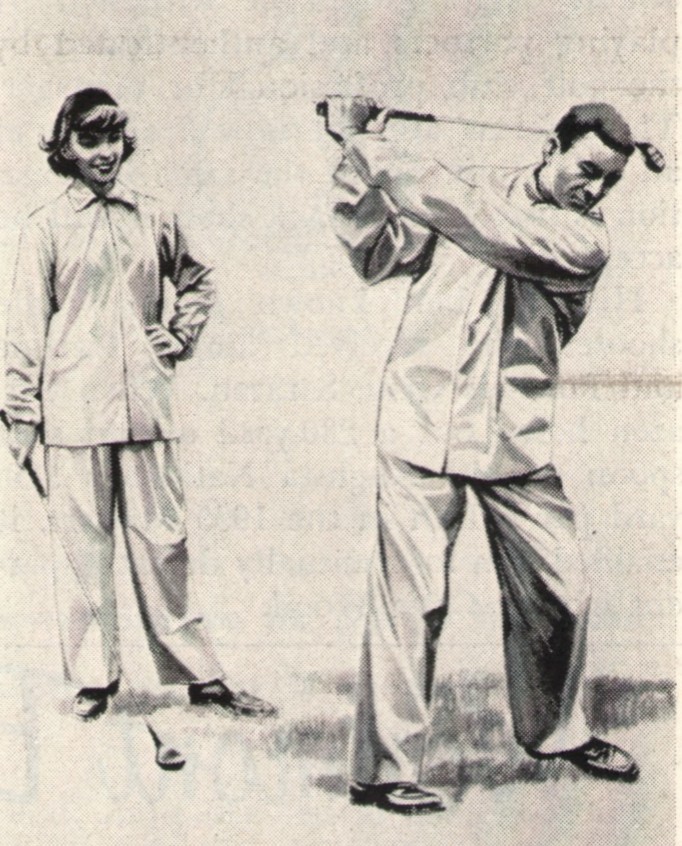
Hodgman rainsuits couldn’t cure a reverse pivot, apparently (see advertisement above). But they did leave plenty of room for unavoidable age-related increases in B.M.I.

GD rain clothing 4-61

Ann “Distant Relative of Possible Inventor of the Rainsuit” Hodgman and I are currently in Amsterdam, celebrating our thirty-fifth wedding anniversary. There was a little rain here this morning, and when we walked to breakfast I wore a golf rain jacket—which, I’m sorry to report, was not a Hodgman. But, at any rate, it’s not raining now.

Will This Umbrella Take Over the Golf World?

Ferenz

People who sell things for a living have a rotten reputation, but I like them. They look you in the eye, use your name a lot, hold your shoulder while they talk to you, and laugh really hard at your jokes.They take you out to expensive restaurants, and when the waiter asks them if they want something to drink they don’t say, “Just water, please.” They send you a Christmas card. They ask you where you went to college and what your kids do after school. They suggest through facial expressions and body language that they would like to marry you. In other words, salespeople treat you exactly the way you wish everyone would treat you—the way you deserve to be treated. Their only tiny flaw is that they don’t mean any of it: they’re just trying to make a sale. But isn’t that really a trivial defect, all things considered? Doesn’t the insincerity of salespeople seem like a negligible shortcoming in comparison with the incalculably opulent richness of their devotion?

Ferenz 2

Well, I think it does. And I always have plenty of opportunities to agree with myself at the P.G.A. Golf Merchandise Show, which is held in Orlando every January and is full of salespeople. Among the dozens I met there a couple of years ago was Jack Ferenz, a former tour player. (His best year was 1990, when he entered twenty-one tournaments, made five cuts, and finished second at the Deposit Guaranty Golf Classic, two strokes behind Gene Sauers, the same week as the Masters.) He was selling an invention of his, which was then called the Dry Club Umbrella. He described it on a Facebook page (which has two “likes” but doesn’t seem to be active anymore): “We have designed a state of the art golf umbrella that will take over the golf world. Our unique design allows player to carry 2 clubs, handsfree, and remain 75% drier than with standard umbrella.”

Ferenz 3

Since then, Ferenz has renamed his invention the Carryclubumbrella, and perhaps also tweaked the design. Even after studying the patent drawings and the photographs and descriptions on Ferenz’s website, though, I’m not a hundred percent certain I understand how it works. Then again, I’m not an umbrella guy, so you should check it out for yourself.

ferenz 4