For Memorial Day: How to Remember Deceased Golfers

The Amerman Tree (right), Memorial Day weekend, 2012.

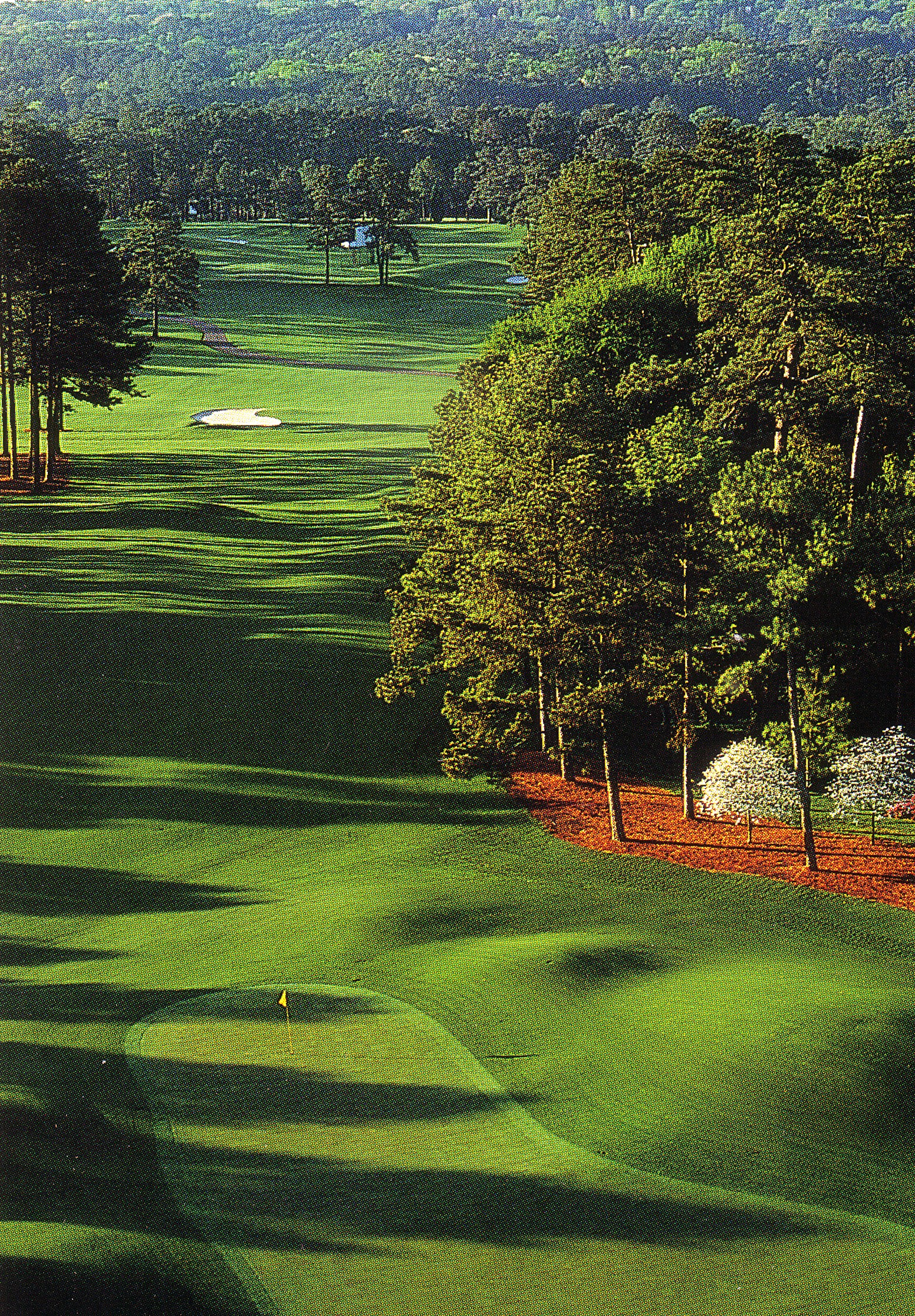
During a tournament one year, I used a very bad word to curse a former member of my club. It was nothing personal. I’d hit a weak banana from the tee, and my line to the green was now blocked by the Amerman Tree, which memorializes a deceased past president of the board of governors. I never knew Mr. Amerman, but I curse him every time I slice a drive into the steadily expanding circumference of his memory.

As I punched my ball sideways into the fairway that day, it occurred to me that planting a tree in the line of play is a terrible way to honor a dearly departed member. Golfers don’t really even like trees, except in the abstract. A memorial maple may seem like a fitting monument on the day it’s planted, but once its trunk has grown thick enough to stand straight without being staked it begins to grate on the nerves of the survivors.

Golfers don't really even like trees, except in the abstract. That's Howard behind the first green.

There’s a better way: Instead of honoring the dead by creating annoyances in their behalf, why not remember them with golf balls? Most golf shops sell thousands every season. What if each one were imprinted with the name of a member who had died the year before?

Your guest in the member-guest would need an explanation. “His name’s on all the balls,” you’d say. “Nice old guy. Died last year. Played the course in eight different decades. Used a three-wood when he played in the snow.”

You’d think of him every time you played. If his name was long enough, you’d use it to line up putts. On your trip to Scotland in July, you’d launch a few into the whins in his honor.

As each summer slipped away, your club’s supply of memorial balls would gradually disperse itself: into the weeds, into the trees, over the walls, around the world. The following spring, your golf shop would be stocked again, with balls bearing new names—but the previous year’s batch would keep turning up for decades, the way old golf balls always do. They’d materialize in shag bags. Caddies would find them in the woods. Old-timers would retrieve them from the pond. A new member would step on one in the fescue near the pump house and ask about the name.

“Nice old guy. Died a few years ago. Caddied for Titanic Thompson once. Runner-up in the club championship. Navy in the Pacific in World War Two. And he never walked past the Amerman Tree without breaking off a branch.”

Tour Players Lead Lives of Quiet Desperation

In 2003, I played in the pro-am at the Western Open, at Cog Hill, near Chicago. The pro on my team was J. P. Hayes, whom I wouldn’t necessarily have recognized if his name hadn’t been printed in huge letters on his golf bag. Nevertheless, I was excited. For a golf fan, playing in a pro-am is a fantasy come true. It’s a chance to spend five hours getting on the nerves of a real tour player, and it provides numerous opportunities to obtain personalized mementoes that can later be sold on eBay.

The excitement felt by the amateurs in any pro-am is almost exactly offset by the dread felt by the professionals, most of whom would prefer to be mowing their lawn, if not their neighbor’s lawn. But the tour requires even the top pros to take part, mainly because pro-ams generate favorable p.r. and make tournament sponsors happy.

My team, without even one useful contribution from me, finished sort of in the middle of the pack. The next day—the first day of the real tournament—I decided to lend comradely support to Hayes by following him in his round. His tee time was 1:09, exactly the same as Tiger Woods’s, although Hayes was assigned to the first tee (along with Justin Leonard and Stuart Appleby) while Woods was assigned to the tenth (along with Chris Smith and Cameron Beckman). Woods, who ended up winning the tournament, influences golf spectators the way a black hole influences cosmic dust: when he emerged from the driving range, at about 12:45, what appeared to be the entire human population of northeastern Illinois began to drift inexorably toward him.

Over on hole No. 1, in contrast, the crowd of spectators quickly reduced itself to a handful of friends, relatives, and stubborn contrarians. I walked with Hayes’s completely charming wife, Laura, who was pregnant with their second child; Amanda Leonard (also pregnant); Ashley Appleby; and a few of Hayes’s relatives, who were visiting from Wisconsin—about the same turnout you would expect for the final round of a club championship.

Non-golfers joke about how boring golf looks on television, but TV actually makes tournaments seem more exciting than they are, because it focuses on leaders and stars, and because the camera doesn’t linger once a shot has been hit. If you’ve ever attended a Tour event in person, you know that most of it consists of absolutely nothing—like a fireworks display at which the rockets go off ten minutes apart. Even if you’re following one of the superstars, you have more than enough time between strokes to read the newspaper, get caught up on your bills, or work out any lingering difficulties in your marriage.

It’s the pros who lead lives of quiet desperation—not regular golfers like us. If a pro hits a ball out of bounds, the other guys in his foursome never say, “Aw, forget it, just drop one up by the tree.” And nobody ever hooks them in the crotch from behind with a two-iron as they’re getting ready to play a shot. They have to hit practice balls and lift weights and take vitamins and live in hotels and worry about telling their wives they’ve been demoted to the Hooters Tour.They sacrifice the best years of their lives to entertain and inspire us, and how do we repay them? By hounding them for autographs, and calling them chokers when they lose, and nodding smugly when Johnny Miller says their swing looks a little laid-off. Then, to top it off, we ruin their Wednesdays with pro-ams.

We have a lot to atone for. And as I walked along with Laura Hayes I thought of a way to do that: by inaugurating a national program of amateur-professional events—“am-pros”—which will be just like pro-ams, except opposite. Rather than imposing ourselves on the pros at the very moment they’re trying to pull themselves together to compete, we’ll invite them to join us at our own clubs, and let them see, for a change, how real golf is played. Any pro who misses the cut at any tournament can simply show up that weekend at any participating club and play for free. We’ll give him a handicap of plus-five or plus-six, and we’ll choose teams the way we usually do, by throwing balls or pulling numbered poker chips out of a hat, and we’ll work him into our regular Saturday or Sunday games. Lunch, too. Want in?

Hacker (real name) counting the skins money at my club this past Sunday. J. P. Hayes and Tiger Woods: this life could be yours.

You Really Have to Play the TPC At Sawgrass

David O., John O., Tony, Gene, TPC at Sawgrass, February, 2009.

The thirteenth hole on Pete Dye’s Stadium Course at the Tournament Players Club at Sawgrass is a straightforward par 3 that measures 150 yards from the blue  tees. The hole is nowhere near as famous or as frightening as the island-green seventeenth, but if you draw the ball the green might as well be an island because  there’s water both in front and on the left.

Despite the dangers, I was briskly confident as I stepped up to the tee. The day before, during my practice round, I had chipped in from the fringe for a birdie, and I had birdied the following hole as well, and (because golf is an easy game) I had parred the hole after that. Now, waggling my 8-iron and visualizing a soaring draw, I glanced one last time at the flag, and half-shanked my ball into the trees on the right.

“I’d better hit a provisional,” I said, not feeling particularly concerned. I teed up another ball, and, with a swing grooved through long and patient repetition, half-shanked it into the same stand of trees.

“I see the second ball,” someone shouted. Five minutes of crawling through dense undergrowth failed to turn up the first. I crouched in a bush to survey my prospects.  To put my second ball on the green, I calculated, I would need to hit a crisp thirty-yard smother-hooked 4-iron through a window-sized gap in the branches, applying enough backspin to keep the ball from skidding off the green into low earth orbit. I declared the ball unplayable and returned to the tee. I took a deep breath and swung again. My third ball found the water on the left.

An eerie hush fell over my playing partners. I felt my consciousness rise slowly out of my body and gaze down, with ineffable pity, at my golf hat. I dropped a fourth ball, at the front of the teeing area, and, with my pitching wedge, yanked it safely onto the far left corner of the green, perhaps fifty feet from the pin. Three putts later, I had my ten.

From that point forward, my memories of my round are indistinct. I had been playing pretty well before my disaster, but I ended up with a 102, including double or triple bogeys on all the remaining holes except the celebrated seventeenth, on which I had a seven. (First ball into the water over the green; second ball into deep rough next to a piling at the rear of the green after bouncing hard and high off a piling at the front; chunky chip; three putts.) As I watched an official inscribe my score on the big board near the clubhouse, I wondered whether I ought not to give up golf altogether, for the good of the game.

All that happened twenty years ago. The tournament in which I was competing was not, quite obviously, the Players Championship, which is held at the Stadium Course each spring and is underway this week. It was an amateur event that no longer exists, alas—a bargain-priced multi-day event on what was then known as the Partners Tour.

But, even though the Partners Tour is defunct, you should find an excuse to play Sawgrass. Hacking your way around a memorable course that you can watch the pros play on TV is both exciting and instructive, and the Stadium Course is the most engaging regular tour venue that mere civilians can play for a somewhat reasonable price. Bay Hill, Cog Hill, Doral, Harbour Town, and Torrey Pines are also possibilities. So is Pebble Beach, although eighteen holes there, including obligatory add-ons, may cost more the annual dues at your home club, and your round will seem to last for several days, and the greens will disappoint you, and the people in the group in front of yours will turn out to have taken up golf the day before yesterday. The Stadium Course is fun to play, and when you later watch the Players Championship—the fifth major!—on TV (as I assume you are doing today, instead of working) you will recognize more than just the last two holes.  Playing a tour course will help you appreciate how the pros make their living, and the next time Rory or Tiger or Phil dumps one in the water on seventeen you can tell your buddies, “Hey, I’ve done that.”


Is Tiger Too Old?

Hogan before he was Hogan: Byron Nelson and Ben Hogan at the 1942 Masters, the last before the war. Note the grip on Hogan's driver. Also, of course, the cigarette.

People who think Tiger Woods is too old to dominate golf again should consider the career of Ben Hogan. At the time of the Masters in 1948, the year he turned 36—the age Woods is now—eight of his nine majors and a third of his tour victories still lay ahead of him, as did the automobile accident that nearly ended his life.

Masters Countdown: Ninth Hole

Augusta National's ninth green, 1935.

Clifford Roberts, Augusta National’s co-founder and first chairman, liked to say that he made only one contribution to the original design of the course. During the construction of the ninth hole, he persuaded the contractor to create a level landing area in the steeply tilting fairway at the distance he normally drove the ball (about 180 yards). “The engineer was not at all enthusiastic about accommodating me,” Roberts wrote in his book about the club, “but finally agreed to bring back a tractor and do the job.” Roberts later told friends that he had requested the change because he didn’t want any of his matches with Bobby Jones to be decided by his luck at hitting a fairway wood to an elevated green from a downhill, sidehill lie. The current ninth hole was then the eighteenth, and Jones customarily either gave Roberts nine strokes or allowed him to begin their matches with a nine-up edge. Even so, Roberts needed all the help he could get.

(Augusta National doesn’t use the U.S.G.A.’s handicapping method. It has its own simple system, devised by Roberts, which is based on the number of pars a player ordinarily shoots, with a small adjustment for birdies. Essentially, if you make six pars, your handicap is twelve. The Roberts system works well, is easy to compute, and allows daily modification.)

Roberts’s difficulties with the second shot on the ninth hole were shared by most of the club’s other members, who, like him and unlike Jones, weren’t long enough off the tee to come close to the ideal driving area, at the bottom of the hill. And neither Jones nor Alister MacKenzie, who designed the course, was at all disapproving of Roberts’s modification. In consultations among the three, Roberts’s role was to supply the viewpoint of the average golfer, and Jones and MacKenzie both solicited his opinion. Roberts’s landing area is still visible in the ninth fairway, and it still receives plentiful use from members and guests, as well as from occasional Masters competitors.

Hord Hardin, who was the president of the U.S.G.A. from 1968-69 and was Augusta National’s third chairman, between 1980 and 1991, told me a story in 1996, shortly before he died, that I’ve heard in several versions. Augusta National had a few women associate members in the early years. (Most, if not all, were members’ wives—possibly including Roberts’s first wife, Mary Agnes Bishop, whom he married in 1937 and from whom he was divorced not long afterward.) In the clubhouse one day, one of the women told Roberts that she had just made a hole-in-one on the eighth—a 500-plus-yard uphill par 5—and Roberts asked how that was possible. Hardin told me, “She was playing the ninth, and flat missed her tee shot. The ball hit a something off to the right, flopped up in the air, and went in the hole on the eighth green, no more than fifty yards away. When he heard that, Mr. Roberts is supposed to have said, ‘That’s it. No more women members.'” Roberts and Jones’s original plan for the club had included a second course, intended mostly for women, and a large women’s locker room, which was to have been situated in the huge new clubhouse they intended to build as soon as they could afford to tear down the dilapidated old plantation house. The Great Depression forced them to scale back their ambitions, and prevented them from demolishing what today is probably the most recognizable building in golf.

As the photograph above shows, the ninth green’s famous false front, which contributed to Greg Norman’s spectacular final-round collapse in 1996, was originally more pronounced. (Look at the far right-hand edge of the photo.) The ninth hole is also seventy yards longer than it was during the first tournament. The most recent extension was during the summer of 2001, when the Masters tee was moved back thirty yards and a high stone wall was built to seclude it from a service road just beyond it. At the same time, additional trees were planted on the left between the new tee and the members’ tee, to eliminate the possibility of tournament players’ using the first fairway as an alternate driving area, and new pine trees were planted along the right side of the ninth fairway, to tighten the landing zone. Even though the hole today is 460 yards long from the tournament tee, Masters competitors often have as little as a nine-iron or a wedge for their second shot.

Players, fans, and television commentators who claim that Augusta National had no rough until Hootie Johnson added the “second cut,” in 1999, should study the photograph below, which was taken at the 1949 Masters. The rough in the foreground is several times the height of any grass on the course today. And note the greenside bunker configuration. MacKenzie’s original large bunker was later reconfigured and divided into three, and then at some point after 1949 the bunker nearest the tee was removed.

Ninth hole, Augusta National, 1949 Masters.

That’s the end of my hole-by-hole Masters Countdown for this year. I’ll take it up again next spring, beginning with the tenth hole—although I’ll have one or two more things to say about the Masters before this year’s tournament is over.

Masters Countdown: Eighth Hole

Augusta National's eighth green, 1935.

When the eighth green was built, it looked very much the way it does today, with tall, steeply contoured mounds on either side. In 1956, though, Clifford Roberts, the club’s co-founder and chairman, had the mounds removed. “That’s the only time I can really remember Mr. Jones getting mad at Cliff,” Phil Harison, a longtime member, told me in the late 1990s. “But he removed the mounds for a reason. They blocked the view of the spectators at the tournament, and once they were gone the spectators could see a lot better. But Mr. Jones got awfully upset about that. He really did, because without the mounds the hole was much less interesting, and the green didn’t look like any other green on the golf course.”

Augusta National's eighth green in 1956, after the mounds had been removed to improve sight lines for spectators.

Roberts never thought that removing the mounds improved the hole—and, indeed, the new green was dreadful. It was featureless and vaguely hourglass-shaped, and it could be approached without trepidation from almost any angle. But Roberts felt strongly that spectators ought to be able to see. Not long before he died, though, he decided that the sacrifice had been too great and that the mounds should be restored. The change was finally made in 1979, not quite two years after his death. Byron Nelson led the project, along with Joseph S. Finger, an architect who, among other accomplishments, had played golf at Rice University in the thirties on a team that was coached by Jimmy Demaret. In restoring the mounds, Nelson and Finger relied heavily on photographs taken during the thirties and forties. Harison—who had grown up in a house that used to stand just beyond the first green—consulted on the project as well. During the Second World War, when the course was closed, he had often ridden a motor bike over the mounds, and he told me that he retained a sort of physical memory of their shape.

Jones and Roberts used to ask Harison to fill out groups in Augusta National’s main member-member event, the Jamboree, beginning when he was thirteen; he and a partner won the event in 1941, when he was sixteen. He didn’t officially become a member until 1946, when he turned twenty-one, but at that time, he told me, Jones and Roberts kidded him by saying, “Oh, you’ve been a member for years.” Harison attended every Masters, beginning with the first, and was the tournament’s official starter for more than sixty years: it was he who introduced each player on the first tee—everyone from Bobby Jones to Tiger Woods. He died 2008, at the age of 82.

During 2001, the tournament tee on the eighth hole was moved back and to the players’ right—part of a course-wide effort, supervised primarily by Tom Fazio, to lengthen the course and increase the premium on accuracy and controlled shot shape off the tee. The fairway bunker was doubled in size and stretched toward the green. (The old bunker ended roughly at the peninsula of turf near the left center of the new bunker. See the photo below.)

The eighth hole has had a fairway bunker in approximately the same position since the course opened. Changes in its size and in the location of the tournament tee—all of which were made, in part, to keep the bunker in play—provide a good indication of how much tournament players’ driving distance has increased since the early 1930s: the far edge of the bunker today is roughly a hundred yards farther from the tee than it was during the first Masters.

Looking back toward the tee from the eighth green. The hole's single bunker is on the left.

Masters Countdown: Fifth Hole

Augusta National's fifth green in 1935.

The fifth hole is the centerpiece of what has sometimes been called Augusta National’s other Amen Corner. It’s ranked by more than a few players as the second best par-four on the course (after the tenth), and television cameras don’t do justice to its dramatic topography. Alister MacKenzie, who designed the course, felt that the fifth was descended in spirit from the Road Hole—the much feared seventeenth hole on the Old Course at St. Andrews. The main similarity may be in the difficulty of the approach shot, since balls that land short invariably stay short, while balls that are hit long occasionally disappear for good in the trees and shrubbery beyond the green. The perils of the green make Jack Nicklaus’s achievement during the 1996 Masters seem all the more astonishing: he eagled the fifth twice, in consecutive rounds.

The pair of large, steep bunkers on the left side of the fairway are a characteristic MacKenzie hazard. (Equally characteristically, Bobby Jones initially felt that the bunkers were superfluous, and they were not added until after the course had opened.) As originally positioned, they were more of a visual hazard than an actual one, since even in the early years players didn’t have much trouble driving over them or playing safely to the right. (The bunkers often aided less skilled players, by stopping pulled or hooked drives that might otherwise have run down the steep hill and out of play—as Wendell Miller, the contractor, predicted they would, in May, 1933, while making an unsuccessful attempt to interest Jones in adding the bunkers then.) MacKenzie, throughout his career as an architect, made frequent use of course features that were essentially optical illusions: seemingly narrow fairways that were ampler than they appeared from the tee; seemingly ample fairways on which the ideal landing areas were narrow and precise; large greens that seemed to provide huge targets but were contoured so that reasonably simple putts could be earned only with brilliant approaches—and bunkers that looked threatening from a distance but were easy to carry. He felt that easily avoided fairway bunkers were good for a player’s self-confidence and sense of achievement.

By 2002, the bunkers had long since ceased to serve even as visual hazards for the vast majority of Masters competitors. Under the direction of Tom Fazio, the tournament tees were moved back, the fairway was reconfigured, and the bunkers were reshaped, deepened, and moved closer to the green. The carry over the farther bunker from the Masters tees is now more than 315 yards, uphill, and both bunkers are so deep that reaching the green from either one is impossible, or nearly so. Each bunker has an almost vertical forward face, on which a thin layer of sand is held in place by a fabric liner, which also prevents balls from becoming embedded.

The fifth fairway caused problems for many years. Buried stones continually worked their way to the surface, where they were a threat to golf swings and mower blades. Finally, in 1962, the club resurfaced the fairway (and also the seventh) with new topsoil. When the job was complete, Clifford Roberts, the club’s co-founder and chairman, devised a characteristically simple method of testing the results: he asked Phil Wahl, the club’s manager, to drive a golf cart up and down the fairway at full speed and report back on the smoothness of the ride.

Masters Countdown: Third Hole

Augusta National's third green, 1935.

Augusta National’s third hole has probably undergone fewer changes than any other hole on the course. Its principal feature today, as was true in the beginning, is a treacherously shaped green, which sits on a tilted natural plateau. Dropping off from the shallow left end of the green is a deep bunker from which pars can be difficult to save. The green is hard to hit and harder to hold, and approaches to it are complicated by the fact that the putting surface is invisible from the fairway.

In 1933, Clifford Roberts, the club’s co-founder and chairman, wrote a letter to Alister MacKenzie, who had designed the course, in which he suggested adding a deep cross bunker in the face of the plateau directly in front of the green. “It was my understanding,” Roberts wrote, “that the deep-face trap located in about the center would make this a definite drive and pitch hole; that is to say, a well struck pitch would be required in order to hold the green and the trap would make it impossible to play a run-up shot.” MacKenzie was vehement in vetoing that idea—which Roberts had admitted Jones didn’t support—and his response contains so much of his thinking about design that it is worth quoting at length:

I am delighted that Bob agrees that the [third] with the one trap is all right. This confirms my impression that Bob knows more about golf and its sound principles than any man I have ever come across.

My own opinion is that a cross bunker would convert it into an ordinary stereotyped hole and would nullify all the subtleties of the undulations of the approach to which we gave so much time and thought.

Consider the many problems which face a golfer approaching the hole. In the first place he can play safely to the right and rely on a long putt going dead to get his four. If he elects to go straight at the flag he must play a perfect pitch or else his ball would hit the bank and come back or run over the green. On the other hand if he tries to run up from the right his shot must be played perfectly as a half hearted run up shot will inevitably run into the bunker on the left, which appears to me to be absolutely perfect both in regard to its position and its construction.

At this hole the super golfer, like Bob, has a most fascinating problem, as to have a reasonable chance of three he will have to attack the hole from the left, where all the slopes help him towards the hole. It is here that the tee-shot bunker comes in as he must make up his mind to play round it with a pulled shot from right to left or a fade from left to right, or, when a strong wind is in his favour, to play over it.

If the approach to this hole is maintained as hard and as true as the green it will make the most perfect hole of its length in the world of golf and any additional bunker would ruin it.

It is holes of this description that keep up one’s interest in golf year after year, stimulate players to improve their game and prevent golf becoming stale.

Jones didn’t think as highly of the third hole as MacKenzie did; his favorite par-fours almost all required long-iron or fairway-wood approaches—shots at which he excelled. But MacKenzie’s conviction has been borne out over the years. Of all the architects who have worked on the course, none has yet made a persuasive case for a major revision. (The single original fairway bunker became a cluster of four fairway bunkers in 1983, but the impact on tee shots didn’t change.) The third hole remains the shortest par-four on the course, yet it was one of the few holes that consistently gave Tiger Woods trouble during his record victory in 1997. (On Friday, he hit a bullet-like drive to within fifteen yards of the green, yet made a bogey.) In fact, the experience of Woods and other long-hitting players suggests that one effective way to “Tiger-proof” a golf hole may be to shorten it.


Masters Countdown: Second Hole

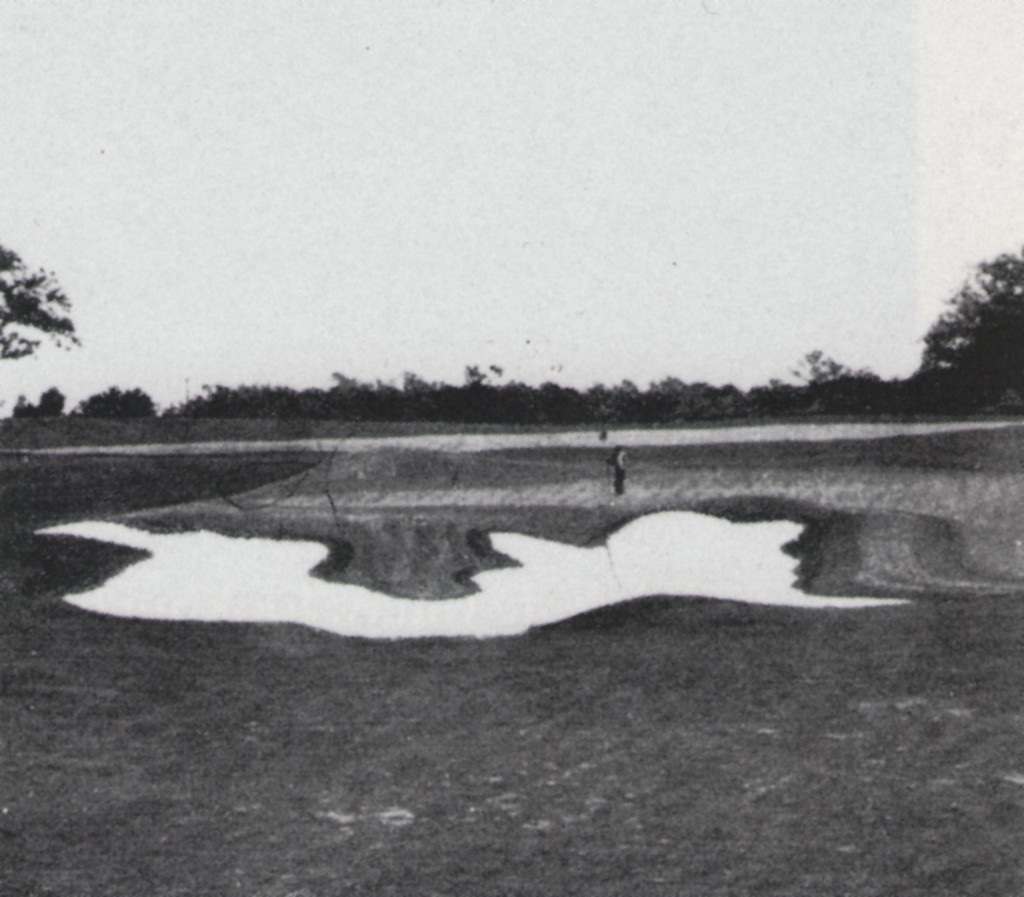
Augusta National's second green in 1935, when it had just one bunker.

During Augusta National’s early years, in the 1930s, the second hole had a vast, ragged bunker in the fairway, not far from the tee. A more subdued version of that bunker survived into the mid-sixties, when Clifford Roberts, the club’s chairman and co-founder, replaced it with a smaller bunker farther down the fairway and to the right. “The players all complained when Roberts put it in,” Gene Sarazen, who suggested the change, told me in the late 1990s. “But it didn’t mean a thing when you complained to Roberts. He had his own mind made up.” Among the players who complained was Ben Hogan, whose fade made the sand a genuine annoyance. Sam Snead told me, “Hogan said the bunker should have been placed on the other side, so you couldn’t cut the corner.” But the left side of the fairway was already well guarded, as it is today, by a grove of pines and a deep ravine with a creek at the bottom of it—one of the few spots on the course where a player can hit a truly unrecoverable drive. Gardner Dickinson once suggested that the tournament’s airline office—a Roberts innovation, which enables players and tournament spectators to make last-minute changes in their travel plans without leaving the property—should be moved into the ravine, on the theory that any player unfortunate enough to hit his tee shot down there might as well book a flight and go home. In recent years, the carry from the tournament tee to the fairway bunker has been stretched to more than 300 yards, but some players are able to hit their drives right past it. And hardly anybody employs Hogan’s second-hole strategy: intentionally hitting his second shot into a greenside bunker and trying to get up and down for birdie from there.

The second green in 1948: two greenside bunkers with a broad gap between them.

Tom Watson, Seventh Grader

Wheezer, 1962

Tom Watson and I had the same seventh-grade math teacher. Watson is six years older than I am, but we attended the same school, in Kansas City. It was called Pembroke-Country Day then and is called Pembroke Hill now. It was boys-only in our day; it began to go co-ed when I was a senior.

My father had had the same math teacher, too, many years before. In my father’s day, the math teacher’s nickname was Tarz, short for Tarzan, because he was built like Johnny Weissmuller; by the time Watson and I had him, his nickname was Wheezer. He looked like Lyndon Johnson, with tremendous gravity-stretched jowls and ear lobes. Age must have lengthened his scrotum, too, because he was always careful to lift his testicles out of the way before sitting in a chair or leaning back against the front of his desk. Sometimes, my friends and I, as we took our seats for math, would pretend to lift our testicles out of the way, too.

Wheezer supervised one of my study halls. One day, an eighth-grader hid a running tape recorder inside a locker in the back of the room, and every five or ten minutes the tape would scream, “WHEEEEEEE-ZER!” There would be pandemonium; then, gradually, everyone would settle down; then it would happen again.

When Watson was in high school, in the mid-sixties, he was the captain of the golf team, of course, but he was also an outstanding shooting guard on a very good basketball team, and he was the quarterback (and leading rusher) on the football team, which won a conference championship. He would put his golf clubs away every August, when two-a-day football practices began, and he wouldn’t touch them again until February, when basketball season was over—a mentally and physically healthy approach to sports that athletic prodigies don’t follow anymore.

I never saw Watson play golf, but I did cheer for him at basketball and football games. Then, in 1967, he went off to Stanford without a scholarship, figuring he’d end up in the insurance business.

Watson was the subject of one of my first magazine articles, a profile for Esquire, which ran in 1982. I had to revise the ending over the summer, as it went to press, because he suddenly won the U.S. Open, at Pebble Beach, after making his famous chip-in birdie on the seventeenth. And then, in July, after the issue could no longer be updated, he won the British Open, too.

These photographs are from Pembroke-Country Day’s yearbook for 1967, when Watson was a senior and I was in sixth grade. I’m pretty sure I was in the bleachers at the football game below, because my friends and I didn’t miss many. Watson is at the far left.