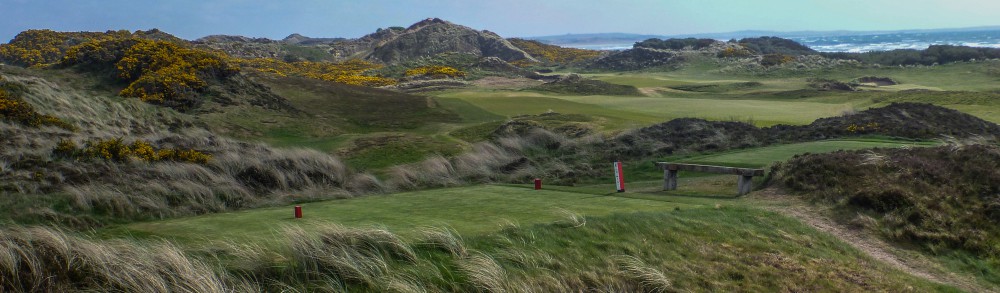
Back-Roads Scotland: Moray Coast

Lossiemouth, Scotland, March 26, 2012. Photo by John Thomson.

The photo above was taken this past Monday evening in Lossiemouth, Scotland, about two hours’ drive northwest of Aberdeen. You are looking across a corner of the North Sea toward the Moray Golf Club, the Lossiemouth Lighthouse, and both the waxing crescent moon and Venus. The photo was taken by John Thomson, a Moray member, whose Uncle Alistair was the club’s professional for thirty-one years and whose father was responsible for the construction of the club’s second eighteen. I haven’t played Moray, but I’ve gazed longingly at both the course and the clubhouse from the Stotfield Hotel, across the street. Here’s what I saw from the hotel’s front door during a trip in 2007:

Moray Golf Club, Lossiemouth, Scotland, 2007.

Moray is one of a number of fine links courses along on the Moray Firth’s southern edge, a hundred-mile stretch of golf-friendly coastline that runs between Inverness and Fraserburgh. Traveling golfers are probably most familiar with two courses at the western end, Castle Stuart and Nairn, which are popular stops for Americans on their way to Royal Dornoch. But those aren’t the only worthy courses on the Moray coast. Others: Nairn DunbarHopeman, Spey Bay, Buckpool, Strathlene, my beloved Cullen, Duff House Royal (not a links course, but significant because it was redesigned, in 1923, by Alister MacKenzie), Royal Tarlair, Rosehearty, and Fraserburgh. And there are many good inland courses nearby as well.

Lossiemouth would make a convenient base camp for any golf trip to the Moray coast. John Thomson, who took the photograph at the top of this post, owns the Links Lodge, a guest house next to the Stotfield; he also owns an adjacent three-bedroom self-catering apartment, the Beach View, which sleeps six. (If there are four golfers in your group, you can do what three Golf Digest editors and I did during a trip to southwestern Ireland in 2006: play a match to determine who will have to double up.) The Links Lodge served as Moray’s clubhouse for the first three years of the club’s existence, between 1889 and 1892; it was then replaced by the building in the photograph below. (The building has been enlarged considerably since then.)

Moray Golf Club, first dedicated clubhouse, 1892.

Thomson told me, “We only found out the Links Lodge was the original clubhouse while replacing a window: we took out a piece of frame with the carpenters’ delivery note still stuck to it.” The first owner, Thomson said, must have been one of the gentlemen in this photograph:

Founding members, Moray Golf Club, 1893.

He continued, “We boast not one but two prime ministers as members—and expelled one of them. We have one of the longest associations of any club in the world with our own labeled malt whiskey (since among the founders were some distillers). Dai Rees, Max Faulkner, and Fred Daly played exhibition matches here, and regular visitors included Ted Ray, Harry Vardon, J. H. Taylor, and James Braid.”

I’ll be in northeastern Scotland next month. My itinerary won’t take me to Lossiemouth, I’m sorry to say, although it will take me to Fraserburgh. I’ll report, eventually. In the meantime, here are a few photos of Hopeman, about four miles west of Moray. I took them in 2007. As you can see from the first, a breeze was blowing the day I played.



Masters Countdown: Seventh Hole


A not especially intelligible drawing of Augusta National's seventh green, from the program for the first Masters, in 1934, when the seventh had no bunkers.

The seventh wasn’t much of a hole in the early days. (The consensus, as described by Clifford Roberts, the club’s co-founder and chairman, was that it was “the only weak hole out of the eighteen.”) Alister MacKenzie, who designed the course, likened it to the eighteenth at St. Andrews, but the resemblance was superficial. Both holes were short, and both had large greens and no bunkers, but in comparison with the venerable and surprisingly difficult closing hole of the Old Course, the seventh at Augusta was a pushover. Many players today would have been able to drive it.

In a letter to MacKenzie in 1933, Roberts wrote, “I think the real criticism . . . is that it lacks character. Ed Dudley [the club’s first professional] made a suggestion which appealed very much to me. He proposed putting a bunker in the middle of the face of the green and letting it wedge into the green. In other words, his thought is to partly develop this green into two sections, the same as is true of one of the greens at Lakeside, California. Bob [Bobby Jones] did not have very much to say about this proposal, but I do not think he was much impressed by it. I think, in truth, that Bob is really hesitant about making any alterations or incidental refinements till you can come here and see the layout.”

Perry Maxwell

Nothing significant happened until 1938, when Horton Smith—who had won the first and third tournaments—suggested elevating the green and fronting it with several deep bunkers. He also suggested moving the green twenty yards back and to the right. Jones and Roberts both approved. The design work was done by Perry
Maxwell, an Oklahoma banker-turned-architect, whose best-known course is probably Tulsa’s Southern Hills. Maxwell had been a partner of MacKenzie’s during the final years of MacKenzie’s life. (Their last joint project, completed in 1933, was Crystal Downs, in Frankfort, Michigan.) The transformation of the seventh green, which cost $2,500, was paid for by Lewis B. Maytag, who was one of the club’s earliest members and was the head of the Maytag Company. In addition, the driving area was tightened through the addition of a grove of pine trees on the left side of the fairway. (There were already trees on the right.)

Maxwell made several less dramatic changes in other greens—among them the first and the fourteenth, to which he added pronounced undulations. Such undulations were his trademark and were known as “Maxwell rolls.” MacKenzie was no longer alive at that time, but he undoubtedly would have approved: he loved dramatic contours. In The Spirit of St. Andrews, he wrote wistfully about the early greens at Machrihanish, a legendary links course, designed by Old Tom Morris, on the Kintyre peninsula in western Scotland: “Some of the natural greens were so undulating that at times one had to putt twenty or thirty yards round to lay dead at a hole only five yards away. These greens have all gone and today one loses all the joy of outwitting an opponent by making spectacular putts of this description.” For the disappearance of such features, MacKenzie blamed a preoccupation with the elimination of “unfairness”—a word that he scornfully placed in quotation marks.

Today, the seventh is 450 yards long—110 yards longer than it was for the first Masters—and the landing area is narrow. Just fifteen years ago, the seventh was considered a birdie hole, even by members. Now it’s a tough par for any player whose tee shot ends up in the pine straw.

How to Take a Golf Trip With Friends


How to stock a golf-trip refrigerator. (Ferris's house, Pinehurst, 2006)

My regular golf buddies and I have taken many trips together, and, by trial and error, we’ve learned a lot about what works and what doesn’t. Here are some tips:

Do give one person the overall responsibility for managing the itinerary, keeping track of reservation deadlines, reminding laggards to make their deposits, and deciding which minor tasks can safely be delegated. Having a single, reliable leader makes it less likely that critical details (such as tee times) will be forgotten, and creates a clear blame path if things go wrong.

Don’t automatically assume that nobody will be up for more than eighteen holes a day or (equally important) that everybody will. During a buddies trip that eight friends and I took to Scotland in 2008, we designated one round as the official eighteen for each day, so that oldsters could flake out in the afternoon without losing their place in the standings. On the final day of an earlier, ten-day trip to Ireland, when even the golf obsessives had begun to fade, we revived everyone’s spirits by playing a scramble in the afternoon.

Do establish a centralized rule-making authority with the power to silence whiners, naysayers, and independent thinkers. Among my friends, this authority is called the Committee, and it typically consists of Hacker (real name) plus one or two people who, over the years, have satisfied Hacker that they are likely to agree with him. The Committee has many responsibilities, including picking the games, choosing the stakes, deciding whether or not Gene will be allowed to play from the senior tees, and settling minor but potentially divisive issues as they arise, such as do we get a first-tee do-over or not, and what about handicap strokes on par-threes? The Committee’s decision is always final—a relief to most people, who go on golf trips to escape their current responsibilities, not to acquire new ones.

The Committee.

Don’t allow trip-threatening behavior to go unpunished. On the second morning of our annual Atlantic City trip a few years ago, one foursome drove to the wrong golf course (with Hacker, of all people, at the wheel), even though all five cars had left our hotel at the same time and everybody had been given printed driving directions. The resulting confusion came close to ruining the whole trip, or so we said. When the round was over, we restored order by conducting a trial in the clubhouse—taking advantage of the fact that two of the participants that year were lawyers—and sentenced the offenders to pay for everybody’s lunch.

Do collect all wagers before anyone tees off. Losers always outnumber winners, and on a large golf trip that means that if the prize money isn’t in hand when the scores are tabulated the victors will have to collect from a sullen mob. We handle this on our golf trips by collecting a single buy-in on the first morning of the whole trip—currently, a hundred bucks a man—and paying all prizes for the trip out of that fund.

Don’t let the stakes get out of hand. The purpose of playing for money is to make three-foot putts seem important, not to let anyone get rich. We try to spread the prize money around by having lots of complicated side bets, all paid off from the same hundred bucks. The big winner, furthermore, is expected to buy lunch on the last day.

Do establish community-building trip traditions, such as our rule that recovering alcoholics drink free.

Don’t feel you have to do everything as a group. We often split up for dinner, primarily to eliminate tedious late-afternoon arguments about who is willing to pay how much to eat what. Doing this also occasionally generates interesting demographic data, as it did on the night when (as someone realized later) all the Democrats went to a sushi bar while all the Republicans went to Outback. (Figuring out that this had happened took some deductive work, because in our group, as in all successful golf groups, we almost never mention politics, even with people we agree with.)

Do be careful about the guest list. We usually open up our trips to friends from outside our club, and even to friends of friends. This has beneficially expanded our acquaintance with overweight middle-aged men from outside our immediate geographical area, but it has occasionally led to problems. One year, one guy invited an old high-school friend of his, whom he hadn’t seen in years. The old friend, who began drinking as soon as he got into Hacker’s car, bought a dozen condoms at a convenience store during the first refueling stop, then stashed the box under his seat and forgot all about it. A week after we got back, Hacker’s wife discovered the condoms and—here’s the problem—didn’t believe, even for a minute, that they belonged to any of us.

Don’t let a buddies trip end without establishing a Committee to pick the next destination.

How to load a rental car. (Cruden Bay, Scotland, 2008)

Coolest Place to Stay in St. Andrews

A terrific guide to golf in Scotland is Golf in Scotland, by Allan McAllister Ferguson, a personal travel planner. The fourth edition has just been published. If you’re going to Scotland, or if you dream of going to Scotland, you need a copy. You should also get sign up for Ferguson’s newsletter.

I took a golf trip to Scotland in 2008 with eight friends from home. Our best lodgings were in St. Andrews, where we spent two nights in a nineteenth-century house on North Street, a short walk from the Old Course. The house, which was designed by the same man who designed the main part of the R. & A. clubhouse, was recommended to me by Ferguson. It had five double bedrooms, and it came stocked with orange juice and candy bars, and there was a gas grill and a lighted artificial putting green in the backyard. And it set us back just $70 per man per night. If we’d known how cool it was going to be, we might have thrown out our itinerary and stayed there the whole time. Here’s a photo of the backyard:

This is how you're supposed to spend the evening after you've played 36 holes on the Old Course.

Unfortunately, the house doesn’t seem to be available at the moment. Ferguson told me he thinks it may be closed for good, but the house’s website is tantalizing. (It also has more pictures.) You might also try sending a begging email to the owner, Stuart Lloyd, who is an English urologist and an R & A member. (The address is on the website.)

Lloyd loves golf more than you do. He and his wife, who is also a doctor, live in Leeds, five hours away, but they spend a lot of time in St. Andrews. They also own a second house there, and in the backyard of that one Stuart built a three-quarter-scale replica of the Road Hole bunker:

If you can’t talk Lloyd into putting you up in St. Andrews, Ferguson has other suggestions—some of which he saves for his newsletter.

Back-Roads Scotland: Cullen

In 2007, I traveled to Scotland on an unusual Golf Digest assignment. I landed in Glasgow without tee times or an itinerary, and I rented a car and set out in a more or less random direction, with the goal of playing only courses I’d never heard of before. You can read my article about that trip here or here.

One of my favorite stops was a quirky course called Cullen, in Aberdeenshire, on the southern coast of the Moray Firth. The original nine holes were laid out by Old Tom Morris, and the course has blind shots, crossing fairways, otherworldly topography, and a cool tee shot that you hit from the top of a cliff. Partway through my round, I joined (as the fifth player) a group of older golfers from a club called Hopeman, about thirty miles to the west. They were on a golf outing, and this was their second round of the day, and they were playing a scramble, in competition with three other groups from their club. Most of them were carrying flasks, from which they were sipping a mixture of something and Drambuie—I couldn’t quite make out the recipe—and their golf bags were so full of empty beer bottles that they clanked when the wind, which was fierce, knocked them over.

They urged me to have a swig from one of their flasks. I declined, because I’d quit drinking about a year before, but they were so relentless that I eventually decided it would be better to risk falling off the wagon than to come to blows. As soon as I’d drunk a capful, though, they began to worry about their supply. “Are you driving?” one asked. His brow was furrowed with concern. When I said I was, he and the others concluded that offering me another swig or a beer would be unwise. Toward the end of the round, one of them asked, in a slurry brogue, “Wha hoe wah noo?” and only I could understand him: “What hole are we on now?” (It was the seventeenth.) Photo below. That’s the eighteenth green in the distance. I went back a year later with friends from home.

The boys from Hopeman: "Wha hoe wah noo?"

The specialty in the clubhouse—at left in the photo above, behind the big rock—is Cullen Skink, a fish soup that has its own Wikipedia entry.

The bent flag shows how hard the wind was blowing.

Looking back toward the clubhouse and the town.

The boys from Hopeman and some of their beverages.

Here’s where my friends and I stayed in Cullen when we went back the following year:

Bunker Dogs

This afternoon, I took a walk on my home golf course with my dog, Henry the Dog. I let him off the leash, and he spent most of the walk running far ahead. On the sixth hole, he surprised himself, after racing across the green, by going airborne over the lip of a bunker. He landed halfway across the sand, like an Olympic long-jumper, then spent five minutes repeating the jump and running in tight circles, pausing occasionally to dig a hole.

Then he stopped to catch his breath and study what he had done, and we headed  back toward the parking lot. I’ll rake that bunker in the spring.

Henry reminded me of another happy dog I walked a golf course with, on the island of South Uist, in far northwestern Scotland, in 2007. That dog almost disappeared down a rabbit hole: