18 Good Things About Golf: No. 11

Four walkers, Old Head Golf Links, Kinsale, Ireland, May, 2006.

11. If you walk and play fairly quickly, golf provides real exercise—not aerobic exercise, usually, but a mildly elevated level of metabolic activity. Golf doesn’t ruin your knees the way running and tennis do, and the time you spend playing golf is time you can’t also spend sitting in front of the TV eating coffee ice cream and drinking Yoo-hoo. Mark Twain famously dismissed golf as “a good walk spoiled,” but it’s actually a walk improved, since golf, unlike mere walking, gives you something challenging to think about, as well as something interesting to do with your hands. Golf is a walk with a purpose.

Member-guest, 2007.

Want to Buy a Building Lot at Augusta National?

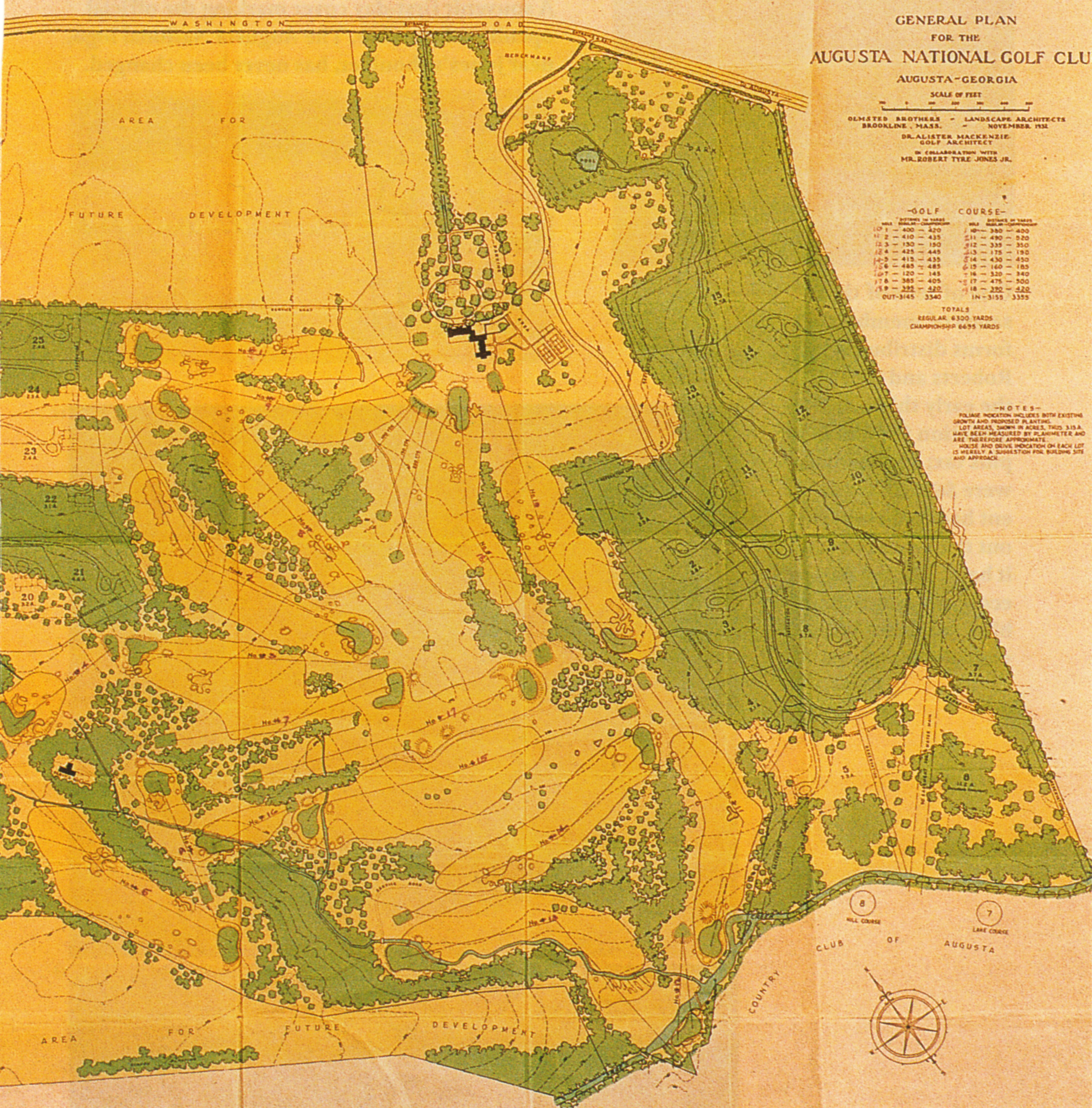
Olmsted Brothers' 1932 Augusta National real-estate development plan. If your eyes are good enough, note the tennis courts and the brand-new clubhouse—none of which were built. Also note the small practice area, between the ninth and eighteenth holes.

Augusta National Golf Club suffered severe financial problems during its first two decades, which coincided with the Great Depression and the Second World War. Its lenders actually foreclosed in 1935, just eight months after Gene Sarazen had seemingly secured the future of both the club and the Masters by hitting “the shot heard round the world.” (I explore those difficulties at some length in The Making of the Masters.)

One of the club’s best hopes for raising money in the early years was to sell building lots overlooking the course. Roughly a third of the club’s property was reserved for that purpose, and the lots were delineated and numbered on several early maps, including the plan reproduced above. For the most part, the lots occupied areas west of the second fairway and east of the tenth and eleventh. (Note to Laurentius: The spot where Rory McIlroy’s yanked tee shot on the tenth hole ended up during the final round of the 2011 Masters was near the edge of Lot No. 1.)

The club’s development plan, which was created by the landscape architecture firm Olmsted Brothers, called for two dozen building sites, and additional acreage was reserved for more. Most of the lots were between three and five acres; the largest, No. 6, was twelve acres. The club actively tried to sell those lots or others for more than twenty years. Boundary lines were cleared, access roads were built, lots were numbered with signs that faced the roads, and a major, continuing effort was made to stir up sales—all without success. In the early 1930s, W. Montgomery Harison, an early member, bought three adjoining lots just beyond the first green, but he was the only taker. He built a huge brick mansion, which stood until 1977, and the elder of his two sons built a much smaller house next door. (Harison’s younger son, Phil, was the tournament’s official starter for more than sixty years. He died 2008, at the age of 82. His own son is a member now.)

W. Montgomery Harison's house overlooking Augusta National's first green, during the Masters in 1941. (The photographer was standing near the ninth green and looking up the first fairway.) The house was torn down in 1977.

After the war, the club briefly considered leasing or renting the remaining lots, at annual charges ranging from $250 to $500 a year. When no enthusiasm for that idea was evident, the club gave up on the original subdivision and for four or five years pursued a more modest development plan in a different location. This new subdivision—which was to be called De Soto Trail—was situated just east of the area now occupied by the par 3 course. It consisted of twenty-four lots, most of them about a half-acre, and was targeted not at club members but at local middle-income families. To avoid the expense of building an access road and installing utilities, the club in 1949 offered the entire parcel to Augusta real-estate agents. There were no bids. The club then tried without success to sell the lots individually. Late in 1952, a developer offered $18,000 for fifteen acres. Roberts viewed that figure as too low, and the club eventually abandoned the entire idea.

Today, golf fans and even club members are almost always amazed to learn that Augusta National, in more than twenty years of conscientious effort, could turn up only one buyer interested in building a house near what today may be most fabled golf course in the world. If the same lots were offered for sale today, the bids would undoubtedly be astronomical. The failure of the real-estate projects underscores the immensity of the challenge that Clifford Roberts and Bobby Jones, Augusta National’s founders, faced in nearly every area of the club’s operation. As late as the early 1950s, Roberts couldn’t get local real-estate developers to return his calls.

It was only in the mid-1950s—when the tournament was securely established, and both the club and the country were on better financial footing—that Roberts began to view all development ideas as a mistake. A local club member named Julian Roberts (no relation) eventually bought Harison’s property and later sold it back to the club. One of Clifford Roberts’s last acts before taking his life, in 1977, was to walk to the first tee with the help of a waiter so that he could look up the fairway and assure himself that the house had been torn down.


Should You Live on a Golf Course?

Houses overlooking the second fairway, Cruden Bay Golf Club, Scotland, May, 2008.

To live on a golf course is not a universal aspiration. At a club where I sometimes play, a dozen houses back up to various fairways. Over the years, the owners of those houses have taken pains to obliterate their views of the course. They’ve built fences, planted bushes and trees, and hung No Trespassing signs. One scary old guy patrols the boundary of his yard the way East German soldiers once patrolled the Berlin Wall. Follow a bad drive into his garden and he unchains his dog.

It’s not that the course is ugly or the golfers rude. It’s just that to some people a fairway is no more attractive than a freeway. Golf, to them, is a public nuisance. (You can’t sunbathe in your underpants when local slicers treat your patio as a cart path.) Some people live next to golf courses because they figure they can’t afford to live someplace nice.

Howard indicating the house I'm going to buy as soon as this blog has made me rich. Royal Portrush Golf Club, Northern Ireland, April, 2012.

I belong to the opposing camp, the folks who view an adjacent par 4 not as an invasion of privacy but as a big, free, weedless lawn. At least, I would if I lived next to one. The perfect neighborhood, in my view, would be the one in the photo above, next to the fourth fairway at Royal Portrush, in Northern Ireland. Or how about something ocean-oriented at Cypress Point, in California? I’ve even picked out a building site: that wind-swept knob to the right of the sixteenth green:

Sixteenth hole, Cypress Point Club, Pebble Beach, California.

I wouldn’t care if a stray shot shattered my front window every once in a while. Heck, I wouldn’t care if you and your foursome cut through my kitchen on your way to the seventeenth tee. Help yourselves to beer! I’d just like to be able to step out my back door and tee it up whenever I wanted to.

I'd also be happy with any of these. North Berwick Golf Club, Scotland, April, 2008.

Next: Would you be willing to spend a few hundred dollars for a building lot at Augusta National? You (or your parents or grandparents) could have, but didn’t.

Scientist Identifies Evolutionary Basis of Love for Golf

Ur-golfers, working on their short game.

In his new book, The Social Conquest of Earth, the retired Harvard sociobiologist Edward O. Wilson writes about the “innate affiliation” that humans feel with landscapes that resemble “those environments in which our species evolved over millions of years in Africa.”  That is to say, golf courses.

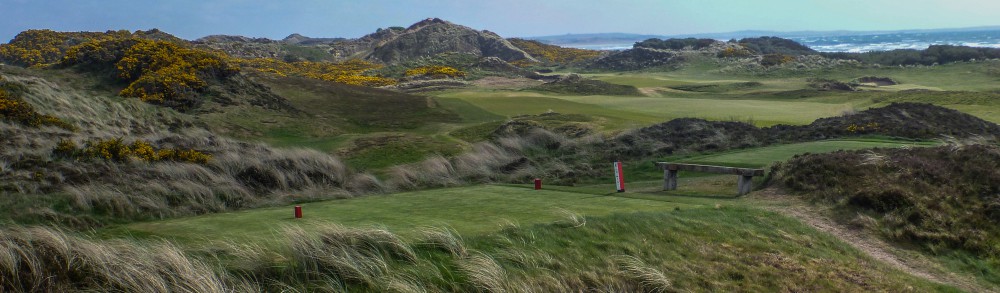
“Studies have shown,” Wilson writes, “that given freedom to choose the setting of their homes or offices, people across cultures gravitate toward an environment that combines three features, intuitively understood by landscape architects and real estate entrepreneurs. They want to be on a height looking down [tee boxes], they prefer open savanna-like terrain [fairways] with scattered trees and copses [rough], and they want to be close to a body of water, such as a river, lake, or ocean [hazards].” For a good example of just such a landscape, you need look no farther than the photograph at the top of this page, which I took last spring at Royal County Down Golf Club, in Newcastle, Northern Ireland. Here’s another, from Cruden Bay Golf Club, in Scotland:

Cruden Bay Golf Club, Scotland, April, 2008.

And the game itself is biologically resonant. Part of its addictiveness, for those of us who are hooked, arises from the thrill of effecting action at a distance—a form of satisfaction that must also have been known to our spear-throwing ancestors. A golfer is a hunter. Stiffing it on a par 3 and felling a woolly mammoth are parallel thrills. We are as nature made us.

Women don’t necessarily feel the same way about golf, and there’s an evolutionary explanation for that, too: men are chromosomally predisposed to doing virtually anything their wives don’t want them to do. (My first literary agent, an enlightened woman, provides ironic support for this hypothesis. For many years, she has tried to persuade her husband to take up golf—“I want to be a golf widow,” she told me once—but he has refused.) Such innate contrariness must have given our humanoid ancestors a powerful evolutionary advantage. A possible scenario: Female cave people implored their mates to spend more time around the cave, picking up saber-tooth tiger bones and entertaining the children; those who complied watched their families slowly starve to death, while those who ignored their mates and went hunting instead survived. In such beneficent behavior we may be seeing evidence of the forerunner of the modern golf gene.

Golf Logos Explained: Narin & Portnoo Golf Club, Ireland

Narin & Portnoo Golf Club is situated among the dunes on a knock-you-over nub of the Atlantic Ocean called Gweebarra Bay, on the northwest coast of County Donegal. The club’s entrance is not captivating: you reach it by driving into the sort of tawdry-looking trailer park that the Irish and British seem to plant on all their choicest oceanfront real estate. But the course is tremendous. Kevin Markham, who has played every 18-hole course in the country, has described the seventh through eleventh as “maybe the best run of holes in Ireland.” The fifteenth, which measures 530 yards and plays into the prevailing wind between a line of dunes and the sea, is the hole that the ninth and tenth at Pebble Beach are trying to be. And the encampment of caravans—whose occupants, it should be said, sustain both the club and its bar—are invisible after a few holes.

On my first visit to the course, in 2011, I played with Connor Mallon, the club’s pro at the time, and set a new record for conversational tedium by saying “Wow! Great hole!” almost every time I opened my mouth other than to comment on the wind, which was intense. (Usually, when you mention wind on a links course, the natives you’re playing with dismiss whatever’s blowing as a breeze, even if you’re having trouble standing. But Mallon, good man, said he’d never known such a gale.) Later, on my way out the gate, I mentally composed an email to my wife, beginning: “Darling, how would you feel about living in a mobile home 750 miles from the Arctic Circle?”

I returned to N & P last month, with six friends from home. Between rounds, I asked a couple of older members, who were hanging around the golf shop, to explain the meaning of the symbols in the club’s logo, but they couldn’t. Eventually, someone looked it up online, and we discovered that the crest was created in 1982, at the request of the club, by a local art teacher. It is “unusual in not featuring any golfing imagery, focusing instead on the historic roots of the area,” the club’s website says. Here are the elements:

The Stonehenge-y thing at the upper left is the Kilclooney Dolmen, which stands above a 4,000-year-old tomb a few miles south of the course, near the village of Ardara (population 578):

Kilclooney Dolmen, near Ardara, Ireland.

The structure at the upper right is known as the Doon Fort, the Bawan, or O’Boyle’s Fort. It’s a circular defensive stone enclosure, and it stands on a crannóg, or artificial island, in Doon Lough, a lake a couple of miles southwest of the course. It was built in 1500 or so by the O’Boyles, who had troublesome neighbors:

O'Boyle's Fort, Doon Loch, County Donegal, Ireland.

Filling the bottom two panels is the Atlantic Ocean, which is a major presence at Narin & Portnoo. The green peak in the middle is the island of Inishkeel, which in decent weather is visible from parts of the course. The island used to have two churches, one for nuns and one for monks. Both are now ruins:

Ruined church, Inishkeel Island, County Donegal, Ireland.

And the U-shaped object in the center of the logo isn’t a horseshoe, as certain of my friends guessed. It’s the Drumboghill Gold Lunulaa Bronze Age necklace shaped like a crescent moon. It was found in a bog near the course in 1909, and is now in the collection of the National Museum. The club’s website says that its shape “matches the arc of the sixth hole.”

Connor Mallon, my host in 2011, took his life on March 14, 2012, at the age of 35. I’d been looking forward to seeing him again, and to having a rematch. At every stop on our 2012 trip, I met people who had known and loved him. In 2011, I bought a shirt from him exactly like the one he’s wearing in the picture below, because I thought that maybe its color held the secret to his golf swing.

Connor Mallon, Narin & Portnoo, near the ninth tee, May 1, 2011.


These are the Best Golf Shoes, and I’m Not Kidding

The True Linkswear golf shoes of Tony, David O., Tim-o, & Tim. Royal Portrush Golf Club, Northern Ireland, April, 2012.

Among the hits of last year’s PGA Golf Merchandise Show were some unusual golf shoes, made by True Linkswear. They look a little like Earth Shoes and a little like Crocs: the front end is wide, allowing your toes to spread out the way they do when you walk barefoot, and there’s almost no heel. A teaching pro who now works for the company told me, “It took me a week to get over it, visually.” But golfers learn to love the look, he said, and are often able to throw away their orthotics, like crutches at a revival meeting. (It’s also possible that True Linkswear shoes promote a slightly better swing, by making it harder for you to lean over your toes.) The company’s reps brought 300 pairs to Orlando but had to stop selling them after just a few hours because they were running out of samples. By the time I got to the booth, they no longer had a pair in my size, but the ones I tried on—which were half a size too small—were still the most comfortable golf shoes I’d ever worn. I now own four pairs.

I took two of those pairs to Ireland this month, along with some New Balance walking shoes. I figured that the walking shoes would be good for après-golf—but I was wrong about that, because by comparison with my golf shoes they felt like army boots. I wore the walking shoes when we went out to dinner our first evening in Ireland but left them in the car after that, and wore only my golf shoes. And I never felt even a twinge, despite the fact that, according to Tim-o’s Fitbit Ultra, we walked between eighteen and twenty-two miles a day (while playing 36 holes and searching for balls among the dunes). And I wore my Trues on the flight home, too.

I wasn’t the only True believer on the trip: Tony, Tim-o, Tim, and I all wore them, in various models and colors—as you can see in the photo above.That’s four of the seven golfers on the group. And Jack wore FootJoy Contour Casuals, which look and feel like sneakers and which he also didn’t bother to take off. It’s now hard for me to believe that golfers ever played in shoes that had stiff soles and metal spikes and had to be broken in.

I’ve retired my original pair of Trues from active golf duty, but I wear them when I work in the yard, walk the dog, and wander through the woods. I’d wear them in the house, too, if I ever wore shoes in the house. And a day will come, I predict, when I will own no other shoes.

Brendan icing a foot rubbed raw by a week of links golf in conventional golf shoes. Cullen Golf Club, Scotland, May, 2008.

In Love With Ireland

Portstewart Golf Club, Northern Ireland, April, 2012.

Six friends and I returned this afternoon from eight days and fourteen rounds of golf in Northern Ireland and Ireland, and earlier this month I spent a similar week, by myself, in northeastern Scotland. I’ll have more to say both trips as soon as I’ve reintroduced myself to my wife and gotten caught up with the pile of stuff on my desk. In the meantime, I’ve been thinking about an earlier Ireland trip, back in 2006, and something that happened on the evening I arrived in Shannon (from Dubai!).

The baggage carousel was still revolving, but several minutes had passed since the last suitcase tumbled onto the conveyor. A young woman in a green Aer Lingus uniform walked over to me. “Is your bag missing?” she asked, her eyes radiating concern. I looked around. The other passengers had departed. The truth sank in. “My g-golf clubs,” I said.

It’s the traveling golfer’s nightmare. I had come to Ireland to spend a week playing southwestern seaside courses, and now, I thought with horror, I was going to have to play Ballybunion with rented equipment—with battered, mismatched irons and woods contaminated by the bad-swing juju of who-knew-how-many anonymous choppers, shankers, and honeymooning beginners. How could I face Waterville without my very own Banzai-shafted 10.5-degree jumbo driver, not to mention my humiliatingly extensive but indispensable collection of hybrids?  I followed the Aer Lingus woman into her office, where she helped me file a claim.

Fifteen minutes later, I was sitting numbly in a taxi, on my way to the tiny resort town of Lahinch (which is famous in Ireland not only for golf but also for surfing, of all things). Three Golf Digest colleagues would be joining me there the following afternoon, along with two rental cars. I was trying hard to appreciate the lush landscape on either side of the road, but I couldn’t stop thinking about my clubs. Why couldn’t the airline have lost Jodie Foster’s daughter instead? Then the driver’s cell phone rang.

“Right,” the driver said, after a brief conversation. “You’ll have your golf clubs by noon tomorrow. I’ll probably deliver them myself.” The young woman in the lost-baggage office, it turned out, had located my bag, in London, and had then taken the time to locate me, by telephoning the taxi dispatcher and asking if a Mr. Owen had been sent to Lahinch. I leaned back against the seat and smiled, finally able to relax. The next morning, I borrowed a set of clubs from Robert McCavery, just the fourth head professional in Lahinch’s 120-year history—he succeeded his father, Bill, who got the job in 1927—and played eighteen holes with two middle-aged women from Switzerland, who were traveling without their husbands.  My golf bag arrived just as we finished.

A week later, I was back at Shannon Airport, killing time before my flight home. And sitting at a table on the other side of the coffee shop, I suddenly noticed, was the young woman from the lost-baggage office—the woman who, a week before, had tracked me down in my taxi. I rushed over, and thanked her for her kindness.

She looked startled for a moment, then smiled. “Mr. Owen,” she said.

We have a responsibility, as golfers and as Americans, not to abuse the hospitality of this gracious, enchanting country.

Tony, Tim-o, Dave-o, Tim, David W., Howard, Jack: Enniscrone Golf Club, Ireland, April, 2012.

Improved Golf Transit

Trolleys, Portstewart Golf Club, Northern Ireland, April, 2012.

At home, my friends and I have almost always walked and carried our bags. In Scotland four years ago, though, we became semi-converted to pull carts–which are called trolleys in the U.K. and Ireland (and are called buggies in Australia). At first, we weren’t very good at handling them and were constantly tipping them over and crashing them into one other, as you can see in the photo below, from Cruden Bay in 2008. (Those are the steps that connect the first tee and the clubhouse. A trolley ramp is built into them, but we still managed to screw everything up.)

Trolley accident, Cruden Bay Golf Club, Scotland, 2008.

Unfortunately, the standard rental trolley is ill-designed for the only job it has to do. An easy way to make up for its major defect is to travel with your own bungee cord, as I do, and use it to secure your bag to the frame, as in this photo, from Enniscrone, where we played yesterday:

Golf bag secured to rental trolley with bungee cord, Enniscrone Golf Club, Ireland, April, 2012.

I still overturn my trolley fairly often, but when I do my bag doesn’t usually fall completely off. The only time I got into serious trouble yesterday was as I was leaving the fourteenth green. I took a path that was meant not for trolleys but for mountain goats, and eventually had to pick up the trolley itself (with the bag securely attached) and carry it.

Ireland: Tony’s Amazing Inflatable Rainsuit

Today, six friends and I played 36 holes at Narin & Portnoo Golf Club, in northwestern Ireland. I wrote about the course and that part of the country last year, in Golf Digest, in an article called The Road Less Traveled. Today, the wind was blowing several hundred miles an hour–as you can see in the video above, which shows Tony and his amazing inflatable rainsuit on the eighth tee–but there was hardly any rain and only a tiny bit of sleet. Between rounds, I asked a couple of older members, who were hanging around the golf shop, to explain the meaning of the symbols in the club’s  logo, but they couldn’t. Someone eventually looked it up online, and the answer was extremely interesting, although now I don’t remember what it was or where they found it. The simplest thing would probably be for you to go yourself, and ask them to look it up again–and you really should do that, because the course is A-plus-plus. (I’d post an image of the logo, but I can’t find a decent one on the Web–another good reason to visit in person.)

The day before, at Portsalon, we had an incident (referred to in court documents as the Incident) that may be of interest to legal scholars. Howard (referred to in court documents as Player H) had a three-foot putt for par which was well outside our standard gimme distance (the length of the longest foot in the foursome). He picked it up because Tim had a par already. On the next tee, we realized that Howard had had a stroke, meaning that his putt had actually been for net birdie. What to do? We decided that the fair thing would be to recreate the putt on the following green, and credit Howard with the birdie if he made it (which he did). Amazingly, the guys on the other team agreed with this ruling, and we have adopted it group-wide.

Here’s another look at that wind:

Golfer’s Cure for Jet Lag

The cure for jet lag is golf. You take the overnight nonstop to Scotland from Newark, arrive bleary-eyed in Glasgow at 8:00 in the morning, drag your clubs past the bomb-sniffing dogs in customs, stumble into a men’s room designated “loo of the year,” change a tall stack of American dollars into a short stack of British pounds, drive 55 miles through Robert Burns country while trying to remember to admire the sheep-dotted hillsides, reach Turnberry in a daze—and tee it up on the Ailsa course, where Tom Watson and Jack Nicklaus fought their legendary Duel in the Sun, at the British Open in 1977. You haven’t slept since what seems like the day before yesterday, but your tee shot somehow finds the fairway, and a little mental arithmetic reveals that your colleagues back home are arriving, just now, at their desks. Suddenly, you feel happier than you’ve felt since the birth of your first child, or since the time you and your brother nearly won the member-guest. (Not to worry: The cure for excessive cheerfulness is also golf.)

Or so I’ve decided over the years, during a number of golf trips abroad: Hit the ground running, and keep running until dinner. I was gratified recently when a doctor who treats sleep disorders, whom I was interviewing for an article, recommended the same thing. To beat jet lag, he said, don’t take a nap upon arrival (my wife’s approach); keep your eyes open until the locals call it a day, or at least until the sun has gone down. That’s what I did this past week, in Scotland, and it’s what I did again yesterday, when I got back home. And I’ll do it again tomorrow, when six of my friends and I take off for a week of golf in Northern Ireland and northwestern Ireland.

Yesterday, my last day in Scotland, I had to interview someone in downtown Edinburgh, and I took a taxi from my hotel, which was at the airport. A guy up ahead of us did something stupid, but the taxi driver anticipated it—he told me he could read the guy’s mind—and he honked and said “What an idiot!” almost before the guy himself knew what a stupid thing he was about to do.

The taxi driver doesn’t own a car, he told me; when he and his wife need to go somewhere far away, they rent one. Usually, they pick it up at 11:00 a.m. and return it the next day at 11:00 a.m. Sometimes, 10:00. He rents from Arnold Clark, and gets a medium-size car, like a Corsa or a Focus. Once, he got upgraded to a really big car because they were out of medium-size cars, and some of his relatives felt initially that he was putting on airs. Occasionally, when he and his wife go to visit his wife’s mother, who lives near the English border, they will use his taxi, an old-fashioned English black cab, and his wife will ride in the back, “regally.” In fact, when he retires, a few years from now, he may keep his taxi, because he enjoys driving it, and sell just the “plate,” which is their equivalent of a medallion. He and his wife go on holiday every September; last year, they spent two weeks in Greece. That cost £3,000, for the two of them, including air fare. He likes to stay in four-star hotels, but in Greece they stayed in a five-star hotel. He likes to take “all-inclusive” trips—self-catering is too much trouble on vacation—but the Greek trip included only breakfast and dinner. That didn’t bother him too much, because when he’s traveling he eats a lot at breakfast—orange juice, corn flakes, yogurt, porridge, eggs, sausage, bacon, black pudding, haggis, beans, you name it—so much that has to let out his belt when he leaves the dining room. His wife, by contrast, eats nothing but toast and sometimes has trouble making it even till lunch. Keeping the weight off is harder than it used to be, even though he goes to the gym, but what choice do you have? The places he and his wife like to go are: Spain, the Canary Islands, Greece, Majorca. They usually go away in September, after the schools have started up again, because then you can get bargains, but just yesterday he looked into going away in July, too. The best the travel agent could do, though, was £1,000 apiece, all-inclusive, for a week—even in Greece! He thinks it might be possible to do better online, but hasn’t checked yet. At any rate, the travel agent said to come back in July or August and have a look at September then. Next year, for his sixtieth birthday, his wife wants to take him to New York City, where he (unlike her) has never been. He wants to go, but four hours is the limit for him, air-travel-wise. Two hours, two and a half hours? Fine. He doesn’t start to panic if he’s in the air longer, but he doesn’t like it. The best way to fly to New York might be with a stop somewhere on the way—maybe in Iceland—to break up the flight. That might make the ticket cheaper, too, since the flight wouldn’t be direct. He thinks that four days should be enough for New York, and he has been told that the part of New York that he and his wife should visit is midtown Manhattan. He was very glad to hear that I agreed with that recommendation.