Sunday Golf in Brooklyn

Marine Park Golf Course; Brooklyn, NY; March 4, 2012; 46 degrees.

There are a dozen public courses in New York City, and they stay open all winter, as long as the ground is snow-free—as it usually is, thanks to the urban heat island effect and the proximity of the Atlantic Ocean. On Sunday, as Rory McIlroy was moving to the top of the world ranking, six members of my regular Sunday Morning Group and I drove to Brooklyn for a round at Marine Park. (Several of our favorite city courses have enticingly warm-sounding names: Marine Park, Pelham Bay, Dyker Beach.)

Marine Park is situated a few miles from J.F.K. International and a few hundred yards from Floyd Bennett Field, which was the city’s first official airport. (When Howard Hughes set a record by flying around the world in ninety-one hours, in 1938, his trip began and ended at Floyd Bennett. The old runway area is now a somewhat dystopian-looking public park and a New York Police Department helicopter base.) The golf course covers a little over two hundred acres inside the elbow formed by Flatbush Avenue and the Belt Parkway. It was designed by Robert Trent Jones and was completed in 1963—just in time for the World’s Fair, which was held virtually next door, in Queens, the following year. The holes have a genuinely linksy feel: few trees, subtly undulating topography, exasperating wind off Jamaica Bay (another warm-sounding name). There’s more broken glass in the bunkers than you’d find at Troon or Carnoustie, and the views from some of the fairways include more barges and giant dump trucks. But the greens on Sunday were fast and terrific, even though nobody had mowed them in months.

Hacker (real name), Marine Park.

In 2007, New York City accused the company that was operating Marine Park of having ties to organized crime, and revoked its lease. The new lessee is investing millions in the course, and has renovated the club house and added a driving range. We saw huge piles of topsoil alongside a number of  the fairways—raw material for improvements to come. The guy manning the cash register in the golf shop, who was also the starter, told us that the days when old car parts and toilet seats would sometimes pop up through the turf are gone.

When we’d finished our round (after playing the last few holes as a sevensome, since there were slowpokes ahead of us and no one behind), we caravaned to Pipin’s Pub, in Bay Ridge. We’ eaten lunch there before—on New Year’s Day 2008, after playing a cold, wet round at Dyker Beach—and ever since then we’d been meaning to go back, partly because almost the entire first page of the menu is devoted to various kinds of cheeseburger. The day’s winners threw all their winnings into the lunch pot, as we almost always do during the off-season, and we ended up leaving a huge tip because with seven people the arithmetic was just impossible.

Pipin's Pub. Photo taken by nice waitress with Irish accent.

City Island

Connecticut is supposed to get snow later today, so on Sunday my friends and I will probably have to go back to New York City to play golf on grass. Among our possible destinations are the two golf courses in the upper left-hand corner of the image above, from Google Earth. That’s Split Rock Golf Course on the left and Pelham Bay Golf Course on the right. (Split Rock, as you can see, has more trees and narrower fairways.) The two courses are divided by a Metro North commuter rail line, and to get from the clubhouse to Split Rock you have to walk under a rusty old train trestle–shown in the photo below, which was taken the first time we played in the Bronx, six or seven years ago.

Gene, D.O., Nick, Split Rock G.C.

When we play in the Bronx, we sometimes have lunch on City Island, which is in the lower right-hand corner of the Google Earth image at the top of this post. To get there from the golf courses, you cross City Island Bridge, the first version of which was built in 1873. City Island looks like the unacknowledged illegitimate child of Nantucket and Hunts Point Avenue. A Connecticut shipbuilder named Orrin Fordham invented oyster farming there, in the eighteen-thirties. Later, the local economy was dominated by boat-building and sail-making.(Five victorious America’s Cup yachts were built on the island.) Today, City Island contains what is almost certainly New York’s densest concentration of yacht clubs (six of them) and seafood restaurants (Johnny’s Reef, Tony’s Pier, Sammy’s Fish Box, and Sammy’s Shrimp Box, among many others), yet the restaurants’ parking lots tend to be enclosed by tall, barbed-wired-topped chain-link fences, like the exercise yards of medium-security prisons, and knowledgeable seafood-loving locals often order lamb chops or steaks.

At the bottom of Fordham Street, on the east side of the island, is a tiny ferry that runs between City Island and Hart Island, a half mile to the east. Hart Island served as a prisoner-of-war camp toward the end of the Civil War and currently contains a vast city-owned cemetery, a potter’s field, which is used for the interment of stillborn infants, unclaimed and indigent people of all ages, and amputated limbs. The deceased—among them the novelist Dawn Powell, who died penniless, in 1965—are buried in long trenches, in stacked pine boxes. The burials are conducted by prisoners from Rikers Island, who travel to and from the ferry landing in blue-and-white buses operated by the Department of Correction. That’s the landing in the photo below. Hacker (real name) and I saw it one Sunday, when we decided to splurge on a post-round, mid-afternoon feast at the Lobster Box.


Signs of Early Spring


Split Rock Golf Course, Bronx, New York, February 27, 2012

The Links at Union Vale was open today, but the manager said there was still snow on the second nine, so Hacker (real name) and I drove to the Bronx and played Split Rock. Hacker paid nineteen dollars and change (senior rate) and I paid thirty-eight. It was 55 degrees and sunny, and the grass was growing. The course-maintenance crew was back at work. They weren’t mowing, but they were blowing sweet-gum seed pods off the cart paths and changing the hole locations. The first time my friends and I played Split Rock this year, back in January, the fairways and greens were frozen hard and we couldn’t get the flags out of some of the cups. But this morning the guy with the hole-cutter didn’t even have to lean hard to get it into the ground. By the time Hacker and I were ready to drive back to Connecticut–after cheeseburgers in the Pelham clubhouse–the course and the parking lot were full.

Sometimes, when we’re traveling with a big group and trying to save time, the first foursome to finish will order lunch for everyone. “Sixteen bacon cheeseburgers, medium, American, fries.” Or, if there’s a vegetarian playing that day, maybe hold the bacon on one of them.


Snoring Golfers

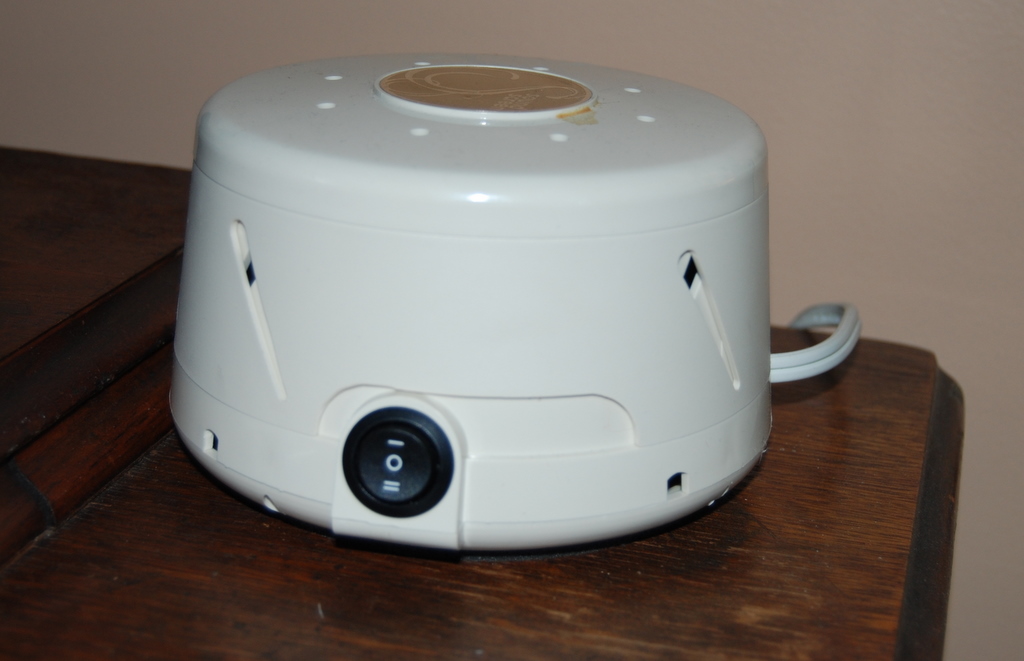
Marpac Sound Screen

Nighttime noise is an issue when you travel with grown men.  On a ski trip when my kids were in high school, I shared a room with two other fiftyish dads and spent much of the night trying to decide which was more annoying, the chainsaw-like snoring or the innumerable brief trips to the bathroom. When my friends and I travel for golf, we try to pair the snorers and coughers with the heaviest sleepers, and make sure that the guy with the anti-apnea machine shares a room with someone who likes white noise. I myself employ two snoring-related sleep aids: gumdrop-size silicone ear plugs and a vaguely wishbone-shaped appliance called a Nozovent, which sprongs my nostrils wide open.  (One night, while my wife and I were getting ready for bed at home, I groggily inserted my earplugs into my nose instead of my ears—as the first one went in, I thought, Whoa, time to buy some fresh ones—then realized what I had done and laughed so hard I nearly suffocated.) On a golf trip to Pinehurst in 2006, I shared a room with two friends. One was a world-class snorer, but the noise he made, though extraordinarily loud, was so steady that it was easy to sleep through. What woke me was a fart (same guy)—like exploding a paper bag. My entire body rose about six inches from my mattress, and it took me a while to get back to sleep. At the bottom of this post is a picture from that trip.

After the death of my father, whose snoring was audible throughout our house, my mother gave me his old white-noise machine, a Marpac Sound Screen. My wife and I keep it in the kitchen—for our dog, Henry, who barks in the middle of the night if he hears raccoons knocking over the cat-food dishes on our back step. Half a dozen friends and I are taking a golf trip to Ireland in April. We’ve all decided to splurge on single rooms, but if we hadn’t I’d take the Marpac with me.

Pinehurst golf trip 2006–with Fairbairn’s greeting for new arrivals.


Clearview Park Golf Course

Clearview

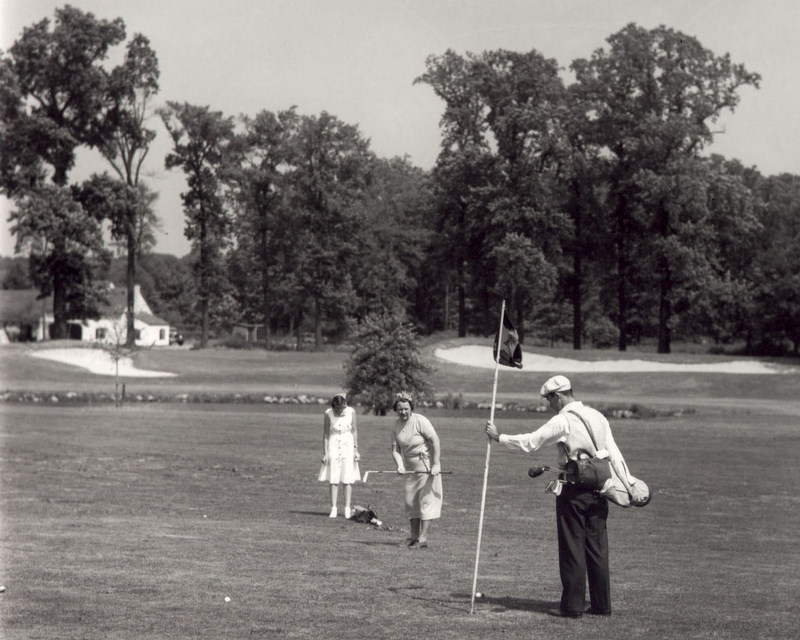
On a warm winter afternoon in 2005, Hacker (real name) and I met at Clearview Park Golf Course, in Queens, for my second round of the day. (I’d played that morning at Van Cortlandt Park, in the Bronx.) The temperature was close to fifty degrees, and the course was packed, mostly with Koreans, who are probably the second most golf-addled ethnic group in New York, after the Irish. The starter, who was also Korean, paired Hacker and me with two Korean men. One of them turned out to be the retired owner of a Manhattan wig shop. He told me that his clientele had included many famous actresses, among them Nancy Sinatra and Ann-Margret, but that actresses are undesirable wig customers because they don’t like to pay. The best customers, he said, are strippers, who favor huge blond wigs and don’t care what anything costs. We finished our round just as a very orange sun was setting beyond Manhattan, and we watched endless ribbons of white and red car lights unspooling across the Throgs Neck Bridge, which looms over the northern end of the course. Six days later, it snowed again. The photos above and below were taken at Clearview in the thirties or forties.

Clearview

More Old NYC Golf Photos

LaTourette clubhouse long ago

In recent years, the clubhouses of several old New York City golf courses have been thoughtfully restored, renovated, and remodeled, at terrific expense. The responsible parties are American Golf Corporation, which holds twenty-year operating licenses for a number of the city’s courses, and Page Ayres Cowley, an architect with extensive experience in the restoration and adaptive reuse of historic structures.

Cowley’s first golf project was LaTourette Golf Course, on Staten Island. The course and the large wooded park surrounding it are laid out on what was once the farm of John J. Crocheron, a French Huguenot who fought in the war of 1812.  In the 1830s, Crocheron gave the property to his daughter, Ann, and her husband, David LaTourette, and moved to Alabama. Crocheron’s gift included a large Federal-style brick mansion with panoramic views of Lower New York Bay. The mansion was occupied until 1910 by a succession of LaTourettes, a number of whom came to unfortunate ends: several died in childhood, one was shot accidentally by a neighbor while wandering in delirium, one died while fighting for the Confederacy in the Civil War, and one is rumored to have committed suicide by hanging himself in the attic.  The farm is thought to be one of the last in New York City to employ oxen as draft animals.  In 1928, the city bought it, for $1.14 million, and turned it into a public park, now part of the Staten Island Greenbelt.  John Van Kleek designed the golf course.  The mansion became the clubhouse in 1936, was designated an individual New York City landmark in 1968, and was added to the National Register of Historic Places in 1982.

LaTourette clubhouse not quite so long ago

One of the best things that ever happened to the old LaTourette mansion occurred in 2001: it caught on fire. The fire started in a wastebasket in an office on the ground floor and did extensive damage, inside and out. American Golf, which was responsible for the building’s reconstruction, awarded the project to Cowley. She told me, “When we started, it was a typical insurance claim. The adjustor said, O. K., the floor is burned, replace the floor; the plaster’s missing, put up Sheetrock; the windows are blown out, replace them with something prefab. But as we went through this, I thought, Why just put it back the way it was?”

Cowley’s firm had recently completed an award-winning five-year restoration of Walt Whitman’s final residence, in Camden, New Jersey—a modest frame house that was the poet’s home for the last eight years of his life and was the only house he ever owned.  At the Library of Congress, Cowley and her associates found old glass negatives showing interior details that had been cropped from published photographs. “Walt Whitman lived in a mess,” she told me. “There were crumpled papers everywhere, and there were dishes stacked on the window sills. The photographs we studied were taken by the artist Thomas Eakins, a good friend of his, and they helped us understand the life of a working man who lived at the poverty line and survived at the grace and favor of his publisher and his patrons.  He was a brilliant poet, and he was a cheapskate. The furniture belonged to his housekeeper, who lived in the back of the house. It didn’t matter to him if the wallpaper matched—just stick it on the wall. At one point, we told the state, which operates the house as a museum, ‘If it doesn’t match, we know it’s right.’”

Old photographs were important in the LaTourette project, too.  Cowley persuaded the insurance company to pay for architectural details it hadn’t felt were necessary, such as mahogany sashes for the windows, and to allow her, instead of replacing unused features (the showers on the second floor, for instance), to recreate elements (such as an unobstructed central hallway on the ground floor) that had been obliterated long before the fire. She also persuaded American Golf to spend nearly two million dollars of its own money.  The result is terrific—not a museum, by any means, but a living landmark that gives the city’s golfers a powerful sense of what it must have been like to visit the home of a wealthy nineteenth-century Staten Island landowner.

LaTourette clubhouse today


Going South

My golf pals and I have gotten used to balmy winter weather and playing whenever we want to. When my friend Jim woke up this morning and saw snow out the window, he told me, he was actually angry. He said that his reaction reminded him of something that happened on a flight he was on several years ago. The airline was experimenting with in-flight Wi-Fi, a brand-new thing at the time. It worked for a while, then cut out, and when it did a guy sitting behind him said, “Oh, for Christ’s sake.”

A possible solution to the snow problem, for my friends and me, would be to go south on Sunday, to New York. There are a dozen public courses within the city limits, and they stay open all year, as long as there’s no snow. I had to be in the city last night, and as I drove home this morning I saw that the snow line was safely far up the Hutchinson River Parkway. I’ve written about those courses twice, in The New Yorker and in Golf Digest.

There are many photographs of the courses In the archives of New York City’s Parks Department–among them these images taken many years ago inside the clubhouse at Pelham Bay and Split Rock Golf Courses, in the Bronx. (We played both in January.)

Everything looks pretty much the same now, thanks to a multi-million-dollar renovation paid for by American Golf, which has a twenty-year operating lease.

Alister MacKenzie

Alister MacKenzie and his wife, Hilda, on the fifteenth green at Cypress Point.

Obsessive students of golf architecture should file away the latest revision of a comprehensive chronology of the life of Alister MacKenzie, the designer of Augusta National, Cypress Point, Royal Melbourne, and a number of other courses worth scheming to play. The chronology is the work of Neil Crafter and the AM Research Team, in Adelaide, Australia, and it contains contributions from many people (including, in a very small way, me). Crafter, in a cover note, writes, “Sean Tully in San Francisco and Bob Beck in Santa Cruz have been most diligent in researching Mackenzie’s time in the USA, and Bob has unearthed records from Cypress Point that show when Mackenzie stayed overnight in the clubhouse and even what he ate for his meals! It is staggering that 80 or more years on we can get down to this level of detail about the life of Alister Mackenzie.” Even if you feel you already know everything you need to know about MacKenzie’s diet, the chronology contains many interesting facts.

Incidentally, the images above and below also appear in my book The Making of the Masters, which is now selling on Amazon for practically nothingBelow is MacKenzie’s original watercolor sketch of the routing of Augusta National. In it, the holes are numbered as they are today. MacKenzie later switched the nines; the club, after the first Masters, switched them back, because the current first nine thawed first on frosty mornings. Note the 90-yard 19th hole, near the clubhouse, squeezed between the 9th and 18th greens. MacKenzie explained the idea in a letter to Clifford Roberts, the club’s founding chairman: “Bobby Jones and some of the other directors thought it might be interesting to have a real 19th hole so that the loser could have the opportunity of getting his money back by playing double or quits. This 19th Hole will be an attractive plateau green, narrow at one end where the flag will usually be placed but wide at the other end so as to give a safety route to the player who has not the courage or the skill to pitch to the narrow end of the green.” The club, in those days, didn’t have the money to build it, and Jones and Roberts, in any event, worried that it would block the view of anyone in the clubhouse who was trying to watch whatever was happening on the 18th. Cool idea, though.

Stroke Bank: A Refinement

Last night, we tried to reserve a tee time for today at the Links at Union Vale, but the course was fully booked into the afternoon—a February Wednesday in New England as busy as a summer Saturday. So we went back to Tunxis Plantation, which was still first-come-first-served. We teed off a little after 9:00, and again played Stroke Bank/Second Ball Decides—see earlier post—and thought of a further improvement: Stroke Deposits.

Let’s say you make a 4 and your partner makes a 5 on a par-four, while your opponents both slice their drives out of bounds and end up with 7s. You and your partner have the low gross score on the hole, so you have to commit first. If you keep your 4 and 5, your opponents, if they wish to halve the hole, will need to use a lot of strokes. In fact, one of them will have to use three strokes (to turn his 7 into a 4, tying your par) and the other will have to use two strokes (to turn his 7 into a 5, tying your partner’s bogey). Alternatively, your opponents could choose to win the hole outright—if either of them is able and willing to spend four strokes (to turn his 7 into a 3, thereby beating your 4, which is your team’s better ball).

If you don’t think they’re likely to do those things, or if you don’t care whether they do—maybe because you’re ahead in the match, or because they’re running out of strokes with hard holes still to play—you or your partner can choose to bank some or all of your surplus. For example, you yourself could deposit as many as three strokes, turning your 4 into a 7. Now your opponents can halve the hole if one of them spends just two strokes, turning his 7 into a 5 (thereby tying the other ball as well). But you’d have increased your stroke-bank balance by three, a trade-off that might be advantageous for you on the holes ahead.

This game, in practice, is nowhere near as complicated as it probably sounds. But there’s lots of psychological intrigue, and the four of us had many long, whispered strategy discussions as we walked from green to tee. Hacker (real name) and I lost three ways to Rick and our superintendent, but the match, as somehow always happens, came down to the final putt. And when we walked off the eighteenth green the sun was shining, and the Weather Underground app on my phone said the temperature was 56 degrees. We stopped at a barbecue place for lunch on the way home, and we’re all going to play again on Sunday.

These guys were warming up on the range at Tunxis when we finished.

Up Early

This morning, eight of us played at Tunxis Plantation. We arrived at 7:30 and stood around talking and drinking coffee for an hour and a half (first photo), as we waited for the frost to melt (second photo) and for the golf shop to open. When the all-clear sounded, we teed off first and, with no one ahead of us, played as fast as we do at home.

I had trouble sleeping last night, as I often do before I play golf. Even now, twenty years after I took up the game, waiting for golf still feels like waiting for Santa Claus. During the season, I set my alarm for 6:00 on Sunday mornings—unnecessarily, because I’m usually awake and squinting at the dial by 5:00 or 5:30, if not by 4:00: isn’t it time to put on my golf clothes yet? I click off the clock a few minutes before it would have buzzed, and tiptoe downstairs without waking my wife.

Six or seven years ago, during my Sunday Morning Group’s annual end-of-season trip to Atlantic City, Hacker (real name) got up, took a shower, woke up his roommate and told him to take a shower, went down to the lobby of the hotel where we were staying, sat in the dark in the empty coffee shop for a while, and then looked at his watch more closely and realized it was 3:30, not 6:30. Hacker has trained himself to wake up without an alarm clock, but he loves golf so much that his internal timekeeping mechanism sometimes jumps a few hours ahead. In Pinehurst once, he got up, took a shower, woke up his roommate and told him to take a shower, went downstairs in the house where they were staying, and found a couple of guys in the living room drinking beer and watching TV. “Kind of early for that, isn’t it, guys?” Actually, no: it was just a little past midnight, an hour after Hacker and his roommate had gone to bed. A street lamp near his window had fooled him into thinking the sun was coming up.

Order ahead from the Tunxis grill---service not available in February.