Back-Roads Scotland: Moray Coast

Lossiemouth, Scotland, March 26, 2012. Photo by John Thomson.

The photo above was taken this past Monday evening in Lossiemouth, Scotland, about two hours’ drive northwest of Aberdeen. You are looking across a corner of the North Sea toward the Moray Golf Club, the Lossiemouth Lighthouse, and both the waxing crescent moon and Venus. The photo was taken by John Thomson, a Moray member, whose Uncle Alistair was the club’s professional for thirty-one years and whose father was responsible for the construction of the club’s second eighteen. I haven’t played Moray, but I’ve gazed longingly at both the course and the clubhouse from the Stotfield Hotel, across the street. Here’s what I saw from the hotel’s front door during a trip in 2007:

Moray Golf Club, Lossiemouth, Scotland, 2007.

Moray is one of a number of fine links courses along on the Moray Firth’s southern edge, a hundred-mile stretch of golf-friendly coastline that runs between Inverness and Fraserburgh. Traveling golfers are probably most familiar with two courses at the western end, Castle Stuart and Nairn, which are popular stops for Americans on their way to Royal Dornoch. But those aren’t the only worthy courses on the Moray coast. Others: Nairn DunbarHopeman, Spey Bay, Buckpool, Strathlene, my beloved Cullen, Duff House Royal (not a links course, but significant because it was redesigned, in 1923, by Alister MacKenzie), Royal Tarlair, Rosehearty, and Fraserburgh. And there are many good inland courses nearby as well.

Lossiemouth would make a convenient base camp for any golf trip to the Moray coast. John Thomson, who took the photograph at the top of this post, owns the Links Lodge, a guest house next to the Stotfield; he also owns an adjacent three-bedroom self-catering apartment, the Beach View, which sleeps six. (If there are four golfers in your group, you can do what three Golf Digest editors and I did during a trip to southwestern Ireland in 2006: play a match to determine who will have to double up.) The Links Lodge served as Moray’s clubhouse for the first three years of the club’s existence, between 1889 and 1892; it was then replaced by the building in the photograph below. (The building has been enlarged considerably since then.)

Moray Golf Club, first dedicated clubhouse, 1892.

Thomson told me, “We only found out the Links Lodge was the original clubhouse while replacing a window: we took out a piece of frame with the carpenters’ delivery note still stuck to it.” The first owner, Thomson said, must have been one of the gentlemen in this photograph:

Founding members, Moray Golf Club, 1893.

He continued, “We boast not one but two prime ministers as members—and expelled one of them. We have one of the longest associations of any club in the world with our own labeled malt whiskey (since among the founders were some distillers). Dai Rees, Max Faulkner, and Fred Daly played exhibition matches here, and regular visitors included Ted Ray, Harry Vardon, J. H. Taylor, and James Braid.”

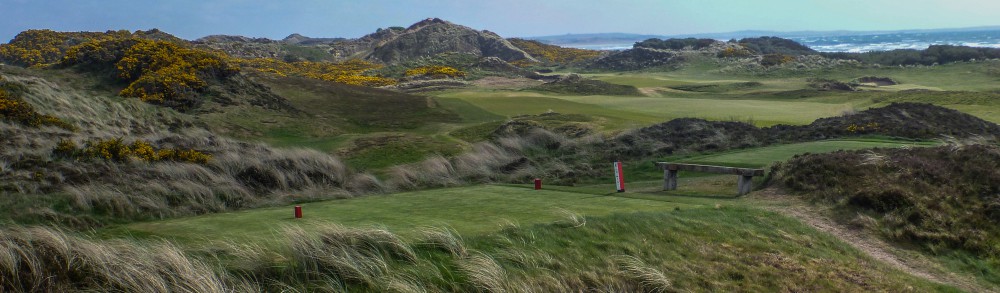
I’ll be in northeastern Scotland next month. My itinerary won’t take me to Lossiemouth, I’m sorry to say, although it will take me to Fraserburgh. I’ll report, eventually. In the meantime, here are a few photos of Hopeman, about four miles west of Moray. I took them in 2007. As you can see from the first, a breeze was blowing the day I played.



Masters Countdown: Eighth Hole

Augusta National's eighth green, 1935.

When the eighth green was built, it looked very much the way it does today, with tall, steeply contoured mounds on either side. In 1956, though, Clifford Roberts, the club’s co-founder and chairman, had the mounds removed. “That’s the only time I can really remember Mr. Jones getting mad at Cliff,” Phil Harison, a longtime member, told me in the late 1990s. “But he removed the mounds for a reason. They blocked the view of the spectators at the tournament, and once they were gone the spectators could see a lot better. But Mr. Jones got awfully upset about that. He really did, because without the mounds the hole was much less interesting, and the green didn’t look like any other green on the golf course.”

Augusta National's eighth green in 1956, after the mounds had been removed to improve sight lines for spectators.

Roberts never thought that removing the mounds improved the hole—and, indeed, the new green was dreadful. It was featureless and vaguely hourglass-shaped, and it could be approached without trepidation from almost any angle. But Roberts felt strongly that spectators ought to be able to see. Not long before he died, though, he decided that the sacrifice had been too great and that the mounds should be restored. The change was finally made in 1979, not quite two years after his death. Byron Nelson led the project, along with Joseph S. Finger, an architect who, among other accomplishments, had played golf at Rice University in the thirties on a team that was coached by Jimmy Demaret. In restoring the mounds, Nelson and Finger relied heavily on photographs taken during the thirties and forties. Harison—who had grown up in a house that used to stand just beyond the first green—consulted on the project as well. During the Second World War, when the course was closed, he had often ridden a motor bike over the mounds, and he told me that he retained a sort of physical memory of their shape.

Jones and Roberts used to ask Harison to fill out groups in Augusta National’s main member-member event, the Jamboree, beginning when he was thirteen; he and a partner won the event in 1941, when he was sixteen. He didn’t officially become a member until 1946, when he turned twenty-one, but at that time, he told me, Jones and Roberts kidded him by saying, “Oh, you’ve been a member for years.” Harison attended every Masters, beginning with the first, and was the tournament’s official starter for more than sixty years: it was he who introduced each player on the first tee—everyone from Bobby Jones to Tiger Woods. He died 2008, at the age of 82.

During 2001, the tournament tee on the eighth hole was moved back and to the players’ right—part of a course-wide effort, supervised primarily by Tom Fazio, to lengthen the course and increase the premium on accuracy and controlled shot shape off the tee. The fairway bunker was doubled in size and stretched toward the green. (The old bunker ended roughly at the peninsula of turf near the left center of the new bunker. See the photo below.)

The eighth hole has had a fairway bunker in approximately the same position since the course opened. Changes in its size and in the location of the tournament tee—all of which were made, in part, to keep the bunker in play—provide a good indication of how much tournament players’ driving distance has increased since the early 1930s: the far edge of the bunker today is roughly a hundred yards farther from the tee than it was during the first Masters.

Looking back toward the tee from the eighth green. The hole's single bunker is on the left.

Masters Countdown: Seventh Hole


A not especially intelligible drawing of Augusta National's seventh green, from the program for the first Masters, in 1934, when the seventh had no bunkers.

The seventh wasn’t much of a hole in the early days. (The consensus, as described by Clifford Roberts, the club’s co-founder and chairman, was that it was “the only weak hole out of the eighteen.”) Alister MacKenzie, who designed the course, likened it to the eighteenth at St. Andrews, but the resemblance was superficial. Both holes were short, and both had large greens and no bunkers, but in comparison with the venerable and surprisingly difficult closing hole of the Old Course, the seventh at Augusta was a pushover. Many players today would have been able to drive it.

In a letter to MacKenzie in 1933, Roberts wrote, “I think the real criticism . . . is that it lacks character. Ed Dudley [the club’s first professional] made a suggestion which appealed very much to me. He proposed putting a bunker in the middle of the face of the green and letting it wedge into the green. In other words, his thought is to partly develop this green into two sections, the same as is true of one of the greens at Lakeside, California. Bob [Bobby Jones] did not have very much to say about this proposal, but I do not think he was much impressed by it. I think, in truth, that Bob is really hesitant about making any alterations or incidental refinements till you can come here and see the layout.”

Perry Maxwell

Nothing significant happened until 1938, when Horton Smith—who had won the first and third tournaments—suggested elevating the green and fronting it with several deep bunkers. He also suggested moving the green twenty yards back and to the right. Jones and Roberts both approved. The design work was done by Perry
Maxwell, an Oklahoma banker-turned-architect, whose best-known course is probably Tulsa’s Southern Hills. Maxwell had been a partner of MacKenzie’s during the final years of MacKenzie’s life. (Their last joint project, completed in 1933, was Crystal Downs, in Frankfort, Michigan.) The transformation of the seventh green, which cost $2,500, was paid for by Lewis B. Maytag, who was one of the club’s earliest members and was the head of the Maytag Company. In addition, the driving area was tightened through the addition of a grove of pine trees on the left side of the fairway. (There were already trees on the right.)

Maxwell made several less dramatic changes in other greens—among them the first and the fourteenth, to which he added pronounced undulations. Such undulations were his trademark and were known as “Maxwell rolls.” MacKenzie was no longer alive at that time, but he undoubtedly would have approved: he loved dramatic contours. In The Spirit of St. Andrews, he wrote wistfully about the early greens at Machrihanish, a legendary links course, designed by Old Tom Morris, on the Kintyre peninsula in western Scotland: “Some of the natural greens were so undulating that at times one had to putt twenty or thirty yards round to lay dead at a hole only five yards away. These greens have all gone and today one loses all the joy of outwitting an opponent by making spectacular putts of this description.” For the disappearance of such features, MacKenzie blamed a preoccupation with the elimination of “unfairness”—a word that he scornfully placed in quotation marks.

Today, the seventh is 450 yards long—110 yards longer than it was for the first Masters—and the landing area is narrow. Just fifteen years ago, the seventh was considered a birdie hole, even by members. Now it’s a tough par for any player whose tee shot ends up in the pine straw.

Coolest Place to Stay in St. Andrews

A terrific guide to golf in Scotland is Golf in Scotland, by Allan McAllister Ferguson, a personal travel planner. The fourth edition has just been published. If you’re going to Scotland, or if you dream of going to Scotland, you need a copy. You should also get sign up for Ferguson’s newsletter.

I took a golf trip to Scotland in 2008 with eight friends from home. Our best lodgings were in St. Andrews, where we spent two nights in a nineteenth-century house on North Street, a short walk from the Old Course. The house, which was designed by the same man who designed the main part of the R. & A. clubhouse, was recommended to me by Ferguson. It had five double bedrooms, and it came stocked with orange juice and candy bars, and there was a gas grill and a lighted artificial putting green in the backyard. And it set us back just $70 per man per night. If we’d known how cool it was going to be, we might have thrown out our itinerary and stayed there the whole time. Here’s a photo of the backyard:

This is how you're supposed to spend the evening after you've played 36 holes on the Old Course.

Unfortunately, the house doesn’t seem to be available at the moment. Ferguson told me he thinks it may be closed for good, but the house’s website is tantalizing. (It also has more pictures.) You might also try sending a begging email to the owner, Stuart Lloyd, who is an English urologist and an R & A member. (The address is on the website.)

Lloyd loves golf more than you do. He and his wife, who is also a doctor, live in Leeds, five hours away, but they spend a lot of time in St. Andrews. They also own a second house there, and in the backyard of that one Stuart built a three-quarter-scale replica of the Road Hole bunker:

If you can’t talk Lloyd into putting you up in St. Andrews, Ferguson has other suggestions—some of which he saves for his newsletter.

Back-Roads Scotland: Cullen

In 2007, I traveled to Scotland on an unusual Golf Digest assignment. I landed in Glasgow without tee times or an itinerary, and I rented a car and set out in a more or less random direction, with the goal of playing only courses I’d never heard of before. You can read my article about that trip here or here.

One of my favorite stops was a quirky course called Cullen, in Aberdeenshire, on the southern coast of the Moray Firth. The original nine holes were laid out by Old Tom Morris, and the course has blind shots, crossing fairways, otherworldly topography, and a cool tee shot that you hit from the top of a cliff. Partway through my round, I joined (as the fifth player) a group of older golfers from a club called Hopeman, about thirty miles to the west. They were on a golf outing, and this was their second round of the day, and they were playing a scramble, in competition with three other groups from their club. Most of them were carrying flasks, from which they were sipping a mixture of something and Drambuie—I couldn’t quite make out the recipe—and their golf bags were so full of empty beer bottles that they clanked when the wind, which was fierce, knocked them over.

They urged me to have a swig from one of their flasks. I declined, because I’d quit drinking about a year before, but they were so relentless that I eventually decided it would be better to risk falling off the wagon than to come to blows. As soon as I’d drunk a capful, though, they began to worry about their supply. “Are you driving?” one asked. His brow was furrowed with concern. When I said I was, he and the others concluded that offering me another swig or a beer would be unwise. Toward the end of the round, one of them asked, in a slurry brogue, “Wha hoe wah noo?” and only I could understand him: “What hole are we on now?” (It was the seventeenth.) Photo below. That’s the eighteenth green in the distance. I went back a year later with friends from home.

The boys from Hopeman: "Wha hoe wah noo?"

The specialty in the clubhouse—at left in the photo above, behind the big rock—is Cullen Skink, a fish soup that has its own Wikipedia entry.

The bent flag shows how hard the wind was blowing.

Looking back toward the clubhouse and the town.

The boys from Hopeman and some of their beverages.

Here’s where my friends and I stayed in Cullen when we went back the following year:

Masters Countdown: Third Hole

Augusta National's third green, 1935.

Augusta National’s third hole has probably undergone fewer changes than any other hole on the course. Its principal feature today, as was true in the beginning, is a treacherously shaped green, which sits on a tilted natural plateau. Dropping off from the shallow left end of the green is a deep bunker from which pars can be difficult to save. The green is hard to hit and harder to hold, and approaches to it are complicated by the fact that the putting surface is invisible from the fairway.

In 1933, Clifford Roberts, the club’s co-founder and chairman, wrote a letter to Alister MacKenzie, who had designed the course, in which he suggested adding a deep cross bunker in the face of the plateau directly in front of the green. “It was my understanding,” Roberts wrote, “that the deep-face trap located in about the center would make this a definite drive and pitch hole; that is to say, a well struck pitch would be required in order to hold the green and the trap would make it impossible to play a run-up shot.” MacKenzie was vehement in vetoing that idea—which Roberts had admitted Jones didn’t support—and his response contains so much of his thinking about design that it is worth quoting at length:

I am delighted that Bob agrees that the [third] with the one trap is all right. This confirms my impression that Bob knows more about golf and its sound principles than any man I have ever come across.

My own opinion is that a cross bunker would convert it into an ordinary stereotyped hole and would nullify all the subtleties of the undulations of the approach to which we gave so much time and thought.

Consider the many problems which face a golfer approaching the hole. In the first place he can play safely to the right and rely on a long putt going dead to get his four. If he elects to go straight at the flag he must play a perfect pitch or else his ball would hit the bank and come back or run over the green. On the other hand if he tries to run up from the right his shot must be played perfectly as a half hearted run up shot will inevitably run into the bunker on the left, which appears to me to be absolutely perfect both in regard to its position and its construction.

At this hole the super golfer, like Bob, has a most fascinating problem, as to have a reasonable chance of three he will have to attack the hole from the left, where all the slopes help him towards the hole. It is here that the tee-shot bunker comes in as he must make up his mind to play round it with a pulled shot from right to left or a fade from left to right, or, when a strong wind is in his favour, to play over it.

If the approach to this hole is maintained as hard and as true as the green it will make the most perfect hole of its length in the world of golf and any additional bunker would ruin it.

It is holes of this description that keep up one’s interest in golf year after year, stimulate players to improve their game and prevent golf becoming stale.

Jones didn’t think as highly of the third hole as MacKenzie did; his favorite par-fours almost all required long-iron or fairway-wood approaches—shots at which he excelled. But MacKenzie’s conviction has been borne out over the years. Of all the architects who have worked on the course, none has yet made a persuasive case for a major revision. (The single original fairway bunker became a cluster of four fairway bunkers in 1983, but the impact on tee shots didn’t change.) The third hole remains the shortest par-four on the course, yet it was one of the few holes that consistently gave Tiger Woods trouble during his record victory in 1997. (On Friday, he hit a bullet-like drive to within fifteen yards of the green, yet made a bogey.) In fact, the experience of Woods and other long-hitting players suggests that one effective way to “Tiger-proof” a golf hole may be to shorten it.


Golf in the Footsteps of the Three Stooges

On Sunday, twelve of us played  Van Cortlandt Park, in the Bronx, one of a dozen courses owned by the city of New York. It opened the summer of 1895, six years after my home club, and is the oldest public course in the United States. It also has what may be the world’s coolest locker room, which still contains the original wooden lockers (photos above and below). The Three Stooges considered Van Cortlandt their home course. Other visitors have included Babe Ruth, Willie Mays, Jackie Robinson, Joe Louis, and my friends and me. (On Sunday, even though it was 28 degrees when we left home, three of us wore shorts.)

Sunday Morning Group, Van Cortlandt locker room, March 11, 2012.

The original Van Cortlandt golf course was built for $642.80. It had just nine holes, of which the last was more than 700 yards long. For a few years in 1960s, the city operated three ski slopes on the four short, hilly, quirky closing holes, at the southern end of the park. (You get to those holes by crossing under the Major Deegan Expressway, on a concrete walkway with tall fences on either side.) But now the golf course is just a golf course, even during the so-called winter.

Emerging from under the Major Deegan Expressway, on the way to the fifteenth tee.

Van Cortlandt was originally known as the Meadows, and it was very popular, even though in 1895 hardly anybody in America owned golf clubs or knew anything about how to hit a golf ball. In 1899, Tom Bendelow—a 30-year-old Scotsman and former typesetter, who eventually designed 650 courses in North America—expanded Van Cortlandt to 18 holes. By 1920, according to the Parks Department, it was handling 5,000 players a week.

This is what golf in America looked like in 1895, the year Van Cortlandt opened.

Bendelow’s design survived until the 1940s, when Robert Moses began building highways on top of it. Today, the course is divided into four roughly equal-size lobes. They are separated by two highways (the Major Deegan and the Mosholu Parkway) and a fence-enclosed swamp called Tibbetts Brook, which resembles the Dead Marshes in The Lord of the Rings, except murkier.

This way across Tibbetts Brook.

On Sunday, the first of our three tee times was 7:56. That meant leaving home at a little before 6:00, which really meant leaving home at a little before 5:00, since daylight saving time had gone into effect overnight. And that, for me, meant getting up at what my brain still thought was 3:30. It was worth it, though—what else could I have done on a Sunday morning in March, except maybe work on my taxes?—and I was actually awake and waiting when my alarm went off, as I usually am the night before I play golf.

Because we were going to Van Cortlandt, we were able to lure Ferris out of hibernation. The night before, he sent us this email:

My childhood home was at 1 Tibbetts Road, in Yonkers, and our property line was Van Cortlandt Park. My friends and I used to cut holes in the chain-link fence near the fourth green and play the three holes on this side of the Major Deegan and Mosholu Parkway. We would steal the bamboo whips that the ‘parkies’ used to whip the dew off the greens, and occasionally we would also steal the flags, and we would sell golf balls. Since the approaches to some of the holes were blind, we could run out and grab balls that had just been hit and then sell them to the next groups that came by. We did all this while keeping an eye out for the parkies’ pickup trucks. When we saw them come rumbling over the hill, we would scoot back through the hole that we had cut in the fence, and then hide in the woods. The following day, the hole would be wired closed, so we always carried a heavy-duty wire-cutter in one of our golf bags. Of course, most of us had old bags, with hickory-shafted clubs. My house was about two hundred yards from the course. I’ve never paid to play at Van Cortlandt, and I’ve never played the holes on the other side of the highways.

Ferris's fence, with a modern hole, just beyond the fourth green.

For lunch, we went to the Bronx Ale House, just a few minutes away. To see what that was like, check out the photos on this (non-golfer’s) blog. Pay particular attention to the picture of the Alehouse Burger. Here was Sunday’s beer menu:

Bronx Ale House.

You can read an old New Yorker article of mine about playing winter golf in New York City here. The photo below is of the line of golfers at the first tee as we walked off the fourteenth green, on our way to the holes on the other side of the Major Deegan. There were more golfers waiting in front of the clubhouse.

Masters Countdown: Second Hole

Augusta National's second green in 1935, when it had just one bunker.

During Augusta National’s early years, in the 1930s, the second hole had a vast, ragged bunker in the fairway, not far from the tee. A more subdued version of that bunker survived into the mid-sixties, when Clifford Roberts, the club’s chairman and co-founder, replaced it with a smaller bunker farther down the fairway and to the right. “The players all complained when Roberts put it in,” Gene Sarazen, who suggested the change, told me in the late 1990s. “But it didn’t mean a thing when you complained to Roberts. He had his own mind made up.” Among the players who complained was Ben Hogan, whose fade made the sand a genuine annoyance. Sam Snead told me, “Hogan said the bunker should have been placed on the other side, so you couldn’t cut the corner.” But the left side of the fairway was already well guarded, as it is today, by a grove of pines and a deep ravine with a creek at the bottom of it—one of the few spots on the course where a player can hit a truly unrecoverable drive. Gardner Dickinson once suggested that the tournament’s airline office—a Roberts innovation, which enables players and tournament spectators to make last-minute changes in their travel plans without leaving the property—should be moved into the ravine, on the theory that any player unfortunate enough to hit his tee shot down there might as well book a flight and go home. In recent years, the carry from the tournament tee to the fairway bunker has been stretched to more than 300 yards, but some players are able to hit their drives right past it. And hardly anybody employs Hogan’s second-hole strategy: intentionally hitting his second shot into a greenside bunker and trying to get up and down for birdie from there.

The second green in 1948: two greenside bunkers with a broad gap between them.

Winter (Such as it Was) is Over

Two extra handicap strokes for wearing shorts after January 1. No penalty for frightening legs.

Six of us played at Tunxis Plantation this morning, and two of us wore shorts. The grounds crew had just finished mowing the greens for the first time in 2012, and the grass became noticeably greener as we played. By the time we putted out on the eighteenth, at a little after 11:00, even shorts felt sort of suffocating.

Our superintendent played with us. He said that he attends a meeting at Tunxis in late March every year, and that in the past the course has always been closed and, usually, either covered with snow or frozen. That won’t be the case this year. The parking lot was filling as we drove away (to the barbecue place down the road), and the thermometer in my car read 67 degrees.

Living, growing divot, March 8, 2012, Farmington, Connecticut.


Masters Countdown: First Hole

Augusta National's first green in the early 1930s, when it was still the tenth. The bunker was later removed and a different bunker was added, closer to the green. The putting-surface contours haven't changed much, however.

In Augusta National’s early years, a small creek ran across the first fairway, at the bottom of the hill, less than a hundred yards from the tee. The carry over the ditch was so short that few players even noticed the hazard, but a member named Clarence J. Schoo—who ran a boxboard manufacturing company in Springfield, Massachusetts, and was a close friend of the club’s chairman and co-founder, Clifford Roberts—drove into it so often that it came to be known as Schooie’s Gulch. After topping yet another drive into the creek one day, Schoo said to Roberts, “I wish you’d fill in that damn ditch.” Roberts did fill in the ditch, during the summer of 1951—and sent the bill to Schoo.

That, at any rate, is how the story is usually told. The real reason for eliminating the ditch was that the club wanted to replace its old press tent with a Quonset hut, on a site to the right of the first fairway, and the ditch was in the way of the planned foundation. The ditch also constituted a maintenance headache that Roberts wanted to eliminate. Schoo, who later became a vice president of the club, did gladly pay for part of the alteration, but he almost certainly wasn’t surprised when he opened his bill.

Schoo was such a poor golfer that when he one day made a natural birdie Roberts decreed that he should be paid the same cash pot that was ordinarily given to golfers who made holes-in-one, on the theory that Schooie was never going to come any closer. Another time, while playing the seventh hole in a foursome that also included Roberts and former President Dwight Eisenhower, Schoo hit a dreadful drive that traveled just a few yards, into a clump of pampas grass to the left of the tee. Schoo said, “Well, in all the years I’ve been playing here, that’s the first time I’ve done that.” That summer, the grounds crew cut back the pampas grass and found several balls with his name imprinted on them. On another occasion, Schoo declared with exasperation that he must be the worst golfer in the club. His caddie, who had been around long enough to hear stories but not long enough to recognize individual members, said, “No, sir. The worst golfer in this club is Mr. Schoo.”