World’s Second-Best Golf Club, Part One: The Big Dogs and their Dogfights

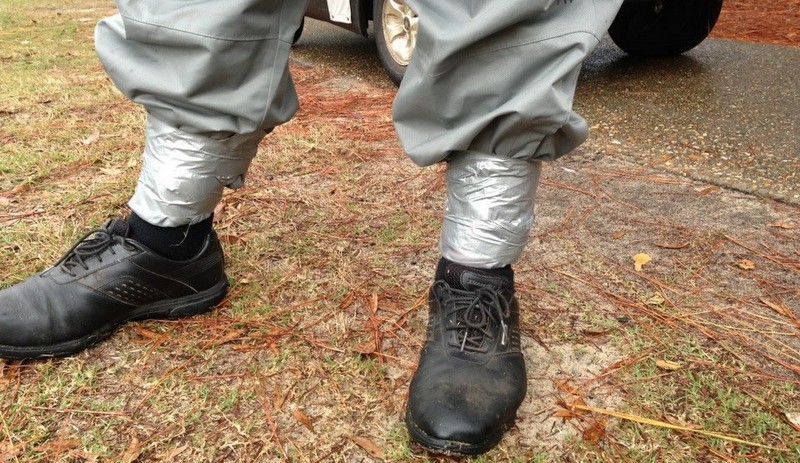
Jim, a Big Dog. Mike Riley writes: "Jim is the only person I have ever seen fall down after a practice swing. In his defense, it was his first practice swing of the day and it occurred after a night at a Mississippi casino." The photo was taken (by Riley) last Christmas Eve. Jim's pants were dragging on the wet ground, so he fixed them."

Mike Riley writes: “Jim is the only person I have ever seen fall down after a practice swing. In his defense, it was his first practice swing of the day and it occurred after a night at a Mississippi casino.” This photo, of Jim’s lower legs and feet, was taken (by Riley) last Christmas Eve. Jim’s pants had been dragging on the wet ground, so he fixed them. “Southerners use duck tape to fix anything,” Riley told me.

The world’s best golf club, I think we can all agree, is mine. Recently—thanks to Mike Riley, a reader—I’ve learned quite a bit about the second best, which is in northwestern Florida and has a course that was designed in the nineteen-twenties by Donald Ross. Riley belongs to a fifty-year-old club-within-the-club known as the Big Dogs, after their standard game, the Big Dogfight. “We play Wednesdays, Fridays, Saturdays, and Sundays, plus holidays,” Riley said. “The number of players varies between twelve and thirty. Fridays and Sundays have larger crowds since college football isn’t competing for attention.”
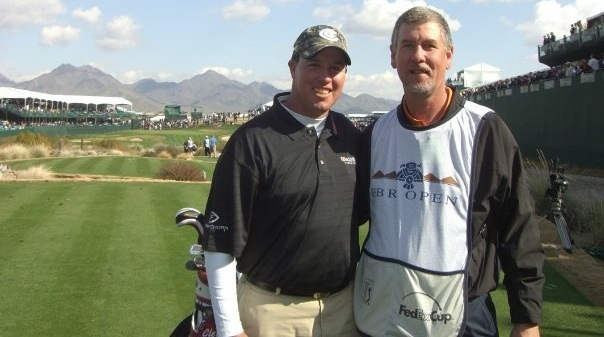
Mike Riley (right) and the tour pro Boo Weekley, an old friend of his. Riley caddied for Weekley during the pro-am of the FBR Open, in Phoenix, a few years ago.

Riley (right) and the tour pro Boo Weekley, an old friend of his. Riley caddied for Weekley during the pro-am of the FBR Open, in Phoenix, a few years ago.

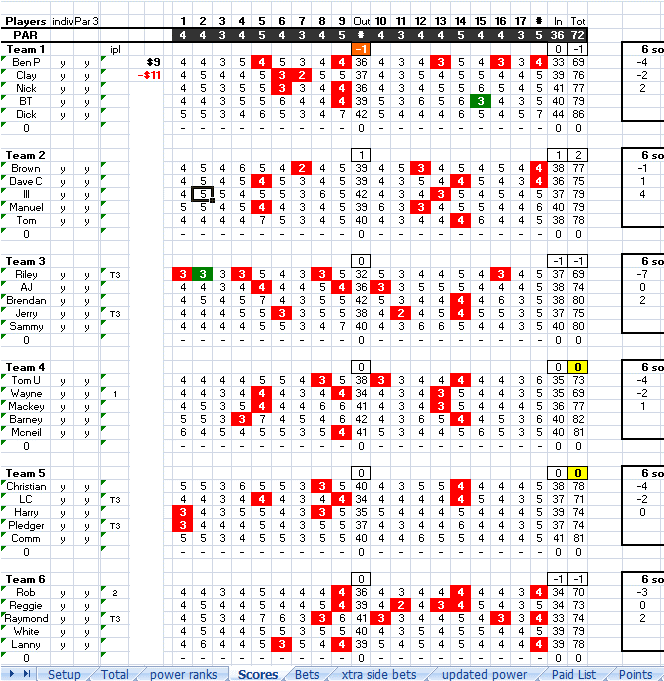
The format of the Big Dogs’ Dogfights is almost too complicated to explain, but here goes: “The team game is a one-dollar nassau in which every team plays every other team (best one, two, and three balls), with individual skins and rabbits,” Riley told me. “There is also an individual points game based on a formula we created that is somewhat akin to what might happen if you played U.S.G.A. handicaps with Stableford scoring. There are also two-dollar best-ball nassaus in which each two-man-team combination plays every other two-man-team combination. For example, Team No. 1’s captain and ‘2-man’ (the best and second best player on Team No. 1) will play best-ball nassaus against every other team’s captain and 2-man.” Here’s what part of one of their score sheets looks like (Riley is the captain of Team No. 3):
Score spreadsheetThe Big Dogs play in four-, five-, and six-man teams, depending on how many show up. A member known as the Commandant makes the assignments, with help from the club’s pro. “Everyone has their own cart, and everyone rides solo, so they get around pretty fast,” Riley said. “Most carts have portable heaters and are equipped with enclosures for the rare cold days in Florida. The fastest cart belongs to Clay; it has an estimated top speed of 35 m.p.h. Some have XM radio. Almost all have ice chests. One (Jim’s) has a grill.”

Jim's cart. Note grill, cooler, heater, and enclosure. The concrete disk under the grill is a safety measure.

Jim’s cart. Note grill, cooler, heater, and enclosure. The concrete septic-tank cover under the grill is a safety device.

Anybody need a brat?
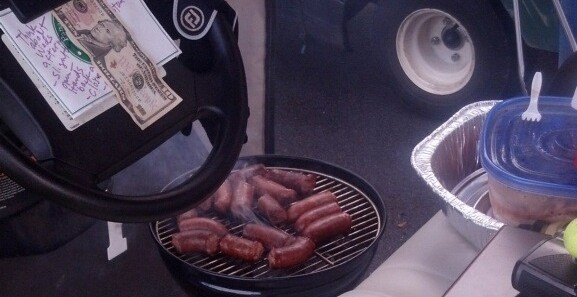
Brats in cart-001One day, Jim fell into the lake on the seventh hole while trying to hit a pitch shot from the bulkhead. “The board he was standing on broke,” Riley said. “He toweled off and finished his round. He smelled like brackish water for the next two hours. Here’s a picture of us pulling him out of the water.”
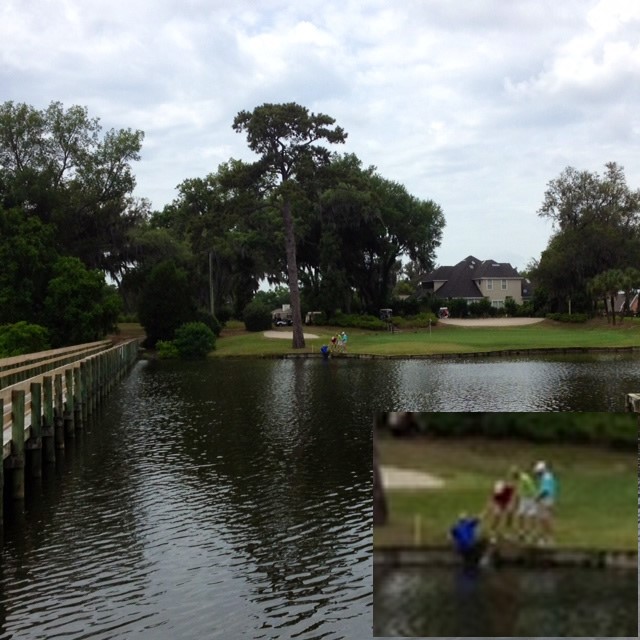
Jim in pondTo be continued.

Hacker (Real Name) Invents Great New Golf Game While Asleep

P1080982

Recently, I wrote that I’d had an extremely rare dream-within-a-dream, about the rules of golf. Reading about my dream made my friend Hacker (shown above) recall that he, too, had recently dreamt about golf, and that in his dream he had invented a new kind of scramble. (In a scramble, all the players on each team drive on each hole, then choose the best drive and play their second shots from there, then choose the best second shot and play their third shots from there, and so on, until the ball is holed out.) In Hacker’s dream version, each four-man team had to count two balls on each hole. As he explained the rules to me: “All four drive. Pick two balls. Assign two players to play each ball until holed out. Score both balls. No handicap.”

Tim (left) and Paul, Sunday scramble, Atlantic City, October 20, 2013.

Tim (left) and Paul, Sunday-afternoon scramble, Atlantic City, October 20, 2013.

In Hacker’s dream, the purpose of this game was “to screw Tim” (another of our friends, who invented our game Perfect Skins “to screw Gilllen”). But it’s a great idea, no matter whom it screws, and we’re going to try it next fall, during the Crystal Anniversary of our annual golf trip to Atlantic City, if not before. Hacker’s dream format is especially attractive because it prevents a team from depending too heavily on any one player.

I love scrambles, and I’ve put some thought into what my ideal scramble team would look like, in any format. The first thing I want is a guy who can drive the ball really long and really straight. On my dream team, that will be me—but not the me who usually hangs out at my club. The me I want is the me who hits all my provisional drives, after I’ve pumped my first drive out of bounds. The provisional me never fails to find the middle of the fairway, and he is scary, scary long.

Next, I want someone who pures his approach shots, so that we can be sure of getting at least one ball close on every hole. That player will be me, too, but not the same me who’s so awesome with a driver. The me I want for approach shots is the me who, during my regular rounds, hits all my lay-ups. The lay-up me hits nothing but smooth, high draws, and he’s a club and a half longer than the me who hits my tee shots on par 3s.

Pitching, chipping, and bunker play usually don’t count for much in a scramble, because with multiple tries at every approach shot you seldom get into serious trouble, and when you do get into trouble you have multiple chances to get out. Still, it’s important to have at least one guy on the team who’s really good at sticking it tight from fifty yards and in. On my dream team, that will be me—but not the provisional me, the lay-up me, or the regular me. For the short stuff, we’re going to need the me who handles my up-and-downs when I’m playing by myself. That me has the softest hands you ever saw. He can knock it dead from any lie—with backspin!—as long as nobody’s watching.

The truly crucial skill in a scramble is putting. The secret weapon on my dream team will be a guy who is probably the best putter I’ve ever played with: me. In a weekend tournament at my club several years ago, every participant had a floating mulligan, which could be used on any shot. I forgot about mine until I got to the sixteenth green, where I faced a tricky ten-footer. I told myself that that I didn’t have to make the putt, because I’d have a second chance if I missed—and the ball went in. And I never even got to use my do-over, because just knowing I had it enabled me to one-putt the next two greens, too, from about as far away. “Leave your putters in your bags, boys,” the mulligan me will say. With a guy like that on the team, how can we do anything but win?

Ben and Shep, final hole, Sunday-afternoon scramble, Atlantic City, October 20, 2013.

Ben and Shep, final-hole gallery, Sunday-afternoon scramble, Atlantic City, October 20, 2013.

What Does It Mean If You Dream About the Rules of Golf?

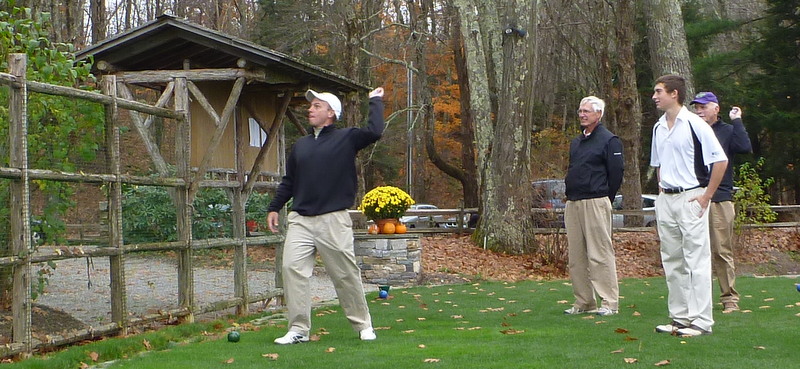
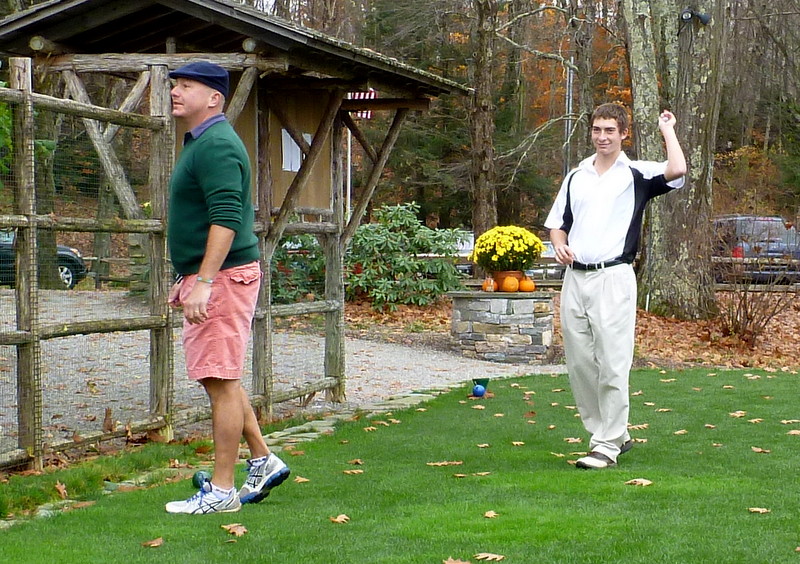
One of the Sunday Morning Group's many playoff formats: wrong-handed throw over the fence from the first tee to the practice green. Corey (throwing), Rick, Nick, Stan. Notice that Stan is practicing--a possible rules violation. October, 2012.

One of the Sunday Morning Group’s many playoff formats: wrong-handed overhand throw over the fence from the first tee to the practice green. Corey (throwing), Rick, Nick, Stan. Notice that Stan is practicing–a possible rules violation. October, 2012.

When my friend Roz’s daughter, Nina, was quite young, she asked Roz where babies come from. Roz explained (within reason), and Nina, astonished, said, “I feel like I’m dweaming!”

Recently, I myself had an interesting dweam, although it was about golf: I was either playing in or attending a tournament of some kind—or maybe I was a caddie. One of the competitors made a succession of poor chips and putts, and his ball ended up in a clump of tall grass next to a tee marker. Another player—or maybe it was the first player’s caddie—attempted to extricate the ball by swatting at it with a driver. The attempt failed, and a rules official said that the player was now required to make “a throw”—that is, to pick up his ball and throw it into a better lie, or onto the green, at a penalty of a stroke.

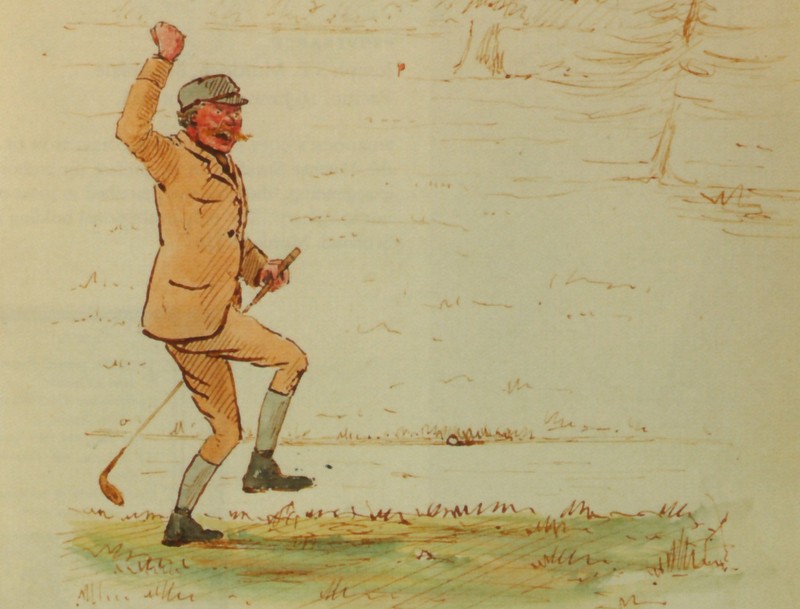
watercolor 1892

I said that I had read the rule book from cover to cover several times (a lie), yet didn’t remember anything about “throwing.” My friend Rick (see photo at the top of this post) and Jim Nantz (the television announcer), who were both there, for some reason, assured me that the official was correct. Nantz did acknowledge that the rule book referred to throws by a different name, which I’ve now forgotten, but that it was all explained in a book called The Begnin’ Throw, although he said I’d be unlikely to find a copy because it was “the rarest of all golf books.” (Even in the dweam, I didn’t know what “Begnin'” means.) I thought, Wow—this will make a great Golf Digest article! But then, after a few other things happened, I woke up.

Doug, examining the result of his own lousy throe, while Nick practices.

Doug, examining the result of his own lousy throw, while Nick practices.

When I woke up, I was in the house of a member of our Enemy Club who died several years ago, in his early forties, and I was crushed when I realized that all that stuff about throwing hadn’t been real and that, therefore, I wouldn’t be able to write an article about it. Meanwhile, I was involved in an important match, and at some point I accidentally interfered with my opponent’s putt by leaving a pair of nail scissors on a green. Then I woke up againthis time in my own actual bed—and realized that the throwing part had been a super-rare dweam-within-a-dweam, a first for me. (Most of my golf dweams are just about me playing an ordinary round on my home course. I once told my friend Jim, “You’d think that I could at least dream about playing someplace exotic, like St. Andrews or Pebble Beach,” and Jim said, “Yeah. After all, it’s free.”)

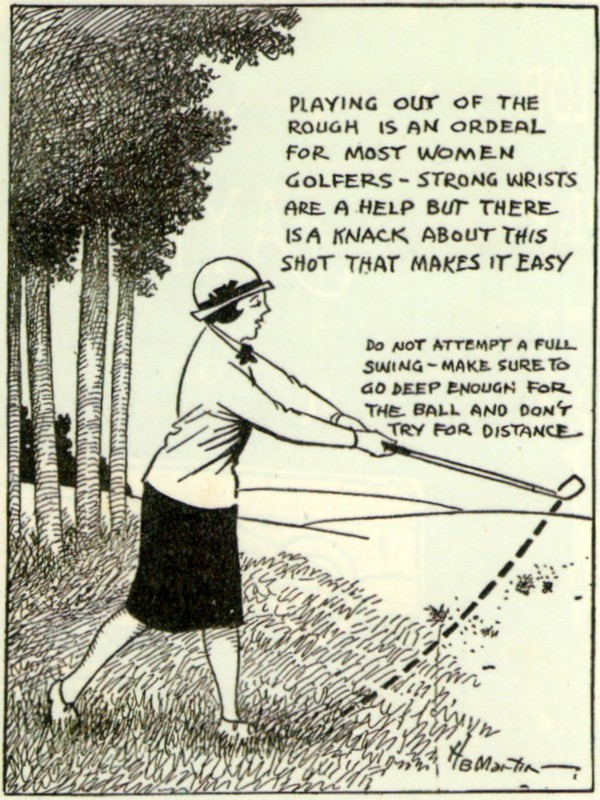
Anyway, upon reflection, I’ve decided that throwing might have a place in golf, and not just in S.M.G. playoffs. Some guys I know occasionally allow “a throw a side” as a handicap alternative: instead of receiving strokes, you are allowed to throw your ball out of trouble once per nine holes, at no penalty. In one memorable instance, a player won a match by using his throw to sink a six-foot putt. He reached over his head, fell forward, and slam-dunked his ball into the hole. Similarly, a throw might have been a better choice here:

Ladies in the rough-001

How Autumn Leaves are Deposited on New England Golf Courses

If you don’t live around here, you may not be familiar with the process shown in the video above. The leaves are imported from China, or someplace, and the wind does most of the work. The colors are nice. P1090888 I shot the video on Monday at our Enemy Club No. 2, where I played with Hacker (real name) and Paul. We have a big team match coming up there in early November, and Hacker and I were studying the greens. Paul joined us because he had nothing better to do. We played 10-Ball with a Snake add-on.

Hacker, seventh green, Enemy Club No. 2.

Hacker, seventh hole, Enemy Club No. 2.

The course is my second favorite nine-holer in our part of the state—after our home course, naturally. It was built on the former estate of some rich guy, and it has lots of old apple trees, which are left to look after themselves. P1090894 Whenever I play there in the fall, I cram apples into my golf bag. They taste a million times better than any of the apples in a grocery store. In fact, I hate apples, except for these.

I had a little trouble zipping this back up.

I had a little trouble zipping this back up.

There were very few other people on the course—a surprise, given how nice the day was. We saw a guy on the practice green who said he was trying to become a less crappy putter.

I think the thing on his left arm may be a practice gadget, too.

I think the thing on his left arm may be a practice gadget, too.

And we saw a kid who, apparently, had invented a game that’s even more complicated than the stuff that Hacker and Tim come up with. P1090930

New Golf Playoff Format: Reverse Putt-Like-Pete

P1090240

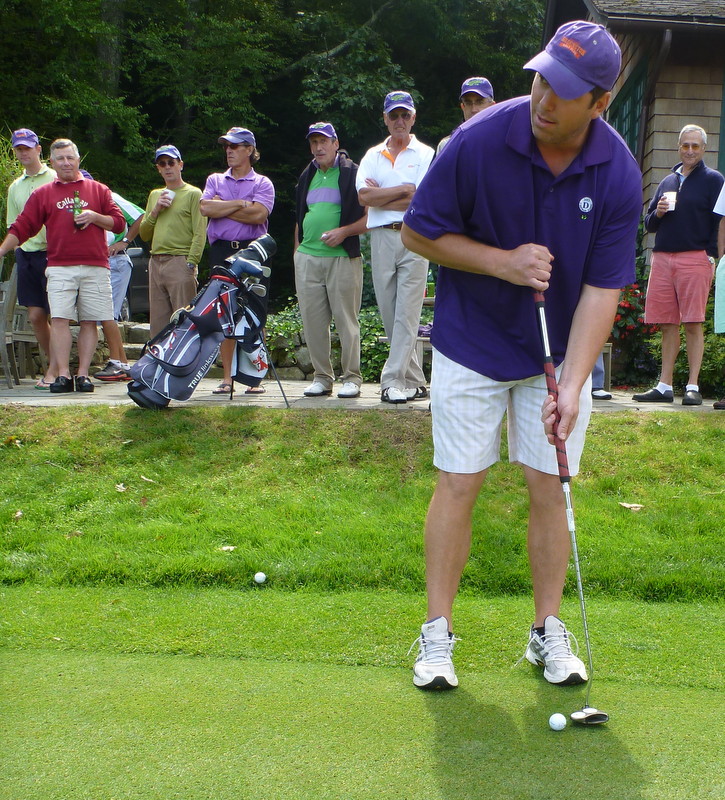
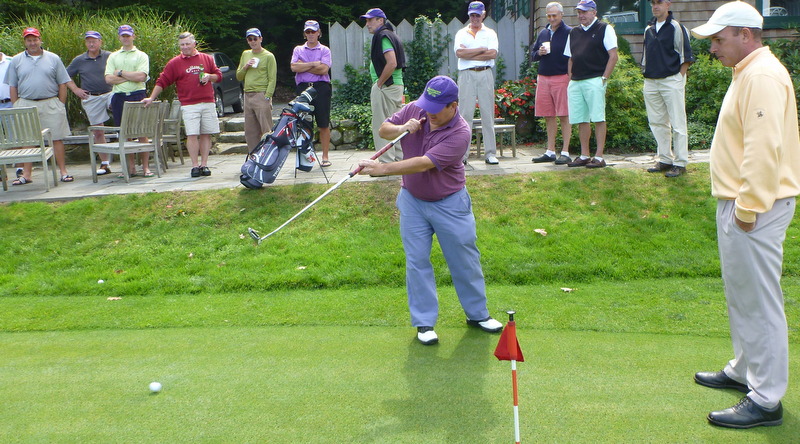
When the Sunday Morning Group’s regular game ends in a tie, we don’t divide the pot—a semi-corollary of Hacker (real name)’s rule that Money Never Flows Backward. We hold a playoff instead, and, over the years, we have invented many compelling formats. Last Sunday, we came up a new one, in honor of Peter P., who is in the hospital. Peter uses a long putter, so Corey, our pro, picked a similar one from the golf shop, and we made the eight playoff participants use it on a long putt on the practice green, closest to the hole wins. To make the competition more interesting, we made them use it wrong-way-around: righties had to putt lefty, and lefties had to putt righty. Furthermore, they had to strike the ball with the round thing on the back of the putter head, not the face. As always in our playoffs, the stymie rule was in effect. Here’s Chic, our new golf chairman, taking his turn:

P1090243

And here’s Rafael, who is from Mexico:

P1090247

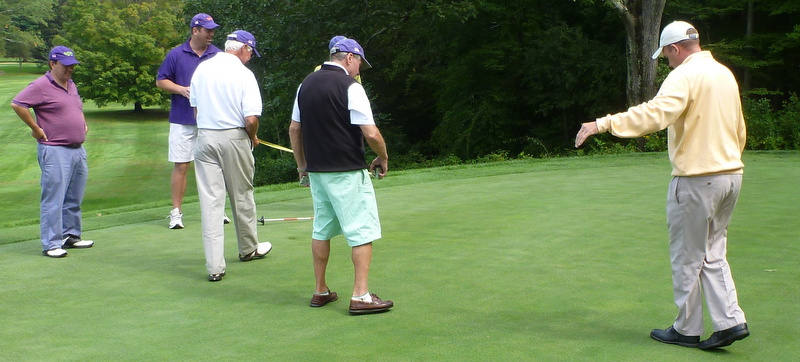
Putting backward off the round thing on the back of a long putter turned out to be harder than anyone had guessed, and only two balls—Rafael’s and Tim’s—ended up within twenty-five feet of the hole. We couldn’t tell whose ball was closer, so Corey paced them off. (By law, golf professionals wear shoes that are exactly twelve inches long.)

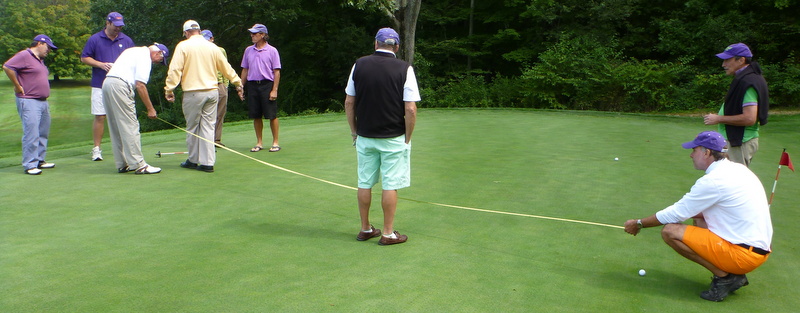
P1090255We still couldn’t tell, so Hacker got a measuring tape from the back of his car:

P1090259

The winner, by half an inch, was Tim:

That's Tim,

That’s Tim, in the green shirt, third from the right. Barney, left, was on his team. Fritz is holding the tape, and Hacker is supervising.

Then everybody went back to the patio for a couple more beers.

P1090265

Video: Myrtle Beach Golfer Hits Self With Own Ball

Jim Coleman (left), showing a friend the video below, George Wright Golf Course, Boston, May, 2013.

Jim Coleman (left), showing a friend the video below, in the grillroom at George Wright Golf Course, Boston, June, 2013.

Back in June, I played a round at George Wright Golf Course, a muny, in the Hyde Park section of Boston. Among the people I played with was Jim Coleman, a caterer, at left in the photo above. Coleman runs the clubhouse grillroom, and after our round we had a terrific lunch, during which showed us a video, on his phone, of a friend hitting himself with his own golf ball during a trip to Myrtle Beach:

Coleman also showed us a video of the same guy taking an unusually large divot with a fairway wood:

Coleman has transformed the grillroom, and made it a popular hangout. He had the brilliant idea of turning several tabletops into scoreboards for the complicated golf games played by George Wright’s regular leagues. They’re thick slabs of slate with grid lines painted on them, and you can write on them with chalk:

IMG_1602-001

“K of C” (at the top of the grid on the tabletop above) stands for “Knights of Columbus.” George Wright also has a Polish League, although most of the guys in it nowadays aren’t Polish. (“They were running out,” one member told me.) Everybody in the grillroom is a Bruins fan, though.

IMG_1613The banner in the photo above, which is displayed next to an Irish flag, looks a lot like the ones that hang from the ceiling at the Boston Garden. Coleman acquired some time ago, under circumstances he didn’t fully describe. “I kind of swindled it out of a guy,” he said.

IMG_1606George Wright Golf Course, incidentally, was named after a star player for the Boston Red Stockings—who, among numerous other accomplishments, batted first in the first National League game, on April 22, 1876.

IMG_1612

Report From the 2013 Men’s Member-Guest, Part One

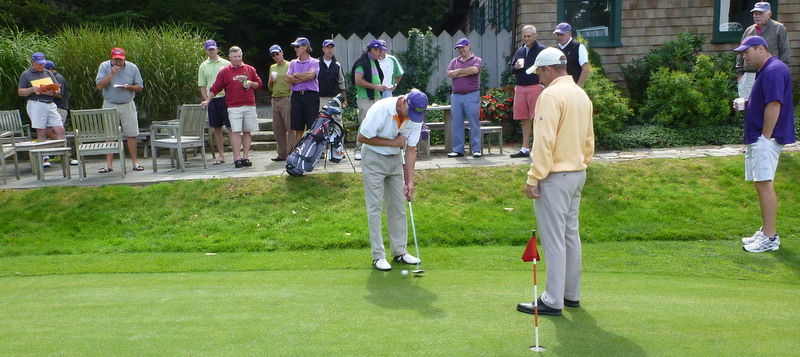
Peter P, Rob G., Fritz, Klinger, Chic, ringside at the putting contest.

Peter P, Rob G., Fritz, Klinger, Scribby, ringside at the putting contest.

The men’s member-guest was the first weekend in August. Among the many highlights was the putting contest, for which qualifying began on Friday afternoon and concluded late Saturday morning, with a break for steaks on the clubhouse porch:

These guys are pretending to eat salad.

These guys are pretending to eat salad. Their steaks are still on the grill.

Some of the most stirring action took place after dark on Friday night, under lights provided by C.J. A qualifying round was two times around a four-hole course. Each each hole was a par-2.

IMG_2371

The green had been triple-cut and rolled, and all the holes were within a few feet of the fringe. If you putted a ball off the green, you had to pay a penalty stroke to move it back. The format was best-ball. In two days of trying, no pair went around in better than two under par.

IMG_2376

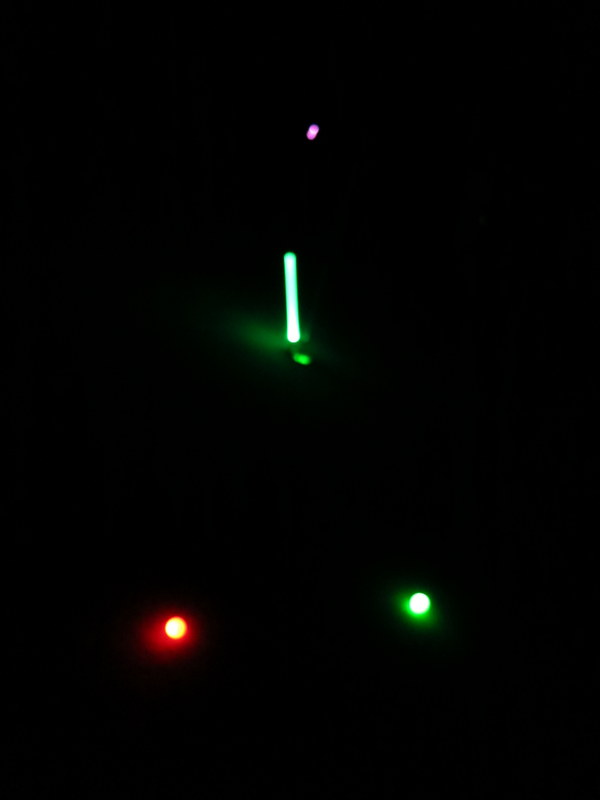
We also had an after-dark pitching contest, using Night Flyer balls. The target was a small kiddie swimming pool, which my wife bought for our dog but our dog, so far, doesn’t like. The kids in the golf shop had filled it with water and glow sticks, and they had marked it with Tiki Torches and flashing LED things that looked like tent stakes. You got three tries for five dollars, and if you made a ball stay in the pool from forty-five yards away you won half the pot. Doing that was harder than it sounds, because only one person managed to do it: Tim. But even the misses looked cool, and in some pictures my brother took they look like those tracking shots on TV.

IMG_2352

Night Flyer balls look like regular balls, but they light up when you clack them together or hit them with a club.

IMG_0170

Putting-contest tickets were ten dollars each. You paid for them at the cashier’s desk, which was also the pari-mutuel betting window for the regular golf matches. Michael U. handled the bets, using a computer program called Backnine Bookie. The program kept a running tally of the odds for every pair in the tournament. You could bet on yourself, and on other teams in any flight except your own flight—a rule we imposed to eliminate any temptation to tank matches. Michael used our handicap-card printer to print a ticket for each bet.

P1080058

To be continued.

Joe, Rob G., Chic, Peter P.

Joe, Rob G., Chic, Peter P.

My Friends and I Like to Play With Glowing Balls

Young Nick, first tee, 9:45 p.m., July 5, 2013.

Young Nick, first tee, 9:45 p.m., July 5, 2013.

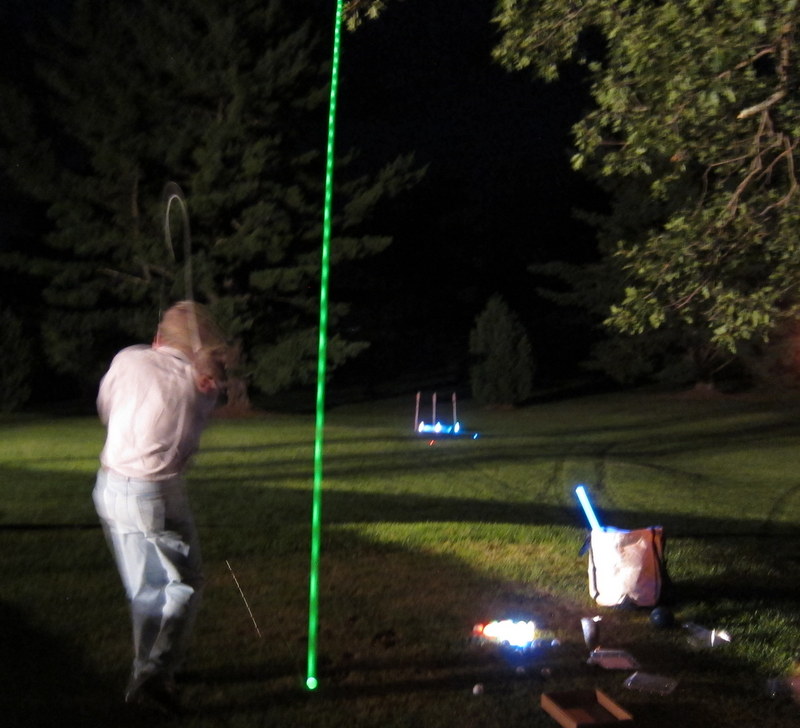
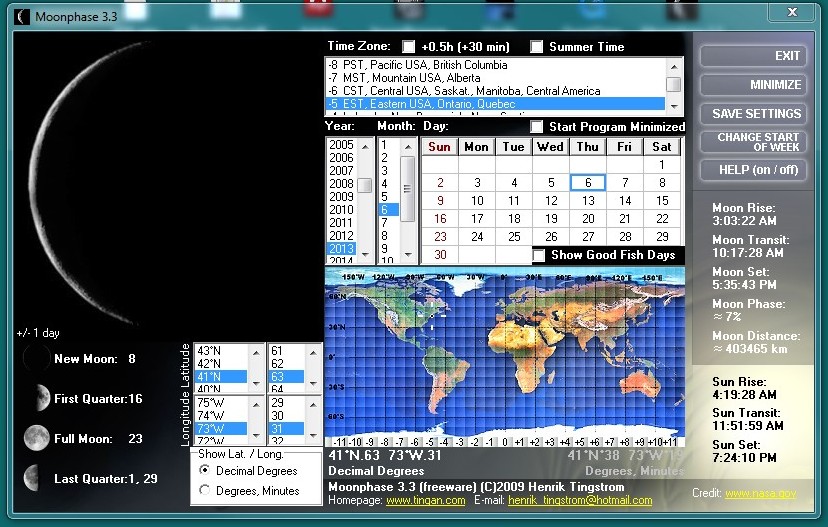
All golfers brood obsessively about the weather; my friends and I also track the phases of the moon. The reason is that we like to play at night, with glowing balls, and glowing balls look best against a truly black sky. The ideal time to play is an hour or two after sunset during a new moon, but other times of the month work, too, as long as the moon either hasn’t risen yet or has already gone down. I now monitor all that with a free program called Moonphase 3.3.

Moonphase

On Friday night, we met on the clubhouse porch at 7:00, for pizza from The Upper Crust, the official provisioner of the Sunday Morning Group.

Austin, John.

Austin, John, pizza, clubhouse porch.

Then we played Putting for Dollars on the practice green while we waited for the sun to go away.

In all our putting contests, we use the stymie rule, which the rest of the golf world abandoned in the 1950s.  Closest to the pin wins, double points if the ball goes in. Luke (second from left) was the only competitor to actually sink a putt.

In all our putting contests, we use the stymie rule, which the rest of the golf world abandoned in the 1950s. Closest to the pin wins, double points if the ball goes in. Luke (second from left) was the only competitor to actually sink a putt.

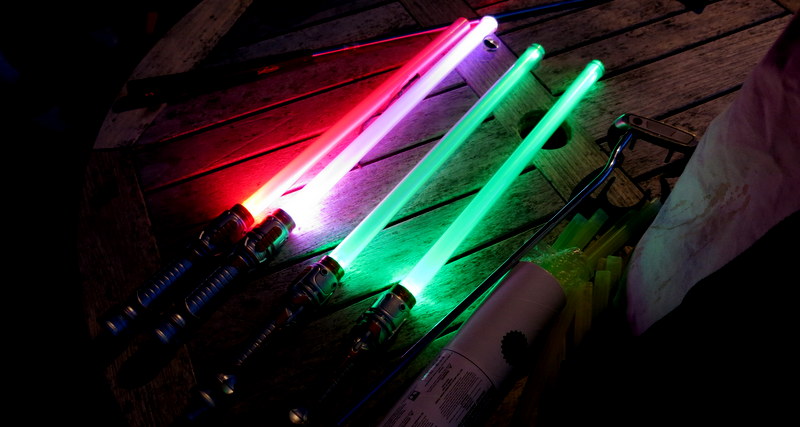
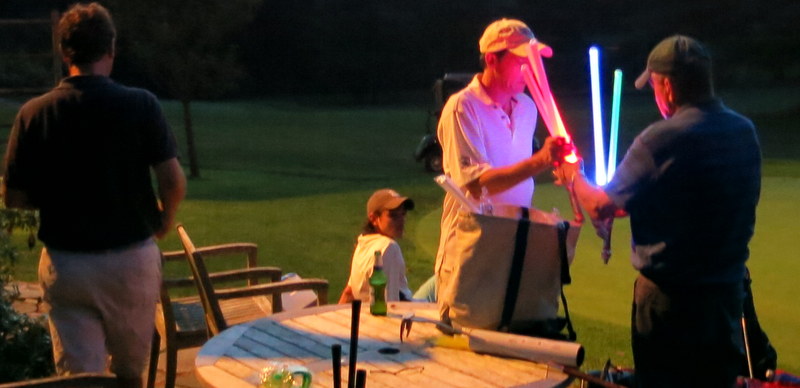
When the sky finally began to seem sort of promising, we turned on our flashing light sabers, to let them warm up.

IMG_2127

Then Hacker (real name) and Tim went out in a golf cart to place light sabers in the cups on the first second, seventh, eighth, and ninth greens, so that we’d be able to tell where the holes were. They also put glowing green rings in the bottoms of the cups.

Paul, Middle Nick, Tim, Hacker.

Paul, Middle Nick, Tim, Hacker.

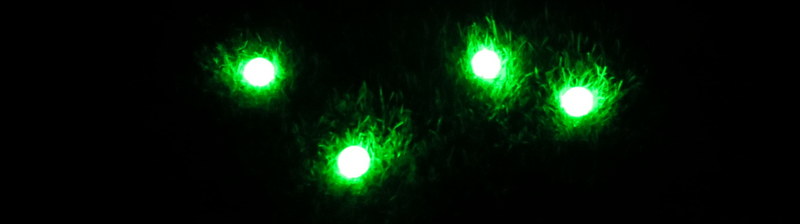
Night golf has been a feature at my club for more than twenty years. For most of those years, we used translucent balls with glow-stick inserts. They were fun to play with, but they didn’t behave like real balls, and they didn’t fly anywhere near as far, and the glow sticks were sometimes hard to cram all the way in. Last year, we switched to Night Flyer balls ($70 a dozen, in six colors, at nightflyer.com). They’re self-illuminating—each one contains its own LED and battery, which isn’t replaceable but lasts for many rounds—and when they’re not lit up they’re visually indistinguishable from regular balls. You switch on the LED by hitting the ball or rapping it against anything hard, and it stays lit as long as you hit it again within eight or ten minutes, which is plenty of time to find it, even in the woods.

IMG_2152-002

We had eleven guys. We played a scramble—each team with its own color—and we all played together. Hacker drove the beer cart. We teed up every shot, including chips, because divots are just about impossible to find at night. Here’s what the second green looked like when everyone was ready to putt:

IMG_2148-002

The red balls look the coolest, both in the air and on the ground.

IMG_2159

Austin made a brief video of someone missing a putt on the eighth green. Paul’s team had already clinched the title by then, so the miss didn’t matter.

Last year, I spoke with Pat Chapman, who is Night Flyer’s sales and marketing manager. She lives in New Hampshire but she grew up in New York, and when people give her a hard time she asks them, “Do you really want to mess with a girl from Brooklyn?” Largely as a result of her steady evangelism, night golf has rapidly grown in popularity all over the world. (“Not so much in France,” she said, “but France is France. What can I say?”) Scandinavians have been particularly enthusiastic, she added—perhaps because they spend so much of the year in the dark. She has organized full-scale night-golf events in many countries—for corporate outings, bachelor parties, wedding receptions, and other golf-appropriate occasions—and Night Flyer sells an almost comically extensive line of glowing accessories, including hole inserts, hazard stakes, tee-box markers, and black-stemmed margarita glasses. (That’s where we got the light sabers.)

New Playoff Format: From Bag Room to Practice Green

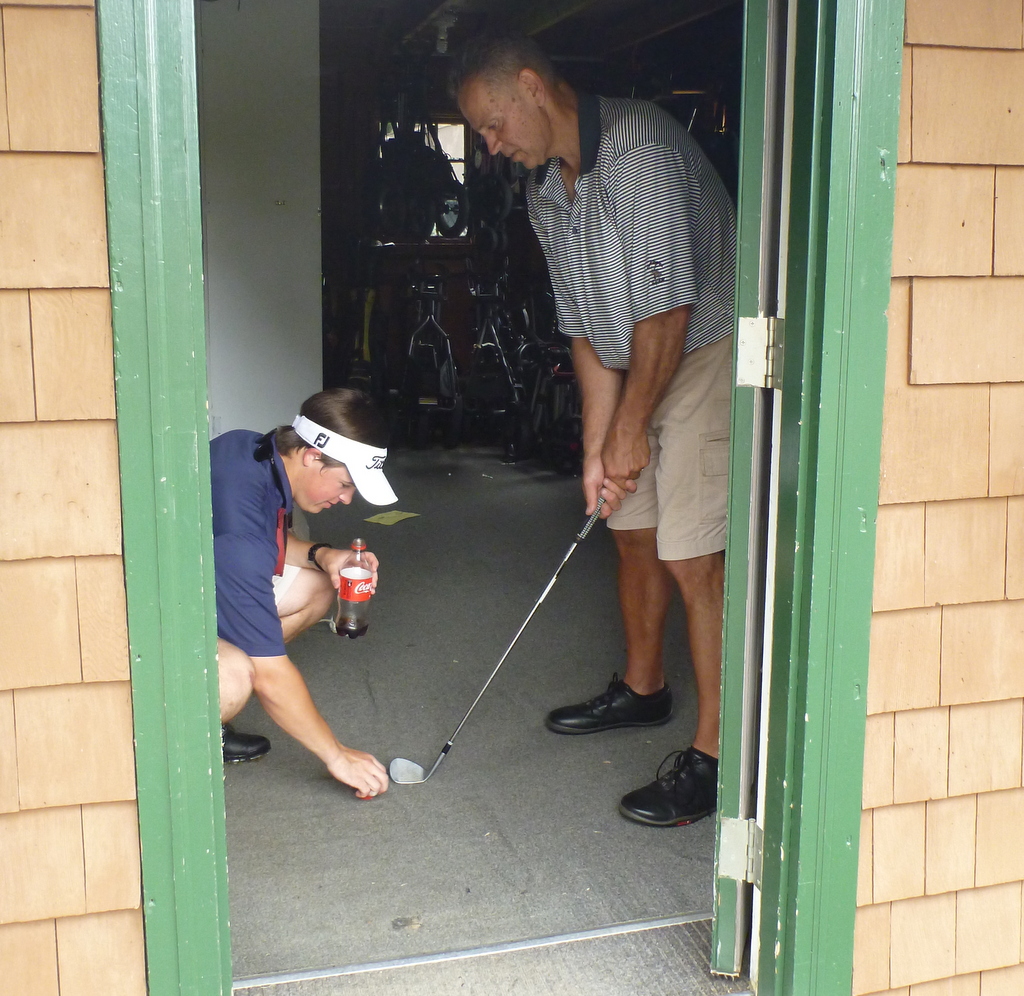
Brendan (third from the right, in the bag-room doorway) is about to pitch to the practice green in the Sunday Morning Group's most recent playoff. Sunday, June 30, 2013.

Brendan (third from the right, in the bag-room doorway) is about to pitch to the practice green in the Sunday Morning Group’s most recent playoff. Sunday, June 30, 2013.

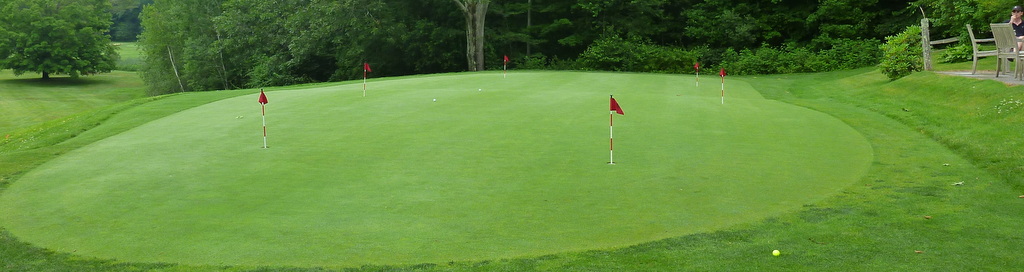
On Sunday, two teams finished at 14-under, so we held a playoff—a form of competition in which, I think it’s safe to say, my club leads the world. The format was a pitch shot from the bag-room floor to the farthest pin on the practice green, a distance of a little more than sixty yards. The shot had to carry the ball washer, the first tee, the first-tee fence, and a small tree, and in order to count it had to stay on the putting surface. As always, closest to the pin wins.

Young Nick, Mike U. (officiating), Gary (our superintendent), and Reese. Gary has teed his ball on a Coca-Cola bottle cap.

Young Nick, Mike U. (officiating), Gary (our superintendent), and Reese. Gary has teed his ball on a Coca-Cola bottle cap.

Several non-competitors, including me, watched from behind the first-tee fence, which we had to add to the first tee because somebody’s guest in the Men’s Member-Guest once hit a tee shot that ricocheted off the pay phone that used to be on the clubhouse porch. A couple of shots in the playoff hit the fence, but not very hard.

Addison, Peter A.., Rick, Hacker (real name).

Addison, Peter A.., Rick, Hacker (real name). The target is off to the right.

The first shot to stay on the green was Mike A.’s. The second was Reese’s. When Reese’s ball was in the air, I was sure it was going to finish closer to the pin than Mike’s, but it was spinning so much that it skidded to a halt and maybe even backed up a little. The reason is that Reese hit his shot directly off the crappy bag-room carpet, rather than teeing it up on a bottle cap, as almost everyone else did. Live and learn.

Reese, about to hit. Quiet, please.

Reese, about to hit. Quiet, please. Notice the tight lie.

Here’s how Mike A.’s and Reese’s balls ended up (if your eyes are good enough to see the tiny white dots on the far side of the green). I’m not sure who hit the yellow ball in the fringe. It may be the one that hit the tree.

P1070599

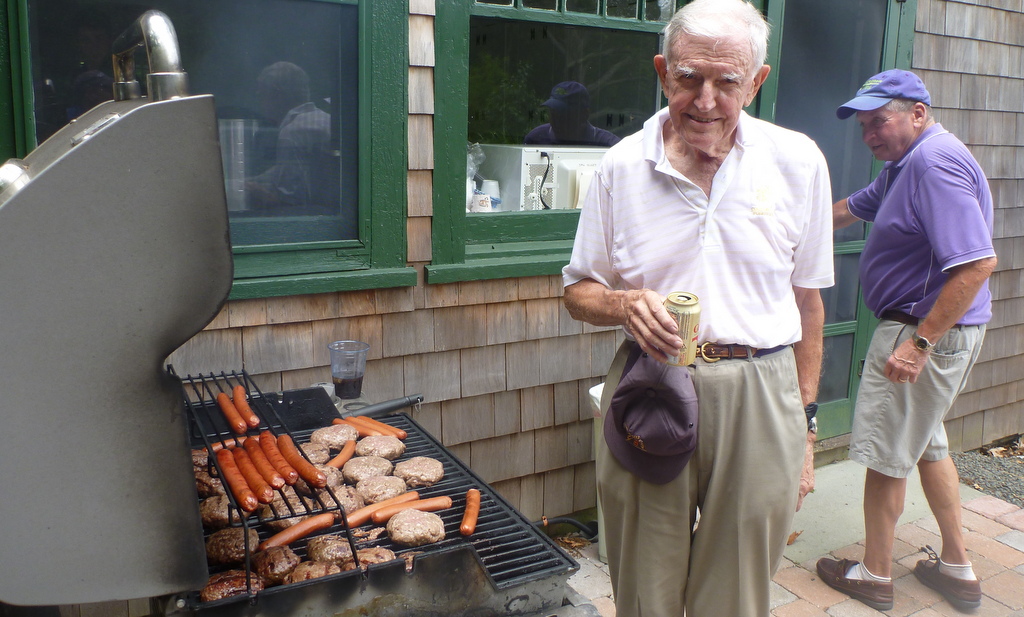
The best thing about Sunday, for those of us who didn’t finish in the money, was lunch, which was provided by Slade. Slade is old-school, lunch-wise, and Sunday was the first time in many years that we had burger patties shaped by human hands—in this case, Slade’s wife’s.

Lunch, Slade, Hacker.

Lunch, Slade, Hacker.

Also, we had twenty-nine guys, if you include Rick and Addison, who were playing a match in the Governors’ Cup, which is our handicap championship. Addison won, and I will now play him in the final as soon as he has returned from a summer trip with his family. Also, several of the guys washed down their burgers and dogs with a new Sunday lunch beverage, which we have (tentatively) called an S.M.G. The main (but not the only) ingredient is beer. I’ll have more to say about it later.

Mike U., Coca-Cola cap, Gary.

Mike U., Coca-Cola bottle cap, Gary.

Reader’s Trip Report: Merion (as a Spectator) and a New Game

Moe Dweck (left).

Moe Dweck (left).

Moe Dweck, a reader in Maryland, who (like me) writes a golf blog and (also like me) probably has a real job of some kind, wrote recently to describe his experience at the U.S. Open, which he attended with friends:

A bunch of guys traveled up to Merion on the Friday of the Open for some spectating and a cheese-steak. (By the way, the cheese-steak at Mama’s Pizzeria in Bala Cynwyd is off the charts. Went classic: white cheese, green peppers, and grilled onions. It is the Philly bread that makes these unbelievable.) The course looked the same to me as it did twenty years ago, but with much narrower landing areas. I think the U.S.G.A. overdid that aspect of the set-up more than slightly. But, overall, the presentation of the course was just awesome to witness in person.

(Parenthetically, let me add that I agree with Dweck about the severity of the set-up, and that I don’t share the U.S.G.A.’s crippling anxiety about birdies. Bubba Watson’s recovery from the pine trees on the first playoff hole in the 2012 Masters would be at or near the top of almost any golfer’s list of the coolest meaningful shots in majors in recent years, but nothing like it would be possible in an Open, because if Watson had missed an Open fairway by the same margin he would have been up to his knees in fescue.) Back to Dweck:

The truth is that the course stood up to the challenge, like it did in 1971 and 1981, because of the greens. One of the writers in Golf World pointed out that it is not the undulations of the greens at Merion that make it tough but the tilts. Could not agree more. On the short eighth, it was nearly impossible to get a ball to stay close, even with a sand-iron in the hands of a pro. Nothing more needs to be said about tilt than the lean on No. 5. I hope the U.S.G.A. continues to present the men’s and women’s Opens on classic old courses like these. Taking the driver out of the hands of a pro is not a federal crime, so I am not sure what all the whining is about. 

Back in April, Dweck wrote to describe a game that he and his regular golf buddies had played on their home course during Masters weekend—a game they called Virtual Pro-Schmo. What they did was take the best Masters rounds from the previous day and treat the guys who shot them as virtual partners in their own game. They transposed each Master’s competitor’s hole scores, in relation to par, onto a scorecard from their own course, then put all the cards into a hat and picked. If a schmo’s virtual pro partner had birdied Augusta’s first hole the day before, for example, then the only way the schmo could improve their best ball on the first hole would be to make an eagle; if the virtual pro had made a bogey, then the schmo had work to do. My friends and I meant to try Dweck’s game during the U.S. Open, but we forgot. We’re going to try to remember during the British.
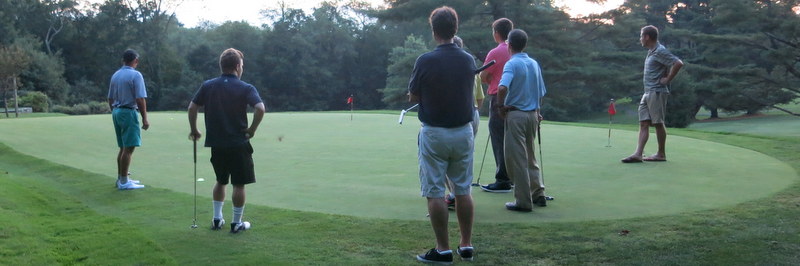
Actually, we might use another format Dweck told me about, which he and his friends used during the Open. “We called it Beat the Pro,” Dweck said. “Thirty-two guys participated. Each one picked a pro-opponent scorecard from a hat. (We used eight guys’ scores, in relation to par, from the Thursday round at Merion.)  We gave our guys 110 percent of their handicap, and they played a quasi-skins format, in which they got three points for every hole on which they beat their pro and one point for every hole they pushed. Winners were the guys who had the most points against the field. I got to knock around Luke Donald. The guys who drew Sergio had to deal with an eagle on No. 2 (which is a par-3 on our course, so they needed a hole-in-one to push) and a quad on No. 15 (a par-5 for us, so a net nine or better scored points there.) Lots of fun.”
My friends and I are going to try this, too, sometime, if we remember. Here’s a picture of Dweck and some of his friends:

Alan Levine, Josh Tremblay, some guy, Rusty Minkoff, and Moe Dweck at some point in the past, during a buddies trip to Laurel Valley Golf Club, Ligonier, Pennsylvania.

Alan Levine, Josh Tremblay, some guy, Rusty Minkoff, and Moe Dweck, during a buddies trip to Laurel Valley Golf Club, Ligonier, Pennsylvania.